









The Superguide
                        a handbook for
                        supervising allied health professionals


                                                 Look for updates on the website:
                        © CETI 2011                l www.ceti.nsw.gov.au l


F I R ST E D IT I O N
TH E S U P E R G U I D E


Clinical Education and Training Institute (CETI)
Building 12
Gladesville Hospital
GLADESVILLE NSW 2111
Tel. (02) 9844 6551
Fax. (02) 9844 6544
www.ceti.nsw.gov.au
info@ceti.nsw.gov.au
Post: Locked Bag 5022
GLADESVILLE NSW 1675


National Library of Australia Cataloguing-in-Publication entry

     Title: The superguide: a handbook for supervising allied health professionals/
     Clinical Education and Training Institute.

     ISBN 9780987193605 (pbk.)

     Subjects: Allied health personnel--Supervision of--Australia--Handbooks,
     manuals, etc.

     Medical education--Australia.

     Other Authors/Contributors: Clinical Education and Training Institute.

     Dewey Number: 610.737069
Suggested citation:
Clinical Education and Training Institute 2011, The superguide: a handbook for
supervising allied health professionals, CETI, Sydney.

This work is copyright. It may be reproduced in whole or in part for study or training
purposes subject to the inclusion of an acknowledgement of the source. It may not
be reproduced for commercial usage or sale. Reproduction for purposes other than
those indicated requires written permission from CETI.
© CETI October 2011


For further copies of this document, please contact CETI,
or download a digital copy from the CETI website: www.ceti.nsw.gov.au
Forewords
                        The Clinical Education and Training Institute (CETI) is delighted to present The
                        Superguide: a handbook for supervising allied health professionals as the first major
                        project of the Allied Health Directorate, adapted from The Superguide: a handbook for
                        supervising doctors in training.
                        Allied health professionals are recognised as essential members of the multidisciplinary
                        team playing a critical role in prevention, treatment and management of complex co
                        morbidities across the continuum of care, reducing the impact of chronic disease
                        and increasing patient’s quality of life. Health services in NSW are in a continual state
                        of change, with the needs of the population and community expectations increasing
                        exponentially. It is vital that clinicians are able to be flexible and adaptable in their practice,                        iii
                        open to new ideas and engage in life long learning to ensure services are based on the
                        best available evidence and meet the needs of the population.
                        Effective supervision is a critical ingredient to ensuring patient safety and promoting
                        professional development of clinicians. Supervision sessions provide a platform for
                        critical reflection, development of clinical reasoning and identification of further learning
                        opportunities. Supervision has benefits to health care organisations by enhancing job
                        satisfaction of both supervisees and supervisors which increases staff retention. Systems
                        of governance must be in place to support the process of supervision, ensure quality and
                        evaluate practice to identify opportunities for further improvement.
                        This document will enrich the quality of supervision already being provided by experienced
                        allied health clinical supervisors in NSW and be a vital resource for newly appointed
                        supervisors.
                        Steven Boyages, CETI Chief Executive


                        This handbook is a welcome resource to the many dedicated allied health professionals
                        working in the NSW Health system. It is recognised that while the 23 allied health
                        professions are unique, the importance of supervision is common to us all. Supervisors
                        are a vital front line resource and have a critical role in developing confident and
                        competent allied health clinicians, promoting excellence in clinical practice, and ensuring
                        patient safety and quality of care. As health professionals we have a responsibility to
                        not only monitor our own practice but also to share our experience with others. Being
                        a supervisor is one of the ways allied health professionals can meet this responsibility.
                        Supervision provided in a positive and supportive environment enables clinicians to
                        excel in clinical practice. Experienced clinicians also have a role in providing constructive
                        feedback and supporting supervisors. As role models, supervisors should “practice what
                        they preach” by also receiving supervision. This assists clinicians to embed a culture of
                        lifelong learning and reflective practice from the very beginning of their careers. While
                        this guide cannot possibly cover everything there is to know about clinical supervision,
                        we hope it will “reinvigorate the conversation” about supervision among allied health
                        professionals. We encourage clinicians to utilise this guide by applying it to their individual
                        professional context to improve the quality of clinical supervision.
                        Brenda McLeod, Chief Allied Health Officer, NSW Ministry of Health


F I R ST E D IT I O N                                                                                            CETI   TH E S U P E R G U I D E
TH E S U P E R G U I D E


     Acknowledgements
     This handbook has been adapted from the original content and format of The Superguide
     – a handbook for supervising doctors in training, 1st edition, November 2010, written by
     Craig Bingham and Dr Ros Crampton.
     Following an initial review of The Superguide content by five members* of the NSW
     Allied Health Directors Network, The Superguide: a handbook for supervising allied
     health professionals was written by The Superguide Steering Committee:
     Jacqueline Dominish                           Patricia Bradd*
     Allied Health                                 Director of Allied Health
iv   Learning Teaching Coordinator                 South Eastern Sydney
     Clinical Education and Training Institute     Local Health District

     Daniella Pfeiffer                             Lyn Biviano*
     Allied Health                                 Chair of Allied Health
     Learning Teaching Coordinator                 Sydney Children’s Hospitals
     Clinical Education and Training Institute     Speciality Network (Westmead campus)

     Initially the project was commenced and overseen by the following members of the
     NSW Allied Health Directors Network:
     Brenda McLeod*                                Jenny Richardson*
     Chief Allied Health Officer                   Director Allied Health
     NSW Ministry of Health                        Central Coast Local Health District
     Kim Nguyen*                                   Richard Cheney
     Director, Allied Health                       Allied Health Advisor
     Hunter New England Local Health District      Western NSW Local Health District
     Brett Williams                              Michael Bazaley
     Director, Allied Health                     Manager Allied Health
     Nepean Blue Mountains Local Health District Forensic Mental Health Specialty Network

     Louise Dever                                  Kay Axford/Lisa Parsci/Sue Colley
     Eastern Sector Manager                        Acting Directors Allied Health
     Southern NSW Local Health District            Sydney and Sydney South West
                                                   Local Health Districts


     Contributions and reviews were provided by many people.
     A list of key contributors is provided on page 85.
Contents
                        Forewords                                            iii   Part three: Clinical teaching and learning 38
                        Acknowledgements                                     iv    The supervisor’s role in clinical teaching              39
                        About this handbook                                  2     Promoting a culture of life-long learning               40
                        Supersummary                                         4     Facilitating the learning process                       41
                                                                                   Identifying different learning styles                   42
                        Part one: What is supervision?                      6      What makes effective clinical teaching?                 43
                        Introduction: the purpose of clinical supervision    7     Ten top tips for the teaching supervisor                44
                        Functions of supervision                             8     Identifying opportunities for clinical teaching         45
                        Clinical supervision and operational management      9     Teaching in the presence of patients                    46
                        Facilitating clinical supervision                   10     Teaching during case discussion                         47
                        Governance for clinical supervision                 12     Teaching at handover                                    48                 1
                        Methods of supervision                              13     THE ISBAR framework for communicating at
                                                                                   handover                                                49
                        Supervision in rural and remote settings            14
                                                                                   Example: handing over by phone with ISBAR               51
                        Setting expectations                                16
                                                                                   Teaching remotely                                       52
                        Supervision contracts                               17
                                                                                   Other clinical teaching opportunities                   52
                        Documenting supervision sessions                    18
                                                                                   Teaching clinical skills                                53
                        Clinical supervision activities                     19
                                                                                   Opportunities for teaching clinical skills              54
                        Developing learning goals                           19
                                                                                   Teaching non-clinical skills                            56
                        Reflective practice                                 21
                                                                                   Developing skills in teaching and education             57
                        Group & peer supervision                            24
                                                                                   Formal teaching                                         58
                        Checklist for effective supervision:                25
                                                                                   Fostering interprofessional collaborative practice      59

                        Part two: How to be an effective
                        clinical supervisor                                 26     Part four: Management of clinical staff                60
                                                                                   Managing clinical staff                                 61
                        What makes an effective clinical supervisor?        27
                                                                                   Managing for performance                                62
                        Barriers to effective supervision                   29
                                                                                   Orientation                                             63
                        Getting to know your supervisee                     30
                                                                                   Mentors coaches and buddies                             64
                        Knowing your supervisee’s competence level          31
                                                                                   Common challenges for supervisors                       66
                        A key concept: hands-on, hands-off                  32
                                                                                   Managing a clinician in difficulty                      68
                        Case study: clinical supervision                    33
                        Giving feedback                                     34     Process for managing a staff member in difficulty       70
                        Supervisee engagement in supervision                35
                        Responsibilities of the supervisee                  37     Appendices of useful resources                         71
                                                                                   Supervision contract example                            72
                                                                                   Clinical supervision agreement example                  73
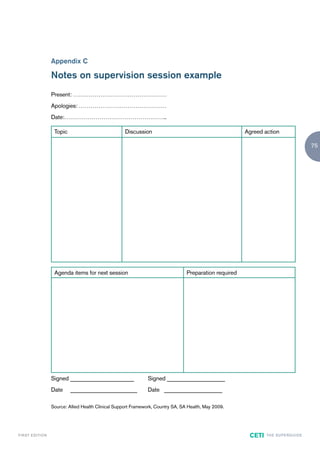
                                                                                   Notes on supervision session example                    75
                                                                                   Supervision log example                                 76
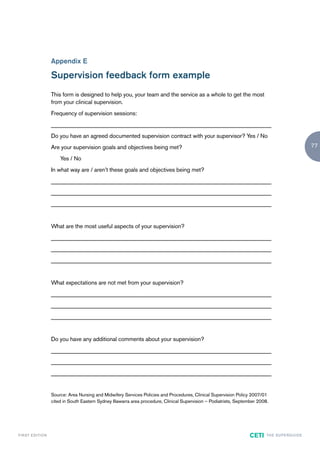
                                                                                   Supervision feedback form example                       77
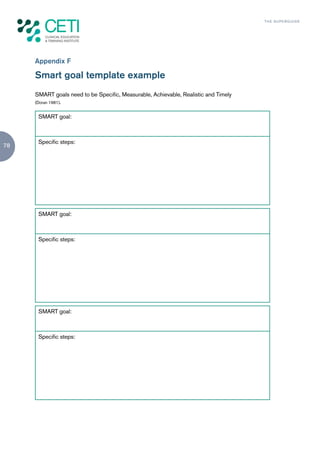
                                                                                   Smart goal template example                             78
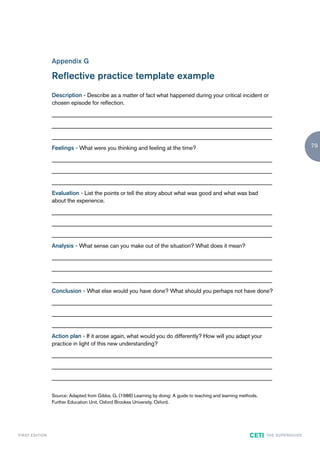
                                                                                   Reflective practice template example                    79
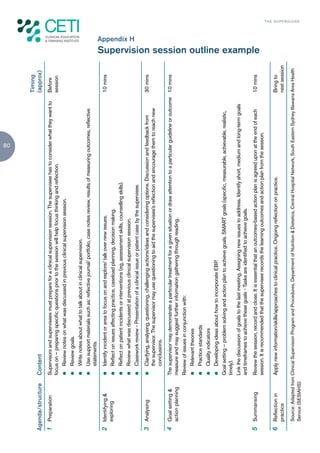
                                                                                   Supervision session outline example                     80
                                                                                   Reference list                                          81
                                                                                   Acknowledgements (continued)                            85


F I R ST E D IT I O N                                                                                                     CETI     TH E S U P E R G U I D E
TH E S U P E R G U I D E


    About this handbook
    CETI has produced this guide in response to the request from many involved in
    supervising allied health professionals for a simple and practical guide to clinical
    supervision. Along with the supportive functions of supervision, it is also acknowledged
    that in practice many supervisors are also involved in teaching and training of staff to
    facilitate professional development and competence in clinical practice. This guide
    therefore also provides information to equip supervisors with practical strategies to
    facilitate adult learning and the acquisition of skills and knowledge.
    This handbook is not a policy document. It gives tips and suggestions based on the
    published evidence of what makes good supervision and the knowledge of many
2
    experienced supervisors in New South Wales.
    It provides information about:
    z    supervising allied health professionals in ways that contribute to the safety and
         better care of patients
    z    effective methods of contributing to the education, welfare and professional
         development of allied health professionals
    It is acknowledged that supervision terminology and requirements are varied across the
    allied health disciplines. In addition, it is important to recognise that each discipline has
    different requirements for registration and continuing professional development. There
    are sections of this guide which are more applicable to the supervision of junior allied
    health professionals, however, whilst learning needs change with experience of individual
    clinicians, it is hoped that the principles of this guide can be applied to all allied health
    professionals throughout their careers.
    This document should be used in conjunction with existing discipline specific supervision
    requirements, Local Health District* supervision and other policies. It will be reviewed
    regularly to ensure that information made available to supervisors is current and useful.
    This guide, updates and other useful resources are available on the website of the
    Clinical Education and Training Institute: www.ceti.nsw.gov.au
    NSW Health supervision policies can be found at www.health.nsw.gov.au

    * Please note the term Local Health District used in the context of this document includes speciality health and hospital
      networks such as St Vincent’s Health Network, Forensic Mental Health Specialty Network and Sydney Children’s
      Hospitals Specialty Network.
Allied health in NSW Health
                        Allied health professionals:
                        z   are tertiary qualified
                        z   hold relevant registration, licence or accreditation to practice
                        z   provide a range of therapeutic and diagnostic services in either the public or
                            private health care sector
                        z   apply their skills and knowledge holistically to restore and maintain optimal
                            physical, sensory, psychological, cognitive and social function
                        z   use clinical reasoning skills in working directly with clients to prevent and/or
                            minimise disability, restore and optimise function on an individual basis
                                                                                                                                                         3
                        z   work as part of a multidisciplinary team
                        z   are ‘allied’ or aligned to each other and other members of the health professional
                            workforce, their clients, the client’s family, carers and community working across
                            the health system.

                        NSW Health allied health professionals*
                        Art Therapist                  Nuclear Medicine Technologist             Psychologist
                        Audiologist                    Occupational Therapist                    Radiation Therapist
                        Counsellor                     Orthoptist                                Radiographer
                        Dietitian                      Orthotist & Prosthetist                   Sexual Assault Counsellor
                        Diversional Therapist          Pharmacist                                Social Worker
                        Exercise Physiologist          Physiotherapist                           Speech Pathologist
                        Genetic Counsellor             Play Therapist/Child Life Therapist       Welfare Officer
                        Music Therapist                Podiatrist

                        * Information provided by Brenda McLeod, Chief Allied Health Officer,
                          Workforce Development and Innovation Branch, NSW Ministry of Health.


F I R ST E D IT I O N                                                                                                  CETI   TH E S U P E R G U I D E
TH E S U P E R G U I D E


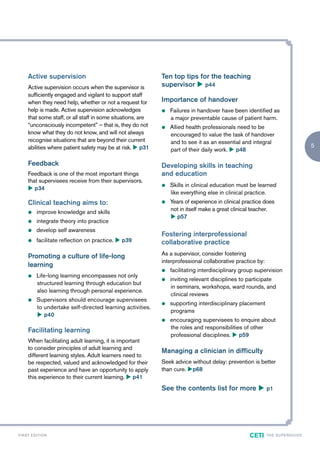
    The supersummary
    Key messages
    z       The quality of supervision makes a difference       Purpose of supervision
            to the quality of safe patient care.                z High quality and safe patient care and treatment
    z       When establishing a relationship between a          z Accountable decision making in clinical practice

            supervisor and a supervisee, it is important        z Facilitation of learning and professional

            to ensure from the very beginning that both           development
            parties have clear expectations of the process.     z Promotion of staff well being

    z       Supervision provides an ideal forum to
4           promote a culture of life-long learning.
                                                              Learning plan and SMART goals
    z       Supervisees must be active participants in
            the supervision process.                          Every clinician should have an individual learning
    z       Supervisors should be aware of adult              plan with specific learning objectives detailing
            learning principles and learning styles.          what it is they are working towards. u p19

    z       Contributing to the professional development
            of allied health professionals can be one
                                                              Reflective practice
            of the most rewarding parts of a senior           “A continuous process that involves thoughtfully
            clinician’s job.                                  considering one’s own experiences and applying
                                                              knowledge to practice” (Schön 1983). up21
    Supervision facilitates
    z       acquisition of skills and knowledge
                                                              Patient safety comes first
    z       reflective practice                               Patient safety is a core responsibility of all
                                                              clinical staff that cannot be delegated. u p30
    z       development of professionalism
    z       confidence and competence in clinical
                                                              Knowing your supervisee’s
            practice
                                                              competence level u p31
    z       professional growth and development. u p7

    Setting expectations                                        Unconsciously incompetent:
                                                                The staff member does not know
                                                                                                        Consciously incompetent:
                                                                                                        The staff member knows that
                                                                what they do not know.                  they do not know.
    When establishing a relationship between a                  Danger at this stage:                   Danger at this stage:
    supervisee and a supervisor, it is important to             An inadequately supervised staff
                                                                member may unwittingly do harm.
                                                                                                        Staff members may avoid situations
                                                                                                        that test their incompetence.
    ensure from the very beginning that both parties            Response:                               Response:
    have clear expectations of the process. u p16               Supervise closely (hands-on),
                                                                and address the knowledge gaps
                                                                                                        Supervise closely (hands-on),
                                                                                                        and encourage the staff member
                                                                of the staff member.                    to overcome their inexperience.


        The A-rated clinical supervisor
        z Available                                             Unconsciously competent:           Consciously competent:
                                                                The staff member can perform       The staff member can, with thought,
        z Approachable                                          the task competently with          perform the task competently.
                                                                practised ease.
        z Able (as both clinician and teacher)                                                     Danger at this stage:
                                                                Response:                          Atypical circumstances or pressure
        z Active (finds the gaps)                               The staff member no longer         may cause the staff member to fail
                                                                needs supervision in this task.    despite previous success.
        What makes an effective clinical                        Get them involved in teaching
                                                                                                   Response:
                                                                it to others.
        supervisor? u p27                                                                          Supervise with hands off, provide praise,
                                                                                                   recognition, opportunities to practise.
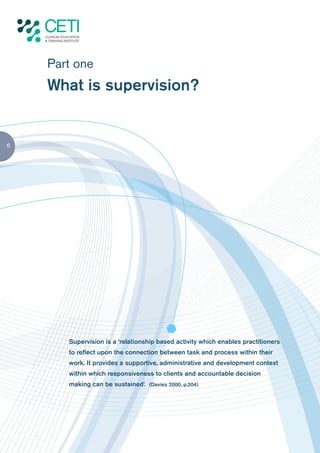
Active supervision                                      Ten top tips for the teaching
       Active supervision occurs when the supervisor is        supervisor u p44
       sufficiently engaged and vigilant to support staff
       when they need help, whether or not a request for       Importance of handover
       help is made. Active supervision acknowledges           z   Failures in handover have been identified as
       that some staff, or all staff in some situations, are       a major preventable cause of patient harm.
       “unconsciously incompetent” – that is, they do not      z   Allied health professionals need to be
       know what they do not know, and will not always             encouraged to value the task of handover
       recognise situations that are beyond their current          and to see it as an essential and integral
       abilities where patient safety may be at risk. u p31                                                                              5
                                                                   part of their daily work. u p48

       Feedback                                                Developing skills in teaching
       Feedback is one of the most important things            and education
       that supervisees receive from their supervisors.
                                                               z   Skills in clinical education must be learned
       u p34
                                                                   like everything else in clinical practice.
       Clinical teaching aims to:                              z   Years of experience in clinical practice does
       z     improve knowledge and skills                          not in itself make a great clinical teacher.
                                                                   u p57
       z     integrate theory into practice
       z     develop self awareness
                                                               Fostering interprofessional
       z     facilitate reflection on practice. u p39          collaborative practice
       Promoting a culture of life-long                        As a supervisor, consider fostering
                                                               interprofessional collaborative practice by:
       learning
                                                               z   facilitating interdisciplinary group supervision
       z     Life-long learning encompasses not only
                                                               z   inviting relevant disciplines to participate
             structured learning through education but
                                                                   in seminars, workshops, ward rounds, and
             also learning through personal experience.
                                                                   clinical reviews
       z     Supervisors should encourage supervisees
                                                               z   supporting interdisciplinary placement
             to undertake self-directed learning activities.
                                                                   programs
             u p40
                                                               z   encouraging supervisees to enquire about
                                                                   the roles and responsibilities of other
       Facilitating learning
                                                                   professional disciplines. u p59
       When facilitating adult learning, it is important
       to consider principles of adult learning and
                                                               Managing a clinician in difficulty
       different learning styles. Adult learners need to
       be respected, valued and acknowledged for their         Seek advice without delay: prevention is better
       past experience and have an opportunity to apply        than cure. up68
       this experience to their current learning. u p41
                                                               See the contents list for more u p1


F I R ST E D IT I O N                                                                                CETI     TH E S U P E R G U I D E
Part one
    What is supervision?


6


       Supervision is a ‘relationship based activity which enables practitioners
       to reflect upon the connection between task and process within their
       work. It provides a supportive, administrative and development context
       within which responsiveness to clients and accountable decision
       making can be sustained’. (Davies 2000, p.204)
Introduction: the purpose of clinical supervision
                        The purpose of clinical supervision is to ensure:
                        z   delivery of high quality patient care and treatment through accountable decision
                            making and clinical practice
                        z   facilitation of learning and professional development
                        z   promotion of staff wellbeing by provision of support.
                        Clinical supervision is considered a vital part of modern, effective health care systems
                        (Milne 2007). Providing effective clinical supervisory support to allied health professionals
                        enhances quality, safety and productivity and improves competence and confidence in
                        clinical practice (Country Health SA 2009; Smith & Pilling 2008; The Chartered Society of Physiotherapy 2005).                              7

                        Supervision facilitates:
                        z   acquisition of skills and knowledge
                        z   reflective practice
                        z   development of professionalism
                        z   confidence and competence in clinical practice
                        z   professional growth and development.
                        The Special Commission of Inquiry into the NSW Acute Public Health System
                        highlighted the link between patient safety and the availability of supervision for junior
                        clinical staff (Garling 2008). While good supervision reduces errors and improves the quality
                        of patient care, inadequate supervision is a contributing factor in critical incidents with
                        poor patient outcomes (Kirk, Eaton & Auty 2000).
                        Supervision of clinicians has been identified as a national priority by Health
                        Workforce Australia (HWA) as evidenced through the development of a National
                        Clinical Supervision Support Framework and the Clinical Supervision Support
                        Program (HWA 2011a; HWA 2011b).
                        Contributing to the professional development of allied health professionals can be one
                        of the most rewarding parts of a senior clinician’s job. Well-supported allied health
                        professionals who have access to supervision report improved job satisfaction, which
                        can lead to improved staff retention rates (Smith & Pilling 2008).
                        The importance of active clinical supervision cannot be underestimated, yet many
                        supervisors feel that they do not always have the time or the skills to provide it. This
                        guide is focused on providing advice to improve the effectiveness and educational
                        value of clinical supervision for allied health professionals in NSW.


F I R ST E D IT I O N                                                                                                         CETI       TH E S U P E R G U I D E
TH E S U P E R G U I D E


    Functions of supervision
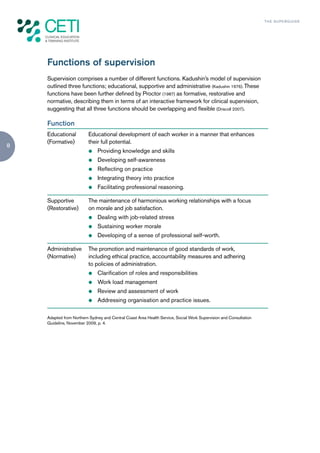
    Supervision comprises a number of different functions. Kadushin’s model of supervision
    outlined three functions; educational, supportive and administrative (Kadushin 1976). These
    functions have been further defined by Proctor (1987) as formative, restorative and
    normative, describing them in terms of an interactive framework for clinical supervision,
    suggesting that all three functions should be overlapping and flexible (Driscoll 2007).

    Function
    Educational          Educational development of each worker in a manner that enhances
    (Formative)          their full potential.
8
                         z    Providing knowledge and skills
                         z    Developing self-awareness
                         z    Reflecting on practice
                         z    Integrating theory into practice
                         z    Facilitating professional reasoning.

    Supportive           The maintenance of harmonious working relationships with a focus
    (Restorative)        on morale and job satisfaction.
                         z    Dealing with job-related stress
                         z    Sustaining worker morale
                         z    Developing of a sense of professional self-worth.

    Administrative       The promotion and maintenance of good standards of work,
    (Normative)          including ethical practice, accountability measures and adhering
                         to policies of administration.
                         z    Clarification of roles and responsibilities
                         z    Work load management
                         z    Review and assessment of work
                         z    Addressing organisation and practice issues.

    Adapted from Northern Sydney and Central Coast Area Health Service, Social Work Supervision and Consultation
    Guideline, November 2009, p. 4.
Clinical supervision and operational management
                        Supervision includes educational, supportive and administrative functions. This may be
                        delivered via a combination of clinical supervision and/or management processes.
                        How and by whom supervision is provided is influenced by the context in which the clinician is
                        working and by service delivery needs. In NSW Health there is a diversity of clinical teams and
                        organisational structures which will impact the manner in which supervision is provided to an
                        individual. It is acknowledged that there is no single method which would adequately cover the
                        diverse nature of these structures.
                        For example a clinician may:
                        1 receive both clinical supervision and be operationally managed by the same individual                                            9
                             of the same discipline.
                        2 report to an operational manager/unit head of the same discipline and have a different
                             clinical supervisor from the same discipline within the same unit.
                        3 report to a team leader from a different discipline for operational management and
                             receive clinical supervision from another person of the same discipline from outside
                             their team.
                        These are only three of many possible examples of supervisory relationships which can exist
                        in NSW Health.
                        Good supervision and staff management are essential to support clinicians. Whilst they can
                        be seen as separate processes they are in fact complementary and must coexist. Some of the
                        literature supports the separation of clinical supervision activities from management activities
                        due to the inherent power imbalances which exist within a line management relationship
                        (Smith 1996, 2005). This could potentially impact on a supervisory relationship if not managed
                        appropriately. Some suggest the two processes should be conducted independently or by
                        separate individuals (Country SA 2009; WACHS 2008). It is acknowledged however, in many settings
                        within NSW Health these roles are often performed by the same individual (SWAHS 2010). In this
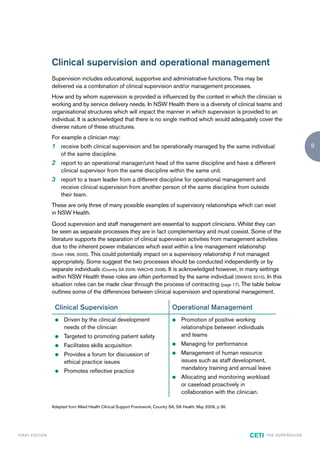
                        situation roles can be made clear through the process of contracting (page 17). The table below
                        outlines some of the differences between clinical supervision and operational management.

                         Clinical Supervision                                           Operational Management
                         z    Driven by the clinical development                        z   Promotion of positive working
                              needs of the clinician                                        relationships between individuals
                         z    Targeted to promoting patient safety                          and teams
                         z    Facilitates skills acquisition                            z   Managing for performance
                         z    Provides a forum for discussion of                        z   Management of human resource
                              ethical practice issues                                       issues such as staff development,
                                                                                            mandatory training and annual leave
                         z    Promotes reflective practice
                                                                                        z   Allocating and monitoring workload
                                                                                            or caseload proactively in
                                                                                            collaboration with the clinician.

                        Adapted from Allied Health Clinical Support Framework, Country SA, SA Health, May 2009, p 36.


F I R ST E D IT I O N                                                                                                   CETI    TH E S U P E R G U I D E
TH E S U P E R G U I D E


     Facilitating clinical supervision
     The components that contribute to effective clinical supervision include:
     z understanding the roles and responsibilities of key individuals and organisations

     z setting the expectations of the supervisory relationship

     z using supervision contracts

     z maintaining supervision documentation

     z evaluating the effectiveness of supervision

     z setting learning goals

     z facilitating reflective practice
10
     z providing a culturally safe and respectful environment.


     Who provides clinical supervision?
     Clinical supervision can be provided by senior clinicians, line managers, service managers,
     team leaders and external supervisors. Deciding who provides clinical supervision
     depends on the context, including the clinical setting, award requirements and the
     availability and skill mix of staff. It is acknowledged senior clinical specialists may find it
     difficult to access suitably experienced clinical supervisors.
     In some cases, supervision may be sought from external professionals or organisations,
     often on a fee-for-service basis, as well as or instead of supervision provided from within
     the organisation. The availability of external clinical supervision will depend on local policy
     and the context in which the clinician is working (eg, rural or in isolation).

     Roles and responsibilities
     Clinical staff and senior management have a responsibility to ensure high quality clinical
     supervision is occurring within Local Health Districts which is provided in a culturally
     safe and respectful manner. The following individuals play a key role in contributing to the
     governance of clinical supervision.
     Director of Allied Health: is responsible for the professional management of allied health
     services in Local Health Districts and is the responsible officer for issues pertaining to the
     employment, progression and registration of allied health staff. The Director of Allied Health
     is responsible for ensuring that supervision processes are in place across Local Health
     Districts.
     Discipline-specific head: when appointed within a facility or Local Health District,
     the discipline-specific head may have both operational and professional oversight of
     professionals from that discipline in the facility/Local Health District. The discipline-specific
     head ensures that policies, procedures and appropriate systems of governance to promote
     supervision are in place and that supervision processes are evaluated and improved.
Team leader/Service manager: may be responsible for operationally managing one or
                        more allied health clinicians from the same or different discipline backgrounds. Where the
                        team leader or service manager is unable to provide clinical supervision to the allied health
                        clinician due to the absence of required skill mix, discussions should occur to arrange
                        appropriate support from outside of the team or service.
                        Senior allied health clinicians: are required to provide supervision and support to less
                        experienced staff. Senior allied health clinicians are responsible for providing supervision
                        which may be conducted one to one, in groups or remotely.
                        Allied health professional educator: some services may have allied health professional
                        educators who are able to provide support and coordinate networks with clinicians
                        responsible for supervision, clinical education and training.
                                                                                                                                              11


F I R ST E D IT I O N                                                                                      CETI    TH E S U P E R G U I D E
TH E S U P E R G U I D E


     Governance for clinical supervision
     In addition to structures and support within Local Health Districts, there are a number
     of organisations involved in the governance of clinical supervision for allied health
     professionals and in developing training and resources to support supervision.
     Professional boards: In July 2010, national registration for some allied health professions
     replaced state registration. Pharmacists, physiotherapists, podiatrists, psychologists and
     (from July 2012) occupational therapists and medical radiation scientists must comply
     with the requirements of their respective boards to achieve general registration. For some
     professions minimum continuing professional development activities/hours are required
     which may also include a specified number of hours devoted to clinical supervision. It
12
     should be noted however professional board requirements for supervision to maintain
     registration are not uniform across disciplines and individuals must check their individual
     registration requirements. If an allied health professional is unfit to practice, the relevant
     registration board must be notified. This is an infrequent process that is guided by local
     policies and involves the Director/Manager of Workforce, the Director of Allied Health
     and the District Chief Executive.
     Non-registered health professionals: In NSW, non-registered health practitioners are
     required to comply with the NSW Government Code of Conduct for Non-Registered
     Health Professionals.
     Professional associations: Discipline-specific professional associations may also have
     guidelines regarding specific supervision requirements and competency standards for
     their profession.
     NSW Health: There are a number of NSW Health policies which are applicable to
     the professional practice of allied health professionals. For more information go to
     www.health.nsw.gov.au.
Methods of supervision
                        Supervision may occur in the following ways:
                                                                                                       In addition to local policy,
                        z On a day-to-day basis                                                        the frequency and duration
                        z Structured one-to-one sessions                                               of supervision should be
                        z In a group environment                                                       guided by requirements of
                                                                                                       registration bodies and/or
                        z Peer-to-peer
                                                                                                       professional associations.

                        Day-to-day supervision
                        Is conducted where the clinician has access to their supervisor in “real time” to facilitate
                        the delivery of patient care. Also known as “informal” supervision, it can occur face to                                                         13
                        face, over the phone or even remotely via email. In addition, the supervisor may provide
                        physical or “hands on” assistance if required to build clinician confidence and to support
                        the delivery of safe patient care.

                        One-to-one structured supervision
                        Is conducted regularly, as determined by local supervision policies or professional practice
                        requirements. The supervision session time should be protected and prioritised by both
                        the supervisee and the supervisor. Supervision should be conducted in an appropriate
                        environment that facilitates patient care/case discussion, reflective practice, and the
                        setting and monitoring of learning goals and objectives. In the case of rural or sole/isolated
                        clinicians, one-to-one supervision may be done by telephone, videoconference or online.

                        Group supervision
                        The purpose of group supervision is to provide a forum for facilitated open discussion and
                        learning from each other’s experiences. This may include clinical case discussions, topics
                        of interest, interprofessional collaboration and team work. Group supervision is lead by a
                        clinical supervisor and can be conducted face to face or via the use of telehealth and
                        online technology, particularly for rural, remote or sole practising clinicians.

                        Peer supervision
                        Is usually conducted between two or more experienced allied health professionals as a
                        method of consultation, problem solving, reflective practice and clinical decision making.
                        It provides a forum for sharing of knowledge and experience and is used to complement
                        more formal avenues of supervision (for group and peer supervision see page 24).
                        For supervision to be effective, it is recommended as a minimum that day-to-day supervision
                        is provided in conjunction with one-to-one structured supervision sessions at a frequency
                        relative to the supervised professional’s experience in the clinical area and years of practice.
                        Adapted from South Eastern Sydney and Illawarra Area Health Service, Department of Nutrition and Dietetics, Central
                        Hospital Network, Clinical Supervision Program and Procedures, 2011, p.5.


F I R ST E D IT I O N                                                                                                                  CETI   TH E S U P E R G U I D E
TH E S U P E R G U I D E


     Supervision in rural and remote settings
     It is recognised that clinicians working in rural and remote settings experience unique
     challenges in both obtaining and providing supervision. Some of the common issues
     experienced by rural clinicians include but are not limited to:
     z   The line manager is often also the supervisor hence it is challenging moving
         between both roles
     z   Line management of clinicians is often outside of the specific discipline
     z   Working in small department/teams and/or hospitals means there are fewer staff
         available to provide supervision and or/supervisors can experience burnout
14   z   Working in isolation/as a sole clinician means there is reliance on the individual
         to be proactive in seeking support remotely
     z   Rural clinicians often work across a range of inpatient, outpatient and community
         settings which adds an additional level of complexity to the delivery of services
         and educational needs of the clinician.
     Obtaining the required level of support may require “thinking outside the box” to harness
     resources and to obtain support from networks of peers or even staff located within
     other Local Health Districts.


     Tips for rural and remote clinicians
     z   Encourage staff members to seek support and help from other clinicians:
         f   within the local area
         f   outside the local area (including metropolitan centres)
         f   from professional bodies
     z   Network with other clinicians both within and outside of the Local Health
         District both in rural and metropolitan areas via email, phone and social media
     z   Join or create a peer support network to share experiences and learn from
         each other (for tips on group/peer supervision go to page 24)
15


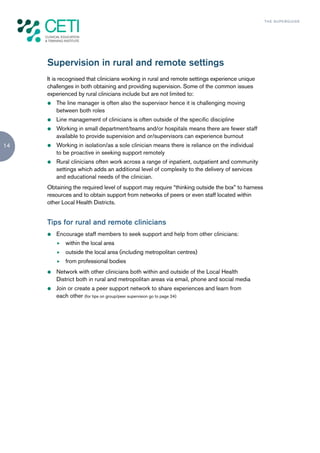
                        RuRAL SCENARIO
                        A sole practising podiatrist is line managed by their local allied
                        health operational manager who is an occupational therapist. The
                        nearest senior/experienced podiatrist is 200 km away. Whilst the
                        operational manager provides day to day support, the podiatrist
                        requires clinical supervision external to the service to facilitate
                        their ongoing development and provide a forum for reflective
                        discussion. The podiatrist discusses the need for external clinical
                        supervision with the operational manager. Arrangements are made
                        for telephone supervision to occur with another podiatrist who works
                        in a metropolitan hospital. In addition, the podiatrist contacts other
                        podiatrists in rural areas and sets up a rural peer support network
                        which meets via teleconference once a month to discuss ongoing
                        issues, complex cases and complete reflective practice.


F I R ST E D IT I O N                                                                       CETI   TH E S U P E R G U I D E
TH E S U P E R G U I D E


     Setting expectations
     When establishing a relationship
                                                       The quality of the relationship
     between a supervisee and
                                                       between the supervisor and the
     supervisor, it is important to ensure             supervisee is the most important
     from the very beginning that clear                factor of effective supervision.
     boundaries are set and both                       (Kilminster & Jolly 2000)
     parties have clear expectations of
     the process.
     Staff who are new to a department or clinical area need a comprehensive orientation.
     For more information on what should be covered in orientation, refer to page 63.
16
     An effective way to set expectations from the very beginning is to discuss:
     z   perceived strengths of both parties
     z   current concerns or fears
     z   areas the supervisee would like to develop
     z   how the supervisee learns best (recognition of different learning styles)
     z   what level of support the supervisee currently feels they require
     z   what the supervisee expects from the supervisory relationship
     z   what has worked/not worked for the supervisee in supervision in the past.

     The supervisor should also discuss with the supervisee:
     z   the frequency of one-to-one supervision sessions
     z   expectations of the supervisee regarding the supervisory relationship
     z   availability and willingness to be contacted as assistance is required
     z   the best way to access advice on a day-to-day basis.
     This will assist both parties to manage potential issues or concerns as they arise
     because a point of reference regarding expectations has been established.
     It is important that the supervisor does not perceive or project to others that supervision
     is a burden. Supervision is an opportunity to support the development of staff and ensure
     the delivery of high quality patient care. Supervisors should ensure the staff they are
     supervising feel genuinely supported and that their role as a supervisor is taken seriously.
Supervision contracts
                        An effective way to ensure that expectations of the supervisory relationship are clear at
                        the outset is by completing a supervision contract. Whilst this is separate to the managing
                        for performance process, the two are both linked to productivity and performance of the
                        individual clinician.
                        A supervision contract is a document which outlines the parameters of the relationship
                        including the responsibilities of each individual. It is signed by both parties and forms the
                        basis of the supervisory relationship. A copy should be kept by the supervisor, supervisee
                        and the line manager (if applicable) in a central file as a reference document.
                        Items covered in a supervision contract may include:                                                                   17
                        z   requirements as outlined in the local supervision policy
                        z   goals of supervision
                        z   frequency and time allocation for supervision
                        z   parameters of confidentiality within the supervisory relationship
                        z   evaluation of the supervision process
                        z   the process if either party feels the supervisory relationship is not working or that
                            the contract has been broken.
                        Examples of supervision contracts are given in Appendix A (page 72) and Appendix B (page 73).


                        Confidentiality
                        Confidentiality is vital to supervision. Agreeing on the parameters of confidentiality
                        protects personal and sensitive information and upholds professional integrity
                        (Country SA 2009).

                        Confidentiality should be discussed as part of establishing the supervision contract.
                        This includes:
                        z   mutually agreed reporting procedures if duty of care issues are raised by the
                            supervisee
                        z   mutually agreed reporting procedures if the supervisor has duty of care concerns
                            pertaining to the supervisee
                        z   agreement in relation to what feedback can be given to the line manager
                        z   ensuring discussions are held in private and documentation is kept in a secure
                            place.


                              It is important for staff to be aware that there are limits to a confidentiality
                            agreement in the case of misconduct or following adverse patient care events.


F I R ST E D IT I O N                                                                                        CETI   TH E S U P E R G U I D E
TH E S U P E R G U I D E


     Documenting supervision sessions
     The agreed actions and outcomes of the discussions which occur during one-to-one
     supervision sessions should be documented on a supervision record form. This provides
     additional guidance to the supervised clinician regarding areas on which they need to
     focus, and records the agreement of both parties regarding actions they are committed
     to taking.
     Notes can be taken by either the supervisor or supervisee during the session. The
     documented record should ideally be signed by both parties, who should each keep
     a copy.
18   Supervision records are legal documents and in the context of misconduct or legal
     proceedings arising out of adverse events may be used as evidence. Supervision notes
     must be objective and accurately maintained according to NSW Health standards and
     stored for a period of time in line with NSW Government State Record Requirements
     www.records.nsw.gov.au.
     Examples of a supervision session sheet and log sheet can be found in Appendix C
     (page 75) and Appendix D (page 76).


     It is important to have systems in place to evaluate the quality and effectiveness of
     supervision. Evaluation of the supervisory relationship is a joint responsibility of the
     supervisor and the supervisee. Perspectives of both the supervisee and the supervisor
     should be included.
     There are several ways to evaluate supervision, such as:
     z   review of the supervision contract
     z   regular review or reflective discussion throughout the supervisory relationship
     z   through a debriefing after a critical incident, misunderstanding or breakdown in
         communication
     z   using an evaluation form or other formal evaluation process
     z   through informal discussion.
     A useful feedback form which can be completed to evaluate the effectiveness of a
     specific one to one supervisory relationship can be found in Appendix E (page 77).
Clinical supervision activities
                        Developing learning goals
                        Good supervision underpins individual professional development and can positively
                        influence the career path of allied health professionals.
                        Every clinician should have an individual learning plan with specific learning objectives
                        detailing what it is they are working towards. This provides a framework for learning and
                        a reference to reflect upon in subsequent supervision sessions and (if appropriate)
                        during formal reviews (page 62).
                        When developing learning goals, the supervisor needs to ensure that appropriate                                        19
                        educational objectives reflect the activities and clinical context of the supervisee.
                        Learning goals should be documented, discussed with the line manager (where
                        applicable) and retained in the supervision record. They should be regularly reviewed
                        and updated in line with the acquisition of skills and knowledge as the clinician develops.
                        Learning goals should be SMART: ie, they should be Specific, Measurable, Achievable,
                        Realistic and Timely (Doran 1981). An example of a SMART goal template can be found in
                        Appendix F (page 78).

                        Specific           Goal must be well defined, clear and unambiguous.
                                           z What do you want to accomplish?

                                           z Why?

                                           z Who will be involved?

                                           z Where will it occur?

                        Measurable         Define a criterion for measuring progress toward the goal.
                                           z How much?

                                           z How many?

                                           z How will you know when you have reached your goal?

                        Achievable         Goal must be achievable.
                                           z How will your goal be achieved?

                                           z What are some of the constraints you may face when
                                             achieving this goal?
                        Realistic          Goal needs to be relevant.
                                           z How does the goal fit with your immediate and long term plan?

                                           z How is it consistent with other goals you have?

                        Timely             Goal should be grounded within a timeframe.
                                           z What can you do in 6 months from now?

                                           z What can you do in 6 weeks from now?

                                           z What can you do today?


F I R ST E D IT I O N                                                                                       CETI    TH E S U P E R G U I D E
TH E S U P E R G U I D E


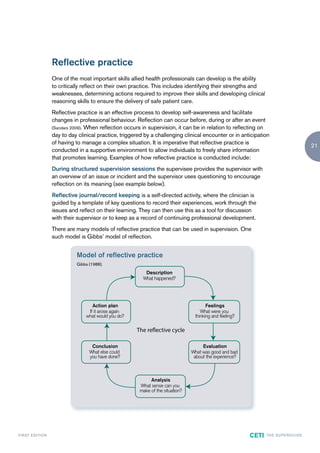
     Examples of smart goals

      Time and workload management
      Within four weeks I will implement three strategies to improve skills in
      workload management. These strategies will be:
      z   making a list each morning of tasks that need to be attended to
          and identifying the priority of each task
      z   ensuring that half an hour each afternoon is scheduled in my diary
          to finalise notes and complete statistics
20    z   checking emails twice a day only.


      Presentation skills
      Within eight weeks I will develop and deliver a presentation to my
      team members on a complex case within my current clinical area. I will
      achieve this by:
      z   identifying a relevant case
      z   exploring different models of case presentation via the literature
          and by seeking advice from other senior clinicians
      z   writing the presentation and linking practice to theory
      z   practising the presentation initially with my supervisor to get
          feedback and develop confidence
      z   delivering the presentation at the next team meeting or in-service.


      Clinical skills
      Within three months I will be able to autonomously manipulate the
      energy content of infant feeds for inpatients requiring extra calories by:
      z   accessing and reviewing all available protocols and guidelines in
          relation to manipulation of formula for paediatric patients
      z   discussing with my supervisor any questions or uncertainty about
          the process
      z   shadowing a senior dietitian in the paediatric unit in the first four weeks
      z   presenting four case studies to supervisor/senior dietitian which
          demonstrate accurate manipulation of the energy content of feeds
      z   getting a senior dietitian to check orders for one month to ensure
          100% accuracy of orders.
Reflective practice
                        One of the most important skills allied health professionals can develop is the ability
                        to critically reflect on their own practice. This includes identifying their strengths and
                        weaknesses, determining actions required to improve their skills and developing clinical
                        reasoning skills to ensure the delivery of safe patient care.
                        Reflective practice is an effective process to develop self-awareness and facilitate
                        changes in professional behaviour. Reflection can occur before, during or after an event
                        (Sandars 2009). When reflection occurs in supervision, it can be in relation to reflecting on
                        day to day clinical practice, triggered by a challenging clinical encounter or in anticipation
                        of having to manage a complex situation. It is imperative that reflective practice is
                                                                                                                                                 21
                        conducted in a supportive environment to allow individuals to freely share information
                        that promotes learning. Examples of how reflective practice is conducted include:
                        During structured supervision sessions the supervisee provides the supervisor with
                        an overview of an issue or incident and the supervisor uses questioning to encourage
                        reflection on its meaning (see example below).
                        Reflective journal/record keeping is a self-directed activity, where the clinician is
                        guided by a template of key questions to record their experiences, work through the
                        issues and reflect on their learning. They can then use this as a tool for discussion
                        with their supervisor or to keep as a record of continuing professional development.
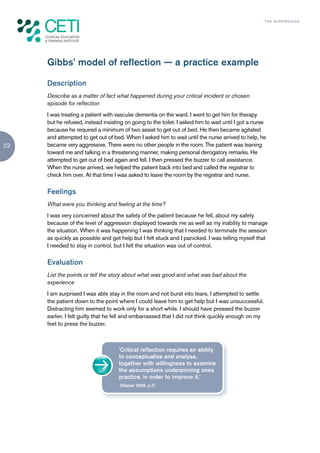
                        There are many models of reflective practice that can be used in supervision. One
                        such model is Gibbs’ model of reflection.


                                  Model of reflective practice
                                  Gibbs (1988).
                                                                Description
                                                               What happened?


                                         Action plan                                         Feelings
                                       If it arose again                                  What were you
                                      what would you do?                               thinking and feeling?


                                         Conclusion                                        Evaluation
                                        What else could                               What was good and bad
                                        you have done?                                 about the experience?


                                                                  Analysis
                                                             What sense can you
                                                             make of the situation?


F I R ST E D IT I O N                                                                                          CETI   TH E S U P E R G U I D E
TH E S U P E R G U I D E


     Gibbs’ model of reflection — a practice example

     Description
     Describe as a matter of fact what happened during your critical incident or chosen
     episode for reflection
     I was treating a patient with vascular dementia on the ward. I went to get him for therapy
     but he refused, instead insisting on going to the toilet. I asked him to wait until I got a nurse
     because he required a minimum of two assist to get out of bed. He then became agitated
     and attempted to get out of bed. When I asked him to wait until the nurse arrived to help, he
22   became very aggressive. There were no other people in the room. The patient was leaning
     toward me and talking in a threatening manner, making personal derogatory remarks. He
     attempted to get out of bed again and fell. I then pressed the buzzer to call assistance.
     When the nurse arrived, we helped the patient back into bed and called the registrar to
     check him over. At that time I was asked to leave the room by the registrar and nurse.

     Feelings
     What were you thinking and feeling at the time?
     I was very concerned about the safety of the patient because he fell, about my safety
     because of the level of aggression displayed towards me as well as my inability to manage
     the situation. When it was happening I was thinking that I needed to terminate the session
     as quickly as possible and get help but I felt stuck and I panicked. I was telling myself that
     I needed to stay in control, but I felt the situation was out of control.

     Evaluation
     List the points or tell the story about what was good and what was bad about the
     experience
     I am surprised I was able stay in the room and not burst into tears. I attempted to settle
     the patient down to the point where I could leave him to get help but I was unsuccessful.
     Distracting him seemed to work only for a short while. I should have pressed the buzzer
     earlier. I felt guilty that he fell and embarrassed that I did not think quickly enough on my
     feet to press the buzzer.


                                    ‘Critical reflection requires an ability
                                    to conceptualise and analyse,
                                    together with willingness to examine
                                    the assumptions underpinning ones
                                    practice, in order to improve it.’
                                     (Napier 2006, p.7)
Analysis
                        What sense can you make out of the situation? What does it mean?
                        I think the patient was taken by surprise when I came in. Even though I explained why
                        I was there, he had just woken up and was disoriented. I should have checked with the
                        nurse about his presentation and paid attention to these signs as potential triggers to
                        his aggression. I later found out that the patient was suffering from delirium.
                        Afterwards I was very upset and tearful. I did not want anyone to know that I was upset
                        so I did not say anything. I felt however that this experience made me doubt my practice
                        and the incident affected my self confidence.
                                                                                                                                                      23
                        Conclusion
                        What else could you have done? What should you perhaps not have done?
                        Because I was in a rush that day I did not have time to plan the session properly or consult
                        with key team members. Despite warnings that this patient can become agitated, I thought
                        I could quickly treat him because I previously had good rapport with him. In hindsight, I
                        think I should have taken the time to organise to see him with a colleague or on another
                        day, but I was overwhelmed with the amount of work I had to get through and patients I
                        had to see.

                        Action plan
                        If it arose again, what would you do differently? How will you adapt your practice in light
                        of this new understanding?
                        I think that it is not worth “just trying to get though the day”. It’s important to plan intervention
                        or treatment with patients who are more challenging. I realise now that I contributed toward
                        the incident by not planning my intervention properly and not calling for assistance sooner.
                        I also recognise that it was important for me to talk the incident through with my supervisor
                        and reflect on all aspects of the situation in order to learn from it.
                        An example of a reflective practice template can be found in Appendix G (page 79).


F I R ST E D IT I O N                                                                                              CETI    TH E S U P E R G U I D E
TH E S U P E R G U I D E


     Group supervision
     z   Many of the principles of one-to-one supervision are just as applicable in the group
         supervision context.
     z   Group supervision is led by an appointed supervisor. However, individuals can
         gain from the reflection, feedback, sharing and input from colleagues as well as the
         supervisor.
     z   Like all supervisors, group supervisors require specific knowledge and skills, in
         particular about managing group processes.
     z   Do some planning prior to establishing a supervision group, to ensure it is the most
24       appropriate/feasible form of supervision and will meet the needs of the allied health
         clinicians requiring supervision.
     z   Carefully consider the composition of the group and selection of staff to be
         supervised. Important considerations include how many supervisees are in the
         group, as well as the skills, experience and individual attributes of the supervisees.
     z   Developing a clear supervision contract that is agreed to and signed by all
         is essential. This includes the frequency of meetings, participants, model of
         supervision, role of the supervisor, expectations of the supervisee, review and
         evaluation processes and confidentiality.
     z   It is important that there is clarity about how feedback will be given to individuals
         in the group and that a culture of learning and self-reflection is fostered amongst
         participants.
     z   Group dynamics do occur in group supervision and need to be managed.
     z   Managing time equitably and ensuring that the needs of each participant are met
         should be constantly monitored.

     Peer supervision
     z   Peer supervision is much more a self-directed activity and involves two or more
         allied health staff meeting to supervise each other’s work.
     z   It requires a strong motivation and commitment from all participants to drive the
         process. The responsibility for the group, its wellbeing and ensuring it meets its
         purpose is shared by all participants.
     z   Whilst peer supervision is often considered a less “formal” process, it still requires a
         clear purpose and structure. Contracts and/or agreements are important and should
         address goals, expectations of participants, how the process will work and any
         “ground rules”.
     z   Groups may include staff that have had supervision training, but members share
         the responsibility for convening and facilitating sessions with members often taking
         turns in being the supervisor and supervisee.
     z   It often works well with staff of similar training and experience that share values but
         hold a range of experiences.
z   It can be a valuable adjunct to formal supervision. It is also a consideration when
                            addressing the needs of experienced clinicians or clinicians in rural settings
                        z   It can involve a mix of case discussions, theoretical discussions, role plays or case
                            based learning.
                        z   It is important that there is clarity about how feedback will be given to individuals
                            in the group and that a culture of learning and self-reflection is fostered among
                            participants.
                        z   Like all supervision, peer supervision requires regular review to ensure it is meeting
                            participants’ needs.


                                                                                                                                               25

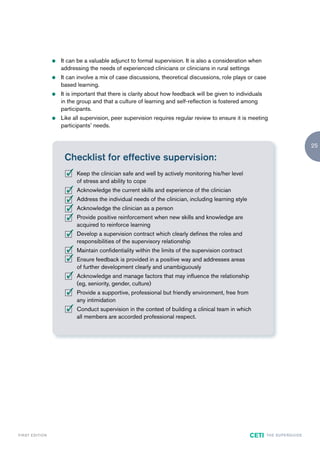
                             Checklist for effective supervision:
                                  Keep the clinician safe and well by actively monitoring his/her level
                                  of stress and ability to cope
                                  Acknowledge the current skills and experience of the clinician
                                  Address the individual needs of the clinician, including learning style
                                  Acknowledge the clinician as a person
                                  Provide positive reinforcement when new skills and knowledge are
                                  acquired to reinforce learning
                                  Develop a supervision contract which clearly defines the roles and
                                  responsibilities of the supervisory relationship
                                  Maintain confidentiality within the limits of the supervision contract
                                  Ensure feedback is provided in a positive way and addresses areas
                                  of further development clearly and unambiguously
                                  Acknowledge and manage factors that may influence the relationship
                                  (eg, seniority, gender, culture)
                                  Provide a supportive, professional but friendly environment, free from
                                  any intimidation
                                  Conduct supervision in the context of building a clinical team in which
                                  all members are accorded professional respect.


F I R ST E D IT I O N                                                                                       CETI    TH E S U P E R G U I D E
Part two
     How to be an effective
     clinical supervisor

26


                The responsibility for clinical supervision is the same
                whether at the point of patient care, in the office
                environment, or on the telephone to the clinician.
What makes an effective clinical supervisor?
                        Many allied health supervisors report that they simply do not have the time to actively
                        supervise staff in the way that they would like. This is a real problem with no easy
                        solutions. However, even small changes in how supervisors organise their clinical duties
                        can make big differences to the effectiveness of supervision.
                        Time spent actively supervising allied health professionals is rewarded in two ways. The
                        first is that active supervision improves staff performance, which saves time and enhances
                        patient care. The second is that supervisors who increase their involvement with staff tend
                        to report higher levels of job satisfaction, as playing a leading role in the development of
                        allied health professionals is personally rewarding. It builds better team interactions and
                                                                                                                                                27
                        contributes to self-esteem for all involved.
                        In order to provide high quality supervision, there are a number of skills which supervisors
                        should ensure they actively focus on developing.

                        Supervisory skills
                        Being available: This is the big one! Clinicians appreciate receiving advice from their
                        supervisor when they encounter clinical situations beyond their current ability.
                        Being aware: Supervisors should know what level of supervision is necessary for safe
                        practice. They anticipate red flags and should be ready to respond if necessary.
                        Being organised: To make the most of the limited time available, it is important for a
                        supervisor to be organised. This includes prioritising time for structured supervision
                        sessions.

                        Personal skills
                        Empathy: Do you remember what it was like to be a more junior clinician? A good
                        supervisor uses insight and understanding to support supervisees.
                        Respect: Showing respect for clinicians and others promotes positive working
                        relationships. This should occur regardless of individual differences and levels of
                        experience.
                        Clarity of expectations: A common problem for clinicians is uncertainty about what their
                        supervisor thinks or wants. Clear expectations and honest feedback from supervisors is
                        highly valued.
                        Confidentiality: Staff are more open and honest about errors or lack of capability if they
                        can discuss these matters in confidence with their supervisor.
                        A motivating and positive attitude: Most people respond best to encouragement, and
                        feedback is more effective if framed in constructive terms.
                        Ability to reflect on practice: A supervisor who is able to reflect on their own practice
                        provides a valuable role model for supervisees.


F I R ST E D IT I O N                                                                                         CETI   TH E S U P E R G U I D E
TH E S U P E R G U I D E


     Willingness to allow staff members to grow, be independent and make some
     mistakes without fear of blame: While the aim of supervision is to minimise risk to
     patients and build confident and competent professionals, everyone makes mistakes.
     All supervisors were junior clinicians once and should acknowledge that some of the
     most important lessons learned were from making mistakes and putting plans into
     action to prevent them from happening again.
     Clinical skills: The modelling of good clinical skills is one of the most effective ways
     that supervisors help their staff. The clinical skills of supervisors should be up-to-date
     and evidence-based.
     Teaching skills: In order to be an effective teacher it is important to invest in your own
28   professional development to enhance teaching skills. For more information on teaching
     refer to Section Three.


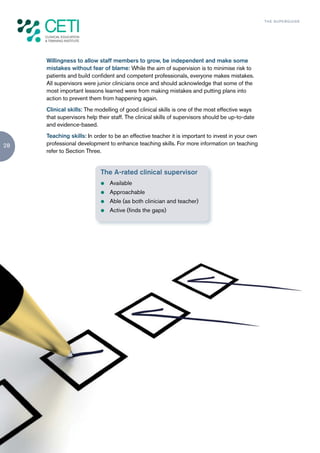
                            The A-rated clinical supervisor
                            z   Available
                            z   Approachable
                            z   Able (as both clinician and teacher)
                            z   Active (finds the gaps)
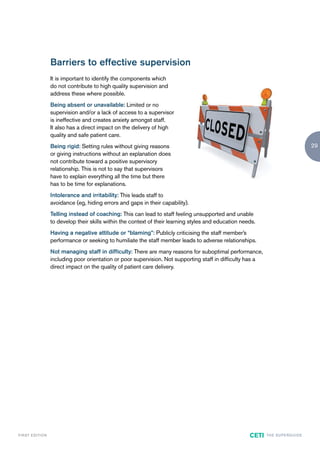
Barriers to effective supervision
                        It is important to identify the components which
                        do not contribute to high quality supervision and
                        address these where possible.
                        Being absent or unavailable: Limited or no
                        supervision and/or a lack of access to a supervisor
                        is ineffective and creates anxiety amongst staff.
                        It also has a direct impact on the delivery of high
                        quality and safe patient care.
                        Being rigid: Setting rules without giving reasons                                                                      29
                        or giving instructions without an explanation does
                        not contribute toward a positive supervisory
                        relationship. This is not to say that supervisors
                        have to explain everything all the time but there
                        has to be time for explanations.
                        Intolerance and irritability: This leads staff to
                        avoidance (eg, hiding errors and gaps in their capability).
                        Telling instead of coaching: This can lead to staff feeling unsupported and unable
                        to develop their skills within the context of their learning styles and education needs.
                        Having a negative attitude or “blaming”: Publicly criticising the staff member’s
                        performance or seeking to humiliate the staff member leads to adverse relationships.
                        Not managing staff in difficulty: There are many reasons for suboptimal performance,
                        including poor orientation or poor supervision. Not supporting staff in difficulty has a
                        direct impact on the quality of patient care delivery.


F I R ST E D IT I O N                                                                                        CETI   TH E S U P E R G U I D E
TH E S U P E R G U I D E


     Getting to know your supervisee
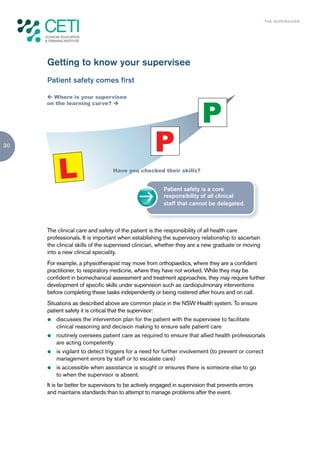
     Patient safety comes first

      Where is your supervisee
     on the learning curve? 


30


                                  Have you checked their skills?


                                                        Patient safety is a core
                                                        responsibility of all clinical
                                                        staff that cannot be delegated.


     The clinical care and safety of the patient is the responsibility of all health care
     professionals. It is important when establishing the supervisory relationship to ascertain
     the clinical skills of the supervised clinician, whether they are a new graduate or moving
     into a new clinical speciality.
     For example, a physiotherapist may move from orthopaedics, where they are a confident
     practitioner, to respiratory medicine, where they have not worked. While they may be
     confident in biomechanical assessment and treatment approaches, they may require further
     development of specific skills under supervision such as cardiopulmonary interventions
     before completing these tasks independently or being rostered after hours and on call.
     Situations as described above are common place in the NSW Health system. To ensure
     patient safety it is critical that the supervisor:
     z discusses the intervention plan for the patient with the supervisee to facilitate
         clinical reasoning and decision making to ensure safe patient care
     z routinely oversees patient care as required to ensure that allied health professionals
         are acting competently
     z is vigilant to detect triggers for a need for further involvement (to prevent or correct
         management errors by staff or to escalate care)
     z is accessible when assistance is sought or ensures there is someone else to go
         to when the supervisor is absent.
     It is far better for supervisors to be actively engaged in supervision that prevents errors
     and maintains standards than to attempt to manage problems after the event.
Knowing your supervisee’s competence level
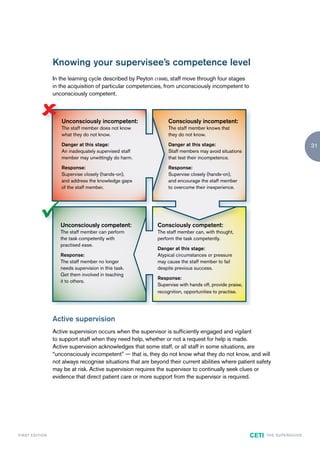
                        In the learning cycle described by Peyton (1998), staff move through four stages
                        in the acquisition of particular competencies, from unconsciously incompetent to
                        unconsciously competent.


                           Unconsciously incompetent:                    Consciously incompetent:
                           The staff member does not know                The staff member knows that
                           what they do not know.                        they do not know.
                           Danger at this stage:                         Danger at this stage:                                                    31
                           An inadequately supervised staff              Staff members may avoid situations
                           member may unwittingly do harm.               that test their incompetence.
                           Response:                                     Response:
                           Supervise closely (hands-on),                 Supervise closely (hands-on),
                           and address the knowledge gaps                and encourage the staff member
                           of the staff member.                          to overcome their inexperience.


                           Unconsciously competent:                 Consciously competent:
                           The staff member can perform             The staff member can, with thought,
                           the task competently with                perform the task competently.
                           practised ease.
                                                                    Danger at this stage:
                           Response:                                Atypical circumstances or pressure
                           The staff member no longer               may cause the staff member to fail
                           needs supervision in this task.          despite previous success.
                           Get them involved in teaching
                                                                    Response:
                           it to others.
                                                                    Supervise with hands off, provide praise,
                                                                    recognition, opportunities to practise.


                        Active supervision
                        Active supervision occurs when the supervisor is sufficiently engaged and vigilant
                        to support staff when they need help, whether or not a request for help is made.
                        Active supervision acknowledges that some staff, or all staff in some situations, are
                        “unconsciously incompetent” — that is, they do not know what they do not know, and will
                        not always recognise situations that are beyond their current abilities where patient safety
                        may be at risk. Active supervision requires the supervisor to continually seek clues or
                        evidence that direct patient care or more support from the supervisor is required.


F I R ST E D IT I O N                                                                                           CETI   TH E S U P E R G U I D E
TH E S U P E R G U I D E


     A key concept: hands-on, hands-off
     An effective supervisor knows when to give staff direction and when to give them freedom
     of action. To move the staff member from consciously incompetent to consciously
     competent, the supervisor must actively calibrate the level of support provided.
     The concept of “hands-on, hands-off” supervision was originally developed for the training
     of junior doctors, but can also apply to allied health professionals.
     Iedema et al. (2008) put forward a model of clinical supervision that recognises the need for
     support and independence. It was found that supervisees value supervisory support
     of two kinds:
32
     “Hands-on” supervision — when the supervisor is directly involved in monitoring or
     helping the supervised clinician as he/she performs tasks.
     “Hands-off” supervision — when the supervisor trusts the supervised clinician to act
     independently, leaving space for the supervisee to deploy emerging skills and test growing
     clinical abilities. However, “hands-off” supervision is not the absence of supervision!
     In general, staff need more hands-on supervision when tasks are new and increasing
     amounts of hands-off supervision as they progress and increase their skills, confidence
     and competence. Staff members also value an intermediate zone that allows them to shift
     back and forth between monitored (hands-on) and independent (hands-off) practice.


     “Hands-on” supervision                        “Hands-off” supervision
     z   Guidance on interventions that            z   Identifying crucial supervision moments
         require further skills development        z   Allowing room to develop
     z   Specific skills training sessions             independence
     z   Seeing patients with supervisor           z   Feeling trusted
     z   Discussing mistakes                       z   Providing opportunities for de-briefing
     z   Opportunities to discuss patient              and discussion.
         management.


     From a supervisor’s point of view, both hands-on and hands-off supervision are active
     processes, requiring the exercise of judgment.
     To work out how much hands-on and hands-off supervision your staff member needs,
     it may be helpful to ask yourself: How far along the trajectory of development is the
     staff member? When is it time to intervene?
Case study: clinical supervision
                        A social work team leader allocates a new referral to a clinician on the team. The referral is
                        to assess a serious child-at-risk situation. The team leader is busy and has been paged to
                        an urgent meeting. Two more experienced team members have called in sick and there is
                        no one else to receive the referral.

                        What next?

                        Path one                                         Path two
                        The team leader gives the referral to the        The team leader asks the clinician if she has                             33
                        clinician and asks that they attend to it as     capacity to take on a new referral, highlighting
                        a matter of urgency. She lets the clinician      the complexity of the case and that it involves
                        know that she will be unavailable and in         the assessment of a child at risk. The clinician
                        meetings for the rest of the afternoon.          explains that she has not previously had to
                                                                         report a case to child protective services.
                        The clinician assesses the situation and
                        due to serious concerns makes a referral         The team leader goes through the key elements
                        to child protective services. Due to the         of a risk assessment and ensures that the
                        nature of the concerns they attend the           clinician feels able to proceed. She explains she
                        hospital and assume care of the child            will be in meetings but the staff member could
                                                                         page her after the assessment.
                        and restrict parental visiting.
                                                                         During a break from meetings the team leader,
                        There is angry confrontation between
                                                                         conscious that she has not heard from the
                        the parents, the social worker and child
                                                                         clinician, makes contact by phone. The social
                        protective services. It is witnessed by other
                                                                         worker explains that she has been caught up
                        parents and security is required to attend.
                                                                         and that child protective services are coming
                        Three days later, nursing staff complain to      to the hospital. The team leader advises
                        the clinician’s supervisor as they were not      speaking with the nursing unit manager and
                        involved in the case management planning.        multidisciplinary team to develop a management
                        The supervisor had not spoken to the             plan. The team decide the meeting with the
                        clinician since the incident and now needs       family will occur away from the bedside and
                        to address the complaint.                        public ward area with security on standby.
                                                                         Despite the challenges of the situation the
                                                                         assumption of care occurs without incident.
                                                                         The team leader follows up by making a time
                                                                         to discuss the case with the clinician.

                        Path one exemplifies limited supervision, with the team leader abdicating responsibility
                        and assuming that her supervisee has a level of knowledge, experience and autonomy that
                        she has not yet achieved. It results in tensions within the multidisciplinary team and a lack
                        of support for the clinician.
                        Path two outlines the supervisors ability to identify competence of the supervisee and
                        builds on her knowledge base through logical questioning. The supervisor is active and
                        follows up with the clinician to offer guidance, while still allowing the clinician to manage
                        the situation. Support and an opportunity for learning after the case is also provided.


F I R ST E D IT I O N                                                                                          CETI     TH E S U P E R G U I D E
TH E S U P E R G U I D E


     Giving feedback
     Feedback is an essential component of supervision and must be clear so that the staff
     member is aware of their strengths and weaknesses and how they can improve
     (Kilminster & Jolly 2000). To give effective feedback:

     z Be timely: Give feedback as close as possible to the event. However, pick a good moment
          for feedback (not when you or the staff member is exhausted, distracted or upset). Feedback
          on performance should be a frequent feature of your relationship with your supervisee.
     z Be specific: Vague or generalised praise or criticism is difficult to act upon. Be specific
          and the staff member will know what to do. Adopt a straightforward manner, be clear
          and give examples where possible.
34
     z Be constructive: Focus on the positive. Avoid dampening positive feedback by qualifying it
          with a negative statement (“You did well in choosing the correct intervention for Mrs Smith,
          but ...”). For constructive criticism, talk in terms of what can be improved, rather than what
          is wrong. Ask the supervisee for a self assessment of their performance. Try to provide
          feedback in the form of solutions and advice. At the same time, if the staff member makes
          an error, feedback needs to clear.
     z Be in an appropriate setting: Positive feedback can be effective when given in the
          presence of peers or patients. Negative feedback (constructive criticism) should be
          given in a private and undisturbed setting.
     z use attentive listening: Supervisees should be given the chance to comment on
          the fairness of feedback and to provide explanations for their performance. A
          feedback session should be a dialogue between two people.
         (Cohen 2005; Lake & Ryan 2006)

                                                     Providing feedback –
     Consequences of a lack
                                                     an example from psychology
     of clear feedback to
     underperforming staff                           During a supervision session, a supervisee
                                                     presents the case of a 10-year-old girl
     z   Clinical care is not as good as             suffering from anxiety. He gives a formulation
         it could be                                 that focuses on the behavioural symptoms
     z   Anxieties and inadequacies are              without taking account of the family history
         not addressed                               or the parenting style.
     z   When weaknesses are exposed                 The supervisor affirms the positive aspects
         later in their career, the staff member     of the assessment and then explores the
         has difficulty accepting criticism          supervisees’ understanding of the causes of
         because of previous “good reports”          anxiety in children, thus attempting to elicit
                                                     the areas to be further explored. When the
     z   Others are blamed when the staff            supervisee fails to mention the impact of
         member is unsuccessful                      family history and parenting style on anxiety in
     z   Learning is inhibited, career               children, the supervisor raises this and gives
         progression is delayed                      a specific example of a situation where this
     z   Staff are not given the opportunity         information changed the clinical management
         to develop to their full potential.         plan. The supervisee is then given an
                                                     opportunity to reflect on the feedback,
         (Cohen 2005)
                                                     discuss its relevance in this particular
                                                     situation and how they will proceed.
Supervisee engagement in supervision
                        While it is the responsibility of the
                        supervisor to remain active in overseeing                Effective supervision requires
                                                                                 commitment, support and
                        clinical care, as per the supervision
                                                                                 governance from management
                        contract, supervisees must be                            and organisations.
                        encouraged to engage and commit to
                        the supervisory process. Supervision is
                        one of the most important relationships
                        of an allied health professional’s career. This can be facilitated by actively encouraging the
                        clinician to seek assistance when required and identify appropriate learning opportunities.
                                                                                                                                              35
                        What makes an allied health professional feel valued?
                        z   Being supported, especially when confronted with clinically challenging situations
                            or while working out of hours, in isolation or outside the acute hospital environment
                            including home and community visits
                        z   Being given responsibility for patient care
                        z   Good teamwork
                        z   Receiving feedback
                        z   Having a supportive learning environment
                        z   Being stimulated to learn
                        z   Having a supervisor take a personal interest in
                            their work and professional development.
                            (Peyton 1998)


                                             The A-rated teachable supervisee
                                             z   Attitude (not arrogant, anxious or overawed)
                                             z   Aptitude (has baseline of clinical skills,
                                                 communication skills and knowledge)
                                             z   Attuned (focused on learning and not bored
                                                 or perfunctory)
                                             z   Awareness (has good insight into abilities
                                                 and is able to accept feedback and modify
                                                 behaviour)


F I R ST E D IT I O N                                                                                       CETI   TH E S U P E R G U I D E
TH E S U P E R G U I D E


     Tips to foster engagement of the supervisee
     z   Do the groundwork when establishing a new supervisory relationship. Developing
         mutually agreed expectations of supervision builds a solid foundation and helps
         address any future issues.
     z   Ensure you demonstrate to the supervisee that you view supervision as priority —
         make sure that supervision time is not hijacked by other competing demands.
     z   Regularly seek feedback from the supervisee about the quality of the relationship
         and the content of supervision.
     z   Be prepared to tailor supervision to meet the specific and changing needs of the
         supervisee.
36   z   Address disengagement as a matter of priority.
     z   Develop an understanding of the supervisee’s (and your own) learning styles
         and use this information to strengthen the learning and make supervision more
         meaningful.
     z   Review the logistics around supervision such as timing, venue and frequency,
         and ensure they continue to be suitable and are not impacting on attendance.
     z   Think of supervision as building on strengths rather than working on deficits.
     z   Be mindful that supervision can be anxiety-provoking for some staff, and ensure
         expectations are realistic and achievable.
     z   Regularly find opportunities to give positive feedback when the supervisee
         successfully uses the learning from supervision in their practice. This not only
         reinforces the value of supervision and increases the supervisee’s clinical
         confidence, it also ensures that patients receive quality care.
Responsibilities of the supervisee
                        Whilst the supervisor has important responsibilities to engage, facilitate learning and
                        provide support, equally the supervisee has an important role to play in getting the
                        most out of supervision.
                        Supervisees should:
                        z   take responsibility for self-directed, lifelong learning including a commitment to
                            ongoing professional development
                        z   actively participate in the supervision process
                        z   openly express needs and expectations related to supervision. Ensure these form
                            the basis of the supervision contract                                                                            37
                        z   make the best use of supervision by coming prepared. This includes having an
                            agenda of points to be discussed so time can be used effectively
                        z   make an effort to create and protect time for supervision. Try to keep scheduled
                            supervision appointments, be on time and try and avoid interruptions
                        z   be prepared to openly identify and discuss practice issues which are challenging
                            and the skills that need developing
                        z   work at developing trust in the supervisory relationship so that issues can be
                            discussed honestly and freely. This makes supervision more meaningful and relevant
                        z   contribute to reflective discussion about practice experiences and learnings
                        z   be open to learning and improving clinical practice skills and incorporating this
                            learning into ones work practice. Be prepared to be challenged in a supportive way
                        z   be open to receiving support and feedback during supervision and take time to
                            reflect and respond to this feedback
                        z   take responsibility for seeking help when required, even if outside the regular
                            supervision time. This ensures patient safety and wellbeing are always put first
                        z   commit to regularly reviewing the supervision process and give honest feedback if
                            it needs to be adapted to meet changing needs.


F I R ST E D IT I O N                                                                                      CETI   TH E S U P E R G U I D E
Part three
     Clinical teaching and learning


38


              “Put simply, the education of health professionals in the 21st
              Century must focus less on memorising and transmitting facts
              and more on promotion of the reasoning and communication
              skills that will enable the professional to be an effective partner,
              facilitator, adviser and advocate.” (Frenk et al. 2010)
The supervisor’s role in clinical teaching
                        As per the functions of supervision outlined in section one, supervision also encompasses
                        education. The purpose of the educational component of supervision is to develop each
                        individual in a manner that enhances their full potential, ensure patient safety, effective
                        and ethical practice. This may be complemented by the provision of education in other
                        teaching forums such as in-service education, grand rounds and case discussion.
                        Clinical teaching aims to:
                        z   improve knowledge and skills
                        z   integrate theory into practice
                        z   develop self awareness                                                                                              39
                        z   facilitate reflection on practice
                        z   enhance clinical reasoning.
                        In addition to clinical skills, the supervisor should also teach the non-clinical skills needed
                        to manage workload, interprofessional practice, team dynamics and the demands of the
                        rapidly changing health care environment.
                        It is particularly important in the case of new graduate allied health professionals to
                        recognise the stress experienced following the transition from the university education
                        system, which is highly structured, to the workplace environment which requires the ability
                        to work under pressure in a resource-constrained environment (Smith & Pilling 2008).
                        Some of the main challenges reported by new graduate allied health professionals are:
                        z   managing a full caseload (including both complex and straightforward patients)
                        z   having full responsibility for patients
                        z   being confident in decision making and exercising authority
                        z   managing time effectively
                        z   completing paperwork.
                            (Smith & Pilling 2008; Tryssenaar & Perkins 2001)

                        Teaching in a clinical setting should therefore include assisting new clinicians to develop
                        non-clinical skills to cope with workplace demands, teaching specific clinical skills and
                        providing knowledge through formal education.


F I R ST E D IT I O N                                                                                         CETI   TH E S U P E R G U I D E
TH E S U P E R G U I D E


     Promoting a culture of life-long learning
     Supervision provides an ideal forum to promote a culture of lifelong learning. Lifelong
     learning refers to the continuous building of skills and knowledge through experiences
     encountered over the course of a lifetime. It encompasses not only structured learning
     through education but also learning through personal experience. Lifelong learning is
     linked to the pursuit of personal or professional knowledge and is voluntary and self-
     directed.
     Linked to the concept of life-long professional learning, discipline specific professional
     associations and professional registration boards have guidelines regarding specific
     education requirements for their profession. This includes meeting continuing professional
40
     development (CPD) requirements and maintaining CPD portfolios. However, self-directed
     and lifelong learning is an attitudinal approach which should be modelled by all senior
     allied health professionals over the course of their career.
Facilitating the learning process
                        There are several approaches to learning that can occur within the context of supervision.
                        Most people learn by a combination of deductive (learning through structure) and
                        inductive (learning by experience) approaches. When facilitating learning, it is important
                        to consider principles of adult learning, different learning styles and a mix of modalities.

                        Principles of adult learning
                        z   Adult learners need to be respected, valued and acknowledged for their past
                            experience and have an opportunity to apply this experience to their current learning
                        z   Adults learn best in environments that reduce possible threats to self-concept and                                  41
                            self-esteem and provide support for change and development
                        z   Adult learners are highly motivated to learn in areas relevant to their current needs,
                            often generated by real life tasks and problems
                        z   Adult learners need feedback to develop
                        z   Adult learners have a tendency towards self directed learning and learn best when
                            they can set their own pace
                        z   Adults learn more effectively through experiential techniques (eg, discussion and
                            problem solving).
                            (Brundage & MacKeracher 1980; Brookfield1998)


F I R ST E D IT I O N                                                                                      CETI      TH E S U P E R G U I D E
TH E S U P E R G U I D E


     Identifying different learning styles
     Many models exist which describe different learning styles (Kolb 1999 and Honey & Mumford 2000).
     Learning styles can be determined through administering learning style questionnaires
     (eg, Myers-Briggs Type Indicator in Myers et al. 1998) or discussing with the supervisee
     how they learn best (eg, preferred learning style, environment and methods).


        A learning style model
                                                          Concrete
                                                         experience
                                                          Having an
42                                                        experience


                                          Activists                          Reflectors
                                                            continuum


              Active                                                                      Reflective
          experimentation                      Processing                continuum       observation
          Putting their theory                                                           Reflecting on
             into practice                                                                experience
                                                            Perception


                                       Pragmatists                           Theorists


                                                         Abstract
                                                    conceptualisation
                                                     Drawing their own
                                                        conclusions

        Reflector: Prefers to learn from activities that allow them to watch, think, and
        review (time to think things over) what has happened. Likes to use journals and
        brainstorming. Lectures are helpful if they provide expert explanations and analysis.
        Theorist: Prefers to think problems through in a step-by-step manner. Likes
        lectures, analogies, systems, case studies, models and readings. Talking with
        experts is normally not helpful.
        Pragmatist: Prefers to apply new learnings to actual practice to see if they work.
        Likes laboratories, field work, and observations. Likes feedback, coaching, and
        obvious links between the task-on-hand and a problem.
        Activist: Prefers the challenges of new experiences, involvement with others,
        assimilations and role-playing.
        Source: Honey P, Mumford A (2000). The learning styles helper’s guide.
        http://www.nwlink.com/~donclark/hrd/styles/honey_mumford.html
What makes effective clinical teaching?

                                                        Ascertain what the staff member is interested
                                                        in and then direct your teaching to this
                Collaboration and active involvement.   motivation. For example: for a junior
                Adults like to have input into their    occupational therapist (OT) currently working
                learning.                               in general rehabilitation, principles of upper
                                                        limb assessment and rehabilitation may be
                                                       reviewed in more detail if they have a specific
                Relevance to the clinical duties        interest in neurological rehabilitation. There
                currently required of the staff         may be opportunities to develop skills and
                member, or to their future career       confidence by encouraging the staff member                                            43
                plans.                                  to take on more complex neurological patients
                                                        as part of their clinical duties while the
                                                        supervisor provides ongoing coaching and
                                                        support.


                                                        Didactic teaching (lectures) is most effective
                                                        when you know the knowledge base of your
                Appropriateness to the level            audience (ask first). A failure of some didactic
                of the staff member.                    teaching is that time is spent teaching staff
                                                       members things they already know.
                Teaching by guided questioning.         The advantage of guided questioning is that
                Asking and encouraging thinking.        it reveals what staff members do know and
                                                        invites them to extend their knowledge. But
                                                        don’t turn questioning into a grilling. Make
                                                        sure staff members are provided with space
                                                        to think about their responses and if they
                                                        require more time to process what is being
                Setting clear learning goals with the   taught, offer to continue the discussion later
                staff member so expectations are        once they have had a chance to reflect.
                clear. Document SMART learning
                goals: Specific; Measurable;
                Attainable; Realistic and Timely.
                                                        Simply telling people what you expect them
                                                        to learn will focus their attention in a clinical
                Giving feedback so that                 encounter.
                staff members know how                 Feedback given and received lets everyone
                they are going.                         know whether the intended outcomes are
                                                        being achieved.
                                                        Adult learning is a collaborative process.
                Seeking feedback so that you
                know how effective teaching
                has been.


F I R ST E D IT I O N                                                                                       CETI   TH E S U P E R G U I D E
TH E S U P E R G U I D E


     Ten top tips for the teaching supervisor
     1    Every little bit helps: Seize the teaching moment. Even if you don’t have the whole
          package worked out, it’s still worthwhile sharing what you can, as best you can. Don’t
          have time to run through a process or procedure in full? Draw the staff member’s
          attention to one key aspect of the task. No time for a complete debrief immediately after
          a difficult case? Ask a few key questions to check the staff member’s understanding of
          what occurred and give quick feedback. Follow up later when there is time.
     2    Teach by guided questioning: Ask questions to discover the state of the
          clinician’s knowledge and understanding. Encourage independent thinking and
          problem-solving. Effective questioning uncovers misunderstandings and reinforces
44        and extends existing knowledge. Questions keep staff engaged, “on their toes”,
          listening and thinking.
     3    Invite staff to set the agenda: Adult learners should be involved in decisions
          about the direction and content of learning. Your ultimate objective as a supervisor
          is to foster the staff member’s ability for self-directed lifelong learning.
     4    Encourage questions: Questions from staff should always be treated with respect.
          You may be shocked at what they did not know, but on closer inspection, may discover
          that others are just keeping quiet. The three most important words in teaching and
          learning are “I don’t know”.
     5    Focus the learner: Start any teaching by setting up the importance of the session.
          Teaching is more effective if it is tailored to learners’ interests, ambitions and
          current level of knowledge and ability. Answer the question: why should they pay
          attention to what you are about to teach them?
     6    Focus the learning: Don’t try to teach too much at once. Try not to repeat what is
          already known. Clinical situations are complex but limit the learning to the key aspects
          that form the learning edge of your audience’s knowledge base. Procedures and
          processes can be broken down into steps, not all of which have to be covered at once.
     7    Encourage independent learning: Don’t try to teach everything – give enough
          information to set staff on track, then ask them to complete the task themselves. Set
          tasks that require staff to act on the information you have provided. Keep learning open-
          ended. Encourage staff to seek other educational opportunities and report back on their
          learning.
     8    Teach evidence-based practice: Build a lifelong learning attitude in your staff.
          Even more important than knowing the current best answer to a clinical problem is
          having the skills to identify a clinical question, search the clinical literature, appraise
          the evidence and form an evidence-based plan.
     9    Check the understanding of staff: Have staff actually understood what has been
          taught? Can they demonstrate clinical reasoning and put knowledge and skills into
          practice? If not, perhaps revisit specific topics or skill areas until staff feel confident
          and can show that they have learned.
     10   Evaluate your own practice as a teacher: How well did your staff learn from the
          information you provided? Every time you teach you have a chance to learn how
          to do it better (and more easily) next time. Try different methods and compare staff
          outcomes. Seek feedback from your staff. Compare notes with your peers.
Identifying opportunities for clinical teaching
                        There are many situations which occur on a day to day basis in a clinical setting which can
                        be turned into opportunities for clinical teaching. While it is beneficial to allocate specific
                        time for teaching (when required), using opportunities as they become apparent can be
                        beneficial to clinicians. Some of the forums where teaching can occur include:
                        z   in the presence of patients
                        z   during case discussion
                        z   during handover
                        z   over the phone
                        z   interdisciplinary (ie, with other allied health disciplines)                                                       45
                        z   interprofessionally (ie, with medicine and nursing).


F I R ST E D IT I O N                                                                                        CETI   TH E S U P E R G U I D E
TH E S U P E R G U I D E


     Teaching in the presence of patients
     Clinical teaching at the point of care is the place where theoretical knowledge is made
     practical in the real world, with real patients.
     Supervisors can use opportunities to teach in the presence of patients by identifying
     patients from their own case load who would provide a beneficial learning opportunity
     to clinicians, or work with a patient from the supervisee’s caseload.
     In preparing to teach in the presence of patients the following principles should be
     applied.

46   Ensuring patient comfort
     z   If possible, provide advance notice to the patient.
     z   Obtain consent in private wherever possible and before the teaching session.
     z   Ensure introductions are made.
     z   All procedures, discussions and communications should be explained and
         made understandable to the patient as the teaching occurs.
     z   Thank the patient and invite questions.
     Note: Patient safety, comfort, privacy and confidentiality is paramount and should
     be monitored at all times.

     Tips for teaching in the presence of patients
     z   Start small, and stay within your comfort zone as a teacher.
     z   Remember what is routine to you may be new to the clinician.
     z   Allocate sufficient time for point of care teaching.
     z   Involve the staff member. Negotiate the goals. Let them select the focus of teaching.
     z   Orient the staff member to your plans prior to the session, including clarifying their
         role and what you hope they will learn from the experience.
     z   Skills/procedures can be modelled first by the supervisor and then demonstrated
         by staff or staff may perform all or part of the interview, procedure or intervention.
     z   Teaching by guided questioning is generally better than just telling, because it allows
         you to determine the person’s level of knowledge and understanding. Ask the staff
         member to report back to check understanding.
     z   If the staff member appears to be struggling or is off track, make a smooth transition
         to take over the clinical interaction.
     z   Don’t criticise at the point of care, debrief elsewhere constructively.
     z   Afterwards seek feedback from the staff member. Reflect on the effectiveness
         of the session and prepare for next time.
Teaching during case discussion
               Case discussion may occur during the formal one-to-one supervision session or
               periodically during day-to-day interactions and discussion regarding patient care.
               Supervisors can use these discussions to provide additional information, or to impart
               skills and knowledge that explain the need for specific interventions. It is also an
               opportunity to encourage reflective practice.
               Using guided questioning to find out why the clinician feels a particular problem exists
               or should be solved in a certain way further develops strong clinical reasoning skills and
               confidence in clinical practice.
                                                                                                                                         47
               Teaching by guided questioning
               Teaching by guided questioning encourages independent thinking and problem solving.
               It allows the supervisee to test options, analyse risk and consider limitations and
               innovations.


                            Examples of guided questions:
                            z   What approach are you taking in this situation and why?
                            z   Can you explain the steps of the task/treatment/intervention
                                and why they are completed in this way?
                            z   What outcomes do you want and how can they be achieved?
                            z   What is your action plan if this approach doesn’t work?
                            z   What values, attitudes, knowledge and/or skills are being
                                challenged in this situation?
                            z   How would you approach the situation next time?
                                (Irwin 2008)


F I R ST E D IT I O N                                                                                  CETI   TH E S U P E R G U I D E
TH E S U P E R G U I D E


     Teaching at handover
     Well structured handover is an excellent learning experience that integrates
     communication, professionalism and clinical management. Staff members learn
     techniques of clinical description and case organisation when involved in the handover
     of a patient to others. Handover is also an important team-building exercise.
     Clinical handover is important to effective clinical care. The practical operation of health
     services, including hospitals, means that patient care might be handed over from team to
     team in various situations including:
     z   following on-call and weekend shifts
48   z   transfer of patients from one clinical setting to another
     z   discharge planning.
     Supervisors should discuss principles of good clinical handover to build the skills of
     clinicians and facilitate the safe transfer of patients from team to team.
     Clinical staff may experience challenges with handover, in particular if they are on the
     receiving end of information about patients they are required to look after on an after-
     hours or weekend shift. This creates a risk for the patient as it is not possible for the staff
     member to check information with the treating therapist or ask additional questions once
     the day shift has gone home.

     The challenge of handover
     z   Being confident to speak up and be an active participant in the handover process.
         Staff must feel able to ask questions if they are unsure of details in someone’s
         handover.
     z   Providing the most critical and relevant information in sufficient detail to ensure the
         issues are clear (just enough versus not too much). This is vital to continuity of care
         and safe clinical practice.
     z   Ensuring time is prioritised in the daily schedule for handover of patient information,
         with consideration of all the points where handover may occur, such as from shift to
         shift, ward to ward and inpatient to outpatient.
     z   Being punctual and consistently turning up on time to handover sessions.
     z   Being organised and planning for absences such as periods of leave.
     z   Ensuring effective and accurate documentation of patient issues occurs in handover
         notes, medical records and discharge summaries.
     z   Maintaining patient confidentiality and privacy while providing appropriate clinical
         handover, particularly if referring to agencies outside NSW Health. (Further
         information is available in the NSW Health Policy Directive PD2005_593: Privacy
         Manual (Version 2) 2005 - NSW Health).
THE ISBAR framework for communicating
                        at handover
                        ISBAR is the NSW Health accepted methodology for clinical handover. The process
                        of handover should occur as per the framework outlined below.
                        Further information is available in the NSW Health Policy Directive 2009_060:
                        “Clinical Handover – Standard Key Principles” (2009) and NSW Health Caring Together
                        “Implementation Toolkit – Standard Principles for Clinical Handover” (2009).


                                Introduction – Identify yourself,    “I am (name and role), from (ward/facility) and I’m                                49
                        I       role, location and who you are
                                talking to.
                                                                     calling because (clear purpose)”


                                Situation – state the patient’s      “The situation is that I have a patient (age/gender), who
                                diagnosis/reason for admission       is (diagnosis/deteriorating/stable). My concerns are
                        S       and the current problem.             (clear and succinct concerns). The current presenting
                                                                     symptoms are (clear, current and relevant symptoms and
                                                                     observations).”

                                Background – what is the             By way of background (Give pertinent information which

                        B       clinical background or context?      may include: Date of admission / presenting symptoms/
                                                                     medication / previous recent vital signs / test results/status
                                                                     changes and any relevant medical and social history)

                                Assessment – What do you             “My assessment on the basis of the above is that the

                        A       think the problem(s) is? (Don’t
                                forget to have a key issues list
                                ready!)
                                                                     patient is….. they are at risk of ... and in need of ...”


                                Recommendation – What are            “My recommendation is that this patient needs (what

                        R
                                you asking the person to do?         test/action) by (who) within (timeframe).” Repeat to
                                                                     confirm what you have heard, eg, “I understand that
                                                                     I am to ... and you will …”


                                                    Clinical handover is the effective
                                                    transfer of professional responsibility
                                                    and accountability for a patient, or
                                                    group of patients, to another person.
                                                    (NSW Department of Health 2009a)


F I R ST E D IT I O N                                                                                                CETI    TH E S U P E R G U I D E
TH E S U P E R G U I D E


     Tips for teaching at handover
     z   Supervisors can select particular patients as the subject of
50       teaching.
     z   Handover is an excellent opportunity for clinicians to take the lead
         in a teaching session. Ask the clinician to select a case to present
         in more detail regarding the patient’s background, who they are
         being handed over to, why, and what is the essential handover
         information that the receiving clinician/team needs to know to
         meet the patient’s care needs.
     z   Aim for one teaching point at each handover. A brief (not
         exhaustive) exploration of a key issue is of lasting value for the
         staff involved.
     z   All staff members should be familiar with the ISBAR framework
         for communications at handover, which is recommended for all
         clinicians in the NSW Health system (NSW Department of Health 2009b).


                          Failures in handover have been
                          identified as a major preventable
                          cause of patient harm. Allied
                          health professionals need to be
                          encouraged to value the task
                          of handover and to see it as an
                          essential and integral part of
                          their daily work.
Example: handing over by phone with ISBAR
                        Transfer of a patient to an external facility for rehabilitation from one speech pathologist
                        to another.
                        Introduction: Hello I am (name), speech pathologist calling from the acute stroke unit at
                        the Royal Hospital. I am calling to hand over care of Mr Smith who is being transferred to
                        the rehabilitation ward at your facility this afternoon. Will you be the person managing him
                        in rehab?
                        Situation: Mr Smith is a 78 year old gentlemen who currently has moderate
                        oropharyngeal dysphagia, and moderate dysarthria affecting intelligibility in conversational
                        speech. His language is functional but mild aphasia is present. He is currently on a                                      51
                        modified minced diet with nectar fluids, is taking medication orally and his chest is clear.
                        He has right upper and lower limb weakness affecting his ability to self-care, including
                        feeding himself. He requires the assistance of one person to mobilise with a transfer belt
                        and assistance of one for self care.
                        Background: The patient presented at Emergency on 31 May 2011 with slurred speech
                        and right upper limb weakness. The CT showed the presence of a left middle cerebral
                        artery thrombolytic stroke. The patient has a history of high LDL cholesterol, IHD and
                        diabetes. He is retired and was previously living independently at home with his wife who
                        is fit and well. He has a supportive son who lives nearby.
                        Assessment: A swallowing assessment from speech pathology demonstrated a weak,
                        delayed swallow and high aspiration risk. A subsequent modified barium swallow (MBS)
                        was conducted, resulting in him being placed on a modified minced diet with nectar fluids
                        due to delayed swallow with pooling in the pharyngeal valleculae leading to aspiration
                        risk. He has also been receiving dysarthria therapy once a day directed at improving
                        intelligibility while in the acute stroke unit. The family has been present during therapy
                        sessions and are keen to participate in the treatment plan for the patient to assist return
                        to independent function. Based on his recent MBS, the patient continues to require a
                        modified diet, but is keen to progress to normal fluids as soon as possible.
                        Recommendation: Based on his risk of aspiration and ongoing speech difficulties,
                        Mr Smith would benefit from therapy to improve oro-facial muscle tone, conversational
                        speech intelligibility and a possible repeat MBS prior to progressing to thin fluids. It is
                        recommended that Mr Smith undertake a period of inpatient rehabilitation to achieve his
                        goals of enhanced swallowing function and improved speech quality. A follow up MBS
                        may also be required.
                        Thank you for taking over care of this patient. I have completed a detailed discharge report
                        which I will fax over to detail the treatment plan to date and recommendations. A separate
                        MBS report will also be attached. Do you have all the information you need to take
                        over care of this patient? Please don’t hesitate to page/phone me if you require further
                        information.


F I R ST E D IT I O N                                                                                        CETI      TH E S U P E R G U I D E
TH E S U P E R G U I D E


     Teaching remotely
     Many clinical consultations and episodes of supervision take place over the phone, via
     email or video conferencing. Despite the distance, the supervisor’s advocacy for patient
     safety is no less than when present at the point of care. There is a tendency to abbreviate
     phone calls to a minimum of information exchange, but the phone can be used to put
     the supervisor “virtually there” with the clinician during clinical encounters. Because the
     supervisor cannot see or touch the patient, there is an increased focus on the clinician’s
     communication skills.
     Particularly in non-urgent contexts, the supervisor can work with the clinician to develop
52   his/her phone communication technique:
     z   Practice the ISBAR communication framework (see page 49)
     z   Provide feedback to the clinician on the selection and presentation of clinical
         information
     z   Practice the “report-back” technique of confirming the content of a phone
         communication with the clinician (repeat the essence of what you have been told
         and repeat the decisions for action that have been made).
     Fear of difficult conversations with supervisors can discourage supervisees from making
     a phone call at the time when it is most needed. Supervisors need to support staff
     members’ use of the phone/teleconferencing and paging system and develop their skills in
     presenting information succinctly and accurately to elicit the support and advice required.


     Other clinical teaching opportunities
     Critical responses
     When there is a critical incident, and there is no time for explanations, it is important to
     make time to review the event afterwards.

     After-hours episodes
     A lot of clinical activity occurs “after hours,” which includes work conducted after
     business hours and on weekends. For some allied health staff, their experience is drawn
     from episodes of care provided “after hours” on an episodic or on-call basis.
     Supervision and training needs after hours are important and require monitoring and
     support by senior clinicians. After-hours clinical situations can be a source of anxiety for
     clinicians, as the patients and their conditions may be unfamiliar.
     The supervisor must be alert to this unfamiliarity and provide a supportive environment.
     Staff working after hours should have access to senior staff supervision as required.
     Providing support to reason through a clinical problem together can enhance patient
     safety and the person’s ability to manage independently in future.
Teaching clinical skills
                        Skills training can begin with virtual experience (eg, texts, scripts, videos, online tutorials,
                        simulations, role plays) but it has to be completed in the workplace with real patients.
                        Supervisors need to be ready to teach a skill when the opportunity arises.
                        A four-step approach to teaching skills described by Walker and Peyton (1998) and
                        adopted in Teaching on the Run (Lake & Ryan 2006), is:
                        1 Demonstration: Trainer demonstrates the skill at normal speed, without
                            commentary.
                        2 Deconstruction: Trainer demonstrates the skill while describing the steps required.
                        3 Comprehension: Trainer demonstrates the skill while the staff member describes                                             53
                            steps required.
                        4 Performance: The staff member demonstrates the skill and describes steps while
                            being observed by the trainer.

                        Tips for teaching clinical skills
                        z   Don’t forget fundamentals: hygiene and infection control; patient communication,
                            consent and introductions.
                        z   Demonstration: make sure the learner can clearly see what you are doing.
                            Demonstration by the supervisor can be combined with performance by the learner.
                        z   Integrate theory with practice: that is, not only demonstrating skills but explaining the
                            logic and the evidence behind the practice. This helps to develop clinical reasoning.
                        z   Don’t teach everything at once: particularly for the demonstration of more complex
                            skills or procedures, not every step needs to be taught in every encounter. Begin by
                            establishing what the staff member already knows. Review the unknown steps in more
                            detail.
                        z   Provide opportunities to practice skills: making time and space available for the
                            staff member to be hands-on, breaking procedures into steps, providing direction and
                            sharing care. Repetition is the key to skills training, with the focus of teaching building
                            on competency.
                        z   use collaborative problem solving: give staff a clinical problem and work with them
                            towards a solution.
                        z   Give feedback: that is timely, specific, and constructive. Ensure feedback is given in
                            an appropriate environment. Good givers of feedback also invite feedback from the
                            staff member, with a view to improving their teaching technique.
                        z   Provide appropriate learning resources: knowing what is available to help staff
                            develop a deeper level of understanding.


F I R ST E D IT I O N                                                                                           CETI      TH E S U P E R G U I D E
TH E S U P E R G U I D E


     Opportunities for teaching clinical skills
     Profession                  Example
     Audiology                   Conducting tests such as ABR (Auditory Brainstem
                                 Response) assessment, ENG (Electronystagmography),
                                 ECogG (Electrocochleography).
     Diversional Therapy         Planning and implementing a leisure education program
                                 to address leisure related barriers.
     Exercise Physiology         Completing advanced exercise assessment and
                                 prescription. Rapidly identifying changes to client’s
54                               health status through observation and assessment.
     Genetic Counselling         Interpreting a family history to assess risk of genetic
                                 disorder.
     Nutrition and Dietetics     Developing a nutrition care plan for a patient requiring
                                 an enteral feed.
     Medical Radiation Science   Managing complex radiological evaluations of patients
                                 with co-morbidities.
     Music Therapy               Understanding the steps of common clinical procedures
                                 to incorporate music for relaxation/distraction.
     Occupational Therapy        Assessing functional mobility in the community using a
                                 power chair. Prescribing pressure-relieving mattresses
                                 and cushions.
     Orthoptics                  Instructing in the practice of investigation and
                                 management of complex adult strabismus.
     Orthotics                   Preparing a custom-made orthosis for a complex
                                 paediatric client according to developmental parameters.
     Play Therapy/Child          Preparing a child for clinical procedures such as an
     Life Therapist              operation or intravenous cannula insertion.
     Pharmacy                    Preparing an individualised medication plan for a
                                 patient with complex co-morbidities.
     Physiotherapy               Undertaking a gait assessment with a stroke patient.
     Podiatry                    Managing an ulcer/wound on a high risk foot.
                                 Conducting minor nail surgery with local anaesthetic.
     Psychology                  Undertaking a psychometric assessment.
     Social Work                 Undertaking a thorough psychosocial assessment
                                 and documenting it in the medical record.
     Speech Pathology            Undertaking a modified barium swallow assessment.
                                 Undertaking a paediatric feeding evaluation.
Teaching an audiology skill
                        A client is booked in to the audiology unit for an auditory brainstem
                        response (ABR) assessment. The junior clinician is aware of the test
                        but has never done it in practice. The senior clinician elicits from the
                        junior clinician reasons why this test may have been chosen for the
                        client rather than a standard audiological test battery. The set up of
                        the test is explained and the junior clinician is guided through the
                        process of preparing the client, including practical processes such as
                        how to attach the electrodes. The test is run and the junior clinician is
                        guided through the process of correctly identifying ABR responses
                        on the trace and marking them. The senior audiologist and junior                                              55
                        audiologist together explain the results to the client and prepare a
                        report for the referral source.
                        Outcome: The junior audiologist has learned the clinical reasoning
                        behind selecting an auditory brainstem response as an assessment,
                        how to set up the test and how to interpret results.


                        Teaching a podiatry skill
                        The senior podiatrist and junior podiatrist are
                        managing a wound on a patient with Type II diabetes.
                        Some of the components of managing a wound include wound
                        debridement, choosing the correct dressing and using an
                        aseptic dressing technique. The podiatrist discusses the type of
                        wound on the patient’s foot: location, shape, borders, exudate,
                        infection and base. Following this discussion the senior podiatrist
                        demonstrates an aseptic dressing technique.
                        The senior podiatrist then shows the junior podiatrist different
                        types of dressing materials and asks the junior podiatrist to choose
                        and discuss which dressing would best suit the wound. The junior
                        podiatrist then takes over the procedure and debrides the wound and
                        applies the correct dressing using an aseptic dressing technique.
                        Outcome: The junior podiatrist has learnt the correct procedure
                        for wound debridement, choice of wound dressing and aseptic
                        dressing technique.


F I R ST E D IT I O N                                                                               CETI   TH E S U P E R G U I D E
TH E S U P E R G U I D E


     Teaching non-clinical skills
     Time management and setting priorities
     One of the hardest skills to master is the effective prioritisation of clinical work to meet the
     needs of patients and service demands. This is a skill which takes time to develop and is
     often difficult even for the most experienced clinicians. An inability to effectively prioritise
     workload can leave clinicians feeling overwhelmed and overlooking essential tasks which
     need to be completed to facilitate the delivery of safe patient care.
     In addition, being a productive member of a discipline specific or multidisciplinary team
     also requires completion of administrative tasks, projects and quality improvement
56
     activities on top of day-to-day clinical work.
     In assisting the staff member to develop skills in time management and prioritisation,
     the supervisor can guide the person to implement some of the following strategies:
     z   quarantining specific sections of the day for direct patient contact activities and
         back of house activities
     z   managing unexpected interruptions and learning to say “no” or “at another time”
         when appropriate
     z   prioritising patients in order of urgency/risk
     z   creating “to do” and patient activity lists
     z   scheduling time during each day to complete documentation tasks
     z   allocating a specific time to make phone calls (eg, making phone calls in 15 minute
         blocks)
     z   setting time aside to respond to emails/complete statistical requirements once a day
     z   being flexible to reprioritise work on a daily or even hourly basis.
Developing skills in teaching and education
                        Skills in clinical education must be
                        learned like everything else in                     “Expertise in clinical practice
                        clinical practice. Years of experience              does not imply expertise in
                        in clinical practice alone does not in              clinical education”
                        itself make a great clinical teacher                (Strohschein, Hagler & May 2002, p. 162)

                        (Strohschein, Hagler & May 2002).

                        Clinical supervisors should be actively seeking to improve their knowledge and
                        skills surrounding:
                        z   principles of adult learning                                                                                           57
                        z   current evidence in clinical education
                        z   delivering effective presentations
                        z   benefits of blended learning
                        z   providing constructive feedback
                        z   facilitating reflective practice and clinical reasoning
                        z   utilising broad based evidence to inform practice.


                        Skills and knowledge can be obtained through blended learning methods including:
                        z   self-directed learning
                        z   sharing of information and resources
                        z   review of literature in a group format such as a journal club
                        z   online learning packages
                        z   participation in simulated learning environments
                        z   attending face-to-face courses in clinical supervision and education.


F I R ST E D IT I O N                                                                                            CETI   TH E S U P E R G U I D E
TH E S U P E R G U I D E


     Formal teaching
     As a senior clinician, you may be required to give in-service training and presentations,
     and the one clear advantage is that your subject will probably match your expertise.
     Practice these tips to make your presentations effective:
     z   Consider your audience and shape your material to make it relevant to their current
         knowledge, clinical responsibilities and objectives. If in doubt, consider using
         questions at the start of your presentation to establish where to pitch your talk.
     z   The first five minutes are vital. Capture interest with a compelling start (why should
         the audience listen?) and explain what you intend to cover in your talk. If you have
         one key point above all, make it early.
58
     z   When using PowerPoint slides, don’t dump all the information on the slide. White
         space, use of images and uncluttered slides with few words will ensure the
         audience pays attention to what you are saying.
     z   Don’t read your presentation — most of all, don’t read your PowerPoint slides. Talk
         to your audience and maintain eye contact.
     z   Stories, jokes and analogies are useful tools to make facts memorable.
     z   Respond to visual cues from the audience to change pace. Ask a question if you are
         not sure that the audience is with you.
     z   Vary your delivery and technique. Consider breaking the presentation with questions
         to or from the audience, or an activity to be carried out by the learners.
     z   Close your presentation strongly, with a summary of what you hope the audience
         will take away.
     z   Avoid overstuffing your presentation with material. It is better to be succinct and
         cover key points than trying to teach everything in one session.
     z   Obtain feedback in order to evaluate the effectiveness of your teaching and make
         improvements next time.

     Beyond the in-service
     Don’t forget the broad spectrum of teaching methods available to you as a teacher
     as alternatives or adjuncts to providing in-services:
     z   simulations and role plays
     z   videos to demonstrate techniques or behaviours
     z   group discussions, case studies and problem-based learning
     z   computer-based education.
     These subjects go beyond what can be covered in this book — so explore. Even
     the simplest departures from the standard in-service format will make the content
     of your education sessions more memorable.
Fostering interprofessional
                        collaborative practice
                        This guide has provided some useful insights and guidance on issues relating to
                        teaching and clinical supervision in the context of the public health system. Learning
                        interprofessionally, when two or more professions learn with, from and about each other
                        to improve collaboration and the quality of care (Freeth et al. 2005) can have many benefits to
                        both patients and health professionals.
                        This marks a significant departure from the ways in which health care workers are
                        traditionally educated and supervised: each discipline training or learning separately to
                        work separately.                                                                                                         59

                        Interprofessional teaching and supervision can prepare health professionals
                        to question taken-for-granted professional assumptions and explore different
                        professional perspectives. It also prepares health professionals for team-based care or
                        interprofessional collaborative practice (IPCP).
                        A growing amount of evidence has emerged outlining the benefits of IPCP which include:
                        z increased staff motivation, well-being and retention
                        z decrease in staff turnover
                        z increased patient and carer satisfaction
                        z increased patient safety
                        z increase in appropriate use of specialist clinical resources
                        z reductions in patient mortality and critical incidents, and
                        z increase in access to and coordination of health services.
                           (WHO 2010)

                        Supervision and clinical education that facilitates greater awareness of the roles and
                        responsibilities of others (doctors, nurses, other allied health staff and patients), and
                        that motivates health professionals to engage and communicate with those from other
                        professions, can better prepare health professionals for work in today’s public health
                        system.
                        Supervisors can consider fostering interprofessional collaborative practice by:
                        z facilitating an interdisciplinary group supervision session
                        z inviting relevant disciplines to participate in seminars, workshops, ward rounds,
                           clinical reviews etc
                        z supporting interdisciplinary placement programs
                        z encouraging supervisees to enquire about the roles and responsibilities of other
                           professional disciplines.


                                  For more information on team-based care or interprofessional
                               collaborative practice, visit the CETI Team Health Program website:
                                     http://www.ceti.nsw.gov.au/team-health/w1/i1007480/


F I R ST E D IT I O N                                                                                         CETI    TH E S U P E R G U I D E
Part four
     Management of clinical staff


60


     “Managers have an imperative to become involved with people as superiors,
     peers and subordinates. They create work conditions that enhance productivity
     and engender commitment. They achieve results through people by selecting the
     right people, designing meaningful jobs, developing their staff skills and career
     prospects, setting standards, rewarding good performance, and offering ongoing
     support and encouragement”. (Lawson & Rotem 2004, p. 77)
Managing clinical staff
                        As per the functions of clinical supervision outlined in section one, supervision also
                        encompasses an administrative role. The purpose of administration is to promote and
                        maintain good standards of work, including ethical practice, accountability measures and
                        adhering to policies where they exist.
                        As discussed on page 9 of this handbook, in NSW Health there is a diversity of
                        organisational structures and lines of reporting which need to be considered in the context
                        of supervision. In some situations the clinical supervisor may also be the line manager and
                        hence performs dual roles.
                        This can include the following tasks in relation to the supervisee:                                                  61
                        z   clarifying roles and responsibilities
                        z   workload management
                        z   review and assessment of work
                        z   addressing organisation and clinical practice issues.

                        Key Tasks
                        There are some administrative tasks required to support a clinician which have an
                        important role in clinical education and training. These activities may be performed by the
                        line manager, supervisor or collaboratively between the two depending on local service
                        arrangements.
                        Four key tasks include but are not limited to:
                        z   managing for performance (to promote and encourage progress)
                        z   orientation
                        z   being or sourcing mentors, coaches and buddies
                        z   managing clinicians in difficulty
                        There are many skills required to operationally manage clinical staff in NSW Health which
                        are beyond the scope of this document. The following section aims to provide tips for
                        supervisors on how to effectively carry out some of these tasks as well as explore some
                        of the “common challenges” experienced by supervisors when attempting to manage and
                        support a clinician in difficulty.


F I R ST E D IT I O N                                                                                     CETI    TH E S U P E R G U I D E
TH E S U P E R G U I D E


     Managing for performance
     In allied health managing for performance is generally undertaken by the operational line
     manager, which may include a unit head, team leader, head of department or service
     manager. This may be the clinical supervisor if they are also the line manager. However,
     if the clinical supervisor is not also the line manager they may also be involved in this
     process. This provides an opportunity for collaboration to occur for the benefit of the
     supervisee.
     “Managing for performance is a process that commences with the recruitment and
     orientation of an individual and involves an on-going cycle of planning, coaching and
     reviewing individual, work, team and organisational performance within the context of the
62   organisation’s goals and strategies” (NSW Department of Health 2005a, p. 4).
     It is important to note that managing for performance is not disciplinary action but is about
     ongoing two way feedback to promote development. It also involves a formal review often
     referred to as the annual performance review (NSW Health 2005a).
     The process of clinical supervision links into the formal review as it is based on individual
     learning goals relating to clinical practice. These items can therefore be discussed in
     addition to the organisation/service requirements of the supervisee.
     If supervision has been effective throughout the year, there should be no surprises at the
     formal review. The staff member should be well aware of the progress they have made
     and the opportunities for further improvement. This should be achieved through regular:
     z   feedback on performance
     z   review of learning goals
     z   one-to-one supervision sessions to discuss progress and opportunities for
         improvement
     z   use of reflective practice to develop increased self awareness.


     Purposes of the formal review
     z   To provide staff members with feedback about their performance and facilitate their
         learning and development.
     z   To review evidence that staff members are progressing and achieving their learning
         objectives. A good review system should assure senior staff/management that allied
         health professionals are meeting certain standards of practice and competence
         before advancing to higher levels of responsibility.
     z   To set objectives for the following year and identify areas for professional
         development in line with service needs and the staff member’s career aspirations.
     For more information, please refer to the NSW Health Policy Directive, PD2005_180,
     Performance managing for a better practice approach for NSW Health 2005.
Orientation
                        Orientation is the key to effectively introducing a new staff member into the clinical area
                        or facility and setting the supervisory relationship. Supervisors are often responsible for
                        organising or participating in orientation for new staff members, even if they delegate parts
                        of the orientation to other staff. Multidisciplinary orientation should be considered where
                        possible as it immediately begins to meld the staff member into the clinical team.
                        Allied health professionals highly value a formal orientation. Not orienting a staff member
                        sends some strong negative messages about the professionalism of the team they are
                        joining. Lack of orientation is often a root cause of later problems that staff members may
                        experience as they settle into their new role.
                                                                                                                                                63
                        It is useful to have a checklist to ensure that orientation is comprehensive (see below).
                        Wherever possible, include a face-to-face handover to a new staff member. A succinct
                        (written or digital) orientation package is an excellent welcome gift. Such packages
                        need regular updating.
                        Orientation provides the supervisor with the opportunity to review the staff member’s
                        current level of knowledge and experience and to develop a plan to meet their particular
                        learning goals.
                        Benefits of a successful orientation extend to the whole clinical unit. With a
                        multidisciplinary, interprofessional collaborative practice approach, teamwork and
                        collaborative relationships are promoted and staff can be better supported. In addition,
                        clinical care of patients will benefit from the use of standard procedures and protocols
                        by all members of the team.


                        Checklist for orientation:
                        Orientation should include:
                            the major focus and goals of the clinical team and the expectations of the clinician’s role
                            roles and responsibilities of the clinician and other members of the department
                            three month review (or as per organisational requirements)
                            expected daily tasks
                            hints for successful interactions with other staff members (who is on the team –
                            key team members and their roles)
                            procedures for making referrals to internal and external service providers
                            other administrative procedures, including documentation
                            supervision needs
                            learning objectives and skills training goals
                            information about professional development opportunities
                            general information about work practices, protocols and guidelines as they apply
                            key principles of clinical handover (NSW Department of Health 2009a)
                            the process of annual formal review.


F I R ST E D IT I O N                                                                                        CETI    TH E S U P E R G U I D E
TH E S U P E R G U I D E


     Mentors, coaches and buddies
     There are many ways which clinicians can obtain additional support to facilitate
     learning in the workplace. This may include obtaining a mentor, coach or buddy.
     Mentoring has been described as a “developmental, caring, sharing and helping
     relationship where one person invites time, know-how and effort in enhancing another
     person’s growth knowledge and skills” (Shea 1999, p. 3, cited in McCloughen, O’Brien
     & Jackson 2009).

     Coaching is a solution-focussed approach used to assist people to retrieve and utilise
     their personal experiences, skills, intuition and expertise in order to find creative, individual
64   solutions to work and personal life situations (Greene & Grant 2003).
     Buddies are pairings of clinicians (usually one who is more experienced than the other)
     for similar purposes.
     Informal mentoring, coaching and buddy relationships can naturally form in the clinical
     environment. They can also be formalised and deliberately fostered by supervisors as
     a support to clinical supervision. These relationships can also form the basis of a peer
     supervisory relationship. Some mentors and/or coaches have skills obtained through
     formal qualifications and training.
     Coaching and mentoring can be used to complement an existing supervisory relationship
     or when the supervisor feels he or she does not have specific knowledge, skill and
     expertise in a particular area of the supervisee’s interest (such as research) or a specific
     therapeutic modality. In this situation, the supervisor can source support from an
     appropriate colleague to act as a mentor or coach to the supervisee.
     Providing a mentor, coach or buddy can be an effective way of:
     z   introducing a staff member to a new facility or a new clinical area
     z   supporting personal and professional growth and development
     z   helping a staff member in difficulty by giving an extra avenue of support
     z   building closer links within and between clinical teams.
     It is important to note, mentors, coaches and buddies do not necessarily need to be from
     the same discipline as the staff member. Smith and Pilling (2007) demonstrated that the use
     of interdisciplinary peer support was valued by new graduate allied health professionals as
     part of an interprofessional education program.
     Generally speaking, a formal mentor, coach or buddy to a staff member should not be
     the supervisor of that staff member, as the roles can conflict.
To be a good coach or mentor (Cohen 2005, Rose 1999)
                        As a supervisor or senior clinician, you may be approached to become a coach or mentor
                        for another staff member. Here are some helpful tips to being a good coach or mentor.

                        Do                                                 Don’t
                        z    Create a safe and supportive environment      z   Dominate or control the staff member
                                                                               (physically, verbally, psychologically)
                        z    Establish a professional relationship
                             built on mutual respect and trust             z   Allow interruptions to your coaching/
                                                                               mentoring time or be distracted/
                        z    Establish the focus of your coaching/
                                                                               interrupted by “more important”
                             mentoring relationship, including an                                                                              65
                                                                               issues
                             agreement for working together
                                                                           z   Assume what you think the staff
                        z    Collaboratively identify, agree upon and          member wants to hear or learn
                             realise the mentoring or coaching goals
                                                                           z   Assume that staff members are used
                        z    Empathise, show patience and allow                to being given constructive feedback
                             the staff member to express feelings
                                                                           z   Take over, show the staff member
                        z    Provide constructive feedback and                 what to do, show off your knowledge
                             clarify how the staff member would                or insist on the staff member doing
                             like feedback conveyed                            things your way
                        z    Ask appropriate and relevant questions        z   Create dependency on you
                             that facilitate communication and
                                                                           z   Show irritation, impatience or
                             clarification
                                                                               annoyance
                        z    Identify and encourage strengths in
                                                                           z   Talk more than you listen
                             the staff member
                                                                           z   Forget what you experienced when
                        z    Encourage the staff member to think
                                                                               you were learning and developing
                             reflectively and critically explore options
                             together.                                     z   Breach confidentiality.


F I R ST E D IT I O N                                                                                       CETI    TH E S U P E R G U I D E
TH E S U P E R G U I D E


     Common challenges for supervisors
     The goal of supervision is to bring out the best in every staff member. There are often
     challenging moments on the way to this goal. The challenges are unique to the individual
     and require solutions tailored to the circumstances. Many problems can be avoided
     by carefully orienting the clinician to their role and to the organisation, setting clear
     expectations and establishing a supervision contract. This will go a long way towards
     preventing any misunderstandings and alert the supervisor to issues that may need
     management.
     It is recognised that most clinicians receive little or no formal training in managing
     staff issues and often acquire these skills through experience and/or modelling other
66
     senior staff behaviour. It is important that supervisors and managers invest in their own
     professional development and supervision to improve confidence in managing complex
     issues.
     Many factors may affect a clinician’s performance. Some of the more common issues
     (and potential responses) are listed below. The first response to any problem should
     involve a face-to-face discussion with the clinician. If the issues involved are sensitive,
     this should be conducted in a private location, free from interruptions and at a time when
     neither is distracted or overstressed. If the issues are serious or if attempts to resolve the
     issues are failing, it is appropriate to seek additional assistance. In particular, if supervision
     is provided separate to line management responsibilities, the line manager should be
     consulted.

     Challenges and solutions
     The clinician with communication problems: Does the clinician recognise that
     communication is a problem? If yes, remediation can be relatively straightforward (eg,
     writing courses, conversational practice, providing scripts or templates to model effective
     communication practices, providing a mentor or buddy, use of audiovisual equipment). If no,
     then the issue is more complex, because the solution has to begin with the clinician gaining
     insight into the problem. For example, members of the clinical team may report that the
     clinician is impolite and uncommunicative while the clinician considers that he/she is efficient
     and focused. Readjusting the clinician’s perceptions involves developing his or her empathic
     ability and, if identified as a problem, should become the focus of supervision.
     The clinician who is uninterested in the area of clinical work: It is best to identify this
     early and plan accordingly. In some instances, the clinician’s lack of interest will be based
     on a misconception of the content of the work or on a failure to appreciate its relevance
     to their area of interest. In many cases, the supervisor can highlight aspects of the work
     that will be of interest to the clinician. In others, an appeal to the clinician’s sense of
     responsibility to the team may motivate them.
The reluctant supervisee: Where the clinician has no interest or cannot see the
                        benefit of supervision. The supervisee needs to be encouraged to see the importance of
                        supervision as part of professional development and delivery of safe patient care. Ensure
                        the supervisory relationship and process appropriately meets the needs of the supervisee.
                        The overconfident clinician: Overconfidence is potentially dangerous and it is important
                        to provide a reality check at an early stage. This may occur by asking the clinician to
                        provide advice on a hypothetical case and then through guided questioning, give a
                        constructive critique of their management plan. Consider highlighting the potential
                        consequences of overconfident practice in relation to a real patient. This should never be
                        done in a way that will belittle or embarrass the clinician.
                        The perfectionist clinician: Some clinicians are so determined to do everything perfectly                             67
                        that they cannot meet realistic deadlines and are in danger of burning themselves out. It is
                        important with these staff to develop an appropriate priority list and work on realistic time
                        management skills.


F I R ST E D IT I O N                                                                                       CETI   TH E S U P E R G U I D E
TH E S U P E R G U I D E


     Managing a clinician in difficulty
     Any of the challenging situations described on the previous page, and others, may
     become a “clinician in difficulty” — somebody who is not progressing as they should
     and potentially placing themselves and others at risk.
     A clinician in difficulty may be supported by both the supervisor and operational line
     manager. Clear processes defining the role of each person are required in the case
     where the line manager is not the clinical supervisor. Where there are specific clinical
     practice issues, a suitably qualified senior clinician from that discipline should be
     involved in the process.
68   It is important to recognise that, in the case of less experienced staff, being a junior
     allied health professional with limited experience can be challenging. Most problems
     can be resolved if they are appropriately identified and managed. The general approach
     to dealing with clinicians in difficulty rests on three principles:
     1 Patient safety should always be the primary consideration
     2 Clinicians in difficulty require ongoing supervision and support
     3 Prevention, early recognition and early intervention are always preferred over a
        punitive approach in dealing with identified issues.
     The saying “prevention is better than a cure” applies here. Being astute and responding
     to issues early prevents a situation escalating to a major incident.
     When a supervisor encounters a clinician in difficulty, he/she should seek advice without
     delay. Experience has shown that simple interventions can be very effective if made
     early enough. Seek advice early from your line manager, other senior colleagues or
     workforce services department. Other units such as the employee assistant program and
     professional practice unit may also be of assistance to both supervisors and supervisees.

     Example: Having a “crucial conversation” with a supervisee
     You have noticed that a supervisee is having difficulty with workload management. You
     know this because you have noticed that he/she is frequently staying back to get work
     done, is often working though lunch and looks exhausted and overwhelmed. You are also
     taking note of the issues the supervisee brings to supervision and you are finding that the
     supervisee is taking on too much extra work. You suspect that the supervisee is doing
     “above and beyond” the work that is required because he/she does not understand their
     role and is therefore anxious about performance and unsure about boundaries. You decide
     to address this in the next supervision session. This entails having a ‘crucial conversation’
     with the supervisee.
Steps in a crucial conversation
                        Setting the      Be transparent. Discuss and           “What would you like to discuss
                        scene            mutually agree upon what will be      in supervision today?”
                                         on the agenda for discussion.
                                                                               “Because it has been such a busy
                                                                               time of the year, I would also like
                                                                               to take some time today to discuss
                                                                               workload management “

                        Discussing the   Focus on observable facts             “I wanted to share with you
                        evidence as a    and behavioural evidence. Be          some thoughts about what I have
                        basis for your   constructive, timely and specific     noticed over the last few months”
                        concerns         (see giving feedback on page 34).
                                                                                                                                             69


                        Exploring the    Use active listening skills           “I am really concerned that you
                        issues           (empathy, questioning and open        may be overdoing it at work. I
                                         body language) and show               have noticed that you are staying
                                         genuine interest when trying to       back late on a regular basis and
                                         find out the cause of the issues.     often not taking lunch breaks. I am
                                                                               wondering what sort of an impact
                                                                               this is having on you?”

                        Looking for      Discuss strategies and support        “My job as your supervisor is to
                        solutions/       options to help address the issue.    ensure you are supported in all
                        support          In this case it could be scheduling   areas of your work. This means
                                         more regular supervision sessions,    looking at ways in which we
                                         teaching time management skills       can help you to manage your
                                         or role playing how to say ‘no’ to    workload”
                                         requests made that are outside
                                         of role or scope of practice.

                        Steps and        Responsibility should be shared       “So we have agreed that over
                        timeline for     when looking for solutions.           the next month we will meet once
                        improvement                                            per week instead of once per
                                         Mutually agree on one or two
                                                                               fortnight. Let’s make a time now
                                         steps, strategies, solutions or
                                                                               for a session next week.
                                         support options that are realistic
                                         and achievable within a timeframe. For our next session, I will find
                                                                            some material for you to read in
                                         Develop a SMART goal
                                                                            regard to workload management
                                         (see example on page 20).
                                                                            and you will keep a reflective
                                                                            practice log”


F I R ST E D IT I O N                                                                                    CETI     TH E S U P E R G U I D E
TH E S U P E R G U I D E


               Process for managing a staff member in difficulty
               The algorithm below outlines a useful process to facilitate managing a staff member
               in difficulty.


                               Concern expressed
                                 about a staff                                      Assess the severity:
                                   member                                            Patient safety?
                                                                                     Staff member safety?
70                                                                                   Misconduct?

                           Preliminary assessment
                                 of concern
                                                                         Consider potential underlying issues
                                                                         Consider need for further investigation

                             Speak with the staff
                                  member
                                                                         Listen and assess. Consider seeking
                                                                         advice from the line manager/Human
                                                                         Resources/Allied Health Director

                             Further investigation
                                                                         Note findings. Consider
                                                                         referral to expert practitioner

                               Agree action plan
                                and review date
                                                                         Seek agreement of staff member
                                                                         Document the action plan


                            Implement action plan
                                                                         Ensure staff member is
                                                                         adequately supported


                                      Review
                                                                         Reach a conclusion. Is the matter
                                                                         resolved or does it require ongoing
                                                                         review or referral?


     Source: NSW Institute of Medical Education and Training 2009, Trainee in difficulty. A handbook for Directors of Prevocational Education and Training.
Part four
Appendices of useful resources


                                                            71


                          CETI   TH E S U P E R G U I D E
TH E S U P E R G U I D E


     Appendix A

     Supervision contract example
     This supervision agreement is made between:
     ______________________ and ______________________
     (Supervisee)                                  (Supervisor)
     We agree to the following:
     The aim of supervision is to enable the supervisee to reflect in depth on issues affecting
72   practice in order to develop professionally and personally towards achieving, sustaining
     and developing a high quality and safe service to patients of (organisation)
     ___________________________________________________________________________.


     We will read, discuss and adopt the agreed organisational policy and guidelines on
     clinical supervision, if appropriate.


     The time and place for supervision meetings will be protected by ensuring privacy, time
     boundaries, punctuality and no interruptions. Sessions will only be cancelled with good
     cause and an alternative/next date confirmed.
     We shall aim to meet regularly as follows:
     Frequency: _____________            Length of session (approx.):___________


     Sessions will be guided by an agenda and agreed to by both supervisor and supervisee
     but will contain time for ad hoc discussion and reflection where appropriate.
     The content of supervision will not be discussed outside the session unless expressly
     agreed by both parties with the exception of unsafe, unethical or illegal practice being
     revealed.


     Signed:                                                         Date:
     (Supervisee)
     Signed:                                                         Date:
     (Supervisor)


     Source: Adapted from City & Hackney Teaching Primary Care Trust, Clinical Supervision Policy, CL003, July
     2006.
Appendix B

                        Clinical supervision agreement example

                         Date of agreement
                         Clinician
                         Clinical supervisor
                         Team leader
                         Review date
                                                                                                                                            73

                        1 Clinical supervision will address the following areas:
                        ____________________________________________________________________________
                        ____________________________________________________________________________
                        ____________________________________________________________________________


                        2 Clinical supervision will take the following form and frequency
                           (eg. 1:1 meeting, team meeting, peer shadowing):
                        ____________________________________________________________________________
                        ____________________________________________________________________________
                        ____________________________________________________________________________
                        3 Confidentiality
                        Our understanding of confidentiality is that the content of support meetings is confidential
                        between the parties, but where there are issues regarding clinical risk and/or performance
                        management, information may need to be shared with other relevant parties.
                        Should information need to be shared, the supervisor will advise the clinician in advance of
                        this occurring, including what information will be shared, with whom and for what purpose.
                        Other areas to consider:
                        ____________________________________________________________________________
                        ____________________________________________________________________________
                        ____________________________________________________________________________
                        ____________________________________________________________________________
                        ____________________________________________________________________________
                        ____________________________________________________________________________
                        ____________________________________________________________________________


F I R ST E D IT I O N                                                                                     CETI   TH E S U P E R G U I D E
TH E S U P E R G U I D E


     4 Record of clinical supervision
         Who will record it?
     ____________________________________________________________________________
         Where will the records be kept?
     ____________________________________________________________________________
         Who has access to this information?
     ____________________________________________________________________________
         What will happen to the clinical supervision notes when:
74
         The clinician leaves their position?
     Notes will be maintained/Archived in line with record management policies.
         Additional information:
     ____________________________________________________________________________
     5 Clinical supervision meetings (if applicable)
         The clinician will prepare for each meeting by:
     ____________________________________________________________________________
     ____________________________________________________________________________
         The clinical supervisor will prepare for each meeting by:
     ____________________________________________________________________________
     ____________________________________________________________________________
         Should a meeting need to be rescheduled we agree to:
     ____________________________________________________________________________
     ____________________________________________________________________________
     6 Other considerations
     The details of this document can be modified at any time when agreed by both parties.
     A copy of this agreement will be given to the team leader/line manager for their records
     Signed:______________________________________                      Date:
     Name: _______________________________________
     Signed:______________________________________                      Date:
     Name: _______________________________________


     Source: Port Augusta Hospital and Regional Health Service, cited in Allied Health Clinical Support
     Framework, Country Health SA, SA Health, May 2009.
Appendix C

                        Notes on supervision session example
                        Present: …………………………………………
                        Apologies: ………………………………………
                        Date:……………………………………………..

                         Topic                             Discussion                                          Agreed action

                                                                                                                                                  75


                         Agenda items for next session                                  Preparation required


                        Signed ______________________                Signed ____________________
                        Date     _______________________             Date ____________________

                        Source: Allied Health Clinical Support Framework, Country SA, SA Health, May 2009.


F I R ST E D IT I O N                                                                                           CETI   TH E S U P E R G U I D E
TH E S U P E R G U I D E


     Appendix D

     Supervision log example

     Supervisee:                                  Supervisor:

      Date                 Type/Length of session            Outcome


76


     Source: Allied Health Clinical Support Framework, Country SA, SA Health, May 2009
Appendix E

                        Supervision feedback form example
                        This form is designed to help you, your team and the service as a whole to get the most
                        from your clinical supervision.
                        Frequency of supervision sessions:
                        ____________________________________________________________________________
                        Do you have an agreed documented supervision contract with your supervisor? Yes / No
                        Are your supervision goals and objectives being met?                                                                                 77

                            Yes / No
                        In what way are / aren’t these goals and objectives being met?
                        ____________________________________________________________________________
                        ____________________________________________________________________________
                        ____________________________________________________________________________


                        What are the most useful aspects of your supervision?
                        ____________________________________________________________________________
                        ____________________________________________________________________________
                        ____________________________________________________________________________


                        What expectations are not met from your supervision?
                        ____________________________________________________________________________
                        ____________________________________________________________________________
                        ____________________________________________________________________________


                        Do you have any additional comments about your supervision?
                        ____________________________________________________________________________
                        ____________________________________________________________________________
                        ____________________________________________________________________________


                        Source: Area Nursing and Midwifery Services Policies and Procedures, Clinical Supervision Policy 2007/01
                        cited in South Eastern Sydney Illawarra area procedure, Clinical Supervision – Podiatrists, September 2008.


F I R ST E D IT I O N                                                                                                    CETI     TH E S U P E R G U I D E
TH E S U P E R G U I D E


     Appendix F

     Smart goal template example
     SMART goals need to be Specific, Measurable, Achievable, Realistic and Timely
     (Doran 1981).


      SMART goal:


      Specific steps:
78


      SMART goal:


      Specific steps:


      SMART goal:


      Specific steps:
Appendix G

                        Reflective practice template example
                        Description - Describe as a matter of fact what happened during your critical incident or
                        chosen episode for reflection.
                        ____________________________________________________________________________
                        ____________________________________________________________________________
                        ____________________________________________________________________________
                        Feelings - What were you thinking and feeling at the time?                                                                      79

                        ____________________________________________________________________________
                        ____________________________________________________________________________
                        ____________________________________________________________________________
                        Evaluation - List the points or tell the story about what was good and what was bad
                        about the experience.
                        ____________________________________________________________________________
                        ____________________________________________________________________________
                        ____________________________________________________________________________
                        Analysis - What sense can you make out of the situation? What does it mean?
                        ____________________________________________________________________________
                        ____________________________________________________________________________
                        ____________________________________________________________________________
                        Conclusion - What else would you have done? What should you perhaps not have done?
                        ____________________________________________________________________________
                        ____________________________________________________________________________
                        ____________________________________________________________________________
                        Action plan - If it arose again, what would you do differently? How will you adapt your
                        practice in light of this new understanding?
                        ____________________________________________________________________________
                        ____________________________________________________________________________
                        ____________________________________________________________________________


                        Source: Adapted from Gibbs, G. (1988) Learning by doing: A guide to teaching and learning methods.
                        Further Education Unit, Oxford Brookes University, Oxford.


F I R ST E D IT I O N                                                                                                 CETI   TH E S U P E R G U I D E
80
                                                                                                                                                                  Timing
Agenda/structure         Content                                                                                                                                  (approx)
1 Preparation            Supervisors and supervisees must prepare for a clinical supervision session. The supervisee has to consider what they want to            Before
                         focus on – preparing specific questions prior to the session will help focus thinking and reflection.                                    session
                         z Review notes on what was discussed in previous clinical supervision session.
                         z Review goals.
                         z Write notes about what to talk about in clinical supervision.
                         z Use support materials such as: reflective journal/ portfolio, case notes review, results of measuring outcomes, reflective
                             statements.
2 Identifying &          z   Identify incident or area to focus on and explore/ talk over new issues.                                                             10 mins
   exploring             z   Reflect on issues affecting practice, caseload planning, decision making.
                         z   Reflect on patient incidents or interventions (eg, assessment skills, counselling skills).
                         z   Review what was discussed at previous clinical supervision session.
                                                                                                                                                                                                                       Appendix H


                         z   Casework review - Presentation of a clinical issue or patient case by the supervisee.
3 Analysing              z   Clarifying, analysing, questioning, challenging actions/ideas and considering options. Discussion and feedback from                  30 mins
                             the supervisor. The supervisor may use questioning to aid the supervisee’s reflection and encourage them to reach new
                             conclusions.
4 Goal setting &         The supervisor may demonstrate a particular treatment for a given situation or draw attention to a particular guideline or outcome 10 mins
   action planning       measure and may suggest further information gathering through reading.
                         Review of issues in conjunction with:
                         z Relevant theories
                         z Practice standards
                         z Quality indicators
                         z Developing ideas about how to incorporate EBP.
                         Goal setting – problem solving and action plan to achieve goals. SMART goals (specific, measurable, achievable, realistic,
                         timely).
                         Link the discussion of goals to the last meeting. Assigning new issues to address. Identify short, medium and long-term goals
                         and timeframes to achieve these goals - Tasks are identified to achieve goals.
5 Summarising            Review the session, record and close. It is essential that an outcomes-based action plan is agreed upon at the end of each               10 mins
                                                                                                                                                                                 Supervision session outline example


                         session. It is recommended that the supervisee records the learning outcomes and action plan from the session.

6 Reflection in          Apply new information/skills/approaches to clinical practice. Ongoing reflection on practice.                                            Bring to
   practice                                                                                                                                                       next session
   Source: Adapted from Clinical Supervision Program and Procedures, Department of Nutrition & Dietetics, Central Hospital Network, South Eastern Sydney Illawarra Area Health
                                                                                                                                                                                                                                    TH E S U P E R G U I D E


   Service (SESIAHS)
Reference list
                        z   Brookfield, S 1998, Understanding and facilitating adult learning: a comprehensive
                            analysis of principles and effective practices, Open University Press, Buckingham.
                        z   Brundage, DH & Mackeracher, D 1980, Adult learning principles and their
                            application to planning, Toronto, Ministry of Education of Ontario.
                        z   City & Hackney Teaching Primary Care Trust 2006, Clinical Supervision Policy
                            and Guidelines for Registered Nurses and Clinical Support Staff, City & Hackney
                            Teaching Primary Care Trust, CL003, July 2006.
                        z   Cohen, M 2005, HNET supervisors manual, Hunter New England Area Health
                            Service, Newcastle, (updated 2009).                                                                             81

                        z   Country Health SA 2009, Allied health clinical support framework, Government of
                            South Australia, SA Health, May 2009.
                        z   Davies, M 2000, The blackwell encyclopaedia of social work, Blackwell Publishing,
                            Oxford.
                        z   Doran, GT 1981, ‘There’s a S.M.A.R.T. way to write management’s goals and
                            objectives’, Management Review, vol. 70, no.11, (AMA FORUM), pp. 35-36.
                        z   Driscoll, J 2007, Practicing clinical supervision: a reflective approach for healthcare
                            professionals, Elsevier, Philadelphia.
                        z   Freeth, D, Hammick, M, Reeves, S, Koppel, L & Barr, H 2005, Effective
                            interprofessional education: development, delivery and evaluation, Blackwell
                            Publishing, Oxford.
                        z   Frenk, J, Chen, L, Bhutta, ZA, Cohen, J, Crisp, N, Evans, T, Fineberg, H, Garcia, P,
                            Ke, Y, Kelley, P, Kistnasamy, B, Meleis, A, Naylor, D, Pablos-Medez, A, Reddy, S,
                            Scrimshaw, S, Sepulveda, J, Serwadda, D & Zurayk, H 2010, ‘Health professionals
                            for a new century: transforming education to strengthen health systems in an
                            independent world’, The Lancet, vol. 376, 4 December 2010, pp. 1923-1958.
                        z   Garling, P 2008, Final report of the special commission of inquiry: Acute care in
                            NSW public hospitals, State of NSW, 27 November 2008.
                        z   Gibbs, G 1988, Learning by doing: a guide to teaching and learning methods,
                            Further Education Unit, Oxford Brookes University, Oxford.
                        z   Greene, J & Grant, AM 2003, Solution-focused coaching: managing people in a
                            complex world. Momentum Press, Great Britain.
                        z   Health Workforce Australia (HWA) 2011a, National Clinical Supervision Support
                            Framework – Consultation Draft, April 2011.
                        z   Health Workforce Australia (HWA) 2011b, Clinical Supervision Support Program –
                            Directions Paper, April 2011.
                        z   Honey, P & Mumford, A 2000, The learning styles helper’s guide, Maidenhead,
                            Peter Honey Publications Ltd, viewed on 31 May 2011, http://www.nwlink.
                            com/~donclark/hrd/styles/honey_mumford.html


F I R ST E D IT I O N                                                                                     CETI   TH E S U P E R G U I D E
TH E S U P E R G U I D E


     z   Iedema, R, Brownhill, S, Lancashire, W, Haines, M, Shaw, T, Street, J & Rubin,
         G 2008, Hands on, Hands off: A model of effective clinical supervision that
         recognises trainee’s need for support and independence, (Final Research Report
         for Institute of Medical Education and Training and Sax Institute), Centre for Health
         Communication, University of Technology, Sydney.
     z   Irwin, J 2008, Professional practice supervision workshop, workshop handouts,
         Faculty of Education and Social Work, University of Sydney, 22 August 2008.
     z   Kadushin, A 1976, Supervision in Social Work, Columbia University Press, New
         York, (2nd ed., 1985).
     z   Kilminster, SM & Jolly, BC 2000, ‘Effective supervision in clinical practice settings:
82       a literature review’, Medical Education, vol. 34, pp. 827–840.
     z   Kirk, SFL, Eaton, J & Auty, L 2000, ‘Dietitians and supervision: should we be doing
         more?’, Journal of Human Nutrition and Dietetics, vol. 13, pp. 317–322.
     z   Kolb, D 1999, The Kolb learning style inventory, Version 3, Hay Group, Boston.
     z   Lake, FR & Ryan, G 2006, Teaching on the run: teaching tips for clinicians, MJA
         Books, Sydney.
     z   Lawson, J & Rotem, A 2004, From clinician to manager: An introduction to hospital
         and health service management, McGraw-Hill Australia Pty Ltd, North Ryde, (2nd
         edition).
     z   McCloughen, A, O’Brien, L & Jackson, D 2009, ‘Esteemed connection: creating a
         mentoring relationship for nurse leadership’, Nursing Inquiry, vol. 16, pp. 326-336.
     z   Milne, D 2007, ‘An empirical definition of clinical supervision’, British Journal of
         Clinical Psychology, vol. 46, pp. 437-447.
     z   Myers, IB, McCaulley, MH, Quenk, NL & Hammer AL 1998, MBTI Manual (A
         guide to the development and use of the Myers Briggs type indicator), Consulting
         Psychologists Press, 3rd edition.
     z   Napier, L 2006, ‘Practicing critical reflection’ in O’Hara, A & Weber, Z 2006, Skills
         for human service practice. Working with individuals, groups and communities,
         Oxford University Press, pp. 7-16.
     z   Northern Sydney and Central Coast Health (NSCCH) 2009, Social Work
         Supervision and Consultation Guideline.
     z   NSW Department of Health 2005a, NSW Health Policy Directive, Performance
         managing for a better practice approach for NSW Health 2005, viewed on 31 May
         2011, http://www.health.nsw.gov.au/policies/PD/2005/pdf/PD2005_180.pdf
     z   NSW Department of Health 2005b, NSW Health Policy Directive, Privacy Manual
         (Version 2). PD2005_593, viewed on 13 September 2011, http://www.health.nsw.
         gov.au/policies/pd/2005/PD2005_593.html.
     z   NSW Department of Health 2009a, Clinical handover – standard key principles,
         policy directive. PD2005_180, viewed on 31 May 2011, http://www.health.nsw.
         gov.au/policies/PD/2005/PD2005_180.html
z   NSW Department of Health 2009b, Implementation toolkit: standard key principles
                            for clinical handover, viewed on 31 May 2011, http://www.archi.net.au/documents/
                            e-library/qs/clinical/clinical-handover/implementation-toolkit.pdf
                        z   NSW Institute of Medical Education and Training (IMET) 2009, Trainee in difficulty.
                            A handbook for Directors of Prevocational Education and Training, IMET, Sydney.
                        z   Peyton, JWR 1998, ‘The learning cycle’, in Peyton, JWR, editor, Teaching and
                            learning in medical practice, Manticore Europe Ltd, Rickmansworth, UK, pp. 13-19.
                        z   Proctor, B. 1987, ‘Supervision: A co-operative exercise in accountability’ in Marken,
                            M & Payne, M (eds) Enabling and Ensuring. Supervision in practice, National Youth
                            Bureau, Leicester.
                        z   Rose, GL 1999, Mentoring in medical school (powerpoint presentation), The                                         83
                            University of Vermont, viewed on 31 May 2011, http://www.alcoholmedicalscholars.
                            org/ppt/mentoring.ppt
                        z   Sandars, J 2009, ‘The use of reflection in medical education: AMEE guide no. 44’,
                            Medical Teacher, vol. 31, pp. 685-695.
                        z   Schön, D 1983, The reflective practitioner. How professionals think in action, Basic
                            Books, Temple Smith, London.
                        z   Smith, MK 1996, 2005, ‘The functions of supervision’, The encyclopedia of informal
                            education, Last updated September 2009.
                        z   Smith, R & Pilling, S 2007, ‘Allied Health Graduate Program – supporting the
                            transition from student to professional in an interdisciplinary program’, Journal of
                            Interprofessional Care, vol. 21, no. 3, pp. 265-276.
                        z   Smith, R & Pilling, S 2008, ‘Supporting the transition from student to professional –
                            a case study in allied health’, Australian Health Review, vol. 32, p. 1.
                        z   South Eastern Sydney and Illawarra Area Health Service (SESIAHS) 2011, Clinical
                            Supervision Program and Procedures, Department of Nutrition and Dietetics,
                            Central Hospital Network.
                        z   South Eastern Sydney and Illawarra Area Health Service (SESIAHS) 2008, Clinical
                            Supervision – Podiatrists, September 2008.
                        z   Strohschein, J, Hagler, P & May, L 2002, ‘Assessing the need for change in clinical
                            education practices’, Physical Therapy, vol. 82.
                        z   Sydney West Area Health Service (SWAHS) 2010, Allied health clinical supervision
                            policy, POLY11429.
                        z   The Chartered Society of Physiotherapy 2005, A guide to implementing clinical
                            supervision, Learning and Development, The Chartered Society of Physiotherapy,
                            London, United Kingdom.
                        z   Tryssenaar, J & Perkins, J 2001, ‘From student to therapist: Exploring the first year of
                            practice’, American Journal of Occupational Therapy, vol. 55, pp. 19-27.


F I R ST E D IT I O N                                                                                      CETI    TH E S U P E R G U I D E
TH E S U P E R G U I D E


     z   Walker, M & Peyton, JWR 1998, ‘Teaching in theatre’, in Peyton JWR, editor,
         Teaching and learning in medical practice, Manticore Europe Ltd, Rickmansworth,
         UK, pp. 171-180.
     z   Western Australia Country Health Service (WACHS) 2008, Clinical supervision for
         allied health professionals, Government of Western Australia.
     z   World Health Organisation 2010, Framework for action on interprofessional
         education and collaborative practice, viewed on 31 May 2011, http://www.who.int/
         hrh/resources/framework_action/en/index.html


     Other reading
84   z   Brown, G, Esdaile, SA & Ryan, SE (eds) 2003, Becoming an advanced health care
         practitioner, Butterworth Heinemann, London.
     z   Freegard, H (ed) 2007, Ethical practice for health professionals, Thompson, Victoria.
     z   Higgs, J, Jones, M, Loftus, S & Christensen, N 2008, Clinical reasoning in the health
         professions (3rd edition), Elsevier, Edinburgh.
     z   Hunter New England Area Health Service 2009, Best practice model for junior
         clinician supervision, HNEAHS, Newcastle.
     z   NSW Institute of Rural Clinical Services and Teaching 2008, A Report: Clinical
         Supervision for Allied Health Professionals in Rural NSW, NSW Institute of Rural
         Clinical Services and Teaching, NSW Health.
     z   Webb, M 2009, Allied health supervision framework, Cunningham Centre,
         Queensland Health.
     z   Whinstanley, J & White, E 2003, ‘Clinical supervision: models of, measures and best
         practice’, Nurse Researcher, vol. 10, no. 4, pp. 7-32.
Acknowledgements (continued from page iv)
                        Contributions and reviews were provided by many people, in particular:

                        Name                         Position                           Organisation
                        Steven Boyages               Chief Executive                    CETI
                        Gaynor Heading               General Manager                CETI
                        Craig Bingham                Program Manager                CETI General Medical
                                                                                    Training Unit
                        Rob Wilkins                  Program Coordinator            CETI Centre for Learning
                                                                                    and Teaching
                                                                                                                                              85
                        Danielle Byers               Program Coordinator            CETI Centre for Learning
                                                                                    and Teaching
                        David Schmidt                Rural Research Project Officer CETI Rural and Remote
                                                                                    Directorate
                        Elisabeth Ford-Conroy        Occupational Therapy Educator South Eastern Sydney
                                                     Prince of Wales and Sydney/    Local Health District
                                                     Sydney Eye Hospitals and
                                                     Health Services
                        Elisabeth Long               Social Work Educator           South Eastern Sydney
                                                     Prince of Wales and Sydney/    Local Health District
                                                     Sydney Eye Hospitals and
                                                     Health Services
                        Meg Wemyss                   Allied Health and Nursing          Sydney Children’s Hospitals
                                                     Educator                           Network, Randwick
                                                                                        Campus
                        Allied Health Professionals across NSW have generously provided information and
                        feedback during the process of the development of this document. Peoples willingness to
                        share existing protocols, procedures and expertise has greatly contributed to the quality
                        and richness of the publication.
                        A special thanks to allied health staff who provided specific input into the following
                        sections: teaching clinical skills, clinical handover/ISBAR, examples of smart goals,
                        providing feedback examples, supervision in rural and remote settings.
                        The CETI Allied Health Superguide Steering Committee would also like to acknowledge
                        the many allied health professionals and colleagues who provided constructive, useful and
                        relevant feedback on the consultation draft.


F I R ST E D IT I O N                                                                                       CETI   TH E S U P E R G U I D E
TH E S U P E R G U I D E


     Notes

     ...........................................................................................................................................................................................................................................................................
     ...........................................................................................................................................................................................................................................................................
     ...........................................................................................................................................................................................................................................................................
     ...........................................................................................................................................................................................................................................................................
     ...........................................................................................................................................................................................................................................................................
     ...........................................................................................................................................................................................................................................................................

86   ...........................................................................................................................................................................................................................................................................
     ...........................................................................................................................................................................................................................................................................
     ...........................................................................................................................................................................................................................................................................
     ...........................................................................................................................................................................................................................................................................
     ...........................................................................................................................................................................................................................................................................
     ...........................................................................................................................................................................................................................................................................
     ...........................................................................................................................................................................................................................................................................
     ...........................................................................................................................................................................................................................................................................
     ...........................................................................................................................................................................................................................................................................
     ...........................................................................................................................................................................................................................................................................
     ...........................................................................................................................................................................................................................................................................
     ...........................................................................................................................................................................................................................................................................
     ...........................................................................................................................................................................................................................................................................
     ...........................................................................................................................................................................................................................................................................
     ...........................................................................................................................................................................................................................................................................
     ...........................................................................................................................................................................................................................................................................
     ...........................................................................................................................................................................................................................................................................
     ...........................................................................................................................................................................................................................................................................
     ...........................................................................................................................................................................................................................................................................
     ...........................................................................................................................................................................................................................................................................
     ...........................................................................................................................................................................................................................................................................
     ...........................................................................................................................................................................................................................................................................
     ...........................................................................................................................................................................................................................................................................
     ...........................................................................................................................................................................................................................................................................
     ...........................................................................................................................................................................................................................................................................
     ...........................................................................................................................................................................................................................................................................
     ...........................................................................................................................................................................................................................................................................
Notes

                        ...........................................................................................................................................................................................................................................................................
                        ...........................................................................................................................................................................................................................................................................
                        ...........................................................................................................................................................................................................................................................................
                        ...........................................................................................................................................................................................................................................................................
                        ...........................................................................................................................................................................................................................................................................
                        ...........................................................................................................................................................................................................................................................................
                        ...........................................................................................................................................................................................................................................................................                              87
                        ...........................................................................................................................................................................................................................................................................
                        ...........................................................................................................................................................................................................................................................................
                        ...........................................................................................................................................................................................................................................................................
                        ...........................................................................................................................................................................................................................................................................
                        ...........................................................................................................................................................................................................................................................................
                        ...........................................................................................................................................................................................................................................................................
                        ...........................................................................................................................................................................................................................................................................
                        ...........................................................................................................................................................................................................................................................................
                        ...........................................................................................................................................................................................................................................................................
                        ...........................................................................................................................................................................................................................................................................
                        ...........................................................................................................................................................................................................................................................................
                        ...........................................................................................................................................................................................................................................................................
                        ...........................................................................................................................................................................................................................................................................
                        ...........................................................................................................................................................................................................................................................................
                        ...........................................................................................................................................................................................................................................................................
                        ...........................................................................................................................................................................................................................................................................
                        ...........................................................................................................................................................................................................................................................................
                        ...........................................................................................................................................................................................................................................................................
                        ...........................................................................................................................................................................................................................................................................
                        ...........................................................................................................................................................................................................................................................................
                        ...........................................................................................................................................................................................................................................................................
                        ...........................................................................................................................................................................................................................................................................
                        ...........................................................................................................................................................................................................................................................................
                        ...........................................................................................................................................................................................................................................................................
                        ...........................................................................................................................................................................................................................................................................
                        ...........................................................................................................................................................................................................................................................................


F I R ST E D IT I O N                                                                                                                                                                                                                                                           CETI                  TH E S U P E R G U I D E
TH E S U P E R G U I D E


     Notes

     ...........................................................................................................................................................................................................................................................................
     ...........................................................................................................................................................................................................................................................................
     ...........................................................................................................................................................................................................................................................................
     ...........................................................................................................................................................................................................................................................................
     ...........................................................................................................................................................................................................................................................................
     ...........................................................................................................................................................................................................................................................................

88   ...........................................................................................................................................................................................................................................................................
     ...........................................................................................................................................................................................................................................................................
     ...........................................................................................................................................................................................................................................................................
     ...........................................................................................................................................................................................................................................................................
     ...........................................................................................................................................................................................................................................................................
     ...........................................................................................................................................................................................................................................................................
     ...........................................................................................................................................................................................................................................................................
     ...........................................................................................................................................................................................................................................................................
     ...........................................................................................................................................................................................................................................................................
     ...........................................................................................................................................................................................................................................................................
     ...........................................................................................................................................................................................................................................................................
     ...........................................................................................................................................................................................................................................................................
     ...........................................................................................................................................................................................................................................................................
     ...........................................................................................................................................................................................................................................................................
     ...........................................................................................................................................................................................................................................................................
     ...........................................................................................................................................................................................................................................................................
     ...........................................................................................................................................................................................................................................................................
     ...........................................................................................................................................................................................................................................................................
     ...........................................................................................................................................................................................................................................................................
     ...........................................................................................................................................................................................................................................................................
     ...........................................................................................................................................................................................................................................................................
     ...........................................................................................................................................................................................................................................................................
     ...........................................................................................................................................................................................................................................................................
     ...........................................................................................................................................................................................................................................................................
     ...........................................................................................................................................................................................................................................................................
     ...........................................................................................................................................................................................................................................................................
     ...........................................................................................................................................................................................................................................................................
Allied Health Superguide

Allied Health Superguide

  • 2.
    The Superguide a handbook for supervising allied health professionals Look for updates on the website: © CETI 2011 l www.ceti.nsw.gov.au l F I R ST E D IT I O N
  • 3.
    TH E SU P E R G U I D E Clinical Education and Training Institute (CETI) Building 12 Gladesville Hospital GLADESVILLE NSW 2111 Tel. (02) 9844 6551 Fax. (02) 9844 6544 www.ceti.nsw.gov.au info@ceti.nsw.gov.au Post: Locked Bag 5022 GLADESVILLE NSW 1675 National Library of Australia Cataloguing-in-Publication entry Title: The superguide: a handbook for supervising allied health professionals/ Clinical Education and Training Institute. ISBN 9780987193605 (pbk.) Subjects: Allied health personnel--Supervision of--Australia--Handbooks, manuals, etc. Medical education--Australia. Other Authors/Contributors: Clinical Education and Training Institute. Dewey Number: 610.737069 Suggested citation: Clinical Education and Training Institute 2011, The superguide: a handbook for supervising allied health professionals, CETI, Sydney. This work is copyright. It may be reproduced in whole or in part for study or training purposes subject to the inclusion of an acknowledgement of the source. It may not be reproduced for commercial usage or sale. Reproduction for purposes other than those indicated requires written permission from CETI. © CETI October 2011 For further copies of this document, please contact CETI, or download a digital copy from the CETI website: www.ceti.nsw.gov.au
  • 4.
    Forewords The Clinical Education and Training Institute (CETI) is delighted to present The Superguide: a handbook for supervising allied health professionals as the first major project of the Allied Health Directorate, adapted from The Superguide: a handbook for supervising doctors in training. Allied health professionals are recognised as essential members of the multidisciplinary team playing a critical role in prevention, treatment and management of complex co morbidities across the continuum of care, reducing the impact of chronic disease and increasing patient’s quality of life. Health services in NSW are in a continual state of change, with the needs of the population and community expectations increasing exponentially. It is vital that clinicians are able to be flexible and adaptable in their practice, iii open to new ideas and engage in life long learning to ensure services are based on the best available evidence and meet the needs of the population. Effective supervision is a critical ingredient to ensuring patient safety and promoting professional development of clinicians. Supervision sessions provide a platform for critical reflection, development of clinical reasoning and identification of further learning opportunities. Supervision has benefits to health care organisations by enhancing job satisfaction of both supervisees and supervisors which increases staff retention. Systems of governance must be in place to support the process of supervision, ensure quality and evaluate practice to identify opportunities for further improvement. This document will enrich the quality of supervision already being provided by experienced allied health clinical supervisors in NSW and be a vital resource for newly appointed supervisors. Steven Boyages, CETI Chief Executive This handbook is a welcome resource to the many dedicated allied health professionals working in the NSW Health system. It is recognised that while the 23 allied health professions are unique, the importance of supervision is common to us all. Supervisors are a vital front line resource and have a critical role in developing confident and competent allied health clinicians, promoting excellence in clinical practice, and ensuring patient safety and quality of care. As health professionals we have a responsibility to not only monitor our own practice but also to share our experience with others. Being a supervisor is one of the ways allied health professionals can meet this responsibility. Supervision provided in a positive and supportive environment enables clinicians to excel in clinical practice. Experienced clinicians also have a role in providing constructive feedback and supporting supervisors. As role models, supervisors should “practice what they preach” by also receiving supervision. This assists clinicians to embed a culture of lifelong learning and reflective practice from the very beginning of their careers. While this guide cannot possibly cover everything there is to know about clinical supervision, we hope it will “reinvigorate the conversation” about supervision among allied health professionals. We encourage clinicians to utilise this guide by applying it to their individual professional context to improve the quality of clinical supervision. Brenda McLeod, Chief Allied Health Officer, NSW Ministry of Health F I R ST E D IT I O N CETI TH E S U P E R G U I D E
  • 5.
    TH E SU P E R G U I D E Acknowledgements This handbook has been adapted from the original content and format of The Superguide – a handbook for supervising doctors in training, 1st edition, November 2010, written by Craig Bingham and Dr Ros Crampton. Following an initial review of The Superguide content by five members* of the NSW Allied Health Directors Network, The Superguide: a handbook for supervising allied health professionals was written by The Superguide Steering Committee: Jacqueline Dominish Patricia Bradd* Allied Health Director of Allied Health iv Learning Teaching Coordinator South Eastern Sydney Clinical Education and Training Institute Local Health District Daniella Pfeiffer Lyn Biviano* Allied Health Chair of Allied Health Learning Teaching Coordinator Sydney Children’s Hospitals Clinical Education and Training Institute Speciality Network (Westmead campus) Initially the project was commenced and overseen by the following members of the NSW Allied Health Directors Network: Brenda McLeod* Jenny Richardson* Chief Allied Health Officer Director Allied Health NSW Ministry of Health Central Coast Local Health District Kim Nguyen* Richard Cheney Director, Allied Health Allied Health Advisor Hunter New England Local Health District Western NSW Local Health District Brett Williams Michael Bazaley Director, Allied Health Manager Allied Health Nepean Blue Mountains Local Health District Forensic Mental Health Specialty Network Louise Dever Kay Axford/Lisa Parsci/Sue Colley Eastern Sector Manager Acting Directors Allied Health Southern NSW Local Health District Sydney and Sydney South West Local Health Districts Contributions and reviews were provided by many people. A list of key contributors is provided on page 85.
  • 6.
    Contents Forewords iii Part three: Clinical teaching and learning 38 Acknowledgements iv The supervisor’s role in clinical teaching 39 About this handbook 2 Promoting a culture of life-long learning 40 Supersummary 4 Facilitating the learning process 41 Identifying different learning styles 42 Part one: What is supervision? 6 What makes effective clinical teaching? 43 Introduction: the purpose of clinical supervision 7 Ten top tips for the teaching supervisor 44 Functions of supervision 8 Identifying opportunities for clinical teaching 45 Clinical supervision and operational management 9 Teaching in the presence of patients 46 Facilitating clinical supervision 10 Teaching during case discussion 47 Governance for clinical supervision 12 Teaching at handover 48 1 Methods of supervision 13 THE ISBAR framework for communicating at handover 49 Supervision in rural and remote settings 14 Example: handing over by phone with ISBAR 51 Setting expectations 16 Teaching remotely 52 Supervision contracts 17 Other clinical teaching opportunities 52 Documenting supervision sessions 18 Teaching clinical skills 53 Clinical supervision activities 19 Opportunities for teaching clinical skills 54 Developing learning goals 19 Teaching non-clinical skills 56 Reflective practice 21 Developing skills in teaching and education 57 Group & peer supervision 24 Formal teaching 58 Checklist for effective supervision: 25 Fostering interprofessional collaborative practice 59 Part two: How to be an effective clinical supervisor 26 Part four: Management of clinical staff 60 Managing clinical staff 61 What makes an effective clinical supervisor? 27 Managing for performance 62 Barriers to effective supervision 29 Orientation 63 Getting to know your supervisee 30 Mentors coaches and buddies 64 Knowing your supervisee’s competence level 31 Common challenges for supervisors 66 A key concept: hands-on, hands-off 32 Managing a clinician in difficulty 68 Case study: clinical supervision 33 Giving feedback 34 Process for managing a staff member in difficulty 70 Supervisee engagement in supervision 35 Responsibilities of the supervisee 37 Appendices of useful resources 71 Supervision contract example 72 Clinical supervision agreement example 73 Notes on supervision session example 75 Supervision log example 76 Supervision feedback form example 77 Smart goal template example 78 Reflective practice template example 79 Supervision session outline example 80 Reference list 81 Acknowledgements (continued) 85 F I R ST E D IT I O N CETI TH E S U P E R G U I D E
  • 7.
    TH E SU P E R G U I D E About this handbook CETI has produced this guide in response to the request from many involved in supervising allied health professionals for a simple and practical guide to clinical supervision. Along with the supportive functions of supervision, it is also acknowledged that in practice many supervisors are also involved in teaching and training of staff to facilitate professional development and competence in clinical practice. This guide therefore also provides information to equip supervisors with practical strategies to facilitate adult learning and the acquisition of skills and knowledge. This handbook is not a policy document. It gives tips and suggestions based on the published evidence of what makes good supervision and the knowledge of many 2 experienced supervisors in New South Wales. It provides information about: z supervising allied health professionals in ways that contribute to the safety and better care of patients z effective methods of contributing to the education, welfare and professional development of allied health professionals It is acknowledged that supervision terminology and requirements are varied across the allied health disciplines. In addition, it is important to recognise that each discipline has different requirements for registration and continuing professional development. There are sections of this guide which are more applicable to the supervision of junior allied health professionals, however, whilst learning needs change with experience of individual clinicians, it is hoped that the principles of this guide can be applied to all allied health professionals throughout their careers. This document should be used in conjunction with existing discipline specific supervision requirements, Local Health District* supervision and other policies. It will be reviewed regularly to ensure that information made available to supervisors is current and useful. This guide, updates and other useful resources are available on the website of the Clinical Education and Training Institute: www.ceti.nsw.gov.au NSW Health supervision policies can be found at www.health.nsw.gov.au * Please note the term Local Health District used in the context of this document includes speciality health and hospital networks such as St Vincent’s Health Network, Forensic Mental Health Specialty Network and Sydney Children’s Hospitals Specialty Network.
  • 8.
    Allied health inNSW Health Allied health professionals: z are tertiary qualified z hold relevant registration, licence or accreditation to practice z provide a range of therapeutic and diagnostic services in either the public or private health care sector z apply their skills and knowledge holistically to restore and maintain optimal physical, sensory, psychological, cognitive and social function z use clinical reasoning skills in working directly with clients to prevent and/or minimise disability, restore and optimise function on an individual basis 3 z work as part of a multidisciplinary team z are ‘allied’ or aligned to each other and other members of the health professional workforce, their clients, the client’s family, carers and community working across the health system. NSW Health allied health professionals* Art Therapist Nuclear Medicine Technologist Psychologist Audiologist Occupational Therapist Radiation Therapist Counsellor Orthoptist Radiographer Dietitian Orthotist & Prosthetist Sexual Assault Counsellor Diversional Therapist Pharmacist Social Worker Exercise Physiologist Physiotherapist Speech Pathologist Genetic Counsellor Play Therapist/Child Life Therapist Welfare Officer Music Therapist Podiatrist * Information provided by Brenda McLeod, Chief Allied Health Officer, Workforce Development and Innovation Branch, NSW Ministry of Health. F I R ST E D IT I O N CETI TH E S U P E R G U I D E
  • 9.
    TH E SU P E R G U I D E The supersummary Key messages z The quality of supervision makes a difference Purpose of supervision to the quality of safe patient care. z High quality and safe patient care and treatment z When establishing a relationship between a z Accountable decision making in clinical practice supervisor and a supervisee, it is important z Facilitation of learning and professional to ensure from the very beginning that both development parties have clear expectations of the process. z Promotion of staff well being z Supervision provides an ideal forum to 4 promote a culture of life-long learning. Learning plan and SMART goals z Supervisees must be active participants in the supervision process. Every clinician should have an individual learning z Supervisors should be aware of adult plan with specific learning objectives detailing learning principles and learning styles. what it is they are working towards. u p19 z Contributing to the professional development of allied health professionals can be one Reflective practice of the most rewarding parts of a senior “A continuous process that involves thoughtfully clinician’s job. considering one’s own experiences and applying knowledge to practice” (Schön 1983). up21 Supervision facilitates z acquisition of skills and knowledge Patient safety comes first z reflective practice Patient safety is a core responsibility of all clinical staff that cannot be delegated. u p30 z development of professionalism z confidence and competence in clinical Knowing your supervisee’s practice competence level u p31 z professional growth and development. u p7 Setting expectations Unconsciously incompetent: The staff member does not know Consciously incompetent: The staff member knows that what they do not know. they do not know. When establishing a relationship between a Danger at this stage: Danger at this stage: supervisee and a supervisor, it is important to An inadequately supervised staff member may unwittingly do harm. Staff members may avoid situations that test their incompetence. ensure from the very beginning that both parties Response: Response: have clear expectations of the process. u p16 Supervise closely (hands-on), and address the knowledge gaps Supervise closely (hands-on), and encourage the staff member of the staff member. to overcome their inexperience. The A-rated clinical supervisor z Available Unconsciously competent: Consciously competent: The staff member can perform The staff member can, with thought, z Approachable the task competently with perform the task competently. practised ease. z Able (as both clinician and teacher) Danger at this stage: Response: Atypical circumstances or pressure z Active (finds the gaps) The staff member no longer may cause the staff member to fail needs supervision in this task. despite previous success. What makes an effective clinical Get them involved in teaching Response: it to others. supervisor? u p27 Supervise with hands off, provide praise, recognition, opportunities to practise.
  • 10.
    Active supervision Ten top tips for the teaching Active supervision occurs when the supervisor is supervisor u p44 sufficiently engaged and vigilant to support staff when they need help, whether or not a request for Importance of handover help is made. Active supervision acknowledges z Failures in handover have been identified as that some staff, or all staff in some situations, are a major preventable cause of patient harm. “unconsciously incompetent” – that is, they do not z Allied health professionals need to be know what they do not know, and will not always encouraged to value the task of handover recognise situations that are beyond their current and to see it as an essential and integral abilities where patient safety may be at risk. u p31 5 part of their daily work. u p48 Feedback Developing skills in teaching Feedback is one of the most important things and education that supervisees receive from their supervisors. z Skills in clinical education must be learned u p34 like everything else in clinical practice. Clinical teaching aims to: z Years of experience in clinical practice does z improve knowledge and skills not in itself make a great clinical teacher. u p57 z integrate theory into practice z develop self awareness Fostering interprofessional z facilitate reflection on practice. u p39 collaborative practice Promoting a culture of life-long As a supervisor, consider fostering interprofessional collaborative practice by: learning z facilitating interdisciplinary group supervision z Life-long learning encompasses not only z inviting relevant disciplines to participate structured learning through education but in seminars, workshops, ward rounds, and also learning through personal experience. clinical reviews z Supervisors should encourage supervisees z supporting interdisciplinary placement to undertake self-directed learning activities. programs u p40 z encouraging supervisees to enquire about the roles and responsibilities of other Facilitating learning professional disciplines. u p59 When facilitating adult learning, it is important to consider principles of adult learning and Managing a clinician in difficulty different learning styles. Adult learners need to be respected, valued and acknowledged for their Seek advice without delay: prevention is better past experience and have an opportunity to apply than cure. up68 this experience to their current learning. u p41 See the contents list for more u p1 F I R ST E D IT I O N CETI TH E S U P E R G U I D E
  • 11.
    Part one What is supervision? 6 Supervision is a ‘relationship based activity which enables practitioners to reflect upon the connection between task and process within their work. It provides a supportive, administrative and development context within which responsiveness to clients and accountable decision making can be sustained’. (Davies 2000, p.204)
  • 12.
    Introduction: the purposeof clinical supervision The purpose of clinical supervision is to ensure: z delivery of high quality patient care and treatment through accountable decision making and clinical practice z facilitation of learning and professional development z promotion of staff wellbeing by provision of support. Clinical supervision is considered a vital part of modern, effective health care systems (Milne 2007). Providing effective clinical supervisory support to allied health professionals enhances quality, safety and productivity and improves competence and confidence in clinical practice (Country Health SA 2009; Smith & Pilling 2008; The Chartered Society of Physiotherapy 2005). 7 Supervision facilitates: z acquisition of skills and knowledge z reflective practice z development of professionalism z confidence and competence in clinical practice z professional growth and development. The Special Commission of Inquiry into the NSW Acute Public Health System highlighted the link between patient safety and the availability of supervision for junior clinical staff (Garling 2008). While good supervision reduces errors and improves the quality of patient care, inadequate supervision is a contributing factor in critical incidents with poor patient outcomes (Kirk, Eaton & Auty 2000). Supervision of clinicians has been identified as a national priority by Health Workforce Australia (HWA) as evidenced through the development of a National Clinical Supervision Support Framework and the Clinical Supervision Support Program (HWA 2011a; HWA 2011b). Contributing to the professional development of allied health professionals can be one of the most rewarding parts of a senior clinician’s job. Well-supported allied health professionals who have access to supervision report improved job satisfaction, which can lead to improved staff retention rates (Smith & Pilling 2008). The importance of active clinical supervision cannot be underestimated, yet many supervisors feel that they do not always have the time or the skills to provide it. This guide is focused on providing advice to improve the effectiveness and educational value of clinical supervision for allied health professionals in NSW. F I R ST E D IT I O N CETI TH E S U P E R G U I D E
  • 13.
    TH E SU P E R G U I D E Functions of supervision Supervision comprises a number of different functions. Kadushin’s model of supervision outlined three functions; educational, supportive and administrative (Kadushin 1976). These functions have been further defined by Proctor (1987) as formative, restorative and normative, describing them in terms of an interactive framework for clinical supervision, suggesting that all three functions should be overlapping and flexible (Driscoll 2007). Function Educational Educational development of each worker in a manner that enhances (Formative) their full potential. 8 z Providing knowledge and skills z Developing self-awareness z Reflecting on practice z Integrating theory into practice z Facilitating professional reasoning. Supportive The maintenance of harmonious working relationships with a focus (Restorative) on morale and job satisfaction. z Dealing with job-related stress z Sustaining worker morale z Developing of a sense of professional self-worth. Administrative The promotion and maintenance of good standards of work, (Normative) including ethical practice, accountability measures and adhering to policies of administration. z Clarification of roles and responsibilities z Work load management z Review and assessment of work z Addressing organisation and practice issues. Adapted from Northern Sydney and Central Coast Area Health Service, Social Work Supervision and Consultation Guideline, November 2009, p. 4.
  • 14.
    Clinical supervision andoperational management Supervision includes educational, supportive and administrative functions. This may be delivered via a combination of clinical supervision and/or management processes. How and by whom supervision is provided is influenced by the context in which the clinician is working and by service delivery needs. In NSW Health there is a diversity of clinical teams and organisational structures which will impact the manner in which supervision is provided to an individual. It is acknowledged that there is no single method which would adequately cover the diverse nature of these structures. For example a clinician may: 1 receive both clinical supervision and be operationally managed by the same individual 9 of the same discipline. 2 report to an operational manager/unit head of the same discipline and have a different clinical supervisor from the same discipline within the same unit. 3 report to a team leader from a different discipline for operational management and receive clinical supervision from another person of the same discipline from outside their team. These are only three of many possible examples of supervisory relationships which can exist in NSW Health. Good supervision and staff management are essential to support clinicians. Whilst they can be seen as separate processes they are in fact complementary and must coexist. Some of the literature supports the separation of clinical supervision activities from management activities due to the inherent power imbalances which exist within a line management relationship (Smith 1996, 2005). This could potentially impact on a supervisory relationship if not managed appropriately. Some suggest the two processes should be conducted independently or by separate individuals (Country SA 2009; WACHS 2008). It is acknowledged however, in many settings within NSW Health these roles are often performed by the same individual (SWAHS 2010). In this situation roles can be made clear through the process of contracting (page 17). The table below outlines some of the differences between clinical supervision and operational management. Clinical Supervision Operational Management z Driven by the clinical development z Promotion of positive working needs of the clinician relationships between individuals z Targeted to promoting patient safety and teams z Facilitates skills acquisition z Managing for performance z Provides a forum for discussion of z Management of human resource ethical practice issues issues such as staff development, mandatory training and annual leave z Promotes reflective practice z Allocating and monitoring workload or caseload proactively in collaboration with the clinician. Adapted from Allied Health Clinical Support Framework, Country SA, SA Health, May 2009, p 36. F I R ST E D IT I O N CETI TH E S U P E R G U I D E
  • 15.
    TH E SU P E R G U I D E Facilitating clinical supervision The components that contribute to effective clinical supervision include: z understanding the roles and responsibilities of key individuals and organisations z setting the expectations of the supervisory relationship z using supervision contracts z maintaining supervision documentation z evaluating the effectiveness of supervision z setting learning goals z facilitating reflective practice 10 z providing a culturally safe and respectful environment. Who provides clinical supervision? Clinical supervision can be provided by senior clinicians, line managers, service managers, team leaders and external supervisors. Deciding who provides clinical supervision depends on the context, including the clinical setting, award requirements and the availability and skill mix of staff. It is acknowledged senior clinical specialists may find it difficult to access suitably experienced clinical supervisors. In some cases, supervision may be sought from external professionals or organisations, often on a fee-for-service basis, as well as or instead of supervision provided from within the organisation. The availability of external clinical supervision will depend on local policy and the context in which the clinician is working (eg, rural or in isolation). Roles and responsibilities Clinical staff and senior management have a responsibility to ensure high quality clinical supervision is occurring within Local Health Districts which is provided in a culturally safe and respectful manner. The following individuals play a key role in contributing to the governance of clinical supervision. Director of Allied Health: is responsible for the professional management of allied health services in Local Health Districts and is the responsible officer for issues pertaining to the employment, progression and registration of allied health staff. The Director of Allied Health is responsible for ensuring that supervision processes are in place across Local Health Districts. Discipline-specific head: when appointed within a facility or Local Health District, the discipline-specific head may have both operational and professional oversight of professionals from that discipline in the facility/Local Health District. The discipline-specific head ensures that policies, procedures and appropriate systems of governance to promote supervision are in place and that supervision processes are evaluated and improved.
  • 16.
    Team leader/Service manager:may be responsible for operationally managing one or more allied health clinicians from the same or different discipline backgrounds. Where the team leader or service manager is unable to provide clinical supervision to the allied health clinician due to the absence of required skill mix, discussions should occur to arrange appropriate support from outside of the team or service. Senior allied health clinicians: are required to provide supervision and support to less experienced staff. Senior allied health clinicians are responsible for providing supervision which may be conducted one to one, in groups or remotely. Allied health professional educator: some services may have allied health professional educators who are able to provide support and coordinate networks with clinicians responsible for supervision, clinical education and training. 11 F I R ST E D IT I O N CETI TH E S U P E R G U I D E
  • 17.
    TH E SU P E R G U I D E Governance for clinical supervision In addition to structures and support within Local Health Districts, there are a number of organisations involved in the governance of clinical supervision for allied health professionals and in developing training and resources to support supervision. Professional boards: In July 2010, national registration for some allied health professions replaced state registration. Pharmacists, physiotherapists, podiatrists, psychologists and (from July 2012) occupational therapists and medical radiation scientists must comply with the requirements of their respective boards to achieve general registration. For some professions minimum continuing professional development activities/hours are required which may also include a specified number of hours devoted to clinical supervision. It 12 should be noted however professional board requirements for supervision to maintain registration are not uniform across disciplines and individuals must check their individual registration requirements. If an allied health professional is unfit to practice, the relevant registration board must be notified. This is an infrequent process that is guided by local policies and involves the Director/Manager of Workforce, the Director of Allied Health and the District Chief Executive. Non-registered health professionals: In NSW, non-registered health practitioners are required to comply with the NSW Government Code of Conduct for Non-Registered Health Professionals. Professional associations: Discipline-specific professional associations may also have guidelines regarding specific supervision requirements and competency standards for their profession. NSW Health: There are a number of NSW Health policies which are applicable to the professional practice of allied health professionals. For more information go to www.health.nsw.gov.au.
  • 18.
    Methods of supervision Supervision may occur in the following ways: In addition to local policy, z On a day-to-day basis the frequency and duration z Structured one-to-one sessions of supervision should be z In a group environment guided by requirements of registration bodies and/or z Peer-to-peer professional associations. Day-to-day supervision Is conducted where the clinician has access to their supervisor in “real time” to facilitate the delivery of patient care. Also known as “informal” supervision, it can occur face to 13 face, over the phone or even remotely via email. In addition, the supervisor may provide physical or “hands on” assistance if required to build clinician confidence and to support the delivery of safe patient care. One-to-one structured supervision Is conducted regularly, as determined by local supervision policies or professional practice requirements. The supervision session time should be protected and prioritised by both the supervisee and the supervisor. Supervision should be conducted in an appropriate environment that facilitates patient care/case discussion, reflective practice, and the setting and monitoring of learning goals and objectives. In the case of rural or sole/isolated clinicians, one-to-one supervision may be done by telephone, videoconference or online. Group supervision The purpose of group supervision is to provide a forum for facilitated open discussion and learning from each other’s experiences. This may include clinical case discussions, topics of interest, interprofessional collaboration and team work. Group supervision is lead by a clinical supervisor and can be conducted face to face or via the use of telehealth and online technology, particularly for rural, remote or sole practising clinicians. Peer supervision Is usually conducted between two or more experienced allied health professionals as a method of consultation, problem solving, reflective practice and clinical decision making. It provides a forum for sharing of knowledge and experience and is used to complement more formal avenues of supervision (for group and peer supervision see page 24). For supervision to be effective, it is recommended as a minimum that day-to-day supervision is provided in conjunction with one-to-one structured supervision sessions at a frequency relative to the supervised professional’s experience in the clinical area and years of practice. Adapted from South Eastern Sydney and Illawarra Area Health Service, Department of Nutrition and Dietetics, Central Hospital Network, Clinical Supervision Program and Procedures, 2011, p.5. F I R ST E D IT I O N CETI TH E S U P E R G U I D E
  • 19.
    TH E SU P E R G U I D E Supervision in rural and remote settings It is recognised that clinicians working in rural and remote settings experience unique challenges in both obtaining and providing supervision. Some of the common issues experienced by rural clinicians include but are not limited to: z The line manager is often also the supervisor hence it is challenging moving between both roles z Line management of clinicians is often outside of the specific discipline z Working in small department/teams and/or hospitals means there are fewer staff available to provide supervision and or/supervisors can experience burnout 14 z Working in isolation/as a sole clinician means there is reliance on the individual to be proactive in seeking support remotely z Rural clinicians often work across a range of inpatient, outpatient and community settings which adds an additional level of complexity to the delivery of services and educational needs of the clinician. Obtaining the required level of support may require “thinking outside the box” to harness resources and to obtain support from networks of peers or even staff located within other Local Health Districts. Tips for rural and remote clinicians z Encourage staff members to seek support and help from other clinicians: f within the local area f outside the local area (including metropolitan centres) f from professional bodies z Network with other clinicians both within and outside of the Local Health District both in rural and metropolitan areas via email, phone and social media z Join or create a peer support network to share experiences and learn from each other (for tips on group/peer supervision go to page 24)
  • 20.
    15 RuRAL SCENARIO A sole practising podiatrist is line managed by their local allied health operational manager who is an occupational therapist. The nearest senior/experienced podiatrist is 200 km away. Whilst the operational manager provides day to day support, the podiatrist requires clinical supervision external to the service to facilitate their ongoing development and provide a forum for reflective discussion. The podiatrist discusses the need for external clinical supervision with the operational manager. Arrangements are made for telephone supervision to occur with another podiatrist who works in a metropolitan hospital. In addition, the podiatrist contacts other podiatrists in rural areas and sets up a rural peer support network which meets via teleconference once a month to discuss ongoing issues, complex cases and complete reflective practice. F I R ST E D IT I O N CETI TH E S U P E R G U I D E
  • 21.
    TH E SU P E R G U I D E Setting expectations When establishing a relationship The quality of the relationship between a supervisee and between the supervisor and the supervisor, it is important to ensure supervisee is the most important from the very beginning that clear factor of effective supervision. boundaries are set and both (Kilminster & Jolly 2000) parties have clear expectations of the process. Staff who are new to a department or clinical area need a comprehensive orientation. For more information on what should be covered in orientation, refer to page 63. 16 An effective way to set expectations from the very beginning is to discuss: z perceived strengths of both parties z current concerns or fears z areas the supervisee would like to develop z how the supervisee learns best (recognition of different learning styles) z what level of support the supervisee currently feels they require z what the supervisee expects from the supervisory relationship z what has worked/not worked for the supervisee in supervision in the past. The supervisor should also discuss with the supervisee: z the frequency of one-to-one supervision sessions z expectations of the supervisee regarding the supervisory relationship z availability and willingness to be contacted as assistance is required z the best way to access advice on a day-to-day basis. This will assist both parties to manage potential issues or concerns as they arise because a point of reference regarding expectations has been established. It is important that the supervisor does not perceive or project to others that supervision is a burden. Supervision is an opportunity to support the development of staff and ensure the delivery of high quality patient care. Supervisors should ensure the staff they are supervising feel genuinely supported and that their role as a supervisor is taken seriously.
  • 22.
    Supervision contracts An effective way to ensure that expectations of the supervisory relationship are clear at the outset is by completing a supervision contract. Whilst this is separate to the managing for performance process, the two are both linked to productivity and performance of the individual clinician. A supervision contract is a document which outlines the parameters of the relationship including the responsibilities of each individual. It is signed by both parties and forms the basis of the supervisory relationship. A copy should be kept by the supervisor, supervisee and the line manager (if applicable) in a central file as a reference document. Items covered in a supervision contract may include: 17 z requirements as outlined in the local supervision policy z goals of supervision z frequency and time allocation for supervision z parameters of confidentiality within the supervisory relationship z evaluation of the supervision process z the process if either party feels the supervisory relationship is not working or that the contract has been broken. Examples of supervision contracts are given in Appendix A (page 72) and Appendix B (page 73). Confidentiality Confidentiality is vital to supervision. Agreeing on the parameters of confidentiality protects personal and sensitive information and upholds professional integrity (Country SA 2009). Confidentiality should be discussed as part of establishing the supervision contract. This includes: z mutually agreed reporting procedures if duty of care issues are raised by the supervisee z mutually agreed reporting procedures if the supervisor has duty of care concerns pertaining to the supervisee z agreement in relation to what feedback can be given to the line manager z ensuring discussions are held in private and documentation is kept in a secure place. It is important for staff to be aware that there are limits to a confidentiality agreement in the case of misconduct or following adverse patient care events. F I R ST E D IT I O N CETI TH E S U P E R G U I D E
  • 23.
    TH E SU P E R G U I D E Documenting supervision sessions The agreed actions and outcomes of the discussions which occur during one-to-one supervision sessions should be documented on a supervision record form. This provides additional guidance to the supervised clinician regarding areas on which they need to focus, and records the agreement of both parties regarding actions they are committed to taking. Notes can be taken by either the supervisor or supervisee during the session. The documented record should ideally be signed by both parties, who should each keep a copy. 18 Supervision records are legal documents and in the context of misconduct or legal proceedings arising out of adverse events may be used as evidence. Supervision notes must be objective and accurately maintained according to NSW Health standards and stored for a period of time in line with NSW Government State Record Requirements www.records.nsw.gov.au. Examples of a supervision session sheet and log sheet can be found in Appendix C (page 75) and Appendix D (page 76). It is important to have systems in place to evaluate the quality and effectiveness of supervision. Evaluation of the supervisory relationship is a joint responsibility of the supervisor and the supervisee. Perspectives of both the supervisee and the supervisor should be included. There are several ways to evaluate supervision, such as: z review of the supervision contract z regular review or reflective discussion throughout the supervisory relationship z through a debriefing after a critical incident, misunderstanding or breakdown in communication z using an evaluation form or other formal evaluation process z through informal discussion. A useful feedback form which can be completed to evaluate the effectiveness of a specific one to one supervisory relationship can be found in Appendix E (page 77).
  • 24.
    Clinical supervision activities Developing learning goals Good supervision underpins individual professional development and can positively influence the career path of allied health professionals. Every clinician should have an individual learning plan with specific learning objectives detailing what it is they are working towards. This provides a framework for learning and a reference to reflect upon in subsequent supervision sessions and (if appropriate) during formal reviews (page 62). When developing learning goals, the supervisor needs to ensure that appropriate 19 educational objectives reflect the activities and clinical context of the supervisee. Learning goals should be documented, discussed with the line manager (where applicable) and retained in the supervision record. They should be regularly reviewed and updated in line with the acquisition of skills and knowledge as the clinician develops. Learning goals should be SMART: ie, they should be Specific, Measurable, Achievable, Realistic and Timely (Doran 1981). An example of a SMART goal template can be found in Appendix F (page 78). Specific Goal must be well defined, clear and unambiguous. z What do you want to accomplish? z Why? z Who will be involved? z Where will it occur? Measurable Define a criterion for measuring progress toward the goal. z How much? z How many? z How will you know when you have reached your goal? Achievable Goal must be achievable. z How will your goal be achieved? z What are some of the constraints you may face when achieving this goal? Realistic Goal needs to be relevant. z How does the goal fit with your immediate and long term plan? z How is it consistent with other goals you have? Timely Goal should be grounded within a timeframe. z What can you do in 6 months from now? z What can you do in 6 weeks from now? z What can you do today? F I R ST E D IT I O N CETI TH E S U P E R G U I D E
  • 25.
    TH E SU P E R G U I D E Examples of smart goals Time and workload management Within four weeks I will implement three strategies to improve skills in workload management. These strategies will be: z making a list each morning of tasks that need to be attended to and identifying the priority of each task z ensuring that half an hour each afternoon is scheduled in my diary to finalise notes and complete statistics 20 z checking emails twice a day only. Presentation skills Within eight weeks I will develop and deliver a presentation to my team members on a complex case within my current clinical area. I will achieve this by: z identifying a relevant case z exploring different models of case presentation via the literature and by seeking advice from other senior clinicians z writing the presentation and linking practice to theory z practising the presentation initially with my supervisor to get feedback and develop confidence z delivering the presentation at the next team meeting or in-service. Clinical skills Within three months I will be able to autonomously manipulate the energy content of infant feeds for inpatients requiring extra calories by: z accessing and reviewing all available protocols and guidelines in relation to manipulation of formula for paediatric patients z discussing with my supervisor any questions or uncertainty about the process z shadowing a senior dietitian in the paediatric unit in the first four weeks z presenting four case studies to supervisor/senior dietitian which demonstrate accurate manipulation of the energy content of feeds z getting a senior dietitian to check orders for one month to ensure 100% accuracy of orders.
  • 26.
    Reflective practice One of the most important skills allied health professionals can develop is the ability to critically reflect on their own practice. This includes identifying their strengths and weaknesses, determining actions required to improve their skills and developing clinical reasoning skills to ensure the delivery of safe patient care. Reflective practice is an effective process to develop self-awareness and facilitate changes in professional behaviour. Reflection can occur before, during or after an event (Sandars 2009). When reflection occurs in supervision, it can be in relation to reflecting on day to day clinical practice, triggered by a challenging clinical encounter or in anticipation of having to manage a complex situation. It is imperative that reflective practice is 21 conducted in a supportive environment to allow individuals to freely share information that promotes learning. Examples of how reflective practice is conducted include: During structured supervision sessions the supervisee provides the supervisor with an overview of an issue or incident and the supervisor uses questioning to encourage reflection on its meaning (see example below). Reflective journal/record keeping is a self-directed activity, where the clinician is guided by a template of key questions to record their experiences, work through the issues and reflect on their learning. They can then use this as a tool for discussion with their supervisor or to keep as a record of continuing professional development. There are many models of reflective practice that can be used in supervision. One such model is Gibbs’ model of reflection. Model of reflective practice Gibbs (1988). Description What happened? Action plan Feelings If it arose again What were you what would you do? thinking and feeling? Conclusion Evaluation What else could What was good and bad you have done? about the experience? Analysis What sense can you make of the situation? F I R ST E D IT I O N CETI TH E S U P E R G U I D E
  • 27.
    TH E SU P E R G U I D E Gibbs’ model of reflection — a practice example Description Describe as a matter of fact what happened during your critical incident or chosen episode for reflection I was treating a patient with vascular dementia on the ward. I went to get him for therapy but he refused, instead insisting on going to the toilet. I asked him to wait until I got a nurse because he required a minimum of two assist to get out of bed. He then became agitated and attempted to get out of bed. When I asked him to wait until the nurse arrived to help, he 22 became very aggressive. There were no other people in the room. The patient was leaning toward me and talking in a threatening manner, making personal derogatory remarks. He attempted to get out of bed again and fell. I then pressed the buzzer to call assistance. When the nurse arrived, we helped the patient back into bed and called the registrar to check him over. At that time I was asked to leave the room by the registrar and nurse. Feelings What were you thinking and feeling at the time? I was very concerned about the safety of the patient because he fell, about my safety because of the level of aggression displayed towards me as well as my inability to manage the situation. When it was happening I was thinking that I needed to terminate the session as quickly as possible and get help but I felt stuck and I panicked. I was telling myself that I needed to stay in control, but I felt the situation was out of control. Evaluation List the points or tell the story about what was good and what was bad about the experience I am surprised I was able stay in the room and not burst into tears. I attempted to settle the patient down to the point where I could leave him to get help but I was unsuccessful. Distracting him seemed to work only for a short while. I should have pressed the buzzer earlier. I felt guilty that he fell and embarrassed that I did not think quickly enough on my feet to press the buzzer. ‘Critical reflection requires an ability to conceptualise and analyse, together with willingness to examine the assumptions underpinning ones practice, in order to improve it.’ (Napier 2006, p.7)
  • 28.
    Analysis What sense can you make out of the situation? What does it mean? I think the patient was taken by surprise when I came in. Even though I explained why I was there, he had just woken up and was disoriented. I should have checked with the nurse about his presentation and paid attention to these signs as potential triggers to his aggression. I later found out that the patient was suffering from delirium. Afterwards I was very upset and tearful. I did not want anyone to know that I was upset so I did not say anything. I felt however that this experience made me doubt my practice and the incident affected my self confidence. 23 Conclusion What else could you have done? What should you perhaps not have done? Because I was in a rush that day I did not have time to plan the session properly or consult with key team members. Despite warnings that this patient can become agitated, I thought I could quickly treat him because I previously had good rapport with him. In hindsight, I think I should have taken the time to organise to see him with a colleague or on another day, but I was overwhelmed with the amount of work I had to get through and patients I had to see. Action plan If it arose again, what would you do differently? How will you adapt your practice in light of this new understanding? I think that it is not worth “just trying to get though the day”. It’s important to plan intervention or treatment with patients who are more challenging. I realise now that I contributed toward the incident by not planning my intervention properly and not calling for assistance sooner. I also recognise that it was important for me to talk the incident through with my supervisor and reflect on all aspects of the situation in order to learn from it. An example of a reflective practice template can be found in Appendix G (page 79). F I R ST E D IT I O N CETI TH E S U P E R G U I D E
  • 29.
    TH E SU P E R G U I D E Group supervision z Many of the principles of one-to-one supervision are just as applicable in the group supervision context. z Group supervision is led by an appointed supervisor. However, individuals can gain from the reflection, feedback, sharing and input from colleagues as well as the supervisor. z Like all supervisors, group supervisors require specific knowledge and skills, in particular about managing group processes. z Do some planning prior to establishing a supervision group, to ensure it is the most 24 appropriate/feasible form of supervision and will meet the needs of the allied health clinicians requiring supervision. z Carefully consider the composition of the group and selection of staff to be supervised. Important considerations include how many supervisees are in the group, as well as the skills, experience and individual attributes of the supervisees. z Developing a clear supervision contract that is agreed to and signed by all is essential. This includes the frequency of meetings, participants, model of supervision, role of the supervisor, expectations of the supervisee, review and evaluation processes and confidentiality. z It is important that there is clarity about how feedback will be given to individuals in the group and that a culture of learning and self-reflection is fostered amongst participants. z Group dynamics do occur in group supervision and need to be managed. z Managing time equitably and ensuring that the needs of each participant are met should be constantly monitored. Peer supervision z Peer supervision is much more a self-directed activity and involves two or more allied health staff meeting to supervise each other’s work. z It requires a strong motivation and commitment from all participants to drive the process. The responsibility for the group, its wellbeing and ensuring it meets its purpose is shared by all participants. z Whilst peer supervision is often considered a less “formal” process, it still requires a clear purpose and structure. Contracts and/or agreements are important and should address goals, expectations of participants, how the process will work and any “ground rules”. z Groups may include staff that have had supervision training, but members share the responsibility for convening and facilitating sessions with members often taking turns in being the supervisor and supervisee. z It often works well with staff of similar training and experience that share values but hold a range of experiences.
  • 30.
    z It can be a valuable adjunct to formal supervision. It is also a consideration when addressing the needs of experienced clinicians or clinicians in rural settings z It can involve a mix of case discussions, theoretical discussions, role plays or case based learning. z It is important that there is clarity about how feedback will be given to individuals in the group and that a culture of learning and self-reflection is fostered among participants. z Like all supervision, peer supervision requires regular review to ensure it is meeting participants’ needs. 25 Checklist for effective supervision: Keep the clinician safe and well by actively monitoring his/her level of stress and ability to cope Acknowledge the current skills and experience of the clinician Address the individual needs of the clinician, including learning style Acknowledge the clinician as a person Provide positive reinforcement when new skills and knowledge are acquired to reinforce learning Develop a supervision contract which clearly defines the roles and responsibilities of the supervisory relationship Maintain confidentiality within the limits of the supervision contract Ensure feedback is provided in a positive way and addresses areas of further development clearly and unambiguously Acknowledge and manage factors that may influence the relationship (eg, seniority, gender, culture) Provide a supportive, professional but friendly environment, free from any intimidation Conduct supervision in the context of building a clinical team in which all members are accorded professional respect. F I R ST E D IT I O N CETI TH E S U P E R G U I D E
  • 31.
    Part two How to be an effective clinical supervisor 26 The responsibility for clinical supervision is the same whether at the point of patient care, in the office environment, or on the telephone to the clinician.
  • 32.
    What makes aneffective clinical supervisor? Many allied health supervisors report that they simply do not have the time to actively supervise staff in the way that they would like. This is a real problem with no easy solutions. However, even small changes in how supervisors organise their clinical duties can make big differences to the effectiveness of supervision. Time spent actively supervising allied health professionals is rewarded in two ways. The first is that active supervision improves staff performance, which saves time and enhances patient care. The second is that supervisors who increase their involvement with staff tend to report higher levels of job satisfaction, as playing a leading role in the development of allied health professionals is personally rewarding. It builds better team interactions and 27 contributes to self-esteem for all involved. In order to provide high quality supervision, there are a number of skills which supervisors should ensure they actively focus on developing. Supervisory skills Being available: This is the big one! Clinicians appreciate receiving advice from their supervisor when they encounter clinical situations beyond their current ability. Being aware: Supervisors should know what level of supervision is necessary for safe practice. They anticipate red flags and should be ready to respond if necessary. Being organised: To make the most of the limited time available, it is important for a supervisor to be organised. This includes prioritising time for structured supervision sessions. Personal skills Empathy: Do you remember what it was like to be a more junior clinician? A good supervisor uses insight and understanding to support supervisees. Respect: Showing respect for clinicians and others promotes positive working relationships. This should occur regardless of individual differences and levels of experience. Clarity of expectations: A common problem for clinicians is uncertainty about what their supervisor thinks or wants. Clear expectations and honest feedback from supervisors is highly valued. Confidentiality: Staff are more open and honest about errors or lack of capability if they can discuss these matters in confidence with their supervisor. A motivating and positive attitude: Most people respond best to encouragement, and feedback is more effective if framed in constructive terms. Ability to reflect on practice: A supervisor who is able to reflect on their own practice provides a valuable role model for supervisees. F I R ST E D IT I O N CETI TH E S U P E R G U I D E
  • 33.
    TH E SU P E R G U I D E Willingness to allow staff members to grow, be independent and make some mistakes without fear of blame: While the aim of supervision is to minimise risk to patients and build confident and competent professionals, everyone makes mistakes. All supervisors were junior clinicians once and should acknowledge that some of the most important lessons learned were from making mistakes and putting plans into action to prevent them from happening again. Clinical skills: The modelling of good clinical skills is one of the most effective ways that supervisors help their staff. The clinical skills of supervisors should be up-to-date and evidence-based. Teaching skills: In order to be an effective teacher it is important to invest in your own 28 professional development to enhance teaching skills. For more information on teaching refer to Section Three. The A-rated clinical supervisor z Available z Approachable z Able (as both clinician and teacher) z Active (finds the gaps)
  • 34.
    Barriers to effectivesupervision It is important to identify the components which do not contribute to high quality supervision and address these where possible. Being absent or unavailable: Limited or no supervision and/or a lack of access to a supervisor is ineffective and creates anxiety amongst staff. It also has a direct impact on the delivery of high quality and safe patient care. Being rigid: Setting rules without giving reasons 29 or giving instructions without an explanation does not contribute toward a positive supervisory relationship. This is not to say that supervisors have to explain everything all the time but there has to be time for explanations. Intolerance and irritability: This leads staff to avoidance (eg, hiding errors and gaps in their capability). Telling instead of coaching: This can lead to staff feeling unsupported and unable to develop their skills within the context of their learning styles and education needs. Having a negative attitude or “blaming”: Publicly criticising the staff member’s performance or seeking to humiliate the staff member leads to adverse relationships. Not managing staff in difficulty: There are many reasons for suboptimal performance, including poor orientation or poor supervision. Not supporting staff in difficulty has a direct impact on the quality of patient care delivery. F I R ST E D IT I O N CETI TH E S U P E R G U I D E
  • 35.
    TH E SU P E R G U I D E Getting to know your supervisee Patient safety comes first  Where is your supervisee on the learning curve?  30 Have you checked their skills? Patient safety is a core responsibility of all clinical staff that cannot be delegated. The clinical care and safety of the patient is the responsibility of all health care professionals. It is important when establishing the supervisory relationship to ascertain the clinical skills of the supervised clinician, whether they are a new graduate or moving into a new clinical speciality. For example, a physiotherapist may move from orthopaedics, where they are a confident practitioner, to respiratory medicine, where they have not worked. While they may be confident in biomechanical assessment and treatment approaches, they may require further development of specific skills under supervision such as cardiopulmonary interventions before completing these tasks independently or being rostered after hours and on call. Situations as described above are common place in the NSW Health system. To ensure patient safety it is critical that the supervisor: z discusses the intervention plan for the patient with the supervisee to facilitate clinical reasoning and decision making to ensure safe patient care z routinely oversees patient care as required to ensure that allied health professionals are acting competently z is vigilant to detect triggers for a need for further involvement (to prevent or correct management errors by staff or to escalate care) z is accessible when assistance is sought or ensures there is someone else to go to when the supervisor is absent. It is far better for supervisors to be actively engaged in supervision that prevents errors and maintains standards than to attempt to manage problems after the event.
  • 36.
    Knowing your supervisee’scompetence level In the learning cycle described by Peyton (1998), staff move through four stages in the acquisition of particular competencies, from unconsciously incompetent to unconsciously competent. Unconsciously incompetent: Consciously incompetent: The staff member does not know The staff member knows that what they do not know. they do not know. Danger at this stage: Danger at this stage: 31 An inadequately supervised staff Staff members may avoid situations member may unwittingly do harm. that test their incompetence. Response: Response: Supervise closely (hands-on), Supervise closely (hands-on), and address the knowledge gaps and encourage the staff member of the staff member. to overcome their inexperience. Unconsciously competent: Consciously competent: The staff member can perform The staff member can, with thought, the task competently with perform the task competently. practised ease. Danger at this stage: Response: Atypical circumstances or pressure The staff member no longer may cause the staff member to fail needs supervision in this task. despite previous success. Get them involved in teaching Response: it to others. Supervise with hands off, provide praise, recognition, opportunities to practise. Active supervision Active supervision occurs when the supervisor is sufficiently engaged and vigilant to support staff when they need help, whether or not a request for help is made. Active supervision acknowledges that some staff, or all staff in some situations, are “unconsciously incompetent” — that is, they do not know what they do not know, and will not always recognise situations that are beyond their current abilities where patient safety may be at risk. Active supervision requires the supervisor to continually seek clues or evidence that direct patient care or more support from the supervisor is required. F I R ST E D IT I O N CETI TH E S U P E R G U I D E
  • 37.
    TH E SU P E R G U I D E A key concept: hands-on, hands-off An effective supervisor knows when to give staff direction and when to give them freedom of action. To move the staff member from consciously incompetent to consciously competent, the supervisor must actively calibrate the level of support provided. The concept of “hands-on, hands-off” supervision was originally developed for the training of junior doctors, but can also apply to allied health professionals. Iedema et al. (2008) put forward a model of clinical supervision that recognises the need for support and independence. It was found that supervisees value supervisory support of two kinds: 32 “Hands-on” supervision — when the supervisor is directly involved in monitoring or helping the supervised clinician as he/she performs tasks. “Hands-off” supervision — when the supervisor trusts the supervised clinician to act independently, leaving space for the supervisee to deploy emerging skills and test growing clinical abilities. However, “hands-off” supervision is not the absence of supervision! In general, staff need more hands-on supervision when tasks are new and increasing amounts of hands-off supervision as they progress and increase their skills, confidence and competence. Staff members also value an intermediate zone that allows them to shift back and forth between monitored (hands-on) and independent (hands-off) practice. “Hands-on” supervision “Hands-off” supervision z Guidance on interventions that z Identifying crucial supervision moments require further skills development z Allowing room to develop z Specific skills training sessions independence z Seeing patients with supervisor z Feeling trusted z Discussing mistakes z Providing opportunities for de-briefing z Opportunities to discuss patient and discussion. management. From a supervisor’s point of view, both hands-on and hands-off supervision are active processes, requiring the exercise of judgment. To work out how much hands-on and hands-off supervision your staff member needs, it may be helpful to ask yourself: How far along the trajectory of development is the staff member? When is it time to intervene?
  • 38.
    Case study: clinicalsupervision A social work team leader allocates a new referral to a clinician on the team. The referral is to assess a serious child-at-risk situation. The team leader is busy and has been paged to an urgent meeting. Two more experienced team members have called in sick and there is no one else to receive the referral. What next? Path one Path two The team leader gives the referral to the The team leader asks the clinician if she has 33 clinician and asks that they attend to it as capacity to take on a new referral, highlighting a matter of urgency. She lets the clinician the complexity of the case and that it involves know that she will be unavailable and in the assessment of a child at risk. The clinician meetings for the rest of the afternoon. explains that she has not previously had to report a case to child protective services. The clinician assesses the situation and due to serious concerns makes a referral The team leader goes through the key elements to child protective services. Due to the of a risk assessment and ensures that the nature of the concerns they attend the clinician feels able to proceed. She explains she hospital and assume care of the child will be in meetings but the staff member could page her after the assessment. and restrict parental visiting. During a break from meetings the team leader, There is angry confrontation between conscious that she has not heard from the the parents, the social worker and child clinician, makes contact by phone. The social protective services. It is witnessed by other worker explains that she has been caught up parents and security is required to attend. and that child protective services are coming Three days later, nursing staff complain to to the hospital. The team leader advises the clinician’s supervisor as they were not speaking with the nursing unit manager and involved in the case management planning. multidisciplinary team to develop a management The supervisor had not spoken to the plan. The team decide the meeting with the clinician since the incident and now needs family will occur away from the bedside and to address the complaint. public ward area with security on standby. Despite the challenges of the situation the assumption of care occurs without incident. The team leader follows up by making a time to discuss the case with the clinician. Path one exemplifies limited supervision, with the team leader abdicating responsibility and assuming that her supervisee has a level of knowledge, experience and autonomy that she has not yet achieved. It results in tensions within the multidisciplinary team and a lack of support for the clinician. Path two outlines the supervisors ability to identify competence of the supervisee and builds on her knowledge base through logical questioning. The supervisor is active and follows up with the clinician to offer guidance, while still allowing the clinician to manage the situation. Support and an opportunity for learning after the case is also provided. F I R ST E D IT I O N CETI TH E S U P E R G U I D E
  • 39.
    TH E SU P E R G U I D E Giving feedback Feedback is an essential component of supervision and must be clear so that the staff member is aware of their strengths and weaknesses and how they can improve (Kilminster & Jolly 2000). To give effective feedback: z Be timely: Give feedback as close as possible to the event. However, pick a good moment for feedback (not when you or the staff member is exhausted, distracted or upset). Feedback on performance should be a frequent feature of your relationship with your supervisee. z Be specific: Vague or generalised praise or criticism is difficult to act upon. Be specific and the staff member will know what to do. Adopt a straightforward manner, be clear and give examples where possible. 34 z Be constructive: Focus on the positive. Avoid dampening positive feedback by qualifying it with a negative statement (“You did well in choosing the correct intervention for Mrs Smith, but ...”). For constructive criticism, talk in terms of what can be improved, rather than what is wrong. Ask the supervisee for a self assessment of their performance. Try to provide feedback in the form of solutions and advice. At the same time, if the staff member makes an error, feedback needs to clear. z Be in an appropriate setting: Positive feedback can be effective when given in the presence of peers or patients. Negative feedback (constructive criticism) should be given in a private and undisturbed setting. z use attentive listening: Supervisees should be given the chance to comment on the fairness of feedback and to provide explanations for their performance. A feedback session should be a dialogue between two people. (Cohen 2005; Lake & Ryan 2006) Providing feedback – Consequences of a lack an example from psychology of clear feedback to underperforming staff During a supervision session, a supervisee presents the case of a 10-year-old girl z Clinical care is not as good as suffering from anxiety. He gives a formulation it could be that focuses on the behavioural symptoms z Anxieties and inadequacies are without taking account of the family history not addressed or the parenting style. z When weaknesses are exposed The supervisor affirms the positive aspects later in their career, the staff member of the assessment and then explores the has difficulty accepting criticism supervisees’ understanding of the causes of because of previous “good reports” anxiety in children, thus attempting to elicit the areas to be further explored. When the z Others are blamed when the staff supervisee fails to mention the impact of member is unsuccessful family history and parenting style on anxiety in z Learning is inhibited, career children, the supervisor raises this and gives progression is delayed a specific example of a situation where this z Staff are not given the opportunity information changed the clinical management to develop to their full potential. plan. The supervisee is then given an opportunity to reflect on the feedback, (Cohen 2005) discuss its relevance in this particular situation and how they will proceed.
  • 40.
    Supervisee engagement insupervision While it is the responsibility of the supervisor to remain active in overseeing Effective supervision requires commitment, support and clinical care, as per the supervision governance from management contract, supervisees must be and organisations. encouraged to engage and commit to the supervisory process. Supervision is one of the most important relationships of an allied health professional’s career. This can be facilitated by actively encouraging the clinician to seek assistance when required and identify appropriate learning opportunities. 35 What makes an allied health professional feel valued? z Being supported, especially when confronted with clinically challenging situations or while working out of hours, in isolation or outside the acute hospital environment including home and community visits z Being given responsibility for patient care z Good teamwork z Receiving feedback z Having a supportive learning environment z Being stimulated to learn z Having a supervisor take a personal interest in their work and professional development. (Peyton 1998) The A-rated teachable supervisee z Attitude (not arrogant, anxious or overawed) z Aptitude (has baseline of clinical skills, communication skills and knowledge) z Attuned (focused on learning and not bored or perfunctory) z Awareness (has good insight into abilities and is able to accept feedback and modify behaviour) F I R ST E D IT I O N CETI TH E S U P E R G U I D E
  • 41.
    TH E SU P E R G U I D E Tips to foster engagement of the supervisee z Do the groundwork when establishing a new supervisory relationship. Developing mutually agreed expectations of supervision builds a solid foundation and helps address any future issues. z Ensure you demonstrate to the supervisee that you view supervision as priority — make sure that supervision time is not hijacked by other competing demands. z Regularly seek feedback from the supervisee about the quality of the relationship and the content of supervision. z Be prepared to tailor supervision to meet the specific and changing needs of the supervisee. 36 z Address disengagement as a matter of priority. z Develop an understanding of the supervisee’s (and your own) learning styles and use this information to strengthen the learning and make supervision more meaningful. z Review the logistics around supervision such as timing, venue and frequency, and ensure they continue to be suitable and are not impacting on attendance. z Think of supervision as building on strengths rather than working on deficits. z Be mindful that supervision can be anxiety-provoking for some staff, and ensure expectations are realistic and achievable. z Regularly find opportunities to give positive feedback when the supervisee successfully uses the learning from supervision in their practice. This not only reinforces the value of supervision and increases the supervisee’s clinical confidence, it also ensures that patients receive quality care.
  • 42.
    Responsibilities of thesupervisee Whilst the supervisor has important responsibilities to engage, facilitate learning and provide support, equally the supervisee has an important role to play in getting the most out of supervision. Supervisees should: z take responsibility for self-directed, lifelong learning including a commitment to ongoing professional development z actively participate in the supervision process z openly express needs and expectations related to supervision. Ensure these form the basis of the supervision contract 37 z make the best use of supervision by coming prepared. This includes having an agenda of points to be discussed so time can be used effectively z make an effort to create and protect time for supervision. Try to keep scheduled supervision appointments, be on time and try and avoid interruptions z be prepared to openly identify and discuss practice issues which are challenging and the skills that need developing z work at developing trust in the supervisory relationship so that issues can be discussed honestly and freely. This makes supervision more meaningful and relevant z contribute to reflective discussion about practice experiences and learnings z be open to learning and improving clinical practice skills and incorporating this learning into ones work practice. Be prepared to be challenged in a supportive way z be open to receiving support and feedback during supervision and take time to reflect and respond to this feedback z take responsibility for seeking help when required, even if outside the regular supervision time. This ensures patient safety and wellbeing are always put first z commit to regularly reviewing the supervision process and give honest feedback if it needs to be adapted to meet changing needs. F I R ST E D IT I O N CETI TH E S U P E R G U I D E
  • 43.
    Part three Clinical teaching and learning 38 “Put simply, the education of health professionals in the 21st Century must focus less on memorising and transmitting facts and more on promotion of the reasoning and communication skills that will enable the professional to be an effective partner, facilitator, adviser and advocate.” (Frenk et al. 2010)
  • 44.
    The supervisor’s rolein clinical teaching As per the functions of supervision outlined in section one, supervision also encompasses education. The purpose of the educational component of supervision is to develop each individual in a manner that enhances their full potential, ensure patient safety, effective and ethical practice. This may be complemented by the provision of education in other teaching forums such as in-service education, grand rounds and case discussion. Clinical teaching aims to: z improve knowledge and skills z integrate theory into practice z develop self awareness 39 z facilitate reflection on practice z enhance clinical reasoning. In addition to clinical skills, the supervisor should also teach the non-clinical skills needed to manage workload, interprofessional practice, team dynamics and the demands of the rapidly changing health care environment. It is particularly important in the case of new graduate allied health professionals to recognise the stress experienced following the transition from the university education system, which is highly structured, to the workplace environment which requires the ability to work under pressure in a resource-constrained environment (Smith & Pilling 2008). Some of the main challenges reported by new graduate allied health professionals are: z managing a full caseload (including both complex and straightforward patients) z having full responsibility for patients z being confident in decision making and exercising authority z managing time effectively z completing paperwork. (Smith & Pilling 2008; Tryssenaar & Perkins 2001) Teaching in a clinical setting should therefore include assisting new clinicians to develop non-clinical skills to cope with workplace demands, teaching specific clinical skills and providing knowledge through formal education. F I R ST E D IT I O N CETI TH E S U P E R G U I D E
  • 45.
    TH E SU P E R G U I D E Promoting a culture of life-long learning Supervision provides an ideal forum to promote a culture of lifelong learning. Lifelong learning refers to the continuous building of skills and knowledge through experiences encountered over the course of a lifetime. It encompasses not only structured learning through education but also learning through personal experience. Lifelong learning is linked to the pursuit of personal or professional knowledge and is voluntary and self- directed. Linked to the concept of life-long professional learning, discipline specific professional associations and professional registration boards have guidelines regarding specific education requirements for their profession. This includes meeting continuing professional 40 development (CPD) requirements and maintaining CPD portfolios. However, self-directed and lifelong learning is an attitudinal approach which should be modelled by all senior allied health professionals over the course of their career.
  • 46.
    Facilitating the learningprocess There are several approaches to learning that can occur within the context of supervision. Most people learn by a combination of deductive (learning through structure) and inductive (learning by experience) approaches. When facilitating learning, it is important to consider principles of adult learning, different learning styles and a mix of modalities. Principles of adult learning z Adult learners need to be respected, valued and acknowledged for their past experience and have an opportunity to apply this experience to their current learning z Adults learn best in environments that reduce possible threats to self-concept and 41 self-esteem and provide support for change and development z Adult learners are highly motivated to learn in areas relevant to their current needs, often generated by real life tasks and problems z Adult learners need feedback to develop z Adult learners have a tendency towards self directed learning and learn best when they can set their own pace z Adults learn more effectively through experiential techniques (eg, discussion and problem solving). (Brundage & MacKeracher 1980; Brookfield1998) F I R ST E D IT I O N CETI TH E S U P E R G U I D E
  • 47.
    TH E SU P E R G U I D E Identifying different learning styles Many models exist which describe different learning styles (Kolb 1999 and Honey & Mumford 2000). Learning styles can be determined through administering learning style questionnaires (eg, Myers-Briggs Type Indicator in Myers et al. 1998) or discussing with the supervisee how they learn best (eg, preferred learning style, environment and methods). A learning style model Concrete experience Having an 42 experience Activists Reflectors continuum Active Reflective experimentation Processing continuum observation Putting their theory Reflecting on into practice experience Perception Pragmatists Theorists Abstract conceptualisation Drawing their own conclusions Reflector: Prefers to learn from activities that allow them to watch, think, and review (time to think things over) what has happened. Likes to use journals and brainstorming. Lectures are helpful if they provide expert explanations and analysis. Theorist: Prefers to think problems through in a step-by-step manner. Likes lectures, analogies, systems, case studies, models and readings. Talking with experts is normally not helpful. Pragmatist: Prefers to apply new learnings to actual practice to see if they work. Likes laboratories, field work, and observations. Likes feedback, coaching, and obvious links between the task-on-hand and a problem. Activist: Prefers the challenges of new experiences, involvement with others, assimilations and role-playing. Source: Honey P, Mumford A (2000). The learning styles helper’s guide. http://www.nwlink.com/~donclark/hrd/styles/honey_mumford.html
  • 48.
    What makes effectiveclinical teaching? Ascertain what the staff member is interested in and then direct your teaching to this Collaboration and active involvement. motivation. For example: for a junior Adults like to have input into their occupational therapist (OT) currently working learning. in general rehabilitation, principles of upper limb assessment and rehabilitation may be  reviewed in more detail if they have a specific Relevance to the clinical duties interest in neurological rehabilitation. There currently required of the staff may be opportunities to develop skills and member, or to their future career confidence by encouraging the staff member 43 plans. to take on more complex neurological patients as part of their clinical duties while the supervisor provides ongoing coaching and support. Didactic teaching (lectures) is most effective when you know the knowledge base of your Appropriateness to the level audience (ask first). A failure of some didactic of the staff member. teaching is that time is spent teaching staff  members things they already know. Teaching by guided questioning. The advantage of guided questioning is that Asking and encouraging thinking. it reveals what staff members do know and invites them to extend their knowledge. But don’t turn questioning into a grilling. Make sure staff members are provided with space to think about their responses and if they require more time to process what is being Setting clear learning goals with the taught, offer to continue the discussion later staff member so expectations are once they have had a chance to reflect. clear. Document SMART learning goals: Specific; Measurable; Attainable; Realistic and Timely. Simply telling people what you expect them to learn will focus their attention in a clinical Giving feedback so that encounter. staff members know how  Feedback given and received lets everyone they are going. know whether the intended outcomes are being achieved. Adult learning is a collaborative process. Seeking feedback so that you know how effective teaching has been. F I R ST E D IT I O N CETI TH E S U P E R G U I D E
  • 49.
    TH E SU P E R G U I D E Ten top tips for the teaching supervisor 1 Every little bit helps: Seize the teaching moment. Even if you don’t have the whole package worked out, it’s still worthwhile sharing what you can, as best you can. Don’t have time to run through a process or procedure in full? Draw the staff member’s attention to one key aspect of the task. No time for a complete debrief immediately after a difficult case? Ask a few key questions to check the staff member’s understanding of what occurred and give quick feedback. Follow up later when there is time. 2 Teach by guided questioning: Ask questions to discover the state of the clinician’s knowledge and understanding. Encourage independent thinking and problem-solving. Effective questioning uncovers misunderstandings and reinforces 44 and extends existing knowledge. Questions keep staff engaged, “on their toes”, listening and thinking. 3 Invite staff to set the agenda: Adult learners should be involved in decisions about the direction and content of learning. Your ultimate objective as a supervisor is to foster the staff member’s ability for self-directed lifelong learning. 4 Encourage questions: Questions from staff should always be treated with respect. You may be shocked at what they did not know, but on closer inspection, may discover that others are just keeping quiet. The three most important words in teaching and learning are “I don’t know”. 5 Focus the learner: Start any teaching by setting up the importance of the session. Teaching is more effective if it is tailored to learners’ interests, ambitions and current level of knowledge and ability. Answer the question: why should they pay attention to what you are about to teach them? 6 Focus the learning: Don’t try to teach too much at once. Try not to repeat what is already known. Clinical situations are complex but limit the learning to the key aspects that form the learning edge of your audience’s knowledge base. Procedures and processes can be broken down into steps, not all of which have to be covered at once. 7 Encourage independent learning: Don’t try to teach everything – give enough information to set staff on track, then ask them to complete the task themselves. Set tasks that require staff to act on the information you have provided. Keep learning open- ended. Encourage staff to seek other educational opportunities and report back on their learning. 8 Teach evidence-based practice: Build a lifelong learning attitude in your staff. Even more important than knowing the current best answer to a clinical problem is having the skills to identify a clinical question, search the clinical literature, appraise the evidence and form an evidence-based plan. 9 Check the understanding of staff: Have staff actually understood what has been taught? Can they demonstrate clinical reasoning and put knowledge and skills into practice? If not, perhaps revisit specific topics or skill areas until staff feel confident and can show that they have learned. 10 Evaluate your own practice as a teacher: How well did your staff learn from the information you provided? Every time you teach you have a chance to learn how to do it better (and more easily) next time. Try different methods and compare staff outcomes. Seek feedback from your staff. Compare notes with your peers.
  • 50.
    Identifying opportunities forclinical teaching There are many situations which occur on a day to day basis in a clinical setting which can be turned into opportunities for clinical teaching. While it is beneficial to allocate specific time for teaching (when required), using opportunities as they become apparent can be beneficial to clinicians. Some of the forums where teaching can occur include: z in the presence of patients z during case discussion z during handover z over the phone z interdisciplinary (ie, with other allied health disciplines) 45 z interprofessionally (ie, with medicine and nursing). F I R ST E D IT I O N CETI TH E S U P E R G U I D E
  • 51.
    TH E SU P E R G U I D E Teaching in the presence of patients Clinical teaching at the point of care is the place where theoretical knowledge is made practical in the real world, with real patients. Supervisors can use opportunities to teach in the presence of patients by identifying patients from their own case load who would provide a beneficial learning opportunity to clinicians, or work with a patient from the supervisee’s caseload. In preparing to teach in the presence of patients the following principles should be applied. 46 Ensuring patient comfort z If possible, provide advance notice to the patient. z Obtain consent in private wherever possible and before the teaching session. z Ensure introductions are made. z All procedures, discussions and communications should be explained and made understandable to the patient as the teaching occurs. z Thank the patient and invite questions. Note: Patient safety, comfort, privacy and confidentiality is paramount and should be monitored at all times. Tips for teaching in the presence of patients z Start small, and stay within your comfort zone as a teacher. z Remember what is routine to you may be new to the clinician. z Allocate sufficient time for point of care teaching. z Involve the staff member. Negotiate the goals. Let them select the focus of teaching. z Orient the staff member to your plans prior to the session, including clarifying their role and what you hope they will learn from the experience. z Skills/procedures can be modelled first by the supervisor and then demonstrated by staff or staff may perform all or part of the interview, procedure or intervention. z Teaching by guided questioning is generally better than just telling, because it allows you to determine the person’s level of knowledge and understanding. Ask the staff member to report back to check understanding. z If the staff member appears to be struggling or is off track, make a smooth transition to take over the clinical interaction. z Don’t criticise at the point of care, debrief elsewhere constructively. z Afterwards seek feedback from the staff member. Reflect on the effectiveness of the session and prepare for next time.
  • 52.
    Teaching during casediscussion Case discussion may occur during the formal one-to-one supervision session or periodically during day-to-day interactions and discussion regarding patient care. Supervisors can use these discussions to provide additional information, or to impart skills and knowledge that explain the need for specific interventions. It is also an opportunity to encourage reflective practice. Using guided questioning to find out why the clinician feels a particular problem exists or should be solved in a certain way further develops strong clinical reasoning skills and confidence in clinical practice. 47 Teaching by guided questioning Teaching by guided questioning encourages independent thinking and problem solving. It allows the supervisee to test options, analyse risk and consider limitations and innovations. Examples of guided questions: z What approach are you taking in this situation and why? z Can you explain the steps of the task/treatment/intervention and why they are completed in this way? z What outcomes do you want and how can they be achieved? z What is your action plan if this approach doesn’t work? z What values, attitudes, knowledge and/or skills are being challenged in this situation? z How would you approach the situation next time? (Irwin 2008) F I R ST E D IT I O N CETI TH E S U P E R G U I D E
  • 53.
    TH E SU P E R G U I D E Teaching at handover Well structured handover is an excellent learning experience that integrates communication, professionalism and clinical management. Staff members learn techniques of clinical description and case organisation when involved in the handover of a patient to others. Handover is also an important team-building exercise. Clinical handover is important to effective clinical care. The practical operation of health services, including hospitals, means that patient care might be handed over from team to team in various situations including: z following on-call and weekend shifts 48 z transfer of patients from one clinical setting to another z discharge planning. Supervisors should discuss principles of good clinical handover to build the skills of clinicians and facilitate the safe transfer of patients from team to team. Clinical staff may experience challenges with handover, in particular if they are on the receiving end of information about patients they are required to look after on an after- hours or weekend shift. This creates a risk for the patient as it is not possible for the staff member to check information with the treating therapist or ask additional questions once the day shift has gone home. The challenge of handover z Being confident to speak up and be an active participant in the handover process. Staff must feel able to ask questions if they are unsure of details in someone’s handover. z Providing the most critical and relevant information in sufficient detail to ensure the issues are clear (just enough versus not too much). This is vital to continuity of care and safe clinical practice. z Ensuring time is prioritised in the daily schedule for handover of patient information, with consideration of all the points where handover may occur, such as from shift to shift, ward to ward and inpatient to outpatient. z Being punctual and consistently turning up on time to handover sessions. z Being organised and planning for absences such as periods of leave. z Ensuring effective and accurate documentation of patient issues occurs in handover notes, medical records and discharge summaries. z Maintaining patient confidentiality and privacy while providing appropriate clinical handover, particularly if referring to agencies outside NSW Health. (Further information is available in the NSW Health Policy Directive PD2005_593: Privacy Manual (Version 2) 2005 - NSW Health).
  • 54.
    THE ISBAR frameworkfor communicating at handover ISBAR is the NSW Health accepted methodology for clinical handover. The process of handover should occur as per the framework outlined below. Further information is available in the NSW Health Policy Directive 2009_060: “Clinical Handover – Standard Key Principles” (2009) and NSW Health Caring Together “Implementation Toolkit – Standard Principles for Clinical Handover” (2009). Introduction – Identify yourself, “I am (name and role), from (ward/facility) and I’m 49 I role, location and who you are talking to. calling because (clear purpose)” Situation – state the patient’s “The situation is that I have a patient (age/gender), who diagnosis/reason for admission is (diagnosis/deteriorating/stable). My concerns are S and the current problem. (clear and succinct concerns). The current presenting symptoms are (clear, current and relevant symptoms and observations).” Background – what is the By way of background (Give pertinent information which B clinical background or context? may include: Date of admission / presenting symptoms/ medication / previous recent vital signs / test results/status changes and any relevant medical and social history) Assessment – What do you “My assessment on the basis of the above is that the A think the problem(s) is? (Don’t forget to have a key issues list ready!) patient is….. they are at risk of ... and in need of ...” Recommendation – What are “My recommendation is that this patient needs (what R you asking the person to do? test/action) by (who) within (timeframe).” Repeat to confirm what you have heard, eg, “I understand that I am to ... and you will …” Clinical handover is the effective transfer of professional responsibility and accountability for a patient, or group of patients, to another person. (NSW Department of Health 2009a) F I R ST E D IT I O N CETI TH E S U P E R G U I D E
  • 55.
    TH E SU P E R G U I D E Tips for teaching at handover z Supervisors can select particular patients as the subject of 50 teaching. z Handover is an excellent opportunity for clinicians to take the lead in a teaching session. Ask the clinician to select a case to present in more detail regarding the patient’s background, who they are being handed over to, why, and what is the essential handover information that the receiving clinician/team needs to know to meet the patient’s care needs. z Aim for one teaching point at each handover. A brief (not exhaustive) exploration of a key issue is of lasting value for the staff involved. z All staff members should be familiar with the ISBAR framework for communications at handover, which is recommended for all clinicians in the NSW Health system (NSW Department of Health 2009b). Failures in handover have been identified as a major preventable cause of patient harm. Allied health professionals need to be encouraged to value the task of handover and to see it as an essential and integral part of their daily work.
  • 56.
    Example: handing overby phone with ISBAR Transfer of a patient to an external facility for rehabilitation from one speech pathologist to another. Introduction: Hello I am (name), speech pathologist calling from the acute stroke unit at the Royal Hospital. I am calling to hand over care of Mr Smith who is being transferred to the rehabilitation ward at your facility this afternoon. Will you be the person managing him in rehab? Situation: Mr Smith is a 78 year old gentlemen who currently has moderate oropharyngeal dysphagia, and moderate dysarthria affecting intelligibility in conversational speech. His language is functional but mild aphasia is present. He is currently on a 51 modified minced diet with nectar fluids, is taking medication orally and his chest is clear. He has right upper and lower limb weakness affecting his ability to self-care, including feeding himself. He requires the assistance of one person to mobilise with a transfer belt and assistance of one for self care. Background: The patient presented at Emergency on 31 May 2011 with slurred speech and right upper limb weakness. The CT showed the presence of a left middle cerebral artery thrombolytic stroke. The patient has a history of high LDL cholesterol, IHD and diabetes. He is retired and was previously living independently at home with his wife who is fit and well. He has a supportive son who lives nearby. Assessment: A swallowing assessment from speech pathology demonstrated a weak, delayed swallow and high aspiration risk. A subsequent modified barium swallow (MBS) was conducted, resulting in him being placed on a modified minced diet with nectar fluids due to delayed swallow with pooling in the pharyngeal valleculae leading to aspiration risk. He has also been receiving dysarthria therapy once a day directed at improving intelligibility while in the acute stroke unit. The family has been present during therapy sessions and are keen to participate in the treatment plan for the patient to assist return to independent function. Based on his recent MBS, the patient continues to require a modified diet, but is keen to progress to normal fluids as soon as possible. Recommendation: Based on his risk of aspiration and ongoing speech difficulties, Mr Smith would benefit from therapy to improve oro-facial muscle tone, conversational speech intelligibility and a possible repeat MBS prior to progressing to thin fluids. It is recommended that Mr Smith undertake a period of inpatient rehabilitation to achieve his goals of enhanced swallowing function and improved speech quality. A follow up MBS may also be required. Thank you for taking over care of this patient. I have completed a detailed discharge report which I will fax over to detail the treatment plan to date and recommendations. A separate MBS report will also be attached. Do you have all the information you need to take over care of this patient? Please don’t hesitate to page/phone me if you require further information. F I R ST E D IT I O N CETI TH E S U P E R G U I D E
  • 57.
    TH E SU P E R G U I D E Teaching remotely Many clinical consultations and episodes of supervision take place over the phone, via email or video conferencing. Despite the distance, the supervisor’s advocacy for patient safety is no less than when present at the point of care. There is a tendency to abbreviate phone calls to a minimum of information exchange, but the phone can be used to put the supervisor “virtually there” with the clinician during clinical encounters. Because the supervisor cannot see or touch the patient, there is an increased focus on the clinician’s communication skills. Particularly in non-urgent contexts, the supervisor can work with the clinician to develop 52 his/her phone communication technique: z Practice the ISBAR communication framework (see page 49) z Provide feedback to the clinician on the selection and presentation of clinical information z Practice the “report-back” technique of confirming the content of a phone communication with the clinician (repeat the essence of what you have been told and repeat the decisions for action that have been made). Fear of difficult conversations with supervisors can discourage supervisees from making a phone call at the time when it is most needed. Supervisors need to support staff members’ use of the phone/teleconferencing and paging system and develop their skills in presenting information succinctly and accurately to elicit the support and advice required. Other clinical teaching opportunities Critical responses When there is a critical incident, and there is no time for explanations, it is important to make time to review the event afterwards. After-hours episodes A lot of clinical activity occurs “after hours,” which includes work conducted after business hours and on weekends. For some allied health staff, their experience is drawn from episodes of care provided “after hours” on an episodic or on-call basis. Supervision and training needs after hours are important and require monitoring and support by senior clinicians. After-hours clinical situations can be a source of anxiety for clinicians, as the patients and their conditions may be unfamiliar. The supervisor must be alert to this unfamiliarity and provide a supportive environment. Staff working after hours should have access to senior staff supervision as required. Providing support to reason through a clinical problem together can enhance patient safety and the person’s ability to manage independently in future.
  • 58.
    Teaching clinical skills Skills training can begin with virtual experience (eg, texts, scripts, videos, online tutorials, simulations, role plays) but it has to be completed in the workplace with real patients. Supervisors need to be ready to teach a skill when the opportunity arises. A four-step approach to teaching skills described by Walker and Peyton (1998) and adopted in Teaching on the Run (Lake & Ryan 2006), is: 1 Demonstration: Trainer demonstrates the skill at normal speed, without commentary. 2 Deconstruction: Trainer demonstrates the skill while describing the steps required. 3 Comprehension: Trainer demonstrates the skill while the staff member describes 53 steps required. 4 Performance: The staff member demonstrates the skill and describes steps while being observed by the trainer. Tips for teaching clinical skills z Don’t forget fundamentals: hygiene and infection control; patient communication, consent and introductions. z Demonstration: make sure the learner can clearly see what you are doing. Demonstration by the supervisor can be combined with performance by the learner. z Integrate theory with practice: that is, not only demonstrating skills but explaining the logic and the evidence behind the practice. This helps to develop clinical reasoning. z Don’t teach everything at once: particularly for the demonstration of more complex skills or procedures, not every step needs to be taught in every encounter. Begin by establishing what the staff member already knows. Review the unknown steps in more detail. z Provide opportunities to practice skills: making time and space available for the staff member to be hands-on, breaking procedures into steps, providing direction and sharing care. Repetition is the key to skills training, with the focus of teaching building on competency. z use collaborative problem solving: give staff a clinical problem and work with them towards a solution. z Give feedback: that is timely, specific, and constructive. Ensure feedback is given in an appropriate environment. Good givers of feedback also invite feedback from the staff member, with a view to improving their teaching technique. z Provide appropriate learning resources: knowing what is available to help staff develop a deeper level of understanding. F I R ST E D IT I O N CETI TH E S U P E R G U I D E
  • 59.
    TH E SU P E R G U I D E Opportunities for teaching clinical skills Profession Example Audiology Conducting tests such as ABR (Auditory Brainstem Response) assessment, ENG (Electronystagmography), ECogG (Electrocochleography). Diversional Therapy Planning and implementing a leisure education program to address leisure related barriers. Exercise Physiology Completing advanced exercise assessment and prescription. Rapidly identifying changes to client’s 54 health status through observation and assessment. Genetic Counselling Interpreting a family history to assess risk of genetic disorder. Nutrition and Dietetics Developing a nutrition care plan for a patient requiring an enteral feed. Medical Radiation Science Managing complex radiological evaluations of patients with co-morbidities. Music Therapy Understanding the steps of common clinical procedures to incorporate music for relaxation/distraction. Occupational Therapy Assessing functional mobility in the community using a power chair. Prescribing pressure-relieving mattresses and cushions. Orthoptics Instructing in the practice of investigation and management of complex adult strabismus. Orthotics Preparing a custom-made orthosis for a complex paediatric client according to developmental parameters. Play Therapy/Child Preparing a child for clinical procedures such as an Life Therapist operation or intravenous cannula insertion. Pharmacy Preparing an individualised medication plan for a patient with complex co-morbidities. Physiotherapy Undertaking a gait assessment with a stroke patient. Podiatry Managing an ulcer/wound on a high risk foot. Conducting minor nail surgery with local anaesthetic. Psychology Undertaking a psychometric assessment. Social Work Undertaking a thorough psychosocial assessment and documenting it in the medical record. Speech Pathology Undertaking a modified barium swallow assessment. Undertaking a paediatric feeding evaluation.
  • 60.
    Teaching an audiologyskill A client is booked in to the audiology unit for an auditory brainstem response (ABR) assessment. The junior clinician is aware of the test but has never done it in practice. The senior clinician elicits from the junior clinician reasons why this test may have been chosen for the client rather than a standard audiological test battery. The set up of the test is explained and the junior clinician is guided through the process of preparing the client, including practical processes such as how to attach the electrodes. The test is run and the junior clinician is guided through the process of correctly identifying ABR responses on the trace and marking them. The senior audiologist and junior 55 audiologist together explain the results to the client and prepare a report for the referral source. Outcome: The junior audiologist has learned the clinical reasoning behind selecting an auditory brainstem response as an assessment, how to set up the test and how to interpret results. Teaching a podiatry skill The senior podiatrist and junior podiatrist are managing a wound on a patient with Type II diabetes. Some of the components of managing a wound include wound debridement, choosing the correct dressing and using an aseptic dressing technique. The podiatrist discusses the type of wound on the patient’s foot: location, shape, borders, exudate, infection and base. Following this discussion the senior podiatrist demonstrates an aseptic dressing technique. The senior podiatrist then shows the junior podiatrist different types of dressing materials and asks the junior podiatrist to choose and discuss which dressing would best suit the wound. The junior podiatrist then takes over the procedure and debrides the wound and applies the correct dressing using an aseptic dressing technique. Outcome: The junior podiatrist has learnt the correct procedure for wound debridement, choice of wound dressing and aseptic dressing technique. F I R ST E D IT I O N CETI TH E S U P E R G U I D E
  • 61.
    TH E SU P E R G U I D E Teaching non-clinical skills Time management and setting priorities One of the hardest skills to master is the effective prioritisation of clinical work to meet the needs of patients and service demands. This is a skill which takes time to develop and is often difficult even for the most experienced clinicians. An inability to effectively prioritise workload can leave clinicians feeling overwhelmed and overlooking essential tasks which need to be completed to facilitate the delivery of safe patient care. In addition, being a productive member of a discipline specific or multidisciplinary team also requires completion of administrative tasks, projects and quality improvement 56 activities on top of day-to-day clinical work. In assisting the staff member to develop skills in time management and prioritisation, the supervisor can guide the person to implement some of the following strategies: z quarantining specific sections of the day for direct patient contact activities and back of house activities z managing unexpected interruptions and learning to say “no” or “at another time” when appropriate z prioritising patients in order of urgency/risk z creating “to do” and patient activity lists z scheduling time during each day to complete documentation tasks z allocating a specific time to make phone calls (eg, making phone calls in 15 minute blocks) z setting time aside to respond to emails/complete statistical requirements once a day z being flexible to reprioritise work on a daily or even hourly basis.
  • 62.
    Developing skills inteaching and education Skills in clinical education must be learned like everything else in “Expertise in clinical practice clinical practice. Years of experience does not imply expertise in in clinical practice alone does not in clinical education” itself make a great clinical teacher (Strohschein, Hagler & May 2002, p. 162) (Strohschein, Hagler & May 2002). Clinical supervisors should be actively seeking to improve their knowledge and skills surrounding: z principles of adult learning 57 z current evidence in clinical education z delivering effective presentations z benefits of blended learning z providing constructive feedback z facilitating reflective practice and clinical reasoning z utilising broad based evidence to inform practice. Skills and knowledge can be obtained through blended learning methods including: z self-directed learning z sharing of information and resources z review of literature in a group format such as a journal club z online learning packages z participation in simulated learning environments z attending face-to-face courses in clinical supervision and education. F I R ST E D IT I O N CETI TH E S U P E R G U I D E
  • 63.
    TH E SU P E R G U I D E Formal teaching As a senior clinician, you may be required to give in-service training and presentations, and the one clear advantage is that your subject will probably match your expertise. Practice these tips to make your presentations effective: z Consider your audience and shape your material to make it relevant to their current knowledge, clinical responsibilities and objectives. If in doubt, consider using questions at the start of your presentation to establish where to pitch your talk. z The first five minutes are vital. Capture interest with a compelling start (why should the audience listen?) and explain what you intend to cover in your talk. If you have one key point above all, make it early. 58 z When using PowerPoint slides, don’t dump all the information on the slide. White space, use of images and uncluttered slides with few words will ensure the audience pays attention to what you are saying. z Don’t read your presentation — most of all, don’t read your PowerPoint slides. Talk to your audience and maintain eye contact. z Stories, jokes and analogies are useful tools to make facts memorable. z Respond to visual cues from the audience to change pace. Ask a question if you are not sure that the audience is with you. z Vary your delivery and technique. Consider breaking the presentation with questions to or from the audience, or an activity to be carried out by the learners. z Close your presentation strongly, with a summary of what you hope the audience will take away. z Avoid overstuffing your presentation with material. It is better to be succinct and cover key points than trying to teach everything in one session. z Obtain feedback in order to evaluate the effectiveness of your teaching and make improvements next time. Beyond the in-service Don’t forget the broad spectrum of teaching methods available to you as a teacher as alternatives or adjuncts to providing in-services: z simulations and role plays z videos to demonstrate techniques or behaviours z group discussions, case studies and problem-based learning z computer-based education. These subjects go beyond what can be covered in this book — so explore. Even the simplest departures from the standard in-service format will make the content of your education sessions more memorable.
  • 64.
    Fostering interprofessional collaborative practice This guide has provided some useful insights and guidance on issues relating to teaching and clinical supervision in the context of the public health system. Learning interprofessionally, when two or more professions learn with, from and about each other to improve collaboration and the quality of care (Freeth et al. 2005) can have many benefits to both patients and health professionals. This marks a significant departure from the ways in which health care workers are traditionally educated and supervised: each discipline training or learning separately to work separately. 59 Interprofessional teaching and supervision can prepare health professionals to question taken-for-granted professional assumptions and explore different professional perspectives. It also prepares health professionals for team-based care or interprofessional collaborative practice (IPCP). A growing amount of evidence has emerged outlining the benefits of IPCP which include: z increased staff motivation, well-being and retention z decrease in staff turnover z increased patient and carer satisfaction z increased patient safety z increase in appropriate use of specialist clinical resources z reductions in patient mortality and critical incidents, and z increase in access to and coordination of health services. (WHO 2010) Supervision and clinical education that facilitates greater awareness of the roles and responsibilities of others (doctors, nurses, other allied health staff and patients), and that motivates health professionals to engage and communicate with those from other professions, can better prepare health professionals for work in today’s public health system. Supervisors can consider fostering interprofessional collaborative practice by: z facilitating an interdisciplinary group supervision session z inviting relevant disciplines to participate in seminars, workshops, ward rounds, clinical reviews etc z supporting interdisciplinary placement programs z encouraging supervisees to enquire about the roles and responsibilities of other professional disciplines. For more information on team-based care or interprofessional collaborative practice, visit the CETI Team Health Program website: http://www.ceti.nsw.gov.au/team-health/w1/i1007480/ F I R ST E D IT I O N CETI TH E S U P E R G U I D E
  • 65.
    Part four Management of clinical staff 60 “Managers have an imperative to become involved with people as superiors, peers and subordinates. They create work conditions that enhance productivity and engender commitment. They achieve results through people by selecting the right people, designing meaningful jobs, developing their staff skills and career prospects, setting standards, rewarding good performance, and offering ongoing support and encouragement”. (Lawson & Rotem 2004, p. 77)
  • 66.
    Managing clinical staff As per the functions of clinical supervision outlined in section one, supervision also encompasses an administrative role. The purpose of administration is to promote and maintain good standards of work, including ethical practice, accountability measures and adhering to policies where they exist. As discussed on page 9 of this handbook, in NSW Health there is a diversity of organisational structures and lines of reporting which need to be considered in the context of supervision. In some situations the clinical supervisor may also be the line manager and hence performs dual roles. This can include the following tasks in relation to the supervisee: 61 z clarifying roles and responsibilities z workload management z review and assessment of work z addressing organisation and clinical practice issues. Key Tasks There are some administrative tasks required to support a clinician which have an important role in clinical education and training. These activities may be performed by the line manager, supervisor or collaboratively between the two depending on local service arrangements. Four key tasks include but are not limited to: z managing for performance (to promote and encourage progress) z orientation z being or sourcing mentors, coaches and buddies z managing clinicians in difficulty There are many skills required to operationally manage clinical staff in NSW Health which are beyond the scope of this document. The following section aims to provide tips for supervisors on how to effectively carry out some of these tasks as well as explore some of the “common challenges” experienced by supervisors when attempting to manage and support a clinician in difficulty. F I R ST E D IT I O N CETI TH E S U P E R G U I D E
  • 67.
    TH E SU P E R G U I D E Managing for performance In allied health managing for performance is generally undertaken by the operational line manager, which may include a unit head, team leader, head of department or service manager. This may be the clinical supervisor if they are also the line manager. However, if the clinical supervisor is not also the line manager they may also be involved in this process. This provides an opportunity for collaboration to occur for the benefit of the supervisee. “Managing for performance is a process that commences with the recruitment and orientation of an individual and involves an on-going cycle of planning, coaching and reviewing individual, work, team and organisational performance within the context of the 62 organisation’s goals and strategies” (NSW Department of Health 2005a, p. 4). It is important to note that managing for performance is not disciplinary action but is about ongoing two way feedback to promote development. It also involves a formal review often referred to as the annual performance review (NSW Health 2005a). The process of clinical supervision links into the formal review as it is based on individual learning goals relating to clinical practice. These items can therefore be discussed in addition to the organisation/service requirements of the supervisee. If supervision has been effective throughout the year, there should be no surprises at the formal review. The staff member should be well aware of the progress they have made and the opportunities for further improvement. This should be achieved through regular: z feedback on performance z review of learning goals z one-to-one supervision sessions to discuss progress and opportunities for improvement z use of reflective practice to develop increased self awareness. Purposes of the formal review z To provide staff members with feedback about their performance and facilitate their learning and development. z To review evidence that staff members are progressing and achieving their learning objectives. A good review system should assure senior staff/management that allied health professionals are meeting certain standards of practice and competence before advancing to higher levels of responsibility. z To set objectives for the following year and identify areas for professional development in line with service needs and the staff member’s career aspirations. For more information, please refer to the NSW Health Policy Directive, PD2005_180, Performance managing for a better practice approach for NSW Health 2005.
  • 68.
    Orientation Orientation is the key to effectively introducing a new staff member into the clinical area or facility and setting the supervisory relationship. Supervisors are often responsible for organising or participating in orientation for new staff members, even if they delegate parts of the orientation to other staff. Multidisciplinary orientation should be considered where possible as it immediately begins to meld the staff member into the clinical team. Allied health professionals highly value a formal orientation. Not orienting a staff member sends some strong negative messages about the professionalism of the team they are joining. Lack of orientation is often a root cause of later problems that staff members may experience as they settle into their new role. 63 It is useful to have a checklist to ensure that orientation is comprehensive (see below). Wherever possible, include a face-to-face handover to a new staff member. A succinct (written or digital) orientation package is an excellent welcome gift. Such packages need regular updating. Orientation provides the supervisor with the opportunity to review the staff member’s current level of knowledge and experience and to develop a plan to meet their particular learning goals. Benefits of a successful orientation extend to the whole clinical unit. With a multidisciplinary, interprofessional collaborative practice approach, teamwork and collaborative relationships are promoted and staff can be better supported. In addition, clinical care of patients will benefit from the use of standard procedures and protocols by all members of the team. Checklist for orientation: Orientation should include: the major focus and goals of the clinical team and the expectations of the clinician’s role roles and responsibilities of the clinician and other members of the department three month review (or as per organisational requirements) expected daily tasks hints for successful interactions with other staff members (who is on the team – key team members and their roles) procedures for making referrals to internal and external service providers other administrative procedures, including documentation supervision needs learning objectives and skills training goals information about professional development opportunities general information about work practices, protocols and guidelines as they apply key principles of clinical handover (NSW Department of Health 2009a) the process of annual formal review. F I R ST E D IT I O N CETI TH E S U P E R G U I D E
  • 69.
    TH E SU P E R G U I D E Mentors, coaches and buddies There are many ways which clinicians can obtain additional support to facilitate learning in the workplace. This may include obtaining a mentor, coach or buddy. Mentoring has been described as a “developmental, caring, sharing and helping relationship where one person invites time, know-how and effort in enhancing another person’s growth knowledge and skills” (Shea 1999, p. 3, cited in McCloughen, O’Brien & Jackson 2009). Coaching is a solution-focussed approach used to assist people to retrieve and utilise their personal experiences, skills, intuition and expertise in order to find creative, individual 64 solutions to work and personal life situations (Greene & Grant 2003). Buddies are pairings of clinicians (usually one who is more experienced than the other) for similar purposes. Informal mentoring, coaching and buddy relationships can naturally form in the clinical environment. They can also be formalised and deliberately fostered by supervisors as a support to clinical supervision. These relationships can also form the basis of a peer supervisory relationship. Some mentors and/or coaches have skills obtained through formal qualifications and training. Coaching and mentoring can be used to complement an existing supervisory relationship or when the supervisor feels he or she does not have specific knowledge, skill and expertise in a particular area of the supervisee’s interest (such as research) or a specific therapeutic modality. In this situation, the supervisor can source support from an appropriate colleague to act as a mentor or coach to the supervisee. Providing a mentor, coach or buddy can be an effective way of: z introducing a staff member to a new facility or a new clinical area z supporting personal and professional growth and development z helping a staff member in difficulty by giving an extra avenue of support z building closer links within and between clinical teams. It is important to note, mentors, coaches and buddies do not necessarily need to be from the same discipline as the staff member. Smith and Pilling (2007) demonstrated that the use of interdisciplinary peer support was valued by new graduate allied health professionals as part of an interprofessional education program. Generally speaking, a formal mentor, coach or buddy to a staff member should not be the supervisor of that staff member, as the roles can conflict.
  • 70.
    To be agood coach or mentor (Cohen 2005, Rose 1999) As a supervisor or senior clinician, you may be approached to become a coach or mentor for another staff member. Here are some helpful tips to being a good coach or mentor. Do Don’t z Create a safe and supportive environment z Dominate or control the staff member (physically, verbally, psychologically) z Establish a professional relationship built on mutual respect and trust z Allow interruptions to your coaching/ mentoring time or be distracted/ z Establish the focus of your coaching/ interrupted by “more important” mentoring relationship, including an 65 issues agreement for working together z Assume what you think the staff z Collaboratively identify, agree upon and member wants to hear or learn realise the mentoring or coaching goals z Assume that staff members are used z Empathise, show patience and allow to being given constructive feedback the staff member to express feelings z Take over, show the staff member z Provide constructive feedback and what to do, show off your knowledge clarify how the staff member would or insist on the staff member doing like feedback conveyed things your way z Ask appropriate and relevant questions z Create dependency on you that facilitate communication and z Show irritation, impatience or clarification annoyance z Identify and encourage strengths in z Talk more than you listen the staff member z Forget what you experienced when z Encourage the staff member to think you were learning and developing reflectively and critically explore options together. z Breach confidentiality. F I R ST E D IT I O N CETI TH E S U P E R G U I D E
  • 71.
    TH E SU P E R G U I D E Common challenges for supervisors The goal of supervision is to bring out the best in every staff member. There are often challenging moments on the way to this goal. The challenges are unique to the individual and require solutions tailored to the circumstances. Many problems can be avoided by carefully orienting the clinician to their role and to the organisation, setting clear expectations and establishing a supervision contract. This will go a long way towards preventing any misunderstandings and alert the supervisor to issues that may need management. It is recognised that most clinicians receive little or no formal training in managing staff issues and often acquire these skills through experience and/or modelling other 66 senior staff behaviour. It is important that supervisors and managers invest in their own professional development and supervision to improve confidence in managing complex issues. Many factors may affect a clinician’s performance. Some of the more common issues (and potential responses) are listed below. The first response to any problem should involve a face-to-face discussion with the clinician. If the issues involved are sensitive, this should be conducted in a private location, free from interruptions and at a time when neither is distracted or overstressed. If the issues are serious or if attempts to resolve the issues are failing, it is appropriate to seek additional assistance. In particular, if supervision is provided separate to line management responsibilities, the line manager should be consulted. Challenges and solutions The clinician with communication problems: Does the clinician recognise that communication is a problem? If yes, remediation can be relatively straightforward (eg, writing courses, conversational practice, providing scripts or templates to model effective communication practices, providing a mentor or buddy, use of audiovisual equipment). If no, then the issue is more complex, because the solution has to begin with the clinician gaining insight into the problem. For example, members of the clinical team may report that the clinician is impolite and uncommunicative while the clinician considers that he/she is efficient and focused. Readjusting the clinician’s perceptions involves developing his or her empathic ability and, if identified as a problem, should become the focus of supervision. The clinician who is uninterested in the area of clinical work: It is best to identify this early and plan accordingly. In some instances, the clinician’s lack of interest will be based on a misconception of the content of the work or on a failure to appreciate its relevance to their area of interest. In many cases, the supervisor can highlight aspects of the work that will be of interest to the clinician. In others, an appeal to the clinician’s sense of responsibility to the team may motivate them.
  • 72.
    The reluctant supervisee:Where the clinician has no interest or cannot see the benefit of supervision. The supervisee needs to be encouraged to see the importance of supervision as part of professional development and delivery of safe patient care. Ensure the supervisory relationship and process appropriately meets the needs of the supervisee. The overconfident clinician: Overconfidence is potentially dangerous and it is important to provide a reality check at an early stage. This may occur by asking the clinician to provide advice on a hypothetical case and then through guided questioning, give a constructive critique of their management plan. Consider highlighting the potential consequences of overconfident practice in relation to a real patient. This should never be done in a way that will belittle or embarrass the clinician. The perfectionist clinician: Some clinicians are so determined to do everything perfectly 67 that they cannot meet realistic deadlines and are in danger of burning themselves out. It is important with these staff to develop an appropriate priority list and work on realistic time management skills. F I R ST E D IT I O N CETI TH E S U P E R G U I D E
  • 73.
    TH E SU P E R G U I D E Managing a clinician in difficulty Any of the challenging situations described on the previous page, and others, may become a “clinician in difficulty” — somebody who is not progressing as they should and potentially placing themselves and others at risk. A clinician in difficulty may be supported by both the supervisor and operational line manager. Clear processes defining the role of each person are required in the case where the line manager is not the clinical supervisor. Where there are specific clinical practice issues, a suitably qualified senior clinician from that discipline should be involved in the process. 68 It is important to recognise that, in the case of less experienced staff, being a junior allied health professional with limited experience can be challenging. Most problems can be resolved if they are appropriately identified and managed. The general approach to dealing with clinicians in difficulty rests on three principles: 1 Patient safety should always be the primary consideration 2 Clinicians in difficulty require ongoing supervision and support 3 Prevention, early recognition and early intervention are always preferred over a punitive approach in dealing with identified issues. The saying “prevention is better than a cure” applies here. Being astute and responding to issues early prevents a situation escalating to a major incident. When a supervisor encounters a clinician in difficulty, he/she should seek advice without delay. Experience has shown that simple interventions can be very effective if made early enough. Seek advice early from your line manager, other senior colleagues or workforce services department. Other units such as the employee assistant program and professional practice unit may also be of assistance to both supervisors and supervisees. Example: Having a “crucial conversation” with a supervisee You have noticed that a supervisee is having difficulty with workload management. You know this because you have noticed that he/she is frequently staying back to get work done, is often working though lunch and looks exhausted and overwhelmed. You are also taking note of the issues the supervisee brings to supervision and you are finding that the supervisee is taking on too much extra work. You suspect that the supervisee is doing “above and beyond” the work that is required because he/she does not understand their role and is therefore anxious about performance and unsure about boundaries. You decide to address this in the next supervision session. This entails having a ‘crucial conversation’ with the supervisee.
  • 74.
    Steps in acrucial conversation Setting the Be transparent. Discuss and “What would you like to discuss scene mutually agree upon what will be in supervision today?” on the agenda for discussion. “Because it has been such a busy time of the year, I would also like to take some time today to discuss workload management “ Discussing the Focus on observable facts “I wanted to share with you evidence as a and behavioural evidence. Be some thoughts about what I have basis for your constructive, timely and specific noticed over the last few months” concerns (see giving feedback on page 34). 69 Exploring the Use active listening skills “I am really concerned that you issues (empathy, questioning and open may be overdoing it at work. I body language) and show have noticed that you are staying genuine interest when trying to back late on a regular basis and find out the cause of the issues. often not taking lunch breaks. I am wondering what sort of an impact this is having on you?” Looking for Discuss strategies and support “My job as your supervisor is to solutions/ options to help address the issue. ensure you are supported in all support In this case it could be scheduling areas of your work. This means more regular supervision sessions, looking at ways in which we teaching time management skills can help you to manage your or role playing how to say ‘no’ to workload” requests made that are outside of role or scope of practice. Steps and Responsibility should be shared “So we have agreed that over timeline for when looking for solutions. the next month we will meet once improvement per week instead of once per Mutually agree on one or two fortnight. Let’s make a time now steps, strategies, solutions or for a session next week. support options that are realistic and achievable within a timeframe. For our next session, I will find some material for you to read in Develop a SMART goal regard to workload management (see example on page 20). and you will keep a reflective practice log” F I R ST E D IT I O N CETI TH E S U P E R G U I D E
  • 75.
    TH E SU P E R G U I D E Process for managing a staff member in difficulty The algorithm below outlines a useful process to facilitate managing a staff member in difficulty. Concern expressed about a staff Assess the severity: member  Patient safety?  Staff member safety? 70  Misconduct? Preliminary assessment of concern Consider potential underlying issues Consider need for further investigation Speak with the staff member Listen and assess. Consider seeking advice from the line manager/Human Resources/Allied Health Director Further investigation Note findings. Consider referral to expert practitioner Agree action plan and review date Seek agreement of staff member Document the action plan Implement action plan Ensure staff member is adequately supported Review Reach a conclusion. Is the matter resolved or does it require ongoing review or referral? Source: NSW Institute of Medical Education and Training 2009, Trainee in difficulty. A handbook for Directors of Prevocational Education and Training.
  • 76.
    Part four Appendices ofuseful resources 71 CETI TH E S U P E R G U I D E
  • 77.
    TH E SU P E R G U I D E Appendix A Supervision contract example This supervision agreement is made between: ______________________ and ______________________ (Supervisee) (Supervisor) We agree to the following: The aim of supervision is to enable the supervisee to reflect in depth on issues affecting 72 practice in order to develop professionally and personally towards achieving, sustaining and developing a high quality and safe service to patients of (organisation) ___________________________________________________________________________. We will read, discuss and adopt the agreed organisational policy and guidelines on clinical supervision, if appropriate. The time and place for supervision meetings will be protected by ensuring privacy, time boundaries, punctuality and no interruptions. Sessions will only be cancelled with good cause and an alternative/next date confirmed. We shall aim to meet regularly as follows: Frequency: _____________ Length of session (approx.):___________ Sessions will be guided by an agenda and agreed to by both supervisor and supervisee but will contain time for ad hoc discussion and reflection where appropriate. The content of supervision will not be discussed outside the session unless expressly agreed by both parties with the exception of unsafe, unethical or illegal practice being revealed. Signed: Date: (Supervisee) Signed: Date: (Supervisor) Source: Adapted from City & Hackney Teaching Primary Care Trust, Clinical Supervision Policy, CL003, July 2006.
  • 78.
    Appendix B Clinical supervision agreement example Date of agreement Clinician Clinical supervisor Team leader Review date 73 1 Clinical supervision will address the following areas: ____________________________________________________________________________ ____________________________________________________________________________ ____________________________________________________________________________ 2 Clinical supervision will take the following form and frequency (eg. 1:1 meeting, team meeting, peer shadowing): ____________________________________________________________________________ ____________________________________________________________________________ ____________________________________________________________________________ 3 Confidentiality Our understanding of confidentiality is that the content of support meetings is confidential between the parties, but where there are issues regarding clinical risk and/or performance management, information may need to be shared with other relevant parties. Should information need to be shared, the supervisor will advise the clinician in advance of this occurring, including what information will be shared, with whom and for what purpose. Other areas to consider: ____________________________________________________________________________ ____________________________________________________________________________ ____________________________________________________________________________ ____________________________________________________________________________ ____________________________________________________________________________ ____________________________________________________________________________ ____________________________________________________________________________ F I R ST E D IT I O N CETI TH E S U P E R G U I D E
  • 79.
    TH E SU P E R G U I D E 4 Record of clinical supervision Who will record it? ____________________________________________________________________________ Where will the records be kept? ____________________________________________________________________________ Who has access to this information? ____________________________________________________________________________ What will happen to the clinical supervision notes when: 74 The clinician leaves their position? Notes will be maintained/Archived in line with record management policies. Additional information: ____________________________________________________________________________ 5 Clinical supervision meetings (if applicable) The clinician will prepare for each meeting by: ____________________________________________________________________________ ____________________________________________________________________________ The clinical supervisor will prepare for each meeting by: ____________________________________________________________________________ ____________________________________________________________________________ Should a meeting need to be rescheduled we agree to: ____________________________________________________________________________ ____________________________________________________________________________ 6 Other considerations The details of this document can be modified at any time when agreed by both parties. A copy of this agreement will be given to the team leader/line manager for their records Signed:______________________________________ Date: Name: _______________________________________ Signed:______________________________________ Date: Name: _______________________________________ Source: Port Augusta Hospital and Regional Health Service, cited in Allied Health Clinical Support Framework, Country Health SA, SA Health, May 2009.
  • 80.
    Appendix C Notes on supervision session example Present: ………………………………………… Apologies: ……………………………………… Date:…………………………………………….. Topic Discussion Agreed action 75 Agenda items for next session Preparation required Signed ______________________ Signed ____________________ Date _______________________ Date ____________________ Source: Allied Health Clinical Support Framework, Country SA, SA Health, May 2009. F I R ST E D IT I O N CETI TH E S U P E R G U I D E
  • 81.
    TH E SU P E R G U I D E Appendix D Supervision log example Supervisee: Supervisor: Date Type/Length of session Outcome 76 Source: Allied Health Clinical Support Framework, Country SA, SA Health, May 2009
  • 82.
    Appendix E Supervision feedback form example This form is designed to help you, your team and the service as a whole to get the most from your clinical supervision. Frequency of supervision sessions: ____________________________________________________________________________ Do you have an agreed documented supervision contract with your supervisor? Yes / No Are your supervision goals and objectives being met? 77 Yes / No In what way are / aren’t these goals and objectives being met? ____________________________________________________________________________ ____________________________________________________________________________ ____________________________________________________________________________ What are the most useful aspects of your supervision? ____________________________________________________________________________ ____________________________________________________________________________ ____________________________________________________________________________ What expectations are not met from your supervision? ____________________________________________________________________________ ____________________________________________________________________________ ____________________________________________________________________________ Do you have any additional comments about your supervision? ____________________________________________________________________________ ____________________________________________________________________________ ____________________________________________________________________________ Source: Area Nursing and Midwifery Services Policies and Procedures, Clinical Supervision Policy 2007/01 cited in South Eastern Sydney Illawarra area procedure, Clinical Supervision – Podiatrists, September 2008. F I R ST E D IT I O N CETI TH E S U P E R G U I D E
  • 83.
    TH E SU P E R G U I D E Appendix F Smart goal template example SMART goals need to be Specific, Measurable, Achievable, Realistic and Timely (Doran 1981). SMART goal: Specific steps: 78 SMART goal: Specific steps: SMART goal: Specific steps:
  • 84.
    Appendix G Reflective practice template example Description - Describe as a matter of fact what happened during your critical incident or chosen episode for reflection. ____________________________________________________________________________ ____________________________________________________________________________ ____________________________________________________________________________ Feelings - What were you thinking and feeling at the time? 79 ____________________________________________________________________________ ____________________________________________________________________________ ____________________________________________________________________________ Evaluation - List the points or tell the story about what was good and what was bad about the experience. ____________________________________________________________________________ ____________________________________________________________________________ ____________________________________________________________________________ Analysis - What sense can you make out of the situation? What does it mean? ____________________________________________________________________________ ____________________________________________________________________________ ____________________________________________________________________________ Conclusion - What else would you have done? What should you perhaps not have done? ____________________________________________________________________________ ____________________________________________________________________________ ____________________________________________________________________________ Action plan - If it arose again, what would you do differently? How will you adapt your practice in light of this new understanding? ____________________________________________________________________________ ____________________________________________________________________________ ____________________________________________________________________________ Source: Adapted from Gibbs, G. (1988) Learning by doing: A guide to teaching and learning methods. Further Education Unit, Oxford Brookes University, Oxford. F I R ST E D IT I O N CETI TH E S U P E R G U I D E
  • 85.
    80 Timing Agenda/structure Content (approx) 1 Preparation Supervisors and supervisees must prepare for a clinical supervision session. The supervisee has to consider what they want to Before focus on – preparing specific questions prior to the session will help focus thinking and reflection. session z Review notes on what was discussed in previous clinical supervision session. z Review goals. z Write notes about what to talk about in clinical supervision. z Use support materials such as: reflective journal/ portfolio, case notes review, results of measuring outcomes, reflective statements. 2 Identifying & z Identify incident or area to focus on and explore/ talk over new issues. 10 mins exploring z Reflect on issues affecting practice, caseload planning, decision making. z Reflect on patient incidents or interventions (eg, assessment skills, counselling skills). z Review what was discussed at previous clinical supervision session. Appendix H z Casework review - Presentation of a clinical issue or patient case by the supervisee. 3 Analysing z Clarifying, analysing, questioning, challenging actions/ideas and considering options. Discussion and feedback from 30 mins the supervisor. The supervisor may use questioning to aid the supervisee’s reflection and encourage them to reach new conclusions. 4 Goal setting & The supervisor may demonstrate a particular treatment for a given situation or draw attention to a particular guideline or outcome 10 mins action planning measure and may suggest further information gathering through reading. Review of issues in conjunction with: z Relevant theories z Practice standards z Quality indicators z Developing ideas about how to incorporate EBP. Goal setting – problem solving and action plan to achieve goals. SMART goals (specific, measurable, achievable, realistic, timely). Link the discussion of goals to the last meeting. Assigning new issues to address. Identify short, medium and long-term goals and timeframes to achieve these goals - Tasks are identified to achieve goals. 5 Summarising Review the session, record and close. It is essential that an outcomes-based action plan is agreed upon at the end of each 10 mins Supervision session outline example session. It is recommended that the supervisee records the learning outcomes and action plan from the session. 6 Reflection in Apply new information/skills/approaches to clinical practice. Ongoing reflection on practice. Bring to practice next session Source: Adapted from Clinical Supervision Program and Procedures, Department of Nutrition & Dietetics, Central Hospital Network, South Eastern Sydney Illawarra Area Health TH E S U P E R G U I D E Service (SESIAHS)
  • 86.
    Reference list z Brookfield, S 1998, Understanding and facilitating adult learning: a comprehensive analysis of principles and effective practices, Open University Press, Buckingham. z Brundage, DH & Mackeracher, D 1980, Adult learning principles and their application to planning, Toronto, Ministry of Education of Ontario. z City & Hackney Teaching Primary Care Trust 2006, Clinical Supervision Policy and Guidelines for Registered Nurses and Clinical Support Staff, City & Hackney Teaching Primary Care Trust, CL003, July 2006. z Cohen, M 2005, HNET supervisors manual, Hunter New England Area Health Service, Newcastle, (updated 2009). 81 z Country Health SA 2009, Allied health clinical support framework, Government of South Australia, SA Health, May 2009. z Davies, M 2000, The blackwell encyclopaedia of social work, Blackwell Publishing, Oxford. z Doran, GT 1981, ‘There’s a S.M.A.R.T. way to write management’s goals and objectives’, Management Review, vol. 70, no.11, (AMA FORUM), pp. 35-36. z Driscoll, J 2007, Practicing clinical supervision: a reflective approach for healthcare professionals, Elsevier, Philadelphia. z Freeth, D, Hammick, M, Reeves, S, Koppel, L & Barr, H 2005, Effective interprofessional education: development, delivery and evaluation, Blackwell Publishing, Oxford. z Frenk, J, Chen, L, Bhutta, ZA, Cohen, J, Crisp, N, Evans, T, Fineberg, H, Garcia, P, Ke, Y, Kelley, P, Kistnasamy, B, Meleis, A, Naylor, D, Pablos-Medez, A, Reddy, S, Scrimshaw, S, Sepulveda, J, Serwadda, D & Zurayk, H 2010, ‘Health professionals for a new century: transforming education to strengthen health systems in an independent world’, The Lancet, vol. 376, 4 December 2010, pp. 1923-1958. z Garling, P 2008, Final report of the special commission of inquiry: Acute care in NSW public hospitals, State of NSW, 27 November 2008. z Gibbs, G 1988, Learning by doing: a guide to teaching and learning methods, Further Education Unit, Oxford Brookes University, Oxford. z Greene, J & Grant, AM 2003, Solution-focused coaching: managing people in a complex world. Momentum Press, Great Britain. z Health Workforce Australia (HWA) 2011a, National Clinical Supervision Support Framework – Consultation Draft, April 2011. z Health Workforce Australia (HWA) 2011b, Clinical Supervision Support Program – Directions Paper, April 2011. z Honey, P & Mumford, A 2000, The learning styles helper’s guide, Maidenhead, Peter Honey Publications Ltd, viewed on 31 May 2011, http://www.nwlink. com/~donclark/hrd/styles/honey_mumford.html F I R ST E D IT I O N CETI TH E S U P E R G U I D E
  • 87.
    TH E SU P E R G U I D E z Iedema, R, Brownhill, S, Lancashire, W, Haines, M, Shaw, T, Street, J & Rubin, G 2008, Hands on, Hands off: A model of effective clinical supervision that recognises trainee’s need for support and independence, (Final Research Report for Institute of Medical Education and Training and Sax Institute), Centre for Health Communication, University of Technology, Sydney. z Irwin, J 2008, Professional practice supervision workshop, workshop handouts, Faculty of Education and Social Work, University of Sydney, 22 August 2008. z Kadushin, A 1976, Supervision in Social Work, Columbia University Press, New York, (2nd ed., 1985). z Kilminster, SM & Jolly, BC 2000, ‘Effective supervision in clinical practice settings: 82 a literature review’, Medical Education, vol. 34, pp. 827–840. z Kirk, SFL, Eaton, J & Auty, L 2000, ‘Dietitians and supervision: should we be doing more?’, Journal of Human Nutrition and Dietetics, vol. 13, pp. 317–322. z Kolb, D 1999, The Kolb learning style inventory, Version 3, Hay Group, Boston. z Lake, FR & Ryan, G 2006, Teaching on the run: teaching tips for clinicians, MJA Books, Sydney. z Lawson, J & Rotem, A 2004, From clinician to manager: An introduction to hospital and health service management, McGraw-Hill Australia Pty Ltd, North Ryde, (2nd edition). z McCloughen, A, O’Brien, L & Jackson, D 2009, ‘Esteemed connection: creating a mentoring relationship for nurse leadership’, Nursing Inquiry, vol. 16, pp. 326-336. z Milne, D 2007, ‘An empirical definition of clinical supervision’, British Journal of Clinical Psychology, vol. 46, pp. 437-447. z Myers, IB, McCaulley, MH, Quenk, NL & Hammer AL 1998, MBTI Manual (A guide to the development and use of the Myers Briggs type indicator), Consulting Psychologists Press, 3rd edition. z Napier, L 2006, ‘Practicing critical reflection’ in O’Hara, A & Weber, Z 2006, Skills for human service practice. Working with individuals, groups and communities, Oxford University Press, pp. 7-16. z Northern Sydney and Central Coast Health (NSCCH) 2009, Social Work Supervision and Consultation Guideline. z NSW Department of Health 2005a, NSW Health Policy Directive, Performance managing for a better practice approach for NSW Health 2005, viewed on 31 May 2011, http://www.health.nsw.gov.au/policies/PD/2005/pdf/PD2005_180.pdf z NSW Department of Health 2005b, NSW Health Policy Directive, Privacy Manual (Version 2). PD2005_593, viewed on 13 September 2011, http://www.health.nsw. gov.au/policies/pd/2005/PD2005_593.html. z NSW Department of Health 2009a, Clinical handover – standard key principles, policy directive. PD2005_180, viewed on 31 May 2011, http://www.health.nsw. gov.au/policies/PD/2005/PD2005_180.html
  • 88.
    z NSW Department of Health 2009b, Implementation toolkit: standard key principles for clinical handover, viewed on 31 May 2011, http://www.archi.net.au/documents/ e-library/qs/clinical/clinical-handover/implementation-toolkit.pdf z NSW Institute of Medical Education and Training (IMET) 2009, Trainee in difficulty. A handbook for Directors of Prevocational Education and Training, IMET, Sydney. z Peyton, JWR 1998, ‘The learning cycle’, in Peyton, JWR, editor, Teaching and learning in medical practice, Manticore Europe Ltd, Rickmansworth, UK, pp. 13-19. z Proctor, B. 1987, ‘Supervision: A co-operative exercise in accountability’ in Marken, M & Payne, M (eds) Enabling and Ensuring. Supervision in practice, National Youth Bureau, Leicester. z Rose, GL 1999, Mentoring in medical school (powerpoint presentation), The 83 University of Vermont, viewed on 31 May 2011, http://www.alcoholmedicalscholars. org/ppt/mentoring.ppt z Sandars, J 2009, ‘The use of reflection in medical education: AMEE guide no. 44’, Medical Teacher, vol. 31, pp. 685-695. z Schön, D 1983, The reflective practitioner. How professionals think in action, Basic Books, Temple Smith, London. z Smith, MK 1996, 2005, ‘The functions of supervision’, The encyclopedia of informal education, Last updated September 2009. z Smith, R & Pilling, S 2007, ‘Allied Health Graduate Program – supporting the transition from student to professional in an interdisciplinary program’, Journal of Interprofessional Care, vol. 21, no. 3, pp. 265-276. z Smith, R & Pilling, S 2008, ‘Supporting the transition from student to professional – a case study in allied health’, Australian Health Review, vol. 32, p. 1. z South Eastern Sydney and Illawarra Area Health Service (SESIAHS) 2011, Clinical Supervision Program and Procedures, Department of Nutrition and Dietetics, Central Hospital Network. z South Eastern Sydney and Illawarra Area Health Service (SESIAHS) 2008, Clinical Supervision – Podiatrists, September 2008. z Strohschein, J, Hagler, P & May, L 2002, ‘Assessing the need for change in clinical education practices’, Physical Therapy, vol. 82. z Sydney West Area Health Service (SWAHS) 2010, Allied health clinical supervision policy, POLY11429. z The Chartered Society of Physiotherapy 2005, A guide to implementing clinical supervision, Learning and Development, The Chartered Society of Physiotherapy, London, United Kingdom. z Tryssenaar, J & Perkins, J 2001, ‘From student to therapist: Exploring the first year of practice’, American Journal of Occupational Therapy, vol. 55, pp. 19-27. F I R ST E D IT I O N CETI TH E S U P E R G U I D E
  • 89.
    TH E SU P E R G U I D E z Walker, M & Peyton, JWR 1998, ‘Teaching in theatre’, in Peyton JWR, editor, Teaching and learning in medical practice, Manticore Europe Ltd, Rickmansworth, UK, pp. 171-180. z Western Australia Country Health Service (WACHS) 2008, Clinical supervision for allied health professionals, Government of Western Australia. z World Health Organisation 2010, Framework for action on interprofessional education and collaborative practice, viewed on 31 May 2011, http://www.who.int/ hrh/resources/framework_action/en/index.html Other reading 84 z Brown, G, Esdaile, SA & Ryan, SE (eds) 2003, Becoming an advanced health care practitioner, Butterworth Heinemann, London. z Freegard, H (ed) 2007, Ethical practice for health professionals, Thompson, Victoria. z Higgs, J, Jones, M, Loftus, S & Christensen, N 2008, Clinical reasoning in the health professions (3rd edition), Elsevier, Edinburgh. z Hunter New England Area Health Service 2009, Best practice model for junior clinician supervision, HNEAHS, Newcastle. z NSW Institute of Rural Clinical Services and Teaching 2008, A Report: Clinical Supervision for Allied Health Professionals in Rural NSW, NSW Institute of Rural Clinical Services and Teaching, NSW Health. z Webb, M 2009, Allied health supervision framework, Cunningham Centre, Queensland Health. z Whinstanley, J & White, E 2003, ‘Clinical supervision: models of, measures and best practice’, Nurse Researcher, vol. 10, no. 4, pp. 7-32.
  • 90.
    Acknowledgements (continued frompage iv) Contributions and reviews were provided by many people, in particular: Name Position Organisation Steven Boyages Chief Executive CETI Gaynor Heading General Manager CETI Craig Bingham Program Manager CETI General Medical Training Unit Rob Wilkins Program Coordinator CETI Centre for Learning and Teaching 85 Danielle Byers Program Coordinator CETI Centre for Learning and Teaching David Schmidt Rural Research Project Officer CETI Rural and Remote Directorate Elisabeth Ford-Conroy Occupational Therapy Educator South Eastern Sydney Prince of Wales and Sydney/ Local Health District Sydney Eye Hospitals and Health Services Elisabeth Long Social Work Educator South Eastern Sydney Prince of Wales and Sydney/ Local Health District Sydney Eye Hospitals and Health Services Meg Wemyss Allied Health and Nursing Sydney Children’s Hospitals Educator Network, Randwick Campus Allied Health Professionals across NSW have generously provided information and feedback during the process of the development of this document. Peoples willingness to share existing protocols, procedures and expertise has greatly contributed to the quality and richness of the publication. A special thanks to allied health staff who provided specific input into the following sections: teaching clinical skills, clinical handover/ISBAR, examples of smart goals, providing feedback examples, supervision in rural and remote settings. The CETI Allied Health Superguide Steering Committee would also like to acknowledge the many allied health professionals and colleagues who provided constructive, useful and relevant feedback on the consultation draft. F I R ST E D IT I O N CETI TH E S U P E R G U I D E
  • 91.
    TH E SU P E R G U I D E Notes ........................................................................................................................................................................................................................................................................... ........................................................................................................................................................................................................................................................................... ........................................................................................................................................................................................................................................................................... ........................................................................................................................................................................................................................................................................... ........................................................................................................................................................................................................................................................................... ........................................................................................................................................................................................................................................................................... 86 ........................................................................................................................................................................................................................................................................... ........................................................................................................................................................................................................................................................................... ........................................................................................................................................................................................................................................................................... ........................................................................................................................................................................................................................................................................... ........................................................................................................................................................................................................................................................................... ........................................................................................................................................................................................................................................................................... ........................................................................................................................................................................................................................................................................... ........................................................................................................................................................................................................................................................................... ........................................................................................................................................................................................................................................................................... ........................................................................................................................................................................................................................................................................... ........................................................................................................................................................................................................................................................................... ........................................................................................................................................................................................................................................................................... ........................................................................................................................................................................................................................................................................... ........................................................................................................................................................................................................................................................................... ........................................................................................................................................................................................................................................................................... ........................................................................................................................................................................................................................................................................... ........................................................................................................................................................................................................................................................................... ........................................................................................................................................................................................................................................................................... ........................................................................................................................................................................................................................................................................... ........................................................................................................................................................................................................................................................................... ........................................................................................................................................................................................................................................................................... ........................................................................................................................................................................................................................................................................... ........................................................................................................................................................................................................................................................................... ........................................................................................................................................................................................................................................................................... ........................................................................................................................................................................................................................................................................... ........................................................................................................................................................................................................................................................................... ...........................................................................................................................................................................................................................................................................
  • 92.
    Notes ........................................................................................................................................................................................................................................................................... ........................................................................................................................................................................................................................................................................... ........................................................................................................................................................................................................................................................................... ........................................................................................................................................................................................................................................................................... ........................................................................................................................................................................................................................................................................... ........................................................................................................................................................................................................................................................................... ........................................................................................................................................................................................................................................................................... 87 ........................................................................................................................................................................................................................................................................... ........................................................................................................................................................................................................................................................................... ........................................................................................................................................................................................................................................................................... ........................................................................................................................................................................................................................................................................... ........................................................................................................................................................................................................................................................................... ........................................................................................................................................................................................................................................................................... ........................................................................................................................................................................................................................................................................... ........................................................................................................................................................................................................................................................................... ........................................................................................................................................................................................................................................................................... ........................................................................................................................................................................................................................................................................... ........................................................................................................................................................................................................................................................................... ........................................................................................................................................................................................................................................................................... ........................................................................................................................................................................................................................................................................... ........................................................................................................................................................................................................................................................................... ........................................................................................................................................................................................................................................................................... ........................................................................................................................................................................................................................................................................... ........................................................................................................................................................................................................................................................................... ........................................................................................................................................................................................................................................................................... ........................................................................................................................................................................................................................................................................... ........................................................................................................................................................................................................................................................................... ........................................................................................................................................................................................................................................................................... ........................................................................................................................................................................................................................................................................... ........................................................................................................................................................................................................................................................................... ........................................................................................................................................................................................................................................................................... ........................................................................................................................................................................................................................................................................... ........................................................................................................................................................................................................................................................................... F I R ST E D IT I O N CETI TH E S U P E R G U I D E
  • 93.
    TH E SU P E R G U I D E Notes ........................................................................................................................................................................................................................................................................... ........................................................................................................................................................................................................................................................................... ........................................................................................................................................................................................................................................................................... ........................................................................................................................................................................................................................................................................... ........................................................................................................................................................................................................................................................................... ........................................................................................................................................................................................................................................................................... 88 ........................................................................................................................................................................................................................................................................... ........................................................................................................................................................................................................................................................................... ........................................................................................................................................................................................................................................................................... ........................................................................................................................................................................................................................................................................... ........................................................................................................................................................................................................................................................................... ........................................................................................................................................................................................................................................................................... ........................................................................................................................................................................................................................................................................... ........................................................................................................................................................................................................................................................................... ........................................................................................................................................................................................................................................................................... ........................................................................................................................................................................................................................................................................... ........................................................................................................................................................................................................................................................................... ........................................................................................................................................................................................................................................................................... ........................................................................................................................................................................................................................................................................... ........................................................................................................................................................................................................................................................................... ........................................................................................................................................................................................................................................................................... ........................................................................................................................................................................................................................................................................... ........................................................................................................................................................................................................................................................................... ........................................................................................................................................................................................................................................................................... ........................................................................................................................................................................................................................................................................... ........................................................................................................................................................................................................................................................................... ........................................................................................................................................................................................................................................................................... ........................................................................................................................................................................................................................................................................... ........................................................................................................................................................................................................................................................................... ........................................................................................................................................................................................................................................................................... ........................................................................................................................................................................................................................................................................... ........................................................................................................................................................................................................................................................................... ...........................................................................................................................................................................................................................................................................