The Superguide
a handbook for
supervising doctors in training


                                  November 2010
                                  FIRST EDITION
                                   CETI | RESOURCE
The Superguide
                    a handbook for
                    supervising doctors in training


                    FIRST EDITION       Look for updates on the website:
                    © CETI 2010           l www.ceti.nsw.gov.au l


FIRST EDI T I O N
TH E S U P E R G U I D E


CLINICAL EDUCATION
& TRAINING INSTITUTE


NSW Clinical Education and Training Institute (CETI)
Building 12
Gladesville Hospital
GLADESVILLE NSW 2060
Tel. (02) 9844 6551
Fax. (02) 9844 6544
www.ceti.nsw.gov.au
info@ceti.nsw.gov.au
Post: Locked Bag 5022
      GLADESVILLE NSW 1675

National Library of Australia Cataloguing-in-Publication entry
          Title: The superguide : a handbook for supervising doctors in training.
          ISBN: (pbk.) 978-0-9806955-9-5
          Notes: Bibliography.
          Subjects: Physicians--Training of--Australia--Evaluation--Handbooks, manuals, etc.
                       Medical education--Australia.
          Other Authors/Contributors: N.S.W. Clinical Education and Training Institute.
          Dewey Number: 610.69520715

Suggested citation:
Clinical Education and Training Institute. The superguide : a handbook on supervising doctors in training.
Sydney: CETI, 2010.

This work is copyright. It may be reproduced in whole or in part for study or training purposes subject to the
inclusion of an acknowledgement of the source. It may not be reproduced for commercial usage or sale.
Reproduction for purposes other than those indicated requires written permission from CETI.
© CETI November 2010.
ISBN

For further copies of this document, please contact CETI,
or download a digital copy from the CETI website:
www.ceti.nsw.gov.au
Foreword: a golden chain
                    If you are a doctor, it is because other doctors have taught you what
                    they know. There is a golden chain of learning that extends back into
                    the past and will extend into the future, each generation building a culture
                    that values learning at the heart of clinical practice. Like all chains, this
                    one is only as good as its weakest link.
                    The traditional methods of training are under pressure in hospitals today,
                    with increasing specialisation of practice and increasing demands for clinical
                    productivity. Waiting patients and performance targets leave consultants and
                    senior registrars time-poor. Simultaneously providing excellent clinical care and
                                                                                                                                             iii
                    delivering the highest standard of supervision and training of junior medical staff
                    is a major challenge. Effective supervision at the point of care is vital for patient safety.
                    Integrating effective training with this supervision is essential to ensure patient safety for
                    the future.
                    If you are new to the supervisor role, we hope this book gives you a framework to underpin
                    your practice. If you are a seasoned supervisor, we hope you find some new insights here.
                    We can all become more effective teachers with support, reflection and feedback.
                    We hope this book will help make the sometimes daunting task of clinical supervision
                    seem a little more achievable.

                                                                                                    Simon Willcock
                                                                                                         Director
                                                       Medical Division, Clinical Education and Training Institute


FIRST EDI T I O N                                                                                            CETI TH E S U P E R G U I D E
TH E S U P E R G U I D E


     CLINICAL EDUCATION
     & TRAINING INSTITUTE


     Acknowledgements
     This handbook was written by
     Dr Roslyn Crampton, Emergency Physician, Westmead Hospital; former Director of
     Prevocational Education and Training, Westmead Hospital; Chair, Prevocational Training
     Council, CETI
     Mr Craig Bingham, Prevocational Program Coordinator, CETI


     The project was overseen by the NSW Prevocational Training Council:
iv   Associate Professor Michael Agrez, Director of    Dr Auriel Jameson, Director of Prevocational
     Prevocational Education and Training, The John    Education and Training, Hornsby Ku-ring-gai
     Hunter Hospital                                   Health Service
     Dr Claire Blizard, Chair, Prevocational           Dr Rodger Laurent, Head of Rheumatology,
     Accreditation Committee, CETI                     Royal North Shore Hospital and Clinical Senior
                                                       Lecturer, Northern Clinical School, University of
     Dr Amanda Brownlow, JMO Forum Past Chair
                                                       Sydney Medical School
     2010, Resident Medical Officer, John Hunter
     Hospital                                          Dr Martin Mackertich, Director of Medical
                                                       Services, St George Hospital & Community
     Dr Jo Burnand, Director of Medical
                                                       Health Service
     Appointments and Training Unit, ACT Health
                                                       Dr Linda MacPherson, Medical Adviser, State &
     Dr Roslyn Crampton, Chair.
                                                       National Innovation, Workforce Development and
     Dr James Edwards, Director of Prevocational       Leadership Branch, NSW Department of Health
     Education and Training, Royal Prince Alfred
                                                       Dr Ricki Sayers, JMO Forum Chair 2010,
     Hospital
                                                       Resident Medical Officer, John Hunter Hospital
     Mr Paul Gavel, Area Director of Workforce
                                                       Ms Sue Stuart-Dent, Director of Junior Medical
     Development, Sydney South West Area Health
                                                       Workforce, Northern Beaches Health Service.
     Service
                                                       Professor Merrilyn Walton, Director, Patient
     Associate Professor Tessa Ho, Office of
                                                       Safety, Workforce Education & Development
     Medical Education, University of Sydney Medical
                                                       Group, School of Public Health, University of
     School
                                                       Sydney

     Contributions and reviews were provided by many people, in particular:

     Ms Janne Boot, Executive Director, Workforce      Dr Anthony Llewellyn, Manager Medical
     Development, North Coast Area Health Service      Administration, Hunter New England Mental
                                                       Health
     Dr Tony Burrell, Director, Patient Safety,
     Clinical Excellence Commission                    Dr David Massasso, Director of Prevocational
                                                       Education and Training, Liverpool Hospital
     Dr Arvin Damodaran, Director of Physician
     Training, Liverpool Hospital                      Dr Stephen May, Director of Prevocational
                                                       Education and Training, Tamworth Hospital
     Mr David Dixon, Director, Workforce
     Development, Hunter New England Area              Dr Shehnarz Salindera, Resident Medical
     Health Service                                    Officer, Coffs Harbour Health Campus
     Dr Gaynor Heading, General Manager, CETI          Dr Marie-Louise Stokes, Senior Medical
                                                       Advisor, CETI
Contents
                    Foreword: a golden chain                 iii   Part three: Trainee management             30
                    Acknowledgements                         iv    21 Keeping trainees safe and well          31
                    The supersummary guide to                      22 The role of the registrar in
                        supervising doctors in training      2        supervising JMOs                        32
                    About this book                          4     23 Mentors and buddies                     33
                    Introduction: the purpose of supervision 5
                                                                   Part four: Term supervision                34
                    Part one: Clinical oversight             6     24 The term supervisor’s role              35                          1
                    1   Patient safety comes first           7     25 The framework of supervision            36
                    2   Active supervision                   8     26 Australian Curriculum Framework
                                                                      for Junior Doctors                      37
                    3   Knowing where you’re at              9
                                                                   27 Designing a term                        38
                    4   The supervision layer cake          10
                                                                   28 Term evaluation                         39
                    5   What makes a good supervisor?       11
                                                                   29 Specific requirements of core terms 40
                    6   A matter of time                    13
                                                                   30 Meeting accreditation standards         41
                    7   A key concept: hands-on, hands-off 14
                                                                   31 Term orientation                        42
                    8   Case study: clinical supervision    15
                                                                   32 Trainee assessment                      43
                                                                   33 Action plans                            47
                    Part two: Clinical teaching             16
                                                                   34 International medical graduates         48
                    9   What makes good clinical teaching? 17
                                                                   35 Common challenges for term
                    10 Ten top tips for teaching            18
                                                                      supervisors                             49
                    11 Learn to teach                       19
                                                                   36 Managing a trainee in difficulty        50
                    12 Bedside teaching                     20
                                                                   37 Beyond the term supervisor role         52
                    13 Examples of bedside teaching         21
                    14 Rounds                               22
                                                                   Part five: Resources                       53
                    15 Teaching procedural skills           23
                                                                   Prevocational trainee action plan
                    16 Example of teaching procedural skills 24        template                               54
                    17 Teaching at handover                 25     IMET’s clinical supervision policy         55
                    18 Other clinical teaching opportunities 26    Term supervisor position description       57
                    19 Giving feedback                      28     Term evaluation form                       59
                    20 Formal teaching                      29     References                                 60


FIRST EDI T I O N                                                                                         CETI TH E S U P E R G U I D E
TH E S U P E R G U I D E


        CLINICAL EDUCATION
        & TRAINING INSTITUTE


    The supersummary guide to supervising doctors in training
    Key messages
                                                                   Objectives of supervision
    z   Contributing to the professional development               z Good patient care and treatment
        of junior doctors can be one of the most
                                                                   z Junior clinician learning
        rewarding parts of a senior clinician’s job.
                                                                   z Junior clinician welfare (including reduced stress)
    z   The quality of supervision makes a difference              z Clinical team building
        to the quality of patient care.
    z   Supervision of junior doctors can be delegated
                                                               Active supervision
        but never abdicated.
                                                               Supervision is passive when the supervisor’s role
2   z   It is not sufficient to wait for the trainee to seek   in patient care relies on routine ward rounds,
        assistance. The supervisor must be actively            and the trainee, working mostly without direct
        engaged in identifying the trainee’s current           supervision, is expected to identify any need for
        level of ability and function, and must anticipate     additional advice or assistance.
        potential problems and be proactive in finding
        solutions.                                             Active supervision occurs when the supervisor
                                                               is sufficiently engaged and vigilant to support
    z   Good supervision turns the necessity for               trainees when they need help, whether or not
        clinical oversight into the opportunity for            a request for help is made. Active supervision
        clinical teaching.                                     acknowledges that some trainees, or all trainees in
    z   Good clinical teaching by supervisors takes            some situations, are “unconsciously incompetent”
                                                               — that is, they do not know what they do not
        time, but saves time by reducing errors and
                                                               know, and will not always recognise situations that
        creating more competent and independently
                                                               are beyond their current abilities where patient
        capable trainees.                                      safety may be at risk. u p8.
    z   Good supervision keeps the trainee safe and
        well by actively monitoring the trainee’s level of      The A-rated clinical supervisor
        stress and ability to cope.                             z Available
                                                                z Approachable
                                                                z Able (as both clinician and teacher)
    Patient safety comes first
                                                                z Active (finds the gaps)
    The safety of the patient is the responsibility of
                                                                What makes a good supervisor? u p11.
    the admitting medical officer (AMO). This is not
    a responsibility that can be delegated away. The
    AMO is responsible for supervising the work of             Hands-on, hands-off: An effective supervisor
    junior doctors caring for their patients. This means       knows when to give trainees direction, and when
    (at a minimum) that the AMO:                               to give them freedom of action. Both hands-on
                                                               and hands-off supervision are active processes,
    z   discusses the management plan for the                  requiring the exercise of judgment. u p14.
        patient with doctors acting under the AMO’s
        instructions to ensure their understanding
    z   routinely oversees patient care to ensure that
                                                               What makes good clinical teaching
        junior doctors are acting competently                  z       Collaboration and active involvement: adults
                                                                       like to have input into their learning.
    z   is vigilant to detect triggers for further
        involvement (to prevent or correct management          z       Relevance: to the current clinical duties and
        errors by junior staff, to escalate care)                      future career plans of the trainee.
    z   is accessible when junior doctors call for help.       z       Appropriateness to the level of the trainee.
✘   Unconsciously incompetent:
    The trainee does not know
                                          Consciously incompetent:
                                          The trainee knows that they       z   Collaborate with other staff members to
    what they do not know.                do not know.                          assess the clinical, communication and
    Danger at this stage:                 Danger at this stage:                 professional skills of trainees and provide
    An inadequately supervised            Trainees may avoid situations
    trainee may unwittingly do harm.      that test their incompetence.         them with informal appraisals.
    Response:                             Response:                         Feedback on how they are doing is one of the
    Supervise closely (hands-on),         Supervise closely (hands-on),
    and challenge the knowledge           and challenge the trainee to      most important things that trainees receive from
    gaps of the trainee.                  overcome their inexperience.      their supervisors. u p28.
                                                                            Teaching procedural skills (u p23):
✓   Unconsciously competent:
    The traineecan perform the
                                       Consciously competent:
                                       The trainee can, with thought,
                                                                            1 Demonstration: Trainer demonstrates at normal
                                                                                speed, without commentary.                                           3
    task competently with              perform the task competently.        2 Deconstruction: Trainer demonstrates while
    practised ease.                    Danger at this stage:
                                       Atypical circumstances or
                                                                                describing steps.
    Response:
                                       pressure may cause the trainee
    The trainee no longer needs
                                       to fail despite previous success.
                                                                            3 Comprehension: Trainer demonstrates while
    supervision in this task.
    Get them involved in teaching      Response:                                trainee describes steps.
                                       Supervise with hands off, provide
    it to others.
                                       praise, recognition, opportunities   4 Performance: Trainee demonstrates and
                                       to practise.                             describes steps.
                                                                            Tips for giving lectures u p29.
       z     Socratic method: asking and encouraging
             thinking.                                                      JMO handover
       z     Setting clear goals: so that trainees know                     Senior leadership should be present to decide
             what learning outcomes are expected. Clear                     who and what should be handed over. Senior staff
             goals are SMART: Specific; Measurable;                         supervision of handover improves patient care,
             Attainable; Realistic and Timely.                              builds the skills of junior medical staff and reduces
       z     Giving feedback: so that trainees know how                     the need to call consultants back. u p25.
             they are going.
       z     Seeking feedback: so that you know how                         The registrar as supervisor
             effective your teaching has been.                              JMOs appreciate registrars as hands-on
       Ten top tips for teaching u p18.                                     supervisors and effective clinical teachers.
                                                                            Developing supervisory skills is an important
       Bedside teaching is the place where theoretical                      part of registrar training. Delegate supervisory
       knowledge is made practical with real patients.                      responsibilities to registrars, assess their
       Bedside teaching is enjoyed by most patients                         performance and provide training and feedback.
       and considered by trainees to be the most
       effective way to learn clinical skills. u p20.                       Because of their closer experience, registrars will
                                                                            often have more insight into the skills, mental state
       Rounds (u p22): consultants should aim to                            and progress of your prevocational trainees than
       achieve the following in their ward-based teaching:                  you do. Seek their opinion as part of assessing
       z     Adequate communication of a management                         your trainees (but do not substitute their opinion
             plan, with opportunities for clarification                     for an exercise of your own judgement). The
             (including questions) by junior medical staff.                 ultimate responsibility for assessing trainees and
                                                                            managing their welfare remains with the term
       z     A teaching point to be illustrated at each                     supervisor. u p32.
             ward round.
                                                                            Being a term supervisor: u pp34–52.
       z     Observe at least one short case study per
             term with each trainee.                                        See the contents list for more detail: u p1.


FIRST EDI T I O N                                                                                                    CETI TH E S U P E R G U I D E
TH E S U P E R G U I D E


    CLINICAL EDUCATION
    & TRAINING INSTITUTE


    About this book
    CETI has produced this book in response to the request from many involved in training
    junior doctors for a simple and practical guide to clinical supervision.
    We hope this handbook will help registrars and senior medical staff supervise
    prevocational trainees (junior medical officers).
    It provides information about:
    z     supervising junior doctors in ways that contribute to the safety and better medical
          care of patients
4   z     effective methods of contributing to the education, welfare and professional
          development of junior doctors
    z     implementing the Australian Curriculum Framework for Junior Doctors
    z     assessing and certifying the competence of junior doctors.
    This handbook is not a policy document. It gives tips and suggestions based on the
    published evidence of what makes good supervision and the knowledge of many
    experienced supervisors and directors of training in New South Wales.
    For further information about NSW Department of Health policies on supervision, see the
    NSW Health website: <www.health.nsw.gov.au>.


    Website
    This handbook, updates and other useful resources are available on the website of the
    Clinical Education and Training Institute:

    www.ceti.nsw.gov.au

    Follow the link to Prevocational Training.
Introduction: the purpose of supervision
                    For this “superguide”, we have identified clinical supervision as having three key
                    elements:
                    1 Clinical oversight to lead, guide and support the trainee at the point of care to
                       ensure patient safety.
                    2 Clinical teaching to enable trainees to develop the competence and knowledge
                       required for responsible practice.
                    3 Trainee management to ensure that trainees are safe and well in their work.
                    The responsibility for clinical supervision is the same                                                               5
                    whether at the patient’s bedside, on a conference ward
                    round, or on the telephone to the junior clinician.
                                                                                       z Responsibility for
                    There is evidence that good supervision reduces                       supervision can
                    errors and improves patient care,1 and that inadequate
                                                                                          be delegated, but
                    supervision is a contributing factor in critical incidents
                    with poor patient outcomes.2 Hore et al suggest that                  never abdicated.
                    unsupervised experience may lead registrars and other
                    junior staff to accept lower standards of care.3 It is far
                    better for supervising doctors to be actively engaged in
                    supervision that prevents errors and maintains standards than to be attempting to manage
                    problems after the event.
                    Successful supervision uses the necessities of clinical oversight as the opportunity for
                    training and education, so that safe supervision today becomes the foundation of safe
                    independent practice by the trainee in the future.
                    The importance of active clinical supervision cannot be underestimated, yet many
                    supervisors feel that they do not always have the time or the skills to provide it.
                    This book is focused on practical advice to improve the effectiveness and educational
                    value of clinical supervision.


                                Objectives of supervision
                                z   Good patient care and treatment
                                z   Junior clinician learning
                                z   Junior clinician welfare (including
                                    reduced stress)
                                z   Clinical team building


FIRST EDI T I O N                                                                                         CETI TH E S U P E R G U I D E
TH E S U P E R G U I D E


    CLINICAL EDUCATION
    & TRAINING INSTITUTE


    Part one
    Clinical oversight


6
                           z   The responsibility for
                               clinical supervision is
                               the same whether at the
                               patient’s bedside, on a
                               conference ward round,
                               or on the telephone to
                               the junior clinician.
1       Patient safety comes first

                              ? Where is your trainee on the learning curve ?


                                                                                               P
                                                                        P                                                                      7


                           L                               Have you checked their skills?


                    The safety of the patient is the responsibility of the admitting medical officer (AMO). This is not
                    a responsibility that can be delegated away. The AMO is responsible for supervising the work
                    of junior doctors caring for their patients. This means (at a minimum) that the AMO:
                    z   discusses the management plan for the patient with doctors acting under the AMO’s
                        instructions to ensure their understanding
                    z   routinely oversees patient care to ensure that junior doctors are acting competently
                    z   is vigilant to detect triggers for further involvement (to prevent or correct
                        management errors by junior staff, to escalate care)
                    z   is accessible when junior doctors call for help.
                    The practical operation of hospitals means that patient care will be handed over from team
                    to team (eg, from day to night, or weekday to weekend). The AMO may not be present
                    at all of these handovers, but must ensure that the handover conveys all the information
                    essential to the safe care of the patient.


FIRST EDI T I O N                                                                                              CETI TH E S U P E R G U I D E
TH E S U P E R G U I D E


    CLINICAL EDUCATION
    & TRAINING INSTITUTE


    2           Active supervision
    Supervision is passive when the supervisor’s role in patient care relies on routine ward
    rounds, and the trainee, working mostly without direct supervision, is expected to identify
    any need for additional advice or assistance.

    Active supervision occurs when the supervisor is sufficiently engaged and vigilant to
    support trainees when they need help, whether or not a request for help is made. Active
    supervision acknowledges that some trainees, or all trainees in some situations, are
    “unconsciously incompetent” — that is, they do not know what they do not know, and will
    not always recognise situations that are beyond their current abilities where patient safety
8   may be at risk. (See “Knowing where you’re at”.)

    Active supervision requires the supervisor continually to seek clues or evidence that more
    direct oversight is needed or that direct patient care by the supervisor is required. A study
    in the United States found that when clinician supervisors saw the patient themselves
    rather than relying on trainee reports, they judged the patient to be more seriously ill.4 This
    finding will resonate with the experience of many supervisors.

    The elements of active supervision have been described5 as:
    z     Routine oversight, which must be sufficiently vigilant to pick up clues that the
          supervisor’s direct intervention in patient care is needed.
    z     Responsive oversight, when the supervisor actively seeks evidence of trainee
          performance and responds with more a “hands-on” or “hands-off” approach to
          supervision (for more on this, see page 14).
    z     Direct oversight, when the supervisor directly intervenes in patient care, as when
          the senior clinician is clearly responsible for taking the immediate action required.
    z     Backstage oversight, when the supervisor ensures that care is progressing
          appropriately by checking the trainee’s record keeping, reviewing tests and imaging,
          and talking with other members of the clinical team. Backstage oversight also
          includes the management of systems to safeguard care, such as handover routines
          and protocols for escalating care.
3       Knowing where you’re at
                    In the learning cycle described by Peyton,6 trainees move through four stages in the acquisition of
                    particular competencies, from unconsciously incompetent to unconsciously competent.


                    ✘         Unconsciously incompetent:
                              The trainee does not know what
                                                                                   Consciously incompetent:
                                                                                   The trainee knows that they
                              they do not know.                                    do not know.

                              Danger at this stage:                                Danger at this stage:
                                                                                                                                                 9
                              An inadequately supervised trainee                   Trainees may avoid situations
                              may unwittingly do harm.                             that test their incompetence.

                              Response:                                            Response:
                              Supervise closely (hands-on),                        Supervise closely (hands-on),
                              and challenge the knowledge gaps                     and challenge the trainee to
                              of the trainee.                                      overcome their inexperience.


                    ✓         Unconsciously competent:                        Consciously competent:
                              The trainee can perform the                     The trainee can, with thought, perform
                              task competently with                           the task competently.
                              practised ease.
                                                                              Danger at this stage:
                              Response:                                       Atypical circumstances or pressure
                              The trainee no longer needs                     may cause the trainee to fail despite
                              supervision in this task.                       previous success.
                              Get them involved in teaching
                                                                              Response:
                              it to others.
                                                                              Supervise with hands off, provide praise,
                                                                              recognition, opportunities to practise.


                    (Figure adapted from Peyton.6)


FIRST EDI T I O N                                                                                                CETI TH E S U P E R G U I D E
TH E S U P E R G U I D E


             CLINICAL EDUCATION
             & TRAINING INSTITUTE


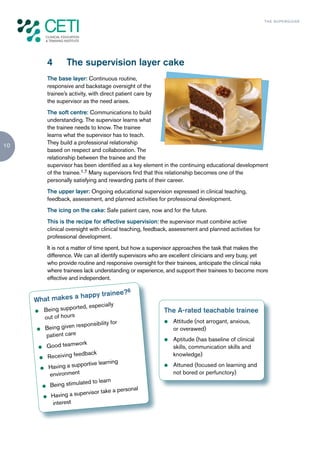
              4          The supervision layer cake
              The base layer: Continuous routine,
              responsive and backstage oversight of the
              trainee’s activity, with direct patient care by
              the supervisor as the need arises.
              The soft centre: Communications to build
              understanding. The supervisor learns what
              the trainee needs to know. The trainee
              learns what the supervisor has to teach.
              They build a professional relationship
10
              based on respect and collaboration. The
              relationship between the trainee and the
              supervisor has been identified as a key element in the continuing educational development
              of the trainee.1,7 Many supervisors find that this relationship becomes one of the
              personally satisfying and rewarding parts of their career.
              The upper layer: Ongoing educational supervision expressed in clinical teaching,
              feedback, assessment, and planned activities for professional development.
              The icing on the cake: Safe patient care, now and for the future.
              This is the recipe for effective supervision: the supervisor must combine active
              clinical oversight with clinical teaching, feedback, assessment and planned activities for
              professional development.
              It is not a matter of time spent, but how a supervisor approaches the task that makes the
              difference. We can all identify supervisors who are excellent clinicians and very busy, yet
              who provide routine and responsive oversight for their trainees, anticipate the clinical risks
              where trainees lack understanding or experience, and support their trainees to become more
              effective and independent.

                                            ee?6
                a happy train
     What makes
                           ed, especially
     z       Being support                                      The A-rated teachable trainee
             out of hours
                                            r                       Attitude (not arrogant, anxious,
                            sponsibility fo
                                                                z
     z       Being given re                                         or overawed)
              patient care
                                                                z   Aptitude (has baseline of clinical
                           rk
      z       Good teamwo                                           skills, communication skills and
                             back
         z    Receiving feed                                        knowledge)
                          ortive learning
         z  Having a supp                                       z   Attuned (focused on learning and
            environment                                             not bored or perfunctory)
                                     n
          z Being st
                     imulated to lear
                                            sonal
                            visor take a per
          z  Having a super
             interest
5       What makes a good supervisor?

                    Supervisory skills
                    Being available: This is the big one: trainees feel
                    lost when they encounter a clinical situation beyond          The A-rated clinical
                    their current ability and they cannot get advice from           supervisor
                    their supervisor.
                                                                                  z   Available
                    Being in charge: Supervisors should know what is
                                                                                  z   Approachable
                    going on under their watch and should give clear and
                    reasonable directions to trainees. Trainees should            z   Able (as both clinician                             11
                    know what is expected of them at all times.                       and teacher)
                    Being vigilant: Supervisors should know what is                z Active (finds the gaps)
                    going on with patients under their care, and be ready
                    to respond personally if necessary. Supervisors
                    should know their trainees, and should know what
                    level of supervision is necessary for safe practice. They anticipate red flags and actively
                    find the gaps in trainee performance.
                    Being organised: To make the most of the limited time available.


                    Personal skills
                    Empathy: Do you remember what it was like to be a trainee? A good supervisor uses
                    insight and understanding to support the trainee.
                    Respect: Showing respect for trainees and others, regardless of their differences from
                    yourself, engenders respect.
                    A direct manner and honesty in communications: A common problem for trainees is
                    uncertainty about what their supervisor thinks or wants. Honest feedback from supervisors
                    is highly valued.
                    Confidentiality: Trainees are more open and honest about errors or lack of competence if
                    they can discuss these matters in confidence with their supervisor.
                    A motivating and positive attitude: Most people respond more to encouragement than
                    to criticism, and criticism is more effective is if framed in constructive terms (“You are
                    doing this well and will do even better when you ...”)
                    Willingness to allow the trainee to grow, be independent and make some mistakes.


                    Clinical skills
                    Contrary to the old saying, in medicine, those who cannot do, cannot teach. The modelling
                    of good clinical skills is one of the chief ways that supervisors help their trainees.
                    The clinical skills of supervisors should be up-to-date and evidence-based.


FIRST EDI T I O N                                                                                         CETI TH E S U P E R G U I D E
TH E S U P E R G U I D E


     CLINICAL EDUCATION
     & TRAINING INSTITUTE


     Teaching skills
     Demonstrating clinical skills: providing hands-on care for patients in the presence of
     trainees — and discussing what is being done.
     Linking theory and practice: that is, not only demonstrating skills but explaining the logic
     and the evidence behind the practice.
     Providing opportunities to practice skills: making time and space available for the
     trainee to be hands-on, breaking procedures into steps, providing direction, sharing care.
     Collaborative problem solving: giving trainees a clinical problem and working with them
     towards a solution.

12   Socratic method: asking questions to discover the state of the trainee’s knowledge and to
     encourage independent thinking and problem-solving is a key method of effective medical
     teaching. Effective questioning reveals what it is that really needs to be taught, uncovers
     misunderstandings, and reinforces and extends existing knowledge. Questions keep
     trainees engaged, “on their toes”, listening and thinking. One proviso: don’t use questions to
     “prosecute” or humiliate the trainee, or to show off your own expansive knowledge.
     Individualising learning: is only possible if you begin by asking questions. Teaching
     is more effective if it is tailored to the trainee’s interests, ambitions and current level of
     knowledge and ability.
     Giving feedback: that is timely, specific, constructive and given in an appropriate
     environment. Good givers of feedback also invite feedback from the trainee, with a view to
     improving their teaching technique.
     Providing appropriate learning resources: knowing what is available to help trainees
     and selecting material pitched at the appropriate level.


         What makes a poor supervisor?
         Absence: supervision that is remote or infrequent is dangerous and
         ineffective.
         Rigidity: setting rules without giving reasons, giving orders without
         explanations. This is not to say that supervisors have to explain everything
         all the time — but there has to be a time for explanations. The justification
         for systems is one of the things trainees must learn.
         Intolerance and irritability: leads trainees to avoidance (hiding errors and gaps in their
         competence).
         Not teaching.
         A negative or relentlessly critical attitude: especially publicly criticising the trainee’s
         performance or seeking to humilate the trainee.
         Treating trainees as clerks: trainees can benefit from doing the paperwork, but not if that’s all
         they do. Opportunities for hands-on clinical care and meaningful interactions with patients and
         the clinical team are essential.
         Writing off trainees in difficulty: there are many reasons for suboptimal performance,
         including poor orientation or poor supervision, which can be addressed with simple measures.
6       A matter of time

                    Many consultants report that they simply do not have the time to actively supervise
                    trainees in the way that they would like. This is a real problem with no easy solutions.
                    However, time spent actively supervising trainees is rewarded in two ways. The first is that
                    active supervision improves trainee performance, which saves time and trouble in patient
                    care. The second is that supervisors who increase their involvement with trainees tend
                    to report higher levels of job satisfaction, as playing a leading role in the development of
                    junior doctors is personally rewarding. It builds better team interactions and contributes to
                    self esteem for all involved.
                                                                                                                                          13
                    Even small changes in how supervisors organise their clinical duties can make big
                    differences to the effectiveness of supervision.


                    Tips for time management
                    “Budget” rounds: For a busy ward round on which you will have registrars, prevocational
                    trainees and students, consider en route which patients should be the subject of short
                    teaching points relevant to each level of trainee. For example:
                    z   For the student: a clinical sign to elicit.
                    z   For the prevocational trainee: a prescribing question that explores knowledge of
                        physiology and pharmacology, or a test to be interpreted.
                    z   For the registrar: questions about the evidence base behind a treatment decision.
                    One minute teaching moments: Develop mini-tutorials on key topics that break complex
                    issues into simpler teachable parcels.
                    Recycle: Having developed a stock of teaching points and mini-tutorials, the supervisor
                    can recycle them each term: they will still be fresh to the trainees.
                    Delegate and double the learning: Ask the registrar to design a series of questions
                    about a patient to teach the prevocational trainee clinical reasoning on a particular issue.
                    Or ask the prevocational trainee to be “registrar for a day” and present a case.
                    Share: Use staff meetings to share ideas for mini-tutorials and teaching points, and create
                    a bank of prepared teaching for all supervisors to use.


FIRST EDI T I O N                                                                                         CETI TH E S U P E R G U I D E
TH E S U P E R G U I D E


     CLINICAL EDUCATION
     & TRAINING INSTITUTE


     7           A key concept: hands-on, hands-off
     An effective supervisor knows when to give trainees direction, and when to give them
     freedom of action. To move the trainee from consciously incompetent to consciously
     competent, the supervisor must actively calibrate the level of support provided.
     Studies3,8 suggest that junior doctors value supervisory support of two kinds:
     z     “Hands-on” supervision — interactions with clinicians who are expert in areas where
           they need help
     z     “Hands-off”supervision — being trusted to act independently, being given space to
           deploy their nascent skills and test their growing clinical abilities.
14
     Trainees also value an intermediate zone that allows them to shift back and forth between
     monitored (hands-on) and independent (hands-off) practice.


       “Hands-on” supervision                       “Hands-off” supervision
       Positive examples:                           Positive examples:
       z     Guidance on procedures,                z   Identifying crucial supervision moments
             skills training sessions
                                                    z   Having enough room for developing
       z     Seeing patients with consultant            independence
       z     Discussing mistakes                    z   Feeling trusted
       z     Opportunities to discuss patient       z   Opportunities for de-briefing
             management
                                                    Negative examples:
       Negative examples:                           z   Being left alone to deal with
       z     Feeling intimidated, humiliated            challenging situations
             and watched
                                                    z   Feeling abandoned – unable to contact
       z     Feeling disempowered                       senior staff
                                                    z   Needs for de-briefing not met


     From a supervisor’s point of view, both hands-on and hands-off supervision are
     active processes, requiring the exercise of judgment. How far along the trajectory of
     development is the trainee? When is it time to intervene? Hands-off supervision is not
     absence of supervision.
     In general, trainees need more hands-on supervision at the beginning of training and
     increasing amounts of hands-off supervision as they progress.
8       Case study: clinical supervision

                    Scenario
                    A consultant surgeon does a ward round of 30 patients with his registrar, an advanced
                    trainee and a new intern. The consultant has heavily booked rooms for which he is already
                    late, and Outpatients is ringing the registrar as there is a busy clinic requiring his presence.
                    One patient is noted to be uncooperative with mobilising post-procedure as she is too
                    dizzy and weak to attempt standing.

                    What next?                                                                                                               15

                     Path one                                   Path two
                     The consultant, preferring the             The consultant, knowing that the intern is new,
                     prompt responses of the advanced           asks her to get the charts and together they
                     trainee, barely looks at or speaks         examine the vital signs, the most recent lab
                     to the intern, and does not realise        results and the medication chart.
                     that she is new. He delegates to the
                                                                Through brief questions he has the intern
                     registrar to “sort it out” and leaves.
                                                                establish that the patient’s blood pressure is
                     The registrar advises the intern to        lowish, with postural hypotension, slow pulse
                     get a cardiology consult and goes          rate and rising creatinine and potassium.
                     to the clinic without leaving contact      Antihypertensives, ACE inhibitor and NSAIDs
                     details or a follow-up arrangement.        are ceased. This reveals the need for prompt
                     The cardiology registrar informs the       action: to repeat the potassium level, give IV
                     intern that she needs to get a CXR         fluids, secure an ECG and further monitoring,
                     and ECG and they will review the           and get an urgent renal consult.
                     patient tomorrow or the next day.          The consultant departs after requesting to be
                     The next day the patient has a severe      informed of progress in two hours. The intern is
                     bradycardic episode and is moved to        overwhelmed by work and forgets to call, but
                                                                the consultant rings to check and calls the renal
                     ICU. The consultant complains about
                                                                physician himself.
                     the intern in front of nursing staff and
                     the patient’s family.                      The patient is managed in the ward without a crisis.


                    Path one exemplifies bad supervision: the consultant abdicates rather than delegates
                    responsibility; he assumes a level of knowledge and experience that the intern does not
                    yet possess (he is hands-off when he should be hands-on); and, instead of support, he
                    blames the intern in circumstances that are humiliating. For some trainees, this kind of
                    experience can be a career-breaker.
                    Path two exemplifies good supervision: the consultant is an active, not passive,
                    supervisor; he identifies and addresses the unconscious incompetence of the intern;
                    teaches by checking level of understanding and building from there through logical
                    questioning; ensures that responsibility is clearly delegated and follows up to check.
                    Patient safety is assured now and made more likely for the rest of the trainee’s career.


FIRST EDI T I O N                                                                                            CETI TH E S U P E R G U I D E
TH E S U P E R G U I D E


     CLINICAL EDUCATION
     & TRAINING INSTITUTE


     Part two:
     Clinical teaching
                   “Good teaching is nothing to do with making things hard.
                      It is nothing to do with frightening students. It is everything
                      to do with benevolence and humility; it always tries to help
                      students feel that a subject can be mastered; it encourages
                      them to try things out for themselves and succeed at
16
                      something quickly.”
                                    — Ramsden P. Learning to teach in higher education.
                                                            London: Routledge, 1992.
9     What makes good clinical teaching?


                                                             Teach the individual: ascertain what the
                    Collaboration and active involvement:    trainee is interested in and then direct your
                    adults like to have input into their     teaching to this motivation. For example: one
                    learning.                                may teach lumbar puncture differently to a
                                                             future anaesthetist than to a future
                                                         ●
                                                             psychiatrist. The first is more interested in
                    Relevance: to the clinical duties
                                                             performing the procedure and will need                                       17
                    currently required of the trainee,
                                                             comprehensive knowledge; the second may
                    or (even better) to the future
                                                             focus on when the procedure may be
                    career plans of the trainee.
                                                             required diagnostically and the risk involved.


                                                             A failure of some didactic teaching (lecturing)
                    Appropriateness to the level of the      is that time is spent teaching trainees things
                    trainee.                                 they already know. Didactic teaching is most
                                                         ●   effective when you know the knowledge
                                                             base of your audience (ask first).
                    Socratic method: asking and
                    encouraging thinking.                    The advantage of the Socratic method is
                                                             that is reveals what trainees do know and
                                                             invites them to extend their knowledge. But:
                                                             don’t turn questioning into a grilling.

                    Setting clear goals: so that trainees
                    know what learning outcomes are
                    expected.
                    Clear goals are SMART:
                    Specific; Measurable; Attainable;
                    Realistic and Timely.                    Simply telling people what you expect them
                                                             to learn will focus their attention in a clinical
                    Giving feedback: so that                 encounter.
                    trainees know how they               ●   Feedback given and received lets everyone
                    are going.                               know whether the intended outcomes are
                                                             being achieved.
                                                             Adult learning is a collaboration between
                    Seeking feedback: so that you
                                                             teacher and student.
                    know how effective your teaching
                    has been.


FIRST EDI T I O N                                                                                         CETI TH E S U P E R G U I D E
TH E S U P E R G U I D E


     CLINICAL EDUCATION
     & TRAINING INSTITUTE


     10 Ten top tips for teaching
        1 Every little bit helps. Even if you don’t have the whole package worked out, it’s still
            worthwhile sharing what you can, as best you can. Don’t have time to run through a
            procedure in full? Draw the trainee’s attention to one key aspect of technique. No time
            for a complete debrief after a critical incident? Ask a few key questions to check trainee
            understanding of what occurred and give quick feedback. Seize the teaching moment.
        2 Develop teaching “pearls”. Pearls are two-minute scripts that teach key lessons
            relevant to your clinical practice. You need to practice these lessons to make them
            as short and clear as possible — then you can use them again and again.

18      3 Use the Socratic method. Ask questions to discover the state of the trainee’s knowledge
            and to encourage independent thinking and problem-solving. Questions keep trainees
            engaged, “on their toes”, thinking and listening. One proviso: don’t use questions to
            “prosecute” or humiliate the trainee, or to show off your own expansive knowledge.
        4 Invite trainees to set the agenda. It is a basic principle of adult learning that the
            student should be involved in decisions about the direction and content of learning.
            Your ultimate objective as a supervisor is to foster the trainee’s ability for self-directed
            lifelong learning.
        5 Encourage questions. Trainee questions should always be treated with respect.
            You may be shocked that they did not already know, but on closer inspection, may
            discover that others are just keeping quiet. The three most important words in
            teaching and learning are “I don’t know”.
        6 Focus the learner. Start any teaching by setting up the importance of the lesson.
            Teaching is more effective if it is tailored to the trainee’s interests, ambitions and
            current level of knowledge and ability. Answer the question: why should trainees
            pay attention to what you are about to teach?
        7 Focus the lesson. Don’t try to teach too much at once. Try not to repeat what the
            trainee already knows. Clinical situations are complex, but limit the lesson to the key
            aspects that are at the leading edge of the trainee’s knowledge. Procedures can be
            broken down into steps, not all of which have to be covered in one lesson.
        8 Demand independent learning. Don’t try to teach everything — give enough
            information to set trainees on track, then ask them to complete the picture themselves.
            Set tasks that require trainees to act on the information you have provided. Keep
            learning open-ended.
        9 Teach evidence-based medicine. Build a lifelong learning attitude in your trainees.
            Even more important than knowing the current best answer to a clinical problem is
            having the skills to identify a clinical question, search the medical literature, appraise
            the evidence and form an evidence-based plan.
     10 Evaluate your own practice as a teacher. How well did your trainees learn the
            lesson you intended? Every time you teach you have a chance to learn how to do
            it better (and more easily) next time. Try different methods and compare trainee
            outcomes. Seek feedback from your trainees. Compare notes with your peers.
11 Learn to teach
                    Clinical teaching is a skill that must be learned like everything else in medicine.
                    If you haven’t done it already, look for an opportunity to do the Teaching on the run training
                    course, developed by Professor Fiona Lake and colleagues at the University of Western
                    Australia.
                    Workshops are designed for 12–16 participants and run for 2–3 hours. Each workshop
                    uses a variety of small group teaching techniques including discussion, video presentation,
                    small group work and reflection.
                    The workshops are:
                                                                                                                                            19
                          1 Clinical (bedside) teaching              4 Supporting trainees
                          2 Skills teaching                          5 Planning term learning
                          3 Feedback and assessment                  6 Effective group teaching


                    Look on the CETI website for information about Teaching on the run workshops and
                    contacts in New South Wales.
                    Teaching on the run: teaching tips for clinicians9 is an
                    excellent pocket book full of distilled practical advice from
                    the workshops. It can be purchased online from the eMJA
                    Shop <http://shop.mja.com.au>, or from the University of
                    Western Australia <http://msc.uwa.edu.au/meddent/totr>.
                    The articles that make up the book can also be viewed online
                    for free at <www.mja.com.au> or <http://www.meddent.uwa.
                    edu.au/teaching/on-the-run/tips>.
                    For those of you who are really on the run, the following pages
                    contain a super-short guide to clinical teaching for supervisors.


FIRST EDI T I O N                                                                                           CETI TH E S U P E R G U I D E
TH E S U P E R G U I D E


     CLINICAL EDUCATION
     & TRAINING INSTITUTE


     12 Bedside teaching
     Bedside teaching is at the heart of effective clinical training: it is the place where theoretical
     knowledge is made practical in the real world, with real patients. Research at the University
     of Newcastle and John Hunter Hospital suggests that bedside teaching is enjoyed by most
     patients and considered by trainees to be the most effective way to learn clinical skills.10


     Tips for bedside teaching10-12
     Patient comfort issues
20   z     If possible, provide advance notice of visit.
     z     Limit length of time for patient comfort.
     z     All procedures, discussions and communications should be explained and
           understandable to the patient.
     z     Avoid or modify presentations at the bedside.
     z     Visit the patient after rounds to give thanks and answer questions.

     Teaching
     z     Start small, and stay within your comfort zone as a teacher.
     z     Use the patients you have: what’s old to you is new to the trainee.
     z     Budget time for bedside teaching, but use a visit you would have been making anyway.
     z     If time is short: demonstrate, make a key point to the trainee, ask a key question,
           move on.
     If time is available:
     z     Orient the trainee to your plans for the session. Negotiate the goals. Tell the trainee
           what is to be taught.
     z     Involve trainees: let them select patients or the focus of teaching; ask them to
           perform all or part of the interview, examination or procedure, or get them to
           demonstrate the abnormal finding.
     z     The Socratic method is generally better than just telling, because it allows you to
           assess the trainee’s knowledge and motivation.
     z     If explaining, ask for report back to check understanding. If directing: ask the trainee
           “Why am I asking you to do this?”
     z     Ask trainee to elicit part of the history — see if they are on track to finding the right
           diagnosis.
     z     If trainee is off track, make a smooth transition to take over the clinical interaction.
     z     Don’t criticise trainees at the bedside. Debrief elsewhere.
     z     Afterwards: seek feedback. Reflect on the effectiveness of the session and prepare
           for next time.
13 Examples of bedside teaching

                    Case 1
                    A supervisor and an intern are doing a ward round of patients admitted under their
                    care during the preceding night.
                    At the bedside the intern presents Mr J, an obese 69-year-old man who has been
                    admitted with a provisional diagnosis of ureteric colic and is awaiting a CT KUB study.
                    The patient is described as stable, with normal electrolytes and creatinine.
                    The supervisor enquires as to what features in the history led to the provisional                                    21
                    diagnosis and the intern describes the patient as having awoken from sleep with
                    severe left-sided abdominal pain from renal angle to the groin. His distress had settled
                    significantly after IV morphine.
                    The supervisor then asks about the symptoms associated with the pain that are typical
                    of hollow organ colic. He encourages the intern to make fresh inquiries of the patient
                    at the bedside, where it becomes clear that rather than being restless with the pain, he
                    feels the need to lie very still, and was initially very faint, although this has settled.
                    Leading the intern to check current vital signs, the supervisor then asks the intern if
                    other differential diagnoses were important to exclude and how promptly this could be
                    determined. The intern then recognises the possibility of a ruptured aortic aneurysm
                    and together the supervisor and intern initiate the immediate actions required.


                    Case 2
                    A respiratory physician and an RMO are at the bedside of a 45-year-old woman
                    admitted with breathlessness. The RMO is keen to complete his paperwork, but the
                    supervisor asks the RMO to demonstrate the abnormal signs in the respiratory system.
                    As a budding obstetrician, the RMO jokes that this is not something he will need to do
                    often. The physician reminds him that nearly all his third trimester patients will complain
                    of breathlessness, and the RMO responds with more focused interest. The patient
                    understands that this interaction is based on her case, but that some of it is theoretical
                    teaching and she should not be concerned.
                    A brief review of the resident’s technique reveals that he is leaving no time for
                    auscultation in exhalation. This is corrected. The causes of a “clear” chest with a large
                    A:a gradient and the best investigation for breathlessness for both pregnant and non-
                    pregnant patients is discussed.


FIRST EDI T I O N                                                                                        CETI TH E S U P E R G U I D E
TH E S U P E R G U I D E


     CLINICAL EDUCATION
     & TRAINING INSTITUTE


     14 Rounds
     Ward rounds are an opportunity for junior doctors to learn and improve their skills, not
     only in patient care, but also in teamwork and communication. They are where important
     decisions are made in patient care and where management plans are formulated.
     They are invaluable opportunities for supervisors to teach junior doctors in a practical
     setting with patient and multidisciplinary team involvement.
     As a minimum, consultants should aim to achieve the following in their ward-based teaching:
     z     Adequate communication of a management plan, with opportunities for clarification
           (including questions) by junior medical staff.
22
     z     A teaching point to be illustrated at
           each ward round. Even five minutes of
           teaching on each ward round will make a         McLeod’s guidelines for effective ward
           difference to trainee performance.              rounds:14
                                                           z   Planning: brief trainees on the purpose
     z     Observe at least one short case study
                                                               of rounds and seek information about
           per term with each trainee.                         trainee expectations and abilities.
     z     Collaborate with other staff members to         z   Timing: select patients for discussion.
           assess the clinical, communication and
                                                           z   Preparation: do background reading for
           professional skills of trainees and provide
                                                               selected cases.
           them with informal appraisals.
                                                           z   Patients: good learning occurs with
                                                               patients who can give a reliable history,
     Tips for teaching during rounds                           present with atypical manifestations
                                                               of common disease, exemplify
     See also “Tips for bedside teaching” on page 20.
                                                               pathophysiology, or present challenges
     z     Ensure that all team members are actively           to the instructor’s level of expertise.
           engaged in the process.                         z   Location: bedside for the experience of
                                                               an actual patient.
     z     Make learning an explicit objective of
           ward rounds and make the specific               z   Format: a mixture of problem-oriented
           learning outcomes of each round explicit            (case presentation leading to management
           (“So, what is the lesson of this case?”).           plan), basic-science (signs and
                                                               symptoms considered from anatomic
     z     Build the team through discussion                   and pathophysiological perspectives),
           and delegation of responsibility. Give              clinical skills (history-taking, physical
           different team members a chance to                  examination).
           lead discussion or present a case.              z   Emphasis: problem-solving rather than
           Prevocational trainees enjoy an                     fact-accumulating.
           opportunity to be “registrar for a day”.
                                                           z   Trainee participation: usually have the
     z     A recent study found that more time was             junior member of the team present the
           devoted to patients discussed earlier in            case, but sometimes use a senior to save
           the round, regardless of diagnosis, and             time and to provide a role model.
           recommended that the order of patient           z   Assessment and feedback: is for
           discussion should be planned to highlight           everybody on the team. Questions must
           specific teaching points.13                         be encouraged.
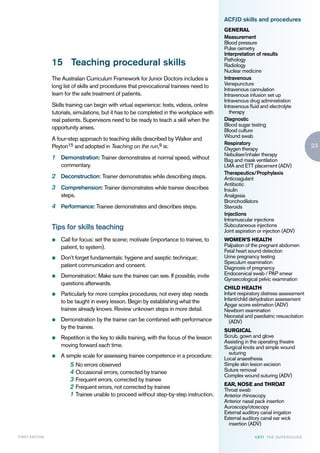
ACFJD skills and procedures
                                                                                                 GENERAL
                                                                                                 Measurement
                                                                                                 Blood pressure
                                                                                                 Pulse oximetry
                                                                                                 Interpretation of results
                    15 Teaching procedural skills                                                Pathology
                                                                                                 Radiology
                                                                                                 Nuclear medicine
                    The Australian Curriculum Framework for Junior Doctors includes a            Intravenous
                    long list of skills and procedures that prevocational trainees need to       Venepuncture
                                                                                                 Intravenous cannulation
                    learn for the safe treatment of patients.                                    Intravenous infusion set up
                                                                                                 Intravenous drug administration
                    Skills training can begin with virtual experience: texts, videos, online     Intravenous fluid and electrolyte
                    tutorials, simulations, but it has to be completed in the workplace with        therapy
                    real patients. Supervisors need to be ready to teach a skill when the        Diagnostic
                                                                                                 Blood sugar testing
                    opportunity arises.                                                          Blood culture
                                                                                                 Wound swab
                    A four-step approach to teaching skills described by Walker and
                                                                                                 Respiratory                                    23
                    Peyton15 and adopted in Teaching on the run,9 is:                            Oxygen therapy
                                                                                                 Nebuliser/inhaler therapy
                    1 Demonstration: Trainer demonstrates at normal speed, without               Bag and mask ventilation
                        commentary.                                                              LMA and ETT placement (ADV)
                                                                                                 Therapeutics/Prophylaxis
                    2 Deconstruction: Trainer demonstrates while describing steps.               Anticoagulant
                                                                                                 Antibiotic
                    3 Comprehension: Trainer demonstrates while trainee describes                Insulin
                        steps.                                                                   Analgesia
                                                                                                 Bronchodilators
                    4 Performance: Trainee demonstrates and describes steps.                     Steroids
                                                                                                 Injections
                                                                                                 Intramuscular injections
                    Tips for skills teaching                                                     Subcutaneous injections
                                                                                                 Joint aspiration or injection (ADV)
                    z   Call for focus: set the scene; motivate (importance to trainee, to       WOMEN’S HEALTH
                        patient, to system).                                                     Palpation of the pregnant abdomen
                                                                                                 Fetal heart sound detection
                    z   Don’t forget fundamentals: hygiene and aseptic technique;                Urine pregnancy testing
                                                                                                 Speculum examination
                        patient communication and consent.                                       Diagnosis of pregnancy
                    z   Demonstration: Make sure the trainee can see. If possible, invite        Endocervical swab / PAP smear
                                                                                                 Gynaecological pelvic examination
                        questions afterwards.
                                                                                                 CHILD HEALTH
                    z   Particularly for more complex procedures, not every step needs           Infant respiratory distress assessment
                        to be taught in every lesson. Begin by establishing what the             Infant/child dehydration assessment
                                                                                                 Apgar score estimation (ADV)
                        trainee already knows. Review unknown steps in more detail.              Newborn examination
                                                                                                 Neonatal and paediatric resuscitation
                    z   Demonstration by the trainer can be combined with performance               (ADV)
                        by the trainee.
                                                                                                 SURGICAL
                    z   Repetition is the key to skills training, with the focus of the lesson   Scrub, gown and glove
                                                                                                 Assisting in the operating theatre
                        moving forward each time.                                                Surgical knots and simple wound
                                                                                                   suturing
                    z   A simple scale for assessing trainee competence in a procedure:          Local anaesthesia
                            5 No errors observed                                                 Simple skin lesion excision
                            4 Occasional errors, corrected by trainee                            Suture removal
                                                                                                 Complex wound suturing (ADV)
                            3 Frequent errors, corrected by trainee
                                                                                                 EAR, NOSE and THROAT
                            2 Frequent errors, not corrected by trainee                          Throat swab
                            1 Trainee unable to proceed without step-by-step instruction.        Anterior rhinoscopy
                                                                                                 Anterior nasal pack insertion
                                                                                                 Auroscopy/otoscopy
                                                                                                 External auditory canal irrigation
                                                                                                 External auditory canal ear wick
                                                                                                   insertion (ADV)

FIRST EDI T I O N                                                                                               CETI TH E S U P E R G U I D E
TH E S U P E R G U I D E


     CLINICAL EDUCATION
     & TRAINING INSTITUTE


     16 Example of teaching procedural skills

       Intern and registrar attend a patient who is having a short generalised seizure. The
       registrar applies bag valve mask ventilation with oxygen, demonstrating to the intern
       how to position the patient’s airway for patency, and asks how the effectiveness of
       ventilation can be monitored and assessed, as well as what to do if the patient vomits.
       When the patient’s condition has returned to regular respiration and oxygenation, the
       registrar disassembles another bag mask set up and then reassembles it step-by-step,
       demonstrating key aspects of the task to the intern.
       The equipment is disassembled again and the intern talks through the set up, how
24
       to position the patient’s airway and the need for ready access to suction. The intern
       takes over the application of the oxygen system and demonstrates the monitoring of
       adequacy of ventilation.
       By this time the patient has regained her normal level of alertness.
       Outcome: patient is better and intern is better at the procedure.
17 Teaching at handover
                    Well structured handover is an excellent learning
                    experience that integrates communication,                    Clinical handover is the effective
                    professionalism and clinical management. Trainees            transfer of professional responsibility
                    learn techniques of clinical description and case            and accountability for a patient, or
                    organisation in receiving a patient from others or           group of patients, to another person.
                    preparing to handover a patient to others. Handover          Failures in handover have been
                    is also an important team-building exercise.                 identified as a major preventable cause
                                                                                 of patient harm.16 Junior doctors need
                    The Acute Care Taskforce’s standard key principles           to be encouraged to value handover
                    for handover by Junior Medical Officers from                 and to see it as an essential and                                  25
                    shift-to-shift or team-to-team recommend senior              integral part of their daily work.
                    leadership should be present at handover to
                    decide who and what should be handed over.17
                    Experience has shown that senior staff supervision
                    of handover improves patient care, builds the skills of junior medical staff and reduces the
                    need to call consultants back.

                    Tips for teaching at handover
                    z   Supervisors can select particular patients at handover as the subject of bedside
                        teaching (see page 20 for more on bedside teaching).
                    z   Handover is an excellent opportunity for junior medical staff to take the lead in a
                        teaching session. Ask trainees to select a case to present in more detail.
                    z   Aim for one teaching point at each handover. A brief (not exhaustive) exploration of a
                        key issue is of lasting value for the trainees involved.
                    z   All trainees should be familiar with the ISBAR framework for communications at handover.


                        I
                             Introduction – Identify yourself,
                                                                  “I am (name and role), from (ward/facility) and I’m calling
                             role, location and who you are
                                                                  because (clear purpose)”
                             talking to.

                                                                  “The situation is that I have a patient (age/gender), who is

                    S
                             Situation – state the patient’s
                                                                  (diagnosis/deteriorating/stable). My concerns are (clear and
                             diagnosis/reason for admission
                                                                  succinct concerns). The current presenting symptoms are
                             and the current problem.
                                                                  (clear, current and relevant symptoms and observations).”
                                                                  By way of background (Give pertinent information which

                    B        Background – what is the
                             clinical background or context?
                                                                  may include: Date of admission / presenting symptoms /
                                                                  medication / previous recent vital signs / test results / status
                                                                  changes and any relevant medical history)
                             Assessment – What do you think

                    A        the problem(s) is? (Don’t forget to “My assessment on the basis of the above is that the
                             have the current vital signs and a patient is….. they are at risk of ... and in need of ...”
                             key problem list ready!)
                                                                  “My recommendation is that this patient needs (what

                    R        Recommendation – What are
                             you asking the person to do?
                                                                  test/action) by (who) within (timeframe).” Repeat to
                                                                  confirm what you have heard, eg, “I understand that I am
                                                                  to ... and you will …”


FIRST EDI T I O N                                                                                                   CETI TH E S U P E R G U I D E
TH E S U P E R G U I D E


     CLINICAL EDUCATION
     & TRAINING INSTITUTE


     18 Other clinical teaching opportunities

          !        Emergency team responses
                When the crisis team attends a critical incident, it operates according to a strict
     protocol, and there is no time for explanations. It is important to review the event afterwards,
     or the trainee may remain in the dark about why things happened the way they did.
     A few pertinent questions to reveal the trainee’s understanding of the key issues are better
     than nothing when a full debrief is not possible. If time is short, at least you can point the
     trainee to sources of further information.
26


      ¹ After-hours episodes
              Most of the week occurs “after hours”. Much of the trainee’s experience is drawn
     from episodes of care provided “after hours”. Supervision and training needs after hours
     are greater and require careful involvement of all senior clinicians at the point of care, at
     handovers and on the telephone to ensure active “find the gaps” supervision is provided.
     After-hours ward calls are often a source of anxiety for the trainee, as the patients and
     their conditions are unfamiliar. The senior clinician must be alert to this unfamiliarity and
     provide a supportive environment while the trainee explains the situation. The supervisor
     must employ responsive oversight and be alert to every cue that the trainee may need
     direct supervision. This is often at the most inconvenient time for both the trainee and
     the supervisor, yet the power of reasoning a clinical problem together can enhance your
     patient’s safety and the trainee’s ability to manage independently in future.
     The practice of each facility in alerting the AMO to a change in their patient’s condition
     may vary slightly, but accountability for patient care is with the AMO. The follow-up
     of any unexpected change in condition remains the responsibility of the AMO. It is
     hazardous to assume that all is well if the trainee has not reported back on the result
     of planned interventions. On these after-hours shifts, the trainee may be distracted
     or overloaded with other patient problems, or may fail to recognise the red flag. Well
     documented instances of such occurences have been reported.2


        ?         Consultations
               Advice from consultants and registrars from other specialist teams is often
     required for patient care. When a supervisor consults another team, the trainee should
     be included if possible because good communication skills are best acquired from role
     model opportunities. Delegating a consultation to a trainee without hands-on supervision
     is only appropriate in considered circumstances, but can be a key learning opportunity, as
     the trainee must distil the history, examination and progress, as well as frame the clinical
     question to be answered. Trainees often report being asked to arrange consultations without
     understanding why. Supervisors need to check that the trainee understands the purpose of
     the consultation and can communicate this to the consulting team. Ideally, the consulting
     team should record their reasoning and recommendations in responding to the request.
(       Phone
                                Many clinical consultations and episodes of supervision take place over the
                    phone. Despite the distance, the supervisor’s responsibility for patient safety is no less
                    than when present at the point of care. There is a tendency to abbreviate phone calls to
                    a minimum of information exchange, but the phone can be used to put the supervisor
                    “virtually there” with the trainee during clinical encounters. Because the supervisor cannot
                    see or touch the patient, there is an increased focus on the trainee’s communication skills.
                    Particularly in non-urgent contexts, the supervisor can work with the trainee to clarify the
                    trainee’s phone communication technique:
                    z   Practise the ISBAR communication framework (see page 25).
                    z   Provide feedback to the trainee on the trainee’s selection and presentation of clinical                          27
                        information.
                    z   Practise the “report-back” technique of confirming the content of a phone
                        communication (repeat the essence of what you have been told and repeat the
                        decisions for action that have been made) and require the trainee to do the same.


                                       Telephone terrors
                                       Fear of difficult conversations with consultants
                                       and registrars can discourage junior doctors
                                       from making a phone call at the time when it is
                                       most needed.
                                       Supervisors need to support trainees use of the phone and develop
                                       their skills in presenting appropriate information.


FIRST EDI T I O N                                                                                        CETI TH E S U P E R G U I D E
TH E S U P E R G U I D E


     CLINICAL EDUCATION
     & TRAINING INSTITUTE


     19 Giving feedback
     According to the JMO Forum, CETI’s representative body of prevocational trainees, verbal
     feedback on how they are doing is one of the most important things that trainees hope to
     receive from their supervisors.


     How to give effective feedback9,18
     z     Be timely. Give feedback as close as
           possible to the event. Don’t wait until the       Consequences of a lack of clear
           end of term. However, pick a good moment          feedback to a trainee who is not
28                                                           performing adequately18
           for feedback (not when you or the trainee is
           exhausted, distracted or upset). Feedback         z   Clinical care is not as good as it
           on performance should be a frequent                   could be.
           feature of your relationship with your            z   Anxieties and inadequacies
           trainees.                                             are not addressed. The trainee
     z     Be specific. Vague or generalised praise or           carrries these on to the next term.
           criticism is difficult to act upon. Be specific   z   When weaknesses are exposed
           and the trainee will know what to do. Adopt           later, the trainee has difficulty
           a straightforward manner and be clear.                accepting criticism because of
     z     Be constructive. Focus on the positive.               previous “good reports”.
           Avoid dampening positive feedback by              z   Others are blamed when the
           qualifying it with a negative statement (“I was       trainee is unsuccessful.
           very happy with your presentation, but ...”).
           For criticism, talk in terms of what can be       z   Learning is inhibited, career
           improved, rather than what is wrong. Try to           progression is delayed.
           provide feedback in the form of solutions and     z   Other, more frank, supervisors
           advice. At the same time, if the trainee makes        may be devalued and attacked
           an error, feedback needs to be unambiguous            later.
           (“You didn’t use the correct technique for
           tying that knot. Next time ...”
     z     Be in an appropriate setting. Positive feedback can be effective when given in the
           presence of peers or patients. Negative feedback (constructive criticism) should be
           given in a private and undisturbed setting.
     z     Use attentive listening. Trainees should be given the chance to comment on the
           fairness of feedback and to provide explanations for their performance. A feedback
           session should be a dialogue.
20 Formal teaching
                    As a senior clinician, you are likely to be called upon to give lectures, and the one clear
                    advantage is that your subject will probably match your expertise. Practice these tips to
                    make your lectures effective:
                    z   Consider your audience and shape your material to make it relevant to their current
                        knowledge, current clinical responsibilities and objectives. If in doubt, consider using
                        questions at the start of your lecture to establish where to pitch your talk.
                    z   Think about lectures you have enjoyed or remembered and try to apply similar
                        techniques.
                                                                                                                                          29
                    z   Don’t read your lecture — most of all, don’t read your Powerpoint slides. Talk to your
                        audience.
                    z   Stories, jokes and analogies are useful tools to make facts memorable.
                    z   The first five minutes are vital: capture interest with a compelling start (why should
                        the audience listen?), and explain what you intend to cover in your talk. If you have
                        one key point above all, make it early.
                    z   Respond to visual cues from the audience to change pace. Ask a question if you are
                        not sure that the audience is with you.
                    z   Vary your delivery and technique. Consider breaking the lecture with questions to or
                        from the audience, or an activity to be carried out by the audience.
                    z   Close your lecture strongly, with a summary of what you hope the audience will take
                        away.
                    z   Avoid overstuffing your lecture with material.


                    More tips
                    z   A great guide is Delivering a lecture at http://teaching.berkeley.edu/bgd/delivering.html,
                        from the book Tools for Teaching.19


                    Beyond the lecture
                    Don’t forget the broad spectrum of teaching methods available to you as a teacher as
                    alternatives or adjuncts to the lecture:
                    z   simulations and role plays
                    z   videos to demonstrate techniques or behaviours
                    z   group discussions, case studies and problem-based learning
                    z   computer-based education
                    These subjects go beyond what we can cover in this book — so explore. Even the
                    simplest departures from the standard lecture format will make your lesson more
                    memorable.


FIRST EDI T I O N                                                                                         CETI TH E S U P E R G U I D E
TH E S U P E R G U I D E


     CLINICAL EDUCATION
     & TRAINING INSTITUTE


     Part three
     Trainee management
                   “Supervision is a key component of working in a team.
                      Supervision demonstrates a respect for supporting junior
                      clinician learning and welfare and requires both supervisor
                      and junior clinician to commit to supervision as an ethical
                      and professional responsibility. Participation in supervision
30
                      requires the supervisor and the junior clinician to be honest
                      about performance and progress and to have the courage to
                      raise problems when they occur.”
                                                       — Tay T, Sanger M, Llewellyn A.
                                     Best practice model for junior clinician supervision.
                                                          Newcastle: HNEAHS, 2009.
21 Keeping trainees safe and well
                    The transition from university student to prevocational trainee can be stressful:
                    z   Loss of structured learning environment coupled with increased demands on
                        knowledge and performance
                    z   Longer hours
                    z   New responsibilities and confrontations with life and death experiences
                    z   Unprecedented levels of administrative duties that may conflict with the trainee’s
                        self-image as a professional clinician
                    z   Frequent changes in work environment, patients, team partners and bosses.                                           31
                    A national survey of JMOs in 2008 found that some JMOs had serious difficulty adjusting
                    to their role, or felt that their workload was excessive, stressful or unsafe.21
                    Good supervision:20
                    z   keeps the trainee safe and well by actively monitoring the trainee’s level of stress and
                        ability to cope
                    z   acknowledges the trainee as a person
                    z   clearly defines the roles and responsibilities of the trainee
                    z   addresses the needs of the individual trainee
                    z   ensures feedback is provided in a positive way and addresses weaknesses clearly and
                        unambiguously
                    z   acknowledges and manages factors that may influence the relationship (eg, seniority,
                        gender, race)
                    z   is provided in a supportive, professional but friendly environment, free from any
                        intimidation
                    z   is conducted in the context of building a clinical team in which all members are accorded
                        professional respect.

                    See also
                    z   Common challenges for term supervisors, page 49
                    z   Managing a trainee in difficulty,
                        page 50.


FIRST EDI T I O N                                                                                           CETI TH E S U P E R G U I D E
TH E S U P E R G U I D E


     CLINICAL EDUCATION
     & TRAINING INSTITUTE


     22 The role of the registrar in supervising JMOs
     Much of the advice in this book can be applied by registrars as well as by senior clinicians,
     but there are some specific features of supervision by registrars.
     Junior medical officers report that most hands-on supervision is provided by registrars,
     who also provide much of their effective clinical teaching. The relative informality of the
     supervision provided by registrars is highly valued by junior doctors. Registrars are more
     like mentors than managers; they are closer to junior doctors in age and experience; they
     can be easier to approach and more likely to take the time required to answer questions
     and demonstrate procedures. These features of the registrar–trainee relationship have
     advantages but also limitations. For example, a registrar is likely to have spent more time
32
     engaged in clinical activities with a prevocational trainee and is in a good position to give
     informal feedback, but this very closeness and informality may inhibit the registrar’s ability
     to make a formal summative assessment of the prevocational trainee’s performance.
     Here are some tips for both registrars and senior clinicians to make best use of registrar-
     level supervision:


       For the registrar                              For the senior clinician
       z     Your role in supervision and teaching    z   Developing supervisory skills is an
             is highly valued. Enjoy it.                  important part of registrar training.
       z     Supervise junior doctors with the            Delegate supervisory responsibilities
             understanding that you would like            to registrars, assess their performance
             your supervisors to show you.                and provide training and feedback.

       z     Don’t assume a responsibility for        z   Because of their closer experience,
             supervision above your seniority. The        registrars will often have more
             AMO cannot abdicate responsibility           insight into the skills, mental state
             for patient care; the term supervisor        and progress of your prevocational
             is responsible for the welfare of            trainees than you do. Seek their
             trainees in the term. Report problems        opinion as part of assessing your
             upwards.                                     trainees (but do not substitute their
                                                          opinion for an exercise of your own
       z     The Director of Prevocational Training       judgement).
             is an alternative source of advice if
             there are problems between senior        z   The ultimate responsibility for
             supervisor and prevocational trainee         assessing trainees and managing
             that leave you feeling squeezed.             their welfare remains with the term
                                                          supervisor.
       z     Take advantage of the Teaching on
             the Run program to learn skills that     z   A useful experience for junior doctors is
             will be valuable throughout your             the opportunity to step up to registrar-
             clinical career — see page 19.               level experiences from time to time.
                                                          Secure the registrar’s involvement in
                                                          planning these opportunities.
23 Mentors and buddies
                    Mentors are senior clinicians who are paired with juniors to provide guidance and support,
                    and buddies are pairings of junior clinicians (usually one with a bit more experience than
                    the other) for similar purposes. Informal mentoring and buddy relationships develop all
                    the time in clinical practice, but they can also be formalised and deliberately fostered by
                    supervisors as a support to supervision and training.
                    Providing a mentor or a buddy can be an effective way of:
                    z       introducing a trainee to a new facility or a new term
                    z       helping a trainee in difficulty by giving an extra avenue of support
                                                                                                                                               33
                    z       building closer links within and between clinical teams.
                    Generally speaking, a formal mentor or buddy to a trainee should not also be a supervisor
                    of that trainee, as the roles can conflict.


                    To be a good mentor18,22

                        Do                                                   Don’t
                        z    Create a safe and supportive                    z   Dominate or control the trainee
                             environment                                         (physically, verbally, psychologically)
                        z    Establish and develop a professional            z   Allow interruptions to your mentoring
                             relationship built on mutual respect and            time or be distracted/interrupted by
                             trust                                               “more important” issues
                        z    Build rapport and actively listen               z   Convey what you think the trainee
                        z    Establish the focus of your mentoring               wants to hear if it is inappropriate
                             relationship, including an agreement for        z   Harshly criticise or attack the trainee
                             working together
                                                                             z   Assume that trainees are used to
                        z    Work together to identify, agree upon               being given constructive feedback —
                             and realise the trainee’s goals                     many have undesirable experiences
                        z    Empathise. Allow the trainee to express         z   Take over, show the trainee what
                             feelings. Remain sensitive and patient.             to do, show off your knowledge or
                        z    Provide constructive feedback and                   insist on the trainee doing things
                             clarify how the trainee would like                  your way
                             feedback conveyed                               z   Create dependency on you
                        z    Ask appropriate and relevant questions
                                                                             z   Show irritation, impatience or
                             that facilitate communication and
                                                                                 annoyance
                             clarification
                                                                             z   Talk more than you listen
                        z    Identify and encourage strengths in the
                             trainee                                         z   Forget what you experienced when
                                                                                 you were learning and developing
                        z    Encourage the trainee to think reflectively
                             and critically explore options together         z   Breach confidentiality


FIRST EDI T I O N                                                                                              CETI TH E S U P E R G U I D E
TH E S U P E R G U I D E


     CLINICAL EDUCATION
     & TRAINING INSTITUTE


     Part four
     Term supervision


34
                              z   Term supervisors play a
                                  key role in the education
                                  and training of junior
                                  doctors. The system
                                  cannot work without
                                  them, but ...


                            ... You are not alone
                            Term supervisors are not meant to perform their role without
                            support. Responsibility for supervision rests with the whole
                            organisation.
         If senior staff feel that they are unable to provide adequate supervision, this should
         be escalated to managers who are responsible for assessing risk, managing
         resources to minimise the risk and monitoring outcomes.
         The organisation must:
         z    allow adequate time and training for skilled supervision
         z    agree on indicators of the quality of supervision and measure these regularly
         z    have a clear and transparent process for hearing and managing concerns about
              supervision that may be raised by junior or senior staff.
                                           — see also “The framework of supervision”, page 36.
24 The term supervisor’s role
                    A term supervisor leads a specific training term, whether that be one of the core training
                    terms in medicine, surgery or emergency medicine, or one of the elective terms in a wide
                    range of medical specialties, from paediatrics to geriatrics, general practice to neurosurgery.
                    The term supervisor’s role includes:
                    z   preparing and reviewing a term description that defines the trainee’s responsibilities
                        and the learning objectives of the term
                    z   defining, documenting and explaining specific knowledge and skills to be developed
                        during the term
                                                                                                                                            35
                    z   determining the level and proximity of supervision that will be required for each trainee
                    z   ensuring that systems of work and training within the term minimise risks and
                        support the safety of staff and patients
                    z   supporting trainee attendance at formal education sessions and providing effective
                        practice-based teaching
                    z   monitoring trainee progress and providing continual constructive feedback to the trainee
                    z   supporting the professional development of the trainee during the term, advising on
                        concerns, managing problems and giving career guidance
                    z   completing a mid-term formative appraisal of the trainee’s performance and an end-
                        term summative assessment.
                    Term supervisors work with the Director of Prevocational Education and Training (DPET)
                    to manage aspects of the professional development of trainees that run across terms.
                    A copy of term supervisor position description is shown on page 57.


FIRST EDI T I O N                                                                                           CETI TH E S U P E R G U I D E
TH E S U P E R G U I D E


      CLINICAL EDUCATION
      & TRAINING INSTITUTE


     25 The framework of supervision
     Term supervisors manage the welfare, training and assessment of trainees within a training
     term, but their role is supported by the individuals and institutions listed below.
     Director of Prevocational Education and Training (DPET): directs the training of
     prevocational medical trainees at each training site, and has a more continuous involvement
     with trainees than their supervisors, who change from term to term. The DPET is a clinician
     who provides support to supervisors and prevocational trainees independently of line
     management, and helps solve problems that can arise during training (eg, underperformance,
     mismatch of expectations, trainee distress, communication issues between trainee and team).
     The DPET is an advocate for trainee welfare within the hospital. The DPET is responsible
36   for providing a structured education program for prevocational trainees and evaluating its
     effectiveness. The DPET coordinates the assessment of trainees, co-signing all end-term
     assessments along with the term supervisor, and certifying interns as eligible for general
     registration upon the satisfactory completion the their internship. For more on the role of the
     DPET, see the DPET guide (www.ceti.nsw.gov.au).
     JMO Management Unit: is the centre for administration of employment, training and
     education of junior doctors. The JMO unit is the point of continuous contact for trainees
     throughout their time at a hospital, and JMO Managers are well placed to monitor trainee
     welfare. The JMO unit works closely with the DPET. It supports and monitor trainees,
     advocates for quality terms with good supervision, and ensures that training accreditation
     standards are met. Liaison with the JMO unit is an essential part of the term supervisor role.
     Director of Medical Services (DMS): as the senior clinician in charge of managing medical
     services in the hospital, is the responsible officer for issues affecting the employment,
     progression and registration of prevocational trainees.
     General Clinical Training Committee (GCTC): is a multidisciplinary body overseeing
     the welfare and training of prevocational trainees within the hospital, providing policy and
     management support to the DPET. Term supervisors can gain support and solve problems by
     participating in the GCTC.
     Network Committee for Prevocational Training (NCPT): prevocational trainees are
     assigned to a network of training sites rather than an individual hospital, and the coordination
     of their training within the network is supervised by the NCPT.
     Medical Division of CETI: Previously the NSW Institute of Medical Education and Training
     (IMET), the Medical Division has statewide responsibility for supporting the education and
     training of doctors employed by NSW Health. It sets accreditation standards for prevocational
     training and ensures that trainees are only employed in hospitals and training terms that
     meet these standards (see www.ceti.nsw.gov.au for more information). The Medical Division
     advocates for education and training, develops resources (such as this book), and oversees
     the operation of the training networks. Its Clinical Supervision Policy is shown on page 55.
     Medical Board of Australia (MBA): from July 2010, national registration of medical
     practitioners has replaced state registration. Interns must comply with the requirements of the
     MBA to achieve general registration. If an intern or resident is unfit to practise medicine, the
     MBA must be notified (this is a relatively infrequent process that involves the DPET, the DMS
     and the hospital Chief Executive).
26 Australian Curriculum Framework for Junior Doctors
                    Developed by the Confederation of Postgraduate Medical Education Councils, the
                    Australian Curriculum Framework for Junior Doctors (ACF)23 outlines the knowledge,
                    skills and behaviours required of prevocational trainees to work safely and effectively
                    in the Australian health system. The ACF is built around three learning areas: clinical
                    management, communication and professionalism.
                    By breaking down the requirements into specific performance elements, the framework
                    makes it easier to plan and assess training in the workplace. It can be used:
                    z   to provide a guide to appropriate goals for each training term
                    z   to review learning opportunities offered by existing training terms, and to identify                                 37
                        gaps in training
                    z   to plan development of new training terms
                    z   as a starting point for discussions about innovative approaches to clinical teaching
                        and professional development
                    z   to structure mid-term appraisal and end-term assessment.
                    The ACF includes a list of specific skills and procedures that trainees should learn over
                    the two years of prevocational training, and a list of common problems and conditions they
                    should learn to assess and manage.


                                                                  The ACF and supporting resources are available
                                                                  online: www.cpmec.org.au/Page/acfjd-project
                                                                  The complete Skills and Procedures list from the
                                                                  ACF is shown on page 23.


FIRST EDI T I O N                                                                                            CETI TH E S U P E R G U I D E
TH E S U P E R G U I D E


     CLINICAL EDUCATION
     & TRAINING INSTITUTE


     27 Designing a term
     All PGY1 (intern) and PGY2 (resident year one) trainees in NSW must work within
     training terms accredited by CETI. There is a term description for every term, including
     nights and relief. CETI provides a template for the development of a term description
     www.ceti.nsw.gov.au).
     A well-designed training term provides the basis for individual professional development
     and can positively influence the career path of junior doctors.
     When developing a term description, the term supervisor needs to ensure that appropriate
     educational objectives are reflected in the activities and clinical content for that term, and
38   that the workload is equitably distributed, with opportunities for optimal teaching and
     supervision. Designing a good term description is in large part a matter of designing an
     effective clinical team with the objectives of good patient care and continuous quality
     improvement.
     The term description should contain at a minimum:
     z     The name of the term supervisor, the name of the term and the term duration.
     z     An overview of the team or unit structure and its particular work.
     z     Any knowledge or skills required before undertaking the term.
     z     The term objectives (knowledge and competencies to be acquired during the term,
           expressed in terms of the Australian Curriculum Framework for Junior Doctors).
           Some of these objectives will be general (eg, “to identify and justify the patient
           management options for common problems and conditions”) and some may be quite
           specific (eg, “learn correct technique to scrub, gown and glove”).
     z     How assessment of and feedback to trainees will occur.
     z     Unit or team activities, including clinics, meetings and theatre sessions. The trainee’s
           need for attendance at each session should be made clear.
     z     Prevocational trainee responsibilities and daily tasks.
     z     The educational resources available to trainees.
     z     Staff members responsible for supervision and how to contact them.
     The ACF includes a list of specific skills and procedures that trainees should acquire over
     the two years of prevocational training, and a list of common problems and conditions
     they should learn to assess and manage. The term supervisor should identify the subset
     of these specific skills, procedures, problems and conditions that the trainee is likely to be
     exposed to in the term and list these in the term description.
     The term description must be given to trainees at the start of the term. If it is well written,
     accurate and complete, it can be the foundation of an excellent orientation to the term,
     and this in itself can prevent many problems.
     Term descriptions should be revised regularly (at least annually), on the basis of an
     effective term evaluation.
28 Term evaluation
                    The accreditation standards for prevocational training ask that facilities have processes in
                    place to evaluate and improve the quality of training terms.
                    The standard means of evaluation is to ask trainees to complete a term evaluation form.
                    CETI has a recommended form, which asks trainees to rate:
                    z   Term orientation
                    z   Supervision (by consultant, by registrar, by RMO)
                    z   Workload
                    z   Learning and educational opportunities                                                                           39

                    z   Feedback and assessment processes
                    The form (see page 59) concludes by asking trainees whether they would recommend the
                    term to their colleagues and inviting them to comment on specific issues.
                    Evaluation forms are generally distributed and collected by the JMO Management Unit
                    and/or the DPET, a process that allows trainees to give feedback anonymously. Feedback
                    to term supervisors is aggregated or delayed to prevent individual trainees being identified
                    by supervisors, and because a pattern of comment is more significant than the remarks
                    of one person. Feedback collected in this way can give supervisors insights into what
                    aspects of the term are most appreciated or disliked.
                    As a term supervisor, you should take advantage of the opportunity to discuss this
                    feedback and responsive improvements to the term with the DPET on a regular basis.
                    There are other effective approaches to term evaluation that can also be used:
                    z   The performance of trainees is also a measure of the effectiveness of the training
                        program in the term. Do you keep track from term to term of how trainees are
                        performing? How often do trainees complete their personal learning objectives
                        in your term? Is there a trend in trainee performance over a series of terms, as
                        measured by standardised assessment tasks?
                    z   Conversation with trainees is a chance to receive as well as to give feedback.
                        Trainees can be reluctant to be critical when speaking with a term supervisor, but
                        can be encouraged to provide positive suggestions for improving or extending the
                        training opportunities within the term.
                    z   Comparing your term description with the term description used by other
                        supervisors who lead similar terms can give you ideas for improvement. If possible,
                        network with other term supervisors so that you can compare and share educational
                        ideas.
                    Term evaluation by all available means forms the basis of your regular review of the term
                    description.


FIRST EDI T I O N                                                                                        CETI TH E S U P E R G U I D E
TH E S U P E R G U I D E


     CLINICAL EDUCATION
     & TRAINING INSTITUTE


     29 Specific requirements of core terms
     The three core terms for prevocational trainees are medicine, surgery and emergency
     medicine. Term supervisors for these terms need to be aware of the essential minimum
     training experiences CETI has identified for these terms.


     Requirements of a core medicine term
     z     Term supervisor: specialist physician responsible for patient care.
     z     Appropriate caseload: considering acuity, comorbidities and patient turnover.
40   z     Patient management ward rounds for the ongoing care of patients conducted with
           the same senior clinician (minimum PGY3) at least three times a week.
     z     Immediate senior clinical assistance available at all times.
     z     Supervision to continuously evaluate aspects of the trainee’s history-taking, physical
           examination skills, discharge planning and communication skills (both written and verbal).
     z     Supervision to ensure that the trainee safely prescribes therapeutic agents.


     Requirements of a core surgery term
     z     Term supervisor: specialist surgeon responsible for patient care.
     z     Appropriate caseload, considering acuity, comorbidities and patient turnover.
     z     Clinical exposure to the range of pre-operative assessment, operative procedures
           and post-operative care.
     z     Immediate senior clinical assistance available at all times.
     z     Daily ward rounds for the ongoing care of patients conducted with the same senior
           clinician (at least PGY3) at least three times a week.
     z     The trainee ‘scrubs in’ to assist with operative procedures for at least four half-day
           sessions in the term.


     Requirements of a core emergency term
     z     Term supervisor: specialist emergency physician responsible for patient care.
     z     Continuous clinical supervision in the department at all times.
     z     Supervision of bedside procedural skills by direct observation.
     z     Supervision of medical emergency skills to ensure that trainees demonstrate
           satisfactory participation in a resuscitation team. This can occur in supervised
           exposure to critically ill patients or in a simulated setting.
     z     Supervision to ensure that trainees demonstrate the ability to identify urgent priorities
           in the assessment, referral and management of an undifferentiated acute patient.
30 Meeting accreditation standards
                    CETI Medical Division sets accreditation standards for prevocational training and monitors
                    the performance of training sites to promote a high standard of general clinical training
                    throughout NSW. The accreditation standards cover the following areas:

                    z   Facility and term orientation         z   Education and Information resources
                    z   Supervision                           z   Prevocational trainee management
                    z   Professional development              z   Prevocational trainees with special needs
                    z   Training and service requirements     z   Safe practice
                    z   Formal education program              z   Promoting prevocational trainee interests                               41

                    z   Clinicians as teachers                z   Supporting prevocational trainees
                    z   Assessment and feedback               z   Physical amenities
                    Each training facility is accredited for a maximum of three years after a self-assessment,
                    an on-site assessment by accreditation surveyors and a review of the survey findings by
                    CETI’s accreditation committee. Accreditation may be awarded with provisos (conditions
                    of accreditation) aimed at requiring improvements in training.
                    Term accreditation is based on the written term description, but the actual practice of
                    each accredited term is assessed during accreditation site surveys.
                    More information about accreditation processes and standards is available at <www.ceti.
                    nsw.gov.au>.
                    Term supervisors play a key role in meeting the accreditation standards for prevocational
                    training by:
                    z   providing a good written term description
                    z   demonstrating a high standard of supervision (both for patient safety and for trainee
                        education)
                    z   managing the welfare of trainees (providing appropriate hours, conditions of work,
                        professional support and advice).
                    Sometimes, despite the best efforts of the term supervisor, the quality of training within a
                    term may fall below the accreditable standard. For example, the workload may become
                    too high, or the number of senior clinical staff may fall below the level needed for adequate
                    supervision. In such circumstances, it is the term supervisor’s job to seek a remedy, by
                    making representations through the General Clinical Training Committee to the hospital
                    administration. If this does not produce a solution, and if the problem persists, it should be
                    reported to CETI. CETI investigates changes in the circumstances of training terms and
                    works with hospital administrations to find ways to ensure the standards are met.


FIRST EDI T I O N                                                                                         CETI TH E S U P E R G U I D E
TH E S U P E R G U I D E


     CLINICAL EDUCATION
     & TRAINING INSTITUTE


     31 Term orientation
     Term orientation — sometimes called term
     induction — is the key to effectively introducing      Checklist for
     a new trainee into the clinical team.                    term orientation
     Term supervisors are responsible for                   As well as providing a written term
     organising term orientation for new trainees,          description, the term supervisor
     even if they delegate parts of the orientation to      must discuss these items with the
     other staff. Junior doctors highly value a formal      trainee, or ensure that they are
     orientation at the start of a term, preferably         discussed by someone else:
     the first morning. Not orienting a trainee to the      1 The major focus and goals
42
     term sends some strong negative messages                  of the clinical unit and the
     about the professionalism of the team they                expectations of the junior
     are joining. Lack of orientation is often a root          doctor’s role:
     cause of later problems that trainees may
                                                               z   roles and responsibilities
     experience during the term.
                                                               z   expected daily tasks
     It is useful to have a checklist to ensure that
     orientation is comprehensive. Wherever                    z   individual registrar and
     possible, include a face-to-face handover                     consultant preferences with
     from the junior doctor leaving the term to the                respect to management
     new trainee. A succinct (written or digital)              z   hints for successful
     orientation package is an excellent welcome                   interactions with other staff
     gift. Such packages need regular update with                  members
     input from junior doctors.                                z   procedures for ordering
     Junior doctors appreciate the participation                   and following up tests,
     of senior doctors in the orientation program,                 investigations, consults
     but much of it can be overseen by registrars,             z   other administrative
     nursing staff and allied health staff. The benefit            procedures in the unit
     of a multidisciplinary orientation is that it
                                                            2 Term learning objectives and
     immediately begins to meld the junior doctor
                                                               skills training goals
     into the the team. Trainees need to know about
     all the team members, not just the medical staff.      3 Supervision needs and the
                                                               process of performance
     Orientation provides the term supervisor with             assessment:
     the opportunity to review the trainee’s current
                                                               z   initial interview
     level of knowledge and experience and to
     develop an individualised plan to meet their              z   mid-term appraisal
     particular needs.                                         z   end-term assessment
     Benefits of a successful orientation extend not        4 General information about
     only to the junior doctor, but to the whole clinical      work practices, protocols and
     unit. With a multidisciplinary approach, teamwork         guidelines as they apply to this
     and collaborative relationships are promoted              term.
     and interns can be better supported. In addition,
     clinical care of patients will benefit from the use
     of standard procedures and protocols.
32 Trainee assessment
                    Junior doctors highly value their interactions with senior doctors. In an ideal world, there
                    would be plenty of time for discussion and feedback between term supervisors and
                    trainees. In practice, time is limited. However, at a minimum, term supervisors must spend
                    enough time observing trainees to make a meaningful assessment of their performance. It
                    is the term supervisor’s responsibility to complete a mid-term appraisal and an end-term
                    assessment of every trainee.


                    Purposes of assessment
                                                                                                                                         43
                    1 Assessment should provide trainees with feedback about their performance that
                       will help their development as doctors. This is the formative assessment purpose.
                       Assessment should help trainees identify their strengths and weaknesses, and give
                       them ideas about how to improve.
                    2 Assessment should identify strengths and weaknesses in the training program
                       so that it can be improved. This is the educational development purpose. Good
                       assessment systems shed light on the performance of the training program as well
                       as the trainees, and can be used to guide improvements.
                    3 Assessment should provide evidence that trainees are achieving the competencies
                       required for their future responsibilities as doctors. This is the certification and
                       registration purpose. A good assessment system should assure us that doctors are
                       meeting certain standards of practice and competence before advancing to higher
                       levels of responsibility.
                    4 Assessment should identify underperforming trainees so that appropriate remedial
                       action can be taken early, and so that, in serious cases of underperformance, the
                       trainee is prevented from advancing to the next stage of training before remediation.
                       This is the safety purpose, protecting both patients and trainees.


FIRST EDI T I O N                                                                                        CETI TH E S U P E R G U I D E
TH E S U P E R G U I D E


     CLINICAL EDUCATION
     & TRAINING INSTITUTE


     Three key meetings for assessment
     There are three key meetings for the purposes of formal assessment: an interview at the
     start of term, a mid-term appraisal meeting, and an end-term meeting to complete the final
     assessment.


     1    Start of term interview
     The interview at the start of term is an aspect of term orientation that the term supervisor
     should conduct personally.
     In this meeting, the term supervisor reviews the term description with the trainee and
44   discusses:
     z     the major focus and goals of the clinical unit and the expectations of the trainee’s
           role
     z     term learning objectives
     z     supervision needs and the processes of performance assessment.
     During the interview the term supervisor should discover:
     z     The current level of experience of the trainee (what terms they have already
           completed, or what undergraduate clinical experience they have). If the trainee
           keeps a portfolio or logbook, the supervisor will find it useful to review it.
     z     The trainee’s personal training objectives (what they hope to learn this term, and
           what career path they hope to pursue).
     The aim of the interview is to develop a shared understanding of the individual learning
     pathway of the trainee. The learning objectives in the term description should be translated
     into specific personal learning objectives that the trainee is committed to achieving and
     that the supervisor is able to support. Assessment throughout the term will then be based
     on the trainee’s level of achievement of these personal objectives. The trainee should be
     encouraged to keep a personal logbook of their progress during the term.
     If there is a mismatch — for example, if the trainee has objectives that cannot be met
     within the term, or if the supervisor doubts that the current skills of the trainee are
     sufficient for the immediate duties of the term — it is better for these issues to be
     identified early. Trainee expectations have to be managed honestly, including bringing
     them to understand that in a workplace-based training system centred on patient care,
     compromise is required. If the trainee has skill deficits, the term supervisor has to come
     up with a remediation plan (you can’t send a trainee back back to the bench and call for
     a new player). Usually the trainee will be fully committed to overcoming any weaknesses,
     if these are identified clearly. Remember, the DPET is available to help with ideas and to
     negotiate a practical solution.
2   Mid-term appraisal
                    This takes place at about week 5 of the
                                                                       Effective assessment at
                    term. The aim is to review the trainee’s
                    performance, reflect on strengths and                 mid-term and end-term
                    weaknesses, and plan the future direction          z   Accurate evidence
                    of the term. The mid-term appraisal is a
                                                                       z   Constructive discussion
                    formative assessment, part of the educational
                    process intended to assist the trainee’s           z   Co-operation to develop a plan to
                    professional development.                              specifically address any problem
                                                                           areas.
                    While it is the term supervisor’s responsibility
                    to complete the mid-term appraisal,                z   Specific methods of assessment                              45
                    consulting other members of the clinical team          (such as, direct observation of
                    to form a picture of the trainee’s performance         procedural skills [DOPS], mini
                    during the term is recommended. It is                  clinical examination exercise
                    also advisable to use a range of specific              [Mini-CEX], or case-based
                    assessment tasks; these might be case                  discussion)
                    presentations, observations of procedural          z   360o assessment (consult the
                    skills, simulated patient exercises, research          clinical team)
                    assignments, review of discharge summaries
                                                                       z   Assignments
                    or other methods appropriate to the term. In
                    general, assessment should be based on a           z   Whatever you do: repeated
                    range of observations, preferably by a range           observations and multiple
                    of observers.                                          methods of assessment are best.
                    The term supervisor should allow half an hour
                    for the mid-term appraisal interview, which
                    should be conducted in a private space free from interruptions. The trainee completes the
                    self-assessment form before meeting with the term supervisor. Self-assessment provides
                    a basis for discussing progress and planning the future direction of training during the
                    term. The trainee is asked to outline personal strengths and achievements and identify
                    weaknesses or needs for further development. The supervisor then offers feedback in the
                    same manner, before completing their written assessment of the trainee.
                    In some circumstances (such as relief terms in which the trainee has moved frequently
                    from team to team) the term supervisor may not have sufficient knowledge of the trainee
                    to form a reasonable assessment even after consulting other staff members. In this case,
                    the DPET should be consulted, and the DPET may agree to assume the responsibility for
                    completing the assessment.
                    When weaknesses and problems in the trainee’s performance are identified at the mid-
                    term appraisal, the term supervisor should work with the trainee to develop an action plan
                    (see page 54). An action plan may also be suitable for the trainee who is performing well
                    as a means of maximising their development during the term.


FIRST EDI T I O N                                                                                      CETI TH E S U P E R G U I D E
TH E S U P E R G U I D E


     CLINICAL EDUCATION
     & TRAINING INSTITUTE


     3    End-term assessment
     The end-term assessment is completed in the final week of term. The process is very
     like the mid-term appraisal. Again, the term supervisor should allow half an hour for
     the interview. For year 1 trainees, this assessment is required by the Medical Board for
     registration. For year 2 trainees, the assessment forms part of their record of achievement
     and will be useful in evaluating their progress to vocational training.
     This is a summative assessment of the trainee’s performance at the end of term. Gaps
     or weaknesses in performance revealed earlier are only relevant if there are reasonable
     grounds for believing that the trainee is still performing at that level. If end-term
     assessment shows that the trainee is underperforming, the DPET should be informed so
46   that a remediation plan can be instituted.
     A study of over 3000 assessment forms completed in New South Wales in 2009
     found that at end-term, supervisors identified less than 1% of trainees as performing at
     “borderline” or “below the expected level”.24 It is thought that supervisors are reluctant to
     document a negative assessment of trainees that might affect their career progression.
     In reality, the effect of a negative assessment is to highlight a potential problem and
     draw increased resources to its solution. The training system as a whole is reluctant
     to lose trainees at this stage of training, and the DPET, hospital administration, CETI
     and the Medical Board will work hard to bring any trainee up to standard. The practical
     disadvantages of not recording a negative assessment when one is justified are many:
     z     Trainee inadequacies may not be addressed because they have not been flagged. The
           trainee carries them on to the next term.
     z     When weaknesses are exposed later, the trainee has difficulty accepting criticism
           because of previous “good reports”. This can inhibit learning and make the remediation
           of weaknesses more difficult.
     z     Unidentified weaknesses in trainee performance pose a risk to patient safety.
33 Action plans
                    Action plans are a formalised means of developing an individual training program. They are
                    particularly important as a means of overcoming identified deficiencies in the performance
                    of a trainee, but they can be just as useful as a means of enhancing the training of trainees
                    who are performing well.
                    An action plan should be developed in consultation with the trainee and should represent
                    an agreement between trainee and supervisor on the future path of training. It will typically
                    include actions and commitments for both parties. Assistance from the DPET may be
                    required when designing an action plan.
                    Action plans might call for the trainee to participate in structured training sessions,                               47
                    individual learning programs or supplementary tutorials, or to observe or participate in
                    particular procedures.
                    As a simple example, prescribing difficulties may require some focused study in
                    pharmacology with additional practical assistance from the team pharmacist. Close
                    supervision of all prescribing by the registrar or CMO may be required until a further
                    review to ensure that the appropriate skills and knowledge have been acquired.
                    For some trainees, an action plan may give attention to language or communication skills
                    or other aspects of personal development.
                    An action plan template for an underperforming trainee is provided on page 54.


FIRST EDI T I O N                                                                                         CETI TH E S U P E R G U I D E
TH E S U P E R G U I D E


     CLINICAL EDUCATION
     & TRAINING INSTITUTE


     34 International medical graduates*
     Term supervisors are responsible for assessing doctors who qualified overseas and who
     are undergoing AMC-supervised training to secure general registration. This group of
     doctors is heterogeneous in their previous medical education and clinical experience.
     Many face special challenges:
     z     language and cultural differences.
     z     differences in medical education, clinical practice and disease patterns between
           countries.
     z     some may not have practised medicine for some years while trying to pass the AMC
48         examination
     z     some may have been specialists in their previous country and find it difficult to
           practise general medicine again
     z     some may have held prestigious positions in their former country and now have to
           start again at the bottom of the ladder
     z     some have significant financial and family commitments
     z     as migrants, some may feel isolated and lack social support.
     Showing some understanding of these difficulties can go a long way towards easing the
     transition into the Australian medical workforce.
     Orientation is particularly important. The term orientation may have to be more detailed
     than it would be for a local graduate. Determining levels of knowledge and experience and
     providing clearly formulated work plans may avoid problems.
     In terms of teaching and assessment, these areas require special attention:
     z     Communication: Both conversational and medical English may be weak. Provide
           lists of abbreviations and their meanings. Ensure that instructions received have
           been understood — don’t assume. Refer the trainee for specific language support
           early if this seems to be an issue.
     z     Procedures: Don’t assume knowledge. In some countries, basic procedures are
           performed by nurses, not doctors.
     z     Documentation: Provide and explain clear models; give them a system for writing
           admission and discharge summaries.
     z     Ward duties: Again, Australian practices are differ from those in many countries. It
           may help to have the registrar work with the trainee to write a daily task list until the
           trainee is familiar with the duties and priorities that are expected.
     Despite the challenges, AMC graduates can be a most rewarding group of trainees to
     work with, because with appropriate assistance they tend to flourish as clinicians.

     Useful resources
     *This chapter is based on advice in the Hunter New England Term Supervisors Handbook.25
     See also: Couser G. Twelve tips for developing training programs for international medical
     graduates. Med Teacher 2007; 29: 427–430.26
35 Common challenges for term supervisors
                    The goal of supervision is to bring out the best in every trainee. There are often challenging
                    moments on the way to this goal. The challenges, like the trainees, are individual and require
                    solutions tailored to the circumstances. Many problems can be avoided by carefully orienting
                    the trainee to the term, because this will prevent many misunderstandings and alert the term
                    supervisor to issues that may need management.
                    Many issues may affect a trainee’s performance. Some of the more common issues (and
                    potential responses) are listed below. The first response to any problem should usually
                    involve face-to-face discussion with the trainee. If the issues involved are sensitive, this
                    should be conducted in a private location free from interruptions at a time when neither
                                                                                                                                             49
                    the supervisor or the trainee is distracted, or overstressed. If the issues are serious or if
                    attempts to resolve the issues are failing, it is appropriate to consult the DPET.


                    Challenges and solutions
                    The trainee with communication problems. Does the trainee recognise that communication
                    is a problem? If yes, remediation can be relatively straightforward (language courses,
                    writing courses, conversational practice, providing scripts or templates to model effective
                    communication practices, providing a mentor or buddy). If no, the issue is more complex,
                    because the solution has to begin with giving the trainee insight into the problem. For example,
                    members of the clinical team may report that the trainee is impolite and uncommunicative,
                    while the trainee considers that he is efficient and focused. Readjusting trainee perceptions
                    involves developing his or her empathic ability (to see things from another’s point of view). The
                    effective technique for this will depend on the character of the trainee.
                    The trainee uninterested in this term’s area of medicine. It is best to identify this at the
                    beginning of the term and plan accordingly. In some instances, the trainee’s lack of interest
                    will be based on a misconception of the content of the term or on a failure to appreciate
                    its relevance to their area of interest. In many cases, the term supervisor can highlight
                    aspects of the term that will be of interest to the trainee (provided that these interests have
                    been identified in the start of term interview). In others, an appeal to the trainee’s sense of
                    responsibility to the team will motivate them.
                    The overconfident trainee. Overconfidence is potentially dangerous, and it is important
                    to provide a reality check at an early stage, perhaps by asking the trainee to advise on a
                    hypothetical case and then providing a critique of their management plan, or by highlighting
                    to them the potential consequences of their overconfidence in relation to a real patient. This
                    should not be done in a way that will embarrass the trainee publicly.
                    The perfectionist trainee. Some trainees are so determined to do everything perfectly
                    that they cannot meet realistic deadlines and are in danger of burning themselves out.
                    It is important with these trainees to develop an appropriate priority list and work on
                    realistic time budgeting.


FIRST EDI T I O N                                                                                            CETI TH E S U P E R G U I D E
TH E S U P E R G U I D E


         CLINICAL EDUCATION
         & TRAINING INSTITUTE


     36 Managing a trainee in difficulty
     Any of the “difficult” trainees described on the previous page, and many others besides,
     may become a “trainee in difficulty” — somebody who is not progressing as they should
     and potentially placing themselves and others at risk.
     Being a junior doctor in training is challenging. It is generally agreed that about 10%
     of trainees experience some difficulties during prevocational years. Most problems can
     be resolved if they are appropriately identified and managed, with trainees becoming
     competent clinicians over time.
     The general approach to dealing with trainees in difficulty rests on three principles:
50
     z     patient safety should always be the primary consideration
     z     trainees in difficulty require supervision and support
     z     prevention, early recognition and early intervention are always preferred over a
           punitive approach in dealing with identified issues.
     When a term supervisor encounters a trainee in difficulty, he should consult the DPET
     without delay. Experience has shown that simple interventions can be very effective if
     made early enough.
     Important: Because trainees move on from term to term and from hospital to hospital, it
     is important to communicate any ongoing concerns about a trainee to the DPET and the
     network JMO manager so that there is continuity of management.
     IMET’s Trainee in Difficulty handbook27 provides more detailed practical advice on
     managing junior doctors who are experiencing difficulties.
     It provides information about:
     z     early signs of trainees in difficulty
     z     how trainees experiencing difficulties present
     z     assessing the severity of the situation – flags for immediate action and referral
     z     the range of underlying issues
     z     speaking to the trainee and other key individuals
     z     formulating, implementing and reviewing an action plan to address identified issues
     z     importance of documentation.


     Useful resource
     The Trainee in Difficulty handbook27 is available as a pdf file on CETI’s website:
      <www.ceti.nsw.gov.au>.
Managing a trainee in difficulty
                    The management algorithm below is taken from the Trainee in Difficulty handbook.27


                                Concern expressed                            Assess the severity:
                                 about a trainee
                                                                             ● Patient safety?
                                                                             ● Trainee safety?
                                                                                                                                    51
                                                                             ● Misconduct?


                            Preliminary assessment
                                  of concern
                                                       ●
                                                                 Consider potential underlying issues
                                                                 Consider need for further investigation


                             Speak with the trainee
                                                       ●
                                                                 Listen and assess
                                                                 Consider seeking advice from HR/DMS


                              Further investigation
                                                       ●
                                                                 Note findings
                                                                 Consider referral to expert practitioner

                             Agree action plan and
                                  review date
                                                       ●
                                                                 Seek agreement of trainee
                                                                 Document the action plan


                             Implement action plan
                                                       ●
                                                                 Ensure trainee is adequately
                                                                 supported


                                     Review
                                                       ●
                                                                 Reach a conclusion: matter resolved
                                                                 or requires ongoing review or referral


FIRST EDI T I O N                                                                                   CETI TH E S U P E R G U I D E
TH E S U P E R G U I D E


     CLINICAL EDUCATION
     & TRAINING INSTITUTE


     37 Beyond the term supervisor role
     Many senior clinicians find leading and mentoring to be one of the most satisfying parts of
     their job. If you enjoy helping junior doctors develop their professional careers, you might
     like to consider the role of Director of Prevocational Education and Training.


     Principal responsibilities of the DPET
     z     Develop, coordinate and promote the clinical training of prevocational trainees,
           in association with prevocational trainee staff management, the General Clinical
           Training Committee (GCTC) and the Network Committee for Prevocational Training
52
           (NCPT).
     z     Support term supervisors in their role.
     z     Participate in the education of prevocational trainees.
     z     Assist the GCTC to evaluate training programs, clinical educators and educational
           resources.
     z     Promote professional responsibility and ethics among prevocational trainees.
     z     Play a major role in the planning, delivery and evaluation of prevocational orientation
           programs including acting as a resource for clinical teachers.
     For more information, consult the DPET guide.28


     Useful resource
     The DPET Guide is available as a pdf file on CETI’s website:
      <www.ceti.nsw.gov.au>.
Part four
                    Resources


                       z   Prevocational trainee action plan template.
                       z   CETI’s Clinical supervision policy: outlines mandatory requirements
                           for clinical supervision of prevocational trainees.
                                                                                                                                 53
                       z   Term supervisor position description.
                       z   Term evaluation form


                                        z More resources, plus
                                            updates to this handbook,
                                            are available online:
                                            www.ceti.nsw.gov.au


FIRST EDI T I O N                                                                                CETI TH E S U P E R G U I D E
54
Prevocational trainee action plan
Trainee name                                 Level                     Current rotation              Term supervisor


Person completing this action plan                                                                   Plan date         Review date
                                                                                                                              & TRAINING INSTITUTE
                                                                                                                              CLINICAL EDUCATION


Agreed actions                               Expected outcome*                               Person responsible        Review date

1


2


3


4


Referred to network committee:       � Yes     � No                    Referral for specialist assistance:
Involvement of DMS                   � Yes     � No
Involvement of HR                    � Yes     � No

Signed:
Trainee                                              Term supervisor                                          DPET
Date                                                 Date                                                     Date

* Ensure that planned outcomes are “SMART”: Specific, Measurable, Achievable, Relevant, Timeframed.
  Ensure that the trainee has adequate support.
                                                                                                                                                     TH E S U P E R G U I D E
IMET
                                                                                                                     NSW Institute of Medical
                                                                                                                     Education and Training
                                                                                                                     — a division of CETI


                                           CLINICAL SUPERVISION POLICY
      Policy Number:    DOC08/8577    Responsible Officer:      Head, SSOD                              Date Last Amended:        20 Nov 2008
      Date of Effect:   20 Nov 2008   Approved by:              Prevocational Accreditation Committee   Currently under review.
      TRIM No:          DOC08/8577
      Context:
      The NSW Institute of Medical Education and Training (IMET) recognises that adequate and appropriate
      supervision is critical to the training and development of prevocational trainees. Supervision of prevocational
      trainees is imperative to ensuring not only their safety but the safety of their patients.
      Scope:
      This policy is applicable to all facilities and accredited terms where prevocational trainees are employed. The
      policy statements are valid whenever a prevocational trainee is on duty.
      Policy Statements:
        1. A PGY2 trainee must not be the most senior doctor in a facility.                                                                                   55

        2. Clinical supervision must:
           • provide a safe environment for patients and prevocational trainees
           • ensure optimal training of prevocational trainees
           • allow for increasing opportunities for independent decision making
           • be readily available at all times.
        3. The proximity of clinical supervision required in each work situation is determined by:
           • the medical facility setting
           • the type of term
           • the knowledge, experience and skill level of the prevocational trainee
           • the scope of practice
           • the complexity of patient care required.
        4. Supervisors must:
           • make themselves known to the prevocational trainees
           • have at a minimum greater clinical experience than a PGY2 trainee
           • be aware of their responsibilities in providing clinical supervision
           • have demonstrated competencies to provide clinical supervision
           • meet conditions as defined by the facility for suitability of supervision
           • be registered with the NSW Medical Board
           • actively assess the level of supervision required.
        5. Supervisors supervising a PGY1 trainee must be awake and onsite at all times.
        6. Supervisors supervising a PGY2 trainee can be asleep but must still be onsite and readily accessible.
        7. A specialist opinion must always be available.
        8. The facility must:
           • ensure appropriate levels of clinical supervision are provided at all times
           • ensure supervisors are aware of their responsibilities in providing clinical supervision
           • ensure the process for contacting supervisors is clear to all involved
           • ensure supervisors have the skills, experience and training to provide safe and effective clinical
              supervision
           • monitor the workload of supervisors to ensure they can effectively fulfil their role as a clinical
              supervisor
           • assess the suitability of a doctor to provide clinical supervision when there are conditions placed on
              their registration
           • ensure there is continuity of responsibility for supervision during periods of supervisory leave
           • provide the term supervisor with a position description in line with the NSW IMET Term Supervisor
              position description template
           • provide position descriptions for all staff responsible for supervising prevocational trainees that
                                                             Clinical Supervision Policy
                                                                        1 of 2


FIRST EDI T I O N                                                                                                             CETI TH E S U P E R G U I D E
TH E S U P E R G U I D E


              CLINICAL EDUCATION
             clarifies their roles and responsibilities for supervision
              & TRAINING INSTITUTE

         •   evaluate the adequacy and effectiveness of prevocational trainee supervision.
     9. Term supervisors must ensure that their contact with the each prevocational trainee is sufficient to permit
        a valid assessment of the prevocational trainee’s performance.
     10. Term supervisors must fulfil the roles, responsibilities and criteria outlined in the NSW IMET Term
         Supervisor position description template.
     11. If the supervisor is not present on site, supervision must be delegated by the supervisor to another suitably
         experienced practitioner on site.
     Definitions:
     AMC Graduates – An overseas trained doctor who has passed the Australian Medical Council (AMC) Clinical
     Examination and meet all requirements for allocation by NSW IMET. is required by the Medical Board to
     undertake a period of supervised training. The position they hold is equivalent to a PGY1 trainee.
     IMG – An international medical graduate who is directly employed by a facility. They have conditional
56   registration with the NSW Medical Board. They are doctors who have obtained their medical degree outside of
     Australia.
     Local Graduates – Medical students who have completed their medical degree in an Australian university.
     PGY1 (Postgraduate Year 1) – is the first year of workplace training following the completion of medical school
     or AMC graduation. The year is also referred to as internship.
     PGY1 Trainee – An AMC Graduate, IMG and local graduate undertaking supervised training in their PGY1.
     PGY2 (Postgraduate Year 2) – is the second year of prevocational training after completing PGY1.
     PGY2 Trainee – An AMC Graduate, IMG and local graduate undertaking supervised training in their PGY2.
     Prevocational Trainee – A Prevocational Trainee includes PGY1 trainees, PGY2 trainees and AMC graduates
     undertaking supervised training.
     Clinical Supervision – Direct or indirect monitoring of prevocational trainees by a more senior medical
     practitioner to:
          • ensure practices are performed safely for both patients and trainees
          • provide prevocational trainees with training, feedback and assessment of clinical procedures and
              patient care.
     Supervisor – A medical practitioner who is responsible for ensuring the clinical supervision of prevocational
     trainees. A supervisor must be a medical practitioner with general registration with the NSW Medical Board
     and have no prior history of removal from any register for disciplinary reasons under any jurisdiction. At a
     minimum their clinical experience must be greater than that of a PGY2 trainee and preferably greater than a
     PGY3 trainee.
     Term Supervisor – A senior medical practitioner designated to be particularly responsible for the orientation,
     supervision and coordination of clinical training and performance assessment of prevocational trainees attached
     to his/her term.
     Term – The specific clinical team, service or unit attachment in which prevocational trainees work and in which
     clinical training takes place. Each of these represents a term for training purposes and each must be accredited
     in order to receive prevocational trainees.
     References:
     •   NSW Medical Board – Internship and AMC Supervised Training Policy
     •   PMCQ – Supervision Policy for Interns in Accredited Facilities (policy number 4.4)
     •   Commonwealth Department of Health and Ageing – National Training and Assessment Guidelines for
                                                             Junior Doctors
     Supporting Documentation:
     •   NSW IMET – Standards of Education, Training and Supervision for Prevocational Trainees and
                    Post AMC Supervised Training
     •   NSW IMET – Term Supervisor Position Description

                                                   Clinical Supervision Policy
                                                              2 of 2
Key roles and responsibilities
                                 Position


FIRST EDI T I O N
                                                                                                         Patient safety
                                 description                                                                •   Employs strategies to ensure the safety of care, including
                                                                                                                combinations of graded supervision, training and personal
                                 Position title:     Term Supervisor
                                                                                                                support for the prevocational trainees assigned to the term.
                                 Name of hospital: To be completed by employing hospital
                                                                                                         Trainee welfare
                                                     Director of Prevocational Education and
                                 Reports to:                                                                •   Coordinates trainee activities across the term.
                                                     Training
                                                                                                            •   Determines the level and proximity of supervision required for
                                 Version:            DOC09/970
                                                                                                                each prevocational trainee in each work situation.
                                                                                                            •   Ensures that the systems of work and training minimise risks
                                Mission of hospital                                                             and support the safety of prevocational trainees.
                                (2-3 sentences to be completed by employing hospital)                       •   Discusses issues such as grievances and career guidance
                                                                                                                with prevocational trainees.
                                                                                                            •   Encourages prevocational trainees to develop progressively
                                Role of Term Supervisor in achieving the hospital                               increasing independence.
                                mission
                                                                                                         Education and training
                                (2-3 sentences to be completed by employing hospital)                       •   Prepares and reviews a term description in consultation with
                                                                                                                other attending medical officers in the team, the Director of
                                The Term Supervisor is responsible for the welfare of prevocational
                                                                                                                Prevocational Education and Training, Junior Medical Officer
                                trainees allocated to their team or unit. Their key roles are ensuring
                                                                                                                Management and prevocational trainees. The term description
                                appropriate supervision for patient safety, providing training to meet
                                                                                                                describes the responsibilities and accountabilities of the
                                the learning objectives of the term, monitoring trainee progress and
                                                                                                                prevocational trainee, specifies the skills required by the
                                assessing trainee performance.
                                                                                                                prevocational trainee to function safely and defines the specific
                                                                                                                knowledge and skills to be gained or enhanced during the
                                Key relationships                                                               term.
                                                                                                            •   Discusses training goals and expectations with the trainee at
                                   •    Prevocational trainees and attending medical officers
                                                                                                                the beginning of term and ensures that a clinical orientation to
                                   •    Director of Prevocational Education and Training
                                                                                                                the term is provided.
                                   •    Chair of the Network Committee for Prevocational Training
                                                                                                            •   Develops the educational program available to trainees during
                                   •    Chair of the General Clinical Training Committee                        the term, supports attendance by prevocational trainees at
                                   •    General Manager                                                         educational events and provides effective practice-based
                                   •    Administrative staff as required                                        teaching.
                                                                                                            •   Monitors the progress of prevocational trainees and provides


CETI TH E S U P E R G U I D E
                                Term Supervisor position description                                                                                                           1
                                                                                                                                        57
58
       continuous constructive feedback to guide their professional       Performance evaluation
       development.
   •   Encourages attending medical officers to provide continuous        The performance of the Term Supervisor will be evaluated annually
       teaching, supervision and constructive feedback to                 by the General Clinical Training Committee (GCTC) with reference
       prevocational trainees.                                            to:
   •   Provides formal documented assessment at mid-term and the               •    DPET feedback
       end of term. These two formal assessments begin with the                •    Prevocational trainee feedback
                                                                                                                                                               & TRAINING INSTITUTE
                                                                                                                                                               CLINICAL EDUCATION


       trainee’s self-assessment and are developed in consultation             •    Efficiency of activities
       with attending medical officers, registrars, nurses and other           •    Performance indicators (to be developed by the GCTC)
       professional staff. Assessment includes planning and
       documenting actions to improve trainee performance.
   •   Intervenes when necessary to correct gaps or weaknesses in
       the knowledge or skills of prevocational trainees.
                                                                          Verification
   •   Informs the Director of Prevocational Training if a                This section verifies that the position holder and supervisor have read
       prevocational trainee appears to be experiencing difficulty with   the above position description and are satisfied that it accurately
       work or the training program.                                      describes the position.


Skills, knowledge, experience competencies and                            Position Holder
behaviours
The Term Supervisor must be an attending medical officer (AMO) at         Signature.....................................................................
the hospital with AMO responsibility for providing patient care within
the scope of the term.                                                    Date.......................................

Term Supervisors must have:
                                                                          Supervisor
   •   an understanding of the concepts of adult education,
       performance monitoring and quality improvement
   •   superior interpersonal skills
   •   a commitment to the mission of the Institute of Medical            Signature.....................................................................
       Education and Training (IMET) and the ability to present and
       explain IMET goals.                                                Date........................................
                                                                                                                                                                                      TH E S U P E R G U I D E


Term Supervisor position description                                                                                                                       2
Prevocational term evaluation form
    <Network Name>

    Thank you for your hard work this term. Please evaluate the term by answering the questions below.
    Your feedback will help ensure that education, training and service arrangements are appropriate and continue to
    improve.

   Hospital:                                       Term No.:                     Term name:

   Level (PGY1, PGY2, AMC):            Clinical                   Term Supervisor:
                                       year:


    ORIENTATION
    o Was orientation offered before starting                        Yes                                    No
      the term?
    o Rate the orientation session and               Highly useful          Useful        Not useful             Not applicable             59
      materials supplied


    SUPERVISION
    o Most supervision and guidance was               Consultant             Registrar        Resident            Other
        provided by                                                                           Medical
                                                                                              Officer
    o Rate your overall supervision in this term
                      • By Consultant                 Highly useful          Useful           Not helpful         Not available
                      • By Registrar                  Highly useful          Useful           Not helpful         Not available
                      • By RMO (if applicable)        Highly useful          Useful           Not helpful         Not available


    WORKLOAD
    o Rate your overall workload in this term         Excessive              Busy             Reasonable          Insufficient

    LEARNING and EDUCATION OPPORTUNITY
    o Did the term meet the learning objectives                       Yes                                   No
      stated in the term description?
    o Were you offered formal teaching                                Yes                                   No
      sessions and tutorials in this term?
    o Rate the overall education and learning         Highly useful          Useful           Not enough          Not
      opportunity you received in this term,                                                                      satisfactory
      including clinical supervision


    ASSESSMENT
    o Rate the overall feedback and                   Highly useful          Useful           Not useful          Not
      assessment process                                                                                          performed


     OVERALL RATING
    o I have gained clinical skills and had good      Strongly               Agree            Disagree            Strongly
      educational opportunities in this term          agree                                                       disagree
    o Would you recommend this term to your                           Yes                                   No
      colleagues?

  Thank you very much. Please use the back of this form to provide comments on any specific training issues raised by your
  experience in this term. Your evaluation will help us to maintain a standard of excellence in our training program.


FIRST EDI T I O N                                                                                           CETI TH E S U P E1 of U I D E
                                                                                                                             RG 2
TH E S U P E R G U I D E


      CLINICAL EDUCATION
      & TRAINING INSTITUTE


     References
      1   Kilminster S, Cottrell D, Grant J, Jolly B. AMEE           15   Walker M, Peyton JWR. Teaching in theatre. In:
          guide no. 27: effective educational and clinical                Peyton JWR, editor. Teaching and learning in
          supervision. Medical Teacher 2007; 29: 2-19.                    medical practice. Rickmansworth, UK: Manticore
      2   Clinical Excellence Commission Patient Safety                   Europe Ltd, 1998: 171-180.
          Team. Patient safety report. Clinical supervision          16   NSW Department of Health. Implementation
          at the point of care. Sydney: Clinical Excellence               toolkit: standard key principles for clinical handover.
          Commission, 2010.                                               Sydney: 2009. <http://www.archi.net.au/
      3   Hore CT, Lancashire W, Fassett RG. Clinical                     documents/e-library/qs/clinical/clinical-handover/
          supervision by consultants in teaching hospitals.               implementation-toolkit.pdf>
          Med J Aust 2009; 191: 220-222.                             17   NSW Department of Health. Improving JMO
60    4   Gennis VM, Gennis MA. Supervision in the                        handover at all shift changes. Implementation toolkit.
          outpatient clinic: effects on teaching and patient              Concept testing draft. Sydney: 2010. <http://www.
          care. J Gen Intern Med 1993; 8: 378-380.                        archi.net.au/documents/e-library/qs/clinical/clinical-
                                                                          handover/jmohandover-consultation.pdf>
      5   Kennedy T, Lingard L, Baker C, et al. Clinical
          oversight: conceptualising the relationship between        18   Cohen M. HNET supervisors manual. Newcastle:
          supervision and safety. J Gen Intern Med 2007; 22:              HNEAHS, 2005 [updated 2009].
          1080-1085.                                                 19   Gross Davis B. Tools for teaching. San Francisco:
      6   Peyton JWR. The learning cycle. In: Peyton JWR,                 Jossey Bass, 1993.
          editor. Teaching and learning in medical practice.         20   Tay T, Sanger M, Llewellyn A. Best practice
          Rickmansworth, UK: Manticore Europe Ltd, 1998:                  model for junior clinician supervision. Newcastle:
          13-19.                                                          HNEAHS, 2009.
      7   Kilminster SM, Jolly BC. Effective supervision in          21   Markwell AL, Wainer Z. The health and wellbeing of
          clinical practice settings: a literature review. Medical        junior doctors: insights from a national survey. Med
          Education 2000; 34: 827-840.                                    J Aust 2009; 191: 441-444.
      8   Iedema R, Brownhill S, Lancashire W, et al.                22   Rose GL. Mentoring in medical school [powerpoint
          ‘Hands on, Hands off’: A model of effective clinical            presentation]. The University of Vermont. <http://
          supervision that recognises trainees’ need for                  www.alcoholmedicalscholars.org/ppt/mentoring.
          support and independence (Final Research Report                 ppt>
          for: Institute of medical Education & Training             23   Confederation of Postgraduate Medical Education
          and Sax Institute). Sydney: Centre for Health                   Councils. Australian Curriculum Framework for
          Communication, University of Technology Sydney,                 Junior Doctors. Version 2.2. Melbourne: CPMEC,
          2008.                                                           2009. <http://www.cpmec.org.au/Page/acfjd-
      9   Lake FR, Ryan G. Teaching on the run: teaching tips             project>
          for clinicians. Sydney: MJA Books, 2006.                   24   Bingham C, Crampton R. Assessment in
     10   Nair BR, Coughlan JL, Hensley MJ. Student and                   prevocational training: a review of 3390 trainee
          patient perspectives on bedside teaching. Medical               assessments in New South Wales. Sydney: CETI,
          Education 1997; 31: 341-346.                                    2010.
     11   MAHEC Office of Regional Primary Care                      25   Agrez M, HNE Health JMO Management Unit. Term
          Education, Asheville, North Carolina. Teaching at the           supervisors handbook. A guide for supervision of
          bedside. [undated] <http://www.oucom.ohiou.edu/                 junior medical staff. Newcastle: HNEAHS, 2009.
          fd/monographs/bedside.htm>                                 26   Couser G. Twelve tips for developing training
     12   Ramani S. Twelve tips to improve bedside teaching.              programs for international medical graduates.
          Medical Teacher 2003; 25: 112- 115.                             Medical Teacher 2007; 29: 427–430.
     13   Walton JM, Steinert Y. Patterns of interaction during      27   NSW Institute of Medical Education and Training.
          rounds: implications for work-based learning.                   Trainee in difficulty. A handbook for Directors of
          Medical Education 2010; 44: 550-558.                            Prevocational Education and Training. Sydney:
     14   McLeod PJ. A successful formula for ward rounds.                IMET, 2009.
          CMAJ 1986; 134: 902-904. <http://www.ncbi.                 28   NSW Institute of Medical Education and Training.
          nlm.nih.gov/pmc/articles/PMC1490955/pdf/                        DPET guide. Sydney: IMET, 2008.
          cmaj00116-0046.pdf>
The Superguide
 a handbook for
 supervising doctors in training


This is a practical handbook designed to help senior
medical staff supervise prevocational trainees (junior
medical officers).

It provides information about:

z   supervising junior doctors in ways that contribute to
    the safety and better medical care of patients

z   effective methods of contributing to the education,
    welfare and professional development of junior
    doctors

z   implementing the Australian Curriculum Framework
    for Junior Doctors

z   assessing and certifying the competence of junior
    doctors.

This handbook is not a policy document. It gives tips and
suggestions based on the published evidence of what
makes good supervision and the knowledge of many
experienced supervisors and directors of training in New
South Wales.


                                                            ISBN 978-0-9806955-9-5

Superguide (Medical)

  • 1.
    The Superguide a handbookfor supervising doctors in training November 2010 FIRST EDITION CETI | RESOURCE
  • 3.
    The Superguide a handbook for supervising doctors in training FIRST EDITION Look for updates on the website: © CETI 2010 l www.ceti.nsw.gov.au l FIRST EDI T I O N
  • 4.
    TH E SU P E R G U I D E CLINICAL EDUCATION & TRAINING INSTITUTE NSW Clinical Education and Training Institute (CETI) Building 12 Gladesville Hospital GLADESVILLE NSW 2060 Tel. (02) 9844 6551 Fax. (02) 9844 6544 www.ceti.nsw.gov.au info@ceti.nsw.gov.au Post: Locked Bag 5022 GLADESVILLE NSW 1675 National Library of Australia Cataloguing-in-Publication entry Title: The superguide : a handbook for supervising doctors in training. ISBN: (pbk.) 978-0-9806955-9-5 Notes: Bibliography. Subjects: Physicians--Training of--Australia--Evaluation--Handbooks, manuals, etc. Medical education--Australia. Other Authors/Contributors: N.S.W. Clinical Education and Training Institute. Dewey Number: 610.69520715 Suggested citation: Clinical Education and Training Institute. The superguide : a handbook on supervising doctors in training. Sydney: CETI, 2010. This work is copyright. It may be reproduced in whole or in part for study or training purposes subject to the inclusion of an acknowledgement of the source. It may not be reproduced for commercial usage or sale. Reproduction for purposes other than those indicated requires written permission from CETI. © CETI November 2010. ISBN For further copies of this document, please contact CETI, or download a digital copy from the CETI website: www.ceti.nsw.gov.au
  • 5.
    Foreword: a goldenchain If you are a doctor, it is because other doctors have taught you what they know. There is a golden chain of learning that extends back into the past and will extend into the future, each generation building a culture that values learning at the heart of clinical practice. Like all chains, this one is only as good as its weakest link. The traditional methods of training are under pressure in hospitals today, with increasing specialisation of practice and increasing demands for clinical productivity. Waiting patients and performance targets leave consultants and senior registrars time-poor. Simultaneously providing excellent clinical care and iii delivering the highest standard of supervision and training of junior medical staff is a major challenge. Effective supervision at the point of care is vital for patient safety. Integrating effective training with this supervision is essential to ensure patient safety for the future. If you are new to the supervisor role, we hope this book gives you a framework to underpin your practice. If you are a seasoned supervisor, we hope you find some new insights here. We can all become more effective teachers with support, reflection and feedback. We hope this book will help make the sometimes daunting task of clinical supervision seem a little more achievable. Simon Willcock Director Medical Division, Clinical Education and Training Institute FIRST EDI T I O N CETI TH E S U P E R G U I D E
  • 6.
    TH E SU P E R G U I D E CLINICAL EDUCATION & TRAINING INSTITUTE Acknowledgements This handbook was written by Dr Roslyn Crampton, Emergency Physician, Westmead Hospital; former Director of Prevocational Education and Training, Westmead Hospital; Chair, Prevocational Training Council, CETI Mr Craig Bingham, Prevocational Program Coordinator, CETI The project was overseen by the NSW Prevocational Training Council: iv Associate Professor Michael Agrez, Director of Dr Auriel Jameson, Director of Prevocational Prevocational Education and Training, The John Education and Training, Hornsby Ku-ring-gai Hunter Hospital Health Service Dr Claire Blizard, Chair, Prevocational Dr Rodger Laurent, Head of Rheumatology, Accreditation Committee, CETI Royal North Shore Hospital and Clinical Senior Lecturer, Northern Clinical School, University of Dr Amanda Brownlow, JMO Forum Past Chair Sydney Medical School 2010, Resident Medical Officer, John Hunter Hospital Dr Martin Mackertich, Director of Medical Services, St George Hospital & Community Dr Jo Burnand, Director of Medical Health Service Appointments and Training Unit, ACT Health Dr Linda MacPherson, Medical Adviser, State & Dr Roslyn Crampton, Chair. National Innovation, Workforce Development and Dr James Edwards, Director of Prevocational Leadership Branch, NSW Department of Health Education and Training, Royal Prince Alfred Dr Ricki Sayers, JMO Forum Chair 2010, Hospital Resident Medical Officer, John Hunter Hospital Mr Paul Gavel, Area Director of Workforce Ms Sue Stuart-Dent, Director of Junior Medical Development, Sydney South West Area Health Workforce, Northern Beaches Health Service. Service Professor Merrilyn Walton, Director, Patient Associate Professor Tessa Ho, Office of Safety, Workforce Education & Development Medical Education, University of Sydney Medical Group, School of Public Health, University of School Sydney Contributions and reviews were provided by many people, in particular: Ms Janne Boot, Executive Director, Workforce Dr Anthony Llewellyn, Manager Medical Development, North Coast Area Health Service Administration, Hunter New England Mental Health Dr Tony Burrell, Director, Patient Safety, Clinical Excellence Commission Dr David Massasso, Director of Prevocational Education and Training, Liverpool Hospital Dr Arvin Damodaran, Director of Physician Training, Liverpool Hospital Dr Stephen May, Director of Prevocational Education and Training, Tamworth Hospital Mr David Dixon, Director, Workforce Development, Hunter New England Area Dr Shehnarz Salindera, Resident Medical Health Service Officer, Coffs Harbour Health Campus Dr Gaynor Heading, General Manager, CETI Dr Marie-Louise Stokes, Senior Medical Advisor, CETI
  • 7.
    Contents Foreword: a golden chain iii Part three: Trainee management 30 Acknowledgements iv 21 Keeping trainees safe and well 31 The supersummary guide to 22 The role of the registrar in supervising doctors in training 2 supervising JMOs 32 About this book 4 23 Mentors and buddies 33 Introduction: the purpose of supervision 5 Part four: Term supervision 34 Part one: Clinical oversight 6 24 The term supervisor’s role 35 1 1 Patient safety comes first 7 25 The framework of supervision 36 2 Active supervision 8 26 Australian Curriculum Framework for Junior Doctors 37 3 Knowing where you’re at 9 27 Designing a term 38 4 The supervision layer cake 10 28 Term evaluation 39 5 What makes a good supervisor? 11 29 Specific requirements of core terms 40 6 A matter of time 13 30 Meeting accreditation standards 41 7 A key concept: hands-on, hands-off 14 31 Term orientation 42 8 Case study: clinical supervision 15 32 Trainee assessment 43 33 Action plans 47 Part two: Clinical teaching 16 34 International medical graduates 48 9 What makes good clinical teaching? 17 35 Common challenges for term 10 Ten top tips for teaching 18 supervisors 49 11 Learn to teach 19 36 Managing a trainee in difficulty 50 12 Bedside teaching 20 37 Beyond the term supervisor role 52 13 Examples of bedside teaching 21 14 Rounds 22 Part five: Resources 53 15 Teaching procedural skills 23 Prevocational trainee action plan 16 Example of teaching procedural skills 24 template 54 17 Teaching at handover 25 IMET’s clinical supervision policy 55 18 Other clinical teaching opportunities 26 Term supervisor position description 57 19 Giving feedback 28 Term evaluation form 59 20 Formal teaching 29 References 60 FIRST EDI T I O N CETI TH E S U P E R G U I D E
  • 8.
    TH E SU P E R G U I D E CLINICAL EDUCATION & TRAINING INSTITUTE The supersummary guide to supervising doctors in training Key messages Objectives of supervision z Contributing to the professional development z Good patient care and treatment of junior doctors can be one of the most z Junior clinician learning rewarding parts of a senior clinician’s job. z Junior clinician welfare (including reduced stress) z The quality of supervision makes a difference z Clinical team building to the quality of patient care. z Supervision of junior doctors can be delegated Active supervision but never abdicated. Supervision is passive when the supervisor’s role 2 z It is not sufficient to wait for the trainee to seek in patient care relies on routine ward rounds, assistance. The supervisor must be actively and the trainee, working mostly without direct engaged in identifying the trainee’s current supervision, is expected to identify any need for level of ability and function, and must anticipate additional advice or assistance. potential problems and be proactive in finding solutions. Active supervision occurs when the supervisor is sufficiently engaged and vigilant to support z Good supervision turns the necessity for trainees when they need help, whether or not clinical oversight into the opportunity for a request for help is made. Active supervision clinical teaching. acknowledges that some trainees, or all trainees in z Good clinical teaching by supervisors takes some situations, are “unconsciously incompetent” — that is, they do not know what they do not time, but saves time by reducing errors and know, and will not always recognise situations that creating more competent and independently are beyond their current abilities where patient capable trainees. safety may be at risk. u p8. z Good supervision keeps the trainee safe and well by actively monitoring the trainee’s level of The A-rated clinical supervisor stress and ability to cope. z Available z Approachable z Able (as both clinician and teacher) Patient safety comes first z Active (finds the gaps) The safety of the patient is the responsibility of What makes a good supervisor? u p11. the admitting medical officer (AMO). This is not a responsibility that can be delegated away. The AMO is responsible for supervising the work of Hands-on, hands-off: An effective supervisor junior doctors caring for their patients. This means knows when to give trainees direction, and when (at a minimum) that the AMO: to give them freedom of action. Both hands-on and hands-off supervision are active processes, z discusses the management plan for the requiring the exercise of judgment. u p14. patient with doctors acting under the AMO’s instructions to ensure their understanding z routinely oversees patient care to ensure that What makes good clinical teaching junior doctors are acting competently z Collaboration and active involvement: adults like to have input into their learning. z is vigilant to detect triggers for further involvement (to prevent or correct management z Relevance: to the current clinical duties and errors by junior staff, to escalate care) future career plans of the trainee. z is accessible when junior doctors call for help. z Appropriateness to the level of the trainee.
  • 9.
    Unconsciously incompetent: The trainee does not know Consciously incompetent: The trainee knows that they z Collaborate with other staff members to what they do not know. do not know. assess the clinical, communication and Danger at this stage: Danger at this stage: professional skills of trainees and provide An inadequately supervised Trainees may avoid situations trainee may unwittingly do harm. that test their incompetence. them with informal appraisals. Response: Response: Feedback on how they are doing is one of the Supervise closely (hands-on), Supervise closely (hands-on), and challenge the knowledge and challenge the trainee to most important things that trainees receive from gaps of the trainee. overcome their inexperience. their supervisors. u p28. Teaching procedural skills (u p23): ✓ Unconsciously competent: The traineecan perform the Consciously competent: The trainee can, with thought, 1 Demonstration: Trainer demonstrates at normal speed, without commentary. 3 task competently with perform the task competently. 2 Deconstruction: Trainer demonstrates while practised ease. Danger at this stage: Atypical circumstances or describing steps. Response: pressure may cause the trainee The trainee no longer needs to fail despite previous success. 3 Comprehension: Trainer demonstrates while supervision in this task. Get them involved in teaching Response: trainee describes steps. Supervise with hands off, provide it to others. praise, recognition, opportunities 4 Performance: Trainee demonstrates and to practise. describes steps. Tips for giving lectures u p29. z Socratic method: asking and encouraging thinking. JMO handover z Setting clear goals: so that trainees know Senior leadership should be present to decide what learning outcomes are expected. Clear who and what should be handed over. Senior staff goals are SMART: Specific; Measurable; supervision of handover improves patient care, Attainable; Realistic and Timely. builds the skills of junior medical staff and reduces z Giving feedback: so that trainees know how the need to call consultants back. u p25. they are going. z Seeking feedback: so that you know how The registrar as supervisor effective your teaching has been. JMOs appreciate registrars as hands-on Ten top tips for teaching u p18. supervisors and effective clinical teachers. Developing supervisory skills is an important Bedside teaching is the place where theoretical part of registrar training. Delegate supervisory knowledge is made practical with real patients. responsibilities to registrars, assess their Bedside teaching is enjoyed by most patients performance and provide training and feedback. and considered by trainees to be the most effective way to learn clinical skills. u p20. Because of their closer experience, registrars will often have more insight into the skills, mental state Rounds (u p22): consultants should aim to and progress of your prevocational trainees than achieve the following in their ward-based teaching: you do. Seek their opinion as part of assessing z Adequate communication of a management your trainees (but do not substitute their opinion plan, with opportunities for clarification for an exercise of your own judgement). The (including questions) by junior medical staff. ultimate responsibility for assessing trainees and managing their welfare remains with the term z A teaching point to be illustrated at each supervisor. u p32. ward round. Being a term supervisor: u pp34–52. z Observe at least one short case study per term with each trainee. See the contents list for more detail: u p1. FIRST EDI T I O N CETI TH E S U P E R G U I D E
  • 10.
    TH E SU P E R G U I D E CLINICAL EDUCATION & TRAINING INSTITUTE About this book CETI has produced this book in response to the request from many involved in training junior doctors for a simple and practical guide to clinical supervision. We hope this handbook will help registrars and senior medical staff supervise prevocational trainees (junior medical officers). It provides information about: z supervising junior doctors in ways that contribute to the safety and better medical care of patients 4 z effective methods of contributing to the education, welfare and professional development of junior doctors z implementing the Australian Curriculum Framework for Junior Doctors z assessing and certifying the competence of junior doctors. This handbook is not a policy document. It gives tips and suggestions based on the published evidence of what makes good supervision and the knowledge of many experienced supervisors and directors of training in New South Wales. For further information about NSW Department of Health policies on supervision, see the NSW Health website: <www.health.nsw.gov.au>. Website This handbook, updates and other useful resources are available on the website of the Clinical Education and Training Institute: www.ceti.nsw.gov.au Follow the link to Prevocational Training.
  • 11.
    Introduction: the purposeof supervision For this “superguide”, we have identified clinical supervision as having three key elements: 1 Clinical oversight to lead, guide and support the trainee at the point of care to ensure patient safety. 2 Clinical teaching to enable trainees to develop the competence and knowledge required for responsible practice. 3 Trainee management to ensure that trainees are safe and well in their work. The responsibility for clinical supervision is the same 5 whether at the patient’s bedside, on a conference ward round, or on the telephone to the junior clinician. z Responsibility for There is evidence that good supervision reduces supervision can errors and improves patient care,1 and that inadequate be delegated, but supervision is a contributing factor in critical incidents with poor patient outcomes.2 Hore et al suggest that never abdicated. unsupervised experience may lead registrars and other junior staff to accept lower standards of care.3 It is far better for supervising doctors to be actively engaged in supervision that prevents errors and maintains standards than to be attempting to manage problems after the event. Successful supervision uses the necessities of clinical oversight as the opportunity for training and education, so that safe supervision today becomes the foundation of safe independent practice by the trainee in the future. The importance of active clinical supervision cannot be underestimated, yet many supervisors feel that they do not always have the time or the skills to provide it. This book is focused on practical advice to improve the effectiveness and educational value of clinical supervision. Objectives of supervision z Good patient care and treatment z Junior clinician learning z Junior clinician welfare (including reduced stress) z Clinical team building FIRST EDI T I O N CETI TH E S U P E R G U I D E
  • 12.
    TH E SU P E R G U I D E CLINICAL EDUCATION & TRAINING INSTITUTE Part one Clinical oversight 6 z The responsibility for clinical supervision is the same whether at the patient’s bedside, on a conference ward round, or on the telephone to the junior clinician.
  • 13.
    1 Patient safety comes first ? Where is your trainee on the learning curve ? P P 7 L Have you checked their skills? The safety of the patient is the responsibility of the admitting medical officer (AMO). This is not a responsibility that can be delegated away. The AMO is responsible for supervising the work of junior doctors caring for their patients. This means (at a minimum) that the AMO: z discusses the management plan for the patient with doctors acting under the AMO’s instructions to ensure their understanding z routinely oversees patient care to ensure that junior doctors are acting competently z is vigilant to detect triggers for further involvement (to prevent or correct management errors by junior staff, to escalate care) z is accessible when junior doctors call for help. The practical operation of hospitals means that patient care will be handed over from team to team (eg, from day to night, or weekday to weekend). The AMO may not be present at all of these handovers, but must ensure that the handover conveys all the information essential to the safe care of the patient. FIRST EDI T I O N CETI TH E S U P E R G U I D E
  • 14.
    TH E SU P E R G U I D E CLINICAL EDUCATION & TRAINING INSTITUTE 2 Active supervision Supervision is passive when the supervisor’s role in patient care relies on routine ward rounds, and the trainee, working mostly without direct supervision, is expected to identify any need for additional advice or assistance. Active supervision occurs when the supervisor is sufficiently engaged and vigilant to support trainees when they need help, whether or not a request for help is made. Active supervision acknowledges that some trainees, or all trainees in some situations, are “unconsciously incompetent” — that is, they do not know what they do not know, and will not always recognise situations that are beyond their current abilities where patient safety 8 may be at risk. (See “Knowing where you’re at”.) Active supervision requires the supervisor continually to seek clues or evidence that more direct oversight is needed or that direct patient care by the supervisor is required. A study in the United States found that when clinician supervisors saw the patient themselves rather than relying on trainee reports, they judged the patient to be more seriously ill.4 This finding will resonate with the experience of many supervisors. The elements of active supervision have been described5 as: z Routine oversight, which must be sufficiently vigilant to pick up clues that the supervisor’s direct intervention in patient care is needed. z Responsive oversight, when the supervisor actively seeks evidence of trainee performance and responds with more a “hands-on” or “hands-off” approach to supervision (for more on this, see page 14). z Direct oversight, when the supervisor directly intervenes in patient care, as when the senior clinician is clearly responsible for taking the immediate action required. z Backstage oversight, when the supervisor ensures that care is progressing appropriately by checking the trainee’s record keeping, reviewing tests and imaging, and talking with other members of the clinical team. Backstage oversight also includes the management of systems to safeguard care, such as handover routines and protocols for escalating care.
  • 15.
    3 Knowing where you’re at In the learning cycle described by Peyton,6 trainees move through four stages in the acquisition of particular competencies, from unconsciously incompetent to unconsciously competent. ✘ Unconsciously incompetent: The trainee does not know what Consciously incompetent: The trainee knows that they they do not know. do not know. Danger at this stage: Danger at this stage: 9 An inadequately supervised trainee Trainees may avoid situations may unwittingly do harm. that test their incompetence. Response: Response: Supervise closely (hands-on), Supervise closely (hands-on), and challenge the knowledge gaps and challenge the trainee to of the trainee. overcome their inexperience. ✓ Unconsciously competent: Consciously competent: The trainee can perform the The trainee can, with thought, perform task competently with the task competently. practised ease. Danger at this stage: Response: Atypical circumstances or pressure The trainee no longer needs may cause the trainee to fail despite supervision in this task. previous success. Get them involved in teaching Response: it to others. Supervise with hands off, provide praise, recognition, opportunities to practise. (Figure adapted from Peyton.6) FIRST EDI T I O N CETI TH E S U P E R G U I D E
  • 16.
    TH E SU P E R G U I D E CLINICAL EDUCATION & TRAINING INSTITUTE 4 The supervision layer cake The base layer: Continuous routine, responsive and backstage oversight of the trainee’s activity, with direct patient care by the supervisor as the need arises. The soft centre: Communications to build understanding. The supervisor learns what the trainee needs to know. The trainee learns what the supervisor has to teach. They build a professional relationship 10 based on respect and collaboration. The relationship between the trainee and the supervisor has been identified as a key element in the continuing educational development of the trainee.1,7 Many supervisors find that this relationship becomes one of the personally satisfying and rewarding parts of their career. The upper layer: Ongoing educational supervision expressed in clinical teaching, feedback, assessment, and planned activities for professional development. The icing on the cake: Safe patient care, now and for the future. This is the recipe for effective supervision: the supervisor must combine active clinical oversight with clinical teaching, feedback, assessment and planned activities for professional development. It is not a matter of time spent, but how a supervisor approaches the task that makes the difference. We can all identify supervisors who are excellent clinicians and very busy, yet who provide routine and responsive oversight for their trainees, anticipate the clinical risks where trainees lack understanding or experience, and support their trainees to become more effective and independent. ee?6 a happy train What makes ed, especially z Being support The A-rated teachable trainee out of hours r Attitude (not arrogant, anxious, sponsibility fo z z Being given re or overawed) patient care z Aptitude (has baseline of clinical rk z Good teamwo skills, communication skills and back z Receiving feed knowledge) ortive learning z Having a supp z Attuned (focused on learning and environment not bored or perfunctory) n z Being st imulated to lear sonal visor take a per z Having a super interest
  • 17.
    5 What makes a good supervisor? Supervisory skills Being available: This is the big one: trainees feel lost when they encounter a clinical situation beyond The A-rated clinical their current ability and they cannot get advice from supervisor their supervisor. z Available Being in charge: Supervisors should know what is z Approachable going on under their watch and should give clear and reasonable directions to trainees. Trainees should z Able (as both clinician 11 know what is expected of them at all times. and teacher) Being vigilant: Supervisors should know what is z Active (finds the gaps) going on with patients under their care, and be ready to respond personally if necessary. Supervisors should know their trainees, and should know what level of supervision is necessary for safe practice. They anticipate red flags and actively find the gaps in trainee performance. Being organised: To make the most of the limited time available. Personal skills Empathy: Do you remember what it was like to be a trainee? A good supervisor uses insight and understanding to support the trainee. Respect: Showing respect for trainees and others, regardless of their differences from yourself, engenders respect. A direct manner and honesty in communications: A common problem for trainees is uncertainty about what their supervisor thinks or wants. Honest feedback from supervisors is highly valued. Confidentiality: Trainees are more open and honest about errors or lack of competence if they can discuss these matters in confidence with their supervisor. A motivating and positive attitude: Most people respond more to encouragement than to criticism, and criticism is more effective is if framed in constructive terms (“You are doing this well and will do even better when you ...”) Willingness to allow the trainee to grow, be independent and make some mistakes. Clinical skills Contrary to the old saying, in medicine, those who cannot do, cannot teach. The modelling of good clinical skills is one of the chief ways that supervisors help their trainees. The clinical skills of supervisors should be up-to-date and evidence-based. FIRST EDI T I O N CETI TH E S U P E R G U I D E
  • 18.
    TH E SU P E R G U I D E CLINICAL EDUCATION & TRAINING INSTITUTE Teaching skills Demonstrating clinical skills: providing hands-on care for patients in the presence of trainees — and discussing what is being done. Linking theory and practice: that is, not only demonstrating skills but explaining the logic and the evidence behind the practice. Providing opportunities to practice skills: making time and space available for the trainee to be hands-on, breaking procedures into steps, providing direction, sharing care. Collaborative problem solving: giving trainees a clinical problem and working with them towards a solution. 12 Socratic method: asking questions to discover the state of the trainee’s knowledge and to encourage independent thinking and problem-solving is a key method of effective medical teaching. Effective questioning reveals what it is that really needs to be taught, uncovers misunderstandings, and reinforces and extends existing knowledge. Questions keep trainees engaged, “on their toes”, listening and thinking. One proviso: don’t use questions to “prosecute” or humiliate the trainee, or to show off your own expansive knowledge. Individualising learning: is only possible if you begin by asking questions. Teaching is more effective if it is tailored to the trainee’s interests, ambitions and current level of knowledge and ability. Giving feedback: that is timely, specific, constructive and given in an appropriate environment. Good givers of feedback also invite feedback from the trainee, with a view to improving their teaching technique. Providing appropriate learning resources: knowing what is available to help trainees and selecting material pitched at the appropriate level. What makes a poor supervisor? Absence: supervision that is remote or infrequent is dangerous and ineffective. Rigidity: setting rules without giving reasons, giving orders without explanations. This is not to say that supervisors have to explain everything all the time — but there has to be a time for explanations. The justification for systems is one of the things trainees must learn. Intolerance and irritability: leads trainees to avoidance (hiding errors and gaps in their competence). Not teaching. A negative or relentlessly critical attitude: especially publicly criticising the trainee’s performance or seeking to humilate the trainee. Treating trainees as clerks: trainees can benefit from doing the paperwork, but not if that’s all they do. Opportunities for hands-on clinical care and meaningful interactions with patients and the clinical team are essential. Writing off trainees in difficulty: there are many reasons for suboptimal performance, including poor orientation or poor supervision, which can be addressed with simple measures.
  • 19.
    6 A matter of time Many consultants report that they simply do not have the time to actively supervise trainees in the way that they would like. This is a real problem with no easy solutions. However, time spent actively supervising trainees is rewarded in two ways. The first is that active supervision improves trainee performance, which saves time and trouble in patient care. The second is that supervisors who increase their involvement with trainees tend to report higher levels of job satisfaction, as playing a leading role in the development of junior doctors is personally rewarding. It builds better team interactions and contributes to self esteem for all involved. 13 Even small changes in how supervisors organise their clinical duties can make big differences to the effectiveness of supervision. Tips for time management “Budget” rounds: For a busy ward round on which you will have registrars, prevocational trainees and students, consider en route which patients should be the subject of short teaching points relevant to each level of trainee. For example: z For the student: a clinical sign to elicit. z For the prevocational trainee: a prescribing question that explores knowledge of physiology and pharmacology, or a test to be interpreted. z For the registrar: questions about the evidence base behind a treatment decision. One minute teaching moments: Develop mini-tutorials on key topics that break complex issues into simpler teachable parcels. Recycle: Having developed a stock of teaching points and mini-tutorials, the supervisor can recycle them each term: they will still be fresh to the trainees. Delegate and double the learning: Ask the registrar to design a series of questions about a patient to teach the prevocational trainee clinical reasoning on a particular issue. Or ask the prevocational trainee to be “registrar for a day” and present a case. Share: Use staff meetings to share ideas for mini-tutorials and teaching points, and create a bank of prepared teaching for all supervisors to use. FIRST EDI T I O N CETI TH E S U P E R G U I D E
  • 20.
    TH E SU P E R G U I D E CLINICAL EDUCATION & TRAINING INSTITUTE 7 A key concept: hands-on, hands-off An effective supervisor knows when to give trainees direction, and when to give them freedom of action. To move the trainee from consciously incompetent to consciously competent, the supervisor must actively calibrate the level of support provided. Studies3,8 suggest that junior doctors value supervisory support of two kinds: z “Hands-on” supervision — interactions with clinicians who are expert in areas where they need help z “Hands-off”supervision — being trusted to act independently, being given space to deploy their nascent skills and test their growing clinical abilities. 14 Trainees also value an intermediate zone that allows them to shift back and forth between monitored (hands-on) and independent (hands-off) practice. “Hands-on” supervision “Hands-off” supervision Positive examples: Positive examples: z Guidance on procedures, z Identifying crucial supervision moments skills training sessions z Having enough room for developing z Seeing patients with consultant independence z Discussing mistakes z Feeling trusted z Opportunities to discuss patient z Opportunities for de-briefing management Negative examples: Negative examples: z Being left alone to deal with z Feeling intimidated, humiliated challenging situations and watched z Feeling abandoned – unable to contact z Feeling disempowered senior staff z Needs for de-briefing not met From a supervisor’s point of view, both hands-on and hands-off supervision are active processes, requiring the exercise of judgment. How far along the trajectory of development is the trainee? When is it time to intervene? Hands-off supervision is not absence of supervision. In general, trainees need more hands-on supervision at the beginning of training and increasing amounts of hands-off supervision as they progress.
  • 21.
    8 Case study: clinical supervision Scenario A consultant surgeon does a ward round of 30 patients with his registrar, an advanced trainee and a new intern. The consultant has heavily booked rooms for which he is already late, and Outpatients is ringing the registrar as there is a busy clinic requiring his presence. One patient is noted to be uncooperative with mobilising post-procedure as she is too dizzy and weak to attempt standing. What next? 15 Path one Path two The consultant, preferring the The consultant, knowing that the intern is new, prompt responses of the advanced asks her to get the charts and together they trainee, barely looks at or speaks examine the vital signs, the most recent lab to the intern, and does not realise results and the medication chart. that she is new. He delegates to the Through brief questions he has the intern registrar to “sort it out” and leaves. establish that the patient’s blood pressure is The registrar advises the intern to lowish, with postural hypotension, slow pulse get a cardiology consult and goes rate and rising creatinine and potassium. to the clinic without leaving contact Antihypertensives, ACE inhibitor and NSAIDs details or a follow-up arrangement. are ceased. This reveals the need for prompt The cardiology registrar informs the action: to repeat the potassium level, give IV intern that she needs to get a CXR fluids, secure an ECG and further monitoring, and ECG and they will review the and get an urgent renal consult. patient tomorrow or the next day. The consultant departs after requesting to be The next day the patient has a severe informed of progress in two hours. The intern is bradycardic episode and is moved to overwhelmed by work and forgets to call, but the consultant rings to check and calls the renal ICU. The consultant complains about physician himself. the intern in front of nursing staff and the patient’s family. The patient is managed in the ward without a crisis. Path one exemplifies bad supervision: the consultant abdicates rather than delegates responsibility; he assumes a level of knowledge and experience that the intern does not yet possess (he is hands-off when he should be hands-on); and, instead of support, he blames the intern in circumstances that are humiliating. For some trainees, this kind of experience can be a career-breaker. Path two exemplifies good supervision: the consultant is an active, not passive, supervisor; he identifies and addresses the unconscious incompetence of the intern; teaches by checking level of understanding and building from there through logical questioning; ensures that responsibility is clearly delegated and follows up to check. Patient safety is assured now and made more likely for the rest of the trainee’s career. FIRST EDI T I O N CETI TH E S U P E R G U I D E
  • 22.
    TH E SU P E R G U I D E CLINICAL EDUCATION & TRAINING INSTITUTE Part two: Clinical teaching “Good teaching is nothing to do with making things hard. It is nothing to do with frightening students. It is everything to do with benevolence and humility; it always tries to help students feel that a subject can be mastered; it encourages them to try things out for themselves and succeed at 16 something quickly.” — Ramsden P. Learning to teach in higher education. London: Routledge, 1992.
  • 23.
    9 What makes good clinical teaching? Teach the individual: ascertain what the Collaboration and active involvement: trainee is interested in and then direct your adults like to have input into their teaching to this motivation. For example: one learning. may teach lumbar puncture differently to a future anaesthetist than to a future ● psychiatrist. The first is more interested in Relevance: to the clinical duties performing the procedure and will need 17 currently required of the trainee, comprehensive knowledge; the second may or (even better) to the future focus on when the procedure may be career plans of the trainee. required diagnostically and the risk involved. A failure of some didactic teaching (lecturing) Appropriateness to the level of the is that time is spent teaching trainees things trainee. they already know. Didactic teaching is most ● effective when you know the knowledge base of your audience (ask first). Socratic method: asking and encouraging thinking. The advantage of the Socratic method is that is reveals what trainees do know and invites them to extend their knowledge. But: don’t turn questioning into a grilling. Setting clear goals: so that trainees know what learning outcomes are expected. Clear goals are SMART: Specific; Measurable; Attainable; Realistic and Timely. Simply telling people what you expect them to learn will focus their attention in a clinical Giving feedback: so that encounter. trainees know how they ● Feedback given and received lets everyone are going. know whether the intended outcomes are being achieved. Adult learning is a collaboration between Seeking feedback: so that you teacher and student. know how effective your teaching has been. FIRST EDI T I O N CETI TH E S U P E R G U I D E
  • 24.
    TH E SU P E R G U I D E CLINICAL EDUCATION & TRAINING INSTITUTE 10 Ten top tips for teaching 1 Every little bit helps. Even if you don’t have the whole package worked out, it’s still worthwhile sharing what you can, as best you can. Don’t have time to run through a procedure in full? Draw the trainee’s attention to one key aspect of technique. No time for a complete debrief after a critical incident? Ask a few key questions to check trainee understanding of what occurred and give quick feedback. Seize the teaching moment. 2 Develop teaching “pearls”. Pearls are two-minute scripts that teach key lessons relevant to your clinical practice. You need to practice these lessons to make them as short and clear as possible — then you can use them again and again. 18 3 Use the Socratic method. Ask questions to discover the state of the trainee’s knowledge and to encourage independent thinking and problem-solving. Questions keep trainees engaged, “on their toes”, thinking and listening. One proviso: don’t use questions to “prosecute” or humiliate the trainee, or to show off your own expansive knowledge. 4 Invite trainees to set the agenda. It is a basic principle of adult learning that the student should be involved in decisions about the direction and content of learning. Your ultimate objective as a supervisor is to foster the trainee’s ability for self-directed lifelong learning. 5 Encourage questions. Trainee questions should always be treated with respect. You may be shocked that they did not already know, but on closer inspection, may discover that others are just keeping quiet. The three most important words in teaching and learning are “I don’t know”. 6 Focus the learner. Start any teaching by setting up the importance of the lesson. Teaching is more effective if it is tailored to the trainee’s interests, ambitions and current level of knowledge and ability. Answer the question: why should trainees pay attention to what you are about to teach? 7 Focus the lesson. Don’t try to teach too much at once. Try not to repeat what the trainee already knows. Clinical situations are complex, but limit the lesson to the key aspects that are at the leading edge of the trainee’s knowledge. Procedures can be broken down into steps, not all of which have to be covered in one lesson. 8 Demand independent learning. Don’t try to teach everything — give enough information to set trainees on track, then ask them to complete the picture themselves. Set tasks that require trainees to act on the information you have provided. Keep learning open-ended. 9 Teach evidence-based medicine. Build a lifelong learning attitude in your trainees. Even more important than knowing the current best answer to a clinical problem is having the skills to identify a clinical question, search the medical literature, appraise the evidence and form an evidence-based plan. 10 Evaluate your own practice as a teacher. How well did your trainees learn the lesson you intended? Every time you teach you have a chance to learn how to do it better (and more easily) next time. Try different methods and compare trainee outcomes. Seek feedback from your trainees. Compare notes with your peers.
  • 25.
    11 Learn toteach Clinical teaching is a skill that must be learned like everything else in medicine. If you haven’t done it already, look for an opportunity to do the Teaching on the run training course, developed by Professor Fiona Lake and colleagues at the University of Western Australia. Workshops are designed for 12–16 participants and run for 2–3 hours. Each workshop uses a variety of small group teaching techniques including discussion, video presentation, small group work and reflection. The workshops are: 19 1 Clinical (bedside) teaching 4 Supporting trainees 2 Skills teaching 5 Planning term learning 3 Feedback and assessment 6 Effective group teaching Look on the CETI website for information about Teaching on the run workshops and contacts in New South Wales. Teaching on the run: teaching tips for clinicians9 is an excellent pocket book full of distilled practical advice from the workshops. It can be purchased online from the eMJA Shop <http://shop.mja.com.au>, or from the University of Western Australia <http://msc.uwa.edu.au/meddent/totr>. The articles that make up the book can also be viewed online for free at <www.mja.com.au> or <http://www.meddent.uwa. edu.au/teaching/on-the-run/tips>. For those of you who are really on the run, the following pages contain a super-short guide to clinical teaching for supervisors. FIRST EDI T I O N CETI TH E S U P E R G U I D E
  • 26.
    TH E SU P E R G U I D E CLINICAL EDUCATION & TRAINING INSTITUTE 12 Bedside teaching Bedside teaching is at the heart of effective clinical training: it is the place where theoretical knowledge is made practical in the real world, with real patients. Research at the University of Newcastle and John Hunter Hospital suggests that bedside teaching is enjoyed by most patients and considered by trainees to be the most effective way to learn clinical skills.10 Tips for bedside teaching10-12 Patient comfort issues 20 z If possible, provide advance notice of visit. z Limit length of time for patient comfort. z All procedures, discussions and communications should be explained and understandable to the patient. z Avoid or modify presentations at the bedside. z Visit the patient after rounds to give thanks and answer questions. Teaching z Start small, and stay within your comfort zone as a teacher. z Use the patients you have: what’s old to you is new to the trainee. z Budget time for bedside teaching, but use a visit you would have been making anyway. z If time is short: demonstrate, make a key point to the trainee, ask a key question, move on. If time is available: z Orient the trainee to your plans for the session. Negotiate the goals. Tell the trainee what is to be taught. z Involve trainees: let them select patients or the focus of teaching; ask them to perform all or part of the interview, examination or procedure, or get them to demonstrate the abnormal finding. z The Socratic method is generally better than just telling, because it allows you to assess the trainee’s knowledge and motivation. z If explaining, ask for report back to check understanding. If directing: ask the trainee “Why am I asking you to do this?” z Ask trainee to elicit part of the history — see if they are on track to finding the right diagnosis. z If trainee is off track, make a smooth transition to take over the clinical interaction. z Don’t criticise trainees at the bedside. Debrief elsewhere. z Afterwards: seek feedback. Reflect on the effectiveness of the session and prepare for next time.
  • 27.
    13 Examples ofbedside teaching Case 1 A supervisor and an intern are doing a ward round of patients admitted under their care during the preceding night. At the bedside the intern presents Mr J, an obese 69-year-old man who has been admitted with a provisional diagnosis of ureteric colic and is awaiting a CT KUB study. The patient is described as stable, with normal electrolytes and creatinine. The supervisor enquires as to what features in the history led to the provisional 21 diagnosis and the intern describes the patient as having awoken from sleep with severe left-sided abdominal pain from renal angle to the groin. His distress had settled significantly after IV morphine. The supervisor then asks about the symptoms associated with the pain that are typical of hollow organ colic. He encourages the intern to make fresh inquiries of the patient at the bedside, where it becomes clear that rather than being restless with the pain, he feels the need to lie very still, and was initially very faint, although this has settled. Leading the intern to check current vital signs, the supervisor then asks the intern if other differential diagnoses were important to exclude and how promptly this could be determined. The intern then recognises the possibility of a ruptured aortic aneurysm and together the supervisor and intern initiate the immediate actions required. Case 2 A respiratory physician and an RMO are at the bedside of a 45-year-old woman admitted with breathlessness. The RMO is keen to complete his paperwork, but the supervisor asks the RMO to demonstrate the abnormal signs in the respiratory system. As a budding obstetrician, the RMO jokes that this is not something he will need to do often. The physician reminds him that nearly all his third trimester patients will complain of breathlessness, and the RMO responds with more focused interest. The patient understands that this interaction is based on her case, but that some of it is theoretical teaching and she should not be concerned. A brief review of the resident’s technique reveals that he is leaving no time for auscultation in exhalation. This is corrected. The causes of a “clear” chest with a large A:a gradient and the best investigation for breathlessness for both pregnant and non- pregnant patients is discussed. FIRST EDI T I O N CETI TH E S U P E R G U I D E
  • 28.
    TH E SU P E R G U I D E CLINICAL EDUCATION & TRAINING INSTITUTE 14 Rounds Ward rounds are an opportunity for junior doctors to learn and improve their skills, not only in patient care, but also in teamwork and communication. They are where important decisions are made in patient care and where management plans are formulated. They are invaluable opportunities for supervisors to teach junior doctors in a practical setting with patient and multidisciplinary team involvement. As a minimum, consultants should aim to achieve the following in their ward-based teaching: z Adequate communication of a management plan, with opportunities for clarification (including questions) by junior medical staff. 22 z A teaching point to be illustrated at each ward round. Even five minutes of teaching on each ward round will make a McLeod’s guidelines for effective ward difference to trainee performance. rounds:14 z Planning: brief trainees on the purpose z Observe at least one short case study of rounds and seek information about per term with each trainee. trainee expectations and abilities. z Collaborate with other staff members to z Timing: select patients for discussion. assess the clinical, communication and z Preparation: do background reading for professional skills of trainees and provide selected cases. them with informal appraisals. z Patients: good learning occurs with patients who can give a reliable history, Tips for teaching during rounds present with atypical manifestations of common disease, exemplify See also “Tips for bedside teaching” on page 20. pathophysiology, or present challenges z Ensure that all team members are actively to the instructor’s level of expertise. engaged in the process. z Location: bedside for the experience of an actual patient. z Make learning an explicit objective of ward rounds and make the specific z Format: a mixture of problem-oriented learning outcomes of each round explicit (case presentation leading to management (“So, what is the lesson of this case?”). plan), basic-science (signs and symptoms considered from anatomic z Build the team through discussion and pathophysiological perspectives), and delegation of responsibility. Give clinical skills (history-taking, physical different team members a chance to examination). lead discussion or present a case. z Emphasis: problem-solving rather than Prevocational trainees enjoy an fact-accumulating. opportunity to be “registrar for a day”. z Trainee participation: usually have the z A recent study found that more time was junior member of the team present the devoted to patients discussed earlier in case, but sometimes use a senior to save the round, regardless of diagnosis, and time and to provide a role model. recommended that the order of patient z Assessment and feedback: is for discussion should be planned to highlight everybody on the team. Questions must specific teaching points.13 be encouraged.
  • 29.
    ACFJD skills andprocedures GENERAL Measurement Blood pressure Pulse oximetry Interpretation of results 15 Teaching procedural skills Pathology Radiology Nuclear medicine The Australian Curriculum Framework for Junior Doctors includes a Intravenous long list of skills and procedures that prevocational trainees need to Venepuncture Intravenous cannulation learn for the safe treatment of patients. Intravenous infusion set up Intravenous drug administration Skills training can begin with virtual experience: texts, videos, online Intravenous fluid and electrolyte tutorials, simulations, but it has to be completed in the workplace with therapy real patients. Supervisors need to be ready to teach a skill when the Diagnostic Blood sugar testing opportunity arises. Blood culture Wound swab A four-step approach to teaching skills described by Walker and Respiratory 23 Peyton15 and adopted in Teaching on the run,9 is: Oxygen therapy Nebuliser/inhaler therapy 1 Demonstration: Trainer demonstrates at normal speed, without Bag and mask ventilation commentary. LMA and ETT placement (ADV) Therapeutics/Prophylaxis 2 Deconstruction: Trainer demonstrates while describing steps. Anticoagulant Antibiotic 3 Comprehension: Trainer demonstrates while trainee describes Insulin steps. Analgesia Bronchodilators 4 Performance: Trainee demonstrates and describes steps. Steroids Injections Intramuscular injections Tips for skills teaching Subcutaneous injections Joint aspiration or injection (ADV) z Call for focus: set the scene; motivate (importance to trainee, to WOMEN’S HEALTH patient, to system). Palpation of the pregnant abdomen Fetal heart sound detection z Don’t forget fundamentals: hygiene and aseptic technique; Urine pregnancy testing Speculum examination patient communication and consent. Diagnosis of pregnancy z Demonstration: Make sure the trainee can see. If possible, invite Endocervical swab / PAP smear Gynaecological pelvic examination questions afterwards. CHILD HEALTH z Particularly for more complex procedures, not every step needs Infant respiratory distress assessment to be taught in every lesson. Begin by establishing what the Infant/child dehydration assessment Apgar score estimation (ADV) trainee already knows. Review unknown steps in more detail. Newborn examination Neonatal and paediatric resuscitation z Demonstration by the trainer can be combined with performance (ADV) by the trainee. SURGICAL z Repetition is the key to skills training, with the focus of the lesson Scrub, gown and glove Assisting in the operating theatre moving forward each time. Surgical knots and simple wound suturing z A simple scale for assessing trainee competence in a procedure: Local anaesthesia 5 No errors observed Simple skin lesion excision 4 Occasional errors, corrected by trainee Suture removal Complex wound suturing (ADV) 3 Frequent errors, corrected by trainee EAR, NOSE and THROAT 2 Frequent errors, not corrected by trainee Throat swab 1 Trainee unable to proceed without step-by-step instruction. Anterior rhinoscopy Anterior nasal pack insertion Auroscopy/otoscopy External auditory canal irrigation External auditory canal ear wick insertion (ADV) FIRST EDI T I O N CETI TH E S U P E R G U I D E
  • 30.
    TH E SU P E R G U I D E CLINICAL EDUCATION & TRAINING INSTITUTE 16 Example of teaching procedural skills Intern and registrar attend a patient who is having a short generalised seizure. The registrar applies bag valve mask ventilation with oxygen, demonstrating to the intern how to position the patient’s airway for patency, and asks how the effectiveness of ventilation can be monitored and assessed, as well as what to do if the patient vomits. When the patient’s condition has returned to regular respiration and oxygenation, the registrar disassembles another bag mask set up and then reassembles it step-by-step, demonstrating key aspects of the task to the intern. The equipment is disassembled again and the intern talks through the set up, how 24 to position the patient’s airway and the need for ready access to suction. The intern takes over the application of the oxygen system and demonstrates the monitoring of adequacy of ventilation. By this time the patient has regained her normal level of alertness. Outcome: patient is better and intern is better at the procedure.
  • 31.
    17 Teaching athandover Well structured handover is an excellent learning experience that integrates communication, Clinical handover is the effective professionalism and clinical management. Trainees transfer of professional responsibility learn techniques of clinical description and case and accountability for a patient, or organisation in receiving a patient from others or group of patients, to another person. preparing to handover a patient to others. Handover Failures in handover have been is also an important team-building exercise. identified as a major preventable cause of patient harm.16 Junior doctors need The Acute Care Taskforce’s standard key principles to be encouraged to value handover for handover by Junior Medical Officers from and to see it as an essential and 25 shift-to-shift or team-to-team recommend senior integral part of their daily work. leadership should be present at handover to decide who and what should be handed over.17 Experience has shown that senior staff supervision of handover improves patient care, builds the skills of junior medical staff and reduces the need to call consultants back. Tips for teaching at handover z Supervisors can select particular patients at handover as the subject of bedside teaching (see page 20 for more on bedside teaching). z Handover is an excellent opportunity for junior medical staff to take the lead in a teaching session. Ask trainees to select a case to present in more detail. z Aim for one teaching point at each handover. A brief (not exhaustive) exploration of a key issue is of lasting value for the trainees involved. z All trainees should be familiar with the ISBAR framework for communications at handover. I Introduction – Identify yourself, “I am (name and role), from (ward/facility) and I’m calling role, location and who you are because (clear purpose)” talking to. “The situation is that I have a patient (age/gender), who is S Situation – state the patient’s (diagnosis/deteriorating/stable). My concerns are (clear and diagnosis/reason for admission succinct concerns). The current presenting symptoms are and the current problem. (clear, current and relevant symptoms and observations).” By way of background (Give pertinent information which B Background – what is the clinical background or context? may include: Date of admission / presenting symptoms / medication / previous recent vital signs / test results / status changes and any relevant medical history) Assessment – What do you think A the problem(s) is? (Don’t forget to “My assessment on the basis of the above is that the have the current vital signs and a patient is….. they are at risk of ... and in need of ...” key problem list ready!) “My recommendation is that this patient needs (what R Recommendation – What are you asking the person to do? test/action) by (who) within (timeframe).” Repeat to confirm what you have heard, eg, “I understand that I am to ... and you will …” FIRST EDI T I O N CETI TH E S U P E R G U I D E
  • 32.
    TH E SU P E R G U I D E CLINICAL EDUCATION & TRAINING INSTITUTE 18 Other clinical teaching opportunities ! Emergency team responses When the crisis team attends a critical incident, it operates according to a strict protocol, and there is no time for explanations. It is important to review the event afterwards, or the trainee may remain in the dark about why things happened the way they did. A few pertinent questions to reveal the trainee’s understanding of the key issues are better than nothing when a full debrief is not possible. If time is short, at least you can point the trainee to sources of further information. 26 ¹ After-hours episodes Most of the week occurs “after hours”. Much of the trainee’s experience is drawn from episodes of care provided “after hours”. Supervision and training needs after hours are greater and require careful involvement of all senior clinicians at the point of care, at handovers and on the telephone to ensure active “find the gaps” supervision is provided. After-hours ward calls are often a source of anxiety for the trainee, as the patients and their conditions are unfamiliar. The senior clinician must be alert to this unfamiliarity and provide a supportive environment while the trainee explains the situation. The supervisor must employ responsive oversight and be alert to every cue that the trainee may need direct supervision. This is often at the most inconvenient time for both the trainee and the supervisor, yet the power of reasoning a clinical problem together can enhance your patient’s safety and the trainee’s ability to manage independently in future. The practice of each facility in alerting the AMO to a change in their patient’s condition may vary slightly, but accountability for patient care is with the AMO. The follow-up of any unexpected change in condition remains the responsibility of the AMO. It is hazardous to assume that all is well if the trainee has not reported back on the result of planned interventions. On these after-hours shifts, the trainee may be distracted or overloaded with other patient problems, or may fail to recognise the red flag. Well documented instances of such occurences have been reported.2 ? Consultations Advice from consultants and registrars from other specialist teams is often required for patient care. When a supervisor consults another team, the trainee should be included if possible because good communication skills are best acquired from role model opportunities. Delegating a consultation to a trainee without hands-on supervision is only appropriate in considered circumstances, but can be a key learning opportunity, as the trainee must distil the history, examination and progress, as well as frame the clinical question to be answered. Trainees often report being asked to arrange consultations without understanding why. Supervisors need to check that the trainee understands the purpose of the consultation and can communicate this to the consulting team. Ideally, the consulting team should record their reasoning and recommendations in responding to the request.
  • 33.
    ( Phone Many clinical consultations and episodes of supervision take place over the phone. Despite the distance, the supervisor’s responsibility for patient safety is no less than when present at the point of care. There is a tendency to abbreviate phone calls to a minimum of information exchange, but the phone can be used to put the supervisor “virtually there” with the trainee during clinical encounters. Because the supervisor cannot see or touch the patient, there is an increased focus on the trainee’s communication skills. Particularly in non-urgent contexts, the supervisor can work with the trainee to clarify the trainee’s phone communication technique: z Practise the ISBAR communication framework (see page 25). z Provide feedback to the trainee on the trainee’s selection and presentation of clinical 27 information. z Practise the “report-back” technique of confirming the content of a phone communication (repeat the essence of what you have been told and repeat the decisions for action that have been made) and require the trainee to do the same. Telephone terrors Fear of difficult conversations with consultants and registrars can discourage junior doctors from making a phone call at the time when it is most needed. Supervisors need to support trainees use of the phone and develop their skills in presenting appropriate information. FIRST EDI T I O N CETI TH E S U P E R G U I D E
  • 34.
    TH E SU P E R G U I D E CLINICAL EDUCATION & TRAINING INSTITUTE 19 Giving feedback According to the JMO Forum, CETI’s representative body of prevocational trainees, verbal feedback on how they are doing is one of the most important things that trainees hope to receive from their supervisors. How to give effective feedback9,18 z Be timely. Give feedback as close as possible to the event. Don’t wait until the Consequences of a lack of clear end of term. However, pick a good moment feedback to a trainee who is not 28 performing adequately18 for feedback (not when you or the trainee is exhausted, distracted or upset). Feedback z Clinical care is not as good as it on performance should be a frequent could be. feature of your relationship with your z Anxieties and inadequacies trainees. are not addressed. The trainee z Be specific. Vague or generalised praise or carrries these on to the next term. criticism is difficult to act upon. Be specific z When weaknesses are exposed and the trainee will know what to do. Adopt later, the trainee has difficulty a straightforward manner and be clear. accepting criticism because of z Be constructive. Focus on the positive. previous “good reports”. Avoid dampening positive feedback by z Others are blamed when the qualifying it with a negative statement (“I was trainee is unsuccessful. very happy with your presentation, but ...”). For criticism, talk in terms of what can be z Learning is inhibited, career improved, rather than what is wrong. Try to progression is delayed. provide feedback in the form of solutions and z Other, more frank, supervisors advice. At the same time, if the trainee makes may be devalued and attacked an error, feedback needs to be unambiguous later. (“You didn’t use the correct technique for tying that knot. Next time ...” z Be in an appropriate setting. Positive feedback can be effective when given in the presence of peers or patients. Negative feedback (constructive criticism) should be given in a private and undisturbed setting. z Use attentive listening. Trainees should be given the chance to comment on the fairness of feedback and to provide explanations for their performance. A feedback session should be a dialogue.
  • 35.
    20 Formal teaching As a senior clinician, you are likely to be called upon to give lectures, and the one clear advantage is that your subject will probably match your expertise. Practice these tips to make your lectures effective: z Consider your audience and shape your material to make it relevant to their current knowledge, current clinical responsibilities and objectives. If in doubt, consider using questions at the start of your lecture to establish where to pitch your talk. z Think about lectures you have enjoyed or remembered and try to apply similar techniques. 29 z Don’t read your lecture — most of all, don’t read your Powerpoint slides. Talk to your audience. z Stories, jokes and analogies are useful tools to make facts memorable. z The first five minutes are vital: capture interest with a compelling start (why should the audience listen?), and explain what you intend to cover in your talk. If you have one key point above all, make it early. z Respond to visual cues from the audience to change pace. Ask a question if you are not sure that the audience is with you. z Vary your delivery and technique. Consider breaking the lecture with questions to or from the audience, or an activity to be carried out by the audience. z Close your lecture strongly, with a summary of what you hope the audience will take away. z Avoid overstuffing your lecture with material. More tips z A great guide is Delivering a lecture at http://teaching.berkeley.edu/bgd/delivering.html, from the book Tools for Teaching.19 Beyond the lecture Don’t forget the broad spectrum of teaching methods available to you as a teacher as alternatives or adjuncts to the lecture: z simulations and role plays z videos to demonstrate techniques or behaviours z group discussions, case studies and problem-based learning z computer-based education These subjects go beyond what we can cover in this book — so explore. Even the simplest departures from the standard lecture format will make your lesson more memorable. FIRST EDI T I O N CETI TH E S U P E R G U I D E
  • 36.
    TH E SU P E R G U I D E CLINICAL EDUCATION & TRAINING INSTITUTE Part three Trainee management “Supervision is a key component of working in a team. Supervision demonstrates a respect for supporting junior clinician learning and welfare and requires both supervisor and junior clinician to commit to supervision as an ethical and professional responsibility. Participation in supervision 30 requires the supervisor and the junior clinician to be honest about performance and progress and to have the courage to raise problems when they occur.” — Tay T, Sanger M, Llewellyn A. Best practice model for junior clinician supervision. Newcastle: HNEAHS, 2009.
  • 37.
    21 Keeping traineessafe and well The transition from university student to prevocational trainee can be stressful: z Loss of structured learning environment coupled with increased demands on knowledge and performance z Longer hours z New responsibilities and confrontations with life and death experiences z Unprecedented levels of administrative duties that may conflict with the trainee’s self-image as a professional clinician z Frequent changes in work environment, patients, team partners and bosses. 31 A national survey of JMOs in 2008 found that some JMOs had serious difficulty adjusting to their role, or felt that their workload was excessive, stressful or unsafe.21 Good supervision:20 z keeps the trainee safe and well by actively monitoring the trainee’s level of stress and ability to cope z acknowledges the trainee as a person z clearly defines the roles and responsibilities of the trainee z addresses the needs of the individual trainee z ensures feedback is provided in a positive way and addresses weaknesses clearly and unambiguously z acknowledges and manages factors that may influence the relationship (eg, seniority, gender, race) z is provided in a supportive, professional but friendly environment, free from any intimidation z is conducted in the context of building a clinical team in which all members are accorded professional respect. See also z Common challenges for term supervisors, page 49 z Managing a trainee in difficulty, page 50. FIRST EDI T I O N CETI TH E S U P E R G U I D E
  • 38.
    TH E SU P E R G U I D E CLINICAL EDUCATION & TRAINING INSTITUTE 22 The role of the registrar in supervising JMOs Much of the advice in this book can be applied by registrars as well as by senior clinicians, but there are some specific features of supervision by registrars. Junior medical officers report that most hands-on supervision is provided by registrars, who also provide much of their effective clinical teaching. The relative informality of the supervision provided by registrars is highly valued by junior doctors. Registrars are more like mentors than managers; they are closer to junior doctors in age and experience; they can be easier to approach and more likely to take the time required to answer questions and demonstrate procedures. These features of the registrar–trainee relationship have advantages but also limitations. For example, a registrar is likely to have spent more time 32 engaged in clinical activities with a prevocational trainee and is in a good position to give informal feedback, but this very closeness and informality may inhibit the registrar’s ability to make a formal summative assessment of the prevocational trainee’s performance. Here are some tips for both registrars and senior clinicians to make best use of registrar- level supervision: For the registrar For the senior clinician z Your role in supervision and teaching z Developing supervisory skills is an is highly valued. Enjoy it. important part of registrar training. z Supervise junior doctors with the Delegate supervisory responsibilities understanding that you would like to registrars, assess their performance your supervisors to show you. and provide training and feedback. z Don’t assume a responsibility for z Because of their closer experience, supervision above your seniority. The registrars will often have more AMO cannot abdicate responsibility insight into the skills, mental state for patient care; the term supervisor and progress of your prevocational is responsible for the welfare of trainees than you do. Seek their trainees in the term. Report problems opinion as part of assessing your upwards. trainees (but do not substitute their opinion for an exercise of your own z The Director of Prevocational Training judgement). is an alternative source of advice if there are problems between senior z The ultimate responsibility for supervisor and prevocational trainee assessing trainees and managing that leave you feeling squeezed. their welfare remains with the term supervisor. z Take advantage of the Teaching on the Run program to learn skills that z A useful experience for junior doctors is will be valuable throughout your the opportunity to step up to registrar- clinical career — see page 19. level experiences from time to time. Secure the registrar’s involvement in planning these opportunities.
  • 39.
    23 Mentors andbuddies Mentors are senior clinicians who are paired with juniors to provide guidance and support, and buddies are pairings of junior clinicians (usually one with a bit more experience than the other) for similar purposes. Informal mentoring and buddy relationships develop all the time in clinical practice, but they can also be formalised and deliberately fostered by supervisors as a support to supervision and training. Providing a mentor or a buddy can be an effective way of: z introducing a trainee to a new facility or a new term z helping a trainee in difficulty by giving an extra avenue of support 33 z building closer links within and between clinical teams. Generally speaking, a formal mentor or buddy to a trainee should not also be a supervisor of that trainee, as the roles can conflict. To be a good mentor18,22 Do Don’t z Create a safe and supportive z Dominate or control the trainee environment (physically, verbally, psychologically) z Establish and develop a professional z Allow interruptions to your mentoring relationship built on mutual respect and time or be distracted/interrupted by trust “more important” issues z Build rapport and actively listen z Convey what you think the trainee z Establish the focus of your mentoring wants to hear if it is inappropriate relationship, including an agreement for z Harshly criticise or attack the trainee working together z Assume that trainees are used to z Work together to identify, agree upon being given constructive feedback — and realise the trainee’s goals many have undesirable experiences z Empathise. Allow the trainee to express z Take over, show the trainee what feelings. Remain sensitive and patient. to do, show off your knowledge or z Provide constructive feedback and insist on the trainee doing things clarify how the trainee would like your way feedback conveyed z Create dependency on you z Ask appropriate and relevant questions z Show irritation, impatience or that facilitate communication and annoyance clarification z Talk more than you listen z Identify and encourage strengths in the trainee z Forget what you experienced when you were learning and developing z Encourage the trainee to think reflectively and critically explore options together z Breach confidentiality FIRST EDI T I O N CETI TH E S U P E R G U I D E
  • 40.
    TH E SU P E R G U I D E CLINICAL EDUCATION & TRAINING INSTITUTE Part four Term supervision 34 z Term supervisors play a key role in the education and training of junior doctors. The system cannot work without them, but ... ... You are not alone Term supervisors are not meant to perform their role without support. Responsibility for supervision rests with the whole organisation. If senior staff feel that they are unable to provide adequate supervision, this should be escalated to managers who are responsible for assessing risk, managing resources to minimise the risk and monitoring outcomes. The organisation must: z allow adequate time and training for skilled supervision z agree on indicators of the quality of supervision and measure these regularly z have a clear and transparent process for hearing and managing concerns about supervision that may be raised by junior or senior staff. — see also “The framework of supervision”, page 36.
  • 41.
    24 The termsupervisor’s role A term supervisor leads a specific training term, whether that be one of the core training terms in medicine, surgery or emergency medicine, or one of the elective terms in a wide range of medical specialties, from paediatrics to geriatrics, general practice to neurosurgery. The term supervisor’s role includes: z preparing and reviewing a term description that defines the trainee’s responsibilities and the learning objectives of the term z defining, documenting and explaining specific knowledge and skills to be developed during the term 35 z determining the level and proximity of supervision that will be required for each trainee z ensuring that systems of work and training within the term minimise risks and support the safety of staff and patients z supporting trainee attendance at formal education sessions and providing effective practice-based teaching z monitoring trainee progress and providing continual constructive feedback to the trainee z supporting the professional development of the trainee during the term, advising on concerns, managing problems and giving career guidance z completing a mid-term formative appraisal of the trainee’s performance and an end- term summative assessment. Term supervisors work with the Director of Prevocational Education and Training (DPET) to manage aspects of the professional development of trainees that run across terms. A copy of term supervisor position description is shown on page 57. FIRST EDI T I O N CETI TH E S U P E R G U I D E
  • 42.
    TH E SU P E R G U I D E CLINICAL EDUCATION & TRAINING INSTITUTE 25 The framework of supervision Term supervisors manage the welfare, training and assessment of trainees within a training term, but their role is supported by the individuals and institutions listed below. Director of Prevocational Education and Training (DPET): directs the training of prevocational medical trainees at each training site, and has a more continuous involvement with trainees than their supervisors, who change from term to term. The DPET is a clinician who provides support to supervisors and prevocational trainees independently of line management, and helps solve problems that can arise during training (eg, underperformance, mismatch of expectations, trainee distress, communication issues between trainee and team). The DPET is an advocate for trainee welfare within the hospital. The DPET is responsible 36 for providing a structured education program for prevocational trainees and evaluating its effectiveness. The DPET coordinates the assessment of trainees, co-signing all end-term assessments along with the term supervisor, and certifying interns as eligible for general registration upon the satisfactory completion the their internship. For more on the role of the DPET, see the DPET guide (www.ceti.nsw.gov.au). JMO Management Unit: is the centre for administration of employment, training and education of junior doctors. The JMO unit is the point of continuous contact for trainees throughout their time at a hospital, and JMO Managers are well placed to monitor trainee welfare. The JMO unit works closely with the DPET. It supports and monitor trainees, advocates for quality terms with good supervision, and ensures that training accreditation standards are met. Liaison with the JMO unit is an essential part of the term supervisor role. Director of Medical Services (DMS): as the senior clinician in charge of managing medical services in the hospital, is the responsible officer for issues affecting the employment, progression and registration of prevocational trainees. General Clinical Training Committee (GCTC): is a multidisciplinary body overseeing the welfare and training of prevocational trainees within the hospital, providing policy and management support to the DPET. Term supervisors can gain support and solve problems by participating in the GCTC. Network Committee for Prevocational Training (NCPT): prevocational trainees are assigned to a network of training sites rather than an individual hospital, and the coordination of their training within the network is supervised by the NCPT. Medical Division of CETI: Previously the NSW Institute of Medical Education and Training (IMET), the Medical Division has statewide responsibility for supporting the education and training of doctors employed by NSW Health. It sets accreditation standards for prevocational training and ensures that trainees are only employed in hospitals and training terms that meet these standards (see www.ceti.nsw.gov.au for more information). The Medical Division advocates for education and training, develops resources (such as this book), and oversees the operation of the training networks. Its Clinical Supervision Policy is shown on page 55. Medical Board of Australia (MBA): from July 2010, national registration of medical practitioners has replaced state registration. Interns must comply with the requirements of the MBA to achieve general registration. If an intern or resident is unfit to practise medicine, the MBA must be notified (this is a relatively infrequent process that involves the DPET, the DMS and the hospital Chief Executive).
  • 43.
    26 Australian CurriculumFramework for Junior Doctors Developed by the Confederation of Postgraduate Medical Education Councils, the Australian Curriculum Framework for Junior Doctors (ACF)23 outlines the knowledge, skills and behaviours required of prevocational trainees to work safely and effectively in the Australian health system. The ACF is built around three learning areas: clinical management, communication and professionalism. By breaking down the requirements into specific performance elements, the framework makes it easier to plan and assess training in the workplace. It can be used: z to provide a guide to appropriate goals for each training term z to review learning opportunities offered by existing training terms, and to identify 37 gaps in training z to plan development of new training terms z as a starting point for discussions about innovative approaches to clinical teaching and professional development z to structure mid-term appraisal and end-term assessment. The ACF includes a list of specific skills and procedures that trainees should learn over the two years of prevocational training, and a list of common problems and conditions they should learn to assess and manage. The ACF and supporting resources are available online: www.cpmec.org.au/Page/acfjd-project The complete Skills and Procedures list from the ACF is shown on page 23. FIRST EDI T I O N CETI TH E S U P E R G U I D E
  • 44.
    TH E SU P E R G U I D E CLINICAL EDUCATION & TRAINING INSTITUTE 27 Designing a term All PGY1 (intern) and PGY2 (resident year one) trainees in NSW must work within training terms accredited by CETI. There is a term description for every term, including nights and relief. CETI provides a template for the development of a term description www.ceti.nsw.gov.au). A well-designed training term provides the basis for individual professional development and can positively influence the career path of junior doctors. When developing a term description, the term supervisor needs to ensure that appropriate educational objectives are reflected in the activities and clinical content for that term, and 38 that the workload is equitably distributed, with opportunities for optimal teaching and supervision. Designing a good term description is in large part a matter of designing an effective clinical team with the objectives of good patient care and continuous quality improvement. The term description should contain at a minimum: z The name of the term supervisor, the name of the term and the term duration. z An overview of the team or unit structure and its particular work. z Any knowledge or skills required before undertaking the term. z The term objectives (knowledge and competencies to be acquired during the term, expressed in terms of the Australian Curriculum Framework for Junior Doctors). Some of these objectives will be general (eg, “to identify and justify the patient management options for common problems and conditions”) and some may be quite specific (eg, “learn correct technique to scrub, gown and glove”). z How assessment of and feedback to trainees will occur. z Unit or team activities, including clinics, meetings and theatre sessions. The trainee’s need for attendance at each session should be made clear. z Prevocational trainee responsibilities and daily tasks. z The educational resources available to trainees. z Staff members responsible for supervision and how to contact them. The ACF includes a list of specific skills and procedures that trainees should acquire over the two years of prevocational training, and a list of common problems and conditions they should learn to assess and manage. The term supervisor should identify the subset of these specific skills, procedures, problems and conditions that the trainee is likely to be exposed to in the term and list these in the term description. The term description must be given to trainees at the start of the term. If it is well written, accurate and complete, it can be the foundation of an excellent orientation to the term, and this in itself can prevent many problems. Term descriptions should be revised regularly (at least annually), on the basis of an effective term evaluation.
  • 45.
    28 Term evaluation The accreditation standards for prevocational training ask that facilities have processes in place to evaluate and improve the quality of training terms. The standard means of evaluation is to ask trainees to complete a term evaluation form. CETI has a recommended form, which asks trainees to rate: z Term orientation z Supervision (by consultant, by registrar, by RMO) z Workload z Learning and educational opportunities 39 z Feedback and assessment processes The form (see page 59) concludes by asking trainees whether they would recommend the term to their colleagues and inviting them to comment on specific issues. Evaluation forms are generally distributed and collected by the JMO Management Unit and/or the DPET, a process that allows trainees to give feedback anonymously. Feedback to term supervisors is aggregated or delayed to prevent individual trainees being identified by supervisors, and because a pattern of comment is more significant than the remarks of one person. Feedback collected in this way can give supervisors insights into what aspects of the term are most appreciated or disliked. As a term supervisor, you should take advantage of the opportunity to discuss this feedback and responsive improvements to the term with the DPET on a regular basis. There are other effective approaches to term evaluation that can also be used: z The performance of trainees is also a measure of the effectiveness of the training program in the term. Do you keep track from term to term of how trainees are performing? How often do trainees complete their personal learning objectives in your term? Is there a trend in trainee performance over a series of terms, as measured by standardised assessment tasks? z Conversation with trainees is a chance to receive as well as to give feedback. Trainees can be reluctant to be critical when speaking with a term supervisor, but can be encouraged to provide positive suggestions for improving or extending the training opportunities within the term. z Comparing your term description with the term description used by other supervisors who lead similar terms can give you ideas for improvement. If possible, network with other term supervisors so that you can compare and share educational ideas. Term evaluation by all available means forms the basis of your regular review of the term description. FIRST EDI T I O N CETI TH E S U P E R G U I D E
  • 46.
    TH E SU P E R G U I D E CLINICAL EDUCATION & TRAINING INSTITUTE 29 Specific requirements of core terms The three core terms for prevocational trainees are medicine, surgery and emergency medicine. Term supervisors for these terms need to be aware of the essential minimum training experiences CETI has identified for these terms. Requirements of a core medicine term z Term supervisor: specialist physician responsible for patient care. z Appropriate caseload: considering acuity, comorbidities and patient turnover. 40 z Patient management ward rounds for the ongoing care of patients conducted with the same senior clinician (minimum PGY3) at least three times a week. z Immediate senior clinical assistance available at all times. z Supervision to continuously evaluate aspects of the trainee’s history-taking, physical examination skills, discharge planning and communication skills (both written and verbal). z Supervision to ensure that the trainee safely prescribes therapeutic agents. Requirements of a core surgery term z Term supervisor: specialist surgeon responsible for patient care. z Appropriate caseload, considering acuity, comorbidities and patient turnover. z Clinical exposure to the range of pre-operative assessment, operative procedures and post-operative care. z Immediate senior clinical assistance available at all times. z Daily ward rounds for the ongoing care of patients conducted with the same senior clinician (at least PGY3) at least three times a week. z The trainee ‘scrubs in’ to assist with operative procedures for at least four half-day sessions in the term. Requirements of a core emergency term z Term supervisor: specialist emergency physician responsible for patient care. z Continuous clinical supervision in the department at all times. z Supervision of bedside procedural skills by direct observation. z Supervision of medical emergency skills to ensure that trainees demonstrate satisfactory participation in a resuscitation team. This can occur in supervised exposure to critically ill patients or in a simulated setting. z Supervision to ensure that trainees demonstrate the ability to identify urgent priorities in the assessment, referral and management of an undifferentiated acute patient.
  • 47.
    30 Meeting accreditationstandards CETI Medical Division sets accreditation standards for prevocational training and monitors the performance of training sites to promote a high standard of general clinical training throughout NSW. The accreditation standards cover the following areas: z Facility and term orientation z Education and Information resources z Supervision z Prevocational trainee management z Professional development z Prevocational trainees with special needs z Training and service requirements z Safe practice z Formal education program z Promoting prevocational trainee interests 41 z Clinicians as teachers z Supporting prevocational trainees z Assessment and feedback z Physical amenities Each training facility is accredited for a maximum of three years after a self-assessment, an on-site assessment by accreditation surveyors and a review of the survey findings by CETI’s accreditation committee. Accreditation may be awarded with provisos (conditions of accreditation) aimed at requiring improvements in training. Term accreditation is based on the written term description, but the actual practice of each accredited term is assessed during accreditation site surveys. More information about accreditation processes and standards is available at <www.ceti. nsw.gov.au>. Term supervisors play a key role in meeting the accreditation standards for prevocational training by: z providing a good written term description z demonstrating a high standard of supervision (both for patient safety and for trainee education) z managing the welfare of trainees (providing appropriate hours, conditions of work, professional support and advice). Sometimes, despite the best efforts of the term supervisor, the quality of training within a term may fall below the accreditable standard. For example, the workload may become too high, or the number of senior clinical staff may fall below the level needed for adequate supervision. In such circumstances, it is the term supervisor’s job to seek a remedy, by making representations through the General Clinical Training Committee to the hospital administration. If this does not produce a solution, and if the problem persists, it should be reported to CETI. CETI investigates changes in the circumstances of training terms and works with hospital administrations to find ways to ensure the standards are met. FIRST EDI T I O N CETI TH E S U P E R G U I D E
  • 48.
    TH E SU P E R G U I D E CLINICAL EDUCATION & TRAINING INSTITUTE 31 Term orientation Term orientation — sometimes called term induction — is the key to effectively introducing Checklist for a new trainee into the clinical team. term orientation Term supervisors are responsible for As well as providing a written term organising term orientation for new trainees, description, the term supervisor even if they delegate parts of the orientation to must discuss these items with the other staff. Junior doctors highly value a formal trainee, or ensure that they are orientation at the start of a term, preferably discussed by someone else: the first morning. Not orienting a trainee to the 1 The major focus and goals 42 term sends some strong negative messages of the clinical unit and the about the professionalism of the team they expectations of the junior are joining. Lack of orientation is often a root doctor’s role: cause of later problems that trainees may z roles and responsibilities experience during the term. z expected daily tasks It is useful to have a checklist to ensure that orientation is comprehensive. Wherever z individual registrar and possible, include a face-to-face handover consultant preferences with from the junior doctor leaving the term to the respect to management new trainee. A succinct (written or digital) z hints for successful orientation package is an excellent welcome interactions with other staff gift. Such packages need regular update with members input from junior doctors. z procedures for ordering Junior doctors appreciate the participation and following up tests, of senior doctors in the orientation program, investigations, consults but much of it can be overseen by registrars, z other administrative nursing staff and allied health staff. The benefit procedures in the unit of a multidisciplinary orientation is that it 2 Term learning objectives and immediately begins to meld the junior doctor skills training goals into the the team. Trainees need to know about all the team members, not just the medical staff. 3 Supervision needs and the process of performance Orientation provides the term supervisor with assessment: the opportunity to review the trainee’s current z initial interview level of knowledge and experience and to develop an individualised plan to meet their z mid-term appraisal particular needs. z end-term assessment Benefits of a successful orientation extend not 4 General information about only to the junior doctor, but to the whole clinical work practices, protocols and unit. With a multidisciplinary approach, teamwork guidelines as they apply to this and collaborative relationships are promoted term. and interns can be better supported. In addition, clinical care of patients will benefit from the use of standard procedures and protocols.
  • 49.
    32 Trainee assessment Junior doctors highly value their interactions with senior doctors. In an ideal world, there would be plenty of time for discussion and feedback between term supervisors and trainees. In practice, time is limited. However, at a minimum, term supervisors must spend enough time observing trainees to make a meaningful assessment of their performance. It is the term supervisor’s responsibility to complete a mid-term appraisal and an end-term assessment of every trainee. Purposes of assessment 43 1 Assessment should provide trainees with feedback about their performance that will help their development as doctors. This is the formative assessment purpose. Assessment should help trainees identify their strengths and weaknesses, and give them ideas about how to improve. 2 Assessment should identify strengths and weaknesses in the training program so that it can be improved. This is the educational development purpose. Good assessment systems shed light on the performance of the training program as well as the trainees, and can be used to guide improvements. 3 Assessment should provide evidence that trainees are achieving the competencies required for their future responsibilities as doctors. This is the certification and registration purpose. A good assessment system should assure us that doctors are meeting certain standards of practice and competence before advancing to higher levels of responsibility. 4 Assessment should identify underperforming trainees so that appropriate remedial action can be taken early, and so that, in serious cases of underperformance, the trainee is prevented from advancing to the next stage of training before remediation. This is the safety purpose, protecting both patients and trainees. FIRST EDI T I O N CETI TH E S U P E R G U I D E
  • 50.
    TH E SU P E R G U I D E CLINICAL EDUCATION & TRAINING INSTITUTE Three key meetings for assessment There are three key meetings for the purposes of formal assessment: an interview at the start of term, a mid-term appraisal meeting, and an end-term meeting to complete the final assessment. 1 Start of term interview The interview at the start of term is an aspect of term orientation that the term supervisor should conduct personally. In this meeting, the term supervisor reviews the term description with the trainee and 44 discusses: z the major focus and goals of the clinical unit and the expectations of the trainee’s role z term learning objectives z supervision needs and the processes of performance assessment. During the interview the term supervisor should discover: z The current level of experience of the trainee (what terms they have already completed, or what undergraduate clinical experience they have). If the trainee keeps a portfolio or logbook, the supervisor will find it useful to review it. z The trainee’s personal training objectives (what they hope to learn this term, and what career path they hope to pursue). The aim of the interview is to develop a shared understanding of the individual learning pathway of the trainee. The learning objectives in the term description should be translated into specific personal learning objectives that the trainee is committed to achieving and that the supervisor is able to support. Assessment throughout the term will then be based on the trainee’s level of achievement of these personal objectives. The trainee should be encouraged to keep a personal logbook of their progress during the term. If there is a mismatch — for example, if the trainee has objectives that cannot be met within the term, or if the supervisor doubts that the current skills of the trainee are sufficient for the immediate duties of the term — it is better for these issues to be identified early. Trainee expectations have to be managed honestly, including bringing them to understand that in a workplace-based training system centred on patient care, compromise is required. If the trainee has skill deficits, the term supervisor has to come up with a remediation plan (you can’t send a trainee back back to the bench and call for a new player). Usually the trainee will be fully committed to overcoming any weaknesses, if these are identified clearly. Remember, the DPET is available to help with ideas and to negotiate a practical solution.
  • 51.
    2 Mid-term appraisal This takes place at about week 5 of the Effective assessment at term. The aim is to review the trainee’s performance, reflect on strengths and mid-term and end-term weaknesses, and plan the future direction z Accurate evidence of the term. The mid-term appraisal is a z Constructive discussion formative assessment, part of the educational process intended to assist the trainee’s z Co-operation to develop a plan to professional development. specifically address any problem areas. While it is the term supervisor’s responsibility to complete the mid-term appraisal, z Specific methods of assessment 45 consulting other members of the clinical team (such as, direct observation of to form a picture of the trainee’s performance procedural skills [DOPS], mini during the term is recommended. It is clinical examination exercise also advisable to use a range of specific [Mini-CEX], or case-based assessment tasks; these might be case discussion) presentations, observations of procedural z 360o assessment (consult the skills, simulated patient exercises, research clinical team) assignments, review of discharge summaries z Assignments or other methods appropriate to the term. In general, assessment should be based on a z Whatever you do: repeated range of observations, preferably by a range observations and multiple of observers. methods of assessment are best. The term supervisor should allow half an hour for the mid-term appraisal interview, which should be conducted in a private space free from interruptions. The trainee completes the self-assessment form before meeting with the term supervisor. Self-assessment provides a basis for discussing progress and planning the future direction of training during the term. The trainee is asked to outline personal strengths and achievements and identify weaknesses or needs for further development. The supervisor then offers feedback in the same manner, before completing their written assessment of the trainee. In some circumstances (such as relief terms in which the trainee has moved frequently from team to team) the term supervisor may not have sufficient knowledge of the trainee to form a reasonable assessment even after consulting other staff members. In this case, the DPET should be consulted, and the DPET may agree to assume the responsibility for completing the assessment. When weaknesses and problems in the trainee’s performance are identified at the mid- term appraisal, the term supervisor should work with the trainee to develop an action plan (see page 54). An action plan may also be suitable for the trainee who is performing well as a means of maximising their development during the term. FIRST EDI T I O N CETI TH E S U P E R G U I D E
  • 52.
    TH E SU P E R G U I D E CLINICAL EDUCATION & TRAINING INSTITUTE 3 End-term assessment The end-term assessment is completed in the final week of term. The process is very like the mid-term appraisal. Again, the term supervisor should allow half an hour for the interview. For year 1 trainees, this assessment is required by the Medical Board for registration. For year 2 trainees, the assessment forms part of their record of achievement and will be useful in evaluating their progress to vocational training. This is a summative assessment of the trainee’s performance at the end of term. Gaps or weaknesses in performance revealed earlier are only relevant if there are reasonable grounds for believing that the trainee is still performing at that level. If end-term assessment shows that the trainee is underperforming, the DPET should be informed so 46 that a remediation plan can be instituted. A study of over 3000 assessment forms completed in New South Wales in 2009 found that at end-term, supervisors identified less than 1% of trainees as performing at “borderline” or “below the expected level”.24 It is thought that supervisors are reluctant to document a negative assessment of trainees that might affect their career progression. In reality, the effect of a negative assessment is to highlight a potential problem and draw increased resources to its solution. The training system as a whole is reluctant to lose trainees at this stage of training, and the DPET, hospital administration, CETI and the Medical Board will work hard to bring any trainee up to standard. The practical disadvantages of not recording a negative assessment when one is justified are many: z Trainee inadequacies may not be addressed because they have not been flagged. The trainee carries them on to the next term. z When weaknesses are exposed later, the trainee has difficulty accepting criticism because of previous “good reports”. This can inhibit learning and make the remediation of weaknesses more difficult. z Unidentified weaknesses in trainee performance pose a risk to patient safety.
  • 53.
    33 Action plans Action plans are a formalised means of developing an individual training program. They are particularly important as a means of overcoming identified deficiencies in the performance of a trainee, but they can be just as useful as a means of enhancing the training of trainees who are performing well. An action plan should be developed in consultation with the trainee and should represent an agreement between trainee and supervisor on the future path of training. It will typically include actions and commitments for both parties. Assistance from the DPET may be required when designing an action plan. Action plans might call for the trainee to participate in structured training sessions, 47 individual learning programs or supplementary tutorials, or to observe or participate in particular procedures. As a simple example, prescribing difficulties may require some focused study in pharmacology with additional practical assistance from the team pharmacist. Close supervision of all prescribing by the registrar or CMO may be required until a further review to ensure that the appropriate skills and knowledge have been acquired. For some trainees, an action plan may give attention to language or communication skills or other aspects of personal development. An action plan template for an underperforming trainee is provided on page 54. FIRST EDI T I O N CETI TH E S U P E R G U I D E
  • 54.
    TH E SU P E R G U I D E CLINICAL EDUCATION & TRAINING INSTITUTE 34 International medical graduates* Term supervisors are responsible for assessing doctors who qualified overseas and who are undergoing AMC-supervised training to secure general registration. This group of doctors is heterogeneous in their previous medical education and clinical experience. Many face special challenges: z language and cultural differences. z differences in medical education, clinical practice and disease patterns between countries. z some may not have practised medicine for some years while trying to pass the AMC 48 examination z some may have been specialists in their previous country and find it difficult to practise general medicine again z some may have held prestigious positions in their former country and now have to start again at the bottom of the ladder z some have significant financial and family commitments z as migrants, some may feel isolated and lack social support. Showing some understanding of these difficulties can go a long way towards easing the transition into the Australian medical workforce. Orientation is particularly important. The term orientation may have to be more detailed than it would be for a local graduate. Determining levels of knowledge and experience and providing clearly formulated work plans may avoid problems. In terms of teaching and assessment, these areas require special attention: z Communication: Both conversational and medical English may be weak. Provide lists of abbreviations and their meanings. Ensure that instructions received have been understood — don’t assume. Refer the trainee for specific language support early if this seems to be an issue. z Procedures: Don’t assume knowledge. In some countries, basic procedures are performed by nurses, not doctors. z Documentation: Provide and explain clear models; give them a system for writing admission and discharge summaries. z Ward duties: Again, Australian practices are differ from those in many countries. It may help to have the registrar work with the trainee to write a daily task list until the trainee is familiar with the duties and priorities that are expected. Despite the challenges, AMC graduates can be a most rewarding group of trainees to work with, because with appropriate assistance they tend to flourish as clinicians. Useful resources *This chapter is based on advice in the Hunter New England Term Supervisors Handbook.25 See also: Couser G. Twelve tips for developing training programs for international medical graduates. Med Teacher 2007; 29: 427–430.26
  • 55.
    35 Common challengesfor term supervisors The goal of supervision is to bring out the best in every trainee. There are often challenging moments on the way to this goal. The challenges, like the trainees, are individual and require solutions tailored to the circumstances. Many problems can be avoided by carefully orienting the trainee to the term, because this will prevent many misunderstandings and alert the term supervisor to issues that may need management. Many issues may affect a trainee’s performance. Some of the more common issues (and potential responses) are listed below. The first response to any problem should usually involve face-to-face discussion with the trainee. If the issues involved are sensitive, this should be conducted in a private location free from interruptions at a time when neither 49 the supervisor or the trainee is distracted, or overstressed. If the issues are serious or if attempts to resolve the issues are failing, it is appropriate to consult the DPET. Challenges and solutions The trainee with communication problems. Does the trainee recognise that communication is a problem? If yes, remediation can be relatively straightforward (language courses, writing courses, conversational practice, providing scripts or templates to model effective communication practices, providing a mentor or buddy). If no, the issue is more complex, because the solution has to begin with giving the trainee insight into the problem. For example, members of the clinical team may report that the trainee is impolite and uncommunicative, while the trainee considers that he is efficient and focused. Readjusting trainee perceptions involves developing his or her empathic ability (to see things from another’s point of view). The effective technique for this will depend on the character of the trainee. The trainee uninterested in this term’s area of medicine. It is best to identify this at the beginning of the term and plan accordingly. In some instances, the trainee’s lack of interest will be based on a misconception of the content of the term or on a failure to appreciate its relevance to their area of interest. In many cases, the term supervisor can highlight aspects of the term that will be of interest to the trainee (provided that these interests have been identified in the start of term interview). In others, an appeal to the trainee’s sense of responsibility to the team will motivate them. The overconfident trainee. Overconfidence is potentially dangerous, and it is important to provide a reality check at an early stage, perhaps by asking the trainee to advise on a hypothetical case and then providing a critique of their management plan, or by highlighting to them the potential consequences of their overconfidence in relation to a real patient. This should not be done in a way that will embarrass the trainee publicly. The perfectionist trainee. Some trainees are so determined to do everything perfectly that they cannot meet realistic deadlines and are in danger of burning themselves out. It is important with these trainees to develop an appropriate priority list and work on realistic time budgeting. FIRST EDI T I O N CETI TH E S U P E R G U I D E
  • 56.
    TH E SU P E R G U I D E CLINICAL EDUCATION & TRAINING INSTITUTE 36 Managing a trainee in difficulty Any of the “difficult” trainees described on the previous page, and many others besides, may become a “trainee in difficulty” — somebody who is not progressing as they should and potentially placing themselves and others at risk. Being a junior doctor in training is challenging. It is generally agreed that about 10% of trainees experience some difficulties during prevocational years. Most problems can be resolved if they are appropriately identified and managed, with trainees becoming competent clinicians over time. The general approach to dealing with trainees in difficulty rests on three principles: 50 z patient safety should always be the primary consideration z trainees in difficulty require supervision and support z prevention, early recognition and early intervention are always preferred over a punitive approach in dealing with identified issues. When a term supervisor encounters a trainee in difficulty, he should consult the DPET without delay. Experience has shown that simple interventions can be very effective if made early enough. Important: Because trainees move on from term to term and from hospital to hospital, it is important to communicate any ongoing concerns about a trainee to the DPET and the network JMO manager so that there is continuity of management. IMET’s Trainee in Difficulty handbook27 provides more detailed practical advice on managing junior doctors who are experiencing difficulties. It provides information about: z early signs of trainees in difficulty z how trainees experiencing difficulties present z assessing the severity of the situation – flags for immediate action and referral z the range of underlying issues z speaking to the trainee and other key individuals z formulating, implementing and reviewing an action plan to address identified issues z importance of documentation. Useful resource The Trainee in Difficulty handbook27 is available as a pdf file on CETI’s website: <www.ceti.nsw.gov.au>.
  • 57.
    Managing a traineein difficulty The management algorithm below is taken from the Trainee in Difficulty handbook.27 Concern expressed Assess the severity: about a trainee ● Patient safety? ● Trainee safety? 51 ● Misconduct? Preliminary assessment of concern ● Consider potential underlying issues Consider need for further investigation Speak with the trainee ● Listen and assess Consider seeking advice from HR/DMS Further investigation ● Note findings Consider referral to expert practitioner Agree action plan and review date ● Seek agreement of trainee Document the action plan Implement action plan ● Ensure trainee is adequately supported Review ● Reach a conclusion: matter resolved or requires ongoing review or referral FIRST EDI T I O N CETI TH E S U P E R G U I D E
  • 58.
    TH E SU P E R G U I D E CLINICAL EDUCATION & TRAINING INSTITUTE 37 Beyond the term supervisor role Many senior clinicians find leading and mentoring to be one of the most satisfying parts of their job. If you enjoy helping junior doctors develop their professional careers, you might like to consider the role of Director of Prevocational Education and Training. Principal responsibilities of the DPET z Develop, coordinate and promote the clinical training of prevocational trainees, in association with prevocational trainee staff management, the General Clinical Training Committee (GCTC) and the Network Committee for Prevocational Training 52 (NCPT). z Support term supervisors in their role. z Participate in the education of prevocational trainees. z Assist the GCTC to evaluate training programs, clinical educators and educational resources. z Promote professional responsibility and ethics among prevocational trainees. z Play a major role in the planning, delivery and evaluation of prevocational orientation programs including acting as a resource for clinical teachers. For more information, consult the DPET guide.28 Useful resource The DPET Guide is available as a pdf file on CETI’s website: <www.ceti.nsw.gov.au>.
  • 59.
    Part four Resources z Prevocational trainee action plan template. z CETI’s Clinical supervision policy: outlines mandatory requirements for clinical supervision of prevocational trainees. 53 z Term supervisor position description. z Term evaluation form z More resources, plus updates to this handbook, are available online: www.ceti.nsw.gov.au FIRST EDI T I O N CETI TH E S U P E R G U I D E
  • 60.
    54 Prevocational trainee actionplan Trainee name Level Current rotation Term supervisor Person completing this action plan Plan date Review date & TRAINING INSTITUTE CLINICAL EDUCATION Agreed actions Expected outcome* Person responsible Review date 1 2 3 4 Referred to network committee: � Yes � No Referral for specialist assistance: Involvement of DMS � Yes � No Involvement of HR � Yes � No Signed: Trainee Term supervisor DPET Date Date Date * Ensure that planned outcomes are “SMART”: Specific, Measurable, Achievable, Relevant, Timeframed. Ensure that the trainee has adequate support. TH E S U P E R G U I D E
  • 61.
    IMET NSW Institute of Medical Education and Training — a division of CETI CLINICAL SUPERVISION POLICY Policy Number: DOC08/8577 Responsible Officer: Head, SSOD Date Last Amended: 20 Nov 2008 Date of Effect: 20 Nov 2008 Approved by: Prevocational Accreditation Committee Currently under review. TRIM No: DOC08/8577 Context: The NSW Institute of Medical Education and Training (IMET) recognises that adequate and appropriate supervision is critical to the training and development of prevocational trainees. Supervision of prevocational trainees is imperative to ensuring not only their safety but the safety of their patients. Scope: This policy is applicable to all facilities and accredited terms where prevocational trainees are employed. The policy statements are valid whenever a prevocational trainee is on duty. Policy Statements: 1. A PGY2 trainee must not be the most senior doctor in a facility. 55 2. Clinical supervision must: • provide a safe environment for patients and prevocational trainees • ensure optimal training of prevocational trainees • allow for increasing opportunities for independent decision making • be readily available at all times. 3. The proximity of clinical supervision required in each work situation is determined by: • the medical facility setting • the type of term • the knowledge, experience and skill level of the prevocational trainee • the scope of practice • the complexity of patient care required. 4. Supervisors must: • make themselves known to the prevocational trainees • have at a minimum greater clinical experience than a PGY2 trainee • be aware of their responsibilities in providing clinical supervision • have demonstrated competencies to provide clinical supervision • meet conditions as defined by the facility for suitability of supervision • be registered with the NSW Medical Board • actively assess the level of supervision required. 5. Supervisors supervising a PGY1 trainee must be awake and onsite at all times. 6. Supervisors supervising a PGY2 trainee can be asleep but must still be onsite and readily accessible. 7. A specialist opinion must always be available. 8. The facility must: • ensure appropriate levels of clinical supervision are provided at all times • ensure supervisors are aware of their responsibilities in providing clinical supervision • ensure the process for contacting supervisors is clear to all involved • ensure supervisors have the skills, experience and training to provide safe and effective clinical supervision • monitor the workload of supervisors to ensure they can effectively fulfil their role as a clinical supervisor • assess the suitability of a doctor to provide clinical supervision when there are conditions placed on their registration • ensure there is continuity of responsibility for supervision during periods of supervisory leave • provide the term supervisor with a position description in line with the NSW IMET Term Supervisor position description template • provide position descriptions for all staff responsible for supervising prevocational trainees that Clinical Supervision Policy 1 of 2 FIRST EDI T I O N CETI TH E S U P E R G U I D E
  • 62.
    TH E SU P E R G U I D E CLINICAL EDUCATION clarifies their roles and responsibilities for supervision & TRAINING INSTITUTE • evaluate the adequacy and effectiveness of prevocational trainee supervision. 9. Term supervisors must ensure that their contact with the each prevocational trainee is sufficient to permit a valid assessment of the prevocational trainee’s performance. 10. Term supervisors must fulfil the roles, responsibilities and criteria outlined in the NSW IMET Term Supervisor position description template. 11. If the supervisor is not present on site, supervision must be delegated by the supervisor to another suitably experienced practitioner on site. Definitions: AMC Graduates – An overseas trained doctor who has passed the Australian Medical Council (AMC) Clinical Examination and meet all requirements for allocation by NSW IMET. is required by the Medical Board to undertake a period of supervised training. The position they hold is equivalent to a PGY1 trainee. IMG – An international medical graduate who is directly employed by a facility. They have conditional 56 registration with the NSW Medical Board. They are doctors who have obtained their medical degree outside of Australia. Local Graduates – Medical students who have completed their medical degree in an Australian university. PGY1 (Postgraduate Year 1) – is the first year of workplace training following the completion of medical school or AMC graduation. The year is also referred to as internship. PGY1 Trainee – An AMC Graduate, IMG and local graduate undertaking supervised training in their PGY1. PGY2 (Postgraduate Year 2) – is the second year of prevocational training after completing PGY1. PGY2 Trainee – An AMC Graduate, IMG and local graduate undertaking supervised training in their PGY2. Prevocational Trainee – A Prevocational Trainee includes PGY1 trainees, PGY2 trainees and AMC graduates undertaking supervised training. Clinical Supervision – Direct or indirect monitoring of prevocational trainees by a more senior medical practitioner to: • ensure practices are performed safely for both patients and trainees • provide prevocational trainees with training, feedback and assessment of clinical procedures and patient care. Supervisor – A medical practitioner who is responsible for ensuring the clinical supervision of prevocational trainees. A supervisor must be a medical practitioner with general registration with the NSW Medical Board and have no prior history of removal from any register for disciplinary reasons under any jurisdiction. At a minimum their clinical experience must be greater than that of a PGY2 trainee and preferably greater than a PGY3 trainee. Term Supervisor – A senior medical practitioner designated to be particularly responsible for the orientation, supervision and coordination of clinical training and performance assessment of prevocational trainees attached to his/her term. Term – The specific clinical team, service or unit attachment in which prevocational trainees work and in which clinical training takes place. Each of these represents a term for training purposes and each must be accredited in order to receive prevocational trainees. References: • NSW Medical Board – Internship and AMC Supervised Training Policy • PMCQ – Supervision Policy for Interns in Accredited Facilities (policy number 4.4) • Commonwealth Department of Health and Ageing – National Training and Assessment Guidelines for Junior Doctors Supporting Documentation: • NSW IMET – Standards of Education, Training and Supervision for Prevocational Trainees and Post AMC Supervised Training • NSW IMET – Term Supervisor Position Description Clinical Supervision Policy 2 of 2
  • 63.
    Key roles andresponsibilities Position FIRST EDI T I O N Patient safety description • Employs strategies to ensure the safety of care, including combinations of graded supervision, training and personal Position title: Term Supervisor support for the prevocational trainees assigned to the term. Name of hospital: To be completed by employing hospital Trainee welfare Director of Prevocational Education and Reports to: • Coordinates trainee activities across the term. Training • Determines the level and proximity of supervision required for Version: DOC09/970 each prevocational trainee in each work situation. • Ensures that the systems of work and training minimise risks Mission of hospital and support the safety of prevocational trainees. (2-3 sentences to be completed by employing hospital) • Discusses issues such as grievances and career guidance with prevocational trainees. • Encourages prevocational trainees to develop progressively Role of Term Supervisor in achieving the hospital increasing independence. mission Education and training (2-3 sentences to be completed by employing hospital) • Prepares and reviews a term description in consultation with other attending medical officers in the team, the Director of The Term Supervisor is responsible for the welfare of prevocational Prevocational Education and Training, Junior Medical Officer trainees allocated to their team or unit. Their key roles are ensuring Management and prevocational trainees. The term description appropriate supervision for patient safety, providing training to meet describes the responsibilities and accountabilities of the the learning objectives of the term, monitoring trainee progress and prevocational trainee, specifies the skills required by the assessing trainee performance. prevocational trainee to function safely and defines the specific knowledge and skills to be gained or enhanced during the Key relationships term. • Discusses training goals and expectations with the trainee at • Prevocational trainees and attending medical officers the beginning of term and ensures that a clinical orientation to • Director of Prevocational Education and Training the term is provided. • Chair of the Network Committee for Prevocational Training • Develops the educational program available to trainees during • Chair of the General Clinical Training Committee the term, supports attendance by prevocational trainees at • General Manager educational events and provides effective practice-based • Administrative staff as required teaching. • Monitors the progress of prevocational trainees and provides CETI TH E S U P E R G U I D E Term Supervisor position description 1 57
  • 64.
    58 continuous constructive feedback to guide their professional Performance evaluation development. • Encourages attending medical officers to provide continuous The performance of the Term Supervisor will be evaluated annually teaching, supervision and constructive feedback to by the General Clinical Training Committee (GCTC) with reference prevocational trainees. to: • Provides formal documented assessment at mid-term and the • DPET feedback end of term. These two formal assessments begin with the • Prevocational trainee feedback & TRAINING INSTITUTE CLINICAL EDUCATION trainee’s self-assessment and are developed in consultation • Efficiency of activities with attending medical officers, registrars, nurses and other • Performance indicators (to be developed by the GCTC) professional staff. Assessment includes planning and documenting actions to improve trainee performance. • Intervenes when necessary to correct gaps or weaknesses in the knowledge or skills of prevocational trainees. Verification • Informs the Director of Prevocational Training if a This section verifies that the position holder and supervisor have read prevocational trainee appears to be experiencing difficulty with the above position description and are satisfied that it accurately work or the training program. describes the position. Skills, knowledge, experience competencies and Position Holder behaviours The Term Supervisor must be an attending medical officer (AMO) at Signature..................................................................... the hospital with AMO responsibility for providing patient care within the scope of the term. Date....................................... Term Supervisors must have: Supervisor • an understanding of the concepts of adult education, performance monitoring and quality improvement • superior interpersonal skills • a commitment to the mission of the Institute of Medical Signature..................................................................... Education and Training (IMET) and the ability to present and explain IMET goals. Date........................................ TH E S U P E R G U I D E Term Supervisor position description 2
  • 65.
    Prevocational term evaluationform <Network Name> Thank you for your hard work this term. Please evaluate the term by answering the questions below. Your feedback will help ensure that education, training and service arrangements are appropriate and continue to improve. Hospital: Term No.: Term name: Level (PGY1, PGY2, AMC): Clinical Term Supervisor: year: ORIENTATION o Was orientation offered before starting Yes No the term? o Rate the orientation session and Highly useful Useful Not useful Not applicable 59 materials supplied SUPERVISION o Most supervision and guidance was Consultant Registrar Resident Other provided by Medical Officer o Rate your overall supervision in this term • By Consultant Highly useful Useful Not helpful Not available • By Registrar Highly useful Useful Not helpful Not available • By RMO (if applicable) Highly useful Useful Not helpful Not available WORKLOAD o Rate your overall workload in this term Excessive Busy Reasonable Insufficient LEARNING and EDUCATION OPPORTUNITY o Did the term meet the learning objectives Yes No stated in the term description? o Were you offered formal teaching Yes No sessions and tutorials in this term? o Rate the overall education and learning Highly useful Useful Not enough Not opportunity you received in this term, satisfactory including clinical supervision ASSESSMENT o Rate the overall feedback and Highly useful Useful Not useful Not assessment process performed OVERALL RATING o I have gained clinical skills and had good Strongly Agree Disagree Strongly educational opportunities in this term agree disagree o Would you recommend this term to your Yes No colleagues? Thank you very much. Please use the back of this form to provide comments on any specific training issues raised by your experience in this term. Your evaluation will help us to maintain a standard of excellence in our training program. FIRST EDI T I O N CETI TH E S U P E1 of U I D E RG 2
  • 66.
    TH E SU P E R G U I D E CLINICAL EDUCATION & TRAINING INSTITUTE References 1 Kilminster S, Cottrell D, Grant J, Jolly B. AMEE 15 Walker M, Peyton JWR. Teaching in theatre. In: guide no. 27: effective educational and clinical Peyton JWR, editor. Teaching and learning in supervision. Medical Teacher 2007; 29: 2-19. medical practice. Rickmansworth, UK: Manticore 2 Clinical Excellence Commission Patient Safety Europe Ltd, 1998: 171-180. Team. Patient safety report. Clinical supervision 16 NSW Department of Health. Implementation at the point of care. Sydney: Clinical Excellence toolkit: standard key principles for clinical handover. Commission, 2010. Sydney: 2009. <http://www.archi.net.au/ 3 Hore CT, Lancashire W, Fassett RG. Clinical documents/e-library/qs/clinical/clinical-handover/ supervision by consultants in teaching hospitals. implementation-toolkit.pdf> Med J Aust 2009; 191: 220-222. 17 NSW Department of Health. Improving JMO 60 4 Gennis VM, Gennis MA. Supervision in the handover at all shift changes. Implementation toolkit. outpatient clinic: effects on teaching and patient Concept testing draft. Sydney: 2010. <http://www. care. J Gen Intern Med 1993; 8: 378-380. archi.net.au/documents/e-library/qs/clinical/clinical- handover/jmohandover-consultation.pdf> 5 Kennedy T, Lingard L, Baker C, et al. Clinical oversight: conceptualising the relationship between 18 Cohen M. HNET supervisors manual. Newcastle: supervision and safety. J Gen Intern Med 2007; 22: HNEAHS, 2005 [updated 2009]. 1080-1085. 19 Gross Davis B. Tools for teaching. San Francisco: 6 Peyton JWR. The learning cycle. In: Peyton JWR, Jossey Bass, 1993. editor. Teaching and learning in medical practice. 20 Tay T, Sanger M, Llewellyn A. Best practice Rickmansworth, UK: Manticore Europe Ltd, 1998: model for junior clinician supervision. Newcastle: 13-19. HNEAHS, 2009. 7 Kilminster SM, Jolly BC. Effective supervision in 21 Markwell AL, Wainer Z. The health and wellbeing of clinical practice settings: a literature review. Medical junior doctors: insights from a national survey. Med Education 2000; 34: 827-840. J Aust 2009; 191: 441-444. 8 Iedema R, Brownhill S, Lancashire W, et al. 22 Rose GL. Mentoring in medical school [powerpoint ‘Hands on, Hands off’: A model of effective clinical presentation]. The University of Vermont. <http:// supervision that recognises trainees’ need for www.alcoholmedicalscholars.org/ppt/mentoring. support and independence (Final Research Report ppt> for: Institute of medical Education & Training 23 Confederation of Postgraduate Medical Education and Sax Institute). Sydney: Centre for Health Councils. Australian Curriculum Framework for Communication, University of Technology Sydney, Junior Doctors. Version 2.2. Melbourne: CPMEC, 2008. 2009. <http://www.cpmec.org.au/Page/acfjd- 9 Lake FR, Ryan G. Teaching on the run: teaching tips project> for clinicians. Sydney: MJA Books, 2006. 24 Bingham C, Crampton R. Assessment in 10 Nair BR, Coughlan JL, Hensley MJ. Student and prevocational training: a review of 3390 trainee patient perspectives on bedside teaching. Medical assessments in New South Wales. Sydney: CETI, Education 1997; 31: 341-346. 2010. 11 MAHEC Office of Regional Primary Care 25 Agrez M, HNE Health JMO Management Unit. Term Education, Asheville, North Carolina. Teaching at the supervisors handbook. A guide for supervision of bedside. [undated] <http://www.oucom.ohiou.edu/ junior medical staff. Newcastle: HNEAHS, 2009. fd/monographs/bedside.htm> 26 Couser G. Twelve tips for developing training 12 Ramani S. Twelve tips to improve bedside teaching. programs for international medical graduates. Medical Teacher 2003; 25: 112- 115. Medical Teacher 2007; 29: 427–430. 13 Walton JM, Steinert Y. Patterns of interaction during 27 NSW Institute of Medical Education and Training. rounds: implications for work-based learning. Trainee in difficulty. A handbook for Directors of Medical Education 2010; 44: 550-558. Prevocational Education and Training. Sydney: 14 McLeod PJ. A successful formula for ward rounds. IMET, 2009. CMAJ 1986; 134: 902-904. <http://www.ncbi. 28 NSW Institute of Medical Education and Training. nlm.nih.gov/pmc/articles/PMC1490955/pdf/ DPET guide. Sydney: IMET, 2008. cmaj00116-0046.pdf>
  • 68.
    The Superguide ahandbook for supervising doctors in training This is a practical handbook designed to help senior medical staff supervise prevocational trainees (junior medical officers). It provides information about: z supervising junior doctors in ways that contribute to the safety and better medical care of patients z effective methods of contributing to the education, welfare and professional development of junior doctors z implementing the Australian Curriculum Framework for Junior Doctors z assessing and certifying the competence of junior doctors. This handbook is not a policy document. It gives tips and suggestions based on the published evidence of what makes good supervision and the knowledge of many experienced supervisors and directors of training in New South Wales. ISBN 978-0-9806955-9-5