Allergy
MD SALOME TCHELIDZE
EUROPEAN UNIVERSITY
Introduction to Allergic Diseases
 Definition: Allergic diseases result from an immune response to harmless
substances (allergens).
 Examples: Allergic rhinitis, allergic asthma, and anaphylaxis.
 Key Point: Allergic reactions involve abnormal immune responses often
driven by cytokine production.
 Cytokines: Proteins involved in cell signaling, crucial for immune responses.
 Role in Allergies: Abnormal cytokine production drives exaggerated
immune responses in allergic individuals.
 Result: Symptoms such as inflammation, sneezing, itching, and airway
restriction.
Differences Between Allergic and Nonallergic Diseases
 Allergic vs. Nonallergic Diseases:
 Allergic asthma vs. intrinsic (nonallergic) asthma
 Allergic rhinitis vs. nonallergic rhinitis
 IgE-mediated vs. non–IgE-mediated anaphylaxis
 Importance: Distinction influences treatment approach and prognosis.
Diagnosis of Allergic Diseases
Key Points for Treatment
 Patient History: Essential first step for identifying allergic conditions.
 Allergy Testing:
 Skin Test: Sensitive and cost-effective.
 In Vitro Testing: Used as a screening tool.
 Purpose: Differentiate between allergic and nonallergic forms.
 Importance of Identifying Mechanism: Determines the appropriate treatment and
prognosis.
 For Allergic Patients:
 Environmental controls
 Medications (e.g., antihistamines, corticosteroids)
 Immunotherapy for specific allergens
 Management Differences: Vary between allergic and nonallergic conditions
Allergic Rhinitis
 Definition: Allergic rhinitis is an inflammation of the nasal passages caused by
airborne antigens, leading to various respiratory symptoms.
 Types:
 Seasonal Allergic Rhinitis (Hay Fever): Triggered by high pollen concentrations.
 Perennial Allergic Rhinitis: Persistent, year-round symptoms without seasonal variation.
 Common Symptoms:
 Physical Signs: Allergic shiners, nasal salute, pale nasal mucosa.
 Sensory Loss: Diminished taste and smell.
 Sleep Disruption: Snoring, nighttime coughing, mouth breathing.
 Others: Eustachian tube dysfunction, nasal speech, possible appetite loss due to
loss of smell.
Diagnosis of Allergic Rhinitis
 Clinical History: Detailed seasonal or environmental triggers.
 Testing Options:
 Skin Prick Test: Measures wheal response to allergens.
 IgE Assays: Quantifies allergen-specific IgE levels.
 Peripheral Eosinophil Count: Elevated counts support diagnosis but are not
definitive.
 Observation: Changes in symptoms with environmental changes (e.g.,
vacations) suggest allergen involvement.
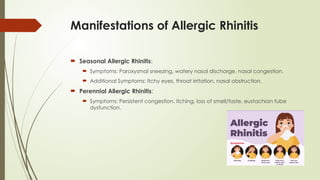
Manifestations of Allergic Rhinitis
 Seasonal Allergic Rhinitis:
 Symptoms: Paroxysmal sneezing, watery nasal discharge, nasal congestion.
 Additional Symptoms: Itchy eyes, throat irritation, nasal obstruction.
 Perennial Allergic Rhinitis:
 Symptoms: Persistent congestion, itching, loss of smell/taste, eustachian tube
dysfunction.
Environmental Control Measures
 Indoor Adjustments:
 Use air conditioning and replace filters regularly.
 HEPA filters for dust and animal dander control.
 Hot water washing for linens and using impermeable encasings.
 Remove carpets and avoid fans or cool-mist vaporizers.
 Minimize clutter to reduce dust accumulation.
Medication Options
 Antihistamines:
 Second-Generation: Fexofenadine, loratadine, cetirizine – less sedative, effective
for daily use.
 Combination Therapy: Antihistamines with α-adrenergic decongestants for
increased effectiveness.
 Intranasal Steroids: Beclomethasone, fluticasone – the most effective for
controlling nasal symptoms.
 Leukotriene Receptor Antagonists: Montelukast for both seasonal and
perennial symptoms.
 Herbal Options: Butterbur, shown effective with minimal side effects.
Specific Immunotherapy
 Allergen-Specific Immunotherapy:
 Recommended when skin testing identifies unavoidable allergen sensitivities.
 More effective for seasonal than perennial symptoms.
 Goal: Possible resolution of allergies and prevention of asthma development in
children.
 Management of Allergy-Related Eye Symptoms
 Eye Symptom Relief:
 Oral antihistamines alleviate eye-related symptoms and improve quality of life.
 Topical treatments and intranasal steroids can help reduce nasal and ocular
symptoms.
Asthma
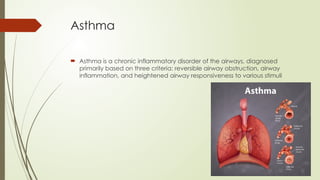
 Asthma is a chronic inflammatory disorder of the airways, diagnosed
primarily based on three criteria: reversible airway obstruction, airway
inflammation, and heightened airway responsiveness to various stimuli
Key Points in Asthma Diagnosis and Management
 Reversible Airway Obstruction: Asthma typically involves a reversible
reduction in airflow, which improves with treatment or sometimes on its
own.
 Airway Inflammation and Responsiveness: The airways in asthma patients
are highly sensitive, reacting to triggers that would not affect non-asthmatic
individuals.
 Symptom Control: Identifying and avoiding allergens and irritants (e.g.,
pollen, dust mites, smoke, certain medications) are crucial to prevent
asthma attacks.
 Asthma Action Plan: Patients should have an action plan to recognize early
signs of an exacerbation and take appropriate steps to prevent worsening.
Differential Diagnosis
 Asthma can sometimes be mistaken for other conditions, with differential diagnoses varying
between age groups:
 Children: Conditions like allergic rhinitis, cystic fibrosis, and viral bronchiolitis should be
considered.
 Adults: COPD, congestive heart failure, and pulmonary embolism are among other conditions
that may mimic asthma
 Precipitating Factors
 Common triggers that may lead to asthma symptoms or exacerbations include:
 Environmental allergens: Dust mites, molds, animal dander, pollen.
 Environmental irritants: Tobacco smoke, air pollutants, strong odors.
 Other factors: GERD, respiratory infections, exercise, strong emotions, certain medications (e.g.,
NSAIDs, beta-blockers).
Diagnostic Testing
 Pulmonary Function Testing (PFT): Spirometry is the gold standard for asthma
diagnosis and includes:
 FEV1 (Forced Expiratory Volume in 1 second): Measures airway obstruction.
 FVC (Forced Vital Capacity): Total air exhaled in a forceful breath.
 Reversibility Testing: Improvement in FEV1 by 12% or 200 mL after a
bronchodilator indicates reversible obstruction, a hallmark of asthma.
 Peak Flow Monitoring: Helpful in self-management but not a diagnostic
tool. It provides insight into daily fluctuations and exacerbations.
Treatment and Classification
 Asthma is categorized into four classifications—intermittent, mild persistent,
moderate persistent, and severe persistent—based on symptom frequency
and spirometric values. Key treatment principles include:
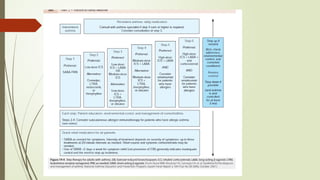
 Stepwise Therapy: Adjusting medication levels based on symptom severity.
 Inhaled Corticosteroids (ICS): First-line treatment for persistent asthma, with
inhaled β2-agonists used for acute relief.
 Exacerbation Management: Short-acting β2-agonists and oral
corticosteroids are recommended for exacerbations. Nebulized ipratropium
can be used in emergency settings but not during hospitalization
Monitoring and Prevention
 Self-Monitoring: Patients with moderate to severe asthma or frequent
exacerbations should monitor their peak flow daily.
 Reducing Medication Reliance: Frequent need for short-acting β2-agonists
indicates poor asthma control and may necessitate higher maintenance
therapy.
 Education and Prevention: Teaching patients to manage their triggers,
recognize early symptoms, and respond quickly to changes in their
condition.
Anaphylaxis
 Definition:
 "Acute, systemic hypersensitivity reaction due to IgE-mediated degranulation of mast cells and basophils."
 Comparison: Immunologic vs. Non-immunologic reactions.
 Key Terms:
 Anaphylaxis, IgE-mediated, Mast Cells, Basophils
 Pathophysiology
 Immunologic Pathway:
 IgE triggers mast cells and basophils to release histamines and other mediators.
 Non-immunologic Pathway:
 Direct degranulation (e.g., reactions to radiocontrast media).
 Mediator Effects:
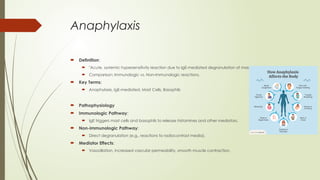
 Vasodilation, increased vascular permeability, smooth muscle contraction.
Classification
 Immunologic Anaphylaxis:
 IgE-mediated (e.g., food allergies).
 Non-IgE-mediated (e.g., blood transfusion reactions).
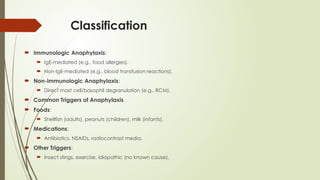
 Non-immunologic Anaphylaxis:
 Direct mast cell/basophil degranulation (e.g., RCM).
 Common Triggers of Anaphylaxis
 Foods:
 Shellfish (adults), peanuts (children), milk (infants).
 Medications:
 Antibiotics, NSAIDs, radiocontrast media.
 Other Triggers:
 Insect stings, exercise, idiopathic (no known cause).
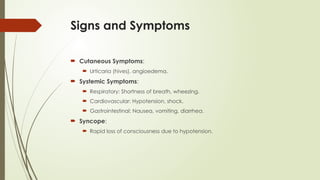
Signs and Symptoms
 Cutaneous Symptoms:
 Urticaria (hives), angioedema.
 Systemic Symptoms:
 Respiratory: Shortness of breath, wheezing.
 Cardiovascular: Hypotension, shock.
 Gastrointestinal: Nausea, vomiting, diarrhea.
 Syncope:
 Rapid loss of consciousness due to hypotension.
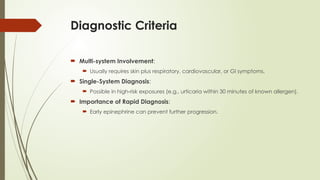
Diagnostic Criteria
 Multi-system Involvement:
 Usually requires skin plus respiratory, cardiovascular, or GI symptoms.
 Single-System Diagnosis:
 Possible in high-risk exposures (e.g., urticaria within 30 minutes of known allergen).
 Importance of Rapid Diagnosis:
 Early epinephrine can prevent further progression.
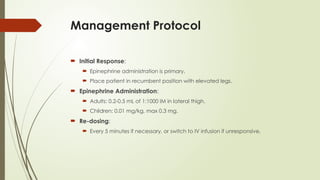
Management Protocol
 Initial Response:
 Epinephrine administration is primary.
 Place patient in recumbent position with elevated legs.
 Epinephrine Administration:
 Adults: 0.2-0.5 mL of 1:1000 IM in lateral thigh.
 Children: 0.01 mg/kg, max 0.3 mg.
 Re-dosing:
 Every 5 minutes if necessary, or switch to IV infusion if unresponsive.
Additional Treatments
 After Epinephrine:
 Antihistamines (H1 and H2): Diphenhydramine, Ranitidine.
 Corticosteroids: Methylprednisolone for prolonged reactions.
 Fluid Resuscitation:
 IV normal saline for persistent hypotension.
 Observation and Follow-up
 Observation Time:
 6-24 hours depending on severity (risk of biphasic reactions).
 Patient Education:
 Prescribe epinephrine autoinjector.
 Training on autoinjector use and avoidance of known allergens.
 Medical alert bracelets recommended for at-risk individuals.
Key Takeaways
 Quick Action Saves Lives:
 Epinephrine is the first-line treatment and should not be delayed.
 Multi-faceted Approach:
 Epinephrine, positioning, oxygen, and IV fluids as primary treatments.
 Preventative Measures:
 Autoinjector prescription and training, allergy identification, and lifestyle
modifications.

Allergy medicine and it’s complete description

  • 1.
  • 2.
    Introduction to AllergicDiseases  Definition: Allergic diseases result from an immune response to harmless substances (allergens).  Examples: Allergic rhinitis, allergic asthma, and anaphylaxis.  Key Point: Allergic reactions involve abnormal immune responses often driven by cytokine production.  Cytokines: Proteins involved in cell signaling, crucial for immune responses.  Role in Allergies: Abnormal cytokine production drives exaggerated immune responses in allergic individuals.  Result: Symptoms such as inflammation, sneezing, itching, and airway restriction.
  • 3.
    Differences Between Allergicand Nonallergic Diseases  Allergic vs. Nonallergic Diseases:  Allergic asthma vs. intrinsic (nonallergic) asthma  Allergic rhinitis vs. nonallergic rhinitis  IgE-mediated vs. non–IgE-mediated anaphylaxis  Importance: Distinction influences treatment approach and prognosis.
  • 4.
    Diagnosis of AllergicDiseases Key Points for Treatment  Patient History: Essential first step for identifying allergic conditions.  Allergy Testing:  Skin Test: Sensitive and cost-effective.  In Vitro Testing: Used as a screening tool.  Purpose: Differentiate between allergic and nonallergic forms.  Importance of Identifying Mechanism: Determines the appropriate treatment and prognosis.  For Allergic Patients:  Environmental controls  Medications (e.g., antihistamines, corticosteroids)  Immunotherapy for specific allergens  Management Differences: Vary between allergic and nonallergic conditions
  • 5.
    Allergic Rhinitis  Definition:Allergic rhinitis is an inflammation of the nasal passages caused by airborne antigens, leading to various respiratory symptoms.  Types:  Seasonal Allergic Rhinitis (Hay Fever): Triggered by high pollen concentrations.  Perennial Allergic Rhinitis: Persistent, year-round symptoms without seasonal variation.  Common Symptoms:  Physical Signs: Allergic shiners, nasal salute, pale nasal mucosa.  Sensory Loss: Diminished taste and smell.  Sleep Disruption: Snoring, nighttime coughing, mouth breathing.  Others: Eustachian tube dysfunction, nasal speech, possible appetite loss due to loss of smell.
  • 6.
    Diagnosis of AllergicRhinitis  Clinical History: Detailed seasonal or environmental triggers.  Testing Options:  Skin Prick Test: Measures wheal response to allergens.  IgE Assays: Quantifies allergen-specific IgE levels.  Peripheral Eosinophil Count: Elevated counts support diagnosis but are not definitive.  Observation: Changes in symptoms with environmental changes (e.g., vacations) suggest allergen involvement.
  • 7.
    Manifestations of AllergicRhinitis  Seasonal Allergic Rhinitis:  Symptoms: Paroxysmal sneezing, watery nasal discharge, nasal congestion.  Additional Symptoms: Itchy eyes, throat irritation, nasal obstruction.  Perennial Allergic Rhinitis:  Symptoms: Persistent congestion, itching, loss of smell/taste, eustachian tube dysfunction.
  • 8.
    Environmental Control Measures Indoor Adjustments:  Use air conditioning and replace filters regularly.  HEPA filters for dust and animal dander control.  Hot water washing for linens and using impermeable encasings.  Remove carpets and avoid fans or cool-mist vaporizers.  Minimize clutter to reduce dust accumulation.
  • 9.
    Medication Options  Antihistamines: Second-Generation: Fexofenadine, loratadine, cetirizine – less sedative, effective for daily use.  Combination Therapy: Antihistamines with α-adrenergic decongestants for increased effectiveness.  Intranasal Steroids: Beclomethasone, fluticasone – the most effective for controlling nasal symptoms.  Leukotriene Receptor Antagonists: Montelukast for both seasonal and perennial symptoms.  Herbal Options: Butterbur, shown effective with minimal side effects.
  • 10.
    Specific Immunotherapy  Allergen-SpecificImmunotherapy:  Recommended when skin testing identifies unavoidable allergen sensitivities.  More effective for seasonal than perennial symptoms.  Goal: Possible resolution of allergies and prevention of asthma development in children.  Management of Allergy-Related Eye Symptoms  Eye Symptom Relief:  Oral antihistamines alleviate eye-related symptoms and improve quality of life.  Topical treatments and intranasal steroids can help reduce nasal and ocular symptoms.
  • 11.
    Asthma  Asthma isa chronic inflammatory disorder of the airways, diagnosed primarily based on three criteria: reversible airway obstruction, airway inflammation, and heightened airway responsiveness to various stimuli
  • 12.
    Key Points inAsthma Diagnosis and Management  Reversible Airway Obstruction: Asthma typically involves a reversible reduction in airflow, which improves with treatment or sometimes on its own.  Airway Inflammation and Responsiveness: The airways in asthma patients are highly sensitive, reacting to triggers that would not affect non-asthmatic individuals.  Symptom Control: Identifying and avoiding allergens and irritants (e.g., pollen, dust mites, smoke, certain medications) are crucial to prevent asthma attacks.  Asthma Action Plan: Patients should have an action plan to recognize early signs of an exacerbation and take appropriate steps to prevent worsening.
  • 13.
    Differential Diagnosis  Asthmacan sometimes be mistaken for other conditions, with differential diagnoses varying between age groups:  Children: Conditions like allergic rhinitis, cystic fibrosis, and viral bronchiolitis should be considered.  Adults: COPD, congestive heart failure, and pulmonary embolism are among other conditions that may mimic asthma  Precipitating Factors  Common triggers that may lead to asthma symptoms or exacerbations include:  Environmental allergens: Dust mites, molds, animal dander, pollen.  Environmental irritants: Tobacco smoke, air pollutants, strong odors.  Other factors: GERD, respiratory infections, exercise, strong emotions, certain medications (e.g., NSAIDs, beta-blockers).
  • 14.
    Diagnostic Testing  PulmonaryFunction Testing (PFT): Spirometry is the gold standard for asthma diagnosis and includes:  FEV1 (Forced Expiratory Volume in 1 second): Measures airway obstruction.  FVC (Forced Vital Capacity): Total air exhaled in a forceful breath.  Reversibility Testing: Improvement in FEV1 by 12% or 200 mL after a bronchodilator indicates reversible obstruction, a hallmark of asthma.  Peak Flow Monitoring: Helpful in self-management but not a diagnostic tool. It provides insight into daily fluctuations and exacerbations.
  • 15.
    Treatment and Classification Asthma is categorized into four classifications—intermittent, mild persistent, moderate persistent, and severe persistent—based on symptom frequency and spirometric values. Key treatment principles include:  Stepwise Therapy: Adjusting medication levels based on symptom severity.  Inhaled Corticosteroids (ICS): First-line treatment for persistent asthma, with inhaled β2-agonists used for acute relief.  Exacerbation Management: Short-acting β2-agonists and oral corticosteroids are recommended for exacerbations. Nebulized ipratropium can be used in emergency settings but not during hospitalization
  • 17.
    Monitoring and Prevention Self-Monitoring: Patients with moderate to severe asthma or frequent exacerbations should monitor their peak flow daily.  Reducing Medication Reliance: Frequent need for short-acting β2-agonists indicates poor asthma control and may necessitate higher maintenance therapy.  Education and Prevention: Teaching patients to manage their triggers, recognize early symptoms, and respond quickly to changes in their condition.
  • 18.
    Anaphylaxis  Definition:  "Acute,systemic hypersensitivity reaction due to IgE-mediated degranulation of mast cells and basophils."  Comparison: Immunologic vs. Non-immunologic reactions.  Key Terms:  Anaphylaxis, IgE-mediated, Mast Cells, Basophils  Pathophysiology  Immunologic Pathway:  IgE triggers mast cells and basophils to release histamines and other mediators.  Non-immunologic Pathway:  Direct degranulation (e.g., reactions to radiocontrast media).  Mediator Effects:  Vasodilation, increased vascular permeability, smooth muscle contraction.
  • 19.
    Classification  Immunologic Anaphylaxis: IgE-mediated (e.g., food allergies).  Non-IgE-mediated (e.g., blood transfusion reactions).  Non-immunologic Anaphylaxis:  Direct mast cell/basophil degranulation (e.g., RCM).  Common Triggers of Anaphylaxis  Foods:  Shellfish (adults), peanuts (children), milk (infants).  Medications:  Antibiotics, NSAIDs, radiocontrast media.  Other Triggers:  Insect stings, exercise, idiopathic (no known cause).
  • 20.
    Signs and Symptoms Cutaneous Symptoms:  Urticaria (hives), angioedema.  Systemic Symptoms:  Respiratory: Shortness of breath, wheezing.  Cardiovascular: Hypotension, shock.  Gastrointestinal: Nausea, vomiting, diarrhea.  Syncope:  Rapid loss of consciousness due to hypotension.
  • 21.
    Diagnostic Criteria  Multi-systemInvolvement:  Usually requires skin plus respiratory, cardiovascular, or GI symptoms.  Single-System Diagnosis:  Possible in high-risk exposures (e.g., urticaria within 30 minutes of known allergen).  Importance of Rapid Diagnosis:  Early epinephrine can prevent further progression.
  • 22.
    Management Protocol  InitialResponse:  Epinephrine administration is primary.  Place patient in recumbent position with elevated legs.  Epinephrine Administration:  Adults: 0.2-0.5 mL of 1:1000 IM in lateral thigh.  Children: 0.01 mg/kg, max 0.3 mg.  Re-dosing:  Every 5 minutes if necessary, or switch to IV infusion if unresponsive.
  • 23.
    Additional Treatments  AfterEpinephrine:  Antihistamines (H1 and H2): Diphenhydramine, Ranitidine.  Corticosteroids: Methylprednisolone for prolonged reactions.  Fluid Resuscitation:  IV normal saline for persistent hypotension.  Observation and Follow-up  Observation Time:  6-24 hours depending on severity (risk of biphasic reactions).  Patient Education:  Prescribe epinephrine autoinjector.  Training on autoinjector use and avoidance of known allergens.  Medical alert bracelets recommended for at-risk individuals.
  • 24.
    Key Takeaways  QuickAction Saves Lives:  Epinephrine is the first-line treatment and should not be delayed.  Multi-faceted Approach:  Epinephrine, positioning, oxygen, and IV fluids as primary treatments.  Preventative Measures:  Autoinjector prescription and training, allergy identification, and lifestyle modifications.