© 2016 Greater Pittsburgh Community Food Bank
Adult &
Family
Lesson
Plans
© 2016 Greater Pittsburgh Community Food Bank
Table of Contents
Adult Lesson Plans
Apple Glazed Stir-Fry............................................................................................................3-6
Banana Pancakes..................................................................................................................7-10
Beans N Greens.....................................................................................................................11-14
ChickpeaCurry......................................................................................................................15-18
Omelets.................................................................................................................................19-22
Ratatouille............................................................................................................................23-26
Savory Oatmeal.................................................................................................................27-30
Family Lesson Plans
Banana Pancakes...............................................................................................................33-36
Beans N Greens..................................................................................................................37-41
Omelets...............................................................................................................................42-45
Savory Oatmeal.................................................................................................................46-49
© 2016 Greater Pittsburgh Community Food Bank
Adult
Lesson
Plans
1
© 2016 Greater Pittsburgh Community Food Bank2
© 2016 Greater Pittsburgh Community Food Bank
Apple Glazed Stir-Fry Lesson Plan
Materials Ingredients
•	 Guess the Apple (pictures of different types
of apples)
•	 Items listed on the checklist
•	 Recipe card and produce tip cards
•	 Food assistance handouts
•	 2 Tbl oil
•	 4 cups sliced mixed vegetables
•	 1 apple, sliced thinly
•	 1/2 cup unsweetened applesauce
•	 1/2 cup water
•	 1 tsp ground ginger (optional)
•	 1 tsp cajun seasoning (or favorite seasoning
blend)
•	 2 Tbl vinegar
•	 1 Tbl low-sodium soy sauce
•	 2 Tbl brown sugar (optional)
Makes 5 servings
Goal:
•	 To learn about different kinds of apples and why it is important to eat
apples.
Objectives:
1.	 Explore and recognize different types of apples
2.	 Identify health concepts of apples
3.	 Learn how to properly store apples
4.	 Learn basic knife and cooking skills
5.	 Understand the versatility of the recipe
6.	 Share information on cost of recipe and breakdown cost per ingredient
7.	 Connect participants with food assistance resources
Related Resources:
•	 Apple Glazed Stir-Fry recipe card
•	 Apples tip card
•	 Saving Produce Guide
•	 Shelf-life Guide
Food Assistance Resources:
•	 P2P calendar
•	 SNAP flyer
•	 Get Help page
Activities Included:
•	 Guess the Apple
3
© 2016 Greater Pittsburgh Community Food Bank
Objective 5
Objective 2
Introduction:
•	 Ask participants what their favorite fruits and vegetables are to put in a stir-
fry. Ask participants to give examples of stir-fry ingredients (peppers, onions,
cabbage, broccoli, carrots, pineapple, snap peas, water chesnuts, summer squash,
eggplant, onion, apples).
•	 Explain to the class that we will be using apples in today’s stir-fry recipe. There
are many different types of apples (will be explained in activity).
•	 Describe how different types of apples have different tastes and textures, some
are better for a quick snack and in raw dishes like a slaw, and some work better in
cooked dishes and baked goods like applesauce and apple pie.
Health concepts:
•	 Several studies have been conducted that reveal a correlation between fruit
and veggie intake and a decrease in cancer. Apples, specifically, have several
antioxidant benefits that may help lower the risk of asthma and lung cancer.
•	 Apples have several cardiovascular benefits. Those who have a regular intake
of apples, about an apple a day, have decreased levels of cholesterol. The
antioxidants also help lower the risk of heart disease and chronic heart problems.
•	 The apple’s properties that influence digestion also help regulate blood sugar.
Storing:
•	 Apples, like peaches and bananas give off a gas called ethylene. This gas causes
other fruits and veggies to ripen quicker so be sure to store them separately.
Also, bruised apples give off more ethylene, so that’s why the saying “one bad
apple can ruin the whole bunch” has become a good rule of thumb. Be sure to
remove any bruised or damaged apples from the rest of the bunch so the others
won’t spoil.
•	 Apples stay the most fresh in a slightly cool environment. Place them in your
crisper drawer or in a plastic container with the lid off in the back of the fridge.
Apples with thin skin will last for about 4 weeks in the fridge, where thicker-
skinned apples will last for several months.
•	 If you have leftover cut apples, toss them with some lemon juice to prevent them
from browning and store them in the fridge for up to a week.
Objective 3
Instruction:
•	 Introduce the participants to all the ingredients we will be using. This specific
recipe uses any mixed vegetables you like, apples, applesauce, ginger, cajun
seasoning, soy sauce, vinegar, low-sodium soy sauce and brown sugar.
•	 Explain to the participants which food group each of the ingredients belong to in
MyPlate.
•	 Introduce to the participants the recipe we will create today: Apple Glazed Stir-
Fry
Objective 4
Modeling and Guided Practice:
•	 Follow instructions on recipe card and demonstrate how to cut each vegetable.
•	 Heat oil in a large pot over high heat. Add vegetables and cook for 5 minutes,
stirring frequently.
•	 While vegetables are cooking, make sauce: mix applesauce, water, ginger, cajun
seasoning, vinegar, soy sauce and brown sugar, if using)
•	 Once vegetables are slightly browned and tender, pour sauce mixture into pot
and stir.
•	 Reduce heat to medium-low and cook for another 5 to 10 minutes.
Objective 5
4
© 2016 Greater Pittsburgh Community Food Bank
Objective 1
Objective 5
Activity: Guess the Apple
•	 While cooking, show examples of apples and ask participants to guess the name
of each apple (Fuji, Red Delicious, Honeycrisp, Granny Smith, McIntosh, Pink Lady,
Golden Delicious). Ask participants to comment on their flavors and textures. Ask
participants to share their favorite apples.
Versatility:
•	 For this recipe, you can use whatever veggies you like, whether they are fresh,
canned or frozen. Just be sure to rinse your canned veggies to reduce the sodium
levels. Fruit and veggies work well together in this sweet stir-fry.
•	 Play around with different seasonings, if you like it spicy, add some cayenne
pepper or hot pepper flakes. If you like it a little sweeter, add some brown sugar
or honey.
•	 The vinegar gives it a nice tang, you can use whatever you have on hand. Rice
wine vinegar or apple cider vinegar work well, or use lemon or lime juice for the
acidity.
•	 If you have a soy allergy, use anything that will add a salty flavor, like liquid
aminos or miso. You can even try mixing some balsamic vinegar with chicken/
beef/veggie bouillon and some molasses. This flavor combination is reminiscent
of soy sauce.
Cost:
•	 2 bell peppers: $1.98
•	 2 cups broccoli: $1.80
•	 1 medium onion: $0.41
•	 1 apple: $0.42
•	 1/2 cup unsweetened applesauce: $0.56
•	 2 Tbl vinegar: $0.16
•	 1 Tbl low-sodium soy sauce: $0.06
•	 Total Cost of recipe: $5.39 or $1.08 per serving (excludes oil, salt, pepper, herbs/
spices)
Closure:
•	 Review Apple Glazed Stir-Fry recipe card
•	 Review Apples tip card
•	 Review additional produce tip cards
•	 Review P2P calendar, SNAP flyer and Get Help Page
Objective 6
Objective 7
5
Apple Glazed Stir-Fry Checklist
electric cooktop
wooden spoon
1/2 cup measure
teaspoons (x2)
tablespoons (x2)
liquid measuring cup
knife
cutting board
bench scraper
bowls for prepping
Cooking Equipment
oil
mixed veggies
apples
unsweetened applesauce
water
ginger
cajun seasoning
vinegar
low-sodium soy sauce
Food items
© 2016 Greater Pittsburgh Community Food Bank6
© 2016 Greater Pittsburgh Community Food Bank
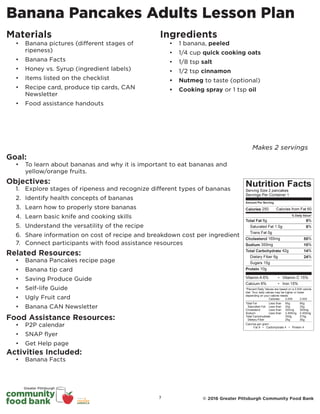
Banana Pancakes Adults Lesson Plan
Materials Ingredients
•	 Banana pictures (different stages of
ripeness)
•	 Banana Facts
•	 Honey vs. Syrup (ingredient labels)
•	 Items listed on the checklist
•	 Recipe card, produce tip cards, CAN
Newsletter
•	 Food assistance handouts
•	 1 banana, peeled
•	 1/4 cup quick cooking oats
•	 1/8 tsp salt
•	 1/2 tsp cinnamon
•	 Nutmeg to taste (optional)
•	 Cooking spray or 1 tsp oil
Makes 2 servings
Goal:
•	 To learn about bananas and why it is important to eat bananas and
yellow/orange fruits.
Objectives:
1.	 Explore stages of ripeness and recognize different types of bananas
2.	 Identify health concepts of bananas
3.	 Learn how to properly store bananas
4.	 Learn basic knife and cooking skills
5.	 Understand the versatility of the recipe
6.	 Share information on cost of recipe and breakdown cost per ingredient
7.	 Connect participants with food assistance resources
Related Resources:
•	 Banana Pancakes recipe page
•	 Banana tip card
•	 Saving Produce Guide
•	 Self-life Guide
•	 Ugly Fruit card
•	 Banana CAN Newsletter
Food Assistance Resources:
•	 P2P calendar
•	 SNAP flyer
•	 Get Help page
Activities Included:
•	 Banana Facts
7
© 2016 Greater Pittsburgh Community Food Bank
Objective 2
Introduction:
•	 Ask participants what their favorite fruit is. Ask participants to give examples
of orange and yellow fruits (grapefruit, orange, lemon, apricots, clementines,
nectarines, mangoes, peaches, pineappple, papaya, cantaloupe, starfruit,
bananas)
•	 Explain the importance of looking for orange and yellow fruits and veggies when
shopping. They have many vitamins and nutrients, such as lycopene, potassium,
vitamin C and vitamin A (beta-carotene) that support eye and bone health.
•	 Introduce bananas as a yellow fruit. Begin to talk about the different stages of
ripeness. Show photos while describing the taste and texture: a green or unripe
banana is a good option for anyone avoiding foods with high sugar content.
They also help abosrb some nutrients better like calcium. Ripe bananas have a
higher sugar content and taste much sweeter. The riper the banana, the sweeter
it is. Ripe bananas are also much easier to digest and have higher levels of
antioxidants and anti-cancer properties. A quick tip: because of the high sugar
content, those with diabetes should avoid ripe bananas.
•	 Explain to the class that they are many different types bananas (activity).
Health concepts:
•	 Bananas have many nutrients that help moderate blood pressure after meals.
The high amounts of fiber keep you feeling fuller longer while also promoting
digestive health. Studies show that a diet rich in fiber helps promote weight loss.
As already mentioned, riper bananas are easier to digest because the complex
starches in an unripe banana have transformed into sugars once ripened.
•	 Bananas are also a low calorie food, containing about a 100 calories and no fat.
They are perfect for a snack and to replenish energy after exercising.
Storing:
•	 Store green bananas at room temperature to ripen. If you want to slow down the
ripening process, leave them on the counter and separate them from the bunch.
If you want them to ripen quicker, put them in a brown paper bag. A quick tip:
apples, peaches and bananas emit a gas called ethylene. This gas causes other
fruits and veggies to ripen quicker, so use them as a ripening agent or store them
separately from your other produce so they won’t rot as quickly.
•	 Refrigeration stops the ripening process, so when your bananas have ripened to
your liking, place them in the fridge to extend their shelf life. Bananas will last for
up to a year in the freezer. Peel them and place them in a freezer bag. They work
great in smoothies or defrosted for baked goods.
Instruction:
•	 Introduce the participants to all the ingredients we will be using. This recipe uses
bananas, oats, eggs, cinnamon and nutmeg. Ask participants if they know where
cinnamon comes from (the bark from a tree, it dries out and curls up naturally).
It’s then ground up into cinnamon powder.
•	 Explain to the participants which food group each of the ingredients belong to in
MyPlate.
•	 Introduce to the participants the recipe we will create today: Banana Pancakes.
Objective 1
Objective 2
Modeling and Guided Practice:
•	 Follow instructions on recipe card and demonstrate how to mash the banana and
crack the egg. Explain to the participants that you should mash it until it looks
like applesauce.
•	 Spray griddle with cooking spray and heat to 350 degrees.
•	 Spoon on four small pancakes and cook for 2 to 3 minutes per side.
Objective 4
Objective 1
Objective 3
8
© 2016 Greater Pittsburgh Community Food Bank
Activity: Banana Facts
•	 While cooking, show examples of different types of bananas (cavendish,
[common] baby, red and plantains). Ask the participants to guess the different
varities of bananas and present facts on each type.
Versatility:
•	 This recipe only contains three ingredients. You can try using different oats, like
old fashioned/rolled, quick cooking or instant oats. Oats work great as a binding
ingredient and can be used in place of flour in both savory and sweet recipes.
Objective 1
Objective 5
Cost:
•	 1 banana: $0.15
•	 1 egg: $0.12
•	 1/4 cup oats: $0.03
•	 Total Cost of recipe: $0.30 or $0.15 per serving (excludes oil and spices)
Closure:
•	 Review Banana Pancakes recipe
•	 Review Produce tip cards
•	 Review Banana CAN Newsletter
•	 Review P2P calendar, SNAP flyer and Get Help Page
Objective 6
Objective 7
Honey vs. Syrup
•	 Show photos of the ingredients label for both maple syrup and honey. Explain
that pure maple syrup has less sugar and more minerals than honey but is much
more expensive. Honey has more vitamins, and in this case, less ingredients.
Most “maple syrups” sold in the stores aren’t actually pure. The first ingredient is
usually high fructose corn syrup follwed by caramel coloring to make it look like
maple syrup.
9
Banana Pancakes Adults Checklist
electric griddle
plastic spatulas (x2)
1/4 cup measure (x2)
bowls for mixing
tablespoons (x2)
metal forks
cutting board
Cooking Equipment
eggs
bananas
seasoned oats
ground cinnamon
cinnamon sticks
nutmeg
cooking spray
honey to top
peanut butter to top
Food items
© 2016 Greater Pittsburgh Community Food Bank10
© 2016 Greater Pittsburgh Community Food Bank
Beans N Greens Adults Lesson Plan
Materials Ingredients
•	 Guess the Greens (pictures of different
types of greens)
•	 Items listed on the checklist
•	 Recipe card and produce tip cards
•	 Food assistance handouts
•	 2 Tbl oil
•	 1 medium onion, diced
•	 6 cloves garlic, sliced thinly
•	 1 lb collard greens or kale (about 12 to 15
stems)
•	 1 cup apple juice or cider
•	 2 (15 oz) cans beans, drained and rinsed
•	 1/2 tsp salt
•	 Black pepper to taste
•	 1 tsp crushed red pepper (optional)
•	 1 1/2 tsp dried herbs (parsley, oregano,
thyme and/or rosemary)
Makes 6 servings
Goal:
•	 To learn about different kinds of greens and why it is important to eat
leafy green vegetables.
Objectives:
1.	 Explore and recognize different types of greens
2.	 Identify health concepts of leafy green vegetables
3.	 Learn how to properly store greens
4.	 Learn basic knife and cooking skills
5.	 Understand the versatility of the recipe
6.	 Share information on cost of recipe and breakdown cost per ingredient
7.	 Connect participants with food assistance resources
Related Resources:
•	 Beans N Greens recipe card
•	 Collard Greens tip card
•	 Lettuce tip card
•	 Saving Produce Guide
•	 Shelf-Life Guide
Food Assistance Resources:
•	 P2P calendar
•	 SNAP flyer
•	 Get Help page
Activities Included:
•	 Guess the Greens
11
© 2016 Greater Pittsburgh Community Food Bank
Objective 1
Introduction:
•	 Ask participants what their favorite green vegetable is. Ask participants to give
examples of green vegetables (artichokes, asparagus, broccoli, brussel sprouts,
cabbage, green beans, leeks, lettuce, okra, peas, green peppers, zucchini, leafy
greens)
•	 Explain to the class what a leafy green vegetable is. There are many different
types of leafy green vegetables (will be explained in activity).
•	 Explain the importance of looking for dark leafy green vegetables when
purchasing veggies.
•	 Introduce collard greens as a leafy green vegetable. Describe how different
greens are known to have different cooking times. Some cook very quickly like
spinach, while others, like collard greens, are traditionally simmered for a very
long time. Describe how most greens still taste great even if they quickly sauteed.
Describe how this recipe is a quick fix for dinner and still tastes great with a short
cooking time.
Health concepts:
•	 Collard greens are one of the one of the healthiest greens. Like kale, cauliflower
and broccoli, collard greens derived from the wild cabbage. All of these
vegetables have very important nutrients and vitamins.
•	 Collard greens have powerful cancer preventing nutrients. The special nutrients
collards have support the three main body systems that are linked with both
cancer development and prevention: the body’s detox system, antioxidant
system, and inflammatory system.
•	 Collard greens are one of the best sources of vitamin K, which is extremely
important for blood clotting. For example, whenever you get a cut, blood clotting
is important to stop the bleeding, in which vitamin K supports. Collards are also
rich in vitamin C and vitamin A which is important for brain health, healthy vision,
and the immune and inflammatory systems. Vitamin A also helps the absorption
of iron.
•	 Dark leafy greens including collard greens are a great source of folate/folic
acid. This vitamin is especially important for pregnant women or women or are
thinking about getting pregnant for it helps support a healthy baby and helps
reduce the risk of brain and spine defects in infants
Storing:
•	 Rinse collard greens just before using. Clean them in a bowl of water or a sink
until all dirt is removed. Let them dry and store greens in a refrigerator for up to 7
days. If cooked, store greens in a closed conainer in the fridge for up to a week.
•	 Have too many collard greens? Blanch them and freeze them for up to a year.
Objective 2
Objective 3
Instruction:
•	 Introduce the participants to all the ingredients we will be using. This specific
recipe uses onions, garlic, collard greens, cannellini beans, herbs and spices. As
for the liquid, the recipe uses apple juice for sweetness, but you can use veggie,
chicken or beef broth/stock. Look for “no salt” or “low sodium labels.” If you
are someone who is really watching your salt intake, try using lots of herbs and
spices in place of salt to flavor your meals.
•	 Explain to the participants which food group each of the ingredients belong to in
MyPlate.
•	 Introduce to the participants the recipe we will create today: Beans N Greens.
Objective 5
12
© 2016 Greater Pittsburgh Community Food Bank
Objective 4
Objective 1
Objective 5
Modeling and Guided Practice:
•	 Follow instructions on recipe card and demonstrate how to cut each vegetable.
•	 Heat oil in a large pan over medium heat. Add onion Let cook for 10 to 12 minutes
or until browned.
•	 While onion is cooking, show participants how to cut garlic, and collard greens.
Focus on stripping the collard green leaves from the stems. Roll the greens up
and cut into small pieces. Mention that you don’t need to waste the stems: pickle
them or save them for homemade veggie broth.
•	 Add garlic and cook for 1 to 2 minutes. As soon as you can the smell garlic, it’s
done. Be careful not to burn or you can make the dish really bitter.
•	 Add the chopped greens and cook for 3 to 5 minutes.
•	 Add apple juice and let simmer for about 3 minutes.
•	 Add beans, salt, herbs and spices. Stir and simmer for about 5 minutes.
Activity: Guess the Greens
•	 While cooking, show examples of greens (Romaine lettuce, swiss chard, kale,
spinach, beet greens, broccoli rabe, cabbage, turnip greens, bokchoy, collard
greens). Ask participants to guess the greens from the pictures shown.
Versatility:
•	 For this recipe, you can use whatever greens you have on hand, or think about
substituting any greens that were mentioned before. Even braised lettuce is
delicious.
•	 Use whatever beans you have on hand, if you like the creaminess of white beans,
use navy or Great Northern beans, but any will work just fine. Just remember to
rinse them to reduce the sodium by 41%.
•	 Play around with different herbs and spices and see what flavor combinations
you like best. For example, smoked paprika (purchased from Giant Eagle for
$1.79) adds a nice smokey flavor that is traditionally found in a greens recipe
(usually from a smoked ham hock).
•	 As mentioned before, for the braising liquid, use whatever liquid is available to
you. If you don’t have apple juice try apple cider. If you don’t like the sweetness,
simply use water or try different stocks/broths, just rememeber to look for the
low sodium/no salt labels.
Cost:
•	 1 large onion: $0.74
•	 6 cloves garlic: $0.14
•	 1 lb chopped collard greens: $2.79
•	 1 cup apple juice: $0.28
•	 2 cans cannellini beans: $1.20
•	 Total Cost of recipe: $5.15 or $0.85 per serving (excludes oil, salt, pepper, herbs/
spices)
Closure:
•	 Review Beans N Greens recipe card
•	 Review Collard Greens tip card
•	 Review Braised Lettuce with Bacon recipe card
•	 Review additional produce tip cards
•	 Review P2P calendar, SNAP flyer and Get Help Page
Objective 6
Objective 7
13
Beans N Greens Adults Checklist
Cooking Equipment
oil
onion
garlic
collard greens
apple juice
beans
salt
pepper
crushed red pepper
dried herbs
Food items
© 2016 Greater Pittsburgh Community Food Bank
electric cooktop
wooden spoon
teaspoons
tablespoons
liquid measuring cup
knife
cutting board
bench scraper
bowls for prepping
14
© 2016 Greater Pittsburgh Community Food Bank
Chickpea Curry Lesson Plan
Materials Ingredients
•	 Guess the Beans (pictures of different types
of beans)
•	 With Protein Variety is Key handout by
USDA
•	 Items listed on the checklist
•	 Recipe cards, produce tip cards, CAN
Newsletter
•	 Food assistance handouts
•	 1 Tbl oil
•	 1/2 large onion, chopped
•	 1 small jalapeno, minced (optional)
•	 3 cloves garlic, minced
•	 1 tsp tomato paste
•	 1 Tbl curry powder
•	 1 tsp ground ginger
•	 1 (15 oz) can coconut milk
•	 2 (15 oz) cans chickpeas, drained and rinsed
•	 1 (15 oz) can diced tomatoes
•	 1 Tbl lime juice (optional)
•	 Handful fresh cilantro leaves (optional)
Makes 6 servings
Goal:
•	 To learn about different types of beans and why it’s important to eat
beans/legumes and plant proteins.
Objectives:
1.	 Explore and recognize different types of beans/legumes
2.	 Identify health concepts of beans
3.	 Learn how to properly store beans
4.	 Learn basic knife and cooking skills
5.	 Understand the versatility of the recipe
6.	 Share information on cost of recipe and breakdown cost per ingredient
7.	 Connect participants with food assistance resources
Related Resources:
•	 With Protein Variety is Key handout by USDA
•	 Chickpea Curry recipe card
•	 Dal recipe card
•	 Saving Produce Guide
•	 Shelf-life Guide
•	 Beans CAN Newsletter
Food Assistance Resources:
•	 P2P calendar
•	 SNAP flyer
•	 Get Help page
Activities Included:
•	 Guess the Beans
15
© 2016 Greater Pittsburgh Community Food Bank
Introduction:
•	 Ask participants what their favorite bean is. Ask participants to give examples
of beans (pinto, black eyed peas, black beans, Great Northern, cannellini, navy,
chickpeas, cranberry beans, kidney beans).
•	 Explain to the class what a legume is. A legume is a class of vegetables that is
basically any plant that has fruit/seed inside of a pod. There are two main types
of legumes: forage and grain. Forage legumes are typically grown in fields and
harvested for animal feed. Grain legumes are grown for human consumption and
consist of the most popular legumes we are familiar with.
•	 There are many different types of legumes. Ask participants if they know any
other kinds besides beans (nuts, peas, lentils). Here is a list of other specific
legumes: soy nuts, soy beans, fava beans, edamame, green beans, wax beans,
sugar snap peas, lima beans, butter beans (and the beans that we will go over in
the activity).
•	 Legumes can be purchased fresh, dried or canned.
•	 Introduce chickpeas or garbanzo beans as a legume in the recipe we will be
making today.
Health concepts:
•	 Legumes are low in fat and contain no cholesterol. They are a great source of
folate, potassium, iron, magnesium and are high in protein and fiber.
•	 Chickpeas also contain important vitamins and minerals that are important
for bone health, heart health, blood pressure, cholesterol, inflammation and
digestion. The mineral, selenium, that is not found in most fruits and veggies, but
found in chickpeas helps detoxify the body, reducing the risk of cancer, while also
preventing inflammation and tumor growth. The folate, fiber and vitamin C also
aid in chickpeas amazing qualities to reduce the risk of cancer.
•	 The fiber also helps maintain a healthy heart. Fiber helps lower the total amount
of cholesterol found in the blood. And, they are specifically heart healthy since
chickpeas contain no cholesterol.
Storing:
•	 Fresh: store fresh, unwashed beans in a resealable container in the fridge (crisper
drawer) for up to a week.
•	 Freezing: blanch, drain and freeze for up to a year.
•	 Dried: store in a cool dry place in packaging or resealable container. They will last
for up to a year past code date.
•	 Canned: will last for up to 3 years past code date. For leftover canned beans,
rinse them thoroughly, store them in an air tight container for 3 to 5 days or
freeze for later use.
Instruction:
•	 Introduce the participants to all of the ingredients we will be using. This specific
recipe uses onions, garlic, jalapeno, coconut milk, chickpeas, diced tomatoes and
spices. The flavorings we will be adding are tomato paste, curry powder, ground
ginger, cilantro and lime juice. Many of these ingredients are optional so you can
cater this recipe to your liking.
•	 Explain to the participants which food group each of the ingredients belong
to in MyPlate. Be sure to note that beans belong in the protein category, not
vegetables.
•	 Introduce to the participants the recipe we will create today: Chickpea Curry.
Objective 2
Objective 1
Objective 3
16
© 2016 Greater Pittsburgh Community Food Bank
Modeling and Guided Practice:
•	 Follow instructions on recipe card and demonstrate how to cut each vegetable:
onion, jalapeno and garlic.
•	 Mention that this recipe has a lot of canned goods so it’s a quick and easy  recipe.
•	 Heat oil in a pan over medium heat. Add onion and cook for 5 minutes. Add
jalapeno, garlic, tomato paste, curry powder and ginger and cook for 1 to 2
minutes.
•	 Add coconut milk, chickpeas, and diced tomatoes. Simmer for 3 to 4 minutes.
When adding the chickpeas, remind the class to rinse beans and all canned goods
to reduce the sodium by 41%.
•	 While curry is simmering, ask the class if they are familiar with curry powder.
Explain to the class that curry powder is a blend of spices, usually including
coriander, turmeric, cumin, fenugreek and chili peppers. Some blends can include
several more flavors like garlic, ginger, mustard, cinnamon, clove and nutmeg.
•	 Finish curry with lime juice and cilantro leaves.
Objective 4
Activity: Guess the Beans
•	 While curry is simmering, show examples of beans (pinto, black eyed peas, black
beans, Great Northern or cannellini, [white kidney beans] chickpeas, [garbanzo
beans] cranberry beans, kidney beans and navy beans. Ask participants to guess
the beans from the pictures shown.
Objective 1
Versatility:
•	 Use whatever beans or legumes you have on hand. Meat like chicken or shrimp
also taste delicious in a coconut curry.
•	 Lentils work great in place of chickpeas and is similar to a dish called Dal.
•	 Try using the coconut milk to cook your lentils or your favorite grains in like rice
or quinoa.
•	 Add your favorite vegetables to this one-pot meal.
Objective 5
Cost:
•	 1/2 large onion: $0.37
•	 3 cloves garlic: $0.07
•	 1 jalapeno: $0.18
•	 1 can coconut milk: $2.05
•	 2 cans chickpeas: $1.20
•	 1 can diced tomatoes: $ 0.72
•	 1/2 lime: $0.25
•	 Total Cost of recipe: $4.84 or $0.80 per serving (excludes oil, salt, pepper, herbs/
spices)
Closure:
•	 Review USDA handout
•	 Review Chickpea Curry recipe card
•	 Review Dal recipe card
•	 Review produce tip cards
•	 Review Beans CAN Newsletter
•	 Review P2P calendar, SNAP flyer and Get Help Page
Objective 6
Objective 7
17
Chickpea Curry Checklist
Cooking Equipment
oil
onion
jalapeno
garlic
tomato paste
chickpeas
diced tomatoes
coconut milk
lime
cilantro leaves
curry powder
ground ginger
salt
Food items
© 2016 Greater Pittsburgh Community Food Bank
electric cooktop
large pot
wooden spoon
can opener
1 teaspoon (x2)
1/2 teaspoon
1 tablespoon (x2)
cutting board
knife
bench scraper
bowls for prepping
18
© 2016 Greater Pittsburgh Community Food Bank
Omelets Adults Lesson Plan
Materials Ingredients
•	 Picture of egg structure
•	 Name that Egg (pictures of different types
of eggs)
•	 Items listed on the checklist
•	 With Protein Variety is Key handout by
USDA
•	 Recipe card, produce tip cards, CAN
Newsletter
•	 Food assistance handouts
•	 1 tsp oil
•	 2 egg
•	 Black pepper to taste
•	 1/4 tsp salt
•	 1/4 cup shredded cheese*
•	 1/4 cup assorted vegetables*
*Omelet ideas:
•	 apples, spinach and swiss
•	 green peppers, onions and cheddar
Makes 1 serving
Goal:
•	 To learn about the structure of eggs and why it is important to eat
eggs.
Objectives:
1.	 Explore and recognize different types of eggs
2.	 Identify health concepts of eggs
3.	 Learn how to properly store eggs
4.	 Learn basic knife and cooking skills
5.	 Understand the versatility of the recipe
6.	 Share information on cost of recipe and breakdown cost per ingredient
7.	 Connect participants with food assistance resources
Related Resources:
•	 With Protein Variety is Key handout by USDA
•	 How to Make an Omelet recipe card
•	 Saving Produce Guide
•	 Shelf-life Guide
•	 Egg CAN Newsletter
Food Assistance Resources:
•	 P2P calendar
•	 SNAP flyer
•	 Get Help page
Activities Included:
•	 Name that Egg
19
© 2016 Greater Pittsburgh Community Food Bank
Objective 1
Introduction:
•	 Ask participants what their favorite way to eat eggs is. Ask participants to give
examples (scrambled, poached, hard/medium/soft boiled, sunny side up, over
easy/medium/hard, baked eggs, frittatas, fried eggs, omelets)
•	 Explain to the class what an egg is made up (three main parts: the shell, the white
(albumen) and the yolk) and show picture.
•	 Talk about different kinds of eggs that you can purchase at the store (cage free,
free range, brown eggs, fresh eggs).
Health concepts:
•	 Eggs have somewhat of a bad reputation for their high cholesterol content. Some
people have stayed away from them completely or have just eaten the white.
However, the American Heart Association revised its dietary guidelines and have
put their healthy stamp on eggs. The AHA reccomends 1 egg per day for healthy
adults, while also suggesting to have a total cholesterol limit of 300 mg, which
can be difficult considering eggs have almost 200 mg of cholesterol.
•	 Studies have shown that the real problem with eggs is not the cholesterol
but the saturated fat. Take small steps to reduce your intake of saturated fats
(for example, cooking your eggs in an unsaturated fat like oil vs. cooking it
in a saturated fat like butter [explain that saturated fats are solid at room
temperature-butter, coconut oil-and unsaturated fats are liquid at room
temperature-olive oil, canola oil).
•	 If you are someone who has special dietary needs related to type 2 diabetes or
cardiovascular disease, consider talking to your doctor about how to incorporate
eggs into your diet.
•	 If you are healthy but lacking some protein and fiber in your diet, eggs are a great
way to fullfill these deficiencies.
•	 Eggs have a ton of nutrients that help prevent disease like macular degeneration
which is the leading cause of blindness in adults.
•	 They also have several vitamins and minerals and most importantly protein (a
macronutrient). Protein is good for you hair, skin and nails and is also important
for muscles and tissue repair.
•	 Talk about the myth that protein will build more muscle: the only way to build
more muscle is to exercise, so make sure you’re not consuming too much protein.
Storing:
•	 Store eggs in their carton instead of transferring to a bowl. That carton has the
“best before date” printed on it so you’ll know when to use them by. Always store
them in the body of the refrigerator instead of the door, so that they maintain
their temperature (when you open and close the fridge door, you expose them to
higher temperatures).
•	 For leftover eggs, such as egg whites and yolks, store them in an air tight
container for 2 to 4 days. Cooked egg dishes such as frittatas and scrambled
eggs should be consumed within 4 days. Hardboiled eggs should be eaten within
a week.
•	 Did you know you can freeze eggs? Frozen eggs will last for up to a year. Crack
them into an ice cub dish and transfer them to a zip top bag or container. Defrost
them overnight in the fridge. Use them right away and only in dishes that are
thoroughly cooked.
Objective 2
Objective 3
20
© 2016 Greater Pittsburgh Community Food Bank
Instruction:
•	 Introduce the participants to all the ingredients we will be using (i.e. 1) apples,
spinach and swiss and 2) green pepper, onion and cheddar). Explain that you can
use any fruits, veggies and cheeses. Play around with different herbs and spices
as well, find what flavor combinations you like.
•	 Explain to the participants which food group each of the ingredients belong to in
MyPlate.
•	 Introduce to the participants the recipe we will create today: Omelets.
Modeling and Guided Practice:
•	 Follow instructions on recipe card and demonstrate how to cut each vegetable.
•	 Heat oil in a large pan over medium heat.
•	 Whisk eggs with salt and pepper.
•	 When the pan is hot, add the eggs and swirl around the pan until it makes a thin
layer. Cook for 30 seconds.
•	 Add cheese and fruits/veggies. Cook until cheese is melted and egg is no longer
runny.
•	 Fold omelet in half and use a spatula to slide out of the pan.
Objective 4
Activity: Name that Egg
•	 While cooking, show examples of eggs (quail, chicken, duck, goose, turkey, emu
and ostrich). Ask participants to guess the greens from the pictures shown.
Versatility:
•	 For this recipe, you can use whatever fruits and veggies you have on hand. If you
have picky children, try cutting up the fruits and veggies into small pieces before
putting them in the omelet. As mentioned before, use a variety of ingredients to
see what flavor combinations you and your kids like. Try having an omelet bar
Cost:
•	 2 eggs: $0.24
•	 1/4 cup shredded cheese: $0.24
•	 1/4 cup veggies: $0.15
•	 Total Cost of recipe: $0.63 per serving (excludes oil, salt, pepper, herbs/spices)
Closure:
•	 Review USDA handout
•	 Review Omelet recipe card
•	 Review Produce tip cards
•	 Review CAN Newsletter
•	 Review P2P calendar, SNAP flyer and Get Help Page
Objective 1
Objective 5
Objective 6
Objective 7
21
Omelets Adults Checklist
Cooking Equipment
oil
eggs
salt
pepper
shredded cheese
assorted fruits/veggies
Food items
© 2016 Greater Pittsburgh Community Food Bank
electric cooktop
flat cast iron skillet
pot holder
plastic spatulas (x2)
1/4 cup measure (x2)
1/4 teaspoon
small cutting boards
small bowls
metal forks
22
© 2016 Greater Pittsburgh Community Food Bank
Ratatouille Lesson Plan
Materials Ingredients
•	 Guess the Veg (facts and pictures of
different types of ratatouille ingredients)
•	 Items listed on the checklist
•	 Recipe card, produce tip cards, CAN
Newsletter
•	 Food assistance handouts
•	 2 Tbl oil
•	 1 medium onion, chopped
•	 2 bell peppers, chopped
•	 6 cloves garlic, minced
•	 2 medium zucchini and/or yellow squash,
cut into cubes
•	 1 medium eggplant, cut into cubes
•	 1 pound tomatoes or 1 (28 oz) can diced
tomatoes
•	 1 1/2 tsp salt
•	 Black pepper to taste
•	 1 1/2 tsp dried basil (or other herbs)
Makes 6 servings
Goal:
•	 To learn about different ingredients in ratatouille and why it’s important
to summer veggies.
Objectives:
1.	 Explore and recognize different types of summer veggies
2.	 Identify health concepts of summer squash and veggies
3.	 Learn how to properly store summer veggies
4.	 Learn basic knife and cooking skills
5.	 Understand the versatility of the recipe
6.	 Share information on cost of recipe and breakdown cost per ingredient
7.	 Connect participants with food assistance resources
Related Resources:
•	 Ratatouille recipe card
•	 Eggplant tip Card
•	 Tomato tip Card
•	 Onion tip Card
•	 Produce Saving Guide
•	 Shelf-life Guide
•	 Summer Squash CAN Newsletter
Food Assistance Resources:
•	 P2P calendar
•	 SNAP flyer
•	 Get Help page
Activities Included:
•	 Guess the Veg
23
© 2016 Greater Pittsburgh Community Food Bank
Objective 1
Introduction:
•	 Ask participants if they’ve ever heard of ratatouille. Ask them to give examples of
ingredients that might be in the recipe: hint to summer vegetables.
•	 Ask participants to give examples of their favorite summer vegetables. Some
examples include bell peppers, lettuce, corn, summer squash, eggplant, garlic,
green beans, lima beans, okra, peas, radishes, sugar snap peas, tomatoes,
zucchini, jalapeno peppers
Health concepts:
•	 Bell peppers have a lot of vitamin E and C. Unripe bell peppers (green peppers)
don’t have as much vitamin C as ripened peppers (red, orange and yellow).
You can allow them to ripen at home and they will develop more vitamin C. Did
you know spicy peppers are actually better for you? The capsaicin, which give
peppers heat, has anti-cancer properties and helps balance blood sugar.
•	 Summer squash has high levels of antioxidants. The best was to cook is by
steaming, not microwaving or boiling, to retain the most amount of nutrients.
Even summer squash that has been previously frozen then steamed has been
found to have the same levels of antioxidants. Also, keep this skin on when
cooking, it has several nutrients and antioxidants as well.
•	 Eggplant, and specifically the skin has high levels of phytonutrients which
are antioxidants that protect fats in your brain cells. Eggplant has several
antioxidants and nutrients that support cardiovascular health as well.
•	 Tomatoes provide an excellent source of vitamin C and beta-carotene (vitamin
A). The lycopene and other antioxidants tomatoes have support heart and bone
health and have anti-cancer properties.
Storing:
•	 Bell peppers: store in the crisper drawer. Because green peppers aren’t mature
they will last for about a week in the fridge where red, orange and yellow will last
for about 4 to 5 days.
•	 Summer squash: left at room temperature, it will spoil quicker so wrap it in a
plastic bag and store it in the fridge. It should last for about 5 days.
•	 Eggplant: store eggplant at room temperature. Eggplant is very susceptible to
ethylene gas so be sure to keep away from bananas, apples and peaches. It will
last for about 5 days.
•	 Tomatoes: keep at room temperature out of direct sunlight. Do not store them in
the fridge.
Instruction:
•	 Introduce the participants to all the ingredients we will be using. This recipe uses  
onions, peppers, garlic, zucchini, yellow squash, eggplant, tomatoes and herbs.
•	 Explain to the participants which food group each of the ingredients belong to in
MyPlate.
•	 Introduce to the participants the recipe we will create today: Ratatouille
Objective 2
Objective 3
Modeling and Guided Practice:
•	 Follow instructions on recipe card and demonstrate how to cut each vegetable.
Start with the onion and pepper.
•	 Heat oil in a large pan over medium heat. Add onion and let cook for 3 to 5
minutes or until browned.
•	 Add bell pepper and cook for 3 to 5 minutes.
Objective 4
24
© 2016 Greater Pittsburgh Community Food Bank
Activity: Guess the Veg
•	 While cooking, reveal facts on the different types of vegetables used in
ratatouille. Ask the participants to identify each veggie based on the facts
provided. Examples include: peppers, zucchini, yellow squash, eggplant and
tomato.
Versatility:
•	 Use your favorite summer veggies in this recipe. If you don’t have fresh tomatoes,
you can always used canned diced or crushed tomatoes. That gives it a really
nice sauce. If you have leftovers, try it on a pizza or served over pasta. The
possibilities are endless. You can also use whatever herbs you have on hand. Try
thyme, parsley, oregano, basil, rosemary, all would be delicious.
Cost:
•	 1 large onion: $0.74
•	 2 bell peppers: $1.98
•	 6 cloves garlic: $0.14
•	 2 zucchini: $1.64
•	 1 medium eggplant: $1.50
•	 3 medium tomatoes: $2.25
•	 Total Cost of recipe: $8.25 or $1.37 per serving (excludes oil, salt, pepper, herbs/
spices)
Closure:
•	 Review Ratatouille recipe card
•	 Review produce tip cards
•	 Review Summer Squash CAN Newsletter
•	 Review P2P calendar, SNAP flyer and Get Help Page
Objective 1
Objective 5
Objective 6
Objective 7
•	 While onion and pepper are cooking, show participants how to cut garlic,
tomatoes, summer squash and eggplant. (Be sure to cut the eggplant into tiny
pieces if it hasn’t been salted.)
•	 Add garlic and cook for 1 to 2 minutes. As soon as you can smell the garlic, it’s
done. Be careful not to burn it or you can make the dish really bitter.
•	 Add summer squash and eggplant and cook for 5 to 10 minutes.
•	 Add tomatoes, salt, pepper and dried basil. Simmer for 10 more minutes.
•	 Mention that this recipe can also be made in the slow cooker. Just add all the
ingredients in a large slow cooker, stir and cook on low for 7 to 9 hours.
25
Ratatouille Checklist
Cooking Equipment
oil
onion
bell pepper
garlic
zucchini
yellow squash
eggplant
tomatoes
salt
pepper
dried herbs
Food items
© 2016 Greater Pittsburgh Community Food Bank
electric cooktop
large pot
wooden spoon
1 cup measure
1 teaspoon
1/2 teaspoon
1 tablespoon
cutting board
knife
bench scraper
bowls for prepping
26
© 2016 Greater Pittsburgh Community Food Bank
Savory Oatmeal Adults Lesson Plan
Materials Ingredients
•	 Different types of grains AND/OR different
types of oats
•	 Picture of whole wheat grain
•	 Guess the Grains (pictures of different types
of grains)
•	 Items listed on the checklist
•	 Make Half Your Grains Whole handout by
USDA
•	 Recipe card, produce tip cards and
magazine
•	 Food assistance handouts
•	 2 Tbl oil
•	 1 large onion, diced
•	 6 cloves garlic, sliced thinly
•	 1 bell pepper, diced
•	 2 medium tomatoes, chopped
•	 2 cups quick oats
•	 3 cups water or low-sodium broth
•	 1/2 tsp salt
•	 Black pepper to taste
•	 1 1/2 tsp dried herbs (parsley, oregano,
thyme and/or rosemary)
Makes 4 servings
Goal:
•	 To learn the physical make-up of a whole grain and why it is important
to eat whole grains.
Objectives:
1.	 Explore and recognize different types of oats
2.	 Identify health concepts of oats
3.	 Learn how to properly store oats
4.	 Learn basic knife and cooking skills
5.	 Understand the versatility of the recipe
6.	 Share information on cost of recipe and breakdown cost per ingredient
7.	 Connect participants with food assistance resources
Related Resources:
•	 Make Half Your Grains Whole handout by USDA
•	 Savory Oatmal recipe card
•	 Tomato tip card
•	 Onion tip card
•	 Saving Produce Guide
•	 Shelf-life Guide
•	 Rolling Oats magazine
Food Assistance Resources:
•	 P2P calendar
•	 SNAP flyer
•	 Get Help page
Activities Included:
•	 Guess the Grains
27
© 2016 Greater Pittsburgh Community Food Bank
Introduction:
•	 Ask participants what a whole grain is. Ask participants to give examples of their
favorite types of grains.
•	 Explain to the class what a whole grain is. There are three different parts: the
BRAN which has most of the fiber, the GERM which contains most of the vitamins
and the ENDOSPERM which has the least amount of fiber and vitamins.
•	 Explain to the class what happens during the refining process of whole grains.
The refining process removes the BRAN and GERM which have most of the fiber
and vitamins. Examples of refined grains include white flour and white rice.
•	 Explain the importance of looking for the “whole grain” label when purchasing
food items. MyPlate reccomends making half of your grains whole.
•	 Introduce oats as a whole grain. Pass out different examples of oats and describe
how they are modified from the groats and how long each takes to cook.
Health concepts:
•	 Along with fiber and vitamins, oats also have several antioxidants and minerals.
Eating a diet rich in whole grains has shown to help lower cholesterol and reduce
the risk of chronic diseases like heart disease, type 2 diabetes and obesity. Whole
grains also promote women’s health. A study published by Harvard University
revealed that women who eat whole grains weigh less.
Storing:
•	 Store oats in an air tight container or keep them in their original packaging and
store them in a zip top bag. Store them in a cool dry place or in the freezer.
•	 Oats will last for years in your pantry. Fun fact: one study done on rolled oats
found that they lasted for up to 20 years! They are extremely shelf-stable.
However, a good rule of thumb is that you can keep them for up to a year after
their code date.
Instruction:
•	 Introduce the participants to all the ingredients we will be using. This recipe uses
veggies, oats, herbs and spices. As for the liquid, the recipe uses water, but you
can use veggie, chicken or beef broth/stock. Look for “no salt” or “low sodium
labels.” If you are someone who is really watching your salt intake, try using lots
of herbs and spices in place of salt to flavor your meals.
•	 Explain to the participants which food group each of the ingredients belong to in
MyPlate.
•	 Introduce to the participants the recipe we will create today: Savory
OatmealIntroduce to the participants the recipe we will create today: Savory
Objective 1
Objective 2
Objective 3
Modeling and Guided Practice:
•	 Follow instructions on recipe card and demonstrate how to cut each vegetable.
•	 Heat oil in a large pan over medium heat. Add onion Let cook for 10-12 minutes or
until browned.
•	 While onion is cooking, show participants how to cut garlic, pepper and
tomatoes.
•	 Add garlic and cook for 1 to 2 minutes. As soon as you can smell garlic, it’s done!
Be careful not to burn or you can make your dish really bitter.
•	 Add the pepper and cook for 7 to 10 minutes.
•	 Add water or broth and bring to a boil. Stir and oats and cook for 5 minutes,
stirring occasionally. Add tomatoes and herbs. Cook until the liquid has been
absorbed.
Objective 4
28
© 2016 Greater Pittsburgh Community Food Bank
Activity: Guess the Grains
•	 While cooking, show examples of grains (barley, rice, cornmeal, buckwheat,
[NOTE: does not contain wheat] wheat, rye, quinoa, oats). Pass out different
examples of whole grains. Ask participants to guess each grain from the pictures
shown.
Versatility:
•	 For this recipe, you can use whatever veggies, herbs, spices and grains you have
on hand. Use canned or frozen veggies if you’d like, just remember to rinse the
canned veggies to reduce the sodium by 41%.
•	 Oats are an extremely versatile food. You can use them in so many meals, savory
or sweet. Use them like flour, as a crumb topping or even as a binder in meatballs
or meatloaf. The possiblities are endless.
Cost:
•	 1 large onion: $0.74
•	 6 cloves garlic: $0.14
•	 1 bell pepper: $0.99
•	 2 medium tomatoes: $1.50
•	 2 cups oats: $ $0.24
•	 Total Cost of recipe: $3.61 or $0.90 per serving (excludes oil, salt, pepper, herbs/
spices)
Closure:
•	 Review USDA handout
•	 Review Savory Oatmeal recipe card
•	 Review Produce tip cards
•	 Review Rolling Oats magazine
•	 Review P2P calendar, SNAP flyer and Get Help Page
Objective 1
Objective 5
Objective 6
Objective 7
29
Savory Oatmeal Adults Checklist
Cooking Equipment
oil
onion
garlic
bell pepper
tomatoes
oats
veggie broth
salt
pepper
dried herbs
Food items
© 2016 Greater Pittsburgh Community Food Bank
electric cooktop
large pot
wooden spoon
1 cup measure
1/2 teaspoon
1 tablespoon
liquid measuring cup
cutting board
knife
bench scraper
30
© 2016 Greater Pittsburgh Community Food Bank
Family
Lesson
Plans
31
© 2016 Greater Pittsburgh Community Food Bank32
© 2016 Greater Pittsburgh Community Food Bank
Banana Pancakes Family Lesson Plan
Materials Ingredients
•	 Banana Stages (pictures of different stages
of ripeness)
•	 Banana Facts (pictures of different types of
bananas)
•	 Honey vs. Syrup (ingredients labels)
•	 Fruit and Veggie Bingo
•	 Items listed on the checklist
•	 Recipe card, produce tip cards, CAN
Newsletter
•	 Food assistance handouts
•	 1 banana, peeled
•	 1/4 cup quick cooking oats
•	 1/8 tsp salt
•	 1/2 tsp cinnamon
•	 Nutmeg to taste (optional)
•	 Cooking spray or 1 tsp oil
Makes 2 servings
Goal:
•	 To learn about bananas and why it is important to eat bananas and
yellow/orange fruits.
Objectives:
1.	 Explore stages of ripeness and recognize different types of bananas
2.	 Identify health concepts of bananas
3.	 Learn how to properly store bananas
4.	 Learn basic knife and cooking skills
5.	 Understand the versatility of the recipe
6.	 Share information on cost of recipe and breakdown cost per ingredient
7.	 Connect participants with food assistance resources
Related Resources:
•	 Banana Pancakes recipe page
•	 Banana tip card
•	 Shelf-Life Guide
•	 Saving Produce Guide
•	 Ugly Fruit Card
•	 Banana CAN Newsletter
Food Assistance Resources:
•	 P2P calendar
•	 SNAP flyer
•	 Get Help page
Activities Included:
•	 Banana Facts
•	 Fruit and Veggie Bingo
33
© 2016 Greater Pittsburgh Community Food Bank
Objective 2
Introduction:
•	 Ask participants what their favorite fruit is. Ask participants to give examples
of orange and yellow fruits (grapefruit, orange, lemon, apricots, clementines,
nectarines, mangoes, peaches, pineappple, papaya, cantaloupe, starfruit,
bananas)
•	 Explain the importance of looking for orange and yellow fruits and veggies when
shopping. They have many vitamins and nutrients, such as lycopene, potassium,
vitamin C and vitamin A (beta-carotene) that support eye and bone health.
•	 Introduce bananas as a yellow fruit. Begin to talk about the different stages of
ripeness. Show photos while describing the taste and texture: a green or unripe
banana is a good option for anyone avoiding foods with high sugar content.
They also help abosrb some nutrients better like calcium. Ripe bananas have a
higher sugar content and taste much sweeter. The riper the banana, the sweeter
it is. Ripe bananas are also much easier to digest and have higher levels of
antioxidants and anti-cancer properties. A quick tip: because of the high sugar
content, those with diabetes should avoid ripe bananas.
•	 Explain to the class that they are many different types bananas (activity).
Health concepts:
•	 Bananas have many nutrients that help moderate blood pressure after meals.
The high amounts of fiber keep you feeling fuller longer while also promoting
digestive health. Studies show that a diet rich in fiber helps promote weight loss.
As already mentioned, riper bananas are easier to digest because the complex
starches in an unripe banana have transformed into sugars once ripened.
•	 Bananas are also a low calorie food, containing about a 100 calories and no fat.
They are perfect for a snack and to replenish energy after exercising.
Storing:
•	 Store green bananas at room temperature to ripen. If you want to slow down the
ripening process, leave them on the counter and separate them from the bunch.
If you want them to ripen quicker, put them in a brown paper bag. A quick tip:
apples, peaches and bananas emit a gas called ethylene. This gas causes other
fruits and veggies to ripen quicker, so use them as a ripening agent or store them
separately from your other produce so they won’t rot as quickly.
•	 Refrigeration stops the ripening process, so when your bananas have ripened to
your liking, place them in the fridge to extend their shelf life. Bananas will last for
up to a year in the freezer. Peel them and place them in a freezer bag. They work
great in smoothies or defrosted for baked goods.
Instruction:
•	 Introduce the participants to all the ingredients we will be using. This recipe uses
bananas, oats, eggs, cinnamon and nutmeg. Ask participants if they know where
cinnamon comes from (the bark from a tree, it dries out and curls up naturally).
It’s then ground up into cinnamon powder.
•	 Explain to the participants which food group each of the ingredients belong to in
MyPlate.
•	 Introduce to the participants the recipe we will create today: Banana Pancakes.
Objective 2
Modeling and Guided Practice:
•	 Follow instructions on recipe card and demonstrate how to mash the banana and
crack the egg. Explain to the participants that you should mash it until it looks
like applesauce. Invite families to come up to the table and grab a bowl, a fork, a
banana and one egg. Pass around the container of oats and instruct the groups to
add 1/4 cup. Make sure that whoever cracks the egg washes their hands after.
Objective 4
Objective 1
Objective 3
34
© 2016 Greater Pittsburgh Community Food Bank
Activity: Banana Facts
•	 While cooking, show examples of different types of bananas (cavendish,
[common] baby, red and plantains). Ask the participants to guess the different
varities of bananas and present facts on each type.
Objective 1
Versatility:
•	 This recipe only contains three ingredients. You can try using different oats, like
old fashioned/rolled, quick cooking or instant oats. Oats work great as a binding
ingredient and can be used in place of flour in both savory and sweet recipes.
Objective 5
Cost:
•	 1 banana: $0.15
•	 1 egg: $0.12
•	 1/4 cup oats: $0.03
•	 Total Cost of recipe: $0.30 or $0.15 per serving (excludes oil and spices)
Closure:
•	 Review Banana Pancakes Recipe
•	 Review Produce tip cards
•	 Review Banana CAN Newsletter
•	 Review P2P calendar, SNAP flyer and Get Help Page
Objective 6
Objective 7
Honey vs. Syrup
•	 Show photos of the ingredients label for both maple syrup and honey. Explain
that pure maple syrup has less sugar and more minerals than honey but is much
more expensive. Honey has more vitamins, and in this case, less ingredients.
Most “maple syrups” sold in the stores aren’t actually pure. The first ingredient is
usually high fructose corn syrup follwed by caramel coloring to make it look like
maple syrup.
•	 Spray griddle with cooking spray and heat to 350 degrees.
•	 Invite families to come up to cook the pancakes.
•	 Spoon on four small pancakes and cook for 2 to 3 minutes per side.
Activity: Fruit & Veggie Bingo
•	 To play bingo, have the leader of the activity draw different cards and call out the
name of what is on the card. Try not to show the picture to see if they know what
it looks like. If not, use descriptive words to give suggestions on what it looks like.
If the group is still unsure, show them the picture of the fruit/vegetable. When
the student has the item called, have them put a marker on top of the square. The
first person to have a bingo on their card is the “winner”, but keep playing until
everyone has received a bingo.
35
Banana Pancakes Family Checklist
electric griddle
plastic spatulas (x2)
1/4 cup measure (x2)
bowls for mixing (1 per 2 people)
tablespoons (x2)
metal forks (1 per 2 people)
cutting board
Cooking Equipment
eggs
bananas
seasoned oats
ground cinnamon
cinnamon sticks
nutmeg
cooking spray
honey to top
peanut butter to top
Food items
© 2016 Greater Pittsburgh Community Food Bank
Beans N Greens Family Lesson Plan
Materials Ingredients
•	 Guess the Greens (pictures of different
types of greens)
•	 Rainbow Race
•	 Items listed on the checklist
•	 Recipe card and produce tip cards
•	 Food assistance handouts
•	 2 Tbl oil
•	 1 medium onion, diced
•	 6 cloves garlic, sliced thinly
•	 1 lb collard greens or kale (about 12 to 15
stems)
•	 1 cup apple juice or cider
•	 2 (15 oz) cans beans, drained and rinsed
•	 1/2 tsp salt
•	 Black pepper to taste
•	 1 tsp crushed red pepper (optional)
•	 1 1/2 tsp dried herbs (parsley, oregano,
thyme and/or rosemary)
Makes 6 servings
Goal:
•	 To learn about different kinds of greens and why it is important to eat
leafy green vegetables.
Objectives:
1.	 Explore and recognize different types of greens
2.	 Identify health concepts of leafy green vegetables
3.	 Learn how to properly store greens
4.	 Learn basic knife and cooking skills
5.	 Understand the versatility of the recipe
6.	 Share information on cost of recipe and breakdown cost per ingredient
7.	 Connect participants with food assistance resources
Related Resources:
•	 Beans N Greens recipe card
•	 Collard Greens tip card
•	 Lettuce tip card
•	 Saving Produce Guide
•	 Shelf-Life Guide
Food Assistance Resources:
•	 P2P calendar
•	 SNAP flyer
•	 Get Help page
Activities Included:
•	 Guess the Greens
•	 Rainbow Race
37
© 2016 Greater Pittsburgh Community Food Bank
Objective 1
Introduction:
•	 Ask participants what their favorite green vegetable is. Ask participants to give
examples of green vegetables (artichokes, asparagus, broccoli, brussel sprouts,
cabbage, green beans, leeks, lettuce, okra, peas, green peppers, zucchini, leafy
greens)
•	 Explain to the class what a leafy green vegetable is. There are many different
types of leafy green vegetables (will be explained in activity).
•	 Explain the importance of looking for dark leafy green vegetables when
purchasing veggies.
•	 Introduce collard greens as a leafy green vegetable. Describe how different
greens are known to have different cooking times. Some cook very quickly like
spinach, while others, like collard greens, are traditionally simmered for a very
long time. Describe how most greens still taste great even if they quickly sauteed.
Describe how this recipe is a quick fix for dinner and still tastes great with a short
cooking time.
Health concepts:
•	 Collard greens are one of the one of the healthiest greens. Like kale, cauliflower
and broccoli, collard greens derived from the wild cabbage. All of these
vegetables have very important nutrients and vitamins.
•	 Collard greens have powerful cancer preventing nutrients. The special nutrients
collards have support the three main body systems that are linked with both
cancer development and prevention: the body’s detox system, antioxidant
system, and inflammatory system.
•	 Collard greens are one of the best sources of vitamin K, which is extremely
important for blood clotting. For example, whenever you get a cut, blood clotting
is important to stop the bleeding, in which vitamin K supports. Collards are also
rich in vitamin C and vitamin A which is important for brain health, healthy vision,
and the immune and inflammatory systems. Vitamin A also helps the absorption
of iron.
•	 Dark leafy greens including collard greens are a great source of folate/folic
acid. This vitamin is especially important for pregnant women or women or are
thinking about getting pregnant for it helps support a healthy baby and helps
reduce the risk of brain and spine defects in infants
Storing:
•	 Rinse collard greens just before using. Clean them in a bowl of water or a sink
until all dirt is removed. Let them dry and store greens in a refrigerator for up to 7
days. If cooked, store greens in a closed conainer in the fridge for up to a week.
•	 Have too many collard greens? Blanch them and freeze them for up to a year.
Objective 2
Objective 3
Instruction:
•	 Introduce the participants to all the ingredients we will be using. This specific
recipe uses onions, garlic, collard greens, cannellini beans, herbs and spices. As
for the liquid, the recipe uses apple juice for sweetness, but you can use veggie,
chicken or beef broth/stock. Look for “no salt” or “low sodium labels.” If you
are someone who is really watching your salt intake, try using lots of herbs and
spices in place of salt to flavor your meals.
•	 Explain to the participants which food group each of the ingredients belong to in
MyPlate.
•	 Introduce to the participants the recipe we will create today: Beans N Greens.
Objective 5
38
© 2016 Greater Pittsburgh Community Food Bank
Objective 4
Objective 1
Modeling and Guided Practice:
•	 Follow instructions on recipe card and demonstrate how to cut each vegetable.
Show participants how to cut garlic, and collard greens. Focus on stripping the
collard green leaves from the stems. Roll the greens up and cut into small pices.
Mention that you don’t need to waste the stems: pickle them or save them for
homemade veggie broth.
•	 Invite families to come up and grab a bowl, cutting board, kid friendly knife and
collard greens. Ask the families to come up and put chopped greens in large bowl
when finished.
•	 Heat oil in a large pan over medium heat. Add onion Let cook for 10 to 12 minutes
or until browned.
•	 Add garlic and cook for 1 to 2 minutes. As soon as you can smell the garlic, it’s
done. Be careful not to burn or you can make the dish really bitter.
•	 Add the chopped greens and cook for 3 to 5 minutes.
•	 Add apple juice and let simmer for about 3 minutes.
•	 Add beans, salt, herbs and spices. Stir and simmer for about 5 minutes.
Activity: Guess the Greens
•	 While cooking, show examples of greens (Romaine lettuce, swiss chard, kale,
spinach, beet greens, broccoli rabe, cabbage, turnip greens, bokchoy, collard
greens). Ask participants to guess the greens from the pictures shown.
Objective 5Versatility:
•	 For this recipe, you can use whatever greens you have on hand, or think about
substituting any greens that were mentioned before. Even braised lettuce is
delicious.
•	 Use whatever beans you have on hand, if you like the creaminess of white beans,
use navy or Great Northern beans, but any will work just fine. Just remember to
rinse them to reduce the sodium by 41%.
•	 Play around with different herbs and spices and see what flavor combinations you
like best. For example, smoked paprika (purchased from Giant Eagle for $1.79)
adds a nice smokey flavor that is traditionally found in a greens recipe (usually
from a smoked ham hock).
•	 As mentioned before, for the braising liquid, use whatever liquid is available to
you. If you don’t have apple juice try apple cider. If you don’t like the sweetness,
simply use water or try different stocks/broths, just rememeber to look for the
low sodium/no salt labels.
Cost:
•	 1 large onion: $0.74
•	 6 cloves garlic: $0.14
•	 1 lb chopped collard greens: $2.79
•	 1 cup apple juice: $0.28
•	 2 cans cannellini beans: $1.20
•	 Total Cost of recipe: $5.15 or $0.85 per serving (excludes oil, salt, pepper, herbs/
spices)
Objective 6
Activity: Rainbow Race
•	 Pass out Rainbow Race activity sheet and pens.
•	 Have participants write down as many fruits and vegetables as they can think of
for each color of the rainbow. Give them a time limit of about 5 minutes to make
it more competitive or wait to review the numbers at the end of the lesson.
39
© 2016 Greater Pittsburgh Community Food Bank
Closure:
•	 Review Beans N Greens recipe card
•	 Review Collard Greens tip card
•	 Review Braised Lettuce with Bacon recipe card
•	 Review additional produce tip cards
•	 Review P2P calendar, SNAP flyer and Get Help Page
Objective 7
40
Beans N Greens Family Checklist
Cooking Equipment
oil
onion
garlic
collard greens
apple juice
beans
salt
pepper
crushed red pepper
dried herbs
Food items
© 2016 Greater Pittsburgh Community Food Bank
electric cooktop
wooden spoon
teaspoons
tablespoons
liquid measuring cup
small cutting boards (x6)
kid friendly knives (x6)
small bowls (x6)
large bowl
41
© 2016 Greater Pittsburgh Community Food Bank
Omelets Family Lesson Plan
Materials Ingredients
•	 Picture of egg structure
•	 Name that Egg (pictures of different types
of eggs)
•	 Egg experiment
•	 Items listed on the checklist
•	 With Protein Variety is Key handout by
USDA
•	 Recipe card, produce tip cards, CAN
Newsletter
•	 Food assistance handouts
•	 1 tsp oil
•	 2 eggs
•	 Black pepper to taste
•	 1/4 tsp salt
•	 1/4 cup shredded cheese*
•	 1/4 cup assorted vegetables*
*Omelet ideas:
•	 apples, spinach and swiss
•	 green peppers, onions and cheddar
Makes 1 serving
Goal:
•	 To learn about the structure of eggs and why it is important to eat
eggs.
Objectives:
1.	 Explore and recognize different types of eggs
2.	 Identify health concepts of eggs
3.	 Learn how to properly store eggs
4.	 Learn basic knife and cooking skills
5.	 Understand the versatility of the recipe
6.	 Share information on cost of recipe and breakdown cost per ingredient
7.	 Connect participants with food assistance resources
Related Resources:
•	 With Protein Variety is Key handout by USDA
•	 How to Make an Omelet recipe card
•	 Saving Produce Guide
•	 Shelf-life Guide
•	 Egg CAN Newsletter
•	 Egg experiment handout
Food Assistance Resources:
•	 P2P calendar
•	 SNAP flyer
•	 Get Help page
Activities Included:
•	 Name that Egg
•	 Egg experiment
42
© 2016 Greater Pittsburgh Community Food Bank
Objective 1
Introduction:
•	 Ask participants what their favorite way to eat eggs is. Ask participants to give
examples (scrambled, poached, hard/medium/soft boiled, sunny side up, over
easy/medium/hard, baked eggs, frittatas, fried eggs, omelets)
•	 Explain to the class what an egg is made up (three main parts: the shell, the white
(albumen) and the yolk) and show picture.
•	 Talk about different kinds of eggs that you can purchase at the store (cage free,
free range, brown eggs, fresh eggs).
Health concepts:
•	 Eggs have somewhat of a bad reputation for their high cholesterol content. Some
people have stayed away from them completely or have just eaten the white.
However, the American Heart Association revised its dietary guidelines and have
put their healthy stamp on eggs. The AHA reccomends 1 egg per day for healthy
adults, while also suggesting to have a total cholesterol limit of 300 mg, which
can be difficult considering eggs have almost 200 mg of cholesterol.
•	 Studies have shown that the real problem with eggs is not the cholesterol
but the saturated fat. Take small steps to reduce your intake of saturated fats
(for example, cooking your eggs in an unsaturated fat like oil vs. cooking it
in a saturated fat like butter [explain that saturated fats are solid at room
temperature-butter, coconut oil-and unsaturated fats are liquid at room
temperature-olive oil, canola oil).
•	 If you are someone who has special dietary needs related to type 2 diabetes or
cardiovascular disease, consider talking to your doctor about how to incorporate
eggs into your diet.
•	 If you are healthy but lacking some protein and fiber in your diet, eggs are a great
way to fullfill these deficiencies.
•	 Eggs have a ton of nutrients that help prevent disease like macular degeneration
which is the leading cause of blindness in adults.
•	 They also have several vitamins and minerals and most importantly protein (a
macronutrient). Protein is good for you hair, skin and nails and is also important
for muscles and tissue repair.
•	 Talk about the myth that protein will build more muscle: the only way to build
more muscle is to exercise, so make sure you’re not consuming too much protein.
Storing:
•	 Store eggs in their carton instead of transferring to a bowl. That carton has the
“best before date” printed on it so you’ll know when to use them by. Always store
them in the body of the refrigerator instead of the door, so that they maintain
their temperature (when you open and close the fridge door, you expose them to
higher temperatures).
•	 For leftover eggs, such as egg whites and yolks, store them in an air tight
container for 2 to 4 days. Cooked egg dishes such as frittatas and scrambled
eggs should be consumed within 4 days. Hardboiled eggs should be eaten within
a week.
•	 Did you know you can freeze eggs? Frozen eggs will last for up to a year. Crack
them into an ice cub dish and transfer them to a zip top bag or container. Defrost
them overnight in the fridge. Use them right away and only in dishes that are
thoroughly cooked.
Objective 2
Objective 3
43
© 2016 Greater Pittsburgh Community Food Bank
Instruction:
•	 Introduce the participants to all the ingredients we will be using (i.e. 1) apples,
spinach and swiss and 2) green pepper, onion and cheddar). Explain that you can
use any fruits, veggies and cheeses. Play around with different herbs and spices
as well, find what flavor combinations you like.
•	 Explain to the participants which food group each of the ingredients belong to in
MyPlate.
•	 Introduce to the participants the recipe we will create today: Omelets.
Modeling and Guided Practice:
•	 Follow instructions on recipe card and show participants how to cut each veggie.
•	 Invite families to come up and grab two eggs, a bowl, kid friendly knife and
cutting board. Instruct families to cut veggies first, then crack eggs and whisk.
Make sure to remind those who are cracking the eggs to wash their hands
immediately after.
•	 Heat oil in a large pan over medium heat. Invite families to come up and start
cooking omelets. When the pan is hot, add the eggs and swirl around the pan
until it makes a thin layer. Cook for 30 seconds.
•	 Add cheese and fruits/veggies. Cook until cheese is melted and egg is no longer
runny.
•	 Fold omelet in half and use a spatula to slide out of the pan.
Objective 4
Objective 1
Activity: Name that Egg
•	 While cooking, show examples of eggs (quail, chicken, duck, goose, turkey, emu
and ostrich). Ask participants to guess the eggs from the pictures shown.
Versatility:
•	 For this recipe, you can use whatever fruits and veggies you have on hand. If you
have picky children, try cutting up the fruits and veggies into small pieces before
putting them in the omelet. As mentioned before, use a variety of ingredients to
see what flavor combinations you and your kids like. Try having an omelet bar
and put out lots of different ingredients to try.
Cost:
•	 2 eggs: $0.24
•	 1/4 cup shredded cheese: $0.24
•	 1/4 cup veggies: $0.15
•	 Total Cost of recipe: $0.63 per serving (excludes oil, salt, pepper, herbs/spices)
Closure:
•	 Review USDA handout
•	 Review Omelet recipe card
•	 Review Produce tip cards
•	 Review CAN Newsletter
•	 Review P2P calendar, SNAP flyer and Get Help Page
Objective 5
Objective 6
Objective 7
Activity: Egg Experiment
•	 Pass out the Egg Experiment handouts. Pass around the egg with the shell that
has been dissolved. Explain to participants how to conduct experiment at home
and that you can eat the egg afterwards. This experiment allows you to see how
much the shell weighs and to observe what the shell membrane looks like.
Objective 1
44
Omelets Family Checklist
Cooking Equipment
oil
eggs (1 per person)
salt
pepper
shredded cheese
assorted fruits/veggies
Food items
© 2016 Greater Pittsburgh Community Food Bank
electric cooktop
flat cast iron skillet
pot holder
plastic spatulas (x2)
1/4 cup measure (x2)
1/4 teaspoon
small cutting boards
small bowls (1 per 2 people)
metal forks (1 per 2 people)
45
© 2016 Greater Pittsburgh Community Food Bank
Savory Oatmeal Family Lesson Plan
Materials Ingredients
•	 Different types of grains AND/OR different
types of oats
•	 Picture of whole wheat grain
•	 Guess the Grains (pictures of different types
of grains)
•	 Frozen lima beans that have been thawed
•	 Items listed on the checklist
•	 Make Half Your Grains Whole handout by
USDA
•	 Recipe card, produce tip cards and
magazine
•	 Food assistance handouts
•	 2 Tbl oil
•	 1 large onion, diced
•	 6 cloves garlic, sliced thinly
•	 1 bell pepper, diced
•	 2 medium tomatoes, chopped
•	 2 cups quick oats
•	 3 cups water or low-sodium broth
•	 1/2 tsp salt
•	 Black pepper to taste
•	 1 1/2 tsp dried herbs (parsley, oregano,
thyme and/or rosemary)
Makes 4 servings
Goal:
•	 To learn the physical make-up of a whole grain and why it is important
to eat whole grains.
Objectives:
1.	 Explore and recognize different types of oats
2.	 Identify health concepts of oats
3.	 Learn how to properly store oats
4.	 Learn basic knife and cooking skills
5.	 Understand the versatility of the recipe
6.	 Share information on cost of recipe and breakdown cost per ingredient
7.	 Connect participants with food assistance resources
Related Resources:
•	 Make Half Your Grains Whole handout by USDA
•	 Savory Oatmal recipe card
•	 Tomato tip card
•	 Onion tip card
•	 Saving Produce Guide
•	 Shelf-life Guide
•	 Rolling Oats magazine
Food Assistance Resources:
•	 P2P calendar
•	 SNAP flyer
•	 Get Help page
Activities Included:
•	 Guess the Grains
46
© 2016 Greater Pittsburgh Community Food Bank
Introduction:
•	 Ask participants what a whole grain is. Ask participants to give examples of their
favorite types of grains.
•	 Explain to the class what a whole grain is. There are three different parts: the
BRAN which has most of the fiber, the GERM which contains most of the vitamins
and the ENDOSPERM which has the least amount of fiber and vitamins.
•	 Explain to the class what happens during the refining process of whole grains.
The refining process removes the BRAN and GERM which have most of the fiber
and vitamins. Examples of refined grains include white flour and white rice.
•	 Explain the importance of looking for the “whole grain” label when purchasing
food items. MyPlate reccomends making half of your grains whole.
•	 Introduce oats as a whole grain. Pass out different examples of oats and describe
how they are modified from the groats and how long each takes to cook.
Health concepts:
•	 Along with fiber and vitamins, oats also have several antioxidants and minerals.
Eating a diet rich in whole grains has shown to help lower cholesterol and reduce
the risk of chronic diseases like heart disease, type 2 diabetes and obesity. Whole
grains also promote women’s health. A study published by Harvard University
revealed that women who eat whole grains weigh less.
Storing:
•	 Store oats in an air tight container or keep them in their original packaging and
store them in a zip top bag. Store them in a cool dry place or in the freezer.
•	 Oats will last for years in your pantry. Fun fact: one study done on rolled oats
found that they lasted for up to 20 years! They are extremely shelf-stable.
However, a good rule of thumb is that you can keep them for up to a year after
their code date.
Instruction:
•	 Introduce the participants to all the ingredients we will be using. This recipe uses
veggies, oats, herbs and spices. As for the liquid, the recipe uses water, but you
can use veggie, chicken or beef broth/stock. Look for “no salt” or “low sodium
labels.” If you are someone who is really watching your salt intake, try using lots
of herbs and spices in place of salt to flavor your meals.
•	 Explain to the participants which food group each of the ingredients belong to in
MyPlate.
•	 Introduce to the participants the recipe we will create today: Savory Oatmeal
Objective 1
Objective 2
Objective 3
Modeling and Guided Practice:
•	 Follow instructions on recipe card and demonstrate how to cut each vegetable.
•	 Invite families to come up and grab a bowl, cutting board, kid friendly knife and
veggies (only one of each kind because they cook in stages).
•	 Invite families to come up and add their veggies to the pot, when instructed. Heat
oil in a large pan over medium heat. Add onion Let cook for 10 to 12 minutes or
until browned.
•	 Add garlic and cook for 1 to 2 minutes. As soon as you can smell garlic, it’s done!
Be careful not to burn or you can make your dish really bitter.
•	 Add the pepper and cook for 7 to 10 minutes.
•	 Add water or broth and bring to a boil. Stir and oats and cook for 5 minutes,
stirring occasionally. Add tomatoes and herbs. Cook until the liquid has been
absorbed.
Objective 4
47
© 2016 Greater Pittsburgh Community Food Bank
Activity: Guess the Grains
•	 While cooking, show examples of grains (barley, rice, cornmeal, buckwheat,
[NOTE: does not contain wheat] wheat, rye, quinoa, oats). Pass out different
examples of whole grains. Ask participants to guess each grain from the pictures
shown.
Objective 1
Versatility:
•	 For this recipe, you can use whatever veggies, herbs, spices and grains you have
on hand. Use canned or frozen veggies if you’d like, just remember to rinse the
canned veggies to reduce the sodium by 41%.
•	 Oats are an extremely versatile food. You can use them in so many meals, savory
or sweet. Use them like flour, as a crumb topping or even as a binder in meatballs
or meatloaf. The possiblities are endless.
Cost:
•	 1 large onion: $0.74
•	 6 cloves garlic: $0.14
•	 1 bell pepper: $0.99
•	 2 medium tomatoes: $1.50
•	 2 cups oats: $ $0.24
•	 Total Cost of recipe: $3.61 or $0.90 per serving (excludes oil, salt, pepper, herbs/
spices)
Closure:
•	 Review USDA handout
•	 Review Savory Oatmeal recipe card
•	 Review Produce tip cards
•	 Review Rolling Oats magazine
•	 Review P2P calendar, SNAP flyer and Get Help Page
Objective 5
Objective 6
Objective 7
Activity: Lima Bean Experiment
•	 While cooking, pass out thawed lima beans to the participants.
•	 Stress to participants that lima beans are NOT a grain, but have the same
structure as a grain because they are seeds, and all seeds have a similar structure.
Lima beans would be in the protein group.
•	 Work together as a class to break down the different parts of the seed. First,
remove the outside layer of the bean. This layer is the BRAN part of a grain. It
contains most of the fiber in the grain. Next, have participants open the lima
bean. You will see a small oval on the side of the bean. This is the GERM. The
germ contains most of the vitamins. It is the part that a new plant would sprout
or germinate from. Lastly, the largest part of the seed is the ENDOSPERM. This
is the part of the seed that has the least amount of vitamins and nutrients. This
is what is used to make white flour. When we use whole grain flour, we eat the
entire grain.
Objective 1
48
Savory Oatmeal Family Checklist
Cooking Equipment
oil
onion
garlic
bell pepper
tomatoes
oats
veggie broth
salt
pepper
dried herbs
Food items
© 2016 Greater Pittsburgh Community Food Bank
electric cooktop
large pot
wooden spoon
1 cup measure
1/2 teaspoon
1 tablespoon
liquid measuring cup
small cutting boards (x6)
kid friendly knives (x6)
49

All Lesson Plans

  • 1.
    © 2016 GreaterPittsburgh Community Food Bank Adult & Family Lesson Plans
  • 2.
    © 2016 GreaterPittsburgh Community Food Bank
  • 3.
    Table of Contents AdultLesson Plans Apple Glazed Stir-Fry............................................................................................................3-6 Banana Pancakes..................................................................................................................7-10 Beans N Greens.....................................................................................................................11-14 ChickpeaCurry......................................................................................................................15-18 Omelets.................................................................................................................................19-22 Ratatouille............................................................................................................................23-26 Savory Oatmeal.................................................................................................................27-30 Family Lesson Plans Banana Pancakes...............................................................................................................33-36 Beans N Greens..................................................................................................................37-41 Omelets...............................................................................................................................42-45 Savory Oatmeal.................................................................................................................46-49 © 2016 Greater Pittsburgh Community Food Bank
  • 4.
    © 2016 GreaterPittsburgh Community Food Bank Adult Lesson Plans 1
  • 5.
    © 2016 GreaterPittsburgh Community Food Bank2
  • 6.
    © 2016 GreaterPittsburgh Community Food Bank Apple Glazed Stir-Fry Lesson Plan Materials Ingredients • Guess the Apple (pictures of different types of apples) • Items listed on the checklist • Recipe card and produce tip cards • Food assistance handouts • 2 Tbl oil • 4 cups sliced mixed vegetables • 1 apple, sliced thinly • 1/2 cup unsweetened applesauce • 1/2 cup water • 1 tsp ground ginger (optional) • 1 tsp cajun seasoning (or favorite seasoning blend) • 2 Tbl vinegar • 1 Tbl low-sodium soy sauce • 2 Tbl brown sugar (optional) Makes 5 servings Goal: • To learn about different kinds of apples and why it is important to eat apples. Objectives: 1. Explore and recognize different types of apples 2. Identify health concepts of apples 3. Learn how to properly store apples 4. Learn basic knife and cooking skills 5. Understand the versatility of the recipe 6. Share information on cost of recipe and breakdown cost per ingredient 7. Connect participants with food assistance resources Related Resources: • Apple Glazed Stir-Fry recipe card • Apples tip card • Saving Produce Guide • Shelf-life Guide Food Assistance Resources: • P2P calendar • SNAP flyer • Get Help page Activities Included: • Guess the Apple 3
  • 7.
    © 2016 GreaterPittsburgh Community Food Bank Objective 5 Objective 2 Introduction: • Ask participants what their favorite fruits and vegetables are to put in a stir- fry. Ask participants to give examples of stir-fry ingredients (peppers, onions, cabbage, broccoli, carrots, pineapple, snap peas, water chesnuts, summer squash, eggplant, onion, apples). • Explain to the class that we will be using apples in today’s stir-fry recipe. There are many different types of apples (will be explained in activity). • Describe how different types of apples have different tastes and textures, some are better for a quick snack and in raw dishes like a slaw, and some work better in cooked dishes and baked goods like applesauce and apple pie. Health concepts: • Several studies have been conducted that reveal a correlation between fruit and veggie intake and a decrease in cancer. Apples, specifically, have several antioxidant benefits that may help lower the risk of asthma and lung cancer. • Apples have several cardiovascular benefits. Those who have a regular intake of apples, about an apple a day, have decreased levels of cholesterol. The antioxidants also help lower the risk of heart disease and chronic heart problems. • The apple’s properties that influence digestion also help regulate blood sugar. Storing: • Apples, like peaches and bananas give off a gas called ethylene. This gas causes other fruits and veggies to ripen quicker so be sure to store them separately. Also, bruised apples give off more ethylene, so that’s why the saying “one bad apple can ruin the whole bunch” has become a good rule of thumb. Be sure to remove any bruised or damaged apples from the rest of the bunch so the others won’t spoil. • Apples stay the most fresh in a slightly cool environment. Place them in your crisper drawer or in a plastic container with the lid off in the back of the fridge. Apples with thin skin will last for about 4 weeks in the fridge, where thicker- skinned apples will last for several months. • If you have leftover cut apples, toss them with some lemon juice to prevent them from browning and store them in the fridge for up to a week. Objective 3 Instruction: • Introduce the participants to all the ingredients we will be using. This specific recipe uses any mixed vegetables you like, apples, applesauce, ginger, cajun seasoning, soy sauce, vinegar, low-sodium soy sauce and brown sugar. • Explain to the participants which food group each of the ingredients belong to in MyPlate. • Introduce to the participants the recipe we will create today: Apple Glazed Stir- Fry Objective 4 Modeling and Guided Practice: • Follow instructions on recipe card and demonstrate how to cut each vegetable. • Heat oil in a large pot over high heat. Add vegetables and cook for 5 minutes, stirring frequently. • While vegetables are cooking, make sauce: mix applesauce, water, ginger, cajun seasoning, vinegar, soy sauce and brown sugar, if using) • Once vegetables are slightly browned and tender, pour sauce mixture into pot and stir. • Reduce heat to medium-low and cook for another 5 to 10 minutes. Objective 5 4
  • 8.
    © 2016 GreaterPittsburgh Community Food Bank Objective 1 Objective 5 Activity: Guess the Apple • While cooking, show examples of apples and ask participants to guess the name of each apple (Fuji, Red Delicious, Honeycrisp, Granny Smith, McIntosh, Pink Lady, Golden Delicious). Ask participants to comment on their flavors and textures. Ask participants to share their favorite apples. Versatility: • For this recipe, you can use whatever veggies you like, whether they are fresh, canned or frozen. Just be sure to rinse your canned veggies to reduce the sodium levels. Fruit and veggies work well together in this sweet stir-fry. • Play around with different seasonings, if you like it spicy, add some cayenne pepper or hot pepper flakes. If you like it a little sweeter, add some brown sugar or honey. • The vinegar gives it a nice tang, you can use whatever you have on hand. Rice wine vinegar or apple cider vinegar work well, or use lemon or lime juice for the acidity. • If you have a soy allergy, use anything that will add a salty flavor, like liquid aminos or miso. You can even try mixing some balsamic vinegar with chicken/ beef/veggie bouillon and some molasses. This flavor combination is reminiscent of soy sauce. Cost: • 2 bell peppers: $1.98 • 2 cups broccoli: $1.80 • 1 medium onion: $0.41 • 1 apple: $0.42 • 1/2 cup unsweetened applesauce: $0.56 • 2 Tbl vinegar: $0.16 • 1 Tbl low-sodium soy sauce: $0.06 • Total Cost of recipe: $5.39 or $1.08 per serving (excludes oil, salt, pepper, herbs/ spices) Closure: • Review Apple Glazed Stir-Fry recipe card • Review Apples tip card • Review additional produce tip cards • Review P2P calendar, SNAP flyer and Get Help Page Objective 6 Objective 7 5
  • 9.
    Apple Glazed Stir-FryChecklist electric cooktop wooden spoon 1/2 cup measure teaspoons (x2) tablespoons (x2) liquid measuring cup knife cutting board bench scraper bowls for prepping Cooking Equipment oil mixed veggies apples unsweetened applesauce water ginger cajun seasoning vinegar low-sodium soy sauce Food items © 2016 Greater Pittsburgh Community Food Bank6
  • 10.
    © 2016 GreaterPittsburgh Community Food Bank Banana Pancakes Adults Lesson Plan Materials Ingredients • Banana pictures (different stages of ripeness) • Banana Facts • Honey vs. Syrup (ingredient labels) • Items listed on the checklist • Recipe card, produce tip cards, CAN Newsletter • Food assistance handouts • 1 banana, peeled • 1/4 cup quick cooking oats • 1/8 tsp salt • 1/2 tsp cinnamon • Nutmeg to taste (optional) • Cooking spray or 1 tsp oil Makes 2 servings Goal: • To learn about bananas and why it is important to eat bananas and yellow/orange fruits. Objectives: 1. Explore stages of ripeness and recognize different types of bananas 2. Identify health concepts of bananas 3. Learn how to properly store bananas 4. Learn basic knife and cooking skills 5. Understand the versatility of the recipe 6. Share information on cost of recipe and breakdown cost per ingredient 7. Connect participants with food assistance resources Related Resources: • Banana Pancakes recipe page • Banana tip card • Saving Produce Guide • Self-life Guide • Ugly Fruit card • Banana CAN Newsletter Food Assistance Resources: • P2P calendar • SNAP flyer • Get Help page Activities Included: • Banana Facts 7
  • 11.
    © 2016 GreaterPittsburgh Community Food Bank Objective 2 Introduction: • Ask participants what their favorite fruit is. Ask participants to give examples of orange and yellow fruits (grapefruit, orange, lemon, apricots, clementines, nectarines, mangoes, peaches, pineappple, papaya, cantaloupe, starfruit, bananas) • Explain the importance of looking for orange and yellow fruits and veggies when shopping. They have many vitamins and nutrients, such as lycopene, potassium, vitamin C and vitamin A (beta-carotene) that support eye and bone health. • Introduce bananas as a yellow fruit. Begin to talk about the different stages of ripeness. Show photos while describing the taste and texture: a green or unripe banana is a good option for anyone avoiding foods with high sugar content. They also help abosrb some nutrients better like calcium. Ripe bananas have a higher sugar content and taste much sweeter. The riper the banana, the sweeter it is. Ripe bananas are also much easier to digest and have higher levels of antioxidants and anti-cancer properties. A quick tip: because of the high sugar content, those with diabetes should avoid ripe bananas. • Explain to the class that they are many different types bananas (activity). Health concepts: • Bananas have many nutrients that help moderate blood pressure after meals. The high amounts of fiber keep you feeling fuller longer while also promoting digestive health. Studies show that a diet rich in fiber helps promote weight loss. As already mentioned, riper bananas are easier to digest because the complex starches in an unripe banana have transformed into sugars once ripened. • Bananas are also a low calorie food, containing about a 100 calories and no fat. They are perfect for a snack and to replenish energy after exercising. Storing: • Store green bananas at room temperature to ripen. If you want to slow down the ripening process, leave them on the counter and separate them from the bunch. If you want them to ripen quicker, put them in a brown paper bag. A quick tip: apples, peaches and bananas emit a gas called ethylene. This gas causes other fruits and veggies to ripen quicker, so use them as a ripening agent or store them separately from your other produce so they won’t rot as quickly. • Refrigeration stops the ripening process, so when your bananas have ripened to your liking, place them in the fridge to extend their shelf life. Bananas will last for up to a year in the freezer. Peel them and place them in a freezer bag. They work great in smoothies or defrosted for baked goods. Instruction: • Introduce the participants to all the ingredients we will be using. This recipe uses bananas, oats, eggs, cinnamon and nutmeg. Ask participants if they know where cinnamon comes from (the bark from a tree, it dries out and curls up naturally). It’s then ground up into cinnamon powder. • Explain to the participants which food group each of the ingredients belong to in MyPlate. • Introduce to the participants the recipe we will create today: Banana Pancakes. Objective 1 Objective 2 Modeling and Guided Practice: • Follow instructions on recipe card and demonstrate how to mash the banana and crack the egg. Explain to the participants that you should mash it until it looks like applesauce. • Spray griddle with cooking spray and heat to 350 degrees. • Spoon on four small pancakes and cook for 2 to 3 minutes per side. Objective 4 Objective 1 Objective 3 8
  • 12.
    © 2016 GreaterPittsburgh Community Food Bank Activity: Banana Facts • While cooking, show examples of different types of bananas (cavendish, [common] baby, red and plantains). Ask the participants to guess the different varities of bananas and present facts on each type. Versatility: • This recipe only contains three ingredients. You can try using different oats, like old fashioned/rolled, quick cooking or instant oats. Oats work great as a binding ingredient and can be used in place of flour in both savory and sweet recipes. Objective 1 Objective 5 Cost: • 1 banana: $0.15 • 1 egg: $0.12 • 1/4 cup oats: $0.03 • Total Cost of recipe: $0.30 or $0.15 per serving (excludes oil and spices) Closure: • Review Banana Pancakes recipe • Review Produce tip cards • Review Banana CAN Newsletter • Review P2P calendar, SNAP flyer and Get Help Page Objective 6 Objective 7 Honey vs. Syrup • Show photos of the ingredients label for both maple syrup and honey. Explain that pure maple syrup has less sugar and more minerals than honey but is much more expensive. Honey has more vitamins, and in this case, less ingredients. Most “maple syrups” sold in the stores aren’t actually pure. The first ingredient is usually high fructose corn syrup follwed by caramel coloring to make it look like maple syrup. 9
  • 13.
    Banana Pancakes AdultsChecklist electric griddle plastic spatulas (x2) 1/4 cup measure (x2) bowls for mixing tablespoons (x2) metal forks cutting board Cooking Equipment eggs bananas seasoned oats ground cinnamon cinnamon sticks nutmeg cooking spray honey to top peanut butter to top Food items © 2016 Greater Pittsburgh Community Food Bank10
  • 14.
    © 2016 GreaterPittsburgh Community Food Bank Beans N Greens Adults Lesson Plan Materials Ingredients • Guess the Greens (pictures of different types of greens) • Items listed on the checklist • Recipe card and produce tip cards • Food assistance handouts • 2 Tbl oil • 1 medium onion, diced • 6 cloves garlic, sliced thinly • 1 lb collard greens or kale (about 12 to 15 stems) • 1 cup apple juice or cider • 2 (15 oz) cans beans, drained and rinsed • 1/2 tsp salt • Black pepper to taste • 1 tsp crushed red pepper (optional) • 1 1/2 tsp dried herbs (parsley, oregano, thyme and/or rosemary) Makes 6 servings Goal: • To learn about different kinds of greens and why it is important to eat leafy green vegetables. Objectives: 1. Explore and recognize different types of greens 2. Identify health concepts of leafy green vegetables 3. Learn how to properly store greens 4. Learn basic knife and cooking skills 5. Understand the versatility of the recipe 6. Share information on cost of recipe and breakdown cost per ingredient 7. Connect participants with food assistance resources Related Resources: • Beans N Greens recipe card • Collard Greens tip card • Lettuce tip card • Saving Produce Guide • Shelf-Life Guide Food Assistance Resources: • P2P calendar • SNAP flyer • Get Help page Activities Included: • Guess the Greens 11
  • 15.
    © 2016 GreaterPittsburgh Community Food Bank Objective 1 Introduction: • Ask participants what their favorite green vegetable is. Ask participants to give examples of green vegetables (artichokes, asparagus, broccoli, brussel sprouts, cabbage, green beans, leeks, lettuce, okra, peas, green peppers, zucchini, leafy greens) • Explain to the class what a leafy green vegetable is. There are many different types of leafy green vegetables (will be explained in activity). • Explain the importance of looking for dark leafy green vegetables when purchasing veggies. • Introduce collard greens as a leafy green vegetable. Describe how different greens are known to have different cooking times. Some cook very quickly like spinach, while others, like collard greens, are traditionally simmered for a very long time. Describe how most greens still taste great even if they quickly sauteed. Describe how this recipe is a quick fix for dinner and still tastes great with a short cooking time. Health concepts: • Collard greens are one of the one of the healthiest greens. Like kale, cauliflower and broccoli, collard greens derived from the wild cabbage. All of these vegetables have very important nutrients and vitamins. • Collard greens have powerful cancer preventing nutrients. The special nutrients collards have support the three main body systems that are linked with both cancer development and prevention: the body’s detox system, antioxidant system, and inflammatory system. • Collard greens are one of the best sources of vitamin K, which is extremely important for blood clotting. For example, whenever you get a cut, blood clotting is important to stop the bleeding, in which vitamin K supports. Collards are also rich in vitamin C and vitamin A which is important for brain health, healthy vision, and the immune and inflammatory systems. Vitamin A also helps the absorption of iron. • Dark leafy greens including collard greens are a great source of folate/folic acid. This vitamin is especially important for pregnant women or women or are thinking about getting pregnant for it helps support a healthy baby and helps reduce the risk of brain and spine defects in infants Storing: • Rinse collard greens just before using. Clean them in a bowl of water or a sink until all dirt is removed. Let them dry and store greens in a refrigerator for up to 7 days. If cooked, store greens in a closed conainer in the fridge for up to a week. • Have too many collard greens? Blanch them and freeze them for up to a year. Objective 2 Objective 3 Instruction: • Introduce the participants to all the ingredients we will be using. This specific recipe uses onions, garlic, collard greens, cannellini beans, herbs and spices. As for the liquid, the recipe uses apple juice for sweetness, but you can use veggie, chicken or beef broth/stock. Look for “no salt” or “low sodium labels.” If you are someone who is really watching your salt intake, try using lots of herbs and spices in place of salt to flavor your meals. • Explain to the participants which food group each of the ingredients belong to in MyPlate. • Introduce to the participants the recipe we will create today: Beans N Greens. Objective 5 12
  • 16.
    © 2016 GreaterPittsburgh Community Food Bank Objective 4 Objective 1 Objective 5 Modeling and Guided Practice: • Follow instructions on recipe card and demonstrate how to cut each vegetable. • Heat oil in a large pan over medium heat. Add onion Let cook for 10 to 12 minutes or until browned. • While onion is cooking, show participants how to cut garlic, and collard greens. Focus on stripping the collard green leaves from the stems. Roll the greens up and cut into small pieces. Mention that you don’t need to waste the stems: pickle them or save them for homemade veggie broth. • Add garlic and cook for 1 to 2 minutes. As soon as you can the smell garlic, it’s done. Be careful not to burn or you can make the dish really bitter. • Add the chopped greens and cook for 3 to 5 minutes. • Add apple juice and let simmer for about 3 minutes. • Add beans, salt, herbs and spices. Stir and simmer for about 5 minutes. Activity: Guess the Greens • While cooking, show examples of greens (Romaine lettuce, swiss chard, kale, spinach, beet greens, broccoli rabe, cabbage, turnip greens, bokchoy, collard greens). Ask participants to guess the greens from the pictures shown. Versatility: • For this recipe, you can use whatever greens you have on hand, or think about substituting any greens that were mentioned before. Even braised lettuce is delicious. • Use whatever beans you have on hand, if you like the creaminess of white beans, use navy or Great Northern beans, but any will work just fine. Just remember to rinse them to reduce the sodium by 41%. • Play around with different herbs and spices and see what flavor combinations you like best. For example, smoked paprika (purchased from Giant Eagle for $1.79) adds a nice smokey flavor that is traditionally found in a greens recipe (usually from a smoked ham hock). • As mentioned before, for the braising liquid, use whatever liquid is available to you. If you don’t have apple juice try apple cider. If you don’t like the sweetness, simply use water or try different stocks/broths, just rememeber to look for the low sodium/no salt labels. Cost: • 1 large onion: $0.74 • 6 cloves garlic: $0.14 • 1 lb chopped collard greens: $2.79 • 1 cup apple juice: $0.28 • 2 cans cannellini beans: $1.20 • Total Cost of recipe: $5.15 or $0.85 per serving (excludes oil, salt, pepper, herbs/ spices) Closure: • Review Beans N Greens recipe card • Review Collard Greens tip card • Review Braised Lettuce with Bacon recipe card • Review additional produce tip cards • Review P2P calendar, SNAP flyer and Get Help Page Objective 6 Objective 7 13
  • 17.
    Beans N GreensAdults Checklist Cooking Equipment oil onion garlic collard greens apple juice beans salt pepper crushed red pepper dried herbs Food items © 2016 Greater Pittsburgh Community Food Bank electric cooktop wooden spoon teaspoons tablespoons liquid measuring cup knife cutting board bench scraper bowls for prepping 14
  • 18.
    © 2016 GreaterPittsburgh Community Food Bank Chickpea Curry Lesson Plan Materials Ingredients • Guess the Beans (pictures of different types of beans) • With Protein Variety is Key handout by USDA • Items listed on the checklist • Recipe cards, produce tip cards, CAN Newsletter • Food assistance handouts • 1 Tbl oil • 1/2 large onion, chopped • 1 small jalapeno, minced (optional) • 3 cloves garlic, minced • 1 tsp tomato paste • 1 Tbl curry powder • 1 tsp ground ginger • 1 (15 oz) can coconut milk • 2 (15 oz) cans chickpeas, drained and rinsed • 1 (15 oz) can diced tomatoes • 1 Tbl lime juice (optional) • Handful fresh cilantro leaves (optional) Makes 6 servings Goal: • To learn about different types of beans and why it’s important to eat beans/legumes and plant proteins. Objectives: 1. Explore and recognize different types of beans/legumes 2. Identify health concepts of beans 3. Learn how to properly store beans 4. Learn basic knife and cooking skills 5. Understand the versatility of the recipe 6. Share information on cost of recipe and breakdown cost per ingredient 7. Connect participants with food assistance resources Related Resources: • With Protein Variety is Key handout by USDA • Chickpea Curry recipe card • Dal recipe card • Saving Produce Guide • Shelf-life Guide • Beans CAN Newsletter Food Assistance Resources: • P2P calendar • SNAP flyer • Get Help page Activities Included: • Guess the Beans 15
  • 19.
    © 2016 GreaterPittsburgh Community Food Bank Introduction: • Ask participants what their favorite bean is. Ask participants to give examples of beans (pinto, black eyed peas, black beans, Great Northern, cannellini, navy, chickpeas, cranberry beans, kidney beans). • Explain to the class what a legume is. A legume is a class of vegetables that is basically any plant that has fruit/seed inside of a pod. There are two main types of legumes: forage and grain. Forage legumes are typically grown in fields and harvested for animal feed. Grain legumes are grown for human consumption and consist of the most popular legumes we are familiar with. • There are many different types of legumes. Ask participants if they know any other kinds besides beans (nuts, peas, lentils). Here is a list of other specific legumes: soy nuts, soy beans, fava beans, edamame, green beans, wax beans, sugar snap peas, lima beans, butter beans (and the beans that we will go over in the activity). • Legumes can be purchased fresh, dried or canned. • Introduce chickpeas or garbanzo beans as a legume in the recipe we will be making today. Health concepts: • Legumes are low in fat and contain no cholesterol. They are a great source of folate, potassium, iron, magnesium and are high in protein and fiber. • Chickpeas also contain important vitamins and minerals that are important for bone health, heart health, blood pressure, cholesterol, inflammation and digestion. The mineral, selenium, that is not found in most fruits and veggies, but found in chickpeas helps detoxify the body, reducing the risk of cancer, while also preventing inflammation and tumor growth. The folate, fiber and vitamin C also aid in chickpeas amazing qualities to reduce the risk of cancer. • The fiber also helps maintain a healthy heart. Fiber helps lower the total amount of cholesterol found in the blood. And, they are specifically heart healthy since chickpeas contain no cholesterol. Storing: • Fresh: store fresh, unwashed beans in a resealable container in the fridge (crisper drawer) for up to a week. • Freezing: blanch, drain and freeze for up to a year. • Dried: store in a cool dry place in packaging or resealable container. They will last for up to a year past code date. • Canned: will last for up to 3 years past code date. For leftover canned beans, rinse them thoroughly, store them in an air tight container for 3 to 5 days or freeze for later use. Instruction: • Introduce the participants to all of the ingredients we will be using. This specific recipe uses onions, garlic, jalapeno, coconut milk, chickpeas, diced tomatoes and spices. The flavorings we will be adding are tomato paste, curry powder, ground ginger, cilantro and lime juice. Many of these ingredients are optional so you can cater this recipe to your liking. • Explain to the participants which food group each of the ingredients belong to in MyPlate. Be sure to note that beans belong in the protein category, not vegetables. • Introduce to the participants the recipe we will create today: Chickpea Curry. Objective 2 Objective 1 Objective 3 16
  • 20.
    © 2016 GreaterPittsburgh Community Food Bank Modeling and Guided Practice: • Follow instructions on recipe card and demonstrate how to cut each vegetable: onion, jalapeno and garlic. • Mention that this recipe has a lot of canned goods so it’s a quick and easy recipe. • Heat oil in a pan over medium heat. Add onion and cook for 5 minutes. Add jalapeno, garlic, tomato paste, curry powder and ginger and cook for 1 to 2 minutes. • Add coconut milk, chickpeas, and diced tomatoes. Simmer for 3 to 4 minutes. When adding the chickpeas, remind the class to rinse beans and all canned goods to reduce the sodium by 41%. • While curry is simmering, ask the class if they are familiar with curry powder. Explain to the class that curry powder is a blend of spices, usually including coriander, turmeric, cumin, fenugreek and chili peppers. Some blends can include several more flavors like garlic, ginger, mustard, cinnamon, clove and nutmeg. • Finish curry with lime juice and cilantro leaves. Objective 4 Activity: Guess the Beans • While curry is simmering, show examples of beans (pinto, black eyed peas, black beans, Great Northern or cannellini, [white kidney beans] chickpeas, [garbanzo beans] cranberry beans, kidney beans and navy beans. Ask participants to guess the beans from the pictures shown. Objective 1 Versatility: • Use whatever beans or legumes you have on hand. Meat like chicken or shrimp also taste delicious in a coconut curry. • Lentils work great in place of chickpeas and is similar to a dish called Dal. • Try using the coconut milk to cook your lentils or your favorite grains in like rice or quinoa. • Add your favorite vegetables to this one-pot meal. Objective 5 Cost: • 1/2 large onion: $0.37 • 3 cloves garlic: $0.07 • 1 jalapeno: $0.18 • 1 can coconut milk: $2.05 • 2 cans chickpeas: $1.20 • 1 can diced tomatoes: $ 0.72 • 1/2 lime: $0.25 • Total Cost of recipe: $4.84 or $0.80 per serving (excludes oil, salt, pepper, herbs/ spices) Closure: • Review USDA handout • Review Chickpea Curry recipe card • Review Dal recipe card • Review produce tip cards • Review Beans CAN Newsletter • Review P2P calendar, SNAP flyer and Get Help Page Objective 6 Objective 7 17
  • 21.
    Chickpea Curry Checklist CookingEquipment oil onion jalapeno garlic tomato paste chickpeas diced tomatoes coconut milk lime cilantro leaves curry powder ground ginger salt Food items © 2016 Greater Pittsburgh Community Food Bank electric cooktop large pot wooden spoon can opener 1 teaspoon (x2) 1/2 teaspoon 1 tablespoon (x2) cutting board knife bench scraper bowls for prepping 18
  • 22.
    © 2016 GreaterPittsburgh Community Food Bank Omelets Adults Lesson Plan Materials Ingredients • Picture of egg structure • Name that Egg (pictures of different types of eggs) • Items listed on the checklist • With Protein Variety is Key handout by USDA • Recipe card, produce tip cards, CAN Newsletter • Food assistance handouts • 1 tsp oil • 2 egg • Black pepper to taste • 1/4 tsp salt • 1/4 cup shredded cheese* • 1/4 cup assorted vegetables* *Omelet ideas: • apples, spinach and swiss • green peppers, onions and cheddar Makes 1 serving Goal: • To learn about the structure of eggs and why it is important to eat eggs. Objectives: 1. Explore and recognize different types of eggs 2. Identify health concepts of eggs 3. Learn how to properly store eggs 4. Learn basic knife and cooking skills 5. Understand the versatility of the recipe 6. Share information on cost of recipe and breakdown cost per ingredient 7. Connect participants with food assistance resources Related Resources: • With Protein Variety is Key handout by USDA • How to Make an Omelet recipe card • Saving Produce Guide • Shelf-life Guide • Egg CAN Newsletter Food Assistance Resources: • P2P calendar • SNAP flyer • Get Help page Activities Included: • Name that Egg 19
  • 23.
    © 2016 GreaterPittsburgh Community Food Bank Objective 1 Introduction: • Ask participants what their favorite way to eat eggs is. Ask participants to give examples (scrambled, poached, hard/medium/soft boiled, sunny side up, over easy/medium/hard, baked eggs, frittatas, fried eggs, omelets) • Explain to the class what an egg is made up (three main parts: the shell, the white (albumen) and the yolk) and show picture. • Talk about different kinds of eggs that you can purchase at the store (cage free, free range, brown eggs, fresh eggs). Health concepts: • Eggs have somewhat of a bad reputation for their high cholesterol content. Some people have stayed away from them completely or have just eaten the white. However, the American Heart Association revised its dietary guidelines and have put their healthy stamp on eggs. The AHA reccomends 1 egg per day for healthy adults, while also suggesting to have a total cholesterol limit of 300 mg, which can be difficult considering eggs have almost 200 mg of cholesterol. • Studies have shown that the real problem with eggs is not the cholesterol but the saturated fat. Take small steps to reduce your intake of saturated fats (for example, cooking your eggs in an unsaturated fat like oil vs. cooking it in a saturated fat like butter [explain that saturated fats are solid at room temperature-butter, coconut oil-and unsaturated fats are liquid at room temperature-olive oil, canola oil). • If you are someone who has special dietary needs related to type 2 diabetes or cardiovascular disease, consider talking to your doctor about how to incorporate eggs into your diet. • If you are healthy but lacking some protein and fiber in your diet, eggs are a great way to fullfill these deficiencies. • Eggs have a ton of nutrients that help prevent disease like macular degeneration which is the leading cause of blindness in adults. • They also have several vitamins and minerals and most importantly protein (a macronutrient). Protein is good for you hair, skin and nails and is also important for muscles and tissue repair. • Talk about the myth that protein will build more muscle: the only way to build more muscle is to exercise, so make sure you’re not consuming too much protein. Storing: • Store eggs in their carton instead of transferring to a bowl. That carton has the “best before date” printed on it so you’ll know when to use them by. Always store them in the body of the refrigerator instead of the door, so that they maintain their temperature (when you open and close the fridge door, you expose them to higher temperatures). • For leftover eggs, such as egg whites and yolks, store them in an air tight container for 2 to 4 days. Cooked egg dishes such as frittatas and scrambled eggs should be consumed within 4 days. Hardboiled eggs should be eaten within a week. • Did you know you can freeze eggs? Frozen eggs will last for up to a year. Crack them into an ice cub dish and transfer them to a zip top bag or container. Defrost them overnight in the fridge. Use them right away and only in dishes that are thoroughly cooked. Objective 2 Objective 3 20
  • 24.
    © 2016 GreaterPittsburgh Community Food Bank Instruction: • Introduce the participants to all the ingredients we will be using (i.e. 1) apples, spinach and swiss and 2) green pepper, onion and cheddar). Explain that you can use any fruits, veggies and cheeses. Play around with different herbs and spices as well, find what flavor combinations you like. • Explain to the participants which food group each of the ingredients belong to in MyPlate. • Introduce to the participants the recipe we will create today: Omelets. Modeling and Guided Practice: • Follow instructions on recipe card and demonstrate how to cut each vegetable. • Heat oil in a large pan over medium heat. • Whisk eggs with salt and pepper. • When the pan is hot, add the eggs and swirl around the pan until it makes a thin layer. Cook for 30 seconds. • Add cheese and fruits/veggies. Cook until cheese is melted and egg is no longer runny. • Fold omelet in half and use a spatula to slide out of the pan. Objective 4 Activity: Name that Egg • While cooking, show examples of eggs (quail, chicken, duck, goose, turkey, emu and ostrich). Ask participants to guess the greens from the pictures shown. Versatility: • For this recipe, you can use whatever fruits and veggies you have on hand. If you have picky children, try cutting up the fruits and veggies into small pieces before putting them in the omelet. As mentioned before, use a variety of ingredients to see what flavor combinations you and your kids like. Try having an omelet bar Cost: • 2 eggs: $0.24 • 1/4 cup shredded cheese: $0.24 • 1/4 cup veggies: $0.15 • Total Cost of recipe: $0.63 per serving (excludes oil, salt, pepper, herbs/spices) Closure: • Review USDA handout • Review Omelet recipe card • Review Produce tip cards • Review CAN Newsletter • Review P2P calendar, SNAP flyer and Get Help Page Objective 1 Objective 5 Objective 6 Objective 7 21
  • 25.
    Omelets Adults Checklist CookingEquipment oil eggs salt pepper shredded cheese assorted fruits/veggies Food items © 2016 Greater Pittsburgh Community Food Bank electric cooktop flat cast iron skillet pot holder plastic spatulas (x2) 1/4 cup measure (x2) 1/4 teaspoon small cutting boards small bowls metal forks 22
  • 26.
    © 2016 GreaterPittsburgh Community Food Bank Ratatouille Lesson Plan Materials Ingredients • Guess the Veg (facts and pictures of different types of ratatouille ingredients) • Items listed on the checklist • Recipe card, produce tip cards, CAN Newsletter • Food assistance handouts • 2 Tbl oil • 1 medium onion, chopped • 2 bell peppers, chopped • 6 cloves garlic, minced • 2 medium zucchini and/or yellow squash, cut into cubes • 1 medium eggplant, cut into cubes • 1 pound tomatoes or 1 (28 oz) can diced tomatoes • 1 1/2 tsp salt • Black pepper to taste • 1 1/2 tsp dried basil (or other herbs) Makes 6 servings Goal: • To learn about different ingredients in ratatouille and why it’s important to summer veggies. Objectives: 1. Explore and recognize different types of summer veggies 2. Identify health concepts of summer squash and veggies 3. Learn how to properly store summer veggies 4. Learn basic knife and cooking skills 5. Understand the versatility of the recipe 6. Share information on cost of recipe and breakdown cost per ingredient 7. Connect participants with food assistance resources Related Resources: • Ratatouille recipe card • Eggplant tip Card • Tomato tip Card • Onion tip Card • Produce Saving Guide • Shelf-life Guide • Summer Squash CAN Newsletter Food Assistance Resources: • P2P calendar • SNAP flyer • Get Help page Activities Included: • Guess the Veg 23
  • 27.
    © 2016 GreaterPittsburgh Community Food Bank Objective 1 Introduction: • Ask participants if they’ve ever heard of ratatouille. Ask them to give examples of ingredients that might be in the recipe: hint to summer vegetables. • Ask participants to give examples of their favorite summer vegetables. Some examples include bell peppers, lettuce, corn, summer squash, eggplant, garlic, green beans, lima beans, okra, peas, radishes, sugar snap peas, tomatoes, zucchini, jalapeno peppers Health concepts: • Bell peppers have a lot of vitamin E and C. Unripe bell peppers (green peppers) don’t have as much vitamin C as ripened peppers (red, orange and yellow). You can allow them to ripen at home and they will develop more vitamin C. Did you know spicy peppers are actually better for you? The capsaicin, which give peppers heat, has anti-cancer properties and helps balance blood sugar. • Summer squash has high levels of antioxidants. The best was to cook is by steaming, not microwaving or boiling, to retain the most amount of nutrients. Even summer squash that has been previously frozen then steamed has been found to have the same levels of antioxidants. Also, keep this skin on when cooking, it has several nutrients and antioxidants as well. • Eggplant, and specifically the skin has high levels of phytonutrients which are antioxidants that protect fats in your brain cells. Eggplant has several antioxidants and nutrients that support cardiovascular health as well. • Tomatoes provide an excellent source of vitamin C and beta-carotene (vitamin A). The lycopene and other antioxidants tomatoes have support heart and bone health and have anti-cancer properties. Storing: • Bell peppers: store in the crisper drawer. Because green peppers aren’t mature they will last for about a week in the fridge where red, orange and yellow will last for about 4 to 5 days. • Summer squash: left at room temperature, it will spoil quicker so wrap it in a plastic bag and store it in the fridge. It should last for about 5 days. • Eggplant: store eggplant at room temperature. Eggplant is very susceptible to ethylene gas so be sure to keep away from bananas, apples and peaches. It will last for about 5 days. • Tomatoes: keep at room temperature out of direct sunlight. Do not store them in the fridge. Instruction: • Introduce the participants to all the ingredients we will be using. This recipe uses onions, peppers, garlic, zucchini, yellow squash, eggplant, tomatoes and herbs. • Explain to the participants which food group each of the ingredients belong to in MyPlate. • Introduce to the participants the recipe we will create today: Ratatouille Objective 2 Objective 3 Modeling and Guided Practice: • Follow instructions on recipe card and demonstrate how to cut each vegetable. Start with the onion and pepper. • Heat oil in a large pan over medium heat. Add onion and let cook for 3 to 5 minutes or until browned. • Add bell pepper and cook for 3 to 5 minutes. Objective 4 24
  • 28.
    © 2016 GreaterPittsburgh Community Food Bank Activity: Guess the Veg • While cooking, reveal facts on the different types of vegetables used in ratatouille. Ask the participants to identify each veggie based on the facts provided. Examples include: peppers, zucchini, yellow squash, eggplant and tomato. Versatility: • Use your favorite summer veggies in this recipe. If you don’t have fresh tomatoes, you can always used canned diced or crushed tomatoes. That gives it a really nice sauce. If you have leftovers, try it on a pizza or served over pasta. The possibilities are endless. You can also use whatever herbs you have on hand. Try thyme, parsley, oregano, basil, rosemary, all would be delicious. Cost: • 1 large onion: $0.74 • 2 bell peppers: $1.98 • 6 cloves garlic: $0.14 • 2 zucchini: $1.64 • 1 medium eggplant: $1.50 • 3 medium tomatoes: $2.25 • Total Cost of recipe: $8.25 or $1.37 per serving (excludes oil, salt, pepper, herbs/ spices) Closure: • Review Ratatouille recipe card • Review produce tip cards • Review Summer Squash CAN Newsletter • Review P2P calendar, SNAP flyer and Get Help Page Objective 1 Objective 5 Objective 6 Objective 7 • While onion and pepper are cooking, show participants how to cut garlic, tomatoes, summer squash and eggplant. (Be sure to cut the eggplant into tiny pieces if it hasn’t been salted.) • Add garlic and cook for 1 to 2 minutes. As soon as you can smell the garlic, it’s done. Be careful not to burn it or you can make the dish really bitter. • Add summer squash and eggplant and cook for 5 to 10 minutes. • Add tomatoes, salt, pepper and dried basil. Simmer for 10 more minutes. • Mention that this recipe can also be made in the slow cooker. Just add all the ingredients in a large slow cooker, stir and cook on low for 7 to 9 hours. 25
  • 29.
    Ratatouille Checklist Cooking Equipment oil onion bellpepper garlic zucchini yellow squash eggplant tomatoes salt pepper dried herbs Food items © 2016 Greater Pittsburgh Community Food Bank electric cooktop large pot wooden spoon 1 cup measure 1 teaspoon 1/2 teaspoon 1 tablespoon cutting board knife bench scraper bowls for prepping 26
  • 30.
    © 2016 GreaterPittsburgh Community Food Bank Savory Oatmeal Adults Lesson Plan Materials Ingredients • Different types of grains AND/OR different types of oats • Picture of whole wheat grain • Guess the Grains (pictures of different types of grains) • Items listed on the checklist • Make Half Your Grains Whole handout by USDA • Recipe card, produce tip cards and magazine • Food assistance handouts • 2 Tbl oil • 1 large onion, diced • 6 cloves garlic, sliced thinly • 1 bell pepper, diced • 2 medium tomatoes, chopped • 2 cups quick oats • 3 cups water or low-sodium broth • 1/2 tsp salt • Black pepper to taste • 1 1/2 tsp dried herbs (parsley, oregano, thyme and/or rosemary) Makes 4 servings Goal: • To learn the physical make-up of a whole grain and why it is important to eat whole grains. Objectives: 1. Explore and recognize different types of oats 2. Identify health concepts of oats 3. Learn how to properly store oats 4. Learn basic knife and cooking skills 5. Understand the versatility of the recipe 6. Share information on cost of recipe and breakdown cost per ingredient 7. Connect participants with food assistance resources Related Resources: • Make Half Your Grains Whole handout by USDA • Savory Oatmal recipe card • Tomato tip card • Onion tip card • Saving Produce Guide • Shelf-life Guide • Rolling Oats magazine Food Assistance Resources: • P2P calendar • SNAP flyer • Get Help page Activities Included: • Guess the Grains 27
  • 31.
    © 2016 GreaterPittsburgh Community Food Bank Introduction: • Ask participants what a whole grain is. Ask participants to give examples of their favorite types of grains. • Explain to the class what a whole grain is. There are three different parts: the BRAN which has most of the fiber, the GERM which contains most of the vitamins and the ENDOSPERM which has the least amount of fiber and vitamins. • Explain to the class what happens during the refining process of whole grains. The refining process removes the BRAN and GERM which have most of the fiber and vitamins. Examples of refined grains include white flour and white rice. • Explain the importance of looking for the “whole grain” label when purchasing food items. MyPlate reccomends making half of your grains whole. • Introduce oats as a whole grain. Pass out different examples of oats and describe how they are modified from the groats and how long each takes to cook. Health concepts: • Along with fiber and vitamins, oats also have several antioxidants and minerals. Eating a diet rich in whole grains has shown to help lower cholesterol and reduce the risk of chronic diseases like heart disease, type 2 diabetes and obesity. Whole grains also promote women’s health. A study published by Harvard University revealed that women who eat whole grains weigh less. Storing: • Store oats in an air tight container or keep them in their original packaging and store them in a zip top bag. Store them in a cool dry place or in the freezer. • Oats will last for years in your pantry. Fun fact: one study done on rolled oats found that they lasted for up to 20 years! They are extremely shelf-stable. However, a good rule of thumb is that you can keep them for up to a year after their code date. Instruction: • Introduce the participants to all the ingredients we will be using. This recipe uses veggies, oats, herbs and spices. As for the liquid, the recipe uses water, but you can use veggie, chicken or beef broth/stock. Look for “no salt” or “low sodium labels.” If you are someone who is really watching your salt intake, try using lots of herbs and spices in place of salt to flavor your meals. • Explain to the participants which food group each of the ingredients belong to in MyPlate. • Introduce to the participants the recipe we will create today: Savory OatmealIntroduce to the participants the recipe we will create today: Savory Objective 1 Objective 2 Objective 3 Modeling and Guided Practice: • Follow instructions on recipe card and demonstrate how to cut each vegetable. • Heat oil in a large pan over medium heat. Add onion Let cook for 10-12 minutes or until browned. • While onion is cooking, show participants how to cut garlic, pepper and tomatoes. • Add garlic and cook for 1 to 2 minutes. As soon as you can smell garlic, it’s done! Be careful not to burn or you can make your dish really bitter. • Add the pepper and cook for 7 to 10 minutes. • Add water or broth and bring to a boil. Stir and oats and cook for 5 minutes, stirring occasionally. Add tomatoes and herbs. Cook until the liquid has been absorbed. Objective 4 28
  • 32.
    © 2016 GreaterPittsburgh Community Food Bank Activity: Guess the Grains • While cooking, show examples of grains (barley, rice, cornmeal, buckwheat, [NOTE: does not contain wheat] wheat, rye, quinoa, oats). Pass out different examples of whole grains. Ask participants to guess each grain from the pictures shown. Versatility: • For this recipe, you can use whatever veggies, herbs, spices and grains you have on hand. Use canned or frozen veggies if you’d like, just remember to rinse the canned veggies to reduce the sodium by 41%. • Oats are an extremely versatile food. You can use them in so many meals, savory or sweet. Use them like flour, as a crumb topping or even as a binder in meatballs or meatloaf. The possiblities are endless. Cost: • 1 large onion: $0.74 • 6 cloves garlic: $0.14 • 1 bell pepper: $0.99 • 2 medium tomatoes: $1.50 • 2 cups oats: $ $0.24 • Total Cost of recipe: $3.61 or $0.90 per serving (excludes oil, salt, pepper, herbs/ spices) Closure: • Review USDA handout • Review Savory Oatmeal recipe card • Review Produce tip cards • Review Rolling Oats magazine • Review P2P calendar, SNAP flyer and Get Help Page Objective 1 Objective 5 Objective 6 Objective 7 29
  • 33.
    Savory Oatmeal AdultsChecklist Cooking Equipment oil onion garlic bell pepper tomatoes oats veggie broth salt pepper dried herbs Food items © 2016 Greater Pittsburgh Community Food Bank electric cooktop large pot wooden spoon 1 cup measure 1/2 teaspoon 1 tablespoon liquid measuring cup cutting board knife bench scraper 30
  • 34.
    © 2016 GreaterPittsburgh Community Food Bank Family Lesson Plans 31
  • 35.
    © 2016 GreaterPittsburgh Community Food Bank32
  • 36.
    © 2016 GreaterPittsburgh Community Food Bank Banana Pancakes Family Lesson Plan Materials Ingredients • Banana Stages (pictures of different stages of ripeness) • Banana Facts (pictures of different types of bananas) • Honey vs. Syrup (ingredients labels) • Fruit and Veggie Bingo • Items listed on the checklist • Recipe card, produce tip cards, CAN Newsletter • Food assistance handouts • 1 banana, peeled • 1/4 cup quick cooking oats • 1/8 tsp salt • 1/2 tsp cinnamon • Nutmeg to taste (optional) • Cooking spray or 1 tsp oil Makes 2 servings Goal: • To learn about bananas and why it is important to eat bananas and yellow/orange fruits. Objectives: 1. Explore stages of ripeness and recognize different types of bananas 2. Identify health concepts of bananas 3. Learn how to properly store bananas 4. Learn basic knife and cooking skills 5. Understand the versatility of the recipe 6. Share information on cost of recipe and breakdown cost per ingredient 7. Connect participants with food assistance resources Related Resources: • Banana Pancakes recipe page • Banana tip card • Shelf-Life Guide • Saving Produce Guide • Ugly Fruit Card • Banana CAN Newsletter Food Assistance Resources: • P2P calendar • SNAP flyer • Get Help page Activities Included: • Banana Facts • Fruit and Veggie Bingo 33
  • 37.
    © 2016 GreaterPittsburgh Community Food Bank Objective 2 Introduction: • Ask participants what their favorite fruit is. Ask participants to give examples of orange and yellow fruits (grapefruit, orange, lemon, apricots, clementines, nectarines, mangoes, peaches, pineappple, papaya, cantaloupe, starfruit, bananas) • Explain the importance of looking for orange and yellow fruits and veggies when shopping. They have many vitamins and nutrients, such as lycopene, potassium, vitamin C and vitamin A (beta-carotene) that support eye and bone health. • Introduce bananas as a yellow fruit. Begin to talk about the different stages of ripeness. Show photos while describing the taste and texture: a green or unripe banana is a good option for anyone avoiding foods with high sugar content. They also help abosrb some nutrients better like calcium. Ripe bananas have a higher sugar content and taste much sweeter. The riper the banana, the sweeter it is. Ripe bananas are also much easier to digest and have higher levels of antioxidants and anti-cancer properties. A quick tip: because of the high sugar content, those with diabetes should avoid ripe bananas. • Explain to the class that they are many different types bananas (activity). Health concepts: • Bananas have many nutrients that help moderate blood pressure after meals. The high amounts of fiber keep you feeling fuller longer while also promoting digestive health. Studies show that a diet rich in fiber helps promote weight loss. As already mentioned, riper bananas are easier to digest because the complex starches in an unripe banana have transformed into sugars once ripened. • Bananas are also a low calorie food, containing about a 100 calories and no fat. They are perfect for a snack and to replenish energy after exercising. Storing: • Store green bananas at room temperature to ripen. If you want to slow down the ripening process, leave them on the counter and separate them from the bunch. If you want them to ripen quicker, put them in a brown paper bag. A quick tip: apples, peaches and bananas emit a gas called ethylene. This gas causes other fruits and veggies to ripen quicker, so use them as a ripening agent or store them separately from your other produce so they won’t rot as quickly. • Refrigeration stops the ripening process, so when your bananas have ripened to your liking, place them in the fridge to extend their shelf life. Bananas will last for up to a year in the freezer. Peel them and place them in a freezer bag. They work great in smoothies or defrosted for baked goods. Instruction: • Introduce the participants to all the ingredients we will be using. This recipe uses bananas, oats, eggs, cinnamon and nutmeg. Ask participants if they know where cinnamon comes from (the bark from a tree, it dries out and curls up naturally). It’s then ground up into cinnamon powder. • Explain to the participants which food group each of the ingredients belong to in MyPlate. • Introduce to the participants the recipe we will create today: Banana Pancakes. Objective 2 Modeling and Guided Practice: • Follow instructions on recipe card and demonstrate how to mash the banana and crack the egg. Explain to the participants that you should mash it until it looks like applesauce. Invite families to come up to the table and grab a bowl, a fork, a banana and one egg. Pass around the container of oats and instruct the groups to add 1/4 cup. Make sure that whoever cracks the egg washes their hands after. Objective 4 Objective 1 Objective 3 34
  • 38.
    © 2016 GreaterPittsburgh Community Food Bank Activity: Banana Facts • While cooking, show examples of different types of bananas (cavendish, [common] baby, red and plantains). Ask the participants to guess the different varities of bananas and present facts on each type. Objective 1 Versatility: • This recipe only contains three ingredients. You can try using different oats, like old fashioned/rolled, quick cooking or instant oats. Oats work great as a binding ingredient and can be used in place of flour in both savory and sweet recipes. Objective 5 Cost: • 1 banana: $0.15 • 1 egg: $0.12 • 1/4 cup oats: $0.03 • Total Cost of recipe: $0.30 or $0.15 per serving (excludes oil and spices) Closure: • Review Banana Pancakes Recipe • Review Produce tip cards • Review Banana CAN Newsletter • Review P2P calendar, SNAP flyer and Get Help Page Objective 6 Objective 7 Honey vs. Syrup • Show photos of the ingredients label for both maple syrup and honey. Explain that pure maple syrup has less sugar and more minerals than honey but is much more expensive. Honey has more vitamins, and in this case, less ingredients. Most “maple syrups” sold in the stores aren’t actually pure. The first ingredient is usually high fructose corn syrup follwed by caramel coloring to make it look like maple syrup. • Spray griddle with cooking spray and heat to 350 degrees. • Invite families to come up to cook the pancakes. • Spoon on four small pancakes and cook for 2 to 3 minutes per side. Activity: Fruit & Veggie Bingo • To play bingo, have the leader of the activity draw different cards and call out the name of what is on the card. Try not to show the picture to see if they know what it looks like. If not, use descriptive words to give suggestions on what it looks like. If the group is still unsure, show them the picture of the fruit/vegetable. When the student has the item called, have them put a marker on top of the square. The first person to have a bingo on their card is the “winner”, but keep playing until everyone has received a bingo. 35
  • 39.
    Banana Pancakes FamilyChecklist electric griddle plastic spatulas (x2) 1/4 cup measure (x2) bowls for mixing (1 per 2 people) tablespoons (x2) metal forks (1 per 2 people) cutting board Cooking Equipment eggs bananas seasoned oats ground cinnamon cinnamon sticks nutmeg cooking spray honey to top peanut butter to top Food items © 2016 Greater Pittsburgh Community Food Bank
  • 40.
    © 2016 GreaterPittsburgh Community Food Bank Beans N Greens Family Lesson Plan Materials Ingredients • Guess the Greens (pictures of different types of greens) • Rainbow Race • Items listed on the checklist • Recipe card and produce tip cards • Food assistance handouts • 2 Tbl oil • 1 medium onion, diced • 6 cloves garlic, sliced thinly • 1 lb collard greens or kale (about 12 to 15 stems) • 1 cup apple juice or cider • 2 (15 oz) cans beans, drained and rinsed • 1/2 tsp salt • Black pepper to taste • 1 tsp crushed red pepper (optional) • 1 1/2 tsp dried herbs (parsley, oregano, thyme and/or rosemary) Makes 6 servings Goal: • To learn about different kinds of greens and why it is important to eat leafy green vegetables. Objectives: 1. Explore and recognize different types of greens 2. Identify health concepts of leafy green vegetables 3. Learn how to properly store greens 4. Learn basic knife and cooking skills 5. Understand the versatility of the recipe 6. Share information on cost of recipe and breakdown cost per ingredient 7. Connect participants with food assistance resources Related Resources: • Beans N Greens recipe card • Collard Greens tip card • Lettuce tip card • Saving Produce Guide • Shelf-Life Guide Food Assistance Resources: • P2P calendar • SNAP flyer • Get Help page Activities Included: • Guess the Greens • Rainbow Race 37
  • 41.
    © 2016 GreaterPittsburgh Community Food Bank Objective 1 Introduction: • Ask participants what their favorite green vegetable is. Ask participants to give examples of green vegetables (artichokes, asparagus, broccoli, brussel sprouts, cabbage, green beans, leeks, lettuce, okra, peas, green peppers, zucchini, leafy greens) • Explain to the class what a leafy green vegetable is. There are many different types of leafy green vegetables (will be explained in activity). • Explain the importance of looking for dark leafy green vegetables when purchasing veggies. • Introduce collard greens as a leafy green vegetable. Describe how different greens are known to have different cooking times. Some cook very quickly like spinach, while others, like collard greens, are traditionally simmered for a very long time. Describe how most greens still taste great even if they quickly sauteed. Describe how this recipe is a quick fix for dinner and still tastes great with a short cooking time. Health concepts: • Collard greens are one of the one of the healthiest greens. Like kale, cauliflower and broccoli, collard greens derived from the wild cabbage. All of these vegetables have very important nutrients and vitamins. • Collard greens have powerful cancer preventing nutrients. The special nutrients collards have support the three main body systems that are linked with both cancer development and prevention: the body’s detox system, antioxidant system, and inflammatory system. • Collard greens are one of the best sources of vitamin K, which is extremely important for blood clotting. For example, whenever you get a cut, blood clotting is important to stop the bleeding, in which vitamin K supports. Collards are also rich in vitamin C and vitamin A which is important for brain health, healthy vision, and the immune and inflammatory systems. Vitamin A also helps the absorption of iron. • Dark leafy greens including collard greens are a great source of folate/folic acid. This vitamin is especially important for pregnant women or women or are thinking about getting pregnant for it helps support a healthy baby and helps reduce the risk of brain and spine defects in infants Storing: • Rinse collard greens just before using. Clean them in a bowl of water or a sink until all dirt is removed. Let them dry and store greens in a refrigerator for up to 7 days. If cooked, store greens in a closed conainer in the fridge for up to a week. • Have too many collard greens? Blanch them and freeze them for up to a year. Objective 2 Objective 3 Instruction: • Introduce the participants to all the ingredients we will be using. This specific recipe uses onions, garlic, collard greens, cannellini beans, herbs and spices. As for the liquid, the recipe uses apple juice for sweetness, but you can use veggie, chicken or beef broth/stock. Look for “no salt” or “low sodium labels.” If you are someone who is really watching your salt intake, try using lots of herbs and spices in place of salt to flavor your meals. • Explain to the participants which food group each of the ingredients belong to in MyPlate. • Introduce to the participants the recipe we will create today: Beans N Greens. Objective 5 38
  • 42.
    © 2016 GreaterPittsburgh Community Food Bank Objective 4 Objective 1 Modeling and Guided Practice: • Follow instructions on recipe card and demonstrate how to cut each vegetable. Show participants how to cut garlic, and collard greens. Focus on stripping the collard green leaves from the stems. Roll the greens up and cut into small pices. Mention that you don’t need to waste the stems: pickle them or save them for homemade veggie broth. • Invite families to come up and grab a bowl, cutting board, kid friendly knife and collard greens. Ask the families to come up and put chopped greens in large bowl when finished. • Heat oil in a large pan over medium heat. Add onion Let cook for 10 to 12 minutes or until browned. • Add garlic and cook for 1 to 2 minutes. As soon as you can smell the garlic, it’s done. Be careful not to burn or you can make the dish really bitter. • Add the chopped greens and cook for 3 to 5 minutes. • Add apple juice and let simmer for about 3 minutes. • Add beans, salt, herbs and spices. Stir and simmer for about 5 minutes. Activity: Guess the Greens • While cooking, show examples of greens (Romaine lettuce, swiss chard, kale, spinach, beet greens, broccoli rabe, cabbage, turnip greens, bokchoy, collard greens). Ask participants to guess the greens from the pictures shown. Objective 5Versatility: • For this recipe, you can use whatever greens you have on hand, or think about substituting any greens that were mentioned before. Even braised lettuce is delicious. • Use whatever beans you have on hand, if you like the creaminess of white beans, use navy or Great Northern beans, but any will work just fine. Just remember to rinse them to reduce the sodium by 41%. • Play around with different herbs and spices and see what flavor combinations you like best. For example, smoked paprika (purchased from Giant Eagle for $1.79) adds a nice smokey flavor that is traditionally found in a greens recipe (usually from a smoked ham hock). • As mentioned before, for the braising liquid, use whatever liquid is available to you. If you don’t have apple juice try apple cider. If you don’t like the sweetness, simply use water or try different stocks/broths, just rememeber to look for the low sodium/no salt labels. Cost: • 1 large onion: $0.74 • 6 cloves garlic: $0.14 • 1 lb chopped collard greens: $2.79 • 1 cup apple juice: $0.28 • 2 cans cannellini beans: $1.20 • Total Cost of recipe: $5.15 or $0.85 per serving (excludes oil, salt, pepper, herbs/ spices) Objective 6 Activity: Rainbow Race • Pass out Rainbow Race activity sheet and pens. • Have participants write down as many fruits and vegetables as they can think of for each color of the rainbow. Give them a time limit of about 5 minutes to make it more competitive or wait to review the numbers at the end of the lesson. 39
  • 43.
    © 2016 GreaterPittsburgh Community Food Bank Closure: • Review Beans N Greens recipe card • Review Collard Greens tip card • Review Braised Lettuce with Bacon recipe card • Review additional produce tip cards • Review P2P calendar, SNAP flyer and Get Help Page Objective 7 40
  • 44.
    Beans N GreensFamily Checklist Cooking Equipment oil onion garlic collard greens apple juice beans salt pepper crushed red pepper dried herbs Food items © 2016 Greater Pittsburgh Community Food Bank electric cooktop wooden spoon teaspoons tablespoons liquid measuring cup small cutting boards (x6) kid friendly knives (x6) small bowls (x6) large bowl 41
  • 45.
    © 2016 GreaterPittsburgh Community Food Bank Omelets Family Lesson Plan Materials Ingredients • Picture of egg structure • Name that Egg (pictures of different types of eggs) • Egg experiment • Items listed on the checklist • With Protein Variety is Key handout by USDA • Recipe card, produce tip cards, CAN Newsletter • Food assistance handouts • 1 tsp oil • 2 eggs • Black pepper to taste • 1/4 tsp salt • 1/4 cup shredded cheese* • 1/4 cup assorted vegetables* *Omelet ideas: • apples, spinach and swiss • green peppers, onions and cheddar Makes 1 serving Goal: • To learn about the structure of eggs and why it is important to eat eggs. Objectives: 1. Explore and recognize different types of eggs 2. Identify health concepts of eggs 3. Learn how to properly store eggs 4. Learn basic knife and cooking skills 5. Understand the versatility of the recipe 6. Share information on cost of recipe and breakdown cost per ingredient 7. Connect participants with food assistance resources Related Resources: • With Protein Variety is Key handout by USDA • How to Make an Omelet recipe card • Saving Produce Guide • Shelf-life Guide • Egg CAN Newsletter • Egg experiment handout Food Assistance Resources: • P2P calendar • SNAP flyer • Get Help page Activities Included: • Name that Egg • Egg experiment 42
  • 46.
    © 2016 GreaterPittsburgh Community Food Bank Objective 1 Introduction: • Ask participants what their favorite way to eat eggs is. Ask participants to give examples (scrambled, poached, hard/medium/soft boiled, sunny side up, over easy/medium/hard, baked eggs, frittatas, fried eggs, omelets) • Explain to the class what an egg is made up (three main parts: the shell, the white (albumen) and the yolk) and show picture. • Talk about different kinds of eggs that you can purchase at the store (cage free, free range, brown eggs, fresh eggs). Health concepts: • Eggs have somewhat of a bad reputation for their high cholesterol content. Some people have stayed away from them completely or have just eaten the white. However, the American Heart Association revised its dietary guidelines and have put their healthy stamp on eggs. The AHA reccomends 1 egg per day for healthy adults, while also suggesting to have a total cholesterol limit of 300 mg, which can be difficult considering eggs have almost 200 mg of cholesterol. • Studies have shown that the real problem with eggs is not the cholesterol but the saturated fat. Take small steps to reduce your intake of saturated fats (for example, cooking your eggs in an unsaturated fat like oil vs. cooking it in a saturated fat like butter [explain that saturated fats are solid at room temperature-butter, coconut oil-and unsaturated fats are liquid at room temperature-olive oil, canola oil). • If you are someone who has special dietary needs related to type 2 diabetes or cardiovascular disease, consider talking to your doctor about how to incorporate eggs into your diet. • If you are healthy but lacking some protein and fiber in your diet, eggs are a great way to fullfill these deficiencies. • Eggs have a ton of nutrients that help prevent disease like macular degeneration which is the leading cause of blindness in adults. • They also have several vitamins and minerals and most importantly protein (a macronutrient). Protein is good for you hair, skin and nails and is also important for muscles and tissue repair. • Talk about the myth that protein will build more muscle: the only way to build more muscle is to exercise, so make sure you’re not consuming too much protein. Storing: • Store eggs in their carton instead of transferring to a bowl. That carton has the “best before date” printed on it so you’ll know when to use them by. Always store them in the body of the refrigerator instead of the door, so that they maintain their temperature (when you open and close the fridge door, you expose them to higher temperatures). • For leftover eggs, such as egg whites and yolks, store them in an air tight container for 2 to 4 days. Cooked egg dishes such as frittatas and scrambled eggs should be consumed within 4 days. Hardboiled eggs should be eaten within a week. • Did you know you can freeze eggs? Frozen eggs will last for up to a year. Crack them into an ice cub dish and transfer them to a zip top bag or container. Defrost them overnight in the fridge. Use them right away and only in dishes that are thoroughly cooked. Objective 2 Objective 3 43
  • 47.
    © 2016 GreaterPittsburgh Community Food Bank Instruction: • Introduce the participants to all the ingredients we will be using (i.e. 1) apples, spinach and swiss and 2) green pepper, onion and cheddar). Explain that you can use any fruits, veggies and cheeses. Play around with different herbs and spices as well, find what flavor combinations you like. • Explain to the participants which food group each of the ingredients belong to in MyPlate. • Introduce to the participants the recipe we will create today: Omelets. Modeling and Guided Practice: • Follow instructions on recipe card and show participants how to cut each veggie. • Invite families to come up and grab two eggs, a bowl, kid friendly knife and cutting board. Instruct families to cut veggies first, then crack eggs and whisk. Make sure to remind those who are cracking the eggs to wash their hands immediately after. • Heat oil in a large pan over medium heat. Invite families to come up and start cooking omelets. When the pan is hot, add the eggs and swirl around the pan until it makes a thin layer. Cook for 30 seconds. • Add cheese and fruits/veggies. Cook until cheese is melted and egg is no longer runny. • Fold omelet in half and use a spatula to slide out of the pan. Objective 4 Objective 1 Activity: Name that Egg • While cooking, show examples of eggs (quail, chicken, duck, goose, turkey, emu and ostrich). Ask participants to guess the eggs from the pictures shown. Versatility: • For this recipe, you can use whatever fruits and veggies you have on hand. If you have picky children, try cutting up the fruits and veggies into small pieces before putting them in the omelet. As mentioned before, use a variety of ingredients to see what flavor combinations you and your kids like. Try having an omelet bar and put out lots of different ingredients to try. Cost: • 2 eggs: $0.24 • 1/4 cup shredded cheese: $0.24 • 1/4 cup veggies: $0.15 • Total Cost of recipe: $0.63 per serving (excludes oil, salt, pepper, herbs/spices) Closure: • Review USDA handout • Review Omelet recipe card • Review Produce tip cards • Review CAN Newsletter • Review P2P calendar, SNAP flyer and Get Help Page Objective 5 Objective 6 Objective 7 Activity: Egg Experiment • Pass out the Egg Experiment handouts. Pass around the egg with the shell that has been dissolved. Explain to participants how to conduct experiment at home and that you can eat the egg afterwards. This experiment allows you to see how much the shell weighs and to observe what the shell membrane looks like. Objective 1 44
  • 48.
    Omelets Family Checklist CookingEquipment oil eggs (1 per person) salt pepper shredded cheese assorted fruits/veggies Food items © 2016 Greater Pittsburgh Community Food Bank electric cooktop flat cast iron skillet pot holder plastic spatulas (x2) 1/4 cup measure (x2) 1/4 teaspoon small cutting boards small bowls (1 per 2 people) metal forks (1 per 2 people) 45
  • 49.
    © 2016 GreaterPittsburgh Community Food Bank Savory Oatmeal Family Lesson Plan Materials Ingredients • Different types of grains AND/OR different types of oats • Picture of whole wheat grain • Guess the Grains (pictures of different types of grains) • Frozen lima beans that have been thawed • Items listed on the checklist • Make Half Your Grains Whole handout by USDA • Recipe card, produce tip cards and magazine • Food assistance handouts • 2 Tbl oil • 1 large onion, diced • 6 cloves garlic, sliced thinly • 1 bell pepper, diced • 2 medium tomatoes, chopped • 2 cups quick oats • 3 cups water or low-sodium broth • 1/2 tsp salt • Black pepper to taste • 1 1/2 tsp dried herbs (parsley, oregano, thyme and/or rosemary) Makes 4 servings Goal: • To learn the physical make-up of a whole grain and why it is important to eat whole grains. Objectives: 1. Explore and recognize different types of oats 2. Identify health concepts of oats 3. Learn how to properly store oats 4. Learn basic knife and cooking skills 5. Understand the versatility of the recipe 6. Share information on cost of recipe and breakdown cost per ingredient 7. Connect participants with food assistance resources Related Resources: • Make Half Your Grains Whole handout by USDA • Savory Oatmal recipe card • Tomato tip card • Onion tip card • Saving Produce Guide • Shelf-life Guide • Rolling Oats magazine Food Assistance Resources: • P2P calendar • SNAP flyer • Get Help page Activities Included: • Guess the Grains 46
  • 50.
    © 2016 GreaterPittsburgh Community Food Bank Introduction: • Ask participants what a whole grain is. Ask participants to give examples of their favorite types of grains. • Explain to the class what a whole grain is. There are three different parts: the BRAN which has most of the fiber, the GERM which contains most of the vitamins and the ENDOSPERM which has the least amount of fiber and vitamins. • Explain to the class what happens during the refining process of whole grains. The refining process removes the BRAN and GERM which have most of the fiber and vitamins. Examples of refined grains include white flour and white rice. • Explain the importance of looking for the “whole grain” label when purchasing food items. MyPlate reccomends making half of your grains whole. • Introduce oats as a whole grain. Pass out different examples of oats and describe how they are modified from the groats and how long each takes to cook. Health concepts: • Along with fiber and vitamins, oats also have several antioxidants and minerals. Eating a diet rich in whole grains has shown to help lower cholesterol and reduce the risk of chronic diseases like heart disease, type 2 diabetes and obesity. Whole grains also promote women’s health. A study published by Harvard University revealed that women who eat whole grains weigh less. Storing: • Store oats in an air tight container or keep them in their original packaging and store them in a zip top bag. Store them in a cool dry place or in the freezer. • Oats will last for years in your pantry. Fun fact: one study done on rolled oats found that they lasted for up to 20 years! They are extremely shelf-stable. However, a good rule of thumb is that you can keep them for up to a year after their code date. Instruction: • Introduce the participants to all the ingredients we will be using. This recipe uses veggies, oats, herbs and spices. As for the liquid, the recipe uses water, but you can use veggie, chicken or beef broth/stock. Look for “no salt” or “low sodium labels.” If you are someone who is really watching your salt intake, try using lots of herbs and spices in place of salt to flavor your meals. • Explain to the participants which food group each of the ingredients belong to in MyPlate. • Introduce to the participants the recipe we will create today: Savory Oatmeal Objective 1 Objective 2 Objective 3 Modeling and Guided Practice: • Follow instructions on recipe card and demonstrate how to cut each vegetable. • Invite families to come up and grab a bowl, cutting board, kid friendly knife and veggies (only one of each kind because they cook in stages). • Invite families to come up and add their veggies to the pot, when instructed. Heat oil in a large pan over medium heat. Add onion Let cook for 10 to 12 minutes or until browned. • Add garlic and cook for 1 to 2 minutes. As soon as you can smell garlic, it’s done! Be careful not to burn or you can make your dish really bitter. • Add the pepper and cook for 7 to 10 minutes. • Add water or broth and bring to a boil. Stir and oats and cook for 5 minutes, stirring occasionally. Add tomatoes and herbs. Cook until the liquid has been absorbed. Objective 4 47
  • 51.
    © 2016 GreaterPittsburgh Community Food Bank Activity: Guess the Grains • While cooking, show examples of grains (barley, rice, cornmeal, buckwheat, [NOTE: does not contain wheat] wheat, rye, quinoa, oats). Pass out different examples of whole grains. Ask participants to guess each grain from the pictures shown. Objective 1 Versatility: • For this recipe, you can use whatever veggies, herbs, spices and grains you have on hand. Use canned or frozen veggies if you’d like, just remember to rinse the canned veggies to reduce the sodium by 41%. • Oats are an extremely versatile food. You can use them in so many meals, savory or sweet. Use them like flour, as a crumb topping or even as a binder in meatballs or meatloaf. The possiblities are endless. Cost: • 1 large onion: $0.74 • 6 cloves garlic: $0.14 • 1 bell pepper: $0.99 • 2 medium tomatoes: $1.50 • 2 cups oats: $ $0.24 • Total Cost of recipe: $3.61 or $0.90 per serving (excludes oil, salt, pepper, herbs/ spices) Closure: • Review USDA handout • Review Savory Oatmeal recipe card • Review Produce tip cards • Review Rolling Oats magazine • Review P2P calendar, SNAP flyer and Get Help Page Objective 5 Objective 6 Objective 7 Activity: Lima Bean Experiment • While cooking, pass out thawed lima beans to the participants. • Stress to participants that lima beans are NOT a grain, but have the same structure as a grain because they are seeds, and all seeds have a similar structure. Lima beans would be in the protein group. • Work together as a class to break down the different parts of the seed. First, remove the outside layer of the bean. This layer is the BRAN part of a grain. It contains most of the fiber in the grain. Next, have participants open the lima bean. You will see a small oval on the side of the bean. This is the GERM. The germ contains most of the vitamins. It is the part that a new plant would sprout or germinate from. Lastly, the largest part of the seed is the ENDOSPERM. This is the part of the seed that has the least amount of vitamins and nutrients. This is what is used to make white flour. When we use whole grain flour, we eat the entire grain. Objective 1 48
  • 52.
    Savory Oatmeal FamilyChecklist Cooking Equipment oil onion garlic bell pepper tomatoes oats veggie broth salt pepper dried herbs Food items © 2016 Greater Pittsburgh Community Food Bank electric cooktop large pot wooden spoon 1 cup measure 1/2 teaspoon 1 tablespoon liquid measuring cup small cutting boards (x6) kid friendly knives (x6) 49