EVALUATION
OF
ORTHODON
TIC
ALIGNER
BIOMECHAN
ICS AROUND
THE
MAXILLARY
ARCH
Presenter: Dr. Turgut Novruzlu
Scientific supervisor: Prof. Dr.Haluk Iseri
Harsimrat Kaur,a Jason Truong,b Giseon Heo,a James K. Mah,c Paul W.
Major,a and Dan L. Romanyka,b
Edmonton, Alberta, Canada, and Las Vegas, Nev
SAMPLE FOOTER TEXT
INTRODUCT
ION
Clear thermoplastic appliances can exert forces upon teeth and
result in various movements of teeth.
Aim of this study is to evaluate the forces and moments
imposed from aligners.
Assessing the effect of thermoplastic material choice, thickness
and amount of activation on single tooth models is important.
This exact study mainly focuses on the forces and moment
systems imposed on central incisor, canine and second premolar
teeth around the arch using a clinically representative glycol
modified polyethylene terephthalate thermoplastic aligner
material
]
20XX 2
MATERIALS AND
METHODS
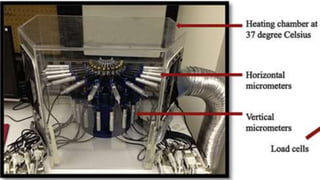
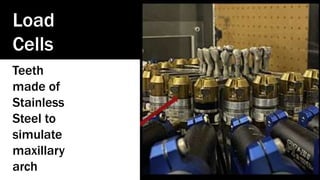
OSIM has horizontal and vertical micrometers that were
used to move teeth in buccolingually and occlusogingivally.
Load cells were used to measure the forces and moments
in 3D were located at a distance from teeth for OSIM.
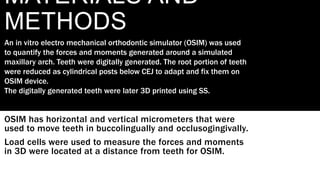
An in vitro electro mechanical orthodontic simulator (OSIM) was used
to quantify the forces and moments generated around a simulated
maxillary arch. Teeth were digitally generated. The root portion of teeth
were reduced as cylindrical posts below CEJ to adapt and fix them on
OSIM device.
The digitally generated teeth were later 3D printed using SS.
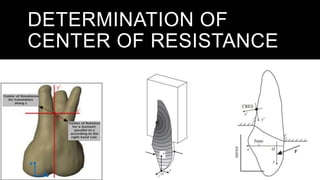
DETERMINATION OF
CENTER OF RESISTANCE
SAMPLE FOOTER TEXT 20XX 4
ELECTRO-MECHANICAL
ORTHODONTIC
SIMULATOR
S
Teeth
made of
Stainless
Steel to
simulate
maxillary
arch
Load
Cells
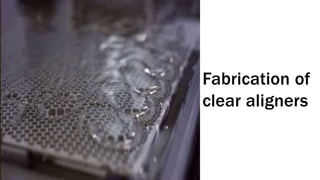
Fabrication of
clear aligners
MATERIALS AND
METHODS
Biostar machine was used to fabricate aligner with 5 bar and heating time
of 25s. After fabrication the aligner was left in airtight bag for 24h before
insterting onto OSIM.
During Orthodontic treatment incisor, canine and premolar are frequently
moved and molars used as anchor teeth. Therefore, in this study central
incisor, canine and second premolar were translated individually by
0.20mm in lingual direnction and taken back to their original position.
Digital scan of OSIM was obtained to generate a plastic 3D print of arch.
Later the 3D printed arch was further replicated with polysiloxane impression
material to make stone cast of high strength.
Glycol-modified polyethylene terephthalate (Taglus) was used to
fabricate aligner.
Sheets of 0.75 mm thickness Taglus material were used for each
test.
MATERIALS AND
METHODS
Initial forces and moments in the XYZ direction were recorded for tested
teeth and adjacent teeth at 0.20 mm of displacement.
Fy- Buccolingual force Fz- Occlusolingual Mx- Third order moment
Each trial was completed at 37 Celsius temperature to mimic oral
temperature.
Each aligner was tested 3 times for each tooth movement and
averaged for quantitive values.
Biostar Scheu Dental, Iserlohn Germany was used according to
manufacturer specified process. A code 113 was used on Biostar
machine.
SAMPLE FOOTER TEXT
STATISTICAL
ANALYSIS
Repeated measures of multivariate
analysis of variance (MANOVA) were
used to assess if there was a
significant mean difference
between Fy and Mx* exerted on 3
teeth when the Fy and Mx
considered jointly.
SAMPLE FOOTER TEXT
RESULTS
All forces and moments were
reported at the center of resistance
of each tooth. Box plots showed
data for Fy (Buccolingual) and Mx
(Third order moment)
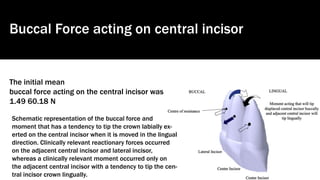
Schematic representation of the buccal force and
moment that has a tendency to tip the crown labially ex-
erted on the central incisor when it is moved in the lingual
direction. Clinically relevant reactionary forces occurred
on the adjacent central incisor and lateral incisor,
whereas a clinically relevant moment occurred only on
the adjacent central incisor with a tendency to tip the cen-
tral incisor crown lingually.
Buccal Force acting on central incisor
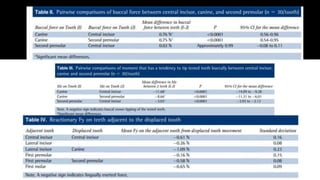
The initial mean
buccal force acting on the central incisor was
1.49 60.18 N
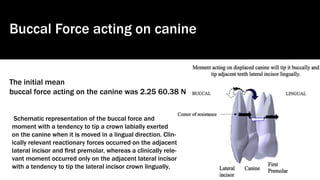
Schematic representation of the buccal force and
moment with a tendency to tip a crown labially exerted
on the canine when it is moved in a lingual direction. Clin-
ically relevant reactionary forces occurred on the adjacent
lateral incisor and first premolar, whereas a clinically rele-
vant moment occurred only on the adjacent lateral incisor
with a tendency to tip the lateral incisor crown lingually.
Buccal Force acting on canine
The initial mean
buccal force acting on the canine was 2.25 60.38 N
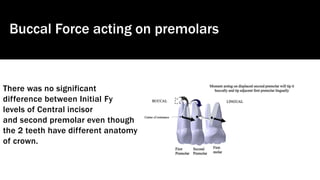
There was no significant
difference between Initial Fy
levels of Central incisor
and second premolar even though
the 2 teeth have different anatomy
of crown.
Buccal Force acting on premolars
SAMPLE FOOTER TEXT
CONCLUSION
CONCLUSION
1. Canine teeth, located at the curvature
of the maxillary arch, experienced
significantly more mean buccal force
than the central incisor and second
premolar when tested teeth were moved
by 0.20 LINGUALLY
CONCLUSION
2. The moment that has a tendency to
tip a tooth buccaly was significantly
more for the canine than the central
incisor and second premolar.
CONCLUSION
3. There were clinically significant
reactionary forces exerted on all
adjacent teeth to the lingually displaced
tooth.
CONCLUSION
4. Apart from buccal forces, intrusion
forces were also measured when the
central incisor, canine, and second
premolar teeth were displaced lingually.
Scan for the original article
Thanks for attention

Aligner Biomechanics

  • 1.
    EVALUATION OF ORTHODON TIC ALIGNER BIOMECHAN ICS AROUND THE MAXILLARY ARCH Presenter: Dr.Turgut Novruzlu Scientific supervisor: Prof. Dr.Haluk Iseri Harsimrat Kaur,a Jason Truong,b Giseon Heo,a James K. Mah,c Paul W. Major,a and Dan L. Romanyka,b Edmonton, Alberta, Canada, and Las Vegas, Nev
  • 2.
    SAMPLE FOOTER TEXT INTRODUCT ION Clearthermoplastic appliances can exert forces upon teeth and result in various movements of teeth. Aim of this study is to evaluate the forces and moments imposed from aligners. Assessing the effect of thermoplastic material choice, thickness and amount of activation on single tooth models is important. This exact study mainly focuses on the forces and moment systems imposed on central incisor, canine and second premolar teeth around the arch using a clinically representative glycol modified polyethylene terephthalate thermoplastic aligner material ] 20XX 2
  • 3.
    MATERIALS AND METHODS OSIM hashorizontal and vertical micrometers that were used to move teeth in buccolingually and occlusogingivally. Load cells were used to measure the forces and moments in 3D were located at a distance from teeth for OSIM. An in vitro electro mechanical orthodontic simulator (OSIM) was used to quantify the forces and moments generated around a simulated maxillary arch. Teeth were digitally generated. The root portion of teeth were reduced as cylindrical posts below CEJ to adapt and fix them on OSIM device. The digitally generated teeth were later 3D printed using SS.
  • 4.
    DETERMINATION OF CENTER OFRESISTANCE SAMPLE FOOTER TEXT 20XX 4
  • 5.
  • 6.
  • 7.
  • 8.
    MATERIALS AND METHODS Biostar machinewas used to fabricate aligner with 5 bar and heating time of 25s. After fabrication the aligner was left in airtight bag for 24h before insterting onto OSIM. During Orthodontic treatment incisor, canine and premolar are frequently moved and molars used as anchor teeth. Therefore, in this study central incisor, canine and second premolar were translated individually by 0.20mm in lingual direnction and taken back to their original position. Digital scan of OSIM was obtained to generate a plastic 3D print of arch. Later the 3D printed arch was further replicated with polysiloxane impression material to make stone cast of high strength. Glycol-modified polyethylene terephthalate (Taglus) was used to fabricate aligner. Sheets of 0.75 mm thickness Taglus material were used for each test.
  • 9.
    MATERIALS AND METHODS Initial forcesand moments in the XYZ direction were recorded for tested teeth and adjacent teeth at 0.20 mm of displacement. Fy- Buccolingual force Fz- Occlusolingual Mx- Third order moment Each trial was completed at 37 Celsius temperature to mimic oral temperature. Each aligner was tested 3 times for each tooth movement and averaged for quantitive values. Biostar Scheu Dental, Iserlohn Germany was used according to manufacturer specified process. A code 113 was used on Biostar machine.
  • 10.
    SAMPLE FOOTER TEXT STATISTICAL ANALYSIS Repeatedmeasures of multivariate analysis of variance (MANOVA) were used to assess if there was a significant mean difference between Fy and Mx* exerted on 3 teeth when the Fy and Mx considered jointly.
  • 11.
    SAMPLE FOOTER TEXT RESULTS Allforces and moments were reported at the center of resistance of each tooth. Box plots showed data for Fy (Buccolingual) and Mx (Third order moment)
  • 12.
    Schematic representation ofthe buccal force and moment that has a tendency to tip the crown labially ex- erted on the central incisor when it is moved in the lingual direction. Clinically relevant reactionary forces occurred on the adjacent central incisor and lateral incisor, whereas a clinically relevant moment occurred only on the adjacent central incisor with a tendency to tip the cen- tral incisor crown lingually. Buccal Force acting on central incisor The initial mean buccal force acting on the central incisor was 1.49 60.18 N
  • 13.
    Schematic representation ofthe buccal force and moment with a tendency to tip a crown labially exerted on the canine when it is moved in a lingual direction. Clin- ically relevant reactionary forces occurred on the adjacent lateral incisor and first premolar, whereas a clinically rele- vant moment occurred only on the adjacent lateral incisor with a tendency to tip the lateral incisor crown lingually. Buccal Force acting on canine The initial mean buccal force acting on the canine was 2.25 60.38 N
  • 14.
    There was nosignificant difference between Initial Fy levels of Central incisor and second premolar even though the 2 teeth have different anatomy of crown. Buccal Force acting on premolars
  • 16.
  • 17.
    CONCLUSION 1. Canine teeth,located at the curvature of the maxillary arch, experienced significantly more mean buccal force than the central incisor and second premolar when tested teeth were moved by 0.20 LINGUALLY
  • 18.
    CONCLUSION 2. The momentthat has a tendency to tip a tooth buccaly was significantly more for the canine than the central incisor and second premolar.
  • 19.
    CONCLUSION 3. There wereclinically significant reactionary forces exerted on all adjacent teeth to the lingually displaced tooth.
  • 20.
    CONCLUSION 4. Apart frombuccal forces, intrusion forces were also measured when the central incisor, canine, and second premolar teeth were displaced lingually.
  • 21.
    Scan for theoriginal article Thanks for attention