REMOVABLE CLEAR
APPLIANCES FOR
ORTHODONTIC
TREATMENT
INTRODUCTION
• With the increase in number of adult patients seeking orthodontic
treatment , now a days demand for more aesthetic options are
increasing …..
Ceramic brackets
Lingual orthodontic treatment
Clear aligners
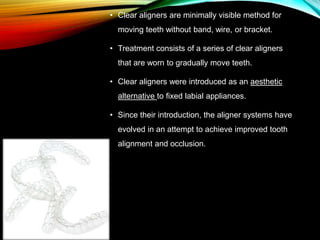
• Clear aligners are minimally visible method for
moving teeth without band, wire, or bracket.
• Treatment consists of a series of clear aligners
that are worn to gradually move teeth.
• Clear aligners were introduced as an aesthetic
alternative to fixed labial appliances.
• Since their introduction, the aligner systems have
evolved in an attempt to achieve improved tooth
alignment and occlusion.
HISTORY
• In 1945 Kesling – Tooth positioner for refining the final
stage of orthodontic treatment after debanding .
• In 1971 Ponitz intoduced a similar appliance called the
invisible retainer , which is made of a thin thermoplastic
acrylic sheet . Invisible retainer can be used to treat minor
relapse and also for detailing of the occlusion .
In 1993 the Essix retainer was introduced which was similar to
the invisible retainer and was made of a clear thin material that
snap fits over the dentition . This can be modified by
orthodontist to bring about minor tooth movement .
In 1997 the Invisalign appliance was introduced by Align
Technology . This system made use of computer aided design
and computer aided manufacturing ( CAD- CAM ) technology to
fabricate series of positioners that can move teeth in small
increaments of about 0.25 to 0.30 mm
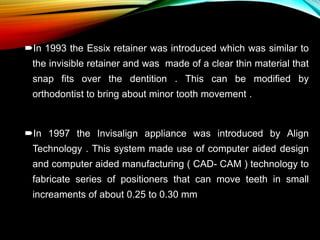
ADVANTAGES
COMFORT MORE ESTHETIC REMOVABLE
GOOD ORAL
HYGIENE
NO EMERGENCY
APPOINTMENTS
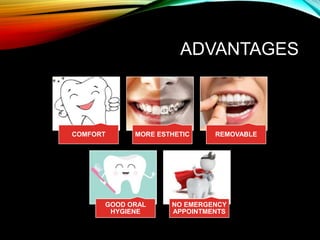
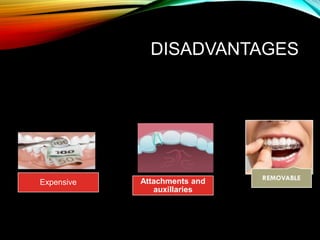
DISADVANTAGES
Expensive Attachments and
auxillaries
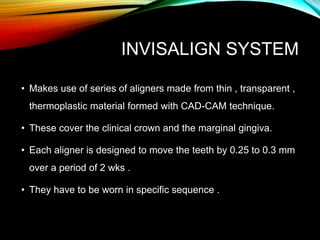
INVISALIGN SYSTEM
• Makes use of series of aligners made from thin , transparent ,
thermoplastic material formed with CAD-CAM technique.
• These cover the clinical crown and the marginal gingiva.
• Each aligner is designed to move the teeth by 0.25 to 0.3 mm
over a period of 2 wks .
• They have to be worn in specific sequence .
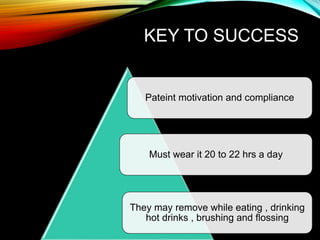
KEY TO SUCCESS
Pateint motivation and compliance
Must wear it 20 to 22 hrs a day
They may remove while eating , drinking
hot drinks , brushing and flossing
INDICATION
• Class I spacing with minor/moderate crowding and existing good
buccal occlusion
• Half-cusp Class II with minor crowding
• Class III with minimal overbite/overjet nonextraction cases
• Deep bite
• Anterior open bite
• Lower incisor extraction
CONTRAINDICATION
• Crowding and spacing over 5 mm
• Skeletal antero-posterior discrepancies of more than 2mm
• Centric – relation and centric –occlusion discrepancies
• Severely rotated teeth (more than 20 degrees )
• Open bite
• Extraction cases
• Severe deep bite
• Extrusion of teeth
• Severely tipped teeth
• Teeth with sort clinical crown
• Arches with multiple missing teeth
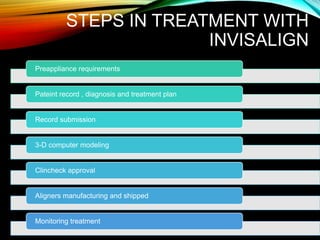
STEPS IN TREATMENT WITH
INVISALIGN
Preappliance requirements
Pateint record , diagnosis and treatment plan
Record submission
3-D computer modeling
Clincheck approval
Aligners manufacturing and shipped
Monitoring treatment
PRE APPLIANCE
REQUIREMENTS
• Restorative treatment if any should be completed
• Should not exhibit any periodontal disease
• Informed consent must be there .
PATIENT RECORD ,
DIAGNOSIS AND
TREATMENT PLAN
• Pateint history
• Clinical examination :-
1. extra oral
2. intra oral
• Diagnosis
• Problem list
• Treatment plan
RECORD SUBMISSION
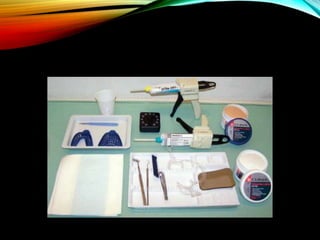
• Invisalign impression trays are available in various sizes to
accommodate all patients and can be ordered online for free
from Invisalign.
• Specifically designed for Invisalign treatment planning,
• the Invisalign trays fit uniquely in the digital scanners that
“read” the impressions.
• Invisalign scanners read only polyvinyl siloxane (PVS)
material, so it is imperative that other materials (e.g., alginate
alternatives, polyether materials) not be used.
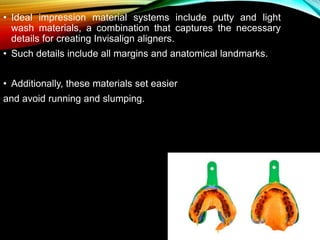
• Ideal impression material systems include putty and light
wash materials, a combination that captures the necessary
details for creating Invisalign aligners.
• Such details include all margins and anatomical landmarks.
• Additionally, these materials set easier
and avoid running and slumping.
BITE REGISTRATION
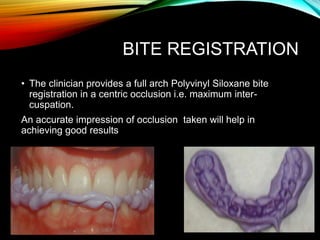
• The clinician provides a full arch Polyvinyl Siloxane bite
registration in a centric occlusion i.e. maximum inter-
cuspation.
An accurate impression of occlusion taken will help in
achieving good results
• Extra oral photographs
• Intra oral photographs
• Radiographs
• And the case file filled completely
• Desired treatment plan has to filled
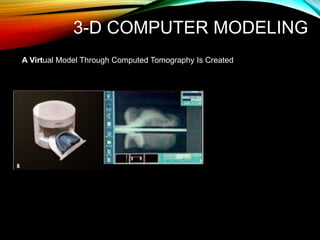
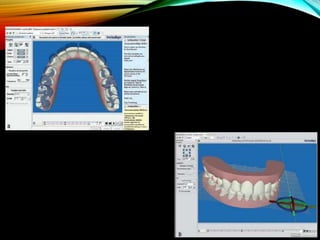
3-D COMPUTER MODELING
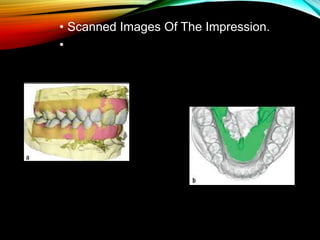
A Virtual Model Through Computed Tomography Is Created
• Scanned Images Of The Impression.
•
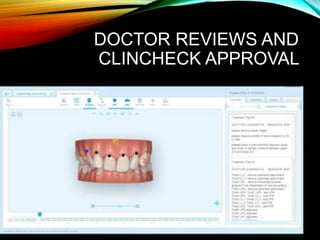
DOCTOR REVIEWS AND
CLINCHECK APPROVAL
• Aligners manufactured and shipped to practioner for delivery
to pateints .
• Monitoring treatment , obtaining desired results and retention .
THE ESSIX
SYSTEM
ESSIX TOOTH MOVING SYSTEM
• The Essix system of tooth-moving mechanics is based on the
philosophy that the orthodontist should have enough control
over a case to make corrections on the chair throughout
treatment. Tooth movement is possible in all planes of space.
Since this can be done without using multiple customized
appliances, the cost of the fabrication is minimal.
• Essix tooth movement is usually prescribed for the adult
patient with mild-to moderate alignment problems who does
not want to wear fixed appliances.
• Tooth movement requires force and space. There are two
types of space that must be evident for the tooth movement
with Essix appliance:-
• • Space within the appliance.
• • Space within the dentition.
• SPACE WITHIN THE APPLIANCE:
• Creates a “bubble” inside the appliance using Bubble forming
Thermopliers.
• Creates a “bubble” inside the appliance using Triad or stone.
• Creates a “window” for the targeted tooth to move into.
SPACE WITHIN THE DENTITION
• extraction or expansion
• interproximal reduction
• FORCE GENERATION IN ESSIX SYSTEM
• There are two primary systems of creating a tooth moving
force with an Essix appliance:-
• • Hillard thermoforming pliers
• • Mounding
HILLARD THERMOFORMING
PLIERS:
• The Hilliard Thermopliers for tooth movement provide force
to move teeth by creating a projection directly into an Essix
appliance
• The bumps created by the pliers are always made towards
the tooth surface for force generation.
• The thermopliers are heated and then placed on the Essix
appliance at the desired tooth position.
• The “bump” can be increased for further movement at
subsequent appointments in 1-mm increment using the hex
screw provided with the pliers.
MOUNDING
• A unique alternative method of producing force is by
bonding a small mound of composite to the enamel surface
of the target tooth rather than altering the Essix appliance.
• The advantage of mounding is an esthetically smooth plastic
surface that is not distorted by placing bumps in it with
heated pliers.
• Every time the depth of a projection is increased, the plastic
becomes thinner; conversely, a mound becomes stronger
with the placement of additional layers of composite
COMPLICATION WITH
REMOVABLE APPLIANCE
• PATEINT MOTIVATION IS CRITICAL IN ACHIEVING THE
DESIRED RESULT WHEN USING APPLIANCE .
• PATEINT MUST WEAR IT ATLEAST 20 TO 22 HRS A DAY
• THE TRANSPERANCY OF APPLIANCE MAY INCREASE
THE LIKELIHOOD OF IT GETTING MISPLACED .

clear aligners.ppt

  • 1.
  • 2.
    INTRODUCTION • With theincrease in number of adult patients seeking orthodontic treatment , now a days demand for more aesthetic options are increasing ….. Ceramic brackets Lingual orthodontic treatment Clear aligners
  • 3.
    • Clear alignersare minimally visible method for moving teeth without band, wire, or bracket. • Treatment consists of a series of clear aligners that are worn to gradually move teeth. • Clear aligners were introduced as an aesthetic alternative to fixed labial appliances. • Since their introduction, the aligner systems have evolved in an attempt to achieve improved tooth alignment and occlusion.
  • 4.
    HISTORY • In 1945Kesling – Tooth positioner for refining the final stage of orthodontic treatment after debanding . • In 1971 Ponitz intoduced a similar appliance called the invisible retainer , which is made of a thin thermoplastic acrylic sheet . Invisible retainer can be used to treat minor relapse and also for detailing of the occlusion .
  • 5.
    In 1993 theEssix retainer was introduced which was similar to the invisible retainer and was made of a clear thin material that snap fits over the dentition . This can be modified by orthodontist to bring about minor tooth movement . In 1997 the Invisalign appliance was introduced by Align Technology . This system made use of computer aided design and computer aided manufacturing ( CAD- CAM ) technology to fabricate series of positioners that can move teeth in small increaments of about 0.25 to 0.30 mm
  • 6.
    ADVANTAGES COMFORT MORE ESTHETICREMOVABLE GOOD ORAL HYGIENE NO EMERGENCY APPOINTMENTS
  • 7.
  • 8.
    INVISALIGN SYSTEM • Makesuse of series of aligners made from thin , transparent , thermoplastic material formed with CAD-CAM technique. • These cover the clinical crown and the marginal gingiva. • Each aligner is designed to move the teeth by 0.25 to 0.3 mm over a period of 2 wks . • They have to be worn in specific sequence .
  • 9.
    KEY TO SUCCESS Pateintmotivation and compliance Must wear it 20 to 22 hrs a day They may remove while eating , drinking hot drinks , brushing and flossing
  • 10.
    INDICATION • Class Ispacing with minor/moderate crowding and existing good buccal occlusion • Half-cusp Class II with minor crowding • Class III with minimal overbite/overjet nonextraction cases • Deep bite • Anterior open bite • Lower incisor extraction
  • 11.
    CONTRAINDICATION • Crowding andspacing over 5 mm • Skeletal antero-posterior discrepancies of more than 2mm • Centric – relation and centric –occlusion discrepancies • Severely rotated teeth (more than 20 degrees ) • Open bite • Extraction cases • Severe deep bite • Extrusion of teeth • Severely tipped teeth • Teeth with sort clinical crown • Arches with multiple missing teeth
  • 12.
    STEPS IN TREATMENTWITH INVISALIGN Preappliance requirements Pateint record , diagnosis and treatment plan Record submission 3-D computer modeling Clincheck approval Aligners manufacturing and shipped Monitoring treatment
  • 13.
    PRE APPLIANCE REQUIREMENTS • Restorativetreatment if any should be completed • Should not exhibit any periodontal disease • Informed consent must be there .
  • 14.
    PATIENT RECORD , DIAGNOSISAND TREATMENT PLAN • Pateint history • Clinical examination :- 1. extra oral 2. intra oral • Diagnosis • Problem list • Treatment plan
  • 15.
    RECORD SUBMISSION • Invisalignimpression trays are available in various sizes to accommodate all patients and can be ordered online for free from Invisalign. • Specifically designed for Invisalign treatment planning, • the Invisalign trays fit uniquely in the digital scanners that “read” the impressions. • Invisalign scanners read only polyvinyl siloxane (PVS) material, so it is imperative that other materials (e.g., alginate alternatives, polyether materials) not be used.
  • 17.
    • Ideal impressionmaterial systems include putty and light wash materials, a combination that captures the necessary details for creating Invisalign aligners. • Such details include all margins and anatomical landmarks. • Additionally, these materials set easier and avoid running and slumping.
  • 18.
    BITE REGISTRATION • Theclinician provides a full arch Polyvinyl Siloxane bite registration in a centric occlusion i.e. maximum inter- cuspation. An accurate impression of occlusion taken will help in achieving good results
  • 19.
    • Extra oralphotographs • Intra oral photographs • Radiographs • And the case file filled completely • Desired treatment plan has to filled
  • 20.
    3-D COMPUTER MODELING AVirtual Model Through Computed Tomography Is Created
  • 21.
    • Scanned ImagesOf The Impression. •
  • 22.
  • 24.
    • Aligners manufacturedand shipped to practioner for delivery to pateints . • Monitoring treatment , obtaining desired results and retention .
  • 25.
  • 26.
    ESSIX TOOTH MOVINGSYSTEM • The Essix system of tooth-moving mechanics is based on the philosophy that the orthodontist should have enough control over a case to make corrections on the chair throughout treatment. Tooth movement is possible in all planes of space. Since this can be done without using multiple customized appliances, the cost of the fabrication is minimal. • Essix tooth movement is usually prescribed for the adult patient with mild-to moderate alignment problems who does not want to wear fixed appliances.
  • 27.
    • Tooth movementrequires force and space. There are two types of space that must be evident for the tooth movement with Essix appliance:- • • Space within the appliance. • • Space within the dentition.
  • 28.
    • SPACE WITHINTHE APPLIANCE: • Creates a “bubble” inside the appliance using Bubble forming Thermopliers. • Creates a “bubble” inside the appliance using Triad or stone. • Creates a “window” for the targeted tooth to move into. SPACE WITHIN THE DENTITION • extraction or expansion • interproximal reduction
  • 29.
    • FORCE GENERATIONIN ESSIX SYSTEM • There are two primary systems of creating a tooth moving force with an Essix appliance:- • • Hillard thermoforming pliers • • Mounding
  • 30.
    HILLARD THERMOFORMING PLIERS: • TheHilliard Thermopliers for tooth movement provide force to move teeth by creating a projection directly into an Essix appliance • The bumps created by the pliers are always made towards the tooth surface for force generation. • The thermopliers are heated and then placed on the Essix appliance at the desired tooth position. • The “bump” can be increased for further movement at subsequent appointments in 1-mm increment using the hex screw provided with the pliers.
  • 31.
    MOUNDING • A uniquealternative method of producing force is by bonding a small mound of composite to the enamel surface of the target tooth rather than altering the Essix appliance. • The advantage of mounding is an esthetically smooth plastic surface that is not distorted by placing bumps in it with heated pliers. • Every time the depth of a projection is increased, the plastic becomes thinner; conversely, a mound becomes stronger with the placement of additional layers of composite
  • 32.
    COMPLICATION WITH REMOVABLE APPLIANCE •PATEINT MOTIVATION IS CRITICAL IN ACHIEVING THE DESIRED RESULT WHEN USING APPLIANCE . • PATEINT MUST WEAR IT ATLEAST 20 TO 22 HRS A DAY • THE TRANSPERANCY OF APPLIANCE MAY INCREASE THE LIKELIHOOD OF IT GETTING MISPLACED .