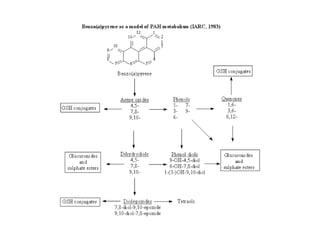
Polynuclear Aromatic
        Hydrocarbon (PAH)
cdfc.rug.ac.be/HealthRisk/PAHs/toxicology.htm
PAH Absorbtion
• Respiratory tract after inhalation of PAH-
  containing aerosols or of particulates to
  which a PAH, in the solid state, has
  become to be absorbed
• Gastro-intestinal tract after ingestion of
  contaminated food or water
• Skin as a result of contact with PAH-
  bearing materials.
PAH Distribution
• Detectable in almost all internal organs,
• Organs rich in adipose tissue are storage
  depots from which hydrocarbons are
  gradually released
• Gastrointestinal tract contains high levels
  of hydrocarbon and metabolites, even
  when PAH are administered by other
  routes, as a result of mucociliary
  clearance and swallowing or hepatobiliary
  excretion (IPCS, 1998)
Elimination
 Most metabolites of PAH are excreted in feces and urine.

Target organs

Skin: Anthracene, benzo[a]pyrene and napthalene are
primary irritants. Anthracene and benzo[a]pyrene were
reported to be sensitisers (IPCS, 1998). Some PAH may
produce skin cancer (scrotum, face)

•Respiratory system: Lung cancer

•Urogenital system: Bladder cancer

•Gastro-intestinal system: Stomach cancer
Teratogenicity
• Embryotoxic effects have been described
  in experimental animals exposed to PAH
  such as benz[a]anthracene,
  benzo[a]pyrene, and napthalene
• Genotoxicity: benzo(a)pyrene binds to
  DNA and causes gene mutations,
  chromosome aberrations, sister chromatid
  exchanges; unsheduled DNA synthesis.
Carcinogenicity
• Cancers associated with exposure to PAHs-
  containing mixtures are predominantly lung and
  skin cancers,following inhalation and dermal
  exposure, respectively. Bladder cancer has also
  been associated with exposure to PAHs in
  aluminium plants or when handling asphalt The
  impact of a potentialconfounding by other
  simultaneous exposures (e.g. aromatic amines,
  other components of bitumen/tar...) has not
  definitely been determined.
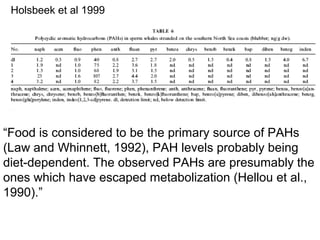
Holsbeek et al 1999


“Food is considered to be the primary source of PAHs
(Law and Whinnett, 1992), PAH levels probably being
diet-dependent. The observed PAHs are presumably the
ones which have escaped metabolization (Hellou et al.,
1990).”
Marsili et al 2001 - ? ng/g fw
(? Table 2 is microgram/g for tPAH)
• Fin whales
   – 1993: 10 to 30 (RECENT SPILLS)
   – 1996: 1

• S coeruleoalba
  – 30’s

  ? Poor metabolizers. Only burn fat if pregnant,
    lactating, sick or migrating

  Suggest PAH may be significant stressor but
   give no reasons
Martineau et al 2002
• High prevalence of epithelial cancers,
  especially in proximal intestine, in SLE
  beluga
• Epidemiologically associated with PAH
  exposure to beluga and humans from
  local aluminum smelters
Other effects
• Anti-estrogenic in flounder – Monteiro et al
  2000 MER 49:453-467

• Are PAH more significant to mm than
  residue data would imply?
• How can we examine their effects that are
  less overt than carcinogenesis?
• Which species are most at risk?
PAH References
•   IARC (1983) IARC Monographs on the evaluation of the carcinogenic risk of chemicals in humans, Polynuclear
    aromatic compounds, Part.1, Chemical, Environmental and Experimental Data, Lyon
•   IPCS (1998) Environmental Health Criteria 202 Selected non-heterocyclic polycyclic aromatic hydrocarbons,
    WHO, Geneva
•   ATSDR (1995), Toxicological profile for Polycyclic aromatic hydrocarbons (PAHs)Updata, U.S. Department of
    Health & Human Services, Agency for Toxic Substances and Disease Registry, U.S. Governement Printing Office
    Hellou, J., Stenson, G., Ni, I. H., and Payne, J. F. 1990. Polycyclic aromatic
    hydrocarbons in muscle tissue of marine mammals from the Northwest Atlantic.
    Marine Pollution Bulletin 21:469-473.
•   Holsbeek, L., Joiris, C. R., Debacker, V., Ali, I. B., Roose, P., Nellissen, J. P., Gobert,
    S., Bouquegneau, J. M., and Bossicart, M. 1999. Heavy metals, organochlorines and
    polycyclic aromatic hydrocarbons in sperm whales stranded in the southern North
    Sea during the 1994/1995 winter. Marine Pollution Bulletin [Mar. Pollut. Bull.]. 38:304-
    313.
•   Martineau, D., Lemberger, K., Dallaire, A., Labelle, P., Lipscomb, T. P., Michel, P.,
    and Mikaelian, I. 2002. Cancer in Wildlife, a Case Study: Beluga from the St.
    Lawrence Estuary, Quebec, Canada. Environmental Health Perspectives [Environ.
    Health Perspect.]. 110:285-292.
•   Mastrangelo, G., Fadda, E., and Marzia, V. 1996. Polycyclic aromatic hydrocarbons
    and cancer in man. Environ Health Perspect 104:1166-1170.
Algal toxins


Some diatoms and dinoflagellates are
variously neurotoxic toxic to humans and
fish via diet or inhalation.
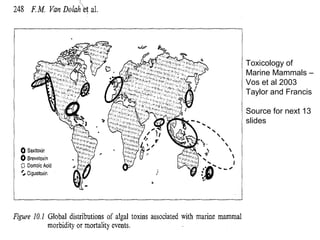
Toxicology of
Marine Mammals –
Vos et al 2003
Taylor and Francis

Source for next 13
slides
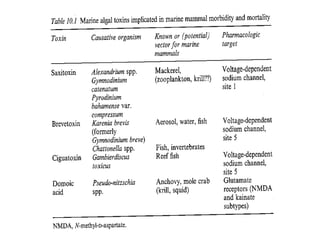
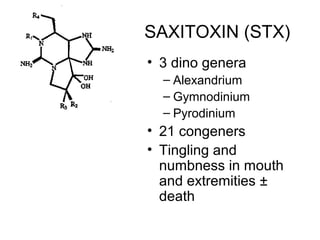
SAXITOXIN (STX)
• 3 dino genera
  – Alexandrium
  – Gymnodinium
  – Pyrodinium
• 21 congeners
• Tingling and
  numbness in mouth
  and extremities ±
  death
1987/8 Humpbacks – Cape Cod
             Bay
• 14 dead in a 5 week period
• Stomach mackerel, whale liver and kidney
  +ve STX-like bioassay, but –ve HPLC
• Local fish had +ve HPLC
• Remains circumstantial
Mediterranean Monk Seal
• May/Jun 1997 - > 100 seals leaving only
  70 in the population
• Morbillivirus present
• STX by bioassay and HPLC, but levels
  lower than expected to cause mortaltity
Sea Otters
• Butter clams can sequester STX
• Sea Otters avoid areas of toxic clams
• When fed toxic clams they avoid the most
  toxic clam parts such as siphon and
  kidney
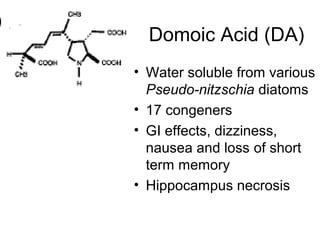
Domoic Acid (DA)
• Water soluble from various
  Pseudo-nitzschia diatoms
• 17 congeners
• GI effects, dizziness,
  nausea and loss of short
  term memory
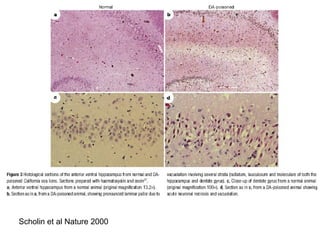
• Hippocampus necrosis
Marine animal DA events
• Pelicans & Cormorants – Monterey Bay 1991 DA,
  anchovies and P-n frustules in stomach
• California Sea Lions 1998 – head weaving, scratching,
  tremors and convulsions – See Gulland et al 2000 and
  Scholin et al 2000. Microgram per gram levels of DA in
  serum, urine and feces (it is cleared rapidly in urine)–
  similar levels to LD50 in mice.
• ’78. ’86. ’92 also DA events in CA in hindsight also in
  2000
• ?also mole crabs to sea otters and krill to gray whales
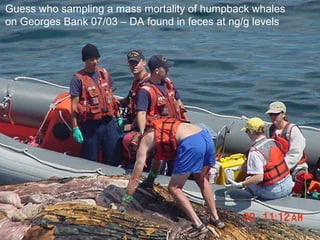
• Detected in humpback mortality on Georges Bank
  summer 2003 at ng/g levels in feces.
Scholin et al Nature 2000
Guess who sampling a mass mortality of humpback whales
on Georges Bank 07/03 – DA found in feces at ng/g levels
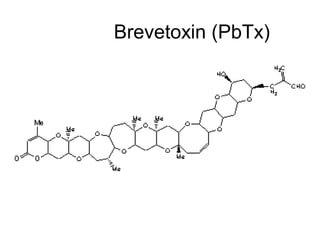
Brevetoxin (PbTx)
PbTx
• 9 congeners
• Karenia brevis (aka Gymnodinium) and other
  dinos
• FL, Japan, NZ and US Mid Atlantic
• Oral – perioral tingling and numbness
• Inhalational – coughing and gagging
• Fish kills. Also Manatees and Tursiops in years
  of drought with poor flow of the Caloosahatchee
  R
• 1987 Tt die off – PbTx, PCB, Morbillivirus,
  Immunosupression
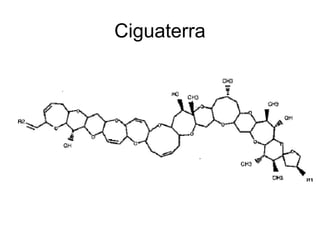
Ciguaterra
Ciguaterra
• 18 congeners Gambierdiscus toxicus a
  coral epiphyte dino, grazed by reef fish
• Nausea, vomiting, diarrhea and perioral
  numbness
• Speculated as involved in decline of
  Hawaiian monk seal
Questions
• How do we get at the multi-factorial
  agents?
• How do you triage the analysis of a mass
  mortality event?
• What are the environmental factors that
  affect algal toxin events?
Algal Toxins References
1989. Toxic dinoflagellates and marine mammal mortalities. Report; Conference WHOI-89-36; CRC-89-6.
Anderson, D. M., and A. W. White. 1992. Marine biotoxins at the top of the food chain. Oceanus 35:55-61.
Lefebvre, K. A., S. Bargu, T. Kieckhefer, and M. W. Silver. 2002. From sanddabs to blue whales: the
pervasiveness of domoic acid. Toxicon [Toxicon] 40:971-977.
O'Shea, T. J., G. B. Rathbun, R. K. Bonde, C. D. Buergelt, and D. K. Odell. 1991. An epizootic of Florida
manatees associated with a dinoflagellate bloom. Marine Mammal Science 7:165-179.
Rue, E., and K. Bruland. Domoic acid binds iron and copper: a possible role for the toxin produced by the
marine diatom Pseudo-nitzschia.
Rue, E., and K. Bruland. 2001. Domoic acid binds iron and copper: a possible role for the toxin produced by
the marine diatom Pseudo-nitzschia. Marine Chemistry [Mar. Chem.]. 76:1-2.
Scholin, C. A., F. Gulland, G. J. Doucette, S. Benson, M. Busman, F. P. Chavez, J. Cordaro, R. DeLong, A.
De Vogelaere, J. Harvey, M. Haulena, K. Lefebvre, T. Lipscomb, F. M. Van Dolah, and et al. 2000. Mortality of
sea lions along the central California coast linked to a toxic diatom bloom. Nature [Nature]. no. 6765:80-84.
Steidinger, K. A. Implications of 1986-87 Ptychodiscus brevis red tide and 1987-88 mass bottlenose dolphin
mortalities.
Trainer, V. L., N. G. Adams, B. D. Bill, C. M. Stehr, J. C. Wekell, P. Moeller, M. Busman, and D. Woodruff.
Domoic acid production near California coastal upwelling zones, June 1998.
Trainer, V. L., N. G. Adams, B. D. Bill, C. M. Stehr, J. C. Wekell, P. Moeller, M. Busman, and D. Woodruff.
1998. Domoic acid production near California coastal upwelling zones, June 1998. Limnology and
Oceanography [Limnol. Oceanogr.]. 45:1818-1833.
Van Dolah, F. M., G. J. Doucette, F. M. Fulland, T. L. Rowles, and G. D. Bossart. 2003. Impacts of algal toxins
on marine mammals. In: Toxicology of Marine Mammals. J. Vos, G. Bossart, M. Fournier and T. O'Shea.
Taylor and Francis, NY.247-269.

Algal toxins pah

  • 1.
    Polynuclear Aromatic Hydrocarbon (PAH) cdfc.rug.ac.be/HealthRisk/PAHs/toxicology.htm
  • 2.
    PAH Absorbtion • Respiratorytract after inhalation of PAH- containing aerosols or of particulates to which a PAH, in the solid state, has become to be absorbed • Gastro-intestinal tract after ingestion of contaminated food or water • Skin as a result of contact with PAH- bearing materials.
  • 3.
    PAH Distribution • Detectablein almost all internal organs, • Organs rich in adipose tissue are storage depots from which hydrocarbons are gradually released • Gastrointestinal tract contains high levels of hydrocarbon and metabolites, even when PAH are administered by other routes, as a result of mucociliary clearance and swallowing or hepatobiliary excretion (IPCS, 1998)
  • 6.
    Elimination Most metabolitesof PAH are excreted in feces and urine. Target organs Skin: Anthracene, benzo[a]pyrene and napthalene are primary irritants. Anthracene and benzo[a]pyrene were reported to be sensitisers (IPCS, 1998). Some PAH may produce skin cancer (scrotum, face) •Respiratory system: Lung cancer •Urogenital system: Bladder cancer •Gastro-intestinal system: Stomach cancer
  • 7.
    Teratogenicity • Embryotoxic effectshave been described in experimental animals exposed to PAH such as benz[a]anthracene, benzo[a]pyrene, and napthalene • Genotoxicity: benzo(a)pyrene binds to DNA and causes gene mutations, chromosome aberrations, sister chromatid exchanges; unsheduled DNA synthesis.
  • 8.
    Carcinogenicity • Cancers associatedwith exposure to PAHs- containing mixtures are predominantly lung and skin cancers,following inhalation and dermal exposure, respectively. Bladder cancer has also been associated with exposure to PAHs in aluminium plants or when handling asphalt The impact of a potentialconfounding by other simultaneous exposures (e.g. aromatic amines, other components of bitumen/tar...) has not definitely been determined.
  • 9.
    Holsbeek et al1999 “Food is considered to be the primary source of PAHs (Law and Whinnett, 1992), PAH levels probably being diet-dependent. The observed PAHs are presumably the ones which have escaped metabolization (Hellou et al., 1990).”
  • 10.
    Marsili et al2001 - ? ng/g fw (? Table 2 is microgram/g for tPAH) • Fin whales – 1993: 10 to 30 (RECENT SPILLS) – 1996: 1 • S coeruleoalba – 30’s ? Poor metabolizers. Only burn fat if pregnant, lactating, sick or migrating Suggest PAH may be significant stressor but give no reasons
  • 11.
    Martineau et al2002 • High prevalence of epithelial cancers, especially in proximal intestine, in SLE beluga • Epidemiologically associated with PAH exposure to beluga and humans from local aluminum smelters
  • 12.
    Other effects • Anti-estrogenicin flounder – Monteiro et al 2000 MER 49:453-467 • Are PAH more significant to mm than residue data would imply? • How can we examine their effects that are less overt than carcinogenesis? • Which species are most at risk?
  • 13.
    PAH References • IARC (1983) IARC Monographs on the evaluation of the carcinogenic risk of chemicals in humans, Polynuclear aromatic compounds, Part.1, Chemical, Environmental and Experimental Data, Lyon • IPCS (1998) Environmental Health Criteria 202 Selected non-heterocyclic polycyclic aromatic hydrocarbons, WHO, Geneva • ATSDR (1995), Toxicological profile for Polycyclic aromatic hydrocarbons (PAHs)Updata, U.S. Department of Health & Human Services, Agency for Toxic Substances and Disease Registry, U.S. Governement Printing Office Hellou, J., Stenson, G., Ni, I. H., and Payne, J. F. 1990. Polycyclic aromatic hydrocarbons in muscle tissue of marine mammals from the Northwest Atlantic. Marine Pollution Bulletin 21:469-473. • Holsbeek, L., Joiris, C. R., Debacker, V., Ali, I. B., Roose, P., Nellissen, J. P., Gobert, S., Bouquegneau, J. M., and Bossicart, M. 1999. Heavy metals, organochlorines and polycyclic aromatic hydrocarbons in sperm whales stranded in the southern North Sea during the 1994/1995 winter. Marine Pollution Bulletin [Mar. Pollut. Bull.]. 38:304- 313. • Martineau, D., Lemberger, K., Dallaire, A., Labelle, P., Lipscomb, T. P., Michel, P., and Mikaelian, I. 2002. Cancer in Wildlife, a Case Study: Beluga from the St. Lawrence Estuary, Quebec, Canada. Environmental Health Perspectives [Environ. Health Perspect.]. 110:285-292. • Mastrangelo, G., Fadda, E., and Marzia, V. 1996. Polycyclic aromatic hydrocarbons and cancer in man. Environ Health Perspect 104:1166-1170.
  • 14.
    Algal toxins Some diatomsand dinoflagellates are variously neurotoxic toxic to humans and fish via diet or inhalation.
  • 15.
    Toxicology of Marine Mammals– Vos et al 2003 Taylor and Francis Source for next 13 slides
  • 17.
    SAXITOXIN (STX) • 3dino genera – Alexandrium – Gymnodinium – Pyrodinium • 21 congeners • Tingling and numbness in mouth and extremities ± death
  • 18.
    1987/8 Humpbacks –Cape Cod Bay • 14 dead in a 5 week period • Stomach mackerel, whale liver and kidney +ve STX-like bioassay, but –ve HPLC • Local fish had +ve HPLC • Remains circumstantial
  • 19.
    Mediterranean Monk Seal •May/Jun 1997 - > 100 seals leaving only 70 in the population • Morbillivirus present • STX by bioassay and HPLC, but levels lower than expected to cause mortaltity
  • 20.
    Sea Otters • Butterclams can sequester STX • Sea Otters avoid areas of toxic clams • When fed toxic clams they avoid the most toxic clam parts such as siphon and kidney
  • 21.
    Domoic Acid (DA) •Water soluble from various Pseudo-nitzschia diatoms • 17 congeners • GI effects, dizziness, nausea and loss of short term memory • Hippocampus necrosis
  • 22.
    Marine animal DAevents • Pelicans & Cormorants – Monterey Bay 1991 DA, anchovies and P-n frustules in stomach • California Sea Lions 1998 – head weaving, scratching, tremors and convulsions – See Gulland et al 2000 and Scholin et al 2000. Microgram per gram levels of DA in serum, urine and feces (it is cleared rapidly in urine)– similar levels to LD50 in mice. • ’78. ’86. ’92 also DA events in CA in hindsight also in 2000 • ?also mole crabs to sea otters and krill to gray whales • Detected in humpback mortality on Georges Bank summer 2003 at ng/g levels in feces.
  • 23.
    Scholin et alNature 2000
  • 24.
    Guess who samplinga mass mortality of humpback whales on Georges Bank 07/03 – DA found in feces at ng/g levels
  • 25.
  • 26.
    PbTx • 9 congeners •Karenia brevis (aka Gymnodinium) and other dinos • FL, Japan, NZ and US Mid Atlantic • Oral – perioral tingling and numbness • Inhalational – coughing and gagging • Fish kills. Also Manatees and Tursiops in years of drought with poor flow of the Caloosahatchee R • 1987 Tt die off – PbTx, PCB, Morbillivirus, Immunosupression
  • 27.
  • 28.
    Ciguaterra • 18 congenersGambierdiscus toxicus a coral epiphyte dino, grazed by reef fish • Nausea, vomiting, diarrhea and perioral numbness • Speculated as involved in decline of Hawaiian monk seal
  • 29.
    Questions • How dowe get at the multi-factorial agents? • How do you triage the analysis of a mass mortality event? • What are the environmental factors that affect algal toxin events?
  • 30.
    Algal Toxins References 1989.Toxic dinoflagellates and marine mammal mortalities. Report; Conference WHOI-89-36; CRC-89-6. Anderson, D. M., and A. W. White. 1992. Marine biotoxins at the top of the food chain. Oceanus 35:55-61. Lefebvre, K. A., S. Bargu, T. Kieckhefer, and M. W. Silver. 2002. From sanddabs to blue whales: the pervasiveness of domoic acid. Toxicon [Toxicon] 40:971-977. O'Shea, T. J., G. B. Rathbun, R. K. Bonde, C. D. Buergelt, and D. K. Odell. 1991. An epizootic of Florida manatees associated with a dinoflagellate bloom. Marine Mammal Science 7:165-179. Rue, E., and K. Bruland. Domoic acid binds iron and copper: a possible role for the toxin produced by the marine diatom Pseudo-nitzschia. Rue, E., and K. Bruland. 2001. Domoic acid binds iron and copper: a possible role for the toxin produced by the marine diatom Pseudo-nitzschia. Marine Chemistry [Mar. Chem.]. 76:1-2. Scholin, C. A., F. Gulland, G. J. Doucette, S. Benson, M. Busman, F. P. Chavez, J. Cordaro, R. DeLong, A. De Vogelaere, J. Harvey, M. Haulena, K. Lefebvre, T. Lipscomb, F. M. Van Dolah, and et al. 2000. Mortality of sea lions along the central California coast linked to a toxic diatom bloom. Nature [Nature]. no. 6765:80-84. Steidinger, K. A. Implications of 1986-87 Ptychodiscus brevis red tide and 1987-88 mass bottlenose dolphin mortalities. Trainer, V. L., N. G. Adams, B. D. Bill, C. M. Stehr, J. C. Wekell, P. Moeller, M. Busman, and D. Woodruff. Domoic acid production near California coastal upwelling zones, June 1998. Trainer, V. L., N. G. Adams, B. D. Bill, C. M. Stehr, J. C. Wekell, P. Moeller, M. Busman, and D. Woodruff. 1998. Domoic acid production near California coastal upwelling zones, June 1998. Limnology and Oceanography [Limnol. Oceanogr.]. 45:1818-1833. Van Dolah, F. M., G. J. Doucette, F. M. Fulland, T. L. Rowles, and G. D. Bossart. 2003. Impacts of algal toxins on marine mammals. In: Toxicology of Marine Mammals. J. Vos, G. Bossart, M. Fournier and T. O'Shea. Taylor and Francis, NY.247-269.