
Jean Nidetch Women’s Center and
P.A.A.V.E. (Peers Advocating Anti-Violence
Education)
Present:
   Workshops and presentations
   Events on campus
   Advocacy for violence prevention and
    breast cancer awareness
   Academic involvement
   Four on staff, certified victim advocates
   Formerly known as SAFE Team, began in
    2002
   Presenters complete an
    18-hour training on domestic violence, sexual
    assault, and stalking
   Sexual Assault, Domestic Violence, and Alcohol
    Facilitated Sexual Assault
     Definitions
     Consent
     Statistics
     Effects on Victims
     Rethinking Violence


   http://www.youtube.com/watch?v=DqHYeCLBG6s&playnext=1
    &list=PL66015E1E63A0A300
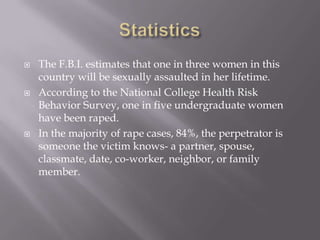
   The F.B.I. estimates that one in three women in this
    country will be sexually assaulted in her lifetime.
   According to the National College Health Risk
    Behavior Survey, one in five undergraduate women
    have been raped.
   In the majority of rape cases, 84%, the perpetrator is
    someone the victim knows- a partner, spouse,
    classmate, date, co-worker, neighbor, or family
    member.
   Sexual assault is a broader category that the Justice
    Department uses to classify rape, attempted rape
    and other violent felonies that fall short of rape.
   Nevada Revised Statutes: Sexual Assault
     “A person who subjects another person to sexual
      penetration, or who forces another person to make a
      sexual penetration on himself or another, against the
      victim’s will or under conditions in which the
      perpetrator knows or should know that the victim is
      mentally or physically incapable of resisting or
      understanding the nature of his conduct, is guilty of
      sexual assault”
   Consent?

   Physically Unable?
       Unconscious
       Physically powerless
       Unable to Communicate
       Helpless
       Unaware
       Physically Disabled
Mentally Unable?
 Incapacitated
   Mentally incapable of resisting or consenting

Degree of intoxication
    Were the victims motor skills impaired?
    Was the victim able to perceive what was happening
    around them?
    Who gave the victim the drinks or drugs?
    Was it the accused?
    Did accused encourage the victim to drink or use more
    drugs?
What is consent?
Both parties are fully conscious.
Both parties have equal ability to act.
Both parties are positive and sincere in their desires.
Both parties have clearly communicated their intent.


    Fear of Rejection
    May hear partner is a survivor
    May not know how
       Hypothetical situations…
         “What if we…”
         “How would you feel if we…”
         “What do you think about…”
       I statements…
       Coercion is NOT consent
Did victim:
  Vomit?
  Urinate?
  Defecate?

Could victim:
  Walk?
  Talk?
  Did victim have to be helped with physical tasks?

Did defendant:
  Carry victim?
  Follow victim?
Ethanol And Blackouts
   Blackout: Periods of memory loss for events that transpired while
    a person was drinking
   (no loss of consciousness- not passed out)
   Ethanol induced memory impairment includes disruption to the
    hippocampus which plays a central role in formation of new
    memory.


Ethanol And Passouts
   Alcohol-induced unconsciousness
   Not asleep, but sedated-due to CNS depressant effect
   Resembles sedated state associated with surgery
   Can last for hours
   Groggy-sedated feeling can linger for 24 hours
Victim is too drunk to consent for 1 of 3 reasons:
 Surreptitious administration by assailant

 Mixing of prescription or over the counter

  drugs with alcohol or recreational drugs
 Recreational use by victim
Alcohol is the most common drug used to facilitate
sexual assaults- particularly among college students. As
opposed to other drugs (such as GHB and Rohypnol) that
are often given to victims without their knowledge,
alcohol is often consumed consensually.
   Perpetrators often take advantage of victims who are
already intoxicated, or purposefully get a target drunk in
order to facilitate a sexual assault. These perpetrators
most often have had much less to drink than the victim
and in some cases have not consumed alcohol at all.
   Alcohol alone
 Alcohol mixed with drugs surreptitiously

   administered by assailant
 Alcohol mixed with prescription, over the

  counter drugs
 Alcohol mixed with recreational drugs

 * synergistic effect of combining drugs
Synergistic Effect

    The interaction of two or more substances or
    other agents to produce a combined effect
    that is greater than the sum of their separate
    effects
The Reality

   Approximately 50% of all sexual assaults are committed
    by a man who has been drinking.
    (Abbey et al. (2004))
   In a nationwide survey of college students, 68% of sexual
    assaults involved alcohol consumption by the offender.
    (Fisher et al. (2003))
   Is there any evidence the accused selected victim because
    they knew they would be an easy target?
   Did the accused use Coercion? Threats? Force?
   Did the victim say no?
Themes
   Sexual assault is all about control.
   A predator picks their prey.
   Who needs force when you have alcohol?
   Drunk victims are less able to resist.
   The perpetrator picks a victim with no ability to
    choose/someone they feel entitled to/ easy victim/
    victim with no memory; they had a plan.
   Can be short or long term
     Cutting/ self-mutilation
     Eating disorders
     Depression
     Alcohol and substance abuse
     Re-entrance into a violent relationship
     Post traumatic stress disorder (PTSD)*
            More information on PTSD and violence is available
             upon request
       Academic Career
    Anyone can be a victim of sexual assault or
     domestic violence. If you or someone you know is
     involved with interpersonal violence know that
     there are confidential resources to help you.


Local Resources
   Rape Crisis Center
    ◦ 366-1640
   More information available at:
    ◦ The Jean Nidetch Women’s Center, UNLV
        SSC A, 255 – 702.895.4475

Alcohol & consent2012

  • 1.
    Jean Nidetch Women’sCenter and P.A.A.V.E. (Peers Advocating Anti-Violence Education) Present:
  • 2.
    Workshops and presentations  Events on campus  Advocacy for violence prevention and breast cancer awareness  Academic involvement  Four on staff, certified victim advocates
  • 3.
    Formerly known as SAFE Team, began in 2002  Presenters complete an 18-hour training on domestic violence, sexual assault, and stalking
  • 4.
    Sexual Assault, Domestic Violence, and Alcohol Facilitated Sexual Assault  Definitions  Consent  Statistics  Effects on Victims  Rethinking Violence  http://www.youtube.com/watch?v=DqHYeCLBG6s&playnext=1 &list=PL66015E1E63A0A300
  • 5.
    The F.B.I. estimates that one in three women in this country will be sexually assaulted in her lifetime.  According to the National College Health Risk Behavior Survey, one in five undergraduate women have been raped.  In the majority of rape cases, 84%, the perpetrator is someone the victim knows- a partner, spouse, classmate, date, co-worker, neighbor, or family member.
  • 6.
    Sexual assault is a broader category that the Justice Department uses to classify rape, attempted rape and other violent felonies that fall short of rape.
  • 7.
    Nevada Revised Statutes: Sexual Assault “A person who subjects another person to sexual penetration, or who forces another person to make a sexual penetration on himself or another, against the victim’s will or under conditions in which the perpetrator knows or should know that the victim is mentally or physically incapable of resisting or understanding the nature of his conduct, is guilty of sexual assault”
  • 8.
    Consent?  Physically Unable?  Unconscious  Physically powerless  Unable to Communicate  Helpless  Unaware  Physically Disabled
  • 9.
    Mentally Unable?  Incapacitated  Mentally incapable of resisting or consenting Degree of intoxication  Were the victims motor skills impaired?  Was the victim able to perceive what was happening around them?  Who gave the victim the drinks or drugs?  Was it the accused?  Did accused encourage the victim to drink or use more drugs?
  • 10.
    What is consent? Bothparties are fully conscious. Both parties have equal ability to act. Both parties are positive and sincere in their desires. Both parties have clearly communicated their intent.  Fear of Rejection  May hear partner is a survivor  May not know how
  • 11.
    Hypothetical situations…  “What if we…”  “How would you feel if we…”  “What do you think about…”  I statements…  Coercion is NOT consent
  • 12.
    Did victim:  Vomit?  Urinate?  Defecate? Could victim:  Walk?  Talk?  Did victim have to be helped with physical tasks? Did defendant:  Carry victim?  Follow victim?
  • 13.
    Ethanol And Blackouts  Blackout: Periods of memory loss for events that transpired while a person was drinking  (no loss of consciousness- not passed out)  Ethanol induced memory impairment includes disruption to the hippocampus which plays a central role in formation of new memory. Ethanol And Passouts  Alcohol-induced unconsciousness  Not asleep, but sedated-due to CNS depressant effect  Resembles sedated state associated with surgery  Can last for hours  Groggy-sedated feeling can linger for 24 hours
  • 15.
    Victim is toodrunk to consent for 1 of 3 reasons:  Surreptitious administration by assailant  Mixing of prescription or over the counter drugs with alcohol or recreational drugs  Recreational use by victim
  • 16.
    Alcohol is themost common drug used to facilitate sexual assaults- particularly among college students. As opposed to other drugs (such as GHB and Rohypnol) that are often given to victims without their knowledge, alcohol is often consumed consensually. Perpetrators often take advantage of victims who are already intoxicated, or purposefully get a target drunk in order to facilitate a sexual assault. These perpetrators most often have had much less to drink than the victim and in some cases have not consumed alcohol at all.
  • 17.
    Alcohol alone  Alcohol mixed with drugs surreptitiously administered by assailant  Alcohol mixed with prescription, over the counter drugs  Alcohol mixed with recreational drugs * synergistic effect of combining drugs
  • 18.
    Synergistic Effect  The interaction of two or more substances or other agents to produce a combined effect that is greater than the sum of their separate effects
  • 19.
    The Reality  Approximately 50% of all sexual assaults are committed by a man who has been drinking. (Abbey et al. (2004))  In a nationwide survey of college students, 68% of sexual assaults involved alcohol consumption by the offender. (Fisher et al. (2003))  Is there any evidence the accused selected victim because they knew they would be an easy target?  Did the accused use Coercion? Threats? Force?  Did the victim say no?
  • 20.
    Themes  Sexual assault is all about control.  A predator picks their prey.  Who needs force when you have alcohol?  Drunk victims are less able to resist.  The perpetrator picks a victim with no ability to choose/someone they feel entitled to/ easy victim/ victim with no memory; they had a plan.
  • 22.
    Can be short or long term  Cutting/ self-mutilation  Eating disorders  Depression  Alcohol and substance abuse  Re-entrance into a violent relationship  Post traumatic stress disorder (PTSD)*  More information on PTSD and violence is available upon request  Academic Career
  • 23.
    Anyone can be a victim of sexual assault or domestic violence. If you or someone you know is involved with interpersonal violence know that there are confidential resources to help you. Local Resources  Rape Crisis Center ◦ 366-1640  More information available at: ◦ The Jean Nidetch Women’s Center, UNLV SSC A, 255 – 702.895.4475