AGA KHAN
UNIVERSITY HOSPITAL
Made by
Rozmin
1
Vision
 Aga Khan University will be an independent
 Primarily serving the developing world and Muslim societies in innovative and enduring
ways.
Mission
 AKU is committed to the development of human capacities
 It seeks to prepare individuals for positive and exemplary leadership roles
 Strength in research and excellence in education
 Enthusiastic to providing meaningful contributions to society
Values
 As an international institution in achieving its mission, AKUH operates on the core principles
of:
 Quality
 Relevance
 Impact
 Access
Vision, Mission & values
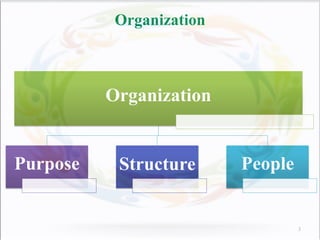
Organization
Purpose Structure People
Organization
3
Organization
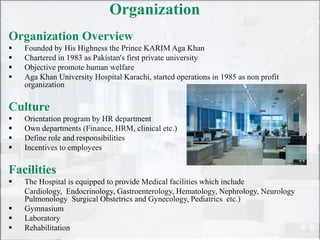
Organization Overview
 Founded by His Highness the Prince KARIM Aga Khan
 Chartered in 1983 as Pakistan's first private university
 Objective promote human welfare
 Aga Khan University Hospital Karachi, started operations in 1985 as non profit
organization
Culture
 Orientation program by HR department
 Own departments (Finance, HRM, clinical etc.)
 Define role and responsibilities
 Incentives to employees
Facilities
 The Hospital is equipped to provide Medical facilities which include
Cardiology, Endocrinology, Gastroenterology, Hematology, Nephrology, Neurology
Pulmonology Surgical Obstetrics and Gynecology, Pediatrics etc.)
 Gymnasium
 Laboratory
 Rehabilitation
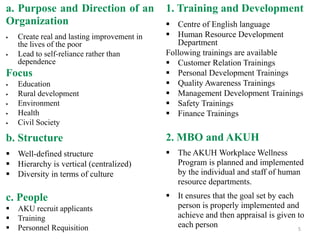
a. Purpose and Direction of an
Organization
 Create real and lasting improvement in
the lives of the poor
 Lead to self-reliance rather than
dependence
Focus
 Education
 Rural development
 Environment
 Health
 Civil Society
b. Structure
 Well-defined structure
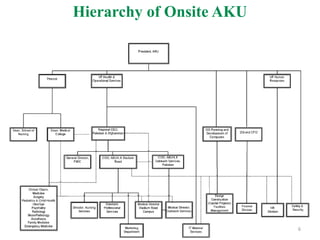
 Hierarchy is vertical (centralized)
 Diversity in terms of culture
c. People
 AKU recruit applicants
 Training
 Personnel Requisition
1. Training and Development
 Centre of English language
 Human Resource Development
Department
Following trainings are available
 Customer Relation Trainings
 Personal Development Trainings
 Quality Awareness Trainings
 Management Development Trainings
 Safety Trainings
 Finance Trainings
2. MBO and AKUH
 The AKUH Workplace Wellness
Program is planned and implemented
by the individual and staff of human
resource departments.
 It ensures that the goal set by each
person is properly implemented and
achieve and then appraisal is given to
each person 5
Hierarchy of Onsite AKU
6
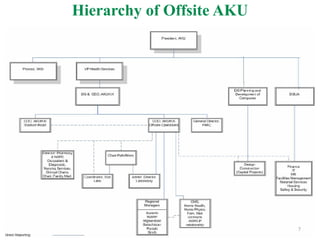
Hierarchy of Offsite AKU
7
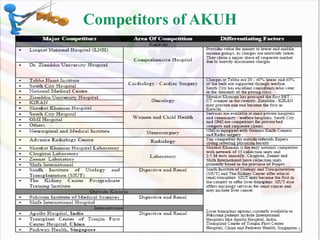
Competitors of AKUH
8
Operating Regions
 PAKISTAN:
 KENYA:
 TANZANIA:
 UGANDA:
 UNITED KINGDOM:
 AFGHANISTAN:
 SYRIA:
 UAE:
Revenues & Expenditure
Income: (USS In millions)
 Hospital revenues 115.1
 Tuition fees 4.1
 Grants & Donations 23.4
 Income from
investments/endowments/other 10.0
Expenditure
 Staff 67.4
 Supplies 37.3
 Other operating expenses 28.3
 Construction projects 10.6
 Excess / (shortfall) of income over
expenditure (3.5)
9
Challenges
a. Human Resource
 Staff and Faculty retention
 Finding new qualified personnel - locally and
internationally
 Matching future initiatives with available skill
set
 Competitive compensation
 Training for new programs
 Succession planning
b. Space
 Limited space on campus, most ancillary and
support functions getting constrained
 Construction constraints - Vertical vs.
Horizontal
 Offsite locations - limited expansion potential,
inappropriateness, weak infrastructure and
access
c. Structure
 Faculty conflict
 Departmental and Institutional governance
 Patient perception of offsite facilities
 Limited awareness about AKHSP facilities.
d. Other
 Expensive image
 Inadequate referral network
 Limited resources
 Regional instability & socioeconomics
 Lack of research credibility
 Global geo-political realities
 Emerging new competitors for specialized
services
 Funding
 Sustainability
 High Cost of Quality
10
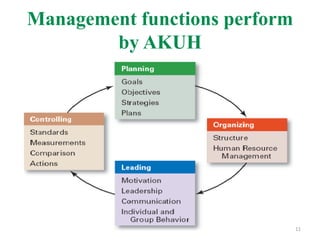
Management functions perform
by AKUH
11
a. Planning
 Planning and Development of Campuses (P&DC)
 Timely and effective implementation of Aga Khan
University's Projects for Pakistan & abroad
 Design process
 Development and implementation of current
program & strategies
 Preparing the project execution plan and
schedules for all aspects of the projects.
12
13
b. Organizing
The organizing unit of AKUH is responsible for
 Developing long and short term strategic plans to
identify resource requirements.
 Support the project management function by
providing a timely and accurate instrument for
projects progress
 Conducting operations and workflow analysis; cost
and inventory control in order to improve operations
and productivity.
 Undertake key project planning, feasibility report
writing and perform field inspections as and when
required 13
c. Leading
 AKU was established to develop the leaders of
tomorrow by
 Continue to draw upon various cultures to
teach critical thinking, problem-solving and
decision-making
 Develop the powerful force of pluralism that
promotes intellectual openness, tolerance and
increased understanding between people of
different societies.
14
d. Controlling
 The controlling system ensures that the progress
of the programs is carefully followed-up and that
outputs and achievements of the program are
measured over time
 Monitoring and Evaluation is based on a rational
process & performances of each individual and its
impact of the program.
 There are several times of controls implemented
in AKU including record keeping infection control
etc.
15
Controlling
a. Control of records
a. Complaint records,
b. Training records,
c. Process monitoring records,
d. Inspection & maintenance records,
e. Pertinent contractor and supplier records,
f. Incident reports,
g. Records of tests for emergency
preparedness,
h. Audit results,
i. Management review results,
j. External communications decision,
k. Records of applicable legal requirements,
l. Records of significant environmental
aspects,
m. Records of environmental meetings,
n. Environmental performance information,
o. Legal compliance records, and
p. Communications with interested parties.
q. Proper account should be taken of
b. Infection Control
a. Infection Control consists of the
following:
b. Personal hygiene
c. Chain of infection, preventive measures
d. Isolation categories and patient care
e. Safe management of sharps, linen and
hospital waste
f. Universal blood and body fluid
precautions
g. Management of exposure to blood and
body fluid and needle stick injuries
h. Employees responsibility in the Infection
Control Program
16
The strategic plan of AKUH
In keeping true to Mission and Vision, the
strategic plan 2010-2023 has the following three
thrusts:
 Develop an "Integrated" Healthcare System
 Establish Centers of Excellence
 Enhance Capacity
17
Situation Analysis of AKUH, Karachi and
Secondary Hospitals
b. WEAKNESSES
 Expensive image
 Inadequate referral network
 High staff turnover and scarcity of trained
manpower
 Physical infrastructure and space limitations
 Overstretched acute care beds, ventilators,
radiology and clinical space. Ability to retain
graduates of Medical College and School of
Nursing
Secondary Hospitals
 Limited awareness about Outreach facilities
 Outreach perceived as an inferior health
facility when compared with AKUH
 Space limitations at Kharadar and Garden
Hospitals
a. STRENGTHS
 High brand equity and quality of care
 Competent and credentialed clinical faculty,
including state-of-the-art equipment and
diagnostic facilities
 Vision and governance
 Proactive approach
 Medical College and School of Nursing
 Residency and Fellowship Programs
 Multidisciplinary approach
 Growth focus
 All services under one roof
 International Accreditations
Secondary Hospitals
 Dedicated Maternal and Child Health
Hospitals offering primary and secondary
care services 18
c. OPPORTUNITIES
 Support AKDN in achieving its overall
Facilitate Teaching and Research
opportunities
 Become the leader for Health care
integration
 Increase access to quality primary,
secondary and tertiary care
 Networking with AKDN and leading
regional players
 International scope by developing e-health
infrastructure
Secondary Hospitals
 Establish Centers of Excellence
d. THREATS
 Limited resources for expansion and
cutting edge technology
 Regional instability & socioeconomics
 Dilution of existing strengths as
competitors gain pace
 Lack of research credibility
 Global geo-political realities
 Inability to respond to opportunities
and issues proactively
Secondary Hospitals
 Limited marketability for certain on-
campus services when relocated to
Secondary sites
19
Conclusion
"AKUH will be recognized as one of the best health
care institutions in Pakistan and the developing
world"
 By providing compassionate, ethical, accessible
and high Quality care
 By providing an outstanding work environment
that raises motivation and commitment in staff.
 By enabling leadership in education and research
20
21

Akuh report ppt

  • 1.
  • 2.
    Vision  Aga KhanUniversity will be an independent  Primarily serving the developing world and Muslim societies in innovative and enduring ways. Mission  AKU is committed to the development of human capacities  It seeks to prepare individuals for positive and exemplary leadership roles  Strength in research and excellence in education  Enthusiastic to providing meaningful contributions to society Values  As an international institution in achieving its mission, AKUH operates on the core principles of:  Quality  Relevance  Impact  Access Vision, Mission & values
  • 3.
  • 4.
    Organization Organization Overview  Foundedby His Highness the Prince KARIM Aga Khan  Chartered in 1983 as Pakistan's first private university  Objective promote human welfare  Aga Khan University Hospital Karachi, started operations in 1985 as non profit organization Culture  Orientation program by HR department  Own departments (Finance, HRM, clinical etc.)  Define role and responsibilities  Incentives to employees Facilities  The Hospital is equipped to provide Medical facilities which include Cardiology, Endocrinology, Gastroenterology, Hematology, Nephrology, Neurology Pulmonology Surgical Obstetrics and Gynecology, Pediatrics etc.)  Gymnasium  Laboratory  Rehabilitation
  • 5.
    a. Purpose andDirection of an Organization  Create real and lasting improvement in the lives of the poor  Lead to self-reliance rather than dependence Focus  Education  Rural development  Environment  Health  Civil Society b. Structure  Well-defined structure  Hierarchy is vertical (centralized)  Diversity in terms of culture c. People  AKU recruit applicants  Training  Personnel Requisition 1. Training and Development  Centre of English language  Human Resource Development Department Following trainings are available  Customer Relation Trainings  Personal Development Trainings  Quality Awareness Trainings  Management Development Trainings  Safety Trainings  Finance Trainings 2. MBO and AKUH  The AKUH Workplace Wellness Program is planned and implemented by the individual and staff of human resource departments.  It ensures that the goal set by each person is properly implemented and achieve and then appraisal is given to each person 5
  • 6.
  • 7.
  • 8.
  • 9.
    Operating Regions  PAKISTAN: KENYA:  TANZANIA:  UGANDA:  UNITED KINGDOM:  AFGHANISTAN:  SYRIA:  UAE: Revenues & Expenditure Income: (USS In millions)  Hospital revenues 115.1  Tuition fees 4.1  Grants & Donations 23.4  Income from investments/endowments/other 10.0 Expenditure  Staff 67.4  Supplies 37.3  Other operating expenses 28.3  Construction projects 10.6  Excess / (shortfall) of income over expenditure (3.5) 9
  • 10.
    Challenges a. Human Resource Staff and Faculty retention  Finding new qualified personnel - locally and internationally  Matching future initiatives with available skill set  Competitive compensation  Training for new programs  Succession planning b. Space  Limited space on campus, most ancillary and support functions getting constrained  Construction constraints - Vertical vs. Horizontal  Offsite locations - limited expansion potential, inappropriateness, weak infrastructure and access c. Structure  Faculty conflict  Departmental and Institutional governance  Patient perception of offsite facilities  Limited awareness about AKHSP facilities. d. Other  Expensive image  Inadequate referral network  Limited resources  Regional instability & socioeconomics  Lack of research credibility  Global geo-political realities  Emerging new competitors for specialized services  Funding  Sustainability  High Cost of Quality 10
  • 11.
  • 12.
    a. Planning  Planningand Development of Campuses (P&DC)  Timely and effective implementation of Aga Khan University's Projects for Pakistan & abroad  Design process  Development and implementation of current program & strategies  Preparing the project execution plan and schedules for all aspects of the projects. 12
  • 13.
    13 b. Organizing The organizingunit of AKUH is responsible for  Developing long and short term strategic plans to identify resource requirements.  Support the project management function by providing a timely and accurate instrument for projects progress  Conducting operations and workflow analysis; cost and inventory control in order to improve operations and productivity.  Undertake key project planning, feasibility report writing and perform field inspections as and when required 13
  • 14.
    c. Leading  AKUwas established to develop the leaders of tomorrow by  Continue to draw upon various cultures to teach critical thinking, problem-solving and decision-making  Develop the powerful force of pluralism that promotes intellectual openness, tolerance and increased understanding between people of different societies. 14
  • 15.
    d. Controlling  Thecontrolling system ensures that the progress of the programs is carefully followed-up and that outputs and achievements of the program are measured over time  Monitoring and Evaluation is based on a rational process & performances of each individual and its impact of the program.  There are several times of controls implemented in AKU including record keeping infection control etc. 15
  • 16.
    Controlling a. Control ofrecords a. Complaint records, b. Training records, c. Process monitoring records, d. Inspection & maintenance records, e. Pertinent contractor and supplier records, f. Incident reports, g. Records of tests for emergency preparedness, h. Audit results, i. Management review results, j. External communications decision, k. Records of applicable legal requirements, l. Records of significant environmental aspects, m. Records of environmental meetings, n. Environmental performance information, o. Legal compliance records, and p. Communications with interested parties. q. Proper account should be taken of b. Infection Control a. Infection Control consists of the following: b. Personal hygiene c. Chain of infection, preventive measures d. Isolation categories and patient care e. Safe management of sharps, linen and hospital waste f. Universal blood and body fluid precautions g. Management of exposure to blood and body fluid and needle stick injuries h. Employees responsibility in the Infection Control Program 16
  • 17.
    The strategic planof AKUH In keeping true to Mission and Vision, the strategic plan 2010-2023 has the following three thrusts:  Develop an "Integrated" Healthcare System  Establish Centers of Excellence  Enhance Capacity 17
  • 18.
    Situation Analysis ofAKUH, Karachi and Secondary Hospitals b. WEAKNESSES  Expensive image  Inadequate referral network  High staff turnover and scarcity of trained manpower  Physical infrastructure and space limitations  Overstretched acute care beds, ventilators, radiology and clinical space. Ability to retain graduates of Medical College and School of Nursing Secondary Hospitals  Limited awareness about Outreach facilities  Outreach perceived as an inferior health facility when compared with AKUH  Space limitations at Kharadar and Garden Hospitals a. STRENGTHS  High brand equity and quality of care  Competent and credentialed clinical faculty, including state-of-the-art equipment and diagnostic facilities  Vision and governance  Proactive approach  Medical College and School of Nursing  Residency and Fellowship Programs  Multidisciplinary approach  Growth focus  All services under one roof  International Accreditations Secondary Hospitals  Dedicated Maternal and Child Health Hospitals offering primary and secondary care services 18
  • 19.
    c. OPPORTUNITIES  SupportAKDN in achieving its overall Facilitate Teaching and Research opportunities  Become the leader for Health care integration  Increase access to quality primary, secondary and tertiary care  Networking with AKDN and leading regional players  International scope by developing e-health infrastructure Secondary Hospitals  Establish Centers of Excellence d. THREATS  Limited resources for expansion and cutting edge technology  Regional instability & socioeconomics  Dilution of existing strengths as competitors gain pace  Lack of research credibility  Global geo-political realities  Inability to respond to opportunities and issues proactively Secondary Hospitals  Limited marketability for certain on- campus services when relocated to Secondary sites 19
  • 20.
    Conclusion "AKUH will berecognized as one of the best health care institutions in Pakistan and the developing world"  By providing compassionate, ethical, accessible and high Quality care  By providing an outstanding work environment that raises motivation and commitment in staff.  By enabling leadership in education and research 20
  • 21.