Akka Persistence Webinar
by Patrik Nordwall

@patriknw
opt-in at-least-once delivery
semantics between actors
recover application state after a crash
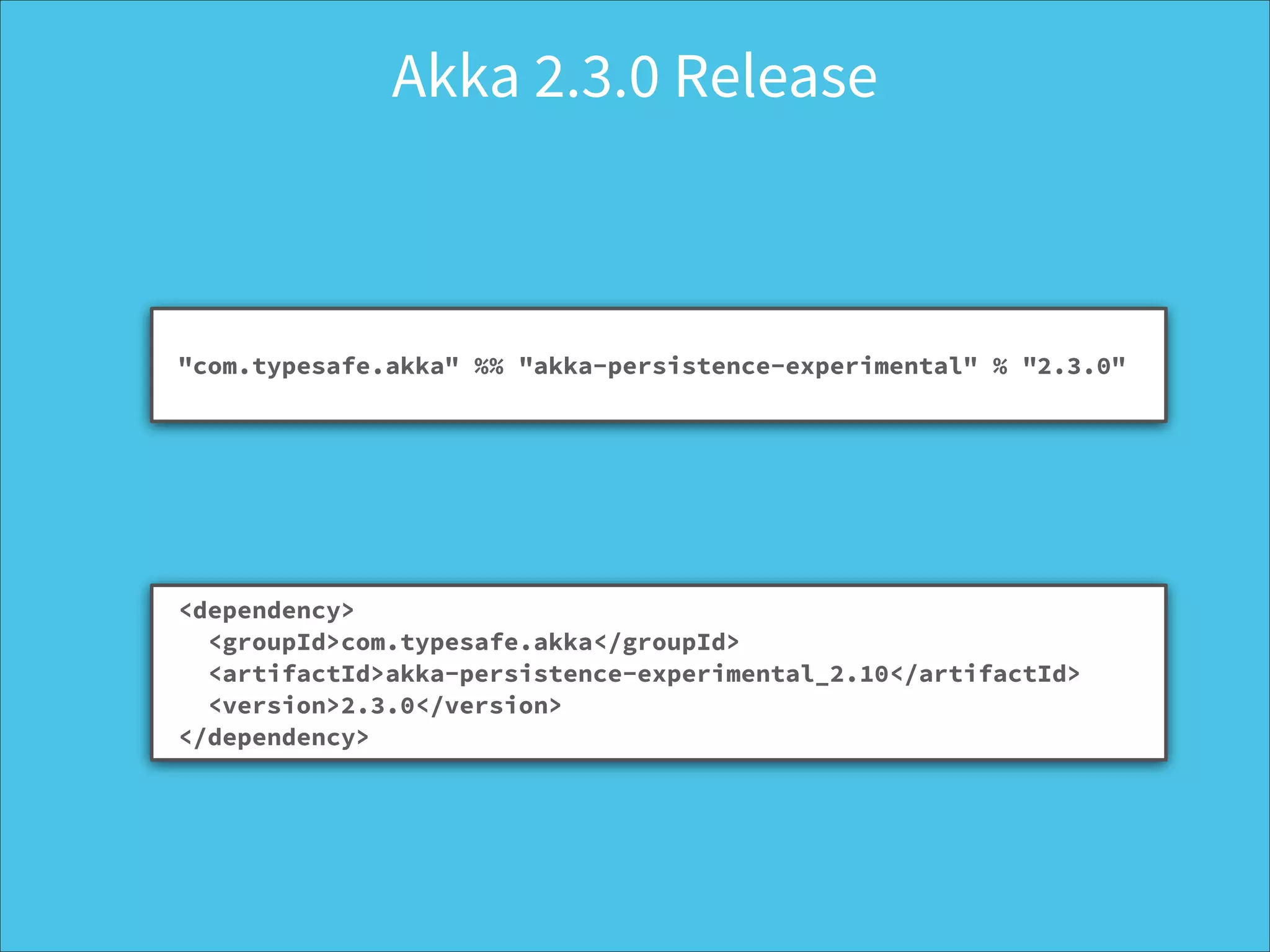
Akka 2.3.0 Release


"com.typesafe.akka" %% "akka-persistence-experimental" % "2.3.0"

<dependency>
<groupId>com.typesafe.akka</groupId>
<artifactId>akka-persistence-experimental_2.10</artifactId>
<version>2.3.0</version>
</dependency>
Martin Krasser

Twitter: mrt1nz

Github: krasserm
Eventsourced


akka-persistence

September 2013 - February 2014 

contractor for Typesafe
Awesome work, Martin!
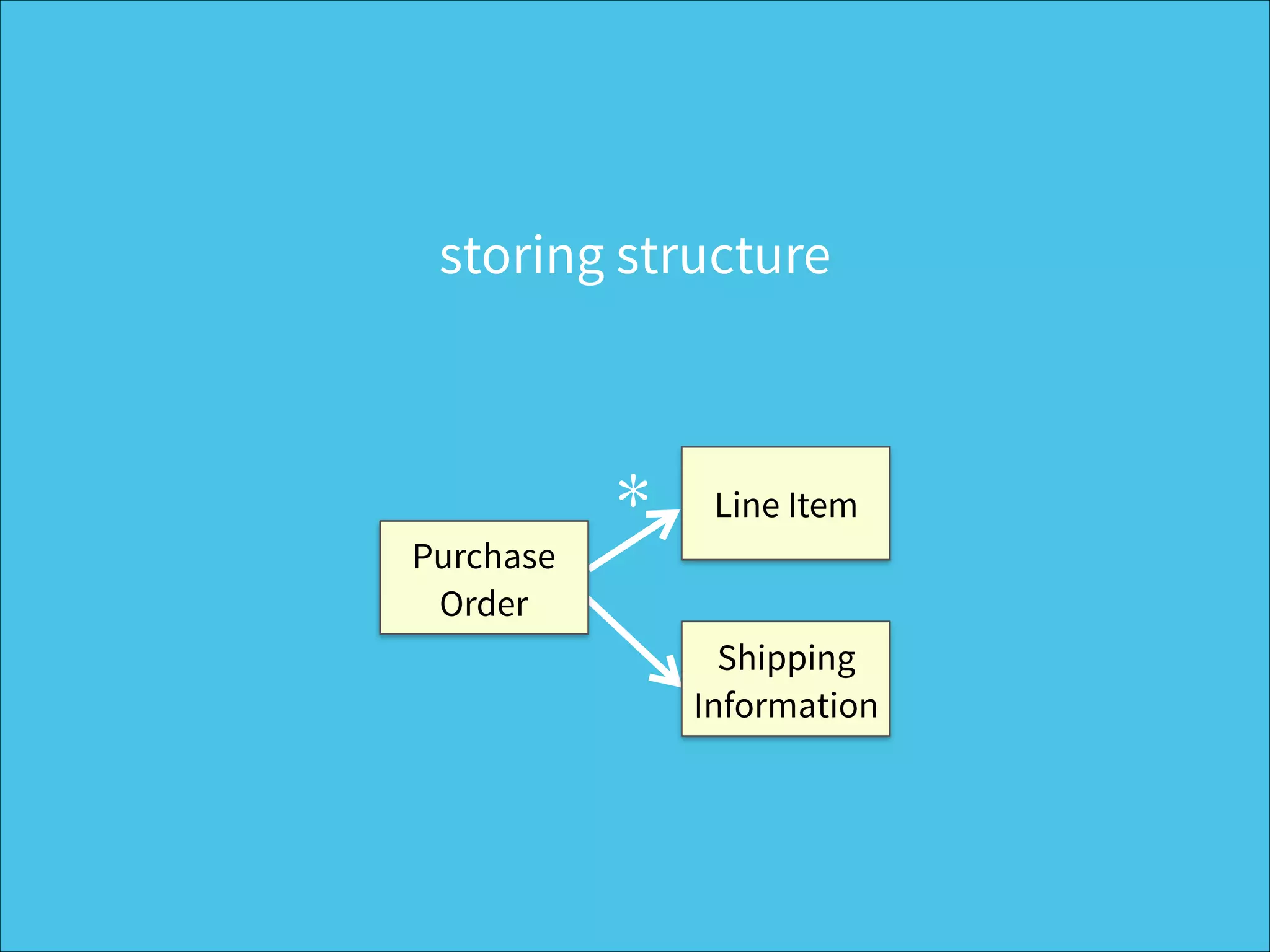
storing structure
*
Purchase
Order
Line Item
Shipping
Information
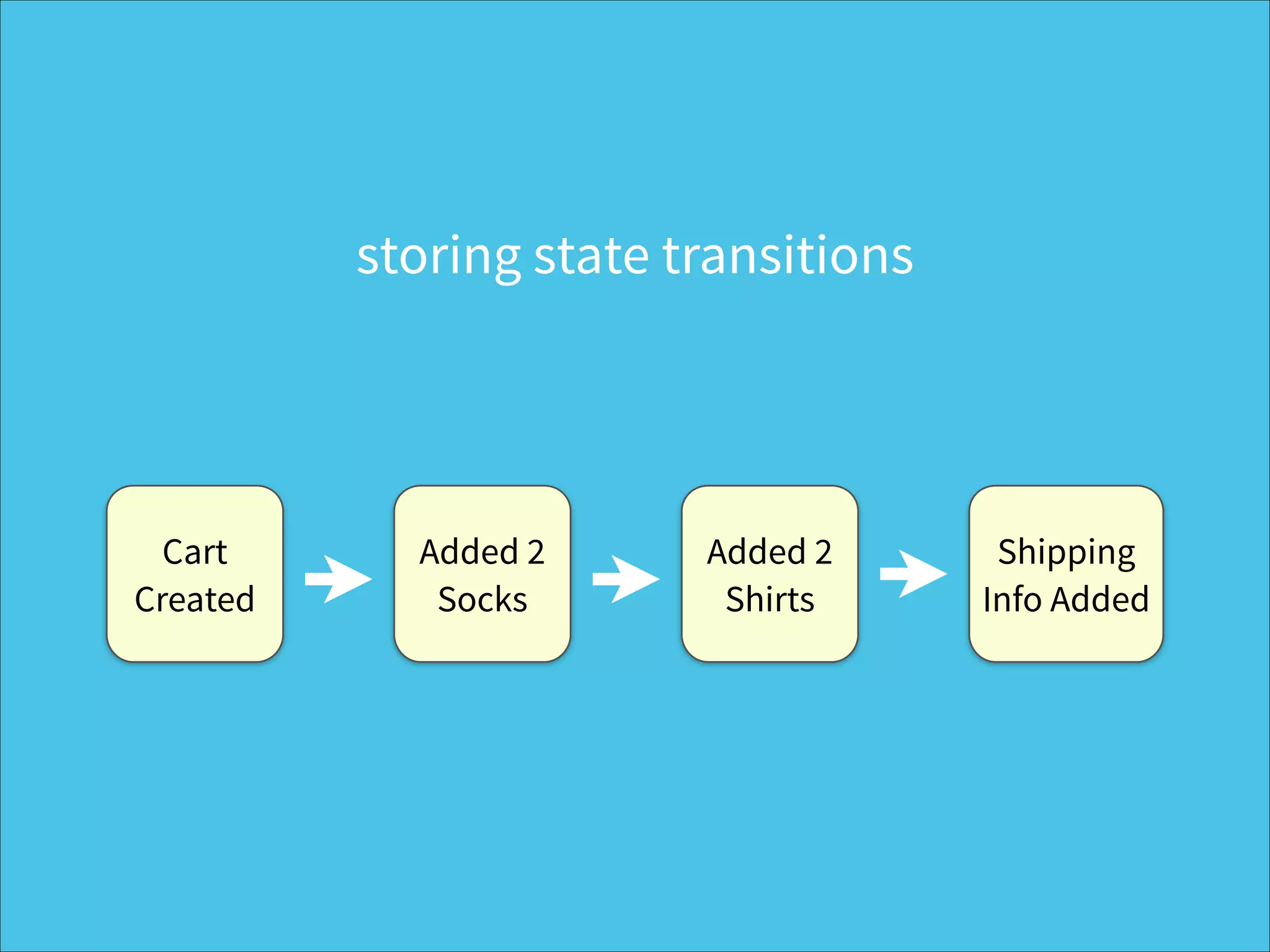
storing state transitions
Cart
Created
Added 2
Socks
Added 2
Shirts
Shipping
Info Added
Akka  Persistence  Webinar
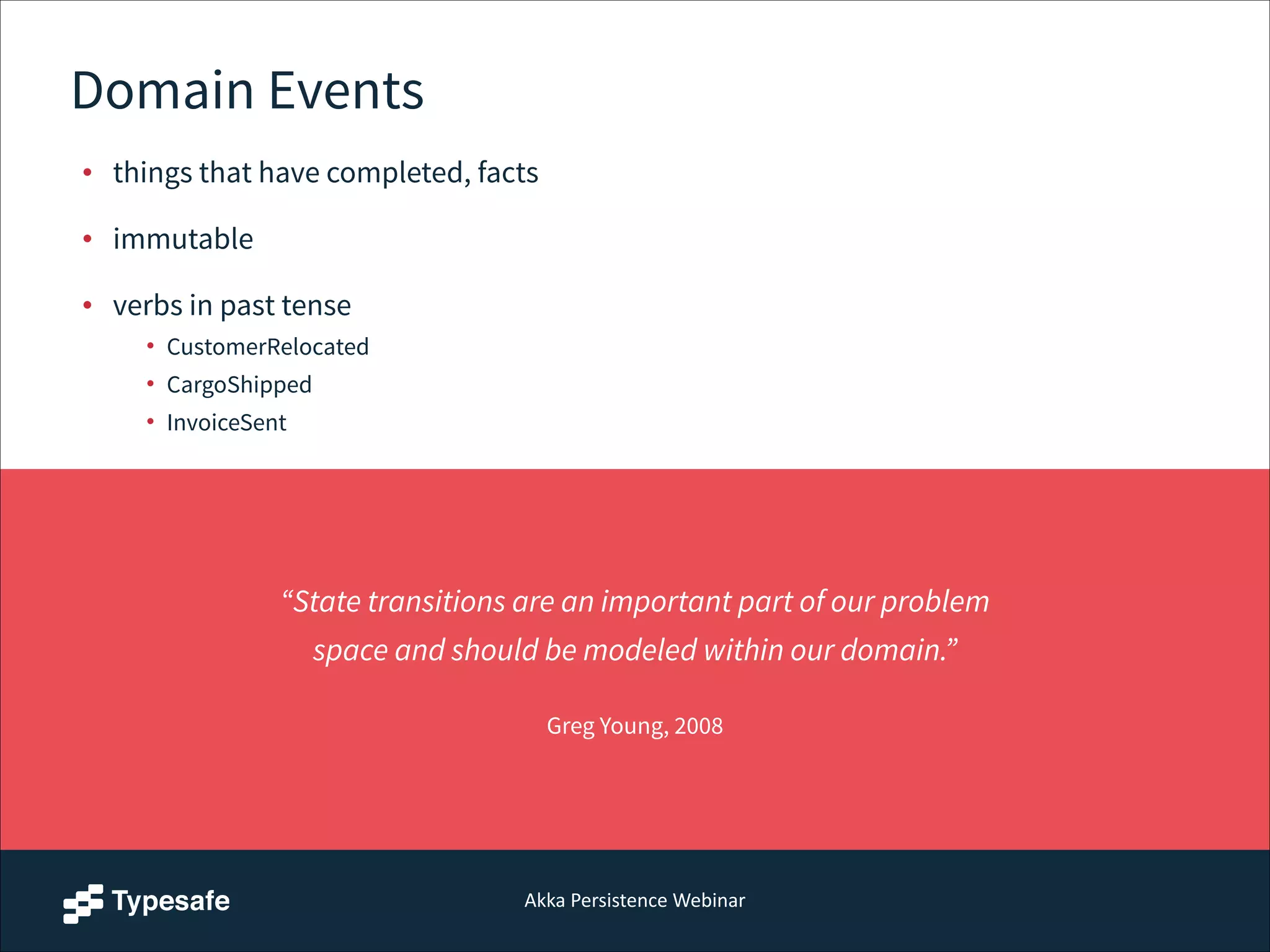
Domain Events
• things that have completed, facts
• immutable
• verbs in past tense
• CustomerRelocated
• CargoShipped
• InvoiceSent
“State transitions are an important part of our problem
space and should be modeled within our domain.”  
Greg Young, 2008
Akka  Persistence  Webinar
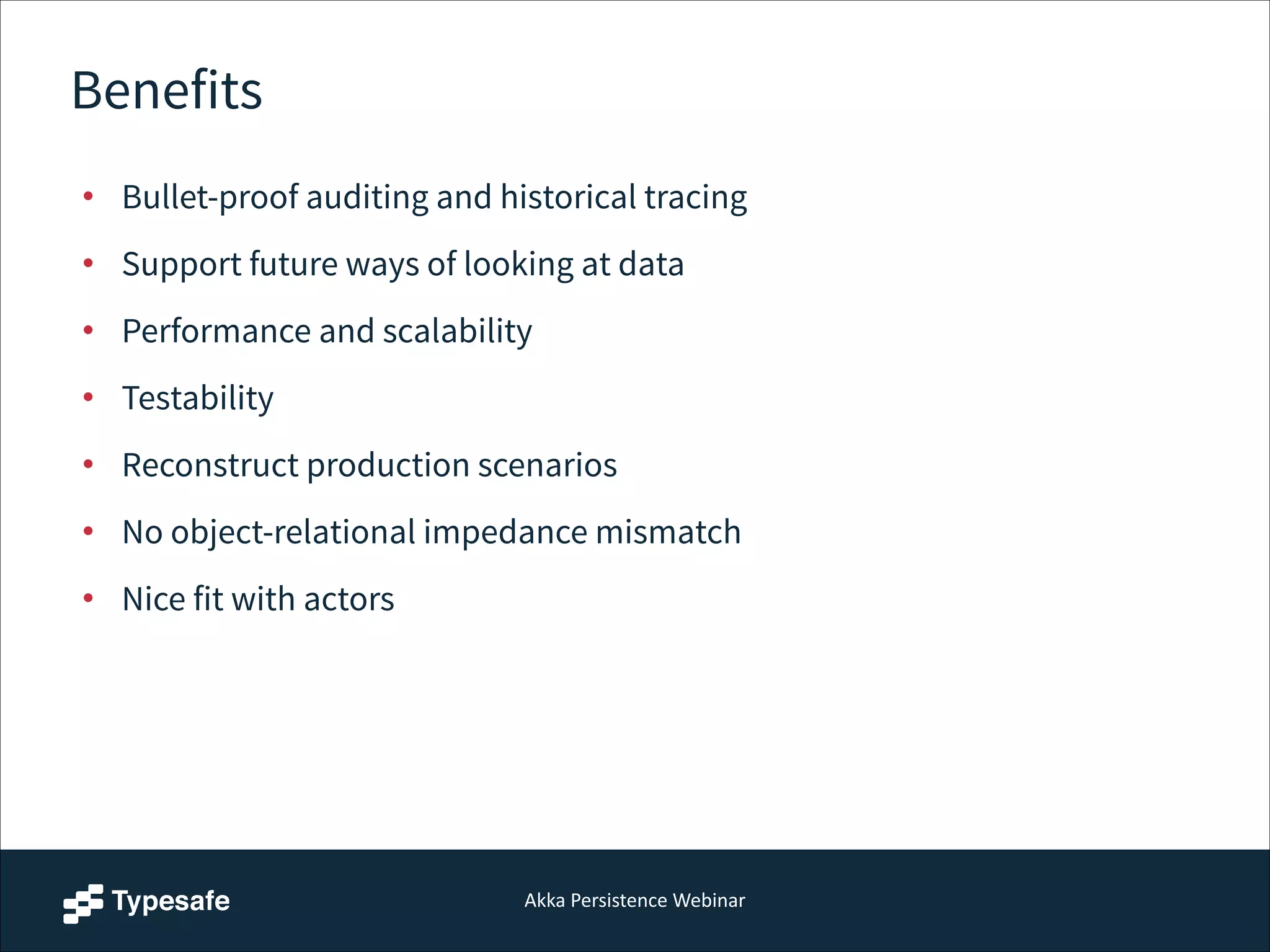
Benefits
• Bullet-proof auditing and historical tracing
• Support future ways of looking at data
• Performance and scalability
• Testability
• Reconstruct production scenarios
• No object-relational impedance mismatch
• Nice fit with actors
Akka  Persistence  Webinar
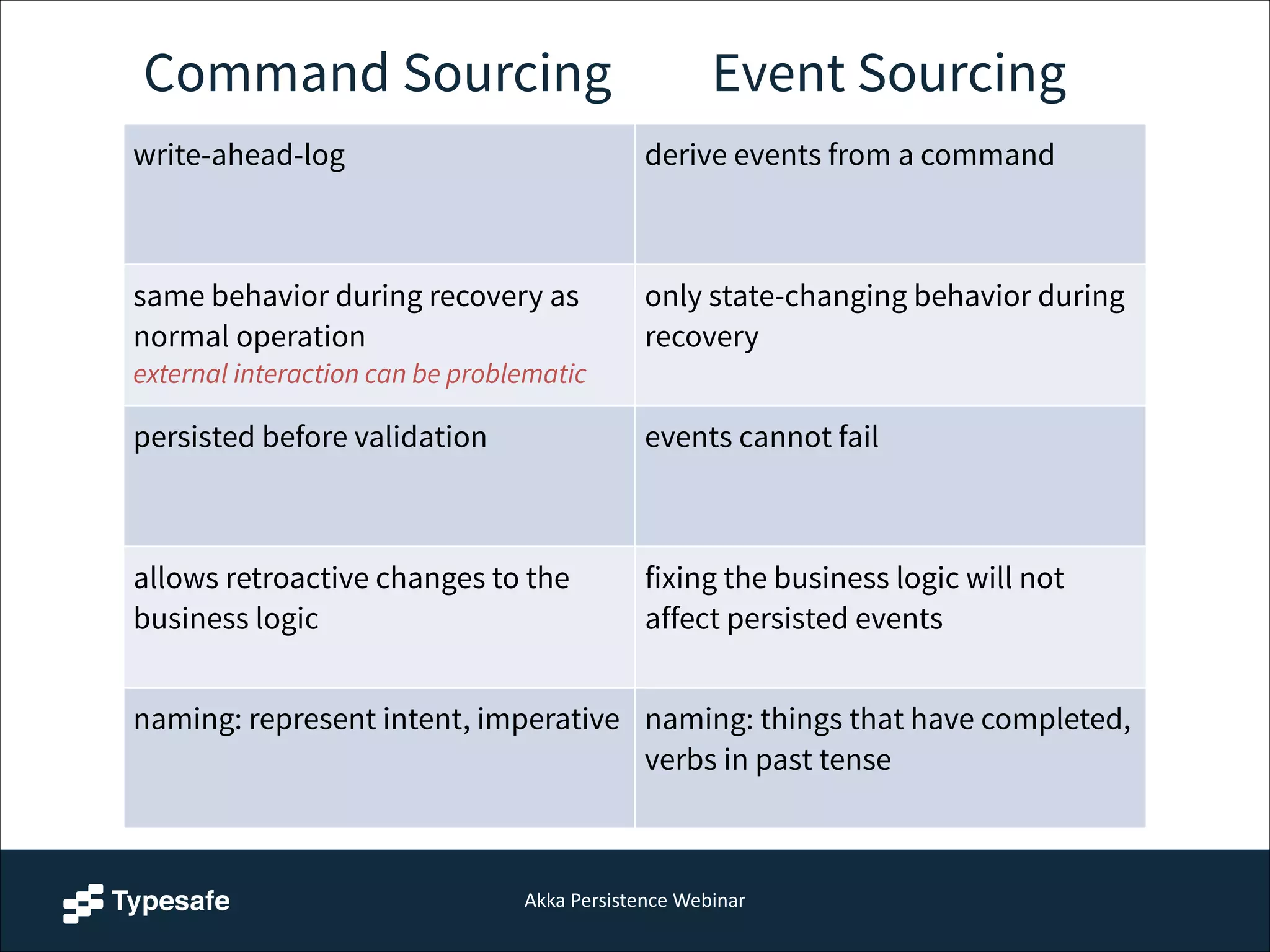
Command Sourcing Event Sourcing
write-ahead-log derive events from a command
same behavior during recovery as
normal operation
external interaction can be problematic
only state-changing behavior during
recovery
persisted before validation events cannot fail
allows retroactive changes to the
business logic
fixing the business logic will not
affect persisted events
naming: represent intent, imperative naming: things that have completed,
verbs in past tense
Akka  Persistence  Webinar
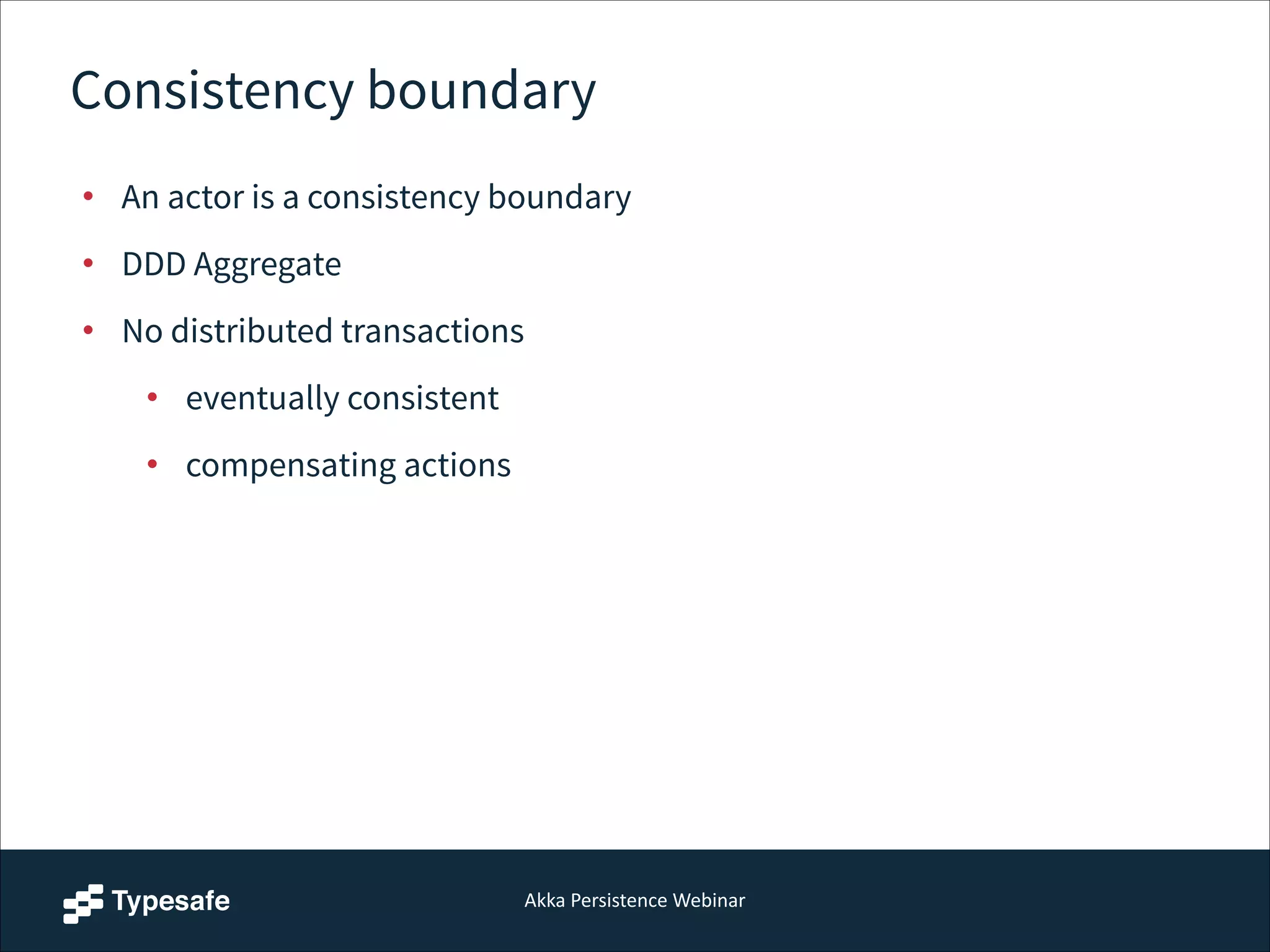
Consistency boundary
• An actor is a consistency boundary
• DDD Aggregate
• No distributed transactions
• eventually consistent
• compensating actions
Akka  Persistence  Webinar
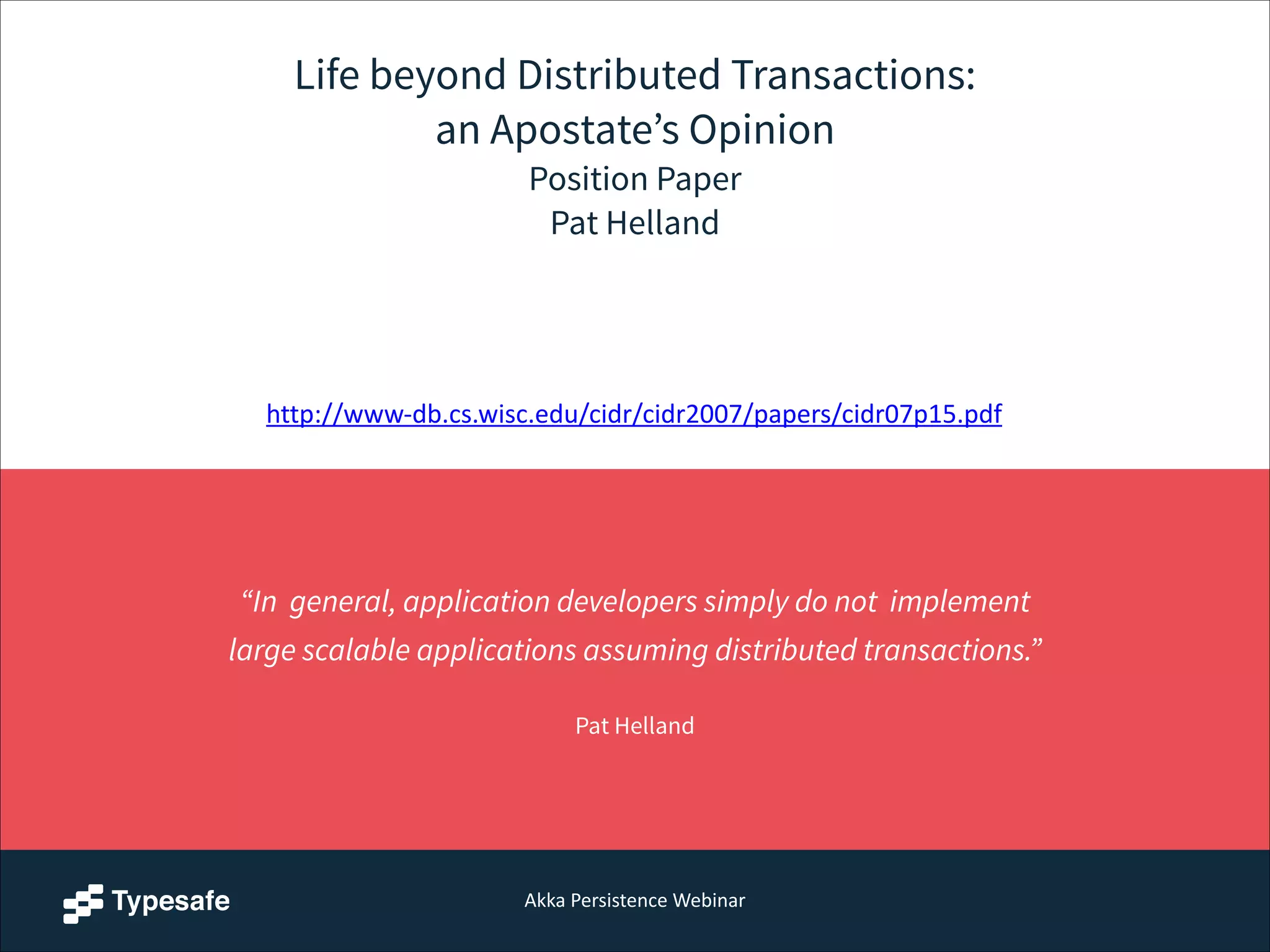
Life beyond Distributed Transactions:
an Apostate’s Opinion
Position Paper
Pat Helland
“In general, application developers simply do not implement
large scalable applications assuming distributed transactions.”  
Pat Helland
http://www-­‐db.cs.wisc.edu/cidr/cidr2007/papers/cidr07p15.pdf
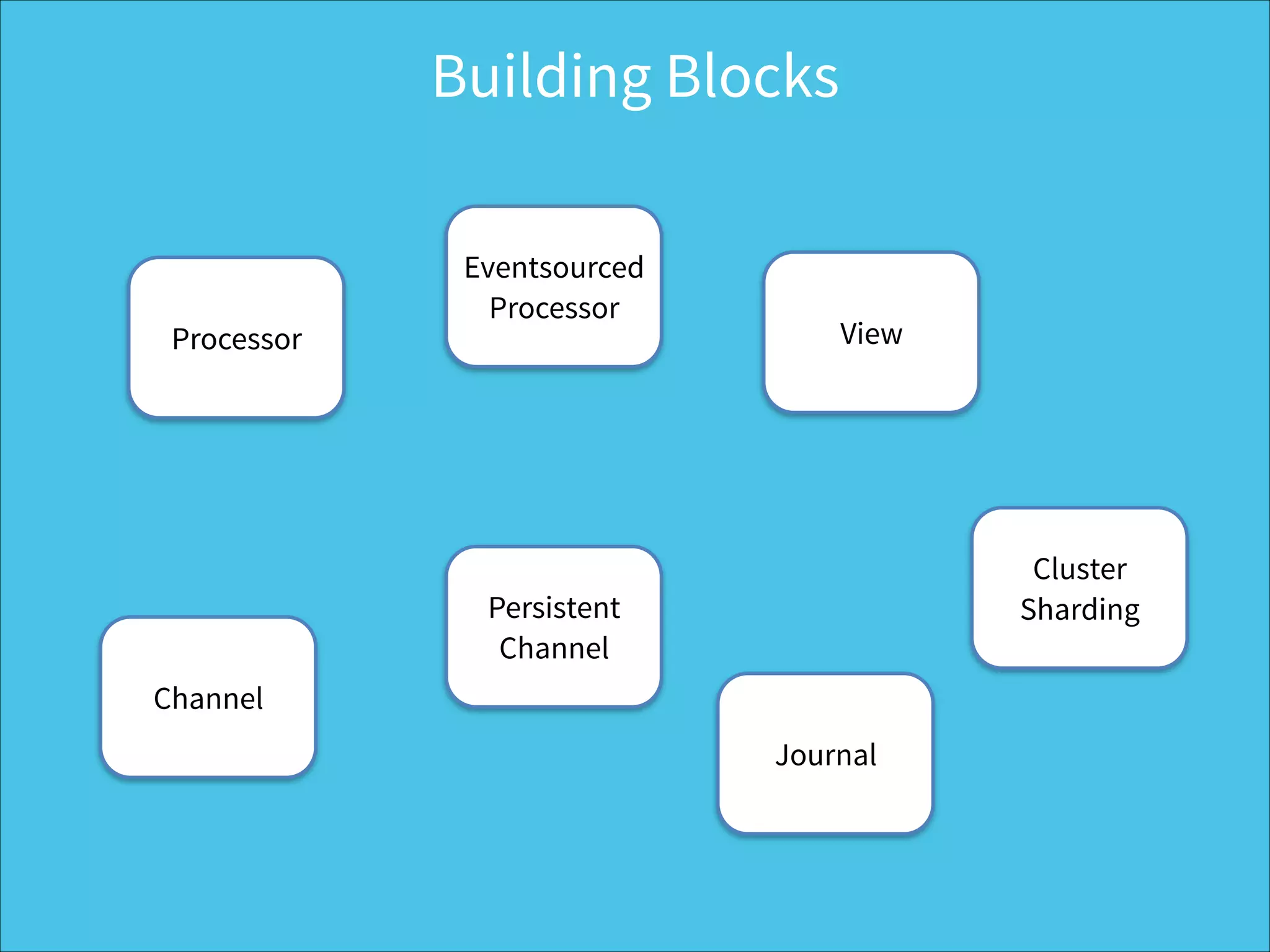
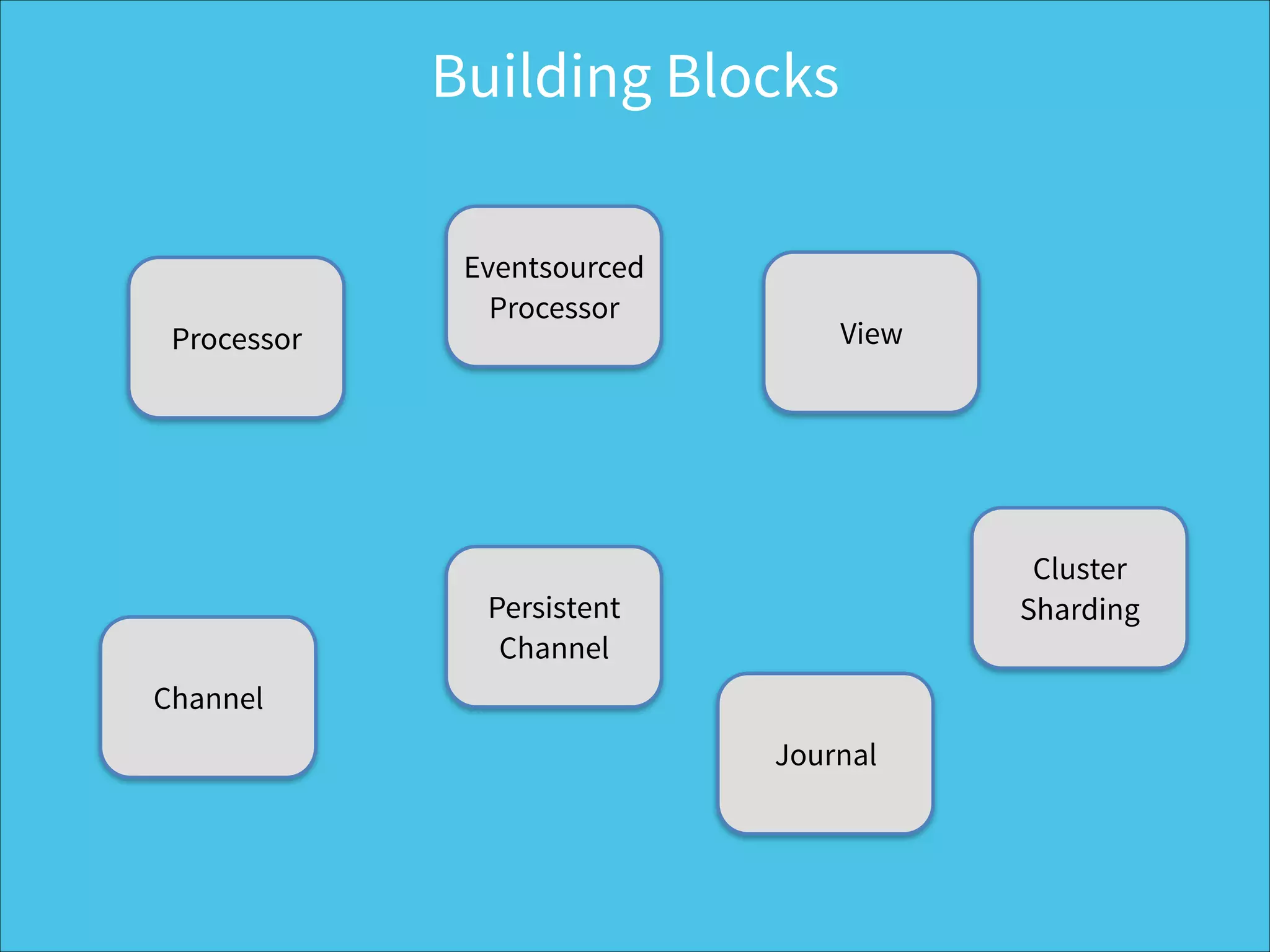
Processor
Eventsourced

Processor
Channel
Persistent

Channel
View
Journal
Cluster

Sharding
Building Blocks
Processor
import akka.persistence.{ Persistent, Processor }
!
class MyProcessor extends Processor {
def receive = {
case Persistent(payload, sequenceNr) =>
// message successfully written to journal
case other =>
// message not written to journal
}
}
val processor = context.actorOf(Props[MyProcessor],

name = "myProcessor")
!
processor ! Persistent("foo") // will be journaled
processor ! "bar" // will not be journaled
Processor
class InvoiceService extends Processor {
var invoices = Map.empty[String, Invoice]
!
def receive: Receive = {
case Persistent(CreateInvoice(id), _) =>
invoices = invoices.updated(id, Invoice(id))
}
}
Processor
class InvoiceService extends Processor {
var invoices = Map.empty[String, Invoice]
!
def receive: Receive = {
case Persistent(CreateInvoice(id), _) =>
invoices = invoices.updated(id, Invoice(id))
!
case Persistent(AddInvoiceItem(id, item), _) =>
invoices.get(id) match {
case Some(inv) =>
invoices = invoices.updated(id, inv.addItem(item))
case None => // TODO
}
!
case GetInvoice(id) =>
sender() ! invoices.getOrElse(id, "not found: " + id)
!
case Persistent(SendInvoiceTo(id, address), _) =>
// TODO send to the invoice printing service
}
}
Processor
case class CreateInvoice(invoiceId: String)

case class AddInvoiceItem(invoiceId: String, invoiceItem: InvoiceItem)
case class SendInvoiceTo(invoiceId: String, to: InvoiceAddress)
case class GetInvoice(invoiceId: String)
!
case class Invoice(id: String,
items: IndexedSeq[InvoiceItem] = Vector.empty) {
def addItem(item: InvoiceItem): Invoice =
copy(items = items :+ item)
}
!
case class InvoiceItem(description: String, count: Int,
amount: BigDecimal)
!
case class InvoiceAddress(name: String, street: String, city: String)
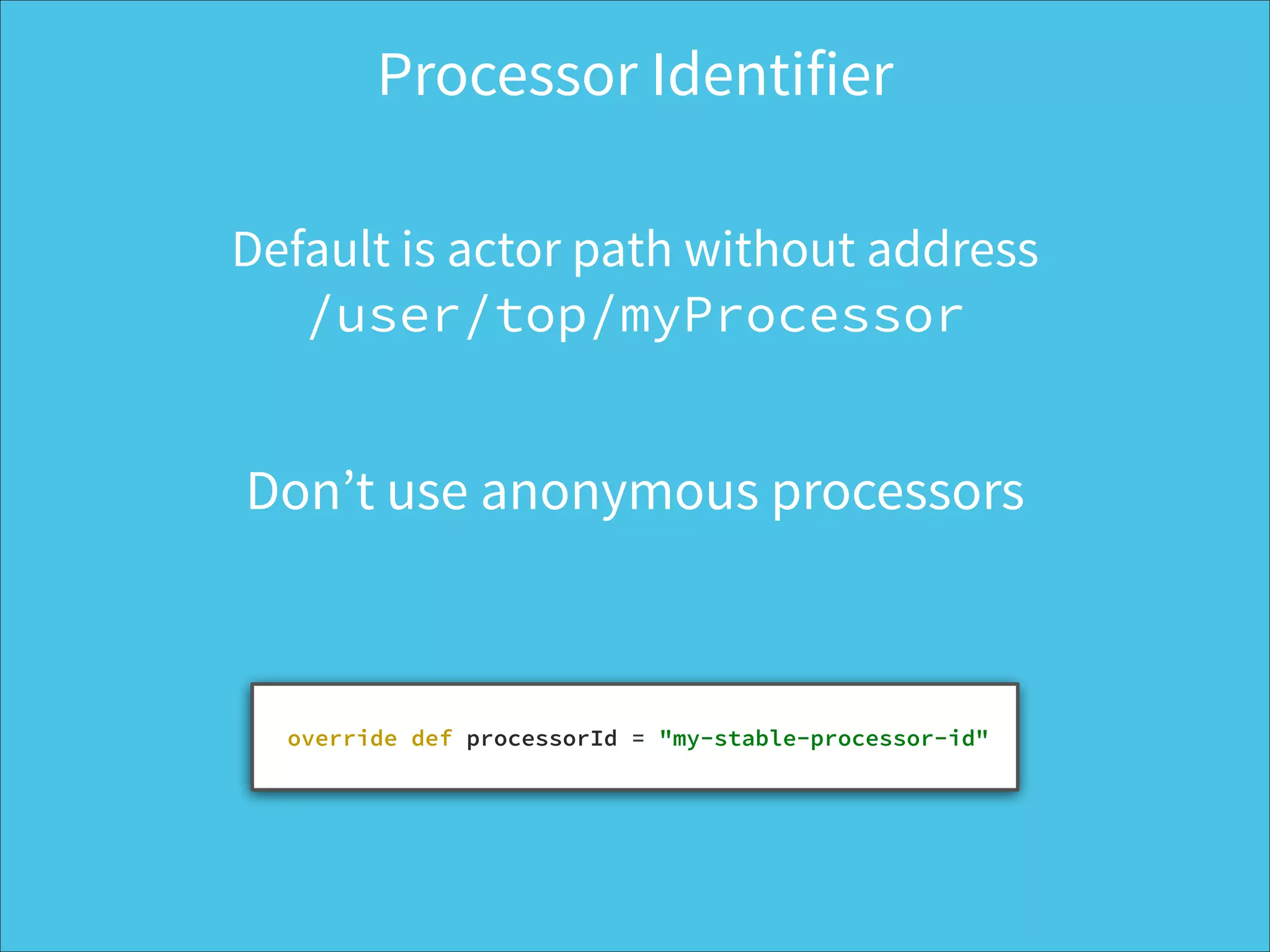
Processor Identifier


override def processorId = "my-stable-processor-id"
Default is actor path without address

/user/top/myProcessor
Don’t use anonymous processors
Akka  Persistence  Webinar
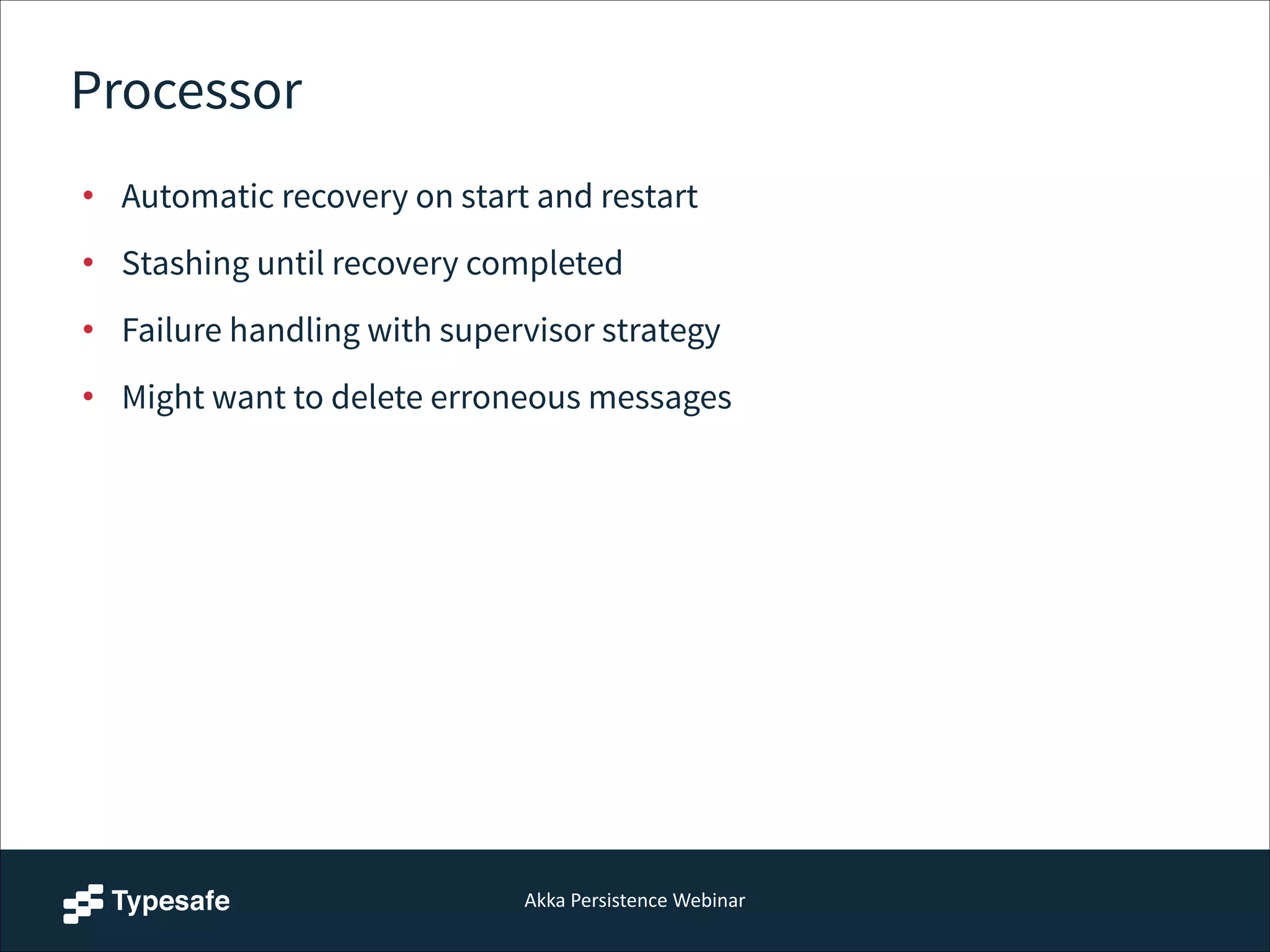
Processor
• Automatic recovery on start and restart
• Stashing until recovery completed
• Failure handling with supervisor strategy
• Might want to delete erroneous messages
What about side effects during replay?
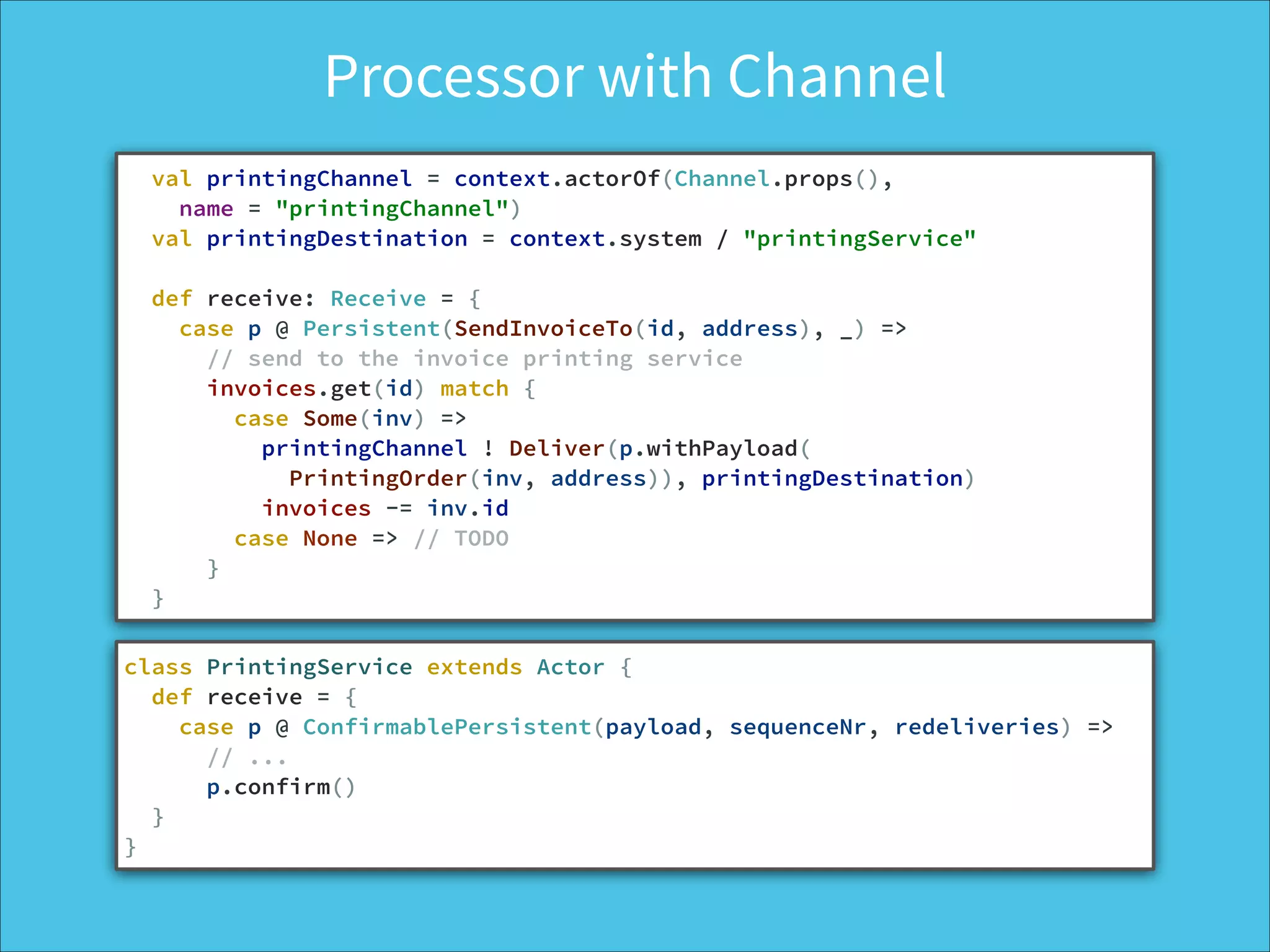
Processor with Channel
val printingChannel = context.actorOf(Channel.props(),
name = "printingChannel")
val printingDestination = context.system / "printingService"
!
def receive: Receive = {
case p @ Persistent(SendInvoiceTo(id, address), _) =>
// send to the invoice printing service
invoices.get(id) match {
case Some(inv) =>
printingChannel ! Deliver(p.withPayload(
PrintingOrder(inv, address)), printingDestination)
invoices -= inv.id
case None => // TODO
}
}
class PrintingService extends Actor {
def receive = {
case p @ ConfirmablePersistent(payload, sequenceNr, redeliveries) =>
// ...
p.confirm()
}
}
Akka  Persistence  Webinar
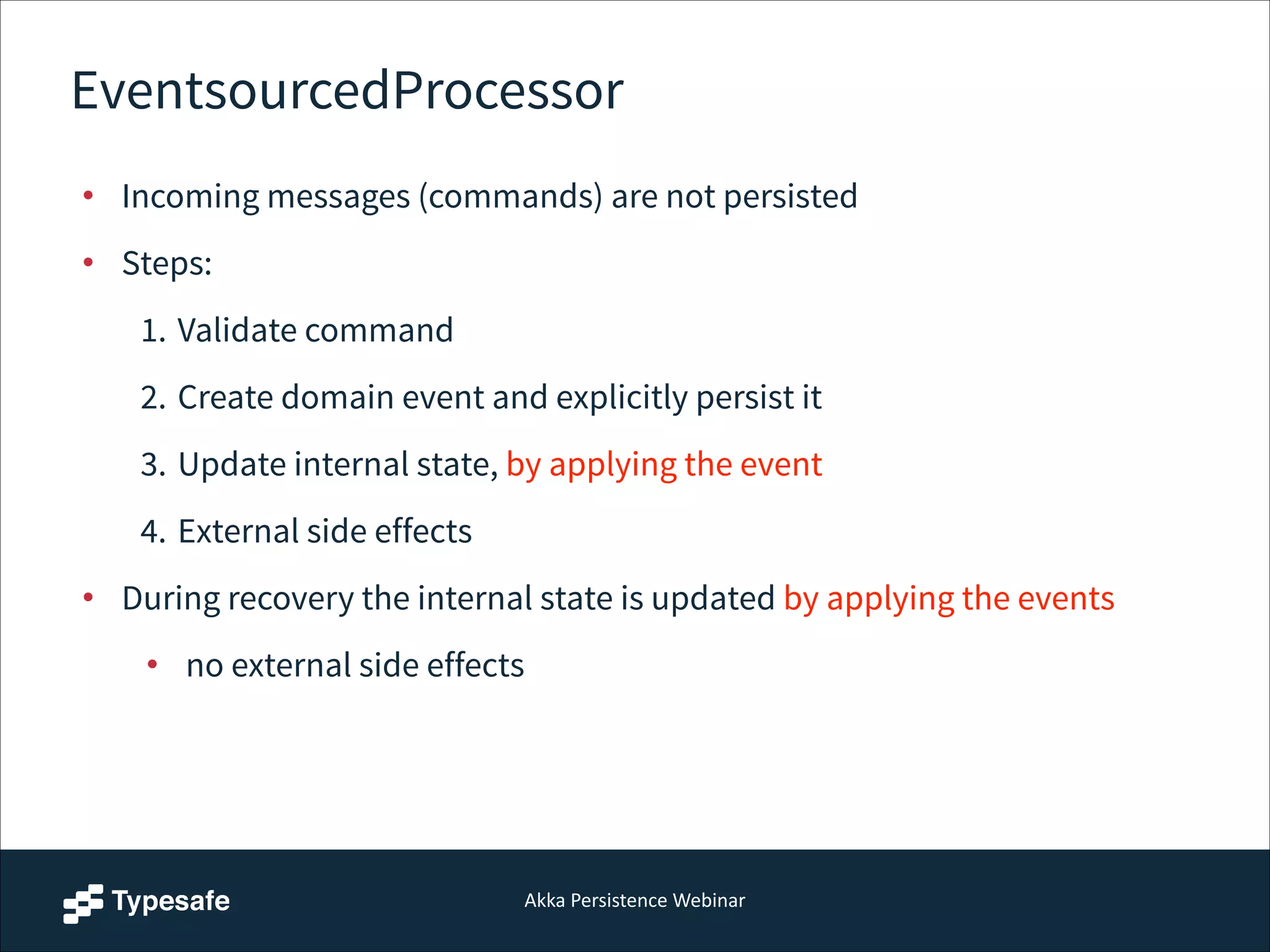
EventsourcedProcessor
• Incoming messages (commands) are not persisted
• Steps:
1. Validate command
2. Create domain event and explicitly persist it
3. Update internal state, by applying the event
4. External side effects
• During recovery the internal state is updated by applying the events
• no external side effects
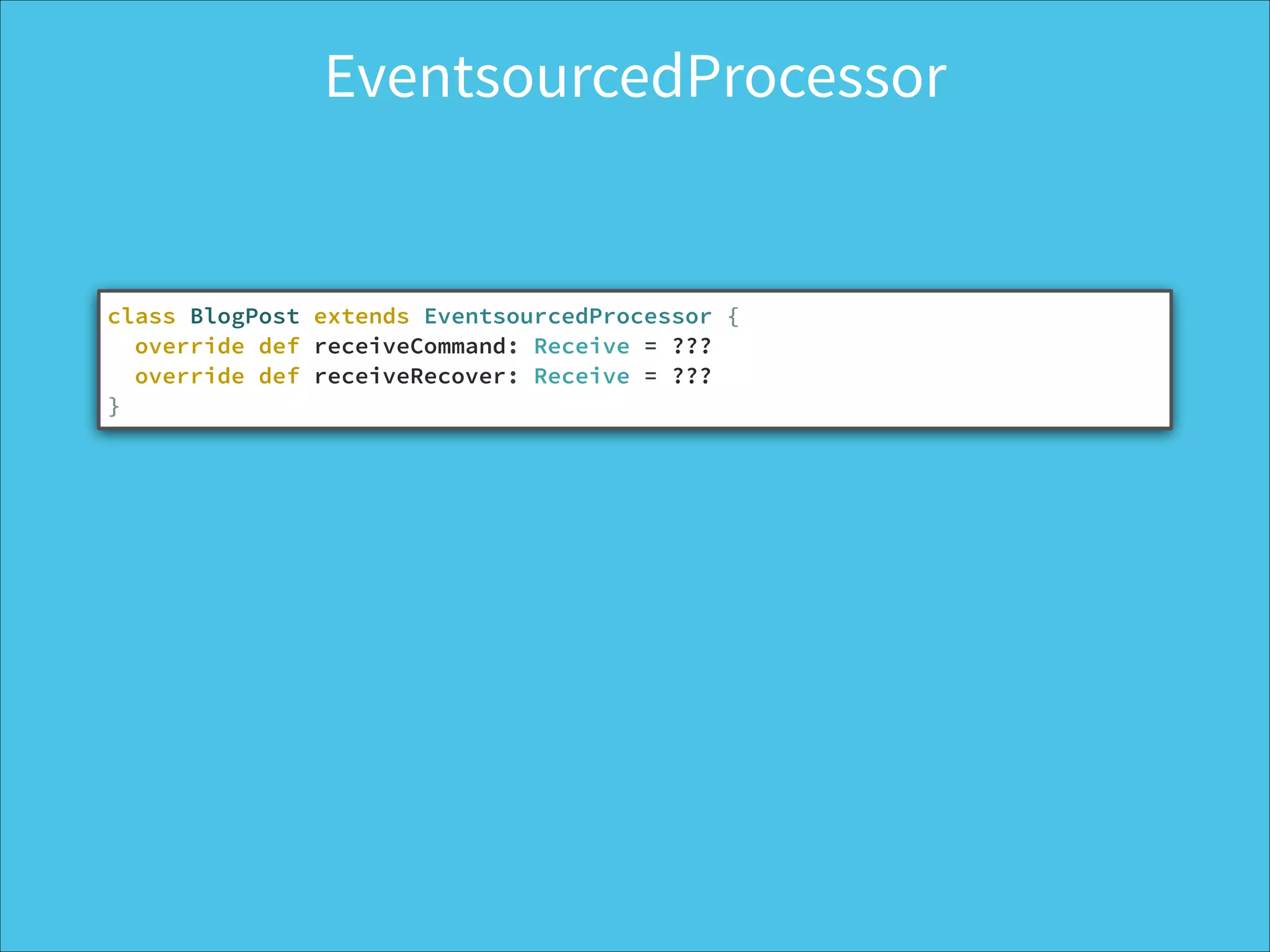
EventsourcedProcessor
class BlogPost extends EventsourcedProcessor {
override def receiveCommand: Receive = ???

override def receiveRecover: Receive = ???
}
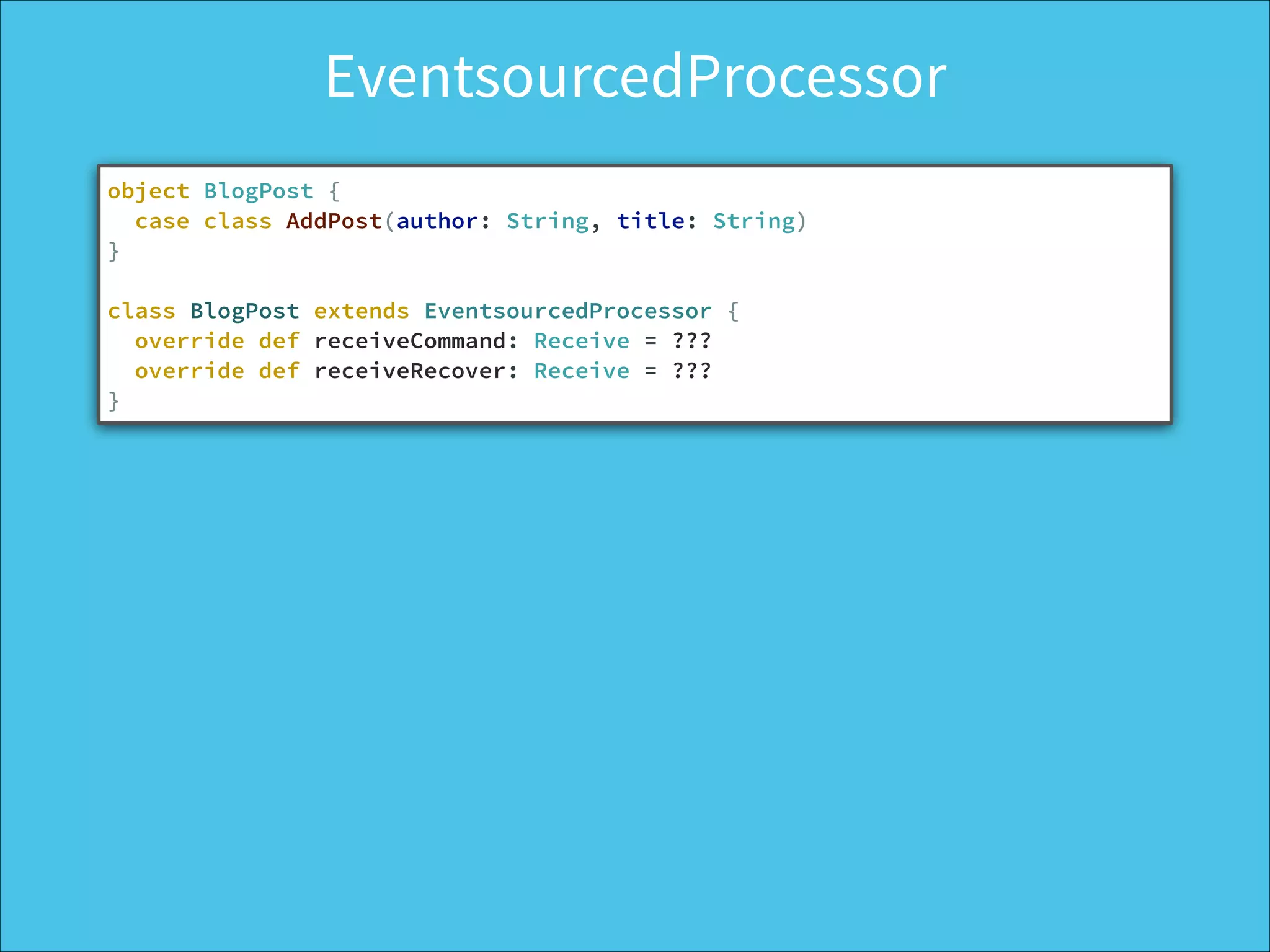
EventsourcedProcessor
object BlogPost {
case class AddPost(author: String, title: String)
}
!
class BlogPost extends EventsourcedProcessor {
override def receiveCommand: Receive = ???

override def receiveRecover: Receive = ???
}
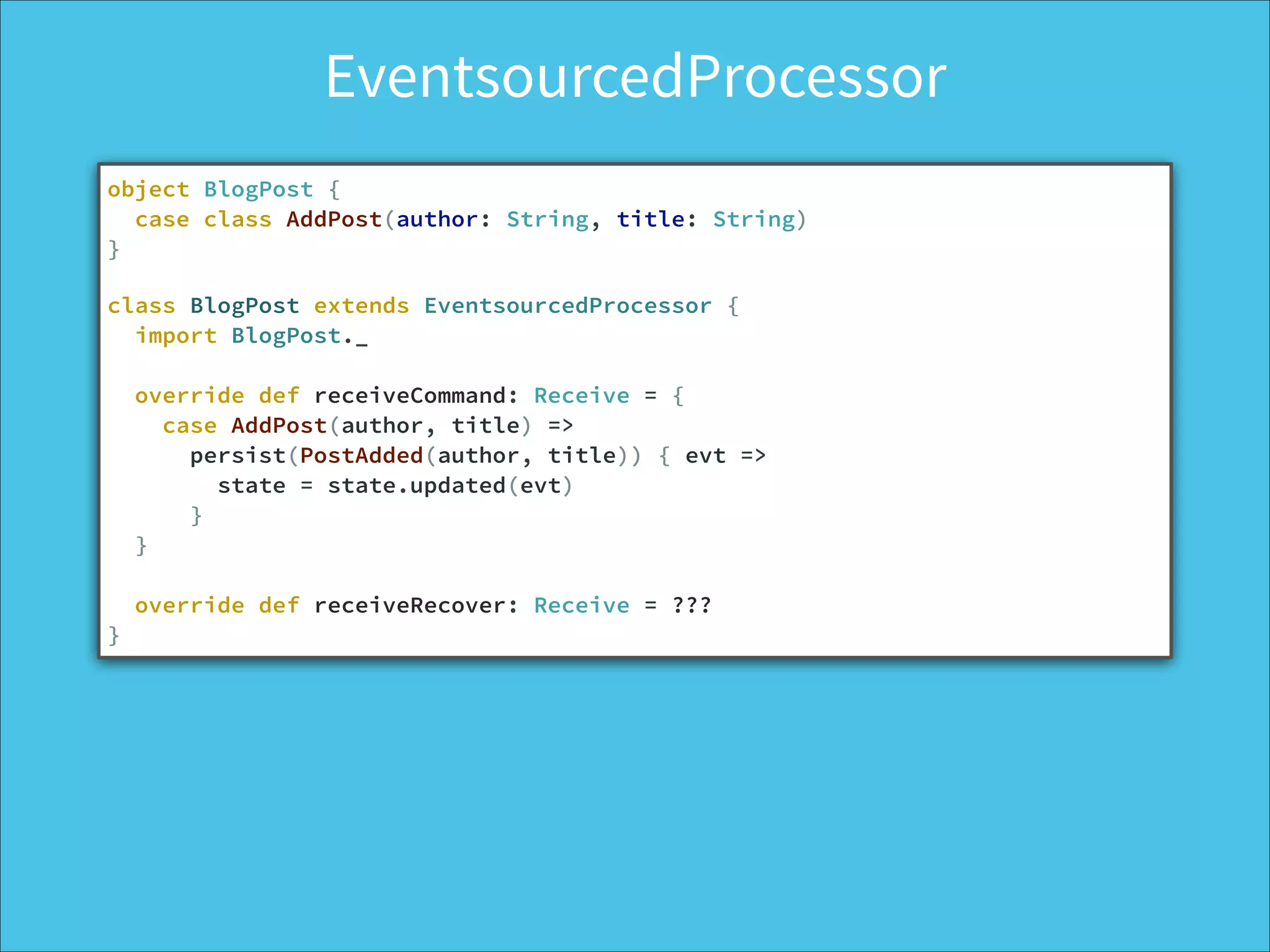
object BlogPost {
case class AddPost(author: String, title: String)
}
!
class BlogPost extends EventsourcedProcessor {
import BlogPost._
!
override def receiveCommand: Receive = {
case AddPost(author, title) =>
persist(PostAdded(author, title)) { evt =>
state = state.updated(evt)
}
}
!
override def receiveRecover: Receive = ???
}
EventsourcedProcessor
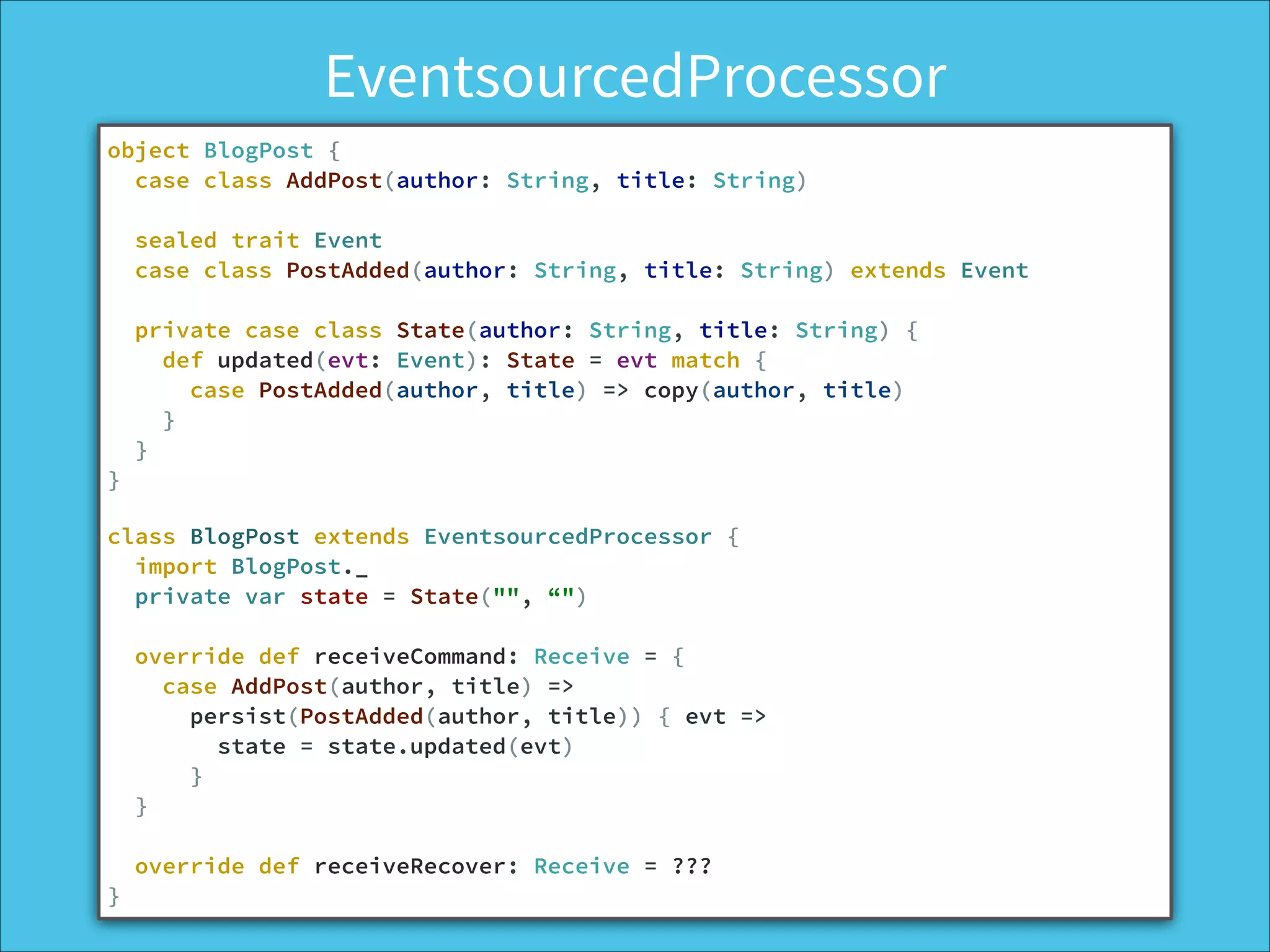
object BlogPost {
case class AddPost(author: String, title: String)
!
sealed trait Event
case class PostAdded(author: String, title: String) extends Event
!
private case class State(author: String, title: String) {
def updated(evt: Event): State = evt match {
case PostAdded(author, title) => copy(author, title)
}
}
}
!
class BlogPost extends EventsourcedProcessor {
import BlogPost._
private var state = State("", “")
!
override def receiveCommand: Receive = {
case AddPost(author, title) =>
persist(PostAdded(author, title)) { evt =>
state = state.updated(evt)
}
}
!
override def receiveRecover: Receive = ???
}
EventsourcedProcessor
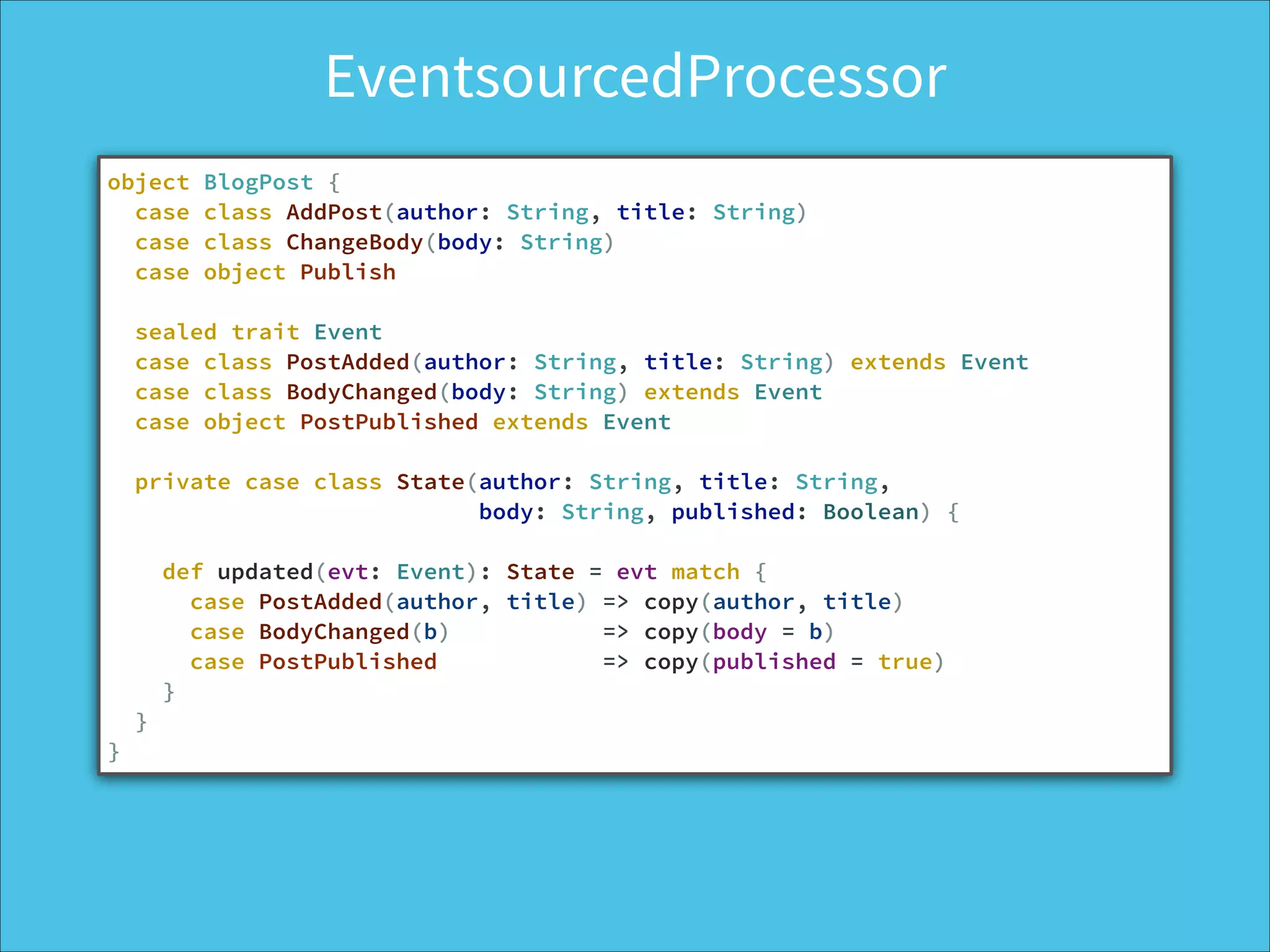
object BlogPost {
case class AddPost(author: String, title: String)
case class ChangeBody(body: String)
case object Publish
!
sealed trait Event
case class PostAdded(author: String, title: String) extends Event
case class BodyChanged(body: String) extends Event
case object PostPublished extends Event
!
private case class State(author: String, title: String,
body: String, published: Boolean) {
!
def updated(evt: Event): State = evt match {
case PostAdded(author, title) => copy(author, title)
case BodyChanged(b) => copy(body = b)
case PostPublished => copy(published = true)
}
}
}
EventsourcedProcessor
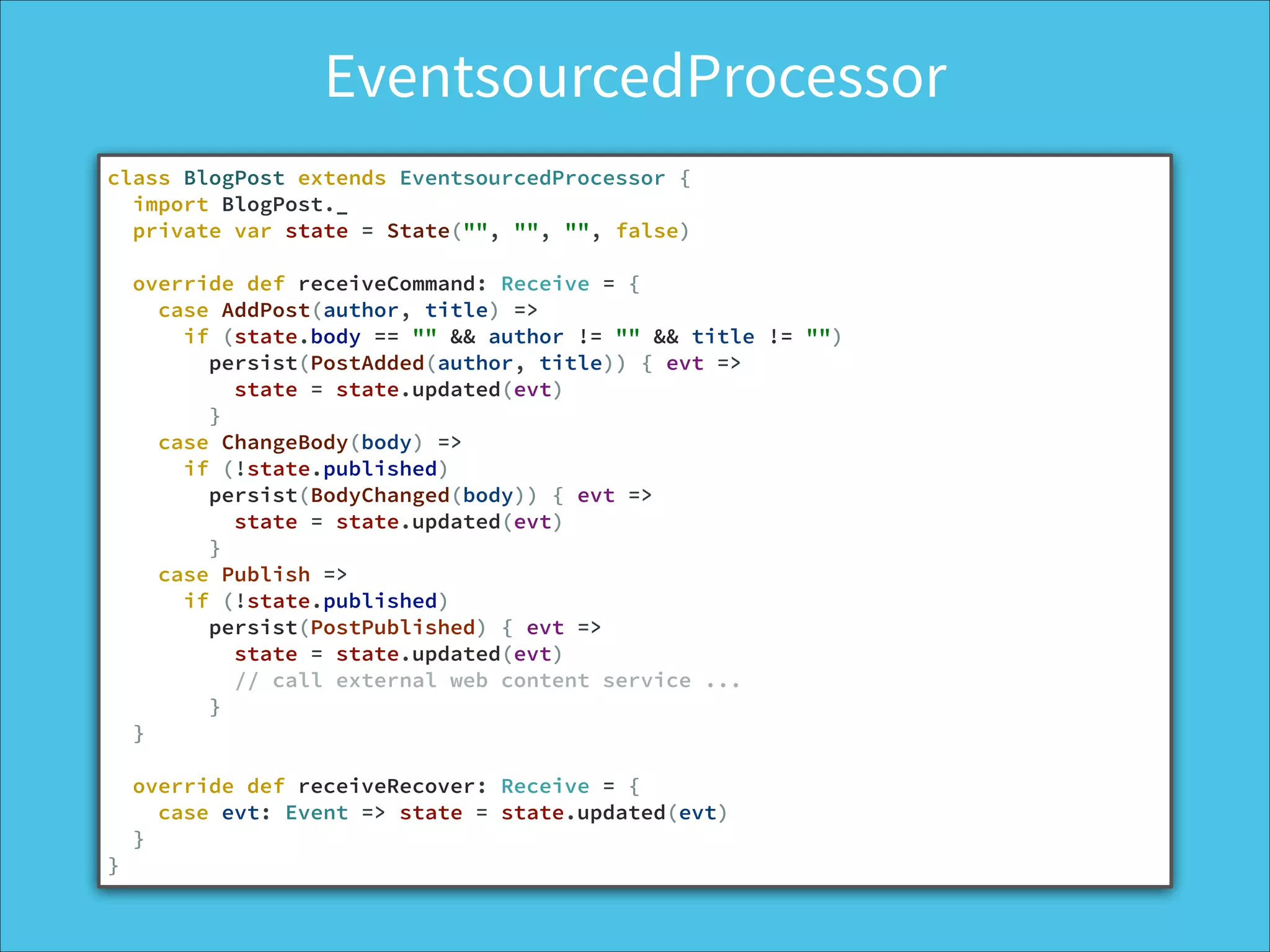
class BlogPost extends EventsourcedProcessor {
import BlogPost._
private var state = State("", "", "", false)
!
override def receiveCommand: Receive = {
case AddPost(author, title) =>
if (state.body == "" && author != "" && title != "")
persist(PostAdded(author, title)) { evt =>
state = state.updated(evt)
}
case ChangeBody(body) =>
if (!state.published)
persist(BodyChanged(body)) { evt =>
state = state.updated(evt)
}
case Publish =>
if (!state.published)
persist(PostPublished) { evt =>
state = state.updated(evt)
// call external web content service ...
}
}
!
override def receiveRecover: Receive = {
case evt: Event => state = state.updated(evt)
}
}
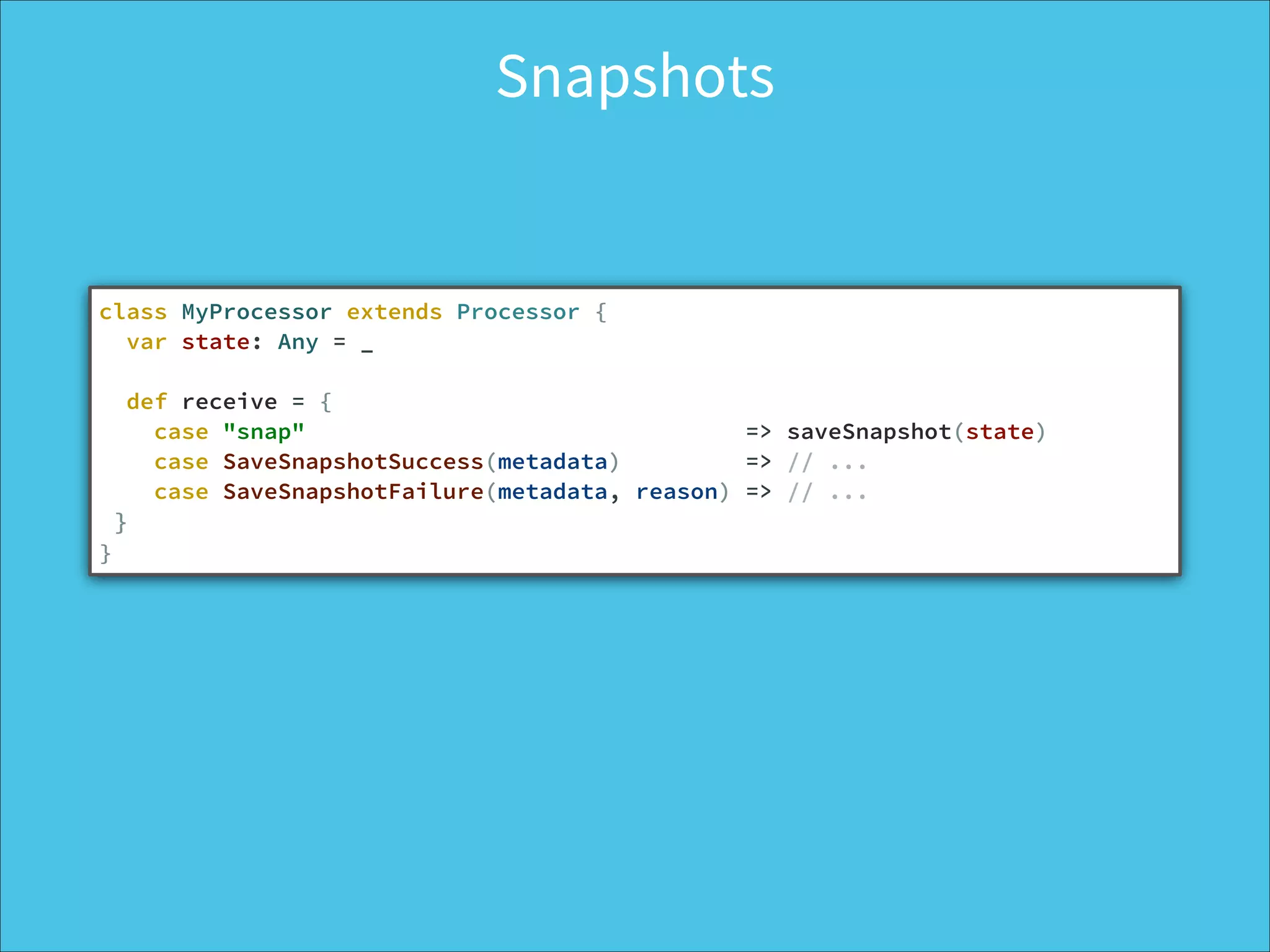
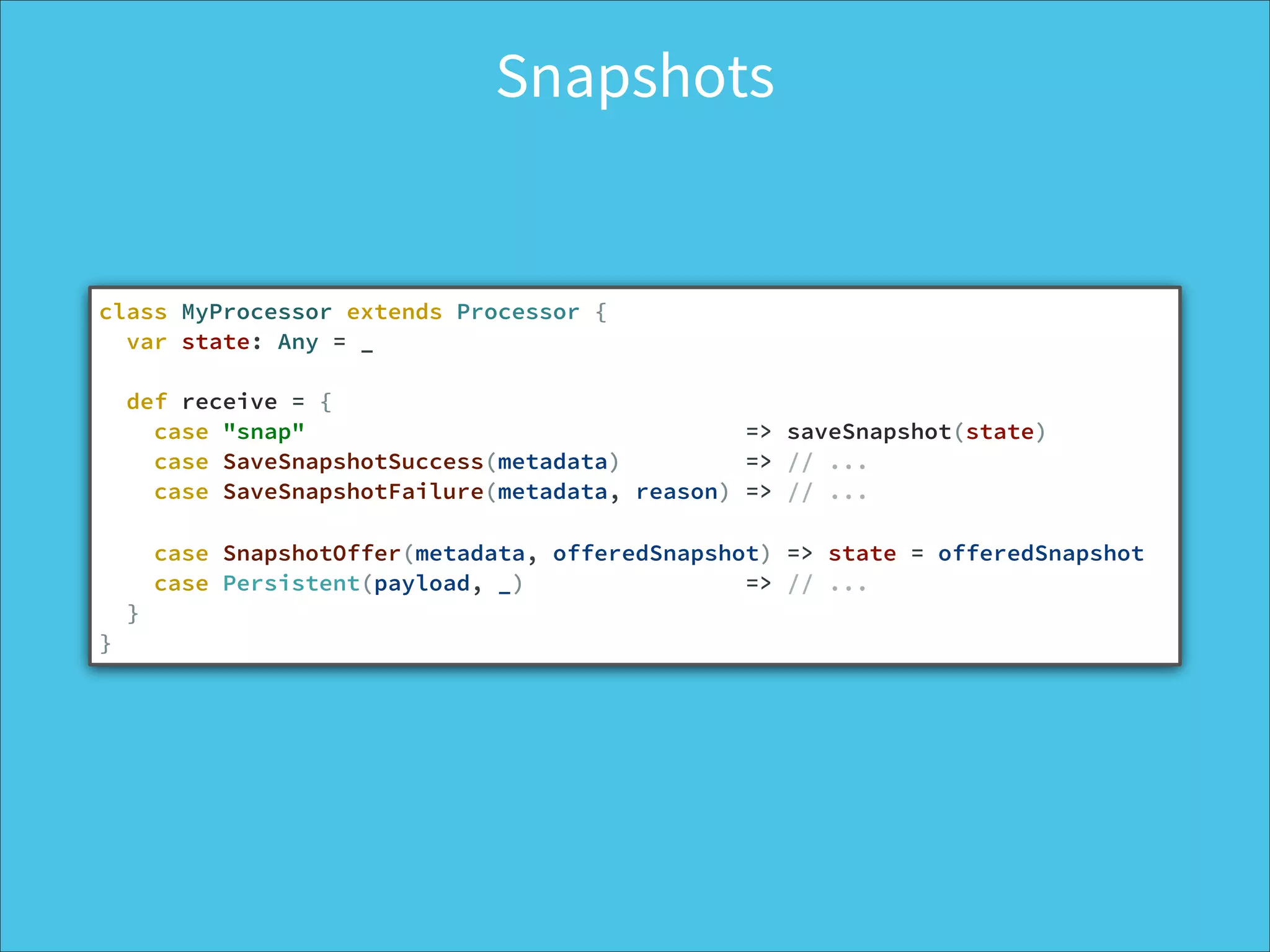
Snapshots
class MyProcessor extends Processor {
var state: Any = _
def receive = {
case "snap" => saveSnapshot(state)
case SaveSnapshotSuccess(metadata) => // ...
case SaveSnapshotFailure(metadata, reason) => // ...
}
}
Snapshots
class MyProcessor extends Processor {
var state: Any = _
def receive = {
case "snap" => saveSnapshot(state)
case SaveSnapshotSuccess(metadata) => // ...
case SaveSnapshotFailure(metadata, reason) => // ...
!
case SnapshotOffer(metadata, offeredSnapshot) => state = offeredSnapshot
case Persistent(payload, _) => // ...
}
}
Akka  Persistence  Webinar
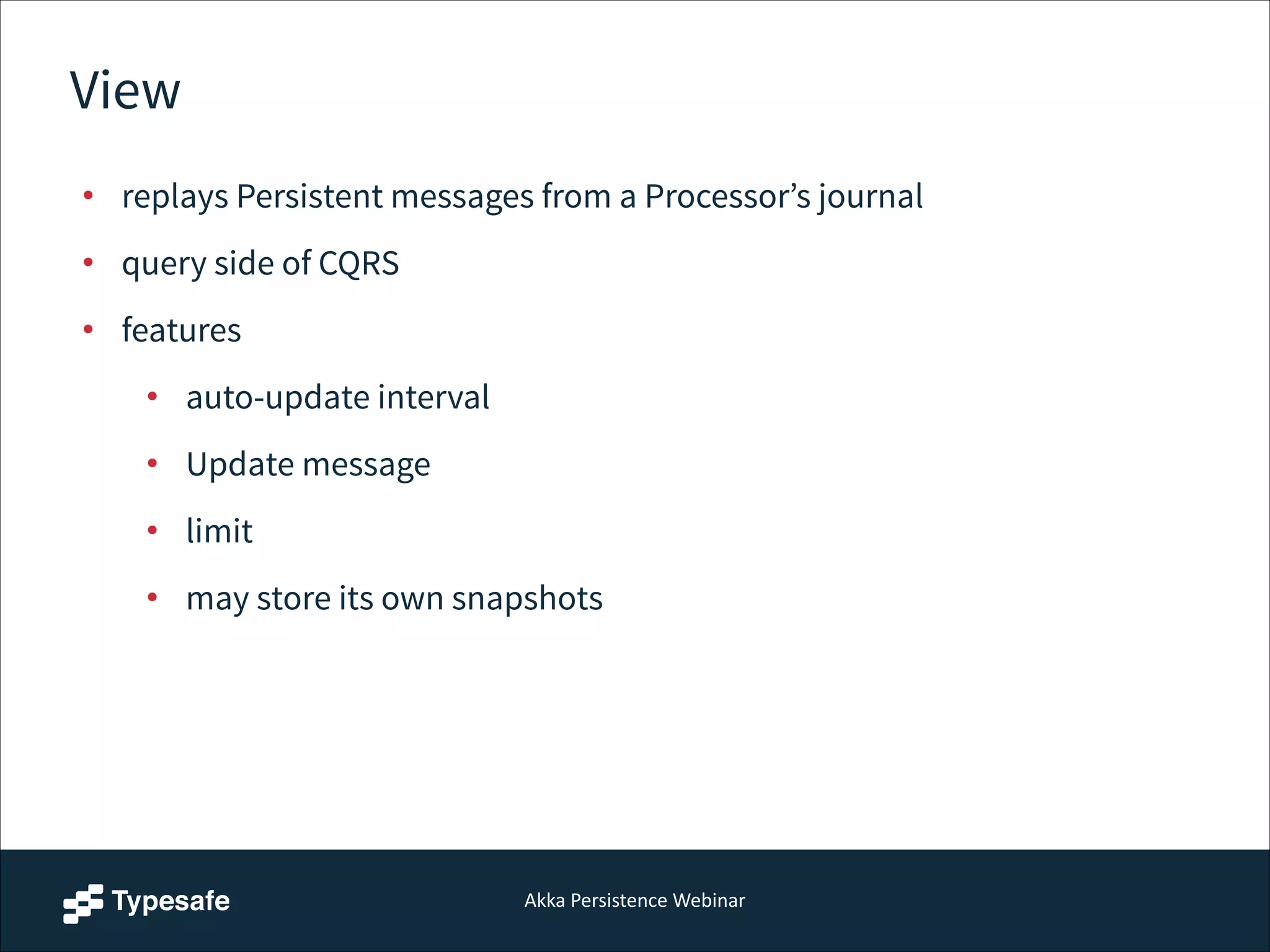
View
• replays Persistent messages from a Processor’s journal
• query side of CQRS
• features
• auto-update interval
• Update message
• limit
• may store its own snapshots
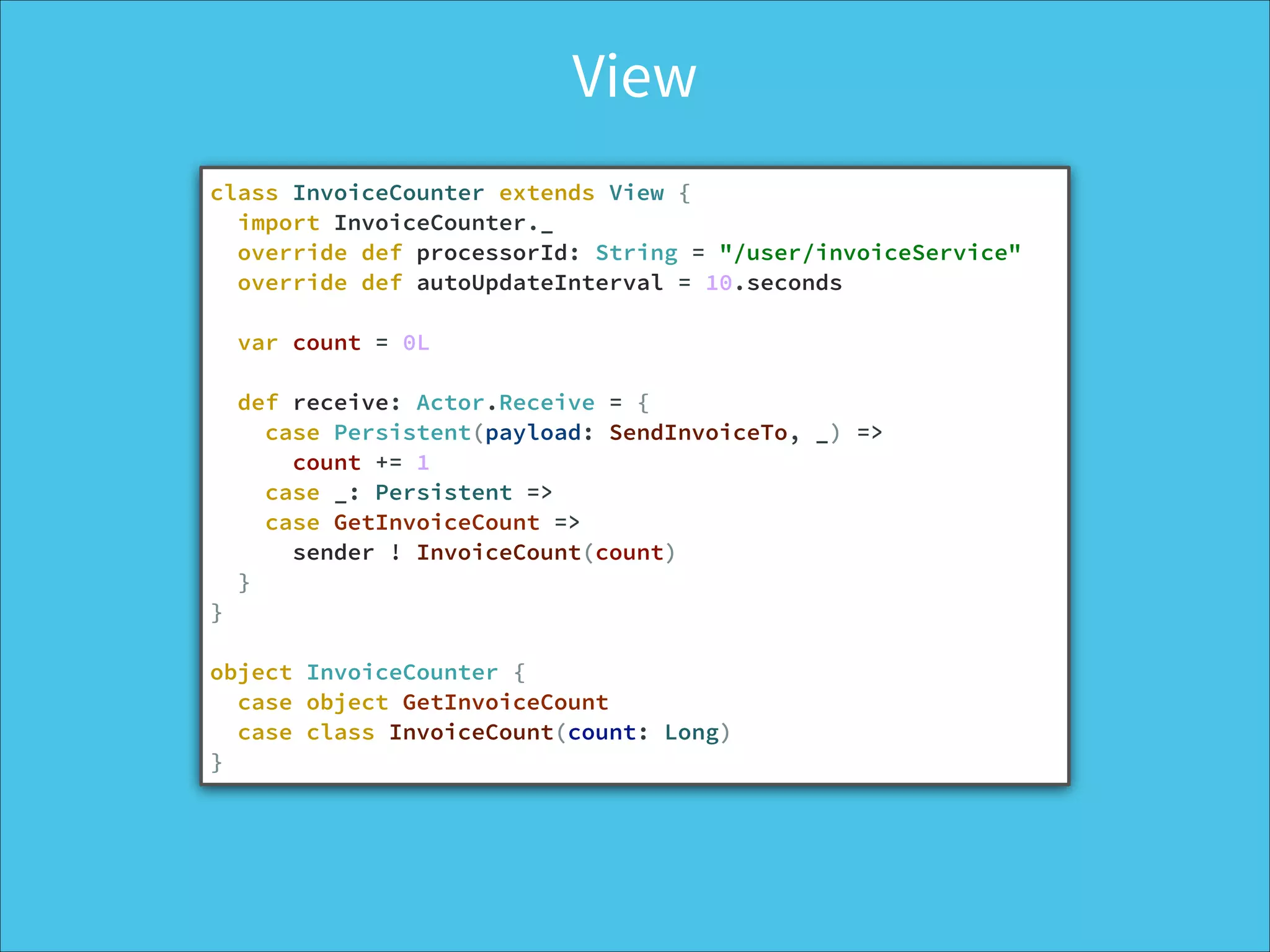
View
class InvoiceCounter extends View {
import InvoiceCounter._
override def processorId: String = "/user/invoiceService"
override def autoUpdateInterval = 10.seconds
!
var count = 0L
!
def receive: Actor.Receive = {
case Persistent(payload: SendInvoiceTo, _) =>
count += 1
case _: Persistent =>
case GetInvoiceCount =>
sender ! InvoiceCount(count)
}
}
!
object InvoiceCounter {
case object GetInvoiceCount
case class InvoiceCount(count: Long)
}
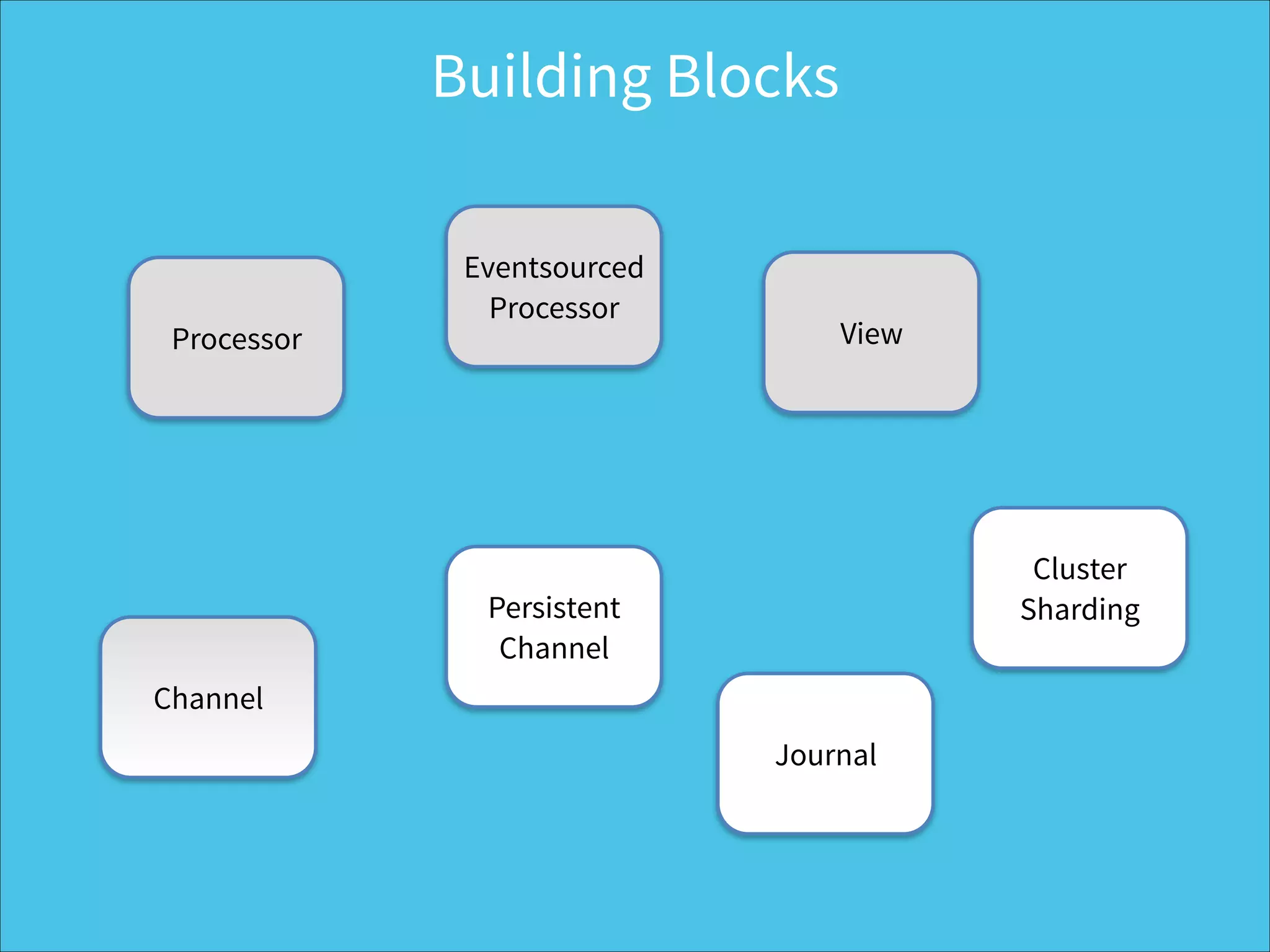
Processor
Eventsourced

Processor
Channel
Persistent

Channel
View
Journal
Cluster

Sharding
Building Blocks
Akka  Persistence  Webinar
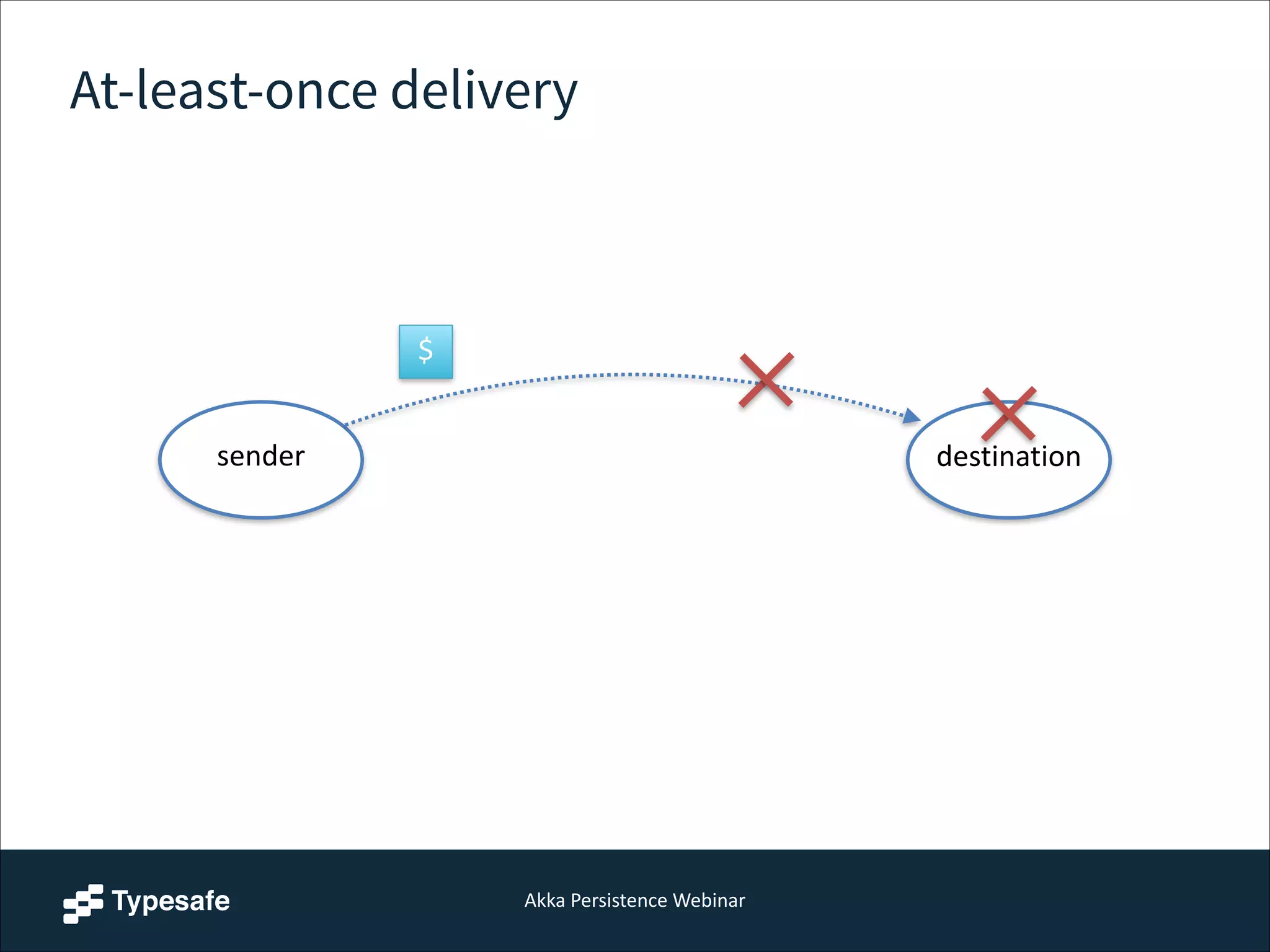
At-least-once delivery
sender destination
$
Akka  Persistence  Webinar
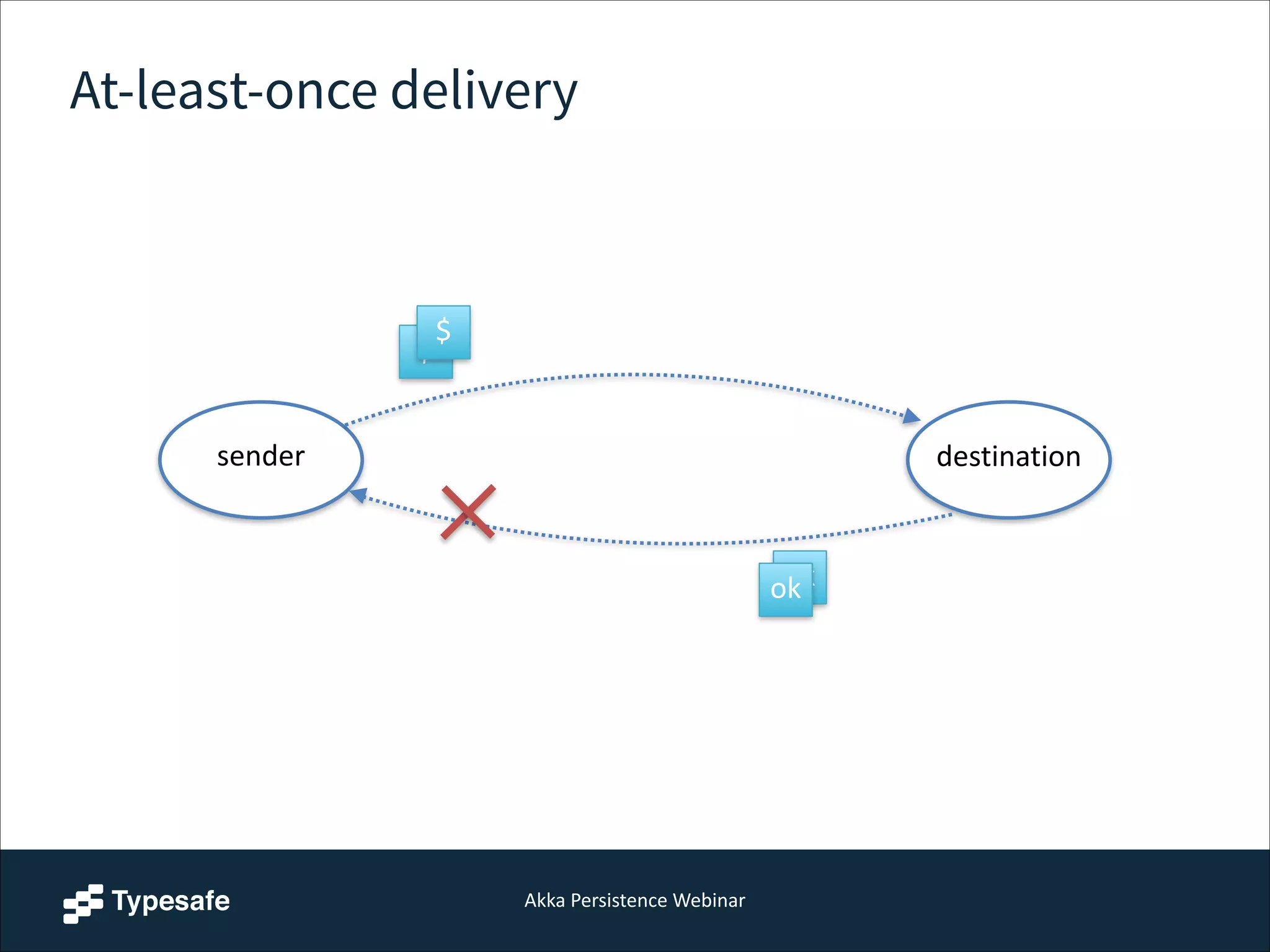
At-least-once delivery
sender destination
$
ok
$
ok
Akka  Persistence  Webinar
Channels
• re-deliver messages until confirmed
• application level confirmation
• different semantics
• duplicates may be received
• message order not retained
• after a crash and restart messages are still delivered
• listener for RedeliverFailure notifications
• recommendation: one destination per channel 

exception: replies via channel
Akka  Persistence  Webinar
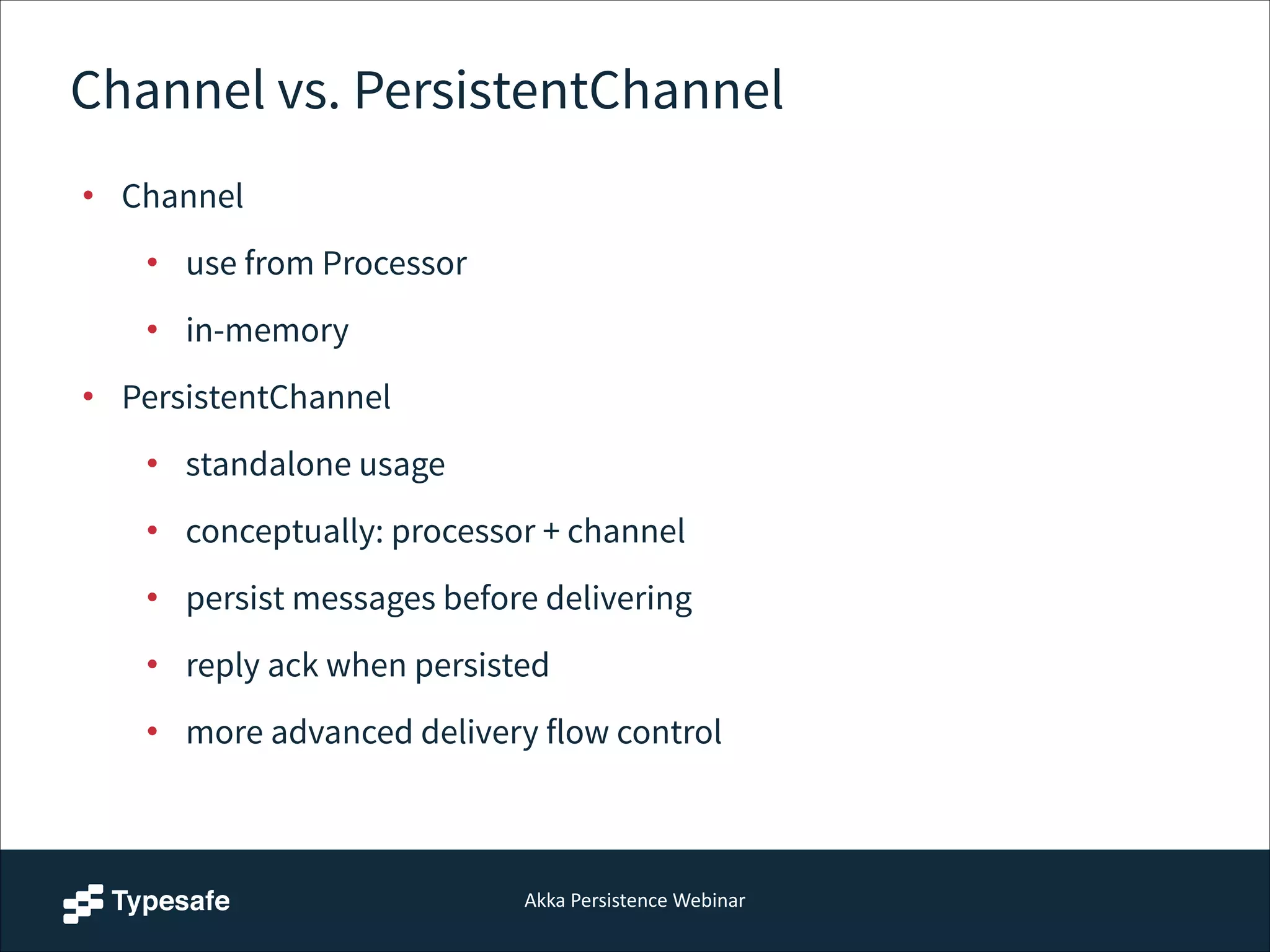
Channel vs. PersistentChannel
• Channel
• use from Processor
• in-memory
• PersistentChannel
• standalone usage
• conceptually: processor + channel
• persist messages before delivering
• reply ack when persisted
• more advanced delivery flow control
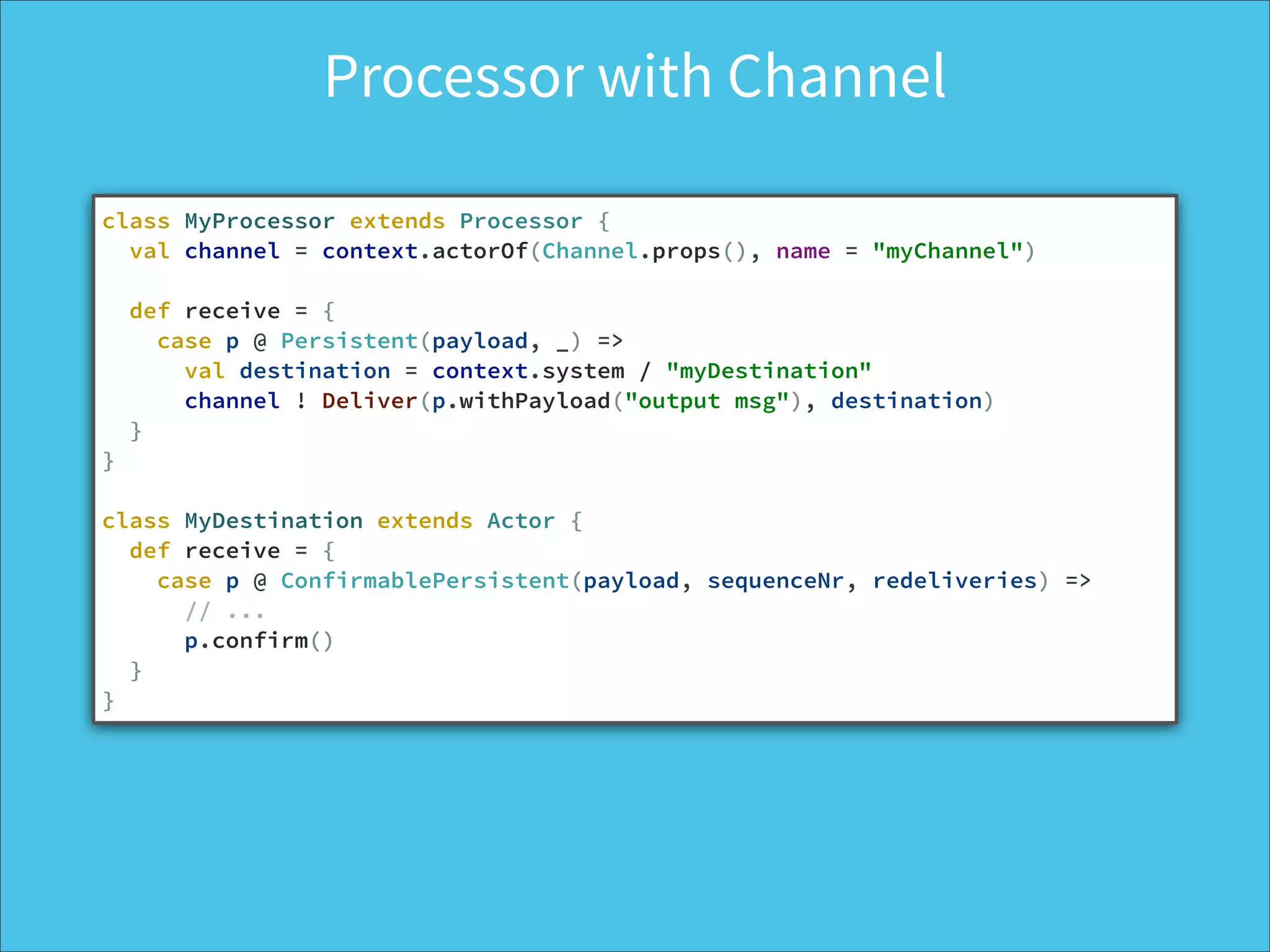
Processor with Channel
class MyProcessor extends Processor {
val channel = context.actorOf(Channel.props(), name = "myChannel")
!
def receive = {
case p @ Persistent(payload, _) =>
val destination = context.system / "myDestination"
channel ! Deliver(p.withPayload("output msg"), destination)
}
}
!
class MyDestination extends Actor {
def receive = {
case p @ ConfirmablePersistent(payload, sequenceNr, redeliveries) =>
// ...
p.confirm()
}
}
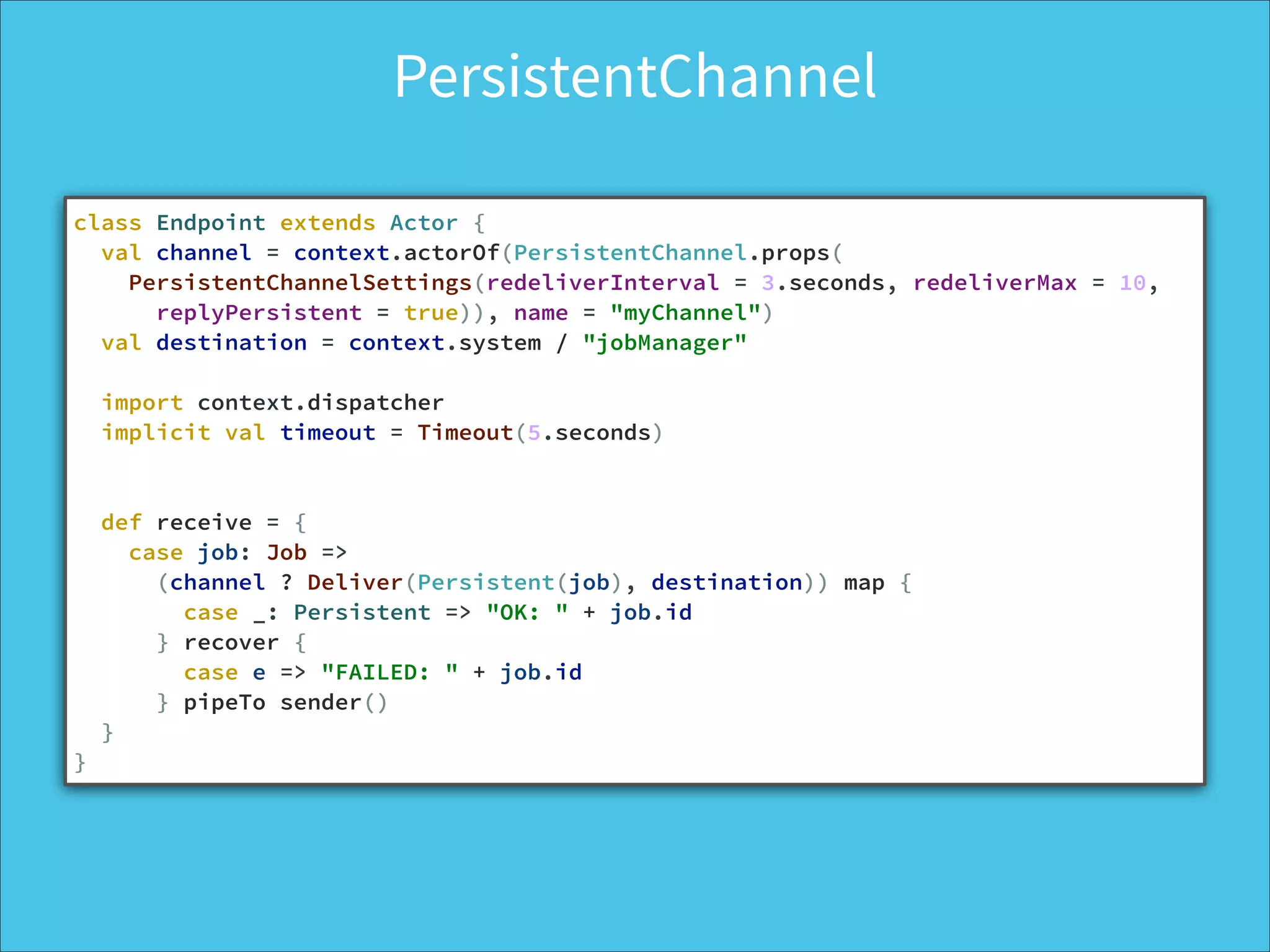
PersistentChannel
class Endpoint extends Actor {
val channel = context.actorOf(PersistentChannel.props(
PersistentChannelSettings(redeliverInterval = 3.seconds, redeliverMax = 10,
replyPersistent = true)), name = "myChannel")
val destination = context.system / "jobManager"
!
import context.dispatcher
implicit val timeout = Timeout(5.seconds)
!
def receive = {
case job: Job =>
(channel ? Deliver(Persistent(job), destination)) map {
case _: Persistent => "OK: " + job.id
} recover {
case e => "FAILED: " + job.id
} pipeTo sender()
}
}
Akka  Persistence  Webinar
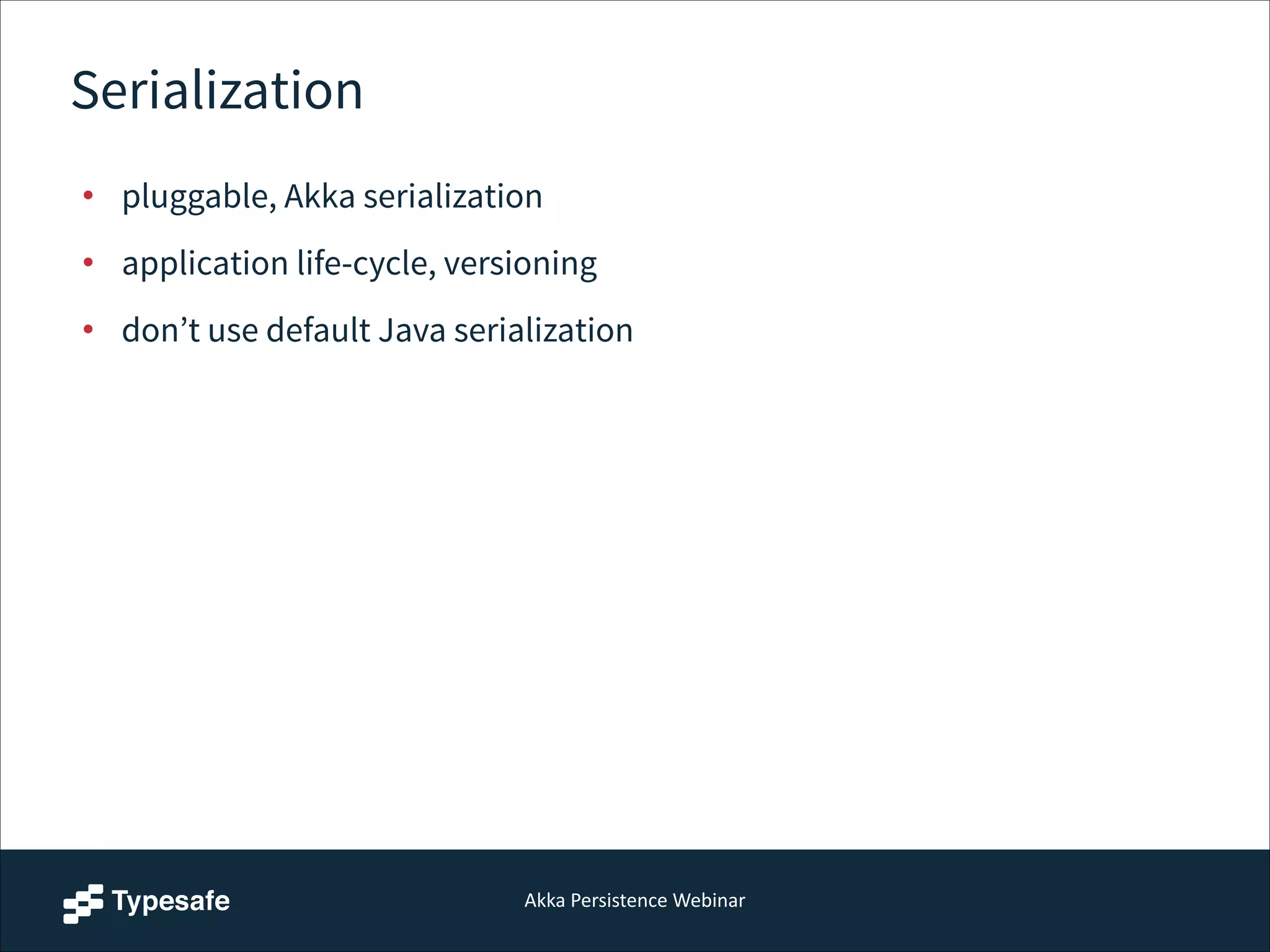
Serialization
• pluggable, Akka serialization
• application life-cycle, versioning
• don’t use default Java serialization
Akka  Persistence  Webinar
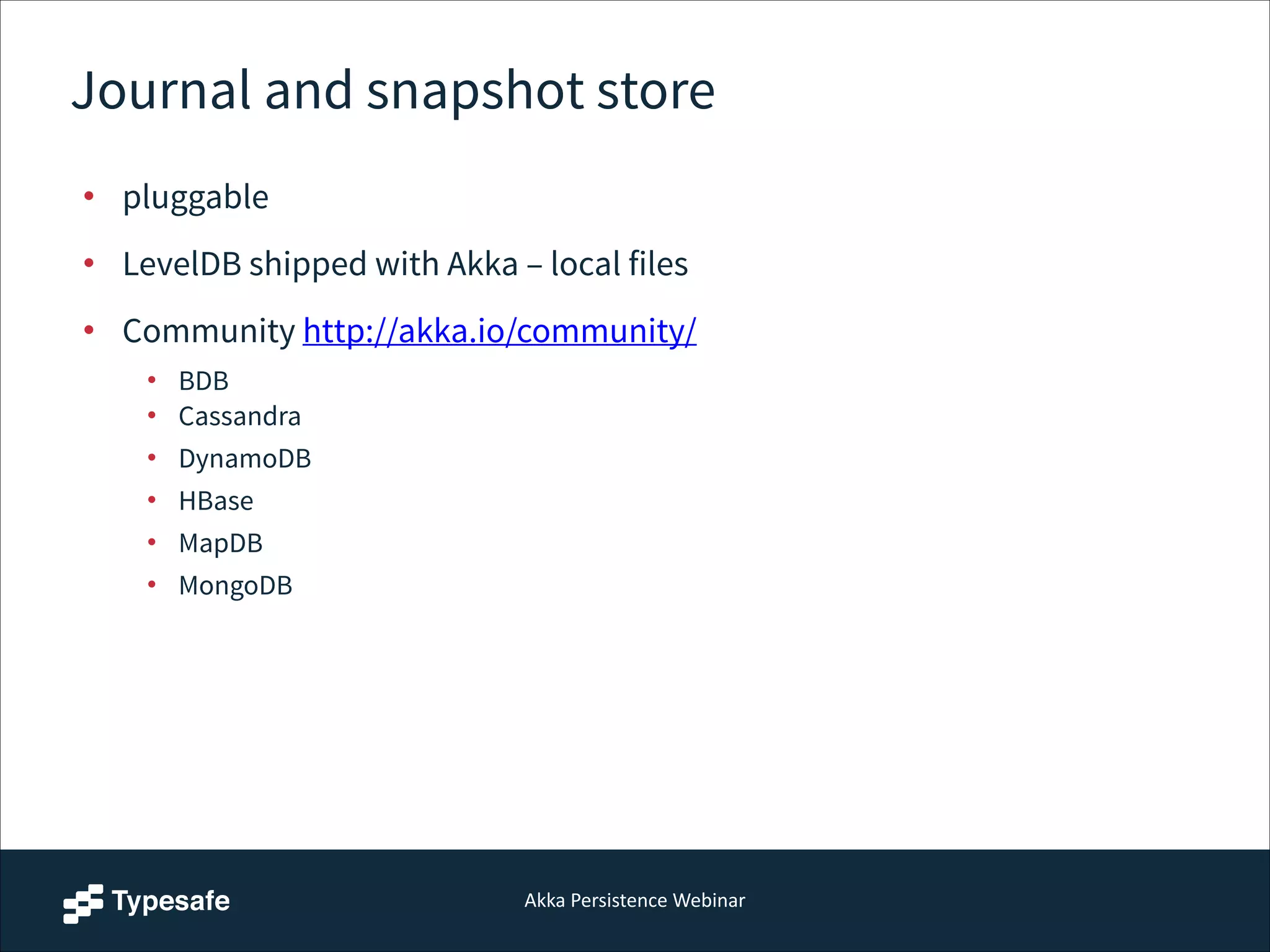
Journal and snapshot store
• pluggable
• LevelDB shipped with Akka – local files
• Community http://akka.io/community/
• BDB
• Cassandra
• DynamoDB
• HBase
• MapDB
• MongoDB
Akka  Persistence  Webinar
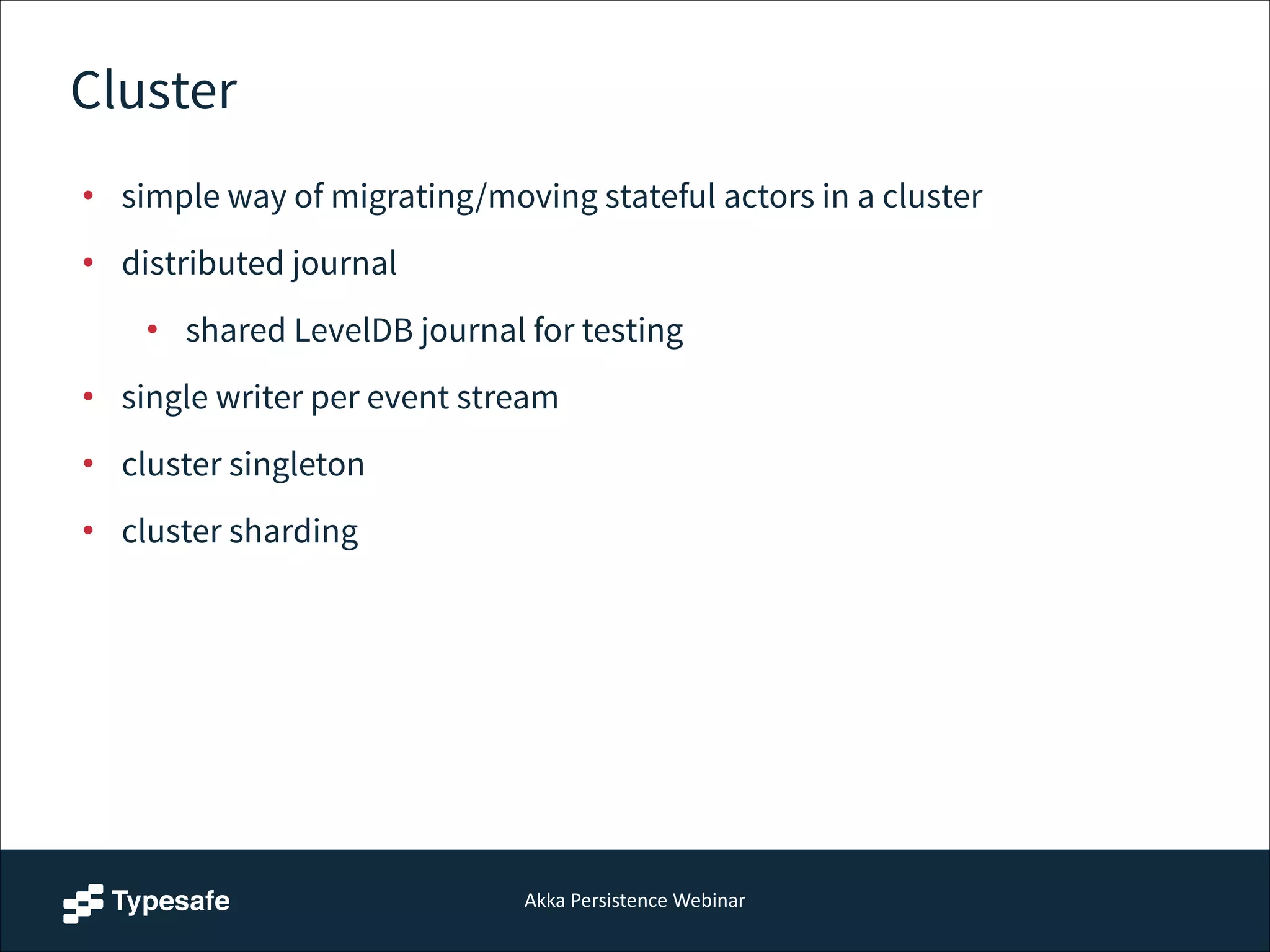
Cluster
• simple way of migrating/moving stateful actors in a cluster
• distributed journal
• shared LevelDB journal for testing
• single writer per event stream
• cluster singleton
• cluster sharding
Akka  Persistence  Webinar
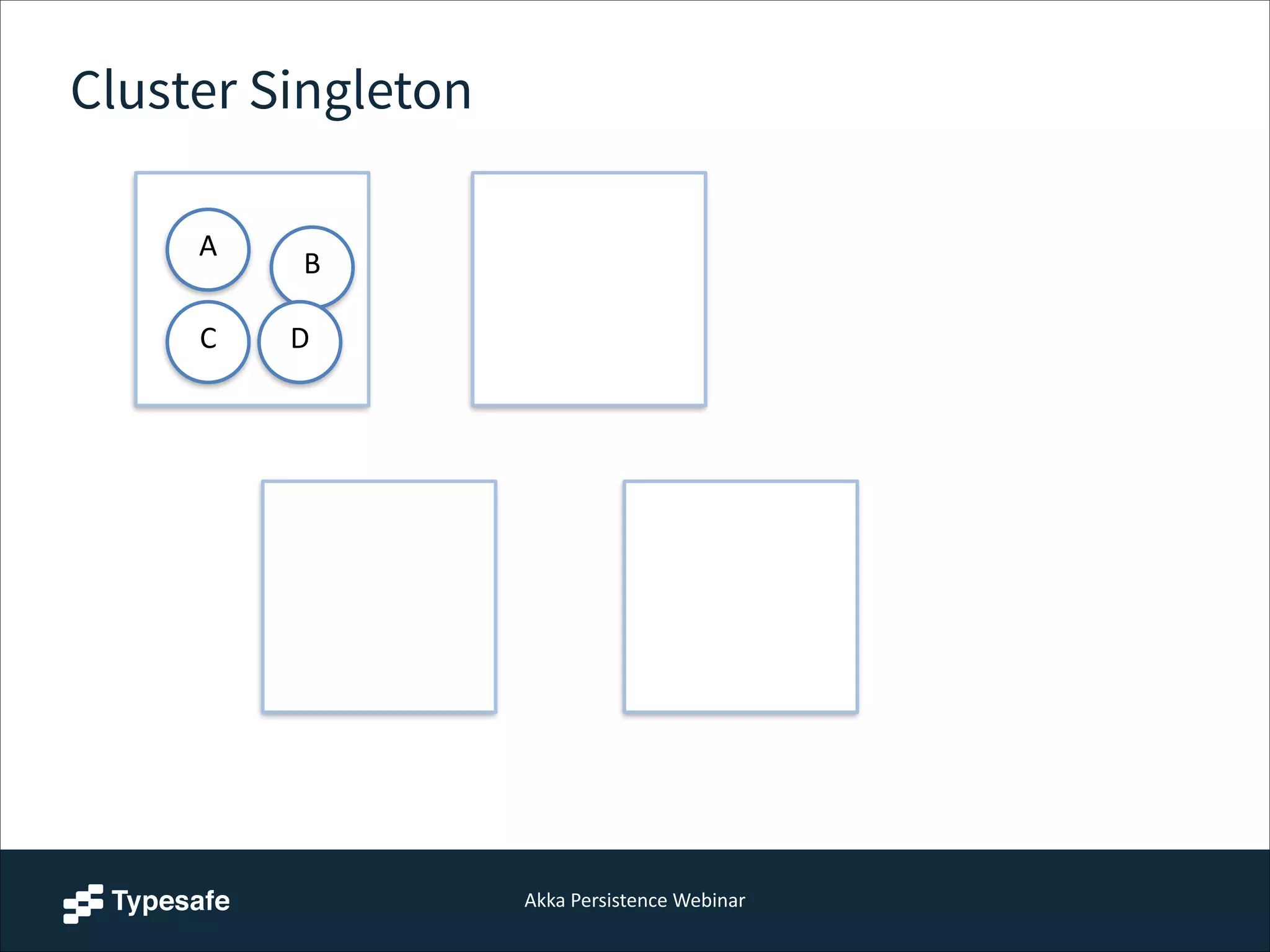
Cluster Singleton
A
B
C D
Akka  Persistence  Webinar
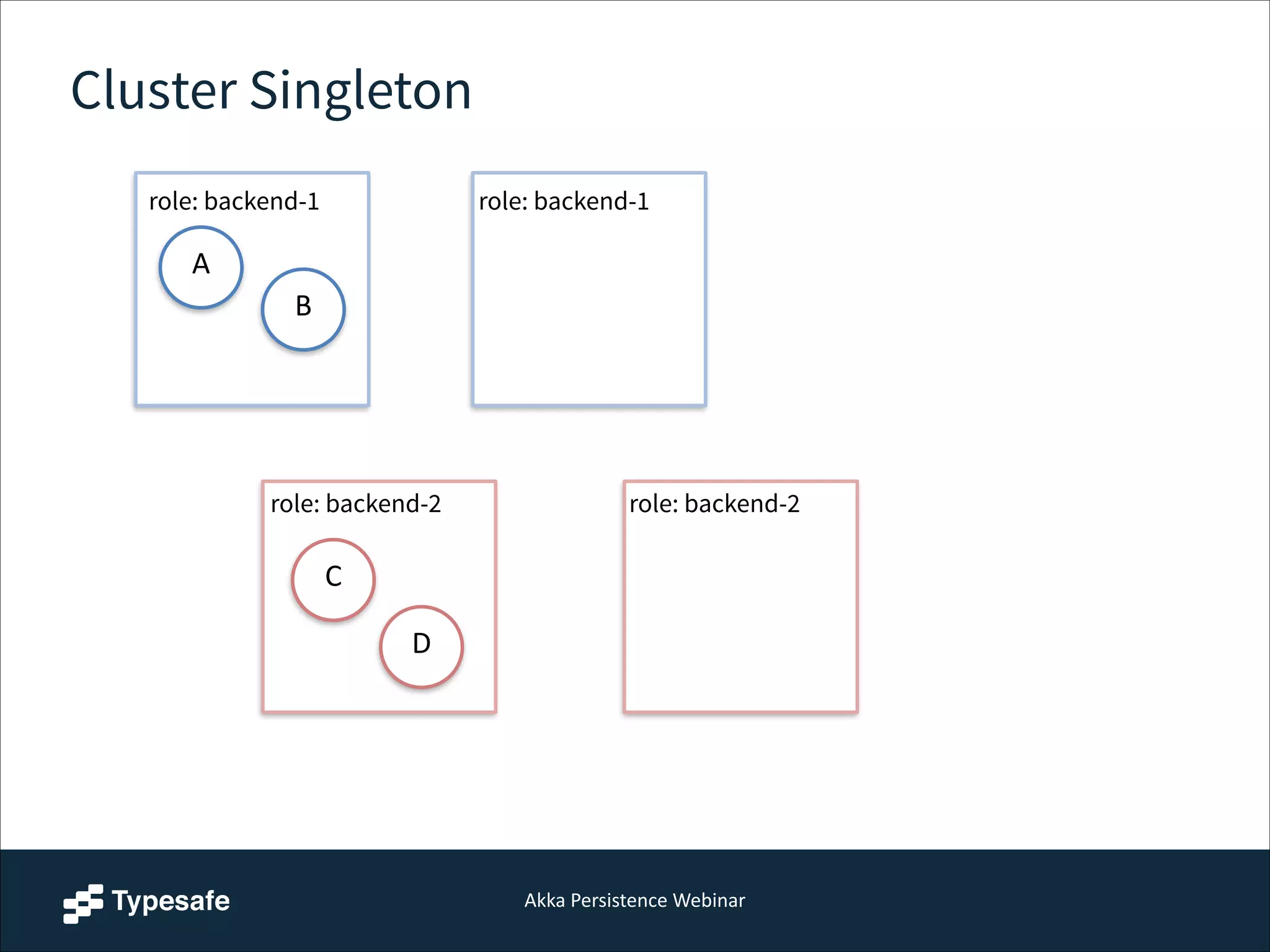
Cluster Singleton
A
B
C
D
role: backend-1 role: backend-1
role: backend-2 role: backend-2
Akka  Persistence  Webinar
Cluster Sharding
A B
C D
Akka  Persistence  Webinar
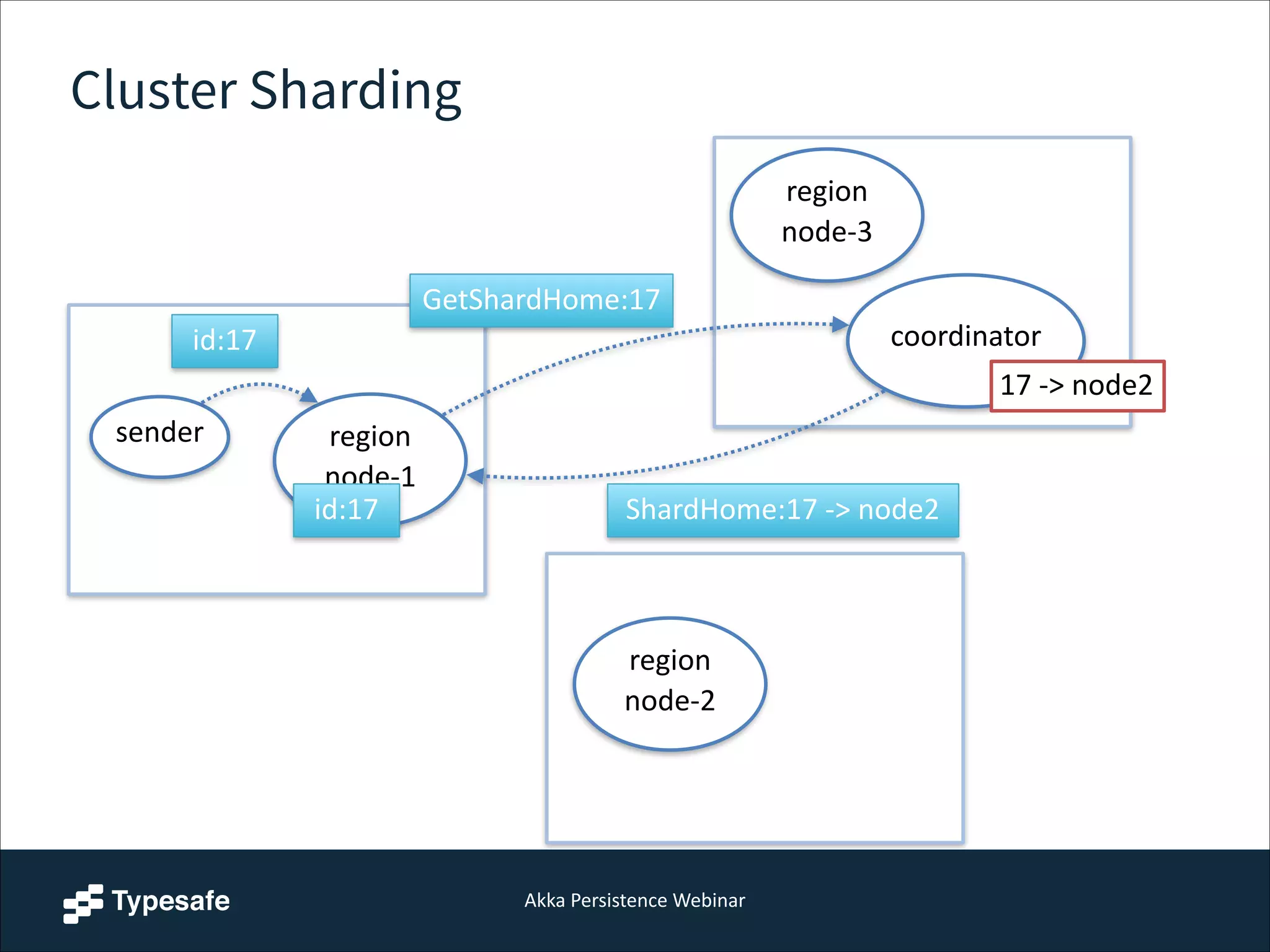
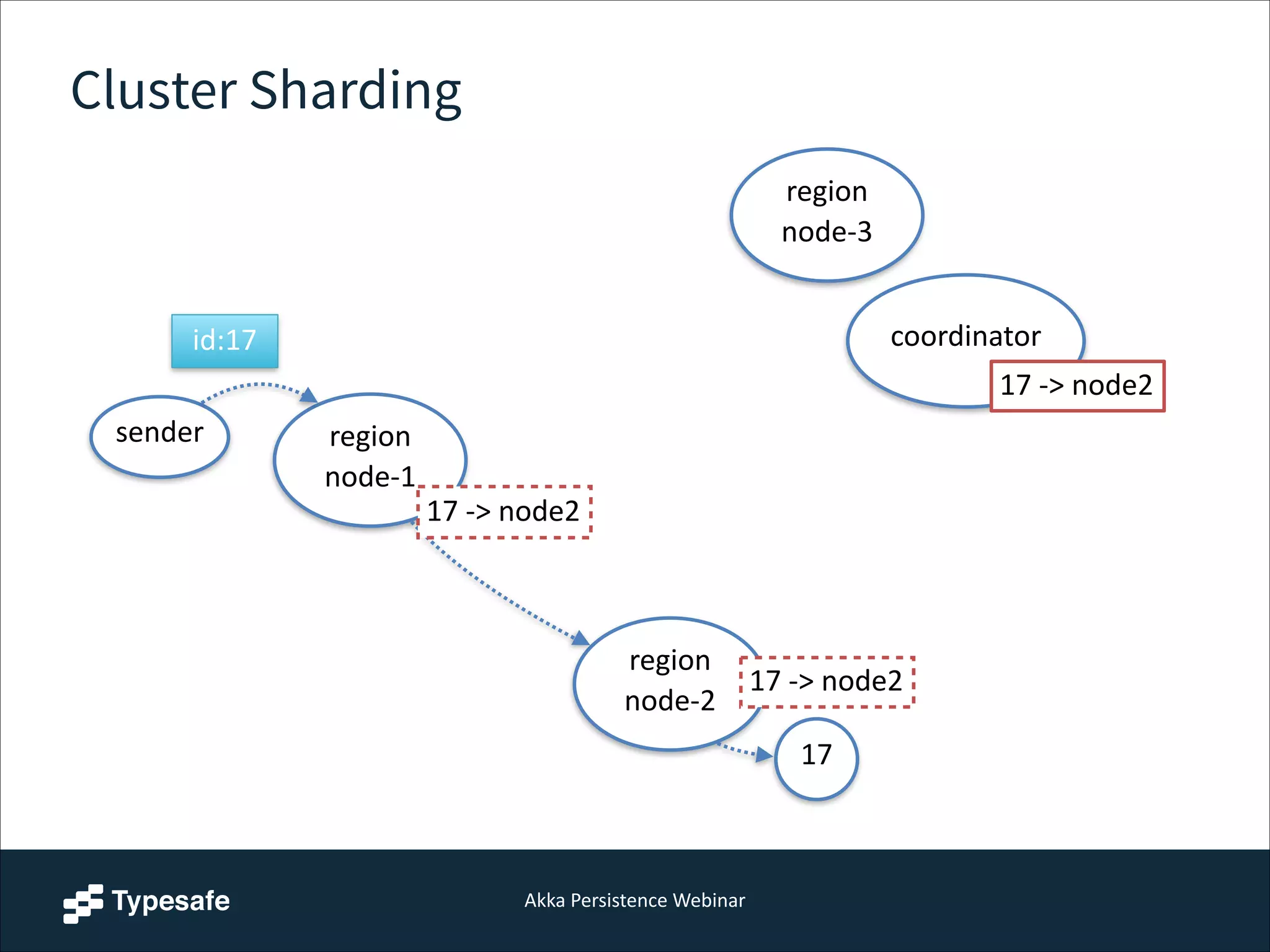
Cluster Sharding
sender
id:17
region

node-­‐1
coordinator
region

node-­‐2
region

node-­‐3
GetShardHome:17
id:17 ShardHome:17  -­‐>  node2
17  -­‐>  node2
Akka  Persistence  Webinar
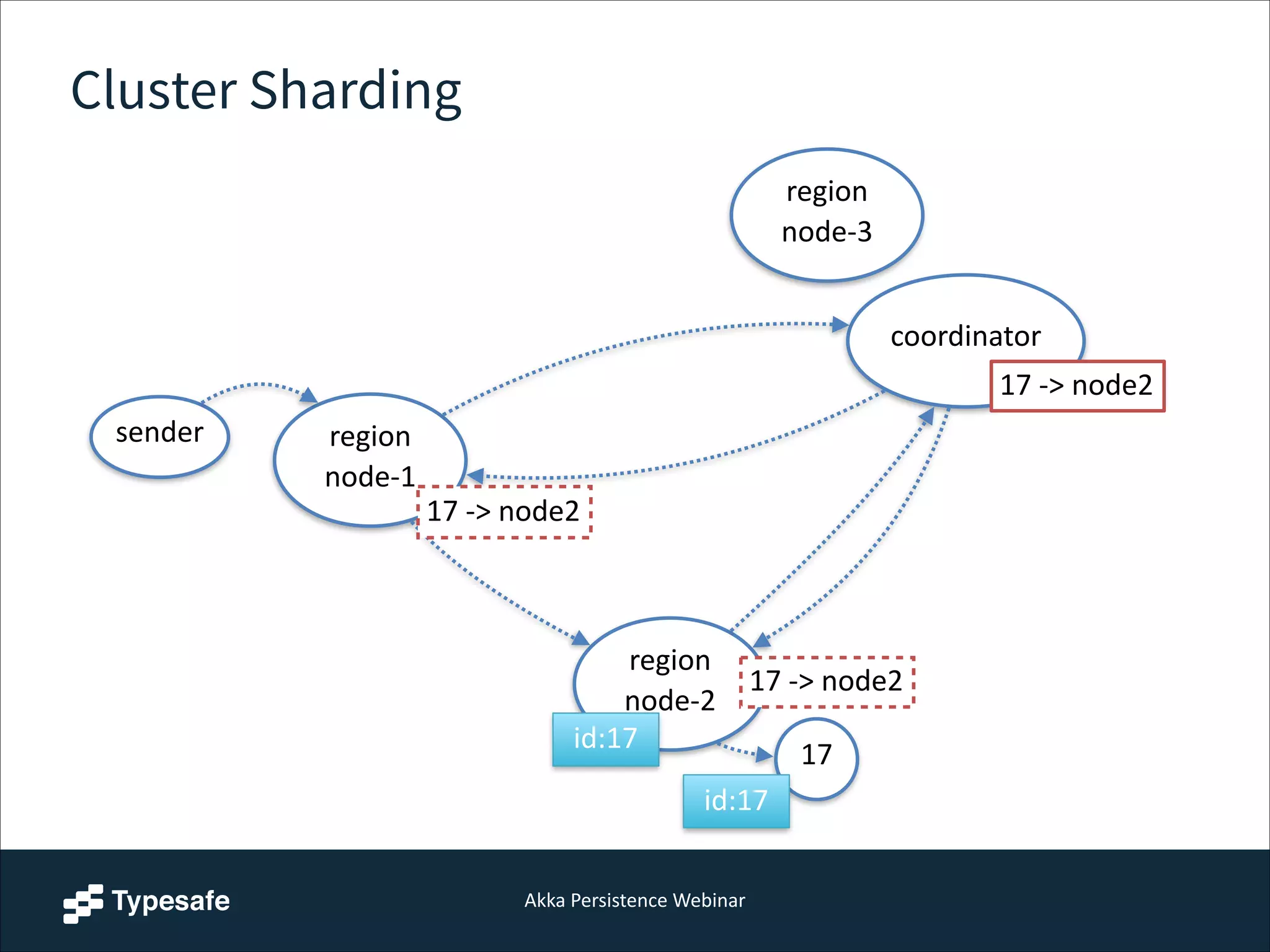
Cluster Sharding
sender region

node-­‐1
coordinator
region

node-­‐2
region

node-­‐3
id:17
id:17
GetShardHome:17
ShardHome:17  -­‐>  node2
id:17
17  -­‐>  node2
17  -­‐>  node2
Akka  Persistence  Webinar
Cluster Sharding
17
sender region

node-­‐1
coordinator
region

node-­‐2
region

node-­‐3
id:17
id:17
17  -­‐>  node2
17  -­‐>  node2
17  -­‐>  node2
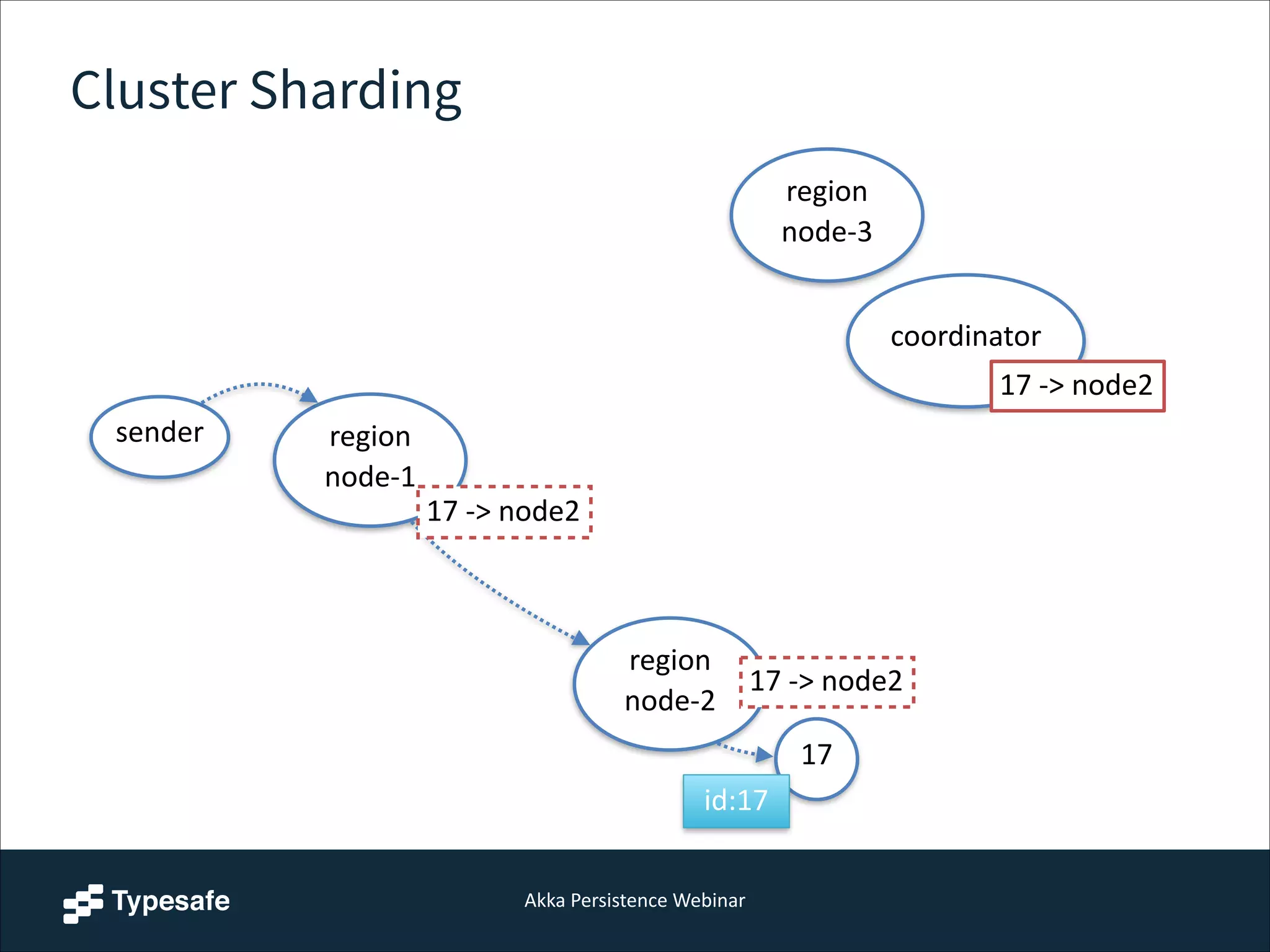
Akka  Persistence  Webinar
Cluster Sharding
17
sender region

node-­‐1
coordinator
region

node-­‐2
region

node-­‐3
17  -­‐>  node2
17  -­‐>  node2
17  -­‐>  node2
id:17
Akka  Persistence  Webinar
Cluster Sharding
17
sender region

node-­‐1
coordinator
region

node-­‐2
region

node-­‐3
17  -­‐>  node2
17  -­‐>  node2
17  -­‐>  node2
id:17
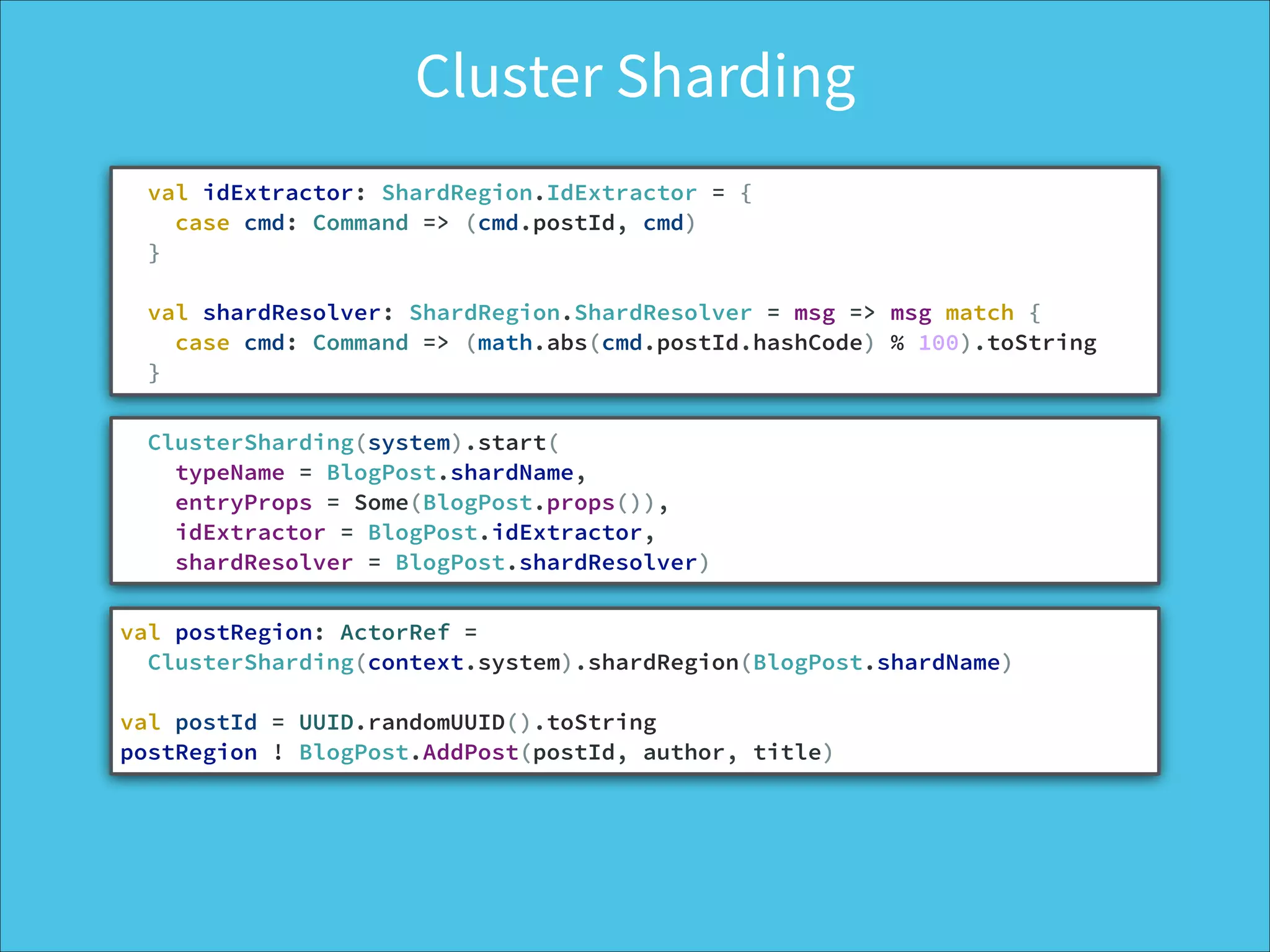
Cluster Sharding
val idExtractor: ShardRegion.IdExtractor = {
case cmd: Command => (cmd.postId, cmd)
}
!
val shardResolver: ShardRegion.ShardResolver = msg => msg match {
case cmd: Command => (math.abs(cmd.postId.hashCode) % 100).toString
}
ClusterSharding(system).start(
typeName = BlogPost.shardName,
entryProps = Some(BlogPost.props()),
idExtractor = BlogPost.idExtractor,
shardResolver = BlogPost.shardResolver)
val postRegion: ActorRef = 

ClusterSharding(context.system).shardRegion(BlogPost.shardName)
!
val postId = UUID.randomUUID().toString
postRegion ! BlogPost.AddPost(postId, author, title)
Processor
Eventsourced

Processor
Channel
Persistent

Channel
View
Journal
Cluster

Sharding
Building Blocks
Akka  Persistence  Webinar
Next step
• Documentation
• http://doc.akka.io/docs/akka/2.3.0/scala/persistence.html
• http://doc.akka.io/docs/akka/2.3.0/java/persistence.html
• http://doc.akka.io/docs/akka/2.3.0/contrib/cluster-sharding.html
• Typesafe Activator
• https://typesafe.com/activator/template/akka-sample-persistence-scala
• https://typesafe.com/activator/template/akka-sample-persistence-java
• http://typesafe.com/activator/template/akka-cluster-sharding-scala
• Mailing list
• http://groups.google.com/group/akka-user
• Migration guide from Eventsourced
• http://doc.akka.io/docs/akka/2.3.0/project/migration-guide-eventsourced-2.3.x.html
Akka  Persistence  Webinar
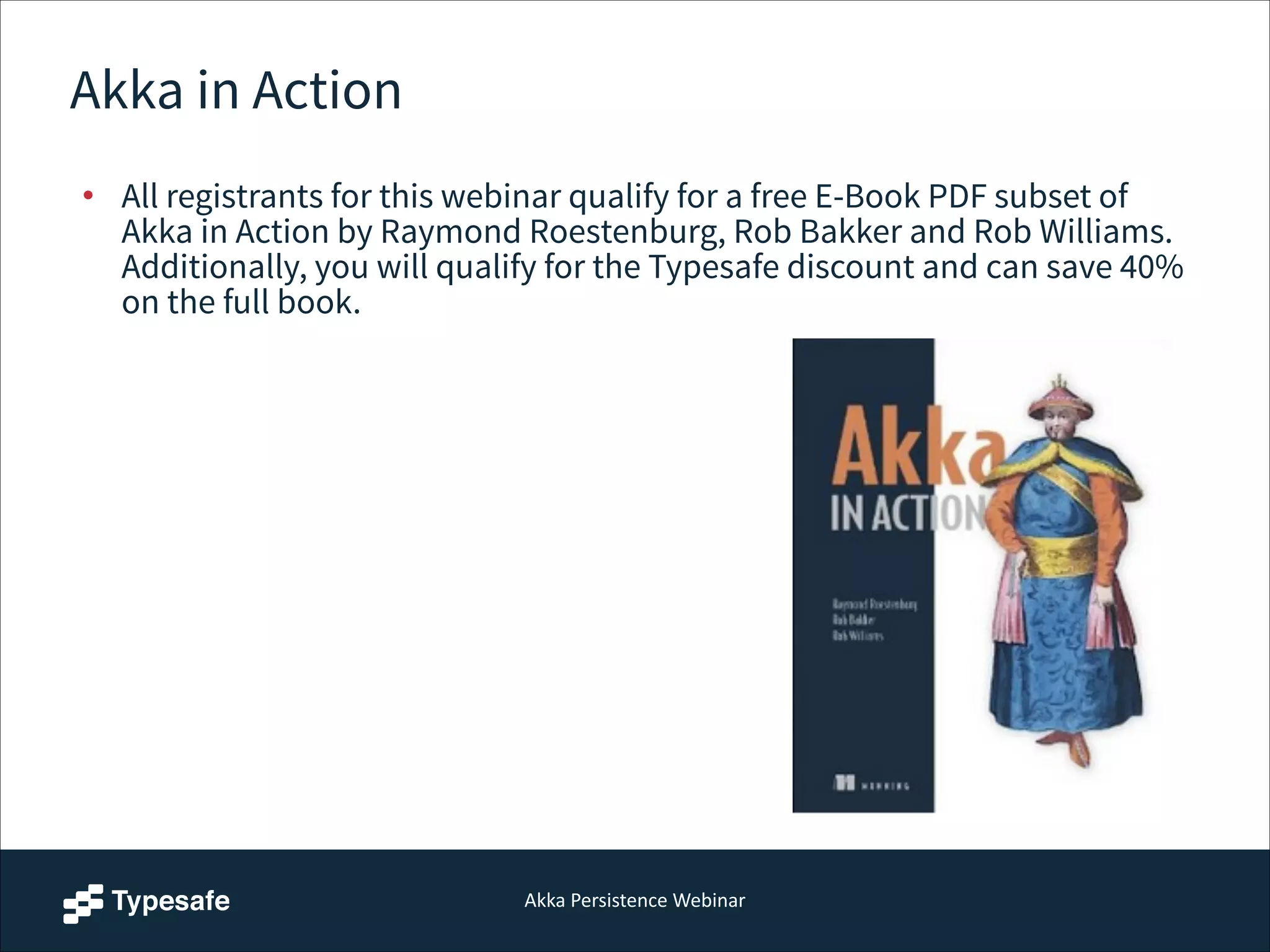
Akka in Action
• All registrants for this webinar qualify for a free E-Book PDF subset of
Akka in Action by Raymond Roestenburg, Rob Bakker and Rob Williams.
Additionally, you will qualify for the Typesafe discount and can save 40%
on the full book.
©Typesafe 2014 – All Rights Reserved

Akka persistence webinar

  • 1.
    Akka Persistence Webinar byPatrik Nordwall
 @patriknw
  • 2.
    opt-in at-least-once delivery semanticsbetween actors recover application state after a crash
  • 3.
    Akka 2.3.0 Release 
 "com.typesafe.akka"%% "akka-persistence-experimental" % "2.3.0"
 <dependency> <groupId>com.typesafe.akka</groupId> <artifactId>akka-persistence-experimental_2.10</artifactId> <version>2.3.0</version> </dependency>
  • 4.
    Martin Krasser
 Twitter: mrt1nz
 Github:krasserm Eventsourced
 
 akka-persistence
 September 2013 - February 2014 
 contractor for Typesafe Awesome work, Martin!
  • 5.
  • 6.
    storing state transitions Cart Created Added2 Socks Added 2 Shirts Shipping Info Added
  • 7.
    Akka  Persistence  Webinar DomainEvents • things that have completed, facts • immutable • verbs in past tense • CustomerRelocated • CargoShipped • InvoiceSent “State transitions are an important part of our problem space and should be modeled within our domain.”   Greg Young, 2008
  • 8.
    Akka  Persistence  Webinar Benefits •Bullet-proof auditing and historical tracing • Support future ways of looking at data • Performance and scalability • Testability • Reconstruct production scenarios • No object-relational impedance mismatch • Nice fit with actors
  • 9.
    Akka  Persistence  Webinar CommandSourcing Event Sourcing write-ahead-log derive events from a command same behavior during recovery as normal operation external interaction can be problematic only state-changing behavior during recovery persisted before validation events cannot fail allows retroactive changes to the business logic fixing the business logic will not affect persisted events naming: represent intent, imperative naming: things that have completed, verbs in past tense
  • 10.
    Akka  Persistence  Webinar Consistencyboundary • An actor is a consistency boundary • DDD Aggregate • No distributed transactions • eventually consistent • compensating actions
  • 11.
    Akka  Persistence  Webinar Lifebeyond Distributed Transactions: an Apostate’s Opinion Position Paper Pat Helland “In general, application developers simply do not implement large scalable applications assuming distributed transactions.”   Pat Helland http://www-­‐db.cs.wisc.edu/cidr/cidr2007/papers/cidr07p15.pdf
  • 12.
  • 13.
    Processor import akka.persistence.{ Persistent,Processor } ! class MyProcessor extends Processor { def receive = { case Persistent(payload, sequenceNr) => // message successfully written to journal case other => // message not written to journal } } val processor = context.actorOf(Props[MyProcessor],
 name = "myProcessor") ! processor ! Persistent("foo") // will be journaled processor ! "bar" // will not be journaled
  • 14.
    Processor class InvoiceService extendsProcessor { var invoices = Map.empty[String, Invoice] ! def receive: Receive = { case Persistent(CreateInvoice(id), _) => invoices = invoices.updated(id, Invoice(id)) } }
  • 15.
    Processor class InvoiceService extendsProcessor { var invoices = Map.empty[String, Invoice] ! def receive: Receive = { case Persistent(CreateInvoice(id), _) => invoices = invoices.updated(id, Invoice(id)) ! case Persistent(AddInvoiceItem(id, item), _) => invoices.get(id) match { case Some(inv) => invoices = invoices.updated(id, inv.addItem(item)) case None => // TODO } ! case GetInvoice(id) => sender() ! invoices.getOrElse(id, "not found: " + id) ! case Persistent(SendInvoiceTo(id, address), _) => // TODO send to the invoice printing service } }
  • 16.
    Processor case class CreateInvoice(invoiceId:String) case class AddInvoiceItem(invoiceId: String, invoiceItem: InvoiceItem) case class SendInvoiceTo(invoiceId: String, to: InvoiceAddress) case class GetInvoice(invoiceId: String) ! case class Invoice(id: String, items: IndexedSeq[InvoiceItem] = Vector.empty) { def addItem(item: InvoiceItem): Invoice = copy(items = items :+ item) } ! case class InvoiceItem(description: String, count: Int, amount: BigDecimal) ! case class InvoiceAddress(name: String, street: String, city: String)
  • 17.
    Processor Identifier 
 override defprocessorId = "my-stable-processor-id" Default is actor path without address
 /user/top/myProcessor Don’t use anonymous processors
  • 18.
    Akka  Persistence  Webinar Processor •Automatic recovery on start and restart • Stashing until recovery completed • Failure handling with supervisor strategy • Might want to delete erroneous messages
  • 19.
    What about sideeffects during replay?
  • 20.
    Processor with Channel valprintingChannel = context.actorOf(Channel.props(), name = "printingChannel") val printingDestination = context.system / "printingService" ! def receive: Receive = { case p @ Persistent(SendInvoiceTo(id, address), _) => // send to the invoice printing service invoices.get(id) match { case Some(inv) => printingChannel ! Deliver(p.withPayload( PrintingOrder(inv, address)), printingDestination) invoices -= inv.id case None => // TODO } } class PrintingService extends Actor { def receive = { case p @ ConfirmablePersistent(payload, sequenceNr, redeliveries) => // ... p.confirm() } }
  • 21.
    Akka  Persistence  Webinar EventsourcedProcessor •Incoming messages (commands) are not persisted • Steps: 1. Validate command 2. Create domain event and explicitly persist it 3. Update internal state, by applying the event 4. External side effects • During recovery the internal state is updated by applying the events • no external side effects
  • 22.
    EventsourcedProcessor class BlogPost extendsEventsourcedProcessor { override def receiveCommand: Receive = ???
 override def receiveRecover: Receive = ??? }
  • 23.
    EventsourcedProcessor object BlogPost { caseclass AddPost(author: String, title: String) } ! class BlogPost extends EventsourcedProcessor { override def receiveCommand: Receive = ???
 override def receiveRecover: Receive = ??? }
  • 24.
    object BlogPost { caseclass AddPost(author: String, title: String) } ! class BlogPost extends EventsourcedProcessor { import BlogPost._ ! override def receiveCommand: Receive = { case AddPost(author, title) => persist(PostAdded(author, title)) { evt => state = state.updated(evt) } } ! override def receiveRecover: Receive = ??? } EventsourcedProcessor
  • 25.
    EventsourcedProcessor object BlogPost { caseclass AddPost(author: String, title: String) ! sealed trait Event case class PostAdded(author: String, title: String) extends Event ! private case class State(author: String, title: String) { def updated(evt: Event): State = evt match { case PostAdded(author, title) => copy(author, title) } } } ! class BlogPost extends EventsourcedProcessor { import BlogPost._ private var state = State("", “") ! override def receiveCommand: Receive = { case AddPost(author, title) => persist(PostAdded(author, title)) { evt => state = state.updated(evt) } } ! override def receiveRecover: Receive = ??? }
  • 26.
    EventsourcedProcessor object BlogPost { caseclass AddPost(author: String, title: String) case class ChangeBody(body: String) case object Publish ! sealed trait Event case class PostAdded(author: String, title: String) extends Event case class BodyChanged(body: String) extends Event case object PostPublished extends Event ! private case class State(author: String, title: String, body: String, published: Boolean) { ! def updated(evt: Event): State = evt match { case PostAdded(author, title) => copy(author, title) case BodyChanged(b) => copy(body = b) case PostPublished => copy(published = true) } } }
  • 27.
    EventsourcedProcessor class BlogPost extendsEventsourcedProcessor { import BlogPost._ private var state = State("", "", "", false) ! override def receiveCommand: Receive = { case AddPost(author, title) => if (state.body == "" && author != "" && title != "") persist(PostAdded(author, title)) { evt => state = state.updated(evt) } case ChangeBody(body) => if (!state.published) persist(BodyChanged(body)) { evt => state = state.updated(evt) } case Publish => if (!state.published) persist(PostPublished) { evt => state = state.updated(evt) // call external web content service ... } } ! override def receiveRecover: Receive = { case evt: Event => state = state.updated(evt) } }
  • 28.
    Snapshots class MyProcessor extendsProcessor { var state: Any = _ def receive = { case "snap" => saveSnapshot(state) case SaveSnapshotSuccess(metadata) => // ... case SaveSnapshotFailure(metadata, reason) => // ... } }
  • 29.
    Snapshots class MyProcessor extendsProcessor { var state: Any = _ def receive = { case "snap" => saveSnapshot(state) case SaveSnapshotSuccess(metadata) => // ... case SaveSnapshotFailure(metadata, reason) => // ... ! case SnapshotOffer(metadata, offeredSnapshot) => state = offeredSnapshot case Persistent(payload, _) => // ... } }
  • 30.
    Akka  Persistence  Webinar View •replays Persistent messages from a Processor’s journal • query side of CQRS • features • auto-update interval • Update message • limit • may store its own snapshots
  • 31.
    View class InvoiceCounter extendsView { import InvoiceCounter._ override def processorId: String = "/user/invoiceService" override def autoUpdateInterval = 10.seconds ! var count = 0L ! def receive: Actor.Receive = { case Persistent(payload: SendInvoiceTo, _) => count += 1 case _: Persistent => case GetInvoiceCount => sender ! InvoiceCount(count) } } ! object InvoiceCounter { case object GetInvoiceCount case class InvoiceCount(count: Long) }
  • 32.
  • 33.
    Akka  Persistence  Webinar At-least-oncedelivery sender destination $
  • 34.
    Akka  Persistence  Webinar At-least-oncedelivery sender destination $ ok $ ok
  • 35.
    Akka  Persistence  Webinar Channels •re-deliver messages until confirmed • application level confirmation • different semantics • duplicates may be received • message order not retained • after a crash and restart messages are still delivered • listener for RedeliverFailure notifications • recommendation: one destination per channel 
 exception: replies via channel
  • 36.
    Akka  Persistence  Webinar Channelvs. PersistentChannel • Channel • use from Processor • in-memory • PersistentChannel • standalone usage • conceptually: processor + channel • persist messages before delivering • reply ack when persisted • more advanced delivery flow control
  • 37.
    Processor with Channel classMyProcessor extends Processor { val channel = context.actorOf(Channel.props(), name = "myChannel") ! def receive = { case p @ Persistent(payload, _) => val destination = context.system / "myDestination" channel ! Deliver(p.withPayload("output msg"), destination) } } ! class MyDestination extends Actor { def receive = { case p @ ConfirmablePersistent(payload, sequenceNr, redeliveries) => // ... p.confirm() } }
  • 38.
    PersistentChannel class Endpoint extendsActor { val channel = context.actorOf(PersistentChannel.props( PersistentChannelSettings(redeliverInterval = 3.seconds, redeliverMax = 10, replyPersistent = true)), name = "myChannel") val destination = context.system / "jobManager" ! import context.dispatcher implicit val timeout = Timeout(5.seconds) ! def receive = { case job: Job => (channel ? Deliver(Persistent(job), destination)) map { case _: Persistent => "OK: " + job.id } recover { case e => "FAILED: " + job.id } pipeTo sender() } }
  • 39.
    Akka  Persistence  Webinar Serialization •pluggable, Akka serialization • application life-cycle, versioning • don’t use default Java serialization
  • 40.
    Akka  Persistence  Webinar Journaland snapshot store • pluggable • LevelDB shipped with Akka – local files • Community http://akka.io/community/ • BDB • Cassandra • DynamoDB • HBase • MapDB • MongoDB
  • 41.
    Akka  Persistence  Webinar Cluster •simple way of migrating/moving stateful actors in a cluster • distributed journal • shared LevelDB journal for testing • single writer per event stream • cluster singleton • cluster sharding
  • 42.
  • 43.
    Akka  Persistence  Webinar ClusterSingleton A B C D role: backend-1 role: backend-1 role: backend-2 role: backend-2
  • 44.
  • 45.
    Akka  Persistence  Webinar ClusterSharding sender id:17 region
 node-­‐1 coordinator region
 node-­‐2 region
 node-­‐3 GetShardHome:17 id:17 ShardHome:17  -­‐>  node2 17  -­‐>  node2
  • 46.
    Akka  Persistence  Webinar ClusterSharding sender region
 node-­‐1 coordinator region
 node-­‐2 region
 node-­‐3 id:17 id:17 GetShardHome:17 ShardHome:17  -­‐>  node2 id:17 17  -­‐>  node2 17  -­‐>  node2
  • 47.
    Akka  Persistence  Webinar ClusterSharding 17 sender region
 node-­‐1 coordinator region
 node-­‐2 region
 node-­‐3 id:17 id:17 17  -­‐>  node2 17  -­‐>  node2 17  -­‐>  node2
  • 48.
    Akka  Persistence  Webinar ClusterSharding 17 sender region
 node-­‐1 coordinator region
 node-­‐2 region
 node-­‐3 17  -­‐>  node2 17  -­‐>  node2 17  -­‐>  node2 id:17
  • 49.
    Akka  Persistence  Webinar ClusterSharding 17 sender region
 node-­‐1 coordinator region
 node-­‐2 region
 node-­‐3 17  -­‐>  node2 17  -­‐>  node2 17  -­‐>  node2 id:17
  • 50.
    Cluster Sharding val idExtractor:ShardRegion.IdExtractor = { case cmd: Command => (cmd.postId, cmd) } ! val shardResolver: ShardRegion.ShardResolver = msg => msg match { case cmd: Command => (math.abs(cmd.postId.hashCode) % 100).toString } ClusterSharding(system).start( typeName = BlogPost.shardName, entryProps = Some(BlogPost.props()), idExtractor = BlogPost.idExtractor, shardResolver = BlogPost.shardResolver) val postRegion: ActorRef = 
 ClusterSharding(context.system).shardRegion(BlogPost.shardName) ! val postId = UUID.randomUUID().toString postRegion ! BlogPost.AddPost(postId, author, title)
  • 51.
  • 52.
    Akka  Persistence  Webinar Nextstep • Documentation • http://doc.akka.io/docs/akka/2.3.0/scala/persistence.html • http://doc.akka.io/docs/akka/2.3.0/java/persistence.html • http://doc.akka.io/docs/akka/2.3.0/contrib/cluster-sharding.html • Typesafe Activator • https://typesafe.com/activator/template/akka-sample-persistence-scala • https://typesafe.com/activator/template/akka-sample-persistence-java • http://typesafe.com/activator/template/akka-cluster-sharding-scala • Mailing list • http://groups.google.com/group/akka-user • Migration guide from Eventsourced • http://doc.akka.io/docs/akka/2.3.0/project/migration-guide-eventsourced-2.3.x.html
  • 53.
    Akka  Persistence  Webinar Akkain Action • All registrants for this webinar qualify for a free E-Book PDF subset of Akka in Action by Raymond Roestenburg, Rob Bakker and Rob Williams. Additionally, you will qualify for the Typesafe discount and can save 40% on the full book.
  • 54.
    ©Typesafe 2014 –All Rights Reserved