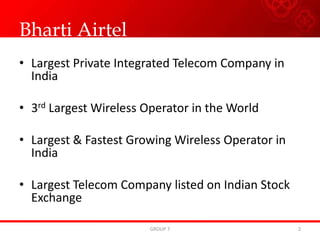
Bharti AirtelLargest Private Integrated Telecom Company in India
3rd Largest Wireless Operator in the World
Largest & Fastest Growing Wireless Operator in India
Largest Telecom Company listed on Indian Stock Exchange2GROUP 7
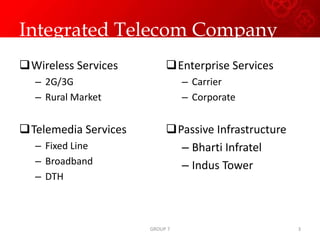
Integrated Telecom CompanyWireless Services
2G/3G
Rural Market
TelemediaServices
Fixed Line
Broadband
DTH
Enterprise Services
Carrier
Corporate
Passive Infrastructure
BhartiInfratel
Indus TowerGROUP 73
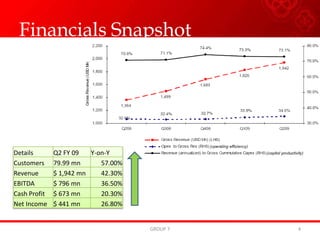
Financials Snapshot4GROUP 7
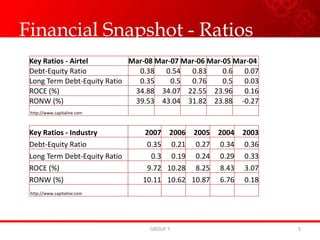
Financial Snapshot - RatiosGROUP 75
Vision 2010By 2010 Airtel will be the most admired brand in India:Loved by more customersTargeted by top talentBenchmarked by more businesses
Vision 2020 To build India's finest business conglomerate by 2020Supporting education of underprivileged children through Bharti Foundation Strategic Intent:To create a conglomerate of the future by bringing about “Big Transformations through Brave Actions.”
Mission“ We at Airtel always think in fresh and innovative ways about the needs of our customers and how we want them to feel. We deliver what we promise and go out of our way to delight the customer with a little bit more”
Core ValuesEmpowering People - to do their best
Being Flexible - to adapt to the changing environment and evolving customer needs
Making it Happen - by striving to change the status quo, innovate and energize new ideas with a strong passion and entrepreneurial spirit
Openness and transparency - with an innate desire to do good
Creating Positive Impact – with a desire to create a meaningful difference in society.Objectives/GoalsTo undertake transformational projects that have a positive impact on the society and contribute to the nation building process. To Diversify into new businesses in agriculture, financial services and retail business with world-class partnersTo lay the foundation for building a “conglomerate” of future
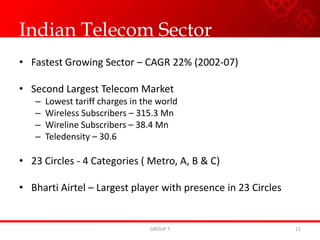
Indian Telecom SectorFastest Growing Sector – CAGR 22% (2002-07)
Second Largest Telecom Market
Lowest tariff charges in the world
Wireless Subscribers – 315.3 Mn
Wireline Subscribers – 38.4 Mn
Teledensity – 30.6
23 Circles - 4 Categories ( Metro, A, B & C)
BhartiAirtel – Largest player with presence in 23 Circles11GROUP 7
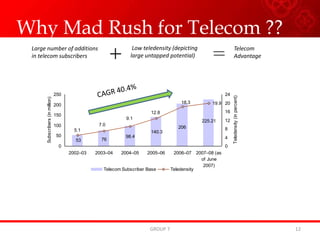
12Why Mad Rush for Telecom ?? Low teledensity (depicting large untapped potential) Large number of additions in telecom subscribersTelecomAdvantageGROUP 7CAGR 40.4%
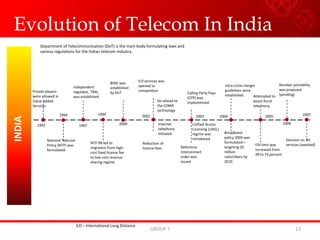
13Evolution of Telecom In IndiaDepartment of Telecommunication (DoT) is the main body formulating laws and various regulations for the Indian telecom industry.ILDservices was opened to competitionBSNL was established by DoTNumber portability was proposed (pending) Intra-circle merger guidelines were establishedIndependent regulator, TRAI, was establishedPrivate players were allowed in Value Added ServicesCalling Party Pays (CPP) was implementedAttempted to boost Rural telephonyGo-ahead to the CDMA technology199920071994200220052003200420062000Internet telephony initiatedUnified Access Licensing (UASL) regime was introducedINDIA 19921997Broadband policy 2004 was formulated—targeting 20 million subscribers by 2010Decision on 3G services (awaited)National Telecom Policy (NTP) was formulatedNTP-99 led to migration from high-cost fixed license fee to low-cost revenue sharing regimeReduction of licence feesFDI limit was increased from 49 to 74 percentReference Interconnect order was issuedILD – International Long DistanceGROUP 7
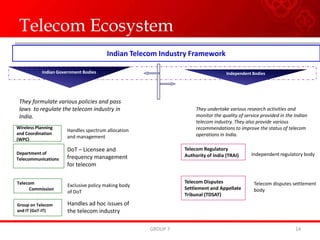
Telecom Ecosystem14Indian Telecom Industry FrameworkIndian Government BodiesIndependent BodiesThey formulate various policies and pass laws to regulate the telecom industry in India.They undertake various research activities and monitor the quality of service provided in the Indian telecom industry. They also provide various recommendations to improve the status of telecom operations in India.Wireless Planning and Coordination (WPC)Handles spectrum allocation and managementDepartment of TelecommunicationsTelecom Regulatory Authority of India (TRAI)DoT – Licensee and frequency management for telecomIndependent regulatory bodyTelecom Disputes Settlement and Appellate Tribunal (TDSAT)Telecom CommissionTelecom disputes settlement bodyExclusive policy making body of DoTHandles ad hoc issues of the telecom industryGroup on Telecom and IT (GoT-IT)GROUP 7
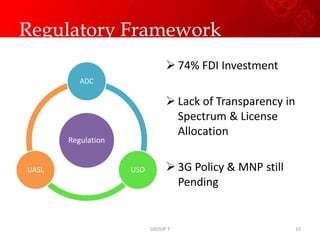
Regulatory Framework74% FDI Investment
Lack of Transparency in Spectrum & License Allocation
3G Policy & MNP still PendingGROUP 715
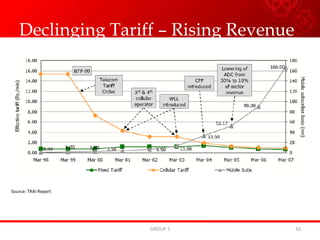
Declinging Tariff – Rising RevenueGROUP 716Source: TRAI Report
Economic FactorsGDP growth rate -  Averaged around 7.9 % from 2002-2008Rising Tele-density – Target of 45% by 2010Growing per capita income/disposable Income Rs 12000 in 2002 to Rs 33000 in 2008)Falling Handset PricesModerate inflation levels which were prevalent during the past 7 years – around 5-6%
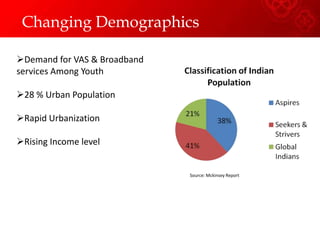
Changing DemographicsDemand for VAS & Broadband services Among Youth
28 % Urban Population
Rapid Urbanization
Rising Income levelSource: Mckinsey Report

Air1

  • 2.
    Bharti AirtelLargest PrivateIntegrated Telecom Company in India
  • 3.
    3rd Largest WirelessOperator in the World
  • 4.
    Largest & FastestGrowing Wireless Operator in India
  • 5.
    Largest Telecom Companylisted on Indian Stock Exchange2GROUP 7
  • 6.
  • 7.
  • 8.
  • 9.
  • 10.
  • 11.
  • 12.
  • 13.
  • 14.
  • 15.
  • 16.
  • 17.
  • 18.
  • 19.
  • 20.
    Financial Snapshot -RatiosGROUP 75
  • 21.
    Vision 2010By 2010Airtel will be the most admired brand in India:Loved by more customersTargeted by top talentBenchmarked by more businesses
  • 22.
    Vision 2020 Tobuild India's finest business conglomerate by 2020Supporting education of underprivileged children through Bharti Foundation Strategic Intent:To create a conglomerate of the future by bringing about “Big Transformations through Brave Actions.”
  • 23.
    Mission“ We at Airtelalways think in fresh and innovative ways about the needs of our customers and how we want them to feel. We deliver what we promise and go out of our way to delight the customer with a little bit more”
  • 24.
  • 25.
    Being Flexible -to adapt to the changing environment and evolving customer needs
  • 26.
    Making it Happen- by striving to change the status quo, innovate and energize new ideas with a strong passion and entrepreneurial spirit
  • 27.
    Openness and transparency- with an innate desire to do good
  • 28.
    Creating Positive Impact– with a desire to create a meaningful difference in society.Objectives/GoalsTo undertake transformational projects that have a positive impact on the society and contribute to the nation building process. To Diversify into new businesses in agriculture, financial services and retail business with world-class partnersTo lay the foundation for building a “conglomerate” of future
  • 29.
    Indian Telecom SectorFastestGrowing Sector – CAGR 22% (2002-07)
  • 30.
  • 31.
  • 32.
  • 33.
  • 34.
  • 35.
    23 Circles -4 Categories ( Metro, A, B & C)
  • 36.
    BhartiAirtel – Largestplayer with presence in 23 Circles11GROUP 7
  • 37.
    12Why Mad Rushfor Telecom ?? Low teledensity (depicting large untapped potential) Large number of additions in telecom subscribersTelecomAdvantageGROUP 7CAGR 40.4%
  • 38.
    13Evolution of TelecomIn IndiaDepartment of Telecommunication (DoT) is the main body formulating laws and various regulations for the Indian telecom industry.ILDservices was opened to competitionBSNL was established by DoTNumber portability was proposed (pending) Intra-circle merger guidelines were establishedIndependent regulator, TRAI, was establishedPrivate players were allowed in Value Added ServicesCalling Party Pays (CPP) was implementedAttempted to boost Rural telephonyGo-ahead to the CDMA technology199920071994200220052003200420062000Internet telephony initiatedUnified Access Licensing (UASL) regime was introducedINDIA 19921997Broadband policy 2004 was formulated—targeting 20 million subscribers by 2010Decision on 3G services (awaited)National Telecom Policy (NTP) was formulatedNTP-99 led to migration from high-cost fixed license fee to low-cost revenue sharing regimeReduction of licence feesFDI limit was increased from 49 to 74 percentReference Interconnect order was issuedILD – International Long DistanceGROUP 7
  • 39.
    Telecom Ecosystem14Indian TelecomIndustry FrameworkIndian Government BodiesIndependent BodiesThey formulate various policies and pass laws to regulate the telecom industry in India.They undertake various research activities and monitor the quality of service provided in the Indian telecom industry. They also provide various recommendations to improve the status of telecom operations in India.Wireless Planning and Coordination (WPC)Handles spectrum allocation and managementDepartment of TelecommunicationsTelecom Regulatory Authority of India (TRAI)DoT – Licensee and frequency management for telecomIndependent regulatory bodyTelecom Disputes Settlement and Appellate Tribunal (TDSAT)Telecom CommissionTelecom disputes settlement bodyExclusive policy making body of DoTHandles ad hoc issues of the telecom industryGroup on Telecom and IT (GoT-IT)GROUP 7
  • 40.
  • 41.
    Lack of Transparencyin Spectrum & License Allocation
  • 42.
    3G Policy &MNP still PendingGROUP 715
  • 43.
    Declinging Tariff –Rising RevenueGROUP 716Source: TRAI Report
  • 44.
    Economic FactorsGDP growthrate - Averaged around 7.9 % from 2002-2008Rising Tele-density – Target of 45% by 2010Growing per capita income/disposable Income Rs 12000 in 2002 to Rs 33000 in 2008)Falling Handset PricesModerate inflation levels which were prevalent during the past 7 years – around 5-6%
  • 45.
    Changing DemographicsDemand forVAS & Broadband services Among Youth
  • 46.
    28 % UrbanPopulation
  • 47.
  • 48.

Editor's Notes

  • #7 Best service provider, good call center serice esp. in local languages, good service even in the remote areas, emphasis on “barriers break when people speak”, new initiatives like google search on airtellive, downloads etc2. Long term HR strategy, Gallup Great Workplace Award, Both internal development as well as external hiring, development programs with iims etc, Young leader development program for top 18 MBA prog3. retail, insurance, realty
  • #16 MNP – Mobile Number Portability
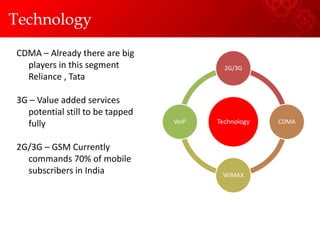
  • #20 The CDMA subscriber base has reached 74.36m in the quarter ending June 2008 as against 68.37m at the end of the previous quarter. The growth in this quarter is 8.76% as against 11.37% for the previous quarter. Reliance remains the largest CDMA mobile operator followed by Tata Teleservices and BSNL with subscriber base of 42.71m, 26.33m and 4.59m respectively. Wimax – This is a disruptive technology facing Indian telecosVoIP – This will put pressure on the Telecos since ISP can offer virtually free internet based mobile phones – Also License fees is 2 Cr against 1650 Cr for telecom operators4 G – people are already talking about it
  • #29 Cellular Services address the communication needs and staying connected.Hence a necessityThere is no substitute that can replace it completely.
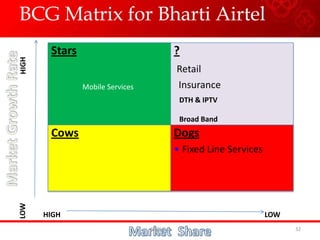
  • #33 What they are doing in retail for last 4 years. What to put in Cash Cow.BhartiInfratelThe Company has entered into a joint ventureagreement with Vodafone Essar Limited (Vodafone)and Idea Cellular Limited (Idea) to form an independenttower company (“Indus Towers Limited” or “IndusTower”) to provide passive infrastructure services in16 circles of India. The Company and Vodafone willhold approximately 42% each in Indus Tower and thebalance 16% will be held by Idea. Pursuant to theaforesaid agreement, BhartiInfratel Limited hassubscribed 50,000 equity shares of Rs. 10 each in IndusTowers Limited on December 17, 2007 for an aggregatevalue of Rs. 500 thousand. For this purpose, BhartiInfratel Ventures Limited has been incorporated as awholly owned subsidiary of BhartiInfratel Ltd. Thetelecom passive infrastructure will be transferred toBharti Infratel Ventures for ultimate merger in IndusTowers Limited.TheCompany’s 61,984,721 mobile customers accounted fora 23.8% of wireless (GSM + CDMA) market share as onMarch 31, 2008.The revenues from the mobile services for the financialyear were Rs. 218,697 mn., a growth of 55% over therevenues in the previous financial year. The mobile servicesbusiness contributed 80% to the consolidated revenues.Telemedia ServicesDuring the year, the Broadband and Telephone Servicesbusiness was renamed as Telemedia Services in line withthe Company’s growing focus on new media solutionsand foray into IPTV and DTH businesses.The Company provides broadband (DSL) and telephoneservices (fixed line) in 15 circles spanning over 94 citiesacross India. As on March 31, 2008, the Company had2,283,328 customers (a growth of 22%), of which 34.8%(~795,000) were subscribing to broadband / internetservices.The Company’s strategy for Telemedia business is to focuson the cities with high revenue potential, excepting forDTH which will be an all India offering. The productoffering in this segment includes supply and installationof fixed-line telephones providing local, national andinternational long distance voice connectivity andbroadband Internet access through DSL. The business alsoprovides value added services such as intelligent networkPassive Infrastructure ServicesThe undertaking relating to the entire assets and liabilitiesof telecom passive infrastructure was transferred fromBhartiAirtel Limited to BhartiInfratel Limited pursuant toa scheme of arrangement sanctioned by the Honble HighCourt of Delhi. BhartiInfratel provides passiveinfrastructure services on a non-discriminatory basis to alltelecom operators in India. BhartiInfratel deploys, ownsand manages passive infrastructure on an all India basis.The Company has approximately 52,000 towers as onMarch 31, 2008, of which approx 30,000 towers will betransferred to Indus Towers Ltd (a Joint Venture betweenBhartiInfratel, Vodafone and Idea Cellular) for 16 circles.
  • #38 Telemedia – Airtel Industry % BroadBand - 0.2 4.5 4 Fixed Line 1.2 40 3 Broadband ..HP and Airtel had a deal …As on March 31, 2008, the Company had2,283,328 customers (a growth of 22%), of which 34.8%(~795,000) were subscribing to broadband / internetservices.Broadband subscribers - 4.38 million at the end of June 2008 as compared to 3.87 million at the end of March 2008 (growth rate @ 13.18%)Out of total 4.38 million broadband subscribers, 3.72 million are DSL based; 0.42 million Cable Modem; 0.11 million Ethernet LAN; 0.045 million Fiber; 0.057 million Radio, Leased Line 0.018 million and 0.005 million use other technologies.The key financial results of the Long Distance Servicesdivision for the year ended March 31,2008 are presentedbelow. About 25% growth ..Enterprise Services – Corporates--- 49% growth ….