Telecom Industry-
India
• PRESENTED BY:
• AMIT JOSHI
• VARSHA KUMARI
• MANEESH SHARMA
• VINAMARATA SINGH
• RAHUL KUMAR
• ASHOK SUMAN
Contents
• Overview of telecom industry.
• Structure of telecom industry.
• Players of Telecom industry.
• SWOT analysis of telecom Industry.
• Vodafone overview and SWOT analysis.
• Airtel overview mission and vision.
• Conclusion and Recommendation.
Fast facts
• Indian telecom market is one of the fastest growing markets in
the world.
• With its 806 million telephone connections as on 28th Feb
2011, it is the second largest network in the world after China.
• It is the second largest wireless network in the world.
• Over 15 million connections are being added every month.
• The target of 600 million telephones by the end of 11th five
year plan has been achieved in February 2012 itself.
Fast facts
• Wireless telephones are increasing at faster rate. The share of
wireless telephones as on 31st December 2012 is 95.54% of
the total phones.
• The share of private sector in total telephone is 84.6%.
• Overall tele-density has reached 66.17%. Urban tele-density is
about 148%, whereas rural tele-density is at 31.22%, which is
also steadily increasing.
• Broadband connections increased to 10.74 million by
November, 2010.
Souce: Cellular operators association of India, TRAI, DoT
Overview
Services offered by the telecom industry
Telecom
services
Basic
services
Mobile
services
Internet
services
VSATsGMPCS
Radio
paging
PMRTS
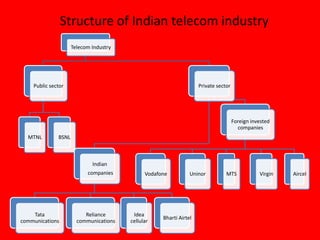
Structure of Indian telecom industry
Telecom Industry
Public sector
MTNL BSNL
Private sector
Indian
companies
Tata
communications
Reliance
communications
Idea
cellular
Bharti Airtel
Foreign invested
companies
Vodafone Uninor MTS Virgin Aircel
Indian Consumer gets the worlds
lowest mobile tarrifs
0.23
0.22
0.19
0.17
0.16
0.11 0.11 0.11
0.09
0.05 0.05
0.04
0.03
0.02
0
0.05
0.1
0.15
0.2
0.25
Belgium
Italy
UK
France
Brazil
Philippines
Taiwan
Argentina
Malayasia
HongKong
Thailand
Pakistan
China
India
Highest minutes of usage
84
159
179
315 320 323 326
461
Russia M alaysia Australia Korea Singapore China Thailand India
Players of Industry
Bharathi
Airtel
21%
Reliance
17%
Vodafone
17%
BSNL
11%
Tata
11%
Idea
11%
Aircel
7%
Others
5%
15 Players in the industry as of Sep 2012
Other Payers:
-Hexacommm
-Escotel
-Spice
-BPL
-MTNL
-Uninor
-Virgin
-MTS
Telecom Industy Users
SWOT ANALYSIS
Strengths
• High Customer Potential
 Tele-density grew from 48% in 2005 to 64% in 2012.
 Significant growth of broadband subscriber.
• High Growth Rate
 Wireless subscriber growing at the rate 60% per annum.
• Allow FDI limit ranging from 74% to 100%.
 The total FDI equity inflow in telecom sector have been US$2223 million
during 2012.
• High Return on Investment.
 Easier to create economies of scales thereby increasing the return on
investment.
• Liberalization of Government.
 The share of the private sector in the telecom sector is 88.6% and
• Lower capital expenditure.
 The Indian Telecom Industry is a high density area, which means more
population per tower. This means less capital expenditure.
Weakness
• Poor Telecom Infrastructure.
 Resulting in large call drops.
• Late Adopters of New Technology.
 India is among the last countries to adopt 3G technology. Recent reports
suggests that already 132 countries in the world has already adopted 3G.
• Most competitive market.
 10 to 12 companies offer mobile services in most parts of India.
• A market strongly regulated by Government.
• Difficult to enter because of huge financial
resources.
 Auction of 3G license has reached Rs 15814.15 crores
Opportunity
• 3G Telecom service and 4G service.
• More quality service.
• Value added service.
 SMS, ringtones, mobile tv, video streaming, mobile banking, mobile ticketing
etc.
• Boost to Telecom manufacturing companies.
 Production of telecom equipments from Rs 4,12,700 million (2007-08) to Rs
6,75,000 million (2010-2012).
• Horizontal integration.
 Entry into other consumer segments . For example Reliance BIG TV, TataSky, Airtel
Digital TV
• Providing fibres connectivity to 2,50,000 village
panchayats by 2015.
Threats
• Telecommunication Policies.
 Renewal of 2G license on the basis of market rate of 3G
 TRAI’s telecom regulatory authority intention of rolling out 4G
technology, known as the ultra-broadband in 2-3 years raising fears
rendering 3G services somewhat obsolete.
• Declining ARPU(Average Revenue per
user).
 Price wars like per second billing which is deflating revenues and
making sure the survival of the fittest.
• Partiality on the part of Government.
 E.g Allowing 3G services in a PSU(MTNL,BSNL) before auctioning to
private sector.
HISTORY
• The company was founded in 1982 as a
joint venture in England.
• the name was derived from the company's
goal of establishing both voice (VO) and
data (DA) services over a mobile telephone
network.
• Vodafone owns and operates networks in
over 30 countries and has partner networks
in over 40 additional countries
CNTD….
•It is the largest telecommunications network
in the world
•Vodafone came in India by acquiring
HUTCHISON ESSAR LTD.
•Launched officially on 21sep 2007.
CNTD…..
• Vodafone India has been awarded the Most
Admired Telecom Operator and Best 3G
Operator at the recent Telecom Operator
Awards 2012.
SWOT ANALYSIS
STRENGT
H
1.One of the most popular
cellular service provider in
India
2.One of the largest Telecom
operator in the world
3.Only Indian operator, with
VSNL, that has an
international submarine
cable
4.High brand visibility
5.Strong advertising with Zoo
ZoozOo concept
6.Tieup with international
sports like Formula One.
WEAKNESS
• Price competition from
BSNL and MTNL
• Untapped Rural Market
• US business not nearly as
strong as European/rest of
the world operation
OPPORTUNITY
• Fast expanding cellular
market
• Latest and low cost
technology
• Untapped rural market
• Research and development
of new mobile technologies
• Good Tariff package
THREAT
• New entrant's low price
offering
• Saturation point in Basic
telephony service
• Mobile Number Portability
INTRODUCTION
Owner- Sunil Bharti Mittal.
Bharti Airtel formerly known as Bharti Tele-
Ventures Limited (BTVL).
India’s largest cellular service provider.
Known for its service.
First cellular operator to set up cellular
showrooms ‘Airtel Connect’.
First cellular company to install a second mobile
switching centre.
HISTORY
1985- entered in telecom business.
1985-Technical collaboration with
Siemens, Takacom corporation.
1990- entered in telecommunication industry.
1992- launching services in Delhi.
1995- opened its first cellular showroom.
2000- invested in acquisitions and alliances to
expand its business.
Won ‘Techies Award’ for four consecutive
years (1997-2000).
VISION
Vision 2013
By 2013 Airtel will be the most admired brand in India:
Loved by more customers
Targeted by top talent
Benchmarked by more businesses
Vision 2020
To build India's finest business conglomerate by 2020
Supporting education of underprivileged children
through Bharti Foundation
Strategic Intent:
To create a conglomerate of the future by bringing
about “Big Transformations through Brave Actions.”
MISSION
“ We at Airtel always think in fresh and
innovative ways about the needs of our
customers and how we want them to
feel. We deliver what we promise and
go out of our way to delight the
customer with a little bit more”
CORE VALUES
Core Values Empowering People - to do their best
Being Flexible - to adapt to the changing
environment and evolving customer needs
Making it Happen - by striving to change the status
quo, innovate and energize new ideas with a strong
passion and entrepreneurial spirit
Openness and transparency - with an innate desire to
do good
Creating Positive Impact – with a desire to create a
meaningful difference in society.
OBJECTIVES
To undertake transformational projects that have a
positive impact on the society and contribute to the
nation building process.
To Diversify into new businesses in
agriculture, financial services and retail business with
world-class partners
To lay the foundation for building a “conglomerate”
of future
SWOT ANALYSIS
Strengths
1. Largest cellular service provider in India, with over 164.61
million subscribers at the end of April 2012.
2. Largest Telecom operator in the world with 207.8 million
subscribers across 19 countries at the end of 2012
3. Only Indian operator, with VSNL, that has an international
submarine cable.
4. High brand visibility
5. Strong advertising with celebrity brand ambassadors
Weakness
1. Price Competition from BSNL and MTNL.
Airtel is tough competition from the operators like BSNL
and MTNL as these two operators are offering services at a
low rate.
1. Untapped Rural Market, Although Airtel have strong
Presence throughout the country but still they are far
away from the Indian rural part and generally this part is
covered by BSNL so indirectly Airtel is loosing revenue
from the rural sector
2. Service centre issues
Opportunity
1.Fast expanding cellular market
2.Latest and low cost technology
3.Untapped rural market
Threats
1.New entrant's low price offering
2.Saturation point in Basic telephony service
3.Mobile Number Portability
Conclusion & Recommendation
In this cut throat competition the winner will be
that company that understands consumer needs
focusing on usability and giving control to the users
The losers are ones that focus on technical
differentiation that majority of consumers do not
understand.
Future strategy which can make one to be a
leader are competitive tariff plans ,VAS and focus
on rural markets.
THANK YOU

Vodafone new (1)

  • 1.
    Telecom Industry- India • PRESENTEDBY: • AMIT JOSHI • VARSHA KUMARI • MANEESH SHARMA • VINAMARATA SINGH • RAHUL KUMAR • ASHOK SUMAN
  • 2.
    Contents • Overview oftelecom industry. • Structure of telecom industry. • Players of Telecom industry. • SWOT analysis of telecom Industry. • Vodafone overview and SWOT analysis. • Airtel overview mission and vision. • Conclusion and Recommendation.
  • 3.
    Fast facts • Indiantelecom market is one of the fastest growing markets in the world. • With its 806 million telephone connections as on 28th Feb 2011, it is the second largest network in the world after China. • It is the second largest wireless network in the world. • Over 15 million connections are being added every month. • The target of 600 million telephones by the end of 11th five year plan has been achieved in February 2012 itself.
  • 4.
    Fast facts • Wirelesstelephones are increasing at faster rate. The share of wireless telephones as on 31st December 2012 is 95.54% of the total phones. • The share of private sector in total telephone is 84.6%. • Overall tele-density has reached 66.17%. Urban tele-density is about 148%, whereas rural tele-density is at 31.22%, which is also steadily increasing. • Broadband connections increased to 10.74 million by November, 2010. Souce: Cellular operators association of India, TRAI, DoT
  • 5.
    Overview Services offered bythe telecom industry Telecom services Basic services Mobile services Internet services VSATsGMPCS Radio paging PMRTS
  • 6.
    Structure of Indiantelecom industry Telecom Industry Public sector MTNL BSNL Private sector Indian companies Tata communications Reliance communications Idea cellular Bharti Airtel Foreign invested companies Vodafone Uninor MTS Virgin Aircel
  • 7.
    Indian Consumer getsthe worlds lowest mobile tarrifs 0.23 0.22 0.19 0.17 0.16 0.11 0.11 0.11 0.09 0.05 0.05 0.04 0.03 0.02 0 0.05 0.1 0.15 0.2 0.25 Belgium Italy UK France Brazil Philippines Taiwan Argentina Malayasia HongKong Thailand Pakistan China India
  • 8.
    Highest minutes ofusage 84 159 179 315 320 323 326 461 Russia M alaysia Australia Korea Singapore China Thailand India
  • 9.
    Players of Industry Bharathi Airtel 21% Reliance 17% Vodafone 17% BSNL 11% Tata 11% Idea 11% Aircel 7% Others 5% 15Players in the industry as of Sep 2012 Other Payers: -Hexacommm -Escotel -Spice -BPL -MTNL -Uninor -Virgin -MTS
  • 10.
  • 11.
  • 12.
    Strengths • High CustomerPotential  Tele-density grew from 48% in 2005 to 64% in 2012.  Significant growth of broadband subscriber. • High Growth Rate  Wireless subscriber growing at the rate 60% per annum. • Allow FDI limit ranging from 74% to 100%.  The total FDI equity inflow in telecom sector have been US$2223 million during 2012. • High Return on Investment.  Easier to create economies of scales thereby increasing the return on investment. • Liberalization of Government.  The share of the private sector in the telecom sector is 88.6% and • Lower capital expenditure.  The Indian Telecom Industry is a high density area, which means more population per tower. This means less capital expenditure.
  • 13.
    Weakness • Poor TelecomInfrastructure.  Resulting in large call drops. • Late Adopters of New Technology.  India is among the last countries to adopt 3G technology. Recent reports suggests that already 132 countries in the world has already adopted 3G. • Most competitive market.  10 to 12 companies offer mobile services in most parts of India. • A market strongly regulated by Government. • Difficult to enter because of huge financial resources.  Auction of 3G license has reached Rs 15814.15 crores
  • 14.
    Opportunity • 3G Telecomservice and 4G service. • More quality service. • Value added service.  SMS, ringtones, mobile tv, video streaming, mobile banking, mobile ticketing etc. • Boost to Telecom manufacturing companies.  Production of telecom equipments from Rs 4,12,700 million (2007-08) to Rs 6,75,000 million (2010-2012). • Horizontal integration.  Entry into other consumer segments . For example Reliance BIG TV, TataSky, Airtel Digital TV • Providing fibres connectivity to 2,50,000 village panchayats by 2015.
  • 15.
    Threats • Telecommunication Policies. Renewal of 2G license on the basis of market rate of 3G  TRAI’s telecom regulatory authority intention of rolling out 4G technology, known as the ultra-broadband in 2-3 years raising fears rendering 3G services somewhat obsolete. • Declining ARPU(Average Revenue per user).  Price wars like per second billing which is deflating revenues and making sure the survival of the fittest. • Partiality on the part of Government.  E.g Allowing 3G services in a PSU(MTNL,BSNL) before auctioning to private sector.
  • 18.
    HISTORY • The companywas founded in 1982 as a joint venture in England. • the name was derived from the company's goal of establishing both voice (VO) and data (DA) services over a mobile telephone network. • Vodafone owns and operates networks in over 30 countries and has partner networks in over 40 additional countries
  • 19.
    CNTD…. •It is thelargest telecommunications network in the world •Vodafone came in India by acquiring HUTCHISON ESSAR LTD. •Launched officially on 21sep 2007.
  • 20.
    CNTD….. • Vodafone Indiahas been awarded the Most Admired Telecom Operator and Best 3G Operator at the recent Telecom Operator Awards 2012.
  • 23.
  • 24.
    STRENGT H 1.One of themost popular cellular service provider in India 2.One of the largest Telecom operator in the world 3.Only Indian operator, with VSNL, that has an international submarine cable 4.High brand visibility 5.Strong advertising with Zoo ZoozOo concept 6.Tieup with international sports like Formula One.
  • 25.
    WEAKNESS • Price competitionfrom BSNL and MTNL • Untapped Rural Market • US business not nearly as strong as European/rest of the world operation
  • 26.
    OPPORTUNITY • Fast expandingcellular market • Latest and low cost technology • Untapped rural market • Research and development of new mobile technologies • Good Tariff package
  • 27.
    THREAT • New entrant'slow price offering • Saturation point in Basic telephony service • Mobile Number Portability
  • 29.
    INTRODUCTION Owner- Sunil BhartiMittal. Bharti Airtel formerly known as Bharti Tele- Ventures Limited (BTVL). India’s largest cellular service provider. Known for its service. First cellular operator to set up cellular showrooms ‘Airtel Connect’. First cellular company to install a second mobile switching centre.
  • 30.
    HISTORY 1985- entered intelecom business. 1985-Technical collaboration with Siemens, Takacom corporation. 1990- entered in telecommunication industry. 1992- launching services in Delhi. 1995- opened its first cellular showroom. 2000- invested in acquisitions and alliances to expand its business. Won ‘Techies Award’ for four consecutive years (1997-2000).
  • 31.
    VISION Vision 2013 By 2013Airtel will be the most admired brand in India: Loved by more customers Targeted by top talent Benchmarked by more businesses Vision 2020 To build India's finest business conglomerate by 2020 Supporting education of underprivileged children through Bharti Foundation Strategic Intent: To create a conglomerate of the future by bringing about “Big Transformations through Brave Actions.”
  • 32.
    MISSION “ We atAirtel always think in fresh and innovative ways about the needs of our customers and how we want them to feel. We deliver what we promise and go out of our way to delight the customer with a little bit more”
  • 33.
    CORE VALUES Core ValuesEmpowering People - to do their best Being Flexible - to adapt to the changing environment and evolving customer needs Making it Happen - by striving to change the status quo, innovate and energize new ideas with a strong passion and entrepreneurial spirit Openness and transparency - with an innate desire to do good Creating Positive Impact – with a desire to create a meaningful difference in society.
  • 34.
    OBJECTIVES To undertake transformationalprojects that have a positive impact on the society and contribute to the nation building process. To Diversify into new businesses in agriculture, financial services and retail business with world-class partners To lay the foundation for building a “conglomerate” of future
  • 35.
  • 36.
    Strengths 1. Largest cellularservice provider in India, with over 164.61 million subscribers at the end of April 2012. 2. Largest Telecom operator in the world with 207.8 million subscribers across 19 countries at the end of 2012 3. Only Indian operator, with VSNL, that has an international submarine cable. 4. High brand visibility 5. Strong advertising with celebrity brand ambassadors
  • 37.
    Weakness 1. Price Competitionfrom BSNL and MTNL. Airtel is tough competition from the operators like BSNL and MTNL as these two operators are offering services at a low rate. 1. Untapped Rural Market, Although Airtel have strong Presence throughout the country but still they are far away from the Indian rural part and generally this part is covered by BSNL so indirectly Airtel is loosing revenue from the rural sector 2. Service centre issues
  • 38.
    Opportunity 1.Fast expanding cellularmarket 2.Latest and low cost technology 3.Untapped rural market Threats 1.New entrant's low price offering 2.Saturation point in Basic telephony service 3.Mobile Number Portability
  • 39.
    Conclusion & Recommendation Inthis cut throat competition the winner will be that company that understands consumer needs focusing on usability and giving control to the users The losers are ones that focus on technical differentiation that majority of consumers do not understand. Future strategy which can make one to be a leader are competitive tariff plans ,VAS and focus on rural markets.
  • 40.