AIR POLLUTION AND HEAT TRAPPING
By:
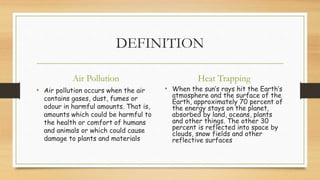
DEFINITION
Air Pollution
• Air pollution occurs when the air
contains gases, dust, fumes or
odour in harmful amounts. That is,
amounts which could be harmful to
the health or comfort of humans
and animals or which could cause
damage to plants and materials
Heat Trapping
• When the sun’s rays hit the Earth’s
atmosphere and the surface of the
Earth, approximately 70 percent of
the energy stays on the planet,
absorbed by land, oceans, plants
and other things. The other 30
percent is reflected into space by
clouds, snow fields and other
reflective surfaces
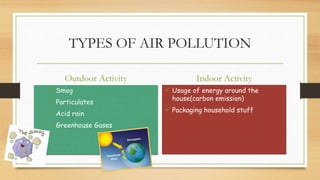
TYPES OF AIR POLLUTION
Outdoor Activity
 Smog
 Particulates
 Acid rain
 Greenhouse Gases
Indoor Activity
 Usage of energy around the
house(carbon emission)
 Packaging household stuff
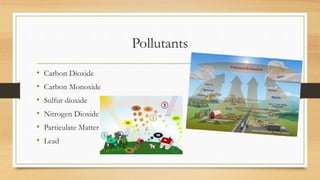
Pollutants
• Carbon Dioxide
• Carbon Monoxide
• Sulfur dioxide
• Nitrogen Dioxide
• Particulate Matter
• Lead
CAUSES
Natural sources
• Smoke that come from wildfires,
volcanoes, methane and dust
Human sources
• power plants and automobile, fumes,
burning wood stoves, fireplaces and
furnaces
WHATS RELATE PHYSICS TO THIS PROBLEM
• The greenhouse effect refers to circumstances where the short wavelengths of
visible light from the sun pass through a transparent medium and are absorbed, but
the longer wavelengths of the infrared re-radiation from the heated objects are
unable to pass through that medium. The trapping of the long wavelength radiation
leads to more heating and a higher resultant temperature. Besides the heating of an
automobile by sunlight through the windshield and the namesake example of
heating the greenhouse by sunlight passing through sealed, transparent windows, the
greenhouse effect has been widely used to describe the trapping of excess heat by
the rising concentration of carbon dioxide in the atmosphere
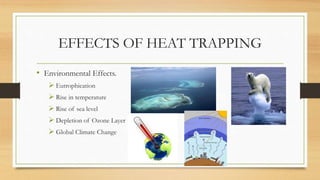
EFFECTS OF HEAT TRAPPING
• Environmental Effects.
 Eutrophication
 Rise in temperature
 Rise of sea level
 Depletion of Ozone Layer
 Global Climate Change
Ways to overcome this problem
• Campaign and activaty can be conducted by the government
• Reduce the usage of application that causes to the emission of carbon
• Conserve energy – remember to turn off lights, computers, and electric appliances
when not in use.
• Use energy efficient light bulbs and appliances.
• Participate in your local utility’s energy conservation programs.
• Limit driving by carpooling, using public transportation, biking and walking.
• Combine errands for fewer trips.
Air Pollution and Heat Trapping~physics

Air Pollution and Heat Trapping~physics

  • 1.
    AIR POLLUTION ANDHEAT TRAPPING By:
  • 2.
    DEFINITION Air Pollution • Airpollution occurs when the air contains gases, dust, fumes or odour in harmful amounts. That is, amounts which could be harmful to the health or comfort of humans and animals or which could cause damage to plants and materials Heat Trapping • When the sun’s rays hit the Earth’s atmosphere and the surface of the Earth, approximately 70 percent of the energy stays on the planet, absorbed by land, oceans, plants and other things. The other 30 percent is reflected into space by clouds, snow fields and other reflective surfaces
  • 3.
    TYPES OF AIRPOLLUTION Outdoor Activity  Smog  Particulates  Acid rain  Greenhouse Gases Indoor Activity  Usage of energy around the house(carbon emission)  Packaging household stuff
  • 4.
    Pollutants • Carbon Dioxide •Carbon Monoxide • Sulfur dioxide • Nitrogen Dioxide • Particulate Matter • Lead
  • 5.
    CAUSES Natural sources • Smokethat come from wildfires, volcanoes, methane and dust Human sources • power plants and automobile, fumes, burning wood stoves, fireplaces and furnaces
  • 7.
    WHATS RELATE PHYSICSTO THIS PROBLEM • The greenhouse effect refers to circumstances where the short wavelengths of visible light from the sun pass through a transparent medium and are absorbed, but the longer wavelengths of the infrared re-radiation from the heated objects are unable to pass through that medium. The trapping of the long wavelength radiation leads to more heating and a higher resultant temperature. Besides the heating of an automobile by sunlight through the windshield and the namesake example of heating the greenhouse by sunlight passing through sealed, transparent windows, the greenhouse effect has been widely used to describe the trapping of excess heat by the rising concentration of carbon dioxide in the atmosphere
  • 8.
    EFFECTS OF HEATTRAPPING • Environmental Effects.  Eutrophication  Rise in temperature  Rise of sea level  Depletion of Ozone Layer  Global Climate Change
  • 10.
    Ways to overcomethis problem • Campaign and activaty can be conducted by the government • Reduce the usage of application that causes to the emission of carbon • Conserve energy – remember to turn off lights, computers, and electric appliances when not in use. • Use energy efficient light bulbs and appliances. • Participate in your local utility’s energy conservation programs. • Limit driving by carpooling, using public transportation, biking and walking. • Combine errands for fewer trips.