A. Mikhailov1
A. Petrov1
O. Proncheva1,2
1Keldysh Institute of Applied Mathematics (RAS)
2Moscow Institute of Physics and Technology (SU)
Mathematical modeling of
information processes
AINL FRUCT: Artificial Intelligence and Natural Language
Conference
 The weapon of criticism cannot, of course, replace
criticism of the weapon, material force must be
overthrown by material force; but theory also
becomes a material force as soon as it has gripped
the masses.
Marx, A Contribution to the Critique of Hegel’s Philosophy of
Right (1844)
 A newspaper is not only a collective propagandist and
collective agitator, but also a collective organiser.
Lenin, Where To Begin (1901)
2
Information
3
 Information is not entropy, information is not
uncertainty!
Thomas D. Schneider
 Information is a measure of the decrease of
uncertainty.
Claude Shannon
 Information is information, not matter or energy.
Norbert Wiener
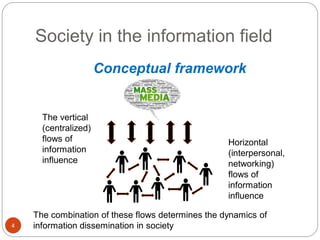
Society in the information field
4
The vertical
(centralized)
flows of
information
influence
Horizontal
(interpersonal,
networking)
flows of
information
influence
The combination of these flows determines the dynamics of
information dissemination in society
Conceptual framework
Sociological argument about information
dissemination through mass-media and
interpersonal communication
5
 The Rwandan genocide, known officially as the genocide
against the Tutsi, was a genocidal mass
slaughter of Tutsi in Rwanda by members of the Hutu majority
government.
Empirical facts:
 The broadcasts increased militia violence not only directly by
influencing behavior in villages with radio reception, but also
indirectly by increasing participation in neighboring villages.
 Spillovers are estimated to have caused more militia violence
than the direct effects.
(D. Yanagizawa-Drott,
Propaganda and conflict: evidence from the Rwandan Genocide» (2014))
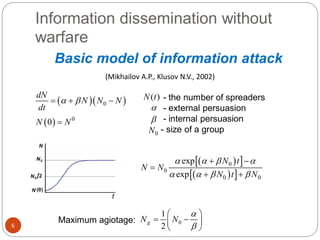
Basic model of information attack
- the number of spreaders
- external persuasion
- internal persuasion
- size of a group
Information dissemination without
warfare
  0
dN
N N N
dt
   
(Mikhailov A.P., Klusov N.V., 2002)
  0
0N N
  
  
0
0
0 0
exp
exp
N t
N N
N t N
   
   
 

 
6


0N
( )N t
Maximum agiotage: 0
1
2
gN N


 
  
 
Information dissemination without
warfare
7
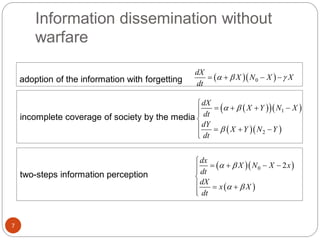
adoption of the information with forgetting   0
dX
X N X X
dt
     
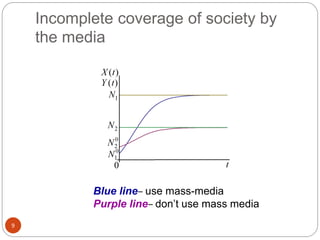
incomplete coverage of society by the media
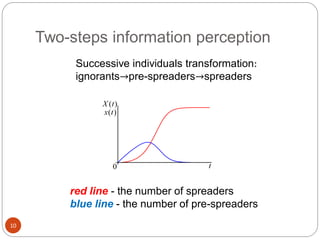
two-steps information perception
   
  
1
2
dX
X Y N X
dt
dY
X Y N Y
dt
 


   

   

  
 
0 2
dx
X N X x
dt
dX
x X
dt
 
 

   

  

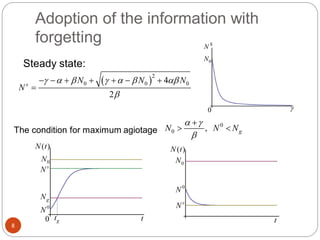
Adoption of the information with
forgetting
8
 
2
0 0 04
2
s
N N N
N
      

      

Steady state:
The condition for maximum agiotage
0
0 , gN N N
 


 
Incomplete coverage of society by
the media
9
Blue line– use mass-media
Purple line– don’t use mass media
Two-steps information perception
10
red line - the number of spreaders
blue line - the number of pre-spreaders
Successive individuals transformation:
ignorants→pre-spreaders→spreaders
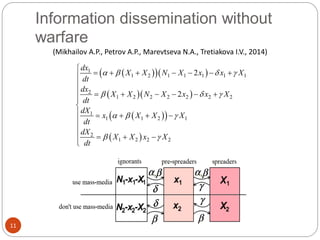
Information dissemination without
warfare
11
(Mikhailov A.P., Petrov A.P., Marevtseva N.A., Tretiakova I.V., 2014)
   
  
  
 
1
1 2 1 1 1 1 1
2
1 2 2 2 2 2 2
1
1 1 2 1
2
1 2 2 2
2
2
dx
X X N X x x X
dt
dx
X X N X x x X
dt
dX
x X X X
dt
dX
X X x X
dt
   
  
  
 

      

      


    


  

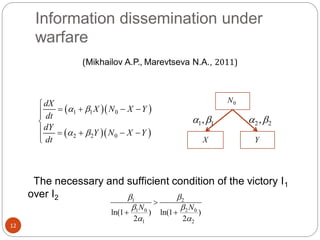
Information dissemination under
warfare
The necessary and sufficient condition of the victory I1
over I2
12
1 2
1 0 2 0
1 2
ln(1 ) ln(1 )
2 2
N N
 
 
 

 
  
  
1 1 0
2 2 0
dX
X N X Y
dt
dY
Y N X Y
dt
 
 

   

    

0N
X Y
1 1,  2 2, 
(Mikhailov A.P., Marevtseva N.A., 2011)
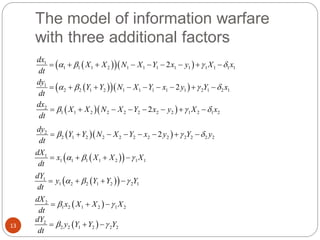
The model of information warfare
with three additional factors
13
 2
1 2 1 2 1 2
dX
x X X X
dt
   
  1
1 2 2 1 2 2 1
dY
y Y Y Y
dt
     
 2
2 2 1 2 2 2
dY
y Y Y Y
dt
   
   1
1 1 1 2 1 1 1 1 1 1 1 1 12
dx
X X N X Y x y X x
dt
           
  2
1 1 2 2 2 2 2 2 1 2 1 22
dx
X X N X Y x y X x
dt
         
   1
2 2 1 2 1 1 1 1 1 2 1 2 12
dy
Y Y N X Y x y Y x
dt
           
  2
2 1 2 2 2 2 2 2 2 2 2 22
dy
Y Y N X Y x y Y y
dt
         
  1
1 1 1 1 2 1 1
dX
x X X X
dt
     
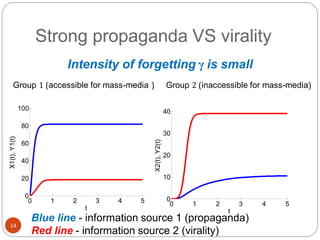
14
Group 1 (accessible for mass-media ) Group 2 (inaccessible for mass-media)
Strong propaganda VS virality
Intensity of forgetting γ is small
0 1 2 3 4 5
0
20
40
60
80
100
X1(t),Y1(t)
t
0 1 2 3 4 5
0
10
20
30
40
X2(t),Y2(t)
t
Blue line - information source 1 (propaganda)
Red line - information source 2 (virality)
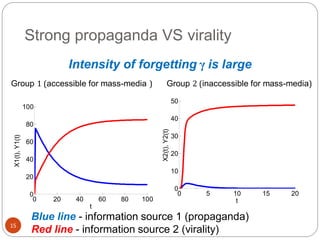
Group 1 (accessible for mass-media ) Group 2 (inaccessible for mass-media)
15
Intensity of forgetting γ is large
Blue line - information source 1 (propaganda)
Red line - information source 2 (virality)
0 20 40 60 80 100
0
20
40
60
80
100
X1(t),Y1(t)
t
0 5 10 15 20
0
10
20
30
40
50
X2(t),Y2(t)
t
Strong propaganda VS virality
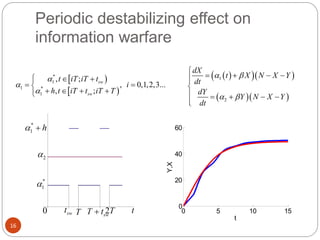
16
   
  
1
2
dX
t X N X Y
dt
dY
Y N X Y
dt
 
 

   

    

 
 
*
1
1 *
1
, ;
, 0,1,2,3...
, ;
sw
sw
t iT iT t
i
h t iT t iT T



  
 
   
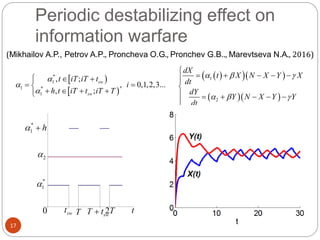
Periodic destabilizing effect on
information warfare
0 5 10 15
0
20
40
60
Y,X
t
Periodic destabilizing effect on
information warfare
17
   
  
1
2
dX
t X N X Y X
dt
dY
Y N X Y Y
dt
  
  

    

     

 
 
*
1
1 *
1
, ;
, 0,1,2,3...
, ;
sw
sw
t iT iT t
i
h t iT t iT T



  
 
   
(Mikhailov A.P., Petrov A.P., Proncheva O.G., Pronchev G.B.., Marevtseva N.A., 2016)
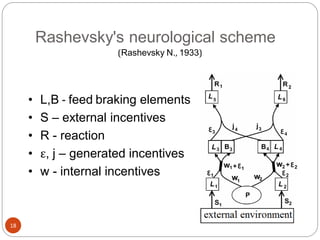
Rashevsky's neurological scheme
18
• L,B - feed braking elements
• S – external incentives
• R - reaction
• ε, j – generated incentives
• w - internal incentives
(Rashevsky N., 1933)
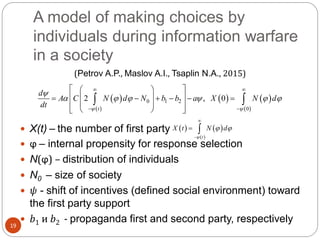
A model of making choices by
individuals during information warfare
in a society
19
(Petrov A.P., Maslov A.I., Tsaplin N.A., 2015)
 X(t) – the number of first party
 ϕ – internal propensity for response selection
 N(ϕ) – distribution of individuals
 N0 – size of society
 ψ - shift of incentives (defined social environment) toward
the first party support
 b1 и b2 - propaganda first and second party, respectively
 
 
   
 
0 1 2
0
2 , 0
t
d
A C N d N b b a X N d
dt  

     
 
 
  
       
  
  
 
   
 t
X t N d

 


 
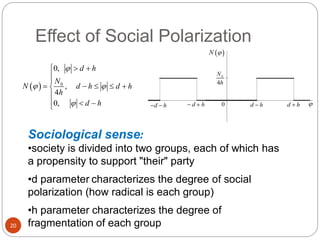
Effect of Social Polarization
20
  0
0,
,
4
0,
d h
N
N d h d h
h
d h

 

 


    

 
Sociological sense:
•society is divided into two groups, each of which has
a propensity to support "their" party
•d parameter characterizes the degree of social
polarization (how radical is each group)
•h parameter characterizes the degree of
fragmentation of each group
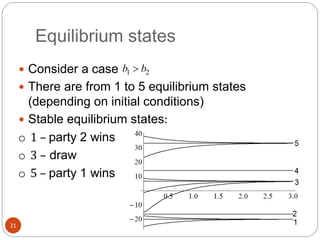
Equilibrium states
 Consider a case
 There are from 1 to 5 equilibrium states
(depending on initial conditions)
 Stable equilibrium states:
21
o 1 – party 2 wins
o 3 – draw
o 5 – party 1 wins
1 2b b
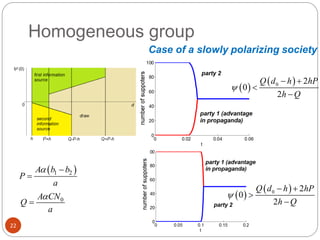
Homogeneous group
22
Case of a slowly polarizing society
 
 0 2
0
2
Q d h hP
h Q

 


 
 0 2
0
2
Q d h hP
h Q

 


 1 2A b b
P
a
 

0A CN
Q
a


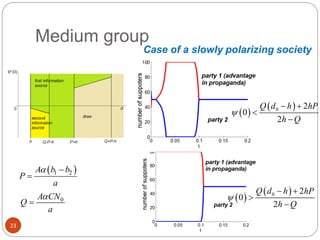
Medium group
23
 
 0 2
0
2
Q d h hP
h Q

 


 1 2A b b
P
a
 

0A CN
Q
a

  
 0 2
0
2
Q d h hP
h Q

 


Case of a slowly polarizing society
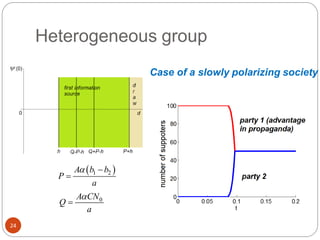
Heterogeneous group
24
 1 2A b b
P
a
 

0A CN
Q
a


Case of a slowly polarizing society
Thank you for your attention!
Proncheva Olga
Olga.proncheva@gmail.com
25

AINL 2016: Proncheva

  • 1.
    A. Mikhailov1 A. Petrov1 O.Proncheva1,2 1Keldysh Institute of Applied Mathematics (RAS) 2Moscow Institute of Physics and Technology (SU) Mathematical modeling of information processes AINL FRUCT: Artificial Intelligence and Natural Language Conference
  • 2.
     The weaponof criticism cannot, of course, replace criticism of the weapon, material force must be overthrown by material force; but theory also becomes a material force as soon as it has gripped the masses. Marx, A Contribution to the Critique of Hegel’s Philosophy of Right (1844)  A newspaper is not only a collective propagandist and collective agitator, but also a collective organiser. Lenin, Where To Begin (1901) 2
  • 3.
    Information 3  Information isnot entropy, information is not uncertainty! Thomas D. Schneider  Information is a measure of the decrease of uncertainty. Claude Shannon  Information is information, not matter or energy. Norbert Wiener
  • 4.
    Society in theinformation field 4 The vertical (centralized) flows of information influence Horizontal (interpersonal, networking) flows of information influence The combination of these flows determines the dynamics of information dissemination in society Conceptual framework
  • 5.
    Sociological argument aboutinformation dissemination through mass-media and interpersonal communication 5  The Rwandan genocide, known officially as the genocide against the Tutsi, was a genocidal mass slaughter of Tutsi in Rwanda by members of the Hutu majority government. Empirical facts:  The broadcasts increased militia violence not only directly by influencing behavior in villages with radio reception, but also indirectly by increasing participation in neighboring villages.  Spillovers are estimated to have caused more militia violence than the direct effects. (D. Yanagizawa-Drott, Propaganda and conflict: evidence from the Rwandan Genocide» (2014))
  • 6.
    Basic model ofinformation attack - the number of spreaders - external persuasion - internal persuasion - size of a group Information dissemination without warfare   0 dN N N N dt     (Mikhailov A.P., Klusov N.V., 2002)   0 0N N       0 0 0 0 exp exp N t N N N t N              6   0N ( )N t Maximum agiotage: 0 1 2 gN N         
  • 7.
    Information dissemination without warfare 7 adoptionof the information with forgetting   0 dX X N X X dt       incomplete coverage of society by the media two-steps information perception        1 2 dX X Y N X dt dY X Y N Y dt                    0 2 dx X N X x dt dX x X dt              
  • 8.
    Adoption of theinformation with forgetting 8   2 0 0 04 2 s N N N N                 Steady state: The condition for maximum agiotage 0 0 , gN N N      
  • 9.
    Incomplete coverage ofsociety by the media 9 Blue line– use mass-media Purple line– don’t use mass media
  • 10.
    Two-steps information perception 10 redline - the number of spreaders blue line - the number of pre-spreaders Successive individuals transformation: ignorants→pre-spreaders→spreaders
  • 11.
    Information dissemination without warfare 11 (MikhailovA.P., Petrov A.P., Marevtseva N.A., Tretiakova I.V., 2014)             1 1 2 1 1 1 1 1 2 1 2 2 2 2 2 2 1 1 1 2 1 2 1 2 2 2 2 2 dx X X N X x x X dt dx X X N X x x X dt dX x X X X dt dX X X x X dt                                         
  • 12.
    Information dissemination under warfare Thenecessary and sufficient condition of the victory I1 over I2 12 1 2 1 0 2 0 1 2 ln(1 ) ln(1 ) 2 2 N N                1 1 0 2 2 0 dX X N X Y dt dY Y N X Y dt                 0N X Y 1 1,  2 2,  (Mikhailov A.P., Marevtseva N.A., 2011)
  • 13.
    The model ofinformation warfare with three additional factors 13  2 1 2 1 2 1 2 dX x X X X dt       1 1 2 2 1 2 2 1 dY y Y Y Y dt        2 2 2 1 2 2 2 dY y Y Y Y dt        1 1 1 1 2 1 1 1 1 1 1 1 1 12 dx X X N X Y x y X x dt               2 1 1 2 2 2 2 2 2 1 2 1 22 dx X X N X Y x y X x dt              1 2 2 1 2 1 1 1 1 1 2 1 2 12 dy Y Y N X Y x y Y x dt               2 2 1 2 2 2 2 2 2 2 2 2 22 dy Y Y N X Y x y Y y dt             1 1 1 1 1 2 1 1 dX x X X X dt      
  • 14.
    14 Group 1 (accessiblefor mass-media ) Group 2 (inaccessible for mass-media) Strong propaganda VS virality Intensity of forgetting γ is small 0 1 2 3 4 5 0 20 40 60 80 100 X1(t),Y1(t) t 0 1 2 3 4 5 0 10 20 30 40 X2(t),Y2(t) t Blue line - information source 1 (propaganda) Red line - information source 2 (virality)
  • 15.
    Group 1 (accessiblefor mass-media ) Group 2 (inaccessible for mass-media) 15 Intensity of forgetting γ is large Blue line - information source 1 (propaganda) Red line - information source 2 (virality) 0 20 40 60 80 100 0 20 40 60 80 100 X1(t),Y1(t) t 0 5 10 15 20 0 10 20 30 40 50 X2(t),Y2(t) t Strong propaganda VS virality
  • 16.
    16       1 2 dX t X N X Y dt dY Y N X Y dt                     * 1 1 * 1 , ; , 0,1,2,3... , ; sw sw t iT iT t i h t iT t iT T             Periodic destabilizing effect on information warfare 0 5 10 15 0 20 40 60 Y,X t
  • 17.
    Periodic destabilizing effecton information warfare 17        1 2 dX t X N X Y X dt dY Y N X Y Y dt                         * 1 1 * 1 , ; , 0,1,2,3... , ; sw sw t iT iT t i h t iT t iT T             (Mikhailov A.P., Petrov A.P., Proncheva O.G., Pronchev G.B.., Marevtseva N.A., 2016)
  • 18.
    Rashevsky's neurological scheme 18 •L,B - feed braking elements • S – external incentives • R - reaction • ε, j – generated incentives • w - internal incentives (Rashevsky N., 1933)
  • 19.
    A model ofmaking choices by individuals during information warfare in a society 19 (Petrov A.P., Maslov A.I., Tsaplin N.A., 2015)  X(t) – the number of first party  ϕ – internal propensity for response selection  N(ϕ) – distribution of individuals  N0 – size of society  ψ - shift of incentives (defined social environment) toward the first party support  b1 и b2 - propaganda first and second party, respectively           0 1 2 0 2 , 0 t d A C N d N b b a X N d dt                                      t X t N d       
  • 20.
    Effect of SocialPolarization 20   0 0, , 4 0, d h N N d h d h h d h                 Sociological sense: •society is divided into two groups, each of which has a propensity to support "their" party •d parameter characterizes the degree of social polarization (how radical is each group) •h parameter characterizes the degree of fragmentation of each group
  • 21.
    Equilibrium states  Considera case  There are from 1 to 5 equilibrium states (depending on initial conditions)  Stable equilibrium states: 21 o 1 – party 2 wins o 3 – draw o 5 – party 1 wins 1 2b b
  • 22.
    Homogeneous group 22 Case ofa slowly polarizing society    0 2 0 2 Q d h hP h Q         0 2 0 2 Q d h hP h Q       1 2A b b P a    0A CN Q a  
  • 23.
    Medium group 23   0 2 0 2 Q d h hP h Q       1 2A b b P a    0A CN Q a      0 2 0 2 Q d h hP h Q      Case of a slowly polarizing society
  • 24.
    Heterogeneous group 24  12A b b P a    0A CN Q a   Case of a slowly polarizing society
  • 25.
    Thank you foryour attention! Proncheva Olga Olga.proncheva@gmail.com 25