Data Augmentation Method for the
Image Sentiment
Analysis
Alexander Rakovsky1, Arseny Moskvichev2, Andrey Filchenkov1
1ITMO University
Saint Petersburg, Russia
2Saint Petersburg State University
Saint Petersburg, Russia
str1t3r@gmail.com, arseny.moskvichev@gmail.com, afilchenkov@corp.mail.ru
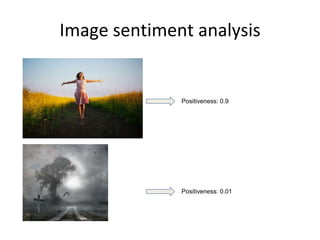
Image sentiment analysis
Positiveness: 0.9
Positiveness: 0.01
Why is it important?
Two words:
Social networks
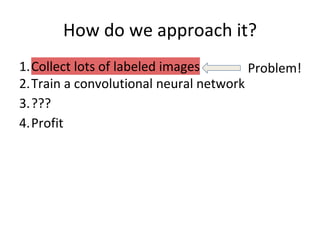
How do we approach it?
1.Collect lots of labeled images
2.Train a convolutional neural network
3.???
4.Profit
How do we approach it?
1.Collect lots of labeled images
2.Train a convolutional neural network
3.???
4.Profit
Problem!
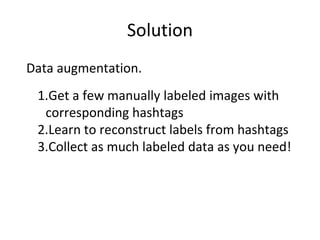
Solution
Data augmentation.
1.Get a few manually labeled images with
corresponding hashtags
2.Learn to reconstruct labels from hashtags
3.Collect as much labeled data as you need!
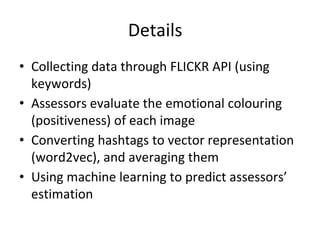
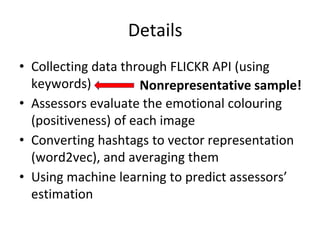
Details
• Collecting data through FLICKR API (using
keywords)
• Assessors evaluate the emotional colouring
(positiveness) of each image
• Converting hashtags to vector representation
(word2vec), and averaging them
• Using machine learning to predict assessors’
estimation
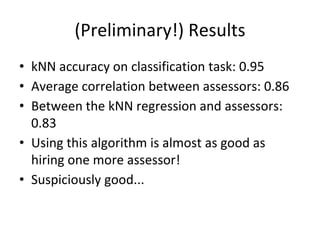
(Preliminary!) Results
• kNN accuracy on classification task: 0.95
• Average correlation between assessors: 0.86
• Between the kNN regression and assessors:
0.83
• Using this algorithm is almost as good as
hiring one more assessor!
• Suspiciously good...
Details
• Collecting data through FLICKR API (using
keywords)
• Assessors evaluate the emotional colouring
(positiveness) of each image
• Converting hashtags to vector representation
(word2vec), and averaging them
• Using machine learning to predict assessors’
estimation
Nonrepresentative sample!
Pros
• Easy to use (no word preprocessing)
• Good results* (compared to dictionary -
based solutions)
Cons
• Needs pre-training and an initial manually
labeled sample
Conclusions
• The proposed method affords a simple and
efficient hashtag-based data augmentation
solution for image sentiment analysis.
• More work is to be done to estimate the
method’s performance on a general set of
images.
Thank you!

AINL 2016: Moskvichev

  • 1.
    Data Augmentation Methodfor the Image Sentiment Analysis Alexander Rakovsky1, Arseny Moskvichev2, Andrey Filchenkov1 1ITMO University Saint Petersburg, Russia 2Saint Petersburg State University Saint Petersburg, Russia str1t3r@gmail.com, arseny.moskvichev@gmail.com, afilchenkov@corp.mail.ru
  • 2.
  • 3.
    Why is itimportant? Two words: Social networks
  • 4.
    How do weapproach it? 1.Collect lots of labeled images 2.Train a convolutional neural network 3.??? 4.Profit
  • 5.
    How do weapproach it? 1.Collect lots of labeled images 2.Train a convolutional neural network 3.??? 4.Profit Problem!
  • 6.
    Solution Data augmentation. 1.Get afew manually labeled images with corresponding hashtags 2.Learn to reconstruct labels from hashtags 3.Collect as much labeled data as you need!
  • 7.
    Details • Collecting datathrough FLICKR API (using keywords) • Assessors evaluate the emotional colouring (positiveness) of each image • Converting hashtags to vector representation (word2vec), and averaging them • Using machine learning to predict assessors’ estimation
  • 8.
    (Preliminary!) Results • kNNaccuracy on classification task: 0.95 • Average correlation between assessors: 0.86 • Between the kNN regression and assessors: 0.83 • Using this algorithm is almost as good as hiring one more assessor! • Suspiciously good...
  • 9.
    Details • Collecting datathrough FLICKR API (using keywords) • Assessors evaluate the emotional colouring (positiveness) of each image • Converting hashtags to vector representation (word2vec), and averaging them • Using machine learning to predict assessors’ estimation Nonrepresentative sample!
  • 10.
    Pros • Easy touse (no word preprocessing) • Good results* (compared to dictionary - based solutions)
  • 11.
    Cons • Needs pre-trainingand an initial manually labeled sample
  • 12.
    Conclusions • The proposedmethod affords a simple and efficient hashtag-based data augmentation solution for image sentiment analysis. • More work is to be done to estimate the method’s performance on a general set of images.
  • 13.