Presented January 16, 2013


        What does the Obama
       Administration Records
     Management Directive Tell Us?


      Listen to the replay.


In association with:                   Presented by:
About AIIM


     AIIM is the Global Community of
        Information Professionals

    We provide the education, research,
            and certification that
      information professionals need
           to manage and share
      information assets in an era of
    mobile, social, cloud, and big data.


            Learn more about AIIM at
                 www.aiim.org


In association with:                       Presented by:
About AIIM


            www.aiim.org/research       Visit AIIM’s video library at
                                          www.aiim.org/videos

                                          With more than 100
          Research/Industry watch       snapshots on all things
                                       Information Management


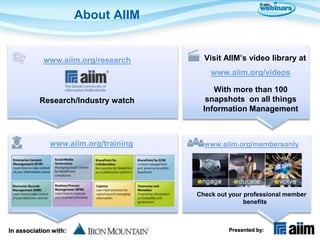
              www.aiim.org/training     www.aiim.org/membersonly


                                      Check out your professional member
                                                     benefits


In association with:                           Presented by:
Register today at aiimconference.com
Secure Your Success
   Become a


     Demonstrate your ability to address
  and manage today’s information challenges


              www.aiim.org/certification
Follow AIIM on
                                         Bryant Duhon – @bduhon
                       #aiim             Jesse Wilkins – @jessewilkins

                #aiimwebinar             Nick Inglis – @nickinglis
                                         Dave Jones – @instinctivedave
                   #aiim13
                                         Doug Miles – @dougmiles00
       AIIM Community – @aiimcmty        Theresa Resek – @tmresek
       AIIM Info – @aiiminfo             Beth Mayhew – @bethmayhew
       John Mancini – @jmancini77
                                                   #ecm
       Atle Skjekkeland – @skjekkeland
       Laurence Hart – @piewords                 #bigdata

       Peggy Winton – @pwwinton                  #aiim13
       Betsy Fanning – @bfanning


In association with:                                 Presented by:
AIIM Presents:


                  What does the Obama Administration
                 Records Management Directive Tell Us?


        Host: Theresa Resek – Director, AIIM Webinars

        John Mancini – President, AIIM

        Sue Trombley – Managing Director, Professional Services, Iron Mountain


In association with:                                        Presented by:
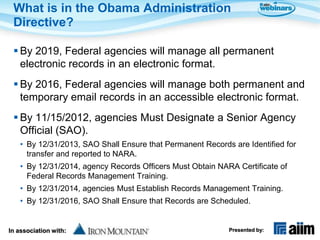
What is in the Obama Administration
 Directive?

  By 2019, Federal agencies will manage all permanent
   electronic records in an electronic format.
  By 2016, Federal agencies will manage both permanent and
   temporary email records in an accessible electronic format.
  By 11/15/2012, agencies Must Designate a Senior Agency
   Official (SAO).
    • By 12/31/2013, SAO Shall Ensure that Permanent Records are Identified for
      transfer and reported to NARA.
    • By 12/31/2014, agency Records Officers Must Obtain NARA Certificate of
      Federal Records Management Training.
    • By 12/31/2014, agencies Must Establish Records Management Training.
    • By 12/31/2016, SAO Shall Ensure that Records are Scheduled.


In association with:                                        Presented by:
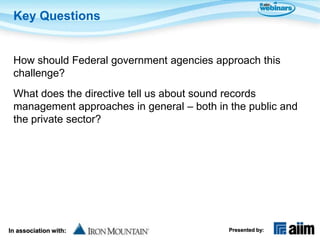
Key Questions


 How should Federal government agencies approach this
 challenge?
 What does the directive tell us about sound records
 management approaches in general – both in the public and
 the private sector?


In association with:                        Presented by:
Directive: Sound Approaches


  Demands that RIM leadership is at the highest level of
   government
  Establishes an occupational series to formalize roles and
   responsibilities
  Requires establishment of formal training program
  Requires certification of records officers


In association with:                            Presented by:
Directive: Sound Approaches


  Dictates that email must be managed in a compliant
   manner
  Requires an understanding of the Cloud and other
   technologies to enable records and information
   management
  AND electronic records will be the official records –
   even for permanent records to ensure
   transparency, efficiency, and accountability


In association with:                           Presented by:
A Road Map:
 not just for Federal agencies, but for any organization

 1. Educate the organization about the basic process for
    capturing records
 2. Conduct an information and records inventory
 3. Create a structure for effective governance
 4. Understand the unique challenges of email and social
    content
 5. Decide on a strategy for back-file paper conversion
 6. Develop a communication, training and change
    management plan


In association with:                          Presented by:
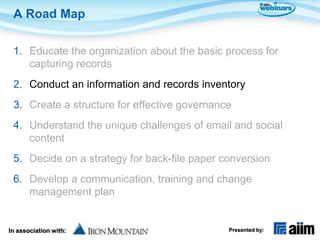
A Road Map

 1. Educate the organization about the basic process for
    capturing records
 2. Conduct an information and records inventory
 3. Create a structure for effective governance
 4. Understand the unique challenges of email and social
    content
 5. Decide on a strategy for back-file paper conversion
 6. Develop a communication, training and change
    management plan


In association with:                          Presented by:
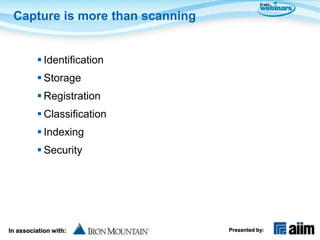
Capture is more than scanning


          Identification
          Storage
          Registration
          Classification
          Indexing
          Security


In association with:             Presented by:
A Road Map

 1. Educate the organization about the basic process for
    capturing records
 2. Conduct an information and records inventory
 3. Create a structure for effective governance
 4. Understand the unique challenges of email and social
    content
 5. Decide on a strategy for back-file paper conversion
 6. Develop a communication, training and change
    management plan


In association with:                          Presented by:
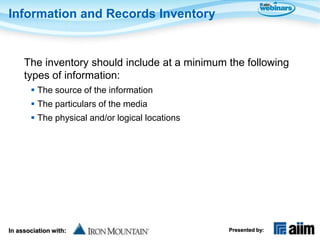
Information and Records Inventory


     The inventory should include at a minimum the following
     types of information:
        The source of the information
        The particulars of the media
        The physical and/or logical locations


In association with:                             Presented by:
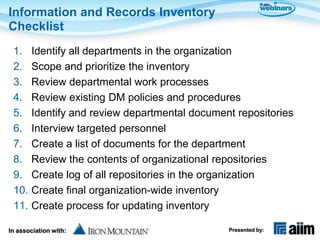
Information and Records Inventory
Checklist
 1.    Identify all departments in the organization
 2.    Scope and prioritize the inventory
 3.    Review departmental work processes
 4.    Review existing DM policies and procedures
 5.    Identify and review departmental document repositories
 6.    Interview targeted personnel
 7.    Create a list of documents for the department
 8.    Review the contents of organizational repositories
 9.    Create log of all repositories in the organization
 10.   Create final organization-wide inventory
 11.   Create process for updating inventory

In association with:                           Presented by:
A Road Map

 1. Educate the organization about the basic process for
    capturing records
 2. Conduct an information and records inventory
 3. Create a structure for effective governance
 4. Understand the unique challenges of email and social
    content
 5. Decide on a strategy for back-file paper conversion
 6. Develop a communication, training and change
    management plan


In association with:                          Presented by:
Information Governance


      Classification schemes
      Metadata models and thesauri
      Records retention and disposition schedule
      Security classification scheme
      Policy and procedures
      Training materials


In association with:                           Presented by:
A Road Map

 1. Educate the organization about the basic process for
    capturing records
 2. Conduct an information and records inventory
 3. Create a structure for effective governance
 4. Understand the unique challenges of email and social
    content
 5. Decide on a strategy for back-file paper conversion
 6. Develop a communication, training and change
    management plan


In association with:                          Presented by:
Unique Challenges of Email
   – and Social Content

    The sheer volume involved
    The informality with which they are created and forwarded
    The ease with which documents can be attached
    The metadata is often just as valuable as the content itself –
     and is lost when email is “preserved” in paper form
    More than most forms of electronic information, “backup” is
     confused with “archive”


In association with:                            Presented by:
A Road Map

 1. Educate the organization about the basic process for
    capturing records
 2. Conduct an information and records inventory
 3. Create a structure for effective governance
 4. Understand the unique challenges of email and social
    content
 5. Decide on a strategy for back-file paper conversion
 6. Develop a communication, training and change
    management plan


In association with:                          Presented by:
Strategy for Back-File Conversion


      Understand that records can be found everywhere
      Understand that for the foreseeable future, records
       management will be a hybrid task
      Understand that back-file conversion can be a thankless
       task


In association with:                             Presented by:
A Road Map

 1. Educate the organization about the basic process for
    capturing records
 2. Conduct an information and records inventory
 3. Create a structure for effective governance
 4. Understand the unique challenges of email and social
    content
 5. Decide on a strategy for back-file paper conversion
 6. Develop a communication, training and change
    management plan


In association with:                          Presented by:
Checklist – Communication, Training,
 and Change Management Plan

  Make sure of support of top management – both at the
   launch of a project and once the excitement is over
  Involve the users and process owners early and often
  Assume that what is hard is soft and what is soft is hard
  Use personas to understand different stakeholder needs
  Be fanatical and internal PR and communications. Treat
   communications like you would for external audiences
  Understand that training doesn’t only occur at launch
  Use AIIM training resources – ERM and CIP

In association with:                            Presented by:
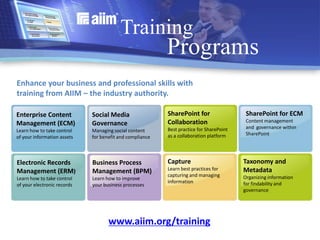
Training
                                                          Programs
Enhance your business and professional skills with
training from AIIM – the industry authority.

Enterprise Content           Social Media                 SharePoint for                  SharePoint for ECM
                                                          Collaboration                   Content management
Management (ECM)             Governance
                                                          Best practice for SharePoint    and governance within
Learn how to take control    Managing social content
                                                          as a collaboration platform     SharePoint
of your information assets   for benefit and compliance


Electronic Records           Business Process             Capture                        Taxonomy and
                                                          Learn best practices for       Metadata
Management (ERM)             Management (BPM)
                                                          capturing and managing         Organizing information
Learn how to take control    Learn how to improve
                                                          information                    for findability and
of your electronic records   your business processes
                                                                                         governance


                                    www.aiim.org/training
Secure Your Success
   Become a


     Demonstrate your ability to address
  and manage today’s information challenges


              www.aiim.org/certification
Conclusion – Next Steps

 The Directive reinforces that:
  Records and Information Management is strategic, not just
   tactical
  Collaboration with key stakeholders is a fundamental
   requirement
  People, process, and technology are partners in success
  Change management cannot be ignored


In association with:                    Presented by:
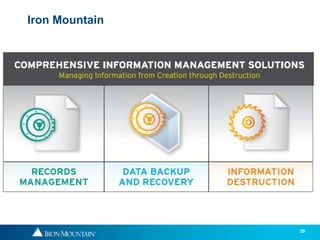
Iron Mountain


                29
Questions?


In association with:        Presented by:
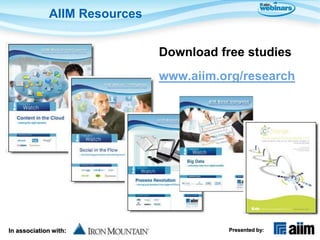
AIIM Resources


                               Download free studies
                               www.aiim.org/research


In association with:                      Presented by:
Survey


               This survey will open in a new window.
                            (or click here)


                  Tell us how we did today,
       and offer suggestions for topics of future events.


In association with:                          Presented by:
Upcoming Webinars


              February 13th
              The Rise of the Information Professional: Why IT Will Never Be the Same


              And more webinars coming in 2013…


                                   Register Today at
                       www.aiim.org/webinars
                   View our library of Webinars OnDemand
                www.aiim.org/WebinarsOnDemand


In association with:                                                 Presented by:

What does the Obama Administration Records Management Directive Tell Us?

  • 1.
    Presented January 16,2013 What does the Obama Administration Records Management Directive Tell Us? Listen to the replay. In association with: Presented by:
  • 2.
    About AIIM AIIM is the Global Community of Information Professionals We provide the education, research, and certification that information professionals need to manage and share information assets in an era of mobile, social, cloud, and big data. Learn more about AIIM at www.aiim.org In association with: Presented by:
  • 3.
    About AIIM www.aiim.org/research Visit AIIM’s video library at www.aiim.org/videos With more than 100 Research/Industry watch snapshots on all things Information Management www.aiim.org/training www.aiim.org/membersonly Check out your professional member benefits In association with: Presented by:
  • 4.
    Register today ataiimconference.com
  • 5.
    Secure Your Success Become a Demonstrate your ability to address and manage today’s information challenges www.aiim.org/certification
  • 6.
    Follow AIIM on Bryant Duhon – @bduhon #aiim Jesse Wilkins – @jessewilkins #aiimwebinar Nick Inglis – @nickinglis Dave Jones – @instinctivedave #aiim13 Doug Miles – @dougmiles00 AIIM Community – @aiimcmty Theresa Resek – @tmresek AIIM Info – @aiiminfo Beth Mayhew – @bethmayhew John Mancini – @jmancini77 #ecm Atle Skjekkeland – @skjekkeland Laurence Hart – @piewords #bigdata Peggy Winton – @pwwinton #aiim13 Betsy Fanning – @bfanning In association with: Presented by:
  • 7.
    AIIM Presents: What does the Obama Administration Records Management Directive Tell Us? Host: Theresa Resek – Director, AIIM Webinars John Mancini – President, AIIM Sue Trombley – Managing Director, Professional Services, Iron Mountain In association with: Presented by:
  • 8.
    What is inthe Obama Administration Directive?  By 2019, Federal agencies will manage all permanent electronic records in an electronic format.  By 2016, Federal agencies will manage both permanent and temporary email records in an accessible electronic format.  By 11/15/2012, agencies Must Designate a Senior Agency Official (SAO). • By 12/31/2013, SAO Shall Ensure that Permanent Records are Identified for transfer and reported to NARA. • By 12/31/2014, agency Records Officers Must Obtain NARA Certificate of Federal Records Management Training. • By 12/31/2014, agencies Must Establish Records Management Training. • By 12/31/2016, SAO Shall Ensure that Records are Scheduled. In association with: Presented by:
  • 9.
    Key Questions Howshould Federal government agencies approach this challenge? What does the directive tell us about sound records management approaches in general – both in the public and the private sector? In association with: Presented by:
  • 10.
    Directive: Sound Approaches  Demands that RIM leadership is at the highest level of government  Establishes an occupational series to formalize roles and responsibilities  Requires establishment of formal training program  Requires certification of records officers In association with: Presented by:
  • 11.
    Directive: Sound Approaches  Dictates that email must be managed in a compliant manner  Requires an understanding of the Cloud and other technologies to enable records and information management  AND electronic records will be the official records – even for permanent records to ensure transparency, efficiency, and accountability In association with: Presented by:
  • 12.
    A Road Map: not just for Federal agencies, but for any organization 1. Educate the organization about the basic process for capturing records 2. Conduct an information and records inventory 3. Create a structure for effective governance 4. Understand the unique challenges of email and social content 5. Decide on a strategy for back-file paper conversion 6. Develop a communication, training and change management plan In association with: Presented by:
  • 13.
    A Road Map 1. Educate the organization about the basic process for capturing records 2. Conduct an information and records inventory 3. Create a structure for effective governance 4. Understand the unique challenges of email and social content 5. Decide on a strategy for back-file paper conversion 6. Develop a communication, training and change management plan In association with: Presented by:
  • 14.
    Capture is morethan scanning  Identification  Storage  Registration  Classification  Indexing  Security In association with: Presented by:
  • 15.
    A Road Map 1. Educate the organization about the basic process for capturing records 2. Conduct an information and records inventory 3. Create a structure for effective governance 4. Understand the unique challenges of email and social content 5. Decide on a strategy for back-file paper conversion 6. Develop a communication, training and change management plan In association with: Presented by:
  • 16.
    Information and RecordsInventory The inventory should include at a minimum the following types of information:  The source of the information  The particulars of the media  The physical and/or logical locations In association with: Presented by:
  • 17.
    Information and RecordsInventory Checklist 1. Identify all departments in the organization 2. Scope and prioritize the inventory 3. Review departmental work processes 4. Review existing DM policies and procedures 5. Identify and review departmental document repositories 6. Interview targeted personnel 7. Create a list of documents for the department 8. Review the contents of organizational repositories 9. Create log of all repositories in the organization 10. Create final organization-wide inventory 11. Create process for updating inventory In association with: Presented by:
  • 18.
    A Road Map 1. Educate the organization about the basic process for capturing records 2. Conduct an information and records inventory 3. Create a structure for effective governance 4. Understand the unique challenges of email and social content 5. Decide on a strategy for back-file paper conversion 6. Develop a communication, training and change management plan In association with: Presented by:
  • 19.
    Information Governance  Classification schemes  Metadata models and thesauri  Records retention and disposition schedule  Security classification scheme  Policy and procedures  Training materials In association with: Presented by:
  • 20.
    A Road Map 1. Educate the organization about the basic process for capturing records 2. Conduct an information and records inventory 3. Create a structure for effective governance 4. Understand the unique challenges of email and social content 5. Decide on a strategy for back-file paper conversion 6. Develop a communication, training and change management plan In association with: Presented by:
  • 21.
    Unique Challenges ofEmail – and Social Content  The sheer volume involved  The informality with which they are created and forwarded  The ease with which documents can be attached  The metadata is often just as valuable as the content itself – and is lost when email is “preserved” in paper form  More than most forms of electronic information, “backup” is confused with “archive” In association with: Presented by:
  • 22.
    A Road Map 1. Educate the organization about the basic process for capturing records 2. Conduct an information and records inventory 3. Create a structure for effective governance 4. Understand the unique challenges of email and social content 5. Decide on a strategy for back-file paper conversion 6. Develop a communication, training and change management plan In association with: Presented by:
  • 23.
    Strategy for Back-FileConversion  Understand that records can be found everywhere  Understand that for the foreseeable future, records management will be a hybrid task  Understand that back-file conversion can be a thankless task In association with: Presented by:
  • 24.
    A Road Map 1. Educate the organization about the basic process for capturing records 2. Conduct an information and records inventory 3. Create a structure for effective governance 4. Understand the unique challenges of email and social content 5. Decide on a strategy for back-file paper conversion 6. Develop a communication, training and change management plan In association with: Presented by:
  • 25.
    Checklist – Communication,Training, and Change Management Plan  Make sure of support of top management – both at the launch of a project and once the excitement is over  Involve the users and process owners early and often  Assume that what is hard is soft and what is soft is hard  Use personas to understand different stakeholder needs  Be fanatical and internal PR and communications. Treat communications like you would for external audiences  Understand that training doesn’t only occur at launch  Use AIIM training resources – ERM and CIP In association with: Presented by:
  • 26.
    Training Programs Enhance your business and professional skills with training from AIIM – the industry authority. Enterprise Content Social Media SharePoint for SharePoint for ECM Collaboration Content management Management (ECM) Governance Best practice for SharePoint and governance within Learn how to take control Managing social content as a collaboration platform SharePoint of your information assets for benefit and compliance Electronic Records Business Process Capture Taxonomy and Learn best practices for Metadata Management (ERM) Management (BPM) capturing and managing Organizing information Learn how to take control Learn how to improve information for findability and of your electronic records your business processes governance www.aiim.org/training
  • 27.
    Secure Your Success Become a Demonstrate your ability to address and manage today’s information challenges www.aiim.org/certification
  • 28.
    Conclusion – NextSteps The Directive reinforces that:  Records and Information Management is strategic, not just tactical  Collaboration with key stakeholders is a fundamental requirement  People, process, and technology are partners in success  Change management cannot be ignored In association with: Presented by:
  • 29.
  • 30.
  • 31.
    AIIM Resources Download free studies www.aiim.org/research In association with: Presented by:
  • 32.
    Survey This survey will open in a new window. (or click here) Tell us how we did today, and offer suggestions for topics of future events. In association with: Presented by:
  • 33.
    Upcoming Webinars February 13th The Rise of the Information Professional: Why IT Will Never Be the Same And more webinars coming in 2013… Register Today at www.aiim.org/webinars View our library of Webinars OnDemand www.aiim.org/WebinarsOnDemand In association with: Presented by:

Editor's Notes

  • #11 Iron Mountain slide
  • #12 Iron Mountain slide
  • #15 The capture process for electronic records has a number of basic steps. The first step is to identify what records and other information should be captured. We will describe this process in further detail in the next section of this module. Next, we need to determine where to store and manage those records that are captured. In smaller organisations this may be as simple as providing a folder on a network shared drive, though this is certainly not the ideal. For larger or more mature organisations, this will often be an electronic records management system (ERMS) or enterprise content management system (ECMS). It could even be a database management system, particularly for structured records. More formal recordkeeping systems will have a process for registering records. This provides proof that the record actually was captured, generally in the form of a unique, system-provided identifier. Next the record will most likely be classified into a classification structure of some sort. The most common structures are hierarchical and reflect either the structure of the organisation, the structure of its work processes and functions, or some other approach such as client matters. This will assist with access to, and management of, the record within the system. We will discuss classification in much more detail in Modules 4, 5, and 6. Once the record is in the system, it will generally require some level of indexing to ensure it can be found and accessed later. This may include indexing the full text of the record for text-type information such as Microsoft Word, Adobe PDF, or OCR text. It will most likely also include some combination of automatically captured and manually created metadata. Finally, the record will be assigned some level of security. This will include both access controls , or who gets access to the record at all, as well as permissions, or what users can do with the record. For most records and most users, permissions will be limited to accessing and reading the record. We will discuss security in more detail later in the course.
  • #17 Why?Locate and describe organizational information holdingsIdentify obsolete or duplicate recordsIdentify vital and permanent recordsIdentify storage needsThe inventory should include at a minimum the following types of information: The source of the information – was it gathered from interviews and walkthroughs or through system records?Whether a particular piece of information exists in more than one format. rendition, or version, and if so, which one(s) are considered to be the copy of record. Only one should be the definitive record, but it is entirely possible during the inventory that several will be identified as such. This will be sorted out as part of the analysis. The particulars of the media – is it paper, microform, some other physical format such as core samples, physical media such as CDs, or digital? For electronic documents, the inventory should also capture file format and software characteristics – for example, Microsoft Word 2007 or Corel WordPerfect X4. And of course the physical and/or logical locations. CDs, paper, and other physical objects have physical locations; for purely digital files stored on magnetic media, the document’s physical location may be difficult to determine and so a logical location may make more sense. This will typically be a network shared drive, storage area network, network-attached storage device, or perhaps an email server.
  • #20 Records management instruments could include all of the following: Classification schemes, including file plans and formal taxonomiesMetadata models, thesauri, and data dictionariesRecords retention and disposition scheduleSecurity classification schemePolicy and proceduresAnd even training materials. In short, anything that can be used to provide that framework, document it, and assist users in complying with it, can be considered an instrument. And as we’ll see shortly, these instruments will need to be maintained as well.
  • #24 Understand that records can be found everywhere.Understand that for the foreseeable future, records management will be a hybrid task…Physical and electronicOn-prem and off-premBoxes and electronsUnderstand that backfile conversion can be…A thankless taskAn all-consuming taskSomething better left to experts