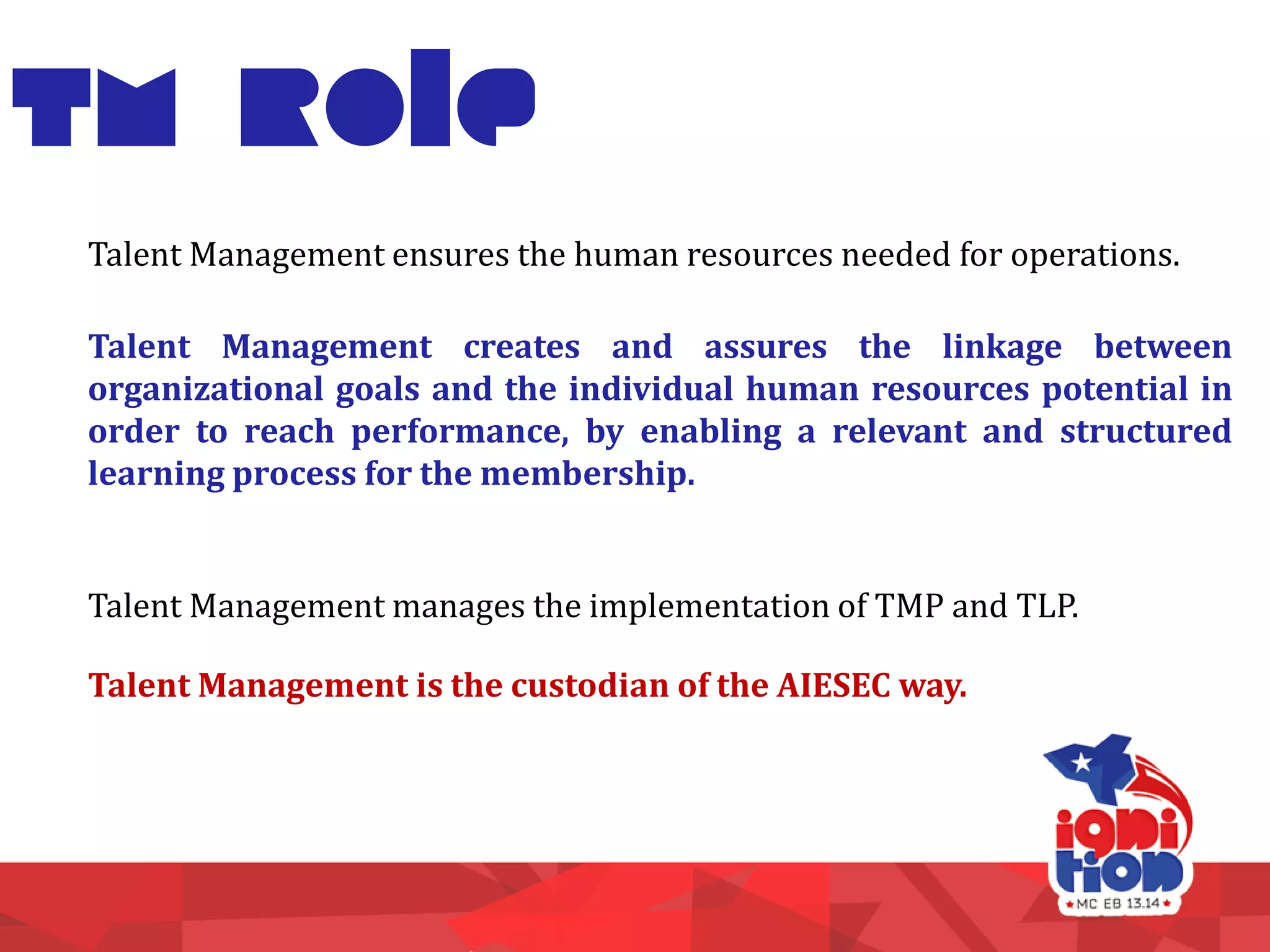
TM Role
Talent Management creates and assures the linkage between
organizational goals and the individual human resources potential in
order to reach performance, by enabling a relevant and structured
learning process for the membership.
Talent Management manages the implementation of TMP and TLP.
Talent Management ensures the human resources needed for operations.
Talent Management is the custodian of the AIESEC way.
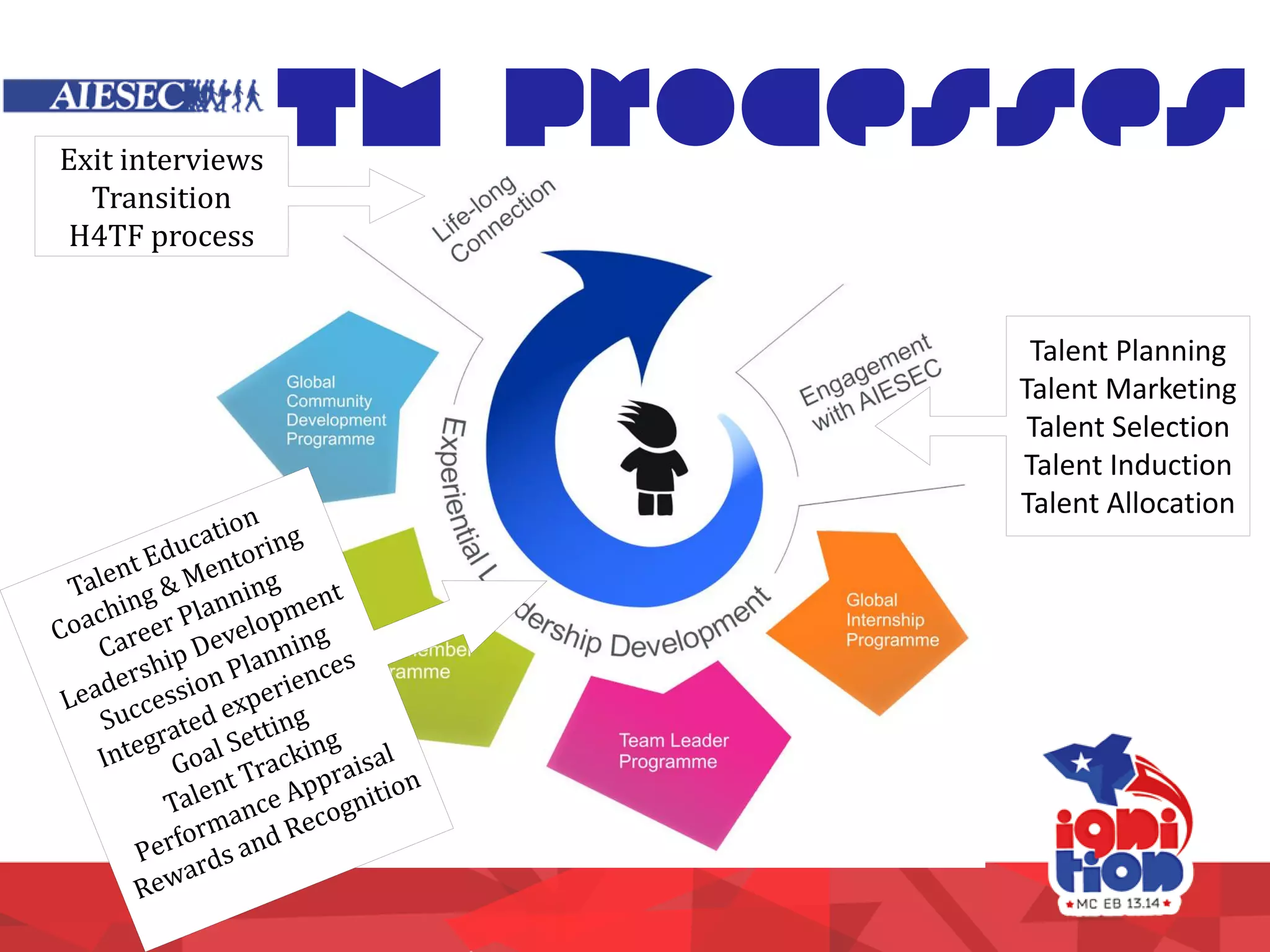
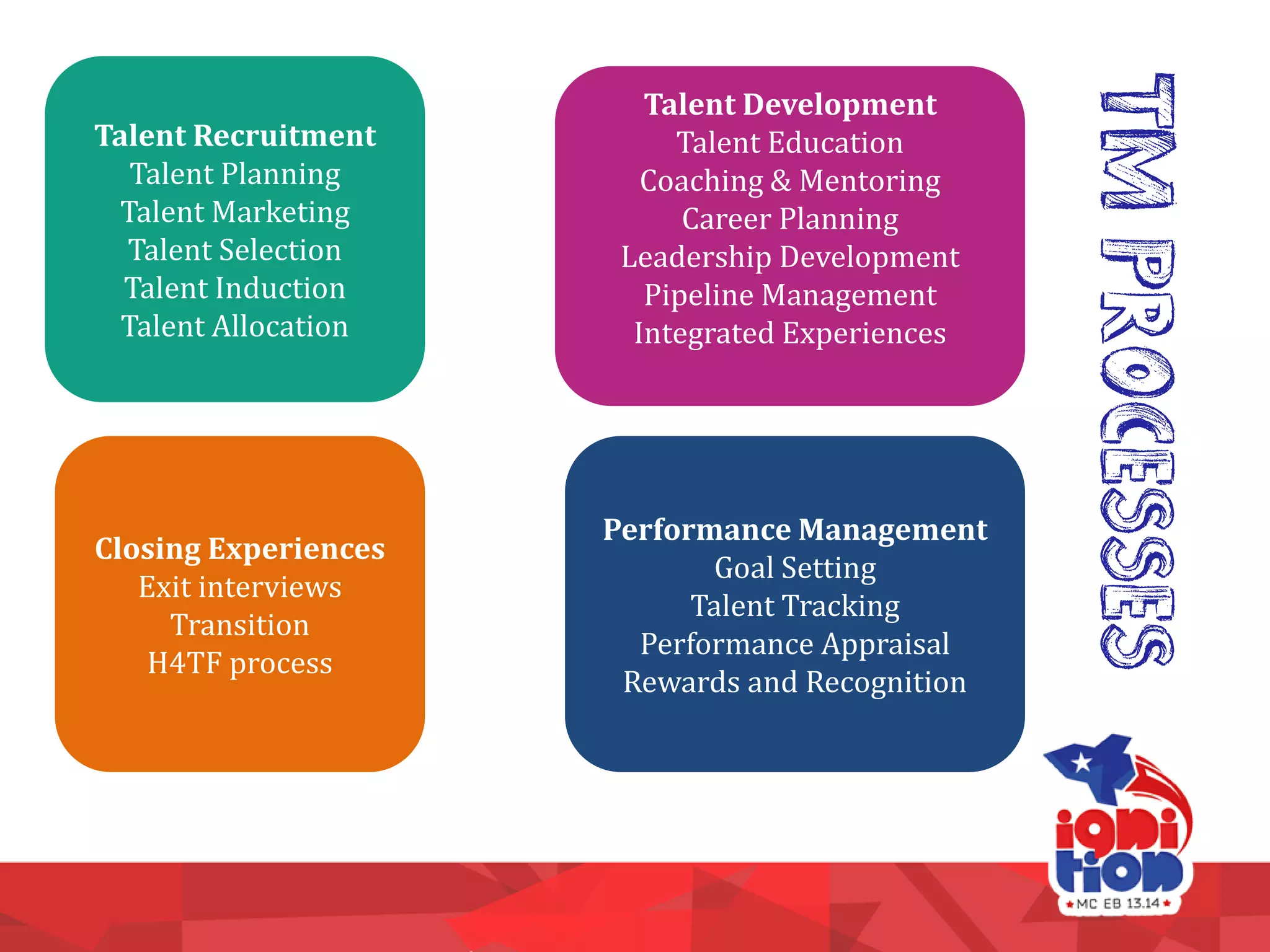
TM Processes
Talent Planning
Talent Marketing
Talent Selection
Talent Induction
Talent Allocation
Exit interviews
Transition
H4TF process
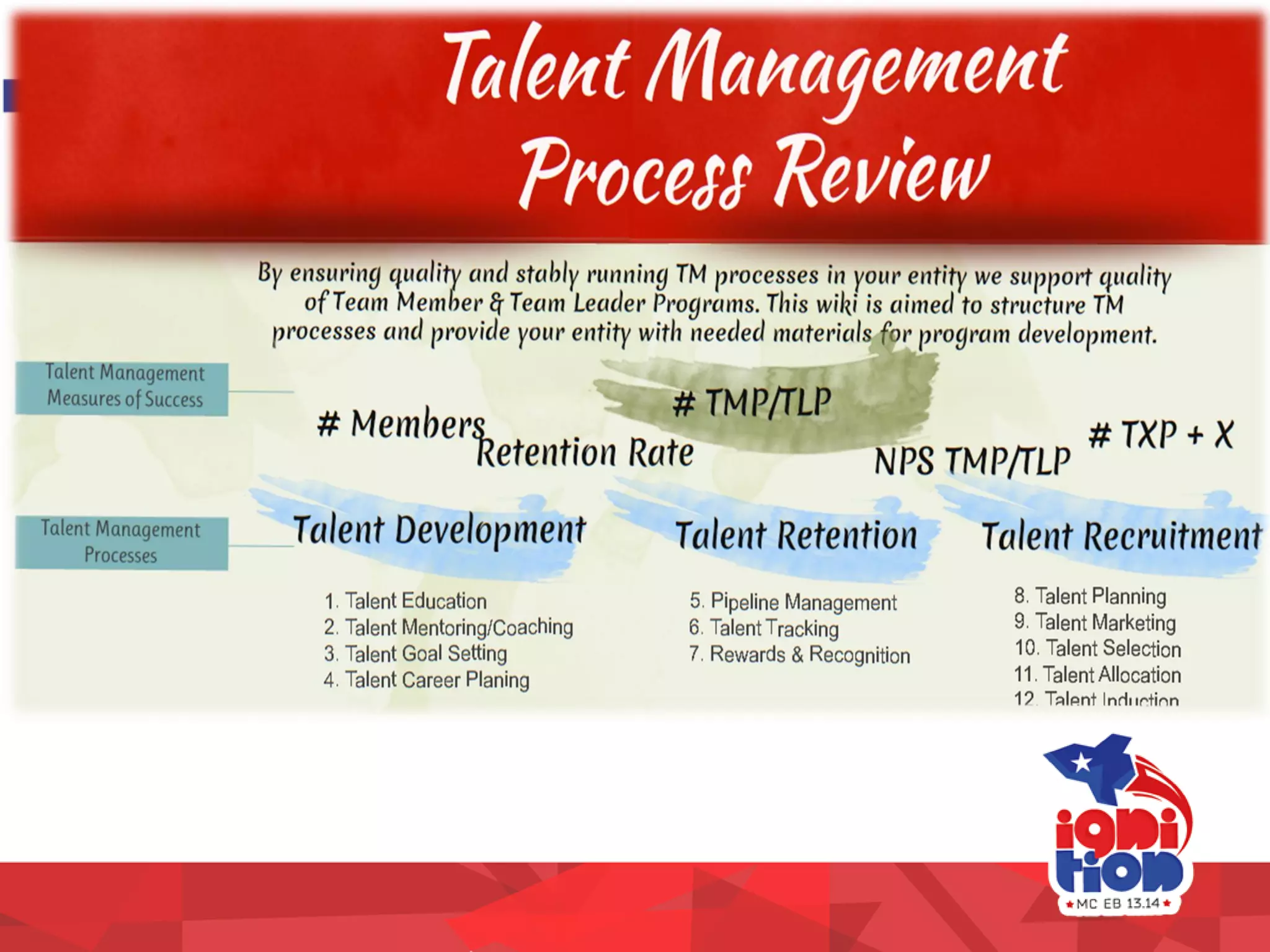
Talent Development
Talent Education
Coaching & Mentoring
Career Planning
Leadership Development
Pipeline Management
Integrated Experiences
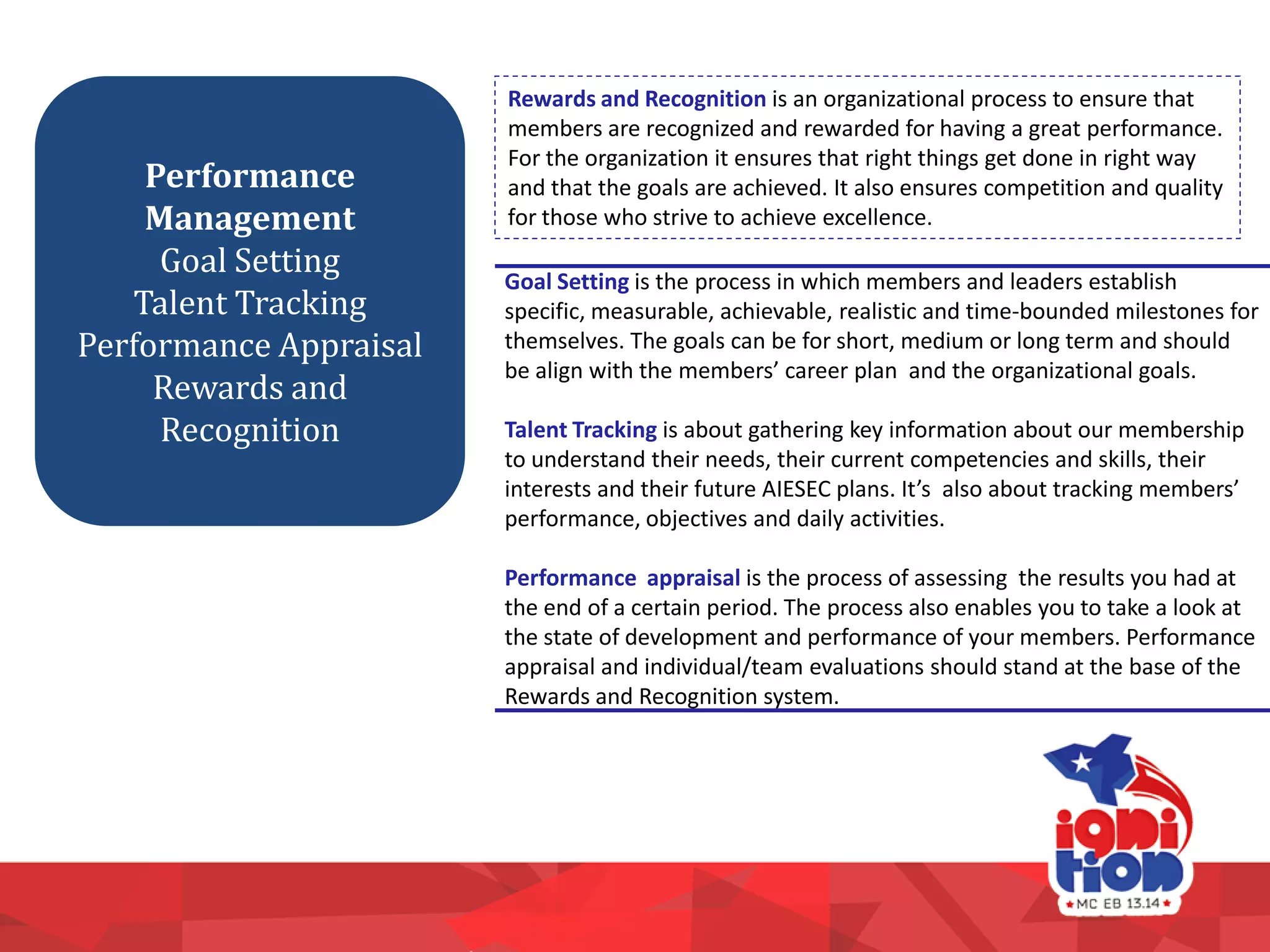
Performance Management
Goal Setting
Talent Tracking
Performance Appraisal
Rewards and Recognition
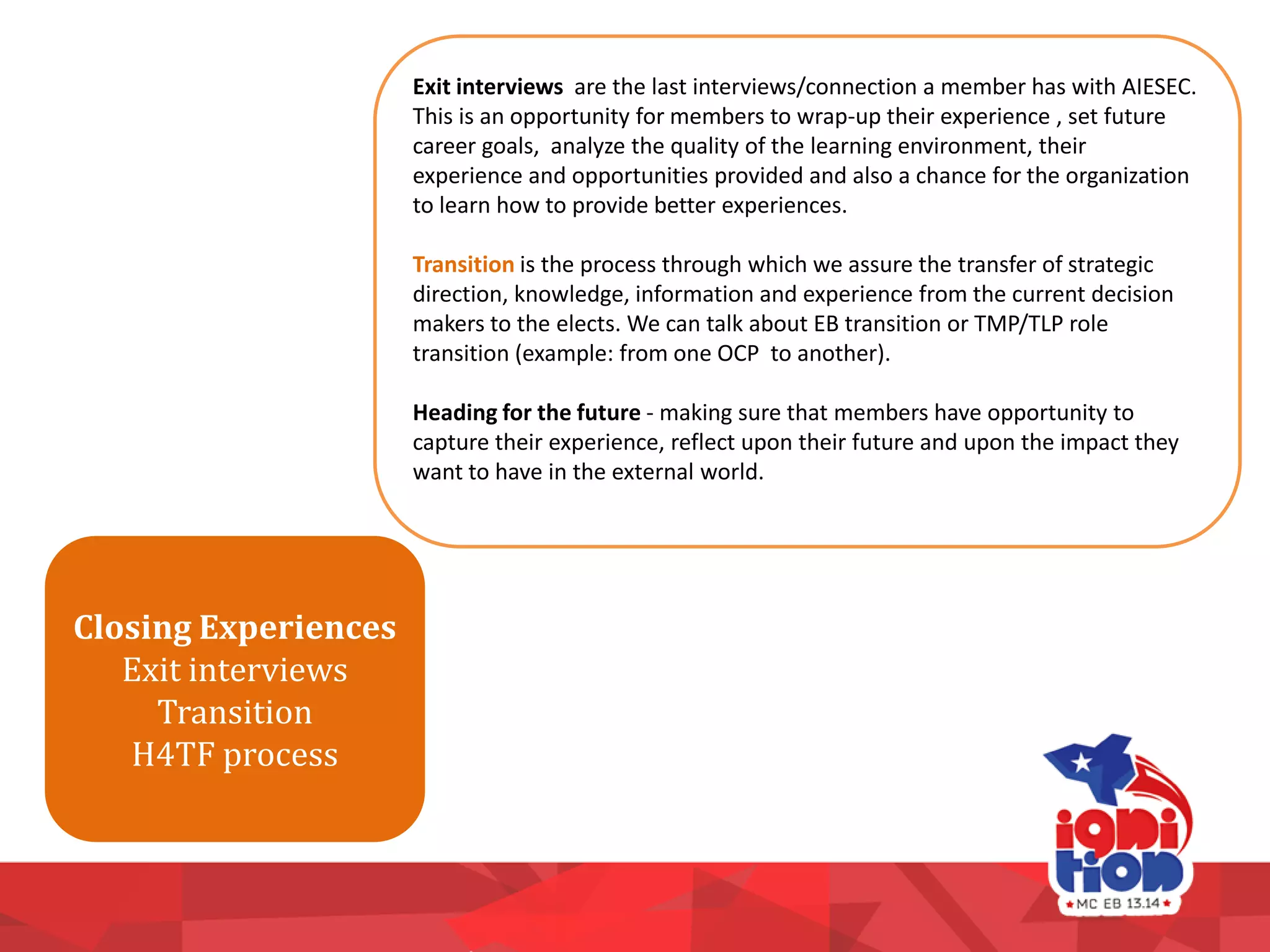
Closing Experiences
Exit interviews
Transition
H4TF process
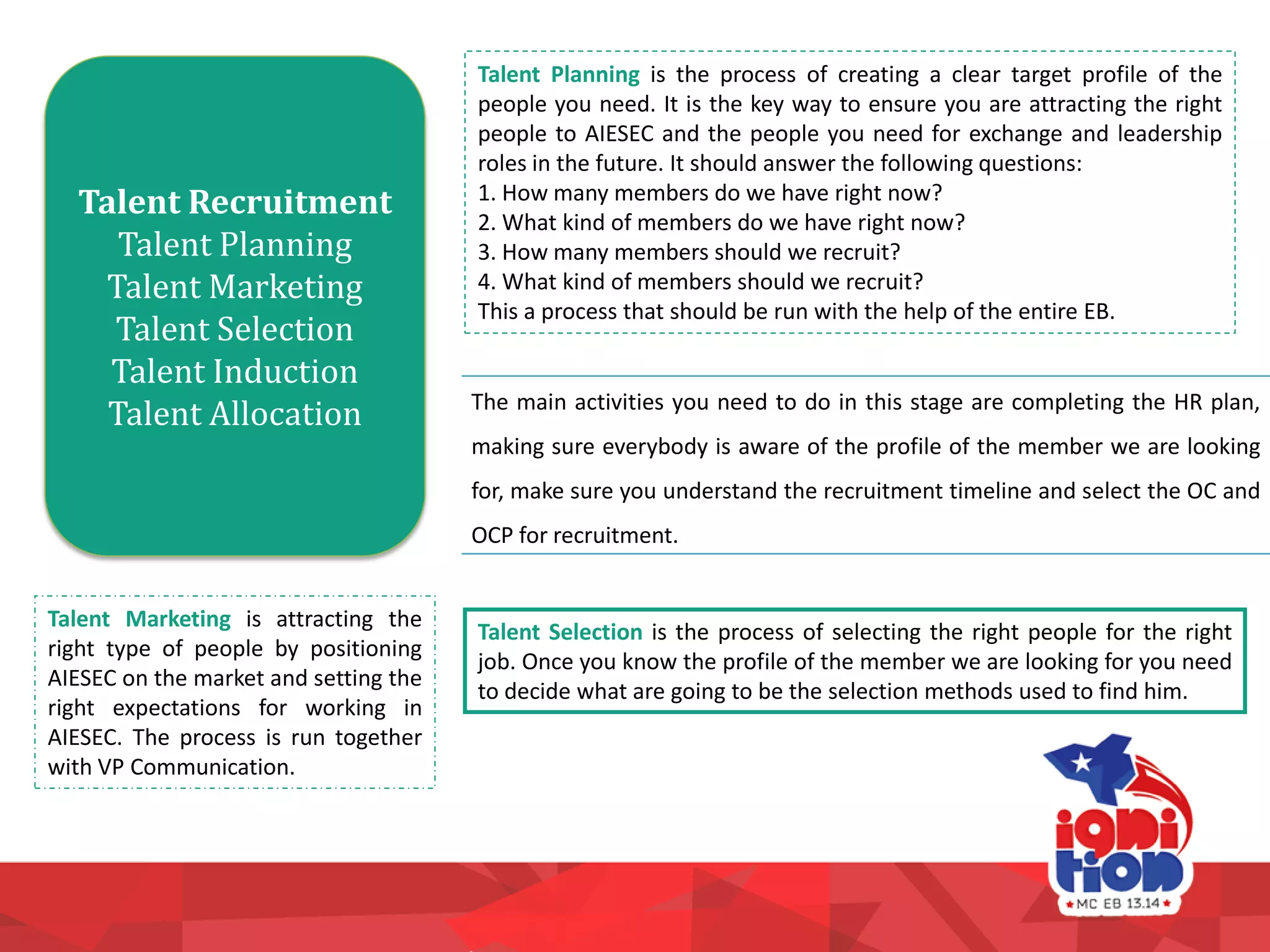
Talent Recruitment
Talent Planning
Talent Marketing
Talent Selection
Talent Induction
Talent Allocation
TMPROCESSES
Talent Recruitment
Talent Planning
Talent Marketing
Talent Selection
Talent Induction
Talent Allocation The main activities you need to do in this stage are completing the HR plan,
making sure everybody is aware of the profile of the member we are looking
for, make sure you understand the recruitment timeline and select the OC and
OCP for recruitment.
Talent Planning is the process of creating a clear target profile of the
people you need. It is the key way to ensure you are attracting the right
people to AIESEC and the people you need for exchange and leadership
roles in the future. It should answer the following questions:
1. How many members do we have right now?
2. What kind of members do we have right now?
3. How many members should we recruit?
4. What kind of members should we recruit?
This a process that should be run with the help of the entire EB.
Talent Marketing is attracting the
right type of people by positioning
AIESEC on the market and setting the
right expectations for working in
AIESEC. The process is run together
with VP Communication.
Talent Selection is the process of selecting the right people for the right
job. Once you know the profile of the member we are looking for you need
to decide what are going to be the selection methods used to find him.
Talent Recruitment
Talent Planning
Talent Marketing
Talent Selection
Talent Induction
Talent Allocation
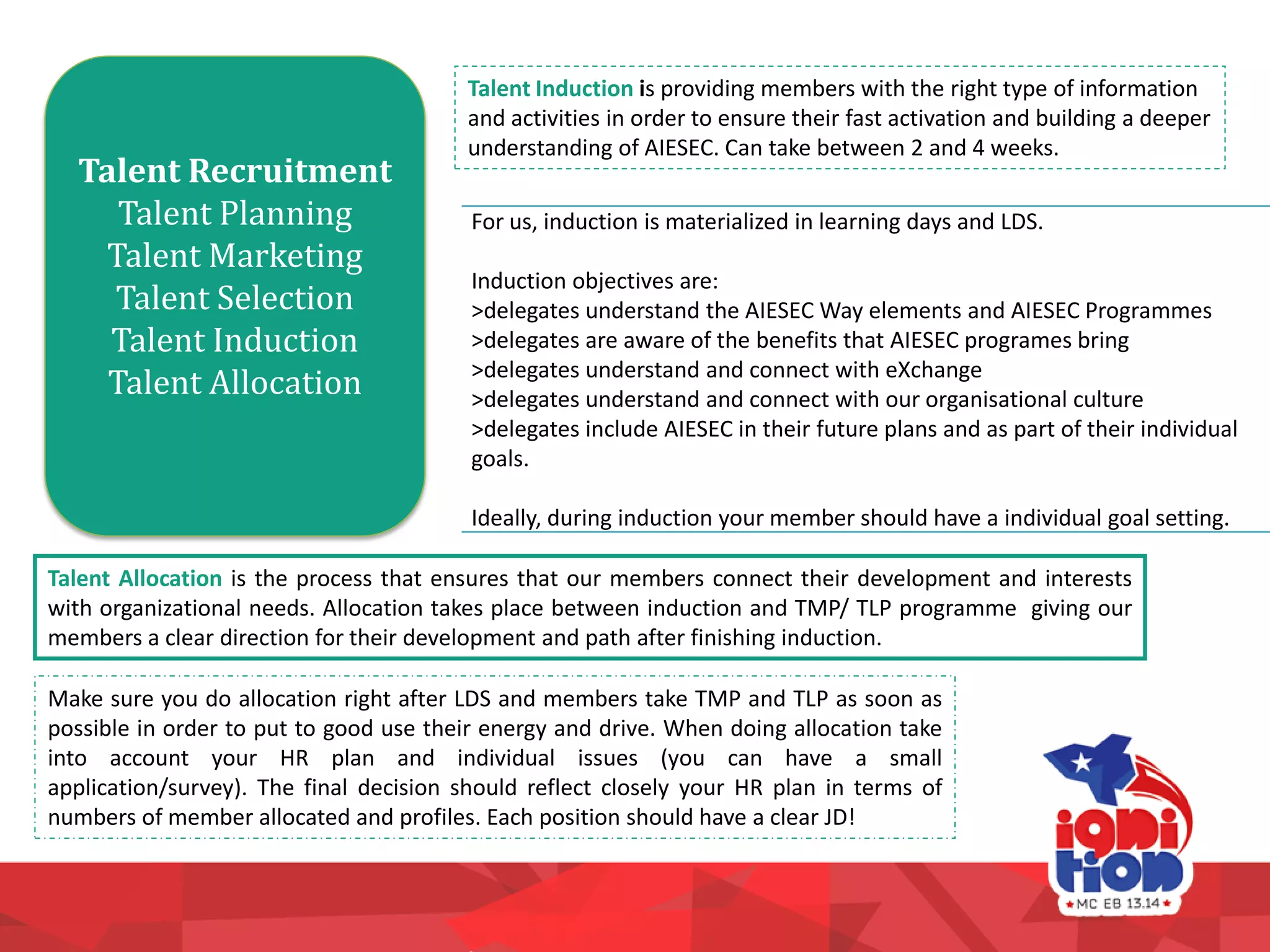
For us, induction is materialized in learning days and LDS.
Induction objectives are:
>delegates understand the AIESEC Way elements and AIESEC Programmes
>delegates are aware of the benefits that AIESEC programes bring
>delegates understand and connect with eXchange
>delegates understand and connect with our organisational culture
>delegates include AIESEC in their future plans and as part of their individual
goals.
Ideally, during induction your member should have a individual goal setting.
Talent Induction is providing members with the right type of information
and activities in order to ensure their fast activation and building a deeper
understanding of AIESEC. Can take between 2 and 4 weeks.
Talent Allocation is the process that ensures that our members connect their development and interests
with organizational needs. Allocation takes place between induction and TMP/ TLP programme giving our
members a clear direction for their development and path after finishing induction.
Make sure you do allocation right after LDS and members take TMP and TLP as soon as
possible in order to put to good use their energy and drive. When doing allocation take
into account your HR plan and individual issues (you can have a small
application/survey). The final decision should reflect closely your HR plan in terms of
numbers of member allocated and profiles. Each position should have a clear JD!
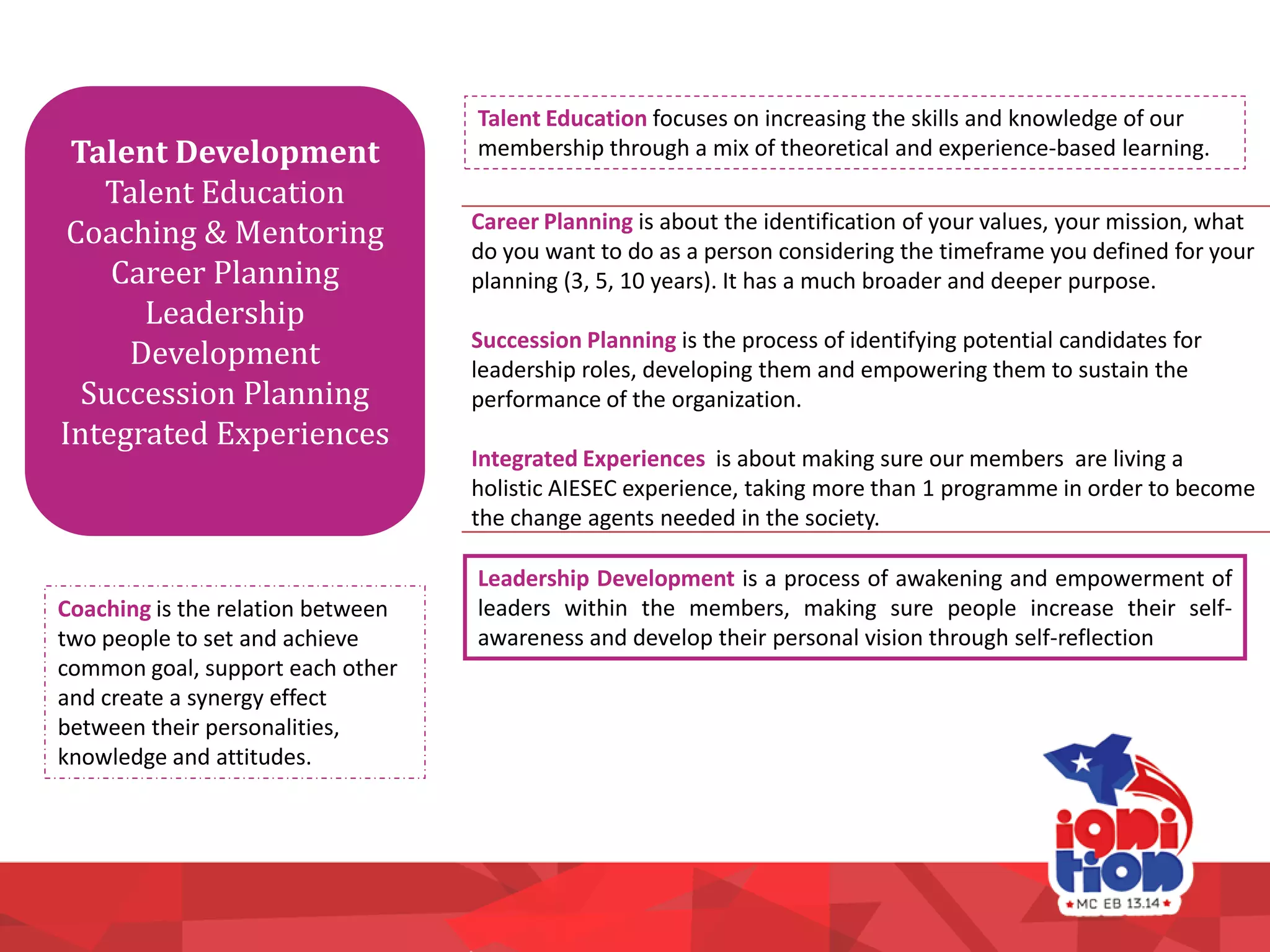
Talent Development
Talent Education
Coaching & Mentoring
Career Planning
Leadership
Development
Succession Planning
Integrated Experiences
Career Planning is about the identification of your values, your mission, what
do you want to do as a person considering the timeframe you defined for your
planning (3, 5, 10 years). It has a much broader and deeper purpose.
Succession Planning is the process of identifying potential candidates for
leadership roles, developing them and empowering them to sustain the
performance of the organization.
Integrated Experiences is about making sure our members are living a
holistic AIESEC experience, taking more than 1 programme in order to become
the change agents needed in the society.
Talent Education focuses on increasing the skills and knowledge of our
membership through a mix of theoretical and experience-based learning.
Coaching is the relation between
two people to set and achieve
common goal, support each other
and create a synergy effect
between their personalities,
knowledge and attitudes.
Leadership Development is a process of awakening and empowerment of
leaders within the members, making sure people increase their self-
awareness and develop their personal vision through self-reflection
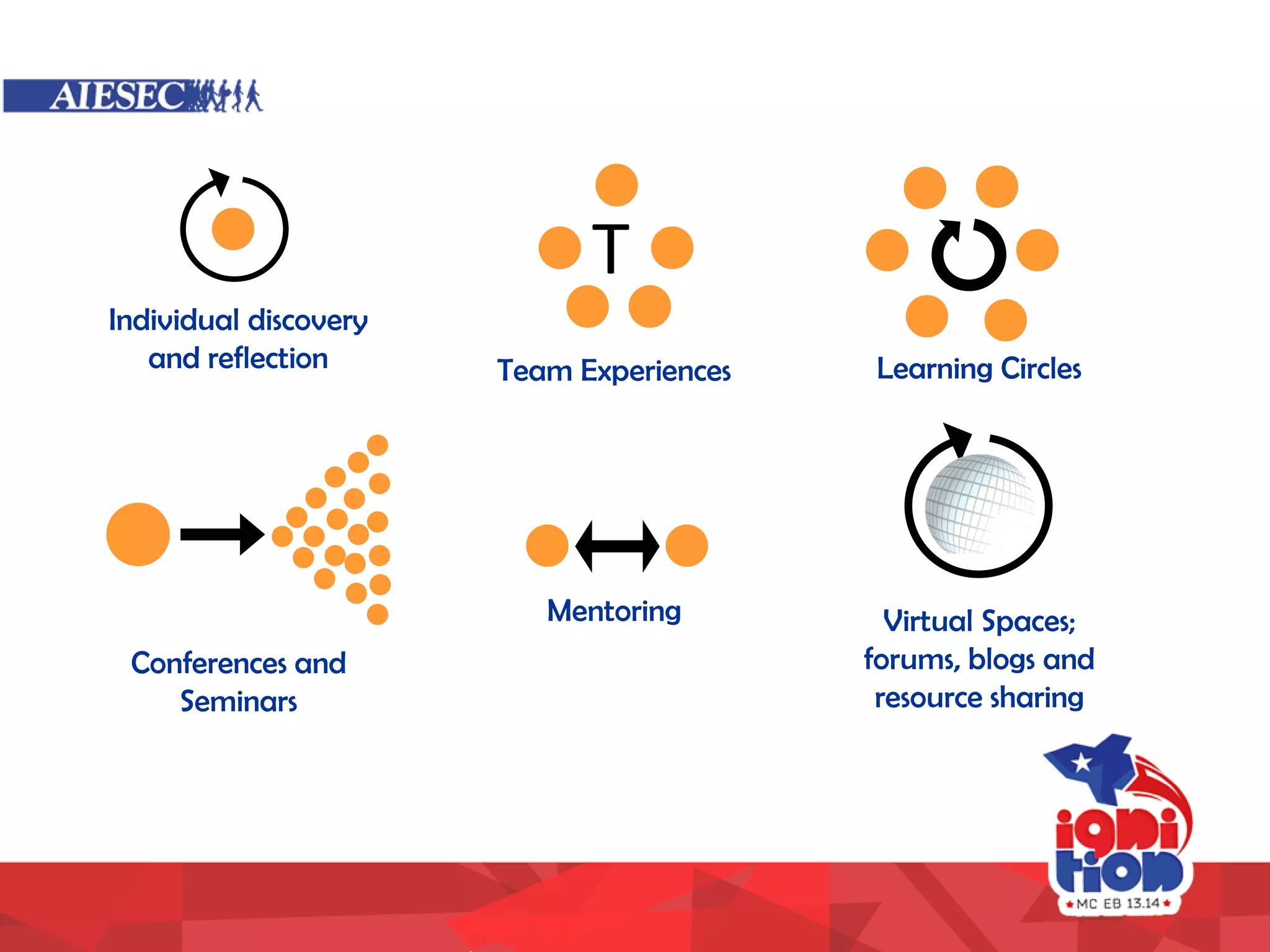
Individual discovery
and reflection
Mentoring
Learning Circles
T
Team Experiences
Conferences and
Seminars
Virtual Spaces;
forums, blogs and
resource sharing
Performance
Management
Goal Setting
Talent Tracking
Performance Appraisal
Rewards and
Recognition
Goal Setting is the process in which members and leaders establish
specific, measurable, achievable, realistic and time-bounded milestones for
themselves. The goals can be for short, medium or long term and should
be align with the members’ career plan and the organizational goals.
Talent Tracking is about gathering key information about our membership
to understand their needs, their current competencies and skills, their
interests and their future AIESEC plans. It’s also about tracking members’
performance, objectives and daily activities.
Performance appraisal is the process of assessing the results you had at
the end of a certain period. The process also enables you to take a look at
the state of development and performance of your members. Performance
appraisal and individual/team evaluations should stand at the base of the
Rewards and Recognition system.
Rewards and Recognition is an organizational process to ensure that
members are recognized and rewarded for having a great performance.
For the organization it ensures that right things get done in right way
and that the goals are achieved. It also ensures competition and quality
for those who strive to achieve excellence.
Exit interviews are the last interviews/connection a member has with AIESEC.
This is an opportunity for members to wrap-up their experience , set future
career goals, analyze the quality of the learning environment, their
experience and opportunities provided and also a chance for the organization
to learn how to provide better experiences.
Transition is the process through which we assure the transfer of strategic
direction, knowledge, information and experience from the current decision
makers to the elects. We can talk about EB transition or TMP/TLP role
transition (example: from one OCP to another).
Heading for the future - making sure that members have opportunity to
capture their experience, reflect upon their future and upon the impact they
want to have in the external world.
Closing Experiences
Exit interviews
Transition
H4TF process
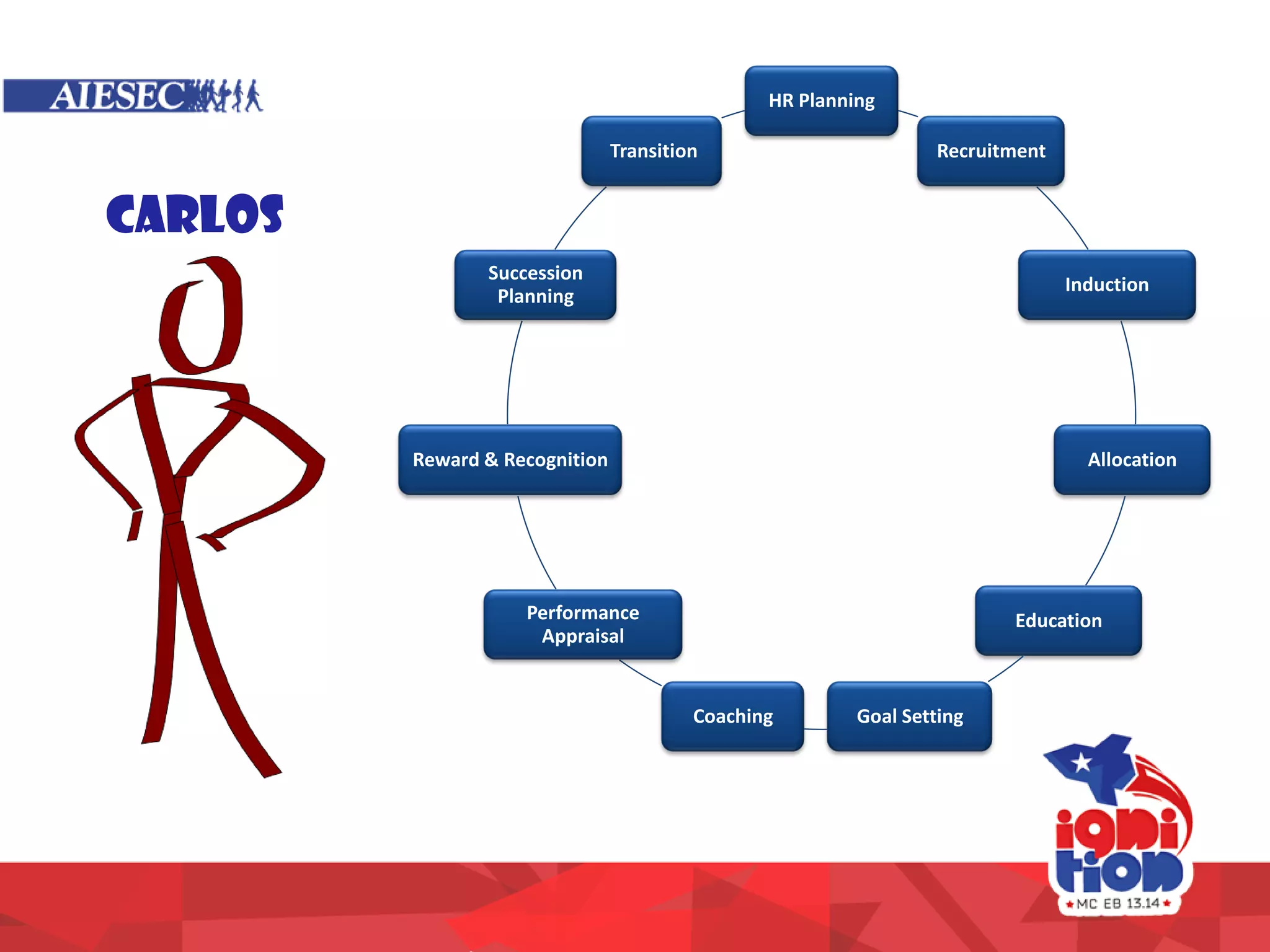
HR Planning
Recruitment
Induction
Allocation
Education
Goal SettingCoaching
Performance
Appraisal
Reward & Recognition
Succession
Planning
Transition
CARLOS
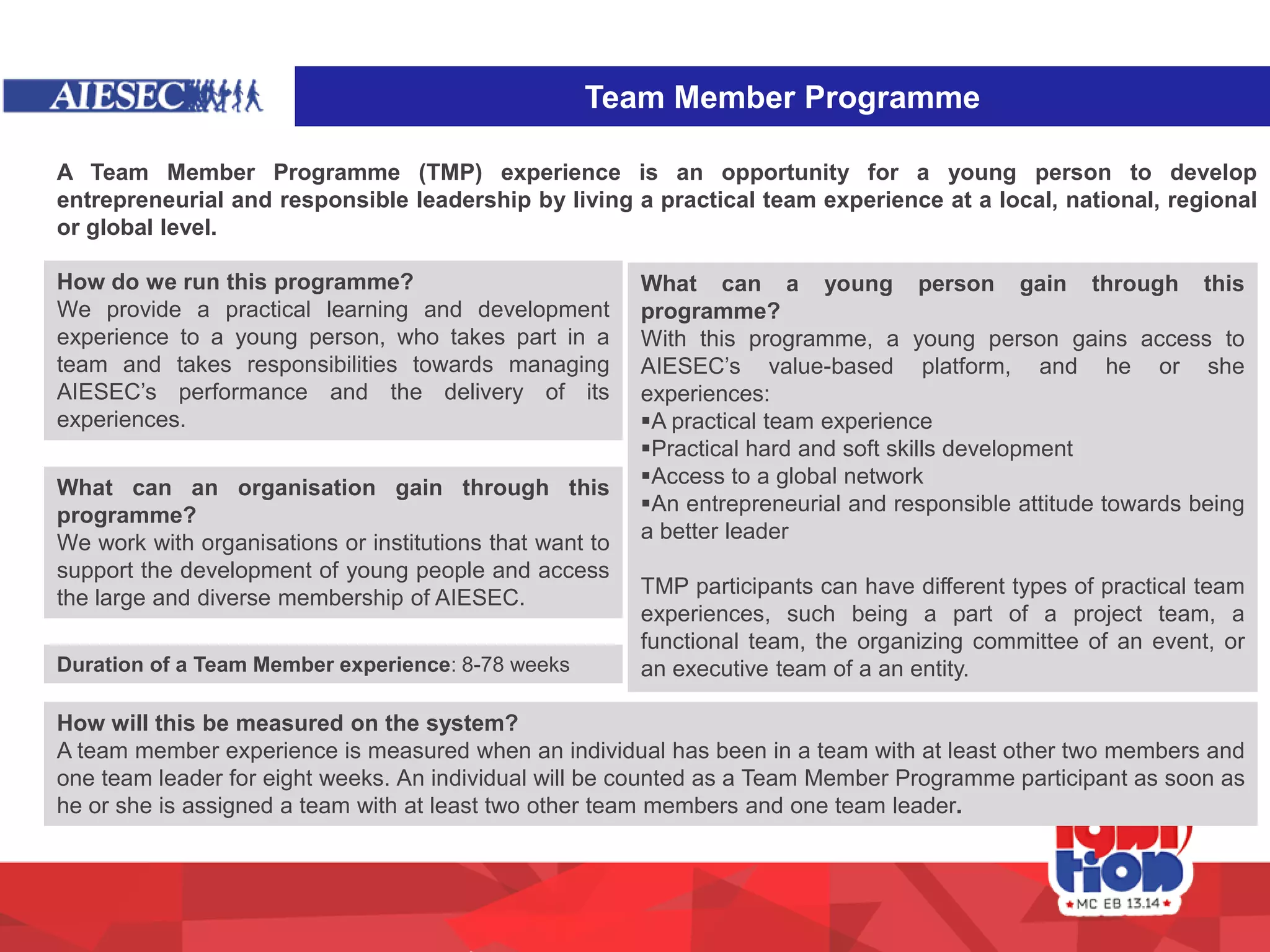
Team Member Programme
A Team Member Programme (TMP) experience is an opportunity for a young person to develop
entrepreneurial and responsible leadership by living a practical team experience at a local, national, regional
or global level.
How do we run this programme?
We provide a practical learning and development
experience to a young person, who takes part in a
team and takes responsibilities towards managing
AIESEC’s performance and the delivery of its
experiences.
What can a young person gain through this
programme?
With this programme, a young person gains access to
AIESEC’s value-based platform, and he or she
experiences:
A practical team experience
Practical hard and soft skills development
Access to a global network
An entrepreneurial and responsible attitude towards being
a better leader
TMP participants can have different types of practical team
experiences, such being a part of a project team, a
functional team, the organizing committee of an event, or
an executive team of a an entity.
What can an organisation gain through this
programme?
We work with organisations or institutions that want to
support the development of young people and access
the large and diverse membership of AIESEC.
How will this be measured on the system?
A team member experience is measured when an individual has been in a team with at least other two members and
one team leader for eight weeks. An individual will be counted as a Team Member Programme participant as soon as
he or she is assigned a team with at least two other team members and one team leader.
Duration of a Team Member experience: 8-78 weeks
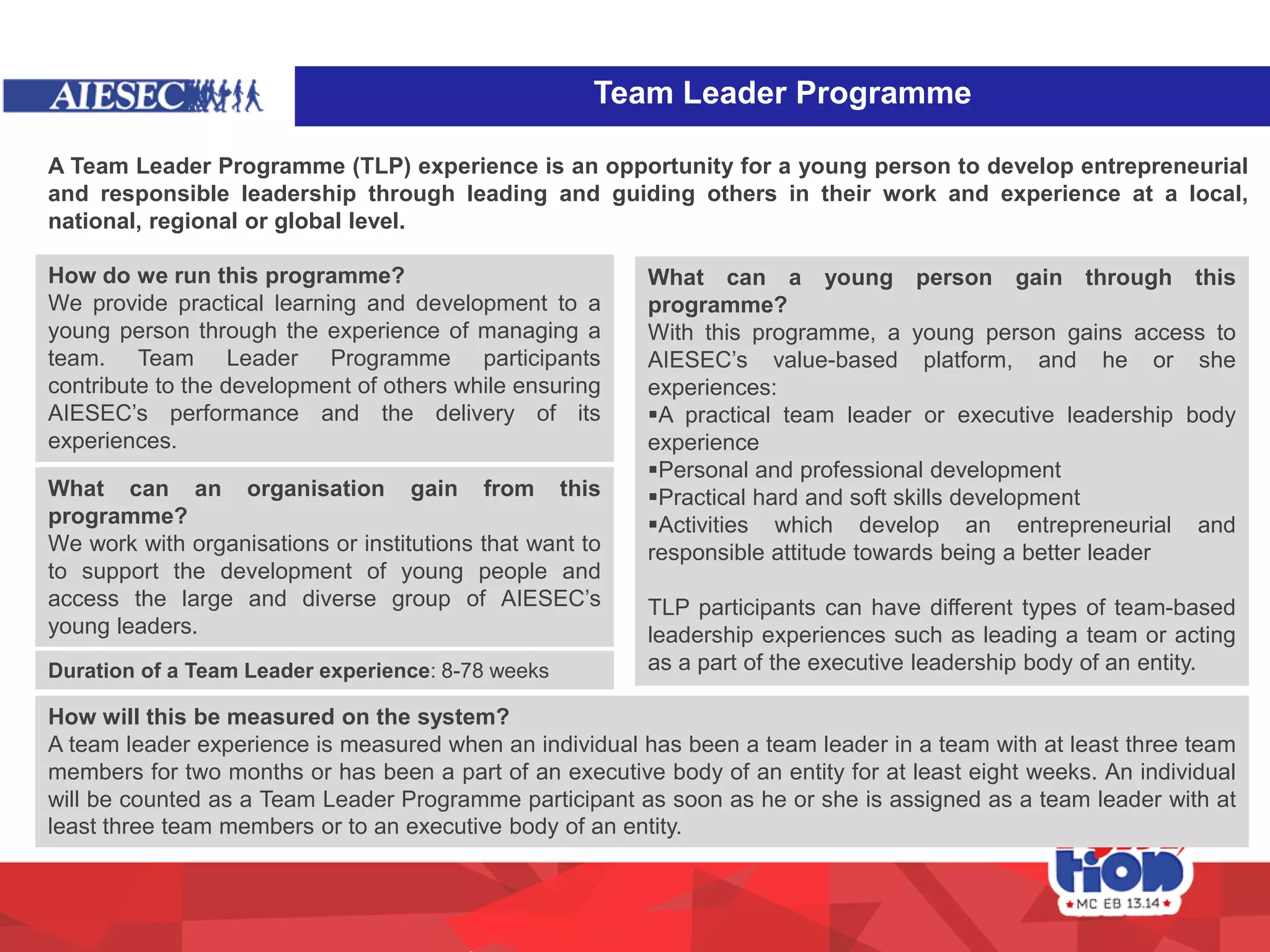
A Team Leader Programme (TLP) experience is an opportunity for a young person to develop entrepreneurial
and responsible leadership through leading and guiding others in their work and experience at a local,
national, regional or global level.
How do we run this programme?
We provide practical learning and development to a
young person through the experience of managing a
team. Team Leader Programme participants
contribute to the development of others while ensuring
AIESEC’s performance and the delivery of its
experiences.
What can a young person gain through this
programme?
With this programme, a young person gains access to
AIESEC’s value-based platform, and he or she
experiences:
A practical team leader or executive leadership body
experience
Personal and professional development
Practical hard and soft skills development
Activities which develop an entrepreneurial and
responsible attitude towards being a better leader
TLP participants can have different types of team-based
leadership experiences such as leading a team or acting
as a part of the executive leadership body of an entity.
What can an organisation gain from this
programme?
We work with organisations or institutions that want to
to support the development of young people and
access the large and diverse group of AIESEC’s
young leaders.
How will this be measured on the system?
A team leader experience is measured when an individual has been a team leader in a team with at least three team
members for two months or has been a part of an executive body of an entity for at least eight weeks. An individual
will be counted as a Team Leader Programme participant as soon as he or she is assigned as a team leader with at
least three team members or to an executive body of an entity.
Duration of a Team Leader experience: 8-78 weeks
Team Leader Programme
TMP-TLP Principles
 Each experience is defined by a team purpose, aligned with The
AIESEC Way, and driven by the individual.
 Each participant is responsible for the delivery of AIESEC 2015.
 Each experience is delivered by co-creating a collaborative
learning environment.
 An experience is physical, virtual or both and taken in any part of
the world.
AIESEC Chile TM Purpose Understanding

AIESEC Chile TM Purpose Understanding

  • 1.
    TM Role Talent Managementcreates and assures the linkage between organizational goals and the individual human resources potential in order to reach performance, by enabling a relevant and structured learning process for the membership. Talent Management manages the implementation of TMP and TLP. Talent Management ensures the human resources needed for operations. Talent Management is the custodian of the AIESEC way.
  • 3.
    TM Processes Talent Planning TalentMarketing Talent Selection Talent Induction Talent Allocation Exit interviews Transition H4TF process
  • 4.
    Talent Development Talent Education Coaching& Mentoring Career Planning Leadership Development Pipeline Management Integrated Experiences Performance Management Goal Setting Talent Tracking Performance Appraisal Rewards and Recognition Closing Experiences Exit interviews Transition H4TF process Talent Recruitment Talent Planning Talent Marketing Talent Selection Talent Induction Talent Allocation TMPROCESSES
  • 5.
    Talent Recruitment Talent Planning TalentMarketing Talent Selection Talent Induction Talent Allocation The main activities you need to do in this stage are completing the HR plan, making sure everybody is aware of the profile of the member we are looking for, make sure you understand the recruitment timeline and select the OC and OCP for recruitment. Talent Planning is the process of creating a clear target profile of the people you need. It is the key way to ensure you are attracting the right people to AIESEC and the people you need for exchange and leadership roles in the future. It should answer the following questions: 1. How many members do we have right now? 2. What kind of members do we have right now? 3. How many members should we recruit? 4. What kind of members should we recruit? This a process that should be run with the help of the entire EB. Talent Marketing is attracting the right type of people by positioning AIESEC on the market and setting the right expectations for working in AIESEC. The process is run together with VP Communication. Talent Selection is the process of selecting the right people for the right job. Once you know the profile of the member we are looking for you need to decide what are going to be the selection methods used to find him.
  • 6.
    Talent Recruitment Talent Planning TalentMarketing Talent Selection Talent Induction Talent Allocation For us, induction is materialized in learning days and LDS. Induction objectives are: >delegates understand the AIESEC Way elements and AIESEC Programmes >delegates are aware of the benefits that AIESEC programes bring >delegates understand and connect with eXchange >delegates understand and connect with our organisational culture >delegates include AIESEC in their future plans and as part of their individual goals. Ideally, during induction your member should have a individual goal setting. Talent Induction is providing members with the right type of information and activities in order to ensure their fast activation and building a deeper understanding of AIESEC. Can take between 2 and 4 weeks. Talent Allocation is the process that ensures that our members connect their development and interests with organizational needs. Allocation takes place between induction and TMP/ TLP programme giving our members a clear direction for their development and path after finishing induction. Make sure you do allocation right after LDS and members take TMP and TLP as soon as possible in order to put to good use their energy and drive. When doing allocation take into account your HR plan and individual issues (you can have a small application/survey). The final decision should reflect closely your HR plan in terms of numbers of member allocated and profiles. Each position should have a clear JD!
  • 7.
    Talent Development Talent Education Coaching& Mentoring Career Planning Leadership Development Succession Planning Integrated Experiences Career Planning is about the identification of your values, your mission, what do you want to do as a person considering the timeframe you defined for your planning (3, 5, 10 years). It has a much broader and deeper purpose. Succession Planning is the process of identifying potential candidates for leadership roles, developing them and empowering them to sustain the performance of the organization. Integrated Experiences is about making sure our members are living a holistic AIESEC experience, taking more than 1 programme in order to become the change agents needed in the society. Talent Education focuses on increasing the skills and knowledge of our membership through a mix of theoretical and experience-based learning. Coaching is the relation between two people to set and achieve common goal, support each other and create a synergy effect between their personalities, knowledge and attitudes. Leadership Development is a process of awakening and empowerment of leaders within the members, making sure people increase their self- awareness and develop their personal vision through self-reflection
  • 8.
    Individual discovery and reflection Mentoring LearningCircles T Team Experiences Conferences and Seminars Virtual Spaces; forums, blogs and resource sharing
  • 9.
    Performance Management Goal Setting Talent Tracking PerformanceAppraisal Rewards and Recognition Goal Setting is the process in which members and leaders establish specific, measurable, achievable, realistic and time-bounded milestones for themselves. The goals can be for short, medium or long term and should be align with the members’ career plan and the organizational goals. Talent Tracking is about gathering key information about our membership to understand their needs, their current competencies and skills, their interests and their future AIESEC plans. It’s also about tracking members’ performance, objectives and daily activities. Performance appraisal is the process of assessing the results you had at the end of a certain period. The process also enables you to take a look at the state of development and performance of your members. Performance appraisal and individual/team evaluations should stand at the base of the Rewards and Recognition system. Rewards and Recognition is an organizational process to ensure that members are recognized and rewarded for having a great performance. For the organization it ensures that right things get done in right way and that the goals are achieved. It also ensures competition and quality for those who strive to achieve excellence.
  • 10.
    Exit interviews arethe last interviews/connection a member has with AIESEC. This is an opportunity for members to wrap-up their experience , set future career goals, analyze the quality of the learning environment, their experience and opportunities provided and also a chance for the organization to learn how to provide better experiences. Transition is the process through which we assure the transfer of strategic direction, knowledge, information and experience from the current decision makers to the elects. We can talk about EB transition or TMP/TLP role transition (example: from one OCP to another). Heading for the future - making sure that members have opportunity to capture their experience, reflect upon their future and upon the impact they want to have in the external world. Closing Experiences Exit interviews Transition H4TF process
  • 11.
  • 12.
    Team Member Programme ATeam Member Programme (TMP) experience is an opportunity for a young person to develop entrepreneurial and responsible leadership by living a practical team experience at a local, national, regional or global level. How do we run this programme? We provide a practical learning and development experience to a young person, who takes part in a team and takes responsibilities towards managing AIESEC’s performance and the delivery of its experiences. What can a young person gain through this programme? With this programme, a young person gains access to AIESEC’s value-based platform, and he or she experiences: A practical team experience Practical hard and soft skills development Access to a global network An entrepreneurial and responsible attitude towards being a better leader TMP participants can have different types of practical team experiences, such being a part of a project team, a functional team, the organizing committee of an event, or an executive team of a an entity. What can an organisation gain through this programme? We work with organisations or institutions that want to support the development of young people and access the large and diverse membership of AIESEC. How will this be measured on the system? A team member experience is measured when an individual has been in a team with at least other two members and one team leader for eight weeks. An individual will be counted as a Team Member Programme participant as soon as he or she is assigned a team with at least two other team members and one team leader. Duration of a Team Member experience: 8-78 weeks
  • 13.
    A Team LeaderProgramme (TLP) experience is an opportunity for a young person to develop entrepreneurial and responsible leadership through leading and guiding others in their work and experience at a local, national, regional or global level. How do we run this programme? We provide practical learning and development to a young person through the experience of managing a team. Team Leader Programme participants contribute to the development of others while ensuring AIESEC’s performance and the delivery of its experiences. What can a young person gain through this programme? With this programme, a young person gains access to AIESEC’s value-based platform, and he or she experiences: A practical team leader or executive leadership body experience Personal and professional development Practical hard and soft skills development Activities which develop an entrepreneurial and responsible attitude towards being a better leader TLP participants can have different types of team-based leadership experiences such as leading a team or acting as a part of the executive leadership body of an entity. What can an organisation gain from this programme? We work with organisations or institutions that want to to support the development of young people and access the large and diverse group of AIESEC’s young leaders. How will this be measured on the system? A team leader experience is measured when an individual has been a team leader in a team with at least three team members for two months or has been a part of an executive body of an entity for at least eight weeks. An individual will be counted as a Team Leader Programme participant as soon as he or she is assigned as a team leader with at least three team members or to an executive body of an entity. Duration of a Team Leader experience: 8-78 weeks Team Leader Programme
  • 14.
    TMP-TLP Principles  Eachexperience is defined by a team purpose, aligned with The AIESEC Way, and driven by the individual.  Each participant is responsible for the delivery of AIESEC 2015.  Each experience is delivered by co-creating a collaborative learning environment.  An experience is physical, virtual or both and taken in any part of the world.