AIDA MODEL &
DAGMAR MODEL

SACHIN PATEL
B.TECH+MBA 9TH SEM
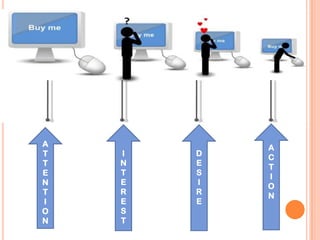
 What is AIDA Model:AIDA model is initiatory and
simplest. AIDA model was presented
by Elmo Lewis in 1898 to explain
how personal selling works. It shows
a set of stair-step stages which
describe the process leading a
potential customer to purchase.
A
T
T
E
N
T
I
O
N

I
N
T
E
R
E
S
T

D
E
S
I
R
E

A
C
T
I
O
N
 A – Attention (Awareness):• attract the attention of the customer.
• Establish customer awareness .
• Inform customers about the product.

I – Interest:•

•

raise customer interest by focusing on and
demonstrating advantages and benefits.
Create buyer interest. Stimulate interest in
product.
D – Desire:• convince customers that they want and
desire the product or service and that it
will satisfy their needs.
• Induce favorable attitude especially in
relation to competing product.

 A – Action:
• lead customers towards taking action
and/or purchasing.
• Sell the product. induce purchase by
stressing the immediat desirability of the
product.
 Later versions of the theory have edited the
AIDA steps. New phases such as
satisfaction (AIDAS) and confidence
(AIDCAS) have been added.

 S - Satisfaction :–
• satisfies the customer so they become a
repeat customer and give referrals to a
product.
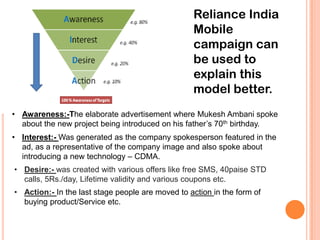
Reliance India
Mobile
campaign can
be used to
explain this
model better.
• Awareness:-The elaborate advertisement where Mukesh Ambani spoke
about the new project being introduced on his father’s 70th birthday.
• Interest:- Was generated as the company spokesperson featured in the
ad, as a representative of the company image and also spoke about
introducing a new technology – CDMA.

• Desire:- was created with various offers like free SMS, 40paise STD
calls, 5Rs./day, Lifetime validity and various coupons etc.
• Action:- In the last stage people are moved to action in the form of
buying product/Service etc.
 Advantages:•

Simplest-

•

Explain how Personal Selling works-

•

A set of stair-step stages-

•

Describe the process leading a potential
customer to purchase-
 DAGMAR Model:• Russell Colley (1961) developed a model for
setting advertising objectives and
measuring the results. This model was
entitled ‘Defining Advertising Goals for
Measured Advertising Results- DAGMAR.’
• DAGMAR model suggests that the ultimate
objective of advertising must carry a
consumer through four levels of
understanding.
• From unawareness to Awareness—the
consumer must first be aware of a brand or
company .
• Comprehension—he or she must have a
comprehension of what the product is and
its benefits.
• Conviction—he or she must arrive at the
mental disposition or conviction to buys the
brand.
• Action—finally, he or she actually buy that
product.
 Advantages:• Define advertising objectives and
measuring the results• unawareness to Awareness• Easy to Understand-
 challenges to the Dagmar
approach :•

•
•
•
•

Sales Goal
Practicability
Measurement Problem
Noise in the System
Inhibiting the Great Idea
THANK
YOU…..

Aida&dagmar

  • 1.
    AIDA MODEL & DAGMARMODEL SACHIN PATEL B.TECH+MBA 9TH SEM
  • 2.
     What isAIDA Model:AIDA model is initiatory and simplest. AIDA model was presented by Elmo Lewis in 1898 to explain how personal selling works. It shows a set of stair-step stages which describe the process leading a potential customer to purchase.
  • 3.
  • 4.
     A –Attention (Awareness):• attract the attention of the customer. • Establish customer awareness . • Inform customers about the product. I – Interest:• • raise customer interest by focusing on and demonstrating advantages and benefits. Create buyer interest. Stimulate interest in product.
  • 5.
    D – Desire:•convince customers that they want and desire the product or service and that it will satisfy their needs. • Induce favorable attitude especially in relation to competing product.  A – Action: • lead customers towards taking action and/or purchasing. • Sell the product. induce purchase by stressing the immediat desirability of the product.
  • 6.
     Later versionsof the theory have edited the AIDA steps. New phases such as satisfaction (AIDAS) and confidence (AIDCAS) have been added.  S - Satisfaction :– • satisfies the customer so they become a repeat customer and give referrals to a product.
  • 7.
    Reliance India Mobile campaign can beused to explain this model better. • Awareness:-The elaborate advertisement where Mukesh Ambani spoke about the new project being introduced on his father’s 70th birthday. • Interest:- Was generated as the company spokesperson featured in the ad, as a representative of the company image and also spoke about introducing a new technology – CDMA. • Desire:- was created with various offers like free SMS, 40paise STD calls, 5Rs./day, Lifetime validity and various coupons etc. • Action:- In the last stage people are moved to action in the form of buying product/Service etc.
  • 8.
     Advantages:• Simplest- • Explain howPersonal Selling works- • A set of stair-step stages- • Describe the process leading a potential customer to purchase-
  • 9.
     DAGMAR Model:•Russell Colley (1961) developed a model for setting advertising objectives and measuring the results. This model was entitled ‘Defining Advertising Goals for Measured Advertising Results- DAGMAR.’ • DAGMAR model suggests that the ultimate objective of advertising must carry a consumer through four levels of understanding.
  • 10.
    • From unawarenessto Awareness—the consumer must first be aware of a brand or company . • Comprehension—he or she must have a comprehension of what the product is and its benefits. • Conviction—he or she must arrive at the mental disposition or conviction to buys the brand. • Action—finally, he or she actually buy that product.
  • 11.
     Advantages:• Defineadvertising objectives and measuring the results• unawareness to Awareness• Easy to Understand-
  • 12.
     challenges tothe Dagmar approach :• • • • • Sales Goal Practicability Measurement Problem Noise in the System Inhibiting the Great Idea
  • 13.