SOFTWARE
ENGINEERING
L E C T U R E 0 1 : I N T R O D U C T I O N TO S O F T WA R E
E N G I N E E R I N G
REFERENCE BOOK
S of t w a re E n g i n e e r i n g : A P r a c t i t i o n e r ’s A p p ro a c h ,
8 t h E d i t i o n
B y R o g e r S . P re s s m a n
OBJECTIVES
● To introduce software engineering and to explain
its importance
● To set out the answers to key questions about
software engineering
● To introduce ethical and professional issues and
to explain why they are of concern to software
engineers
● The economies of ALL developed nations are
dependent on software
● More and more systems are software controlled
● Software engineering is concerned with theories,
methods and tools for professional software
development
● Software engineering expenditure represents a
significant fraction of GNP(Gross National Product) in
all developed countries
SOFTWARE ENGINEERING
● Software costs often dominate system costs. The
costs of software on a PC are often greater than
the hardware cost
● Software costs more to maintain than it does to
develop. For systems with a long life,
maintenance costs may be several times
development costs
● Software engineering is concerned with cost-
effective software development
SOFTWARE COSTS
FAQS ABOUT SOFTWARE ENGINEERING
● What is software?
● What is software engineering?
● What is the difference between software
engineering and computer science?
● What is the difference between software
engineering and system engineering?
● What is a software process?
● What is a software process model?
WHAT IS SOFTWARE?
● Computer programs and associated
documentation
● Software products may be developed for a
particular customer or may be developed for a
general market
● Software products may be
• Generic - developed to be sold to a range of different
customers
• Custom - developed for a single customer according to their
specification
WHAT IS SOFTWARE ENGINEERING?
● Software engineering is an engineering discipline
which is concerned with all aspects of software
production
● Software engineers should adopt a systematic and
organised approach to their work and use
appropriate tools and techniques depending on the
problem to be solved, the development constraints
and the resources available
WHAT IS THE DIFFERENCE BETWEEN SOFTWARE
ENGINEERING AND COMPUTER SCIENCE?
● Computer science is concerned with theory and
fundamentals;
● software engineering is concerned with the
practicalities of developing and delivering
useful software
WHAT IS THE DIFFERENCE BETWEEN SOFTWARE
ENGINEERING AND SYSTEM ENGINEERING?
● System engineering is concerned with all aspects
of computer-based systems development
including hardware, software and process
engineering.
Software engineering is part of this process
● System engineers are involved in system
specification, architectural design, integration and
deployment
WHAT IS A SOFTWARE PROCESS?
● A set of activities whose goal is the development or
evolution of software
● Generic activities in all software processes are:
• Specification - what the system should do and its development constraints
• Development - production of the software system
• Validation - checking that the software is what the customer wants
• Evolution - changing the software in response to changing demands
WHAT IS A SOFTWARE PROCESS MODEL?
● A simplified representation of a software process,
presented from a specific perspective
● Examples of process perspectives are
• Workflow perspective - sequence of activities
• Data-flow perspective - information flow
• Role/action perspective - who does what
● Generic process models
• Waterfall
• Evolutionary development
• Formal transformation
WHAT ARE THE COSTS OF SOFTWARE
ENGINEERING?
● Roughly 60% of costs are development costs,
40% are testing costs. For custom software,
evolution costs often exceed development costs
● Costs vary depending on the type of system being
developed and the requirements of system
attributes such as performance and system
reliability.
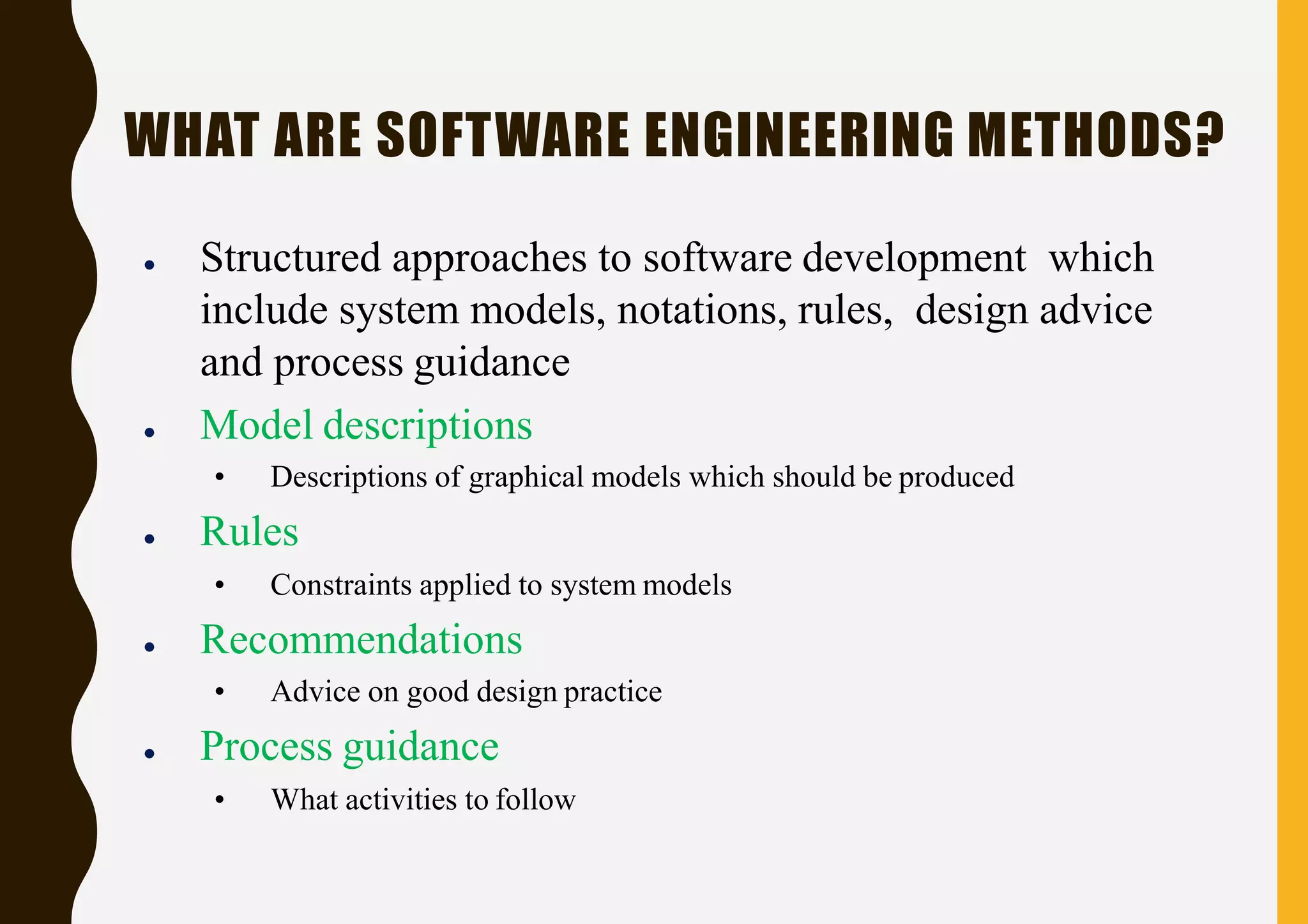
WHAT ARE SOFTWARE ENGINEERING METHODS?
● Structured approaches to software development which
include system models, notations, rules, design advice
and process guidance
● Model descriptions
• Descriptions of graphical models which should be produced
● Rules
• Constraints applied to system models
● Recommendations
• Advice on good design practice
● Process guidance
• What activities to follow
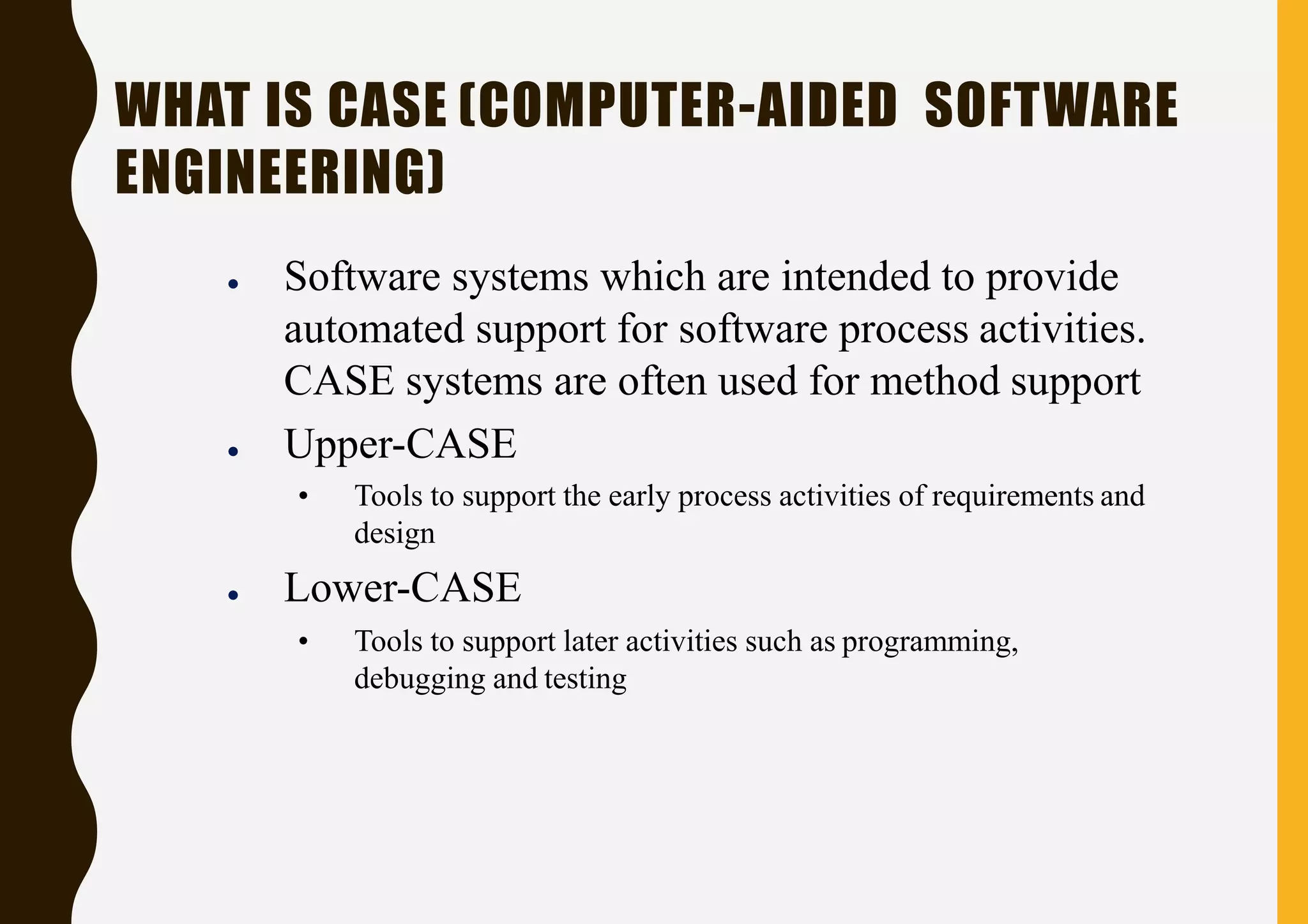
WHAT IS CASE (COMPUTER-AIDED SOFTWARE
ENGINEERING)
● Software systems which are intended to provide
automated support for software process activities.
CASE systems are often used for method support
● Upper-CASE
• Tools to support the early process activities of requirements and
design
● Lower-CASE
• Tools to support later activities such as programming,
debugging and testing
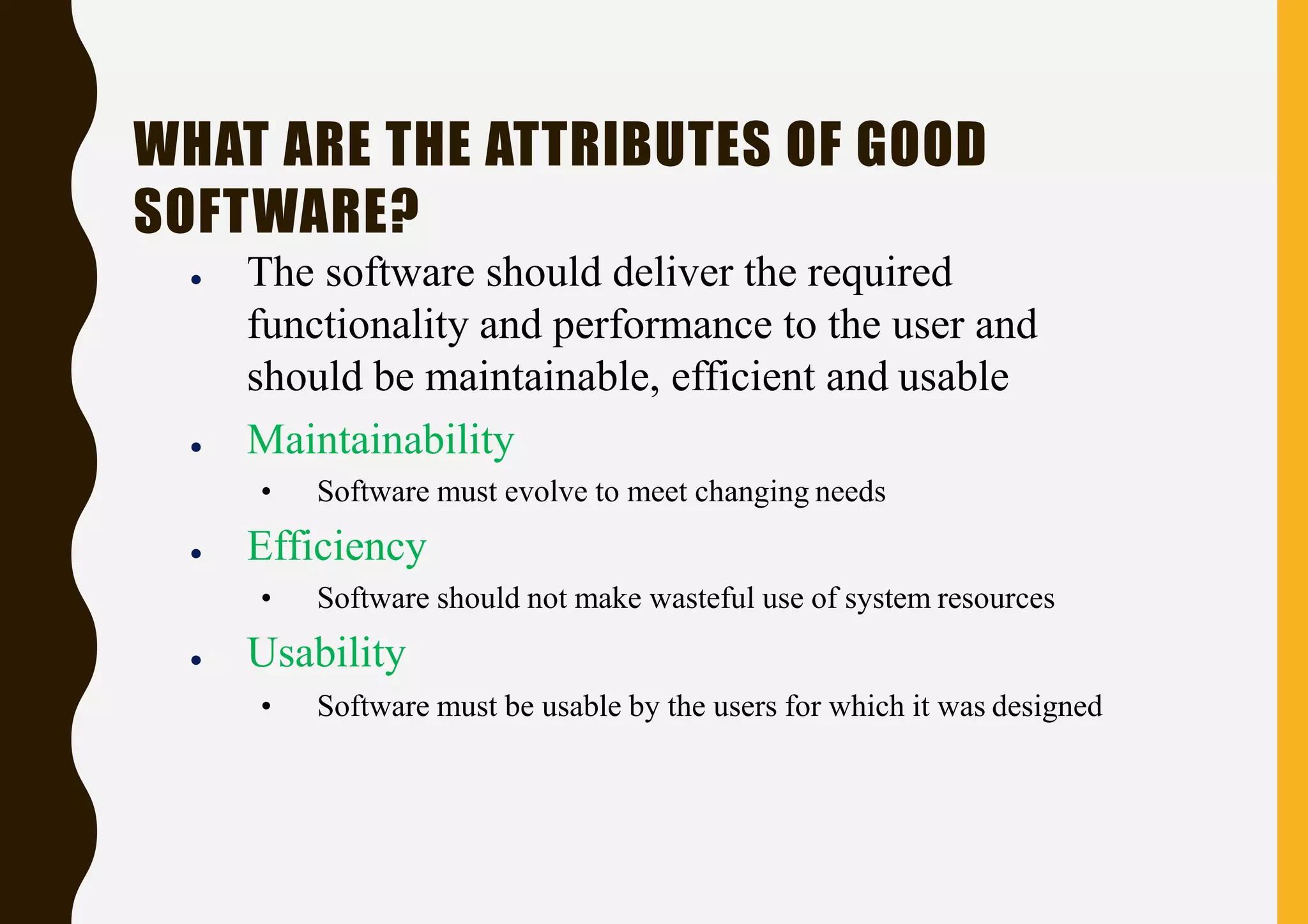
WHAT ARE THE ATTRIBUTES OF GOOD
SOFTWARE?
● The software should deliver the required
functionality and performance to the user and
should be maintainable, efficient and usable
● Maintainability
• Software must evolve to meet changing needs
● Efficiency
• Software should not make wasteful use of system resources
● Usability
• Software must be usable by the users for which it was designed
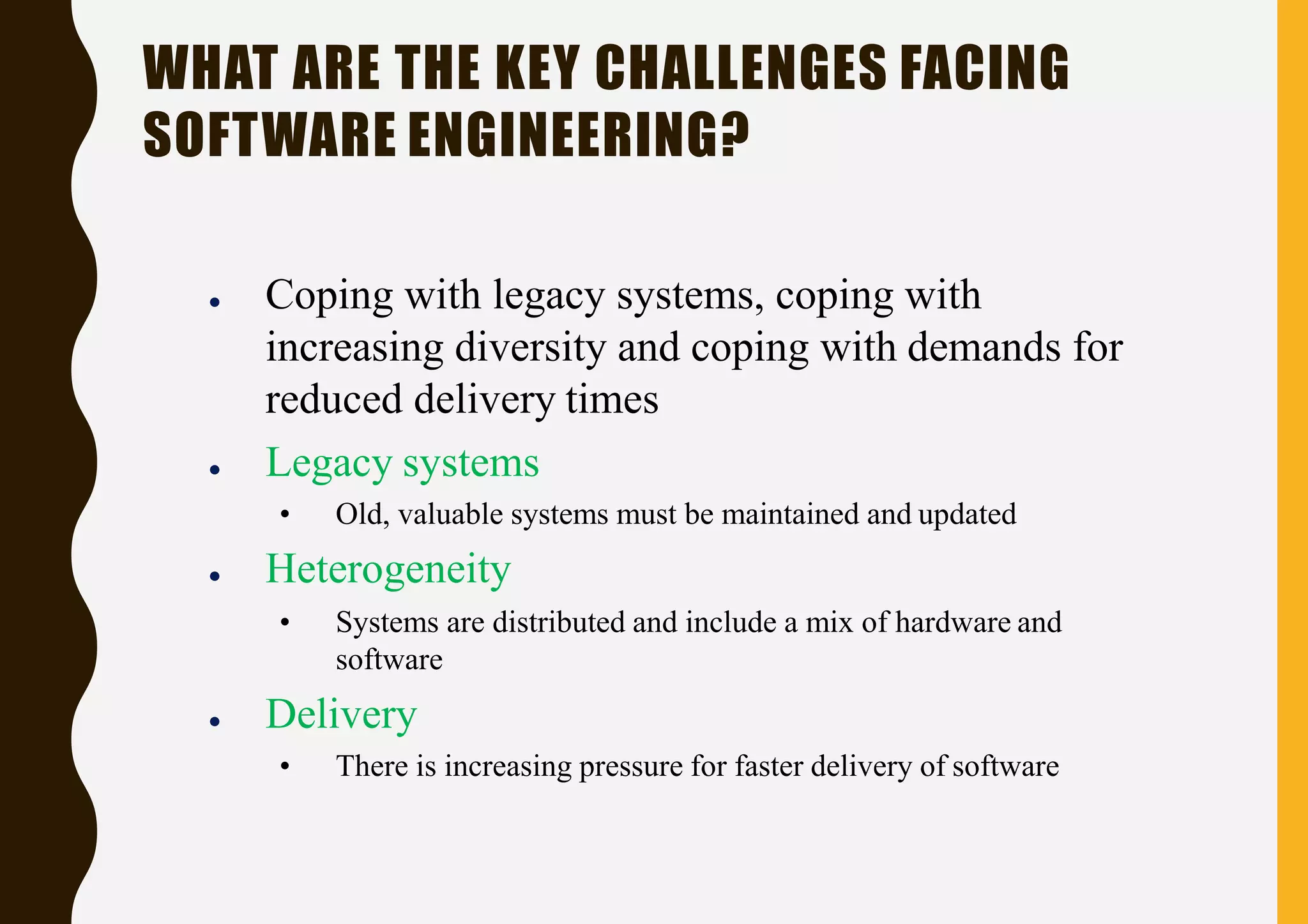
WHAT ARE THE KEY CHALLENGES FACING
SOFTWARE ENGINEERING?
● Coping with legacy systems, coping with
increasing diversity and coping with demands for
reduced delivery times
● Legacy systems
• Old, valuable systems must be maintained and updated
● Heterogeneity
• Systems are distributed and include a mix of hardware and
software
● Delivery
• There is increasing pressure for faster delivery of software
PROFESSIONAL AND ETHICAL RESPONSIBILITY
● Software engineering involves wider
responsibilities than simply the application of
technical skills
● Software engineers must behave in an honest and
ethically responsible way if they are to be
respected as professionals
● Ethical behaviour is more than simply upholding
the law.
ISSUES OF PROFESSIONAL RESPONSIBILITY
● Confidentiality
• Engineers should normally respect the confidentiality of their
employers or clients irrespective of whether or not a formal
confidentiality agreement has been signed.
● Competence
• Engineers should not misrepresent their level of competence.
They should not knowingly accept work which is outwith their
competence.
ISSUES OF PROFESSIONALRESPONSIBILITY
● Intellectual property rights
• Engineers should be aware of local laws governing the use of
intellectual property such as patents, copyright, etc. They should
be careful to ensure that the intellectual property of employers
and clients is protected.
● Computer misuse
• Software engineers should not use their technical skills to
misuse other people’s computers. Computer misuse ranges from
relatively trivial (game playing on an employer’s machine, say)
to extremely serious (dissemination of viruses).
ACM/IEEE CODE OF ETHICS
● The professional societies in the US have
cooperated to produce a code of ethical practice.
● Members of these organisations sign up to the
code of practice when they join.
● The Code contains eight Principles related to the
behaviour of and decisions made by professional
software engineers, including practitioners,
educators, managers, supervisors and policy
makers, as well as trainees and students of the
profession.
CODE OFETHICS -PRINCIPLES
● 1. PUBLIC
• Software engineers shall act consistently with the public
interest.
● 2. CLIENT AND EMPLOYER
• Software engineers shall act in a manner that is in the
best interests of their client and employer consistent with
the public interest.
● 3. PRODUCT
• Software engineers shall ensure that their products and
related modifications meet the highest professional
standards possible.
CODE OFETHICS -PRINCIPLES
4. JUDGMENT
• Software engineers shall maintain integrity and
independence in their professional judgment.
5. MANAGEMENT
• Software engineering managers and leaders shall subscribe to
and promote an ethical approach to the management of software
development and maintenance.
6. PROFESSION
• Software engineers shall advance the integrity and
profession consistent with the publicreputation of the
interest.
CODE OFETHICS -PRINCIPLES
7. COLLEAGUES
 Software engineers shall be fair to and supportive of their
colleagues.
8. SELF
 Software engineers shall participate in lifelong learning practice
of their profession.

Se introduction lec 1

  • 1.
    SOFTWARE ENGINEERING L E CT U R E 0 1 : I N T R O D U C T I O N TO S O F T WA R E E N G I N E E R I N G
  • 2.
    REFERENCE BOOK S oft w a re E n g i n e e r i n g : A P r a c t i t i o n e r ’s A p p ro a c h , 8 t h E d i t i o n B y R o g e r S . P re s s m a n
  • 3.
    OBJECTIVES ● To introducesoftware engineering and to explain its importance ● To set out the answers to key questions about software engineering ● To introduce ethical and professional issues and to explain why they are of concern to software engineers
  • 4.
    ● The economiesof ALL developed nations are dependent on software ● More and more systems are software controlled ● Software engineering is concerned with theories, methods and tools for professional software development ● Software engineering expenditure represents a significant fraction of GNP(Gross National Product) in all developed countries SOFTWARE ENGINEERING
  • 5.
    ● Software costsoften dominate system costs. The costs of software on a PC are often greater than the hardware cost ● Software costs more to maintain than it does to develop. For systems with a long life, maintenance costs may be several times development costs ● Software engineering is concerned with cost- effective software development SOFTWARE COSTS
  • 6.
    FAQS ABOUT SOFTWAREENGINEERING ● What is software? ● What is software engineering? ● What is the difference between software engineering and computer science? ● What is the difference between software engineering and system engineering? ● What is a software process? ● What is a software process model?
  • 7.
    WHAT IS SOFTWARE? ●Computer programs and associated documentation ● Software products may be developed for a particular customer or may be developed for a general market ● Software products may be • Generic - developed to be sold to a range of different customers • Custom - developed for a single customer according to their specification
  • 8.
    WHAT IS SOFTWAREENGINEERING? ● Software engineering is an engineering discipline which is concerned with all aspects of software production ● Software engineers should adopt a systematic and organised approach to their work and use appropriate tools and techniques depending on the problem to be solved, the development constraints and the resources available
  • 9.
    WHAT IS THEDIFFERENCE BETWEEN SOFTWARE ENGINEERING AND COMPUTER SCIENCE? ● Computer science is concerned with theory and fundamentals; ● software engineering is concerned with the practicalities of developing and delivering useful software
  • 10.
    WHAT IS THEDIFFERENCE BETWEEN SOFTWARE ENGINEERING AND SYSTEM ENGINEERING? ● System engineering is concerned with all aspects of computer-based systems development including hardware, software and process engineering. Software engineering is part of this process ● System engineers are involved in system specification, architectural design, integration and deployment
  • 11.
    WHAT IS ASOFTWARE PROCESS? ● A set of activities whose goal is the development or evolution of software ● Generic activities in all software processes are: • Specification - what the system should do and its development constraints • Development - production of the software system • Validation - checking that the software is what the customer wants • Evolution - changing the software in response to changing demands
  • 12.
    WHAT IS ASOFTWARE PROCESS MODEL? ● A simplified representation of a software process, presented from a specific perspective ● Examples of process perspectives are • Workflow perspective - sequence of activities • Data-flow perspective - information flow • Role/action perspective - who does what ● Generic process models • Waterfall • Evolutionary development • Formal transformation
  • 13.
    WHAT ARE THECOSTS OF SOFTWARE ENGINEERING? ● Roughly 60% of costs are development costs, 40% are testing costs. For custom software, evolution costs often exceed development costs ● Costs vary depending on the type of system being developed and the requirements of system attributes such as performance and system reliability.
  • 14.
    WHAT ARE SOFTWAREENGINEERING METHODS? ● Structured approaches to software development which include system models, notations, rules, design advice and process guidance ● Model descriptions • Descriptions of graphical models which should be produced ● Rules • Constraints applied to system models ● Recommendations • Advice on good design practice ● Process guidance • What activities to follow
  • 15.
    WHAT IS CASE(COMPUTER-AIDED SOFTWARE ENGINEERING) ● Software systems which are intended to provide automated support for software process activities. CASE systems are often used for method support ● Upper-CASE • Tools to support the early process activities of requirements and design ● Lower-CASE • Tools to support later activities such as programming, debugging and testing
  • 16.
    WHAT ARE THEATTRIBUTES OF GOOD SOFTWARE? ● The software should deliver the required functionality and performance to the user and should be maintainable, efficient and usable ● Maintainability • Software must evolve to meet changing needs ● Efficiency • Software should not make wasteful use of system resources ● Usability • Software must be usable by the users for which it was designed
  • 17.
    WHAT ARE THEKEY CHALLENGES FACING SOFTWARE ENGINEERING? ● Coping with legacy systems, coping with increasing diversity and coping with demands for reduced delivery times ● Legacy systems • Old, valuable systems must be maintained and updated ● Heterogeneity • Systems are distributed and include a mix of hardware and software ● Delivery • There is increasing pressure for faster delivery of software
  • 18.
    PROFESSIONAL AND ETHICALRESPONSIBILITY ● Software engineering involves wider responsibilities than simply the application of technical skills ● Software engineers must behave in an honest and ethically responsible way if they are to be respected as professionals ● Ethical behaviour is more than simply upholding the law.
  • 19.
    ISSUES OF PROFESSIONALRESPONSIBILITY ● Confidentiality • Engineers should normally respect the confidentiality of their employers or clients irrespective of whether or not a formal confidentiality agreement has been signed. ● Competence • Engineers should not misrepresent their level of competence. They should not knowingly accept work which is outwith their competence.
  • 20.
    ISSUES OF PROFESSIONALRESPONSIBILITY ●Intellectual property rights • Engineers should be aware of local laws governing the use of intellectual property such as patents, copyright, etc. They should be careful to ensure that the intellectual property of employers and clients is protected. ● Computer misuse • Software engineers should not use their technical skills to misuse other people’s computers. Computer misuse ranges from relatively trivial (game playing on an employer’s machine, say) to extremely serious (dissemination of viruses).
  • 21.
    ACM/IEEE CODE OFETHICS ● The professional societies in the US have cooperated to produce a code of ethical practice. ● Members of these organisations sign up to the code of practice when they join. ● The Code contains eight Principles related to the behaviour of and decisions made by professional software engineers, including practitioners, educators, managers, supervisors and policy makers, as well as trainees and students of the profession.
  • 22.
    CODE OFETHICS -PRINCIPLES ●1. PUBLIC • Software engineers shall act consistently with the public interest. ● 2. CLIENT AND EMPLOYER • Software engineers shall act in a manner that is in the best interests of their client and employer consistent with the public interest. ● 3. PRODUCT • Software engineers shall ensure that their products and related modifications meet the highest professional standards possible.
  • 23.
    CODE OFETHICS -PRINCIPLES 4.JUDGMENT • Software engineers shall maintain integrity and independence in their professional judgment. 5. MANAGEMENT • Software engineering managers and leaders shall subscribe to and promote an ethical approach to the management of software development and maintenance. 6. PROFESSION • Software engineers shall advance the integrity and profession consistent with the publicreputation of the interest.
  • 24.
    CODE OFETHICS -PRINCIPLES 7.COLLEAGUES  Software engineers shall be fair to and supportive of their colleagues. 8. SELF  Software engineers shall participate in lifelong learning practice of their profession.