1/42
abhinav April 1, 2025
AI in project and capital expenditure management
(CapEx): Scope, integration, use cases, challenges and
future outlook
zbrain.ai/ai-in-the-project-and-capital-expenditure-management
← All Insights
Project and capital expenditure (CapEx) management is fundamental to an organization’s
ability to achieve its strategic objectives and maintain a competitive edge. Projects drive
innovation, deliver new products and services, and facilitate operational improvements,
while capital expenditures ensure the acquisition, maintenance, and enhancement of
long-term assets necessary for sustained growth.
Project initiatives and capital expenditures (CapEx) are the financial lifeblood of strategic
growth, involving investments in assets and major projects that shape an organization’s
future. In today’s turbulent economic climate, effective CapEx planning and execution are
more critical than ever – a recent survey found that 70% of companies plan to spend 10–
30% more on CapEx in the next three years to drive resilience and growth. Yet traditional
CapEx processes often rely on labor-intensive workflows and fragmented data,
contributing to poor outcomes. In fact, only about 35% of projects meet their original
goals, largely due to issues like poor risk visibility, siloed communication, and inefficient
resource allocation. These shortcomings can lead to financial waste, delayed growth, and
missed opportunities.
Artificial Intelligence (AI) is increasingly stepping in to transform how organizations
manage projects and CapEx. By leveraging AI – from predictive analytics to natural
language processing (NLP) – enterprises are automating tedious processes, improving
2/42
forecast accuracy, and identifying risks in advance. According to a 2024 global survey,
90% of project managers report a positive ROI on AI tools, with 63% citing higher
productivity and efficiency as a top benefit.
As AI adoption accelerates, platforms like ZBrain are playing a pivotal role in integrating
AI into the project and capital expenditure (CapEx) lifecycle. By enhancing forecasting
accuracy, optimizing capital budgeting, and enabling real-time monitoring of spending and
project performance, ZBrain empowers organizations to improve both execution efficiency
and investment outcomes. Beyond automation, ZBrain evaluates AI readiness across
CapEx operations, uncovers opportunities to streamline high-impact processes, and
delivers tailored AI solutions to boost decision-making speed, compliance, and financial
control.
This article explores how AI is transforming the end-to-end project and CapEx process,
driving smarter investments, reducing risk, and enabling greater agility. It also highlights
how platforms like ZBrain help enterprises harness AI to make faster, data-driven capital
planning decisions, ensuring superior ROI and strategic alignment in an increasingly
dynamic business environment.
What are project and capital expenditure management, and why
are they important?
Defining project expenditure
The term “project expenditure” encompasses the total financial resources consumed
during the lifecycle of a specific project. Definitions of project expenditure can vary
depending on the context, whether it be legal, operational, or financial. From a legal
standpoint, project expenditure is often defined as the sum of capital expenditure and
other project-related non-capitalized expenditure incurred or to be incurred on the project,
explicitly excluding internal costs, resources, or salaries. This definition provides a clear
boundary for what constitutes a project expense in contractual agreements.
Operationally, understanding project expenses involves recognizing all the costs that
must be covered while a team works on a project, whether directly tied to the project or
occurring in the background. These expenses can be classified into direct costs, which
are straightforwardly linked to the project (e.g., specialized software, contractor hours,
travel), and indirect costs, which are necessary for the business but not tied to a specific
project (e.g., rent, support staff salaries, utilities). Furthermore, project expenses can be
categorized as fixed (constant regardless of project scope) or variable (fluctuating with
project scope or duration). Tracking these actual expenses is crucial for businesses to
determine project profitability and refine estimating and pricing strategies for future work.
In a broader financial context, project expenditure includes all costs and charges, whether
of a capital or operating nature, incurred by or on behalf of a joint venture or related to
conducting specific operations. It represents the actual expenditure properly incurred in
relation to the project. Keeping tabs on the actual expenditure, which refers to the total
3/42
amount of money spent on a project at any given point, helps project managers ensure
financial viability by comparing actual costs with budgeted amounts. This comparison
allows for the identification of deviations and the implementation of corrective actions. A
project expenditure organization is an entity that can incur these expenditures for projects
and serve as a planning and budgeting resource.
Defining capital expenditure
Capital expenditures (CapEx) represent funds that companies allocate to acquire,
enhance, or maintain long-term assets such as property, buildings, equipment, or
technology. These investments are intended to support business operations over multiple
years and are capitalized on the balance sheet, with their costs amortized or depreciated
over the asset’s useful lives. ​These expenses are essential for companies to remain
competitive by providing the resources needed to keep up with industry trends and
developments. CapEx is distinct from operating expenses (OpEx), which are ongoing
expenses inherent to the operation of an asset, such as electricity or cleaning. The key
differentiator is that the financial benefit of a capital expenditure extends beyond the
current fiscal year.
There are three main types of capital expenditure: maintenance CapEx (investments to
maintain existing assets), growth CapEx (funds to acquire new assets or improve existing
ones for expansion), and strategic CapEx (investments in long-term assets to achieve
specific strategic objectives). Examples of CapEx include the purchase of land, buildings,
machinery, equipment, vehicles, or technology systems, as well as significant upgrades or
repairs that extend the useful life of an asset. In accounting, a capital expenditure is
added to an asset account on the balance sheet and is not directly tax-deductible in the
year it is incurred; instead, its cost is capitalized and then depreciated or amortized over
the asset’s useful life. Capital expenditures are typically found under the “investing
activities” section of the cash flow statement.
The strategic importance of project and capital expenditure
Project and capital expenditure (CapEx) management is essential to executing
organizational strategy and driving long-term growth. These investments—such as
infrastructure upgrades, technology deployments, or expansion projects—enable
companies to scale operations, boost efficiency, and maintain competitive advantage.
They are the foundation of strategic initiatives, translating long-term goals into tangible
outcomes.
Effective CapEx governance ensures that limited capital is directed toward the highest-
value initiatives, aligning investment decisions with corporate priorities. In fact, business
leaders view CapEx as critical to strategic planning, cost control, and maximizing return
on invested capital (ROIC).
4/42
Beyond strategic alignment, CapEx decisions directly impact financial sustainability.
Poorly managed projects can lead to budget overruns, delays, and write-offs—eroding
profitability and constraining future investment. On the other hand, companies with
mature CapEx processes can reduce capital spend by up to 25% and improve ROIC by
2–4% through better planning, cost control, and execution.
In today’s capital-constrained environment, strong CapEx management is not optional—
it’s a strategic imperative. The growing complexity of projects, rising stakeholder
expectations, and the need for faster, more data-driven decisions make optimizing CapEx
processes a top priority for modern enterprises.
Understanding the stages of project and capital expenditure
management
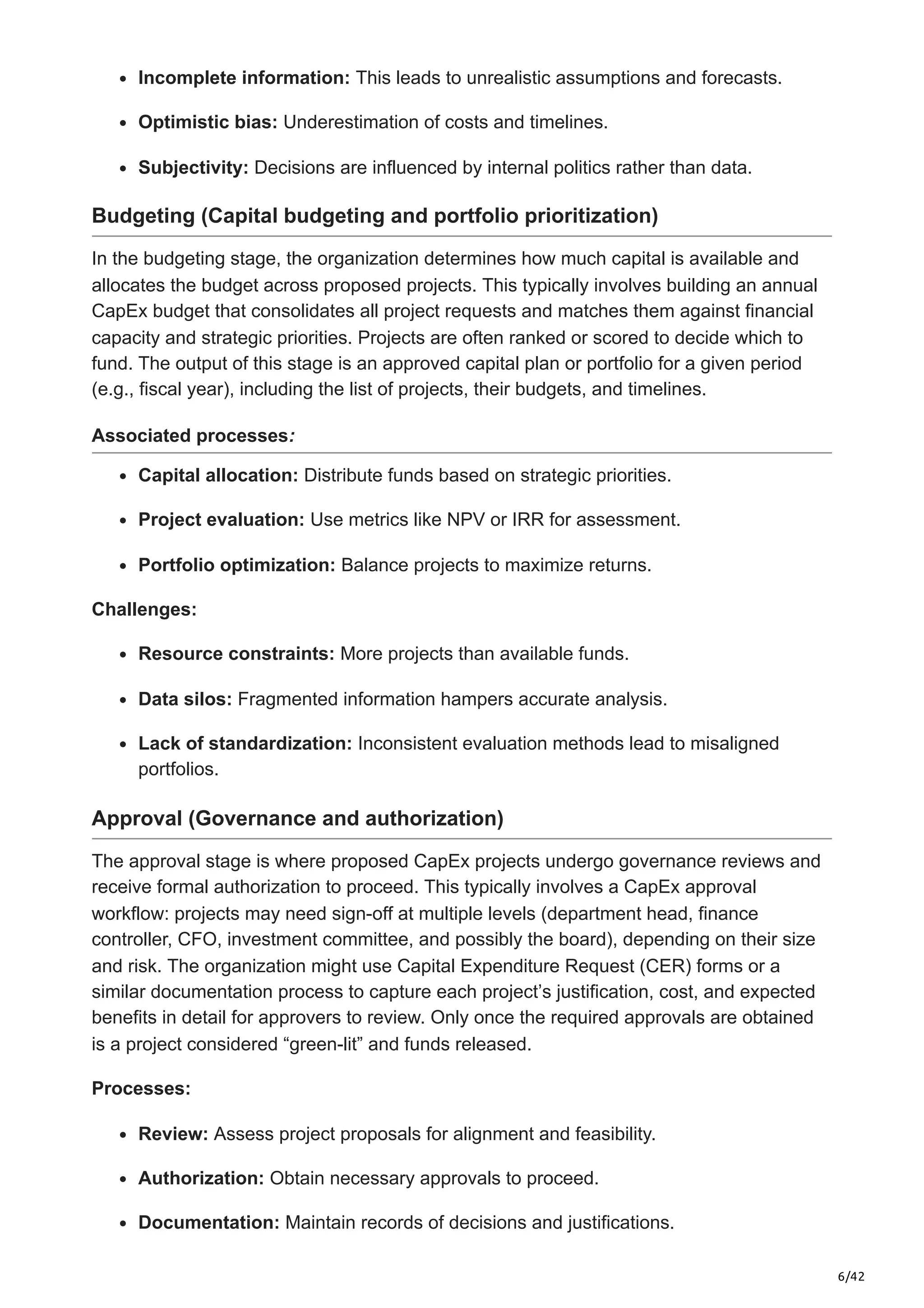
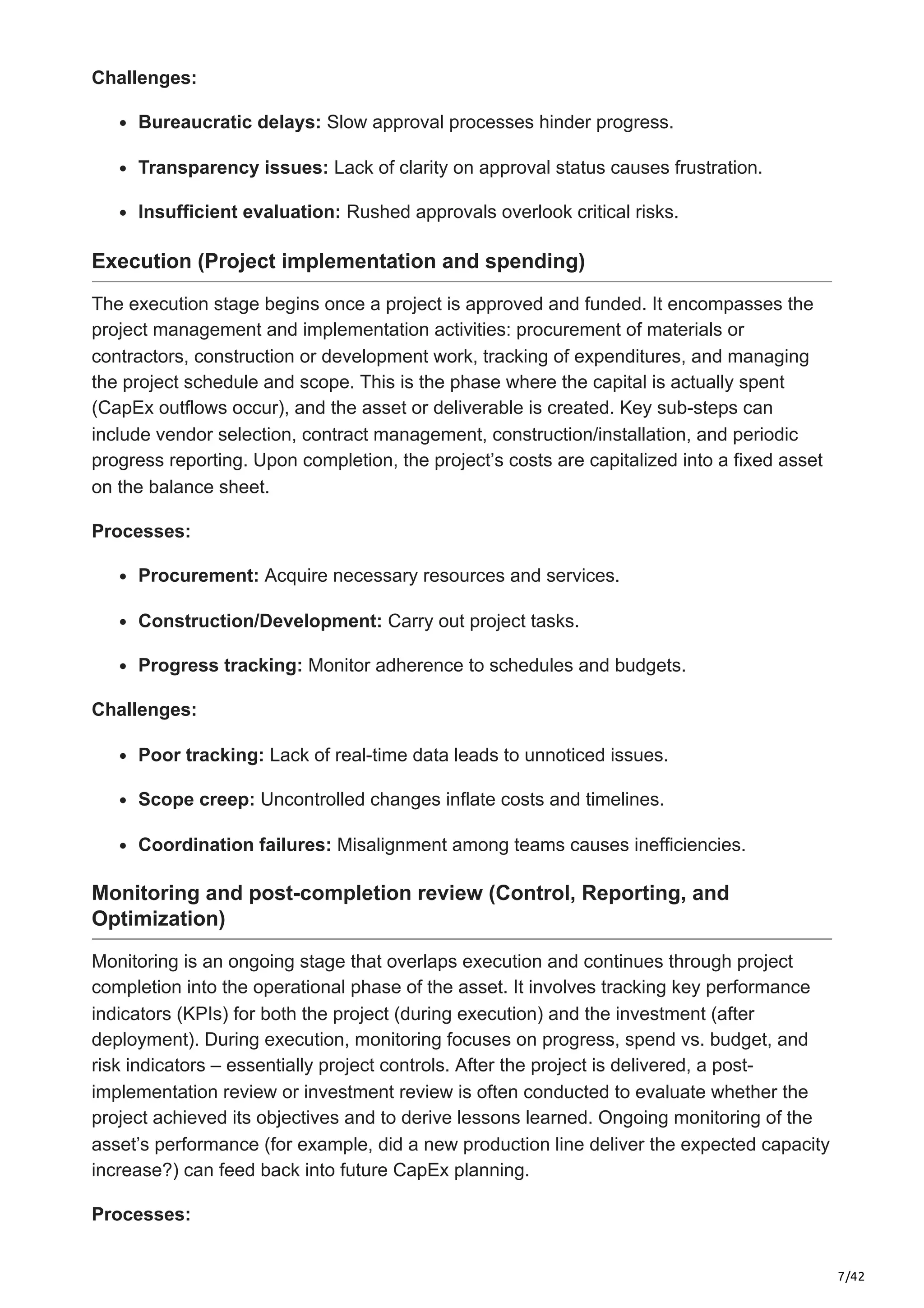
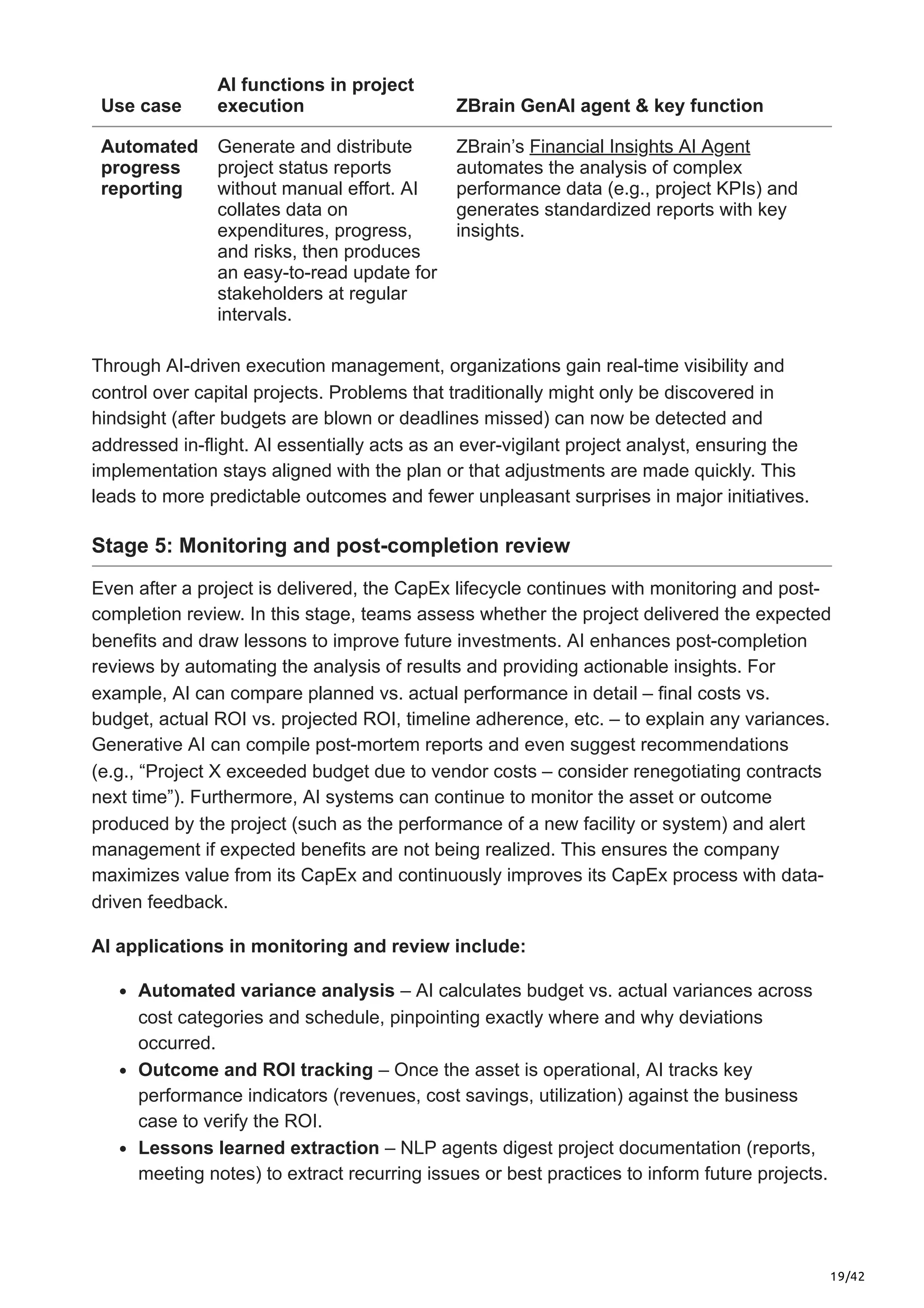
Project and capital expenditure management involves several key stages, each with
specific activities and decision points. A typical lifecycle moves from initial planning and
budgeting through approval and execution, and finally into ongoing monitoring and post-
completion review. Each stage carries unique challenges that can impact project success
if not handled well. Understanding these phases is crucial in identifying where AI can
intervene to enhance efficiency and control. Below, we detail each major stage of the
CapEx lifecycle along with the typical pain points encountered at each phase and their
operational consequences.
Planning
Budgeting
Approval
Execution
5/42
Monitoring
Understanding the stages of project and capital expenditure management
Planning
Ideation
business case
Post-review
Optimization
learnings
Budgeting
Capital allcation
prioritization
Approval
Governance
authorization
Monitoring
Reporting
Execution
Project
implementa-
tion
Planning Processes
Budgeting Processes
Approval Processes
Execution Processes
Monitoring Processes
Idea generation
Capital allocation
Review
Procurement
Performance monitoring
Feasibility analysis
Project evaluation
Authorization
Construction/Development
Reporting
Business case development
Portfolio optimization
Documentation
Common Challenges
Incomplete information
Resource constraints
Poor tracking
Progress tracking
Post-implementation
review
Planning (Ideation and business case development)
In the planning stage, project ideas are generated and refined into formal proposals or
business cases. Business units may submit “wishlist” proposals for capital projects they
desire in the upcoming period. These proposals typically include a basic outline of the
project, its expected benefits, cost estimate, and strategic rationale. The goal of this stage
is to evaluate which project ideas are worth pursuing and to develop them into solid
business cases aligned with organizational strategy.
Associated processes:
Idea generation: Identify potential projects to meet strategic goals.​
Feasibility analysis: Assess technical and financial viability.​
Business case development: Document objectives, benefits, costs, and risks.
Challenges:
6/42
Incomplete information: This leads to unrealistic assumptions and forecasts.​
Optimistic bias: Underestimation of costs and timelines.​
Subjectivity: Decisions are influenced by internal politics rather than data.
Budgeting (Capital budgeting and portfolio prioritization)
In the budgeting stage, the organization determines how much capital is available and
allocates the budget across proposed projects. This typically involves building an annual
CapEx budget that consolidates all project requests and matches them against financial
capacity and strategic priorities. Projects are often ranked or scored to decide which to
fund. The output of this stage is an approved capital plan or portfolio for a given period
(e.g., fiscal year), including the list of projects, their budgets, and timelines.
Associated processes:
Capital allocation: Distribute funds based on strategic priorities.​
Project evaluation: Use metrics like NPV or IRR for assessment.​
Portfolio optimization: Balance projects to maximize returns.
Challenges:
Resource constraints: More projects than available funds.​
Data silos: Fragmented information hampers accurate analysis.​
Lack of standardization: Inconsistent evaluation methods lead to misaligned
portfolios.
Approval (Governance and authorization)
The approval stage is where proposed CapEx projects undergo governance reviews and
receive formal authorization to proceed. This typically involves a CapEx approval
workflow: projects may need sign-off at multiple levels (department head, finance
controller, CFO, investment committee, and possibly the board), depending on their size
and risk. The organization might use Capital Expenditure Request (CER) forms or a
similar documentation process to capture each project’s justification, cost, and expected
benefits in detail for approvers to review. Only once the required approvals are obtained
is a project considered “green-lit” and funds released.
Processes:
Review: Assess project proposals for alignment and feasibility.​
Authorization: Obtain necessary approvals to proceed.​
Documentation: Maintain records of decisions and justifications.​
7/42
Challenges:
Bureaucratic delays: Slow approval processes hinder progress.​
Transparency issues: Lack of clarity on approval status causes frustration.​
Insufficient evaluation: Rushed approvals overlook critical risks.
Execution (Project implementation and spending)
The execution stage begins once a project is approved and funded. It encompasses the
project management and implementation activities: procurement of materials or
contractors, construction or development work, tracking of expenditures, and managing
the project schedule and scope. This is the phase where the capital is actually spent
(CapEx outflows occur), and the asset or deliverable is created. Key sub-steps can
include vendor selection, contract management, construction/installation, and periodic
progress reporting. Upon completion, the project’s costs are capitalized into a fixed asset
on the balance sheet.
Processes:
Procurement: Acquire necessary resources and services.​
Construction/Development: Carry out project tasks.
Progress tracking: Monitor adherence to schedules and budgets.​
Challenges:
Poor tracking: Lack of real-time data leads to unnoticed issues.​
Scope creep: Uncontrolled changes inflate costs and timelines.​
Coordination failures: Misalignment among teams causes inefficiencies.
Monitoring and post-completion review (Control, Reporting, and
Optimization)
Monitoring is an ongoing stage that overlaps execution and continues through project
completion into the operational phase of the asset. It involves tracking key performance
indicators (KPIs) for both the project (during execution) and the investment (after
deployment). During execution, monitoring focuses on progress, spend vs. budget, and
risk indicators – essentially project controls. After the project is delivered, a post-
implementation review or investment review is often conducted to evaluate whether the
project achieved its objectives and to derive lessons learned. Ongoing monitoring of the
asset’s performance (for example, did a new production line deliver the expected capacity
increase?) can feed back into future CapEx planning.
Processes:
8/42
Performance monitoring: Track KPIs during and after execution.​
Reporting: Communicate progress and outcomes to stakeholders.​
Post-implementation review: Evaluate success and document lessons learned.​
Challenges:
Data fragmentation: Disparate systems hinder comprehensive monitoring.​
Delayed reporting: Slow data collection obscures real-time insights.​
Lack of follow-up: Failure to assess outcomes prevents learning.
Summary of challenges across stages: From the above, it’s clear each CapEx stage
has pain points – uncertain forecasts in planning, prioritization dilemmas in budgeting,
slow workflows in approvals, execution risks causing overruns, and siloed reporting in
monitoring. These traditional challenges make CapEx management complex and often
inefficient. Organizations end up with delayed projects, overspent budgets, or
unmeasured outcomes, all of which undermine the strategic value of their investments.
The next section explores how artificial intelligence technologies directly address these
pain points, bringing new capabilities to forecast, optimize, automate, and learn at each
stage of the project/CapEx lifecycle.
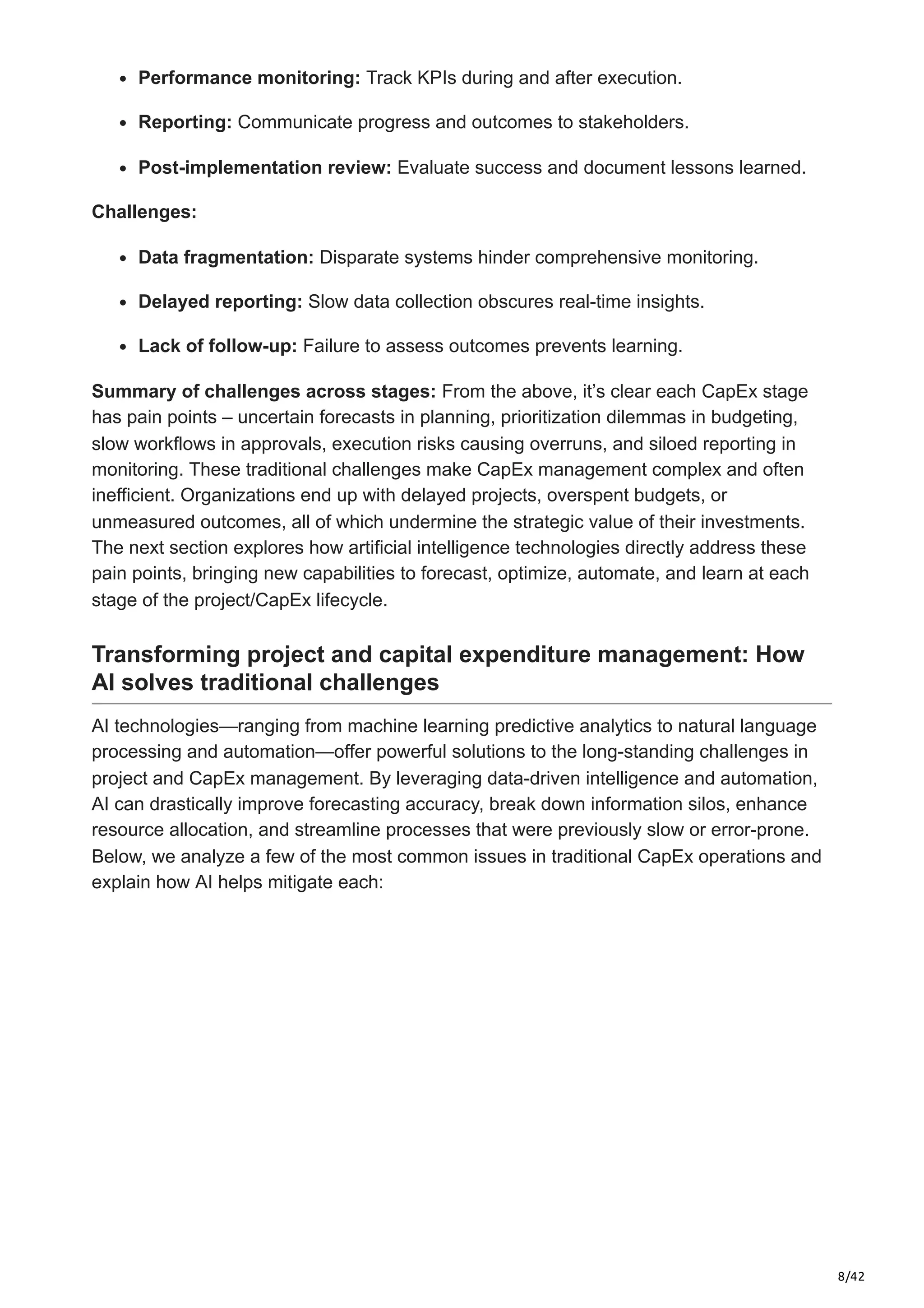
Transforming project and capital expenditure management: How
AI solves traditional challenges
AI technologies—ranging from machine learning predictive analytics to natural language
processing and automation—offer powerful solutions to the long-standing challenges in
project and CapEx management. By leveraging data-driven intelligence and automation,
AI can drastically improve forecasting accuracy, break down information silos, enhance
resource allocation, and streamline processes that were previously slow or error-prone.
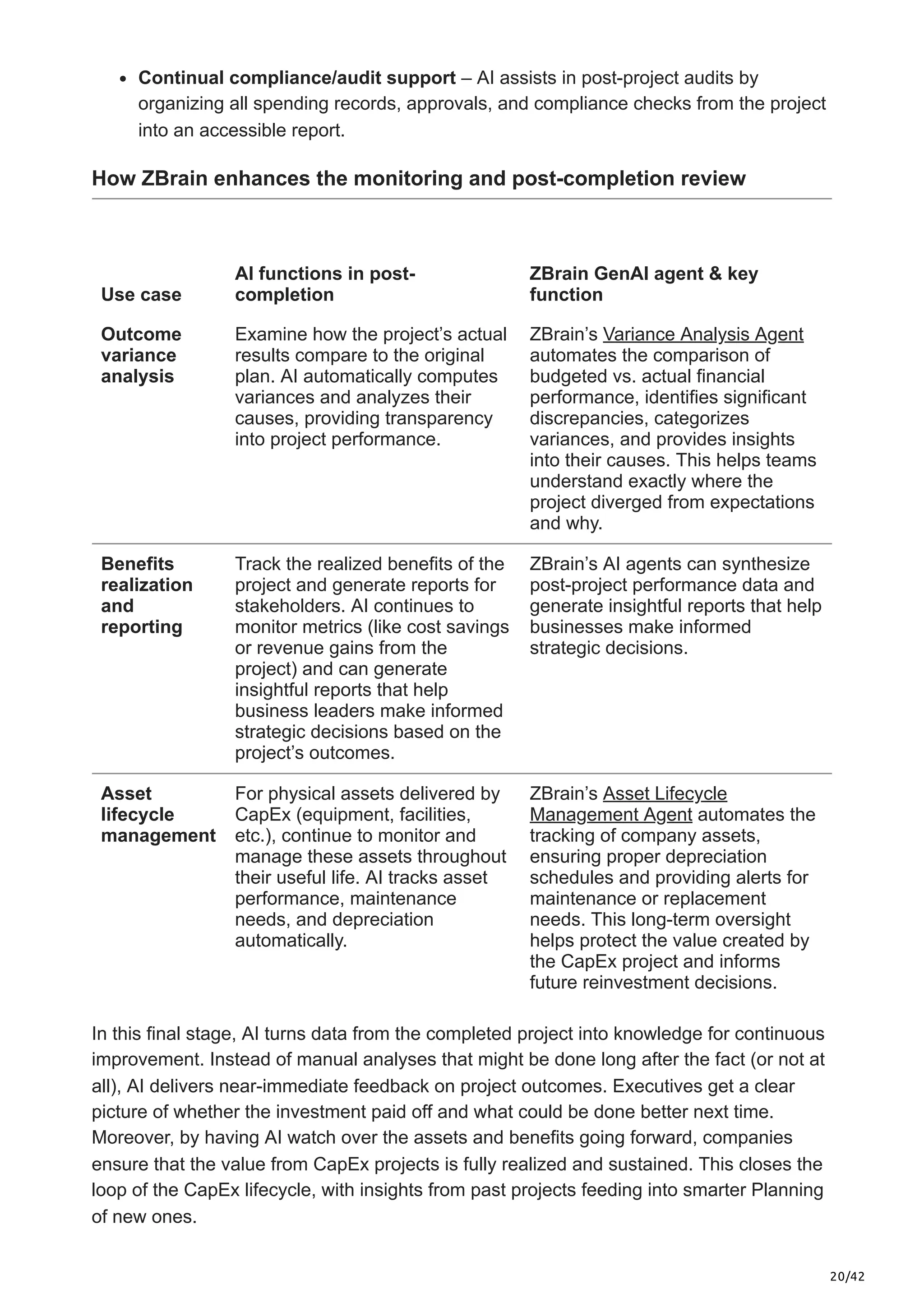
Below, we analyze a few of the most common issues in traditional CapEx operations and
explain how AI helps mitigate each:
9/42
Poor Forecasting
& Planning
Inaccurate forecasts &
overly optimistic plans
lead to project failures
Cost Overruns &
Schedule Delays
Traditional methods
detect issues too late
after damage has
occurred
Data Silos &
Visibility Gaps
Fragmented data across
systems hinders unified
view for decisions
Inefficient Resource
Allocation
Subjective allocation
processes prone to bias
and limited analysis
Manual Processes
and Slow Workflows
Manual, repetitive tasks
consume time and are
prone to errors
AI Solution
Advanced predictive analytics & machine learning analyze
historical data, market trends, and input costs for more
realistic project projections
AI Solution
Continuous monitoring & early risk detection by analyzing
real-time project data for proactive interventions
AI Solution
Integrates & analyzes data from disparate sources,
including unstructured data, providing real-time
visibility
AI Solution
Advanced analytics and optimization algorithms
objectively evaluate project proposals and
allocate resources effectively
AI Solution
AI automates routine tasks and streamlines workflows,
reducing errors and accelerating processes, thereby
enhancing overall efficiency.
Transforming project and capital expenditur
management: How AI solves traditional challenges
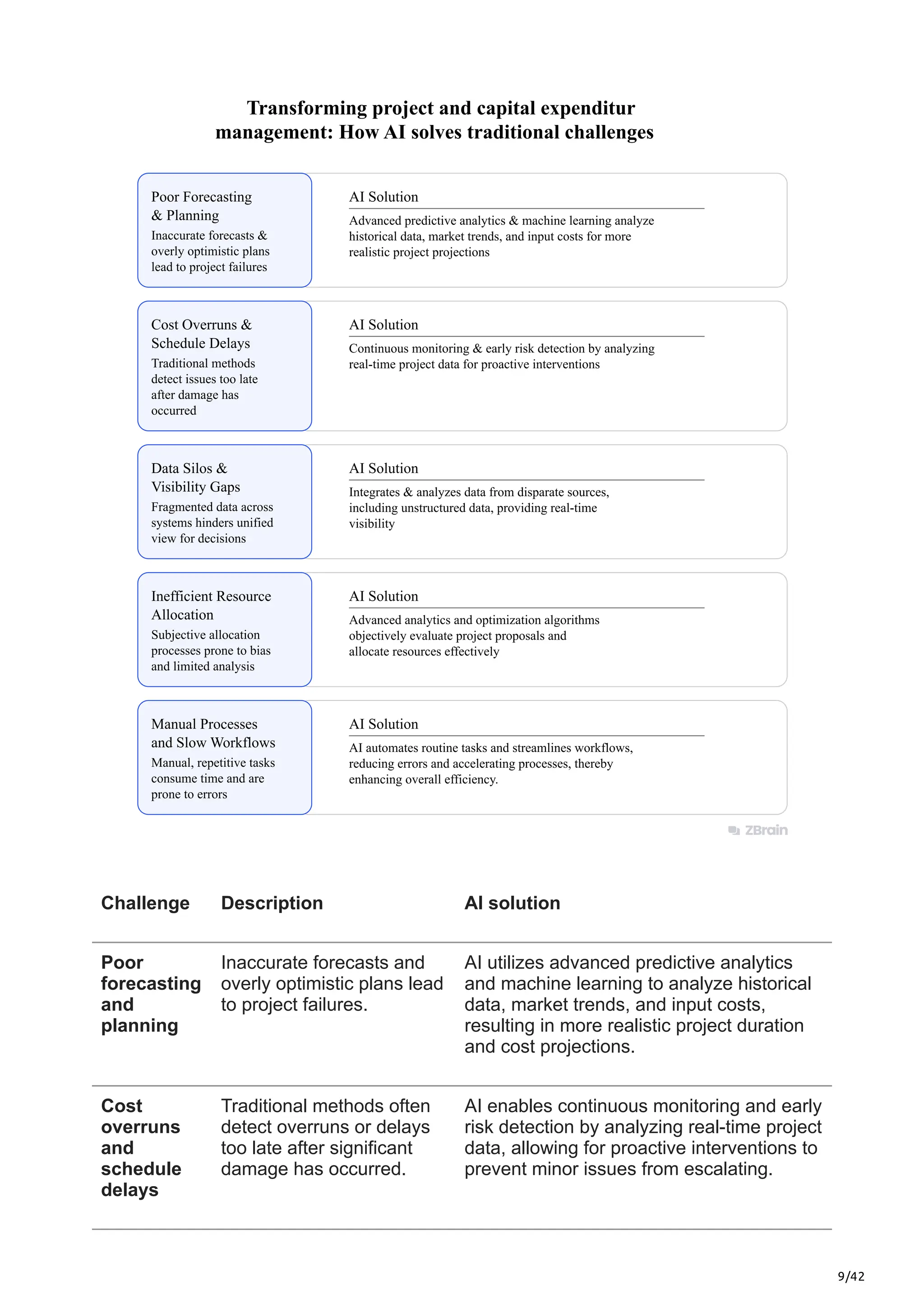
Challenge Description AI solution
Poor
forecasting
and
planning
Inaccurate forecasts and
overly optimistic plans lead
to project failures.
AI utilizes advanced predictive analytics
and machine learning to analyze historical
data, market trends, and input costs,
resulting in more realistic project duration
and cost projections.
Cost
overruns
and
schedule
delays
Traditional methods often
detect overruns or delays
too late after significant
damage has occurred.
AI enables continuous monitoring and early
risk detection by analyzing real-time project
data, allowing for proactive interventions to
prevent minor issues from escalating.
10/42
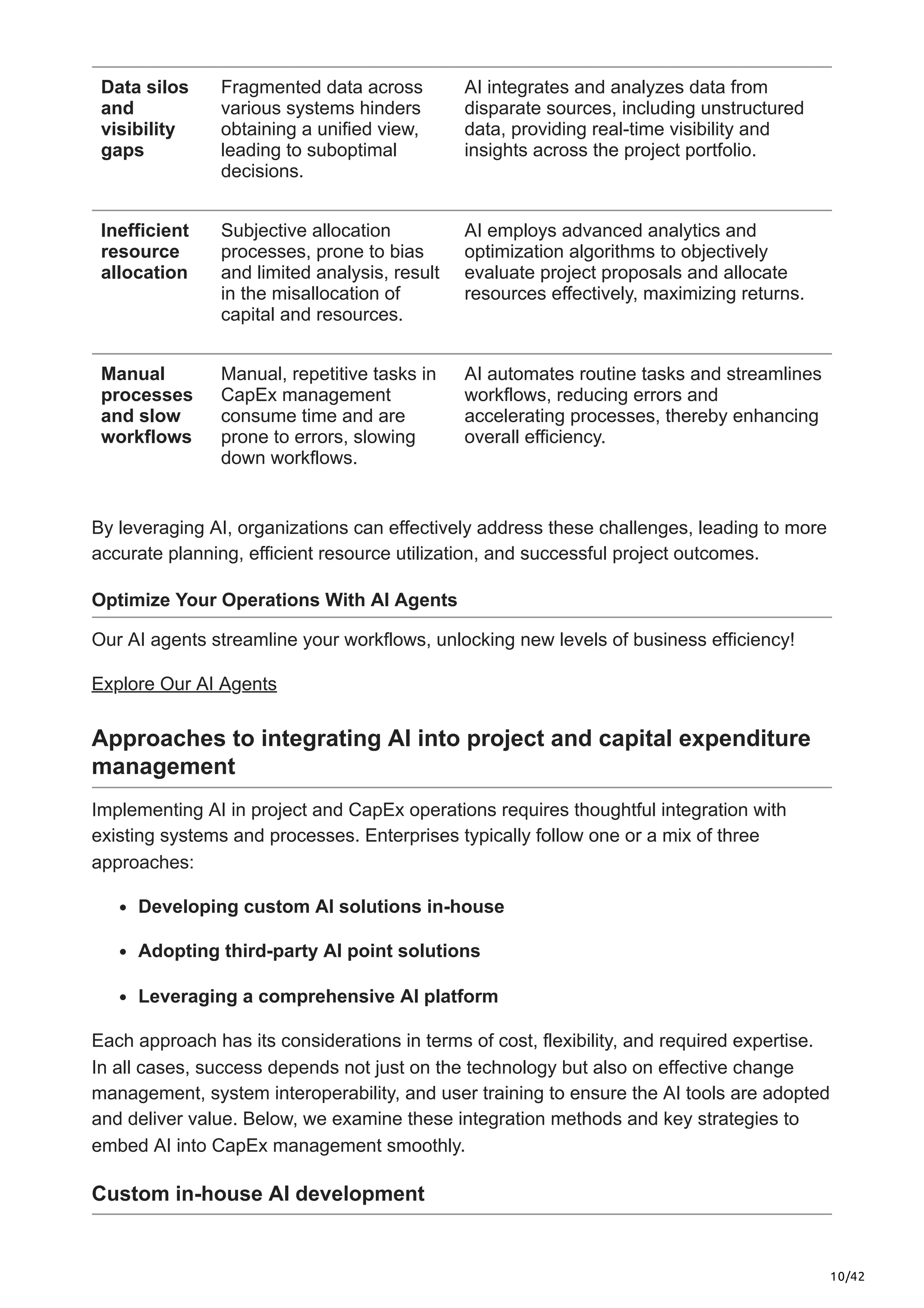
Data silos
and
visibility
gaps
Fragmented data across
various systems hinders
obtaining a unified view,
leading to suboptimal
decisions.
AI integrates and analyzes data from
disparate sources, including unstructured
data, providing real-time visibility and
insights across the project portfolio.
Inefficient
resource
allocation
Subjective allocation
processes, prone to bias
and limited analysis, result
in the misallocation of
capital and resources.
AI employs advanced analytics and
optimization algorithms to objectively
evaluate project proposals and allocate
resources effectively, maximizing returns.
Manual
processes
and slow
workflows
Manual, repetitive tasks in
CapEx management
consume time and are
prone to errors, slowing
down workflows.
AI automates routine tasks and streamlines
workflows, reducing errors and
accelerating processes, thereby enhancing
overall efficiency.
By leveraging AI, organizations can effectively address these challenges, leading to more
accurate planning, efficient resource utilization, and successful project outcomes.
Optimize Your Operations With AI Agents
Our AI agents streamline your workflows, unlocking new levels of business efficiency!
Explore Our AI Agents
Approaches to integrating AI into project and capital expenditure
management
Implementing AI in project and CapEx operations requires thoughtful integration with
existing systems and processes. Enterprises typically follow one or a mix of three
approaches:
Developing custom AI solutions in-house
Adopting third-party AI point solutions
Leveraging a comprehensive AI platform
Each approach has its considerations in terms of cost, flexibility, and required expertise.
In all cases, success depends not just on the technology but also on effective change
management, system interoperability, and user training to ensure the AI tools are adopted
and deliver value. Below, we examine these integration methods and key strategies to
embed AI into CapEx management smoothly.
Custom in-house AI development
11/42
Developing AI solutions internally allows organizations to tailor systems precisely to their
unique CapEx workflows and data environments. This approach enables the creation of
bespoke tools that automate resource forecasting, align execution with strategic goals,
and track performance effectively.
Key benefits include:
Strategic customization: AI models can be designed to meet specific
requirements, such as aligning budget forecasts with operational milestones or
modeling dynamic resource allocation.
Full control and compliance: In-house development ensures complete oversight
of data flows, aiding in regulatory compliance and the protection of sensitive
operational data.
Scalability: Custom solutions can evolve alongside organizational needs,
supporting new performance indicators and adapting to changing business
processes.
By accurately forecasting resource needs and aligning execution with strategic plans,
custom AI solutions enhance clarity and drive measurable performance improvements.
AI point solutions (Third-party tools)
Integrating specialized third-party AI tools into specific CapEx functions offers a practical
alternative to in-house development. These solutions, often ready-to-use or requiring
minimal configuration, provide expertise and speed in deployment.
Advantages include:
Speed and expertise: Rapid deployment is possible, leveraging industry best
practices embedded within the tools.
Cost-effectiveness: Licensing software can be more economical than funding an
internal AI development team.
Integration capabilities: Many point solutions offer APIs for seamless integration
with existing enterprise systems, such as ERP and project management platforms.
However, it’s essential to manage potential integration challenges and ensure that
multiple tools do not create new data silos. Evaluating interoperability and user
experience is crucial to maximize the benefits of AI point solutions.
Comprehensive AI platforms
Adopting an end-to-end AI platform like ZBrain provides a unified suite of capabilities for
CapEx management, encompassing data integration, analytics, automation, and decision
support. These platforms offer:
12/42
Integration and breadth: A cohesive environment that consolidates various AI
functionalities, ensuring a single source of truth and simplifying maintenance.
Scalability and future-proofing: Designed to grow with the organization, these
platforms allow for expansion into other areas beyond CapEx, such as finance or
operations.
Customization and flexibility: Many platforms enable the development of
additional AI models using built-in tools, offering a balance between tailored
solutions and supported frameworks.
Selecting the appropriate approach depends on factors such as organizational size,
specific needs, resource availability, and long-term strategic goals. Each method offers
distinct pathways to harness AI’s potential in enhancing CapEx management efficiency
and effectiveness.
AI applications transforming project and capital expenditure
management
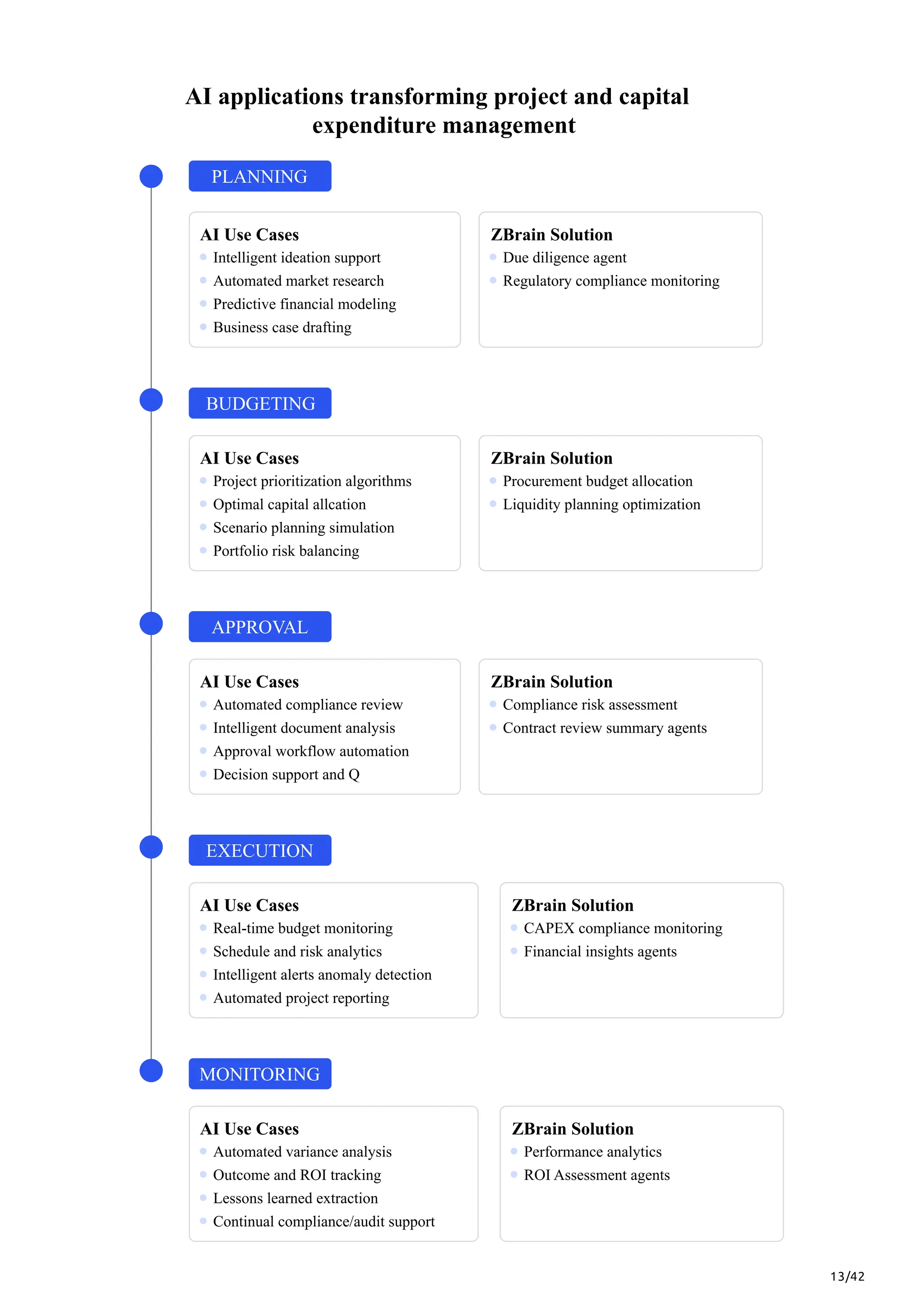
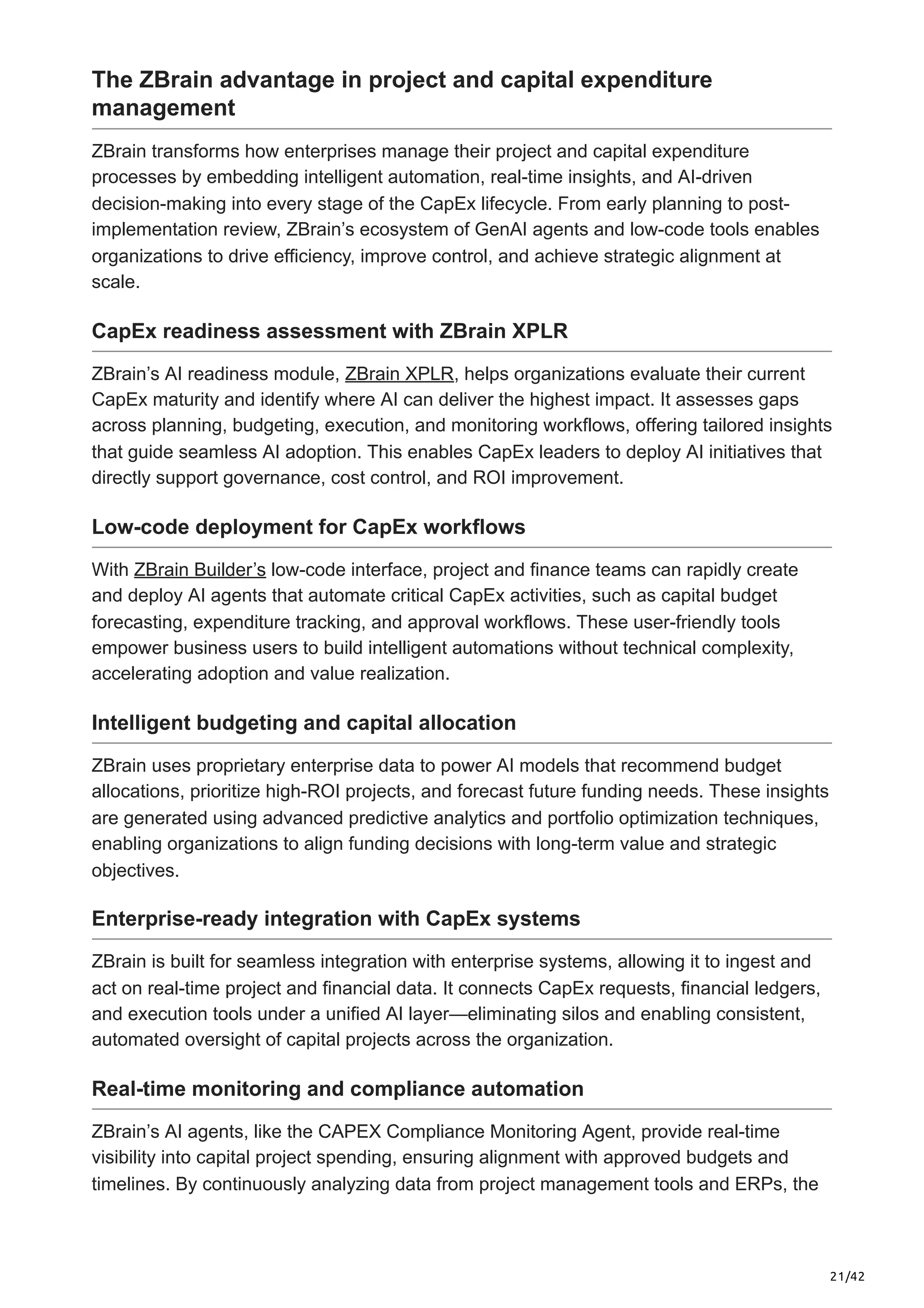
Adopting AI across the capital expenditure (CapEx) lifecycle can radically improve how
organizations plan, execute, and evaluate big investments. From brainstorming project
ideas to reviewing outcomes, AI brings data-driven insights and automation to each
phase. Enterprise-grade generative AI platforms like ZBrain allow companies to deploy
specialized AI agents for finance that streamline CapEx processes end-to-end.
13/42
AI applications transforming project and capital
expenditure management
BUDGETING
APPROVAL
EXECUTION
MONITORING
PLANNING
AI Use Cases
AI Use Cases
AI Use Cases
AI Use Cases
AI Use Cases
ZBrain Solution
ZBrain Solution
ZBrain Solution
ZBrain Solution
ZBrain Solution
Intelligent ideation support
Project prioritization algorithms
Automated compliance review
Real-time budget monitoring
Automated variance analysis
Due diligence agent
Procurement budget allocation
Compliance risk assessment
CAPEX compliance monitoring
Performance analytics
Automated market research
Optimal capital allcation
Intelligent document analysis
Schedule and risk analytics
Outcome and ROI tracking
Regulatory compliance monitoring
Liquidity planning optimization
Contract review summary agents
Financial insights agents
ROI Assessment agents
Predictive financial modeling
Scenario planning simulation
Approval workflow automation
Intelligent alerts anomaly detection
Lessons learned extraction
Business case drafting
Portfolio risk balancing
Decision support and Q
Automated project reporting
Continual compliance/audit support
14/42
Stage 1: Planning (Ideation and business case development)
In the planning stage, organizations identify potential projects and build the business case
for investment. AI supercharges this phase by expanding ideation, accelerating research,
and strengthening the quality of analysis behind each proposal. Generative AI can sift
through vast internal data and external market information to uncover patterns or
opportunities that humans might miss. It can also forecast financial outcomes and risks
early on, helping teams refine project ideas before they reach decision makers. By using
AI in planning, companies develop more robust business cases grounded in data and
predictive insights, improving confidence that chosen projects will succeed.
AI applications in planning include:
Intelligent ideation support – AI brainstorms project ideas or improvements based
on past project data and emerging trends.
Automated market and feasibility research – NLP agents gather and summarize
industry research, benchmarks, and regulations to inform the business case.
Predictive financial modeling – AI forecasts project ROI, cash flows, and risk
scenarios using historical data and machine learning.
Business case drafting assistance – Generative AI helps write proposal
documents, creating executive summaries and highlighting key insights.
How ZBrain enhances the planning for project and capital expenditure
management
Use case
AI functions in CapEx
planning
ZBrain GenAI agent & key
function
Ideation and
research
Generate and evaluate project
ideas by analyzing internal
knowledge and external
market data.
ZBrain AI agents can aggregate
and analyze data to enhance due
diligence assessments, allowing
teams to make informed, data-
driven decisions.
Regulatory
insight
integration
Ensure early-stage ideas align
with regulatory requirements
and policies. AI monitors
relevant laws or compliance
issues so the business case
addresses them upfront.
ZBrain’s Regulatory Compliance
Monitoring Agent offers real-time
insights into regulatory changes
relevant to the business, helping
mitigate compliance risks from the
start.
15/42
Use case
AI functions in CapEx
planning
ZBrain GenAI agent & key
function
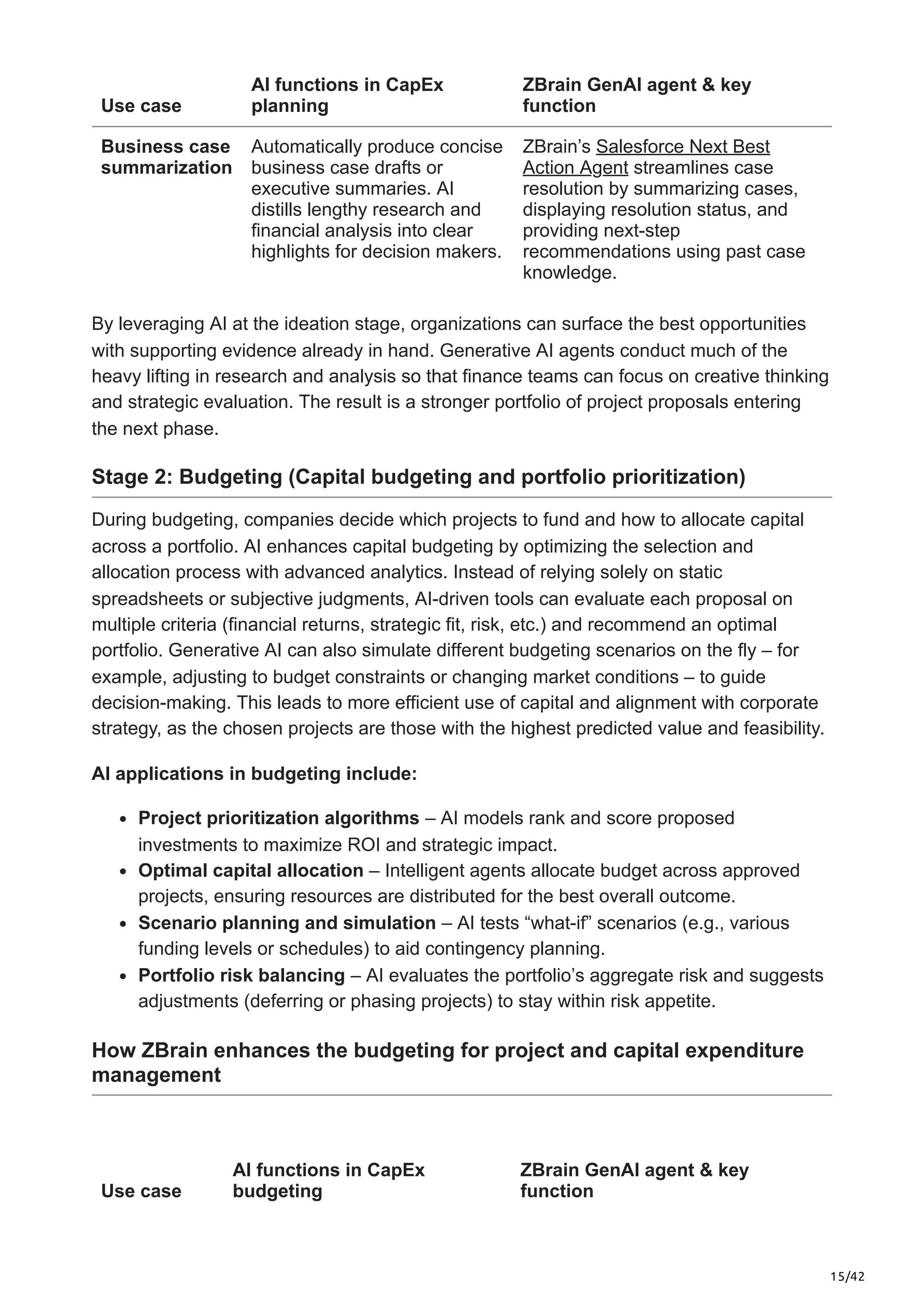
Business case
summarization
Automatically produce concise
business case drafts or
executive summaries. AI
distills lengthy research and
financial analysis into clear
highlights for decision makers.
ZBrain’s Salesforce Next Best
Action Agent streamlines case
resolution by summarizing cases,
displaying resolution status, and
providing next-step
recommendations using past case
knowledge.
By leveraging AI at the ideation stage, organizations can surface the best opportunities
with supporting evidence already in hand. Generative AI agents conduct much of the
heavy lifting in research and analysis so that finance teams can focus on creative thinking
and strategic evaluation. The result is a stronger portfolio of project proposals entering
the next phase.
Stage 2: Budgeting (Capital budgeting and portfolio prioritization)
During budgeting, companies decide which projects to fund and how to allocate capital
across a portfolio. AI enhances capital budgeting by optimizing the selection and
allocation process with advanced analytics. Instead of relying solely on static
spreadsheets or subjective judgments, AI-driven tools can evaluate each proposal on
multiple criteria (financial returns, strategic fit, risk, etc.) and recommend an optimal
portfolio. Generative AI can also simulate different budgeting scenarios on the fly – for
example, adjusting to budget constraints or changing market conditions – to guide
decision-making. This leads to more efficient use of capital and alignment with corporate
strategy, as the chosen projects are those with the highest predicted value and feasibility.
AI applications in budgeting include:
Project prioritization algorithms – AI models rank and score proposed
investments to maximize ROI and strategic impact.
Optimal capital allocation – Intelligent agents allocate budget across approved
projects, ensuring resources are distributed for the best overall outcome.
Scenario planning and simulation – AI tests “what-if” scenarios (e.g., various
funding levels or schedules) to aid contingency planning.
Portfolio risk balancing – AI evaluates the portfolio’s aggregate risk and suggests
adjustments (deferring or phasing projects) to stay within risk appetite.
How ZBrain enhances the budgeting for project and capital expenditure
management
Use case
AI functions in CapEx
budgeting
ZBrain GenAI agent & key
function
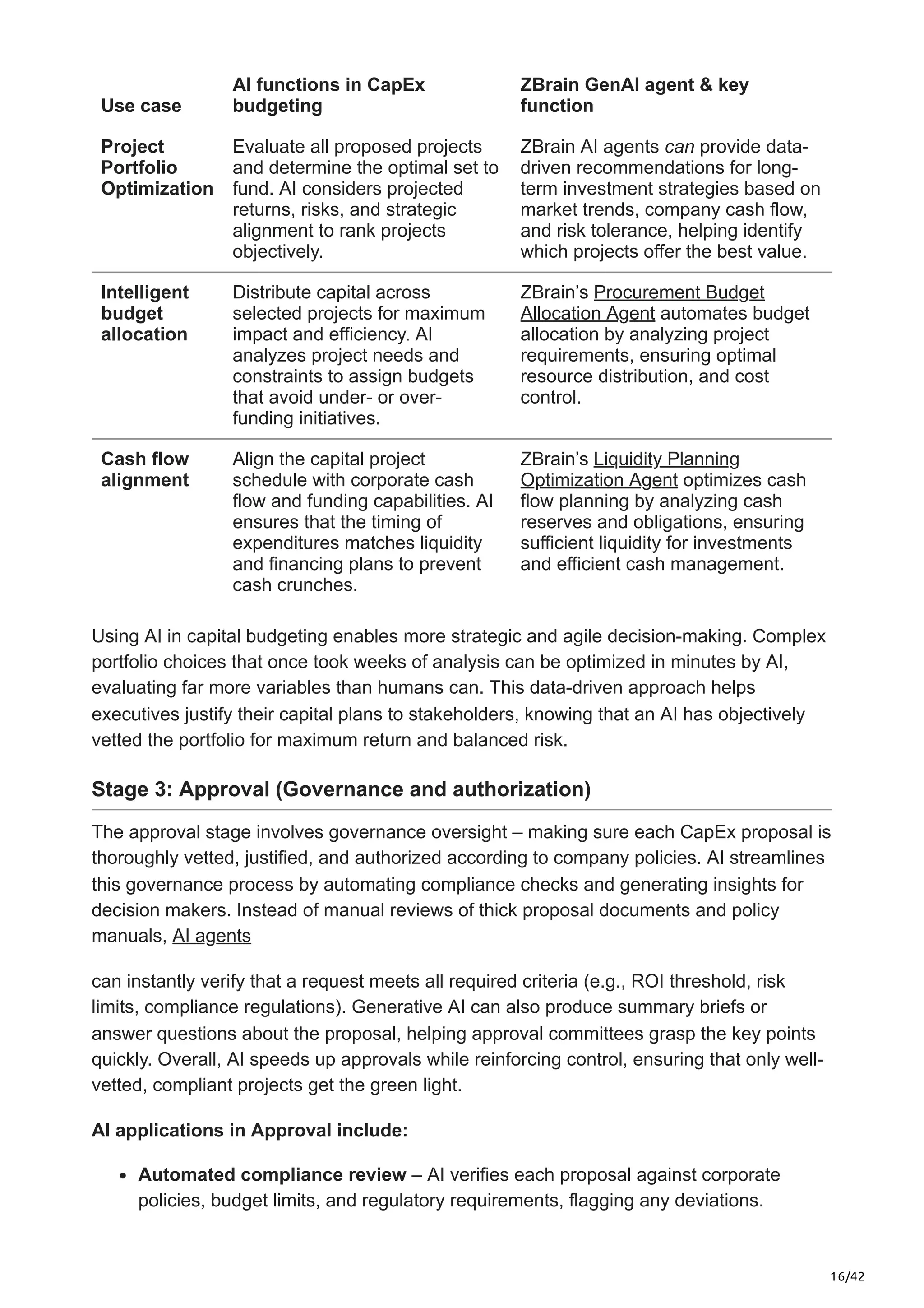
16/42
Use case
AI functions in CapEx
budgeting
ZBrain GenAI agent & key
function
Project
Portfolio
Optimization
Evaluate all proposed projects
and determine the optimal set to
fund. AI considers projected
returns, risks, and strategic
alignment to rank projects
objectively.
ZBrain AI agents can provide data-
driven recommendations for long-
term investment strategies based on
market trends, company cash flow,
and risk tolerance, helping identify
which projects offer the best value.
Intelligent
budget
allocation
Distribute capital across
selected projects for maximum
impact and efficiency. AI
analyzes project needs and
constraints to assign budgets
that avoid under- or over-
funding initiatives.
ZBrain’s Procurement Budget
Allocation Agent automates budget
allocation by analyzing project
requirements, ensuring optimal
resource distribution, and cost
control.
Cash flow
alignment
Align the capital project
schedule with corporate cash
flow and funding capabilities. AI
ensures that the timing of
expenditures matches liquidity
and financing plans to prevent
cash crunches.
ZBrain’s Liquidity Planning
Optimization Agent optimizes cash
flow planning by analyzing cash
reserves and obligations, ensuring
sufficient liquidity for investments
and efficient cash management.
Using AI in capital budgeting enables more strategic and agile decision-making. Complex
portfolio choices that once took weeks of analysis can be optimized in minutes by AI,
evaluating far more variables than humans can. This data-driven approach helps
executives justify their capital plans to stakeholders, knowing that an AI has objectively
vetted the portfolio for maximum return and balanced risk.
Stage 3: Approval (Governance and authorization)
The approval stage involves governance oversight – making sure each CapEx proposal is
thoroughly vetted, justified, and authorized according to company policies. AI streamlines
this governance process by automating compliance checks and generating insights for
decision makers. Instead of manual reviews of thick proposal documents and policy
manuals, AI agents
can instantly verify that a request meets all required criteria (e.g., ROI threshold, risk
limits, compliance regulations). Generative AI can also produce summary briefs or
answer questions about the proposal, helping approval committees grasp the key points
quickly. Overall, AI speeds up approvals while reinforcing control, ensuring that only well-
vetted, compliant projects get the green light.
AI applications in Approval include:
Automated compliance review – AI verifies each proposal against corporate
policies, budget limits, and regulatory requirements, flagging any deviations.
17/42
Intelligent document analysis – NLP agents read lengthy business case
documents and pull out critical information (financials, risks, commitments) for
reviewers.
Approval workflow automation – AI routes the CapEx request through the proper
approval chain, sends reminders to approvers, and tracks the status to prevent
bottlenecks.
Decision support and Q&A – Chatbot-style agents answer executives’ questions
about the proposal (e.g., “What’s the NPV?” or “Has risk considered new
regulations?”) by drawing on the underlying data.
How ZBrain enhances the approval for project and capital expenditure
management
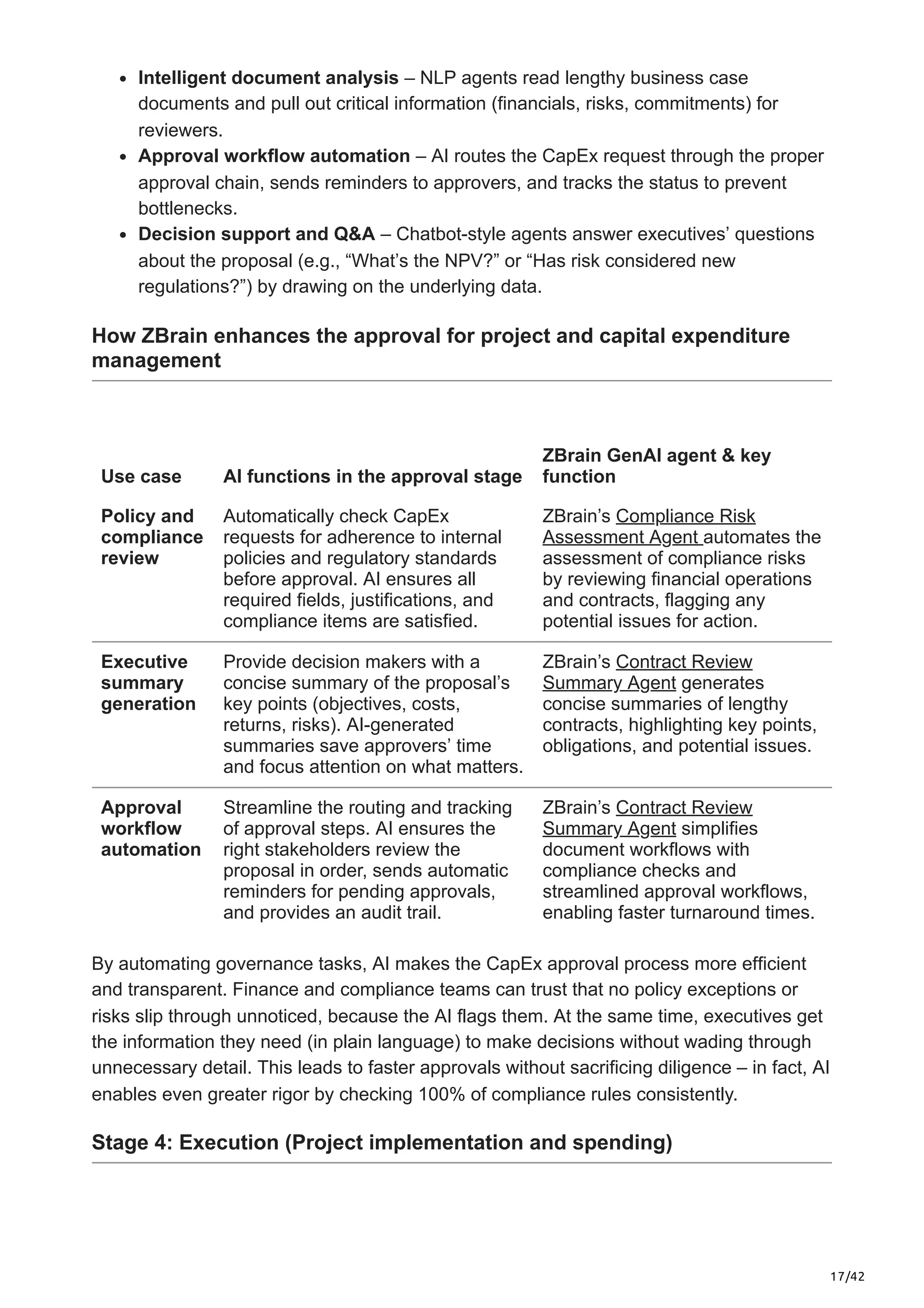
Use case AI functions in the approval stage
ZBrain GenAI agent & key
function
Policy and
compliance
review
Automatically check CapEx
requests for adherence to internal
policies and regulatory standards
before approval. AI ensures all
required fields, justifications, and
compliance items are satisfied.
ZBrain’s Compliance Risk
Assessment Agent automates the
assessment of compliance risks
by reviewing financial operations
and contracts, flagging any
potential issues for action.
Executive
summary
generation
Provide decision makers with a
concise summary of the proposal’s
key points (objectives, costs,
returns, risks). AI-generated
summaries save approvers’ time
and focus attention on what matters.
ZBrain’s Contract Review
Summary Agent generates
concise summaries of lengthy
contracts, highlighting key points,
obligations, and potential issues.
Approval
workflow
automation
Streamline the routing and tracking
of approval steps. AI ensures the
right stakeholders review the
proposal in order, sends automatic
reminders for pending approvals,
and provides an audit trail.
ZBrain’s Contract Review
Summary Agent simplifies
document workflows with
compliance checks and
streamlined approval workflows,
enabling faster turnaround times.
By automating governance tasks, AI makes the CapEx approval process more efficient
and transparent. Finance and compliance teams can trust that no policy exceptions or
risks slip through unnoticed, because the AI flags them. At the same time, executives get
the information they need (in plain language) to make decisions without wading through
unnecessary detail. This leads to faster approvals without sacrificing diligence – in fact, AI
enables even greater rigor by checking 100% of compliance rules consistently.
Stage 4: Execution (Project implementation and spending)
18/42
Once a project is approved and funded, the execution stage focuses on delivering the
project on time and on budget. AI plays a pivotal role here by monitoring project
performance in real time and aiding in proactive decision-making. AI agents can
automatically track spending vs. budget, schedule progress vs. plan, and even quality or
risk metrics, alerting project managers when something deviates from expectations.
Through predictive analytics, AI might forecast a cost overrun or schedule slip before it
fully materializes, enabling the team to course-correct early. Additionally, generative AI
can automate routine project reporting and documentation. This all leads to tighter control
over CapEx projects, reducing waste and increasing the chances of on-budget, on-time
completion.
AI applications in execution include:
Real-time budget monitoring – AI continuously reconciles project expenditures
against the approved budget, flagging overspend or underspend in any category.
Schedule and risk analytics – AI analyzes project schedules, resource utilization,
and external factors to predict delays or risks and recommend mitigations.
Intelligent alerts and anomaly detection – The system automatically notifies
managers of anomalies (e.g., sudden cost spikes, contractor delays) that need
attention.
Automated project reporting – AI generates periodic status reports for
stakeholders, summarizing progress, spend, and issues, which saves project
managers time on paperwork.
How ZBrain enhances the execution for project and capital expenditure
management
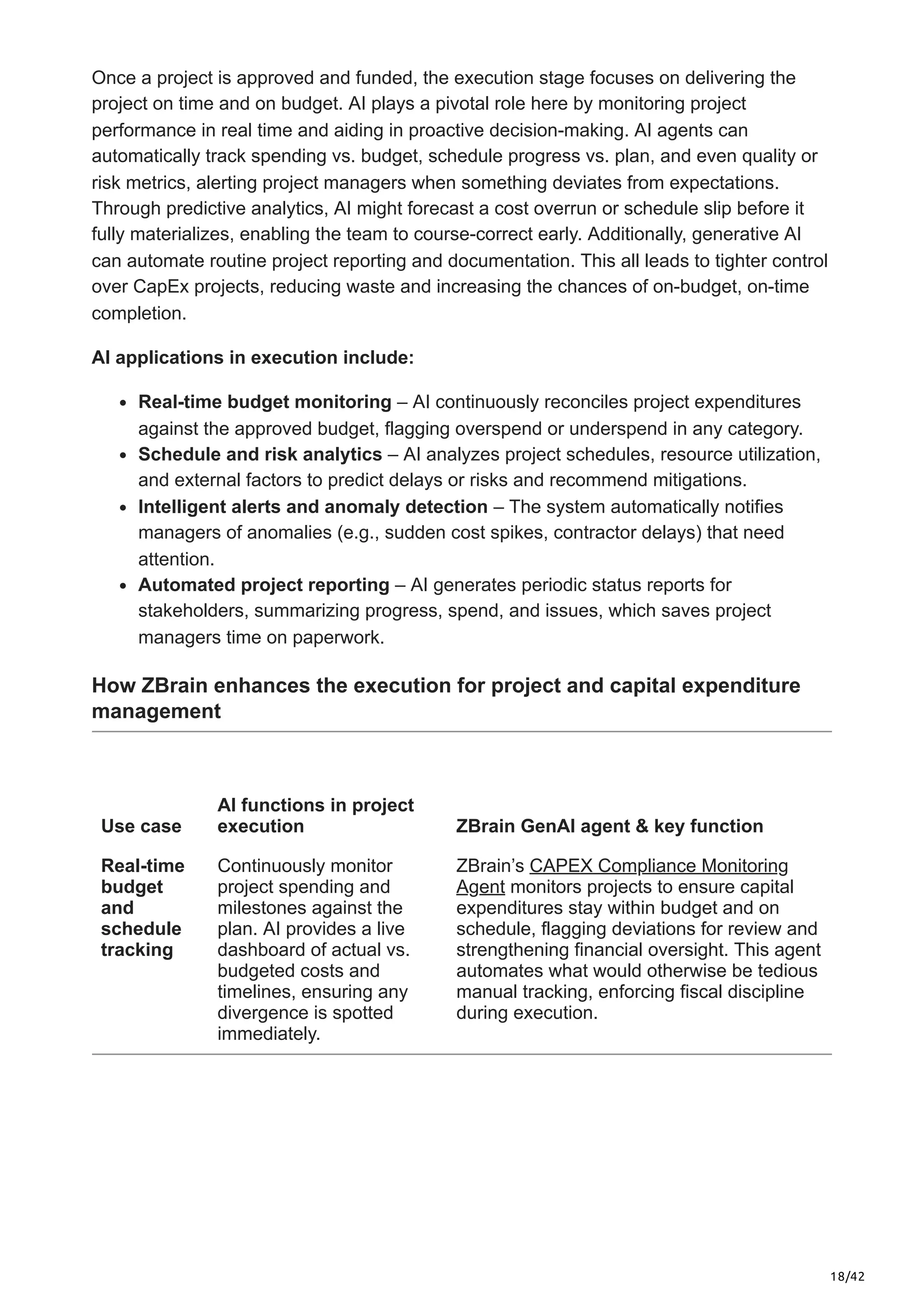
Use case
AI functions in project
execution ZBrain GenAI agent & key function
Real-time
budget
and
schedule
tracking
Continuously monitor
project spending and
milestones against the
plan. AI provides a live
dashboard of actual vs.
budgeted costs and
timelines, ensuring any
divergence is spotted
immediately.
ZBrain’s CAPEX Compliance Monitoring
Agent monitors projects to ensure capital
expenditures stay within budget and on
schedule, flagging deviations for review and
strengthening financial oversight. This agent
automates what would otherwise be tedious
manual tracking, enforcing fiscal discipline
during execution.
19/42
Use case
AI functions in project
execution ZBrain GenAI agent & key function
Automated
progress
reporting
Generate and distribute
project status reports
without manual effort. AI
collates data on
expenditures, progress,
and risks, then produces
an easy-to-read update for
stakeholders at regular
intervals.
ZBrain’s Financial Insights AI Agent
automates the analysis of complex
performance data (e.g., project KPIs) and
generates standardized reports with key
insights.
Through AI-driven execution management, organizations gain real-time visibility and
control over capital projects. Problems that traditionally might only be discovered in
hindsight (after budgets are blown or deadlines missed) can now be detected and
addressed in-flight. AI essentially acts as an ever-vigilant project analyst, ensuring the
implementation stays aligned with the plan or that adjustments are made quickly. This
leads to more predictable outcomes and fewer unpleasant surprises in major initiatives.
Stage 5: Monitoring and post-completion review
Even after a project is delivered, the CapEx lifecycle continues with monitoring and post-
completion review. In this stage, teams assess whether the project delivered the expected
benefits and draw lessons to improve future investments. AI enhances post-completion
reviews by automating the analysis of results and providing actionable insights. For
example, AI can compare planned vs. actual performance in detail – final costs vs.
budget, actual ROI vs. projected ROI, timeline adherence, etc. – to explain any variances.
Generative AI can compile post-mortem reports and even suggest recommendations
(e.g., “Project X exceeded budget due to vendor costs – consider renegotiating contracts
next time”). Furthermore, AI systems can continue to monitor the asset or outcome
produced by the project (such as the performance of a new facility or system) and alert
management if expected benefits are not being realized. This ensures the company
maximizes value from its CapEx and continuously improves its CapEx process with data-
driven feedback.
AI applications in monitoring and review include:
Automated variance analysis – AI calculates budget vs. actual variances across
cost categories and schedule, pinpointing exactly where and why deviations
occurred.
Outcome and ROI tracking – Once the asset is operational, AI tracks key
performance indicators (revenues, cost savings, utilization) against the business
case to verify the ROI.
Lessons learned extraction – NLP agents digest project documentation (reports,
meeting notes) to extract recurring issues or best practices to inform future projects.
20/42
Continual compliance/audit support – AI assists in post-project audits by
organizing all spending records, approvals, and compliance checks from the project
into an accessible report.
How ZBrain enhances the monitoring and post-completion review
Use case
AI functions in post-
completion
ZBrain GenAI agent & key
function
Outcome
variance
analysis
Examine how the project’s actual
results compare to the original
plan. AI automatically computes
variances and analyzes their
causes, providing transparency
into project performance.
ZBrain’s Variance Analysis Agent
automates the comparison of
budgeted vs. actual financial
performance, identifies significant
discrepancies, categorizes
variances, and provides insights
into their causes. This helps teams
understand exactly where the
project diverged from expectations
and why.
Benefits
realization
and
reporting
Track the realized benefits of the
project and generate reports for
stakeholders. AI continues to
monitor metrics (like cost savings
or revenue gains from the
project) and can generate
insightful reports that help
business leaders make informed
strategic decisions based on the
project’s outcomes.
ZBrain’s AI agents can synthesize
post-project performance data and
generate insightful reports that help
businesses make informed
strategic decisions.
Asset
lifecycle
management
For physical assets delivered by
CapEx (equipment, facilities,
etc.), continue to monitor and
manage these assets throughout
their useful life. AI tracks asset
performance, maintenance
needs, and depreciation
automatically.
ZBrain’s Asset Lifecycle
Management Agent automates the
tracking of company assets,
ensuring proper depreciation
schedules and providing alerts for
maintenance or replacement
needs. This long-term oversight
helps protect the value created by
the CapEx project and informs
future reinvestment decisions.
In this final stage, AI turns data from the completed project into knowledge for continuous
improvement. Instead of manual analyses that might be done long after the fact (or not at
all), AI delivers near-immediate feedback on project outcomes. Executives get a clear
picture of whether the investment paid off and what could be done better next time.
Moreover, by having AI watch over the assets and benefits going forward, companies
ensure that the value from CapEx projects is fully realized and sustained. This closes the
loop of the CapEx lifecycle, with insights from past projects feeding into smarter Planning
of new ones.
21/42
The ZBrain advantage in project and capital expenditure
management
ZBrain transforms how enterprises manage their project and capital expenditure
processes by embedding intelligent automation, real-time insights, and AI-driven
decision-making into every stage of the CapEx lifecycle. From early planning to post-
implementation review, ZBrain’s ecosystem of GenAI agents and low-code tools enables
organizations to drive efficiency, improve control, and achieve strategic alignment at
scale.
CapEx readiness assessment with ZBrain XPLR
ZBrain’s AI readiness module, ZBrain XPLR, helps organizations evaluate their current
CapEx maturity and identify where AI can deliver the highest impact. It assesses gaps
across planning, budgeting, execution, and monitoring workflows, offering tailored insights
that guide seamless AI adoption. This enables CapEx leaders to deploy AI initiatives that
directly support governance, cost control, and ROI improvement.
Low-code deployment for CapEx workflows
With ZBrain Builder’s low-code interface, project and finance teams can rapidly create
and deploy AI agents that automate critical CapEx activities, such as capital budget
forecasting, expenditure tracking, and approval workflows. These user-friendly tools
empower business users to build intelligent automations without technical complexity,
accelerating adoption and value realization.
Intelligent budgeting and capital allocation
ZBrain uses proprietary enterprise data to power AI models that recommend budget
allocations, prioritize high-ROI projects, and forecast future funding needs. These insights
are generated using advanced predictive analytics and portfolio optimization techniques,
enabling organizations to align funding decisions with long-term value and strategic
objectives.
Enterprise-ready integration with CapEx systems
ZBrain is built for seamless integration with enterprise systems, allowing it to ingest and
act on real-time project and financial data. It connects CapEx requests, financial ledgers,
and execution tools under a unified AI layer—eliminating silos and enabling consistent,
automated oversight of capital projects across the organization.
Real-time monitoring and compliance automation
ZBrain’s AI agents, like the CAPEX Compliance Monitoring Agent, provide real-time
visibility into capital project spending, ensuring alignment with approved budgets and
timelines. By continuously analyzing data from project management tools and ERPs, the
22/42
agent detects anomalies early, enforces policy adherence, and flags financial risks—
helping prevent overspending, delays, or non-compliance.
Continuous performance tracking and review
ZBrain equips organizations with tools to monitor and evaluate project outcomes post-
completion. Agents like the Variance Analysis Agent and Financial Insights Agent
automatically analyze cost, schedule, and ROI variances—providing finance leaders with
actionable feedback for continuous improvement. These insights inform future planning
and help build a smarter, more agile CapEx cycle.
Flexible data ingestion and reporting
ZBrain’s architecture supports real-time ingestion of structured and unstructured data
from multiple systems. This flexibility ensures project managers and finance teams have
access to up-to-date dashboards, automated reports, and natural language summaries
highlighting budget health, progress status, and performance trends—all accessible
through conversational AI interfaces.
Intelligent agent ecosystem for end-to-end CapEx execution
ZBrain’s pre-built and customizable agents automate key CapEx tasks—such as budget
reviews, policy compliance checks, project tracking, and audit preparation. These agents
work independently or in orchestration, executing workflows with minimal human
intervention while ensuring data integrity and governance throughout the lifecycle.
Optimize Your Operations With AI Agents
Our AI agents streamline your workflows, unlocking new levels of business efficiency!
Explore Our AI Agents
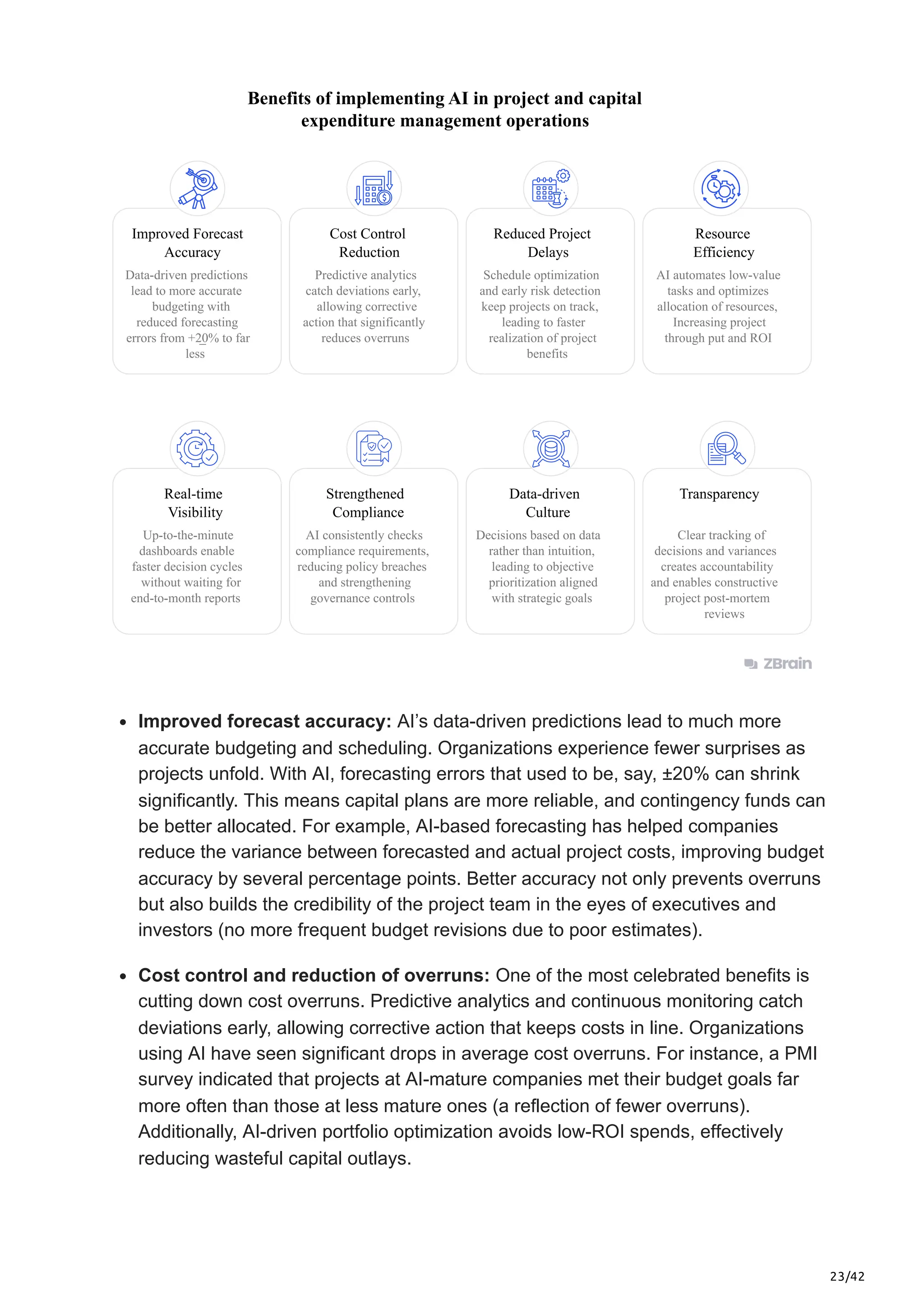
Benefits of implementing AI in project and capital expenditure
management operations
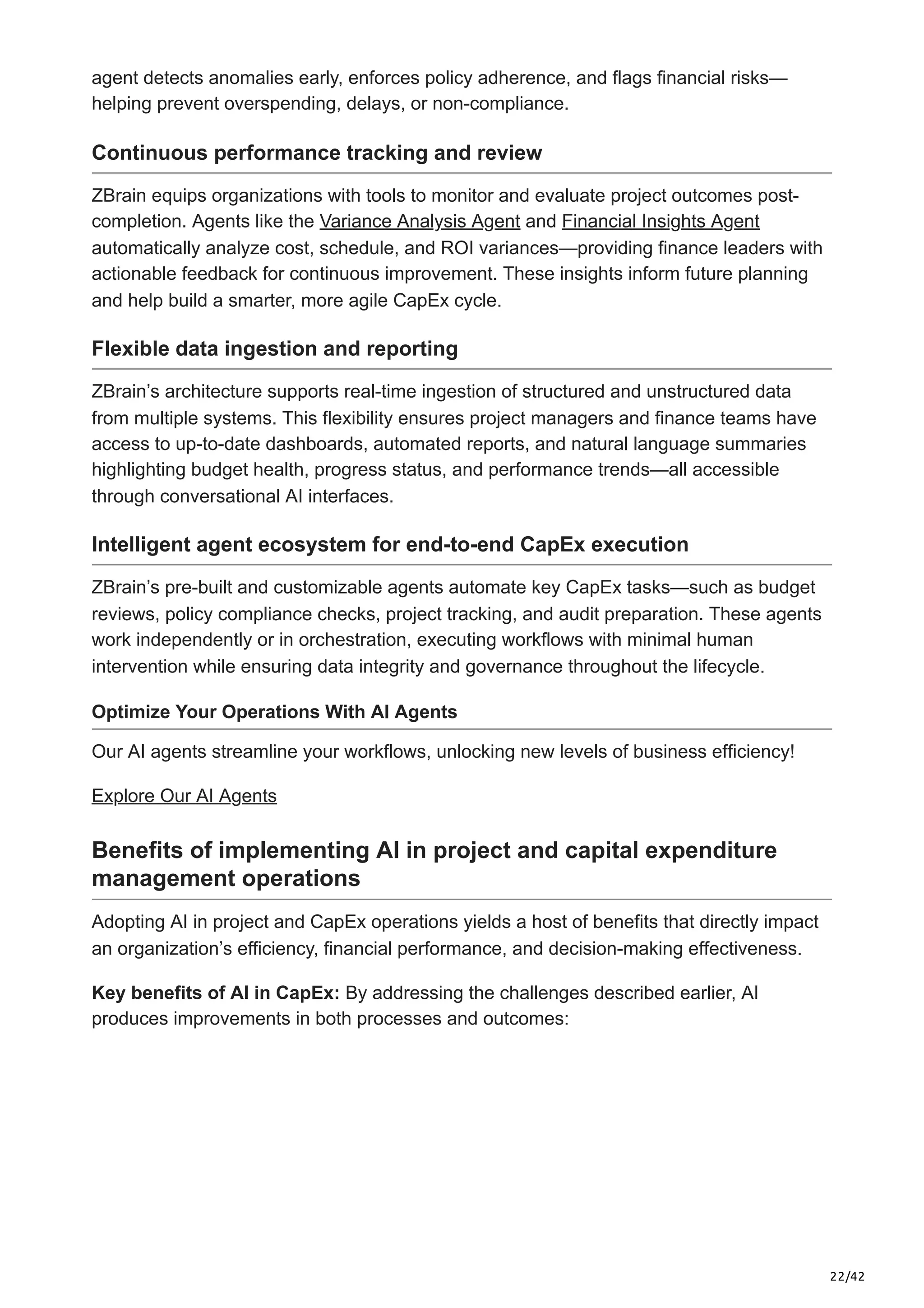
Adopting AI in project and CapEx operations yields a host of benefits that directly impact
an organization’s efficiency, financial performance, and decision-making effectiveness.
Key benefits of AI in CapEx: By addressing the challenges described earlier, AI
produces improvements in both processes and outcomes:
23/42
Benefits of implementing AI in project and capital
expenditure management operations
Improved Forecast
Accuracy
Data-driven predictions
lead to more accurate
budgeting with
reduced forecasting
errors from +20% to far
less
_
Cost Control
Reduction
Predictive analytics
catch deviations early,
allowing corrective
action that significantly
reduces overruns
Resource
Efficiency
AI automates low-value
tasks and optimizes
allocation of resources,
Increasing project
through put and ROI
Schedule optimization
and early risk detection
keep projects on track,
leading to faster
realization of project
benefits
Reduced Project
Delays
Real-time
Visibility
Up-to-the-minute
dashboards enable
faster decision cycles
without waiting for
end-to-month reports
Strengthened
Compliance
AI consistently checks
compliance requirements,
reducing policy breaches
and strengthening
governance controls
Data-driven
Culture
Decisions based on data
rather than intuition,
leading to objective
prioritization aligned
with strategic goals
Transparency
Clear tracking of
decisions and variances
creates accountability
and enables constructive
project post-mortem
reviews
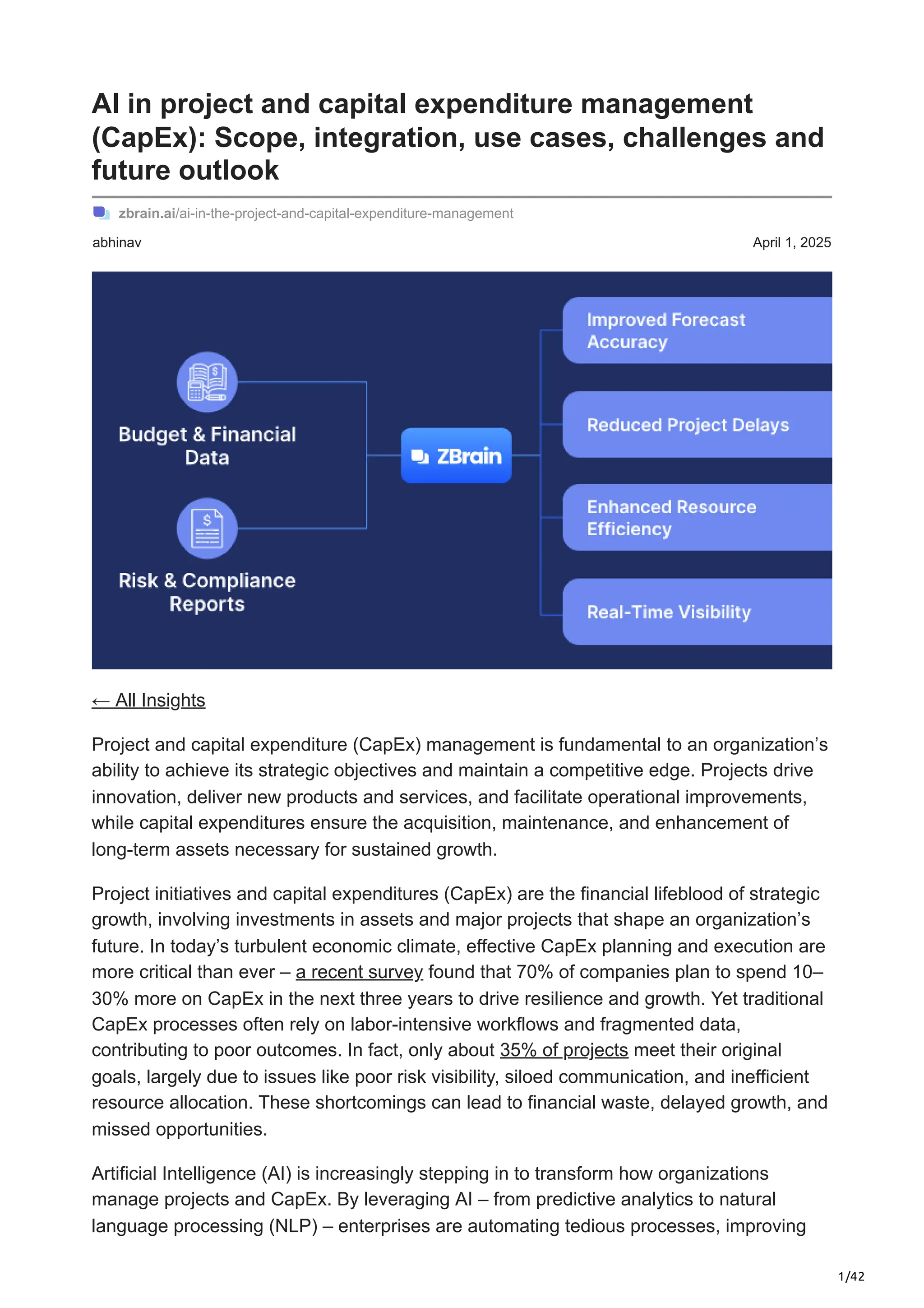
Improved forecast accuracy: AI’s data-driven predictions lead to much more
accurate budgeting and scheduling. Organizations experience fewer surprises as
projects unfold. With AI, forecasting errors that used to be, say, ±20% can shrink
significantly. This means capital plans are more reliable, and contingency funds can
be better allocated. For example, AI-based forecasting has helped companies
reduce the variance between forecasted and actual project costs, improving budget
accuracy by several percentage points. Better accuracy not only prevents overruns
but also builds the credibility of the project team in the eyes of executives and
investors (no more frequent budget revisions due to poor estimates).
Cost control and reduction of overruns: One of the most celebrated benefits is
cutting down cost overruns. Predictive analytics and continuous monitoring catch
deviations early, allowing corrective action that keeps costs in line. Organizations
using AI have seen significant drops in average cost overruns. For instance, a PMI
survey indicated that projects at AI-mature companies met their budget goals far
more often than those at less mature ones (a reflection of fewer overruns).
Additionally, AI-driven portfolio optimization avoids low-ROI spends, effectively
reducing wasteful capital outlays.
24/42
Reduced project delays: AI’s schedule optimization and risk mitigation features
help keep projects on or ahead of schedule. Early risk detection (like forecasting
weather impacts or resource conflicts) enables teams to take action that prevents
delays. As a result, schedule adherence improves. Fewer delays also mean earlier
realization of benefits – for revenue-generating projects, this can hasten revenue by
weeks or months. Moreover, avoiding delays helps avoid penalty costs or expedited
shipping/overtime costs often accompanying last-minute rushes. In short, AI
contributes to timely project delivery, supporting dependable strategic execution.
Enhanced resource efficiency: Automation and analytics ensure that human and
financial resources are used where they add the most value. AI can automate low-
value tasks (data entry, report generation), effectively multiplying the productivity of
the team. For example, AI might show that a project is likely to come in under
budget, prompting a company to redirect the surplus to another needed project in
the same fiscal year – something that might not be caught in time otherwise.
Overall, resources (money, people, equipment) are optimized, yielding higher
throughput of projects for the same input.
Real-time visibility and decision speed: AI provides real-time dashboards and
alerts, giving decision-makers up-to-the-minute information. This immediacy leads
to faster decision-making cycles. Instead of waiting for end-of-month reports,
managers can pivot mid-month if needed. Real-time reporting also enhances control
– any issues are immediately known and can be escalated. The benefit is a more
agile management of CapEx. Executives have on-demand insight into capital
deployment. This speeds up not only responses to problems but also the ability to
seize opportunities (for instance, recognizing underspend and accelerating another
project mid-year). Quick, well-informed decisions help keep the portfolio optimized
continuously, not just at quarterly intervals.
Strengthened compliance and governance: AI doesn’t get tired or overlook
things – it will check compliance requirements consistently. This leads to better
adherence to internal policies (like spending limits, required approvals) and external
regulations (like capitalization rules, budgeting laws in the public sector).
Companies benefit from fewer compliance breaches. For example, an AI agent that
ensures every CapEx request has the proper approvals can virtually eliminate
cases of unauthorized spending. Similarly, AI can ensure accurate categorization of
expenses as CapEx vs. OpEx according to accounting standards, avoiding audit
findings. Stronger governance through AI builds stakeholder confidence (e.g., the
board can trust that CapEx is under control) and can prevent costly issues like fines
or project shutdowns due to compliance failure. Essentially, AI acts as a compliance
guardrail, reducing risk.
25/42
Data-driven culture and strategic alignment: Over time, the use of AI fosters a
more data-driven decision culture in the CapEx domain. Project proposals and
decisions start to lean on data and AI insights rather than solely past experience or
intuition. This often results in more objective prioritization and a closer tie to
strategic goals, because AI can continuously evaluate how each project contributes
to key objectives. We see benefits like improved alignment of CapEx with strategy –
e.g., if AI highlights that a project has a low alignment score, it forces a conversation
about strategic fit, ensuring capital is spent where it supports the company’s
direction. Intangibly, this leads to better strategic outcomes from CapEx investments
(the right projects get done).
Transparency and accountability: With AI tracking and logging recommendations
and variances, there’s a clear record of what happened and why. This transparency
means it’s easier to hold teams accountable (in a fair way) and to have constructive
post-project reviews. For instance, if a project still goes over budget, AI logs might
show that it alerted management at the 80% mark, but the issue wasn’t fully
addressed, providing a learning point. Or it might show that even with AI
predictions, an unforeseeable event occurred, helping refine models. In either case,
the organization learns and individuals have data to discuss rather than
blamestorming. This can improve trust in the process and among team members,
as decisions were based on objective analysis and everyone had visibility.
Collectively, these benefits translate into significant ROI for AI in CapEx. They hit both
quantitative aspects (cost savings, more projects delivered per year, increased ROI on
investments, reduced labor hours, etc.) and qualitative improvements (better decision
quality, agility, improved team morale due to less grunt work, etc.).
Measuring the ROI of AI in project and capital expenditure
management
Implementing AI in CapEx operations improves financial control, enhances governance,
and increases execution efficiency. ZBrain’s intelligent AI agents automate key functions
—such as budget forecasting, compliance monitoring, variance analysis, and reporting—
while supporting data-driven decision-making across the CapEx lifecycle. Businesses can
measure the impact of these capabilities by evaluating reductions in manual workload,
improved budget adherence, faster approvals, and enhanced project ROI. Below are
examples of how ZBrain helps drive measurable returns from AI-powered CapEx
management.
ZBrain implementation for CapEx processes: Key ROI indicators
ZBrain delivers ROI in CapEx management by optimizing capital allocation, reducing
process delays, improving risk detection, and ensuring projects stay within scope and
budget. Here’s a breakdown of AI-driven impact for core CapEx functions:
26/42
Automated CapEx compliance monitoring
Use case: Tracking real-time project spending and schedule adherence against approved
budgets.
ROI metrics:
Reduced cost overruns through early deviation detection
Lower risk of budget breaches and unapproved scope changes
Fewer compliance violations and audit findings
Example: ZBrain agents can flag potential overspend early, enabling proactive
corrections and minimizing financial leakage.
Intelligent budget forecasting and allocation
Use case: Using predictive analytics to guide project prioritization and fund allocation.
ROI metrics:
More accurate CapEx budgeting
Improved capital efficiency (more value per invested dollar)
Reduced underfunding or overfunding of projects
Example: ZBrain agents can analyze past project data and recommend optimal
funding strategies to maximize ROI across the CapEx portfolio.
Accelerated approval workflows
Use case: Automating routing, validation, and tracking of CapEx requests for faster
decision-making.
ROI metrics:
Shorter approval cycle times
Increased project throughput (more projects approved and started on time)
Reduced admin overhead
Example: ZBrain AI agents can ensure all proposals meet internal requirements
and route them through an automated workflow, cutting approval times significantly.
Post-project performance analysis
Use case: Evaluating actual project outcomes against initial forecasts and generating
variance reports.
ROI metrics:
Better investment accountability (track ROI realization)
Reduced repeat mistakes through data-informed reviews
27/42
Enhanced continuous improvement in project planning
Example: ZBrain AI agents compare forecasted vs. actual results, identifying root
causes of cost or schedule deviations and guiding future project decisions.
With these AI-powered capabilities, ZBrain enables enterprises to confidently track
CapEx ROI and ensure capital is deployed efficiently, risk is minimized, and performance
is continuously optimized.
Challenges and considerations in adopting AI for project and
capital expenditure management operations
While the benefits of AI in project and CapEx operations are significant, organizations
must navigate several challenges and considerations when implementing these
technologies. These include organizational and cultural barriers, technical hurdles, and
ethical or procedural issues. Awareness of these challenges upfront and following best
practices to address them will help ensure a smooth AI deployment and sustainable
adoption. Here, we explore some common obstacles and how ZBrain’s AI solutions tackle
these issues:
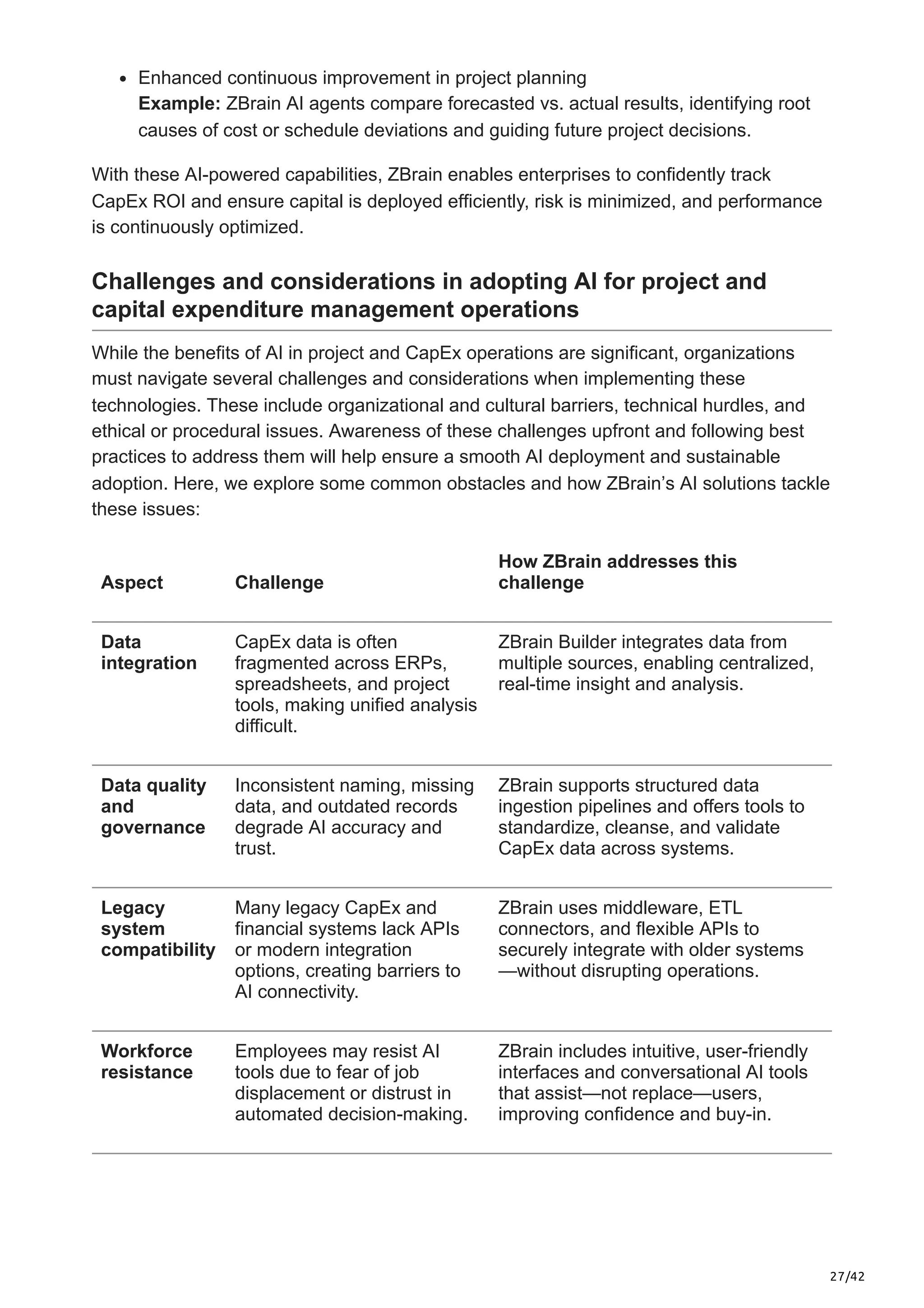
Aspect Challenge
How ZBrain addresses this
challenge
Data
integration
CapEx data is often
fragmented across ERPs,
spreadsheets, and project
tools, making unified analysis
difficult.
ZBrain Builder integrates data from
multiple sources, enabling centralized,
real-time insight and analysis.
Data quality
and
governance
Inconsistent naming, missing
data, and outdated records
degrade AI accuracy and
trust.
ZBrain supports structured data
ingestion pipelines and offers tools to
standardize, cleanse, and validate
CapEx data across systems.
Legacy
system
compatibility
Many legacy CapEx and
financial systems lack APIs
or modern integration
options, creating barriers to
AI connectivity.
ZBrain uses middleware, ETL
connectors, and flexible APIs to
securely integrate with older systems
—without disrupting operations.
Workforce
resistance
Employees may resist AI
tools due to fear of job
displacement or distrust in
automated decision-making.
ZBrain includes intuitive, user-friendly
interfaces and conversational AI tools
that assist—not replace—users,
improving confidence and buy-in.
28/42
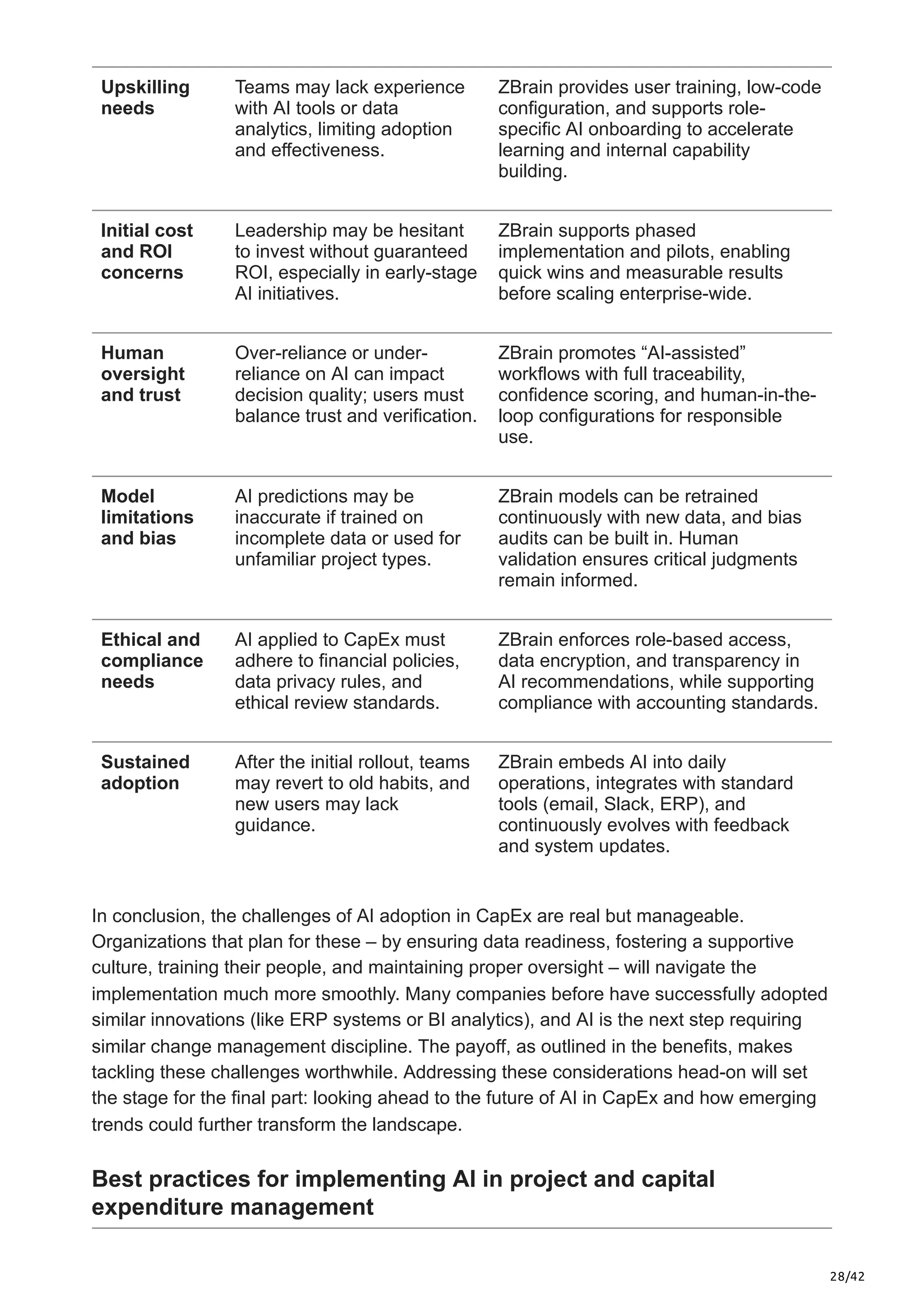
Upskilling
needs
Teams may lack experience
with AI tools or data
analytics, limiting adoption
and effectiveness.
ZBrain provides user training, low-code
configuration, and supports role-
specific AI onboarding to accelerate
learning and internal capability
building.
Initial cost
and ROI
concerns
Leadership may be hesitant
to invest without guaranteed
ROI, especially in early-stage
AI initiatives.
ZBrain supports phased
implementation and pilots, enabling
quick wins and measurable results
before scaling enterprise-wide.
Human
oversight
and trust
Over-reliance or under-
reliance on AI can impact
decision quality; users must
balance trust and verification.
ZBrain promotes “AI-assisted”
workflows with full traceability,
confidence scoring, and human-in-the-
loop configurations for responsible
use.
Model
limitations
and bias
AI predictions may be
inaccurate if trained on
incomplete data or used for
unfamiliar project types.
ZBrain models can be retrained
continuously with new data, and bias
audits can be built in. Human
validation ensures critical judgments
remain informed.
Ethical and
compliance
needs
AI applied to CapEx must
adhere to financial policies,
data privacy rules, and
ethical review standards.
ZBrain enforces role-based access,
data encryption, and transparency in
AI recommendations, while supporting
compliance with accounting standards.
Sustained
adoption
After the initial rollout, teams
may revert to old habits, and
new users may lack
guidance.
ZBrain embeds AI into daily
operations, integrates with standard
tools (email, Slack, ERP), and
continuously evolves with feedback
and system updates.
In conclusion, the challenges of AI adoption in CapEx are real but manageable.
Organizations that plan for these – by ensuring data readiness, fostering a supportive
culture, training their people, and maintaining proper oversight – will navigate the
implementation much more smoothly. Many companies before have successfully adopted
similar innovations (like ERP systems or BI analytics), and AI is the next step requiring
similar change management discipline. The payoff, as outlined in the benefits, makes
tackling these challenges worthwhile. Addressing these considerations head-on will set
the stage for the final part: looking ahead to the future of AI in CapEx and how emerging
trends could further transform the landscape.
Best practices for implementing AI in project and capital
expenditure management
29/42
Successfully implementing AI in CapEx operations transforms capital planning from a
static budgeting exercise into a dynamic, data-driven process. It enables organizations to
connect long-term investment strategies with real-time execution, risk monitoring, and
performance analysis. To achieve this transformation, enterprises must take a structured
approach that addresses technology, processes, people, and governance. Below are key
best practices for adopting AI across the CapEx lifecycle—from planning and budgeting
to approval, execution, and post-completion review.
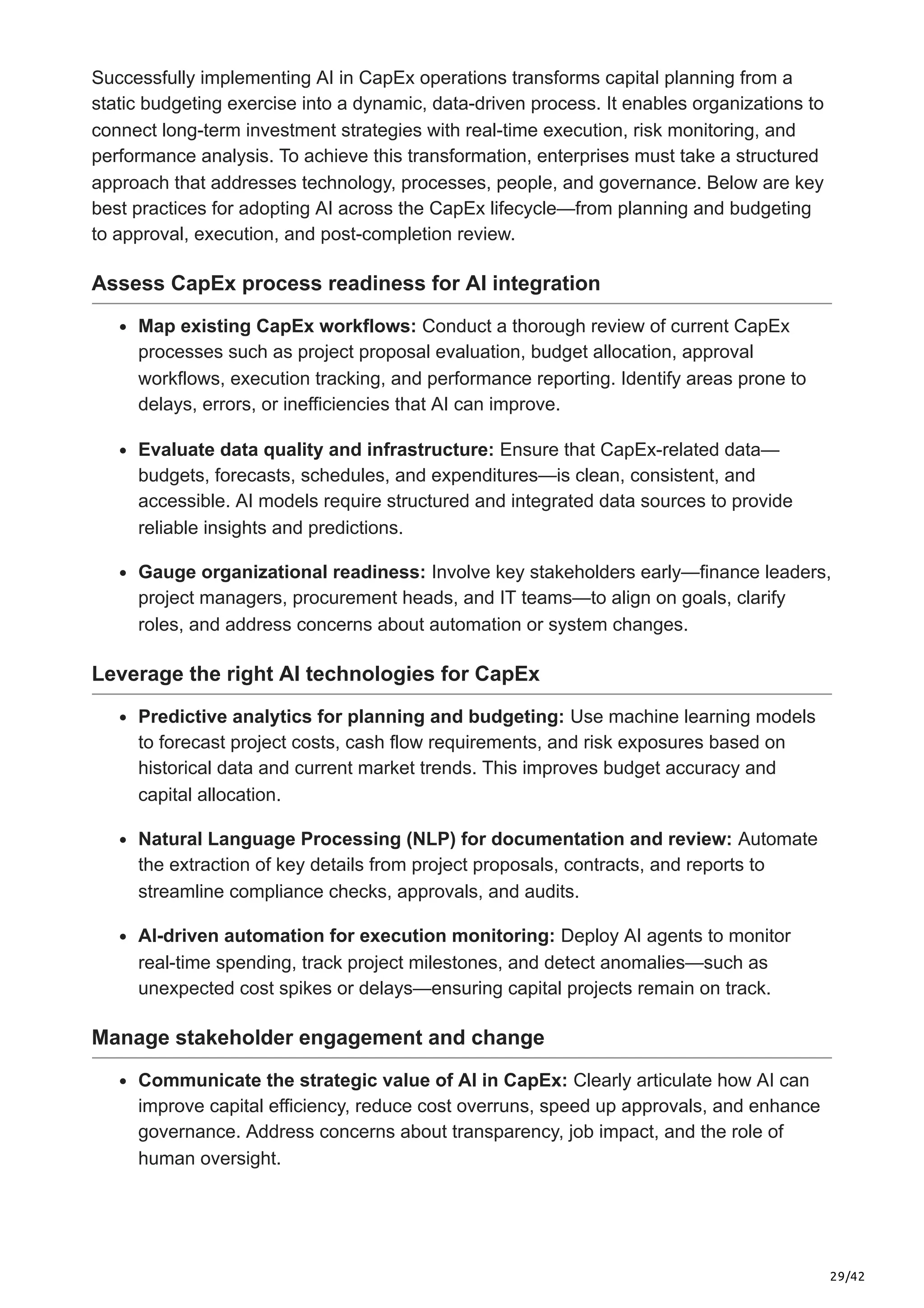
Assess CapEx process readiness for AI integration
Map existing CapEx workflows: Conduct a thorough review of current CapEx
processes such as project proposal evaluation, budget allocation, approval
workflows, execution tracking, and performance reporting. Identify areas prone to
delays, errors, or inefficiencies that AI can improve.
Evaluate data quality and infrastructure: Ensure that CapEx-related data—
budgets, forecasts, schedules, and expenditures—is clean, consistent, and
accessible. AI models require structured and integrated data sources to provide
reliable insights and predictions.
Gauge organizational readiness: Involve key stakeholders early—finance leaders,
project managers, procurement heads, and IT teams—to align on goals, clarify
roles, and address concerns about automation or system changes.
Leverage the right AI technologies for CapEx
Predictive analytics for planning and budgeting: Use machine learning models
to forecast project costs, cash flow requirements, and risk exposures based on
historical data and current market trends. This improves budget accuracy and
capital allocation.
Natural Language Processing (NLP) for documentation and review: Automate
the extraction of key details from project proposals, contracts, and reports to
streamline compliance checks, approvals, and audits.
AI-driven automation for execution monitoring: Deploy AI agents to monitor
real-time spending, track project milestones, and detect anomalies—such as
unexpected cost spikes or delays—ensuring capital projects remain on track.
Manage stakeholder engagement and change
Communicate the strategic value of AI in CapEx: Clearly articulate how AI can
improve capital efficiency, reduce cost overruns, speed up approvals, and enhance
governance. Address concerns about transparency, job impact, and the role of
human oversight.
30/42
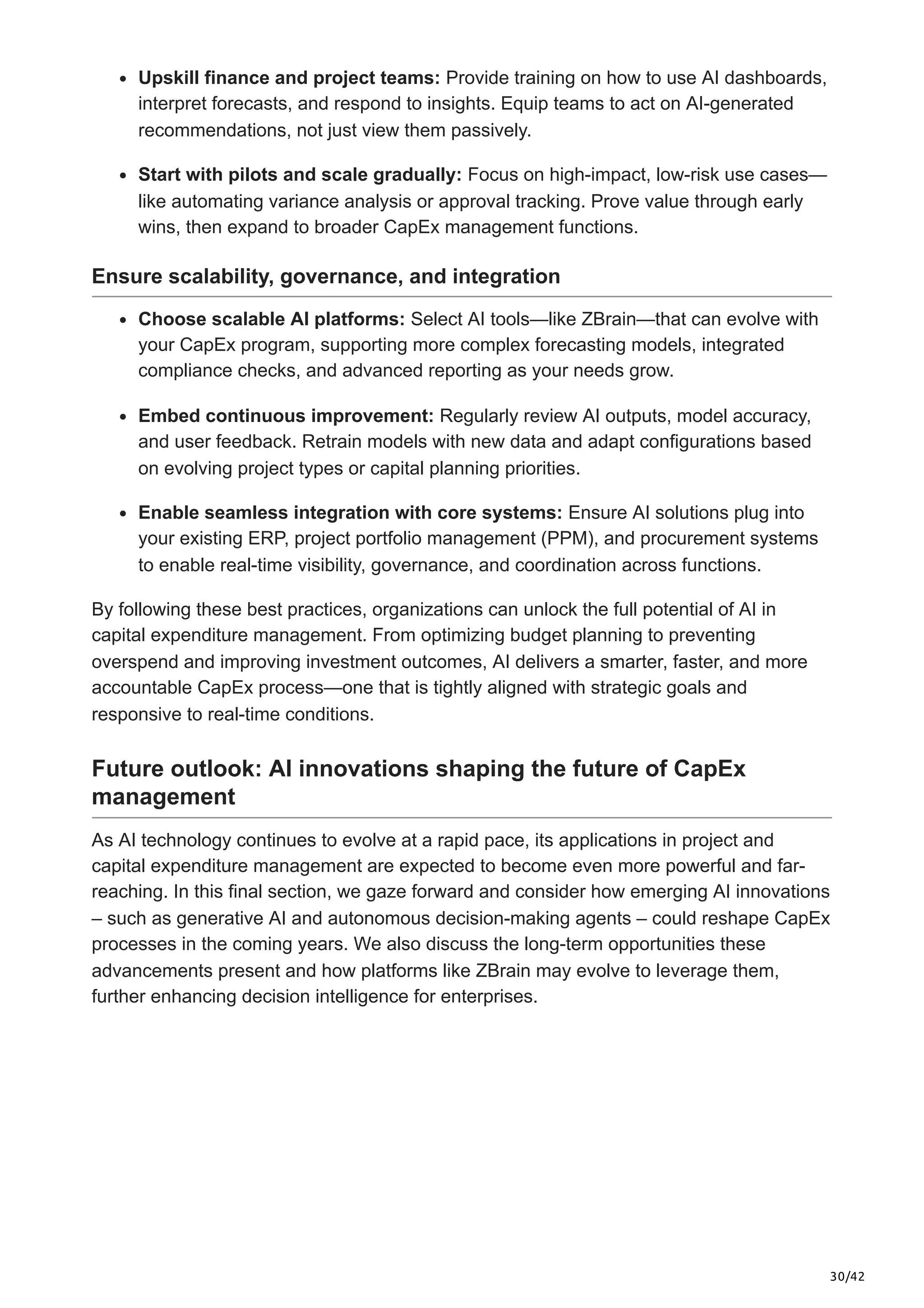
Upskill finance and project teams: Provide training on how to use AI dashboards,
interpret forecasts, and respond to insights. Equip teams to act on AI-generated
recommendations, not just view them passively.
Start with pilots and scale gradually: Focus on high-impact, low-risk use cases—
like automating variance analysis or approval tracking. Prove value through early
wins, then expand to broader CapEx management functions.
Ensure scalability, governance, and integration
Choose scalable AI platforms: Select AI tools—like ZBrain—that can evolve with
your CapEx program, supporting more complex forecasting models, integrated
compliance checks, and advanced reporting as your needs grow.
Embed continuous improvement: Regularly review AI outputs, model accuracy,
and user feedback. Retrain models with new data and adapt configurations based
on evolving project types or capital planning priorities.
Enable seamless integration with core systems: Ensure AI solutions plug into
your existing ERP, project portfolio management (PPM), and procurement systems
to enable real-time visibility, governance, and coordination across functions.
By following these best practices, organizations can unlock the full potential of AI in
capital expenditure management. From optimizing budget planning to preventing
overspend and improving investment outcomes, AI delivers a smarter, faster, and more
accountable CapEx process—one that is tightly aligned with strategic goals and
responsive to real-time conditions.
Future outlook: AI innovations shaping the future of CapEx
management
As AI technology continues to evolve at a rapid pace, its applications in project and
capital expenditure management are expected to become even more powerful and far-
reaching. In this final section, we gaze forward and consider how emerging AI innovations
– such as generative AI and autonomous decision-making agents – could reshape CapEx
processes in the coming years. We also discuss the long-term opportunities these
advancements present and how platforms like ZBrain may evolve to leverage them,
further enhancing decision intelligence for enterprises.
31/42
Generative AI and Advanced Analytics: One of the most talked-about
developments is generative AI (exemplified by models like GPT-4, etc.), which can
create new content and insights based on deep learning. In the context of CapEx
management, generative AI could be game-changing in several ways:
Automated report writing and interpretation: Imagine an AI that not only
crunches numbers but also writes narrative reports. In the future, generative
AI could take all project data and automatically produce an easy-to-read
monthly CapEx report: “Project Alpha is trending 5% under budget due to cost
savings in procurement. However, watch for potential delays in Project Beta
due to regulatory approval pending.” This saves analysts time and ensures
that even non-technical stakeholders get insights in plain language. In fact,
generative AI’s ability to “understand context and generate original content”
means it could digest hundreds of pages of project documentation and
summarize the key points, enabling faster comprehension of complex
projects.
Conversational interfaces (AI assistants): We will likely see more advanced
AI assistants that decision-makers can talk to in natural language. Instead of
going through dashboards, a manager might ask a voice or chat assistant,
“How does our Q3 CapEx spend compare to last year and what risks should I
be aware of?” and the AI will generate an answer on the fly, pulling from both
data and learned knowledge. ZBrain and similar platforms may integrate such
conversational AI deeply, effectively becoming a virtual project controller or
financial analyst available 24/7. This democratizes access to insights – busy
executives can simply ask questions and get immediate, contextual answers
which generative AI can deliver by synthesizing data and analysis.
Project scenario generation: Generative models can also create simulations
or scenarios. For instance, give the AI a project plan and ask it to generate a
worst-case and best-case scenario narrative. It might output detailed
hypothetical scenarios (“In a worst-case scenario, a labor strike could occur in
month 5, causing a 30-day delay and requiring an extra $200k in costs…”)
with reasoning. This can aid in contingency planning, as managers can review
AI-generated scenarios to ensure they haven’t overlooked any extreme
possibilities. Generative AI could even generate alternative project plans – for
example, create a modified schedule that compresses timelines or a value-
engineered budget – which human planners can then evaluate. Essentially, AI
could serve as an “idea generator,” presenting options that humans might not
have immediately considered.
32/42
Autonomous decision-making and agents: As AI models become more
sophisticated and trusted, there’s potential for autonomous decision agents in the
CapEx process. We can foresee:
Automated micro-decisions: AI agents might handle routine decisions
independently. For example, an AI could automatically approve capital
expenditures below a certain amount if they meet all criteria, without any
human in the loop, truly achieving a “touchless” process for low-risk items.
Similarly, an AI might autonomously reallocate budget across projects within a
program if one project is underrunning and another needs a top-up, following
predefined rules to optimize capital use in real-time. This kind of autonomous
adjustment can keep the portfolio optimized continuously, rather than waiting
for monthly meetings. Companies will likely start with small decisions and
gradually expand AI’s authority as confidence grows.
AI project managers or schedulers: Looking further ahead, we might have
AI systems that act as project managers for certain aspects. For instance, an
AI could manage the scheduling of tasks among teams, dynamically adjusting
assignments every day based on progress and priorities – essentially an
autonomous scheduler that optimizes who should do what and when, across
multiple projects, in a way that humans can’t easily compute. While human
project managers focus on strategy and leadership, the AI takes care of the
minute-by-minute coordination. Some experimental systems already show
promise in managing schedules and resources algorithmically; in the future
this could become mainstream.
Strategic recommendations and decision support: Autonomous doesn’t
always mean without human involvement – it can also mean proactively
making recommendations that normally would require an analyst. Future AI
might, for example, scan the global economic environment (interest rates,
commodity prices) and automatically recommend, “Next year, consider
increasing CapEx in renewable energy projects because material costs are
predicted to drop and government incentives are rising.” This blends external
data with internal strategy to give strategic direction. While the final decision
remains with executives, the AI agent has essentially done high-level analysis
and recommended a course of action. The boundary between analysis and
decision starts to blur as AI gets better at holistic reasoning.
33/42
Hyper-integration and real-time enterprise: Another future trend is AI linking
CapEx decisions with other enterprise domains in real time. For example, AI could
integrate capital planning with operational performance. If a factory machine (asset)
is underperforming and affecting production, an AI might automatically raise a
CapEx request to replace that machine earlier than scheduled, because it computes
that the lost production is more costly than the early capital spend. This kind of
cross-domain autonomous optimization is on the horizon as AI connects the dots
between finance, operations, maintenance, etc. ZBrain’s broad industry and
departmental coverage hints at this direction – an integrated platform that knows
about everything from sales to finance could, with AI, coordinate decisions among
them.
Generative design and planning: In fields like construction and engineering, AI
(including generative algorithms) is starting to do design optimization – e.g.,
generating building designs that meet certain criteria at lower cost. In the future,
during project planning, AI could generate multiple design or execution alternatives,
each with cost/schedule implications, for the team to choose from. This means
CapEx planning becomes a collaborative process with AI where AI might say
“Option A costs $5M and takes 8 months, Option B costs $4.5M and takes 9
months” by actually creating Option B (a slightly different design or method). This
pushes AI further upstream into the conceptual phase of projects, potentially
yielding more innovative solutions that humans alone might not conceive.
Increased ROI and competitive advantage: Organizations that fully embrace
these advanced AI capabilities may achieve significantly higher ROI on their capital
investments compared to those that don’t. We might see a widening gap where AI-
driven firms execute projects 20-30% cheaper or faster than their peers, simply
because AI optimizes their planning and execution at every step. For investors and
stakeholders, this could make such companies very attractive. There’s a potential
network effect too – AI could help learn from industry-wide data (if shared in some
anonymous way) so that everyone benefits, or it could become a competitive edge
where companies keep their AI models’ knowledge proprietary as a form of
intellectual property (like “our AI has learned from 1000 projects and gives us
unique insight”).
Reskilling and new roles: As AI takes over routine tasks, project controllers and
financial analysts will shift to roles like AI supervisors, strategists, and interpreters.
Their jobs may involve formulating the right questions for AI to answer, validating AI
outputs, and focusing on human-centric tasks like stakeholder communication,
negotiation, and leadership that AI cannot replace. The workforce will adapt; for
example, tomorrow’s PMO might include a “Project AI Analyst” who ensures the AI
is properly tuned and its insights are integrated into decisions.
34/42
Risks and governance in the future: With more autonomous AI, governance will
have to evolve too. Companies will need to set boundaries for AI decisions
(especially large capital decisions likely will always need some human sign-off).
Regulatory frameworks might eventually emerge around AI in corporate finance –
perhaps requiring audit trails of AI decisions to ensure accountability. It’s plausible
that auditors in the future will audit the algorithms as well as the financial records
(“algorithm auditing” to ensure no bias or error in how AI is handling financial
processes). So, companies will implement AI governance policies as part of their
overall corporate governance.
Long-term vision: Looking 10+ years out, one could envision a largely “self-
driving” CapEx process. Much like self-driving cars aim to ferry passengers safely to
destinations, a self-driving CapEx system would take strategic goals and
automatically handle many aspects of capital allocation and project execution to
reach those goals efficiently, with minimal manual intervention. Humans would
oversee and handle exceptions, focusing on strategic creativity and leadership. At
this stage, AI might use advanced cognitive capabilities – understanding not just
data but also reading the industry landscape and maybe even negotiating with other
AI (e.g., an AI representing your company negotiating a contract with an AI
representing a vendor).
While that might sound far-fetched, the seeds are visible today in early forms. The
progression will be incremental: more tasks automated, more intelligence in
recommendations, gradually increasing autonomy, and broader scope of data considered.
Importantly, companies like ZBrain are likely to continuously incorporate state-of-the-art
AI research into their products, meaning clients of such platforms will benefit from
improvements with simple updates rather than having to build anew.
Endnote
In conclusion, the future of AI in CapEx management is poised to make the process more
proactive, autonomous, and intelligent than ever. Generative AI will provide richer insights
and simplify communication; autonomous agents will handle routine decisions and
optimize processes in real time; and the entire enterprise will become more adaptive with
AI linking strategy to execution seamlessly. Platforms like ZBrain will be central in
delivering these capabilities, evolving from today’s assistive roles into truly collaborative
partners in decision-making. For organizations, staying attuned to these developments
and being early adopters where feasible could yield substantial competitive advantages –
those who harness emerging AI fully will execute projects faster, cheaper, and more
strategically aligned, effectively rewriting the playbook for capital expenditure
management in the future.
Ready to streamline your CapEx management with AI? Leverage ZBrain’s powerful
automation to refine investment strategies, boost resource allocation, and enhance
operational visibility, securing superior ROI and a competitive edge.
35/42
Listen to the article
Author’s Bio
Akash Takyar
CEO LeewayHertz
Akash Takyar, the founder and CEO of LeewayHertz and
ZBrain, is a pioneer in enterprise technology and AI-driven
solutions. With a proven track record of conceptualizing and
delivering more than 100 scalable, user-centric digital
products, Akash has earned the trust of Fortune 500
companies, including Siemens, 3M, P&G, and Hershey’s.
An early adopter of emerging technologies, Akash leads
innovation in AI, driving transformative solutions that
enhance business operations. With his entrepreneurial spirit,
technical acumen and passion for AI, Akash continues to explore new horizons,
empowering businesses with solutions that enable seamless automation, intelligent
decision-making, and next-generation digital experiences.
Frequently Asked Questions
What is ZBrain, and how can it optimize project and capital expenditure (CapEx) management with AI?
ZBrain is an enterprise AI enablement platform that streamlines CapEx operations across
the entire lifecycle—from project planning and budgeting to execution and performance
review. It helps organizations move from static capital planning to real-time, insight-driven
investment management.
Here’s how ZBrain enhances CapEx processes:
AI readiness assessment with ZBrain XPLR: ZBrain XPLR evaluates an
organization’s CapEx maturity, data infrastructure, and readiness for AI integration.
It identifies high-impact opportunities where AI can improve planning, execution,
and governance in capital projects.
Seamless data ingestion and system integration: ZBrain Builder connects with
ERP, project management, and financial systems to unify data flows. This enables
accurate, real-time CapEx forecasting, budget tracking, and performance
monitoring.
Low-code agent development: With ZBrain Builder’s low-code environment,
finance and project teams can build AI agents for tasks like budget variance
analysis, capital allocation, or compliance monitoring—without relying on heavy IT
support.
Flexible deployment and model options: ZBrain supports diverse AI models and
integrates with major cloud platforms (AWS, Azure, GCP), providing scalable and
secure AI solutions for enterprise-grade CapEx environments.
36/42
Built-in governance and oversight: ZBrain’s intelligent agents continuously
monitor CapEx processes for policy adherence, risk exposure, and audit readiness
—ensuring that all capital investments remain aligned with internal controls and
regulatory standards.
By offering a unified AI layer across planning, budgeting, approvals, and reporting, ZBrain
enables organizations to execute capital investments with greater precision, speed, and
transparency.
How does ZBrain ensure the security and privacy of sensitive CapEx data?
ZBrain safeguards critical CapEx and project financial data through a secure, enterprise-
grade infrastructure:
Private cloud deployments: ZBrain agents can be hosted in a private cloud
environment, keeping sensitive project data within your secure IT ecosystem.
Role-based access control: Granular permissions restrict access based on user
roles, ensuring only authorized personnel can view or act on capital investment
data.
Compliance certifications: ZBrain adheres to ISO 27001:2022 and SOC 2 Type II
standards, ensuring all CapEx data handling meets global security and audit
requirements.
This ensures that capital planning, spending, and post-project evaluations are protected
throughout the entire CapEx lifecycle.
Can ZBrain AI agents integrate with our existing CapEx systems?
Yes, ZBrain is designed to integrate seamlessly with your existing CapEx infrastructure,
including:
ERP systems: SAP, Oracle, Microsoft Dynamics
Project management tools: Primavera, MS Project
Financial reporting systems and data warehouses
This interoperability allows organizations to:
Leverage existing systems without replacing them
Automate capital budgeting, approvals, and compliance workflows
Enhance data visibility and reporting across departments
ZBrain enables smarter CapEx management without disrupting existing workflows.
What kind of AI agents can be built with ZBrain for CapEx operations?
37/42
ZBrain Builder allows teams to create AI agents tailored for every stage of the CapEx
lifecycle. Examples include:
Budget forecasting agents to predict funding needs based on historical trends and
market data
Variance analysis agents to monitor actual vs. planned costs and highlight
deviations
Compliance agents to verify adherence to CapEx policies and investment
guidelines
Performance review agents to assess ROI, delivery timelines, and post-
completion outcomes
These agents empower organizations to automate and optimize project selection,
execution, and evaluation, ensuring capital is allocated wisely and tracked accurately.
How does ZBrain support diverse CapEx processes across industries?
ZBrain’s modular design allows it to support a wide range of CapEx scenarios—across
sectors such as manufacturing, infrastructure, energy, and logistics. It can be configured
to:
Forecast and allocate large-scale capital budgets
Track vendor contracts and payment milestones
Monitor CapEx utilization in real time
Support strategic investment planning and performance reporting
This flexibility ensures ZBrain can align with both industry-specific regulations and
company-specific CapEx strategies.
How can we measure the ROI of ZBrain in our CapEx operations?
ZBrain delivers ROI across multiple dimensions of CapEx performance. Key metrics
include:
Reduced manual effort: Automate capital planning, approval routing, and budget
tracking
Improved budget adherence: Minimize overspend with real-time monitoring
Faster project initiation: Accelerate approval workflows and reduce time-to-
execution
Enhanced forecasting accuracy: Use predictive models to allocate resources
more effectively
38/42
Lower risk exposure: Detect and mitigate compliance or performance risks early
By tracking these KPIs—such as budget variance, approval cycle time, and project ROI—
organizations can quantify ZBrain’s impact on capital performance.
How do we get started with ZBrain for CapEx?
To begin your AI journey in CapEx with ZBrain:
Contact us at hello@zbrain.ai
Or fill out the inquiry form on zbrain.ai
Our team will work with you to assess your current CapEx environment, identify key
opportunities for AI integration, and develop a pilot plan tailored to your organization’s
goals.
Insights
AI for plan-to-results
The integration of AI into plan-to-results operations is transforming how organizations
align strategic planning with execution to optimize business performance.
39/42
AI for accounts payable and receivable
The integration of AI in AP and AR operations extends beyond routine automation,
offering strategic insights that empower finance professionals to evolve from reactive
problem-solvers into proactive strategists.
AI for HR planning and strategy
Integrating AI into HR planning and strategy is revolutionizing how organizations manage
their workforce, optimize talent, and align HR initiatives with business goals.
40/42
AI in quote management
AI is redefining quote management by automating complex processes, improving pricing
accuracy, and accelerating approval workflows.
Generative AI for sales
The role of generative AI in sales is expanding rapidly, making it a critical tool for
organizations seeking to stay competitive.
41/42
AI for control and risk management
AI is increasingly revolutionizing control and risk management by automating labor-
intensive tasks, monitoring compliance in real-time, and enhancing predictive analytics.
AI for plan-to-deliver
AI-powered automation and intelligent decision-making are transforming the plan-to-
deliver process, enabling organizations to proactively address inefficiencies, streamline
procurement, enhance inventory control, and optimize logistics.
42/42
AI in case management
AI transforms customer case management by automating workflows, enhancing data
accuracy, and enabling real-time insights.
Generative AI for IT
The adoption of generative AI in IT is shifting from experimental pilot programs to full-
scale implementation, reflecting a commitment by companies to harness the business
value and competitive advantages these technologies offer.

AI in project and capital expenditure management CapEx Scope integration use cases challenges and fut.pdf

  • 1.
    1/42 abhinav April 1,2025 AI in project and capital expenditure management (CapEx): Scope, integration, use cases, challenges and future outlook zbrain.ai/ai-in-the-project-and-capital-expenditure-management ← All Insights Project and capital expenditure (CapEx) management is fundamental to an organization’s ability to achieve its strategic objectives and maintain a competitive edge. Projects drive innovation, deliver new products and services, and facilitate operational improvements, while capital expenditures ensure the acquisition, maintenance, and enhancement of long-term assets necessary for sustained growth. Project initiatives and capital expenditures (CapEx) are the financial lifeblood of strategic growth, involving investments in assets and major projects that shape an organization’s future. In today’s turbulent economic climate, effective CapEx planning and execution are more critical than ever – a recent survey found that 70% of companies plan to spend 10– 30% more on CapEx in the next three years to drive resilience and growth. Yet traditional CapEx processes often rely on labor-intensive workflows and fragmented data, contributing to poor outcomes. In fact, only about 35% of projects meet their original goals, largely due to issues like poor risk visibility, siloed communication, and inefficient resource allocation. These shortcomings can lead to financial waste, delayed growth, and missed opportunities. Artificial Intelligence (AI) is increasingly stepping in to transform how organizations manage projects and CapEx. By leveraging AI – from predictive analytics to natural language processing (NLP) – enterprises are automating tedious processes, improving
  • 2.
    2/42 forecast accuracy, andidentifying risks in advance. According to a 2024 global survey, 90% of project managers report a positive ROI on AI tools, with 63% citing higher productivity and efficiency as a top benefit. As AI adoption accelerates, platforms like ZBrain are playing a pivotal role in integrating AI into the project and capital expenditure (CapEx) lifecycle. By enhancing forecasting accuracy, optimizing capital budgeting, and enabling real-time monitoring of spending and project performance, ZBrain empowers organizations to improve both execution efficiency and investment outcomes. Beyond automation, ZBrain evaluates AI readiness across CapEx operations, uncovers opportunities to streamline high-impact processes, and delivers tailored AI solutions to boost decision-making speed, compliance, and financial control. This article explores how AI is transforming the end-to-end project and CapEx process, driving smarter investments, reducing risk, and enabling greater agility. It also highlights how platforms like ZBrain help enterprises harness AI to make faster, data-driven capital planning decisions, ensuring superior ROI and strategic alignment in an increasingly dynamic business environment. What are project and capital expenditure management, and why are they important? Defining project expenditure The term “project expenditure” encompasses the total financial resources consumed during the lifecycle of a specific project. Definitions of project expenditure can vary depending on the context, whether it be legal, operational, or financial. From a legal standpoint, project expenditure is often defined as the sum of capital expenditure and other project-related non-capitalized expenditure incurred or to be incurred on the project, explicitly excluding internal costs, resources, or salaries. This definition provides a clear boundary for what constitutes a project expense in contractual agreements. Operationally, understanding project expenses involves recognizing all the costs that must be covered while a team works on a project, whether directly tied to the project or occurring in the background. These expenses can be classified into direct costs, which are straightforwardly linked to the project (e.g., specialized software, contractor hours, travel), and indirect costs, which are necessary for the business but not tied to a specific project (e.g., rent, support staff salaries, utilities). Furthermore, project expenses can be categorized as fixed (constant regardless of project scope) or variable (fluctuating with project scope or duration). Tracking these actual expenses is crucial for businesses to determine project profitability and refine estimating and pricing strategies for future work. In a broader financial context, project expenditure includes all costs and charges, whether of a capital or operating nature, incurred by or on behalf of a joint venture or related to conducting specific operations. It represents the actual expenditure properly incurred in relation to the project. Keeping tabs on the actual expenditure, which refers to the total
  • 3.
    3/42 amount of moneyspent on a project at any given point, helps project managers ensure financial viability by comparing actual costs with budgeted amounts. This comparison allows for the identification of deviations and the implementation of corrective actions. A project expenditure organization is an entity that can incur these expenditures for projects and serve as a planning and budgeting resource. Defining capital expenditure Capital expenditures (CapEx) represent funds that companies allocate to acquire, enhance, or maintain long-term assets such as property, buildings, equipment, or technology. These investments are intended to support business operations over multiple years and are capitalized on the balance sheet, with their costs amortized or depreciated over the asset’s useful lives. ​These expenses are essential for companies to remain competitive by providing the resources needed to keep up with industry trends and developments. CapEx is distinct from operating expenses (OpEx), which are ongoing expenses inherent to the operation of an asset, such as electricity or cleaning. The key differentiator is that the financial benefit of a capital expenditure extends beyond the current fiscal year. There are three main types of capital expenditure: maintenance CapEx (investments to maintain existing assets), growth CapEx (funds to acquire new assets or improve existing ones for expansion), and strategic CapEx (investments in long-term assets to achieve specific strategic objectives). Examples of CapEx include the purchase of land, buildings, machinery, equipment, vehicles, or technology systems, as well as significant upgrades or repairs that extend the useful life of an asset. In accounting, a capital expenditure is added to an asset account on the balance sheet and is not directly tax-deductible in the year it is incurred; instead, its cost is capitalized and then depreciated or amortized over the asset’s useful life. Capital expenditures are typically found under the “investing activities” section of the cash flow statement. The strategic importance of project and capital expenditure Project and capital expenditure (CapEx) management is essential to executing organizational strategy and driving long-term growth. These investments—such as infrastructure upgrades, technology deployments, or expansion projects—enable companies to scale operations, boost efficiency, and maintain competitive advantage. They are the foundation of strategic initiatives, translating long-term goals into tangible outcomes. Effective CapEx governance ensures that limited capital is directed toward the highest- value initiatives, aligning investment decisions with corporate priorities. In fact, business leaders view CapEx as critical to strategic planning, cost control, and maximizing return on invested capital (ROIC).
  • 4.
    4/42 Beyond strategic alignment,CapEx decisions directly impact financial sustainability. Poorly managed projects can lead to budget overruns, delays, and write-offs—eroding profitability and constraining future investment. On the other hand, companies with mature CapEx processes can reduce capital spend by up to 25% and improve ROIC by 2–4% through better planning, cost control, and execution. In today’s capital-constrained environment, strong CapEx management is not optional— it’s a strategic imperative. The growing complexity of projects, rising stakeholder expectations, and the need for faster, more data-driven decisions make optimizing CapEx processes a top priority for modern enterprises. Understanding the stages of project and capital expenditure management Project and capital expenditure management involves several key stages, each with specific activities and decision points. A typical lifecycle moves from initial planning and budgeting through approval and execution, and finally into ongoing monitoring and post- completion review. Each stage carries unique challenges that can impact project success if not handled well. Understanding these phases is crucial in identifying where AI can intervene to enhance efficiency and control. Below, we detail each major stage of the CapEx lifecycle along with the typical pain points encountered at each phase and their operational consequences. Planning Budgeting Approval Execution
  • 5.
    5/42 Monitoring Understanding the stagesof project and capital expenditure management Planning Ideation business case Post-review Optimization learnings Budgeting Capital allcation prioritization Approval Governance authorization Monitoring Reporting Execution Project implementa- tion Planning Processes Budgeting Processes Approval Processes Execution Processes Monitoring Processes Idea generation Capital allocation Review Procurement Performance monitoring Feasibility analysis Project evaluation Authorization Construction/Development Reporting Business case development Portfolio optimization Documentation Common Challenges Incomplete information Resource constraints Poor tracking Progress tracking Post-implementation review Planning (Ideation and business case development) In the planning stage, project ideas are generated and refined into formal proposals or business cases. Business units may submit “wishlist” proposals for capital projects they desire in the upcoming period. These proposals typically include a basic outline of the project, its expected benefits, cost estimate, and strategic rationale. The goal of this stage is to evaluate which project ideas are worth pursuing and to develop them into solid business cases aligned with organizational strategy. Associated processes: Idea generation: Identify potential projects to meet strategic goals.​ Feasibility analysis: Assess technical and financial viability.​ Business case development: Document objectives, benefits, costs, and risks. Challenges:
  • 6.
    6/42 Incomplete information: Thisleads to unrealistic assumptions and forecasts.​ Optimistic bias: Underestimation of costs and timelines.​ Subjectivity: Decisions are influenced by internal politics rather than data. Budgeting (Capital budgeting and portfolio prioritization) In the budgeting stage, the organization determines how much capital is available and allocates the budget across proposed projects. This typically involves building an annual CapEx budget that consolidates all project requests and matches them against financial capacity and strategic priorities. Projects are often ranked or scored to decide which to fund. The output of this stage is an approved capital plan or portfolio for a given period (e.g., fiscal year), including the list of projects, their budgets, and timelines. Associated processes: Capital allocation: Distribute funds based on strategic priorities.​ Project evaluation: Use metrics like NPV or IRR for assessment.​ Portfolio optimization: Balance projects to maximize returns. Challenges: Resource constraints: More projects than available funds.​ Data silos: Fragmented information hampers accurate analysis.​ Lack of standardization: Inconsistent evaluation methods lead to misaligned portfolios. Approval (Governance and authorization) The approval stage is where proposed CapEx projects undergo governance reviews and receive formal authorization to proceed. This typically involves a CapEx approval workflow: projects may need sign-off at multiple levels (department head, finance controller, CFO, investment committee, and possibly the board), depending on their size and risk. The organization might use Capital Expenditure Request (CER) forms or a similar documentation process to capture each project’s justification, cost, and expected benefits in detail for approvers to review. Only once the required approvals are obtained is a project considered “green-lit” and funds released. Processes: Review: Assess project proposals for alignment and feasibility.​ Authorization: Obtain necessary approvals to proceed.​ Documentation: Maintain records of decisions and justifications.​
  • 7.
    7/42 Challenges: Bureaucratic delays: Slowapproval processes hinder progress.​ Transparency issues: Lack of clarity on approval status causes frustration.​ Insufficient evaluation: Rushed approvals overlook critical risks. Execution (Project implementation and spending) The execution stage begins once a project is approved and funded. It encompasses the project management and implementation activities: procurement of materials or contractors, construction or development work, tracking of expenditures, and managing the project schedule and scope. This is the phase where the capital is actually spent (CapEx outflows occur), and the asset or deliverable is created. Key sub-steps can include vendor selection, contract management, construction/installation, and periodic progress reporting. Upon completion, the project’s costs are capitalized into a fixed asset on the balance sheet. Processes: Procurement: Acquire necessary resources and services.​ Construction/Development: Carry out project tasks. Progress tracking: Monitor adherence to schedules and budgets.​ Challenges: Poor tracking: Lack of real-time data leads to unnoticed issues.​ Scope creep: Uncontrolled changes inflate costs and timelines.​ Coordination failures: Misalignment among teams causes inefficiencies. Monitoring and post-completion review (Control, Reporting, and Optimization) Monitoring is an ongoing stage that overlaps execution and continues through project completion into the operational phase of the asset. It involves tracking key performance indicators (KPIs) for both the project (during execution) and the investment (after deployment). During execution, monitoring focuses on progress, spend vs. budget, and risk indicators – essentially project controls. After the project is delivered, a post- implementation review or investment review is often conducted to evaluate whether the project achieved its objectives and to derive lessons learned. Ongoing monitoring of the asset’s performance (for example, did a new production line deliver the expected capacity increase?) can feed back into future CapEx planning. Processes:
  • 8.
    8/42 Performance monitoring: TrackKPIs during and after execution.​ Reporting: Communicate progress and outcomes to stakeholders.​ Post-implementation review: Evaluate success and document lessons learned.​ Challenges: Data fragmentation: Disparate systems hinder comprehensive monitoring.​ Delayed reporting: Slow data collection obscures real-time insights.​ Lack of follow-up: Failure to assess outcomes prevents learning. Summary of challenges across stages: From the above, it’s clear each CapEx stage has pain points – uncertain forecasts in planning, prioritization dilemmas in budgeting, slow workflows in approvals, execution risks causing overruns, and siloed reporting in monitoring. These traditional challenges make CapEx management complex and often inefficient. Organizations end up with delayed projects, overspent budgets, or unmeasured outcomes, all of which undermine the strategic value of their investments. The next section explores how artificial intelligence technologies directly address these pain points, bringing new capabilities to forecast, optimize, automate, and learn at each stage of the project/CapEx lifecycle. Transforming project and capital expenditure management: How AI solves traditional challenges AI technologies—ranging from machine learning predictive analytics to natural language processing and automation—offer powerful solutions to the long-standing challenges in project and CapEx management. By leveraging data-driven intelligence and automation, AI can drastically improve forecasting accuracy, break down information silos, enhance resource allocation, and streamline processes that were previously slow or error-prone. Below, we analyze a few of the most common issues in traditional CapEx operations and explain how AI helps mitigate each:
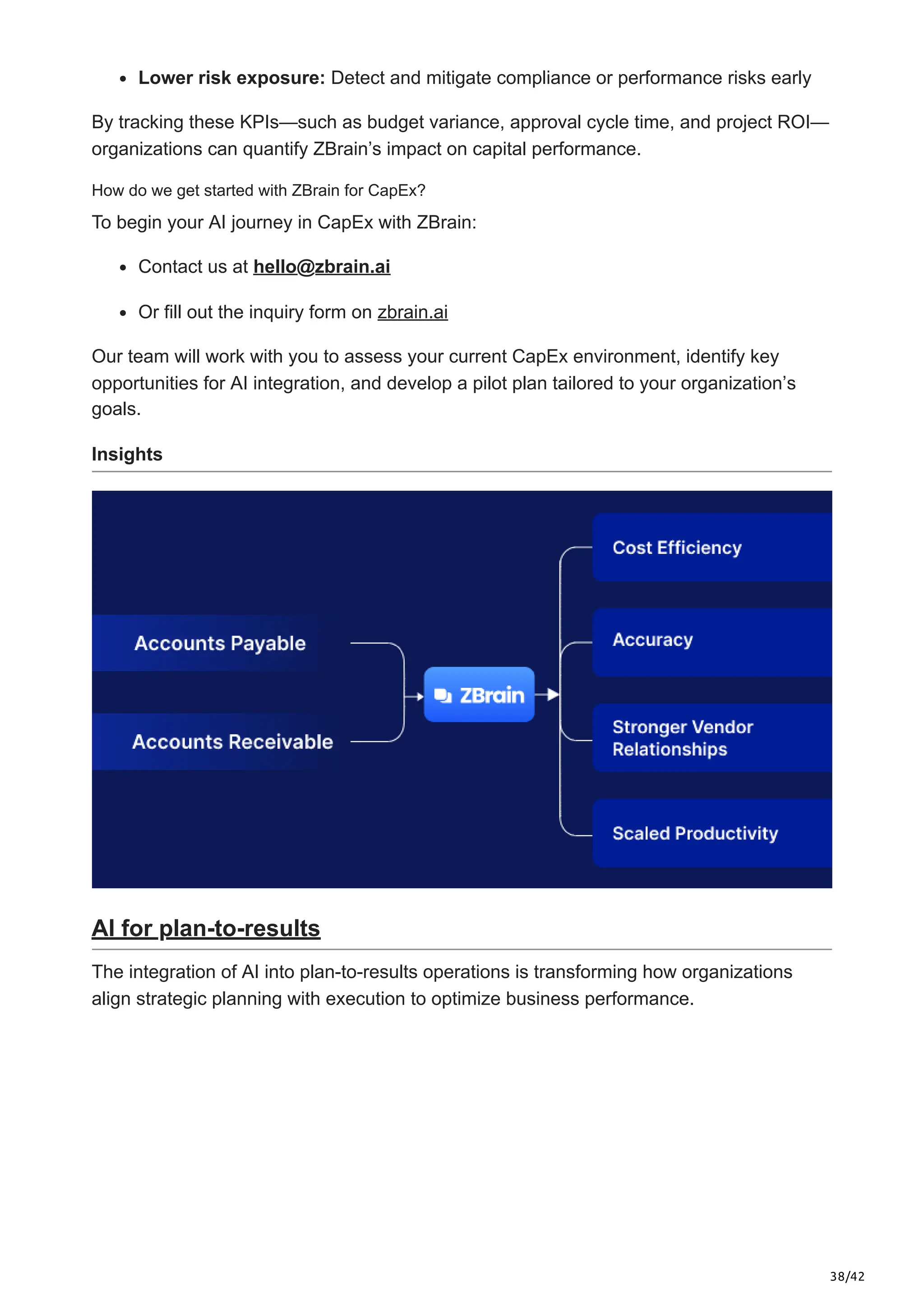
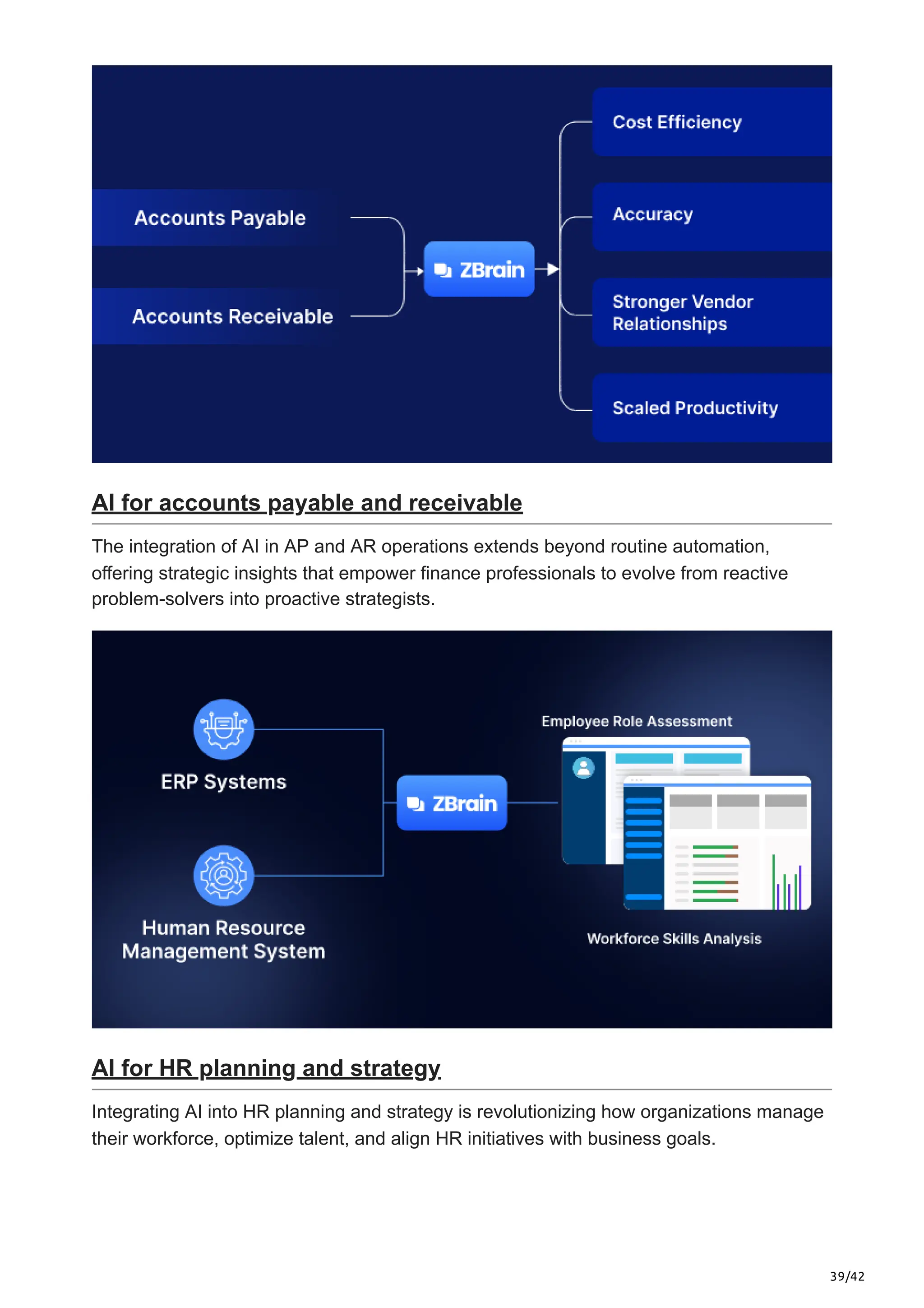
  • 9.
    9/42 Poor Forecasting & Planning Inaccurateforecasts & overly optimistic plans lead to project failures Cost Overruns & Schedule Delays Traditional methods detect issues too late after damage has occurred Data Silos & Visibility Gaps Fragmented data across systems hinders unified view for decisions Inefficient Resource Allocation Subjective allocation processes prone to bias and limited analysis Manual Processes and Slow Workflows Manual, repetitive tasks consume time and are prone to errors AI Solution Advanced predictive analytics & machine learning analyze historical data, market trends, and input costs for more realistic project projections AI Solution Continuous monitoring & early risk detection by analyzing real-time project data for proactive interventions AI Solution Integrates & analyzes data from disparate sources, including unstructured data, providing real-time visibility AI Solution Advanced analytics and optimization algorithms objectively evaluate project proposals and allocate resources effectively AI Solution AI automates routine tasks and streamlines workflows, reducing errors and accelerating processes, thereby enhancing overall efficiency. Transforming project and capital expenditur management: How AI solves traditional challenges Challenge Description AI solution Poor forecasting and planning Inaccurate forecasts and overly optimistic plans lead to project failures. AI utilizes advanced predictive analytics and machine learning to analyze historical data, market trends, and input costs, resulting in more realistic project duration and cost projections. Cost overruns and schedule delays Traditional methods often detect overruns or delays too late after significant damage has occurred. AI enables continuous monitoring and early risk detection by analyzing real-time project data, allowing for proactive interventions to prevent minor issues from escalating.
  • 10.
    10/42 Data silos and visibility gaps Fragmented dataacross various systems hinders obtaining a unified view, leading to suboptimal decisions. AI integrates and analyzes data from disparate sources, including unstructured data, providing real-time visibility and insights across the project portfolio. Inefficient resource allocation Subjective allocation processes, prone to bias and limited analysis, result in the misallocation of capital and resources. AI employs advanced analytics and optimization algorithms to objectively evaluate project proposals and allocate resources effectively, maximizing returns. Manual processes and slow workflows Manual, repetitive tasks in CapEx management consume time and are prone to errors, slowing down workflows. AI automates routine tasks and streamlines workflows, reducing errors and accelerating processes, thereby enhancing overall efficiency. By leveraging AI, organizations can effectively address these challenges, leading to more accurate planning, efficient resource utilization, and successful project outcomes. Optimize Your Operations With AI Agents Our AI agents streamline your workflows, unlocking new levels of business efficiency! Explore Our AI Agents Approaches to integrating AI into project and capital expenditure management Implementing AI in project and CapEx operations requires thoughtful integration with existing systems and processes. Enterprises typically follow one or a mix of three approaches: Developing custom AI solutions in-house Adopting third-party AI point solutions Leveraging a comprehensive AI platform Each approach has its considerations in terms of cost, flexibility, and required expertise. In all cases, success depends not just on the technology but also on effective change management, system interoperability, and user training to ensure the AI tools are adopted and deliver value. Below, we examine these integration methods and key strategies to embed AI into CapEx management smoothly. Custom in-house AI development
  • 11.
    11/42 Developing AI solutionsinternally allows organizations to tailor systems precisely to their unique CapEx workflows and data environments. This approach enables the creation of bespoke tools that automate resource forecasting, align execution with strategic goals, and track performance effectively. Key benefits include: Strategic customization: AI models can be designed to meet specific requirements, such as aligning budget forecasts with operational milestones or modeling dynamic resource allocation. Full control and compliance: In-house development ensures complete oversight of data flows, aiding in regulatory compliance and the protection of sensitive operational data. Scalability: Custom solutions can evolve alongside organizational needs, supporting new performance indicators and adapting to changing business processes. By accurately forecasting resource needs and aligning execution with strategic plans, custom AI solutions enhance clarity and drive measurable performance improvements. AI point solutions (Third-party tools) Integrating specialized third-party AI tools into specific CapEx functions offers a practical alternative to in-house development. These solutions, often ready-to-use or requiring minimal configuration, provide expertise and speed in deployment. Advantages include: Speed and expertise: Rapid deployment is possible, leveraging industry best practices embedded within the tools. Cost-effectiveness: Licensing software can be more economical than funding an internal AI development team. Integration capabilities: Many point solutions offer APIs for seamless integration with existing enterprise systems, such as ERP and project management platforms. However, it’s essential to manage potential integration challenges and ensure that multiple tools do not create new data silos. Evaluating interoperability and user experience is crucial to maximize the benefits of AI point solutions. Comprehensive AI platforms Adopting an end-to-end AI platform like ZBrain provides a unified suite of capabilities for CapEx management, encompassing data integration, analytics, automation, and decision support. These platforms offer:
  • 12.
    12/42 Integration and breadth:A cohesive environment that consolidates various AI functionalities, ensuring a single source of truth and simplifying maintenance. Scalability and future-proofing: Designed to grow with the organization, these platforms allow for expansion into other areas beyond CapEx, such as finance or operations. Customization and flexibility: Many platforms enable the development of additional AI models using built-in tools, offering a balance between tailored solutions and supported frameworks. Selecting the appropriate approach depends on factors such as organizational size, specific needs, resource availability, and long-term strategic goals. Each method offers distinct pathways to harness AI’s potential in enhancing CapEx management efficiency and effectiveness. AI applications transforming project and capital expenditure management Adopting AI across the capital expenditure (CapEx) lifecycle can radically improve how organizations plan, execute, and evaluate big investments. From brainstorming project ideas to reviewing outcomes, AI brings data-driven insights and automation to each phase. Enterprise-grade generative AI platforms like ZBrain allow companies to deploy specialized AI agents for finance that streamline CapEx processes end-to-end.
  • 13.
    13/42 AI applications transformingproject and capital expenditure management BUDGETING APPROVAL EXECUTION MONITORING PLANNING AI Use Cases AI Use Cases AI Use Cases AI Use Cases AI Use Cases ZBrain Solution ZBrain Solution ZBrain Solution ZBrain Solution ZBrain Solution Intelligent ideation support Project prioritization algorithms Automated compliance review Real-time budget monitoring Automated variance analysis Due diligence agent Procurement budget allocation Compliance risk assessment CAPEX compliance monitoring Performance analytics Automated market research Optimal capital allcation Intelligent document analysis Schedule and risk analytics Outcome and ROI tracking Regulatory compliance monitoring Liquidity planning optimization Contract review summary agents Financial insights agents ROI Assessment agents Predictive financial modeling Scenario planning simulation Approval workflow automation Intelligent alerts anomaly detection Lessons learned extraction Business case drafting Portfolio risk balancing Decision support and Q Automated project reporting Continual compliance/audit support
  • 14.
    14/42 Stage 1: Planning(Ideation and business case development) In the planning stage, organizations identify potential projects and build the business case for investment. AI supercharges this phase by expanding ideation, accelerating research, and strengthening the quality of analysis behind each proposal. Generative AI can sift through vast internal data and external market information to uncover patterns or opportunities that humans might miss. It can also forecast financial outcomes and risks early on, helping teams refine project ideas before they reach decision makers. By using AI in planning, companies develop more robust business cases grounded in data and predictive insights, improving confidence that chosen projects will succeed. AI applications in planning include: Intelligent ideation support – AI brainstorms project ideas or improvements based on past project data and emerging trends. Automated market and feasibility research – NLP agents gather and summarize industry research, benchmarks, and regulations to inform the business case. Predictive financial modeling – AI forecasts project ROI, cash flows, and risk scenarios using historical data and machine learning. Business case drafting assistance – Generative AI helps write proposal documents, creating executive summaries and highlighting key insights. How ZBrain enhances the planning for project and capital expenditure management Use case AI functions in CapEx planning ZBrain GenAI agent & key function Ideation and research Generate and evaluate project ideas by analyzing internal knowledge and external market data. ZBrain AI agents can aggregate and analyze data to enhance due diligence assessments, allowing teams to make informed, data- driven decisions. Regulatory insight integration Ensure early-stage ideas align with regulatory requirements and policies. AI monitors relevant laws or compliance issues so the business case addresses them upfront. ZBrain’s Regulatory Compliance Monitoring Agent offers real-time insights into regulatory changes relevant to the business, helping mitigate compliance risks from the start.
  • 15.
    15/42 Use case AI functionsin CapEx planning ZBrain GenAI agent & key function Business case summarization Automatically produce concise business case drafts or executive summaries. AI distills lengthy research and financial analysis into clear highlights for decision makers. ZBrain’s Salesforce Next Best Action Agent streamlines case resolution by summarizing cases, displaying resolution status, and providing next-step recommendations using past case knowledge. By leveraging AI at the ideation stage, organizations can surface the best opportunities with supporting evidence already in hand. Generative AI agents conduct much of the heavy lifting in research and analysis so that finance teams can focus on creative thinking and strategic evaluation. The result is a stronger portfolio of project proposals entering the next phase. Stage 2: Budgeting (Capital budgeting and portfolio prioritization) During budgeting, companies decide which projects to fund and how to allocate capital across a portfolio. AI enhances capital budgeting by optimizing the selection and allocation process with advanced analytics. Instead of relying solely on static spreadsheets or subjective judgments, AI-driven tools can evaluate each proposal on multiple criteria (financial returns, strategic fit, risk, etc.) and recommend an optimal portfolio. Generative AI can also simulate different budgeting scenarios on the fly – for example, adjusting to budget constraints or changing market conditions – to guide decision-making. This leads to more efficient use of capital and alignment with corporate strategy, as the chosen projects are those with the highest predicted value and feasibility. AI applications in budgeting include: Project prioritization algorithms – AI models rank and score proposed investments to maximize ROI and strategic impact. Optimal capital allocation – Intelligent agents allocate budget across approved projects, ensuring resources are distributed for the best overall outcome. Scenario planning and simulation – AI tests “what-if” scenarios (e.g., various funding levels or schedules) to aid contingency planning. Portfolio risk balancing – AI evaluates the portfolio’s aggregate risk and suggests adjustments (deferring or phasing projects) to stay within risk appetite. How ZBrain enhances the budgeting for project and capital expenditure management Use case AI functions in CapEx budgeting ZBrain GenAI agent & key function
  • 16.
    16/42 Use case AI functionsin CapEx budgeting ZBrain GenAI agent & key function Project Portfolio Optimization Evaluate all proposed projects and determine the optimal set to fund. AI considers projected returns, risks, and strategic alignment to rank projects objectively. ZBrain AI agents can provide data- driven recommendations for long- term investment strategies based on market trends, company cash flow, and risk tolerance, helping identify which projects offer the best value. Intelligent budget allocation Distribute capital across selected projects for maximum impact and efficiency. AI analyzes project needs and constraints to assign budgets that avoid under- or over- funding initiatives. ZBrain’s Procurement Budget Allocation Agent automates budget allocation by analyzing project requirements, ensuring optimal resource distribution, and cost control. Cash flow alignment Align the capital project schedule with corporate cash flow and funding capabilities. AI ensures that the timing of expenditures matches liquidity and financing plans to prevent cash crunches. ZBrain’s Liquidity Planning Optimization Agent optimizes cash flow planning by analyzing cash reserves and obligations, ensuring sufficient liquidity for investments and efficient cash management. Using AI in capital budgeting enables more strategic and agile decision-making. Complex portfolio choices that once took weeks of analysis can be optimized in minutes by AI, evaluating far more variables than humans can. This data-driven approach helps executives justify their capital plans to stakeholders, knowing that an AI has objectively vetted the portfolio for maximum return and balanced risk. Stage 3: Approval (Governance and authorization) The approval stage involves governance oversight – making sure each CapEx proposal is thoroughly vetted, justified, and authorized according to company policies. AI streamlines this governance process by automating compliance checks and generating insights for decision makers. Instead of manual reviews of thick proposal documents and policy manuals, AI agents can instantly verify that a request meets all required criteria (e.g., ROI threshold, risk limits, compliance regulations). Generative AI can also produce summary briefs or answer questions about the proposal, helping approval committees grasp the key points quickly. Overall, AI speeds up approvals while reinforcing control, ensuring that only well- vetted, compliant projects get the green light. AI applications in Approval include: Automated compliance review – AI verifies each proposal against corporate policies, budget limits, and regulatory requirements, flagging any deviations.
  • 17.
    17/42 Intelligent document analysis– NLP agents read lengthy business case documents and pull out critical information (financials, risks, commitments) for reviewers. Approval workflow automation – AI routes the CapEx request through the proper approval chain, sends reminders to approvers, and tracks the status to prevent bottlenecks. Decision support and Q&A – Chatbot-style agents answer executives’ questions about the proposal (e.g., “What’s the NPV?” or “Has risk considered new regulations?”) by drawing on the underlying data. How ZBrain enhances the approval for project and capital expenditure management Use case AI functions in the approval stage ZBrain GenAI agent & key function Policy and compliance review Automatically check CapEx requests for adherence to internal policies and regulatory standards before approval. AI ensures all required fields, justifications, and compliance items are satisfied. ZBrain’s Compliance Risk Assessment Agent automates the assessment of compliance risks by reviewing financial operations and contracts, flagging any potential issues for action. Executive summary generation Provide decision makers with a concise summary of the proposal’s key points (objectives, costs, returns, risks). AI-generated summaries save approvers’ time and focus attention on what matters. ZBrain’s Contract Review Summary Agent generates concise summaries of lengthy contracts, highlighting key points, obligations, and potential issues. Approval workflow automation Streamline the routing and tracking of approval steps. AI ensures the right stakeholders review the proposal in order, sends automatic reminders for pending approvals, and provides an audit trail. ZBrain’s Contract Review Summary Agent simplifies document workflows with compliance checks and streamlined approval workflows, enabling faster turnaround times. By automating governance tasks, AI makes the CapEx approval process more efficient and transparent. Finance and compliance teams can trust that no policy exceptions or risks slip through unnoticed, because the AI flags them. At the same time, executives get the information they need (in plain language) to make decisions without wading through unnecessary detail. This leads to faster approvals without sacrificing diligence – in fact, AI enables even greater rigor by checking 100% of compliance rules consistently. Stage 4: Execution (Project implementation and spending)
  • 18.
    18/42 Once a projectis approved and funded, the execution stage focuses on delivering the project on time and on budget. AI plays a pivotal role here by monitoring project performance in real time and aiding in proactive decision-making. AI agents can automatically track spending vs. budget, schedule progress vs. plan, and even quality or risk metrics, alerting project managers when something deviates from expectations. Through predictive analytics, AI might forecast a cost overrun or schedule slip before it fully materializes, enabling the team to course-correct early. Additionally, generative AI can automate routine project reporting and documentation. This all leads to tighter control over CapEx projects, reducing waste and increasing the chances of on-budget, on-time completion. AI applications in execution include: Real-time budget monitoring – AI continuously reconciles project expenditures against the approved budget, flagging overspend or underspend in any category. Schedule and risk analytics – AI analyzes project schedules, resource utilization, and external factors to predict delays or risks and recommend mitigations. Intelligent alerts and anomaly detection – The system automatically notifies managers of anomalies (e.g., sudden cost spikes, contractor delays) that need attention. Automated project reporting – AI generates periodic status reports for stakeholders, summarizing progress, spend, and issues, which saves project managers time on paperwork. How ZBrain enhances the execution for project and capital expenditure management Use case AI functions in project execution ZBrain GenAI agent & key function Real-time budget and schedule tracking Continuously monitor project spending and milestones against the plan. AI provides a live dashboard of actual vs. budgeted costs and timelines, ensuring any divergence is spotted immediately. ZBrain’s CAPEX Compliance Monitoring Agent monitors projects to ensure capital expenditures stay within budget and on schedule, flagging deviations for review and strengthening financial oversight. This agent automates what would otherwise be tedious manual tracking, enforcing fiscal discipline during execution.
  • 19.
    19/42 Use case AI functionsin project execution ZBrain GenAI agent & key function Automated progress reporting Generate and distribute project status reports without manual effort. AI collates data on expenditures, progress, and risks, then produces an easy-to-read update for stakeholders at regular intervals. ZBrain’s Financial Insights AI Agent automates the analysis of complex performance data (e.g., project KPIs) and generates standardized reports with key insights. Through AI-driven execution management, organizations gain real-time visibility and control over capital projects. Problems that traditionally might only be discovered in hindsight (after budgets are blown or deadlines missed) can now be detected and addressed in-flight. AI essentially acts as an ever-vigilant project analyst, ensuring the implementation stays aligned with the plan or that adjustments are made quickly. This leads to more predictable outcomes and fewer unpleasant surprises in major initiatives. Stage 5: Monitoring and post-completion review Even after a project is delivered, the CapEx lifecycle continues with monitoring and post- completion review. In this stage, teams assess whether the project delivered the expected benefits and draw lessons to improve future investments. AI enhances post-completion reviews by automating the analysis of results and providing actionable insights. For example, AI can compare planned vs. actual performance in detail – final costs vs. budget, actual ROI vs. projected ROI, timeline adherence, etc. – to explain any variances. Generative AI can compile post-mortem reports and even suggest recommendations (e.g., “Project X exceeded budget due to vendor costs – consider renegotiating contracts next time”). Furthermore, AI systems can continue to monitor the asset or outcome produced by the project (such as the performance of a new facility or system) and alert management if expected benefits are not being realized. This ensures the company maximizes value from its CapEx and continuously improves its CapEx process with data- driven feedback. AI applications in monitoring and review include: Automated variance analysis – AI calculates budget vs. actual variances across cost categories and schedule, pinpointing exactly where and why deviations occurred. Outcome and ROI tracking – Once the asset is operational, AI tracks key performance indicators (revenues, cost savings, utilization) against the business case to verify the ROI. Lessons learned extraction – NLP agents digest project documentation (reports, meeting notes) to extract recurring issues or best practices to inform future projects.
  • 20.
    20/42 Continual compliance/audit support– AI assists in post-project audits by organizing all spending records, approvals, and compliance checks from the project into an accessible report. How ZBrain enhances the monitoring and post-completion review Use case AI functions in post- completion ZBrain GenAI agent & key function Outcome variance analysis Examine how the project’s actual results compare to the original plan. AI automatically computes variances and analyzes their causes, providing transparency into project performance. ZBrain’s Variance Analysis Agent automates the comparison of budgeted vs. actual financial performance, identifies significant discrepancies, categorizes variances, and provides insights into their causes. This helps teams understand exactly where the project diverged from expectations and why. Benefits realization and reporting Track the realized benefits of the project and generate reports for stakeholders. AI continues to monitor metrics (like cost savings or revenue gains from the project) and can generate insightful reports that help business leaders make informed strategic decisions based on the project’s outcomes. ZBrain’s AI agents can synthesize post-project performance data and generate insightful reports that help businesses make informed strategic decisions. Asset lifecycle management For physical assets delivered by CapEx (equipment, facilities, etc.), continue to monitor and manage these assets throughout their useful life. AI tracks asset performance, maintenance needs, and depreciation automatically. ZBrain’s Asset Lifecycle Management Agent automates the tracking of company assets, ensuring proper depreciation schedules and providing alerts for maintenance or replacement needs. This long-term oversight helps protect the value created by the CapEx project and informs future reinvestment decisions. In this final stage, AI turns data from the completed project into knowledge for continuous improvement. Instead of manual analyses that might be done long after the fact (or not at all), AI delivers near-immediate feedback on project outcomes. Executives get a clear picture of whether the investment paid off and what could be done better next time. Moreover, by having AI watch over the assets and benefits going forward, companies ensure that the value from CapEx projects is fully realized and sustained. This closes the loop of the CapEx lifecycle, with insights from past projects feeding into smarter Planning of new ones.
  • 21.
    21/42 The ZBrain advantagein project and capital expenditure management ZBrain transforms how enterprises manage their project and capital expenditure processes by embedding intelligent automation, real-time insights, and AI-driven decision-making into every stage of the CapEx lifecycle. From early planning to post- implementation review, ZBrain’s ecosystem of GenAI agents and low-code tools enables organizations to drive efficiency, improve control, and achieve strategic alignment at scale. CapEx readiness assessment with ZBrain XPLR ZBrain’s AI readiness module, ZBrain XPLR, helps organizations evaluate their current CapEx maturity and identify where AI can deliver the highest impact. It assesses gaps across planning, budgeting, execution, and monitoring workflows, offering tailored insights that guide seamless AI adoption. This enables CapEx leaders to deploy AI initiatives that directly support governance, cost control, and ROI improvement. Low-code deployment for CapEx workflows With ZBrain Builder’s low-code interface, project and finance teams can rapidly create and deploy AI agents that automate critical CapEx activities, such as capital budget forecasting, expenditure tracking, and approval workflows. These user-friendly tools empower business users to build intelligent automations without technical complexity, accelerating adoption and value realization. Intelligent budgeting and capital allocation ZBrain uses proprietary enterprise data to power AI models that recommend budget allocations, prioritize high-ROI projects, and forecast future funding needs. These insights are generated using advanced predictive analytics and portfolio optimization techniques, enabling organizations to align funding decisions with long-term value and strategic objectives. Enterprise-ready integration with CapEx systems ZBrain is built for seamless integration with enterprise systems, allowing it to ingest and act on real-time project and financial data. It connects CapEx requests, financial ledgers, and execution tools under a unified AI layer—eliminating silos and enabling consistent, automated oversight of capital projects across the organization. Real-time monitoring and compliance automation ZBrain’s AI agents, like the CAPEX Compliance Monitoring Agent, provide real-time visibility into capital project spending, ensuring alignment with approved budgets and timelines. By continuously analyzing data from project management tools and ERPs, the
  • 22.
    22/42 agent detects anomaliesearly, enforces policy adherence, and flags financial risks— helping prevent overspending, delays, or non-compliance. Continuous performance tracking and review ZBrain equips organizations with tools to monitor and evaluate project outcomes post- completion. Agents like the Variance Analysis Agent and Financial Insights Agent automatically analyze cost, schedule, and ROI variances—providing finance leaders with actionable feedback for continuous improvement. These insights inform future planning and help build a smarter, more agile CapEx cycle. Flexible data ingestion and reporting ZBrain’s architecture supports real-time ingestion of structured and unstructured data from multiple systems. This flexibility ensures project managers and finance teams have access to up-to-date dashboards, automated reports, and natural language summaries highlighting budget health, progress status, and performance trends—all accessible through conversational AI interfaces. Intelligent agent ecosystem for end-to-end CapEx execution ZBrain’s pre-built and customizable agents automate key CapEx tasks—such as budget reviews, policy compliance checks, project tracking, and audit preparation. These agents work independently or in orchestration, executing workflows with minimal human intervention while ensuring data integrity and governance throughout the lifecycle. Optimize Your Operations With AI Agents Our AI agents streamline your workflows, unlocking new levels of business efficiency! Explore Our AI Agents Benefits of implementing AI in project and capital expenditure management operations Adopting AI in project and CapEx operations yields a host of benefits that directly impact an organization’s efficiency, financial performance, and decision-making effectiveness. Key benefits of AI in CapEx: By addressing the challenges described earlier, AI produces improvements in both processes and outcomes:
  • 23.
    23/42 Benefits of implementingAI in project and capital expenditure management operations Improved Forecast Accuracy Data-driven predictions lead to more accurate budgeting with reduced forecasting errors from +20% to far less _ Cost Control Reduction Predictive analytics catch deviations early, allowing corrective action that significantly reduces overruns Resource Efficiency AI automates low-value tasks and optimizes allocation of resources, Increasing project through put and ROI Schedule optimization and early risk detection keep projects on track, leading to faster realization of project benefits Reduced Project Delays Real-time Visibility Up-to-the-minute dashboards enable faster decision cycles without waiting for end-to-month reports Strengthened Compliance AI consistently checks compliance requirements, reducing policy breaches and strengthening governance controls Data-driven Culture Decisions based on data rather than intuition, leading to objective prioritization aligned with strategic goals Transparency Clear tracking of decisions and variances creates accountability and enables constructive project post-mortem reviews Improved forecast accuracy: AI’s data-driven predictions lead to much more accurate budgeting and scheduling. Organizations experience fewer surprises as projects unfold. With AI, forecasting errors that used to be, say, ±20% can shrink significantly. This means capital plans are more reliable, and contingency funds can be better allocated. For example, AI-based forecasting has helped companies reduce the variance between forecasted and actual project costs, improving budget accuracy by several percentage points. Better accuracy not only prevents overruns but also builds the credibility of the project team in the eyes of executives and investors (no more frequent budget revisions due to poor estimates). Cost control and reduction of overruns: One of the most celebrated benefits is cutting down cost overruns. Predictive analytics and continuous monitoring catch deviations early, allowing corrective action that keeps costs in line. Organizations using AI have seen significant drops in average cost overruns. For instance, a PMI survey indicated that projects at AI-mature companies met their budget goals far more often than those at less mature ones (a reflection of fewer overruns). Additionally, AI-driven portfolio optimization avoids low-ROI spends, effectively reducing wasteful capital outlays.
  • 24.
    24/42 Reduced project delays:AI’s schedule optimization and risk mitigation features help keep projects on or ahead of schedule. Early risk detection (like forecasting weather impacts or resource conflicts) enables teams to take action that prevents delays. As a result, schedule adherence improves. Fewer delays also mean earlier realization of benefits – for revenue-generating projects, this can hasten revenue by weeks or months. Moreover, avoiding delays helps avoid penalty costs or expedited shipping/overtime costs often accompanying last-minute rushes. In short, AI contributes to timely project delivery, supporting dependable strategic execution. Enhanced resource efficiency: Automation and analytics ensure that human and financial resources are used where they add the most value. AI can automate low- value tasks (data entry, report generation), effectively multiplying the productivity of the team. For example, AI might show that a project is likely to come in under budget, prompting a company to redirect the surplus to another needed project in the same fiscal year – something that might not be caught in time otherwise. Overall, resources (money, people, equipment) are optimized, yielding higher throughput of projects for the same input. Real-time visibility and decision speed: AI provides real-time dashboards and alerts, giving decision-makers up-to-the-minute information. This immediacy leads to faster decision-making cycles. Instead of waiting for end-of-month reports, managers can pivot mid-month if needed. Real-time reporting also enhances control – any issues are immediately known and can be escalated. The benefit is a more agile management of CapEx. Executives have on-demand insight into capital deployment. This speeds up not only responses to problems but also the ability to seize opportunities (for instance, recognizing underspend and accelerating another project mid-year). Quick, well-informed decisions help keep the portfolio optimized continuously, not just at quarterly intervals. Strengthened compliance and governance: AI doesn’t get tired or overlook things – it will check compliance requirements consistently. This leads to better adherence to internal policies (like spending limits, required approvals) and external regulations (like capitalization rules, budgeting laws in the public sector). Companies benefit from fewer compliance breaches. For example, an AI agent that ensures every CapEx request has the proper approvals can virtually eliminate cases of unauthorized spending. Similarly, AI can ensure accurate categorization of expenses as CapEx vs. OpEx according to accounting standards, avoiding audit findings. Stronger governance through AI builds stakeholder confidence (e.g., the board can trust that CapEx is under control) and can prevent costly issues like fines or project shutdowns due to compliance failure. Essentially, AI acts as a compliance guardrail, reducing risk.
  • 25.
    25/42 Data-driven culture andstrategic alignment: Over time, the use of AI fosters a more data-driven decision culture in the CapEx domain. Project proposals and decisions start to lean on data and AI insights rather than solely past experience or intuition. This often results in more objective prioritization and a closer tie to strategic goals, because AI can continuously evaluate how each project contributes to key objectives. We see benefits like improved alignment of CapEx with strategy – e.g., if AI highlights that a project has a low alignment score, it forces a conversation about strategic fit, ensuring capital is spent where it supports the company’s direction. Intangibly, this leads to better strategic outcomes from CapEx investments (the right projects get done). Transparency and accountability: With AI tracking and logging recommendations and variances, there’s a clear record of what happened and why. This transparency means it’s easier to hold teams accountable (in a fair way) and to have constructive post-project reviews. For instance, if a project still goes over budget, AI logs might show that it alerted management at the 80% mark, but the issue wasn’t fully addressed, providing a learning point. Or it might show that even with AI predictions, an unforeseeable event occurred, helping refine models. In either case, the organization learns and individuals have data to discuss rather than blamestorming. This can improve trust in the process and among team members, as decisions were based on objective analysis and everyone had visibility. Collectively, these benefits translate into significant ROI for AI in CapEx. They hit both quantitative aspects (cost savings, more projects delivered per year, increased ROI on investments, reduced labor hours, etc.) and qualitative improvements (better decision quality, agility, improved team morale due to less grunt work, etc.). Measuring the ROI of AI in project and capital expenditure management Implementing AI in CapEx operations improves financial control, enhances governance, and increases execution efficiency. ZBrain’s intelligent AI agents automate key functions —such as budget forecasting, compliance monitoring, variance analysis, and reporting— while supporting data-driven decision-making across the CapEx lifecycle. Businesses can measure the impact of these capabilities by evaluating reductions in manual workload, improved budget adherence, faster approvals, and enhanced project ROI. Below are examples of how ZBrain helps drive measurable returns from AI-powered CapEx management. ZBrain implementation for CapEx processes: Key ROI indicators ZBrain delivers ROI in CapEx management by optimizing capital allocation, reducing process delays, improving risk detection, and ensuring projects stay within scope and budget. Here’s a breakdown of AI-driven impact for core CapEx functions:
  • 26.
    26/42 Automated CapEx compliancemonitoring Use case: Tracking real-time project spending and schedule adherence against approved budgets. ROI metrics: Reduced cost overruns through early deviation detection Lower risk of budget breaches and unapproved scope changes Fewer compliance violations and audit findings Example: ZBrain agents can flag potential overspend early, enabling proactive corrections and minimizing financial leakage. Intelligent budget forecasting and allocation Use case: Using predictive analytics to guide project prioritization and fund allocation. ROI metrics: More accurate CapEx budgeting Improved capital efficiency (more value per invested dollar) Reduced underfunding or overfunding of projects Example: ZBrain agents can analyze past project data and recommend optimal funding strategies to maximize ROI across the CapEx portfolio. Accelerated approval workflows Use case: Automating routing, validation, and tracking of CapEx requests for faster decision-making. ROI metrics: Shorter approval cycle times Increased project throughput (more projects approved and started on time) Reduced admin overhead Example: ZBrain AI agents can ensure all proposals meet internal requirements and route them through an automated workflow, cutting approval times significantly. Post-project performance analysis Use case: Evaluating actual project outcomes against initial forecasts and generating variance reports. ROI metrics: Better investment accountability (track ROI realization) Reduced repeat mistakes through data-informed reviews
  • 27.
    27/42 Enhanced continuous improvementin project planning Example: ZBrain AI agents compare forecasted vs. actual results, identifying root causes of cost or schedule deviations and guiding future project decisions. With these AI-powered capabilities, ZBrain enables enterprises to confidently track CapEx ROI and ensure capital is deployed efficiently, risk is minimized, and performance is continuously optimized. Challenges and considerations in adopting AI for project and capital expenditure management operations While the benefits of AI in project and CapEx operations are significant, organizations must navigate several challenges and considerations when implementing these technologies. These include organizational and cultural barriers, technical hurdles, and ethical or procedural issues. Awareness of these challenges upfront and following best practices to address them will help ensure a smooth AI deployment and sustainable adoption. Here, we explore some common obstacles and how ZBrain’s AI solutions tackle these issues: Aspect Challenge How ZBrain addresses this challenge Data integration CapEx data is often fragmented across ERPs, spreadsheets, and project tools, making unified analysis difficult. ZBrain Builder integrates data from multiple sources, enabling centralized, real-time insight and analysis. Data quality and governance Inconsistent naming, missing data, and outdated records degrade AI accuracy and trust. ZBrain supports structured data ingestion pipelines and offers tools to standardize, cleanse, and validate CapEx data across systems. Legacy system compatibility Many legacy CapEx and financial systems lack APIs or modern integration options, creating barriers to AI connectivity. ZBrain uses middleware, ETL connectors, and flexible APIs to securely integrate with older systems —without disrupting operations. Workforce resistance Employees may resist AI tools due to fear of job displacement or distrust in automated decision-making. ZBrain includes intuitive, user-friendly interfaces and conversational AI tools that assist—not replace—users, improving confidence and buy-in.
  • 28.
    28/42 Upskilling needs Teams may lackexperience with AI tools or data analytics, limiting adoption and effectiveness. ZBrain provides user training, low-code configuration, and supports role- specific AI onboarding to accelerate learning and internal capability building. Initial cost and ROI concerns Leadership may be hesitant to invest without guaranteed ROI, especially in early-stage AI initiatives. ZBrain supports phased implementation and pilots, enabling quick wins and measurable results before scaling enterprise-wide. Human oversight and trust Over-reliance or under- reliance on AI can impact decision quality; users must balance trust and verification. ZBrain promotes “AI-assisted” workflows with full traceability, confidence scoring, and human-in-the- loop configurations for responsible use. Model limitations and bias AI predictions may be inaccurate if trained on incomplete data or used for unfamiliar project types. ZBrain models can be retrained continuously with new data, and bias audits can be built in. Human validation ensures critical judgments remain informed. Ethical and compliance needs AI applied to CapEx must adhere to financial policies, data privacy rules, and ethical review standards. ZBrain enforces role-based access, data encryption, and transparency in AI recommendations, while supporting compliance with accounting standards. Sustained adoption After the initial rollout, teams may revert to old habits, and new users may lack guidance. ZBrain embeds AI into daily operations, integrates with standard tools (email, Slack, ERP), and continuously evolves with feedback and system updates. In conclusion, the challenges of AI adoption in CapEx are real but manageable. Organizations that plan for these – by ensuring data readiness, fostering a supportive culture, training their people, and maintaining proper oversight – will navigate the implementation much more smoothly. Many companies before have successfully adopted similar innovations (like ERP systems or BI analytics), and AI is the next step requiring similar change management discipline. The payoff, as outlined in the benefits, makes tackling these challenges worthwhile. Addressing these considerations head-on will set the stage for the final part: looking ahead to the future of AI in CapEx and how emerging trends could further transform the landscape. Best practices for implementing AI in project and capital expenditure management
  • 29.
    29/42 Successfully implementing AIin CapEx operations transforms capital planning from a static budgeting exercise into a dynamic, data-driven process. It enables organizations to connect long-term investment strategies with real-time execution, risk monitoring, and performance analysis. To achieve this transformation, enterprises must take a structured approach that addresses technology, processes, people, and governance. Below are key best practices for adopting AI across the CapEx lifecycle—from planning and budgeting to approval, execution, and post-completion review. Assess CapEx process readiness for AI integration Map existing CapEx workflows: Conduct a thorough review of current CapEx processes such as project proposal evaluation, budget allocation, approval workflows, execution tracking, and performance reporting. Identify areas prone to delays, errors, or inefficiencies that AI can improve. Evaluate data quality and infrastructure: Ensure that CapEx-related data— budgets, forecasts, schedules, and expenditures—is clean, consistent, and accessible. AI models require structured and integrated data sources to provide reliable insights and predictions. Gauge organizational readiness: Involve key stakeholders early—finance leaders, project managers, procurement heads, and IT teams—to align on goals, clarify roles, and address concerns about automation or system changes. Leverage the right AI technologies for CapEx Predictive analytics for planning and budgeting: Use machine learning models to forecast project costs, cash flow requirements, and risk exposures based on historical data and current market trends. This improves budget accuracy and capital allocation. Natural Language Processing (NLP) for documentation and review: Automate the extraction of key details from project proposals, contracts, and reports to streamline compliance checks, approvals, and audits. AI-driven automation for execution monitoring: Deploy AI agents to monitor real-time spending, track project milestones, and detect anomalies—such as unexpected cost spikes or delays—ensuring capital projects remain on track. Manage stakeholder engagement and change Communicate the strategic value of AI in CapEx: Clearly articulate how AI can improve capital efficiency, reduce cost overruns, speed up approvals, and enhance governance. Address concerns about transparency, job impact, and the role of human oversight.
  • 30.
    30/42 Upskill finance andproject teams: Provide training on how to use AI dashboards, interpret forecasts, and respond to insights. Equip teams to act on AI-generated recommendations, not just view them passively. Start with pilots and scale gradually: Focus on high-impact, low-risk use cases— like automating variance analysis or approval tracking. Prove value through early wins, then expand to broader CapEx management functions. Ensure scalability, governance, and integration Choose scalable AI platforms: Select AI tools—like ZBrain—that can evolve with your CapEx program, supporting more complex forecasting models, integrated compliance checks, and advanced reporting as your needs grow. Embed continuous improvement: Regularly review AI outputs, model accuracy, and user feedback. Retrain models with new data and adapt configurations based on evolving project types or capital planning priorities. Enable seamless integration with core systems: Ensure AI solutions plug into your existing ERP, project portfolio management (PPM), and procurement systems to enable real-time visibility, governance, and coordination across functions. By following these best practices, organizations can unlock the full potential of AI in capital expenditure management. From optimizing budget planning to preventing overspend and improving investment outcomes, AI delivers a smarter, faster, and more accountable CapEx process—one that is tightly aligned with strategic goals and responsive to real-time conditions. Future outlook: AI innovations shaping the future of CapEx management As AI technology continues to evolve at a rapid pace, its applications in project and capital expenditure management are expected to become even more powerful and far- reaching. In this final section, we gaze forward and consider how emerging AI innovations – such as generative AI and autonomous decision-making agents – could reshape CapEx processes in the coming years. We also discuss the long-term opportunities these advancements present and how platforms like ZBrain may evolve to leverage them, further enhancing decision intelligence for enterprises.
  • 31.
    31/42 Generative AI andAdvanced Analytics: One of the most talked-about developments is generative AI (exemplified by models like GPT-4, etc.), which can create new content and insights based on deep learning. In the context of CapEx management, generative AI could be game-changing in several ways: Automated report writing and interpretation: Imagine an AI that not only crunches numbers but also writes narrative reports. In the future, generative AI could take all project data and automatically produce an easy-to-read monthly CapEx report: “Project Alpha is trending 5% under budget due to cost savings in procurement. However, watch for potential delays in Project Beta due to regulatory approval pending.” This saves analysts time and ensures that even non-technical stakeholders get insights in plain language. In fact, generative AI’s ability to “understand context and generate original content” means it could digest hundreds of pages of project documentation and summarize the key points, enabling faster comprehension of complex projects. Conversational interfaces (AI assistants): We will likely see more advanced AI assistants that decision-makers can talk to in natural language. Instead of going through dashboards, a manager might ask a voice or chat assistant, “How does our Q3 CapEx spend compare to last year and what risks should I be aware of?” and the AI will generate an answer on the fly, pulling from both data and learned knowledge. ZBrain and similar platforms may integrate such conversational AI deeply, effectively becoming a virtual project controller or financial analyst available 24/7. This democratizes access to insights – busy executives can simply ask questions and get immediate, contextual answers which generative AI can deliver by synthesizing data and analysis. Project scenario generation: Generative models can also create simulations or scenarios. For instance, give the AI a project plan and ask it to generate a worst-case and best-case scenario narrative. It might output detailed hypothetical scenarios (“In a worst-case scenario, a labor strike could occur in month 5, causing a 30-day delay and requiring an extra $200k in costs…”) with reasoning. This can aid in contingency planning, as managers can review AI-generated scenarios to ensure they haven’t overlooked any extreme possibilities. Generative AI could even generate alternative project plans – for example, create a modified schedule that compresses timelines or a value- engineered budget – which human planners can then evaluate. Essentially, AI could serve as an “idea generator,” presenting options that humans might not have immediately considered.
  • 32.
    32/42 Autonomous decision-making andagents: As AI models become more sophisticated and trusted, there’s potential for autonomous decision agents in the CapEx process. We can foresee: Automated micro-decisions: AI agents might handle routine decisions independently. For example, an AI could automatically approve capital expenditures below a certain amount if they meet all criteria, without any human in the loop, truly achieving a “touchless” process for low-risk items. Similarly, an AI might autonomously reallocate budget across projects within a program if one project is underrunning and another needs a top-up, following predefined rules to optimize capital use in real-time. This kind of autonomous adjustment can keep the portfolio optimized continuously, rather than waiting for monthly meetings. Companies will likely start with small decisions and gradually expand AI’s authority as confidence grows. AI project managers or schedulers: Looking further ahead, we might have AI systems that act as project managers for certain aspects. For instance, an AI could manage the scheduling of tasks among teams, dynamically adjusting assignments every day based on progress and priorities – essentially an autonomous scheduler that optimizes who should do what and when, across multiple projects, in a way that humans can’t easily compute. While human project managers focus on strategy and leadership, the AI takes care of the minute-by-minute coordination. Some experimental systems already show promise in managing schedules and resources algorithmically; in the future this could become mainstream. Strategic recommendations and decision support: Autonomous doesn’t always mean without human involvement – it can also mean proactively making recommendations that normally would require an analyst. Future AI might, for example, scan the global economic environment (interest rates, commodity prices) and automatically recommend, “Next year, consider increasing CapEx in renewable energy projects because material costs are predicted to drop and government incentives are rising.” This blends external data with internal strategy to give strategic direction. While the final decision remains with executives, the AI agent has essentially done high-level analysis and recommended a course of action. The boundary between analysis and decision starts to blur as AI gets better at holistic reasoning.
  • 33.
    33/42 Hyper-integration and real-timeenterprise: Another future trend is AI linking CapEx decisions with other enterprise domains in real time. For example, AI could integrate capital planning with operational performance. If a factory machine (asset) is underperforming and affecting production, an AI might automatically raise a CapEx request to replace that machine earlier than scheduled, because it computes that the lost production is more costly than the early capital spend. This kind of cross-domain autonomous optimization is on the horizon as AI connects the dots between finance, operations, maintenance, etc. ZBrain’s broad industry and departmental coverage hints at this direction – an integrated platform that knows about everything from sales to finance could, with AI, coordinate decisions among them. Generative design and planning: In fields like construction and engineering, AI (including generative algorithms) is starting to do design optimization – e.g., generating building designs that meet certain criteria at lower cost. In the future, during project planning, AI could generate multiple design or execution alternatives, each with cost/schedule implications, for the team to choose from. This means CapEx planning becomes a collaborative process with AI where AI might say “Option A costs $5M and takes 8 months, Option B costs $4.5M and takes 9 months” by actually creating Option B (a slightly different design or method). This pushes AI further upstream into the conceptual phase of projects, potentially yielding more innovative solutions that humans alone might not conceive. Increased ROI and competitive advantage: Organizations that fully embrace these advanced AI capabilities may achieve significantly higher ROI on their capital investments compared to those that don’t. We might see a widening gap where AI- driven firms execute projects 20-30% cheaper or faster than their peers, simply because AI optimizes their planning and execution at every step. For investors and stakeholders, this could make such companies very attractive. There’s a potential network effect too – AI could help learn from industry-wide data (if shared in some anonymous way) so that everyone benefits, or it could become a competitive edge where companies keep their AI models’ knowledge proprietary as a form of intellectual property (like “our AI has learned from 1000 projects and gives us unique insight”). Reskilling and new roles: As AI takes over routine tasks, project controllers and financial analysts will shift to roles like AI supervisors, strategists, and interpreters. Their jobs may involve formulating the right questions for AI to answer, validating AI outputs, and focusing on human-centric tasks like stakeholder communication, negotiation, and leadership that AI cannot replace. The workforce will adapt; for example, tomorrow’s PMO might include a “Project AI Analyst” who ensures the AI is properly tuned and its insights are integrated into decisions.
  • 34.
    34/42 Risks and governancein the future: With more autonomous AI, governance will have to evolve too. Companies will need to set boundaries for AI decisions (especially large capital decisions likely will always need some human sign-off). Regulatory frameworks might eventually emerge around AI in corporate finance – perhaps requiring audit trails of AI decisions to ensure accountability. It’s plausible that auditors in the future will audit the algorithms as well as the financial records (“algorithm auditing” to ensure no bias or error in how AI is handling financial processes). So, companies will implement AI governance policies as part of their overall corporate governance. Long-term vision: Looking 10+ years out, one could envision a largely “self- driving” CapEx process. Much like self-driving cars aim to ferry passengers safely to destinations, a self-driving CapEx system would take strategic goals and automatically handle many aspects of capital allocation and project execution to reach those goals efficiently, with minimal manual intervention. Humans would oversee and handle exceptions, focusing on strategic creativity and leadership. At this stage, AI might use advanced cognitive capabilities – understanding not just data but also reading the industry landscape and maybe even negotiating with other AI (e.g., an AI representing your company negotiating a contract with an AI representing a vendor). While that might sound far-fetched, the seeds are visible today in early forms. The progression will be incremental: more tasks automated, more intelligence in recommendations, gradually increasing autonomy, and broader scope of data considered. Importantly, companies like ZBrain are likely to continuously incorporate state-of-the-art AI research into their products, meaning clients of such platforms will benefit from improvements with simple updates rather than having to build anew. Endnote In conclusion, the future of AI in CapEx management is poised to make the process more proactive, autonomous, and intelligent than ever. Generative AI will provide richer insights and simplify communication; autonomous agents will handle routine decisions and optimize processes in real time; and the entire enterprise will become more adaptive with AI linking strategy to execution seamlessly. Platforms like ZBrain will be central in delivering these capabilities, evolving from today’s assistive roles into truly collaborative partners in decision-making. For organizations, staying attuned to these developments and being early adopters where feasible could yield substantial competitive advantages – those who harness emerging AI fully will execute projects faster, cheaper, and more strategically aligned, effectively rewriting the playbook for capital expenditure management in the future. Ready to streamline your CapEx management with AI? Leverage ZBrain’s powerful automation to refine investment strategies, boost resource allocation, and enhance operational visibility, securing superior ROI and a competitive edge.
  • 35.
    35/42 Listen to thearticle Author’s Bio Akash Takyar CEO LeewayHertz Akash Takyar, the founder and CEO of LeewayHertz and ZBrain, is a pioneer in enterprise technology and AI-driven solutions. With a proven track record of conceptualizing and delivering more than 100 scalable, user-centric digital products, Akash has earned the trust of Fortune 500 companies, including Siemens, 3M, P&G, and Hershey’s. An early adopter of emerging technologies, Akash leads innovation in AI, driving transformative solutions that enhance business operations. With his entrepreneurial spirit, technical acumen and passion for AI, Akash continues to explore new horizons, empowering businesses with solutions that enable seamless automation, intelligent decision-making, and next-generation digital experiences. Frequently Asked Questions What is ZBrain, and how can it optimize project and capital expenditure (CapEx) management with AI? ZBrain is an enterprise AI enablement platform that streamlines CapEx operations across the entire lifecycle—from project planning and budgeting to execution and performance review. It helps organizations move from static capital planning to real-time, insight-driven investment management. Here’s how ZBrain enhances CapEx processes: AI readiness assessment with ZBrain XPLR: ZBrain XPLR evaluates an organization’s CapEx maturity, data infrastructure, and readiness for AI integration. It identifies high-impact opportunities where AI can improve planning, execution, and governance in capital projects. Seamless data ingestion and system integration: ZBrain Builder connects with ERP, project management, and financial systems to unify data flows. This enables accurate, real-time CapEx forecasting, budget tracking, and performance monitoring. Low-code agent development: With ZBrain Builder’s low-code environment, finance and project teams can build AI agents for tasks like budget variance analysis, capital allocation, or compliance monitoring—without relying on heavy IT support. Flexible deployment and model options: ZBrain supports diverse AI models and integrates with major cloud platforms (AWS, Azure, GCP), providing scalable and secure AI solutions for enterprise-grade CapEx environments.
  • 36.
    36/42 Built-in governance andoversight: ZBrain’s intelligent agents continuously monitor CapEx processes for policy adherence, risk exposure, and audit readiness —ensuring that all capital investments remain aligned with internal controls and regulatory standards. By offering a unified AI layer across planning, budgeting, approvals, and reporting, ZBrain enables organizations to execute capital investments with greater precision, speed, and transparency. How does ZBrain ensure the security and privacy of sensitive CapEx data? ZBrain safeguards critical CapEx and project financial data through a secure, enterprise- grade infrastructure: Private cloud deployments: ZBrain agents can be hosted in a private cloud environment, keeping sensitive project data within your secure IT ecosystem. Role-based access control: Granular permissions restrict access based on user roles, ensuring only authorized personnel can view or act on capital investment data. Compliance certifications: ZBrain adheres to ISO 27001:2022 and SOC 2 Type II standards, ensuring all CapEx data handling meets global security and audit requirements. This ensures that capital planning, spending, and post-project evaluations are protected throughout the entire CapEx lifecycle. Can ZBrain AI agents integrate with our existing CapEx systems? Yes, ZBrain is designed to integrate seamlessly with your existing CapEx infrastructure, including: ERP systems: SAP, Oracle, Microsoft Dynamics Project management tools: Primavera, MS Project Financial reporting systems and data warehouses This interoperability allows organizations to: Leverage existing systems without replacing them Automate capital budgeting, approvals, and compliance workflows Enhance data visibility and reporting across departments ZBrain enables smarter CapEx management without disrupting existing workflows. What kind of AI agents can be built with ZBrain for CapEx operations?
  • 37.
    37/42 ZBrain Builder allowsteams to create AI agents tailored for every stage of the CapEx lifecycle. Examples include: Budget forecasting agents to predict funding needs based on historical trends and market data Variance analysis agents to monitor actual vs. planned costs and highlight deviations Compliance agents to verify adherence to CapEx policies and investment guidelines Performance review agents to assess ROI, delivery timelines, and post- completion outcomes These agents empower organizations to automate and optimize project selection, execution, and evaluation, ensuring capital is allocated wisely and tracked accurately. How does ZBrain support diverse CapEx processes across industries? ZBrain’s modular design allows it to support a wide range of CapEx scenarios—across sectors such as manufacturing, infrastructure, energy, and logistics. It can be configured to: Forecast and allocate large-scale capital budgets Track vendor contracts and payment milestones Monitor CapEx utilization in real time Support strategic investment planning and performance reporting This flexibility ensures ZBrain can align with both industry-specific regulations and company-specific CapEx strategies. How can we measure the ROI of ZBrain in our CapEx operations? ZBrain delivers ROI across multiple dimensions of CapEx performance. Key metrics include: Reduced manual effort: Automate capital planning, approval routing, and budget tracking Improved budget adherence: Minimize overspend with real-time monitoring Faster project initiation: Accelerate approval workflows and reduce time-to- execution Enhanced forecasting accuracy: Use predictive models to allocate resources more effectively
  • 38.
    38/42 Lower risk exposure:Detect and mitigate compliance or performance risks early By tracking these KPIs—such as budget variance, approval cycle time, and project ROI— organizations can quantify ZBrain’s impact on capital performance. How do we get started with ZBrain for CapEx? To begin your AI journey in CapEx with ZBrain: Contact us at hello@zbrain.ai Or fill out the inquiry form on zbrain.ai Our team will work with you to assess your current CapEx environment, identify key opportunities for AI integration, and develop a pilot plan tailored to your organization’s goals. Insights AI for plan-to-results The integration of AI into plan-to-results operations is transforming how organizations align strategic planning with execution to optimize business performance.
  • 39.
    39/42 AI for accountspayable and receivable The integration of AI in AP and AR operations extends beyond routine automation, offering strategic insights that empower finance professionals to evolve from reactive problem-solvers into proactive strategists. AI for HR planning and strategy Integrating AI into HR planning and strategy is revolutionizing how organizations manage their workforce, optimize talent, and align HR initiatives with business goals.
  • 40.
    40/42 AI in quotemanagement AI is redefining quote management by automating complex processes, improving pricing accuracy, and accelerating approval workflows. Generative AI for sales The role of generative AI in sales is expanding rapidly, making it a critical tool for organizations seeking to stay competitive.
  • 41.
    41/42 AI for controland risk management AI is increasingly revolutionizing control and risk management by automating labor- intensive tasks, monitoring compliance in real-time, and enhancing predictive analytics. AI for plan-to-deliver AI-powered automation and intelligent decision-making are transforming the plan-to- deliver process, enabling organizations to proactively address inefficiencies, streamline procurement, enhance inventory control, and optimize logistics.
  • 42.
    42/42 AI in casemanagement AI transforms customer case management by automating workflows, enhancing data accuracy, and enabling real-time insights. Generative AI for IT The adoption of generative AI in IT is shifting from experimental pilot programs to full- scale implementation, reflecting a commitment by companies to harness the business value and competitive advantages these technologies offer.