1/40
AI for plan-to-deliver (P2D): Scope, integration, use
cases, challenges and future outlook
zbrain.ai/ai-for-plan-to-deliver
The plan-to-deliver (P2D) process is fundamental to supply chain operations,
encompassing procurement, inventory management, order fulfillment, and logistics
coordination. An effective P2D process ensures timely deliveries, optimized inventory
levels, and seamless coordination across the supply chain. However, as businesses scale
and customer demands become more complex, traditional methods—often reliant on
manual workflows, siloed data systems, and reactive decision-making—struggle to keep
up. These inefficiencies lead to delays, increased operational costs, and a lack of agility in
responding to market demands. Consequently, organizations face challenges in
optimizing procurement, managing inventory effectively, and ensuring timely deliveries. To
remain competitive, businesses require a more agile, data-driven approach to managing
their supply chain operations.
This is where AI becomes a game-changer. According to Gartner, leading supply chain
organizations are using AI to optimize processes at more than twice the rate of their low-
performing peers. Additionally, MarketsandMarkets projects that AI in the supply chain
market will grow from USD 5.4 billion in 2022 to USD 20.2 billion by 2027, emphasizing
the rapid adoption of AI-driven solutions.
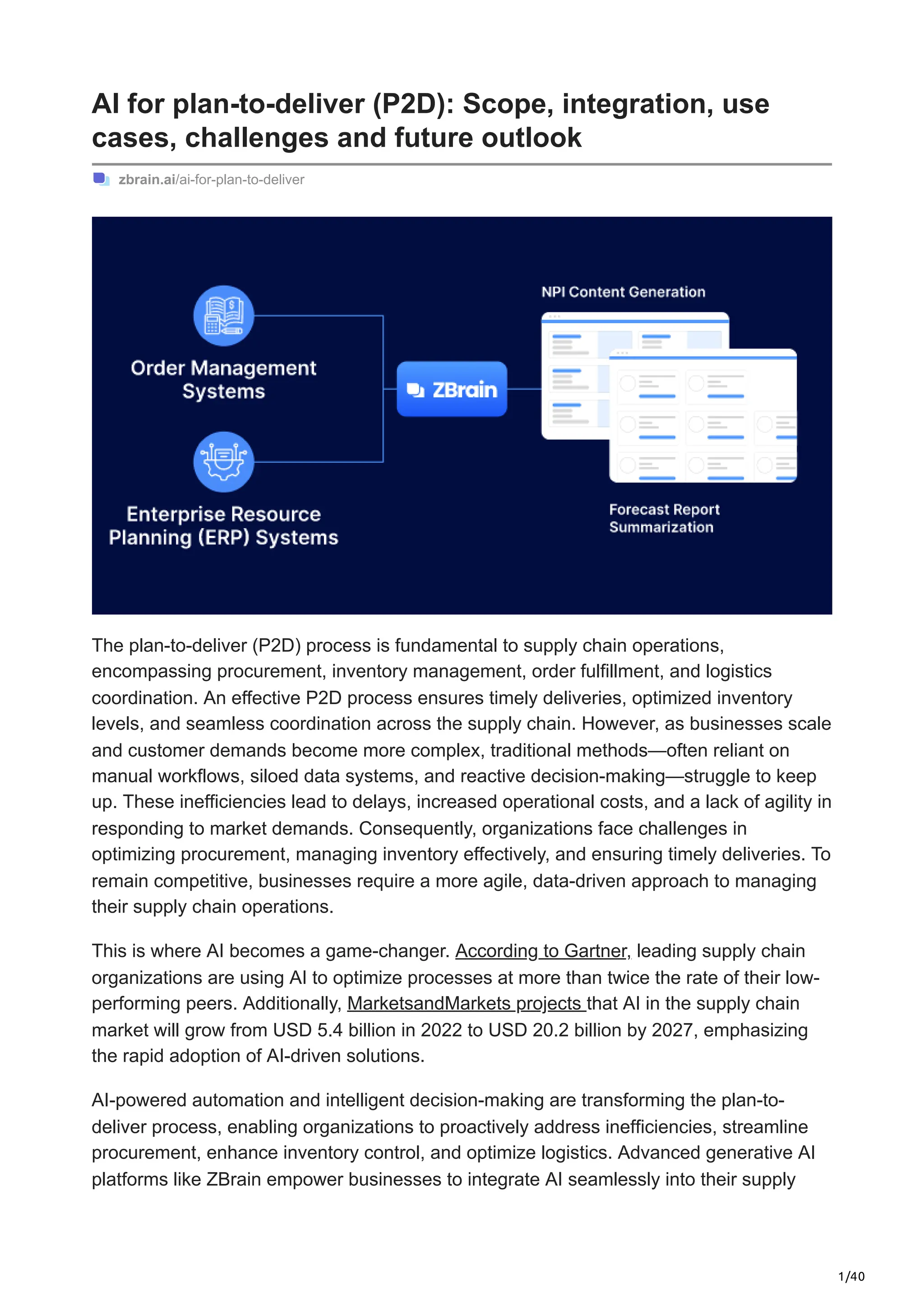
AI-powered automation and intelligent decision-making are transforming the plan-to-
deliver process, enabling organizations to proactively address inefficiencies, streamline
procurement, enhance inventory control, and optimize logistics. Advanced generative AI
platforms like ZBrain empower businesses to integrate AI seamlessly into their supply
2/40
chain workflows, improving efficiency, accuracy, and agility. By leveraging AI-driven
insights and automation, organizations can overcome traditional bottlenecks, enhance
fulfillment speed, and drive long-term operational success.
This article explores the limitations of traditional plan-to-deliver processes, the
transformative impact of AI in supply chain optimization, and how ZBrain equips
businesses with AI-driven capabilities to enhance agility, streamline operations, and
future-proof their supply chain strategies.
What is the plan-to-deliver process?
The plan-to-deliver (P2D) process is a comprehensive framework that governs the end-
to-end management of supply chain activities, ensuring materials, components, and
finished goods flow seamlessly to meet customer demand efficiently. This process aligns
closely with the Supply Chain Operations Reference (SCOR) model, which provides a
standardized approach to evaluating and improving supply chain performance.
Key stages of the plan-to-deliver process include:
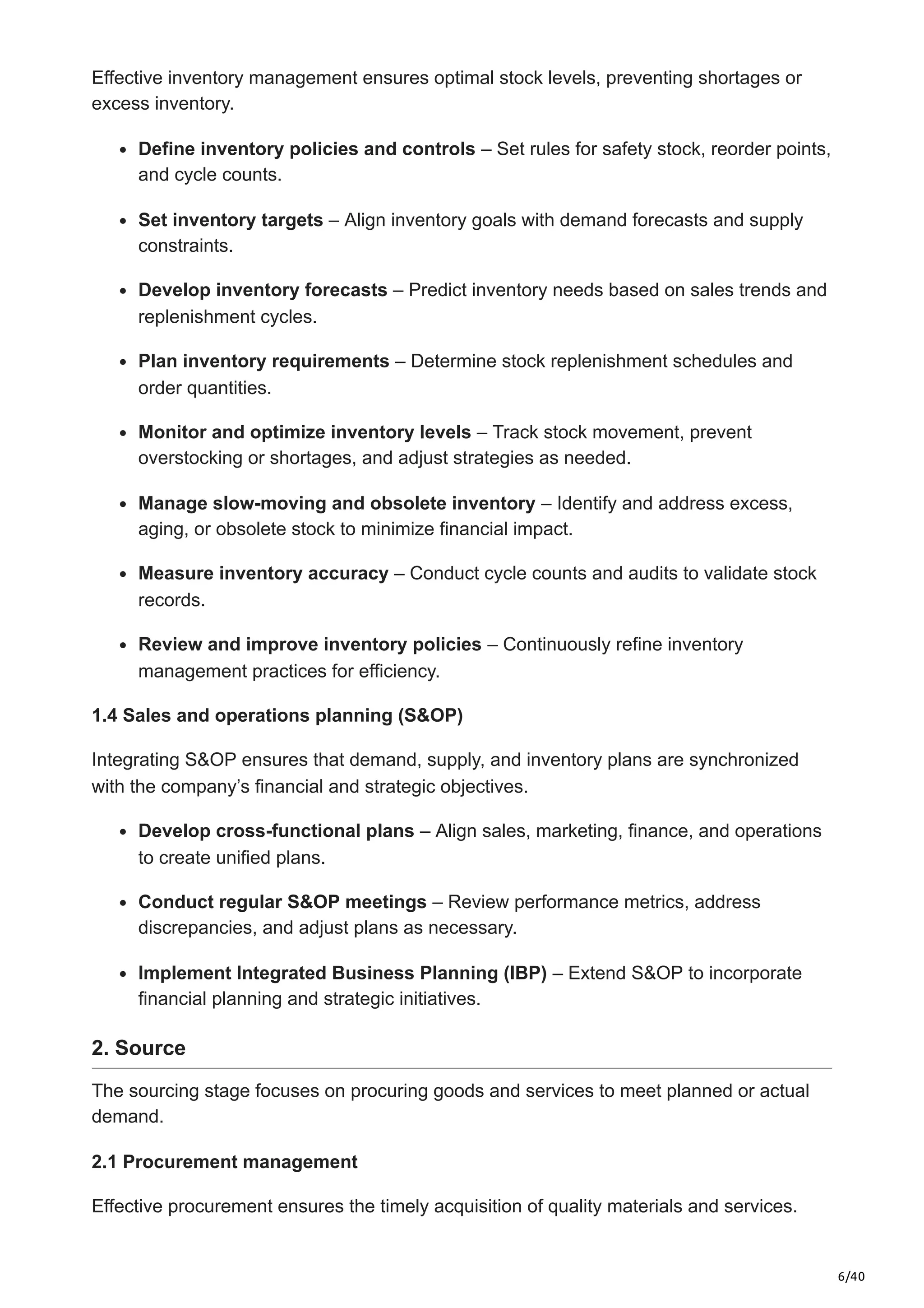
1. Plan: Forecasting customer demand to align procurement and production
strategies, balancing supply and demand, and managing inventory levels to ensure
operational efficiency.
2. Source: Procuring materials and managing supplier relationships to meet
production requirements, ensuring quality and timely delivery of inputs.
3. Make: Executing production according to demand and supply plans while optimizing
resources, including scheduling manufacturing activities and maintaining quality
standards.
4. Deliver: Fulfilling orders, managing logistics, and ensuring timely delivery to
customers, encompassing order processing, warehousing, and outbound
transportation.
5. Return: Managing the return of products for any reason, including handling returns
and recycling processes, to maintain customer satisfaction and sustainability.
By integrating these stages into a structured workflow, businesses can enhance supply
chain visibility, reduce costs, and improve overall operational agility. The SCOR model,
developed by the Supply Chain Council (now part of the Association for Supply Chain
Management), encompasses these stages and provides a framework for evaluating and
improving supply chain performance.
Implementing AI-powered solutions can significantly enhance the execution of the plan-
to-deliver process. Technologies such as machine learning and predictive analytics
enable organizations to optimize demand forecasting, streamline supplier collaboration,
3/40
improve warehouse efficiency, and ensure real-time shipment tracking. By leveraging
these advanced technologies, businesses can drive efficiency, reduce operational risks,
and enhance decision-making across the supply chain.
An optimized plan-to-deliver process enables organizations to achieve greater supply
chain resilience, ensure timely fulfillment, and adapt to shifting market demands. By
integrating intelligent automation, data analytics, and predictive insights, businesses can
maintain a competitive edge while improving cost-effectiveness and service reliability.
Why is the plan-to-deliver process important?
The plan-to-deliver process is crucial for maintaining an efficient and responsive supply
chain. It provides a structured approach to managing procurement, production, logistics,
and delivery, ensuring smooth coordination across all supply chain functions.
A well-structured plan-to-deliver process standardizes critical operations such as demand
planning, inventory optimization, and transportation management. This consistency helps
reduce supply chain disruptions, minimize waste, and improve fulfillment accuracy. With
real-time visibility into inventory levels and logistics operations, businesses can
proactively address potential bottlenecks and optimize resource utilization.
A robust plan-to-deliver strategy also strengthens compliance with regulatory
requirements and contractual obligations. It ensures that procurement, warehousing, and
distribution processes adhere to industry standards, reducing risks related to supply chain
inefficiencies. Additionally, data-driven insights from plan-to-deliver operations support
better demand forecasting, supplier performance management, and strategic decision-
making.
Ultimately, an optimized plan-to-deliver process enhances operational performance,
improves service reliability, and enables businesses to navigate supply chain complexities
with agility and precision. Organizations can achieve a resilient, customer-centric, and
future-ready supply chain by integrating AI-driven automation, predictive analytics, and
intelligent workflows.
Understanding the plan-to-deliver stages
The plan-to-deliver(P2D) process is a critical component of operations management,
ensuring the seamless production and delivery of goods. It consists of five main stages:
4/40
1. Plan – Forecast demand, align supply, and manage inventory to ensure operational
efficiency.
2. Source – Procure materials and manage supplier relationships to meet production
requirements.
3. Make – Execute production according to demand and supply plans while optimizing
resources.
4. Deliver – Fulfill orders, manage logistics, and ensure timely delivery to customers.
5. Return – Manage the return of products for any reason, including post-delivery
customer support.
Each stage plays a vital role in minimizing disruptions, optimizing costs, and meeting
customer expectations.
1. Plan
The planning stage involves demand forecasting, aligning supply with demand, and
managing inventory to ensure smooth production and distribution.​
1.1 Demand planning
Accurate demand planning prevents inventory imbalances and optimizes supply chain
performance.​
Develop new product introduction (NPI) plans – Define launch strategies,
including pricing, promotions, and distribution plans for new products.​
Create promotional and brand plans – Collaborate with customers to design
campaigns that drive demand.​
5/40
Generate baseline forecasts – Analyze historical sales data and market trends to
establish initial demand projections.​
Develop first-cut forecasts – Utilize statistical models and market insights to refine
demand projections.​
Conduct consensus demand meetings – Align forecasts across sales, marketing,
and supply planning teams.​
Participate in Sales and Operations Planning (S&OP) meetings – Engage in
cross-functional meetings to synchronize demand plans with supply and financial
goals.​
Monitor forecasts versus actuals – Track forecast accuracy and adjust
projections accordingly.​
Evaluate and improve forecasting approaches – Assess forecasting models,
measure accuracy (e.g., Mean Absolute Percentage Error, forecast bias), and refine
methodologies.​
1.2 Supply planning
Supply planning ensures production capacity and material availability align with demand
projections.​
Develop rough-cut capacity plans – Assess production capabilities and resource
constraints.​
Generate initial supply plans – Develop plans to meet demand forecasts.​
Conduct supply meetings – Review supply plans with stakeholders and resolve
discrepancies.​
Participate in S&OP meetings – Align supply, demand, and financial objectives.​
Optimize Material Requirements Planning (MRP) – Plan raw material
procurement based on production schedules.​
Create Master Production Schedules (MPS) – Develop detailed production
schedules to meet demand efficiently.​
Develop line schedules – Convert production schedules into executable
manufacturing work orders.​
Evaluate and optimize supply planning approaches – Continuously improve
strategies for efficiency and responsiveness.​
1.3 Inventory management
6/40
Effective inventory management ensures optimal stock levels, preventing shortages or
excess inventory.​
Define inventory policies and controls – Set rules for safety stock, reorder points,
and cycle counts.​
Set inventory targets – Align inventory goals with demand forecasts and supply
constraints.​
Develop inventory forecasts – Predict inventory needs based on sales trends and
replenishment cycles.​
Plan inventory requirements – Determine stock replenishment schedules and
order quantities.​
Monitor and optimize inventory levels – Track stock movement, prevent
overstocking or shortages, and adjust strategies as needed.​
Manage slow-moving and obsolete inventory – Identify and address excess,
aging, or obsolete stock to minimize financial impact.​
Measure inventory accuracy – Conduct cycle counts and audits to validate stock
records.​
Review and improve inventory policies – Continuously refine inventory
management practices for efficiency.​
1.4 Sales and operations planning (S&OP)
Integrating S&OP ensures that demand, supply, and inventory plans are synchronized
with the company’s financial and strategic objectives.​
Develop cross-functional plans – Align sales, marketing, finance, and operations
to create unified plans.​
Conduct regular S&OP meetings – Review performance metrics, address
discrepancies, and adjust plans as necessary.​
Implement Integrated Business Planning (IBP) – Extend S&OP to incorporate
financial planning and strategic initiatives.
2. Source
The sourcing stage focuses on procuring goods and services to meet planned or actual
demand.​
2.1 Procurement management
Effective procurement ensures the timely acquisition of quality materials and services.​
7/40
Develop procurement strategies – Align procurement plans with organizational
objectives and market conditions.​
Identify and evaluate suppliers – Assess potential suppliers based on capability,
capacity, and alignment with company values.​
Negotiate contracts and agreements – Establish terms and conditions that define
pricing, delivery schedules, and service levels.​
Manage supplier relationships – Maintain open communication, address issues
promptly, and foster long-term partnerships.​
Monitor supplier performance – Create key performance indicators (KPIs) to track
quality, delivery, and cost performance.​
Implement supplier development programs – Collaborate with suppliers to
improve processes, reduce costs, and enhance product quality.​
2.2 Purchase order management
Managing purchase orders ensures timely procurement and accuracy in the purchasing
process.​
Generate purchase requisitions – Initiate requests for materials or services based
on demand and inventory levels.​
Convert requisitions to purchase orders – Create formal purchase orders (POs)
and obtain necessary approvals.​
Transmit purchase orders to suppliers – Communicate POs to suppliers through
electronic data interchange (EDI) or other agreed methods.​
Confirm order acknowledgment – Ensure suppliers have received and accepted
the PO terms.​
Monitor order status – Track the progress of orders to ensure on-time delivery.​
Resolve discrepancies – Address any quantity, quality, or delivery timelines
issues.​
2.3 Inbound logistics
Efficient inbound logistics are essential for the timely receipt and handling of materials.​
Plan and coordinate inbound shipments – Optimize supplier deliveries for
efficiency and cost control.​
Monitor carrier performance – Ensure timely and compliant transportation.​
8/40
Manage customs and compliance – Handle import regulations and
documentation.​
2.4 Inventory management
Effective inventory management ensures optimal stock levels, preventing shortages or
excess inventory.​
Define inventory policies and controls – Set rules for safety stock, reorder points,
and cycle counts.​
Set inventory targets – Align inventory goals with demand forecasts and supply
constraints.​
Forecasts – Predict inventory needs based on sales trends and replenishment
cycles.​
Plan inventory requirements – Determine stock replenishment schedules and
order quantities.​
Monitor and optimize inventory levels – Track stock movement, prevent
overstocking or shortages, and adjust strategies as needed.​
Manage slow-moving and obsolete inventory – Identify and address excess,
aging, or obsolete stock to minimize financial impact.
Measure inventory accuracy – Conduct cycle counts and audits to validate stock
records.​
Review and improve inventory policies – Continuously refine inventory
management practices for efficiency.​
3. Make
The production stage focuses on transforming materials into finished products to meet
planned or actual demand.​
3.1 Production management
Efficient production management ensures that manufacturing processes are optimized for
quality and efficiency.​
Develop production plans – Align production schedules with demand forecasts
and supply constraints.​
Manage production schedules – Coordinate labor, equipment, and materials to
meet production targets.​
9/40
Execute production processes – Oversee manufacturing activities to ensure
adherence to quality and efficiency standards.​
Perform quality inspections – Conduct regular checks to maintain product quality.​
Manage production data – Maintain records of production metrics for analysis and
improvement.​
3.2 Maintenance management
Proper maintenance management ensures equipment reliability and minimizes downtime.​
Develop maintenance plans – Schedule regular preventive maintenance activities.​
Monitor equipment performance – Use predictive analytics to anticipate and
prevent failures.​
Manage spare parts inventory – Ensure availability of necessary components for
maintenance activities.​
3.3 Quality management
Maintaining high-quality standards is crucial for customer satisfaction and compliance.​
Define quality standards and controls – Establish inspection protocols and
compliance measures.​
Perform quality audits and inspections – Ensure adherence to regulatory and
internal quality requirements.​
Manage non-conformance and corrective actions – Address defects and drive
process improvements.
4. Deliver
The delivery stage encompasses activities related to order management, warehousing,
transportation, and ensuring timely delivery to customers.​
4.1 Order management
Effective order management ensures accurate processing and fulfillment of customer
orders.​
Process customer orders – Receive, validate, and enter orders into the system.​
Manage order status – Track orders from receipt to delivery, providing updates as
necessary.​
Handle order modifications and cancellations – Manage changes to orders
efficiently to maintain customer satisfaction.​
10/40
4.2 Warehouse management
Efficient warehouse operations are vital for timely order fulfillment and inventory accuracy.​
Receive and store inventory – Ensure accurate inbound processing and optimal
space utilization.​
Optimize inventory management – Maintain stock accuracy and minimize
carrying costs.​
Pick, pack, and prepare shipments – Streamline order fulfillment processes to
ensure timely dispatch.​
4.3 Outbound transportation
Effective outbound transportation ensures that products reach customers promptly and in
good condition.​
Plan and schedule shipments – Align deliveries with customer demand and
service levels.​
Optimize carrier selection – Balance cost, speed, and reliability when choosing
transportation providers.​
Track and manage deliveries – Ensure on-time fulfillment and proactively handle
any disruptions.
4.4 Reverse logistics
Managing returns efficiently is crucial for customer satisfaction and cost control.​
Process returns and refurbishments – Handle returned goods efficiently for
reuse, resale, or disposal.​
Ensure compliance with regulations – Adhere to laws and guidelines related to
waste management, recalls, and warranty returns.​
Optimize cost recovery – Minimize losses and maximize salvage value through
effective reverse logistics strategies.
5. Return
The return stage involves processes associated with returning products, whether due to
defects, end-of-life, or customer dissatisfaction.​
5.1 Return of defective products
Efficient handling of defective products ensures customer satisfaction and compliance.​
11/40
Authorize returns – Establish clear policies and procedures for accepting defective
products.​
Receive returned products – Inspect and document returned items to assess their
condition.​
Process refunds or replacements – Provide timely resolutions to maintain
customer trust.​
5.2 Return of end-of-life products
Managing end-of-life products responsibly supports sustainability initiatives.​
Develop take-back programs – Encourage customers to return products for
recycling or disposal.​
Ensure environmentally friendly disposal – Adhere to regulations and best
practices for waste management.​
5.3 Return of unsold inventory
Handling unsold inventory efficiently minimizes financial impact.​
Negotiate return agreements – Establish terms with retailers or distributors for
returning unsold goods.​
Process returned inventory – Assess and decide on refurbishment, redistribution,
or disposal.
Transforming plan-to-deliver process: How AI solves traditional
challenges
The plan-to-deliver process ensures seamless supply chain operations, covering demand
forecasting, production, logistics, and delivery. However, traditional approaches often face
challenges such as inefficiencies, manual errors, and limited visibility, leading to
operational delays and increased costs.
AI-driven automation, predictive analytics, and intelligent workflows can address these
challenges, improving efficiency, accuracy, and decision-making. Below is a breakdown of
key plan-to-deliver challenges, their impact, and how AI helps overcome them.
Challenge
Impact of traditional
methods
How AI helps overcome the
challenge
12/40
Demand
forecasting
inaccuracies
Over-reliance on historical
data leads to inaccurate
demand predictions, causing
stockouts or overstocking.
AI-driven demand forecasting models
analyze real-time market trends,
customer behavior, and external
factors to improve accuracy.
Slow
demand
planning
adjustments
Delays in adjusting forecasts
based on changing market
conditions affect supply chain
responsiveness.
AI enables dynamic forecasting and
real-time scenario analysis, allowing
businesses to adapt to demand
fluctuations quickly.
Manual
supply
planning
Human-driven planning
increases errors, delays
material procurement, and
leads to inefficiencies.
AI automates supply planning by
analyzing demand patterns,
optimizing inventory levels, and
recommending procurement actions.
Inventory
imbalances
Excess inventory leads to high
carrying costs, while shortages
result in missed sales and
operational disruptions.
AI optimizes inventory management
by predicting demand patterns and
automating stock replenishment
decisions.
Reactive
rather than
proactive
maintenance
Unplanned equipment failures
cause production delays and
increased downtime.
AI-driven predictive maintenance
analyzes sensor data to anticipate
equipment failures and schedule
proactive maintenance.
Production
bottlenecks
Inconsistent scheduling and
inefficient resource allocation
lead to delays and increased
costs.
AI optimizes production scheduling
by analyzing constraints, workforce
availability, and demand priorities.
Lack of real-
time
production
insights
Limited visibility into production
performance affects quality
control and efficiency.
AI-powered analytics provide real-
time insights into production metrics,
enabling data-driven decision-making
and process optimization.
Inefficient
logistics
planning
Poor route optimization
increases transportation costs
and delivery delays.
AI optimizes logistics by using real-
time data for route planning, carrier
selection, and dynamic scheduling.
Limited
visibility into
shipments
Inaccurate tracking leads to
missed delivery timelines and
customer dissatisfaction.
AI-powered tracking systems provide
real-time shipment visibility, reducing
delivery uncertainties.
13/40
High return
rates and
inefficient
reverse
logistics
Manual handling of returns
increases processing time and
costs.
AI automates return management,
identifying root causes of returns and
optimizing refurbishment or disposal
processes.
By leveraging AI, businesses can enhance their plan-to-deliver processes, improving
efficiency, reducing costs, and ensuring a resilient supply chain.
Optimize Your Operations With AI Agents
Our AI agents streamline your workflows, unlocking new levels of business efficiency!
Explore Our AI Agents
Approaches to integrating AI into plan-to-deliver
AI is transforming operation management by optimizing planning, production, inventory
control, and logistics. Businesses can integrate AI into their plan-to-deliver processes
through different approaches based on their operational needs, resources, and long-term
goals.
Custom, in-house AI development
This approach involves developing AI solutions tailored to supply chain operations, such
as demand forecasting, production planning, and logistics optimization.
Advantages:
Customization: Aligns AI models with specific business workflows, such as
supplier coordination and inventory replenishment.
Full control: Ensures data privacy, regulatory compliance (e.g., ISO 27001:2022,
SOC 2 Type II), and process transparency.
Scalability: Supports evolving supply chain needs and long-term growth.
Using AI point solutions
This approach involves leveraging ready-made AI tools for targeted tasks like automated
demand sensing, real-time shipment tracking, and warehouse optimization.
Advantages:
Quick deployment: Pre-built AI models accelerate efficiency in forecasting,
inventory control, and logistics.
Cost-effective: Reduces development costs compared to custom AI solutions.
Seamless integration: Works with existing ERP, WMS, and TMS systems.
Adopting a comprehensive AI platform
14/40
This approach involves using an end-to-end AI platform like to optimize the entire supply
chain—from planning and manufacturing to transportation and reverse logistics.
Advantages:
Centralized data and compliance: Ensures supply chain visibility while adhering
to regulatory standards.
End-to-end automation: Enhances efficiency across procurement, production,
warehousing, and delivery.
Scalability and flexibility: Adapts to shifting demand, supplier performance, and
market trends.
Choosing the right AI integration approach
To effectively integrate AI into supply chain operations, businesses should consider:
Operational needs: Identify key areas for AI-driven automation, such as demand
planning, inventory optimization, or logistics.
Resources and expertise: Assess internal capabilities and budget for AI adoption.
Compliance and security: Ensure AI solutions meet industry regulations and data
protection standards.
Scalability: Choose AI strategies that align with long-term growth and evolving
supply chain complexities.
By aligning AI with plan-to-deliver processes, businesses can improve efficiency, enhance
supply chain resilience, and drive operational excellence.
AI applications transforming the plan-to-deliver processes
Artificial intelligence is revolutionizing the plan-to-deliver process by enhancing demand
forecasting, optimizing supply planning, streamlining production, and improving logistics
management. AI-driven solutions enable businesses to predict demand more accurately,
automate resource allocation, and minimize disruptions across the supply chain. By
leveraging AI-powered automation and predictive analytics, organizations can reduce
costs, improve operational efficiency, and ensure seamless order fulfillment, ultimately
enhancing customer satisfaction.
Below is a detailed explanation of AI applications across each stage of the plan-to-deliver
process, showcasing how AI improves efficiency, accuracy, and agility in planning,
production, and delivery operations.
15/40
Source Make Return
Plan Deliver
Stages
Use
Cases
NPI content
generation
Supplier
evaluation and
selection
Strategic content
generation
Supplier
communication
content generation
Automated return
authorization
Generative AI for
defect analysis
Automated sorting
for recycling
AI-guided
refurbishment
decisions
Warehouse
process
documentation
Order fulfillment
communication
Returns processing
documentation
Customer service
response
generation
Manufacturing
content
generation
Virtual
manufacturing
assistant
Production plan
documentation
Inspection report
generation
Packaging content
generation
Contract analysis
and management
Spend analysis
and optimization
Purchase
requisition
processing
Shipment tracking
and anomaly
detection
Inventory analysis
and optimization
Promo and brand
plan content
generation
Forecast report
summarization
Consensus
meeting report
generation
S&OP report
automation
Inventory policy
documentation
1. Plan
Artificial Intelligence is revolutionizing the planning stage of supply chain management by
enhancing demand forecasting, optimizing supply planning, improving inventory
management, and refining Sales and Operations Planning (S&OP). By leveraging
predictive analytics, machine learning, and real-time data processing, businesses can
achieve greater accuracy, reduce inefficiencies, and adapt swiftly to market changes.
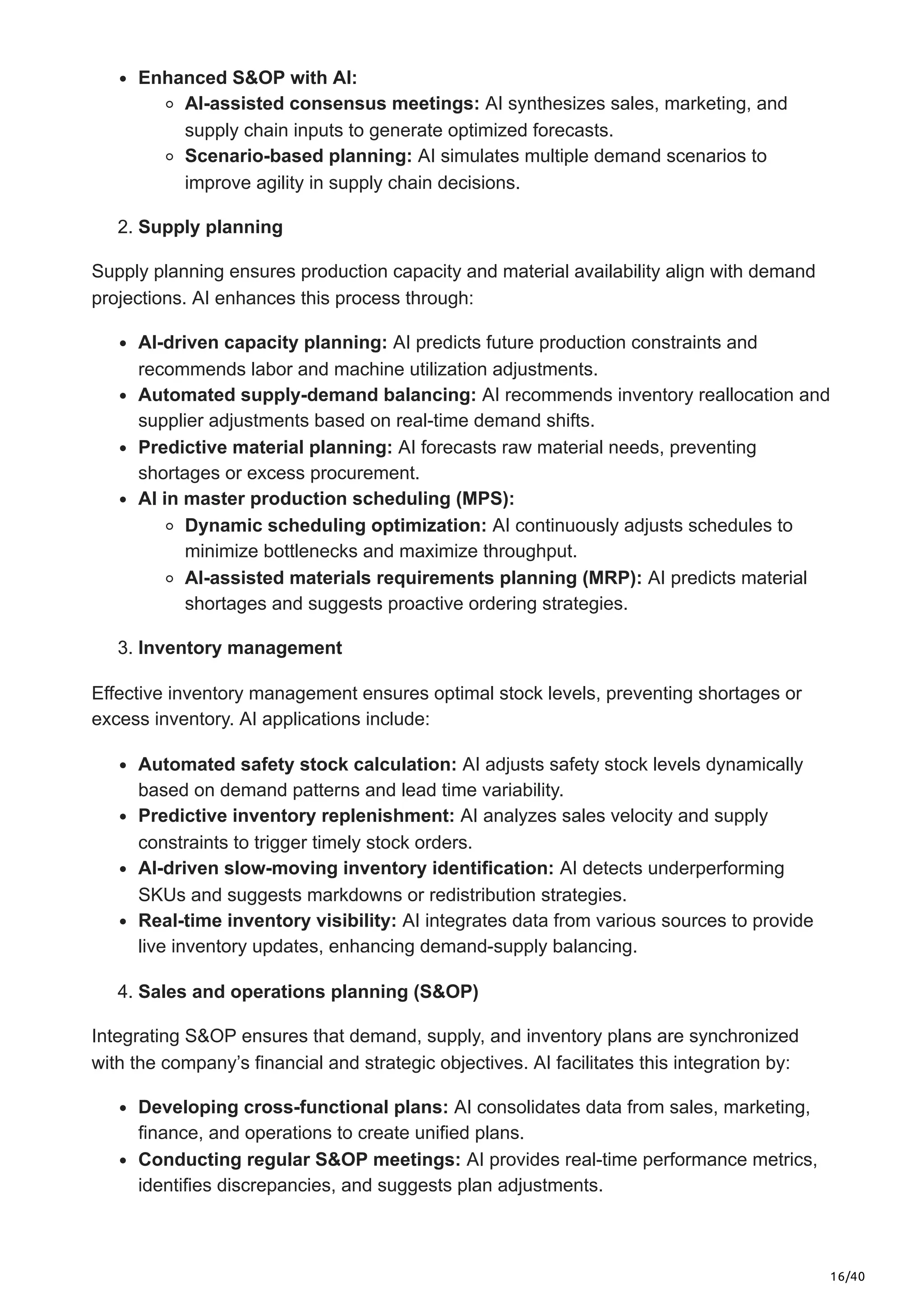
1. Demand planning
Accurate demand planning prevents inventory imbalances and optimizes supply chain
performance. AI contributes in the following ways:
Automated forecast generation: AI analyzes historical sales data, market trends,
and external factors (e.g., weather, economic indicators) to predict demand more
accurately.
Real-time demand sensing: AI continuously monitors customer behavior,
competitor actions, and social media trends to adjust forecasts dynamically.
Self-learning forecasting models: AI refines forecasting accuracy over time by
identifying patterns in historical forecast accuracy versus actuals.
AI-powered new product introduction (NPI) planning:
Market trend analysis: AI scans consumer sentiment, social media, and
competitive launches to optimize product positioning.
Automated pricing recommendations: AI evaluates market demand
elasticity to suggest optimal pricing strategies.
16/40
Enhanced S&OP with AI:
AI-assisted consensus meetings: AI synthesizes sales, marketing, and
supply chain inputs to generate optimized forecasts.
Scenario-based planning: AI simulates multiple demand scenarios to
improve agility in supply chain decisions.
2. Supply planning
Supply planning ensures production capacity and material availability align with demand
projections. AI enhances this process through:
AI-driven capacity planning: AI predicts future production constraints and
recommends labor and machine utilization adjustments.
Automated supply-demand balancing: AI recommends inventory reallocation and
supplier adjustments based on real-time demand shifts.
Predictive material planning: AI forecasts raw material needs, preventing
shortages or excess procurement.
AI in master production scheduling (MPS):
Dynamic scheduling optimization: AI continuously adjusts schedules to
minimize bottlenecks and maximize throughput.
AI-assisted materials requirements planning (MRP): AI predicts material
shortages and suggests proactive ordering strategies.
3. Inventory management
Effective inventory management ensures optimal stock levels, preventing shortages or
excess inventory. AI applications include:
Automated safety stock calculation: AI adjusts safety stock levels dynamically
based on demand patterns and lead time variability.
Predictive inventory replenishment: AI analyzes sales velocity and supply
constraints to trigger timely stock orders.
AI-driven slow-moving inventory identification: AI detects underperforming
SKUs and suggests markdowns or redistribution strategies.
Real-time inventory visibility: AI integrates data from various sources to provide
live inventory updates, enhancing demand-supply balancing.
4. Sales and operations planning (S&OP)
Integrating S&OP ensures that demand, supply, and inventory plans are synchronized
with the company’s financial and strategic objectives. AI facilitates this integration by:
Developing cross-functional plans: AI consolidates data from sales, marketing,
finance, and operations to create unified plans.
Conducting regular S&OP meetings: AI provides real-time performance metrics,
identifies discrepancies, and suggests plan adjustments.
17/40
Implementing integrated business planning (IBP): AI extends S&OP to
incorporate financial planning and strategic initiatives, ensuring alignment across
the organization.
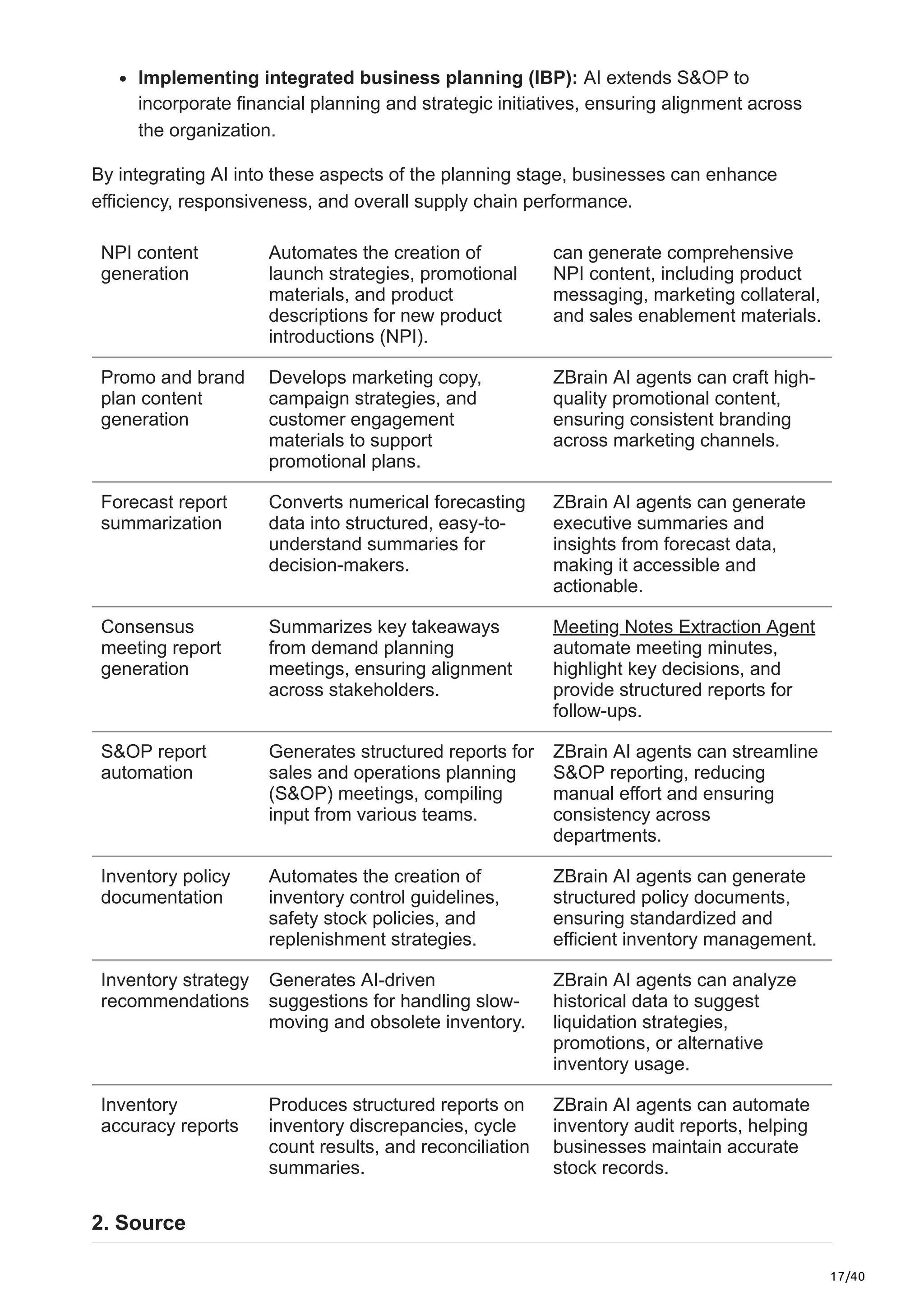
By integrating AI into these aspects of the planning stage, businesses can enhance
efficiency, responsiveness, and overall supply chain performance.
NPI content
generation
Automates the creation of
launch strategies, promotional
materials, and product
descriptions for new product
introductions (NPI).
can generate comprehensive
NPI content, including product
messaging, marketing collateral,
and sales enablement materials.
Promo and brand
plan content
generation
Develops marketing copy,
campaign strategies, and
customer engagement
materials to support
promotional plans.
ZBrain AI agents can craft high-
quality promotional content,
ensuring consistent branding
across marketing channels.
Forecast report
summarization
Converts numerical forecasting
data into structured, easy-to-
understand summaries for
decision-makers.
ZBrain AI agents can generate
executive summaries and
insights from forecast data,
making it accessible and
actionable.
Consensus
meeting report
generation
Summarizes key takeaways
from demand planning
meetings, ensuring alignment
across stakeholders.
Meeting Notes Extraction Agent
automate meeting minutes,
highlight key decisions, and
provide structured reports for
follow-ups.
S&OP report
automation
Generates structured reports for
sales and operations planning
(S&OP) meetings, compiling
input from various teams.
ZBrain AI agents can streamline
S&OP reporting, reducing
manual effort and ensuring
consistency across
departments.
Inventory policy
documentation
Automates the creation of
inventory control guidelines,
safety stock policies, and
replenishment strategies.
ZBrain AI agents can generate
structured policy documents,
ensuring standardized and
efficient inventory management.
Inventory strategy
recommendations
Generates AI-driven
suggestions for handling slow-
moving and obsolete inventory.
ZBrain AI agents can analyze
historical data to suggest
liquidation strategies,
promotions, or alternative
inventory usage.
Inventory
accuracy reports
Produces structured reports on
inventory discrepancies, cycle
count results, and reconciliation
summaries.
ZBrain AI agents can automate
inventory audit reports, helping
businesses maintain accurate
stock records.
2. Source
18/40
2.1 Procurement management
Effective procurement ensures timely acquisition of quality materials and services. AI
applications include:
AI-driven supplier evaluation: AI algorithms analyze vast datasets to assess
supplier capabilities, financial stability, and compliance records, facilitating informed
decision-making.
Contract analysis and management: AI-powered tools extract and analyze key
terms from contracts, ensuring compliance and identifying potential risks.
Spend analysis and optimization: AI identifies spending patterns and cost-saving
opportunities, enabling more strategic procurement decisions.
2.2 Purchase order management
Managing purchase orders ensures timely procurement and accuracy in the purchasing
process. AI applications include:
Automated purchase requisition processing: AI systems streamline the creation
and approval of purchase requisitions, reducing manual errors and accelerating
procurement cycles.
Predictive order management: AI forecasts demand and optimizes order
quantities, ensuring timely procurement and preventing stockouts.
2.3 Inbound logistics
Efficient inbound logistics are essential for the timely receipt and handling of materials. AI
applications include:
AI-optimized shipment planning: AI analyzes factors like traffic, weather, and
carrier performance to optimize inbound shipment schedules, reducing delays and
costs.
Real-time tracking and anomaly detection: AI monitors shipments in real-time,
detecting deviations from planned routes or schedules and enabling proactive issue
resolution.
2.4 Inventory management
Effective inventory management ensures optimal stock levels, preventing shortages or
excess inventory. AI applications include:
Demand forecasting: AI predicts future product demand based on historical data
and market trends, optimizing inventory levels.
Inventory optimization: AI recommends optimal stock levels, reorder points, and
safety stock, reducing carrying costs and preventing shortages.
19/40
Automated stock replenishment: AI systems trigger automatic replenishment
orders when inventory levels reach predefined thresholds, ensuring continuous
supply.
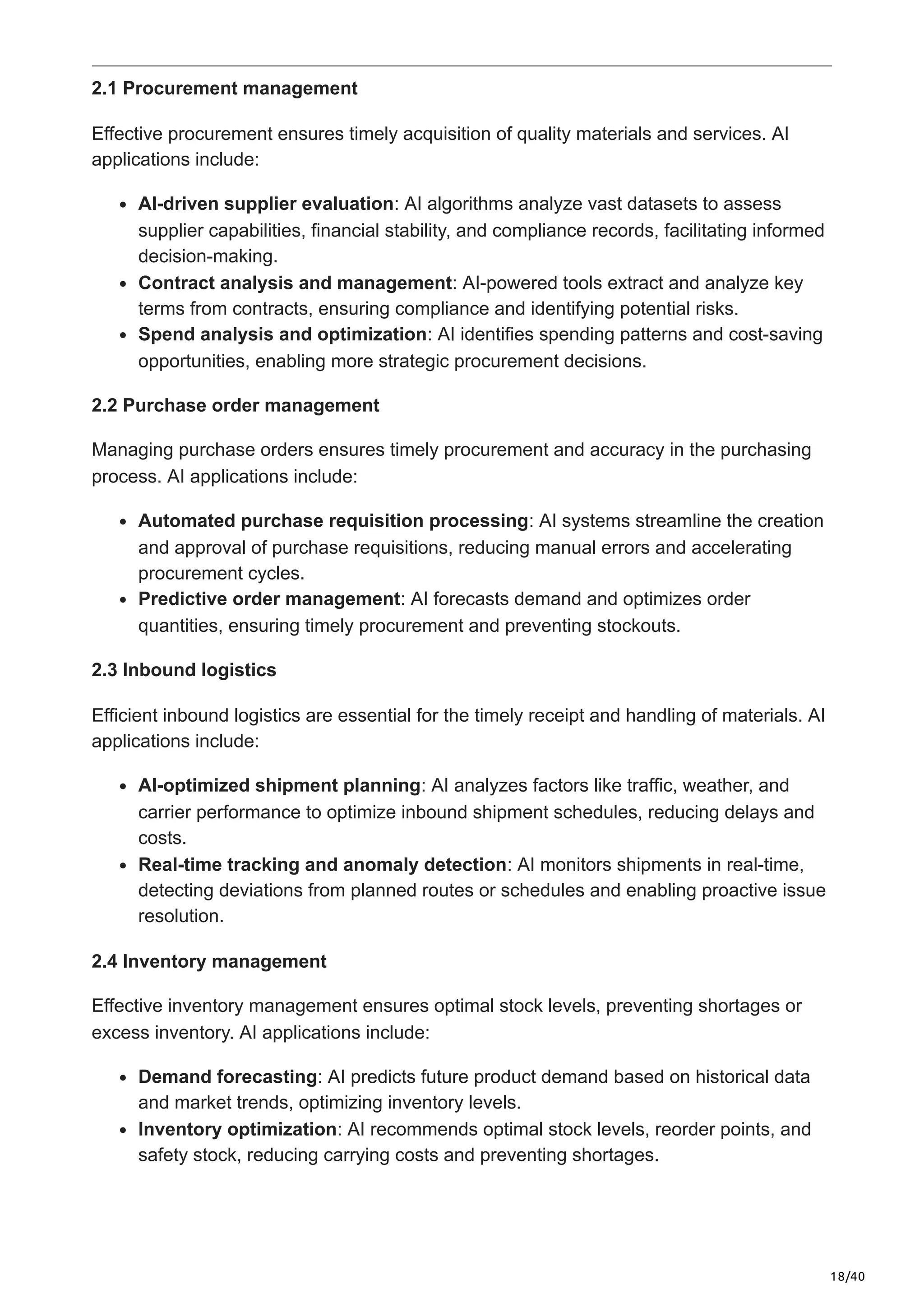
Supplier
evaluation
and
selection
AI assesses supplier
capabilities, financial
stability, and compliance
records.
Vendor Data Validation Agent automates
vendor selection by analyzing
performance metrics and compliance
records.
Contract
analysis and
management
AI extracts and analyzes key
contract terms to ensure
compliance and mitigate
risks.
Contract Compliance Check Agent
evaluates contracts for compliance,
highlighting potential risks.
Spend
analysis and
optimization
AI identifies spending
patterns and cost-saving
opportunities.
ZBrain AI agents can analyze expenses
to identify cost-saving opportunities.
Purchase
requisition
processing
AI automates the creation
and approval of purchase
requisitions.
Purchase Order Validation Agent
streamlines purchase order creation and
approval workflows.
Shipment
tracking and
anomaly
detection
AI monitors shipments in
real-time, detecting
deviations from schedules.
Supplier On-Time Delivery Monitoring
Agent Monitors supplier delivery
schedules and flags delays.
Inventory
analysis and
optimization
AI predicts demand and
recommends optimal stock
levels.
ZBrain AI agents can analyze inventory
needs and help optimize stock levels.
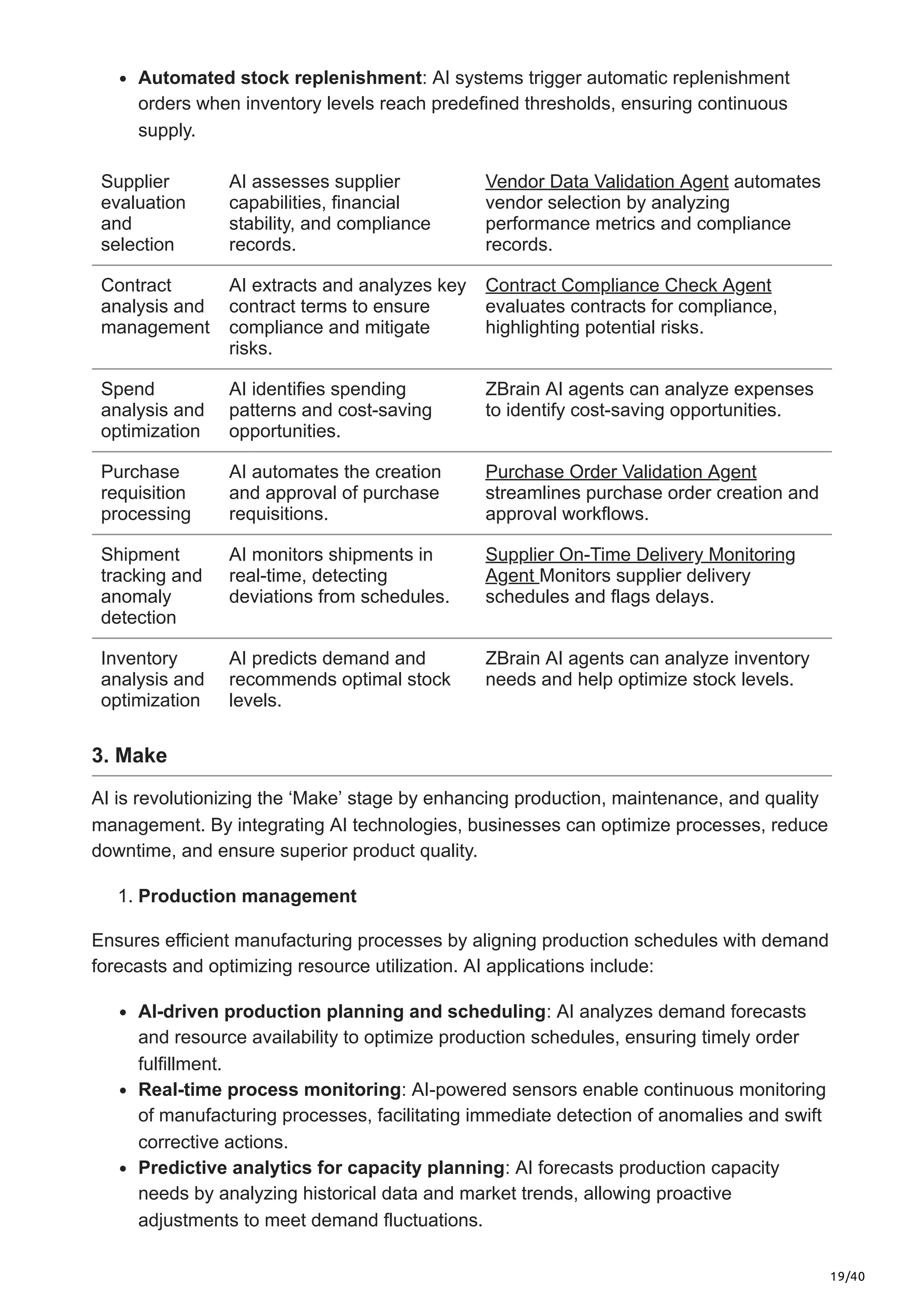
3. Make
AI is revolutionizing the ‘Make’ stage by enhancing production, maintenance, and quality
management. By integrating AI technologies, businesses can optimize processes, reduce
downtime, and ensure superior product quality.
1. Production management
Ensures efficient manufacturing processes by aligning production schedules with demand
forecasts and optimizing resource utilization. AI applications include:​
AI-driven production planning and scheduling: AI analyzes demand forecasts
and resource availability to optimize production schedules, ensuring timely order
fulfillment.
Real-time process monitoring: AI-powered sensors enable continuous monitoring
of manufacturing processes, facilitating immediate detection of anomalies and swift
corrective actions.
Predictive analytics for capacity planning: AI forecasts production capacity
needs by analyzing historical data and market trends, allowing proactive
adjustments to meet demand fluctuations.
20/40
2. Maintenance management
Focuses on maintaining equipment reliability and minimizing downtime through effective
maintenance strategies. AI applications include:​
Predictive maintenance: AI utilizes equipment sensor data to predict potential
failures, enabling maintenance to be scheduled at optimal times and reducing
unplanned downtime.
Automated maintenance scheduling: AI systems automatically schedule
maintenance activities based on equipment usage patterns and predictive analytics,
ensuring minimal disruption to production schedules.
Spare parts inventory optimization: AI predicts the need for spare parts by
analyzing equipment performance data, ensuring necessary components are
available without overstocking, thereby reducing inventory costs.
3. Quality management
Ensures products meet or exceed customer expectations and comply with regulatory
standards. AI applications include:​
AI-powered quality inspections: Computer vision and machine learning
algorithms enable automated, real-time inspection of products during
manufacturing, leading to early detection of defects and reduced waste.
Predictive quality analytics: AI identifies patterns in production data that may lead
to quality issues, allowing for proactive adjustments to processes before defects
occur.
Root cause analysis: AI assists in identifying the underlying causes of quality
problems by analyzing vast amounts of data, facilitating targeted corrective actions
and continuous improvement.
Integrating AI into the ‘Make’ stage empowers manufacturers to enhance operational
efficiency, maintain high-quality standards, and respond agilely to market demands,
thereby gaining a competitive edge in the industry.
Strategic
content
generation
Automates the creation of
strategic plans, reports, and
decision-support materials for
manufacturing strategy
alignment.
ZBrain AI agents can generate
structured strategic documents,
summaries, and insights to support
leadership in manufacturing
planning.
Manufacturing
content
generation
Creates manufacturing
documentation, including
process guidelines, operational
reports, and performance
insights.
ZBrain AI agents can streamline the
generation of process
documentation, operational SOPs,
and compliance reports.
21/40
Virtual
manufacturing
assistant
Provides AI-powered
assistance for managing
manufacturing queries,
process tracking, and workflow
guidance.
ZBrain AI agents can act as virtual
assistants to support production
teams with insights,
recommendations, and workflow
automation.
Production
plan
documentation
Automates the creation of
detailed production plans,
including scheduling and
resource allocation.
ZBrain AI agents can generate
structured production schedules,
resourcing plans, and operational
workflows.
Inspection
report
generation
Automates the documentation
of in-line inspections, defect
reports, and quality
assessments.
Product Quality Monitoring Agent
can generate inspection summaries,
defect logs, and compliance reports
to ensure manufacturing quality.
Packaging
content
generation
Generates labeling, packaging
specifications, and compliance
documentation for finished
products.
ZBrain AI agents can create
packaging instructions, product
labels, and efficiency insights for
streamlined packaging operations.
Production
summary
report
generation
Automates the creation of
production completion reports,
performance analytics, and
compliance documentation.
ZBrain AI agents can compile
production summaries, efficiency
reports, and compliance checklists
for improved visibility.
Lean
documentation
content
generation
Creates materials for lean
manufacturing initiatives,
including process improvement
guidelines and best practices.
ZBrain AI agents can generate lean
documentation, standard operating
procedures, and continuous
improvement insights.
Specification
compliance
content
generation
Automates the creation of
compliance reports, BOM
documentation, and routing
specifications.
ZBrain AI agents can generate
structured BOM data, routing
documents, and compliance
summaries to ensure accuracy.
4. Deliver
Artificial intelligence is transforming the delivery stage by enhancing order management,
warehouse operations, outbound transportation, and reverse logistics. By integrating AI
technologies, businesses can streamline processes, reduce costs, and improve customer
satisfaction.
1. Order management
Effective order management ensures accurate processing and fulfillment of customer
orders. AI applications include:​
Automated order processing: AI systems can automatically receive, validate, and
enter customer orders into the system, reducing manual errors and accelerating
order fulfillment.​
22/40
Order status tracking: AI-powered platforms provide real-time visibility into order
status, enabling proactive communication with customers regarding their deliveries.​
Intelligent order modifications: AI can efficiently handle order changes or
cancellations by analyzing the impact on inventory and logistics, ensuring customer
satisfaction.​
2. Warehouse management
Efficient warehouse operations are vital for timely order fulfillment and inventory accuracy.
AI applications include:​
Automated storage and retrieval systems (ASRS): AI-driven robotics manage
the storage and retrieval of goods, optimizing space utilization and reducing
retrieval times.
AI-driven inventory optimization: AI analyzes inventory levels and sales data to
maintain optimal stock levels, minimizing carrying costs and preventing stockouts.​
Robotic picking and packing: AI-powered robots handle picking and packing
tasks, increasing efficiency and accuracy in order fulfillment. ​
3. Outbound transportation
Effective outbound transportation ensures that products reach customers promptly and in
good condition. AI applications include:​
AI-powered route optimization: AI algorithms analyze traffic patterns, weather
conditions, and delivery windows to determine the most efficient delivery routes,
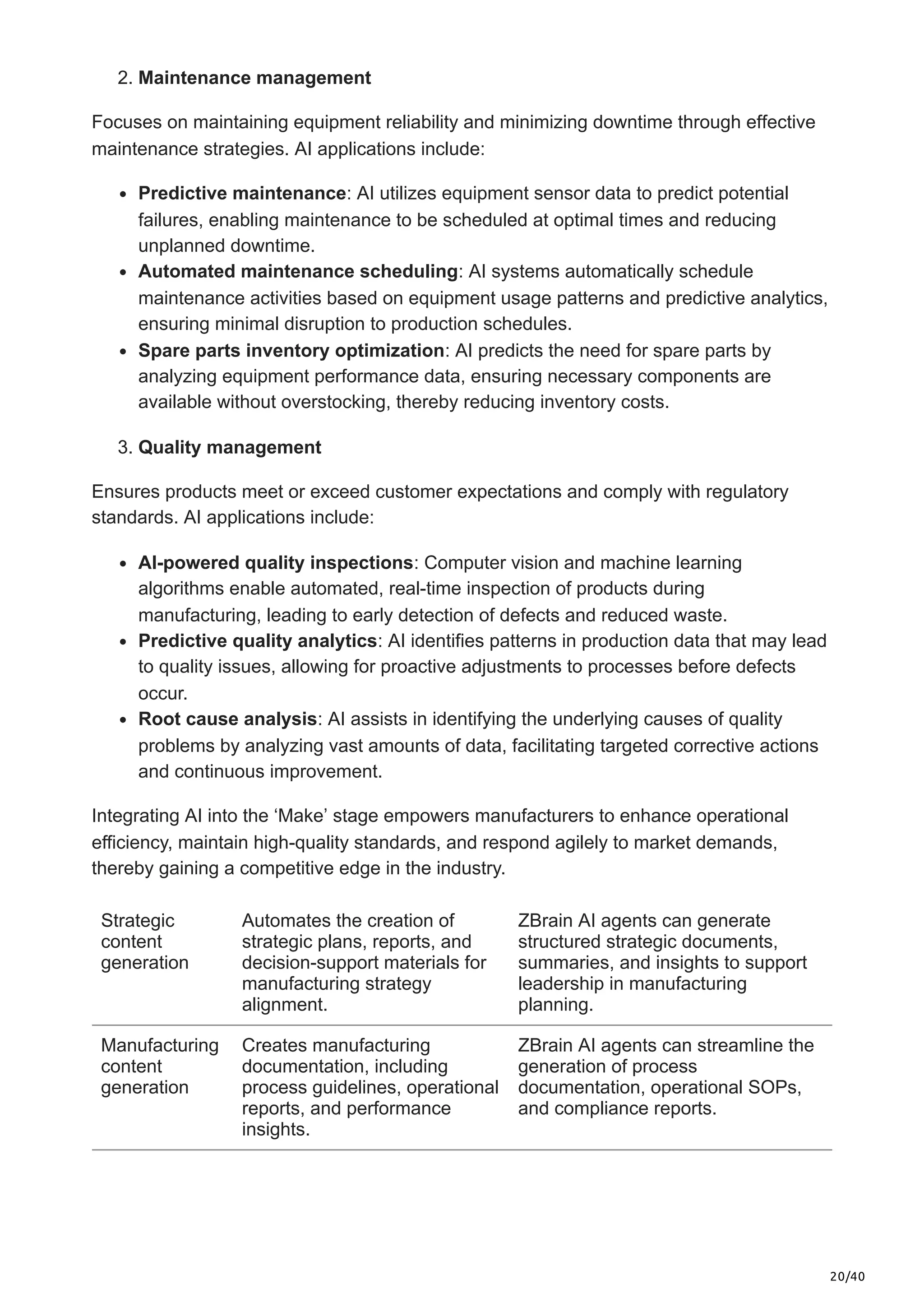
reducing transit times and fuel consumption.​
Predictive maintenance for fleets: AI monitors vehicle performance data to predict
maintenance needs, reducing unexpected breakdowns and ensuring timely
deliveries.​
Autonomous delivery vehicles: AI enables self-driving trucks and drones to
deliver goods, enhancing delivery efficiency and reducing reliance on human
drivers. ​
4. Reverse logistics
Managing returns efficiently is crucial for customer satisfaction and cost control. AI
applications include:​
Automated returns processing: AI systems can classify and process returned
items for resale, refurbishment, or disposal, streamlining reverse logistics
operations.​
Fraud detection in returns: AI analyzes return patterns to identify and prevent
fraudulent return activities, protecting revenue.​
Cost recovery optimization: AI evaluates returned products to determine the best
course of action—such as resale, recycling, or disposal—to maximize value
recovery.
23/40
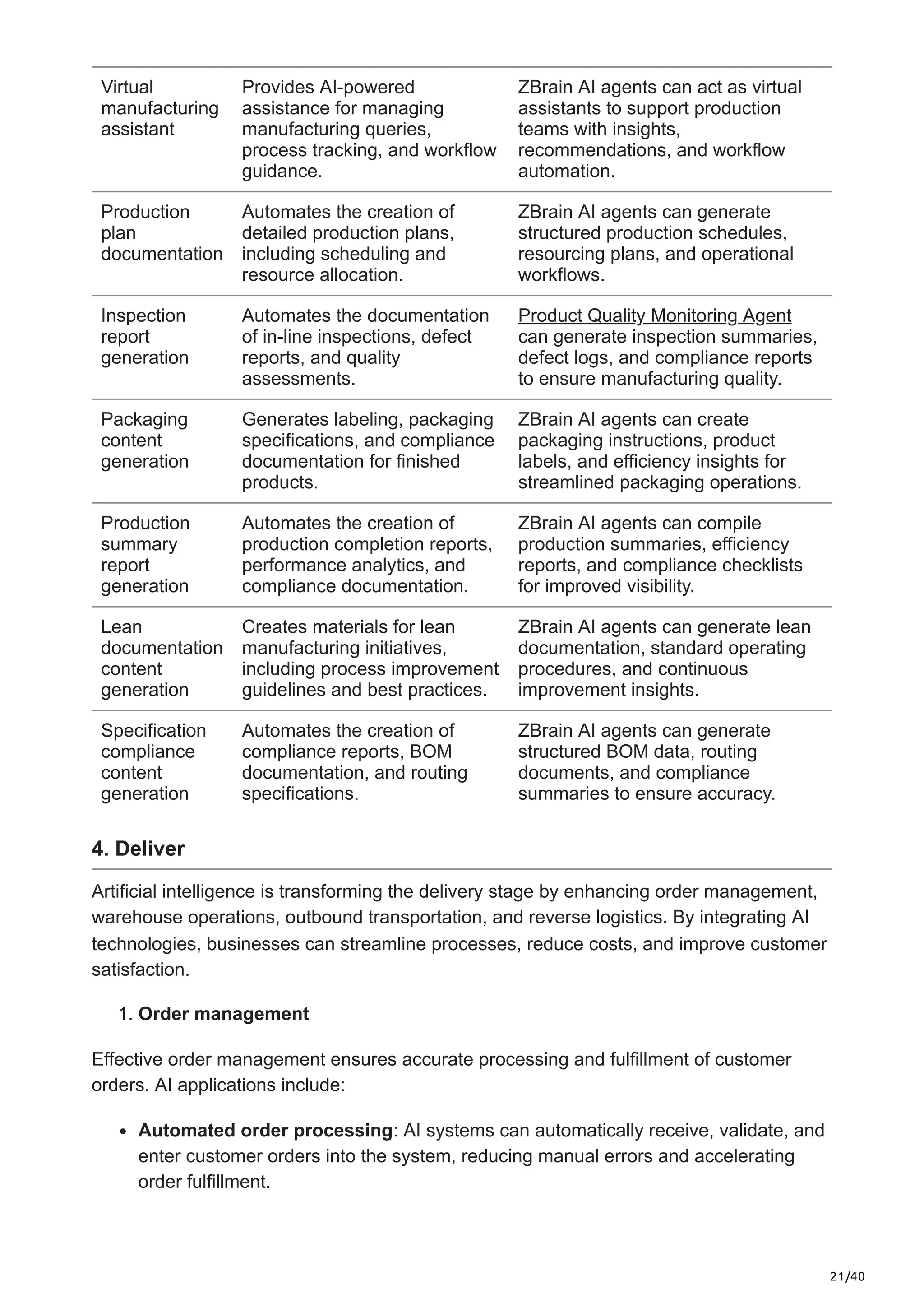
Supplier
communication
content
generation
Automates the creation
of standardized
messages, alerts, and
coordination updates for
suppliers.
Supplier Communication Automation
Agent can generate supplier notifications,
shipment updates, and coordination
templates to streamline inbound logistics.
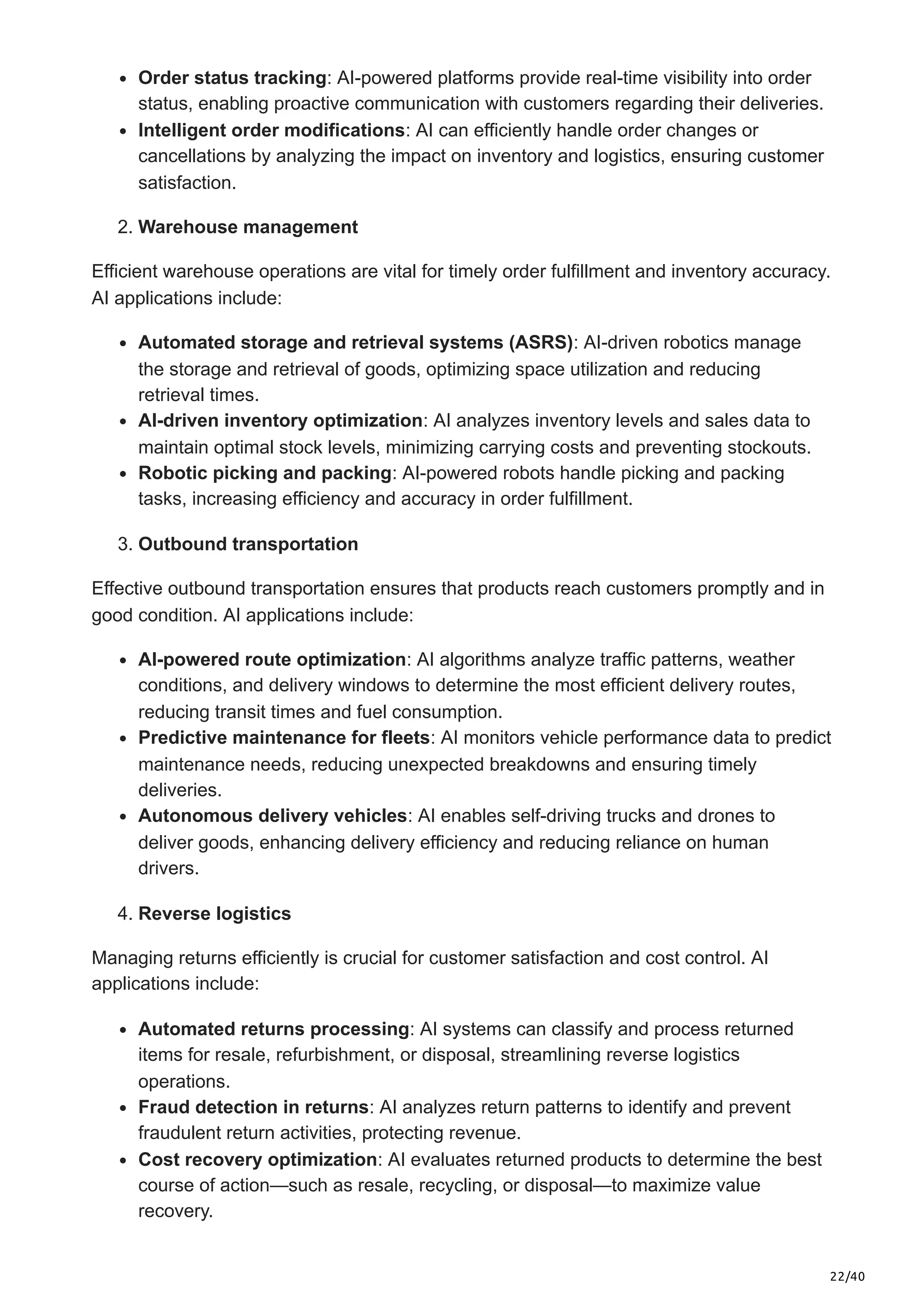
Warehouse
process
documentation
Creates detailed
warehouse operation
manuals, slotting
guidelines, and
compliance
documentation.
ZBrain AI agents can generate structured
warehouse documentation, ensuring
consistent processes and regulatory
adherence.
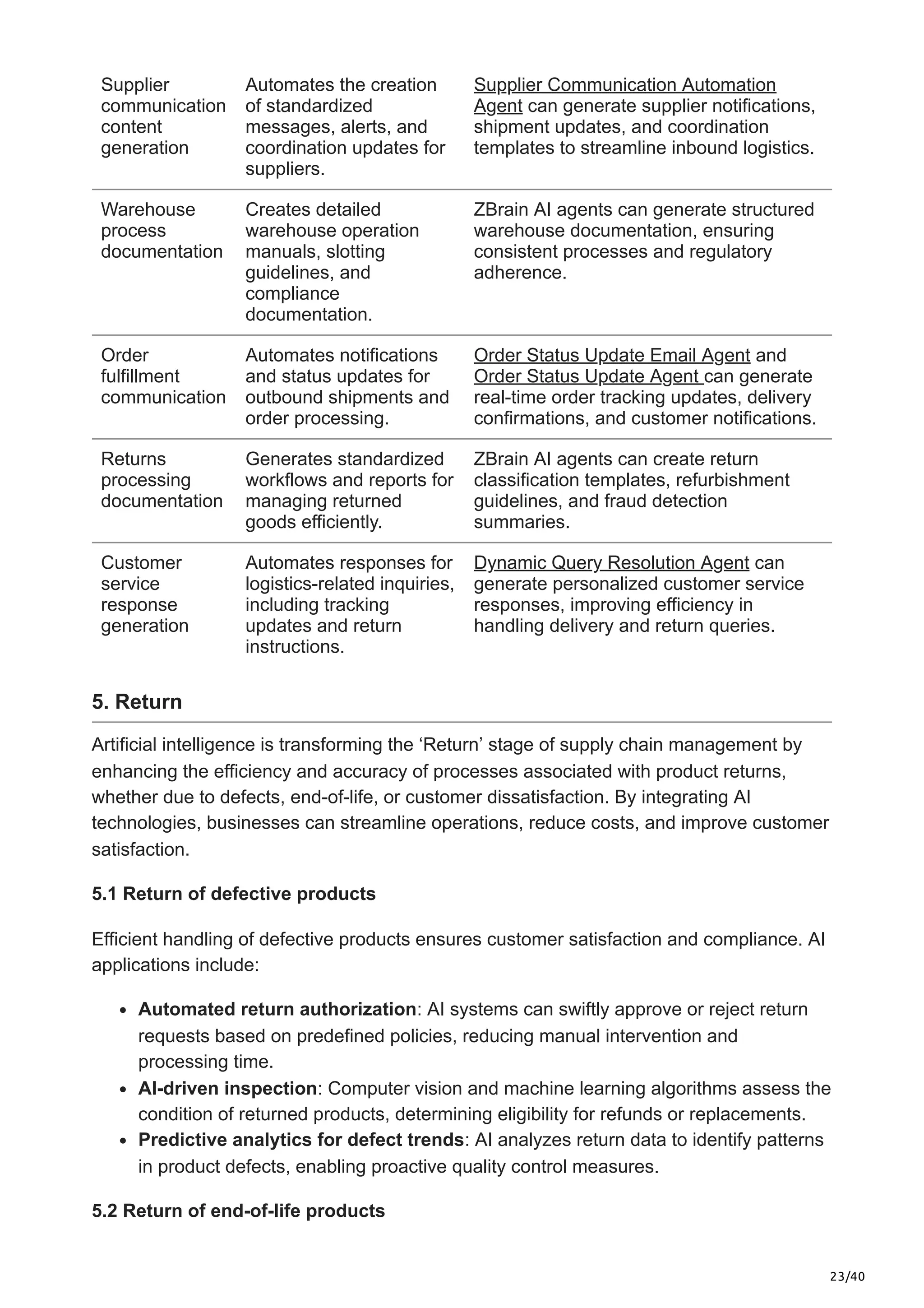
Order
fulfillment
communication
Automates notifications
and status updates for
outbound shipments and
order processing.
Order Status Update Email Agent and
Order Status Update Agent can generate
real-time order tracking updates, delivery
confirmations, and customer notifications.
Returns
processing
documentation
Generates standardized
workflows and reports for
managing returned
goods efficiently.
ZBrain AI agents can create return
classification templates, refurbishment
guidelines, and fraud detection
summaries.
Customer
service
response
generation
Automates responses for
logistics-related inquiries,
including tracking
updates and return
instructions.
Dynamic Query Resolution Agent can
generate personalized customer service
responses, improving efficiency in
handling delivery and return queries.
5. Return
Artificial intelligence is transforming the ‘Return’ stage of supply chain management by
enhancing the efficiency and accuracy of processes associated with product returns,
whether due to defects, end-of-life, or customer dissatisfaction. By integrating AI
technologies, businesses can streamline operations, reduce costs, and improve customer
satisfaction.
5.1 Return of defective products
Efficient handling of defective products ensures customer satisfaction and compliance. AI
applications include:
Automated return authorization: AI systems can swiftly approve or reject return
requests based on predefined policies, reducing manual intervention and
processing time.
AI-driven inspection: Computer vision and machine learning algorithms assess the
condition of returned products, determining eligibility for refunds or replacements.
Predictive analytics for defect trends: AI analyzes return data to identify patterns
in product defects, enabling proactive quality control measures.
5.2 Return of end-of-life products
24/40
Managing end-of-life products responsibly supports sustainability initiatives. AI
applications include:
Smart take-back programs: AI optimizes collection schedules and locations for
end-of-life products, enhancing customer participation and operational efficiency.
Automated sorting for recycling: AI-powered systems classify materials from
returned products, facilitating environmentally friendly disposal and recycling
processes.
5.3 Return of unsold inventory
Handling unsold inventory efficiently minimizes financial impact. AI applications include:
Dynamic return agreements: AI analyzes sales and returns data to negotiate
favorable terms with retailers or distributors for returning unsold goods.
AI-guided refurbishment decisions: AI evaluates the condition and market
demand for returned inventory, guiding decisions on refurbishment, redistribution, or
disposal to maximize recovery value.
Automated
return
authorization
AI swiftly approves or
rejects return requests
based on predefined
policies.
ZBrain AI agents can automate the
evaluation of return requests, ensuring
compliance with company policies and
reducing processing time.
Generative AI
for defect
analysis
AI identifies patterns in
product defects to enable
proactive quality control.
ZBrain AI agents can analyze return data
to detect recurring issues, supporting
continuous product improvement.
Automated
sorting for
recycling
AI classifies materials from
returned products for
environmentally friendly
disposal.
ZBrain AI agents can automate the
sorting of returned items, facilitating
efficient recycling processes.
AI-guided
refurbishment
decisions
AI evaluates returned
inventory to guide
refurbishment,
redistribution, or disposal
decisions.
ZBrain AI agents can assess the viability
of refurbishing returned products,
maximizing recovery value.
These AI-driven transformations make the plan-to-deliver process more efficient, reducing
costs, minimizing delays, and improving overall operational performance.
ZBrain, with its AI capabilities, helps organizations optimize plan-to-deliver processes by
enhancing automation, efficiency, and decision-making across operations.
AI readiness assessment:, evaluates an organization’s preparedness for AI
adoption in supply chain planning, logistics, and fulfillment. It provides actionable
insights to identify strengths and areas for improvement, ensuring a smooth AI
implementation.
25/40
Low-code development: , a low-code AI development platform, simplifies the
creation of custom AI solutions for supply chain challenges, making it accessible to
business users without extensive technical expertise.
Proprietary data utilization: The platform enables organizations to leverage
proprietary data effectively, ensuring AI solutions are aligned with specific supply
chain objectives, such as inventory optimization and operational efficiency.
Enterprise-ready: ZBrain Builder is designed for enterprise environments, offering
security, scalability, and seamless integration with existing supply chain
management systems, making it suitable for large organizations.
End-to-end support: ZBrain Builder supports the entire AI lifecycle for supply chain
applications—from development to deployment and continuous optimization—
ensuring seamless transitions and process improvements.
Flexible data ingestion: ZBrain Builder integrates data from multiple sources to
provide real-time insights into inventory, logistics, and supplier performance,
improving decision-making and operational efficiency.
Intelligent agent creation: AI agents built on ZBrain Builder assist in automating
knowledge-driven supply chain tasks, such as answering queries, assisting in
exception handling, and supporting decision-making in logistics and procurement,
reducing manual effort and improving operational efficiency.
With these capabilities, serves as a powerful AI platform for optimizing and automating
plan-to-deliver processes, driving efficiency, accuracy, and scalability in supply chain
operations.
Optimize Your Operations With AI Agents
Our AI agents streamline your workflows, unlocking new levels of business efficiency!
Explore Our AI Agents
Benefits of implementing AI for plan-to-deliver processes
Integrating AI into plan-to-deliver processes enhances efficiency, accuracy, and decision-
making across supply chain and manufacturing operations. AI-driven automation helps
businesses streamline workflows, optimize production, and improve overall supply chain
performance. Here are the key benefits:
Increased delivery date accuracy
AI-powered order processing enables businesses to provide more accurate delivery
estimates by analyzing real-time data on production capacity, material availability, and
logistics constraints. This helps improve on-time and in-full (OTIF) delivery rates and
enhances customer satisfaction.
26/40
Improved visibility into production and supply chain operations
AI-driven analytics provide real-time status updates on production and inventory levels,
enabling proactive decision-making. Enhanced traceability allows production managers to
identify bottlenecks, optimize workflows, and minimize disruptions caused by supply chain
variations.
Enhanced demand and inventory planning
AI automates inventory monitoring and demand analysis, ensuring businesses maintain
optimal stock levels. AI-driven insights help organizations adjust forecasts dynamically,
preventing stockouts and overstock situations while ensuring cost-efficient inventory
management.
Accelerated new product introductions (NPI)
AI-powered content generation and workflow automation streamline the NPI process,
enabling faster market launches. Automated documentation, marketing material creation,
and strategic planning insights reduce time-to-market and support product development
at scale.
Optimized production schedules
AI assists in intelligent production scheduling by analyzing operational constraints and
suggesting optimal workflows, resource allocations, and task sequencing. This minimizes
downtime, reduces changeovers, and ensures production meets demand efficiently.
Reduced production costs and cost variances
AI-driven cost-tracking tools monitor material, labor, and overhead expenses, helping
manufacturers understand their true cost of production. AI insights into cost variances
assist in identifying inefficiencies, leading to more cost-effective production strategies.
Improved quality control and compliance
AI enables manufacturers to implement automated quality checks, ensuring consistency
from raw materials to finished products. AI-powered analytics detect patterns in defect
rates, suggest corrective actions, and ensure compliance with industry standards through
automated reporting.
Enable scalable and flexible operations
AI-driven automation supports scaling manufacturing and supply chain operations
efficiently. Businesses can adapt quickly to market demand changes, roll out new
products and locations, and standardize processes across multiple facilities.
27/40
By integrating AI across the plan-to-deliver process, businesses can achieve higher
operational efficiency, reduced costs, and improved customer satisfaction, making their
supply chains more resilient and competitive in an evolving market.
Measuring the ROI of AI plan-to-deliver processes
Implementing AI in plan-to-deliver (P2D) processes enhances efficiency, accuracy, and
decision-making across planning, manufacturing, logistics, and fulfillment. ZBrain’s AI
solutions optimize key P2D functions, from production scheduling and inventory
management to delivery route optimization and compliance tracking. Businesses can
assess AI investments by evaluating cost savings, process efficiency, and improved
operational control. Below are examples of how ZBrain’s AI applications drive ROI across
P2D workflows.
AI-driven improvements in P2D processes using ZBrain can deliver measurable ROI by
streamlining operations, reducing delays, and enabling data-driven decision-making.
Here’s a breakdown of ROI for key P2D use cases:
Strategic planning and decision support
Use case: Enhancing production and logistics strategy with AI-driven insights
and scenario planning.
ROI metrics:
Improved demand forecasting accuracy
Optimized resource allocation
Faster decision-making for supply chain adjustments
Example: ZBrain AI agents can analyze real-time market data and historical data to
optimize manufacturing and logistics strategies, reducing overproduction and minimizing
supply chain disruptions.
AI-driven production planning and optimization
Use case: Automating production scheduling and workflow adjustments based
on demand fluctuations and supply constraints.
ROI metrics:
Increased production efficiency
Reduced idle time and machine downtime
Minimized production bottlenecks
Example: ZBrain AI agents can automate production scheduling, ensuring optimal
machine and labor utilization while dynamically adjusting workflows to meet demand
changes.
28/40
Inventory and materials management
Use case: AI-powered inventory monitoring and optimization for raw materials
and finished goods.
ROI metrics:
Reduced stockouts and excess inventory
Improved inventory turnover rates
Lower storage and holding costs
Example: ZBrain AI agents can provide real-time insights into inventory levels,
recommending optimal stock replenishment strategies to prevent shortages and
overstocking.
AI-enhanced logistics and transportation management
Use case: Optimizing inbound and outbound transportation with AI-driven
routing and carrier selection.
ROI metrics:
Reduced transportation costs
Improved on-time delivery rates
Lower carbon footprint through route optimization
Example: ZBrain AI agents can assist logistics decision-making by analyzing historical
demand and fulfillment data. They can generate insights to optimize inventory placement,
carrier selection, and fulfillment strategies for improved efficiency.
Warehouse and order fulfillment automation
Use case: AI-driven warehouse slotting and order picking to improve
fulfillment efficiency.
ROI metrics:
Faster order processing and reduced fulfillment time
Lower operational costs through automation
Enhanced order accuracy and reduced errors
Example: ZBrain AI agents can optimize warehouse slotting to improve picking speed and
integrate with automated systems to minimize errors in order fulfillment.
Reverse logistics and returns management
Use case: Automating returns processing and fraud detection in reverse
logistics.
ROI metrics:
Reduced return processing time
Improved asset recovery rates
Minimized fraudulent returns
Example: ZBrain AI agents can analyze return patterns to detect fraud, categorize
returned goods for resale or refurbishment, and optimize the reverse logistics process.
29/40
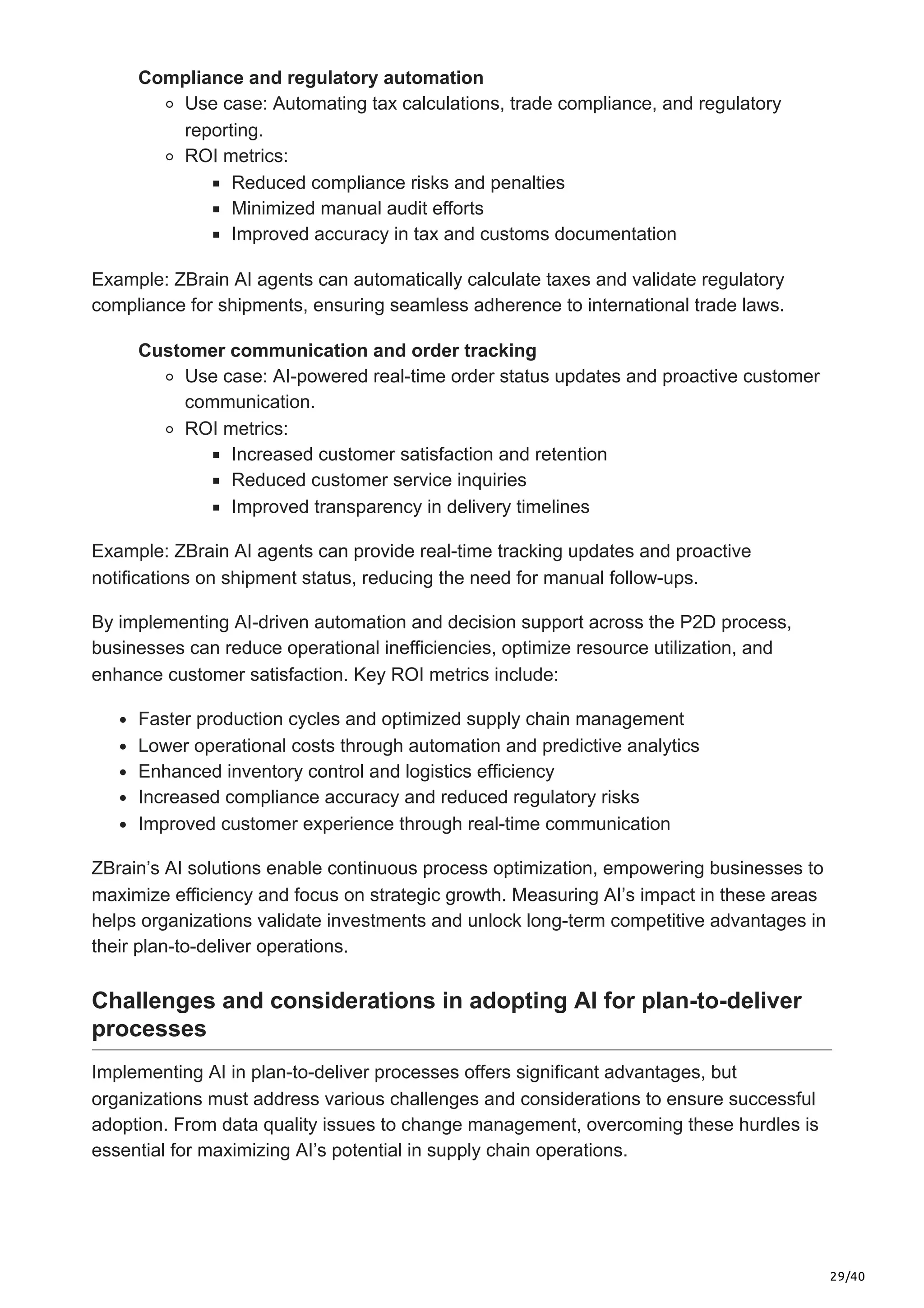
Compliance and regulatory automation
Use case: Automating tax calculations, trade compliance, and regulatory
reporting.
ROI metrics:
Reduced compliance risks and penalties
Minimized manual audit efforts
Improved accuracy in tax and customs documentation
Example: ZBrain AI agents can automatically calculate taxes and validate regulatory
compliance for shipments, ensuring seamless adherence to international trade laws.
Customer communication and order tracking
Use case: AI-powered real-time order status updates and proactive customer
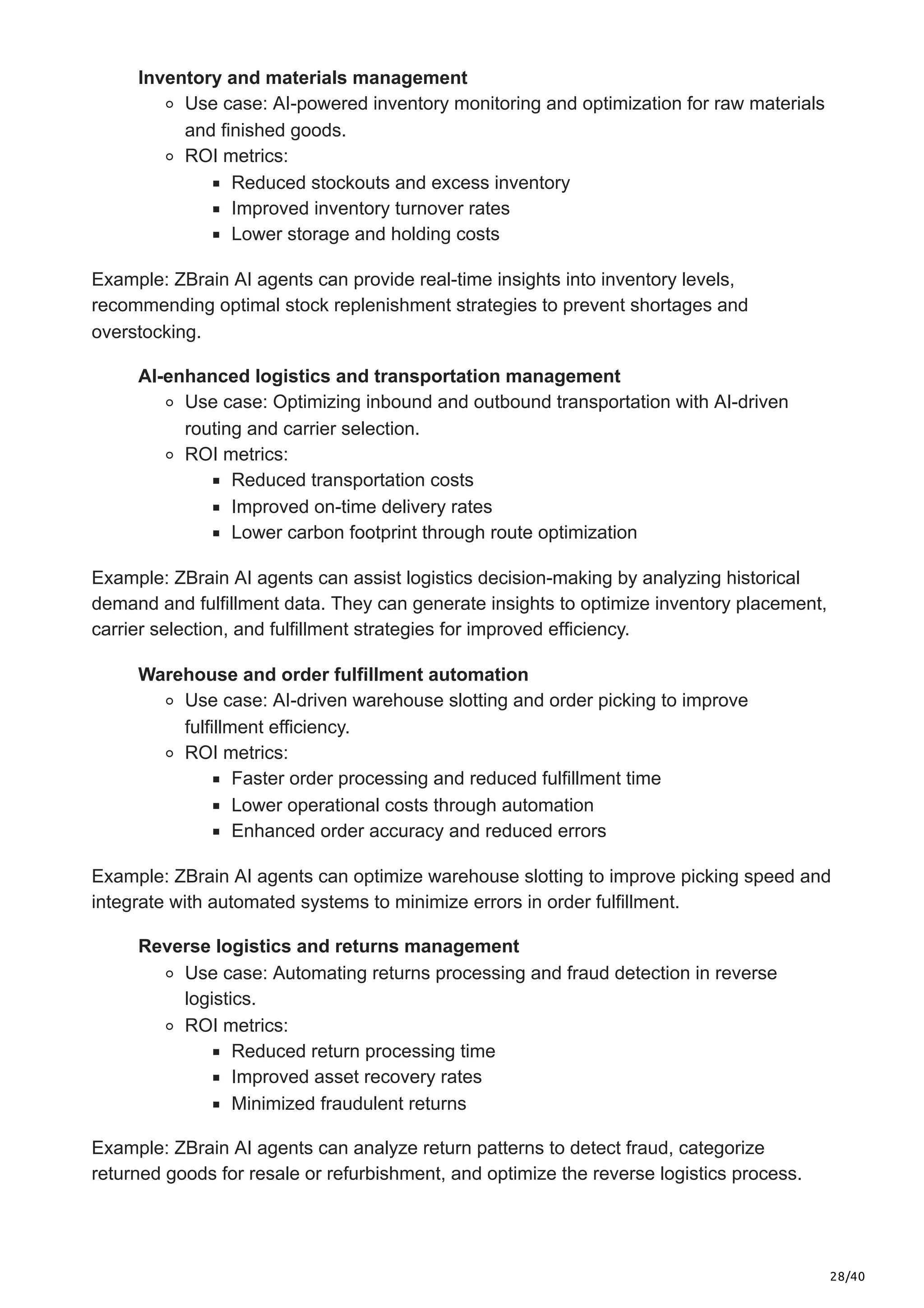
communication.
ROI metrics:
Increased customer satisfaction and retention
Reduced customer service inquiries
Improved transparency in delivery timelines
Example: ZBrain AI agents can provide real-time tracking updates and proactive
notifications on shipment status, reducing the need for manual follow-ups.
By implementing AI-driven automation and decision support across the P2D process,
businesses can reduce operational inefficiencies, optimize resource utilization, and
enhance customer satisfaction. Key ROI metrics include:
Faster production cycles and optimized supply chain management
Lower operational costs through automation and predictive analytics
Enhanced inventory control and logistics efficiency
Increased compliance accuracy and reduced regulatory risks
Improved customer experience through real-time communication
ZBrain’s AI solutions enable continuous process optimization, empowering businesses to
maximize efficiency and focus on strategic growth. Measuring AI’s impact in these areas
helps organizations validate investments and unlock long-term competitive advantages in
their plan-to-deliver operations.
Challenges and considerations in adopting AI for plan-to-deliver
processes
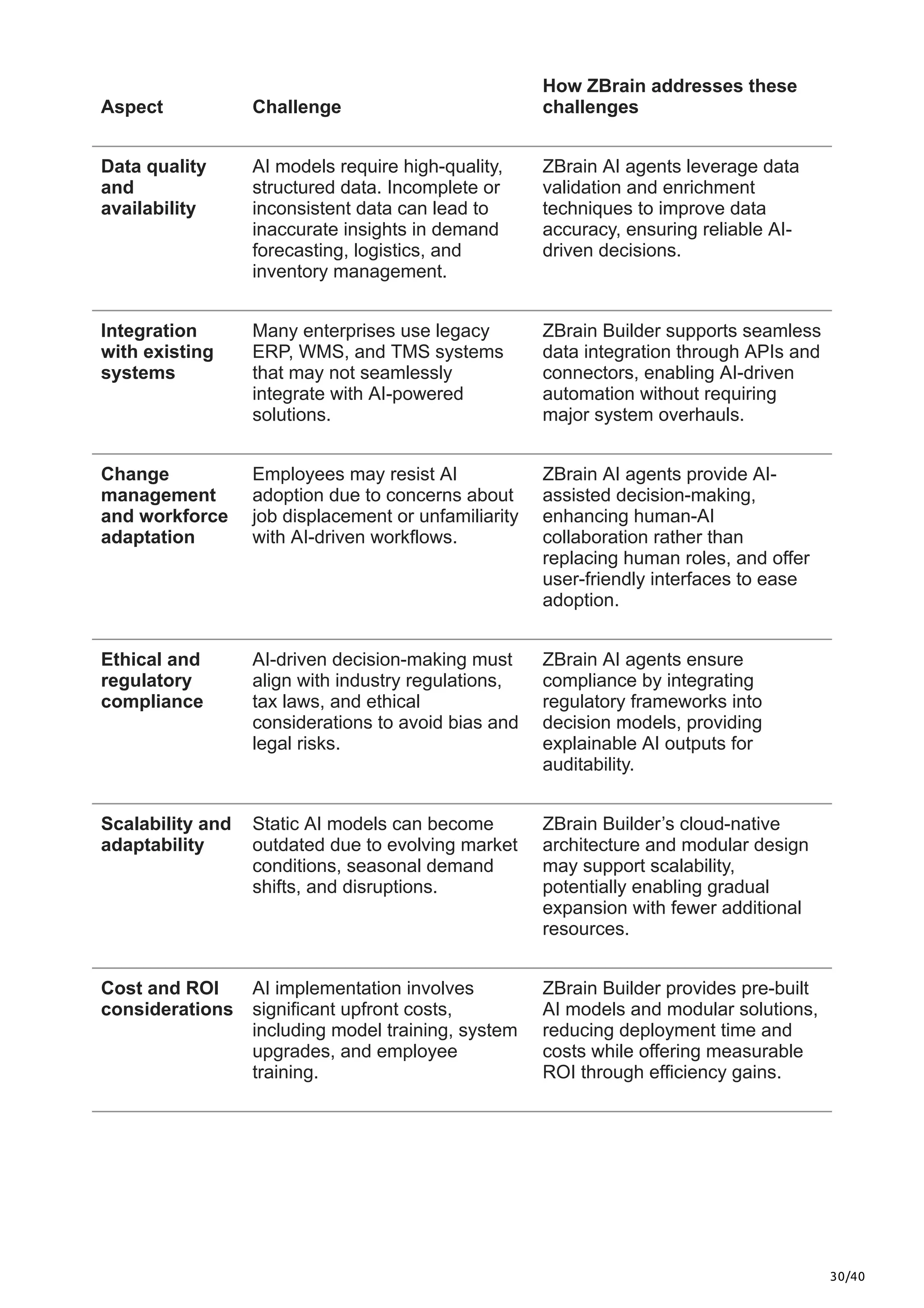
Implementing AI in plan-to-deliver processes offers significant advantages, but
organizations must address various challenges and considerations to ensure successful
adoption. From data quality issues to change management, overcoming these hurdles is
essential for maximizing AI’s potential in supply chain operations.
30/40
Aspect Challenge
How ZBrain addresses these
challenges
Data quality
and
availability
AI models require high-quality,
structured data. Incomplete or
inconsistent data can lead to
inaccurate insights in demand
forecasting, logistics, and
inventory management.
ZBrain AI agents leverage data
validation and enrichment
techniques to improve data
accuracy, ensuring reliable AI-
driven decisions.
Integration
with existing
systems
Many enterprises use legacy
ERP, WMS, and TMS systems
that may not seamlessly
integrate with AI-powered
solutions.
ZBrain Builder supports seamless
data integration through APIs and
connectors, enabling AI-driven
automation without requiring
major system overhauls.
Change
management
and workforce
adaptation
Employees may resist AI
adoption due to concerns about
job displacement or unfamiliarity
with AI-driven workflows.
ZBrain AI agents provide AI-
assisted decision-making,
enhancing human-AI
collaboration rather than
replacing human roles, and offer
user-friendly interfaces to ease
adoption.
Ethical and
regulatory
compliance
AI-driven decision-making must
align with industry regulations,
tax laws, and ethical
considerations to avoid bias and
legal risks.
ZBrain AI agents ensure
compliance by integrating
regulatory frameworks into
decision models, providing
explainable AI outputs for
auditability.
Scalability and
adaptability
Static AI models can become
outdated due to evolving market
conditions, seasonal demand
shifts, and disruptions.
ZBrain Builder’s cloud-native
architecture and modular design
may support scalability,
potentially enabling gradual
expansion with fewer additional
resources.
Cost and ROI
considerations
AI implementation involves
significant upfront costs,
including model training, system
upgrades, and employee
training.
ZBrain Builder provides pre-built
AI models and modular solutions,
reducing deployment time and
costs while offering measurable
ROI through efficiency gains.
31/40
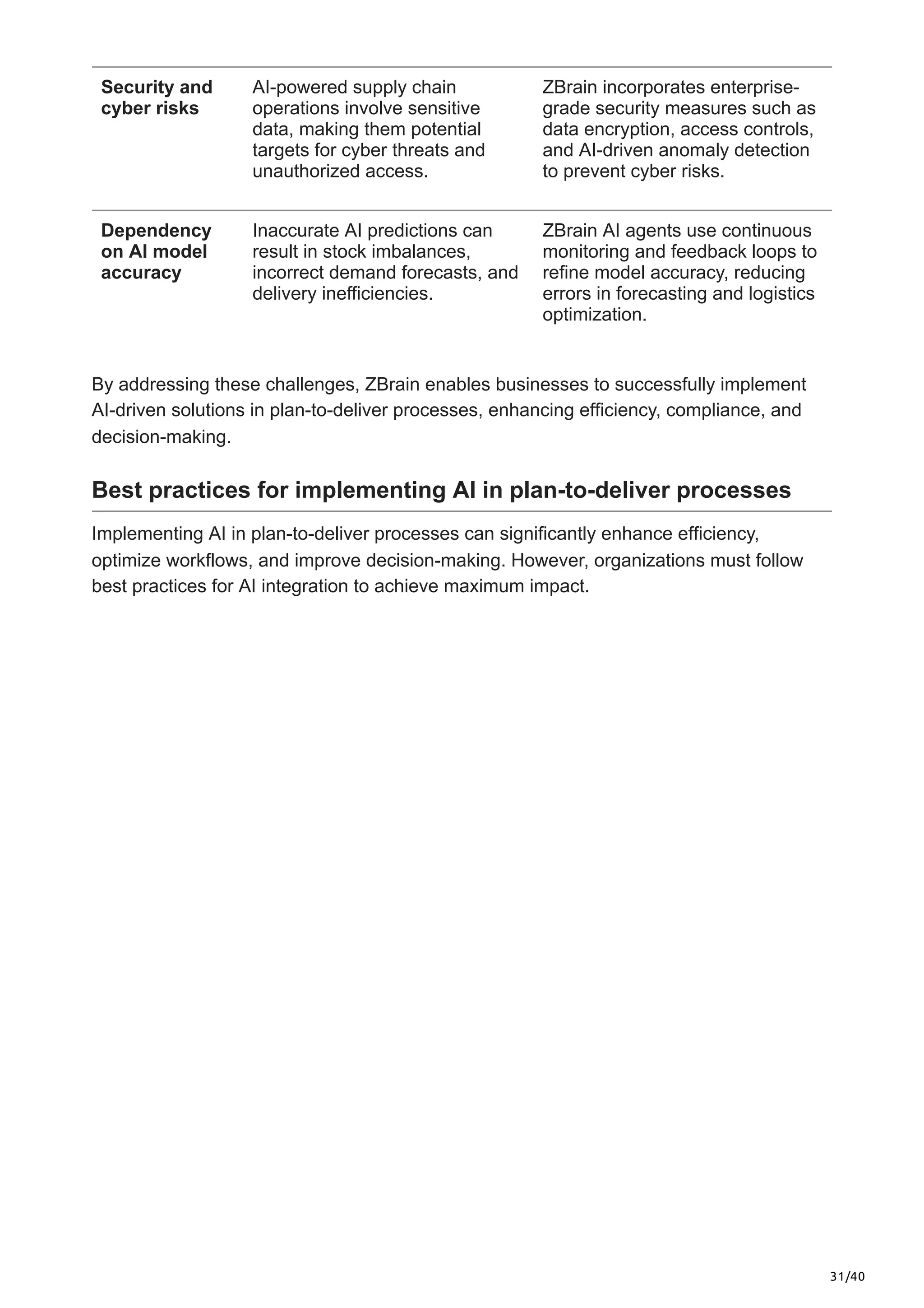
Security and
cyber risks
AI-powered supply chain
operations involve sensitive
data, making them potential
targets for cyber threats and
unauthorized access.
ZBrain incorporates enterprise-
grade security measures such as
data encryption, access controls,
and AI-driven anomaly detection
to prevent cyber risks.
Dependency
on AI model
accuracy
Inaccurate AI predictions can
result in stock imbalances,
incorrect demand forecasts, and
delivery inefficiencies.
ZBrain AI agents use continuous
monitoring and feedback loops to
refine model accuracy, reducing
errors in forecasting and logistics
optimization.
By addressing these challenges, ZBrain enables businesses to successfully implement
AI-driven solutions in plan-to-deliver processes, enhancing efficiency, compliance, and
decision-making.
Best practices for implementing AI in plan-to-deliver processes
Implementing AI in plan-to-deliver processes can significantly enhance efficiency,
optimize workflows, and improve decision-making. However, organizations must follow
best practices for AI integration to achieve maximum impact.
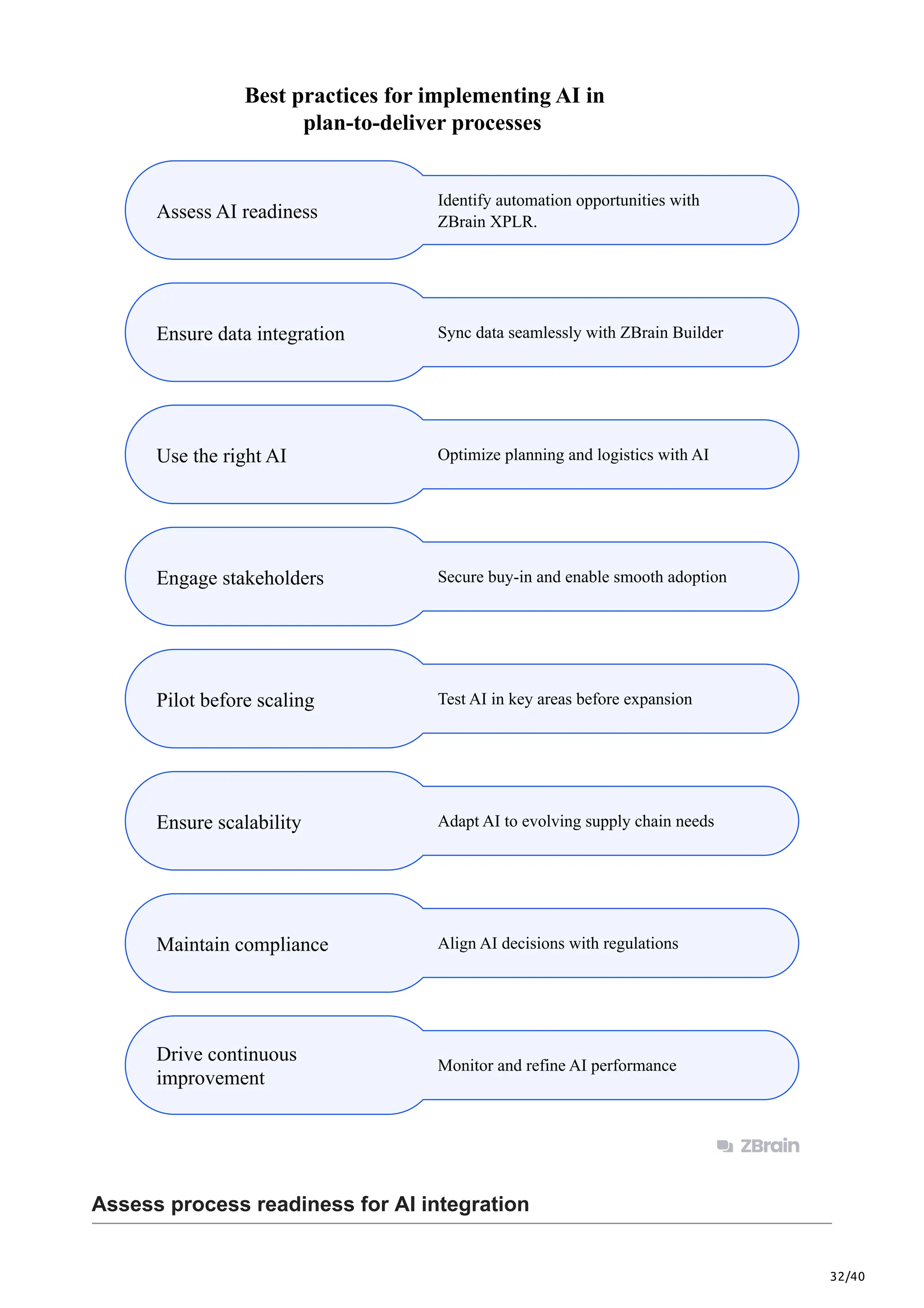
32/40
Best practices for implementing AI in
plan-to-deliver processes
Assess AI readiness
Ensure data integration
Use the right AI
Engage stakeholders
Pilot before scaling
Ensure scalability
Maintain compliance
Drive continuous
improvement
Identify automation opportunities with
ZBrain XPLR.
Sync data seamlessly with ZBrain Builder
Optimize planning and logistics with AI
Secure buy-in and enable smooth adoption
Test AI in key areas before expansion
Adapt AI to evolving supply chain needs
Align AI decisions with regulations
Monitor and refine AI performance
Assess process readiness for AI integration
33/40
Before deploying AI, businesses should evaluate their existing plan-to-deliver workflows
to identify areas that would benefit from automation. This involves mapping current
processes, assessing data quality, and ensuring the necessary infrastructure is in place.
ZBrain XPLR helps organizations conduct AI readiness assessments, enabling them to
pinpoint areas for optimization, such as demand forecasting, production scheduling, and
logistics planning.
Ensure data quality and integration
AI models rely on structured, high-quality data from various sources, including ERP,
WMS, and TMS systems. Ensuring seamless data integration is critical for accurate
forecasting, inventory management, and logistics coordination. facilitates smooth data
synchronization across multiple platforms and employs data validation techniques to
enhance accuracy and consistency.
Leverage the right AI technologies
Selecting the most suitable AI technologies ensures efficiency across all plan-to-deliver
stages, from production planning to final delivery. AI-driven demand forecasting can
optimize inventory levels, while predictive analytics can enhance supply chain resilience.
Engage stakeholders and manage change effectively
AI implementation success depends on securing buy-in from supply chain, production,
and logistics teams. Communicating the benefits of AI, addressing concerns about job
displacement, and providing training ensures smooth adoption. ZBrain supports change
management through AI-driven decision support tools and intuitive interfaces, enabling
teams to adapt and maximize AI’s potential.
Pilot AI implementation before scaling
Instead of rolling out AI across all operations at once, organizations should begin with
small-scale pilot implementations. This approach allows for testing AI-driven solutions in
controlled environments, such as production scheduling or warehouse automation, before
scaling up. ZBrain enables businesses to deploy AI in specific areas, analyze
performance, and gradually expand its usage based on measurable improvements.
Ensure scalability and adaptability
AI solutions should be flexible and scalable to accommodate growing production
volumes, evolving logistics demands, and changing market conditions. continuously learn
from new data, refining their models to adapt to fluctuating business needs, making them
ideal for dynamic supply chain environments.
Maintain compliance and transparency
34/40
AI-driven decision-making in supply chain operations must align with industry regulations
and provide explainable insights. Businesses should prioritize AI solutions that support
regulatory compliance and enhance visibility into AI-driven recommendations. ZBrain
integrates industry-specific compliance standards into its AI models, ensuring businesses
maintain transparency and adhere to necessary regulations.
Focus on continuous improvement
To maximize the benefits of AI, organizations must continuously monitor AI performance,
analyze key metrics, and refine AI models based on real-world data. ZBrain facilitates
ongoing optimization by enabling real-time monitoring and iterative improvements in plan-
to-deliver workflows.
By following these best practices, businesses can successfully implement AI in plan-to-
deliver processes, achieving improved efficiency, cost savings, and smarter decision-
making across supply chain operations.
The future of AI in plan-to-deliver processes
AI is poised to revolutionize plan-to-deliver (P2D) processes by introducing higher levels
of automation, intelligence, and adaptability. As AI technologies continue to evolve,
businesses will leverage them to enhance efficiency, reduce costs, and improve decision-
making across planning, manufacturing, and logistics operations. Below are key trends
that will shape the future of AI in P2D processes.
AI-driven predictive and prescriptive analytics
AI will increasingly move beyond descriptive analytics (what happened) to predictive
(what will happen) and prescriptive (what should be done) analytics.
Advanced forecasting models will analyze vast datasets from market trends,
historical demand, and external factors like geopolitical events to provide highly
accurate demand predictions.
Automated decision-making will recommend optimal production schedules,
inventory levels, and supplier choices, minimizing human intervention.
Real-time scenario simulations will enable businesses to test various supply
chain and manufacturing strategies before execution.
🔹Impact: AI-powered insights will help businesses proactively adjust supply chain
strategies, optimize inventory, and mitigate disruptions before they occur.
Generative AI for intelligent content and process automation
Generative AI will enhance P2D workflows by automating content creation, process
optimization, and decision support.
35/40
Automated documentation for production schedules, inventory reports, and
quality compliance reports will reduce manual work.
AI-generated product strategies and marketing materials will accelerate product
launches.
Conversational AI interfaces will allow employees to interact with AI agents for
instant insights and decision support.
🔹Impact: Generative AI will improve efficiency, reduce human workload, and enhance
decision-making through intelligent automation.
AI-powered autonomous supply chains
AI will play a critical role in enabling autonomous supply chains, where decision-making
and execution occur with minimal human intervention.
Self-adjusting production schedules will dynamically align with demand
fluctuations and raw material availability.
AI-driven procurement will select suppliers based on real-time performance, price
fluctuations, and risk analysis.
Smart warehouses and factories will leverage AI to manage inventory, optimize
workflows, and predict maintenance needs.
🔹Impact: Businesses will experience reduced downtime, improved resource utilization,
and a more resilient supply chain.
AI-enhanced manufacturing and smart factories
The future of manufacturing will be shaped by AI-driven automation, robotics, and
process optimization.
AI-integrated IoT sensors will monitor equipment performance and predict
maintenance needs, reducing unexpected downtimes.
Cognitive AI assistants will guide production teams, optimizing workforce
allocation and machine operations.
AI-driven defect detection will enhance quality control by identifying potential
issues before they escalate.
🔹Impact: AI will drive higher production efficiency, improve product quality, and enable
agile manufacturing operations.
Hyper-personalization in logistics and order fulfillment
AI will enable hyper-personalized and adaptive logistics strategies.
36/40
AI-powered route optimization will provide real-time route adjustments based on
weather, traffic, and delivery urgency.
Dynamic demand-based warehousing will ensure that products are stored closer
to areas with high demand, reducing lead times.
AI-driven reverse logistics will streamline returns and refurbishments, minimizing
losses.
🔹Impact: Logistics operations will become more customer-centric, cost-efficient, and
adaptable to real-time changes.
AI for sustainability and ethical supply chains
Sustainability will be a key driver of AI advancements in P2D processes.
Carbon footprint optimization models will help businesses track and reduce
emissions in production and logistics.
AI-driven waste reduction strategies will minimize material wastage in
manufacturing and packaging.
Ethical sourcing insights will ensure responsible procurement practices by
analyzing supplier behavior and compliance records.
🔹Impact: Businesses will be able to meet sustainability goals while improving
operational efficiency.
The future of AI in plan-to-deliver processes will be marked by intelligent automation,
enhanced decision-making, and adaptive supply chain strategies. Businesses that
embrace AI will gain a competitive edge by improving efficiency, reducing costs, and
responding faster to market changes. As AI continues to evolve, organizations must
invest in scalable AI-driven solutions to stay ahead in the rapidly changing business
landscape.
helps businesses enhance their plan-to-deliver processes by identifying automation
opportunities and streamlining workflows. Its AI-driven solutions improve efficiency,
accuracy, and decision-making across planning, procurement, production, logistics, and
fulfillment.
assesses AI readiness, uncovering areas for improvement and aligning AI strategies with
business objectives. This ensures a smooth transition to AI-driven solutions while
minimizing risks.
low-code interface enables users to create custom AI applications for demand planning,
procurement automation, production monitoring, and logistics optimization.
37/40
By integrating with existing systems, ensuring scalability, and maintaining security, ZBrain
empowers organizations to optimize supply chain operations, enhance efficiency, and
drive business growth.
Endnote
AI is transforming plan-to-deliver processes by automating key tasks, optimizing
workflows, and providing actionable insights that enhance efficiency and decision-making.
From demand planning to procurement, production, and logistics, AI minimizes manual
effort, improves accuracy, and accelerates fulfillment. As AI technology evolves, its role in
optimizing supply chain operations will continue to expand, helping businesses stay agile
and competitive. Embracing AI-driven solutions ensures sustained efficiency, innovation,
and adaptability in an ever-changing market landscape.
Ready to transform your plan-to-deliver processes with AI? Harness the power of
intelligent automation to enhance efficiency, improve accuracy, and drive data-driven
decision-making across your operations.
Frequently Asked Questions
What is ZBrain, and how can it optimize plan-to-deliver processes with AI?
ZBrain is an end-to-end AI enablement platform designed to streamline AI adoption
across the plan-to-deliver lifecycle. It simplifies AI readiness assessment, use case
identification, development, and deployment, helping organizations enhance efficiency,
accuracy, and decision-making in logistics, warehousing, transportation, and fulfillment.
ZBrain XPLR evaluates an organization’s current logistics and supply chain
processes to identify key AI adoption opportunities. By assessing data availability,
system integration readiness, and potential AI-driven optimizations, businesses can
implement AI strategically for improved supply chain efficiency.
Seamless data ingestion and integration:
ZBrain Builder connects with ERP, WMS, and logistics platforms, ingesting
structured and unstructured data from various sources. This ensures a unified data
pipeline, enabling real-time inventory, shipments, and demand fluctuations tracking
for improved decision-making.
Low-code AI development environment:
ZBrain Builder’s intuitive, low-code interface allows supply chain and logistics teams
to create AI agents with minimal coding expertise. This accelerates AI deployment,
enabling businesses to enhance route optimization, inventory forecasting, and
warehouse management without extensive development efforts.
38/40
Cloud and model flexibility:
Supporting models like GPT-4 and LLaMA, ZBrain integrates seamlessly with cloud
platforms such as AWS, Azure, and GCP. This flexibility allows organizations to
choose the optimal infrastructure for balancing cost, scalability, and performance
across their plan-to-deliver operations.
Enhanced compliance and governance:
ZBrain ensures regulatory compliance and operational governance by tracking
industry-specific standards related to transportation, warehousing, and fulfillment.
AI-driven insights help businesses identify potential risks, monitor adherence to
safety and compliance regulations, and maintain audit readiness.
By providing a flexible, low-code AI platform with robust data integration and custom AI
capabilities, ZBrain empowers organizations to automate, optimize, and innovate across
their entire plan-to-deliver process, driving efficiency and agility in supply chain
operations.
How does ZBrain ensure the security and privacy of sensitive data in plan-to-deliver processes?
ZBrain is designed with a strong emphasis on data security and privacy, ensuring that
sensitive supply chain and logistics information is protected at every stage of the plan-to-
deliver process. Here’s how ZBrain safeguards critical data across procurement,
warehousing, transportation, and fulfillment:
Private cloud deployments:
ZBrain AI agents can be deployed in a private cloud environment, ensuring that sensitive
logistics data—such as supplier details, shipment records, and inventory levels—remains
securely within an organization’s infrastructure.
Robust security features:
ZBrain incorporates multiple layers of security to protect sensitive plan-to-deliver data,
including:
Access controls: Granular role-based access controls ensure that only authorized
personnel can access or modify critical data, such as procurement records,
warehouse inventories, and transportation schedules.
Compliance and governance:
ZBrain adheres to industry-leading security and compliance standards ISO 27001:2022
and SOC 2 Type II, ensuring that supply chain data is managed with integrity,
confidentiality, and accountability. It also supports regulatory compliance with sector-
specific standards, including transportation safety and warehousing regulations.
By integrating advanced security features with compliance-driven governance, ZBrain
ensures that organizations can confidently implement AI across their plan-to-deliver
processes while maintaining the highest standards of data protection.
Can ZBrain AI agents be integrated with existing systems in plan-to-deliver processes?
39/40
Yes, ZBrain AI agents are designed to integrate seamlessly with existing ERP, warehouse
management (WMS), and transportation management systems (TMS) used in plan-to-
deliver operations. The platform supports various data formats and standards, ensuring
smooth interoperability with legacy infrastructure across procurement, warehousing,
logistics, and fulfillment.
This integration allows organizations to:
Leverage existing infrastructure: Enhance current supply chain and logistics
processes without requiring a complete system overhaul.
Enhance workflow efficiency: ZBrain AI agents integrate with existing platforms to
improve decision-making, assist in exception handling, and streamline processes
such as inventory planning, warehouse organization, and shipment coordination.
Enhance data-driven decision-making: Leverage AI-powered insights to
streamline procurement, optimize logistics planning, and proactively address
potential disruptions, ensuring smooth coordination across supply chain operations.
By enabling seamless integration, ZBrain ensures that businesses can modernize their
plan-to-deliver processes without disrupting existing workflows, driving efficiency and
agility across operations.
What kind of AI agents can be built on ZBrain Builder for plan-to-deliver processes?
ZBrain Builder enables the development of generative AI agents tailored to various plan-
to-deliver processes. These AI agents can assist with procurement automation, inventory
reconciliation, warehouse slotting recommendations, and logistics coordination. By
leveraging generative AI, organizations can automate data processing, enhance workflow
efficiency, and generate intelligent insights for better decision-making. ZBrain’s AI agents
help optimize supply chain operations, ensuring faster fulfillment, improved accuracy, and
seamless end-to-end coordination across procurement, warehousing, and transportation.
How does ZBrain cater to diverse plan-to-deliver needs across business operations?
ZBrain’s flexibility allows it to address a wide range of plan-to-deliver requirements.
Organizations can build generative AI agents to streamline procurement workflows,
automate inventory reconciliation, optimize warehouse slotting, and enhance logistics
coordination. By leveraging AI-driven automation and insights, businesses can improve
operational efficiency, reduce manual intervention, and ensure seamless end-to-end
supply chain execution across industries.
How can we measure the ROI of ZBrain in our plan-to-deliver processes?
Measuring ROI from ZBrain in plan-to-deliver operations involves evaluating key
performance indicators (KPIs) related to automation, efficiency, and cost savings. Key
metrics include:
40/40
Reduced manual effort: Automating procurement workflows, inventory
reconciliation, and warehouse slotting minimizes manual intervention, leading to
faster processing and fewer errors.
Optimized logistics and fulfillment: AI-driven insights help streamline warehouse
management and transportation planning, improving delivery timelines and reducing
delays.
Improved inventory accuracy: Automated stock updates and reconciliation reduce
discrepancies, lowering the risk of stockouts or excess inventory.
Lower operational costs: AI-enabled efficiencies in procurement, warehousing,
and transportation management help reduce overhead costs.
Enhanced supply chain visibility: Real-time AI insights improve tracking and
coordination, ensuring smoother plan-to-deliver execution.
By tracking these KPIs, businesses can quantify the impact of ZBrain’s generative AI
capabilities on optimizing plan-to-deliver processes, improving efficiency, and driving cost-
effective supply chain management.
How can I get started with ZBrain for my plan-to-deliver processes?
To begin using ZBrain to optimize your plan-to-deliver processes, contact us at or fill out
the inquiry form on our website. Our team will contact you to explore how our platform
can integrate with your existing operations systems and streamline plan-to-deliver
workflows.
Insights

AI for plan-to-deliver P2D Scope integration use cases challenges and future outlook (1).pdf

  • 1.
    1/40 AI for plan-to-deliver(P2D): Scope, integration, use cases, challenges and future outlook zbrain.ai/ai-for-plan-to-deliver The plan-to-deliver (P2D) process is fundamental to supply chain operations, encompassing procurement, inventory management, order fulfillment, and logistics coordination. An effective P2D process ensures timely deliveries, optimized inventory levels, and seamless coordination across the supply chain. However, as businesses scale and customer demands become more complex, traditional methods—often reliant on manual workflows, siloed data systems, and reactive decision-making—struggle to keep up. These inefficiencies lead to delays, increased operational costs, and a lack of agility in responding to market demands. Consequently, organizations face challenges in optimizing procurement, managing inventory effectively, and ensuring timely deliveries. To remain competitive, businesses require a more agile, data-driven approach to managing their supply chain operations. This is where AI becomes a game-changer. According to Gartner, leading supply chain organizations are using AI to optimize processes at more than twice the rate of their low- performing peers. Additionally, MarketsandMarkets projects that AI in the supply chain market will grow from USD 5.4 billion in 2022 to USD 20.2 billion by 2027, emphasizing the rapid adoption of AI-driven solutions. AI-powered automation and intelligent decision-making are transforming the plan-to- deliver process, enabling organizations to proactively address inefficiencies, streamline procurement, enhance inventory control, and optimize logistics. Advanced generative AI platforms like ZBrain empower businesses to integrate AI seamlessly into their supply
  • 2.
    2/40 chain workflows, improvingefficiency, accuracy, and agility. By leveraging AI-driven insights and automation, organizations can overcome traditional bottlenecks, enhance fulfillment speed, and drive long-term operational success. This article explores the limitations of traditional plan-to-deliver processes, the transformative impact of AI in supply chain optimization, and how ZBrain equips businesses with AI-driven capabilities to enhance agility, streamline operations, and future-proof their supply chain strategies. What is the plan-to-deliver process? The plan-to-deliver (P2D) process is a comprehensive framework that governs the end- to-end management of supply chain activities, ensuring materials, components, and finished goods flow seamlessly to meet customer demand efficiently. This process aligns closely with the Supply Chain Operations Reference (SCOR) model, which provides a standardized approach to evaluating and improving supply chain performance. Key stages of the plan-to-deliver process include: 1. Plan: Forecasting customer demand to align procurement and production strategies, balancing supply and demand, and managing inventory levels to ensure operational efficiency. 2. Source: Procuring materials and managing supplier relationships to meet production requirements, ensuring quality and timely delivery of inputs. 3. Make: Executing production according to demand and supply plans while optimizing resources, including scheduling manufacturing activities and maintaining quality standards. 4. Deliver: Fulfilling orders, managing logistics, and ensuring timely delivery to customers, encompassing order processing, warehousing, and outbound transportation. 5. Return: Managing the return of products for any reason, including handling returns and recycling processes, to maintain customer satisfaction and sustainability. By integrating these stages into a structured workflow, businesses can enhance supply chain visibility, reduce costs, and improve overall operational agility. The SCOR model, developed by the Supply Chain Council (now part of the Association for Supply Chain Management), encompasses these stages and provides a framework for evaluating and improving supply chain performance. Implementing AI-powered solutions can significantly enhance the execution of the plan- to-deliver process. Technologies such as machine learning and predictive analytics enable organizations to optimize demand forecasting, streamline supplier collaboration,
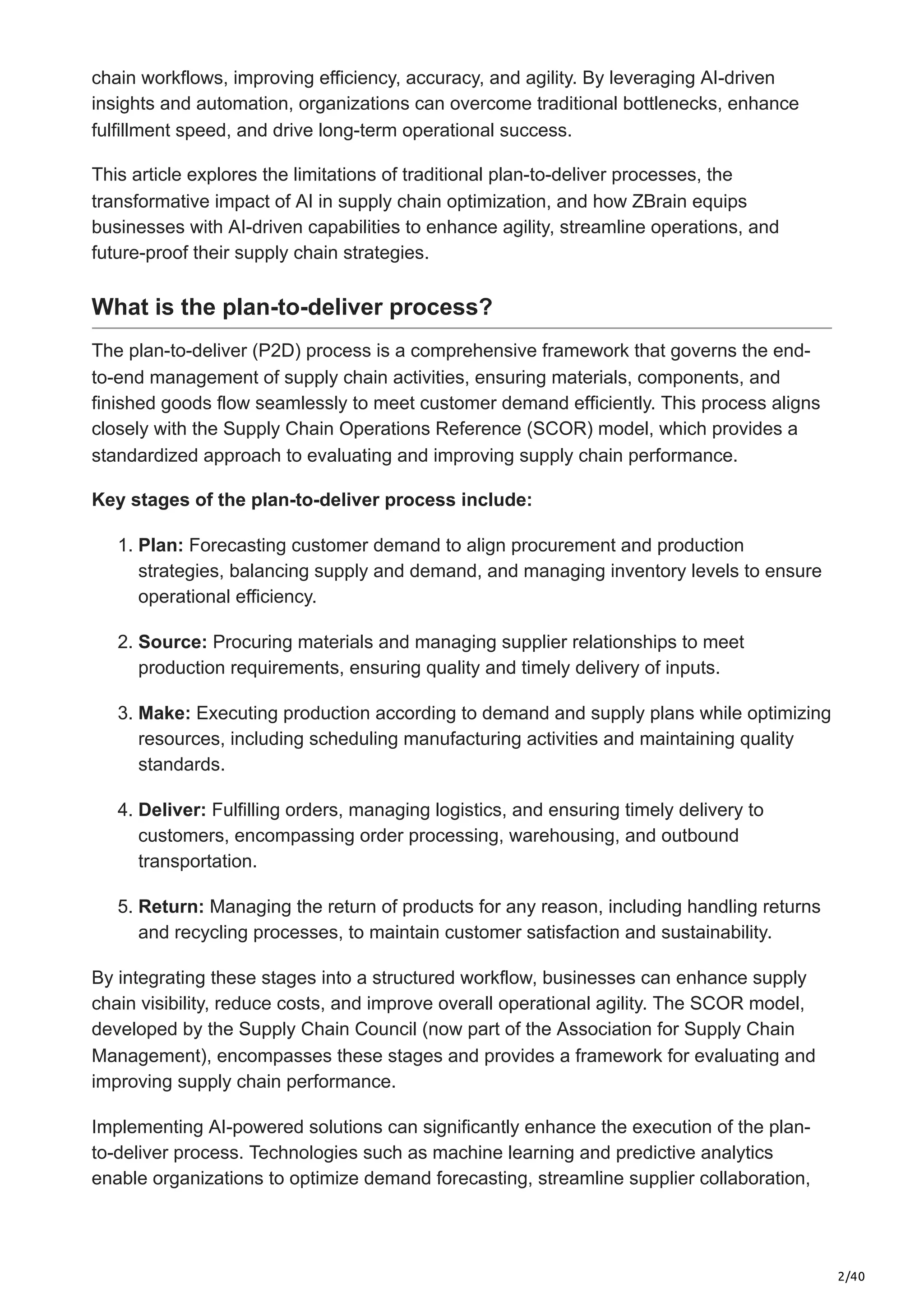
  • 3.
    3/40 improve warehouse efficiency,and ensure real-time shipment tracking. By leveraging these advanced technologies, businesses can drive efficiency, reduce operational risks, and enhance decision-making across the supply chain. An optimized plan-to-deliver process enables organizations to achieve greater supply chain resilience, ensure timely fulfillment, and adapt to shifting market demands. By integrating intelligent automation, data analytics, and predictive insights, businesses can maintain a competitive edge while improving cost-effectiveness and service reliability. Why is the plan-to-deliver process important? The plan-to-deliver process is crucial for maintaining an efficient and responsive supply chain. It provides a structured approach to managing procurement, production, logistics, and delivery, ensuring smooth coordination across all supply chain functions. A well-structured plan-to-deliver process standardizes critical operations such as demand planning, inventory optimization, and transportation management. This consistency helps reduce supply chain disruptions, minimize waste, and improve fulfillment accuracy. With real-time visibility into inventory levels and logistics operations, businesses can proactively address potential bottlenecks and optimize resource utilization. A robust plan-to-deliver strategy also strengthens compliance with regulatory requirements and contractual obligations. It ensures that procurement, warehousing, and distribution processes adhere to industry standards, reducing risks related to supply chain inefficiencies. Additionally, data-driven insights from plan-to-deliver operations support better demand forecasting, supplier performance management, and strategic decision- making. Ultimately, an optimized plan-to-deliver process enhances operational performance, improves service reliability, and enables businesses to navigate supply chain complexities with agility and precision. Organizations can achieve a resilient, customer-centric, and future-ready supply chain by integrating AI-driven automation, predictive analytics, and intelligent workflows. Understanding the plan-to-deliver stages The plan-to-deliver(P2D) process is a critical component of operations management, ensuring the seamless production and delivery of goods. It consists of five main stages:
  • 4.
    4/40 1. Plan –Forecast demand, align supply, and manage inventory to ensure operational efficiency. 2. Source – Procure materials and manage supplier relationships to meet production requirements. 3. Make – Execute production according to demand and supply plans while optimizing resources. 4. Deliver – Fulfill orders, manage logistics, and ensure timely delivery to customers. 5. Return – Manage the return of products for any reason, including post-delivery customer support. Each stage plays a vital role in minimizing disruptions, optimizing costs, and meeting customer expectations. 1. Plan The planning stage involves demand forecasting, aligning supply with demand, and managing inventory to ensure smooth production and distribution.​ 1.1 Demand planning Accurate demand planning prevents inventory imbalances and optimizes supply chain performance.​ Develop new product introduction (NPI) plans – Define launch strategies, including pricing, promotions, and distribution plans for new products.​ Create promotional and brand plans – Collaborate with customers to design campaigns that drive demand.​
  • 5.
    5/40 Generate baseline forecasts– Analyze historical sales data and market trends to establish initial demand projections.​ Develop first-cut forecasts – Utilize statistical models and market insights to refine demand projections.​ Conduct consensus demand meetings – Align forecasts across sales, marketing, and supply planning teams.​ Participate in Sales and Operations Planning (S&OP) meetings – Engage in cross-functional meetings to synchronize demand plans with supply and financial goals.​ Monitor forecasts versus actuals – Track forecast accuracy and adjust projections accordingly.​ Evaluate and improve forecasting approaches – Assess forecasting models, measure accuracy (e.g., Mean Absolute Percentage Error, forecast bias), and refine methodologies.​ 1.2 Supply planning Supply planning ensures production capacity and material availability align with demand projections.​ Develop rough-cut capacity plans – Assess production capabilities and resource constraints.​ Generate initial supply plans – Develop plans to meet demand forecasts.​ Conduct supply meetings – Review supply plans with stakeholders and resolve discrepancies.​ Participate in S&OP meetings – Align supply, demand, and financial objectives.​ Optimize Material Requirements Planning (MRP) – Plan raw material procurement based on production schedules.​ Create Master Production Schedules (MPS) – Develop detailed production schedules to meet demand efficiently.​ Develop line schedules – Convert production schedules into executable manufacturing work orders.​ Evaluate and optimize supply planning approaches – Continuously improve strategies for efficiency and responsiveness.​ 1.3 Inventory management
  • 6.
    6/40 Effective inventory managementensures optimal stock levels, preventing shortages or excess inventory.​ Define inventory policies and controls – Set rules for safety stock, reorder points, and cycle counts.​ Set inventory targets – Align inventory goals with demand forecasts and supply constraints.​ Develop inventory forecasts – Predict inventory needs based on sales trends and replenishment cycles.​ Plan inventory requirements – Determine stock replenishment schedules and order quantities.​ Monitor and optimize inventory levels – Track stock movement, prevent overstocking or shortages, and adjust strategies as needed.​ Manage slow-moving and obsolete inventory – Identify and address excess, aging, or obsolete stock to minimize financial impact.​ Measure inventory accuracy – Conduct cycle counts and audits to validate stock records.​ Review and improve inventory policies – Continuously refine inventory management practices for efficiency.​ 1.4 Sales and operations planning (S&OP) Integrating S&OP ensures that demand, supply, and inventory plans are synchronized with the company’s financial and strategic objectives.​ Develop cross-functional plans – Align sales, marketing, finance, and operations to create unified plans.​ Conduct regular S&OP meetings – Review performance metrics, address discrepancies, and adjust plans as necessary.​ Implement Integrated Business Planning (IBP) – Extend S&OP to incorporate financial planning and strategic initiatives. 2. Source The sourcing stage focuses on procuring goods and services to meet planned or actual demand.​ 2.1 Procurement management Effective procurement ensures the timely acquisition of quality materials and services.​
  • 7.
    7/40 Develop procurement strategies– Align procurement plans with organizational objectives and market conditions.​ Identify and evaluate suppliers – Assess potential suppliers based on capability, capacity, and alignment with company values.​ Negotiate contracts and agreements – Establish terms and conditions that define pricing, delivery schedules, and service levels.​ Manage supplier relationships – Maintain open communication, address issues promptly, and foster long-term partnerships.​ Monitor supplier performance – Create key performance indicators (KPIs) to track quality, delivery, and cost performance.​ Implement supplier development programs – Collaborate with suppliers to improve processes, reduce costs, and enhance product quality.​ 2.2 Purchase order management Managing purchase orders ensures timely procurement and accuracy in the purchasing process.​ Generate purchase requisitions – Initiate requests for materials or services based on demand and inventory levels.​ Convert requisitions to purchase orders – Create formal purchase orders (POs) and obtain necessary approvals.​ Transmit purchase orders to suppliers – Communicate POs to suppliers through electronic data interchange (EDI) or other agreed methods.​ Confirm order acknowledgment – Ensure suppliers have received and accepted the PO terms.​ Monitor order status – Track the progress of orders to ensure on-time delivery.​ Resolve discrepancies – Address any quantity, quality, or delivery timelines issues.​ 2.3 Inbound logistics Efficient inbound logistics are essential for the timely receipt and handling of materials.​ Plan and coordinate inbound shipments – Optimize supplier deliveries for efficiency and cost control.​ Monitor carrier performance – Ensure timely and compliant transportation.​
  • 8.
    8/40 Manage customs andcompliance – Handle import regulations and documentation.​ 2.4 Inventory management Effective inventory management ensures optimal stock levels, preventing shortages or excess inventory.​ Define inventory policies and controls – Set rules for safety stock, reorder points, and cycle counts.​ Set inventory targets – Align inventory goals with demand forecasts and supply constraints.​ Forecasts – Predict inventory needs based on sales trends and replenishment cycles.​ Plan inventory requirements – Determine stock replenishment schedules and order quantities.​ Monitor and optimize inventory levels – Track stock movement, prevent overstocking or shortages, and adjust strategies as needed.​ Manage slow-moving and obsolete inventory – Identify and address excess, aging, or obsolete stock to minimize financial impact. Measure inventory accuracy – Conduct cycle counts and audits to validate stock records.​ Review and improve inventory policies – Continuously refine inventory management practices for efficiency.​ 3. Make The production stage focuses on transforming materials into finished products to meet planned or actual demand.​ 3.1 Production management Efficient production management ensures that manufacturing processes are optimized for quality and efficiency.​ Develop production plans – Align production schedules with demand forecasts and supply constraints.​ Manage production schedules – Coordinate labor, equipment, and materials to meet production targets.​
  • 9.
    9/40 Execute production processes– Oversee manufacturing activities to ensure adherence to quality and efficiency standards.​ Perform quality inspections – Conduct regular checks to maintain product quality.​ Manage production data – Maintain records of production metrics for analysis and improvement.​ 3.2 Maintenance management Proper maintenance management ensures equipment reliability and minimizes downtime.​ Develop maintenance plans – Schedule regular preventive maintenance activities.​ Monitor equipment performance – Use predictive analytics to anticipate and prevent failures.​ Manage spare parts inventory – Ensure availability of necessary components for maintenance activities.​ 3.3 Quality management Maintaining high-quality standards is crucial for customer satisfaction and compliance.​ Define quality standards and controls – Establish inspection protocols and compliance measures.​ Perform quality audits and inspections – Ensure adherence to regulatory and internal quality requirements.​ Manage non-conformance and corrective actions – Address defects and drive process improvements. 4. Deliver The delivery stage encompasses activities related to order management, warehousing, transportation, and ensuring timely delivery to customers.​ 4.1 Order management Effective order management ensures accurate processing and fulfillment of customer orders.​ Process customer orders – Receive, validate, and enter orders into the system.​ Manage order status – Track orders from receipt to delivery, providing updates as necessary.​ Handle order modifications and cancellations – Manage changes to orders efficiently to maintain customer satisfaction.​
  • 10.
    10/40 4.2 Warehouse management Efficientwarehouse operations are vital for timely order fulfillment and inventory accuracy.​ Receive and store inventory – Ensure accurate inbound processing and optimal space utilization.​ Optimize inventory management – Maintain stock accuracy and minimize carrying costs.​ Pick, pack, and prepare shipments – Streamline order fulfillment processes to ensure timely dispatch.​ 4.3 Outbound transportation Effective outbound transportation ensures that products reach customers promptly and in good condition.​ Plan and schedule shipments – Align deliveries with customer demand and service levels.​ Optimize carrier selection – Balance cost, speed, and reliability when choosing transportation providers.​ Track and manage deliveries – Ensure on-time fulfillment and proactively handle any disruptions. 4.4 Reverse logistics Managing returns efficiently is crucial for customer satisfaction and cost control.​ Process returns and refurbishments – Handle returned goods efficiently for reuse, resale, or disposal.​ Ensure compliance with regulations – Adhere to laws and guidelines related to waste management, recalls, and warranty returns.​ Optimize cost recovery – Minimize losses and maximize salvage value through effective reverse logistics strategies. 5. Return The return stage involves processes associated with returning products, whether due to defects, end-of-life, or customer dissatisfaction.​ 5.1 Return of defective products Efficient handling of defective products ensures customer satisfaction and compliance.​
  • 11.
    11/40 Authorize returns –Establish clear policies and procedures for accepting defective products.​ Receive returned products – Inspect and document returned items to assess their condition.​ Process refunds or replacements – Provide timely resolutions to maintain customer trust.​ 5.2 Return of end-of-life products Managing end-of-life products responsibly supports sustainability initiatives.​ Develop take-back programs – Encourage customers to return products for recycling or disposal.​ Ensure environmentally friendly disposal – Adhere to regulations and best practices for waste management.​ 5.3 Return of unsold inventory Handling unsold inventory efficiently minimizes financial impact.​ Negotiate return agreements – Establish terms with retailers or distributors for returning unsold goods.​ Process returned inventory – Assess and decide on refurbishment, redistribution, or disposal. Transforming plan-to-deliver process: How AI solves traditional challenges The plan-to-deliver process ensures seamless supply chain operations, covering demand forecasting, production, logistics, and delivery. However, traditional approaches often face challenges such as inefficiencies, manual errors, and limited visibility, leading to operational delays and increased costs. AI-driven automation, predictive analytics, and intelligent workflows can address these challenges, improving efficiency, accuracy, and decision-making. Below is a breakdown of key plan-to-deliver challenges, their impact, and how AI helps overcome them. Challenge Impact of traditional methods How AI helps overcome the challenge
  • 12.
    12/40 Demand forecasting inaccuracies Over-reliance on historical dataleads to inaccurate demand predictions, causing stockouts or overstocking. AI-driven demand forecasting models analyze real-time market trends, customer behavior, and external factors to improve accuracy. Slow demand planning adjustments Delays in adjusting forecasts based on changing market conditions affect supply chain responsiveness. AI enables dynamic forecasting and real-time scenario analysis, allowing businesses to adapt to demand fluctuations quickly. Manual supply planning Human-driven planning increases errors, delays material procurement, and leads to inefficiencies. AI automates supply planning by analyzing demand patterns, optimizing inventory levels, and recommending procurement actions. Inventory imbalances Excess inventory leads to high carrying costs, while shortages result in missed sales and operational disruptions. AI optimizes inventory management by predicting demand patterns and automating stock replenishment decisions. Reactive rather than proactive maintenance Unplanned equipment failures cause production delays and increased downtime. AI-driven predictive maintenance analyzes sensor data to anticipate equipment failures and schedule proactive maintenance. Production bottlenecks Inconsistent scheduling and inefficient resource allocation lead to delays and increased costs. AI optimizes production scheduling by analyzing constraints, workforce availability, and demand priorities. Lack of real- time production insights Limited visibility into production performance affects quality control and efficiency. AI-powered analytics provide real- time insights into production metrics, enabling data-driven decision-making and process optimization. Inefficient logistics planning Poor route optimization increases transportation costs and delivery delays. AI optimizes logistics by using real- time data for route planning, carrier selection, and dynamic scheduling. Limited visibility into shipments Inaccurate tracking leads to missed delivery timelines and customer dissatisfaction. AI-powered tracking systems provide real-time shipment visibility, reducing delivery uncertainties.
  • 13.
    13/40 High return rates and inefficient reverse logistics Manualhandling of returns increases processing time and costs. AI automates return management, identifying root causes of returns and optimizing refurbishment or disposal processes. By leveraging AI, businesses can enhance their plan-to-deliver processes, improving efficiency, reducing costs, and ensuring a resilient supply chain. Optimize Your Operations With AI Agents Our AI agents streamline your workflows, unlocking new levels of business efficiency! Explore Our AI Agents Approaches to integrating AI into plan-to-deliver AI is transforming operation management by optimizing planning, production, inventory control, and logistics. Businesses can integrate AI into their plan-to-deliver processes through different approaches based on their operational needs, resources, and long-term goals. Custom, in-house AI development This approach involves developing AI solutions tailored to supply chain operations, such as demand forecasting, production planning, and logistics optimization. Advantages: Customization: Aligns AI models with specific business workflows, such as supplier coordination and inventory replenishment. Full control: Ensures data privacy, regulatory compliance (e.g., ISO 27001:2022, SOC 2 Type II), and process transparency. Scalability: Supports evolving supply chain needs and long-term growth. Using AI point solutions This approach involves leveraging ready-made AI tools for targeted tasks like automated demand sensing, real-time shipment tracking, and warehouse optimization. Advantages: Quick deployment: Pre-built AI models accelerate efficiency in forecasting, inventory control, and logistics. Cost-effective: Reduces development costs compared to custom AI solutions. Seamless integration: Works with existing ERP, WMS, and TMS systems. Adopting a comprehensive AI platform
  • 14.
    14/40 This approach involvesusing an end-to-end AI platform like to optimize the entire supply chain—from planning and manufacturing to transportation and reverse logistics. Advantages: Centralized data and compliance: Ensures supply chain visibility while adhering to regulatory standards. End-to-end automation: Enhances efficiency across procurement, production, warehousing, and delivery. Scalability and flexibility: Adapts to shifting demand, supplier performance, and market trends. Choosing the right AI integration approach To effectively integrate AI into supply chain operations, businesses should consider: Operational needs: Identify key areas for AI-driven automation, such as demand planning, inventory optimization, or logistics. Resources and expertise: Assess internal capabilities and budget for AI adoption. Compliance and security: Ensure AI solutions meet industry regulations and data protection standards. Scalability: Choose AI strategies that align with long-term growth and evolving supply chain complexities. By aligning AI with plan-to-deliver processes, businesses can improve efficiency, enhance supply chain resilience, and drive operational excellence. AI applications transforming the plan-to-deliver processes Artificial intelligence is revolutionizing the plan-to-deliver process by enhancing demand forecasting, optimizing supply planning, streamlining production, and improving logistics management. AI-driven solutions enable businesses to predict demand more accurately, automate resource allocation, and minimize disruptions across the supply chain. By leveraging AI-powered automation and predictive analytics, organizations can reduce costs, improve operational efficiency, and ensure seamless order fulfillment, ultimately enhancing customer satisfaction. Below is a detailed explanation of AI applications across each stage of the plan-to-deliver process, showcasing how AI improves efficiency, accuracy, and agility in planning, production, and delivery operations.
  • 15.
    15/40 Source Make Return PlanDeliver Stages Use Cases NPI content generation Supplier evaluation and selection Strategic content generation Supplier communication content generation Automated return authorization Generative AI for defect analysis Automated sorting for recycling AI-guided refurbishment decisions Warehouse process documentation Order fulfillment communication Returns processing documentation Customer service response generation Manufacturing content generation Virtual manufacturing assistant Production plan documentation Inspection report generation Packaging content generation Contract analysis and management Spend analysis and optimization Purchase requisition processing Shipment tracking and anomaly detection Inventory analysis and optimization Promo and brand plan content generation Forecast report summarization Consensus meeting report generation S&OP report automation Inventory policy documentation 1. Plan Artificial Intelligence is revolutionizing the planning stage of supply chain management by enhancing demand forecasting, optimizing supply planning, improving inventory management, and refining Sales and Operations Planning (S&OP). By leveraging predictive analytics, machine learning, and real-time data processing, businesses can achieve greater accuracy, reduce inefficiencies, and adapt swiftly to market changes. 1. Demand planning Accurate demand planning prevents inventory imbalances and optimizes supply chain performance. AI contributes in the following ways: Automated forecast generation: AI analyzes historical sales data, market trends, and external factors (e.g., weather, economic indicators) to predict demand more accurately. Real-time demand sensing: AI continuously monitors customer behavior, competitor actions, and social media trends to adjust forecasts dynamically. Self-learning forecasting models: AI refines forecasting accuracy over time by identifying patterns in historical forecast accuracy versus actuals. AI-powered new product introduction (NPI) planning: Market trend analysis: AI scans consumer sentiment, social media, and competitive launches to optimize product positioning. Automated pricing recommendations: AI evaluates market demand elasticity to suggest optimal pricing strategies.
  • 16.
    16/40 Enhanced S&OP withAI: AI-assisted consensus meetings: AI synthesizes sales, marketing, and supply chain inputs to generate optimized forecasts. Scenario-based planning: AI simulates multiple demand scenarios to improve agility in supply chain decisions. 2. Supply planning Supply planning ensures production capacity and material availability align with demand projections. AI enhances this process through: AI-driven capacity planning: AI predicts future production constraints and recommends labor and machine utilization adjustments. Automated supply-demand balancing: AI recommends inventory reallocation and supplier adjustments based on real-time demand shifts. Predictive material planning: AI forecasts raw material needs, preventing shortages or excess procurement. AI in master production scheduling (MPS): Dynamic scheduling optimization: AI continuously adjusts schedules to minimize bottlenecks and maximize throughput. AI-assisted materials requirements planning (MRP): AI predicts material shortages and suggests proactive ordering strategies. 3. Inventory management Effective inventory management ensures optimal stock levels, preventing shortages or excess inventory. AI applications include: Automated safety stock calculation: AI adjusts safety stock levels dynamically based on demand patterns and lead time variability. Predictive inventory replenishment: AI analyzes sales velocity and supply constraints to trigger timely stock orders. AI-driven slow-moving inventory identification: AI detects underperforming SKUs and suggests markdowns or redistribution strategies. Real-time inventory visibility: AI integrates data from various sources to provide live inventory updates, enhancing demand-supply balancing. 4. Sales and operations planning (S&OP) Integrating S&OP ensures that demand, supply, and inventory plans are synchronized with the company’s financial and strategic objectives. AI facilitates this integration by: Developing cross-functional plans: AI consolidates data from sales, marketing, finance, and operations to create unified plans. Conducting regular S&OP meetings: AI provides real-time performance metrics, identifies discrepancies, and suggests plan adjustments.
  • 17.
    17/40 Implementing integrated businessplanning (IBP): AI extends S&OP to incorporate financial planning and strategic initiatives, ensuring alignment across the organization. By integrating AI into these aspects of the planning stage, businesses can enhance efficiency, responsiveness, and overall supply chain performance. NPI content generation Automates the creation of launch strategies, promotional materials, and product descriptions for new product introductions (NPI). can generate comprehensive NPI content, including product messaging, marketing collateral, and sales enablement materials. Promo and brand plan content generation Develops marketing copy, campaign strategies, and customer engagement materials to support promotional plans. ZBrain AI agents can craft high- quality promotional content, ensuring consistent branding across marketing channels. Forecast report summarization Converts numerical forecasting data into structured, easy-to- understand summaries for decision-makers. ZBrain AI agents can generate executive summaries and insights from forecast data, making it accessible and actionable. Consensus meeting report generation Summarizes key takeaways from demand planning meetings, ensuring alignment across stakeholders. Meeting Notes Extraction Agent automate meeting minutes, highlight key decisions, and provide structured reports for follow-ups. S&OP report automation Generates structured reports for sales and operations planning (S&OP) meetings, compiling input from various teams. ZBrain AI agents can streamline S&OP reporting, reducing manual effort and ensuring consistency across departments. Inventory policy documentation Automates the creation of inventory control guidelines, safety stock policies, and replenishment strategies. ZBrain AI agents can generate structured policy documents, ensuring standardized and efficient inventory management. Inventory strategy recommendations Generates AI-driven suggestions for handling slow- moving and obsolete inventory. ZBrain AI agents can analyze historical data to suggest liquidation strategies, promotions, or alternative inventory usage. Inventory accuracy reports Produces structured reports on inventory discrepancies, cycle count results, and reconciliation summaries. ZBrain AI agents can automate inventory audit reports, helping businesses maintain accurate stock records. 2. Source
  • 18.
    18/40 2.1 Procurement management Effectiveprocurement ensures timely acquisition of quality materials and services. AI applications include: AI-driven supplier evaluation: AI algorithms analyze vast datasets to assess supplier capabilities, financial stability, and compliance records, facilitating informed decision-making. Contract analysis and management: AI-powered tools extract and analyze key terms from contracts, ensuring compliance and identifying potential risks. Spend analysis and optimization: AI identifies spending patterns and cost-saving opportunities, enabling more strategic procurement decisions. 2.2 Purchase order management Managing purchase orders ensures timely procurement and accuracy in the purchasing process. AI applications include: Automated purchase requisition processing: AI systems streamline the creation and approval of purchase requisitions, reducing manual errors and accelerating procurement cycles. Predictive order management: AI forecasts demand and optimizes order quantities, ensuring timely procurement and preventing stockouts. 2.3 Inbound logistics Efficient inbound logistics are essential for the timely receipt and handling of materials. AI applications include: AI-optimized shipment planning: AI analyzes factors like traffic, weather, and carrier performance to optimize inbound shipment schedules, reducing delays and costs. Real-time tracking and anomaly detection: AI monitors shipments in real-time, detecting deviations from planned routes or schedules and enabling proactive issue resolution. 2.4 Inventory management Effective inventory management ensures optimal stock levels, preventing shortages or excess inventory. AI applications include: Demand forecasting: AI predicts future product demand based on historical data and market trends, optimizing inventory levels. Inventory optimization: AI recommends optimal stock levels, reorder points, and safety stock, reducing carrying costs and preventing shortages.
  • 19.
    19/40 Automated stock replenishment:AI systems trigger automatic replenishment orders when inventory levels reach predefined thresholds, ensuring continuous supply. Supplier evaluation and selection AI assesses supplier capabilities, financial stability, and compliance records. Vendor Data Validation Agent automates vendor selection by analyzing performance metrics and compliance records. Contract analysis and management AI extracts and analyzes key contract terms to ensure compliance and mitigate risks. Contract Compliance Check Agent evaluates contracts for compliance, highlighting potential risks. Spend analysis and optimization AI identifies spending patterns and cost-saving opportunities. ZBrain AI agents can analyze expenses to identify cost-saving opportunities. Purchase requisition processing AI automates the creation and approval of purchase requisitions. Purchase Order Validation Agent streamlines purchase order creation and approval workflows. Shipment tracking and anomaly detection AI monitors shipments in real-time, detecting deviations from schedules. Supplier On-Time Delivery Monitoring Agent Monitors supplier delivery schedules and flags delays. Inventory analysis and optimization AI predicts demand and recommends optimal stock levels. ZBrain AI agents can analyze inventory needs and help optimize stock levels. 3. Make AI is revolutionizing the ‘Make’ stage by enhancing production, maintenance, and quality management. By integrating AI technologies, businesses can optimize processes, reduce downtime, and ensure superior product quality. 1. Production management Ensures efficient manufacturing processes by aligning production schedules with demand forecasts and optimizing resource utilization. AI applications include:​ AI-driven production planning and scheduling: AI analyzes demand forecasts and resource availability to optimize production schedules, ensuring timely order fulfillment. Real-time process monitoring: AI-powered sensors enable continuous monitoring of manufacturing processes, facilitating immediate detection of anomalies and swift corrective actions. Predictive analytics for capacity planning: AI forecasts production capacity needs by analyzing historical data and market trends, allowing proactive adjustments to meet demand fluctuations.
  • 20.
    20/40 2. Maintenance management Focuseson maintaining equipment reliability and minimizing downtime through effective maintenance strategies. AI applications include:​ Predictive maintenance: AI utilizes equipment sensor data to predict potential failures, enabling maintenance to be scheduled at optimal times and reducing unplanned downtime. Automated maintenance scheduling: AI systems automatically schedule maintenance activities based on equipment usage patterns and predictive analytics, ensuring minimal disruption to production schedules. Spare parts inventory optimization: AI predicts the need for spare parts by analyzing equipment performance data, ensuring necessary components are available without overstocking, thereby reducing inventory costs. 3. Quality management Ensures products meet or exceed customer expectations and comply with regulatory standards. AI applications include:​ AI-powered quality inspections: Computer vision and machine learning algorithms enable automated, real-time inspection of products during manufacturing, leading to early detection of defects and reduced waste. Predictive quality analytics: AI identifies patterns in production data that may lead to quality issues, allowing for proactive adjustments to processes before defects occur. Root cause analysis: AI assists in identifying the underlying causes of quality problems by analyzing vast amounts of data, facilitating targeted corrective actions and continuous improvement. Integrating AI into the ‘Make’ stage empowers manufacturers to enhance operational efficiency, maintain high-quality standards, and respond agilely to market demands, thereby gaining a competitive edge in the industry. Strategic content generation Automates the creation of strategic plans, reports, and decision-support materials for manufacturing strategy alignment. ZBrain AI agents can generate structured strategic documents, summaries, and insights to support leadership in manufacturing planning. Manufacturing content generation Creates manufacturing documentation, including process guidelines, operational reports, and performance insights. ZBrain AI agents can streamline the generation of process documentation, operational SOPs, and compliance reports.
  • 21.
    21/40 Virtual manufacturing assistant Provides AI-powered assistance formanaging manufacturing queries, process tracking, and workflow guidance. ZBrain AI agents can act as virtual assistants to support production teams with insights, recommendations, and workflow automation. Production plan documentation Automates the creation of detailed production plans, including scheduling and resource allocation. ZBrain AI agents can generate structured production schedules, resourcing plans, and operational workflows. Inspection report generation Automates the documentation of in-line inspections, defect reports, and quality assessments. Product Quality Monitoring Agent can generate inspection summaries, defect logs, and compliance reports to ensure manufacturing quality. Packaging content generation Generates labeling, packaging specifications, and compliance documentation for finished products. ZBrain AI agents can create packaging instructions, product labels, and efficiency insights for streamlined packaging operations. Production summary report generation Automates the creation of production completion reports, performance analytics, and compliance documentation. ZBrain AI agents can compile production summaries, efficiency reports, and compliance checklists for improved visibility. Lean documentation content generation Creates materials for lean manufacturing initiatives, including process improvement guidelines and best practices. ZBrain AI agents can generate lean documentation, standard operating procedures, and continuous improvement insights. Specification compliance content generation Automates the creation of compliance reports, BOM documentation, and routing specifications. ZBrain AI agents can generate structured BOM data, routing documents, and compliance summaries to ensure accuracy. 4. Deliver Artificial intelligence is transforming the delivery stage by enhancing order management, warehouse operations, outbound transportation, and reverse logistics. By integrating AI technologies, businesses can streamline processes, reduce costs, and improve customer satisfaction. 1. Order management Effective order management ensures accurate processing and fulfillment of customer orders. AI applications include:​ Automated order processing: AI systems can automatically receive, validate, and enter customer orders into the system, reducing manual errors and accelerating order fulfillment.​
  • 22.
    22/40 Order status tracking:AI-powered platforms provide real-time visibility into order status, enabling proactive communication with customers regarding their deliveries.​ Intelligent order modifications: AI can efficiently handle order changes or cancellations by analyzing the impact on inventory and logistics, ensuring customer satisfaction.​ 2. Warehouse management Efficient warehouse operations are vital for timely order fulfillment and inventory accuracy. AI applications include:​ Automated storage and retrieval systems (ASRS): AI-driven robotics manage the storage and retrieval of goods, optimizing space utilization and reducing retrieval times. AI-driven inventory optimization: AI analyzes inventory levels and sales data to maintain optimal stock levels, minimizing carrying costs and preventing stockouts.​ Robotic picking and packing: AI-powered robots handle picking and packing tasks, increasing efficiency and accuracy in order fulfillment. ​ 3. Outbound transportation Effective outbound transportation ensures that products reach customers promptly and in good condition. AI applications include:​ AI-powered route optimization: AI algorithms analyze traffic patterns, weather conditions, and delivery windows to determine the most efficient delivery routes, reducing transit times and fuel consumption.​ Predictive maintenance for fleets: AI monitors vehicle performance data to predict maintenance needs, reducing unexpected breakdowns and ensuring timely deliveries.​ Autonomous delivery vehicles: AI enables self-driving trucks and drones to deliver goods, enhancing delivery efficiency and reducing reliance on human drivers. ​ 4. Reverse logistics Managing returns efficiently is crucial for customer satisfaction and cost control. AI applications include:​ Automated returns processing: AI systems can classify and process returned items for resale, refurbishment, or disposal, streamlining reverse logistics operations.​ Fraud detection in returns: AI analyzes return patterns to identify and prevent fraudulent return activities, protecting revenue.​ Cost recovery optimization: AI evaluates returned products to determine the best course of action—such as resale, recycling, or disposal—to maximize value recovery.
  • 23.
    23/40 Supplier communication content generation Automates the creation ofstandardized messages, alerts, and coordination updates for suppliers. Supplier Communication Automation Agent can generate supplier notifications, shipment updates, and coordination templates to streamline inbound logistics. Warehouse process documentation Creates detailed warehouse operation manuals, slotting guidelines, and compliance documentation. ZBrain AI agents can generate structured warehouse documentation, ensuring consistent processes and regulatory adherence. Order fulfillment communication Automates notifications and status updates for outbound shipments and order processing. Order Status Update Email Agent and Order Status Update Agent can generate real-time order tracking updates, delivery confirmations, and customer notifications. Returns processing documentation Generates standardized workflows and reports for managing returned goods efficiently. ZBrain AI agents can create return classification templates, refurbishment guidelines, and fraud detection summaries. Customer service response generation Automates responses for logistics-related inquiries, including tracking updates and return instructions. Dynamic Query Resolution Agent can generate personalized customer service responses, improving efficiency in handling delivery and return queries. 5. Return Artificial intelligence is transforming the ‘Return’ stage of supply chain management by enhancing the efficiency and accuracy of processes associated with product returns, whether due to defects, end-of-life, or customer dissatisfaction. By integrating AI technologies, businesses can streamline operations, reduce costs, and improve customer satisfaction. 5.1 Return of defective products Efficient handling of defective products ensures customer satisfaction and compliance. AI applications include: Automated return authorization: AI systems can swiftly approve or reject return requests based on predefined policies, reducing manual intervention and processing time. AI-driven inspection: Computer vision and machine learning algorithms assess the condition of returned products, determining eligibility for refunds or replacements. Predictive analytics for defect trends: AI analyzes return data to identify patterns in product defects, enabling proactive quality control measures. 5.2 Return of end-of-life products
  • 24.
    24/40 Managing end-of-life productsresponsibly supports sustainability initiatives. AI applications include: Smart take-back programs: AI optimizes collection schedules and locations for end-of-life products, enhancing customer participation and operational efficiency. Automated sorting for recycling: AI-powered systems classify materials from returned products, facilitating environmentally friendly disposal and recycling processes. 5.3 Return of unsold inventory Handling unsold inventory efficiently minimizes financial impact. AI applications include: Dynamic return agreements: AI analyzes sales and returns data to negotiate favorable terms with retailers or distributors for returning unsold goods. AI-guided refurbishment decisions: AI evaluates the condition and market demand for returned inventory, guiding decisions on refurbishment, redistribution, or disposal to maximize recovery value. Automated return authorization AI swiftly approves or rejects return requests based on predefined policies. ZBrain AI agents can automate the evaluation of return requests, ensuring compliance with company policies and reducing processing time. Generative AI for defect analysis AI identifies patterns in product defects to enable proactive quality control. ZBrain AI agents can analyze return data to detect recurring issues, supporting continuous product improvement. Automated sorting for recycling AI classifies materials from returned products for environmentally friendly disposal. ZBrain AI agents can automate the sorting of returned items, facilitating efficient recycling processes. AI-guided refurbishment decisions AI evaluates returned inventory to guide refurbishment, redistribution, or disposal decisions. ZBrain AI agents can assess the viability of refurbishing returned products, maximizing recovery value. These AI-driven transformations make the plan-to-deliver process more efficient, reducing costs, minimizing delays, and improving overall operational performance. ZBrain, with its AI capabilities, helps organizations optimize plan-to-deliver processes by enhancing automation, efficiency, and decision-making across operations. AI readiness assessment:, evaluates an organization’s preparedness for AI adoption in supply chain planning, logistics, and fulfillment. It provides actionable insights to identify strengths and areas for improvement, ensuring a smooth AI implementation.
  • 25.
    25/40 Low-code development: ,a low-code AI development platform, simplifies the creation of custom AI solutions for supply chain challenges, making it accessible to business users without extensive technical expertise. Proprietary data utilization: The platform enables organizations to leverage proprietary data effectively, ensuring AI solutions are aligned with specific supply chain objectives, such as inventory optimization and operational efficiency. Enterprise-ready: ZBrain Builder is designed for enterprise environments, offering security, scalability, and seamless integration with existing supply chain management systems, making it suitable for large organizations. End-to-end support: ZBrain Builder supports the entire AI lifecycle for supply chain applications—from development to deployment and continuous optimization— ensuring seamless transitions and process improvements. Flexible data ingestion: ZBrain Builder integrates data from multiple sources to provide real-time insights into inventory, logistics, and supplier performance, improving decision-making and operational efficiency. Intelligent agent creation: AI agents built on ZBrain Builder assist in automating knowledge-driven supply chain tasks, such as answering queries, assisting in exception handling, and supporting decision-making in logistics and procurement, reducing manual effort and improving operational efficiency. With these capabilities, serves as a powerful AI platform for optimizing and automating plan-to-deliver processes, driving efficiency, accuracy, and scalability in supply chain operations. Optimize Your Operations With AI Agents Our AI agents streamline your workflows, unlocking new levels of business efficiency! Explore Our AI Agents Benefits of implementing AI for plan-to-deliver processes Integrating AI into plan-to-deliver processes enhances efficiency, accuracy, and decision- making across supply chain and manufacturing operations. AI-driven automation helps businesses streamline workflows, optimize production, and improve overall supply chain performance. Here are the key benefits: Increased delivery date accuracy AI-powered order processing enables businesses to provide more accurate delivery estimates by analyzing real-time data on production capacity, material availability, and logistics constraints. This helps improve on-time and in-full (OTIF) delivery rates and enhances customer satisfaction.
  • 26.
    26/40 Improved visibility intoproduction and supply chain operations AI-driven analytics provide real-time status updates on production and inventory levels, enabling proactive decision-making. Enhanced traceability allows production managers to identify bottlenecks, optimize workflows, and minimize disruptions caused by supply chain variations. Enhanced demand and inventory planning AI automates inventory monitoring and demand analysis, ensuring businesses maintain optimal stock levels. AI-driven insights help organizations adjust forecasts dynamically, preventing stockouts and overstock situations while ensuring cost-efficient inventory management. Accelerated new product introductions (NPI) AI-powered content generation and workflow automation streamline the NPI process, enabling faster market launches. Automated documentation, marketing material creation, and strategic planning insights reduce time-to-market and support product development at scale. Optimized production schedules AI assists in intelligent production scheduling by analyzing operational constraints and suggesting optimal workflows, resource allocations, and task sequencing. This minimizes downtime, reduces changeovers, and ensures production meets demand efficiently. Reduced production costs and cost variances AI-driven cost-tracking tools monitor material, labor, and overhead expenses, helping manufacturers understand their true cost of production. AI insights into cost variances assist in identifying inefficiencies, leading to more cost-effective production strategies. Improved quality control and compliance AI enables manufacturers to implement automated quality checks, ensuring consistency from raw materials to finished products. AI-powered analytics detect patterns in defect rates, suggest corrective actions, and ensure compliance with industry standards through automated reporting. Enable scalable and flexible operations AI-driven automation supports scaling manufacturing and supply chain operations efficiently. Businesses can adapt quickly to market demand changes, roll out new products and locations, and standardize processes across multiple facilities.
  • 27.
    27/40 By integrating AIacross the plan-to-deliver process, businesses can achieve higher operational efficiency, reduced costs, and improved customer satisfaction, making their supply chains more resilient and competitive in an evolving market. Measuring the ROI of AI plan-to-deliver processes Implementing AI in plan-to-deliver (P2D) processes enhances efficiency, accuracy, and decision-making across planning, manufacturing, logistics, and fulfillment. ZBrain’s AI solutions optimize key P2D functions, from production scheduling and inventory management to delivery route optimization and compliance tracking. Businesses can assess AI investments by evaluating cost savings, process efficiency, and improved operational control. Below are examples of how ZBrain’s AI applications drive ROI across P2D workflows. AI-driven improvements in P2D processes using ZBrain can deliver measurable ROI by streamlining operations, reducing delays, and enabling data-driven decision-making. Here’s a breakdown of ROI for key P2D use cases: Strategic planning and decision support Use case: Enhancing production and logistics strategy with AI-driven insights and scenario planning. ROI metrics: Improved demand forecasting accuracy Optimized resource allocation Faster decision-making for supply chain adjustments Example: ZBrain AI agents can analyze real-time market data and historical data to optimize manufacturing and logistics strategies, reducing overproduction and minimizing supply chain disruptions. AI-driven production planning and optimization Use case: Automating production scheduling and workflow adjustments based on demand fluctuations and supply constraints. ROI metrics: Increased production efficiency Reduced idle time and machine downtime Minimized production bottlenecks Example: ZBrain AI agents can automate production scheduling, ensuring optimal machine and labor utilization while dynamically adjusting workflows to meet demand changes.
  • 28.
    28/40 Inventory and materialsmanagement Use case: AI-powered inventory monitoring and optimization for raw materials and finished goods. ROI metrics: Reduced stockouts and excess inventory Improved inventory turnover rates Lower storage and holding costs Example: ZBrain AI agents can provide real-time insights into inventory levels, recommending optimal stock replenishment strategies to prevent shortages and overstocking. AI-enhanced logistics and transportation management Use case: Optimizing inbound and outbound transportation with AI-driven routing and carrier selection. ROI metrics: Reduced transportation costs Improved on-time delivery rates Lower carbon footprint through route optimization Example: ZBrain AI agents can assist logistics decision-making by analyzing historical demand and fulfillment data. They can generate insights to optimize inventory placement, carrier selection, and fulfillment strategies for improved efficiency. Warehouse and order fulfillment automation Use case: AI-driven warehouse slotting and order picking to improve fulfillment efficiency. ROI metrics: Faster order processing and reduced fulfillment time Lower operational costs through automation Enhanced order accuracy and reduced errors Example: ZBrain AI agents can optimize warehouse slotting to improve picking speed and integrate with automated systems to minimize errors in order fulfillment. Reverse logistics and returns management Use case: Automating returns processing and fraud detection in reverse logistics. ROI metrics: Reduced return processing time Improved asset recovery rates Minimized fraudulent returns Example: ZBrain AI agents can analyze return patterns to detect fraud, categorize returned goods for resale or refurbishment, and optimize the reverse logistics process.
  • 29.
    29/40 Compliance and regulatoryautomation Use case: Automating tax calculations, trade compliance, and regulatory reporting. ROI metrics: Reduced compliance risks and penalties Minimized manual audit efforts Improved accuracy in tax and customs documentation Example: ZBrain AI agents can automatically calculate taxes and validate regulatory compliance for shipments, ensuring seamless adherence to international trade laws. Customer communication and order tracking Use case: AI-powered real-time order status updates and proactive customer communication. ROI metrics: Increased customer satisfaction and retention Reduced customer service inquiries Improved transparency in delivery timelines Example: ZBrain AI agents can provide real-time tracking updates and proactive notifications on shipment status, reducing the need for manual follow-ups. By implementing AI-driven automation and decision support across the P2D process, businesses can reduce operational inefficiencies, optimize resource utilization, and enhance customer satisfaction. Key ROI metrics include: Faster production cycles and optimized supply chain management Lower operational costs through automation and predictive analytics Enhanced inventory control and logistics efficiency Increased compliance accuracy and reduced regulatory risks Improved customer experience through real-time communication ZBrain’s AI solutions enable continuous process optimization, empowering businesses to maximize efficiency and focus on strategic growth. Measuring AI’s impact in these areas helps organizations validate investments and unlock long-term competitive advantages in their plan-to-deliver operations. Challenges and considerations in adopting AI for plan-to-deliver processes Implementing AI in plan-to-deliver processes offers significant advantages, but organizations must address various challenges and considerations to ensure successful adoption. From data quality issues to change management, overcoming these hurdles is essential for maximizing AI’s potential in supply chain operations.
  • 30.
    30/40 Aspect Challenge How ZBrainaddresses these challenges Data quality and availability AI models require high-quality, structured data. Incomplete or inconsistent data can lead to inaccurate insights in demand forecasting, logistics, and inventory management. ZBrain AI agents leverage data validation and enrichment techniques to improve data accuracy, ensuring reliable AI- driven decisions. Integration with existing systems Many enterprises use legacy ERP, WMS, and TMS systems that may not seamlessly integrate with AI-powered solutions. ZBrain Builder supports seamless data integration through APIs and connectors, enabling AI-driven automation without requiring major system overhauls. Change management and workforce adaptation Employees may resist AI adoption due to concerns about job displacement or unfamiliarity with AI-driven workflows. ZBrain AI agents provide AI- assisted decision-making, enhancing human-AI collaboration rather than replacing human roles, and offer user-friendly interfaces to ease adoption. Ethical and regulatory compliance AI-driven decision-making must align with industry regulations, tax laws, and ethical considerations to avoid bias and legal risks. ZBrain AI agents ensure compliance by integrating regulatory frameworks into decision models, providing explainable AI outputs for auditability. Scalability and adaptability Static AI models can become outdated due to evolving market conditions, seasonal demand shifts, and disruptions. ZBrain Builder’s cloud-native architecture and modular design may support scalability, potentially enabling gradual expansion with fewer additional resources. Cost and ROI considerations AI implementation involves significant upfront costs, including model training, system upgrades, and employee training. ZBrain Builder provides pre-built AI models and modular solutions, reducing deployment time and costs while offering measurable ROI through efficiency gains.
  • 31.
    31/40 Security and cyber risks AI-poweredsupply chain operations involve sensitive data, making them potential targets for cyber threats and unauthorized access. ZBrain incorporates enterprise- grade security measures such as data encryption, access controls, and AI-driven anomaly detection to prevent cyber risks. Dependency on AI model accuracy Inaccurate AI predictions can result in stock imbalances, incorrect demand forecasts, and delivery inefficiencies. ZBrain AI agents use continuous monitoring and feedback loops to refine model accuracy, reducing errors in forecasting and logistics optimization. By addressing these challenges, ZBrain enables businesses to successfully implement AI-driven solutions in plan-to-deliver processes, enhancing efficiency, compliance, and decision-making. Best practices for implementing AI in plan-to-deliver processes Implementing AI in plan-to-deliver processes can significantly enhance efficiency, optimize workflows, and improve decision-making. However, organizations must follow best practices for AI integration to achieve maximum impact.
  • 32.
    32/40 Best practices forimplementing AI in plan-to-deliver processes Assess AI readiness Ensure data integration Use the right AI Engage stakeholders Pilot before scaling Ensure scalability Maintain compliance Drive continuous improvement Identify automation opportunities with ZBrain XPLR. Sync data seamlessly with ZBrain Builder Optimize planning and logistics with AI Secure buy-in and enable smooth adoption Test AI in key areas before expansion Adapt AI to evolving supply chain needs Align AI decisions with regulations Monitor and refine AI performance Assess process readiness for AI integration
  • 33.
    33/40 Before deploying AI,businesses should evaluate their existing plan-to-deliver workflows to identify areas that would benefit from automation. This involves mapping current processes, assessing data quality, and ensuring the necessary infrastructure is in place. ZBrain XPLR helps organizations conduct AI readiness assessments, enabling them to pinpoint areas for optimization, such as demand forecasting, production scheduling, and logistics planning. Ensure data quality and integration AI models rely on structured, high-quality data from various sources, including ERP, WMS, and TMS systems. Ensuring seamless data integration is critical for accurate forecasting, inventory management, and logistics coordination. facilitates smooth data synchronization across multiple platforms and employs data validation techniques to enhance accuracy and consistency. Leverage the right AI technologies Selecting the most suitable AI technologies ensures efficiency across all plan-to-deliver stages, from production planning to final delivery. AI-driven demand forecasting can optimize inventory levels, while predictive analytics can enhance supply chain resilience. Engage stakeholders and manage change effectively AI implementation success depends on securing buy-in from supply chain, production, and logistics teams. Communicating the benefits of AI, addressing concerns about job displacement, and providing training ensures smooth adoption. ZBrain supports change management through AI-driven decision support tools and intuitive interfaces, enabling teams to adapt and maximize AI’s potential. Pilot AI implementation before scaling Instead of rolling out AI across all operations at once, organizations should begin with small-scale pilot implementations. This approach allows for testing AI-driven solutions in controlled environments, such as production scheduling or warehouse automation, before scaling up. ZBrain enables businesses to deploy AI in specific areas, analyze performance, and gradually expand its usage based on measurable improvements. Ensure scalability and adaptability AI solutions should be flexible and scalable to accommodate growing production volumes, evolving logistics demands, and changing market conditions. continuously learn from new data, refining their models to adapt to fluctuating business needs, making them ideal for dynamic supply chain environments. Maintain compliance and transparency
  • 34.
    34/40 AI-driven decision-making insupply chain operations must align with industry regulations and provide explainable insights. Businesses should prioritize AI solutions that support regulatory compliance and enhance visibility into AI-driven recommendations. ZBrain integrates industry-specific compliance standards into its AI models, ensuring businesses maintain transparency and adhere to necessary regulations. Focus on continuous improvement To maximize the benefits of AI, organizations must continuously monitor AI performance, analyze key metrics, and refine AI models based on real-world data. ZBrain facilitates ongoing optimization by enabling real-time monitoring and iterative improvements in plan- to-deliver workflows. By following these best practices, businesses can successfully implement AI in plan-to- deliver processes, achieving improved efficiency, cost savings, and smarter decision- making across supply chain operations. The future of AI in plan-to-deliver processes AI is poised to revolutionize plan-to-deliver (P2D) processes by introducing higher levels of automation, intelligence, and adaptability. As AI technologies continue to evolve, businesses will leverage them to enhance efficiency, reduce costs, and improve decision- making across planning, manufacturing, and logistics operations. Below are key trends that will shape the future of AI in P2D processes. AI-driven predictive and prescriptive analytics AI will increasingly move beyond descriptive analytics (what happened) to predictive (what will happen) and prescriptive (what should be done) analytics. Advanced forecasting models will analyze vast datasets from market trends, historical demand, and external factors like geopolitical events to provide highly accurate demand predictions. Automated decision-making will recommend optimal production schedules, inventory levels, and supplier choices, minimizing human intervention. Real-time scenario simulations will enable businesses to test various supply chain and manufacturing strategies before execution. 🔹Impact: AI-powered insights will help businesses proactively adjust supply chain strategies, optimize inventory, and mitigate disruptions before they occur. Generative AI for intelligent content and process automation Generative AI will enhance P2D workflows by automating content creation, process optimization, and decision support.
  • 35.
    35/40 Automated documentation forproduction schedules, inventory reports, and quality compliance reports will reduce manual work. AI-generated product strategies and marketing materials will accelerate product launches. Conversational AI interfaces will allow employees to interact with AI agents for instant insights and decision support. 🔹Impact: Generative AI will improve efficiency, reduce human workload, and enhance decision-making through intelligent automation. AI-powered autonomous supply chains AI will play a critical role in enabling autonomous supply chains, where decision-making and execution occur with minimal human intervention. Self-adjusting production schedules will dynamically align with demand fluctuations and raw material availability. AI-driven procurement will select suppliers based on real-time performance, price fluctuations, and risk analysis. Smart warehouses and factories will leverage AI to manage inventory, optimize workflows, and predict maintenance needs. 🔹Impact: Businesses will experience reduced downtime, improved resource utilization, and a more resilient supply chain. AI-enhanced manufacturing and smart factories The future of manufacturing will be shaped by AI-driven automation, robotics, and process optimization. AI-integrated IoT sensors will monitor equipment performance and predict maintenance needs, reducing unexpected downtimes. Cognitive AI assistants will guide production teams, optimizing workforce allocation and machine operations. AI-driven defect detection will enhance quality control by identifying potential issues before they escalate. 🔹Impact: AI will drive higher production efficiency, improve product quality, and enable agile manufacturing operations. Hyper-personalization in logistics and order fulfillment AI will enable hyper-personalized and adaptive logistics strategies.
  • 36.
    36/40 AI-powered route optimizationwill provide real-time route adjustments based on weather, traffic, and delivery urgency. Dynamic demand-based warehousing will ensure that products are stored closer to areas with high demand, reducing lead times. AI-driven reverse logistics will streamline returns and refurbishments, minimizing losses. 🔹Impact: Logistics operations will become more customer-centric, cost-efficient, and adaptable to real-time changes. AI for sustainability and ethical supply chains Sustainability will be a key driver of AI advancements in P2D processes. Carbon footprint optimization models will help businesses track and reduce emissions in production and logistics. AI-driven waste reduction strategies will minimize material wastage in manufacturing and packaging. Ethical sourcing insights will ensure responsible procurement practices by analyzing supplier behavior and compliance records. 🔹Impact: Businesses will be able to meet sustainability goals while improving operational efficiency. The future of AI in plan-to-deliver processes will be marked by intelligent automation, enhanced decision-making, and adaptive supply chain strategies. Businesses that embrace AI will gain a competitive edge by improving efficiency, reducing costs, and responding faster to market changes. As AI continues to evolve, organizations must invest in scalable AI-driven solutions to stay ahead in the rapidly changing business landscape. helps businesses enhance their plan-to-deliver processes by identifying automation opportunities and streamlining workflows. Its AI-driven solutions improve efficiency, accuracy, and decision-making across planning, procurement, production, logistics, and fulfillment. assesses AI readiness, uncovering areas for improvement and aligning AI strategies with business objectives. This ensures a smooth transition to AI-driven solutions while minimizing risks. low-code interface enables users to create custom AI applications for demand planning, procurement automation, production monitoring, and logistics optimization.
  • 37.
    37/40 By integrating withexisting systems, ensuring scalability, and maintaining security, ZBrain empowers organizations to optimize supply chain operations, enhance efficiency, and drive business growth. Endnote AI is transforming plan-to-deliver processes by automating key tasks, optimizing workflows, and providing actionable insights that enhance efficiency and decision-making. From demand planning to procurement, production, and logistics, AI minimizes manual effort, improves accuracy, and accelerates fulfillment. As AI technology evolves, its role in optimizing supply chain operations will continue to expand, helping businesses stay agile and competitive. Embracing AI-driven solutions ensures sustained efficiency, innovation, and adaptability in an ever-changing market landscape. Ready to transform your plan-to-deliver processes with AI? Harness the power of intelligent automation to enhance efficiency, improve accuracy, and drive data-driven decision-making across your operations. Frequently Asked Questions What is ZBrain, and how can it optimize plan-to-deliver processes with AI? ZBrain is an end-to-end AI enablement platform designed to streamline AI adoption across the plan-to-deliver lifecycle. It simplifies AI readiness assessment, use case identification, development, and deployment, helping organizations enhance efficiency, accuracy, and decision-making in logistics, warehousing, transportation, and fulfillment. ZBrain XPLR evaluates an organization’s current logistics and supply chain processes to identify key AI adoption opportunities. By assessing data availability, system integration readiness, and potential AI-driven optimizations, businesses can implement AI strategically for improved supply chain efficiency. Seamless data ingestion and integration: ZBrain Builder connects with ERP, WMS, and logistics platforms, ingesting structured and unstructured data from various sources. This ensures a unified data pipeline, enabling real-time inventory, shipments, and demand fluctuations tracking for improved decision-making. Low-code AI development environment: ZBrain Builder’s intuitive, low-code interface allows supply chain and logistics teams to create AI agents with minimal coding expertise. This accelerates AI deployment, enabling businesses to enhance route optimization, inventory forecasting, and warehouse management without extensive development efforts.
  • 38.
    38/40 Cloud and modelflexibility: Supporting models like GPT-4 and LLaMA, ZBrain integrates seamlessly with cloud platforms such as AWS, Azure, and GCP. This flexibility allows organizations to choose the optimal infrastructure for balancing cost, scalability, and performance across their plan-to-deliver operations. Enhanced compliance and governance: ZBrain ensures regulatory compliance and operational governance by tracking industry-specific standards related to transportation, warehousing, and fulfillment. AI-driven insights help businesses identify potential risks, monitor adherence to safety and compliance regulations, and maintain audit readiness. By providing a flexible, low-code AI platform with robust data integration and custom AI capabilities, ZBrain empowers organizations to automate, optimize, and innovate across their entire plan-to-deliver process, driving efficiency and agility in supply chain operations. How does ZBrain ensure the security and privacy of sensitive data in plan-to-deliver processes? ZBrain is designed with a strong emphasis on data security and privacy, ensuring that sensitive supply chain and logistics information is protected at every stage of the plan-to- deliver process. Here’s how ZBrain safeguards critical data across procurement, warehousing, transportation, and fulfillment: Private cloud deployments: ZBrain AI agents can be deployed in a private cloud environment, ensuring that sensitive logistics data—such as supplier details, shipment records, and inventory levels—remains securely within an organization’s infrastructure. Robust security features: ZBrain incorporates multiple layers of security to protect sensitive plan-to-deliver data, including: Access controls: Granular role-based access controls ensure that only authorized personnel can access or modify critical data, such as procurement records, warehouse inventories, and transportation schedules. Compliance and governance: ZBrain adheres to industry-leading security and compliance standards ISO 27001:2022 and SOC 2 Type II, ensuring that supply chain data is managed with integrity, confidentiality, and accountability. It also supports regulatory compliance with sector- specific standards, including transportation safety and warehousing regulations. By integrating advanced security features with compliance-driven governance, ZBrain ensures that organizations can confidently implement AI across their plan-to-deliver processes while maintaining the highest standards of data protection. Can ZBrain AI agents be integrated with existing systems in plan-to-deliver processes?
  • 39.
    39/40 Yes, ZBrain AIagents are designed to integrate seamlessly with existing ERP, warehouse management (WMS), and transportation management systems (TMS) used in plan-to- deliver operations. The platform supports various data formats and standards, ensuring smooth interoperability with legacy infrastructure across procurement, warehousing, logistics, and fulfillment. This integration allows organizations to: Leverage existing infrastructure: Enhance current supply chain and logistics processes without requiring a complete system overhaul. Enhance workflow efficiency: ZBrain AI agents integrate with existing platforms to improve decision-making, assist in exception handling, and streamline processes such as inventory planning, warehouse organization, and shipment coordination. Enhance data-driven decision-making: Leverage AI-powered insights to streamline procurement, optimize logistics planning, and proactively address potential disruptions, ensuring smooth coordination across supply chain operations. By enabling seamless integration, ZBrain ensures that businesses can modernize their plan-to-deliver processes without disrupting existing workflows, driving efficiency and agility across operations. What kind of AI agents can be built on ZBrain Builder for plan-to-deliver processes? ZBrain Builder enables the development of generative AI agents tailored to various plan- to-deliver processes. These AI agents can assist with procurement automation, inventory reconciliation, warehouse slotting recommendations, and logistics coordination. By leveraging generative AI, organizations can automate data processing, enhance workflow efficiency, and generate intelligent insights for better decision-making. ZBrain’s AI agents help optimize supply chain operations, ensuring faster fulfillment, improved accuracy, and seamless end-to-end coordination across procurement, warehousing, and transportation. How does ZBrain cater to diverse plan-to-deliver needs across business operations? ZBrain’s flexibility allows it to address a wide range of plan-to-deliver requirements. Organizations can build generative AI agents to streamline procurement workflows, automate inventory reconciliation, optimize warehouse slotting, and enhance logistics coordination. By leveraging AI-driven automation and insights, businesses can improve operational efficiency, reduce manual intervention, and ensure seamless end-to-end supply chain execution across industries. How can we measure the ROI of ZBrain in our plan-to-deliver processes? Measuring ROI from ZBrain in plan-to-deliver operations involves evaluating key performance indicators (KPIs) related to automation, efficiency, and cost savings. Key metrics include:
  • 40.
    40/40 Reduced manual effort:Automating procurement workflows, inventory reconciliation, and warehouse slotting minimizes manual intervention, leading to faster processing and fewer errors. Optimized logistics and fulfillment: AI-driven insights help streamline warehouse management and transportation planning, improving delivery timelines and reducing delays. Improved inventory accuracy: Automated stock updates and reconciliation reduce discrepancies, lowering the risk of stockouts or excess inventory. Lower operational costs: AI-enabled efficiencies in procurement, warehousing, and transportation management help reduce overhead costs. Enhanced supply chain visibility: Real-time AI insights improve tracking and coordination, ensuring smoother plan-to-deliver execution. By tracking these KPIs, businesses can quantify the impact of ZBrain’s generative AI capabilities on optimizing plan-to-deliver processes, improving efficiency, and driving cost- effective supply chain management. How can I get started with ZBrain for my plan-to-deliver processes? To begin using ZBrain to optimize your plan-to-deliver processes, contact us at or fill out the inquiry form on our website. Our team will contact you to explore how our platform can integrate with your existing operations systems and streamline plan-to-deliver workflows. Insights