1/19
ZBrain June 19, 2025
Applications, Architecture & ZBrain’s Role
zbrain.ai/ambient-agents
In recent years, artificial intelligence has made remarkable strides—from answering
questions in chat windows to drafting contracts and forecasting demand. But most of
these systems are reactive: they wait for a prompt, a click, or a command to act. As
enterprise needs evolve, so too must the intelligence that powers them.
This is where ambient agents come into play.
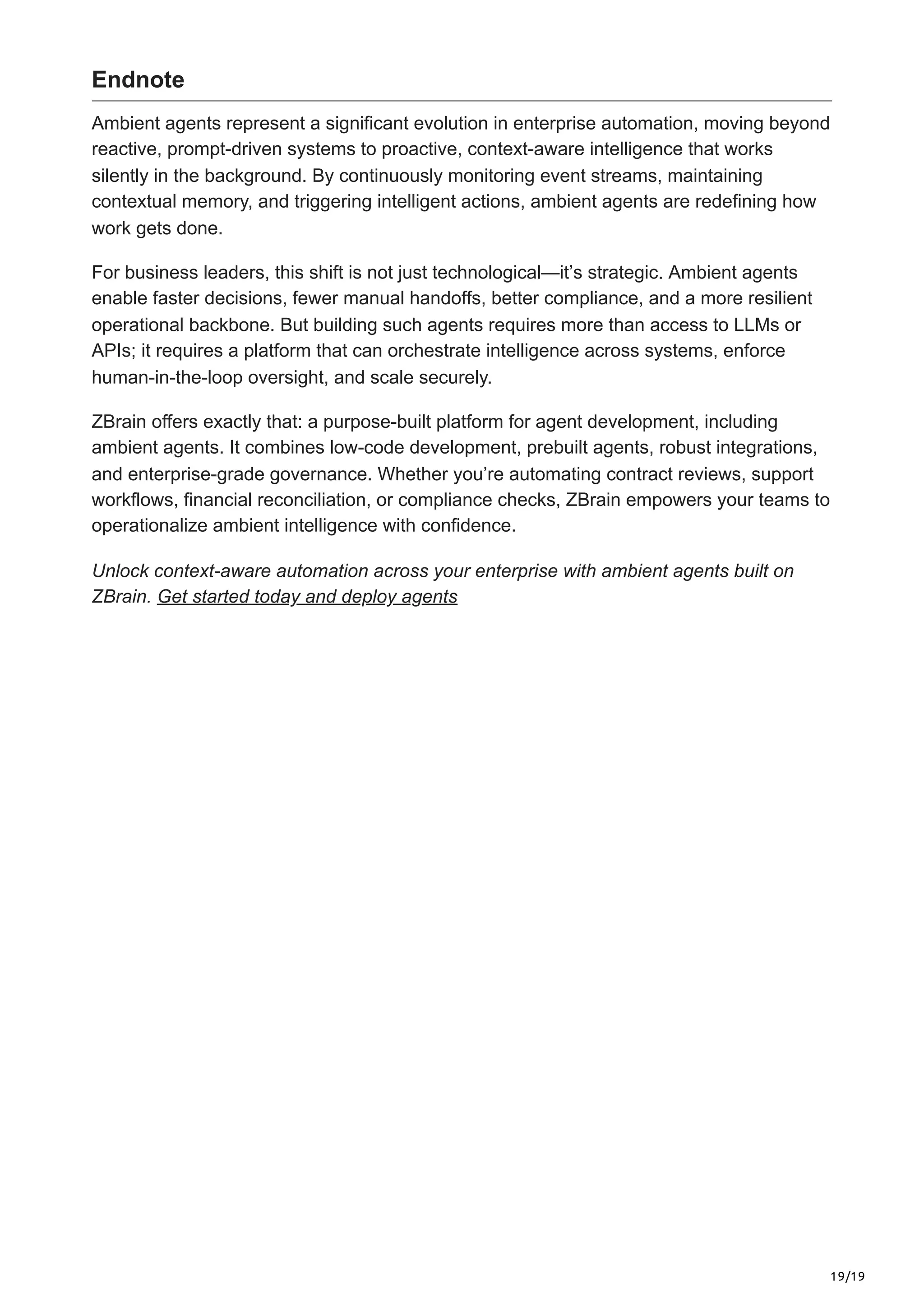
Ambient agents are AI systems designed to operate continuously in the background,
monitoring signals, interpreting context, and taking meaningful action without requiring
explicit prompts from humans. They are always working, aware of their environment, and
capable of acting within defined guardrails. Unlike rule-based bots or chat-driven agents,
ambient agents are context-aware—continuously monitoring events and leveraging
historical context—and are autonomous, making them ideal for streamlining complex
workflows across operations, compliance, finance, sales, and support. They don’t just
wait for instructions—they anticipate needs, surface insights, and intervene when
something is off track. Although ambient agents act autonomously, they often incorporate
human-in-the-loop checkpoints, such as notification, questioning, and review phases, to
ensure actions remain aligned with organizational policies and context. Ambient agents
can seamlessly plug into existing pipelines—such as CI/CD workflows, event buses, and
ticketing systems—allowing operations, compliance, finance, sales, and support teams to
benefit from real-time triggers and human-in-the-loop feedback (for example, LangChain’s
“Agent Inbox” UX surfaces alerts for review and approval)
2/19
This article explores what ambient agents are, how they differ from other agent types,
their roots in ambient intelligence, and how enterprises can leverage platforms like to
build and scale them for real-world use cases. Whether you’re just learning about agentic
systems or actively planning to deploy them, this guide will equip you with the conceptual
clarity and practical understanding to take the next step.
What are ambient agents?
Ambient agents are AI systems designed to run continuously in the background,
monitoring streams of events and acting on them without awaiting direct human prompts.
In other words, they “listen” to event streams – such as sensor readings, user activity
logs, or system signals – and autonomously decide when and how to respond. As
Harrison Chase of LangChain explains, ambient agents act on event streams rather than
on one-to-one queries, enabling “massively parallel and autonomous workflows”. In
practice, this means an ambient agent might quietly monitor a smart-home sensor or
enterprise database, detect when something significant happens, and then take or
suggest an action (all within defined safety policies) without a user explicitly asking it to
do so.
So, what is an event stream? Ambient agents rely on event-driven architectures. An event
stream is simply a continuous log of events in a system or environment – for example,
user clicks on a website, IoT sensor readings (temperature, motion, door open/close
events), system logs, or transactions in a database. These streams act like a central
nervous system, providing real-time observations of the world. Ambient agents subscribe
to such streams and process new events as they arrive. For instance, an ambient agent
might watch a stream of smart-home motion sensor data to infer when someone enters or
leaves a room. With each event, the agent updates its understanding of the current
context: it might combine recent data (occupancy, time of day, weather, user calendar) to
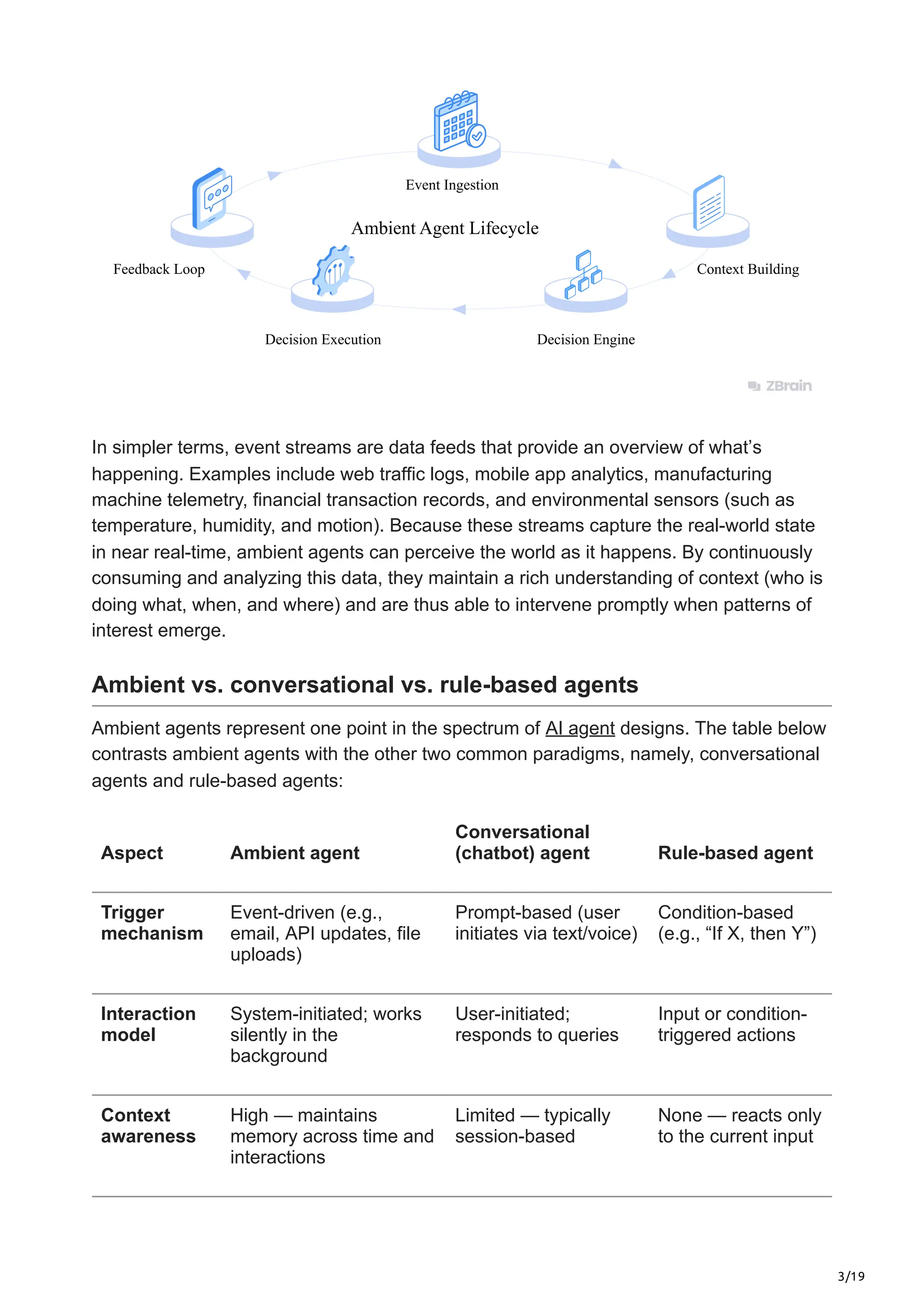
make decisions. In technical terms, an ambient agent architecture typically includes event
ingestion (e.g., Kafka topics, IoT message buses, log collectors) and context-building
layers that aggregate recent events, metrics, and historical state. A robust ambient agent
often requires access to a stream of events to monitor (for example, via Kafka,
Kubernetes events, telemetry, CI/CD hooks, etc.). When an event occurs, the agent
formats it into a structured prompt that contains system context, past interactions, and
policy rules, and then sends it to the LLM. The model generates a step-by-step plan (e.g.,
fetch metrics, compare thresholds, notify on-call), which the orchestration layer parses
into concrete API or tool calls. Finally, the agent either executes those calls directly or, if
configured, routes the proposal through a human‐in‐the‐loop approval step before acting
or raising an alert.
3/19
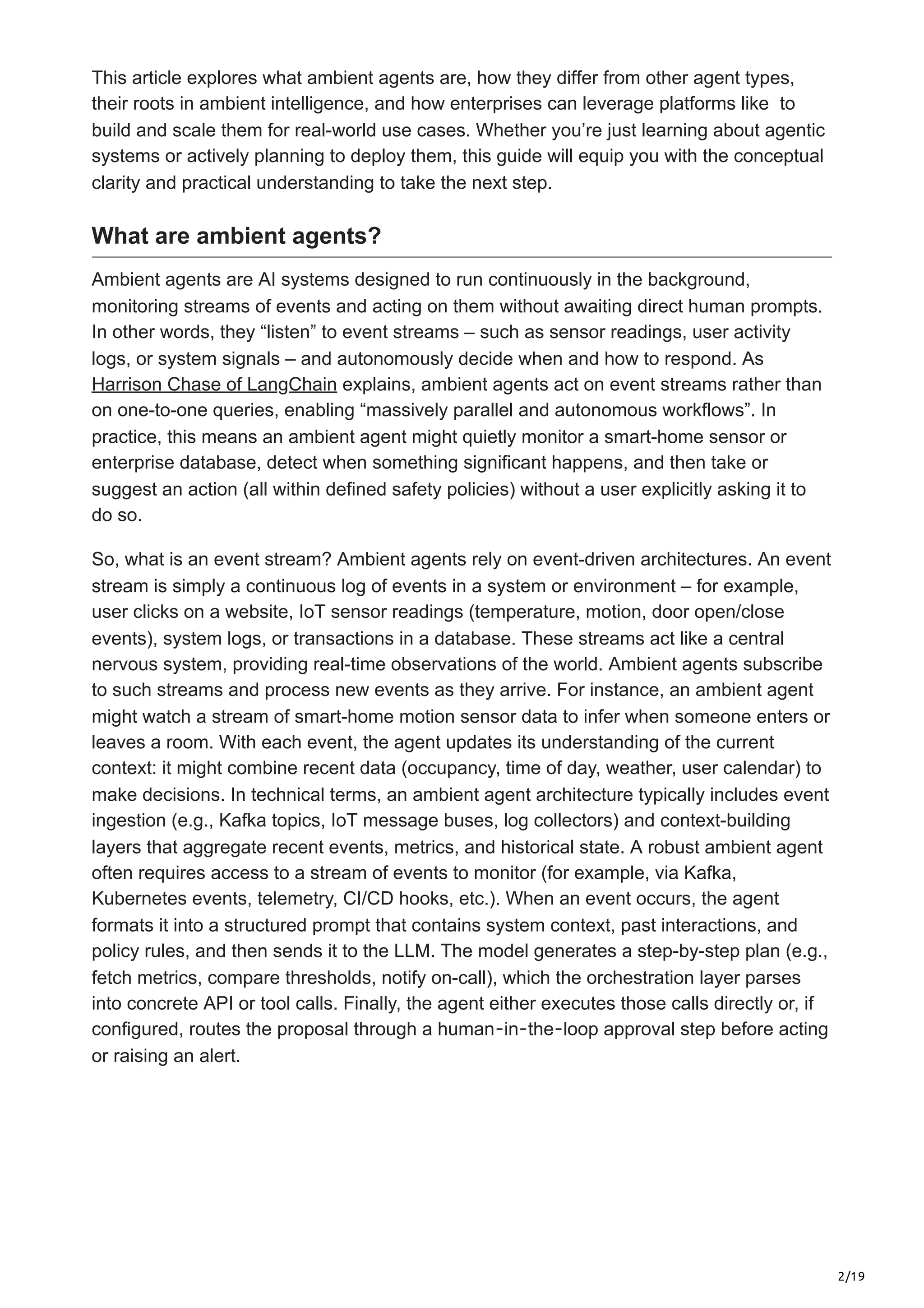
Ambient Agent Lifecycle
Event Ingestion
Context Building
Feedback Loop
Decision Engine
Decision Execution
In simpler terms, event streams are data feeds that provide an overview of what’s
happening. Examples include web traffic logs, mobile app analytics, manufacturing
machine telemetry, financial transaction records, and environmental sensors (such as
temperature, humidity, and motion). Because these streams capture the real-world state
in near real-time, ambient agents can perceive the world as it happens. By continuously
consuming and analyzing this data, they maintain a rich understanding of context (who is
doing what, when, and where) and are thus able to intervene promptly when patterns of
interest emerge.
Ambient vs. conversational vs. rule-based agents
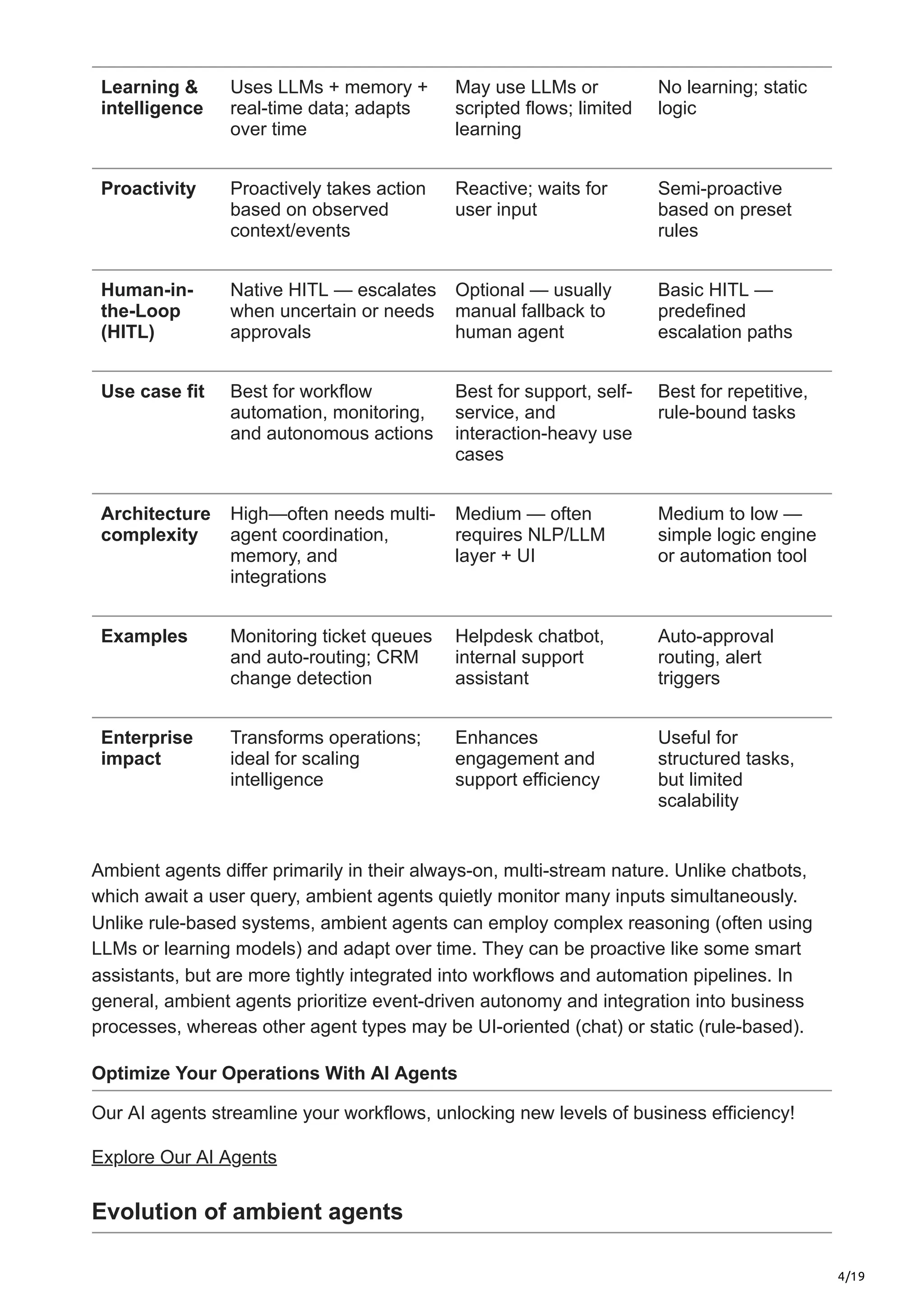
Ambient agents represent one point in the spectrum of AI agent designs. The table below
contrasts ambient agents with the other two common paradigms, namely, conversational
agents and rule-based agents:
Aspect Ambient agent
Conversational
(chatbot) agent Rule-based agent
Trigger
mechanism
Event-driven (e.g.,
email, API updates, file
uploads)
Prompt-based (user
initiates via text/voice)
Condition-based
(e.g., “If X, then Y”)
Interaction
model
System-initiated; works
silently in the
background
User-initiated;
responds to queries
Input or condition-
triggered actions
Context
awareness
High — maintains
memory across time and
interactions
Limited — typically
session-based
None — reacts only
to the current input
4/19
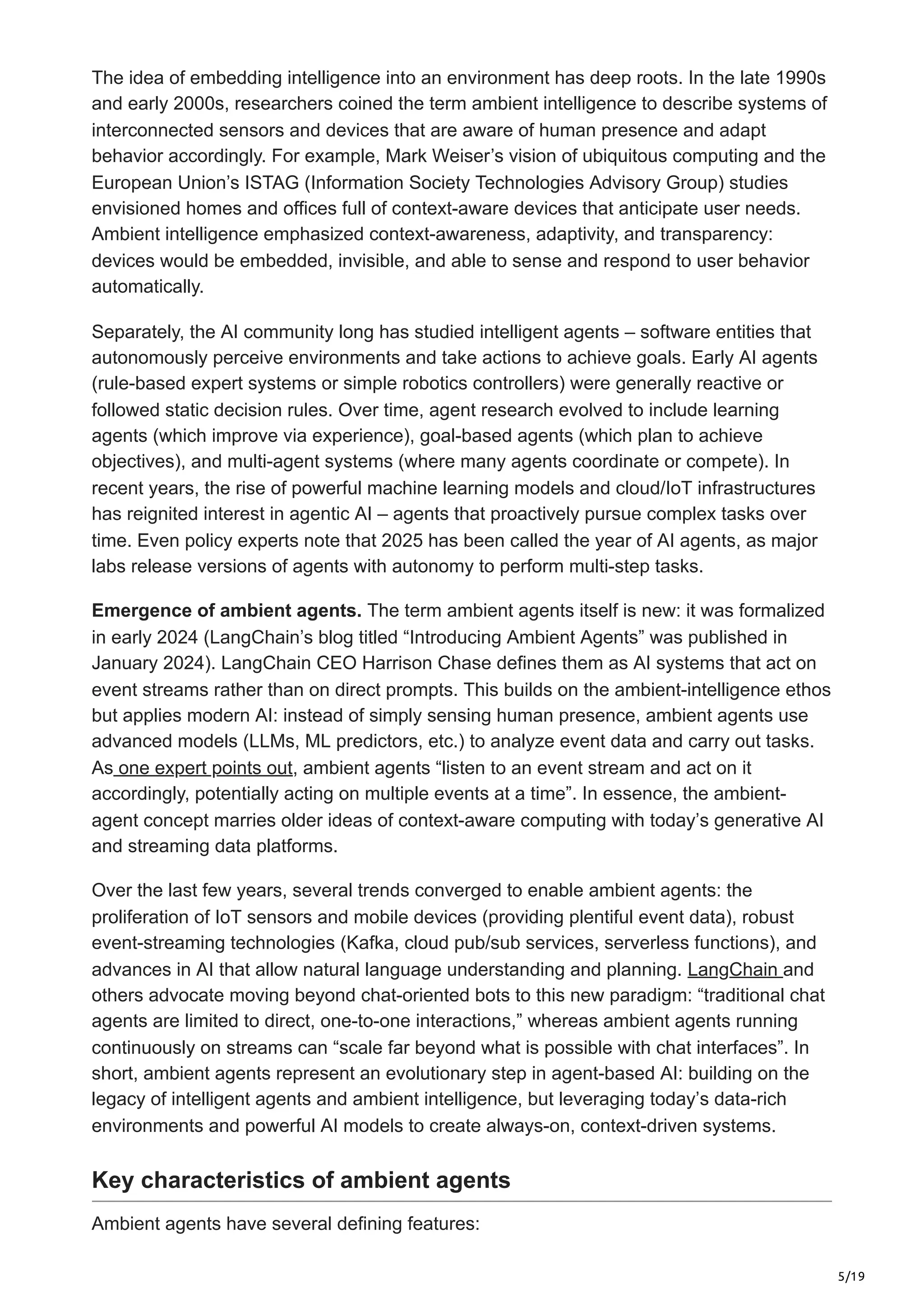
Learning &
intelligence
Uses LLMs + memory +
real-time data; adapts
over time
May use LLMs or
scripted flows; limited
learning
No learning; static
logic
Proactivity Proactively takes action
based on observed
context/events
Reactive; waits for
user input
Semi-proactive
based on preset
rules
Human-in-
the-Loop
(HITL)
Native HITL — escalates
when uncertain or needs
approvals
Optional — usually
manual fallback to
human agent
Basic HITL —
predefined
escalation paths
Use case fit Best for workflow
automation, monitoring,
and autonomous actions
Best for support, self-
service, and
interaction-heavy use
cases
Best for repetitive,
rule-bound tasks
Architecture
complexity
High—often needs multi-
agent coordination,
memory, and
integrations
Medium — often
requires NLP/LLM
layer + UI
Medium to low —
simple logic engine
or automation tool
Examples Monitoring ticket queues
and auto-routing; CRM
change detection
Helpdesk chatbot,
internal support
assistant
Auto-approval
routing, alert
triggers
Enterprise
impact
Transforms operations;
ideal for scaling
intelligence
Enhances
engagement and
support efficiency
Useful for
structured tasks,
but limited
scalability
Ambient agents differ primarily in their always-on, multi-stream nature. Unlike chatbots,
which await a user query, ambient agents quietly monitor many inputs simultaneously.
Unlike rule-based systems, ambient agents can employ complex reasoning (often using
LLMs or learning models) and adapt over time. They can be proactive like some smart
assistants, but are more tightly integrated into workflows and automation pipelines. In
general, ambient agents prioritize event-driven autonomy and integration into business
processes, whereas other agent types may be UI-oriented (chat) or static (rule-based).
Optimize Your Operations With AI Agents
Our AI agents streamline your workflows, unlocking new levels of business efficiency!
Explore Our AI Agents
Evolution of ambient agents
5/19
The idea of embedding intelligence into an environment has deep roots. In the late 1990s
and early 2000s, researchers coined the term ambient intelligence to describe systems of
interconnected sensors and devices that are aware of human presence and adapt
behavior accordingly. For example, Mark Weiser’s vision of ubiquitous computing and the
European Union’s ISTAG (Information Society Technologies Advisory Group) studies
envisioned homes and offices full of context-aware devices that anticipate user needs.
Ambient intelligence emphasized context-awareness, adaptivity, and transparency:
devices would be embedded, invisible, and able to sense and respond to user behavior
automatically.
Separately, the AI community long has studied intelligent agents – software entities that
autonomously perceive environments and take actions to achieve goals. Early AI agents
(rule-based expert systems or simple robotics controllers) were generally reactive or
followed static decision rules. Over time, agent research evolved to include learning
agents (which improve via experience), goal-based agents (which plan to achieve
objectives), and multi-agent systems (where many agents coordinate or compete). In
recent years, the rise of powerful machine learning models and cloud/IoT infrastructures
has reignited interest in agentic AI – agents that proactively pursue complex tasks over
time. Even policy experts note that 2025 has been called the year of AI agents, as major
labs release versions of agents with autonomy to perform multi-step tasks.
Emergence of ambient agents. The term ambient agents itself is new: it was formalized
in early 2024 (LangChain’s blog titled “Introducing Ambient Agents” was published in
January 2024). LangChain CEO Harrison Chase defines them as AI systems that act on
event streams rather than on direct prompts. This builds on the ambient-intelligence ethos
but applies modern AI: instead of simply sensing human presence, ambient agents use
advanced models (LLMs, ML predictors, etc.) to analyze event data and carry out tasks.
As one expert points out, ambient agents “listen to an event stream and act on it
accordingly, potentially acting on multiple events at a time”. In essence, the ambient-
agent concept marries older ideas of context-aware computing with today’s generative AI
and streaming data platforms.
Over the last few years, several trends converged to enable ambient agents: the
proliferation of IoT sensors and mobile devices (providing plentiful event data), robust
event-streaming technologies (Kafka, cloud pub/sub services, serverless functions), and
advances in AI that allow natural language understanding and planning. LangChain and
others advocate moving beyond chat-oriented bots to this new paradigm: “traditional chat
agents are limited to direct, one-to-one interactions,” whereas ambient agents running
continuously on streams can “scale far beyond what is possible with chat interfaces”. In
short, ambient agents represent an evolutionary step in agent-based AI: building on the
legacy of intelligent agents and ambient intelligence, but leveraging today’s data-rich
environments and powerful AI models to create always-on, context-driven systems.
Key characteristics of ambient agents
Ambient agents have several defining features:
6/19
Always-on monitoring: Continuously runs in the background 24/7 and listens for
defined triggers (e.g., emails, document uploads, system logs) without waiting for
user prompts.
Contextual memory: Maintain a persistent memory of past interactions, data
points, and decisions. This allows the agent to recall historical context, such as
vendor terms or customer preferences, when processing new events.
Event-driven actions: Automatically initiate processes or notifications when
specific conditions in the data stream are met.
Collaborative workflows: Coordinate with other specialized agents or systems.
For example, a procurement agent can hand off tasks to a finance agent for
payment processing or to a legal agent for contract review.
Human-in-the-loop: Include checkpoints (notifications, approval requests, or
escalation flags) for ambiguous or high-risk decisions, ensuring that humans can
review critical actions.
These capabilities allow ambient agents to seamlessly integrate into enterprise
operations. They handle routine events invisibly and intervene only when their logic or
training advises it. These agents operate without user initiation, build knowledge
continuously, intervene intelligently when needed, scale seamlessly across departments,
and embed directly into workflows, not just chat interfaces. In practice, this means an
ambient agent could manage repetitive tasks on its own—say, updating a CRM record
when a support ticket is resolved—and only surface on a dashboard or to a human agent
when an exception arises.
Human-in-the-loop in ambient agents
While ambient agents are designed for autonomy, human oversight remains a critical part
of their operation, especially in enterprise settings where decisions impact customers,
compliance, or revenue. Human-in-the-loop (HITL) provides structured checkpoints within
an agent’s workflow, allowing humans to approve, revise, or override actions before they
are finalized. This ensures that ambient agents operate within clearly defined policy
boundaries and align with organizational judgment.
Human-in-the-loop processes are vital for trustworthy ambient agents. In practice,
ambient agents are governed by enterprise policies and include explicit HITL checkpoints.
For example, when encountering an unclear request or a compliance-sensitive decision,
an agent may pause and either notify a stakeholder of the action it intends to take,
question the user to clarify intent, or escalate for review before proceeding. This ensures
that sensitive decisions are never executed silently and always reflect human judgment
when needed. This design means that ambient agents become partners rather than
replacements for human roles: they handle bulk processing, but let people oversee the
gray areas.
Key benefits of human-in-the-loop design include:
It lowers the stakes, making it easier to ship agents to production.
7/19
It mimics human communication, building user trust and adoption.
It empowers long-term memory and learning.
Rather than slowing down automation, HITL ensures agents remain aligned with
enterprise goals while building trust across teams. In , HITL is built into the orchestration
layer, allowing creators to easily insert review steps, define escalation paths, and log
decisions for auditability.
Typical HITL scenarios in ambient agents include:
A manager reviewing and approving a contract draft generated by a contract
validation agent before it is sent to a vendor.
A financial analyst verifying an expense forecast generated by an agent before it is
published in a report.
An HR executive approving intervention steps recommended by a talent risk agent
based on behavior patterns.
These interactions not only mitigate risk and build trust, but also create feedback: each
review teaches the system and refines its future decisions. In short, human oversight and
agent autonomy work together to scale enterprise operations safely.
Architectural and functional elements of ambient agents
Ambient agents share several key architectural and functional elements:
Context awareness: By design, ambient agents maintain a continuously updated
representation of their environment. As new events arrive—such as sensor
readings, user actions, or system logs—they integrate these signals into a stored
memory (often referred to as an internal model) that reflects the latest state of the
world, enabling the agent to make informed, context-sensitive decisions. Like
ambient-intelligence systems, they can use sensors or data streams (motion
detectors, system logs, user profiles, etc.) to detect people’s presence, activities,
and preferences. This context can include which users are active, what processes
are running, or what environmental conditions prevail. A context builder or memory
module aggregates recent events and state so that the agent can make informed
decisions. For example, an ambient shopping assistant might use a customer’s
browsing history (events) together with current time and location to infer intent.
8/19
Event-driven operation (Real-time processing): Ambient agents are inherently
event-driven. They subscribe to event streams and are triggered whenever relevant
events occur. Unlike chatbots, which wait for user queries, ambient agents react as
soon as new data arrives. Because they process events in real-time, they can take
prompt action. With an event-driven architecture, ambient agents subscribe to real-
time streams of events—each stream representing observations about the external
world. This continuous intake allows agents to stay aware of their environment and
respond intelligently as situations unfold. In practice, this often involves message
queues or event buses (Kafka topics, MQTT feeds, cloud event hubs, etc.) feeding
data into the agent’s pipeline.
Autonomy and proactivity: Ambient agents are designed to operate largely
autonomously (subject to policy constraints). They continuously monitor and, within
defined boundaries, take actions without needing fresh prompts. Such agents are
autonomous—able to act on signals without direct user prompts—and event-driven,
responding to contextual triggers rather than conversational inputs. In effect, they
proactively address issues: for example, an industrial ambient agent might detect a
pattern of equipment vibration spikes and initiate a diagnostic or preventive action,
rather than waiting for an engineer to notice a problem.
Processing and reasoning layers: Under the hood, ambient agents combine data-
processing, reasoning, and execution modules. A typical architecture can include:
Event ingestion layer: Connectors to capture events (e.g., IoT telemetry,
logs, webhooks, database triggers).
Context builder: Aggregates recent events, logs, user data, and metadata
into a coherent context (e.g., compiling all sensor readings for a room, or
collating all recent customer actions).
Policy/rule engine: Ensures the agent operates within safe bounds. This
might be explicit rules or learned policies that restrict what the agent can do
(e.g., never delete data, never act on weekends without approval).
AI/decision module: The core brain – often an LLM or other model – that
interprets the context and decides on actions or responses. It may perform
tasks like classification, prediction, planning, or generating messages.
Action executor: The mechanism that enables an ambient agent to act on its
decisions by interfacing with external systems, APIs, or internal functions. It is
typically powered by a combination of integration infrastructure, execution
logic, and connectors.
Observability: Systems to log the agent’s actions, store state across events,
and provide dashboards for monitoring. Long-running ambient agents typically
maintain memory and must support retrospective auditing—that is, the ability
to review and trace past decisions along with the context in which they were
made. This ‘time travel’ capability is essential for accountability, compliance,
and continuous improvement.
Human-in-the-loop interfaces: Webhooks, dashboards, or conversational
UIs where humans can review, approve, or override agent actions. In practice,
ambient agents often notify users or ask for approval for high-risk decisions
(the agent inbox concept, similar to a ticketing system).
9/19
Real-time feedback loop: A crucial element is continuous learning and adjustment.
Robust ambient agents incorporate feedback loops where their actions (and any
human corrections) are fed back into the system to refine policies or models. This
makes them adaptive over time, improving personalization and reducing false
positives. This learning capability distinguishes them from rigid rule-based systems
and helps them compound value with each run.
While many platforms offer isolated agent tooling, ZBrain brings these architectural layers
together into an integrated orchestration environment, purpose-built for enterprise-grade
ambient agents. Below, we explore how ZBrain realizes these capabilities.
A closer look at ZBrain ambient agents as adaptive, context-aware
AI systems
The architectural elements outlined above—context awareness, event-driven operation,
governed autonomy, and human-in-the-loop controls—form the blueprint of any capable
ambient agent. However, designing and deploying such agents at enterprise scale
requires more than a conceptual framework. It demands a platform that can orchestrate
these capabilities end-to-end, ensure secure and compliant operations, and deliver
extensibility across diverse enterprise systems.
ZBrain Builder is designed to operationalize this architecture. It provides a low-code
orchestration layer, memory systems, human-in-the -loop workflows, and robust
connectors to enterprise systems. Below, we outline how ZBrain maps to the ambient
agent model, enabling organizations to transition from concept to deployment with
minimal friction.
You can use ZBrain Builder to create custom ambient agents tailored to your processes—
whether it’s logistics exceptions, contract renewal monitoring, executive brief generation,
or supplier onboarding audits. ZBrain Builder allows both technical and non-technical
teams to define:
Triggers (events from systems or messages)
Flows (logic workflows using conditions, actions, memory, and LLMs)
Outputs (like emails, Slack messages, dashboard updates, or API-triggered actions)
The platform supports feedback loops and monitoring so that agents can evolve and
improve.
ZBrain isn’t just a tool—it’s a full ecosystem for enterprise AI automation, making it the
ideal environment for scalable ambient agent development.
Ambient
agent layer ZBrain capability
10/19
Event
ingestion
Triggers from emails, file uploads, APIs, DB updates, system events
(via connectors)
Context
builder
Uses session memory to hold context
Policy/rule
engine
Low-code conditional logic and escalation paths are built into agent
workflows, with the ability to integrate guardrail agents for safe
decision-making. Prompts and instructions also serve as soft policies,
guiding LLM behavior to stay aligned with organizational rules and
goals
AI/decision
module
LLM-driven reasoning and conditional branching based on real-time
data
Action
executor
Interfaces with external systems, APIs, or internal services to carry out
decisions. ZBrain’s built-in connectors, execution flows, and
integration logic trigger actions such as API calls, database updates,
or notifications—ensuring seamless interaction with enterprise
systems.
Observability Dashboards, logs, and state tracing for auditability and performance
monitoring
Human-in-
the-loop
Approval steps and manual overrides can be incorporated into the
agent’s logic; the system also includes built-in feedback mechanisms.
Security &
governance
Role-based access control, authentication, audit logs, and enterprise-
grade encryption
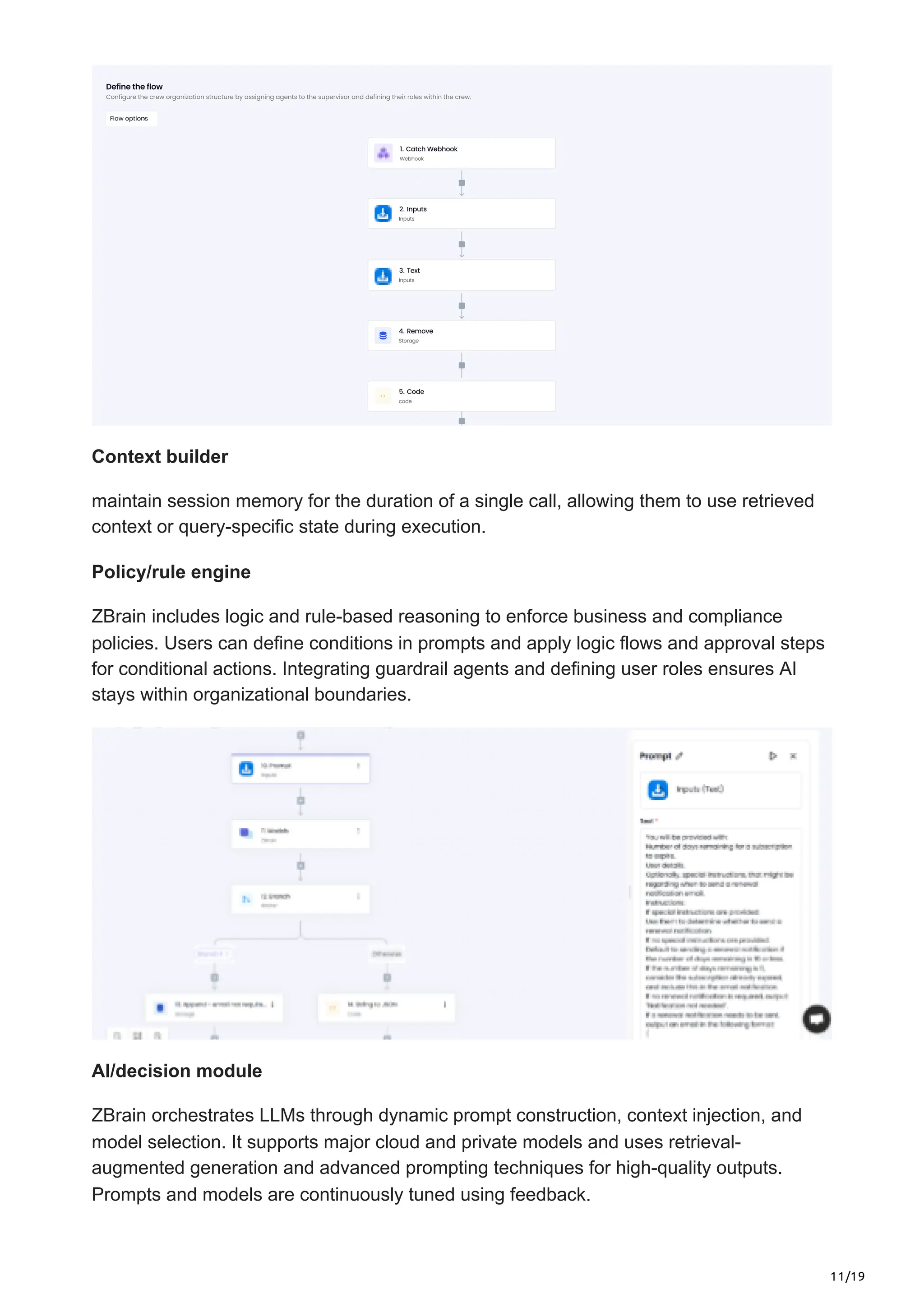
Event ingestion
provides a comprehensive data ingestion framework that feeds events and data into
ambient agents in real time. Its flow interface includes triggers (scheduled, webhook or
event-based) that can invoke AI workflows as soon as new data arrives. It supports
continuous and scheduled ingestion from enterprise systems like APIs, Salesforce,
SharePoint, and databases through connectors. For example, a new customer order in an
e-commerce system can fire a webhook trigger in ZBrain, automatically loading the order
data into the agent’s workflow.
11/19
Context builder
maintain session memory for the duration of a single call, allowing them to use retrieved
context or query-specific state during execution.
Policy/rule engine
ZBrain includes logic and rule-based reasoning to enforce business and compliance
policies. Users can define conditions in prompts and apply logic flows and approval steps
for conditional actions. Integrating guardrail agents and defining user roles ensures AI
stays within organizational boundaries.
AI/decision module
ZBrain orchestrates LLMs through dynamic prompt construction, context injection, and
model selection. It supports major cloud and private models and uses retrieval-
augmented generation and advanced prompting techniques for high-quality outputs.
Prompts and models are continuously tuned using feedback.
12/19
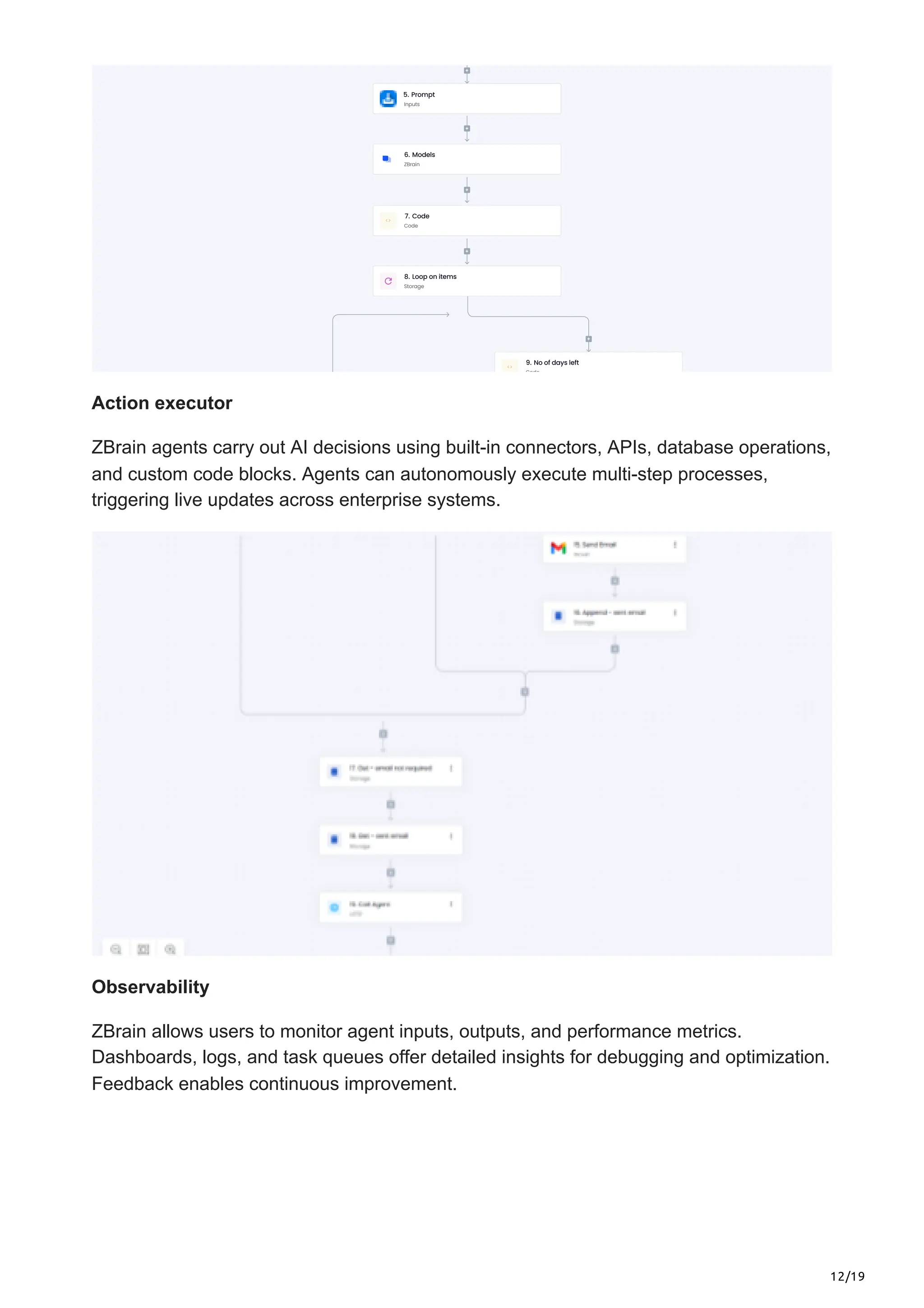
Action executor
ZBrain agents carry out AI decisions using built-in connectors, APIs, database operations,
and custom code blocks. Agents can autonomously execute multi-step processes,
triggering live updates across enterprise systems.
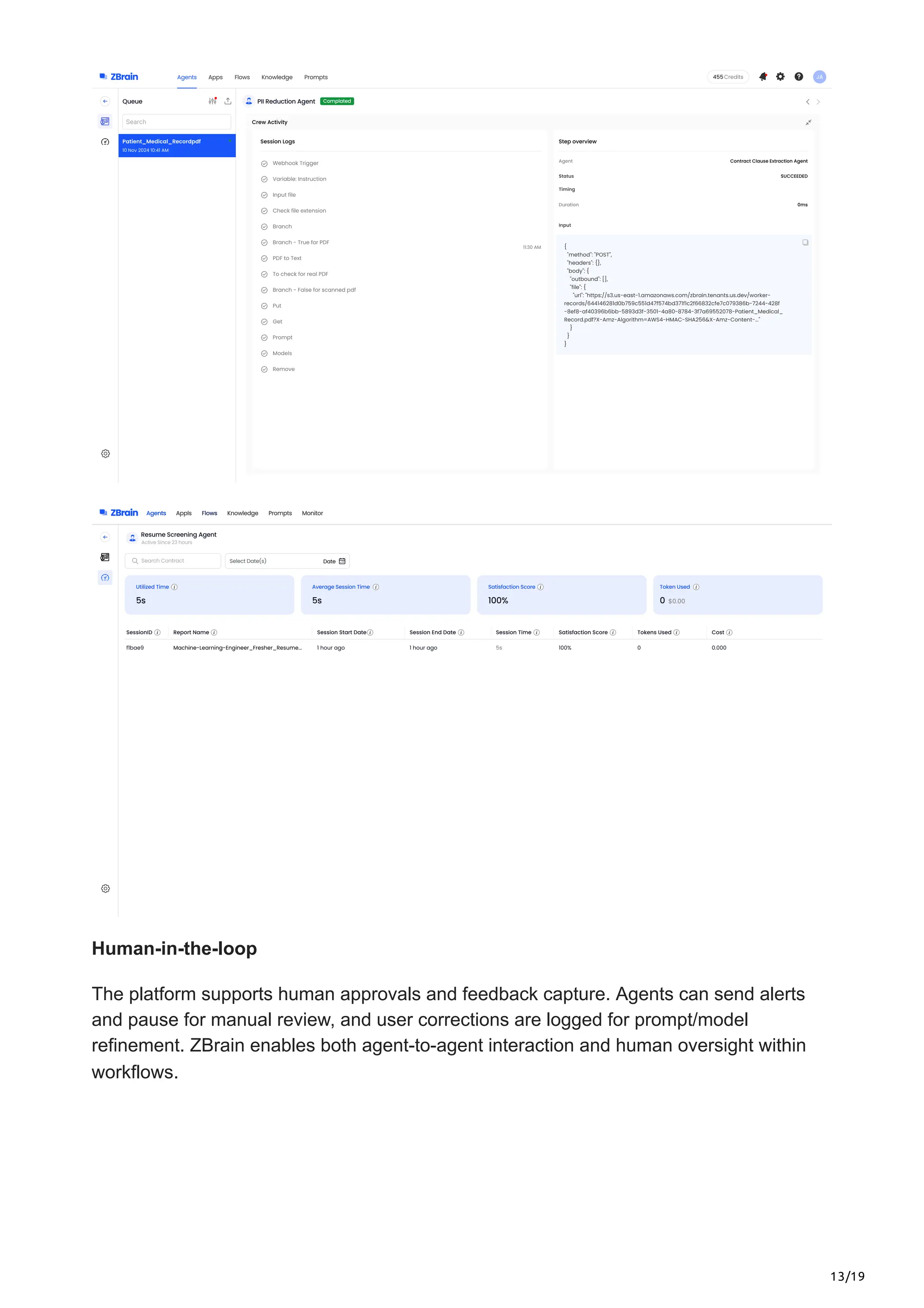
Observability
ZBrain allows users to monitor agent inputs, outputs, and performance metrics.
Dashboards, logs, and task queues offer detailed insights for debugging and optimization.
Feedback enables continuous improvement.
13/19
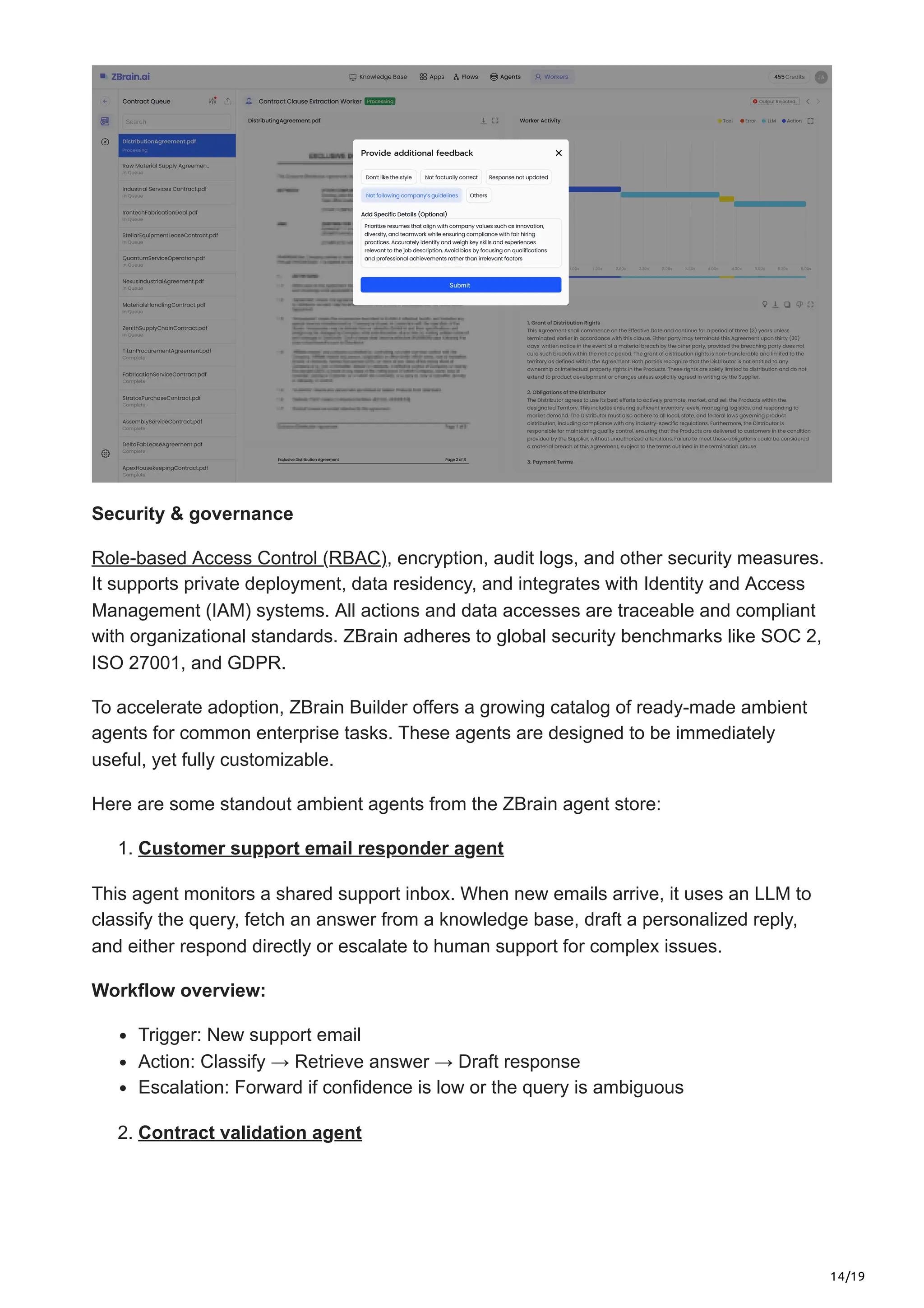
Human-in-the-loop
The platform supports human approvals and feedback capture. Agents can send alerts
and pause for manual review, and user corrections are logged for prompt/model
refinement. ZBrain enables both agent-to-agent interaction and human oversight within
workflows.
14/19
Security & governance
Role-based Access Control (RBAC), encryption, audit logs, and other security measures.
It supports private deployment, data residency, and integrates with Identity and Access
Management (IAM) systems. All actions and data accesses are traceable and compliant
with organizational standards. ZBrain adheres to global security benchmarks like SOC 2,
ISO 27001, and GDPR.
To accelerate adoption, ZBrain Builder offers a growing catalog of ready-made ambient
agents for common enterprise tasks. These agents are designed to be immediately
useful, yet fully customizable.
Here are some standout ambient agents from the ZBrain agent store:
1. Customer support email responder agent
This agent monitors a shared support inbox. When new emails arrive, it uses an LLM to
classify the query, fetch an answer from a knowledge base, draft a personalized reply,
and either respond directly or escalate to human support for complex issues.
Workflow overview:
Trigger: New support email
Action: Classify → Retrieve answer → Draft response
Escalation: Forward if confidence is low or the query is ambiguous
2. Contract validation agent
15/19
Continuously scans uploaded contracts or documents against company policy. It identifies
non-compliant terms, highlights risky clauses, and routes flagged content to legal or
compliance teams.
Workflow overview:
Trigger: New contract upload
Action: Compare terms against policy → Highlight risks
Escalation: Notify legal if a critical deviation is found
3. Purchase order-invoice matching agent
Matches incoming invoices with existing purchase orders or delivery receipts. Flags
discrepancies, automates reconciliation, and escalates exceptions to finance.
Workflow overview:
Trigger: New invoice PDF or system record
Action: Extract invoice data → Match with PO→ Flag mismatch
Escalation: Enable procurement teams to review flagged discrepancies
4. Customer feedback sentiment analysis agent
Monitors customer reviews, survey responses, or social media to classify sentiment,
surface emerging trends and concerns, and route the feedback results for CX leaders.
Workflow overview:
Trigger: New form submission or review feed update
Action: Analyze sentiment → Process the feedback → Flag negative comments
Escalation: Route processed feedback to relevant personnel for timely interventions
Enterprise applications of ambient agents
Ambient agents are especially valuable in enterprise environments rich with digital signals
—emails, database updates, workflow triggers, logs, and document uploads. Unlike
traditional bots, they are designed to passively observe these data streams, interpret
patterns, and act independently, without needing constant human input.
Here’s how they are transforming core enterprise functions:
1. Operational monitoring and intervention
In logistics, manufacturing, or IT operations, ambient agents can monitor event streams
for anomalies, threshold breaches, or delayed processes, then take corrective actions
automatically. For example, if a shipment status update indicates a delay, an ambient
agent might trigger customer notifications or reroute related orders without user prompts.
2. Business performance insights
16/19
Ambient agents can be embedded into business intelligence systems to continuously
track KPIs and detect significant trends or deviations. Rather than waiting for dashboards
to be queried, these agents proactively surface insights like a sudden drop in conversion
rates or a spike in employee churn indicators, delivering them to decision-makers at the
right time.
3. Finance and audit readiness
In finance teams, ambient agents can monitor ongoing financial transactions, flag
potential compliance breaches, and alert auditors to exceptions. They can also watch for
inconsistencies in revenue recognition, recurring billing issues, or late payments, making
financial processes more transparent and audit-friendly.
4. Process automation and escalation
Ambient agents can orchestrate multi-step workflows across tools, without requiring user
input. For example, they can detect when a procurement approval is delayed beyond
SLA, auto-remind stakeholders, and escalate if needed. This allows enterprises to
automate not just tasks, but end-to-end flows based on time, state, or priority.
5. Sentiment and communication monitoring
By observing internal and external communications (emails, chats, survey results),
ambient agents can detect shifts in sentiment, compliance risks, or engagement trends.
This allows HR or CX teams to proactively act on potential issues—like declining morale
or customer dissatisfaction—before they become crises.
6. Information governance and document compliance
Ambient agents are effective in maintaining control over documents and content across
enterprise systems. They can watch for newly added files, check them for sensitive
information, validate naming or storage policies, and quarantine or tag documents for
review.
Benefits of ambient agents
Ambient agents offer several key advantages in real-world systems:
Continuous automation and scale: Because they run 24/7 and operate on
background event streams, ambient agents can automate vast numbers of routine
tasks in parallel. Ambient architectures allow massively parallel workflows, far
beyond the one-to-one interactions of chatbots. For instance, dozens of ambient
agents could simultaneously monitor different sales pipelines, infrastructure
components, or customer accounts, triggering actions independently. This leads to
huge potential scale-ups in efficiency.
17/19
Greater responsiveness: By reacting instantly to events, ambient agents can
address issues before humans even notice. For example, an ambient agent could
detect a security anomaly or a system failure as soon as it occurs and initiate
containment measures immediately. Ambient agents embed real-time behavioral
data into their operation, enabling context-aware optimization (e.g., preventing sales
drop-offs in e-commerce or fraud in financial systems).
Integration into existing systems: Ambient agents are designed to connect with
enterprise workflows and data sources. They run continuously, not reactively, and
connect to systems, not just users. This means they can tap into existing
databases, APIs, or IoT infrastructures. For example, a support ambient agent
might automatically retrieve customer information from a CRM and combine it with a
user’s recent app logs to assist in an escalated ticket. Salesforce envisions ambient
agents working behind the scenes to orchestrate across its clouds – for instance,
pulling order data from Commerce Cloud and shipment status from Service Cloud
and synthesizing an answer to a customer inquiry without human intervention.
Improved consistency & learning: Unlike humans, agents do not get tired or
distracted. They apply policies uniformly every time. Moreover, because they
operate on data, they can continuously learn. Each interaction provides feedback
that can be used to refine their decision policies. Ambient agents compound value,
which means, each run improves policy tuning and signal quality. Over time, an
ambient agent becomes better at identifying relevant events and reducing noise.
Human-centric control: Paradoxically, even as ambient agents work
independently, they often enhance human productivity. By surfacing only the most
relevant events for human review (think of an agent’s inbox of recommended
actions), they help decision-makers focus on higher-level tasks. This can improve
trust: actions are carried out only after human approval or with clear explanations.
Architectures emphasize human-in-the-loop patterns (“notify, question, review”) to
keep humans informed and in control.
Optimize Your Operations With AI Agents
Our AI agents streamline your workflows, unlocking new levels of business efficiency!
Explore Our AI Agents
Challenges and risks associated with the ambient agents
implementation
Deploying ambient agents also brings unique challenges:
18/19
Complexity and debugging: The logic of an ambient agent can be opaque until
something goes wrong. Some experts warn of hidden complexity – when an agent
errs, its chain of reasoning (over many event correlations) can be difficult to trace.
Debugging failures or false positives is difficult because the system’s decisions
depend on lengthy event histories and possibly stochastic model outputs.
Organizations must invest in robust observability, including logging, testing
frameworks, and mechanisms that enable retrospective inspection (time travel
capabilities) of the agent’s memory and decision history for accurate diagnostics
and auditing.
Trust and oversight: Increased autonomy means potential for unintended actions.
Industry experts emphasize that ambient agents require careful human oversight:
policies must be set, and high-risk actions gated by approvals. Without clear
governance, an agent might take a destructive action (e.g., deleting critical data) if
its rules are too loose. Building trust involves transparency (e.g., audit trails) and the
ability to tune risk thresholds. Ambient systems function more like smart co-pilots
than full autopilots—handling routine tasks autonomously by default, but escalating
to humans when uncertainty or risk is high.
Privacy and security: Ambient agents process continuous streams of potentially
sensitive data. In a smart home, an agent might hear conversations or track
locations; in healthcare, it might access personal health metrics. This raises valid
privacy concerns. Designers must implement data protection from the ground up
(e.g., anonymization, secure enclaves). Emerging guidelines (like the EU’s
proposed AI Act) may impose strict requirements on “continuous monitoring” AI.
Indeed, policy experts warn that advanced agents introduce novel data-protection
risks – for example, by continuously collecting more personal data than a user might
expect. Ensuring compliance with GDPR, HIPAA or industry regulations can be
complex.
Computational and engineering costs: Running many agents constantly
demands significant computing and infrastructure resources. Agents often need
reliable state persistence and can incur bursty workloads. Companies should invest
in orchestration platforms and observability tools specifically designed for long-
running agents. Edge cases, like network failures or corrupted streams, must be
handled to prevent system-wide issues.
Ethical considerations: Because ambient agents can influence people’s
experiences without explicit prompts, ethical design is critical. Agents should be fair
and avoid reinforcing biases (e.g., not neglecting certain user segments), and they
should never manipulate users without consent. The invisible nature of ambient
action demands explainability: when an agent affects a user (say, automatically
scheduling a meeting or denying access), it should provide an understandable
rationale or allow human override.
In summary, the power of ambient agents lies in their autonomy and breadth of operation,
but their safe deployment hinges on governance. As experts emphasize, the benefits of
24/7 automated optimization come hand-in-hand with the need for robust oversight.
19/19
Endnote
Ambient agents represent a significant evolution in enterprise automation, moving beyond
reactive, prompt-driven systems to proactive, context-aware intelligence that works
silently in the background. By continuously monitoring event streams, maintaining
contextual memory, and triggering intelligent actions, ambient agents are redefining how
work gets done.
For business leaders, this shift is not just technological—it’s strategic. Ambient agents
enable faster decisions, fewer manual handoffs, better compliance, and a more resilient
operational backbone. But building such agents requires more than access to LLMs or
APIs; it requires a platform that can orchestrate intelligence across systems, enforce
human-in-the-loop oversight, and scale securely.
ZBrain offers exactly that: a purpose-built platform for agent development, including
ambient agents. It combines low-code development, prebuilt agents, robust integrations,
and enterprise-grade governance. Whether you’re automating contract reviews, support
workflows, financial reconciliation, or compliance checks, ZBrain empowers your teams to
operationalize ambient intelligence with confidence.
Unlock context-aware automation across your enterprise with ambient agents built on
ZBrain. Get started today and deploy agents

Applications Architecture ZBrains Role.pdf

  • 1.
    1/19 ZBrain June 19,2025 Applications, Architecture & ZBrain’s Role zbrain.ai/ambient-agents In recent years, artificial intelligence has made remarkable strides—from answering questions in chat windows to drafting contracts and forecasting demand. But most of these systems are reactive: they wait for a prompt, a click, or a command to act. As enterprise needs evolve, so too must the intelligence that powers them. This is where ambient agents come into play. Ambient agents are AI systems designed to operate continuously in the background, monitoring signals, interpreting context, and taking meaningful action without requiring explicit prompts from humans. They are always working, aware of their environment, and capable of acting within defined guardrails. Unlike rule-based bots or chat-driven agents, ambient agents are context-aware—continuously monitoring events and leveraging historical context—and are autonomous, making them ideal for streamlining complex workflows across operations, compliance, finance, sales, and support. They don’t just wait for instructions—they anticipate needs, surface insights, and intervene when something is off track. Although ambient agents act autonomously, they often incorporate human-in-the-loop checkpoints, such as notification, questioning, and review phases, to ensure actions remain aligned with organizational policies and context. Ambient agents can seamlessly plug into existing pipelines—such as CI/CD workflows, event buses, and ticketing systems—allowing operations, compliance, finance, sales, and support teams to benefit from real-time triggers and human-in-the-loop feedback (for example, LangChain’s “Agent Inbox” UX surfaces alerts for review and approval)
  • 2.
    2/19 This article exploreswhat ambient agents are, how they differ from other agent types, their roots in ambient intelligence, and how enterprises can leverage platforms like to build and scale them for real-world use cases. Whether you’re just learning about agentic systems or actively planning to deploy them, this guide will equip you with the conceptual clarity and practical understanding to take the next step. What are ambient agents? Ambient agents are AI systems designed to run continuously in the background, monitoring streams of events and acting on them without awaiting direct human prompts. In other words, they “listen” to event streams – such as sensor readings, user activity logs, or system signals – and autonomously decide when and how to respond. As Harrison Chase of LangChain explains, ambient agents act on event streams rather than on one-to-one queries, enabling “massively parallel and autonomous workflows”. In practice, this means an ambient agent might quietly monitor a smart-home sensor or enterprise database, detect when something significant happens, and then take or suggest an action (all within defined safety policies) without a user explicitly asking it to do so. So, what is an event stream? Ambient agents rely on event-driven architectures. An event stream is simply a continuous log of events in a system or environment – for example, user clicks on a website, IoT sensor readings (temperature, motion, door open/close events), system logs, or transactions in a database. These streams act like a central nervous system, providing real-time observations of the world. Ambient agents subscribe to such streams and process new events as they arrive. For instance, an ambient agent might watch a stream of smart-home motion sensor data to infer when someone enters or leaves a room. With each event, the agent updates its understanding of the current context: it might combine recent data (occupancy, time of day, weather, user calendar) to make decisions. In technical terms, an ambient agent architecture typically includes event ingestion (e.g., Kafka topics, IoT message buses, log collectors) and context-building layers that aggregate recent events, metrics, and historical state. A robust ambient agent often requires access to a stream of events to monitor (for example, via Kafka, Kubernetes events, telemetry, CI/CD hooks, etc.). When an event occurs, the agent formats it into a structured prompt that contains system context, past interactions, and policy rules, and then sends it to the LLM. The model generates a step-by-step plan (e.g., fetch metrics, compare thresholds, notify on-call), which the orchestration layer parses into concrete API or tool calls. Finally, the agent either executes those calls directly or, if configured, routes the proposal through a human‐in‐the‐loop approval step before acting or raising an alert.
  • 3.
    3/19 Ambient Agent Lifecycle EventIngestion Context Building Feedback Loop Decision Engine Decision Execution In simpler terms, event streams are data feeds that provide an overview of what’s happening. Examples include web traffic logs, mobile app analytics, manufacturing machine telemetry, financial transaction records, and environmental sensors (such as temperature, humidity, and motion). Because these streams capture the real-world state in near real-time, ambient agents can perceive the world as it happens. By continuously consuming and analyzing this data, they maintain a rich understanding of context (who is doing what, when, and where) and are thus able to intervene promptly when patterns of interest emerge. Ambient vs. conversational vs. rule-based agents Ambient agents represent one point in the spectrum of AI agent designs. The table below contrasts ambient agents with the other two common paradigms, namely, conversational agents and rule-based agents: Aspect Ambient agent Conversational (chatbot) agent Rule-based agent Trigger mechanism Event-driven (e.g., email, API updates, file uploads) Prompt-based (user initiates via text/voice) Condition-based (e.g., “If X, then Y”) Interaction model System-initiated; works silently in the background User-initiated; responds to queries Input or condition- triggered actions Context awareness High — maintains memory across time and interactions Limited — typically session-based None — reacts only to the current input
  • 4.
    4/19 Learning & intelligence Uses LLMs+ memory + real-time data; adapts over time May use LLMs or scripted flows; limited learning No learning; static logic Proactivity Proactively takes action based on observed context/events Reactive; waits for user input Semi-proactive based on preset rules Human-in- the-Loop (HITL) Native HITL — escalates when uncertain or needs approvals Optional — usually manual fallback to human agent Basic HITL — predefined escalation paths Use case fit Best for workflow automation, monitoring, and autonomous actions Best for support, self- service, and interaction-heavy use cases Best for repetitive, rule-bound tasks Architecture complexity High—often needs multi- agent coordination, memory, and integrations Medium — often requires NLP/LLM layer + UI Medium to low — simple logic engine or automation tool Examples Monitoring ticket queues and auto-routing; CRM change detection Helpdesk chatbot, internal support assistant Auto-approval routing, alert triggers Enterprise impact Transforms operations; ideal for scaling intelligence Enhances engagement and support efficiency Useful for structured tasks, but limited scalability Ambient agents differ primarily in their always-on, multi-stream nature. Unlike chatbots, which await a user query, ambient agents quietly monitor many inputs simultaneously. Unlike rule-based systems, ambient agents can employ complex reasoning (often using LLMs or learning models) and adapt over time. They can be proactive like some smart assistants, but are more tightly integrated into workflows and automation pipelines. In general, ambient agents prioritize event-driven autonomy and integration into business processes, whereas other agent types may be UI-oriented (chat) or static (rule-based). Optimize Your Operations With AI Agents Our AI agents streamline your workflows, unlocking new levels of business efficiency! Explore Our AI Agents Evolution of ambient agents
  • 5.
    5/19 The idea ofembedding intelligence into an environment has deep roots. In the late 1990s and early 2000s, researchers coined the term ambient intelligence to describe systems of interconnected sensors and devices that are aware of human presence and adapt behavior accordingly. For example, Mark Weiser’s vision of ubiquitous computing and the European Union’s ISTAG (Information Society Technologies Advisory Group) studies envisioned homes and offices full of context-aware devices that anticipate user needs. Ambient intelligence emphasized context-awareness, adaptivity, and transparency: devices would be embedded, invisible, and able to sense and respond to user behavior automatically. Separately, the AI community long has studied intelligent agents – software entities that autonomously perceive environments and take actions to achieve goals. Early AI agents (rule-based expert systems or simple robotics controllers) were generally reactive or followed static decision rules. Over time, agent research evolved to include learning agents (which improve via experience), goal-based agents (which plan to achieve objectives), and multi-agent systems (where many agents coordinate or compete). In recent years, the rise of powerful machine learning models and cloud/IoT infrastructures has reignited interest in agentic AI – agents that proactively pursue complex tasks over time. Even policy experts note that 2025 has been called the year of AI agents, as major labs release versions of agents with autonomy to perform multi-step tasks. Emergence of ambient agents. The term ambient agents itself is new: it was formalized in early 2024 (LangChain’s blog titled “Introducing Ambient Agents” was published in January 2024). LangChain CEO Harrison Chase defines them as AI systems that act on event streams rather than on direct prompts. This builds on the ambient-intelligence ethos but applies modern AI: instead of simply sensing human presence, ambient agents use advanced models (LLMs, ML predictors, etc.) to analyze event data and carry out tasks. As one expert points out, ambient agents “listen to an event stream and act on it accordingly, potentially acting on multiple events at a time”. In essence, the ambient- agent concept marries older ideas of context-aware computing with today’s generative AI and streaming data platforms. Over the last few years, several trends converged to enable ambient agents: the proliferation of IoT sensors and mobile devices (providing plentiful event data), robust event-streaming technologies (Kafka, cloud pub/sub services, serverless functions), and advances in AI that allow natural language understanding and planning. LangChain and others advocate moving beyond chat-oriented bots to this new paradigm: “traditional chat agents are limited to direct, one-to-one interactions,” whereas ambient agents running continuously on streams can “scale far beyond what is possible with chat interfaces”. In short, ambient agents represent an evolutionary step in agent-based AI: building on the legacy of intelligent agents and ambient intelligence, but leveraging today’s data-rich environments and powerful AI models to create always-on, context-driven systems. Key characteristics of ambient agents Ambient agents have several defining features:
  • 6.
    6/19 Always-on monitoring: Continuouslyruns in the background 24/7 and listens for defined triggers (e.g., emails, document uploads, system logs) without waiting for user prompts. Contextual memory: Maintain a persistent memory of past interactions, data points, and decisions. This allows the agent to recall historical context, such as vendor terms or customer preferences, when processing new events. Event-driven actions: Automatically initiate processes or notifications when specific conditions in the data stream are met. Collaborative workflows: Coordinate with other specialized agents or systems. For example, a procurement agent can hand off tasks to a finance agent for payment processing or to a legal agent for contract review. Human-in-the-loop: Include checkpoints (notifications, approval requests, or escalation flags) for ambiguous or high-risk decisions, ensuring that humans can review critical actions. These capabilities allow ambient agents to seamlessly integrate into enterprise operations. They handle routine events invisibly and intervene only when their logic or training advises it. These agents operate without user initiation, build knowledge continuously, intervene intelligently when needed, scale seamlessly across departments, and embed directly into workflows, not just chat interfaces. In practice, this means an ambient agent could manage repetitive tasks on its own—say, updating a CRM record when a support ticket is resolved—and only surface on a dashboard or to a human agent when an exception arises. Human-in-the-loop in ambient agents While ambient agents are designed for autonomy, human oversight remains a critical part of their operation, especially in enterprise settings where decisions impact customers, compliance, or revenue. Human-in-the-loop (HITL) provides structured checkpoints within an agent’s workflow, allowing humans to approve, revise, or override actions before they are finalized. This ensures that ambient agents operate within clearly defined policy boundaries and align with organizational judgment. Human-in-the-loop processes are vital for trustworthy ambient agents. In practice, ambient agents are governed by enterprise policies and include explicit HITL checkpoints. For example, when encountering an unclear request or a compliance-sensitive decision, an agent may pause and either notify a stakeholder of the action it intends to take, question the user to clarify intent, or escalate for review before proceeding. This ensures that sensitive decisions are never executed silently and always reflect human judgment when needed. This design means that ambient agents become partners rather than replacements for human roles: they handle bulk processing, but let people oversee the gray areas. Key benefits of human-in-the-loop design include: It lowers the stakes, making it easier to ship agents to production.
  • 7.
    7/19 It mimics humancommunication, building user trust and adoption. It empowers long-term memory and learning. Rather than slowing down automation, HITL ensures agents remain aligned with enterprise goals while building trust across teams. In , HITL is built into the orchestration layer, allowing creators to easily insert review steps, define escalation paths, and log decisions for auditability. Typical HITL scenarios in ambient agents include: A manager reviewing and approving a contract draft generated by a contract validation agent before it is sent to a vendor. A financial analyst verifying an expense forecast generated by an agent before it is published in a report. An HR executive approving intervention steps recommended by a talent risk agent based on behavior patterns. These interactions not only mitigate risk and build trust, but also create feedback: each review teaches the system and refines its future decisions. In short, human oversight and agent autonomy work together to scale enterprise operations safely. Architectural and functional elements of ambient agents Ambient agents share several key architectural and functional elements: Context awareness: By design, ambient agents maintain a continuously updated representation of their environment. As new events arrive—such as sensor readings, user actions, or system logs—they integrate these signals into a stored memory (often referred to as an internal model) that reflects the latest state of the world, enabling the agent to make informed, context-sensitive decisions. Like ambient-intelligence systems, they can use sensors or data streams (motion detectors, system logs, user profiles, etc.) to detect people’s presence, activities, and preferences. This context can include which users are active, what processes are running, or what environmental conditions prevail. A context builder or memory module aggregates recent events and state so that the agent can make informed decisions. For example, an ambient shopping assistant might use a customer’s browsing history (events) together with current time and location to infer intent.
  • 8.
    8/19 Event-driven operation (Real-timeprocessing): Ambient agents are inherently event-driven. They subscribe to event streams and are triggered whenever relevant events occur. Unlike chatbots, which wait for user queries, ambient agents react as soon as new data arrives. Because they process events in real-time, they can take prompt action. With an event-driven architecture, ambient agents subscribe to real- time streams of events—each stream representing observations about the external world. This continuous intake allows agents to stay aware of their environment and respond intelligently as situations unfold. In practice, this often involves message queues or event buses (Kafka topics, MQTT feeds, cloud event hubs, etc.) feeding data into the agent’s pipeline. Autonomy and proactivity: Ambient agents are designed to operate largely autonomously (subject to policy constraints). They continuously monitor and, within defined boundaries, take actions without needing fresh prompts. Such agents are autonomous—able to act on signals without direct user prompts—and event-driven, responding to contextual triggers rather than conversational inputs. In effect, they proactively address issues: for example, an industrial ambient agent might detect a pattern of equipment vibration spikes and initiate a diagnostic or preventive action, rather than waiting for an engineer to notice a problem. Processing and reasoning layers: Under the hood, ambient agents combine data- processing, reasoning, and execution modules. A typical architecture can include: Event ingestion layer: Connectors to capture events (e.g., IoT telemetry, logs, webhooks, database triggers). Context builder: Aggregates recent events, logs, user data, and metadata into a coherent context (e.g., compiling all sensor readings for a room, or collating all recent customer actions). Policy/rule engine: Ensures the agent operates within safe bounds. This might be explicit rules or learned policies that restrict what the agent can do (e.g., never delete data, never act on weekends without approval). AI/decision module: The core brain – often an LLM or other model – that interprets the context and decides on actions or responses. It may perform tasks like classification, prediction, planning, or generating messages. Action executor: The mechanism that enables an ambient agent to act on its decisions by interfacing with external systems, APIs, or internal functions. It is typically powered by a combination of integration infrastructure, execution logic, and connectors. Observability: Systems to log the agent’s actions, store state across events, and provide dashboards for monitoring. Long-running ambient agents typically maintain memory and must support retrospective auditing—that is, the ability to review and trace past decisions along with the context in which they were made. This ‘time travel’ capability is essential for accountability, compliance, and continuous improvement. Human-in-the-loop interfaces: Webhooks, dashboards, or conversational UIs where humans can review, approve, or override agent actions. In practice, ambient agents often notify users or ask for approval for high-risk decisions (the agent inbox concept, similar to a ticketing system).
  • 9.
    9/19 Real-time feedback loop:A crucial element is continuous learning and adjustment. Robust ambient agents incorporate feedback loops where their actions (and any human corrections) are fed back into the system to refine policies or models. This makes them adaptive over time, improving personalization and reducing false positives. This learning capability distinguishes them from rigid rule-based systems and helps them compound value with each run. While many platforms offer isolated agent tooling, ZBrain brings these architectural layers together into an integrated orchestration environment, purpose-built for enterprise-grade ambient agents. Below, we explore how ZBrain realizes these capabilities. A closer look at ZBrain ambient agents as adaptive, context-aware AI systems The architectural elements outlined above—context awareness, event-driven operation, governed autonomy, and human-in-the-loop controls—form the blueprint of any capable ambient agent. However, designing and deploying such agents at enterprise scale requires more than a conceptual framework. It demands a platform that can orchestrate these capabilities end-to-end, ensure secure and compliant operations, and deliver extensibility across diverse enterprise systems. ZBrain Builder is designed to operationalize this architecture. It provides a low-code orchestration layer, memory systems, human-in-the -loop workflows, and robust connectors to enterprise systems. Below, we outline how ZBrain maps to the ambient agent model, enabling organizations to transition from concept to deployment with minimal friction. You can use ZBrain Builder to create custom ambient agents tailored to your processes— whether it’s logistics exceptions, contract renewal monitoring, executive brief generation, or supplier onboarding audits. ZBrain Builder allows both technical and non-technical teams to define: Triggers (events from systems or messages) Flows (logic workflows using conditions, actions, memory, and LLMs) Outputs (like emails, Slack messages, dashboard updates, or API-triggered actions) The platform supports feedback loops and monitoring so that agents can evolve and improve. ZBrain isn’t just a tool—it’s a full ecosystem for enterprise AI automation, making it the ideal environment for scalable ambient agent development. Ambient agent layer ZBrain capability
  • 10.
    10/19 Event ingestion Triggers from emails,file uploads, APIs, DB updates, system events (via connectors) Context builder Uses session memory to hold context Policy/rule engine Low-code conditional logic and escalation paths are built into agent workflows, with the ability to integrate guardrail agents for safe decision-making. Prompts and instructions also serve as soft policies, guiding LLM behavior to stay aligned with organizational rules and goals AI/decision module LLM-driven reasoning and conditional branching based on real-time data Action executor Interfaces with external systems, APIs, or internal services to carry out decisions. ZBrain’s built-in connectors, execution flows, and integration logic trigger actions such as API calls, database updates, or notifications—ensuring seamless interaction with enterprise systems. Observability Dashboards, logs, and state tracing for auditability and performance monitoring Human-in- the-loop Approval steps and manual overrides can be incorporated into the agent’s logic; the system also includes built-in feedback mechanisms. Security & governance Role-based access control, authentication, audit logs, and enterprise- grade encryption Event ingestion provides a comprehensive data ingestion framework that feeds events and data into ambient agents in real time. Its flow interface includes triggers (scheduled, webhook or event-based) that can invoke AI workflows as soon as new data arrives. It supports continuous and scheduled ingestion from enterprise systems like APIs, Salesforce, SharePoint, and databases through connectors. For example, a new customer order in an e-commerce system can fire a webhook trigger in ZBrain, automatically loading the order data into the agent’s workflow.
  • 11.
    11/19 Context builder maintain sessionmemory for the duration of a single call, allowing them to use retrieved context or query-specific state during execution. Policy/rule engine ZBrain includes logic and rule-based reasoning to enforce business and compliance policies. Users can define conditions in prompts and apply logic flows and approval steps for conditional actions. Integrating guardrail agents and defining user roles ensures AI stays within organizational boundaries. AI/decision module ZBrain orchestrates LLMs through dynamic prompt construction, context injection, and model selection. It supports major cloud and private models and uses retrieval- augmented generation and advanced prompting techniques for high-quality outputs. Prompts and models are continuously tuned using feedback.
  • 12.
    12/19 Action executor ZBrain agentscarry out AI decisions using built-in connectors, APIs, database operations, and custom code blocks. Agents can autonomously execute multi-step processes, triggering live updates across enterprise systems. Observability ZBrain allows users to monitor agent inputs, outputs, and performance metrics. Dashboards, logs, and task queues offer detailed insights for debugging and optimization. Feedback enables continuous improvement.
  • 13.
    13/19 Human-in-the-loop The platform supportshuman approvals and feedback capture. Agents can send alerts and pause for manual review, and user corrections are logged for prompt/model refinement. ZBrain enables both agent-to-agent interaction and human oversight within workflows.
  • 14.
    14/19 Security & governance Role-basedAccess Control (RBAC), encryption, audit logs, and other security measures. It supports private deployment, data residency, and integrates with Identity and Access Management (IAM) systems. All actions and data accesses are traceable and compliant with organizational standards. ZBrain adheres to global security benchmarks like SOC 2, ISO 27001, and GDPR. To accelerate adoption, ZBrain Builder offers a growing catalog of ready-made ambient agents for common enterprise tasks. These agents are designed to be immediately useful, yet fully customizable. Here are some standout ambient agents from the ZBrain agent store: 1. Customer support email responder agent This agent monitors a shared support inbox. When new emails arrive, it uses an LLM to classify the query, fetch an answer from a knowledge base, draft a personalized reply, and either respond directly or escalate to human support for complex issues. Workflow overview: Trigger: New support email Action: Classify → Retrieve answer → Draft response Escalation: Forward if confidence is low or the query is ambiguous 2. Contract validation agent
  • 15.
    15/19 Continuously scans uploadedcontracts or documents against company policy. It identifies non-compliant terms, highlights risky clauses, and routes flagged content to legal or compliance teams. Workflow overview: Trigger: New contract upload Action: Compare terms against policy → Highlight risks Escalation: Notify legal if a critical deviation is found 3. Purchase order-invoice matching agent Matches incoming invoices with existing purchase orders or delivery receipts. Flags discrepancies, automates reconciliation, and escalates exceptions to finance. Workflow overview: Trigger: New invoice PDF or system record Action: Extract invoice data → Match with PO→ Flag mismatch Escalation: Enable procurement teams to review flagged discrepancies 4. Customer feedback sentiment analysis agent Monitors customer reviews, survey responses, or social media to classify sentiment, surface emerging trends and concerns, and route the feedback results for CX leaders. Workflow overview: Trigger: New form submission or review feed update Action: Analyze sentiment → Process the feedback → Flag negative comments Escalation: Route processed feedback to relevant personnel for timely interventions Enterprise applications of ambient agents Ambient agents are especially valuable in enterprise environments rich with digital signals —emails, database updates, workflow triggers, logs, and document uploads. Unlike traditional bots, they are designed to passively observe these data streams, interpret patterns, and act independently, without needing constant human input. Here’s how they are transforming core enterprise functions: 1. Operational monitoring and intervention In logistics, manufacturing, or IT operations, ambient agents can monitor event streams for anomalies, threshold breaches, or delayed processes, then take corrective actions automatically. For example, if a shipment status update indicates a delay, an ambient agent might trigger customer notifications or reroute related orders without user prompts. 2. Business performance insights
  • 16.
    16/19 Ambient agents canbe embedded into business intelligence systems to continuously track KPIs and detect significant trends or deviations. Rather than waiting for dashboards to be queried, these agents proactively surface insights like a sudden drop in conversion rates or a spike in employee churn indicators, delivering them to decision-makers at the right time. 3. Finance and audit readiness In finance teams, ambient agents can monitor ongoing financial transactions, flag potential compliance breaches, and alert auditors to exceptions. They can also watch for inconsistencies in revenue recognition, recurring billing issues, or late payments, making financial processes more transparent and audit-friendly. 4. Process automation and escalation Ambient agents can orchestrate multi-step workflows across tools, without requiring user input. For example, they can detect when a procurement approval is delayed beyond SLA, auto-remind stakeholders, and escalate if needed. This allows enterprises to automate not just tasks, but end-to-end flows based on time, state, or priority. 5. Sentiment and communication monitoring By observing internal and external communications (emails, chats, survey results), ambient agents can detect shifts in sentiment, compliance risks, or engagement trends. This allows HR or CX teams to proactively act on potential issues—like declining morale or customer dissatisfaction—before they become crises. 6. Information governance and document compliance Ambient agents are effective in maintaining control over documents and content across enterprise systems. They can watch for newly added files, check them for sensitive information, validate naming or storage policies, and quarantine or tag documents for review. Benefits of ambient agents Ambient agents offer several key advantages in real-world systems: Continuous automation and scale: Because they run 24/7 and operate on background event streams, ambient agents can automate vast numbers of routine tasks in parallel. Ambient architectures allow massively parallel workflows, far beyond the one-to-one interactions of chatbots. For instance, dozens of ambient agents could simultaneously monitor different sales pipelines, infrastructure components, or customer accounts, triggering actions independently. This leads to huge potential scale-ups in efficiency.
  • 17.
    17/19 Greater responsiveness: Byreacting instantly to events, ambient agents can address issues before humans even notice. For example, an ambient agent could detect a security anomaly or a system failure as soon as it occurs and initiate containment measures immediately. Ambient agents embed real-time behavioral data into their operation, enabling context-aware optimization (e.g., preventing sales drop-offs in e-commerce or fraud in financial systems). Integration into existing systems: Ambient agents are designed to connect with enterprise workflows and data sources. They run continuously, not reactively, and connect to systems, not just users. This means they can tap into existing databases, APIs, or IoT infrastructures. For example, a support ambient agent might automatically retrieve customer information from a CRM and combine it with a user’s recent app logs to assist in an escalated ticket. Salesforce envisions ambient agents working behind the scenes to orchestrate across its clouds – for instance, pulling order data from Commerce Cloud and shipment status from Service Cloud and synthesizing an answer to a customer inquiry without human intervention. Improved consistency & learning: Unlike humans, agents do not get tired or distracted. They apply policies uniformly every time. Moreover, because they operate on data, they can continuously learn. Each interaction provides feedback that can be used to refine their decision policies. Ambient agents compound value, which means, each run improves policy tuning and signal quality. Over time, an ambient agent becomes better at identifying relevant events and reducing noise. Human-centric control: Paradoxically, even as ambient agents work independently, they often enhance human productivity. By surfacing only the most relevant events for human review (think of an agent’s inbox of recommended actions), they help decision-makers focus on higher-level tasks. This can improve trust: actions are carried out only after human approval or with clear explanations. Architectures emphasize human-in-the-loop patterns (“notify, question, review”) to keep humans informed and in control. Optimize Your Operations With AI Agents Our AI agents streamline your workflows, unlocking new levels of business efficiency! Explore Our AI Agents Challenges and risks associated with the ambient agents implementation Deploying ambient agents also brings unique challenges:
  • 18.
    18/19 Complexity and debugging:The logic of an ambient agent can be opaque until something goes wrong. Some experts warn of hidden complexity – when an agent errs, its chain of reasoning (over many event correlations) can be difficult to trace. Debugging failures or false positives is difficult because the system’s decisions depend on lengthy event histories and possibly stochastic model outputs. Organizations must invest in robust observability, including logging, testing frameworks, and mechanisms that enable retrospective inspection (time travel capabilities) of the agent’s memory and decision history for accurate diagnostics and auditing. Trust and oversight: Increased autonomy means potential for unintended actions. Industry experts emphasize that ambient agents require careful human oversight: policies must be set, and high-risk actions gated by approvals. Without clear governance, an agent might take a destructive action (e.g., deleting critical data) if its rules are too loose. Building trust involves transparency (e.g., audit trails) and the ability to tune risk thresholds. Ambient systems function more like smart co-pilots than full autopilots—handling routine tasks autonomously by default, but escalating to humans when uncertainty or risk is high. Privacy and security: Ambient agents process continuous streams of potentially sensitive data. In a smart home, an agent might hear conversations or track locations; in healthcare, it might access personal health metrics. This raises valid privacy concerns. Designers must implement data protection from the ground up (e.g., anonymization, secure enclaves). Emerging guidelines (like the EU’s proposed AI Act) may impose strict requirements on “continuous monitoring” AI. Indeed, policy experts warn that advanced agents introduce novel data-protection risks – for example, by continuously collecting more personal data than a user might expect. Ensuring compliance with GDPR, HIPAA or industry regulations can be complex. Computational and engineering costs: Running many agents constantly demands significant computing and infrastructure resources. Agents often need reliable state persistence and can incur bursty workloads. Companies should invest in orchestration platforms and observability tools specifically designed for long- running agents. Edge cases, like network failures or corrupted streams, must be handled to prevent system-wide issues. Ethical considerations: Because ambient agents can influence people’s experiences without explicit prompts, ethical design is critical. Agents should be fair and avoid reinforcing biases (e.g., not neglecting certain user segments), and they should never manipulate users without consent. The invisible nature of ambient action demands explainability: when an agent affects a user (say, automatically scheduling a meeting or denying access), it should provide an understandable rationale or allow human override. In summary, the power of ambient agents lies in their autonomy and breadth of operation, but their safe deployment hinges on governance. As experts emphasize, the benefits of 24/7 automated optimization come hand-in-hand with the need for robust oversight.
  • 19.
    19/19 Endnote Ambient agents representa significant evolution in enterprise automation, moving beyond reactive, prompt-driven systems to proactive, context-aware intelligence that works silently in the background. By continuously monitoring event streams, maintaining contextual memory, and triggering intelligent actions, ambient agents are redefining how work gets done. For business leaders, this shift is not just technological—it’s strategic. Ambient agents enable faster decisions, fewer manual handoffs, better compliance, and a more resilient operational backbone. But building such agents requires more than access to LLMs or APIs; it requires a platform that can orchestrate intelligence across systems, enforce human-in-the-loop oversight, and scale securely. ZBrain offers exactly that: a purpose-built platform for agent development, including ambient agents. It combines low-code development, prebuilt agents, robust integrations, and enterprise-grade governance. Whether you’re automating contract reviews, support workflows, financial reconciliation, or compliance checks, ZBrain empowers your teams to operationalize ambient intelligence with confidence. Unlock context-aware automation across your enterprise with ambient agents built on ZBrain. Get started today and deploy agents