This is theauthor's version of the work
Preprint notes
Title of the article:
AI Ethics in Industry: A Research Framework
Authors:
Ville Vakkuri, Kai-Kristian Kemell, Pekka Abrahamsson
Notes:
-This is the author's version of the work
-This is a pre-print of an article accepted to Third Annual Seminar on Technology Ethics
https://future-ethics.utu.fi/iii-seminar-on-technology-ethics/
-The final authenticated version will be link here when published
2.
This is theauthor's version of the work
AI Ethics in Industry: A Research Framework
Ville Vakkuri[0000-0002-1550-1110], Kai-Kristian Kemell[0000-0002-0225-4560] and Pekka
Abrahamsson [0000-0002-4360-2226]
University of Jyväskylä, PO Box 35, FI-40014 Jyväskylä, Finland
ville.vakkuri|kai-kristian.o.kemell|pekka.abrahamsson@jyu.fi
Abstract. Artificial Intelligence (AI) systems exert a growing influence on our society. As they become more
ubiquitous, their potential negative impacts also become evident through various real-world incidents.
Following such early incidents, academic and public discussion on AI ethics has highlighted the need for
implementing ethics in AI system development. However, little currently exists in the way of frameworks
for understanding the practical implementation of AI ethics. In this paper, we discuss a research
framework for implementing AI ethics in industrial settings. The framework presents a starting point for
empirical studies into AI ethics but is still being developed further based on its practical utilization.
Keywords: Artificial intelligence, AI ethics, AI development, Responsibility, Accountability, Transparency,
Research framework.
1 Introduction
Artificial Intelligence (AI) and Autonomous Systems (AS) have become increasingly prevalent in software
development endeavors, changing the role of ethics in software development. One key difference
between conventional software systems and AI systems is that the idea of active users in the context of
AI systems can be questioned. More often than not, individuals are simply objects for AI systems that they
either perform actions upon or use for data collection purposes. On the other hand, users of AI systems
are usually organizations as opposed to individuals. This is problematic in terms of consent, not least
because one may not even be aware of being used for data collection purposes by an AI.
To this end, existing studies have argued that developing AI/AS is a multi-disciplinary endeavor rather than
a simple software engineering one (Charisi et al. 2017). Developers of these systems should be aware of
the ethical issues involved in these systems in order to be able to mitigate their potential negative impacts.
While discussion on AI ethics among the academia has been active in the recent years, various public
voices have also expressed concern over AI/AS following recent real-world incidents (e.g. in relation to
unfair systems (Flores, Bechtel & Lowenkamp 2016)).
However, despite the increasing activity in the area of AI ethics, there is currently a gap between research
and practice. Few empirical studies on the topic exist, and the state of practice remains largely unknown.
The IEEE Ethically Aligned Design guidelines have suggested that they have not been widely adopted by
practitioners. Additionally, in a past study, we have presented preliminary results supporting the notion
of a gap in the area (Vakkuri, Kemell, Kultanen, Siponen, & Abrahamsson 2019b). Other past studies have
shown that developers are not well-informed on ethics in general (McNamara, Smith & Murphy-Hill 2018).
This gap points towards a need for tooling and methods in the area, as well as a need for further empirical
studies on the topic.
3.
This is theauthor's version of the work
To provide a starting point for bridging the gap between research and practice in terms of empirical
research, we present a framework for AI ethics in practice. The framework is built around extant
conceptual research in the area of AI ethics, intended to serve a framework for empirical studies into AI
ethics. The framework has been utilized in practice to collect empirical data and based on this utilization
we discuss the framework in this paper.
The rest of this paper is organized as follows. In section 2 we discuss the theoretical background of the
study by going over existing research in the area. Then, in section 3, we present the research framework
discussed in this paper. In section 4 we go over the results of an empirical study in which the framework
was utilized. In section 5, we discuss the framework and its implications. Section 6 concludes the paper.
2 Background: The Current State of AI Ethics
The academic discussion on AI ethics has thus far largely focused on defining the area through central
constructs and principles. Thus far, the focus has been on four main principles for AI ethics: transparency
(Dignum, 2017; The IEEE Global Initiative on Ethics of Autonomous and Intelligent Systems 2019; Turilli &
Floridi 2009), accountability (Dignum 2017; The IEEE Global Initiative on Ethics of Autonomous and
Intelligent Systems 2019), responsibility (Dignum 2017), and fairness (e.g. (Flores et al. 2016)). However,
not all four of these values are universally agreed to form the core of AI ethics (e.g. (Morley, Floridi, Kinsey
& Elhalal 2019)) and effectiveness of using values or principles to approach AI Ethics has been criticized in
and of itself (Mittelstadt 2019).
Various real-world incidents out on the field (e.g., (Reuters 2019)) have recently began to spark public
discussion on AI ethics. This has led to governments, standardization institutions, and practitioner
organizations reacting by producing their own demands and guidelines for involving ethics into AI
development, with many guidelines and regulations in the works. Countries such as France (Villani et al.,
2018), Germany (Ethics commission's complete report on automated and connected driving 2017) and
Finland (Finland’s age of artificial intelligence report 2017) have emphasized the role of ethics in AI /AS.
On an international level, the EU began to draft its own AI ethics guidelines which were presented in April
2019 (AI HLEG 2019). Moreover, the IEEE P7000™ Standards Working Groups ISO has founded its own
standardization subcommittee (ISO/IEC JTC 1/SC 42 artificial intelligence.). Finally, larger practitioner
organizations have also presented their own guidelines concerning ethics in AI (e.g., Google guidelines
(Pichai 2018)), Intel’s recommendations for public policy principles on AI (Rao 2017), Microsoft’s
guidelines for conversational bots (Microsoft, 2018)).
Attempts to bring this on-going academic discussion out on the field have been primarily made in the form
of guidelines and principles lacking practices to implement them (Morley et al. 2019). Out of these
guidelines, perhaps the most prominent ones up until now have been the IEEE guidelines for Ethically
Aligned Design (The IEEE Global Initiative on Ethics of Autonomous and Intelligent Systems 2019), born
from the IEEE Global Initiative on Ethics of Autonomous and Intelligent Systems alongside its IEEE P7000™
Standards Working Groups, which were branded under the concept of EAD (The IEEE Global Initiative on
Ethics of Autonomous and Intelligent Systems, 2019).
These guidelines, however, are unlikely to see large-scale industry adoption based on what we already
know about ethical guidelines in IT. In their study on the effects of the ACM ethical guidelines (Gotterbarn
4.
This is theauthor's version of the work
et al. 2018), McNamara et al. (2018) discovered that the guidelines had had little impact on developer
behavior. The IEEE EAD (The IEEE Global Initiative on Ethics of Autonomous and Intelligent Systems 2019)
guidelines already suggest that this is likely to be the case in AI ethics as well, although there currently
exists no empirical data to confirm this assumption.
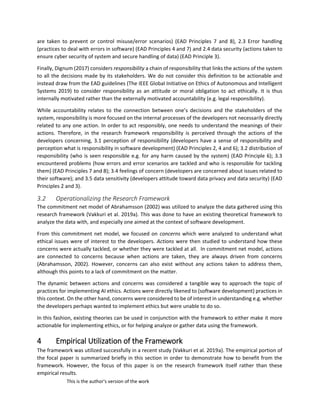
3 Research Model
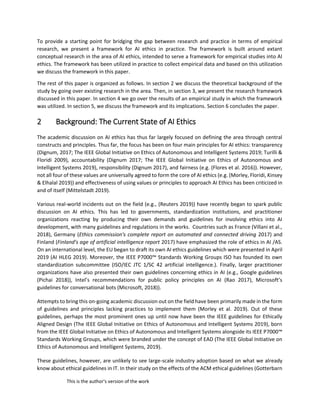
Figure 1 Research framework
Academic literature has discussed various principles as a way to address ethics as a part of the
development of AI and AI-based systems. Currently, four constructs are considered central ones in AI
ethics: Transparency (Dignum, 2017; The IEEE Global Initiative on Ethics of Autonomous and Intelligent
Systems., 2019; Turilli & Floridi, 2009), Accountability (Dignum, 2017; Turilli & Floridi, 2009), Responsibility
(Dignum, 2017), and Fairness e.g. (Flores et al., 2016). Perhaps notably, a recent EU report (High-Level
Expert Group on Artificial Intelligence, 2019) also discussed Trustworthiness as its key construct, a value
all systems should aim for, according to the report. Morley et al. (2019) presented an entirely new set of
more abstract constructs intended to summarize the existing discussion and the plethora of principles
discussed so far in addition to the ones mentioned here. They presented five constructs in the form of:
Beneficence, Non-maleficence, Autonomy, Justice, and Explicability.
To categorize the field of AI ethics three categories have been presented: (1) Ethics by Design (integrating
ethics into system behavior); (2) Ethics in Design (software development methods etc. supporting
implementation of ethics); and (3) Ethics for Design (standards etc. that ensure the integrity of developers
and users) (Dignum, 2018). In this model, we focus on the latter two categories.
Out of the aforementioned four principles that have been proposed to form the basis of ethical
development of AI systems, we consider accountability, responsibility, and transparency (the so-called
ART principles (Dignum (2017)) a starting point for understanding the involvement of ethics in ICT projects.
These three constructs form the basis of ethical AI and attempts to identify their possible relations, as well
as relations of other constructs that may be involved in the process.
5.
This is theauthor's version of the work
To make these principles tangible, a subset of constructs in the form of actions (Fig. 1 (1.1-3.5)), discussed
in detail in subsection 3.1, was formed under each key concept. These actions were outlined based on the
IEEE guidelines for EAD (The IEEE Global Initiative on Ethics of Autonomous and Intelligent Systems, 2019).
The actions were split into two categories, Ethics in Design and Ethics for Design(ers), based on Dignum’s
(2018) typology of AI ethics.
3.1 The ART Model
Transparency is a key ethical construct that is related to understanding AI systems. Dignum (2017)
discusses transparency as transparency of AI systems and specifically algorithms and data used. Arguably,
transparency is a pro-ethical circumstance that makes it possible to implement AI ethics in the first place
(Turilli and Floridi 2009). Without understanding how the system works, it is impossible to understand
why it malfunctioned and consequently to establish who is responsible. Additionally, both the EU AI Ethics
guidelines (AI HLEG 2019) and EAD guidelines (The IEEE Global Initiative on Ethics of Autonomous and
Intelligent Systems 2019) consider transparency an important ethical principle.
In the research framework presented in this paper, we consider transparency not only in relation to AI
systems but also in relation to AI systems development. I.e., we also consider it important that we
understand what decisions were made, by whom, and why during development. Different practices
support this type of transparency (e.g. audits and code documentation (Vakkuri, Kemell, & Abrahamsson
2019a)).
For the system to be considered transparent (line 1.a), feature traceability (1.1) (EAD Principle 5) should
be present, and the system should be predictable in its behavior (1.2) (EAD Principles 5 and 6). For
development to be considered transparent (line 1.c), the decision-making strategies of the endeavor
should be clear (1.4) (EAD Principles 5 and 6), and decisions should be traceable back to individual
developers (1.3) (EAD Principles 1, 5, and 6). As a pro-ethical circumstance, transparency also produces
the possibility to assess accountability and responsibility (line 1.b) in relation to both development and
the system.
Accountability refers to determining who is accountable or liable for the decisions made by the AI. Dignum
(2017) defines accountability to be the explanation and justification of one’s decisions and one’s actions
to the relevant stakeholders. In the context of this research framework, accountability is used not only in
the context of systems, but also in a more general sense. We consider, for example, how various
accountability issues (legal, social) were taken into consideration during the development.
As mentioned earlier, transparency is the pro-ethical condition here that makes accountability possible
(denoted by line 1.b). We must understand how the system works in order to establish accountability.
Similarly, we should be able to determine why it works that way by understanding what decisions made
during development led to the system working that way. We consider accountability in a broad sense,
thus including also legal and social concerns related to the system. Much like transparency, accountability
is also considered a key construct in AI ethics (The IEEE Global Initiative on Ethics of Autonomous and
Intelligent Systems 2019) and it holds an important role in preventing misuse of AI systems and supporting
wellbeing through AI systems.
In our research model, accountability is perceived through the concrete actions of the developers
concerning the systems itself, 2.1 Preparing for anything unexpected: (actions that are taken to prevent
or control unexpected situation) (EAD Principle 8), 2.2 Preparing for misuse/error scenarios (actions that
6.
This is theauthor's version of the work
are taken to prevent or control misuse/error scenarios) (EAD Principles 7 and 8), 2.3 Error handling
(practices to deal with errors in software) (EAD Principles 4 and 7) and 2.4 data security (actions taken to
ensure cyber security of system and secure handling of data) (EAD Principle 3).
Finally, Dignum (2017) considers responsibility a chain of responsibility that links the actions of the system
to all the decisions made by its stakeholders. We do not consider this definition to be actionable and
instead draw from the EAD guidelines (The IEEE Global Initiative on Ethics of Autonomous and Intelligent
Systems 2019) to consider responsibility as an attitude or moral obligation to act ethically. It is thus
internally motivated rather than the externally motivated accountability (e.g. legal responsibility).
While accountability relates to the connection between one’s decisions and the stakeholders of the
system, responsibility is more focused on the internal processes of the developers not necessarily directly
related to any one action. In order to act responsibly, one needs to understand the meanings of their
actions. Therefore, in the research framework responsibility is perceived through the actions of the
developers concerning, 3.1 perception of responsibility (developers have a sense of responsibility and
perception what is responsibility in software development) (EAD Principles 2, 4 and 6); 3.2 distribution of
responsibility (who is seen responsible e.g. for any harm caused by the system) (EAD Principle 6); 3.3
encountered problems (how errors and error scenarios are tackled and who is responsible for tackling
them) (EAD Principles 7 and 8); 3.4 feelings of concern (developers are concerned about issues related to
their software); and 3.5 data sensitivity (developers attitude toward data privacy and data security) (EAD
Principles 2 and 3).
3.2 Operationalizing the Research Framework
The commitment net model of Abrahamsson (2002) was utilized to analyze the data gathered using this
research framework (Vakkuri et al. 2019a). This was done to have an existing theoretical framework to
analyze the data with, and especially one aimed at the context of software development.
From this commitment net model, we focused on concerns which were analyzed to understand what
ethical issues were of interest to the developers. Actions were then studied to understand how these
concerns were actually tackled, or whether they were tackled at all. In commitment net model, actions
are connected to concerns because when actions are taken, they are always driven from concerns
(Abrahamsson, 2002). However, concerns can also exist without any actions taken to address them,
although this points to a lack of commitment on the matter.
The dynamic between actions and concerns was considered a tangible way to approach the topic of
practices for implementing AI ethics. Actions were directly likened to (software development) practices in
this context. On the other hand, concerns were considered to be of interest in understanding e.g. whether
the developers perhaps wanted to implement ethics but were unable to do so.
In this fashion, existing theories can be used in conjunction with the framework to either make it more
actionable for implementing ethics, or for helping analyze or gather data using the framework.
4 Empirical Utilization of the Framework
The framework was utilized successfully in a recent study (Vakkuri et al. 2019a). The empirical portion of
the focal paper is summarized briefly in this section in order to demonstrate how to benefit from the
framework. However, the focus of this paper is on the research framework itself rather than these
empirical results.
7.
This is theauthor's version of the work
4.1 Study Design
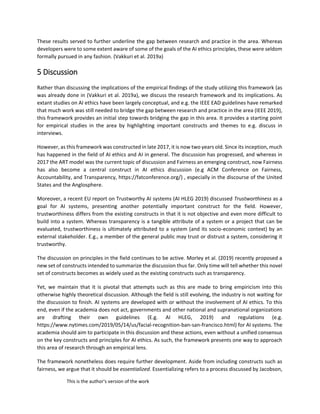
The research framework was utilized to carry out a multiple case study of three case companies. Each
company was a software company developing AI solutions for the healthcare industry. More specifically,
the case studies focused on one specific project inside each of the case companies.
Table 1. Case Information
Case Case Description Respondent[Reference]
Statistical tool for detecting
marginalization
Data analyst [R1]
A Consultant [R2]
Project coordinator [R3]
Voice and NLP based tool for diagnostics
Developer [R4]
B Developer [R5]
Project manager [R6]
NLP based tool for indoor navigation
Developer [R7]
C Developer [R8]
Data from the cases were gathered using semi-structured interviews, for which the strategy was prepared
according to the guidelines of Galletta (2013). The research framework, described in the preceding section,
was utilized to construct the research instrument with which the data was collected. The questions
prepared for the semi-structured interviews focused on the components of the framework. The interviews
were recorded and the transcripts were analyzed for the empirical study. The transcripts were analyzed
using a grounded theory (Strauss and Corbin 1998 and later Heath 2004) inspired approach. Each
transcript was first analyzed separately, after which the results of the analysis were compared across cases
to find similarities. (Vakkuri et al. 2019a)
4.2 Empirical Results
The findings of the empirical study conducted using this framework were summarized into four Primary
Empirical Conclusions (PECs). The PECs were communicated as follows:
● PEC1 Responsibility of developers and development is under-discussed
● PEC2 Developers recognize transparency as a goal, but it is not formally pursued
● PEC3 Developers feel accountable for error handling on programming level and have the means
to deal with it
● PEC4 While the developers speculate potential socioethical impacts of the resulting system, they
do not have means to address them.
8.
This is theauthor's version of the work
These results served to further underline the gap between research and practice in the area. Whereas
developers were to some extent aware of some of the goals of the AI ethics principles, these were seldom
formally pursued in any fashion. (Vakkuri et al. 2019a)
5 Discussion
Rather than discussing the implications of the empirical findings of the study utilizing this framework (as
was already done in (Vakkuri et al. 2019a), we discuss the research framework and its implications. As
extant studies on AI ethics have been largely conceptual, and e.g. the IEEE EAD guidelines have remarked
that much work was still needed to bridge the gap between research and practice in the area (IEEE 2019),
this framework provides an initial step towards bridging the gap in this area. It provides a starting point
for empirical studies in the area by highlighting important constructs and themes to e.g. discuss in
interviews.
However, as this framework was constructed in late 2017, it is now two years old. Since its inception, much
has happened in the field of AI ethics and AI in general. The discussion has progressed, and whereas in
2017 the ART model was the current topic of discussion and Fairness an emerging construct, now Fairness
has also become a central construct in AI ethics discussion (e.g ACM Conference on Fairness,
Accountability, and Transparency, https://fatconference.org/) , especially in the discourse of the United
States and the Anglosphere.
Moreover, a recent EU report on Trustworthy AI systems (AI HLEG 2019) discussed Trustworthiness as a
goal for AI systems, presenting another potentially important construct for the field. However,
trustworthiness differs from the existing constructs in that it is not objective and even more difficult to
build into a system. Whereas transparency is a tangible attribute of a system or a project that can be
evaluated, trustworthiness is ultimately attributed to a system (and its socio-economic context) by an
external stakeholder. E.g., a member of the general public may trust or distrust a system, considering it
trustworthy.
The discussion on principles in the field continues to be active. Morley et al. (2019) recently proposed a
new set of constructs intended to summarize the discussion thus far. Only time will tell whether this novel
set of constructs becomes as widely used as the existing constructs such as transparency.
Yet, we maintain that it is pivotal that attempts such as this are made to bring empiricism into this
otherwise highly theoretical discussion. Although the field is still evolving, the industry is not waiting for
the discussion to finish. AI systems are developed with or without the involvement of AI ethics. To this
end, even if the academia does not act, governments and other national and supranational organizations
are drafting their own guidelines (E.g. AI HLEG, 2019) and regulations (e.g.
https://www.nytimes.com/2019/05/14/us/facial-recognition-ban-san-francisco.html) for AI systems. The
academia should aim to participate in this discussion and these actions, even without a unified consensus
on the key constructs and principles for AI ethics. As such, the framework presents one way to approach
this area of research through an empirical lens.
The framework nonetheless does require further development. Aside from including constructs such as
fairness, we argue that it should be essentialized. Essentializing refers to a process discussed by Jacobson,
9.
This is theauthor's version of the work
Lawson, Ng, McMahon & Goedicke (2017) in the context of the Essence Theory of Software Engineering
(Jacobson, Ng, McMahon, Spence & Lidman 2012) where a Software Engineering (SE) practice is
essentialized. Essentialization, according to Jacobson et al. (2017), refers to the process of distilling e.g. a
software engineering practice into its essential components in order to communicate it clearly and in a
unified fashion, while communicating it in the Essence language.
In the context of this framework, we see essentialization as one way to make it more understandable for
industry experts. Essentializing a practice, or method, or a framework has three steps, according to
Jacobson et al. (2017):
1. Identifying the elements - this is primarily identifying a list of elements that make up a practice.
The output is essentially a diagram.
2. Drafting the relationships between the elements and the outline of each element - at this point,
the cards are created.
3. Providing further details - Usually, the cards will be supplemented with additional gui-delines, hints
and tips, examples, and references to other resources, such as articles and books
In this fashion, the framework could be essentialized by e.g. making Essence alphas out of the principles
such as transparency. Alphas, in the context of Essence, are things to work with which are measured in
order to see progress on the endeavor (Jacobson et al. 2012). One could thus consider them goals. The
framework could then be extended by practices which seek to help an organization progress in achieving
these ethical principles.
As it stands, the framework can be utilized for empirical studies in the area of AI ethics. It presents a
practice-focused view of AI ethics. However, it does not cover all the aspects of the AI ethics discussion in
2019 (and beyond). Depending on the context, one may wish to extend it to include fairness as the fourth
key principle for AI ethics, and/or trustworthiness.
6 Conclusions & Future work
In this paper, we have presented a framework for approaching AI ethics through practice. Having
conducted an empirical study using the framework (Vakkuri et al. 2019a), we discussed the implications
of the framework and how it should be developed further in this paper. Though the framework, as is, can
be utilized for empirical studies, it should be complemented by the inclusion of some of the more recent
AI ethics constructs such as fairness and trustworthiness to make it more current. Given that the
framework was originally devised in late 2017, the discussion in the field of AI ethics has since then gone
forward.
We seek to develop the framework further ourselves. We have utilized a similar framework in another
study (Vakkuri et al. 2019b). Aside from simply expanding the framework to include fairness and
trustworthiness, we have plans to essentialize the framework by utilizing the Essence Theory of Software
Engineering (Jacobson et al. 2012, Jacobson et al. 2017) in order to make it more relevant to practitioners.
10.
This is theauthor's version of the work
References
Abrahamsson, P. (2002). Commitment nets in software process improvement. Annals of Software
Engineering, 14(1), 407-438. doi:1020526329708
AI HLEG (High-Level Expert Group on Artificial Intelligence). (2019). Ethics guidelines for trustworthy AI.
Retrieved from https://ec.europa.eu/digital-single-market/en/news/ethics-guidelines-
trustworthy-ai
Reuters (2019). Amazon scraps secret AI recruiting tool that showed bias against women. Reuters
Retrieved from https://www.reuters.com/article/us-amazon-com-jobs-automation-
insight/amazon-scraps-secret-ai-recruiting-tool-that-showed-bias-against-women-
idUSKCN1MK08G
Ananny, M., & Crawford, K. (2018). Seeing without knowing: Limitations of the transparency ideal and its
application to algorithmic accountability. New Media & Society, 20(3), 973-989.
doi:10.1177/1461444816676645
Bryson, J. (2017). Standardizing ethical design for artificial intelligence and autonomous systems.
Computer, 50(5), 116-119.
Charisi, V., Dennis, L., Lieck, M. F. R., Matthias, A., Sombetzki, M. S. J., Winfield, A. F., & Yampolskiy, R.
(2017). Towards moral autonomous systems.https://arxiv.org/abs/1703.04741
Dignum, V. (2017). Responsible autonomy. https://arxiv.org/abs/1706.02513
Dignum, V. (2018). Ethics in artificial intelligence: Introduction to the special issue. Ethics and
Information Technology, 20(1), 1-3. doi:10.1007/s10676-018-9450-z"
Ethics commission's complete report on automated and connected driving. (2017) .BMVI. Retrieved from
https://www.bmvi.de/goto?id=354980
Finland’s age of artificial intelligence report. (2017). Retrieved from
https://www.tekoalyaika.fi/en/reports/finlands-age-of-artificial-intelligence/
Fitzgerald, B., Hartnett, G., & Conboy, K. (2006). Customizing agile methods to software practices at intel
shannon. European Journal of Information Systems, 15(2), 200-213.
doi:10.1057/palgrave.ejis.3000605
Flores, A. W., Bechtel, K., & Lowenkamp, C. T. (2016). False positives, false negatives, and false analyses:
A rejoinder to "machine bias: There's software used across the country to predict future criminals,
and it's biased against blacks". Federal Probation, 80(2), 38.
Galletta, A. (2013). Mastering the semi-structured interview and beyond. New York: NYU Press.
Retrieved from https://www.jstor.org/stable/j.ctt9qgh5x
Gotel, O., Cleland-Huang, J., Hayes, J. H., Zisman, A., Egyed, A., Grunbacher, P., Mäder, P. (2012).
Traceability fundamentals. Software and systems traceability (pp. 3-22) Springer.
Gotterbarn, D. W., Brinkman, B., Flick, C., Kirkpatrick, M. S., Miller, K., Vazansky, K. & Wolf, M. J. (2018).
ACM code of ethics and professional conduct. Retrieved from https://www.acm.org/code-of-
ethics
Heath, H. (2004). Developing a grounded theory approach: A comparison of glaser and strauss.
International Journal of Nursing Studies, 41(2), 141-150.
ISO/IEC JTC 1/SC 42 artificial intelligence. Retrieved from https://www.iso.org/committee/6794475.html
Jacobson, I., Ng, P., McMahon, P. E., Spence, I., and Lidman, S. (2012). The Essence of Software
Engineering: The SEMAT Kernel. ACM Queue, 10(10).
Jacobson, I., Lawson, H., Ng, P., McMahon, P. E., and Goedicke, M. (2017). Software Engineering
Essentialized. Pre-print book draft. Retrieved from
http://semat.org/documents/400812/405173/Part1-2017-12-17_draft_3.pdf/
McNamara, A., Smith, J., & Murphy-Hill, E. Does ACM's code of ethics change ethical decision making in
software development? Paper presented at the 26th ACM Joint Meeting on European Software
11.
This is theauthor's version of the work
Engineering Conference and Symposium on the Foundations of Software Engineering ESEC/FSE.
doi:10.1145/3236024.3264833
Microsoft (2018). Responsible bots: 10 guidelines for developers of conversational AI. Retrieved from
https://www.microsoft.com/en-
us/research/uploads/prod/2018/11/Bot_Guidelines_Nov_2018.pdf
Morley, J., Floridi, L., Kinsey, L., & Elhalal, A. (2019). From what to how. an overview of AI ethics tools,
methods and research to translate principles into practices. https://arxiv.org/abs/1905.06876
Pichai, S. (2018). AI at google: Our principles. Retrieved from https://www.blog.google/technology/ai/ai-
principles/
Rao, N. (2017). Intel recommendations for public policy principles on AI. Retrieved from
https://blogs.intel.com/policy/2017/10/18/naveen-rao-announces-intel-ai-public-
policy/#gs.8qnx16
Strauss, A., & Corbin, J. (1998). Basics of qualitative research: Techniques and procedures for developing
grounded theory, 2nd ed. Thousand Oaks, CA, US: Sage Publications, Inc.
The IEEE Global Initiative on Ethics of Autonomous and Intelligent Systems. (2019). Ethically aligned
design: A vision for prioritizing human well-being with autonomous and intelligent systems, first
edition. . Retrieved from https://standards.ieee.org/content/ieee-standards/en/industry-
connections/ec/autonomous-systems.html
Turilli, M., & Floridi, L. (2009). The ethics of information transparency. Ethics and Information
Technology, 11(2), 105-112. doi:10.1007/s10676-009-9187-9
Unterkalmsteiner, M., Gorschek, T., Islam, A. K. M. M, Chow Kian Cheng, Permadi, R. B., & Feldt, R.
(2011). Evaluation and measurement of software process improvement-A systematic literature
review. IEEE Transactions on Software Engineering, 38(2), 398-424. doi:10.1109/TSE.2011.26
Vakkuri, V., Kemell, KK. & Abrahamsson, P. (2019a). Implementing Ethics in AI: Initial results of an
industrial multiple case study. To be published in the proceedings of the 20th International
Conference on Product-Focused Software Process Improvement (PROFES2019).
https://arxiv.org/abs/1906.12307
Vakkuri, V., Kemell, KK., Kultanen, J., Siponen, M., & Abrahamsson, P. (2019b). Ethically Aligned Design of
Autonomous Systems: Industry viewpoint and an empirical study. To be published in the
proceedings of the 8th Transport Research Arena (TRA2020) Conference.
https://arxiv.org/abs/1906.07946
Villani, C., Bonnet, Y., schoenauer, m., berthet, c., levin, f., cornut, a. c., . Rondepierre, B. (2018). For a
meaningful artificial intelligence: Towards a french and european strategy Conseil national du
numérique. Retrieved from https://www.aiforhumanity.fr/pdfs/MissionVillani_Report_ENG-
VF.pdf

![This is the author's version of the work
AI Ethics in Industry: A Research Framework
Ville Vakkuri[0000-0002-1550-1110], Kai-Kristian Kemell[0000-0002-0225-4560] and Pekka
Abrahamsson [0000-0002-4360-2226]
University of Jyväskylä, PO Box 35, FI-40014 Jyväskylä, Finland
ville.vakkuri|kai-kristian.o.kemell|pekka.abrahamsson@jyu.fi
Abstract. Artificial Intelligence (AI) systems exert a growing influence on our society. As they become more
ubiquitous, their potential negative impacts also become evident through various real-world incidents.
Following such early incidents, academic and public discussion on AI ethics has highlighted the need for
implementing ethics in AI system development. However, little currently exists in the way of frameworks
for understanding the practical implementation of AI ethics. In this paper, we discuss a research
framework for implementing AI ethics in industrial settings. The framework presents a starting point for
empirical studies into AI ethics but is still being developed further based on its practical utilization.
Keywords: Artificial intelligence, AI ethics, AI development, Responsibility, Accountability, Transparency,
Research framework.
1 Introduction
Artificial Intelligence (AI) and Autonomous Systems (AS) have become increasingly prevalent in software
development endeavors, changing the role of ethics in software development. One key difference
between conventional software systems and AI systems is that the idea of active users in the context of
AI systems can be questioned. More often than not, individuals are simply objects for AI systems that they
either perform actions upon or use for data collection purposes. On the other hand, users of AI systems
are usually organizations as opposed to individuals. This is problematic in terms of consent, not least
because one may not even be aware of being used for data collection purposes by an AI.
To this end, existing studies have argued that developing AI/AS is a multi-disciplinary endeavor rather than
a simple software engineering one (Charisi et al. 2017). Developers of these systems should be aware of
the ethical issues involved in these systems in order to be able to mitigate their potential negative impacts.
While discussion on AI ethics among the academia has been active in the recent years, various public
voices have also expressed concern over AI/AS following recent real-world incidents (e.g. in relation to
unfair systems (Flores, Bechtel & Lowenkamp 2016)).
However, despite the increasing activity in the area of AI ethics, there is currently a gap between research
and practice. Few empirical studies on the topic exist, and the state of practice remains largely unknown.
The IEEE Ethically Aligned Design guidelines have suggested that they have not been widely adopted by
practitioners. Additionally, in a past study, we have presented preliminary results supporting the notion
of a gap in the area (Vakkuri, Kemell, Kultanen, Siponen, & Abrahamsson 2019b). Other past studies have
shown that developers are not well-informed on ethics in general (McNamara, Smith & Murphy-Hill 2018).
This gap points towards a need for tooling and methods in the area, as well as a need for further empirical
studies on the topic.](https://image.slidesharecdn.com/artmodel-250304041601-c2d0e188/85/AI-ethics-model-framework-with-accountability-2-320.jpg)
![This is the author's version of the work
4.1 Study Design
The research framework was utilized to carry out a multiple case study of three case companies. Each
company was a software company developing AI solutions for the healthcare industry. More specifically,
the case studies focused on one specific project inside each of the case companies.
Table 1. Case Information
Case Case Description Respondent[Reference]
Statistical tool for detecting
marginalization
Data analyst [R1]
A Consultant [R2]
Project coordinator [R3]
Voice and NLP based tool for diagnostics
Developer [R4]
B Developer [R5]
Project manager [R6]
NLP based tool for indoor navigation
Developer [R7]
C Developer [R8]
Data from the cases were gathered using semi-structured interviews, for which the strategy was prepared
according to the guidelines of Galletta (2013). The research framework, described in the preceding section,
was utilized to construct the research instrument with which the data was collected. The questions
prepared for the semi-structured interviews focused on the components of the framework. The interviews
were recorded and the transcripts were analyzed for the empirical study. The transcripts were analyzed
using a grounded theory (Strauss and Corbin 1998 and later Heath 2004) inspired approach. Each
transcript was first analyzed separately, after which the results of the analysis were compared across cases
to find similarities. (Vakkuri et al. 2019a)
4.2 Empirical Results
The findings of the empirical study conducted using this framework were summarized into four Primary
Empirical Conclusions (PECs). The PECs were communicated as follows:
● PEC1 Responsibility of developers and development is under-discussed
● PEC2 Developers recognize transparency as a goal, but it is not formally pursued
● PEC3 Developers feel accountable for error handling on programming level and have the means
to deal with it
● PEC4 While the developers speculate potential socioethical impacts of the resulting system, they
do not have means to address them.](https://image.slidesharecdn.com/artmodel-250304041601-c2d0e188/85/AI-ethics-model-framework-with-accountability-7-320.jpg)


![[DSC Adria 23] Muthu Ramachandran AI Ethics Framework for Generative AI such ...](https://cdn.slidesharecdn.com/ss_thumbnails/muthuramachandranaiethicsframeworkforgenerativeaisuchaschatgptdscmay2023-230530191644-0a1125e3-thumbnail.jpg?width=640&height=640&fit=bounds)


