Recognizing the Principles in an Appreciative
Conversation
December 2022
Ganesh Ramakrishnan (RG)
http://twitter.com/r_ganesh
P
A Deeper Dive into AI Principles
• Spot check
• Recap of AI Basics
• 5 Principles
• Conversations: Sample plus Practice
• Spot recheck
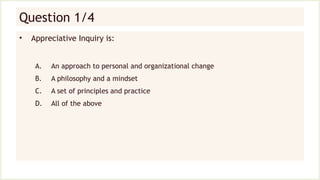
Question 1/4
• Appreciative Inquiry is:
A. An approach to personal and organizational change
B. A philosophy and a mindset
C. A set of principles and practice
D. All of the above
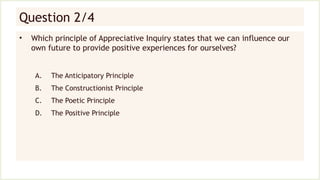
Question 2/4
• Which principle of Appreciative Inquiry states that we can influence our
own future to provide positive experiences for ourselves?
A. The Anticipatory Principle
B. The Constructionist Principle
C. The Poetic Principle
D. The Positive Principle
Question 3/4
• Which principle of Appreciative Inquiry is in line with placebo effect and
Pygmalion effect?
A. The Anticipatory Principle
B. The Constructionist Principle
C. The Poetic Principle
D. The Positive Principle
Question 4/4
• Which principle of Appreciative Inquiry reminds us that we can choose
what we study?
A. The Anticipatory Principle
B. The Constructionist Principle
C. The Poetic Principle
D. The Positive Principle
Recap of Concept
• Appreciative Inquiry is:
– an approach to personal change and organizational change
– both a philosophy and a set of principles and practices
– the study and exploration of what gives life to human systems when they
function at their best
– based on the assumption that questions and dialogue about strengths,
successes, values, hopes, and dreams are themselves transformational
– not about looking at the world with rose-colored glasses and being overly
positive, but instead, focuses on how the future can be built on the best parts
of the past
Core assumptions of AI
1. In every society, organization, or group, something works.
2. What we focus on becomes our reality.
3. Reality is created in the moment, and there are multiple realities.
4. The act of asking questions of an organization or group influences the group in
some way.
5. People have more confidence and comfort to journey to the future (the unknown)
when they carry forward parts of the past (the known).
6. If we carry parts of the past forward, they should be only the best parts.
7. It is important to value differences.
8. The language we use creates our reality.
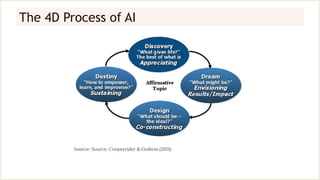
The 4D Process of AI
Benefits of AI
• Reframes the study of problems into the study of successes
• Offers new language that allows greater honesty about difficult topics
• Unleashes creativity through whole-systems, participatory, and energizing
processes
• Creates opportunities for developing new relationships, networks, and
communities of practice
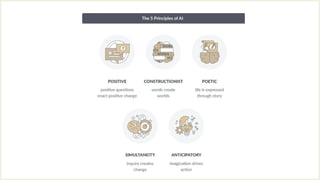
Could We List the 5 AI Principles?
1.
2.
3.
4.
5.
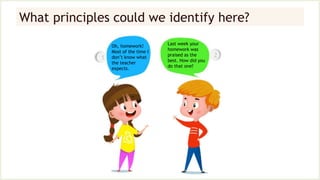
What principles could we identify here?
Oh, homework!
Most of the time I
don’t know what
the teacher
expects.
Last week your
homework was
praised as the
best. How did you
do that one?
1 2
As expected, our rollout of the new system has
led to groans and jibes, and just a few positive
feedback comments.
Hmmm… this gives me a few ideas for
broadcasting, and even earn brownie points
with the boss!
Do you share the feedback
with colleagues and the rest
of the organization?
1
2
3
Question 1/4
• Appreciative Inquiry is:
A. An approach to personal and organizational change
B. A philosophy and a mindset
C. A set of principles and practice
D. All of the above
• Answer: D. All of the above
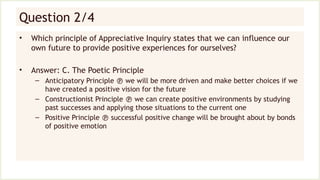
Question 2/4
• Which principle of Appreciative Inquiry states that we can influence our
own future to provide positive experiences for ourselves?
• Answer: C. The Poetic Principle
– Anticipatory Principle  we will be more driven and make better choices if we
have created a positive vision for the future
– Constructionist Principle  we can create positive environments by studying
past successes and applying those situations to the current one
– Positive Principle  successful positive change will be brought about by bonds
of positive emotion
Question 3/4
• Which principle of Appreciative Inquiry is in line with placebo effect and
Pygmalion effect?
• Answer: A. The Anticipatory Principle
– Poetic Principle  we can influence our own future to provide positive exercise
experiences for ourselves
– Constructionist Principle  we can create positive environments by studying
past successes and applying those situations to the current one
– Positive Principle  successful positive change will be brought about by bonds
of positive emotion
Question 4/4
• Which principle of Appreciative Inquiry reminds us that we can choose
what we study?
• Answer: C. The Poetic Principle
– Anticipatory Principle  we will be more driven and make better choices if we
have created a positive vision for the future
– Constructionist Principle  we can create positive environments by studying
past successes and applying those situations to the current one
– Positive Principle  successful positive change will be brought about by bonds
of positive emotion
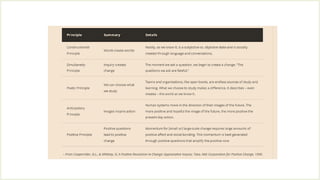
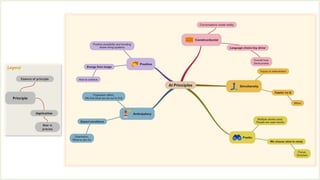
Legend
Principle
Essence of principle
Implication
Role in
process
Remember, you don’t fear people whose story you know. Real
listening always brings people closer together.
Trust that meaningful conversations can change your world.
-Margaret Wheatley, “Turning to One Another,” 2002
thank you
To explore further:
https://positivitystrategist.org/appreciative-inquiry/
https://positivepsychology.com/appreciative-inquiry-process/

AI (Appreciative Inquiry) Principles - An Overview

  • 1.
    Recognizing the Principlesin an Appreciative Conversation December 2022 Ganesh Ramakrishnan (RG) http://twitter.com/r_ganesh P
  • 2.
    A Deeper Diveinto AI Principles • Spot check • Recap of AI Basics • 5 Principles • Conversations: Sample plus Practice • Spot recheck
  • 3.
    Question 1/4 • AppreciativeInquiry is: A. An approach to personal and organizational change B. A philosophy and a mindset C. A set of principles and practice D. All of the above
  • 4.
    Question 2/4 • Whichprinciple of Appreciative Inquiry states that we can influence our own future to provide positive experiences for ourselves? A. The Anticipatory Principle B. The Constructionist Principle C. The Poetic Principle D. The Positive Principle
  • 5.
    Question 3/4 • Whichprinciple of Appreciative Inquiry is in line with placebo effect and Pygmalion effect? A. The Anticipatory Principle B. The Constructionist Principle C. The Poetic Principle D. The Positive Principle
  • 6.
    Question 4/4 • Whichprinciple of Appreciative Inquiry reminds us that we can choose what we study? A. The Anticipatory Principle B. The Constructionist Principle C. The Poetic Principle D. The Positive Principle
  • 7.
    Recap of Concept •Appreciative Inquiry is: – an approach to personal change and organizational change – both a philosophy and a set of principles and practices – the study and exploration of what gives life to human systems when they function at their best – based on the assumption that questions and dialogue about strengths, successes, values, hopes, and dreams are themselves transformational – not about looking at the world with rose-colored glasses and being overly positive, but instead, focuses on how the future can be built on the best parts of the past
  • 8.
    Core assumptions ofAI 1. In every society, organization, or group, something works. 2. What we focus on becomes our reality. 3. Reality is created in the moment, and there are multiple realities. 4. The act of asking questions of an organization or group influences the group in some way. 5. People have more confidence and comfort to journey to the future (the unknown) when they carry forward parts of the past (the known). 6. If we carry parts of the past forward, they should be only the best parts. 7. It is important to value differences. 8. The language we use creates our reality.
  • 9.
  • 10.
    Benefits of AI •Reframes the study of problems into the study of successes • Offers new language that allows greater honesty about difficult topics • Unleashes creativity through whole-systems, participatory, and energizing processes • Creates opportunities for developing new relationships, networks, and communities of practice
  • 11.
    Could We Listthe 5 AI Principles? 1. 2. 3. 4. 5.
  • 14.
    What principles couldwe identify here? Oh, homework! Most of the time I don’t know what the teacher expects. Last week your homework was praised as the best. How did you do that one? 1 2
  • 15.
    As expected, ourrollout of the new system has led to groans and jibes, and just a few positive feedback comments. Hmmm… this gives me a few ideas for broadcasting, and even earn brownie points with the boss! Do you share the feedback with colleagues and the rest of the organization? 1 2 3
  • 16.
    Question 1/4 • AppreciativeInquiry is: A. An approach to personal and organizational change B. A philosophy and a mindset C. A set of principles and practice D. All of the above • Answer: D. All of the above
  • 17.
    Question 2/4 • Whichprinciple of Appreciative Inquiry states that we can influence our own future to provide positive experiences for ourselves? • Answer: C. The Poetic Principle – Anticipatory Principle  we will be more driven and make better choices if we have created a positive vision for the future – Constructionist Principle  we can create positive environments by studying past successes and applying those situations to the current one – Positive Principle  successful positive change will be brought about by bonds of positive emotion
  • 18.
    Question 3/4 • Whichprinciple of Appreciative Inquiry is in line with placebo effect and Pygmalion effect? • Answer: A. The Anticipatory Principle – Poetic Principle  we can influence our own future to provide positive exercise experiences for ourselves – Constructionist Principle  we can create positive environments by studying past successes and applying those situations to the current one – Positive Principle  successful positive change will be brought about by bonds of positive emotion
  • 19.
    Question 4/4 • Whichprinciple of Appreciative Inquiry reminds us that we can choose what we study? • Answer: C. The Poetic Principle – Anticipatory Principle  we will be more driven and make better choices if we have created a positive vision for the future – Constructionist Principle  we can create positive environments by studying past successes and applying those situations to the current one – Positive Principle  successful positive change will be brought about by bonds of positive emotion
  • 20.
  • 21.
    Remember, you don’tfear people whose story you know. Real listening always brings people closer together. Trust that meaningful conversations can change your world. -Margaret Wheatley, “Turning to One Another,” 2002 thank you To explore further: https://positivitystrategist.org/appreciative-inquiry/ https://positivepsychology.com/appreciative-inquiry-process/

Editor's Notes

  • #3 https://practicequiz.com/q/which-principle-of-appreciative-inquiry-states-t
  • #4 https://practicequiz.com/q/which-principle-of-appreciative-inquiry-states-t
  • #5 https://practicequiz.com/q/which-principle-of-appreciative-inquiry-states-t
  • #6 https://practicequiz.com/q/which-principle-of-appreciative-inquiry-states-t
  • #7 From the guide largely developed by Hallie Preskill and Arani Grindle in 2015
  • #8 Hammond, S. A. (2013). The thin book of appreciative inquiry. 3rd. Ed. Thin Book Publishing. Pp. 20–21
  • #16 https://practicequiz.com/q/which-principle-of-appreciative-inquiry-states-t
  • #17 https://practicequiz.com/q/which-principle-of-appreciative-inquiry-states-t
  • #18 https://practicequiz.com/q/which-principle-of-appreciative-inquiry-states-t
  • #19 https://practicequiz.com/q/which-principle-of-appreciative-inquiry-states-t