Cloud Computing Or  “ How I learned to love XaaS where X= any function as a service.” John Ahearn
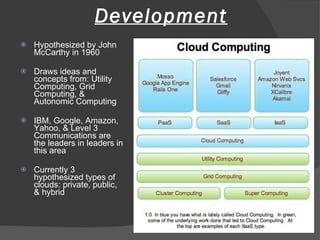
Development Hypothesized by John McCarthy in 1960 Draws ideas and concepts from: Utility Computing, Grid Computing, & Autonomic Computing IBM, Google, Amazon, Yahoo, & Level 3 Communications are the leaders in leaders in this area Currently 3 hypothesized types of clouds: private, public, & hybrid
 
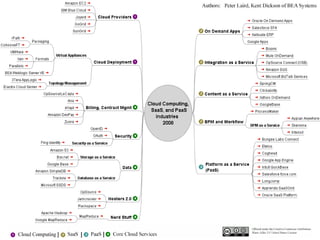
Characteristics/Components Single point of access for all computing needs Supported by large data centers Virtualization of information systems and technologies Open Standards Internet connectivity Service level agreements by commercial organizations No physical infrastructure owned by the end user Functions of cloud computing Software as a Service (SaaS) Platform as a Service (PaaS) Infrastructure as a Service (IaaS)
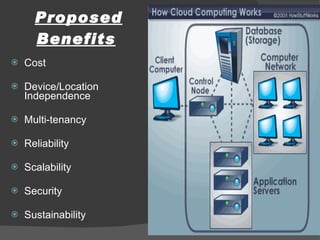
Proposed Benefits Cost Device/Location Independence Multi-tenancy Reliability Scalability Security Sustainability
Concerns Consumer Privacy National/International Regulation Security Support Long term viability
Benefits   Analysis Cost Lower infrastructure startup and personnel costs thru the outsourcing of IT functions and leveraging of virtualization technologies  Lower overhead and maintenance costs thru the simplification of hardware components Device/Location Independence Access of files and information from anywhere and on any platform Multi-tenancy Sharing of costs among large pool of users Resource upgrade managed by a central pool of professionals dedicated to servicing the technology Reliability Business continuity and disaster recovery is easier as the cloud architecture utilizes several layers of servers to offer the virtualization technologies and database access Eliminates data redundancy and error Scalability Cloud architecture provides the computing resources needed to run applications as it is needed.  Allows untapped resources to be utilized for other applications as needed Security Centralization of data results in the focus of security resources Sustainability Better resource utilization leverage by “common” picture of network demands, work loads, and end user requirements
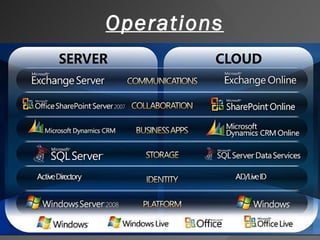
Operations
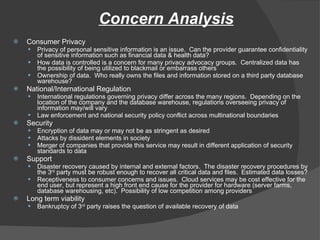
Concern Analysis Consumer Privacy Privacy of personal sensitive information is an issue.  Can the provider guarantee confidentiality of sensitive information such as financial data & health data? How data is controlled is a concern for many privacy advocacy groups.  Centralized data has the possibility of being utilized to blackmail or embarrass others  Ownership of data.  Who really owns the files and information stored on a third party database warehouse? National/International Regulation International regulations governing privacy differ across the many regions.  Depending on the location of the company and the database warehouse, regulations overseeing privacy of information may/will vary Law enforcement and national security policy conflict across multinational boundaries  Security Encryption of data may or may not be as stringent as desired Attacks by dissident elements in society Merger of companies that provide this service may result in different application of security standards to data Support Disaster recovery caused by internal and external factors.  The disaster recovery procedures by the 3 rd  party must be robust enough to recover all critical data and files.  Estimated data losses? Receptiveness to consumer concerns and issues.  Cloud services may be cost effective for the end user, but represent a high front end cause for the provider for hardware (server farms, database warehousing, etc).  Possibility of low competition among providers Long term viability Bankruptcy of 3 rd  party raises the question of available recovery of data
 
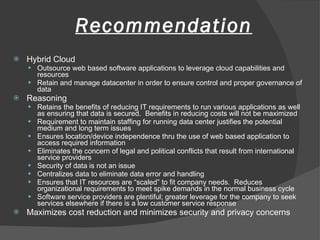
Recommendation Hybrid Cloud Outsource web based software applications to leverage cloud capabilities and resources Retain and manage datacenter in order to ensure control and proper governance of data Reasoning Retains the benefits of reducing IT requirements to run various applications as well as ensuring that data is secured.  Benefits in reducing costs will not be maximized Requirement to maintain staffing for running data center justifies the potential medium and long term issues Ensures location/device independence thru the use of web based application to access required information Eliminates the concern of legal and political conflicts that result from international service providers Security of data is not an issue Centralizes data to eliminate data error and handling Ensures that IT resources are “scaled” to fit company needs.  Reduces organizational requirements to meet spike demands in the normal business cycle Software service providers are plentiful; greater leverage for the company to seek services elsewhere if there is a low customer service response Maximizes cost reduction and minimizes security and privacy concerns
Questions?

Ahearn Cloud Presentation

  • 1.
    Cloud Computing Or “ How I learned to love XaaS where X= any function as a service.” John Ahearn
  • 2.
    Development Hypothesized byJohn McCarthy in 1960 Draws ideas and concepts from: Utility Computing, Grid Computing, & Autonomic Computing IBM, Google, Amazon, Yahoo, & Level 3 Communications are the leaders in leaders in this area Currently 3 hypothesized types of clouds: private, public, & hybrid
  • 3.
  • 4.
    Characteristics/Components Single pointof access for all computing needs Supported by large data centers Virtualization of information systems and technologies Open Standards Internet connectivity Service level agreements by commercial organizations No physical infrastructure owned by the end user Functions of cloud computing Software as a Service (SaaS) Platform as a Service (PaaS) Infrastructure as a Service (IaaS)
  • 5.
    Proposed Benefits CostDevice/Location Independence Multi-tenancy Reliability Scalability Security Sustainability
  • 6.
    Concerns Consumer PrivacyNational/International Regulation Security Support Long term viability
  • 7.
    Benefits Analysis Cost Lower infrastructure startup and personnel costs thru the outsourcing of IT functions and leveraging of virtualization technologies Lower overhead and maintenance costs thru the simplification of hardware components Device/Location Independence Access of files and information from anywhere and on any platform Multi-tenancy Sharing of costs among large pool of users Resource upgrade managed by a central pool of professionals dedicated to servicing the technology Reliability Business continuity and disaster recovery is easier as the cloud architecture utilizes several layers of servers to offer the virtualization technologies and database access Eliminates data redundancy and error Scalability Cloud architecture provides the computing resources needed to run applications as it is needed. Allows untapped resources to be utilized for other applications as needed Security Centralization of data results in the focus of security resources Sustainability Better resource utilization leverage by “common” picture of network demands, work loads, and end user requirements
  • 8.
  • 9.
    Concern Analysis ConsumerPrivacy Privacy of personal sensitive information is an issue. Can the provider guarantee confidentiality of sensitive information such as financial data & health data? How data is controlled is a concern for many privacy advocacy groups. Centralized data has the possibility of being utilized to blackmail or embarrass others Ownership of data. Who really owns the files and information stored on a third party database warehouse? National/International Regulation International regulations governing privacy differ across the many regions. Depending on the location of the company and the database warehouse, regulations overseeing privacy of information may/will vary Law enforcement and national security policy conflict across multinational boundaries Security Encryption of data may or may not be as stringent as desired Attacks by dissident elements in society Merger of companies that provide this service may result in different application of security standards to data Support Disaster recovery caused by internal and external factors. The disaster recovery procedures by the 3 rd party must be robust enough to recover all critical data and files. Estimated data losses? Receptiveness to consumer concerns and issues. Cloud services may be cost effective for the end user, but represent a high front end cause for the provider for hardware (server farms, database warehousing, etc). Possibility of low competition among providers Long term viability Bankruptcy of 3 rd party raises the question of available recovery of data
  • 10.
  • 11.
    Recommendation Hybrid CloudOutsource web based software applications to leverage cloud capabilities and resources Retain and manage datacenter in order to ensure control and proper governance of data Reasoning Retains the benefits of reducing IT requirements to run various applications as well as ensuring that data is secured. Benefits in reducing costs will not be maximized Requirement to maintain staffing for running data center justifies the potential medium and long term issues Ensures location/device independence thru the use of web based application to access required information Eliminates the concern of legal and political conflicts that result from international service providers Security of data is not an issue Centralizes data to eliminate data error and handling Ensures that IT resources are “scaled” to fit company needs. Reduces organizational requirements to meet spike demands in the normal business cycle Software service providers are plentiful; greater leverage for the company to seek services elsewhere if there is a low customer service response Maximizes cost reduction and minimizes security and privacy concerns
  • 12.