OECD-FAO AGRICULTURAL
OUTLOOK 2015-2024
July 2015AGRO-BUZZ
A Summary
Agricultural Outlook 2015-2024
INTRODUCTION
In agriculture, the global economy witnessed diverse trends in the last decade.
While there have been years of tight supply & spiraling commodity prices, there
have also been years with a strong harvest coupled with a steep decline in output
prices.
This report summarizes the trends in agri-commodity market, in context of
developed & emerging markets and their outlook for the next decade.
ASSUMPTIONS
a. Global economy growth rate is assumed at 3%.
b. World population growth rate at 1% p.a. in the next decade. Slower growth
expected in all regions, including India, where, despite the assumption,
population is expected to grow by 139 mn people.
c. Inflation rate differs across countries.
d. US dollar expected to remain strong.
e. Nominal oil price to increase at an annual average growth rate of 3.7%
f. Policy implementations do not have a direct impact on production decisions
in many countries.
Agricultural Outlook 2015-2024
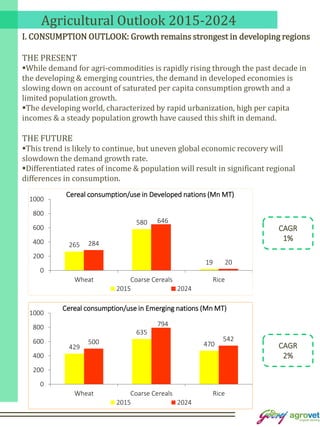
I. CONSUMPTION OUTLOOK: Growth remains strongest in developing regions
THE PRESENT
While demand for agri-commodities is rapidly rising through the past decade in
the developing & emerging countries, the demand in developed economies is
slowing down on account of saturated per capita consumption growth and a
limited population growth.
The developing world, characterized by rapid urbanization, high per capita
incomes & a steady population growth have caused this shift in demand.
THE FUTURE
This trend is likely to continue, but uneven global economic recovery will
slowdown the demand growth rate.
Differentiated rates of income & population will result in significant regional
differences in consumption.
265
580
19
284
646
20
0
200
400
600
800
1000
Wheat Coarse Cereals Rice
Cereal consumption/use in Developed nations (Mn MT)
2015 2024
429
635
470500
794
542
0
200
400
600
800
1000
Wheat Coarse Cereals Rice
Cereal consumption/use in Emerging nations (Mn MT)
2015 2024
CAGR
1%
CAGR
2%
Agricultural Outlook 2015-2024
WHAT CHANGES
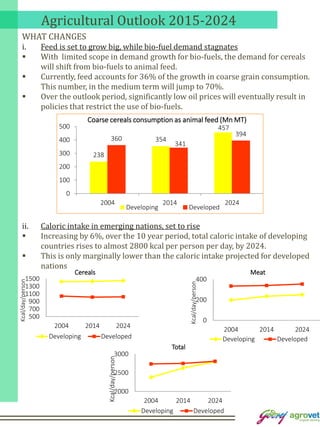
i. Feed is set to grow big, while bio-fuel demand stagnates
 With limited scope in demand growth for bio-fuels, the demand for cereals
will shift from bio-fuels to animal feed.
 Currently, feed accounts for 36% of the growth in coarse grain consumption.
This number, in the medium term will jump to 70%.
 Over the outlook period, significantly low oil prices will eventually result in
policies that restrict the use of bio-fuels.
ii. Caloric intake in emerging nations, set to rise
 Increasing by 6%, over the 10 year period, total caloric intake of developing
countries rises to almost 2800 kcal per person per day, by 2024.
 This is only marginally lower than the caloric intake projected for developed
nations
238
354
457
360
341
394
0
100
200
300
400
500
2004 2014 2024
Coarse cereals consumption as animal feed (Mn MT)
Developing Developed
500
700
900
1100
1300
1500
2004 2014 2024
Kcal/day/person
Cereals
Developing Developed
2000
2500
3000
2004 2014 2024
Kcal/day/person
Total
Developing Developed
0
200
400
2004 2014 2024
Kcal/day/person
Meat
Developing Developed
Agricultural Outlook 2015-2024
II. PRODUCTION OUTLOOK: Growth concentrated in regions where resources
are less constraining
THE PRESENT
In the past decade, demand was moderately growing, hence production was in
effect, gradually rising.
Production trend has been dependent on use of land. Since land prices have been
high in the last decade, therefore it has been used for purposes other than
agriculture.
THE FUTURE
In the coming decade, production will depend on dietary preferences more than
use of land. This primarily implies that production of oilseeds is likely to go up,
while cereals production will also rise – on account of higher coarse cereals
production.
[320 Mn tonnes of additional cereals will be produced by 2024, of which 180 Mn
tonnes is coarse cereals alone]
WHAT CHANGES
i. Improved profitability in the livestock sector
Even though supply got restricted due to a number of disease outbreaks, high
meat prices, and a sharp decline in feed prices [in USA, EU, Canada & China
markets], allowed the livestock industry to remain profitable.
This trend [of meat to feed price ratio] is likely to continue over the next decade
and therefore support production, which is projected to expand by 24% over
the outlook period. Consequently this pushes up production of feed, and
hence oilseeds.
~ 26 Mn tonnes of additional poultry meat will be produced globally.
-5
5
15
25
35
Skim milk
powder
Whole milk
powder
Butter Sheep Cheese Beef Pork Poultry Fish
Increase in volume (%) 2024 over 2012-14
Developed countries Developing countries Least Developed Countries
Agricultural Outlook 2015-2024
III. PRICE OUTLOOK: Real prices of agri-commodities follow the long-term
declining trend
THE PRESENT
Over the last decade, commodity prices have been fluctuating, but remained on the
higher side.
This trend has changed with prices starting to moderate since 2013.
THE FUTURE
A moderate price trend is likely to continue, until eventually, real prices start to
decline over the next decade.
WHAT CHANGES
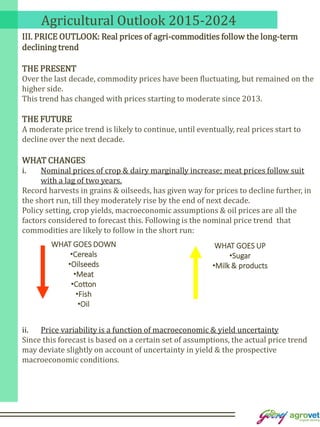
i. Nominal prices of crop & dairy marginally increase; meat prices follow suit
with a lag of two years.
Record harvests in grains & oilseeds, has given way for prices to decline further, in
the short run, till they moderately rise by the end of next decade.
Policy setting, crop yields, macroeconomic assumptions & oil prices are all the
factors considered to forecast this. Following is the nominal price trend that
commodities are likely to follow in the short run:
ii. Price variability is a function of macroeconomic & yield uncertainty
Since this forecast is based on a certain set of assumptions, the actual price trend
may deviate slightly on account of uncertainty in yield & the prospective
macroeconomic conditions.
WHAT GOES DOWN
•Cereals
•Oilseeds
•Meat
•Cotton
•Fish
•Oil
WHAT GOES UP
•Sugar
•Milk & products
Agricultural Outlook 2015-2024
COMMODITY SNAPSHOTS
A. CEREALS
BRIEF: Increased total production & decline in prices on account of high
coarse grain production
WHEAT UNIT 2012-14 (Avg) 2024 (F) GROWTH RATE
Production MnMT 700 787 12%
Consumption MnMT 694 784 13%
Price $/MT 302 272 -10%
RICE UNIT 2012-14 (Avg) 2024 (F) GROWTH RATE
Production MnMT 494 564 14%
Consumption MnMT 488 562 15%
Price $/MT 519 449 -13%
COARSE GRAINS UNIT 2012-14 (Avg) 2024 (F) GROWTH RATE
Production MnMT 1255 1449 15%
Consumption MnMT 1215 1440 19%
Price $/MT 227 194 -15%
OBSERVATIONS
Cereal production is forecasted to increase by 14% over the next decade primarily
due to yield improvement as area under sowing is expected to be more or less
stagnant.
Among these, coarse cereals has the highest production levels on account of
demand and final use as animal feed.
Of the 225 Mn MT of increase in consumption of coarse cereals, about 2/3rd is on
account of feed use [156 Mn MT]
Most of the additional feed is going to be consumed in developing countries (1030
MT) to feed an expanding livestock sector.
Agricultural Outlook 2015-2024
B. OILSEEDS
BRIEF: Record oilseed production to continue but edible oil production to
marginally rise on account of slower expansion of palm oil – price to
increase at a slow pace in the long term
425
169
58
20
516
211
77
28
0
200
400
600
Oilseeds Vegetable Oil Palm Oil Bio-Fuel
World Oil & oilseed Production (Mn MT)
2012-14(Avg.) 2024
OBSERVATIONS
Despite a significant rise in oil seed production, the same is not reflected in
vegetable oil production, as palm oil production rises only marginally
Demand for protein meal rises as the livestock sector expands. Increased
production initially pushes the price down, however, demand catches up with
supply in the long term putting protein meal prices on an upward trajectory.
Growth in vegetable oil production slows considerably in countries that
traditionally produce high oil yielding crops such as sunflower and rapeseed, partly
due to limited growth in biodiesel production, for which vegetable oil represents
the main feedstock.
This reduced growth in bio-fuel production will cause recovery of vegetable oil
prices to be slower than that of protein meal prices.
0
500
1,000
Price recovery comparison of vegetable oil vs. protein meal
[$/MT] [World avg.]
Vegetable oil Protein meal
Agricultural Outlook 2015-2024
C. MEAT
BRIEF: Meat industry expands at a slower rate yet, positive outlook on
account of low feed grain prices
0
50 000
100 000 World Poultry Meat consumption forecast (‘000 MT)
Developing countries Developed countries
The widening
gap
OBSERVATIONS
Consumption growth rate in developed countries over the projection period
stagnates, while total consumption in developing countries grows robustly. [See
graph above]
Yet, consumption per capita of meat in developed countries is expected to remain
more than double than in the developing countries (68 kg per person per year as
compared to 28 kg per person per year)
Rapid population growth and urbanization within many developing regions
remains a core driver of total consumption growth.
In the long term real prices will fall even though nominal prices start to rise.
Poultry meat will capture more than half of the additional meat produced globally
by 2024, compared to 2012-14. In general, production will also benefit from both
improved meat-to-feed price margins as well as better feed conversion ratios in the
next decade.
1000
1500
2000
2500
2014 2015 2016 2017 2018 2019 2020 2021 2022 2023 2024
Real vs. nominal price trend [world avg.] of poultry meat
( $/MT)
Nominal Price Real Price
Agricultural Outlook 2015-2024
E. FISH
BRIEF: Aquaculture, one of the fastest growing food sectors in the coming
decade
D. DAIRY
BRIEF: Declining prices to continue in the short run, although they firm up in
the medium term
OBSERVATIONS
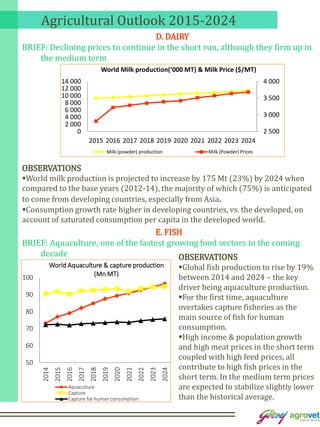
World milk production is projected to increase by 175 Mt (23%) by 2024 when
compared to the base years (2012-14), the majority of which (75%) is anticipated
to come from developing countries, especially from Asia.
Consumption growth rate higher in developing countries, vs. the developed, on
account of saturated consumption per capita in the developed world.
2 500
3 000
3 500
4 000
0
2 000
4 000
6 000
8 000
10 000
12 000
14 000
2015 2016 2017 2018 2019 2020 2021 2022 2023 2024
World Milk production(‘000 MT) & Milk Price ($/MT)
Milk (powder) production Milk (Powder) Prices
OBSERVATIONS
Global fish production to rise by 19%
between 2014 and 2024 – the key
driver being aquaculture production.
For the first time, aquaculture
overtakes capture fisheries as the
main source of fish for human
consumption.
High income & population growth
and high meat prices in the short term
coupled with high feed prices, all
contribute to high fish prices in the
short term. In the medium term prices
are expected to stabilize slightly lower
than the historical average.
50
60
70
80
90
100
2014
2015
2016
2017
2018
2019
2020
2021
2022
2023
2024
World Aquaculture & capture production
(Mn MT)
Aquaculture
Capture
Capture for human consumption
Agricultural Outlook 2015-2024
CONCLUSION
 The last decade has set a trend of steadily rising prices of agri-commodities. In
the coming decade, this trend is set to change.
Production will now be determined by taste, preferences & choices, instead of
land use & availability.
Higher production will be a result of higher yields in most developing nations.
Higher production and improved yields will also be the prime factor determining
the downward trend in long term real commodity prices.
Important trend changes include shift of demand for coarse cereals, from use in
bio-fuels to use in animal feed.
This proves beneficiary for the livestock sector in more than one ways – It meets
the feed requirements of the expanding livestock industry, and also improves
meat-to-feed price ratios making the livestock (esp. poultry) industry that was
subject to much volatility in the last decade, steady and profitable once again.
On the whole, the agri-commodities market is largely going to be uniform in terms
of production & price correction, when compared with the last decade. Strong
income, population growth, will be the prime reason for shift in demand &
preferences.
Agricultural Outlook 2015-2024
LIST OF SOURCES:
OECD/Food and Agriculture Organization of the United
Nations (2015), OECD-FAO Agricultural Outlook 2015,
OECD Publishing, Paris.
http://dx.doi.org/10.1787/agr_outlook-2015-en
OECD/FAO (2015), “OECD-FAO Agricultural Outlook”, OECD
Agriculture Statistics (database),
http://dx.doi.org/10.1787/agr-outl-data-en.
OECD/FAO (2015), “OECD-FAO Agricultural Outlook”, OECD
Agriculture Statistics (database),
http://dx.doi.org/10.1787/888933228776
Image credit: dreamstime.com; canstockphoto; shutterstock
Created & compiled by
Business Development & Strategy Team, Godrej Agrovet
For any further queries or comments, please feel free to contact at:
aparna.tiwari@godrejagrovet.com
Aparna Tiwari
Economist – Business development & strategy

Agro buzz - Agricultural Outlook 2024

  • 1.
  • 2.
    Agricultural Outlook 2015-2024 INTRODUCTION Inagriculture, the global economy witnessed diverse trends in the last decade. While there have been years of tight supply & spiraling commodity prices, there have also been years with a strong harvest coupled with a steep decline in output prices. This report summarizes the trends in agri-commodity market, in context of developed & emerging markets and their outlook for the next decade. ASSUMPTIONS a. Global economy growth rate is assumed at 3%. b. World population growth rate at 1% p.a. in the next decade. Slower growth expected in all regions, including India, where, despite the assumption, population is expected to grow by 139 mn people. c. Inflation rate differs across countries. d. US dollar expected to remain strong. e. Nominal oil price to increase at an annual average growth rate of 3.7% f. Policy implementations do not have a direct impact on production decisions in many countries.
  • 3.
    Agricultural Outlook 2015-2024 I.CONSUMPTION OUTLOOK: Growth remains strongest in developing regions THE PRESENT While demand for agri-commodities is rapidly rising through the past decade in the developing & emerging countries, the demand in developed economies is slowing down on account of saturated per capita consumption growth and a limited population growth. The developing world, characterized by rapid urbanization, high per capita incomes & a steady population growth have caused this shift in demand. THE FUTURE This trend is likely to continue, but uneven global economic recovery will slowdown the demand growth rate. Differentiated rates of income & population will result in significant regional differences in consumption. 265 580 19 284 646 20 0 200 400 600 800 1000 Wheat Coarse Cereals Rice Cereal consumption/use in Developed nations (Mn MT) 2015 2024 429 635 470500 794 542 0 200 400 600 800 1000 Wheat Coarse Cereals Rice Cereal consumption/use in Emerging nations (Mn MT) 2015 2024 CAGR 1% CAGR 2%
  • 4.
    Agricultural Outlook 2015-2024 WHATCHANGES i. Feed is set to grow big, while bio-fuel demand stagnates  With limited scope in demand growth for bio-fuels, the demand for cereals will shift from bio-fuels to animal feed.  Currently, feed accounts for 36% of the growth in coarse grain consumption. This number, in the medium term will jump to 70%.  Over the outlook period, significantly low oil prices will eventually result in policies that restrict the use of bio-fuels. ii. Caloric intake in emerging nations, set to rise  Increasing by 6%, over the 10 year period, total caloric intake of developing countries rises to almost 2800 kcal per person per day, by 2024.  This is only marginally lower than the caloric intake projected for developed nations 238 354 457 360 341 394 0 100 200 300 400 500 2004 2014 2024 Coarse cereals consumption as animal feed (Mn MT) Developing Developed 500 700 900 1100 1300 1500 2004 2014 2024 Kcal/day/person Cereals Developing Developed 2000 2500 3000 2004 2014 2024 Kcal/day/person Total Developing Developed 0 200 400 2004 2014 2024 Kcal/day/person Meat Developing Developed
  • 5.
    Agricultural Outlook 2015-2024 II.PRODUCTION OUTLOOK: Growth concentrated in regions where resources are less constraining THE PRESENT In the past decade, demand was moderately growing, hence production was in effect, gradually rising. Production trend has been dependent on use of land. Since land prices have been high in the last decade, therefore it has been used for purposes other than agriculture. THE FUTURE In the coming decade, production will depend on dietary preferences more than use of land. This primarily implies that production of oilseeds is likely to go up, while cereals production will also rise – on account of higher coarse cereals production. [320 Mn tonnes of additional cereals will be produced by 2024, of which 180 Mn tonnes is coarse cereals alone] WHAT CHANGES i. Improved profitability in the livestock sector Even though supply got restricted due to a number of disease outbreaks, high meat prices, and a sharp decline in feed prices [in USA, EU, Canada & China markets], allowed the livestock industry to remain profitable. This trend [of meat to feed price ratio] is likely to continue over the next decade and therefore support production, which is projected to expand by 24% over the outlook period. Consequently this pushes up production of feed, and hence oilseeds. ~ 26 Mn tonnes of additional poultry meat will be produced globally. -5 5 15 25 35 Skim milk powder Whole milk powder Butter Sheep Cheese Beef Pork Poultry Fish Increase in volume (%) 2024 over 2012-14 Developed countries Developing countries Least Developed Countries
  • 6.
    Agricultural Outlook 2015-2024 III.PRICE OUTLOOK: Real prices of agri-commodities follow the long-term declining trend THE PRESENT Over the last decade, commodity prices have been fluctuating, but remained on the higher side. This trend has changed with prices starting to moderate since 2013. THE FUTURE A moderate price trend is likely to continue, until eventually, real prices start to decline over the next decade. WHAT CHANGES i. Nominal prices of crop & dairy marginally increase; meat prices follow suit with a lag of two years. Record harvests in grains & oilseeds, has given way for prices to decline further, in the short run, till they moderately rise by the end of next decade. Policy setting, crop yields, macroeconomic assumptions & oil prices are all the factors considered to forecast this. Following is the nominal price trend that commodities are likely to follow in the short run: ii. Price variability is a function of macroeconomic & yield uncertainty Since this forecast is based on a certain set of assumptions, the actual price trend may deviate slightly on account of uncertainty in yield & the prospective macroeconomic conditions. WHAT GOES DOWN •Cereals •Oilseeds •Meat •Cotton •Fish •Oil WHAT GOES UP •Sugar •Milk & products
  • 7.
    Agricultural Outlook 2015-2024 COMMODITYSNAPSHOTS A. CEREALS BRIEF: Increased total production & decline in prices on account of high coarse grain production WHEAT UNIT 2012-14 (Avg) 2024 (F) GROWTH RATE Production MnMT 700 787 12% Consumption MnMT 694 784 13% Price $/MT 302 272 -10% RICE UNIT 2012-14 (Avg) 2024 (F) GROWTH RATE Production MnMT 494 564 14% Consumption MnMT 488 562 15% Price $/MT 519 449 -13% COARSE GRAINS UNIT 2012-14 (Avg) 2024 (F) GROWTH RATE Production MnMT 1255 1449 15% Consumption MnMT 1215 1440 19% Price $/MT 227 194 -15% OBSERVATIONS Cereal production is forecasted to increase by 14% over the next decade primarily due to yield improvement as area under sowing is expected to be more or less stagnant. Among these, coarse cereals has the highest production levels on account of demand and final use as animal feed. Of the 225 Mn MT of increase in consumption of coarse cereals, about 2/3rd is on account of feed use [156 Mn MT] Most of the additional feed is going to be consumed in developing countries (1030 MT) to feed an expanding livestock sector.
  • 8.
    Agricultural Outlook 2015-2024 B.OILSEEDS BRIEF: Record oilseed production to continue but edible oil production to marginally rise on account of slower expansion of palm oil – price to increase at a slow pace in the long term 425 169 58 20 516 211 77 28 0 200 400 600 Oilseeds Vegetable Oil Palm Oil Bio-Fuel World Oil & oilseed Production (Mn MT) 2012-14(Avg.) 2024 OBSERVATIONS Despite a significant rise in oil seed production, the same is not reflected in vegetable oil production, as palm oil production rises only marginally Demand for protein meal rises as the livestock sector expands. Increased production initially pushes the price down, however, demand catches up with supply in the long term putting protein meal prices on an upward trajectory. Growth in vegetable oil production slows considerably in countries that traditionally produce high oil yielding crops such as sunflower and rapeseed, partly due to limited growth in biodiesel production, for which vegetable oil represents the main feedstock. This reduced growth in bio-fuel production will cause recovery of vegetable oil prices to be slower than that of protein meal prices. 0 500 1,000 Price recovery comparison of vegetable oil vs. protein meal [$/MT] [World avg.] Vegetable oil Protein meal
  • 9.
    Agricultural Outlook 2015-2024 C.MEAT BRIEF: Meat industry expands at a slower rate yet, positive outlook on account of low feed grain prices 0 50 000 100 000 World Poultry Meat consumption forecast (‘000 MT) Developing countries Developed countries The widening gap OBSERVATIONS Consumption growth rate in developed countries over the projection period stagnates, while total consumption in developing countries grows robustly. [See graph above] Yet, consumption per capita of meat in developed countries is expected to remain more than double than in the developing countries (68 kg per person per year as compared to 28 kg per person per year) Rapid population growth and urbanization within many developing regions remains a core driver of total consumption growth. In the long term real prices will fall even though nominal prices start to rise. Poultry meat will capture more than half of the additional meat produced globally by 2024, compared to 2012-14. In general, production will also benefit from both improved meat-to-feed price margins as well as better feed conversion ratios in the next decade. 1000 1500 2000 2500 2014 2015 2016 2017 2018 2019 2020 2021 2022 2023 2024 Real vs. nominal price trend [world avg.] of poultry meat ( $/MT) Nominal Price Real Price
  • 10.
    Agricultural Outlook 2015-2024 E.FISH BRIEF: Aquaculture, one of the fastest growing food sectors in the coming decade D. DAIRY BRIEF: Declining prices to continue in the short run, although they firm up in the medium term OBSERVATIONS World milk production is projected to increase by 175 Mt (23%) by 2024 when compared to the base years (2012-14), the majority of which (75%) is anticipated to come from developing countries, especially from Asia. Consumption growth rate higher in developing countries, vs. the developed, on account of saturated consumption per capita in the developed world. 2 500 3 000 3 500 4 000 0 2 000 4 000 6 000 8 000 10 000 12 000 14 000 2015 2016 2017 2018 2019 2020 2021 2022 2023 2024 World Milk production(‘000 MT) & Milk Price ($/MT) Milk (powder) production Milk (Powder) Prices OBSERVATIONS Global fish production to rise by 19% between 2014 and 2024 – the key driver being aquaculture production. For the first time, aquaculture overtakes capture fisheries as the main source of fish for human consumption. High income & population growth and high meat prices in the short term coupled with high feed prices, all contribute to high fish prices in the short term. In the medium term prices are expected to stabilize slightly lower than the historical average. 50 60 70 80 90 100 2014 2015 2016 2017 2018 2019 2020 2021 2022 2023 2024 World Aquaculture & capture production (Mn MT) Aquaculture Capture Capture for human consumption
  • 11.
    Agricultural Outlook 2015-2024 CONCLUSION The last decade has set a trend of steadily rising prices of agri-commodities. In the coming decade, this trend is set to change. Production will now be determined by taste, preferences & choices, instead of land use & availability. Higher production will be a result of higher yields in most developing nations. Higher production and improved yields will also be the prime factor determining the downward trend in long term real commodity prices. Important trend changes include shift of demand for coarse cereals, from use in bio-fuels to use in animal feed. This proves beneficiary for the livestock sector in more than one ways – It meets the feed requirements of the expanding livestock industry, and also improves meat-to-feed price ratios making the livestock (esp. poultry) industry that was subject to much volatility in the last decade, steady and profitable once again. On the whole, the agri-commodities market is largely going to be uniform in terms of production & price correction, when compared with the last decade. Strong income, population growth, will be the prime reason for shift in demand & preferences.
  • 12.
    Agricultural Outlook 2015-2024 LISTOF SOURCES: OECD/Food and Agriculture Organization of the United Nations (2015), OECD-FAO Agricultural Outlook 2015, OECD Publishing, Paris. http://dx.doi.org/10.1787/agr_outlook-2015-en OECD/FAO (2015), “OECD-FAO Agricultural Outlook”, OECD Agriculture Statistics (database), http://dx.doi.org/10.1787/agr-outl-data-en. OECD/FAO (2015), “OECD-FAO Agricultural Outlook”, OECD Agriculture Statistics (database), http://dx.doi.org/10.1787/888933228776 Image credit: dreamstime.com; canstockphoto; shutterstock Created & compiled by Business Development & Strategy Team, Godrej Agrovet For any further queries or comments, please feel free to contact at: aparna.tiwari@godrejagrovet.com Aparna Tiwari Economist – Business development & strategy