MODULE NAME: AGRICULTURAL MECHANIZATION
SECTOR: AGRICULTURE AND FOOD PROCESSING
Learning unit 1: Identify types of farm machineries and implements
Learning hour: 15
1. Identify farm machinery
1.1. Introduction to farm machinery
Farm machinery are heavy and strong equipments normally used to clear the rolling hard lands
into usable forms such as land recovery operations carried out over forest lands for cultivation
and it is also used for making roads and for building construction.
1.1.1 Types of farm machinery:
1. Power tiller (2 wheel tractor)
Power tiller (Walking tractor): Power tiller is a walking type tractor. This tractor is usually fitted
with two wheels only. The direction of travel and its controls for field operation is performed by
the operator, walking behind the tractor. Two-wheel tractor The higher power "riding"
rotavators cross out of the home garden category into farming category especially in Asia, Africa
and South America, capable of preparing 1 hectare of land in 8 – 10 hours. These are also known
as power tillers, walking tractors or two-wheel tractors.
I. Power Tiller Attachments
Creating a niche of Power Tiller Attachments such as Power Tiller Operated Reversible Mould
Board Plough, Spraying, Shorter Rotary 340 Mm For Sugarcane, Reaper For Power Tiller,
Power Tiller Operated Generator, Dry Tilling and many more items at its best, with utmost
quality.
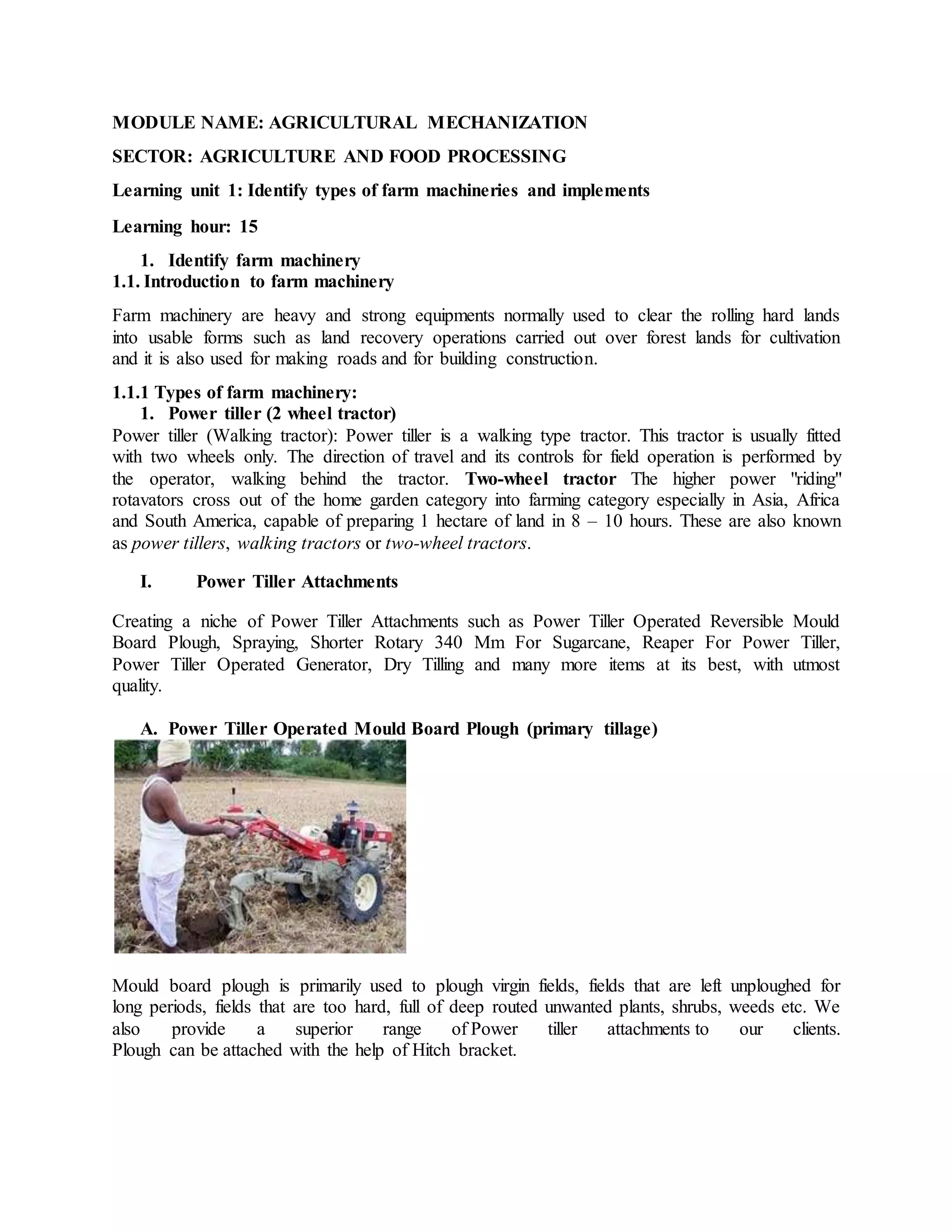
A. Power Tiller Operated Mould Board Plough (primary tillage)
Mould board plough is primarily used to plough virgin fields, fields that are left unploughed for
long periods, fields that are too hard, full of deep routed unwanted plants, shrubs, weeds etc. We
also provide a superior range of Power tiller attachments to our clients.
Plough can be attached with the help of Hitch bracket.
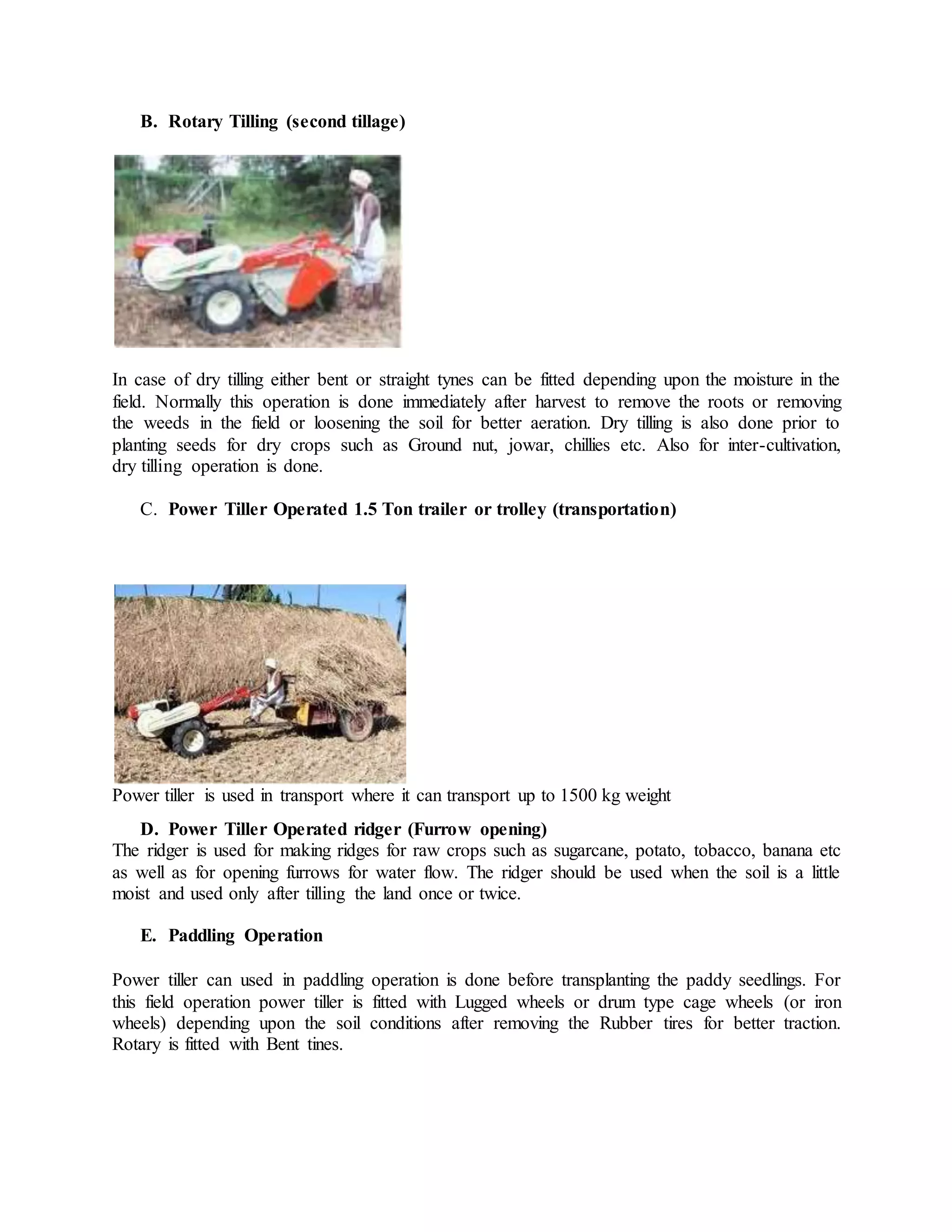
B. Rotary Tilling (second tillage)
In case of dry tilling either bent or straight tynes can be fitted depending upon the moisture in the
field. Normally this operation is done immediately after harvest to remove the roots or removing
the weeds in the field or loosening the soil for better aeration. Dry tilling is also done prior to
planting seeds for dry crops such as Ground nut, jowar, chillies etc. Also for inter-cultivation,
dry tilling operation is done.
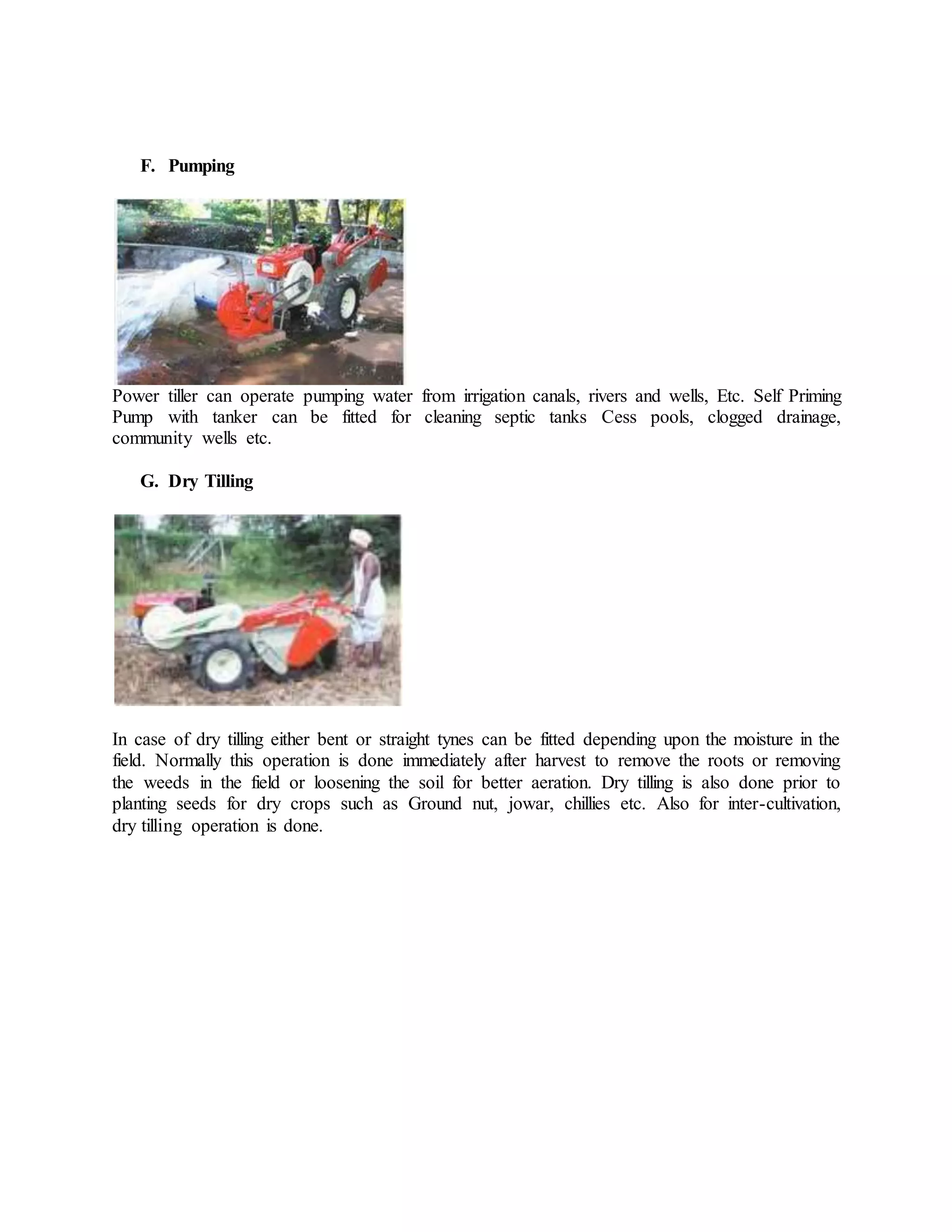
C. Power Tiller Operated 1.5 Ton trailer or trolley (transportation)
Power tiller is used in transport where it can transport up to 1500 kg weight
D. Power Tiller Operated ridger (Furrow opening)
The ridger is used for making ridges for raw crops such as sugarcane, potato, tobacco, banana etc
as well as for opening furrows for water flow. The ridger should be used when the soil is a little
moist and used only after tilling the land once or twice.
E. Paddling Operation
Power tiller can used in paddling operation is done before transplanting the paddy seedlings. For
this field operation power tiller is fitted with Lugged wheels or drum type cage wheels (or iron
wheels) depending upon the soil conditions after removing the Rubber tires for better traction.
Rotary is fitted with Bent tines.
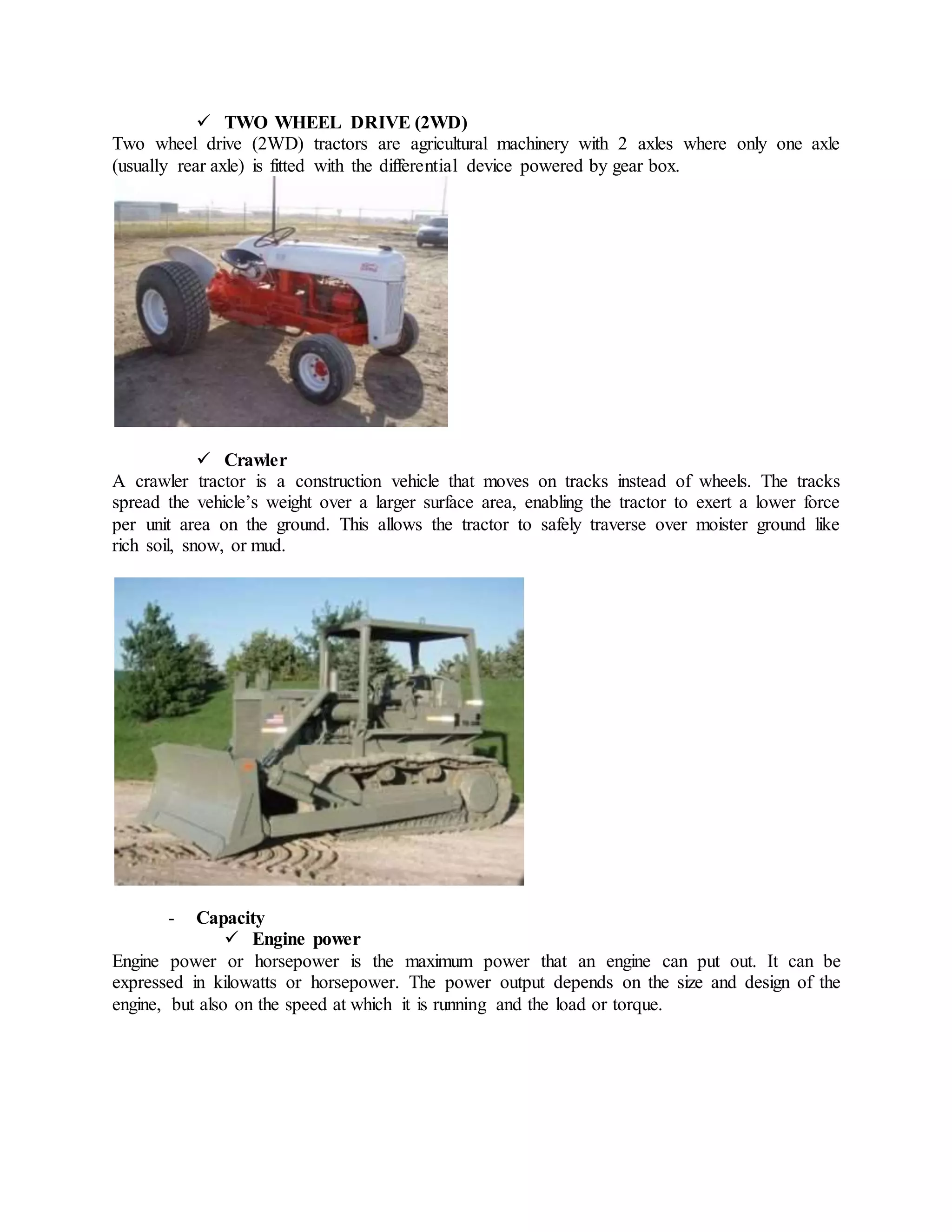
F. Pumping
Power tiller can operate pumping water from irrigation canals, rivers and wells, Etc. Self Priming
Pump with tanker can be fitted for cleaning septic tanks Cess pools, clogged drainage,
community wells etc.
G. Dry Tilling
In case of dry tilling either bent or straight tynes can be fitted depending upon the moisture in the
field. Normally this operation is done immediately after harvest to remove the roots or removing
the weeds in the field or loosening the soil for better aeration. Dry tilling is also done prior to
planting seeds for dry crops such as Ground nut, jowar, chillies etc. Also for inter-cultivation,
dry tilling operation is done.
2. Tractor (4wheel tractor)
A tractor is a self propelled power unit having wheels or tracks for operating agriculture
implements and machines including trailers. Tractor engine is used as a prime mover for active
tools and stationary farm machinery through power take off shaft or belt pulley.
On the basis of purpose, wheeled tractor is classified into three groups:
(a) General purpose tractor: It is used for major farm operations; such as ploughing,
harrowing, sowing, harvesting and transporting work. Such tractors have (i) low ground
clearance (ii) increased engine power (iii) good grip and (iv)wide tires.
(b) Row crop tractor: It is used for crop cultivation. Such tractor is provided with
replaceable driving wheels of different tread widths. It has high ground clearance to save
damage of crops. Wide wheel track can be adjusted to suit inter row distance.
(c) Special purpose tractor: It is used for definite jobs like cotton fields, marshy land,
hillsides, garden etc. Special designs are there for special purpose tractor.
3. Rice transplanter
The self propelled rice transplanter consists of air-cooled gasoline engine, main clutch, running
clutch, planting clutch, seeding table, float, star wheel, accelerator lever, ground wheel, and
handle and linkage mechanism.
4. Rice harvester
Harvesting is the process of collecting the mature rice crop from the field. The goal of good
harvesting is to maximize grain yield, and to minimize grain losses and quality deterioration.
5. Combine harvester
The combine harvester, or simply combine, is a machine that harvests grain crops. It combined
into a single operation what previously had taken three separate operations (reaping, binding, and
threshing). Among the crops harvested with a combine are wheat, oats, rye, barley, corn (maize),
soybeans, and flax (linseed).
1.2. Classify the farm machinery
A. Classification of the farm machinery:
- Type:
 FOUR WHEEL DRIVE (4WD)
Four wheel drive (4WD) tractors are agricultural machinery with 2 axles where all axles are
fitted with the differential device powered by gear box.
Example of a 4WD tractor
 TWO WHEEL DRIVE (2WD)
Two wheel drive (2WD) tractors are agricultural machinery with 2 axles where only one axle
(usually rear axle) is fitted with the differential device powered by gear box.
 Crawler
A crawler tractor is a construction vehicle that moves on tracks instead of wheels. The tracks
spread the vehicle’s weight over a larger surface area, enabling the tractor to exert a lower force
per unit area on the ground. This allows the tractor to safely traverse over moister ground like
rich soil, snow, or mud.
- Capacity
 Engine power
Engine power or horsepower is the maximum power that an engine can put out. It can be
expressed in kilowatts or horsepower. The power output depends on the size and design of the
engine, but also on the speed at which it is running and the load or torque.
- Purpose:
Ploughing
This may be defined as the mechanical manipulation of soil in order to get the desired condition
of seed bed for planting and for good growth of plant. This mechanical manipulation of soil is
used to maintain, modify or promote changes in soil structure in an effort to produce more
desirable soil environment for plant growth.
Harvesting/Processing
Harvesting is the process of collecting the mature rice crop from the field. The goal of good
harvesting is to maximize grain yield, and to minimize grain losses and quality deterioration
- Transplanting
In agriculture and gardening, transplanting or replanting is the technique of moving a plant
from one location to another. Most often this takes the form of starting a plant from seed in
optimal conditions, such as in a greenhouse or protected nursery bed, then replanting it in
another, usually outdoor, growing location. Botanical transplants are used infrequently and
carefully because they carry with them a significant risk of killing the plant.
1.3. classify the farm machinery attachments
Self propelled implement,
Self propelled implement are vehicles "manufactured, designed, redesigned, converted, or
reconstructed" to perform a specific farm task.
Propelled implement,
Propelled implements are agriculture implements which are mounted and powered by a tractor
Purpose:
 Ploughing: is the agricultural preparation of soil by mechanical agitation of various types,
such as digging, stirring, and overturning.
 Sowing: to put seeds in or on the ground so that plants will grow
 Fertilizing: to spread a natural or chemical substance on land or plants, in order to make the
plants grow well
 Pesticides applicators: a device used to put pesticides on or into a particular place of a crop
 Weeding: any wild plant that grows in an unwanted place, especially in a garden or field
where it prevents the cultivated plants from growing freely
 Harvesting: the time of year when crops are cut and collected from the fields, or the activity
of cutting and collecting them, or the crops that are cut and collected:
 Irrigation: to supply land with water so that crops and plants will grow:
 Processing: a method of producing or transform crops for adding it value in a factory or by
the machine by treating natural substances
Agricultural mechanization

Agricultural mechanization

  • 1.
    MODULE NAME: AGRICULTURALMECHANIZATION SECTOR: AGRICULTURE AND FOOD PROCESSING Learning unit 1: Identify types of farm machineries and implements Learning hour: 15 1. Identify farm machinery 1.1. Introduction to farm machinery Farm machinery are heavy and strong equipments normally used to clear the rolling hard lands into usable forms such as land recovery operations carried out over forest lands for cultivation and it is also used for making roads and for building construction. 1.1.1 Types of farm machinery: 1. Power tiller (2 wheel tractor) Power tiller (Walking tractor): Power tiller is a walking type tractor. This tractor is usually fitted with two wheels only. The direction of travel and its controls for field operation is performed by the operator, walking behind the tractor. Two-wheel tractor The higher power "riding" rotavators cross out of the home garden category into farming category especially in Asia, Africa and South America, capable of preparing 1 hectare of land in 8 – 10 hours. These are also known as power tillers, walking tractors or two-wheel tractors. I. Power Tiller Attachments Creating a niche of Power Tiller Attachments such as Power Tiller Operated Reversible Mould Board Plough, Spraying, Shorter Rotary 340 Mm For Sugarcane, Reaper For Power Tiller, Power Tiller Operated Generator, Dry Tilling and many more items at its best, with utmost quality. A. Power Tiller Operated Mould Board Plough (primary tillage) Mould board plough is primarily used to plough virgin fields, fields that are left unploughed for long periods, fields that are too hard, full of deep routed unwanted plants, shrubs, weeds etc. We also provide a superior range of Power tiller attachments to our clients. Plough can be attached with the help of Hitch bracket.
  • 2.
    B. Rotary Tilling(second tillage) In case of dry tilling either bent or straight tynes can be fitted depending upon the moisture in the field. Normally this operation is done immediately after harvest to remove the roots or removing the weeds in the field or loosening the soil for better aeration. Dry tilling is also done prior to planting seeds for dry crops such as Ground nut, jowar, chillies etc. Also for inter-cultivation, dry tilling operation is done. C. Power Tiller Operated 1.5 Ton trailer or trolley (transportation) Power tiller is used in transport where it can transport up to 1500 kg weight D. Power Tiller Operated ridger (Furrow opening) The ridger is used for making ridges for raw crops such as sugarcane, potato, tobacco, banana etc as well as for opening furrows for water flow. The ridger should be used when the soil is a little moist and used only after tilling the land once or twice. E. Paddling Operation Power tiller can used in paddling operation is done before transplanting the paddy seedlings. For this field operation power tiller is fitted with Lugged wheels or drum type cage wheels (or iron wheels) depending upon the soil conditions after removing the Rubber tires for better traction. Rotary is fitted with Bent tines.
  • 3.
    F. Pumping Power tillercan operate pumping water from irrigation canals, rivers and wells, Etc. Self Priming Pump with tanker can be fitted for cleaning septic tanks Cess pools, clogged drainage, community wells etc. G. Dry Tilling In case of dry tilling either bent or straight tynes can be fitted depending upon the moisture in the field. Normally this operation is done immediately after harvest to remove the roots or removing the weeds in the field or loosening the soil for better aeration. Dry tilling is also done prior to planting seeds for dry crops such as Ground nut, jowar, chillies etc. Also for inter-cultivation, dry tilling operation is done.
  • 4.
    2. Tractor (4wheeltractor) A tractor is a self propelled power unit having wheels or tracks for operating agriculture implements and machines including trailers. Tractor engine is used as a prime mover for active tools and stationary farm machinery through power take off shaft or belt pulley. On the basis of purpose, wheeled tractor is classified into three groups: (a) General purpose tractor: It is used for major farm operations; such as ploughing, harrowing, sowing, harvesting and transporting work. Such tractors have (i) low ground clearance (ii) increased engine power (iii) good grip and (iv)wide tires. (b) Row crop tractor: It is used for crop cultivation. Such tractor is provided with replaceable driving wheels of different tread widths. It has high ground clearance to save damage of crops. Wide wheel track can be adjusted to suit inter row distance. (c) Special purpose tractor: It is used for definite jobs like cotton fields, marshy land, hillsides, garden etc. Special designs are there for special purpose tractor. 3. Rice transplanter The self propelled rice transplanter consists of air-cooled gasoline engine, main clutch, running clutch, planting clutch, seeding table, float, star wheel, accelerator lever, ground wheel, and handle and linkage mechanism. 4. Rice harvester Harvesting is the process of collecting the mature rice crop from the field. The goal of good harvesting is to maximize grain yield, and to minimize grain losses and quality deterioration.
  • 5.
    5. Combine harvester Thecombine harvester, or simply combine, is a machine that harvests grain crops. It combined into a single operation what previously had taken three separate operations (reaping, binding, and threshing). Among the crops harvested with a combine are wheat, oats, rye, barley, corn (maize), soybeans, and flax (linseed). 1.2. Classify the farm machinery A. Classification of the farm machinery: - Type:  FOUR WHEEL DRIVE (4WD) Four wheel drive (4WD) tractors are agricultural machinery with 2 axles where all axles are fitted with the differential device powered by gear box. Example of a 4WD tractor
  • 6.
     TWO WHEELDRIVE (2WD) Two wheel drive (2WD) tractors are agricultural machinery with 2 axles where only one axle (usually rear axle) is fitted with the differential device powered by gear box.  Crawler A crawler tractor is a construction vehicle that moves on tracks instead of wheels. The tracks spread the vehicle’s weight over a larger surface area, enabling the tractor to exert a lower force per unit area on the ground. This allows the tractor to safely traverse over moister ground like rich soil, snow, or mud. - Capacity  Engine power Engine power or horsepower is the maximum power that an engine can put out. It can be expressed in kilowatts or horsepower. The power output depends on the size and design of the engine, but also on the speed at which it is running and the load or torque.
  • 7.
    - Purpose: Ploughing This maybe defined as the mechanical manipulation of soil in order to get the desired condition of seed bed for planting and for good growth of plant. This mechanical manipulation of soil is used to maintain, modify or promote changes in soil structure in an effort to produce more desirable soil environment for plant growth. Harvesting/Processing Harvesting is the process of collecting the mature rice crop from the field. The goal of good harvesting is to maximize grain yield, and to minimize grain losses and quality deterioration - Transplanting In agriculture and gardening, transplanting or replanting is the technique of moving a plant from one location to another. Most often this takes the form of starting a plant from seed in optimal conditions, such as in a greenhouse or protected nursery bed, then replanting it in another, usually outdoor, growing location. Botanical transplants are used infrequently and carefully because they carry with them a significant risk of killing the plant. 1.3. classify the farm machinery attachments Self propelled implement, Self propelled implement are vehicles "manufactured, designed, redesigned, converted, or reconstructed" to perform a specific farm task. Propelled implement, Propelled implements are agriculture implements which are mounted and powered by a tractor Purpose:  Ploughing: is the agricultural preparation of soil by mechanical agitation of various types, such as digging, stirring, and overturning.  Sowing: to put seeds in or on the ground so that plants will grow  Fertilizing: to spread a natural or chemical substance on land or plants, in order to make the plants grow well  Pesticides applicators: a device used to put pesticides on or into a particular place of a crop  Weeding: any wild plant that grows in an unwanted place, especially in a garden or field where it prevents the cultivated plants from growing freely  Harvesting: the time of year when crops are cut and collected from the fields, or the activity of cutting and collecting them, or the crops that are cut and collected:  Irrigation: to supply land with water so that crops and plants will grow:  Processing: a method of producing or transform crops for adding it value in a factory or by the machine by treating natural substances