Population Geography
MARK LESTER B. LIQUIGAN, PhD
As of Today!
Population Geography is the study of the
spatial distribution of human population,
and of the population characteristics of
individual regions and places. It includes
studies of population growth and decline,
as well as the migration of people from
one place to another.
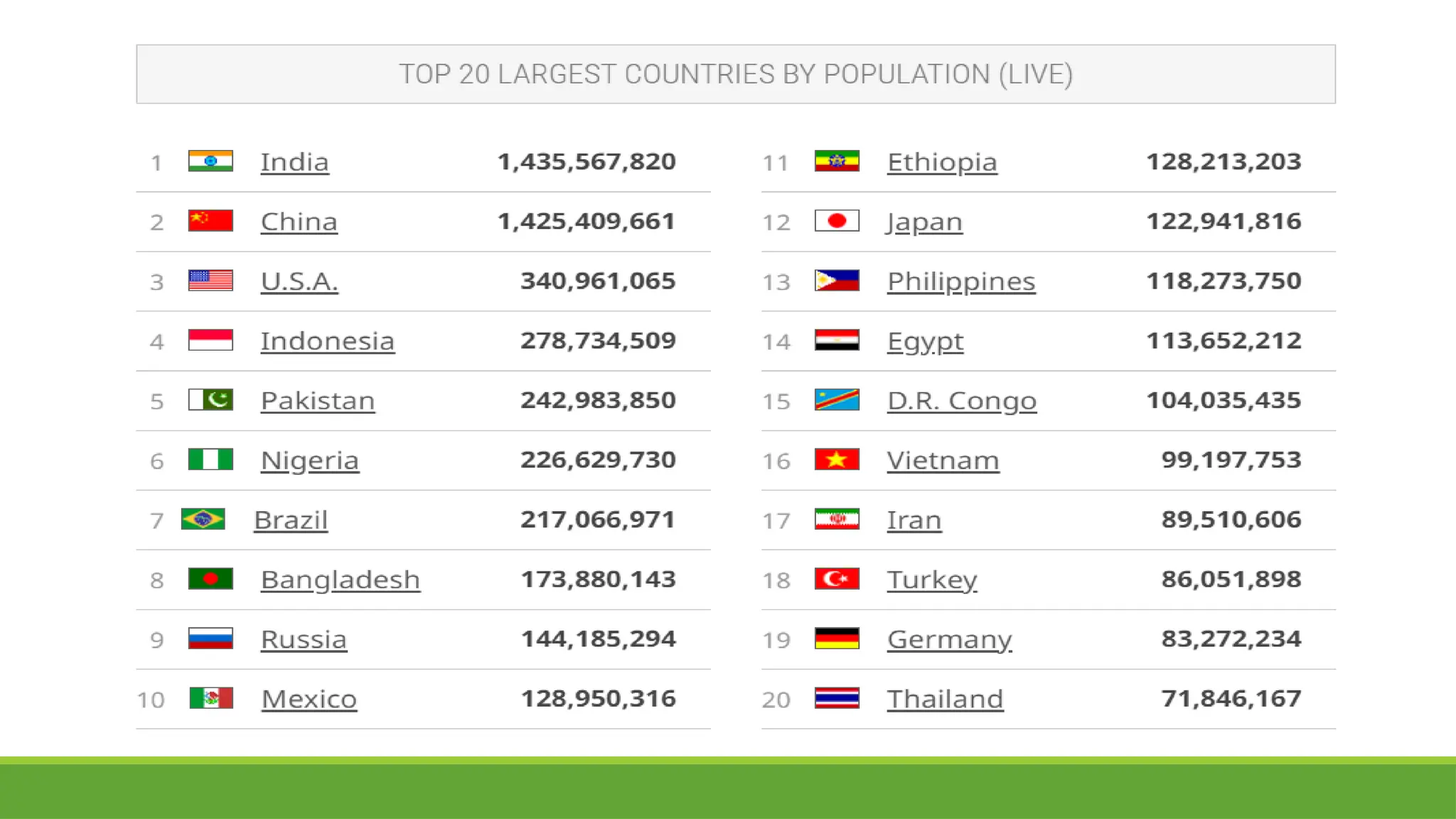
The current world population is approximately
7.7 billion, and that population is very
unevenly distributed among the world’s 193
independent countries that are members of
the United Nations. The world’s two most
populous countries, India and China,
collectively account for over a third of the
world’s population.
Population Density, which is the population of a
country divided by its land area. This statistic is
somewhat tricky when used to rank countries.
Microstates, city-States, and small island countries
typically have high population densities due to the
limited areas available. Cities inherently are more
crowded than rural areas; thus, a country that is
precisely one city is intensely crowded.
Population pyramid is a graph depicting the
distribution of a population across various
age brackets. If a country’s pyramid has a
wide base and narrow top, such as states, that
indicates that a large proportion of the
population is relatively young.
Demographic transition examines birth rates and
death rates in societies before, during, and after
the Industrial Revolution. There are four (or some
say, five) stages in this model: the pre-industrial,
the early industrial, the late industrial, and the
post-industrial. It isn’t appropriate to put exact
dates on these four stages, since different parts of
the world experienced them at different times.
The pre-industrial stage (Stage 1) represents the
vast majority of human history, extending from the
dawn of human civilization until the Industrial
Revolution. During this stage, the vast majority of
humans lived in rural areas and farmed for a
living. Living standards were poor, and technology
was extremely limited. Birth rates in the pre-
industrial stage were extremely high.
The beginning of the early industrial stage (Stage
2) was marked by the advent of the industrial revolution
and all the developments that came with it – modern
factories, modern agriculture, modern science, and
modern medicine. During this period, human population
began a slow transition away from rural areas toward
urban ones. The mechanization of agriculture reduced
the need for labor on farms, and the rise of the factory
increased the need for labor in cities.
During the late industrial stage(Stage 3), the
majority of the population shifted away from the farm
to the city, technology continued to advance at a rapid
pace, and standards of living improved dramatically. In
this period, birth rates declined significantly. A primary
reason is a change in the economic status of children.
On the farm, children were considered an economic
asset. In cities and their suburbs, children begin to be
viewed as an economic liability.
Wealth and technology continue to grow during the post-
industrial stage (Stage 4). In this period, agricultural and
industrial output continues to expand, but the majority of
the population shifts toward employment in the service
and information sectors. Birth rates continue their steep
decline as children become very expensive, and as more
people, particularly women, choose to complete a college
education. Marriages are further delayed, and the
reproductive window closes even more. Cultural norms
shift toward smaller and smaller families.
A country’s population can also be affected by
immigration and
emigration. Immigration refers to the
entrance of migrants, while emigration refers
to the exit of migrants. The net migration
rate refers to the difference between annual
immigrants and emigrants per one thousand
people in a country’s population.
Human migration is the movement of people from one place to
another with intentions of settling, permanently or temporarily, at
a new location (geographic region).
The movement often occurs over long distances and from
one country to another (external migration), but internal
migration (within a single country) is the dominant form of human
migration globally.
Migration is often associated with better human capital at both
individual and household level, and with better access to
migration networks, facilitating a possible second move. It has a
high potential to improve human development, and some studies
confirm that migration is the most direct route out of poverty.
Voluntary migration is based on the initiative
and the free will of the person and is influenced
by a combination of factors: economic, political
and social: either in the migrants` country of
origin (determinant factors or "push factors") or in
the country of destination (attraction factors or
"pull factors").
Forced migration refers to the movements of
refugees and internally displaced people
(displaced by conflict) as well as people displaced
by natural or environmental disasters, chemical or
nuclear disasters, famine, or development
projects. These different causes of migration
leave people with one choice, to move to a new
environment. Immigrants leave their beloved
homes to seek a life in camps, spontaneous
settlements, and countries of asylum.
Agricultural Geography
MARK LESTER B. LIQUIGAN, PhD
Agricultural geography is defined as the study
of the geographical and locational attributes,
patterns, and processes of crop and animal
farming, and related subjects such as farm
land, farm-associated human geographers,
environmental issues, and theoretical works
on the location of agricultural activities.
Bio-physical determinants
1. agricultural patterns and productivity;
2. socio-cultural patterns
3. agricultural activities and spatial organization
4. agricultural decision-making analysis
5. agricultural technological changes
6. agriculture and economic development
7. global emerging issues in agriculture

Agricultural Geography and Population Geography.pptx

  • 1.
  • 2.
  • 4.
    Population Geography isthe study of the spatial distribution of human population, and of the population characteristics of individual regions and places. It includes studies of population growth and decline, as well as the migration of people from one place to another.
  • 5.
    The current worldpopulation is approximately 7.7 billion, and that population is very unevenly distributed among the world’s 193 independent countries that are members of the United Nations. The world’s two most populous countries, India and China, collectively account for over a third of the world’s population.
  • 6.
    Population Density, whichis the population of a country divided by its land area. This statistic is somewhat tricky when used to rank countries. Microstates, city-States, and small island countries typically have high population densities due to the limited areas available. Cities inherently are more crowded than rural areas; thus, a country that is precisely one city is intensely crowded.
  • 8.
    Population pyramid isa graph depicting the distribution of a population across various age brackets. If a country’s pyramid has a wide base and narrow top, such as states, that indicates that a large proportion of the population is relatively young.
  • 9.
    Demographic transition examinesbirth rates and death rates in societies before, during, and after the Industrial Revolution. There are four (or some say, five) stages in this model: the pre-industrial, the early industrial, the late industrial, and the post-industrial. It isn’t appropriate to put exact dates on these four stages, since different parts of the world experienced them at different times.
  • 10.
    The pre-industrial stage(Stage 1) represents the vast majority of human history, extending from the dawn of human civilization until the Industrial Revolution. During this stage, the vast majority of humans lived in rural areas and farmed for a living. Living standards were poor, and technology was extremely limited. Birth rates in the pre- industrial stage were extremely high.
  • 11.
    The beginning ofthe early industrial stage (Stage 2) was marked by the advent of the industrial revolution and all the developments that came with it – modern factories, modern agriculture, modern science, and modern medicine. During this period, human population began a slow transition away from rural areas toward urban ones. The mechanization of agriculture reduced the need for labor on farms, and the rise of the factory increased the need for labor in cities.
  • 12.
    During the lateindustrial stage(Stage 3), the majority of the population shifted away from the farm to the city, technology continued to advance at a rapid pace, and standards of living improved dramatically. In this period, birth rates declined significantly. A primary reason is a change in the economic status of children. On the farm, children were considered an economic asset. In cities and their suburbs, children begin to be viewed as an economic liability.
  • 13.
    Wealth and technologycontinue to grow during the post- industrial stage (Stage 4). In this period, agricultural and industrial output continues to expand, but the majority of the population shifts toward employment in the service and information sectors. Birth rates continue their steep decline as children become very expensive, and as more people, particularly women, choose to complete a college education. Marriages are further delayed, and the reproductive window closes even more. Cultural norms shift toward smaller and smaller families.
  • 14.
    A country’s populationcan also be affected by immigration and emigration. Immigration refers to the entrance of migrants, while emigration refers to the exit of migrants. The net migration rate refers to the difference between annual immigrants and emigrants per one thousand people in a country’s population.
  • 15.
    Human migration isthe movement of people from one place to another with intentions of settling, permanently or temporarily, at a new location (geographic region). The movement often occurs over long distances and from one country to another (external migration), but internal migration (within a single country) is the dominant form of human migration globally. Migration is often associated with better human capital at both individual and household level, and with better access to migration networks, facilitating a possible second move. It has a high potential to improve human development, and some studies confirm that migration is the most direct route out of poverty.
  • 16.
    Voluntary migration isbased on the initiative and the free will of the person and is influenced by a combination of factors: economic, political and social: either in the migrants` country of origin (determinant factors or "push factors") or in the country of destination (attraction factors or "pull factors").
  • 17.
    Forced migration refersto the movements of refugees and internally displaced people (displaced by conflict) as well as people displaced by natural or environmental disasters, chemical or nuclear disasters, famine, or development projects. These different causes of migration leave people with one choice, to move to a new environment. Immigrants leave their beloved homes to seek a life in camps, spontaneous settlements, and countries of asylum.
  • 18.
  • 20.
    Agricultural geography isdefined as the study of the geographical and locational attributes, patterns, and processes of crop and animal farming, and related subjects such as farm land, farm-associated human geographers, environmental issues, and theoretical works on the location of agricultural activities.
  • 21.
    Bio-physical determinants 1. agriculturalpatterns and productivity; 2. socio-cultural patterns 3. agricultural activities and spatial organization 4. agricultural decision-making analysis 5. agricultural technological changes 6. agriculture and economic development 7. global emerging issues in agriculture