Sustaining Agility after the Coaches LeaveDan LeFebvreAgile/Scrum Coach, CSC© DCL Agility, 2010-201118/10/2011Agile2011
Dan LeFebvreFounder & Agile Coach,DCL Agility, LLCwww.dclagility.comCertified ScrumMaster (CSM), Certified Scrum Professional (CSP)Certified Scrum Coach (CSC)Extensive  experience in software product development as a developer, manager, director, and coachUsing agile practices since 2003Fulltime Agile Coach since 200628/10/2011Agile2011
Learning OutcomesUnderstand the forces that act against a change to agileTechniques to discuss and address them in your organizationHow to install mechanisms to maintain agility38/10/2011Agile2011
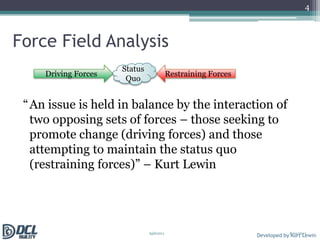
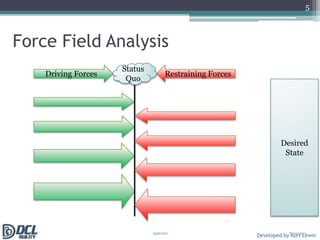
Force Field Analysis4Status QuoDriving ForcesRestraining Forces“	An issue is held in balance by the interaction of two opposing sets of forces – those seeking to promote change (driving forces) and those attempting to maintain the status quo (restraining forces)” – Kurt LewinDeveloped by Kurt Lewin8/10/2011Agile2011
Status QuoDriving ForcesRestraining ForcesDesired StateForce Field Analysis5Developed by Kurt Lewin8/10/2011Agile2011
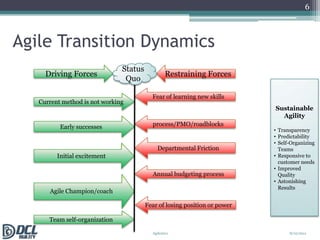
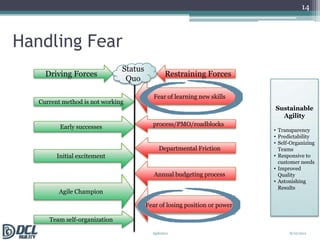
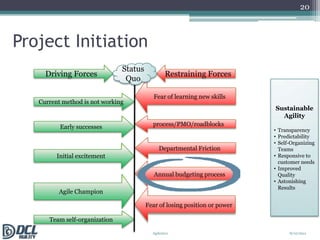
Agile Transition Dynamics6Status QuoDriving ForcesRestraining ForcesSustainable AgilityTransparency
Predictability
Self-Organizing Teams
Responsive to customer needs
Improved Quality
Astonishing ResultsFear of learning new skillsCurrent method is not workingprocess/PMO/roadblocksEarly successesDepartmental FrictionInitial excitementAnnual budgeting processAgile Champion/coachFear of losing position or powerTeam self-organization8/10/2011Agile2011
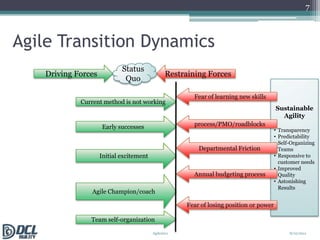
Agile Transition Dynamics7Status QuoDriving ForcesRestraining ForcesSustainable AgilityTransparency
Predictability
Self-Organizing Teams
Responsive to customer needs
Improved Quality
Astonishing ResultsFear of learning new skillsCurrent method is not workingprocess/PMO/roadblocksEarly successesDepartmental FrictionInitial excitementAnnual budgeting processAgile Champion/coachFear of losing position or powerTeam self-organization8/10/2011Agile2011
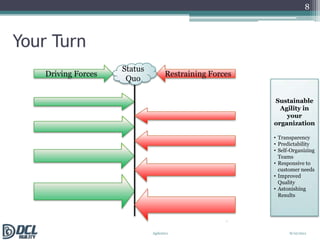
Status QuoDriving ForcesRestraining ForcesSustainable Agility in your organizationTransparency
Predictability
Self-Organizing Teams
Responsive to customer needs
Improved Quality
Astonishing ResultsYour Turn88/10/2011Agile2011
Exercise: Stretch breakStand up and stretch your bodyTurn to the person standing next to you and give him/her a short, two-minute, verbal summary of what you've just learned about Force Field AnalysisNext, listen to your partner’s summarization of his/her learningSit when finished98/10/2011Agile2011 9
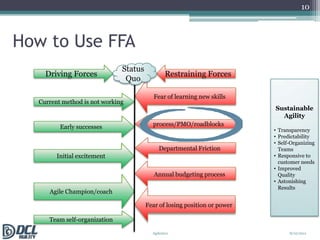
How to Use FFA10Status QuoDriving ForcesRestraining ForcesSustainable AgilityTransparency

Agile2011 when the coaches leave

Editor's Notes

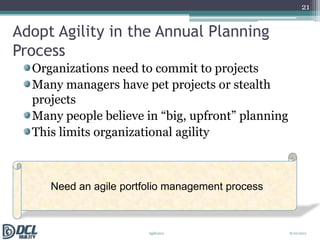
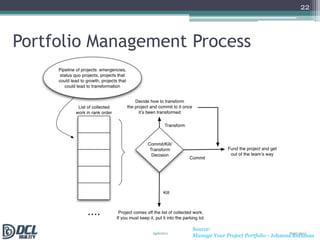
  • #4 Transitioning to agile is hard. It involves learning new techniques, thinking in a different way, and stepping out of your comfort zone. No wonder so many agile transitions revert back to previous ways over time. A change in management or a loss of the agile champion is often a catalyst for this process. This talk describes several mechanisms to help counteract these forces, and how to incorporate them into your organization. Presented through examinations of real-life examples, interactive exercises and open discussions, this talk provides guidance on how to create sustainable agility.Process/MechanicsWhat are the general dynamics of change? 15 min Overview of Satir change model and dynamics involvedWhat are the specific forces resisting agility? 15 min Use of force-field analysis to examine these forces within an organizationWhat is organizational entropy and how can it be avoided? 30 min Open discussion on the decay of organizational systems, conservation of organization energy, and how to combat these.What are the key mechanisms to sustain agility? 30 min Presented as a series of examinations of real-life situtations and how they were addressed, both successfully and unsuccessfully. Also included is my recommendation of the 3 key mechanisms and how to set them up in your organization.Learning outcomesUnderstand the forces that act against a change to agileTechniques to discuss and address them in your organizationHow to install mechanism to maintain agility
  • #5 Force field analysis is a tool to examine forces driving a change and forces restraining the changeDefine the change you want to see. Write down the goal or vision of a future desired state. Or you might prefer to understand the present status quo or equilibrium.Brainstorm or Mind Map the Driving Forces - those that are favorable to change. Record these on a force field diagram. Brainstorm or Mind Map the Restraining Forces - those that are unfavorable to, or oppose change. Record these on the force field diagram. Evaluate the Driving and Restraining forces. You can do this by rating each force, from 1 (weak) to 5 (strong), and total each side. Or you can leave the numbers out completely and focus holistically on the impact each has.Review the forces. Decide which of the forces have some flexibility for change or which can be influenced.Strategize! Create a strategy to strengthen the driving forces or weaken the restraining forces, or both. If you've rated each force how can you raise the scores of the Driving Forces or lower the scores of the Restraining Forces, or both?Prioritize action steps. What action steps can you take that will achieve the greatest impact? Identify the resources you will need and decide how to implement the action steps.Hint: Sometimes it's easier to reduce the impact of restraining forces than it is to strengthen driving forces.
  • #6 Force field analysis is a tool to examine forces driving a change and forces restraining the changeDefine the change you want to see. Write down the goal or vision of a future desired state. Or you might prefer to understand the present status quo or equilibrium.Brainstorm or Mind Map the Driving Forces - those that are favorable to change. Record these on a force field diagram. Brainstorm or Mind Map the Restraining Forces - those that are unfavorable to, or oppose change. Record these on the force field diagram. Evaluate the Driving and Restraining forces. You can do this by rating each force, from 1 (weak) to 5 (strong), and total each side. Or you can leave the numbers out completely and focus holistically on the impact each has.
  • #7 Let's see how this could look in a typical agile transition.It usually starts with the realization that the current method is not working.Then there is resistance from the PMO or those vested in the current way. Roadblocks are either erected or reinforced. Statements like we need these documents, agile is hacking, we need to plan.Some early successes help to fuel the energy but fear of learning new skills, or being exposed start to grow. Remember one of the Scrum values is courage and this is when it starts getting tested.Teams and some business people start getting excited. The annual budgeting process starts to get in the way. Many organization plan a year's worth of projects for the budget and set commitments for the year. This flys in the face of agility so resistance mounts. Also, friction with other departments gets exacerbated, Dev vs. QA, marketing vs. Engineering, facilities may even get annoyed about team moves, stuff on the walls, and lack of conference rooms.Usually a senior person, seeing the benefits, becomes the champion. She works with other to reduce friction and fear, helps remove roadblocks, increases visibility of the successes and maintains positivity. Teams also get addicted to self-organization. This drives more fear, particularly of middle managers who cannot see their role in the new way.
  • #8 We get movement toward the goal but the resistance grows so the adoption stalls. Many organizations see a 10% to 30% improvement and are happy.What happens if the champion leaves?The restraining forces can sometime overwhelm the remaining driving forces and the company reverts back to the status quo.Does this sound familiar?
  • #9 Get in groups of 5 to 7. Take 15 minutes. How did that go?
  • #10 Build in short stretch breaks for the learners to do. Tell them what to do and why it's important for them to do it.Ask learners to stand, then say to them: "By changing your position from sitting to standing, you have just now increased the flow of oxygen to your brain by about 20 percent, which means your brain is suddenly working better. Now stretch your body (arms, legs, torso), and then turn to the person standing next to you and give him/her a short verbal summary of what you've just learned from the lecture so far. Sit when finished."
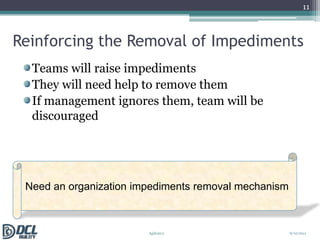
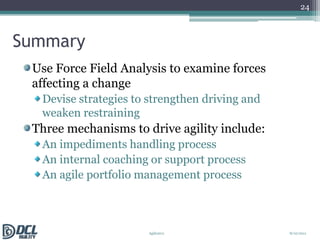
  • #11 Once you have your diagram, you can then look at it and devise strategies to increase the driving forces or reduce the restraining forces. One thing is sure, you cannot just depend on the agile champion to keep it going. Some fundamental changes to organizational processes have to happen so that dependence on an individual is reducedReview the forces. Decide which of the forces have some flexibility for change or which can be influenced.Strategize! Create a strategy to strengthen the driving forces or weaken the restraining forces, or both. If you've rated each force how can you raise the scores of the Driving Forces or lower the scores of the Restraining Forces, or both?Prioritize action steps. What action steps can you take that will achieve the greatest impact? Identify the resources you will need and decide how to implement the action steps.Hint: Sometimes it's easier to reduce the impact of restraining forces than it is to strengthen driving forces.
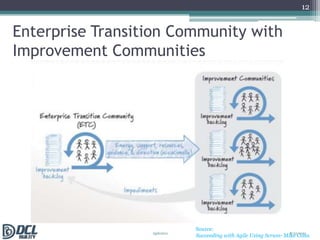
  • #13 Suggested by Ken Schwaber and Mike CohnETCTeam of senior leadersCollects and prioritizes impedimentsCreates an environment where employees can form teams to remove impedimentsICTeams of individual contributors with energy to fix a problem
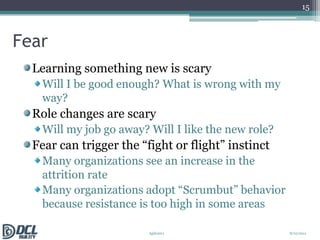
  • #15 Handling fear.
  • #21 Handling fear.
  • #24 One minute per person, i.e., 5-6 minutes total for the group