Introduction to Agile
Marketing
Will Egan
@willegan | willegan.com
Introduction to Agile Marketing
AGENDA
‣ Welcome
‣ Setting the scene
‣ Principles of agile marketing
‣ Comparing traditional to agile
‣ Implementation
‣ Tools
‣ Conclusion
3 x
Practical
Exercises
INTRODUCTION
A little about me…
‣ CMO at Ausmed
‣ Co-founder of Code the Future
‣ Background in technical SEO
‣ Digital marketing since 2007
INTRODUCTION
Objectives
‣ Understand what lean and agile methodology is and the benefits of
thinking in those terms, and how it's different to growth hacking
‣ Learn how to apply methodology to marketing
‣ Case studies and examples on agile marketing in action
‣ Review of the various tools and planning required for execution
‣ Discuss what success looks like and the metrics to track success
‣ Live simulation: walk through how to optimise performance of current
marketing initiatives with agile marketing
INTRODUCTION
We have one and half hours…
‣ What do you hope to get out of this class?
‣ Why have you come here today?
‣ What must I cover, for this to be worthwhile?
‣ More theory, or more practical?
‣ What type of marketing environment are you in?
Setting the Scene
Introduction to Agile Marketing
Volatile
Uncertain
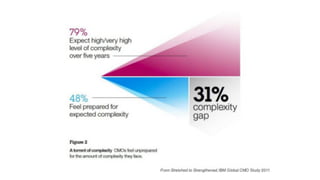
Complex
Ambiguous
VUCA
Volatile
‣ Change is constant
‣ Change is accelerating
‣ Competitive advantages are getting harder to maintain
‣ Competition emerging everywhere
‣ Brands are struggling to outlast their products
12
VUCA
Uncertain
‣ Returns are harder to guarantee
‣ Strategies that worked even six months ago may not work today
‣ Brands are easier to build, but it’s even easier to fall
‣ Vocal customers demanding more
‣ Invariably, first to the plate gets the biggest feed
‣ Opportunities emerging and disappearing rapidly
VUCA
Complex
‣ Technical complexity is high, and increasing
‣ Data/analytics driving decision making
‣ Marketing teams relying on more skills
‣ People with the right skills are rare
‣ Channels expanding/audiences narrowing
17
VUCA
Ambiguous
‣ Returns are getting harder to guarantee
‣ Digital Darwinism
‣ Speed and uncertainty
‣ Should you persist with failing campaigns?
‣ Misleading data
INTRODUCTION
Need for an Agile Marketing Environment
Agile methodology allows the modern marketing team to
adapt to fast-changing market conditions, respond to
immediate sales needs, and prove ROI quickly and
consistently.
Definition taken from Hubspot’s ‘Go Agile or Go Home’
INTRODUCTION
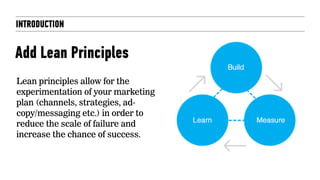
Add Lean Principles
Lean principles allow for the
experimentation of your marketing
plan (channels, strategies, ad-
copy/messaging etc.) in order to
reduce the scale of failure and
increase the chance of success.
INTRODUCTION
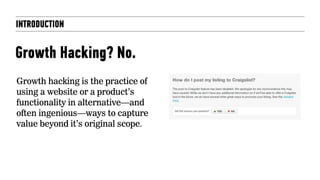
Growth Hacking? No.
Growth hacking is the practice of
using a website or a product’s
functionality in alternative—and
often ingenious—ways to capture
value beyond it’s original scope.
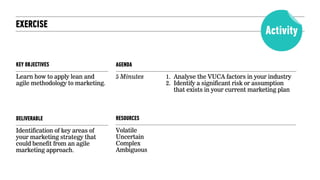
KEY OBJECTIVES
Learn how to apply lean and
agile methodology to marketing.
EXERCISE
AGENDA
5 Minutes 1. Analyse the VUCA factors in your industry
2. Identify a significant risk or assumption
that exists in your current marketing plan
DELIVERABLE
Identification of key areas of
your marketing strategy that
could benefit from an agile
marketing approach.
RESOURCES
Volatile
Uncertain
Complex
Ambiguous
Activity
Principles of Agile
Marketing
Introduction to Agile Marketing
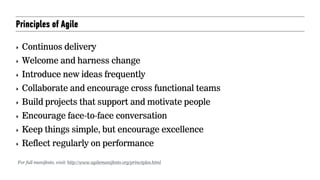
Principles of Agile
‣ Continuos delivery
‣ Welcome and harness change
‣ Introduce new ideas frequently
‣ Collaborate and encourage cross functional teams
‣ Build projects that support and motivate people
‣ Encourage face-to-face conversation
‣ Keep things simple, but encourage excellence
‣ Reflect regularly on performance
For full manifesto, visit: http://www.agilemanifesto.org/principles.html
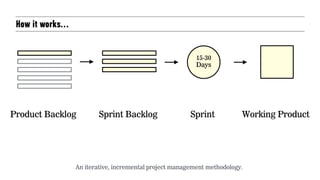
How it works…
Product Backlog
An iterative, incremental project management methodology.
Sprint Backlog
15-30
Days
Sprint Working Product
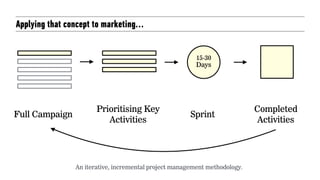
Applying that concept to marketing…
Full Campaign
An iterative, incremental project management methodology.
Prioritising Key
Activities
15-30
Days
Sprint
Completed
Activities
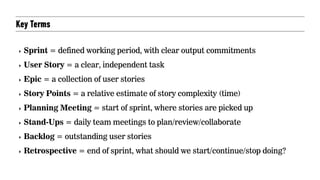
Key Terms
‣ Sprint = defined working period, with clear output commitments
‣ User Story = a clear, independent task
‣ Epic = a collection of user stories
‣ Story Points = a relative estimate of story complexity (time)
‣ Planning Meeting = start of sprint, where stories are picked up
‣ Stand-Ups = daily team meetings to plan/review/collaborate
‣ Backlog = outstanding user stories
‣ Retrospective = end of sprint, what should we start/continue/stop doing?
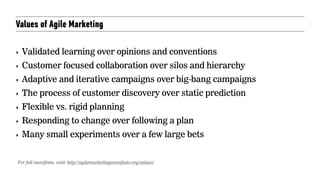
Values of Agile Marketing
‣ Validated learning over opinions and conventions
‣ Customer focused collaboration over silos and hierarchy
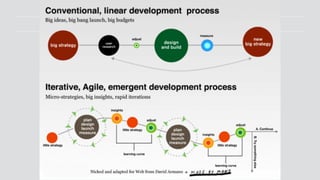
‣ Adaptive and iterative campaigns over big-bang campaigns
‣ The process of customer discovery over static prediction
‣ Flexible vs. rigid planning
‣ Responding to change over following a plan
‣ Many small experiments over a few large bets
For full manifesto, visit: http://agilemarketingmanifesto.org/values/
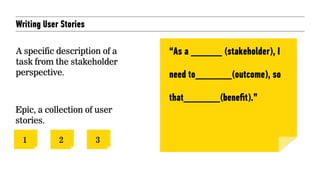
Writing User Stories
A specific description of a
task from the stakeholder
perspective.
“As a ______ (stakeholder), I
need to_______(outcome), so
that_______(benefit).”
Epic, a collection of user
stories.
1 2 3
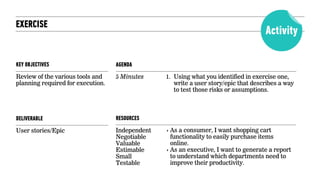
KEY OBJECTIVES
Review of the various tools and
planning required for execution.
EXERCISE
AGENDA
5 Minutes 1. Using what you identified in exercise one,
write a user story/epic that describes a way
to test those risks or assumptions.
DELIVERABLE
User stories/Epic
RESOURCES
Independent
Negotiable
Valuable
Estimable
Small
Testable
Activity
‣ As a consumer, I want shopping cart
functionality to easily purchase items
online.
‣ As an executive, I want to generate a report
to understand which departments need to
improve their productivity.
How Traditional
and Agile Differ
Introduction to Agile Marketing
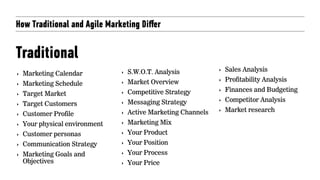
How Traditional and Agile Marketing Differ
Traditional
‣ Marketing Calendar
‣ Marketing Schedule
‣ Target Market
‣ Target Customers
‣ Customer Profile
‣ Your physical environment
‣ Customer personas
‣ Communication Strategy
‣ Marketing Goals and
Objectives
‣ S.W.O.T. Analysis
‣ Market Overview
‣ Competitive Strategy
‣ Messaging Strategy
‣ Active Marketing Channels
‣ Marketing Mix
‣ Your Product
‣ Your Position
‣ Your Process
‣ Your Price
‣ Sales Analysis
‣ Profitability Analysis
‣ Finances and Budgeting
‣ Competitor Analysis
‣ Market research
How Traditional and Agile Marketing Differ
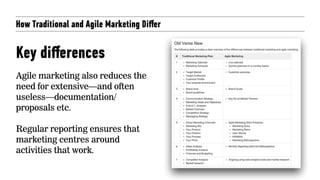
Key differences
Agile marketing also reduces the
need for extensive—and often
useless—documentation/
proposals etc.
Regular reporting ensures that
marketing centres around
activities that work.
KEY CHALLENGE/QUESTION
1. Are we hitting our deadlines?
2. Are we meeting our goals?
3. Are we telling the right
story?
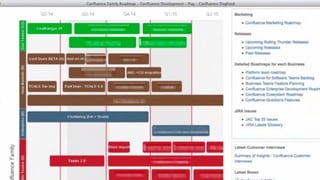
CASE STUDY
SUMMARY
Agile is not just for development teams. At Atlassian, Agile is a way
of life for all teams.
https://www.atlassian.com/landing/agile/how-we-do-it#!marketing
Atlassian
37
38
39
Implementation
Introduction to Agile Marketing
Key Considerations
‣ Ensure your team is well educated on agile
‣ Start with an experiment with one team, or one project
‣ Prepare campaigns in both formats, to see how they would differ
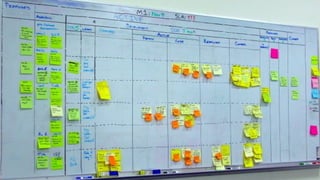
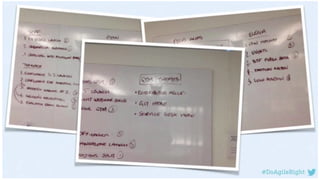
‣ Don’t obsess over tools to begin with, just use a wall and cards
‣ Define your go-to-market themes and data points you can track to
report against them
Identifying Go To Market Themes
‣ Rather than dictating exact activities, provide a vision of what you
want your team/campaign to focus on
‣ Develop a reporting tool that provides you with that feedback loop
‣ Review the GTM themes at each retrospective
‣ They should provide a general direction only, without defining exactly
what we do, but remain measurable.
‣ Examples:
‣ “Grow our online community”
‣ “Directly grow revenue from existing traffic”
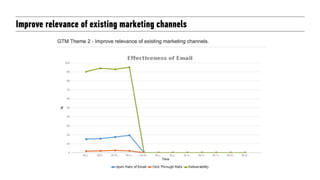
‣ “Improve relevance of existing marketing channels”
Improve relevance of existing marketing channels
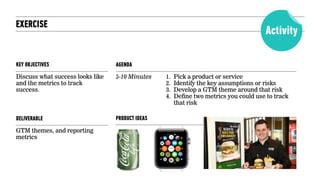
KEY OBJECTIVES
Discuss what success looks like
and the metrics to track
success.
EXERCISE
AGENDA
5-10 Minutes 1. Pick a product or service
2. Identify the key assumptions or risks
3. Develop a GTM theme around that risk
4. Define two metrics you could use to track
that risk
DELIVERABLE
GTM themes, and reporting
metrics
PRODUCT IDEAS
Activity
Tools
Introduction to Agile Marketing
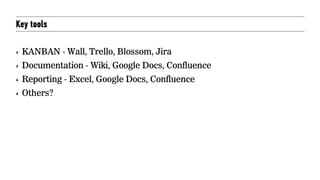
Key tools
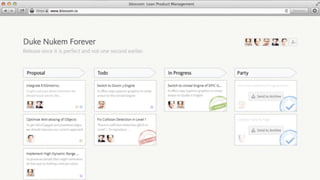
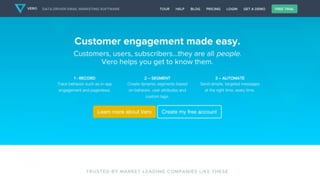
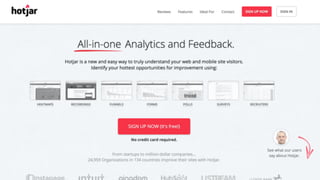
‣ KANBAN - Wall, Trello, Blossom, Jira
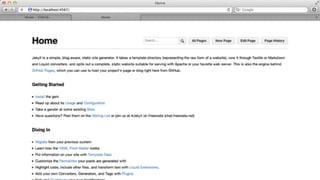
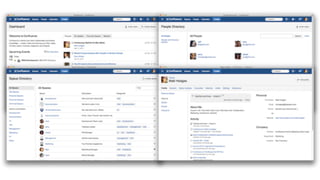
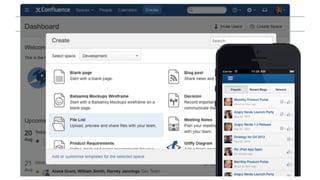
‣ Documentation - Wiki, Google Docs, Confluence
‣ Reporting - Excel, Google Docs, Confluence
‣ Others?
49
50
51
52
53
Bonus Tools/Ideas
Introduction to Agile Marketing
that will make you money… quickly!
56
57
58
Conclusion
Introduction to Agile Marketing
Key Considerations
‣ Agile marketing is a reaction to the transition that other teams have
already made in the business
‣ It’s designed to reduce time, failure, documentation and increase
success, feedback, happiness
‣ Introduce by providing education on agile
‣ Then, transition one team or campaign over first
‣ Build a feedback loop, and become better at defining success metrics
‣ Change constantly, remember your evolutionary instinct
‣ Don’t worry about the tools and system so much, focus on the
underlying values of agile
Thanks, Q&A
Introduction to Agile Marketing
Will Egan
@willegan | willegan.com
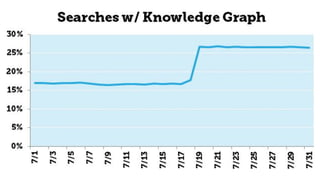
• https://moz.com/blog/app-store-rankings-formula-deconstructed-in-5-mad-
science-experiments
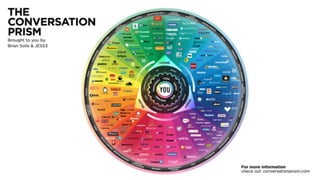
• https://conversationprism.com
ADDITIONAL REFERENCES

Introduction to Agile Marketing

  • 1.
    Introduction to Agile Marketing WillEgan @willegan | willegan.com
  • 2.
    Introduction to AgileMarketing AGENDA ‣ Welcome ‣ Setting the scene ‣ Principles of agile marketing ‣ Comparing traditional to agile ‣ Implementation ‣ Tools ‣ Conclusion 3 x Practical Exercises
  • 3.
    INTRODUCTION A little aboutme… ‣ CMO at Ausmed ‣ Co-founder of Code the Future ‣ Background in technical SEO ‣ Digital marketing since 2007
  • 4.
    INTRODUCTION Objectives ‣ Understand whatlean and agile methodology is and the benefits of thinking in those terms, and how it's different to growth hacking ‣ Learn how to apply methodology to marketing ‣ Case studies and examples on agile marketing in action ‣ Review of the various tools and planning required for execution ‣ Discuss what success looks like and the metrics to track success ‣ Live simulation: walk through how to optimise performance of current marketing initiatives with agile marketing
  • 5.
    INTRODUCTION We have oneand half hours… ‣ What do you hope to get out of this class? ‣ Why have you come here today? ‣ What must I cover, for this to be worthwhile? ‣ More theory, or more practical? ‣ What type of marketing environment are you in?
  • 6.
  • 7.
  • 8.
  • 9.
  • 10.
  • 11.
    VUCA Volatile ‣ Change isconstant ‣ Change is accelerating ‣ Competitive advantages are getting harder to maintain ‣ Competition emerging everywhere ‣ Brands are struggling to outlast their products
  • 12.
  • 13.
    VUCA Uncertain ‣ Returns areharder to guarantee ‣ Strategies that worked even six months ago may not work today ‣ Brands are easier to build, but it’s even easier to fall ‣ Vocal customers demanding more ‣ Invariably, first to the plate gets the biggest feed ‣ Opportunities emerging and disappearing rapidly
  • 16.
    VUCA Complex ‣ Technical complexityis high, and increasing ‣ Data/analytics driving decision making ‣ Marketing teams relying on more skills ‣ People with the right skills are rare ‣ Channels expanding/audiences narrowing
  • 17.
  • 18.
    VUCA Ambiguous ‣ Returns aregetting harder to guarantee ‣ Digital Darwinism ‣ Speed and uncertainty ‣ Should you persist with failing campaigns? ‣ Misleading data
  • 20.
    INTRODUCTION Need for anAgile Marketing Environment Agile methodology allows the modern marketing team to adapt to fast-changing market conditions, respond to immediate sales needs, and prove ROI quickly and consistently. Definition taken from Hubspot’s ‘Go Agile or Go Home’
  • 21.
    INTRODUCTION Add Lean Principles Leanprinciples allow for the experimentation of your marketing plan (channels, strategies, ad- copy/messaging etc.) in order to reduce the scale of failure and increase the chance of success.
  • 22.
    INTRODUCTION Growth Hacking? No. Growthhacking is the practice of using a website or a product’s functionality in alternative—and often ingenious—ways to capture value beyond it’s original scope.
  • 23.
    KEY OBJECTIVES Learn howto apply lean and agile methodology to marketing. EXERCISE AGENDA 5 Minutes 1. Analyse the VUCA factors in your industry 2. Identify a significant risk or assumption that exists in your current marketing plan DELIVERABLE Identification of key areas of your marketing strategy that could benefit from an agile marketing approach. RESOURCES Volatile Uncertain Complex Ambiguous Activity
  • 24.
  • 25.
    Principles of Agile ‣Continuos delivery ‣ Welcome and harness change ‣ Introduce new ideas frequently ‣ Collaborate and encourage cross functional teams ‣ Build projects that support and motivate people ‣ Encourage face-to-face conversation ‣ Keep things simple, but encourage excellence ‣ Reflect regularly on performance For full manifesto, visit: http://www.agilemanifesto.org/principles.html
  • 26.
    How it works… ProductBacklog An iterative, incremental project management methodology. Sprint Backlog 15-30 Days Sprint Working Product
  • 27.
    Applying that conceptto marketing… Full Campaign An iterative, incremental project management methodology. Prioritising Key Activities 15-30 Days Sprint Completed Activities
  • 28.
    Key Terms ‣ Sprint= defined working period, with clear output commitments ‣ User Story = a clear, independent task ‣ Epic = a collection of user stories ‣ Story Points = a relative estimate of story complexity (time) ‣ Planning Meeting = start of sprint, where stories are picked up ‣ Stand-Ups = daily team meetings to plan/review/collaborate ‣ Backlog = outstanding user stories ‣ Retrospective = end of sprint, what should we start/continue/stop doing?
  • 29.
    Values of AgileMarketing ‣ Validated learning over opinions and conventions ‣ Customer focused collaboration over silos and hierarchy ‣ Adaptive and iterative campaigns over big-bang campaigns ‣ The process of customer discovery over static prediction ‣ Flexible vs. rigid planning ‣ Responding to change over following a plan ‣ Many small experiments over a few large bets For full manifesto, visit: http://agilemarketingmanifesto.org/values/
  • 30.
    Writing User Stories Aspecific description of a task from the stakeholder perspective. “As a ______ (stakeholder), I need to_______(outcome), so that_______(benefit).” Epic, a collection of user stories. 1 2 3
  • 31.
    KEY OBJECTIVES Review ofthe various tools and planning required for execution. EXERCISE AGENDA 5 Minutes 1. Using what you identified in exercise one, write a user story/epic that describes a way to test those risks or assumptions. DELIVERABLE User stories/Epic RESOURCES Independent Negotiable Valuable Estimable Small Testable Activity ‣ As a consumer, I want shopping cart functionality to easily purchase items online. ‣ As an executive, I want to generate a report to understand which departments need to improve their productivity.
  • 32.
    How Traditional and AgileDiffer Introduction to Agile Marketing
  • 34.
    How Traditional andAgile Marketing Differ Traditional ‣ Marketing Calendar ‣ Marketing Schedule ‣ Target Market ‣ Target Customers ‣ Customer Profile ‣ Your physical environment ‣ Customer personas ‣ Communication Strategy ‣ Marketing Goals and Objectives ‣ S.W.O.T. Analysis ‣ Market Overview ‣ Competitive Strategy ‣ Messaging Strategy ‣ Active Marketing Channels ‣ Marketing Mix ‣ Your Product ‣ Your Position ‣ Your Process ‣ Your Price ‣ Sales Analysis ‣ Profitability Analysis ‣ Finances and Budgeting ‣ Competitor Analysis ‣ Market research
  • 35.
    How Traditional andAgile Marketing Differ Key differences Agile marketing also reduces the need for extensive—and often useless—documentation/ proposals etc. Regular reporting ensures that marketing centres around activities that work.
  • 36.
    KEY CHALLENGE/QUESTION 1. Arewe hitting our deadlines? 2. Are we meeting our goals? 3. Are we telling the right story? CASE STUDY SUMMARY Agile is not just for development teams. At Atlassian, Agile is a way of life for all teams. https://www.atlassian.com/landing/agile/how-we-do-it#!marketing Atlassian
  • 37.
  • 38.
  • 39.
  • 40.
  • 42.
    Key Considerations ‣ Ensureyour team is well educated on agile ‣ Start with an experiment with one team, or one project ‣ Prepare campaigns in both formats, to see how they would differ ‣ Don’t obsess over tools to begin with, just use a wall and cards ‣ Define your go-to-market themes and data points you can track to report against them
  • 43.
    Identifying Go ToMarket Themes ‣ Rather than dictating exact activities, provide a vision of what you want your team/campaign to focus on ‣ Develop a reporting tool that provides you with that feedback loop ‣ Review the GTM themes at each retrospective ‣ They should provide a general direction only, without defining exactly what we do, but remain measurable. ‣ Examples: ‣ “Grow our online community” ‣ “Directly grow revenue from existing traffic” ‣ “Improve relevance of existing marketing channels”
  • 44.
    Improve relevance ofexisting marketing channels
  • 45.
    KEY OBJECTIVES Discuss whatsuccess looks like and the metrics to track success. EXERCISE AGENDA 5-10 Minutes 1. Pick a product or service 2. Identify the key assumptions or risks 3. Develop a GTM theme around that risk 4. Define two metrics you could use to track that risk DELIVERABLE GTM themes, and reporting metrics PRODUCT IDEAS Activity
  • 46.
  • 47.
    Key tools ‣ KANBAN- Wall, Trello, Blossom, Jira ‣ Documentation - Wiki, Google Docs, Confluence ‣ Reporting - Excel, Google Docs, Confluence ‣ Others?
  • 49.
  • 50.
  • 51.
  • 52.
  • 53.
  • 55.
    Bonus Tools/Ideas Introduction toAgile Marketing that will make you money… quickly!
  • 56.
  • 57.
  • 58.
  • 59.
  • 60.
    Key Considerations ‣ Agilemarketing is a reaction to the transition that other teams have already made in the business ‣ It’s designed to reduce time, failure, documentation and increase success, feedback, happiness ‣ Introduce by providing education on agile ‣ Then, transition one team or campaign over first ‣ Build a feedback loop, and become better at defining success metrics ‣ Change constantly, remember your evolutionary instinct ‣ Don’t worry about the tools and system so much, focus on the underlying values of agile
  • 61.
    Thanks, Q&A Introduction toAgile Marketing Will Egan @willegan | willegan.com
  • 62.