Agile Software Development by the
            Numbers:
What’s Really Going On Out There

             Scott W. Ambler
        Chief Methodologist/Agile
        scott_ambler@ca.ibm.com
Warning!
•   You’ll be presented with a lot of information very quickly
Agenda
 •   The Surveys
 •   Agile Practices
 •   Agility@Scale
 •   Adoption and Success Rates
 •   Management
 •   Governance
 •   Development and Quality
 •   Modeling and Documentation
 •   Communication
 •   Parting Thoughts
Agenda
 •   The Surveys
 •   Agile Practices
 •   Agility@Scale
 •   Adoption and Success
     Rates
 •   Management
 •   Governance
 •   Development and Quality
 •   Modeling and
     Documentation
 •   Communication
 •   Parting Thoughts
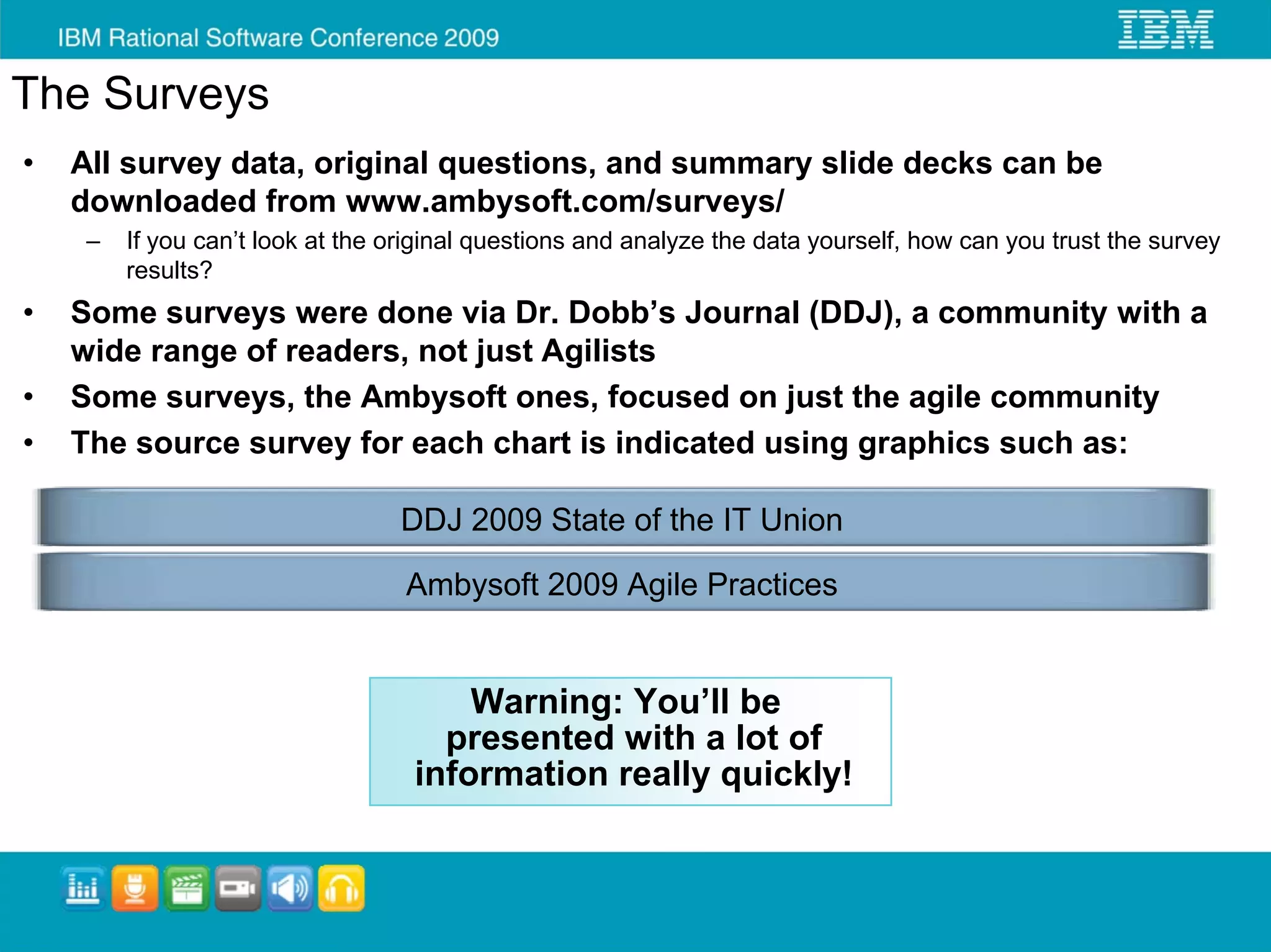
The Surveys
•   All survey data, original questions, and summary slide decks can be
    downloaded from www.ambysoft.com/surveys/
     –   If you can’t look at the original questions and analyze the data yourself, how can you trust the survey
         results?
•   Some surveys were done via Dr. Dobb’s Journal (DDJ), a community with a
    wide range of readers, not just Agilists
•   Some surveys, the Ambysoft ones, focused on just the agile community
•   The source survey for each chart is indicated using graphics such as:

                                  DDJ 2009 State of the IT Union

                                   Ambysoft 2009 Agile Practices


                                        Warning: You’ll be
                                      presented with a lot of
                                    information really quickly!
Agenda
 •   The Surveys
 •   Agile Practices
 •   Agility@Scale
 •   Adoption and Success
     Rates
 •   Management
 •   Governance
 •   Development and Quality
 •   Modeling and
     Documentation
 •   Communication
 •   Parting Thoughts
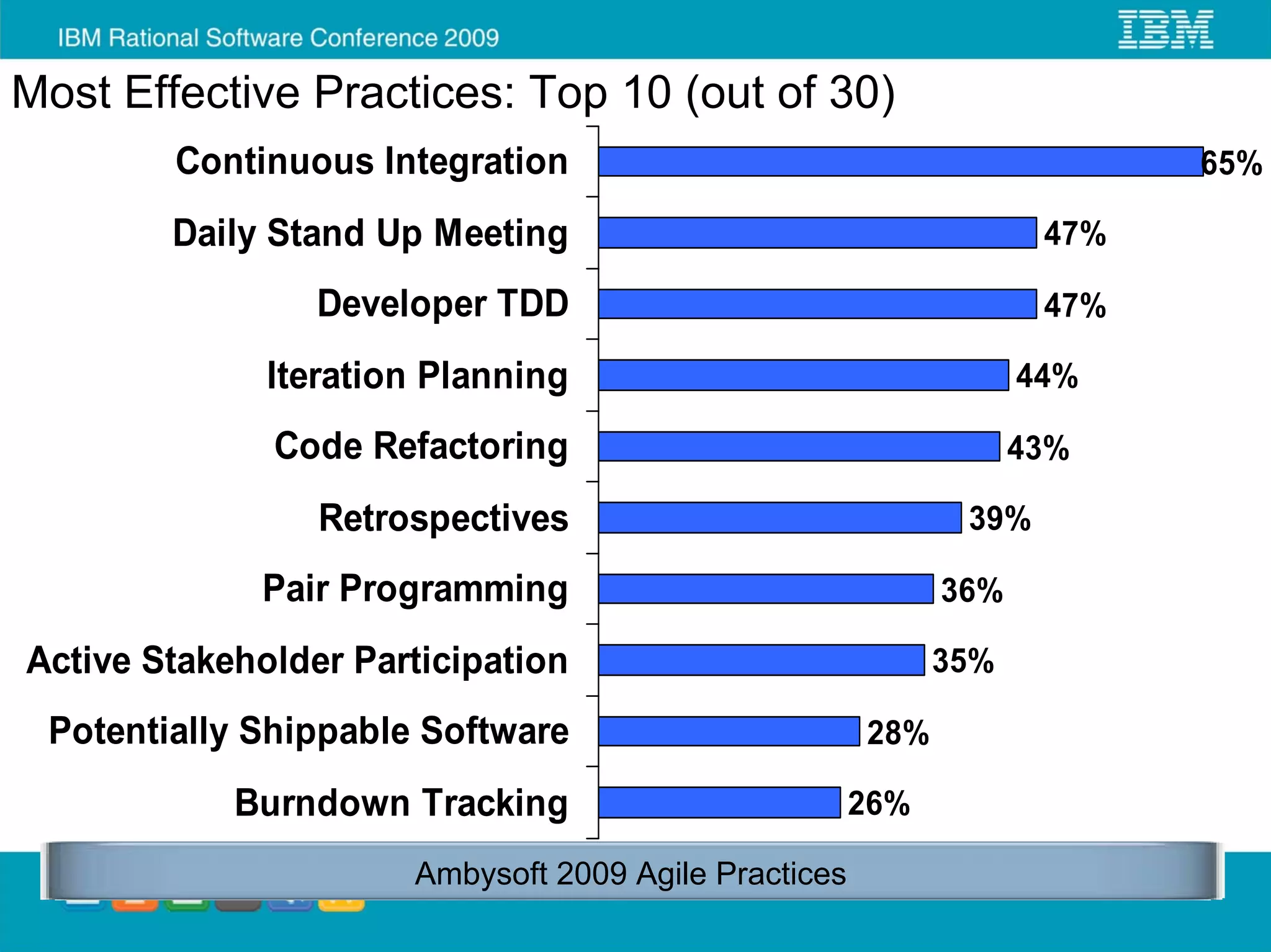
Most Effective Practices: Top 10 (out of 30)
        Continuous Integration                                           65%

        Daily Stand Up Meeting                                     47%

                 Developer TDD                                     47%

              Iteration Planning                                  44%

              Code Refactoring                                    43%

                 Retrospectives                              39%

             Pair Programming                               36%

Active Stakeholder Participation                            35%

 Potentially Shippable Software                       28%

            Burndown Tracking                         26%

                      Ambysoft 2009 Agile Practices
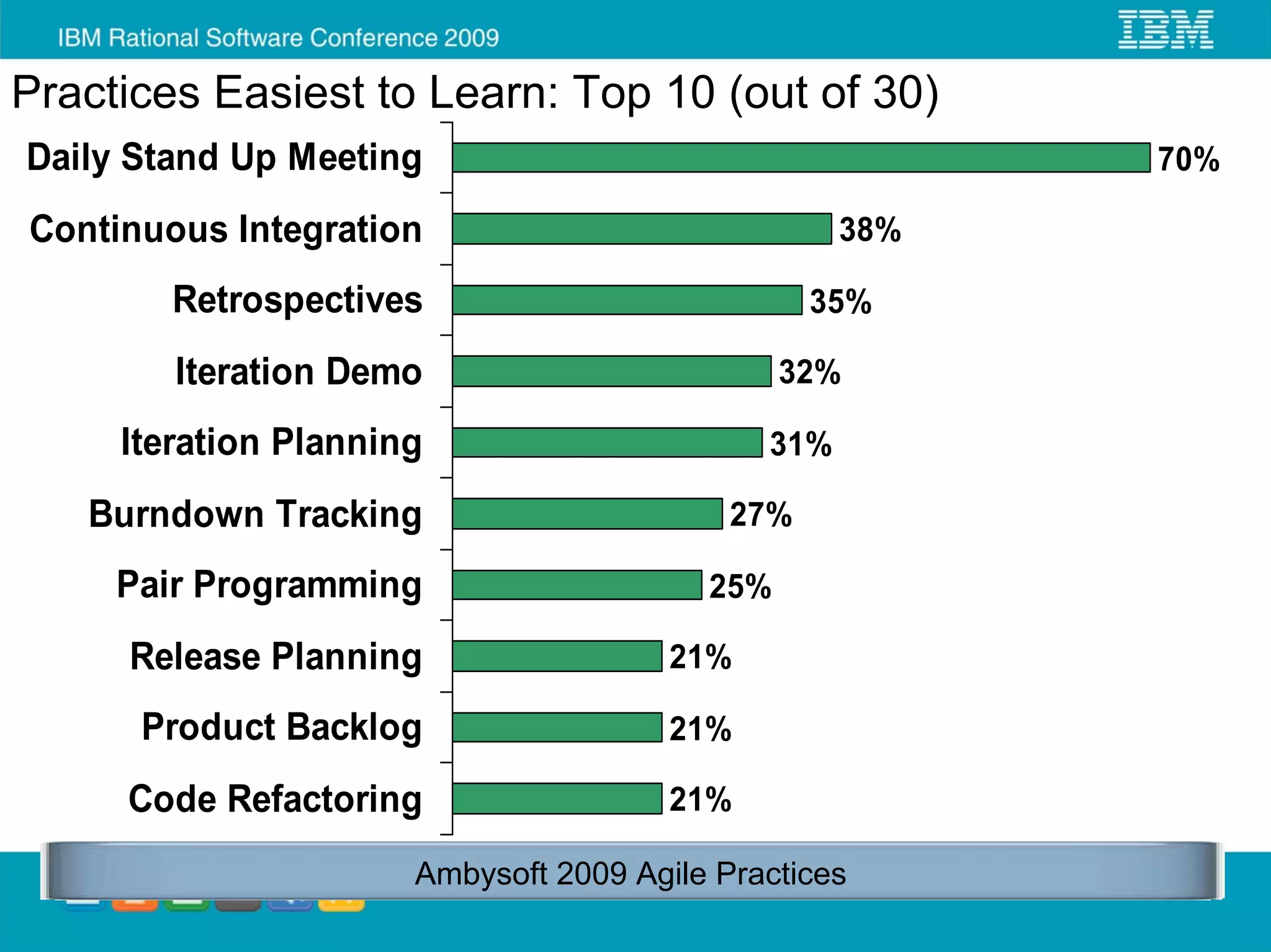
Practices Easiest to Learn: Top 10 (out of 30)
Daily Stand Up Meeting                                   70%

Continuous Integration                             38%

        Retrospectives                           35%

        Iteration Demo                         32%

     Iteration Planning                      31%

   Burndown Tracking                       27%

     Pair Programming                    25%

     Release Planning                  21%

      Product Backlog                  21%

     Code Refactoring                  21%

                      Ambysoft 2009 Agile Practices
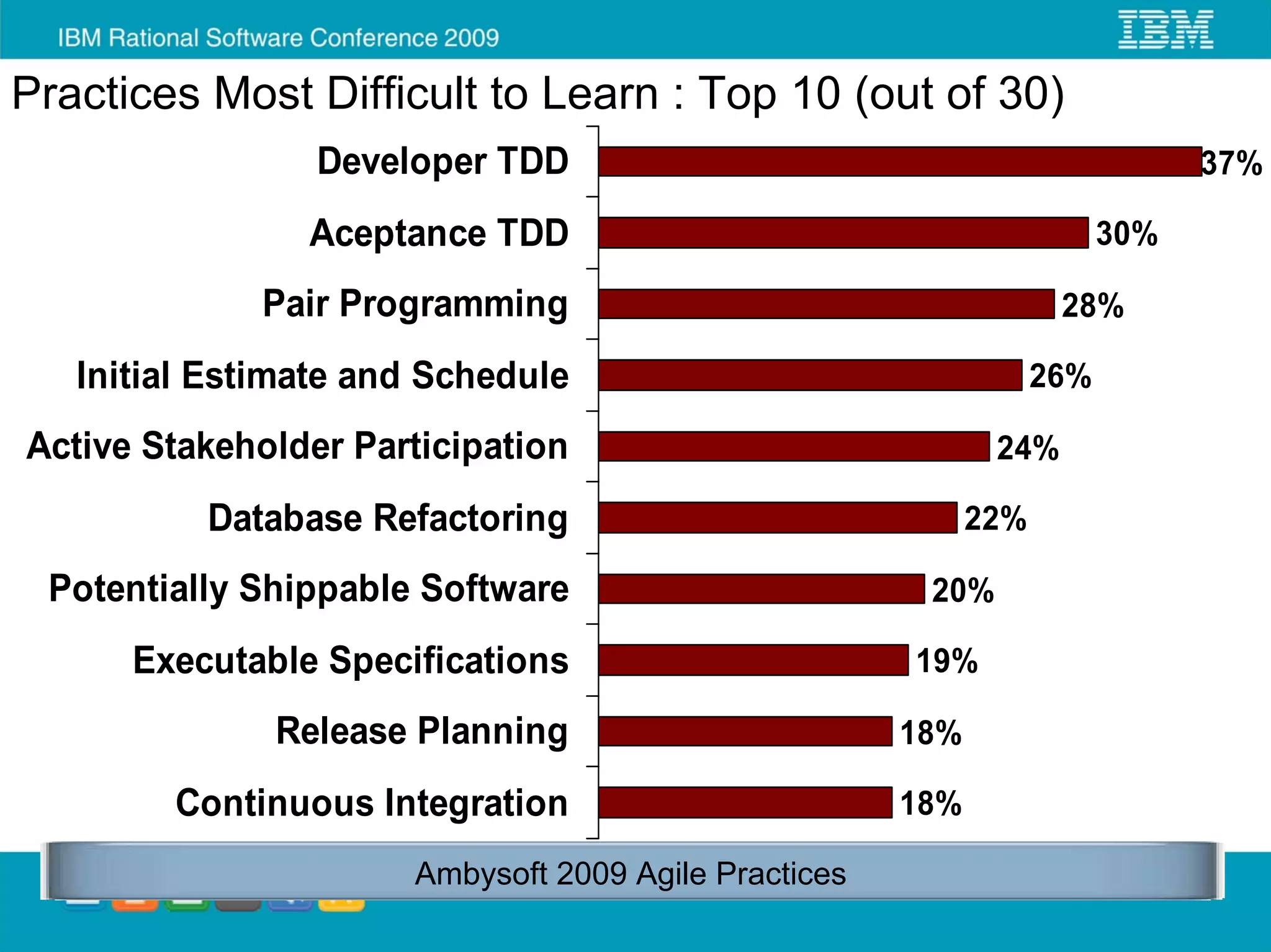
Practices Most Difficult to Learn : Top 10 (out of 30)
                 Developer TDD                                                37%

                Aceptance TDD                                           30%

             Pair Programming                                      28%

   Initial Estimate and Schedule                                  26%

Active Stakeholder Participation                             24%

          Database Refactoring                              22%

 Potentially Shippable Software                        20%

      Executable Specifications                       19%

              Release Planning                        18%

        Continuous Integration                        18%

                      Ambysoft 2009 Agile Practices
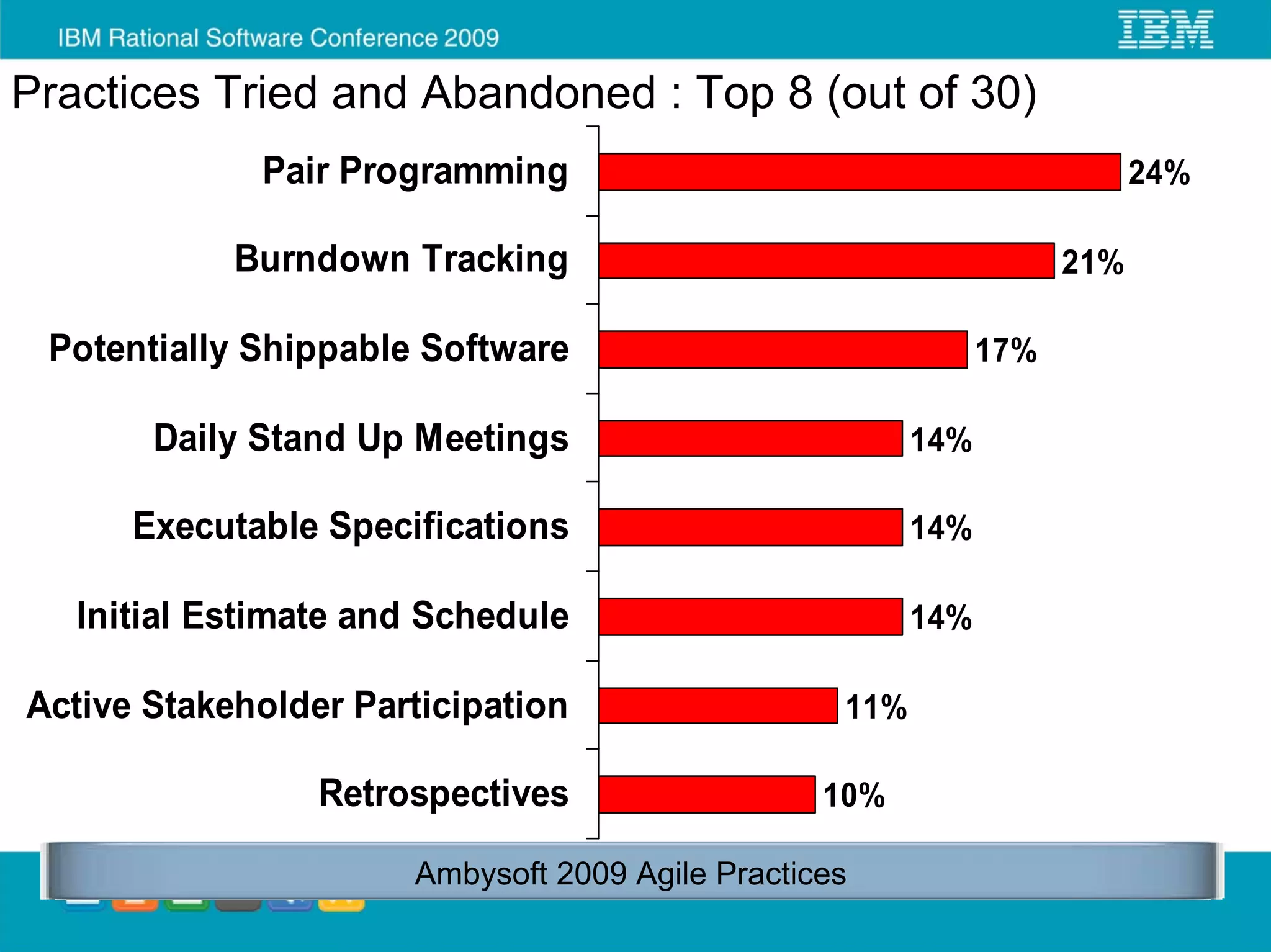
Practices Tried and Abandoned : Top 8 (out of 30)
             Pair Programming                                             24%

            Burndown Tracking                                       21%

 Potentially Shippable Software                               17%

       Daily Stand Up Meetings                          14%

      Executable Specifications                         14%

   Initial Estimate and Schedule                        14%

Active Stakeholder Participation                  11%

                 Retrospectives                  10%

                      Ambysoft 2009 Agile Practices
Agenda
 •   The Surveys
 •   Agile Practices
 •   Agility@Scale
 •   Adoption and Success
     Rates
 •   Management
 •   Governance
 •   Development and Quality
 •   Modeling and
     Documentation
 •   Communication
 •   Parting Thoughts
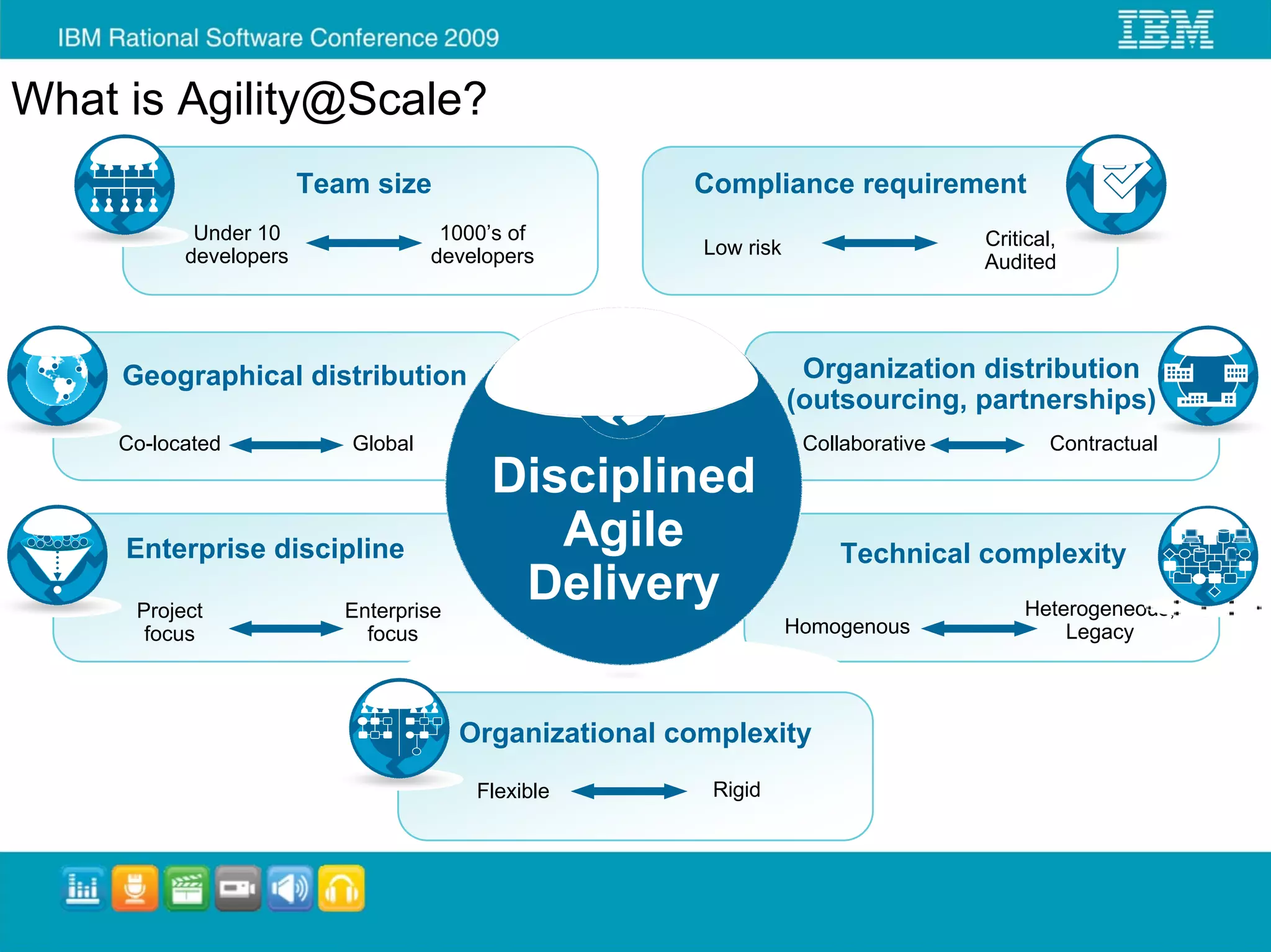
What is Agility@Scale?
                        Team size                       Compliance requirement
            Under 10                 1000’s of                                       Critical,
           developers               developers           Low risk
                                                                                     Audited


     Geographical distribution                                       Organization distribution
                                                                    (outsourcing, partnerships)
    Co-located             Global                                    Collaborative           Contractual
                                          Disciplined
     Enterprise discipline                   Agile                      Technical complexity
      Project              Enterprise
                                           Delivery                                       Heterogeneous,
       focus                 focus                                  Homogenous                Legacy


                                        Organizational complexity
                                         Flexible        Rigid
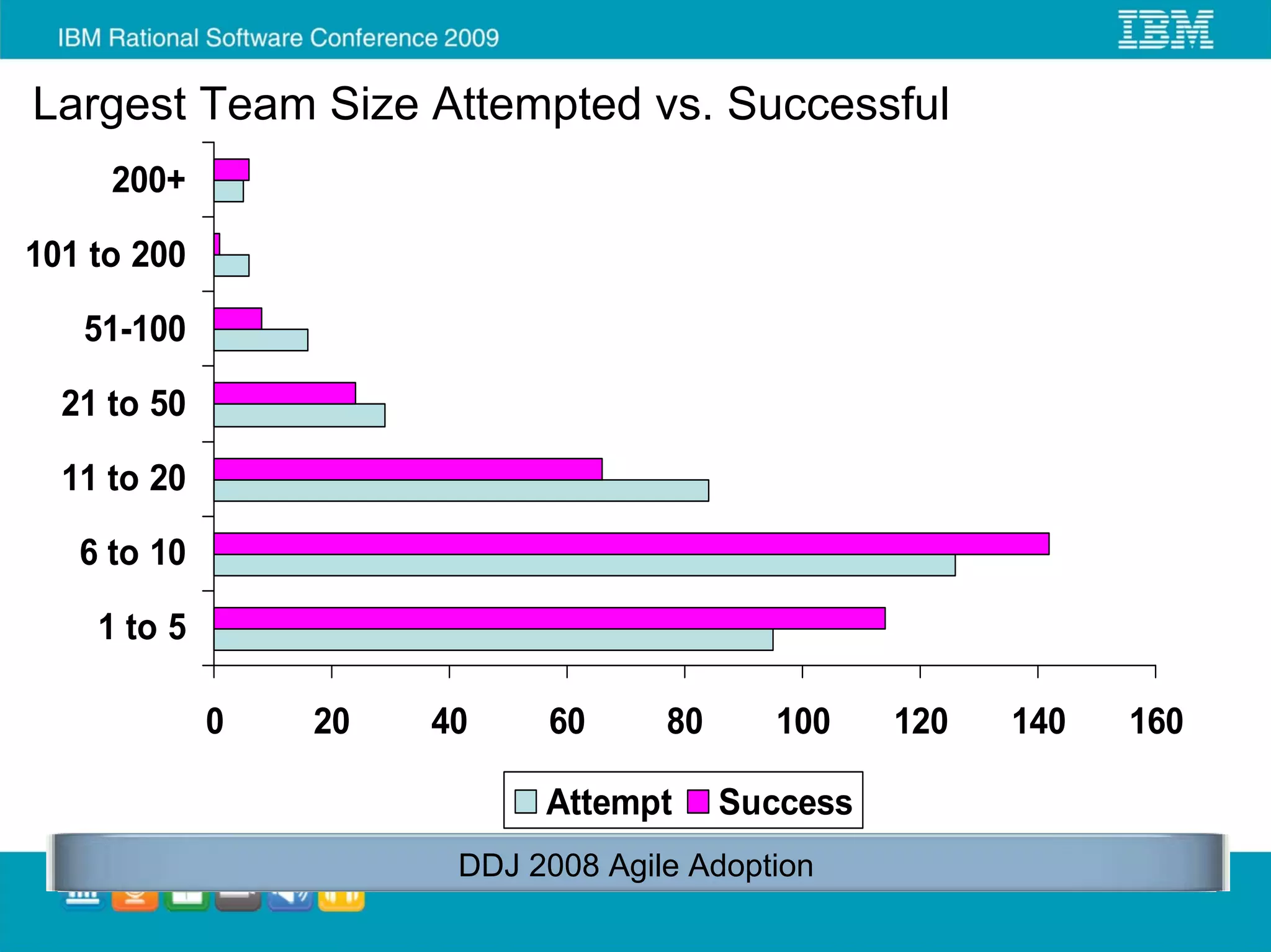
Largest Team Size Attempted vs. Successful
     200+

101 to 200

   51-100

  21 to 50

  11 to 20

   6 to 10

    1 to 5

             0   20   40    60      80     100     120   140   160

                            Attempt      Success
                       DDJ 2008 Agile Adoption
Does your team have to comply to industry regulations?


                     Don't Know
                         7%                             Yes
                                                        33%


                  No
                  60%


                        Ambysoft 2009 Agile Practices
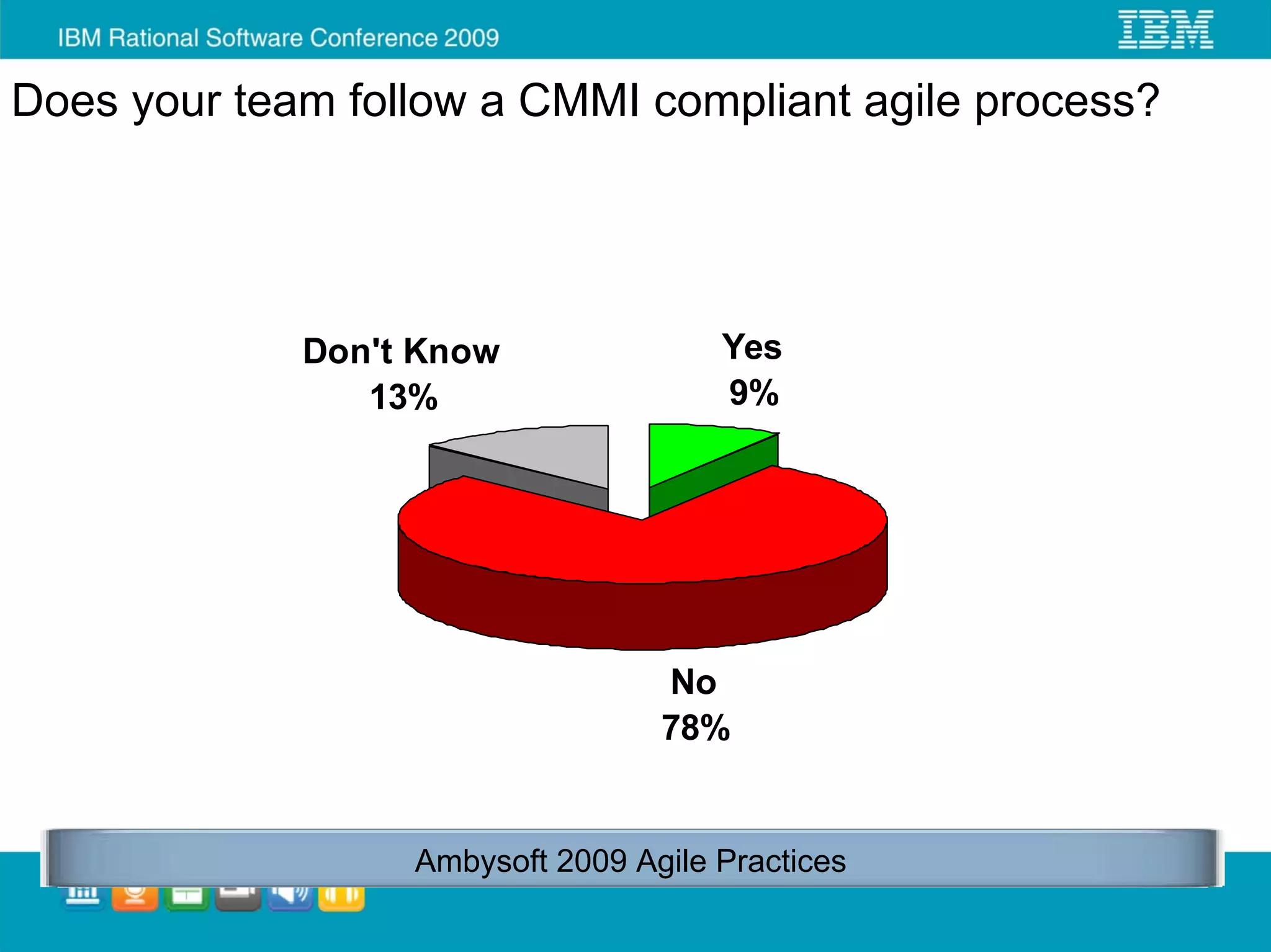
Does your team follow a CMMI compliant agile process?


             Don't Know               Yes
                13%                   9%


                                  No
                                  78%


                  Ambysoft 2009 Agile Practices
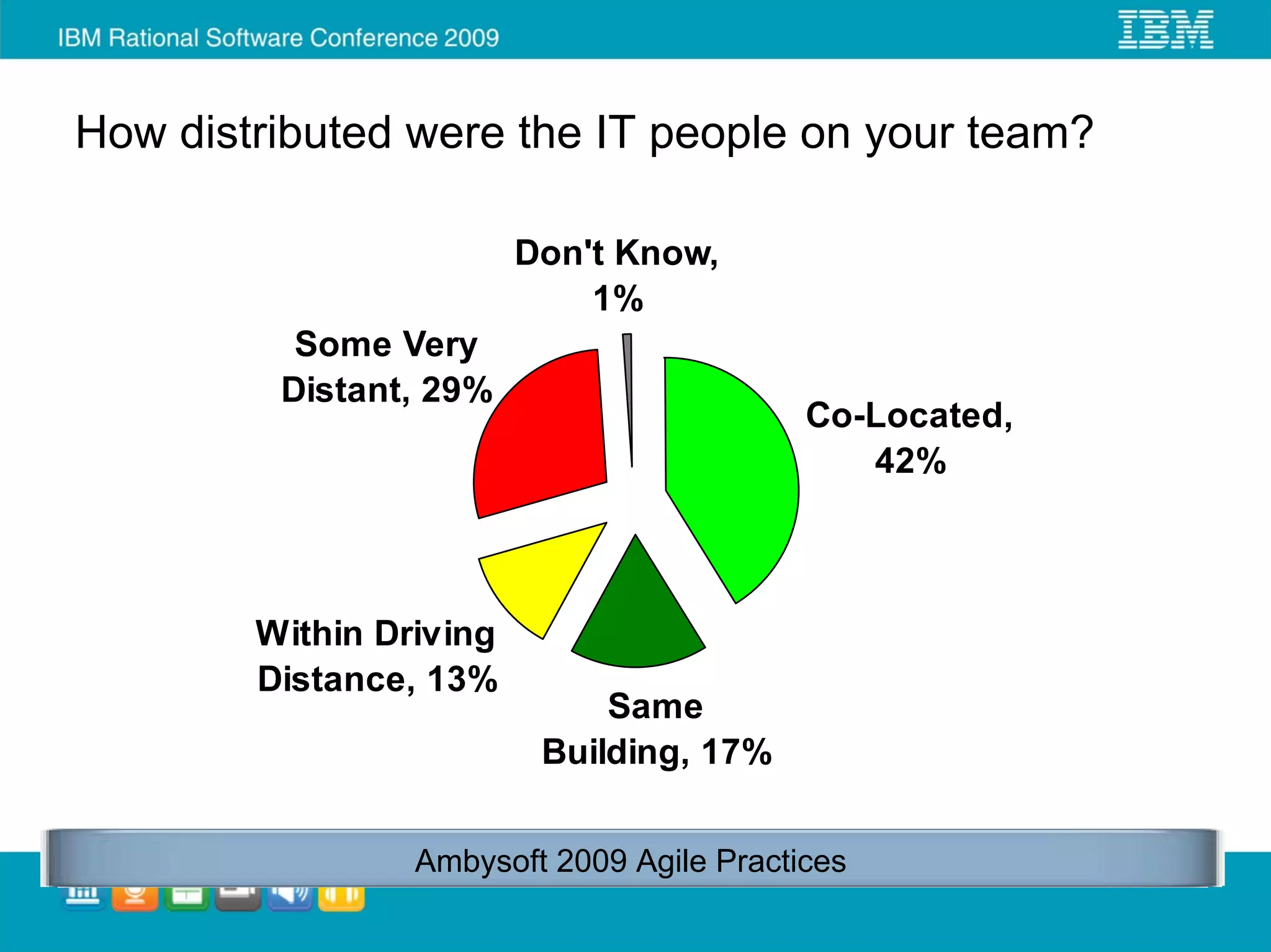
How distributed were the IT people on your team?

                         Don't Know,
                             1%
          Some Very
         Distant, 29%
                                           Co-Located,
                                              42%


        Within Driving
        Distance, 13%
                              Same
                          Building, 17%


                 Ambysoft 2009 Agile Practices
Agenda

 •   The Surveys
 •   Agile Practices
 •   Agility@Scale
 •   Adoption and Success
     Rates
 •   Management
 •   Governance
 •   Development and Quality
 •   Modeling and
     Documentation
 •   Communication
 •   Parting Thoughts
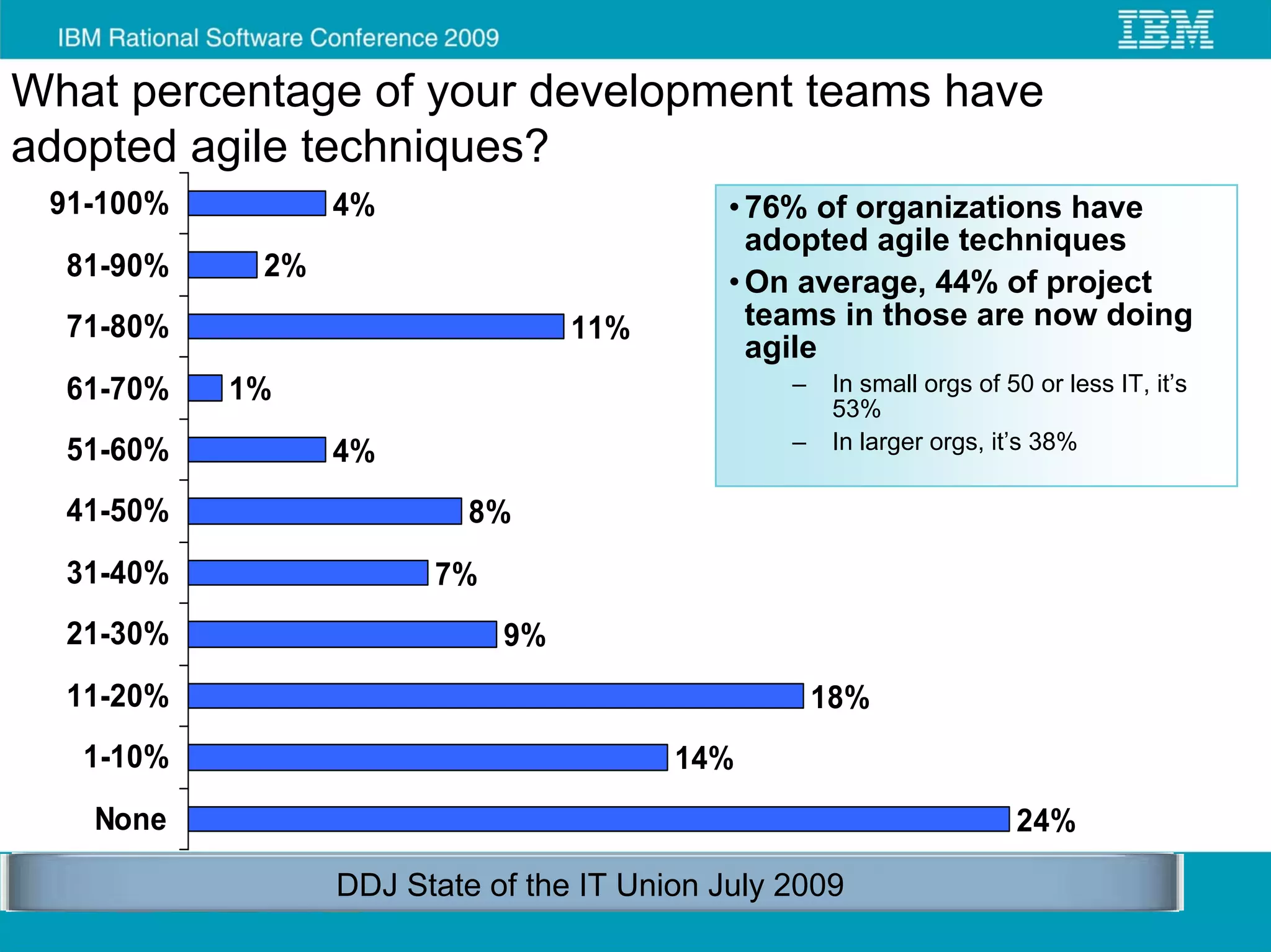
What percentage of your development teams have
adopted agile techniques?
 91-100%         4%                         • 76% of organizations have
                                              adopted agile techniques
  81-90%    2%
                                            • On average, 44% of project
  71-80%                         11%          teams in those are now doing
                                              agile
  61-70%   1%                                   –    In small orgs of 50 or less IT, it’s
                                                     53%
  51-60%         4%                             –    In larger orgs, it’s 38%

  41-50%                  8%
  31-40%               7%
  21-30%                    9%
  11-20%                                            18%
   1-10%                                14%
   None                                                                24%

                 DDJ State of the IT Union July 2009
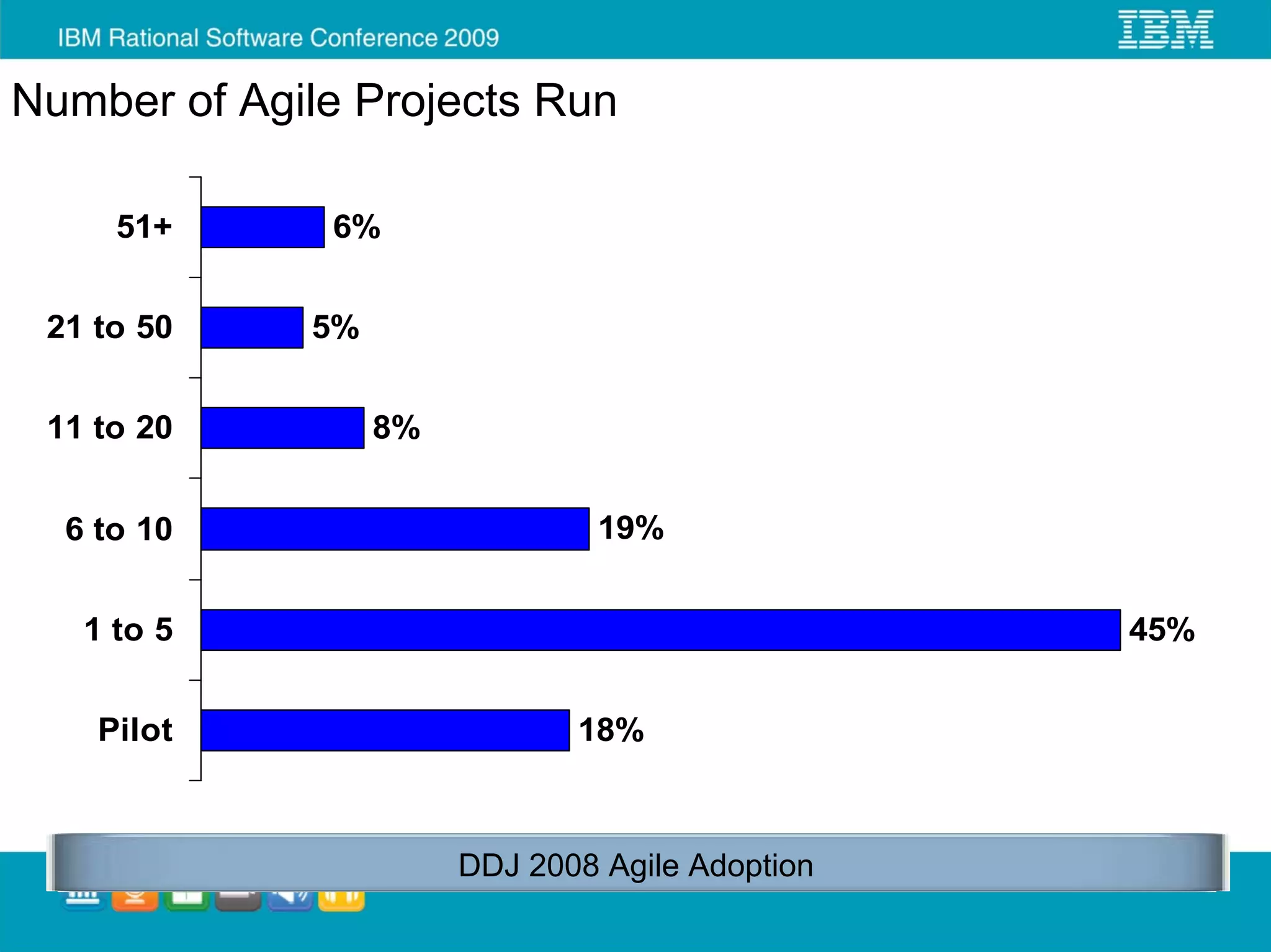
Number of Agile Projects Run

     51+      6%


 21 to 50    5%


 11 to 20         8%


  6 to 10                       19%


   1 to 5                                        45%


    Pilot                     18%


                       DDJ 2008 Agile Adoption
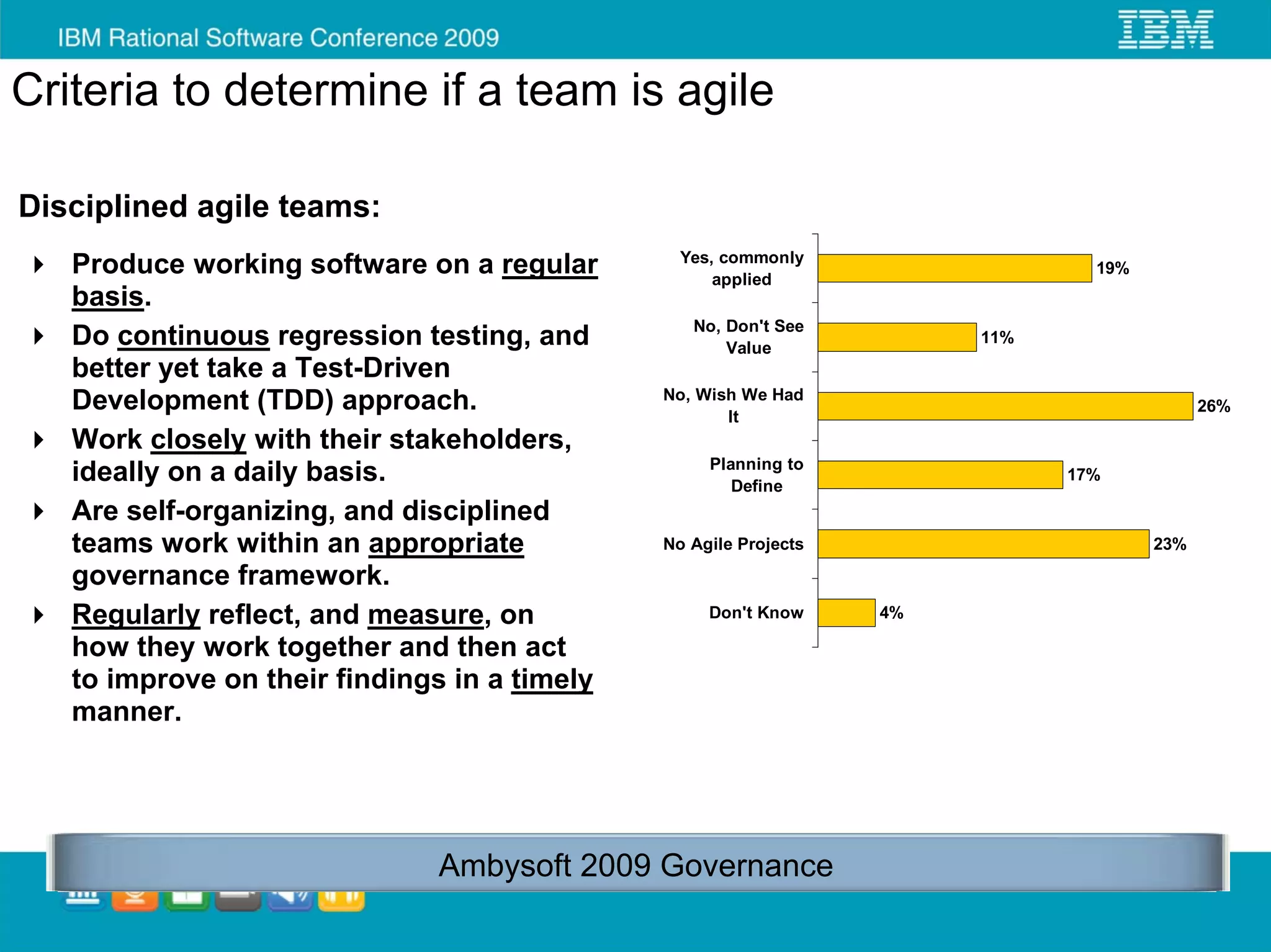
Criteria to determine if a team is agile

Disciplined agile teams:
                                                Yes, commonly
   Produce working software on a regular            applied
                                                                               19%
   basis.
                                                 No, Don't See
   Do continuous regression testing, and             Value
                                                                       11%

   better yet take a Test-Driven
                                              No, Wish We Had
   Development (TDD) approach.                       It
                                                                                           26%

   Work closely with their stakeholders,
                                                   Planning to
   ideally on a daily basis.                          Define
                                                                             17%

   Are self-organizing, and disciplined
   teams work within an appropriate           No Agile Projects                      23%

   governance framework.
   Regularly reflect, and measure, on              Don't Know     4%

   how they work together and then act
   to improve on their findings in a timely
   manner.


                              Ambysoft 2009 Governance
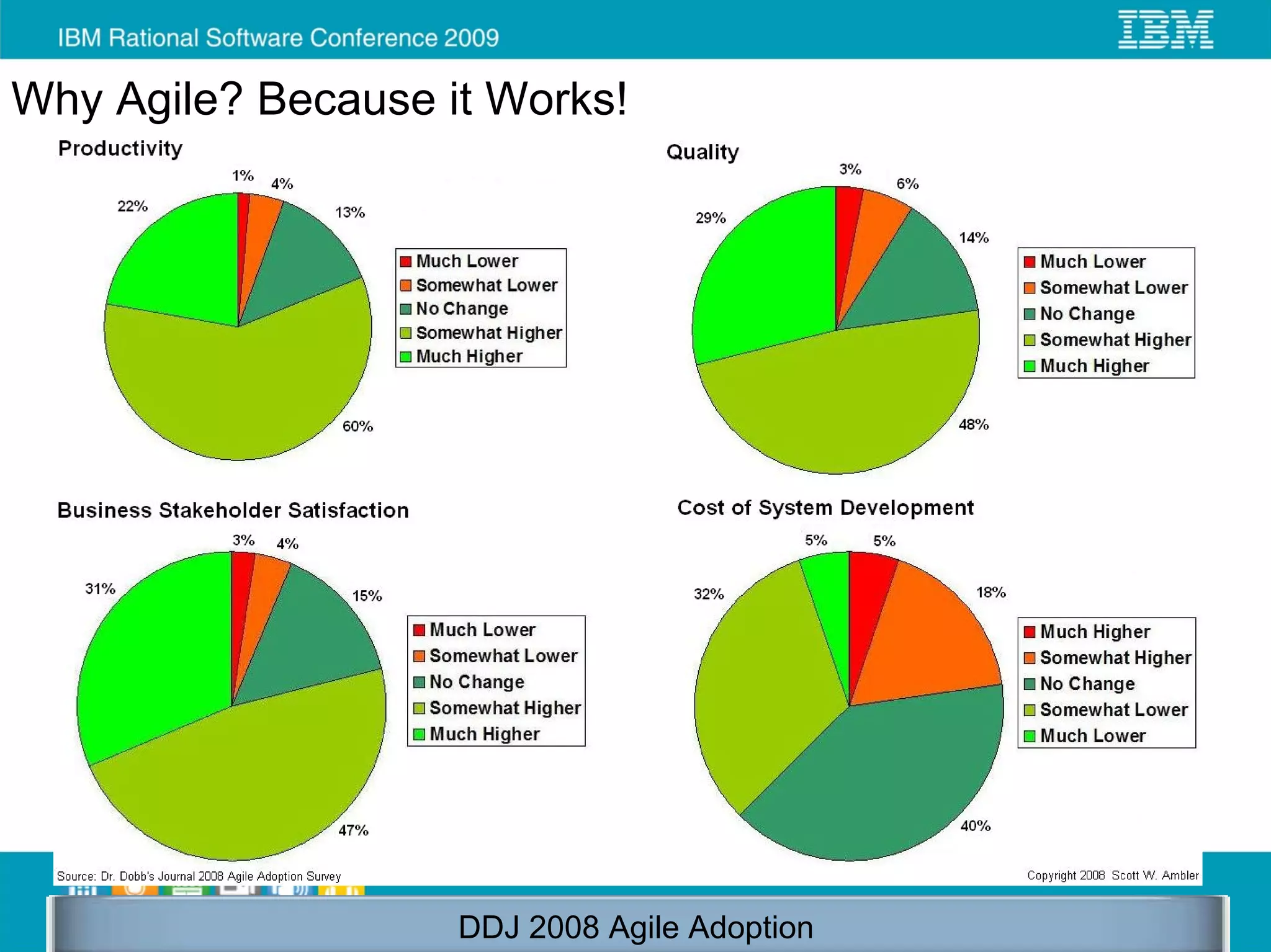
Why Agile? Because it Works!


                    DDJ 2008 Agile Adoption
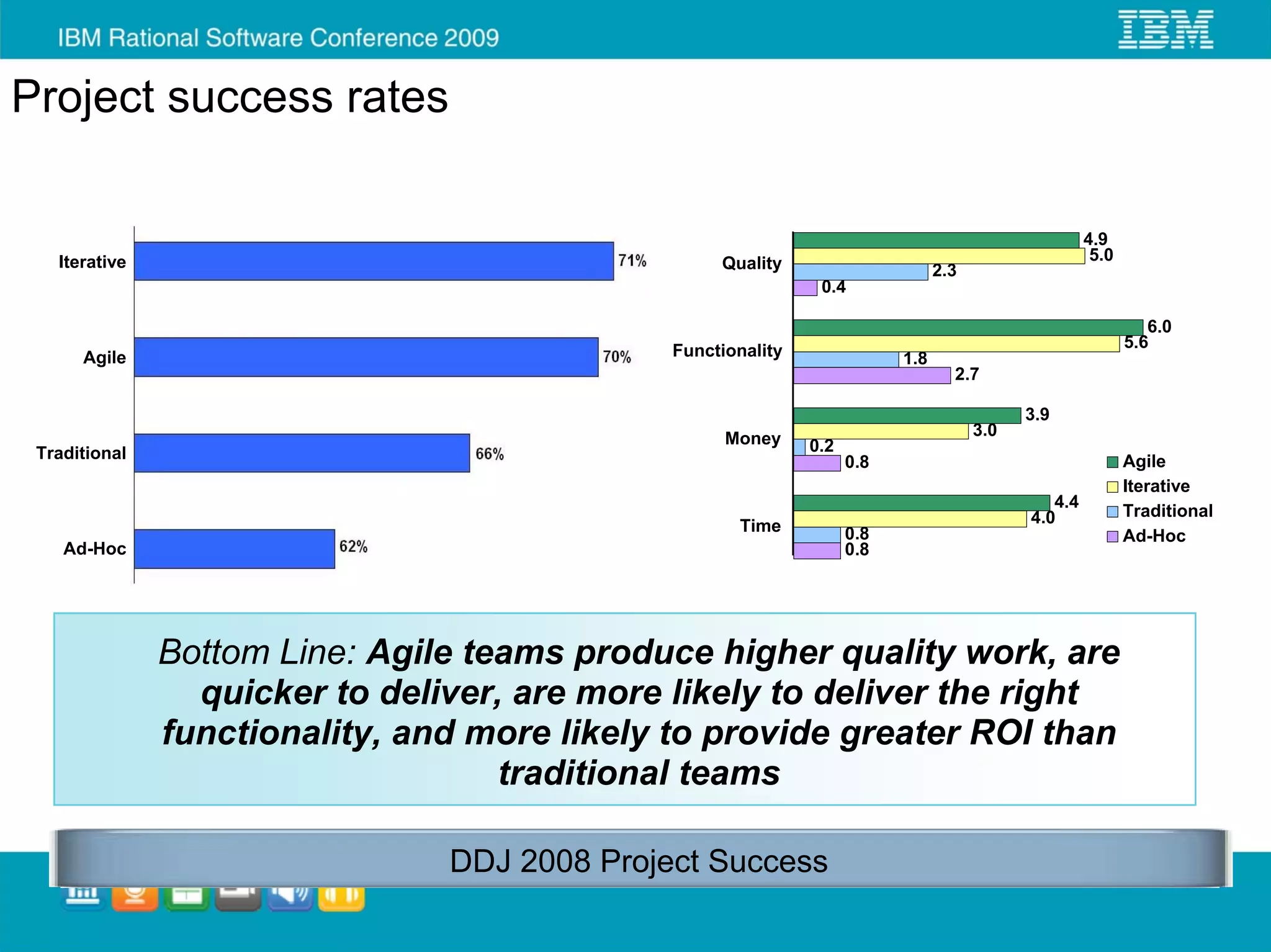
Project success rates

                                                                                                     4.9
   Iterative                                       Quality                                            5.0
                                                                                2.3
                                                               0.4

                                                                                                               6.0
                                              Functionality                                                 5.6
      Agile                                                               1.8
                                                                                  2.7

                                                                                            3.9
                                                    Money                             3.0
 Traditional                                                  0.2
                                                                    0.8                                     Agile
                                                                                                            Iterative
                                                                                               4.4
                                                                                            4.0             Traditional
                                                     Time           0.8                                     Ad-Hoc
    Ad-Hoc                                                          0.8


               Bottom Line: Agile teams produce higher quality work, are
                 quicker to deliver, are more likely to deliver the right
               functionality, and more likely to provide greater ROI than
                                    traditional teams

                                DDJ 2008 Project Success
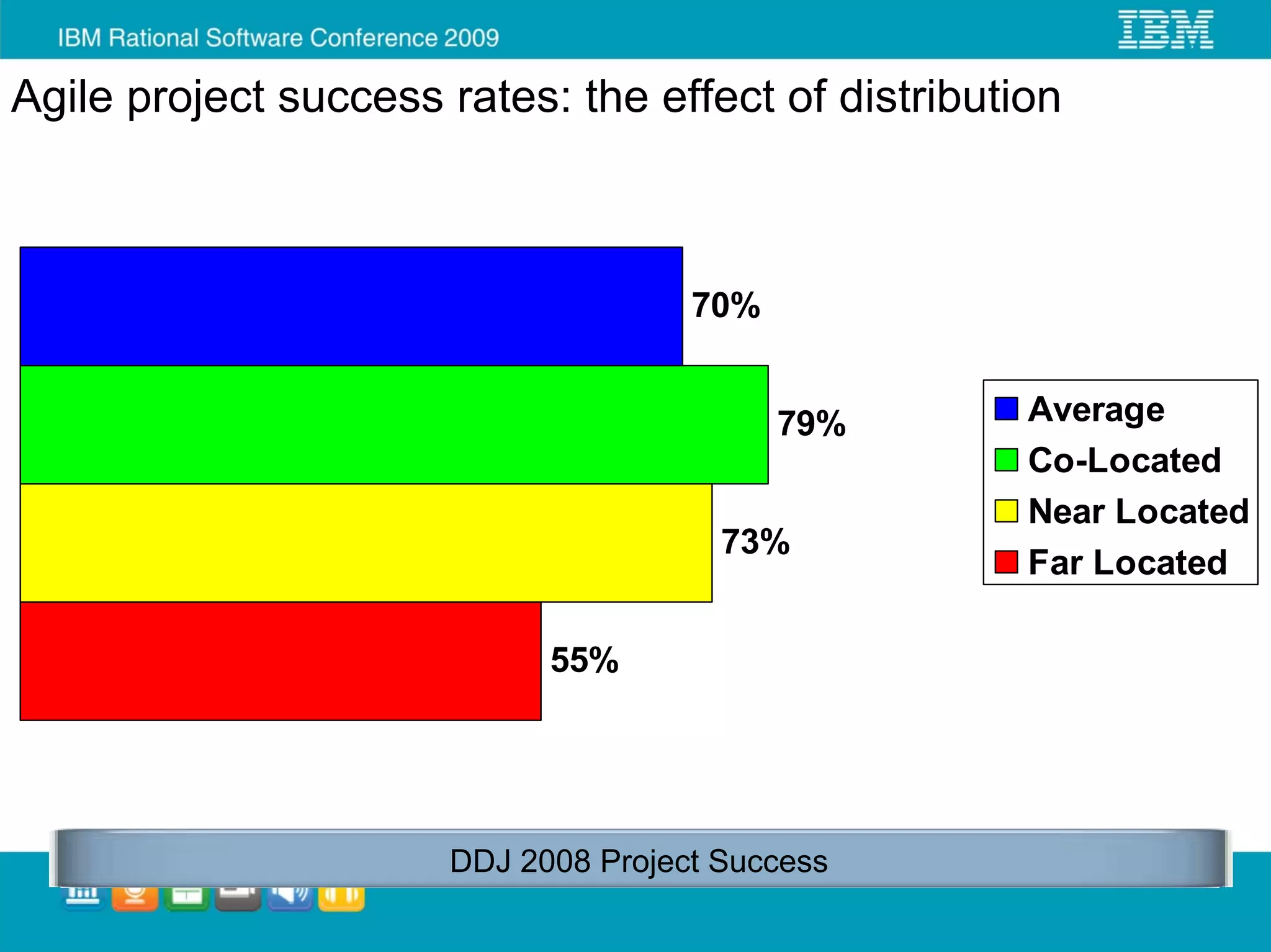
Agile project success rates: the effect of distribution


                                     70%


                                           79%       Average
                                                     Co-Located
                                                     Near Located
                                       73%
                                                     Far Located

                            55%


                      DDJ 2008 Project Success
Agenda
 •   The Surveys
 •   Agile Practices
 •   Agility@Scale
 •   Adoption and Success
     Rates
 •   Management
 •   Governance
 •   Development and Quality
 •   Modeling and
     Documentation
 •   Communication
 •   Parting Thoughts
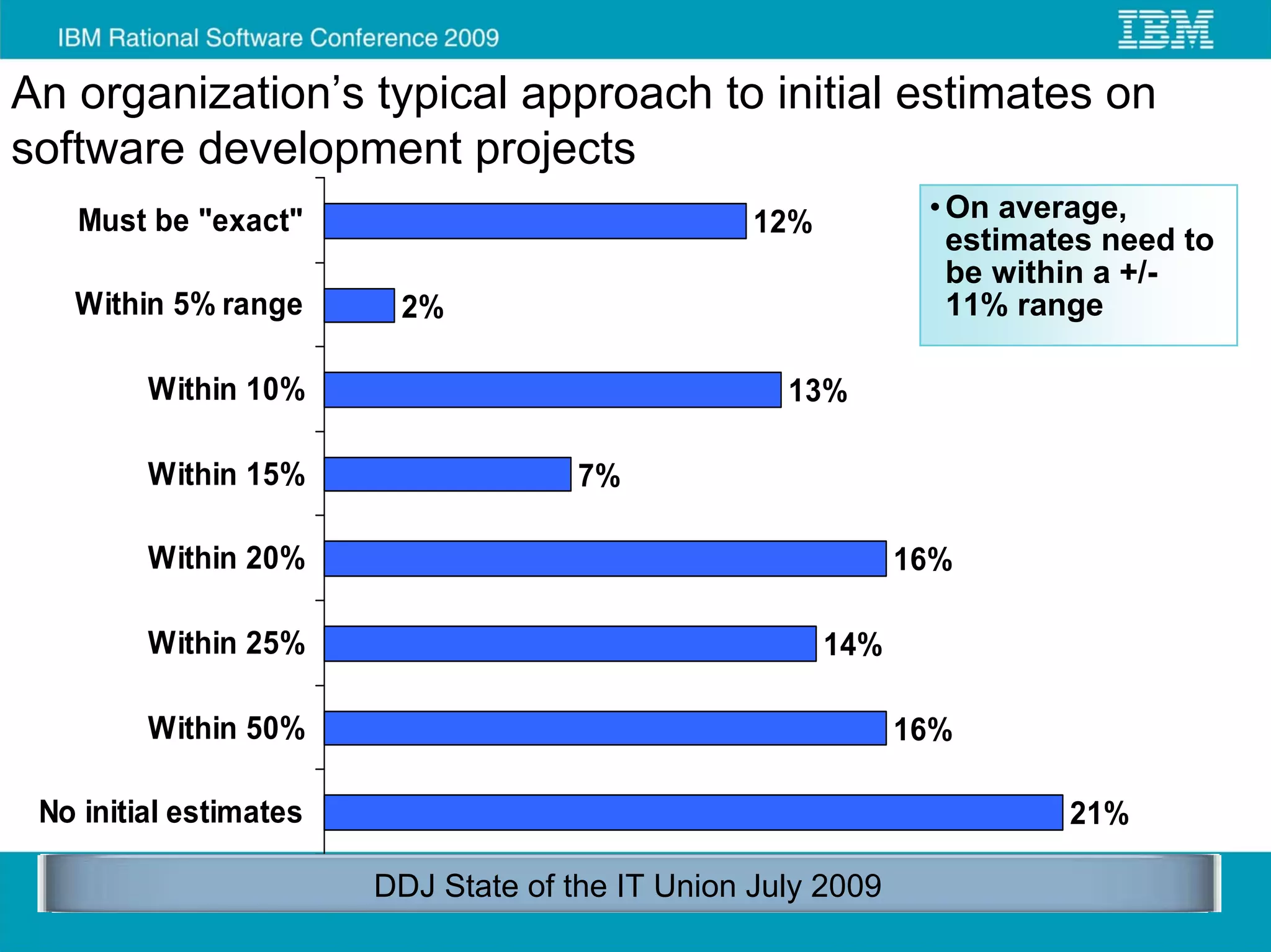
An organization’s typical approach to initial estimates on
software development projects
   Must be "exact"                                12%          • On average,
                                                                 estimates need to
                                                                 be within a +/-
   Within 5% range       2%                                      11% range

         Within 10%                                 13%

         Within 15%                   7%

         Within 20%                                           16%

         Within 25%                                     14%

         Within 50%                                           16%

 No initial estimates                                                   21%

                        DDJ State of the IT Union July 2009
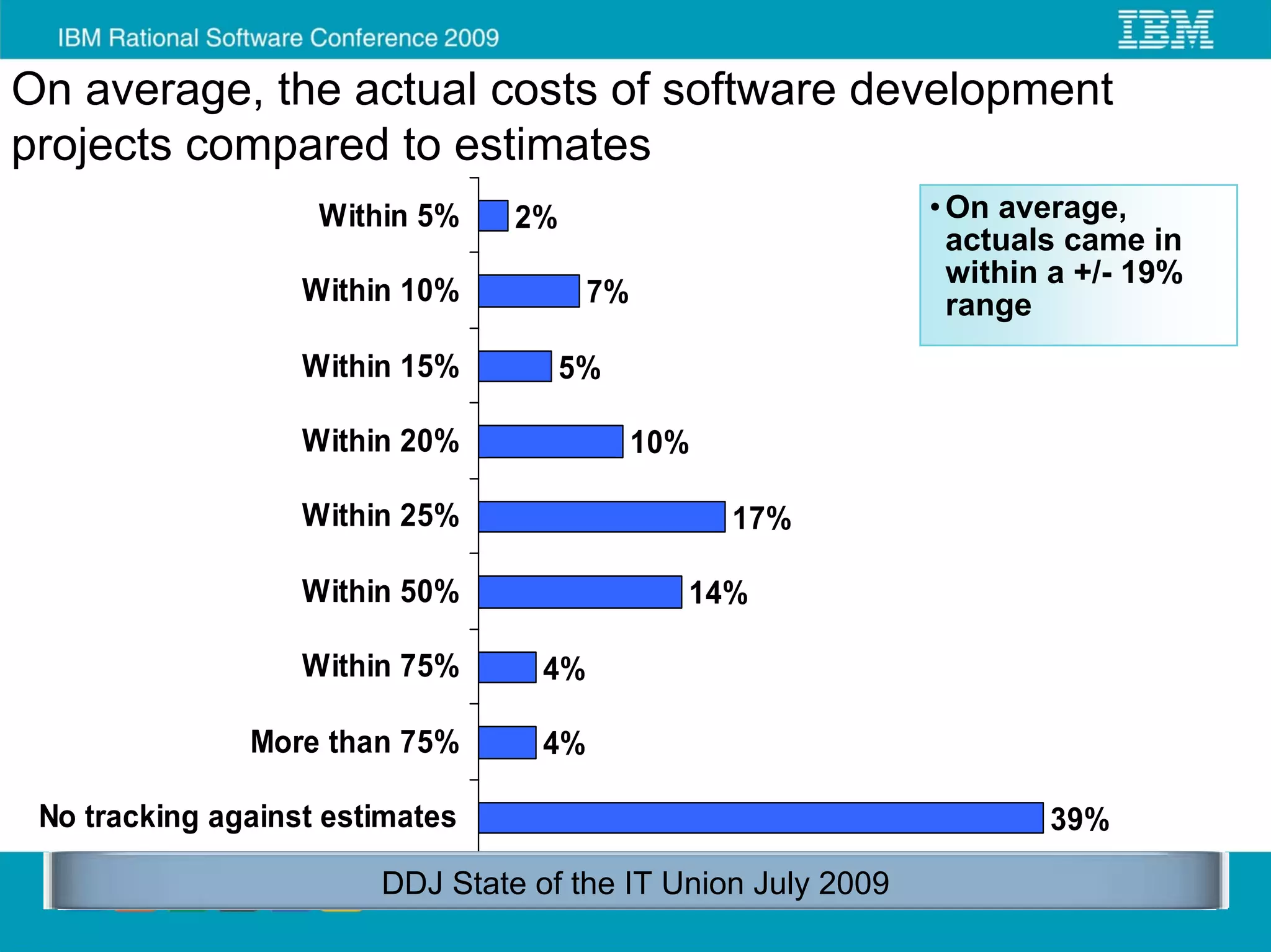
On average, the actual costs of software development
projects compared to estimates
                    Within 5%    2%                           • On average,
                                                                actuals came in
                                                                within a +/- 19%
                   Within 10%           7%                      range
                   Within 15%         5%

                   Within 20%                10%

                   Within 25%                      17%

                   Within 50%                  14%

                   Within 75%      4%

               More than 75%       4%

 No tracking against estimates                                        39%

                        DDJ State of the IT Union July 2009
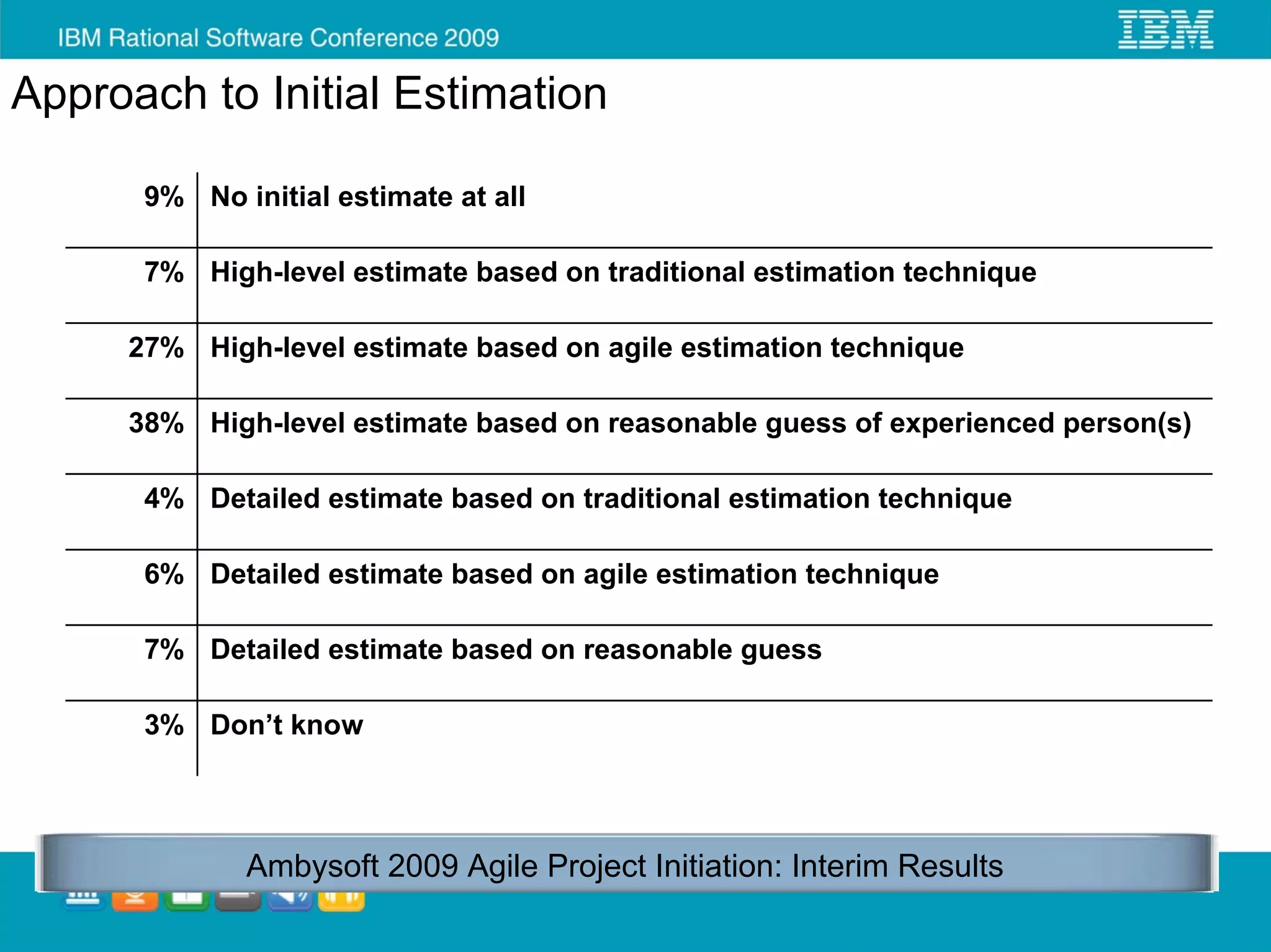
Approach to Initial Estimation

      9% No initial estimate at all

      7% High-level estimate based on traditional estimation technique

     27% High-level estimate based on agile estimation technique

     38% High-level estimate based on reasonable guess of experienced person(s)

      4% Detailed estimate based on traditional estimation technique

      6% Detailed estimate based on agile estimation technique

      7% Detailed estimate based on reasonable guess

      3% Don’t know


             Ambysoft 2009 Agile Project Initiation: Interim Results
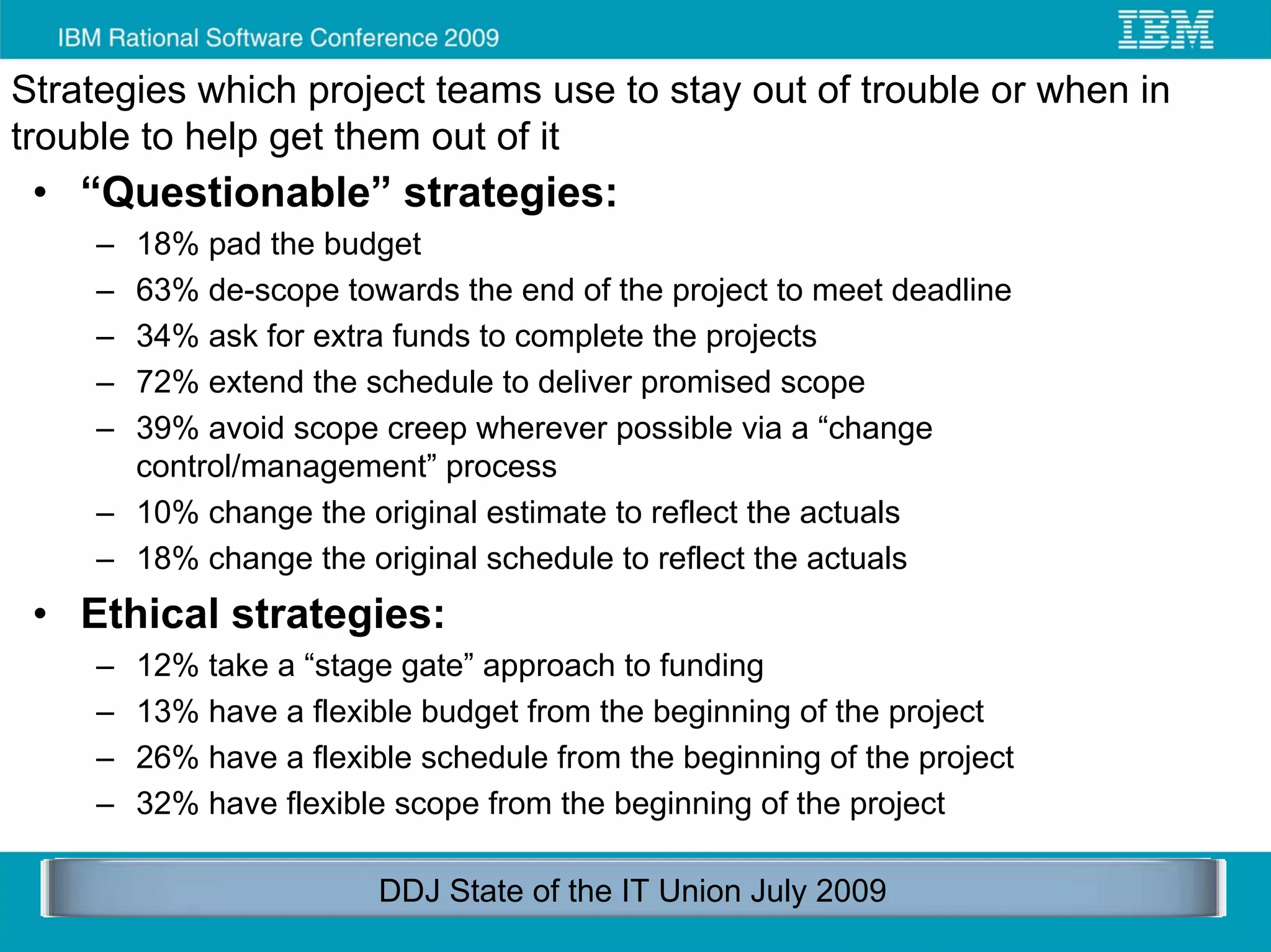
Strategies which project teams use to stay out of trouble or when in
trouble to help get them out of it
 • “Questionable” strategies:
    – 18% pad the budget
    – 63% de-scope towards the end of the project to meet deadline
    – 34% ask for extra funds to complete the projects
    – 72% extend the schedule to deliver promised scope
    – 39% avoid scope creep wherever possible via a “change
      control/management” process
    – 10% change the original estimate to reflect the actuals
    – 18% change the original schedule to reflect the actuals
 • Ethical strategies:
    –   12% take a “stage gate” approach to funding
    –   13% have a flexible budget from the beginning of the project
    –   26% have a flexible schedule from the beginning of the project
    –   32% have flexible scope from the beginning of the project

                         DDJ State of the IT Union July 2009
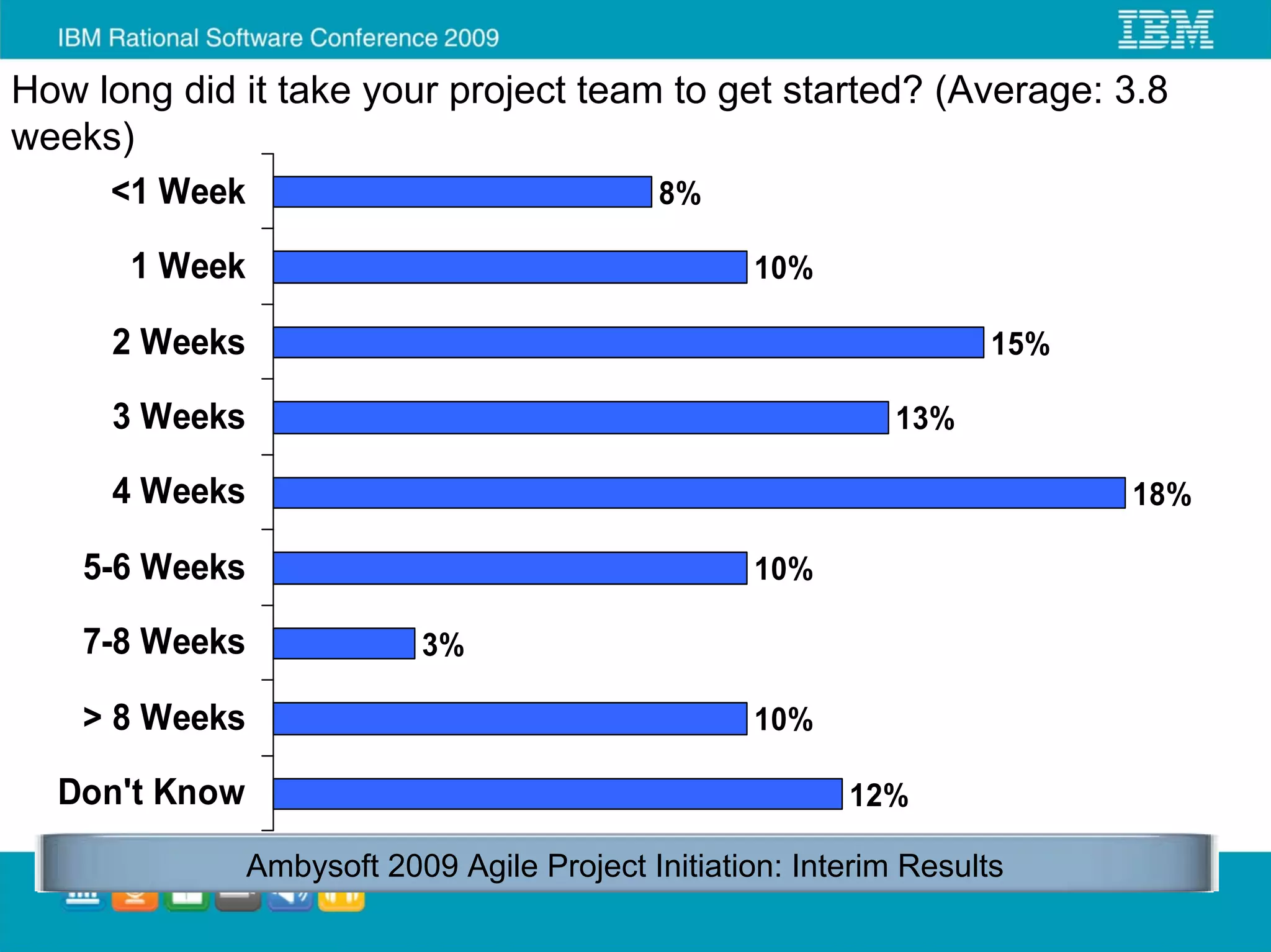
How long did it take your project team to get started? (Average: 3.8
weeks)
     <1 Week                                 8%

       1 Week                                       10%

     2 Weeks                                                          15%

     3 Weeks                                                   13%

     4 Weeks                                                                18%

    5-6 Weeks                                       10%

    7-8 Weeks               3%

    > 8 Weeks                                       10%

  Don't Know                                               12%

                Ambysoft 2009 Agile Project Initiation: Interim Results
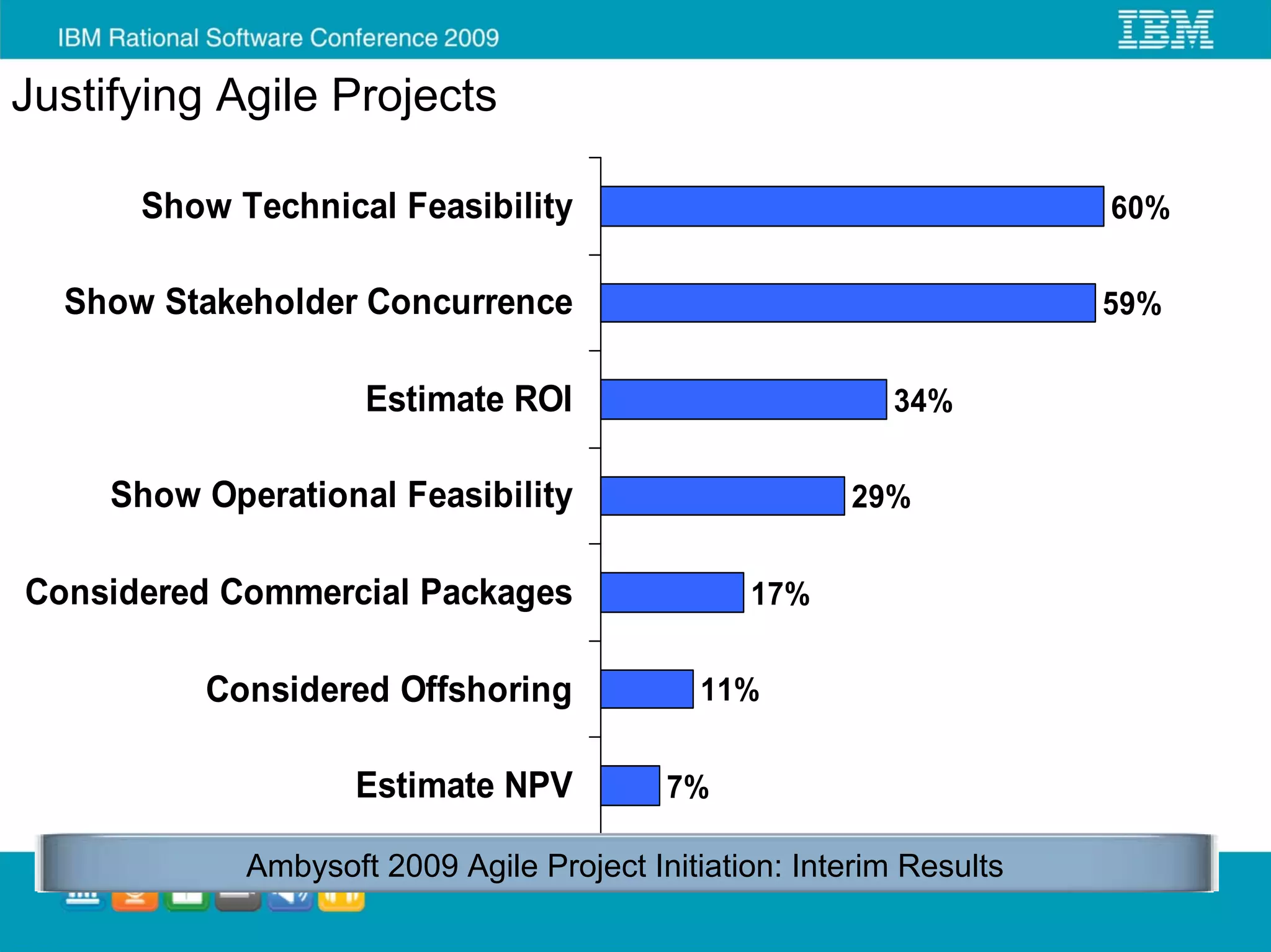
Justifying Agile Projects

      Show Technical Feasibility                                       60%

  Show Stakeholder Concurrence                                         59%


                     Estimate ROI                           34%

     Show Operational Feasibility                       29%


Considered Commercial Packages                   17%


          Considered Offshoring              11%


                    Estimate NPV           7%

             Ambysoft 2009 Agile Project Initiation: Interim Results
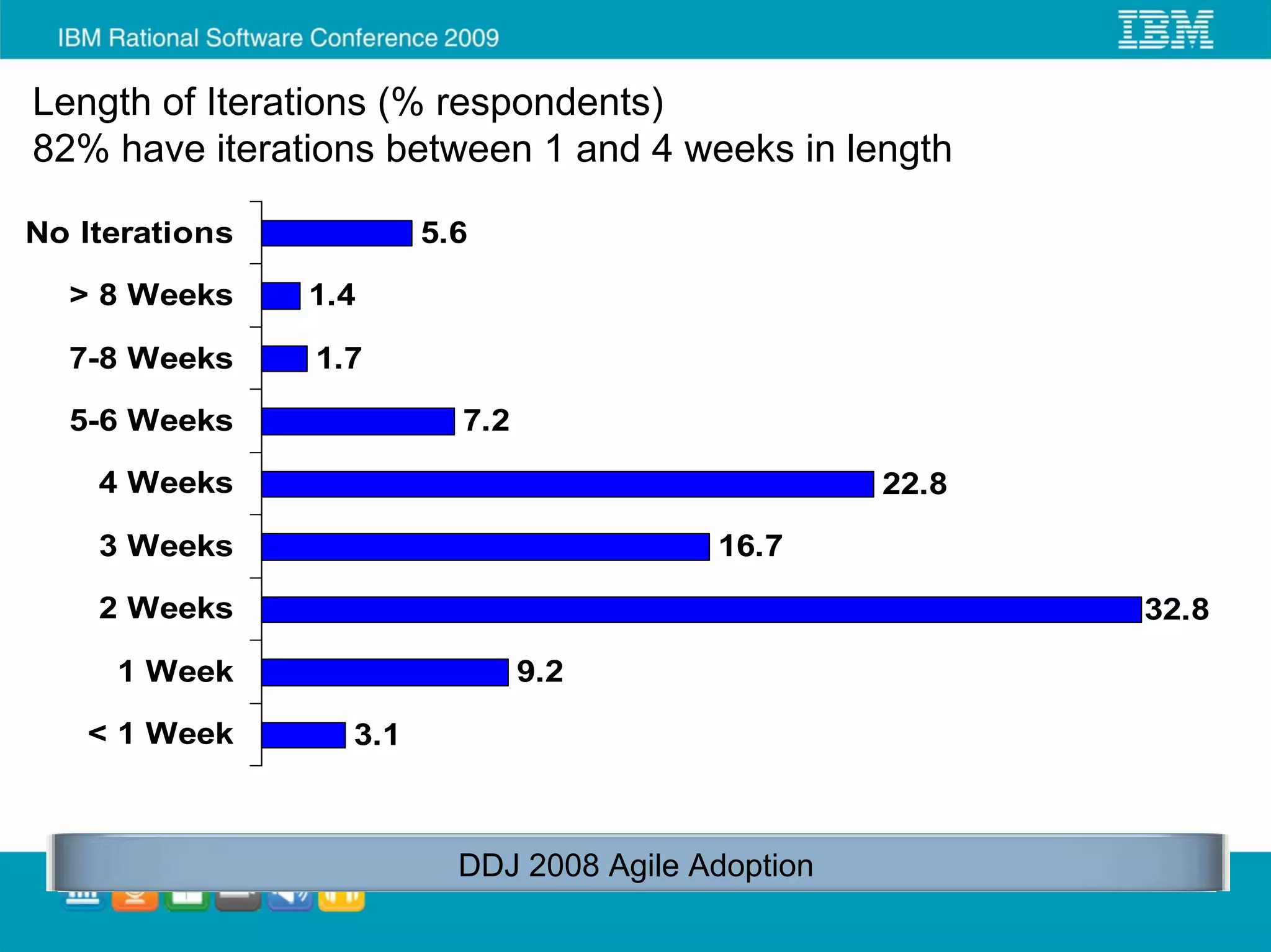
Length of Iterations (% respondents)
82% have iterations between 1 and 4 weeks in length

No Iterations           5.6

  > 8 Weeks     1.4

  7-8 Weeks     1.7

  5-6 Weeks               7.2

    4 Weeks                                         22.8

    3 Weeks                               16.7

    2 Weeks                                                32.8

     1 Week                     9.2

   < 1 Week       3.1


                          DDJ 2008 Agile Adoption
Agenda
 •   The Surveys
 •   Agile Practices
 •   Agility@Scale
 •   Adoption and Success
     Rates
 •   Management
 •   Governance
 •   Development and Quality
 •   Modeling and
     Documentation
 •   Communication
 •   Parting Thoughts
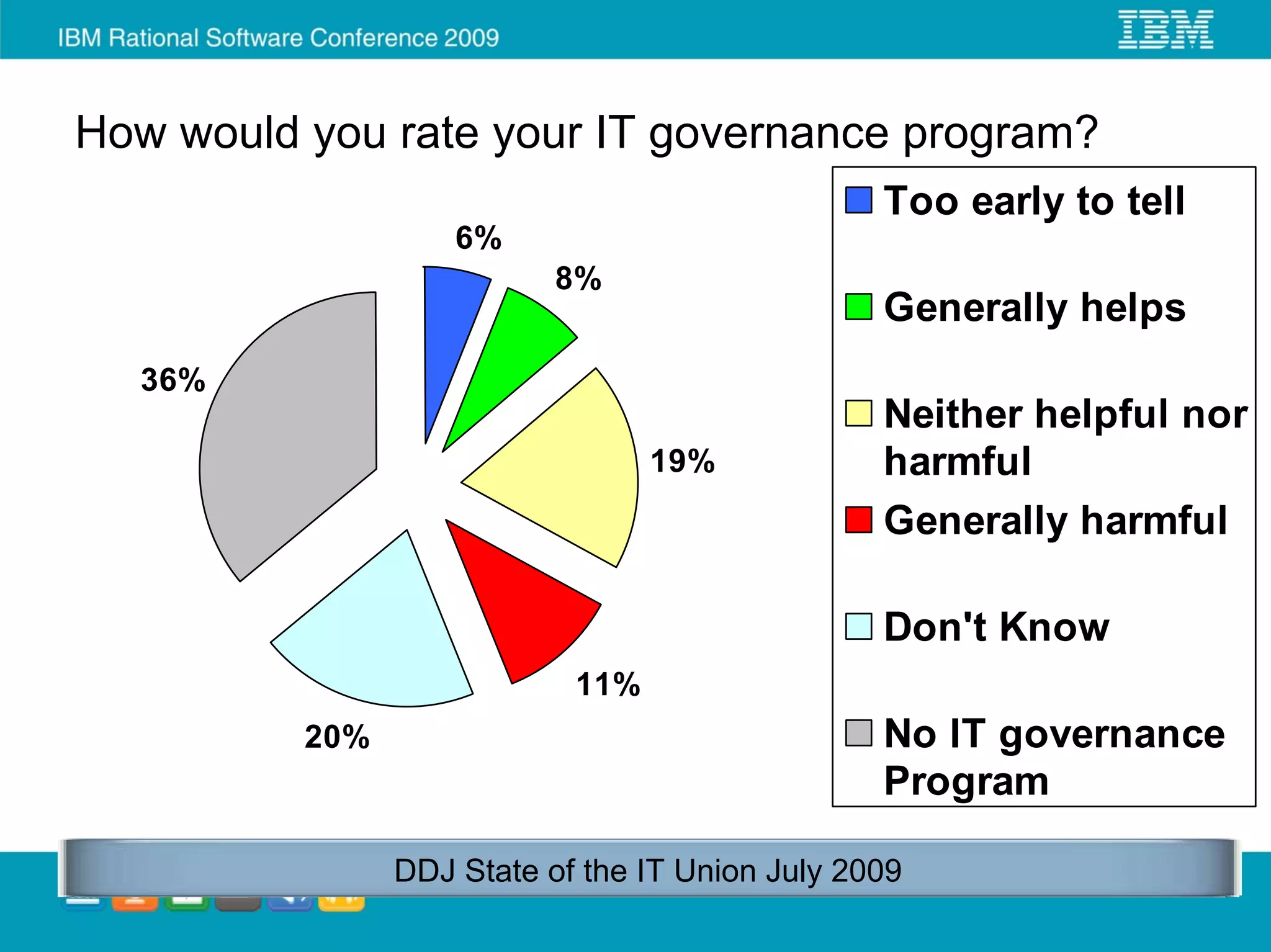
How would you rate your IT governance program?
                                                 Too early to tell
                    6%
                           8%
                                                 Generally helps
  36%
                                                 Neither helpful nor
                                  19%            harmful
                                                 Generally harmful

                                                 Don't Know
                            11%
          20%                                    No IT governance
                                                 Program

                DDJ State of the IT Union July 2009
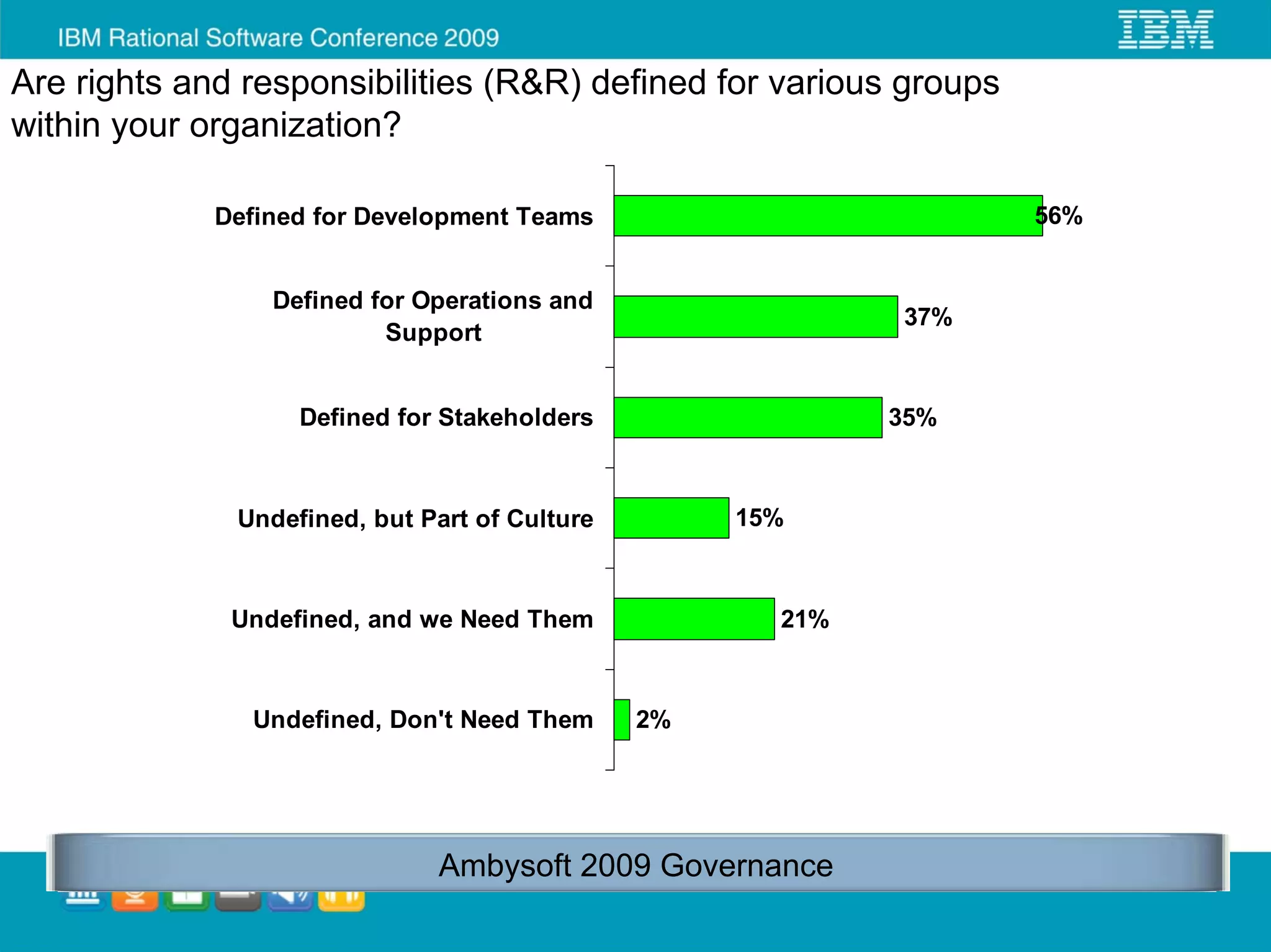
Are rights and responsibilities (R&R) defined for various groups
within your organization?

             Defined for Development Teams                         56%


                 Defined for Operations and
                                                            37%
                          Support


                   Defined for Stakeholders                 35%


              Undefined, but Part of Culture        15%


              Undefined, and we Need Them             21%


               Undefined, Don't Need Them      2%


                              Ambysoft 2009 Governance
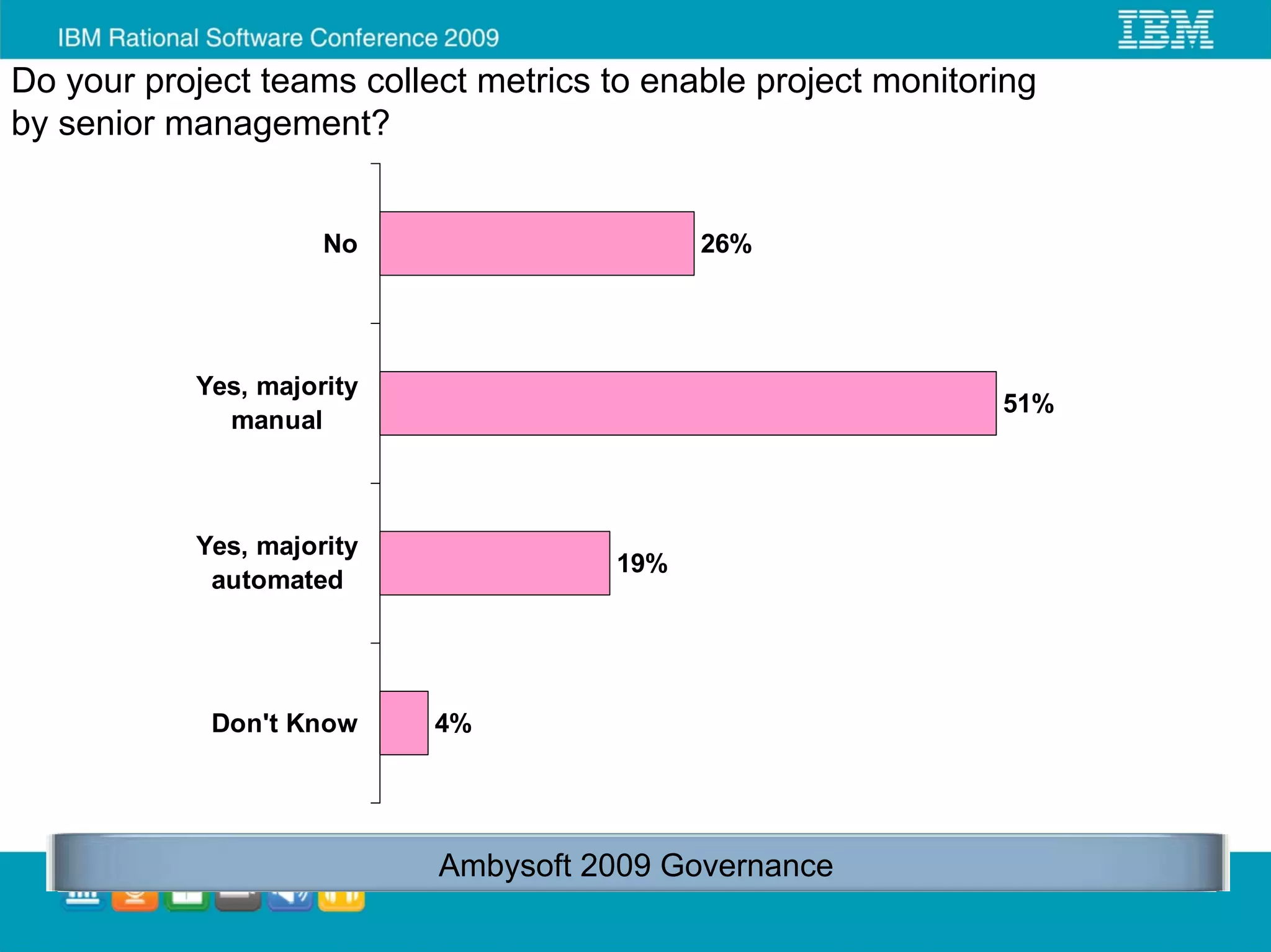
Do your project teams collect metrics to enable project monitoring
by senior management?


                     No                     26%


           Yes, majority
                                                               51%
             manual


           Yes, majority
                                      19%
            automated


            Don't Know     4%


                           Ambysoft 2009 Governance
Agenda
 •   The Surveys
 •   Agile Practices
 •   Agility@Scale
 •   Adoption and Success
     Rates
 •   Management
 •   Governance
 •   Development and Quality
 •   Modeling and
     Documentation
 •   Communication
 •   Parting Thoughts
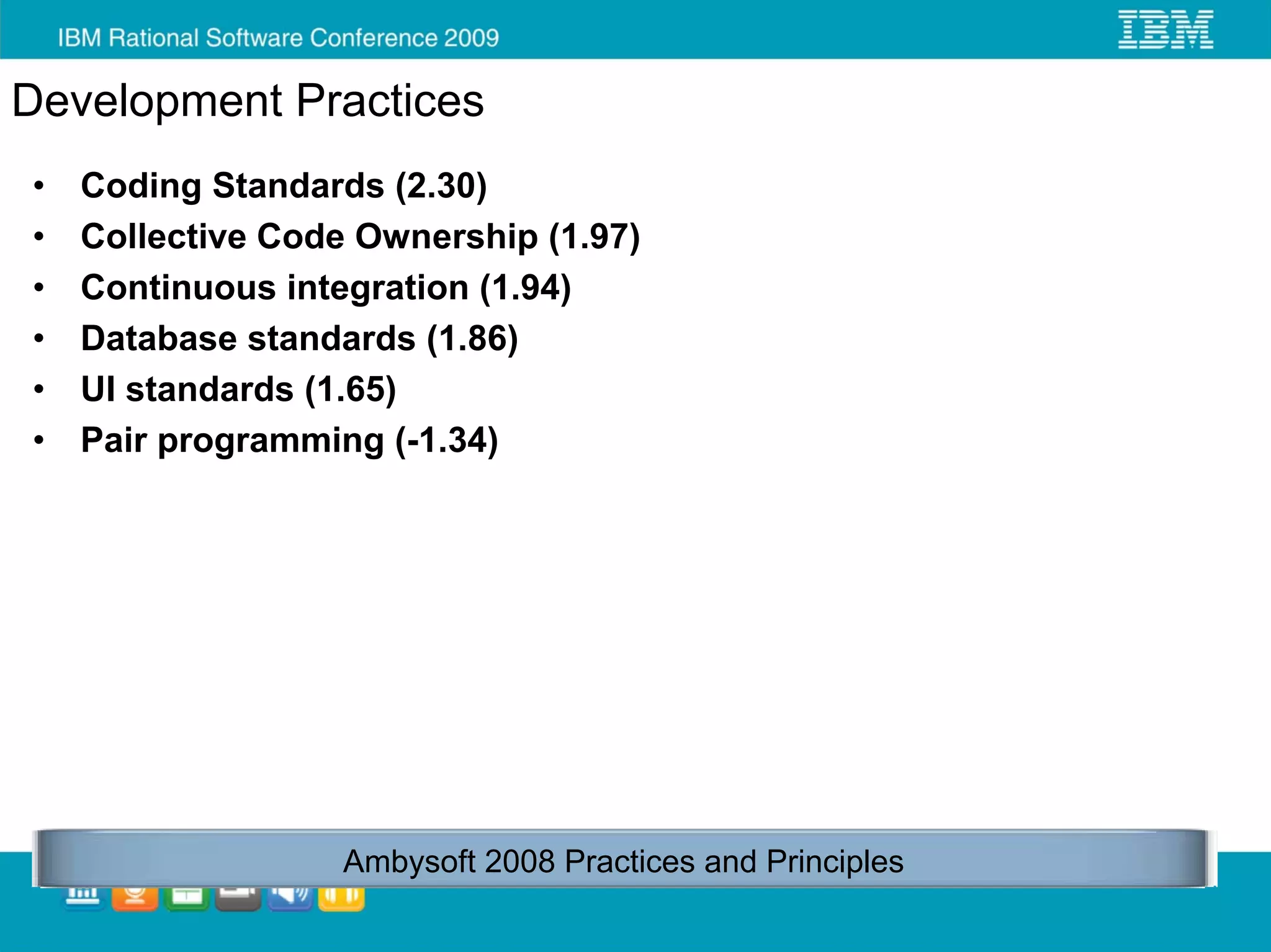
Development Practices
•   Coding Standards (2.30)
•   Collective Code Ownership (1.97)
•   Continuous integration (1.94)
•   Database standards (1.86)
•   UI standards (1.65)
•   Pair programming (-1.34)


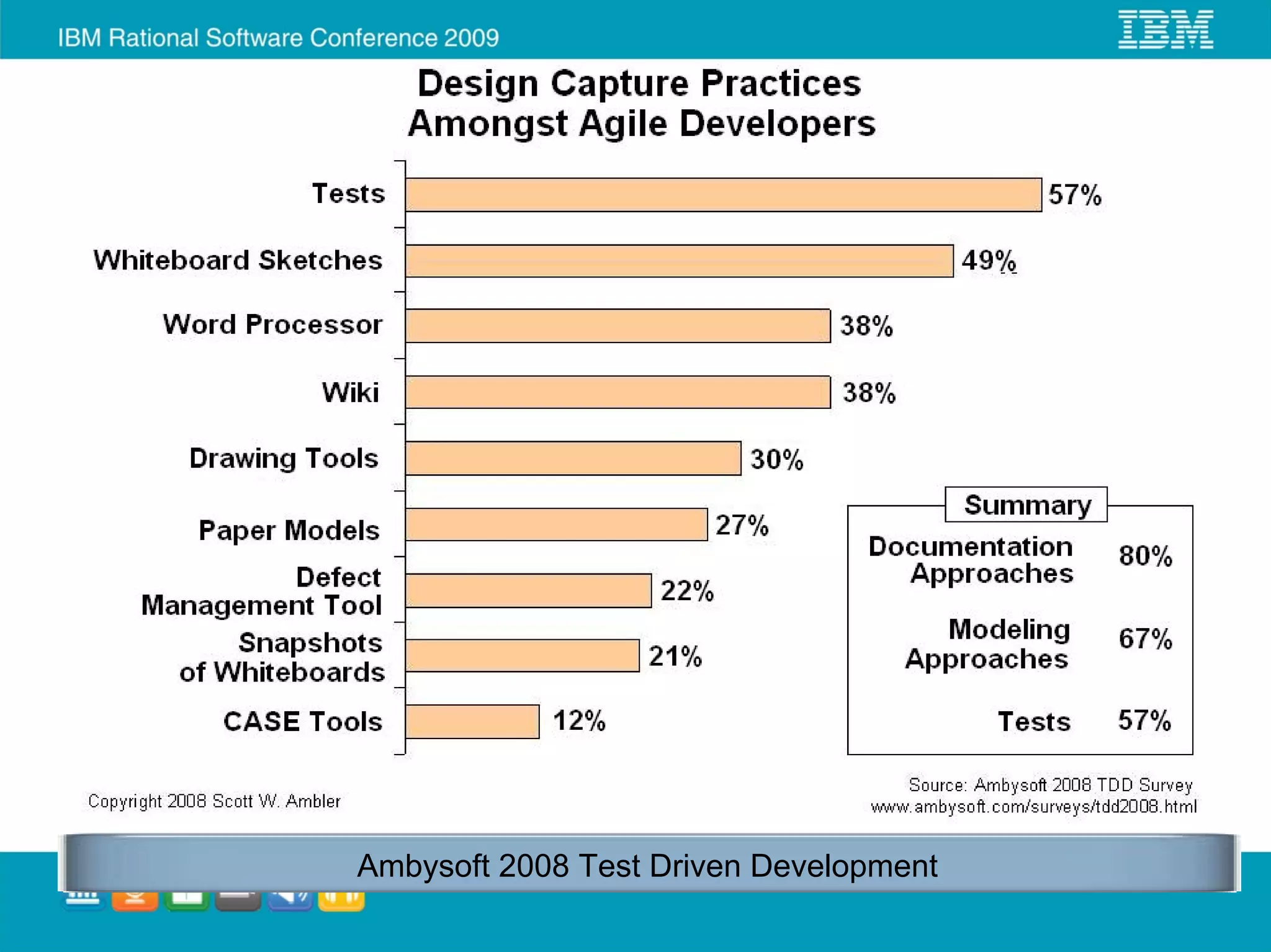
                   Ambysoft 2008 Practices and Principles
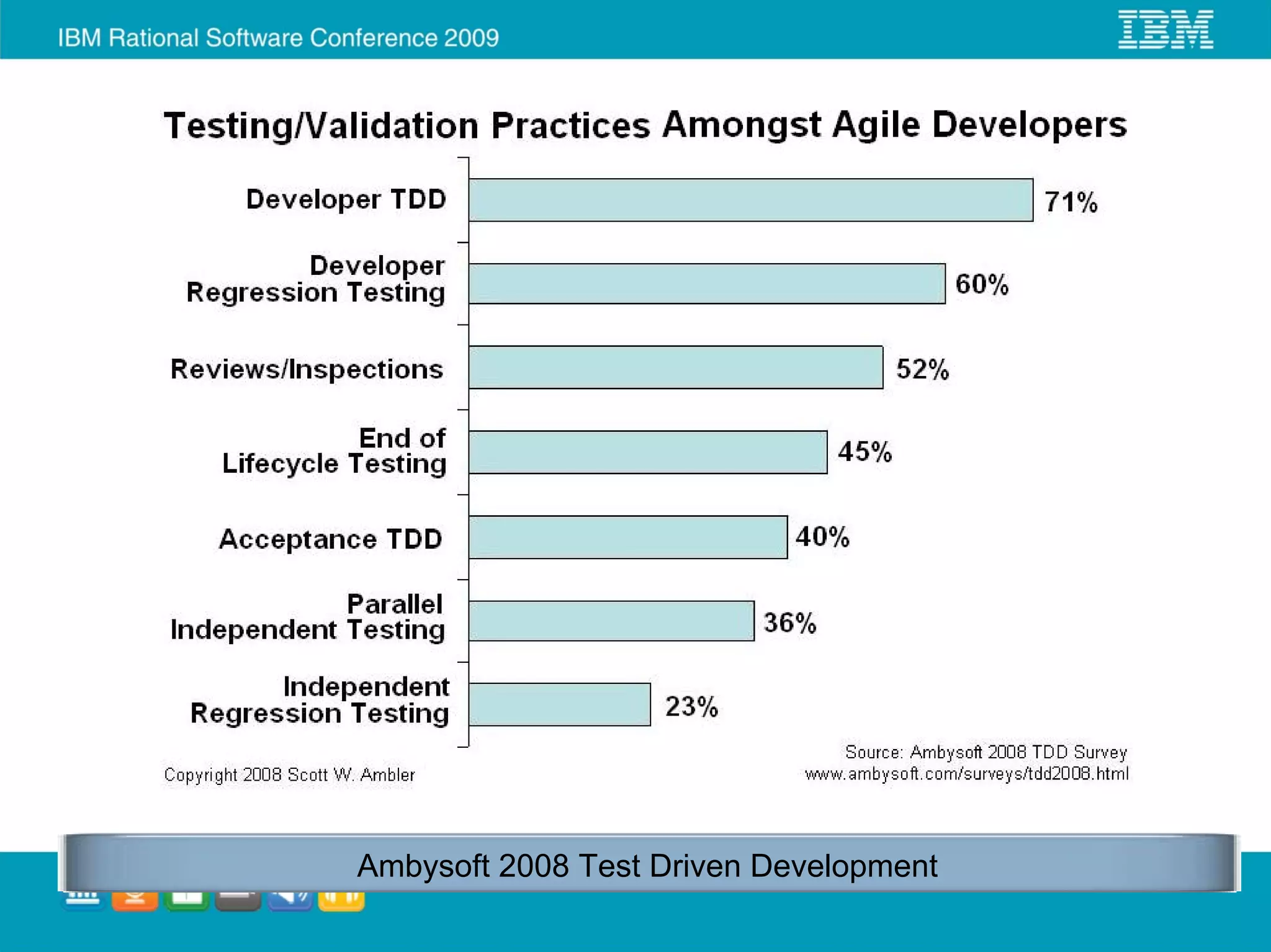
Ambysoft 2008 Test Driven Development
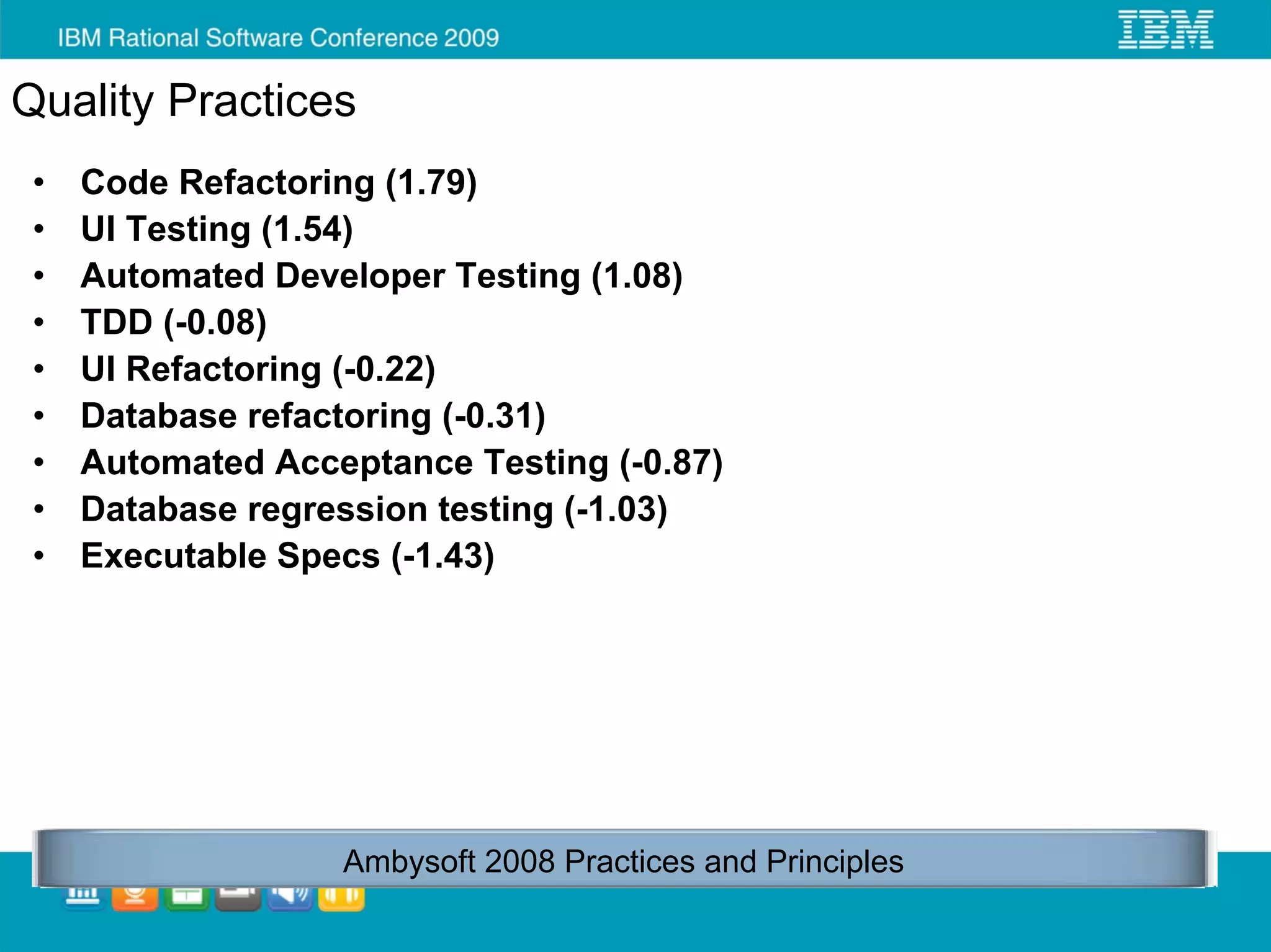
Quality Practices
 •   Code Refactoring (1.79)
 •   UI Testing (1.54)
 •   Automated Developer Testing (1.08)
 •   TDD (-0.08)
 •   UI Refactoring (-0.22)
 •   Database refactoring (-0.31)
 •   Automated Acceptance Testing (-0.87)
 •   Database regression testing (-1.03)
 •   Executable Specs (-1.43)


                   Ambysoft 2008 Practices and Principles
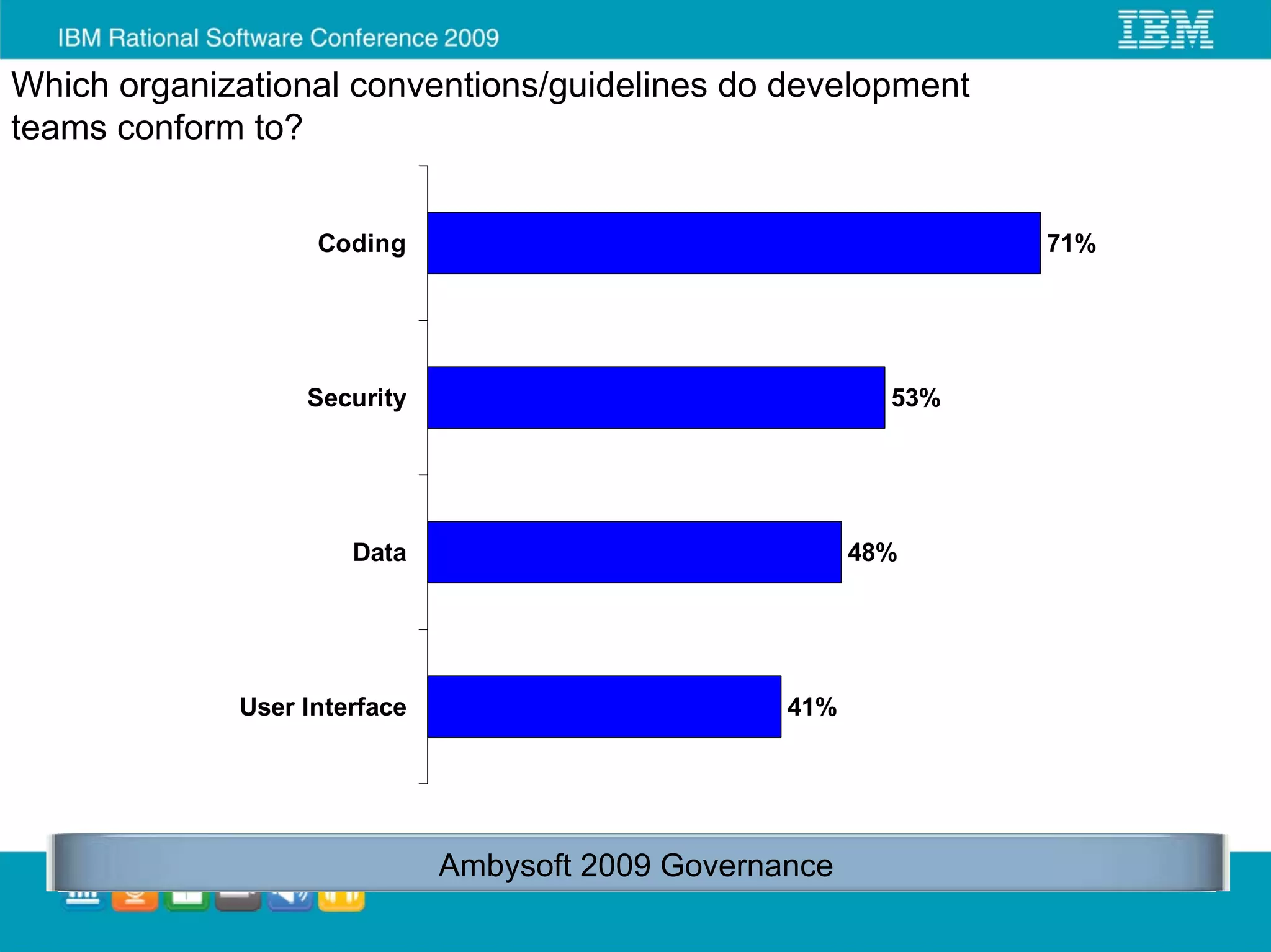
Which organizational conventions/guidelines do development
teams conform to?


                   Coding                                        71%


                  Security                                 53%


                      Data                               48%


             User Interface                        41%


                              Ambysoft 2009 Governance
Agenda

 •   The Surveys
 •   Agile Practices
 •   Agility@Scale
 •   Adoption and Success
     Rates
 •   Management
 •   Governance
 •   Development and Quality
 •   Modeling and
     Documentation
 •   Communication
 •   Parting Thoughts
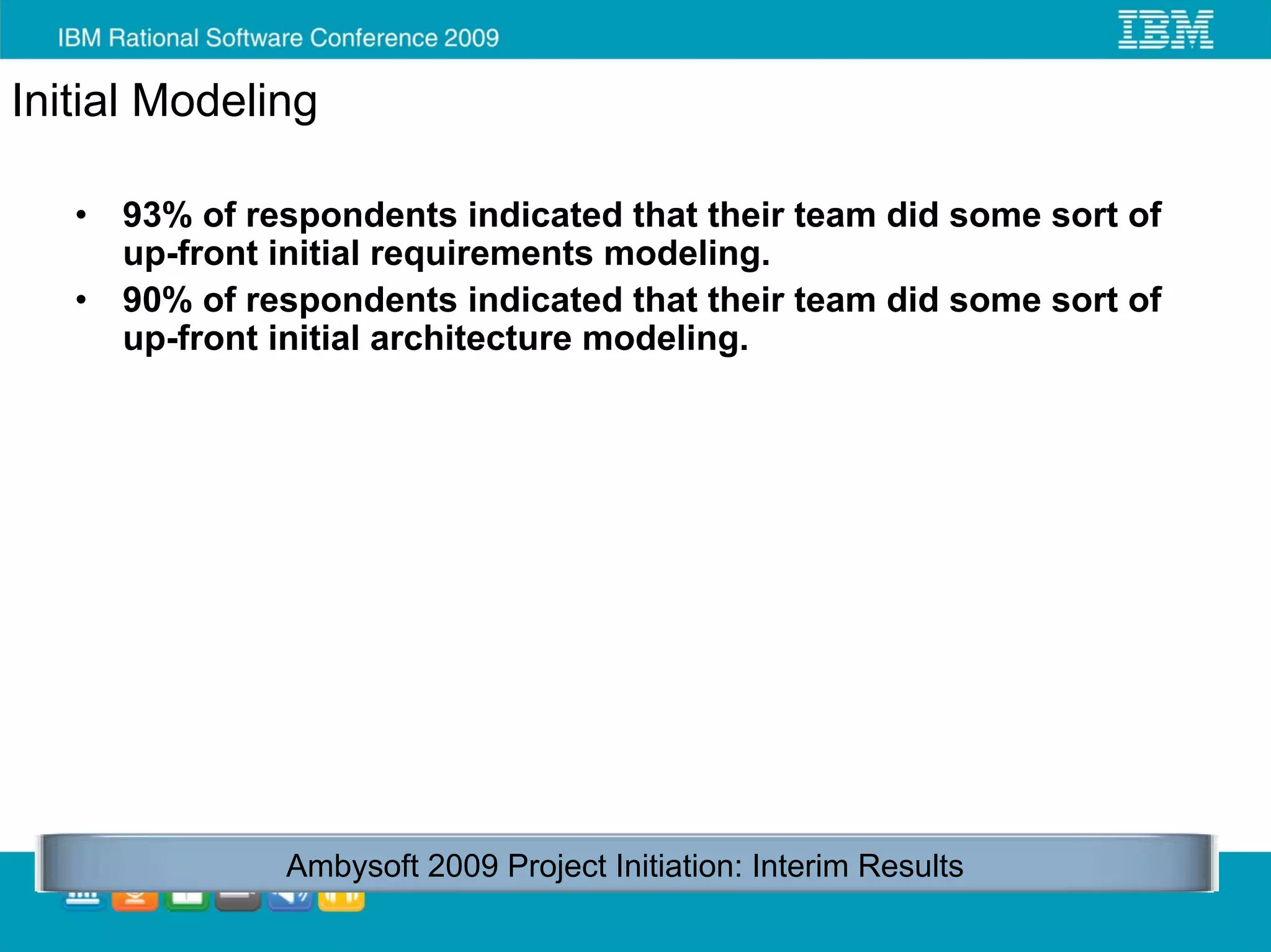
Initial Modeling

   •   93% of respondents indicated that their team did some sort of
       up-front initial requirements modeling.
   •   90% of respondents indicated that their team did some sort of
       up-front initial architecture modeling.


                Ambysoft 2009 Project Initiation: Interim Results
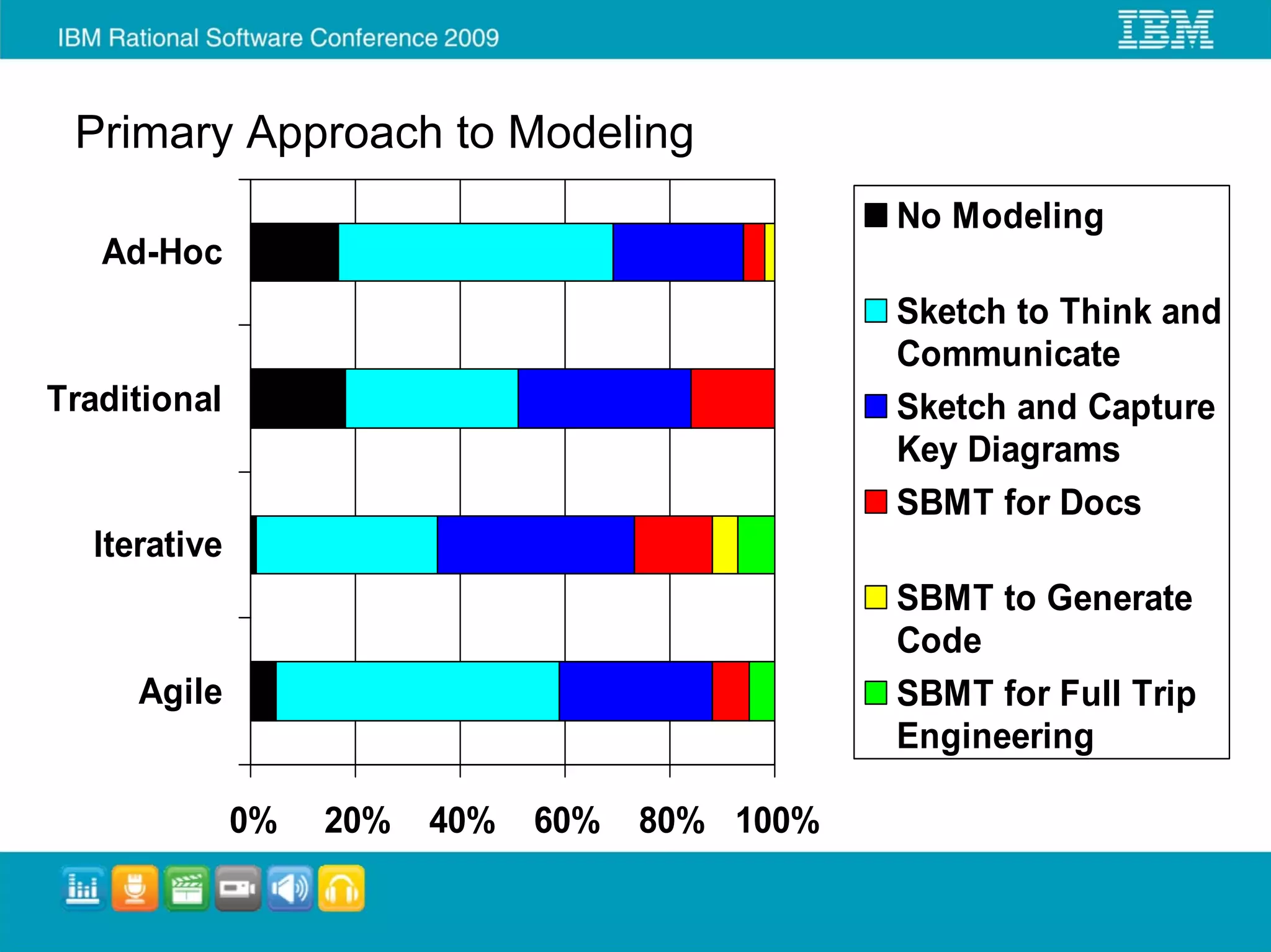
Primary Approach to Modeling
                                                No Modeling
   Ad-Hoc
                                                Sketch to Think and
                                                Communicate
Traditional                                     Sketch and Capture
                                                Key Diagrams
                                                SBMT for Docs
  Iterative
                                                SBMT to Generate
                                                Code
     Agile                                      SBMT for Full Trip
                                                Engineering

              0%   20%   40%   60%   80% 100%
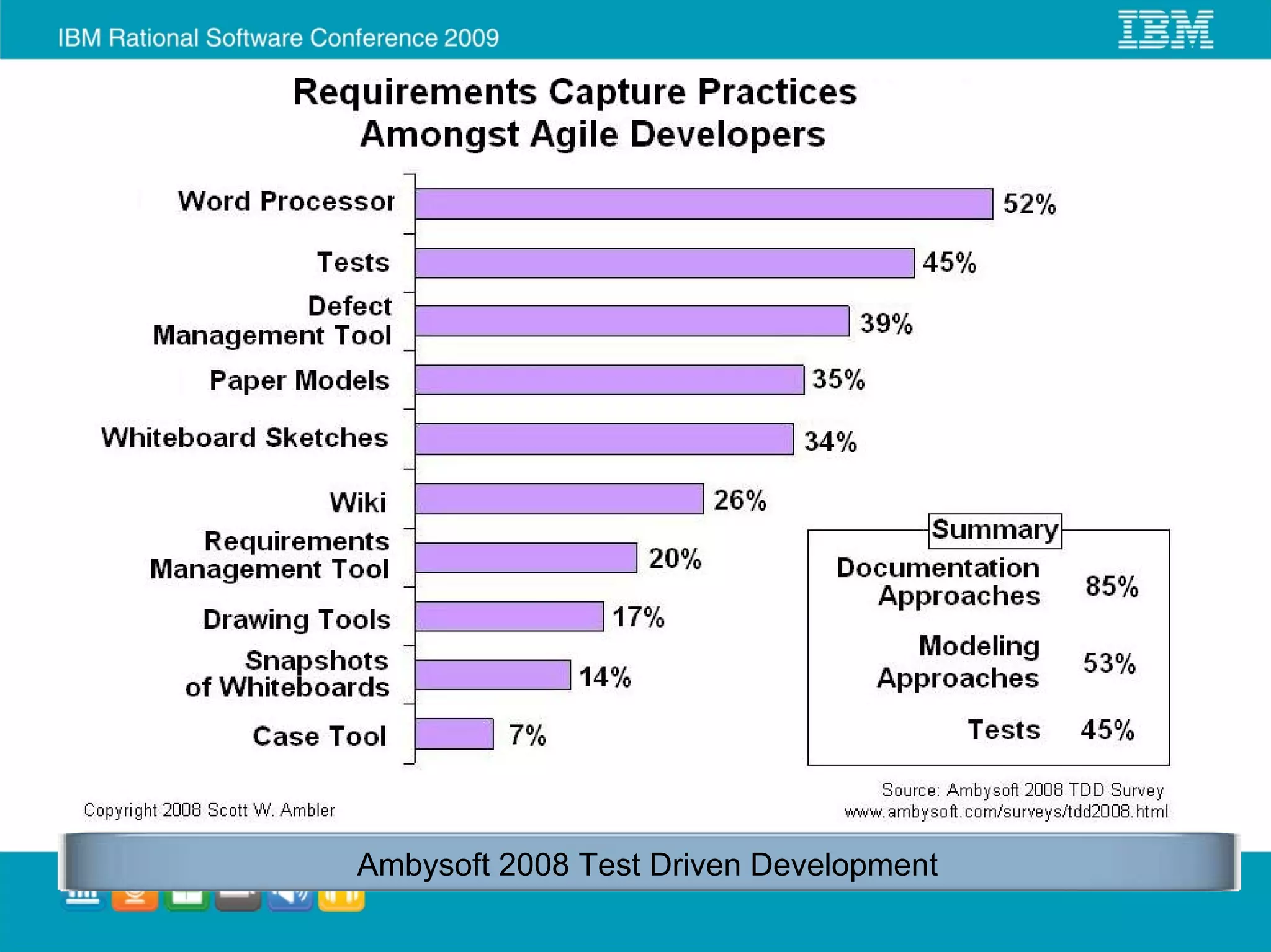
Ambysoft 2008 Test Driven Development
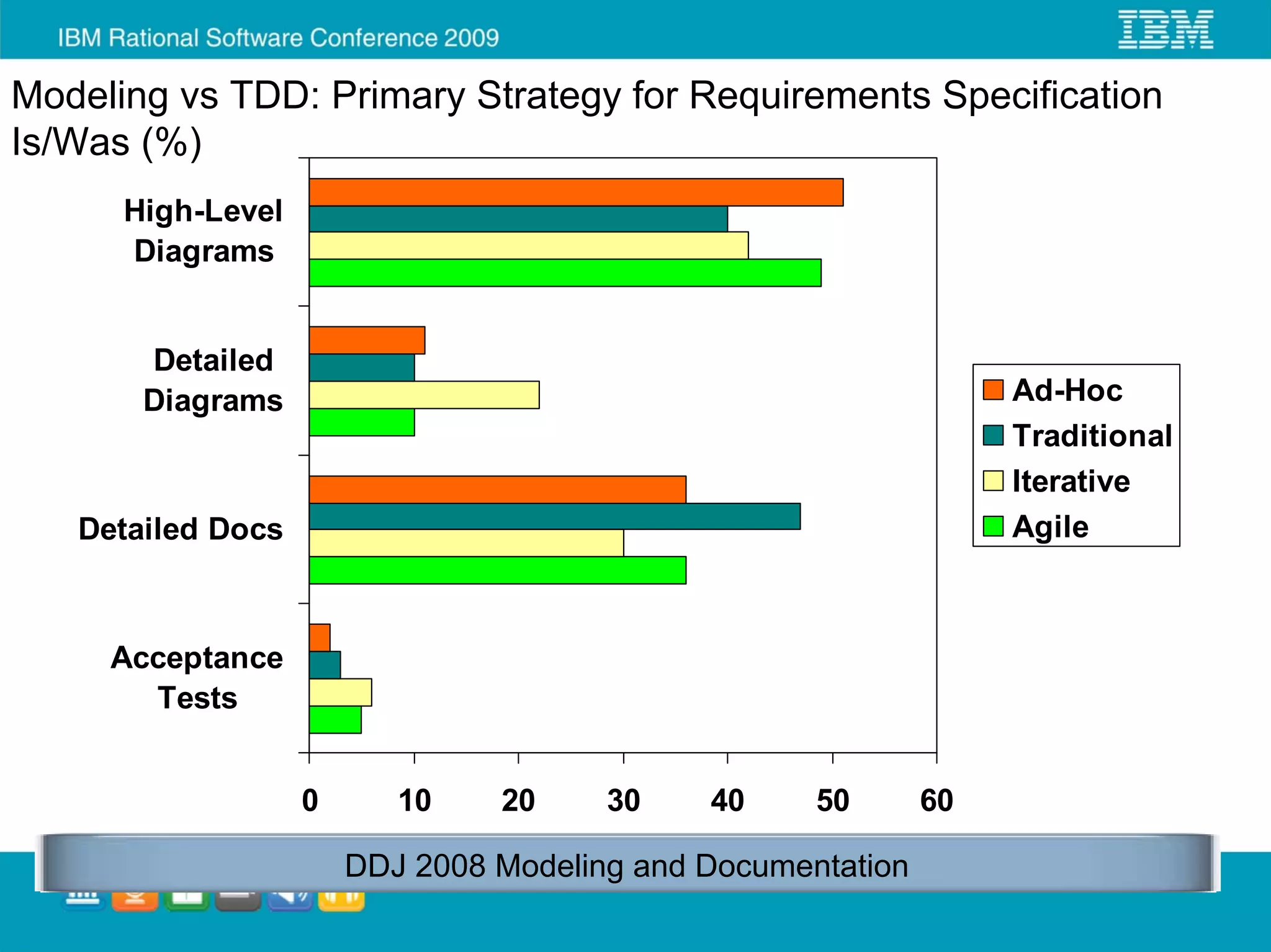
Modeling vs TDD: Primary Strategy for Requirements Specification
Is/Was (%)
      High-Level
      Diagrams


       Detailed
       Diagrams                                                   Ad-Hoc
                                                                  Traditional
                                                                  Iterative
   Detailed Docs                                                  Agile


     Acceptance
       Tests


                   0      10    20     30    40     50       60

                       DDJ 2008 Modeling and Documentation
Ambysoft 2008 Test Driven Development
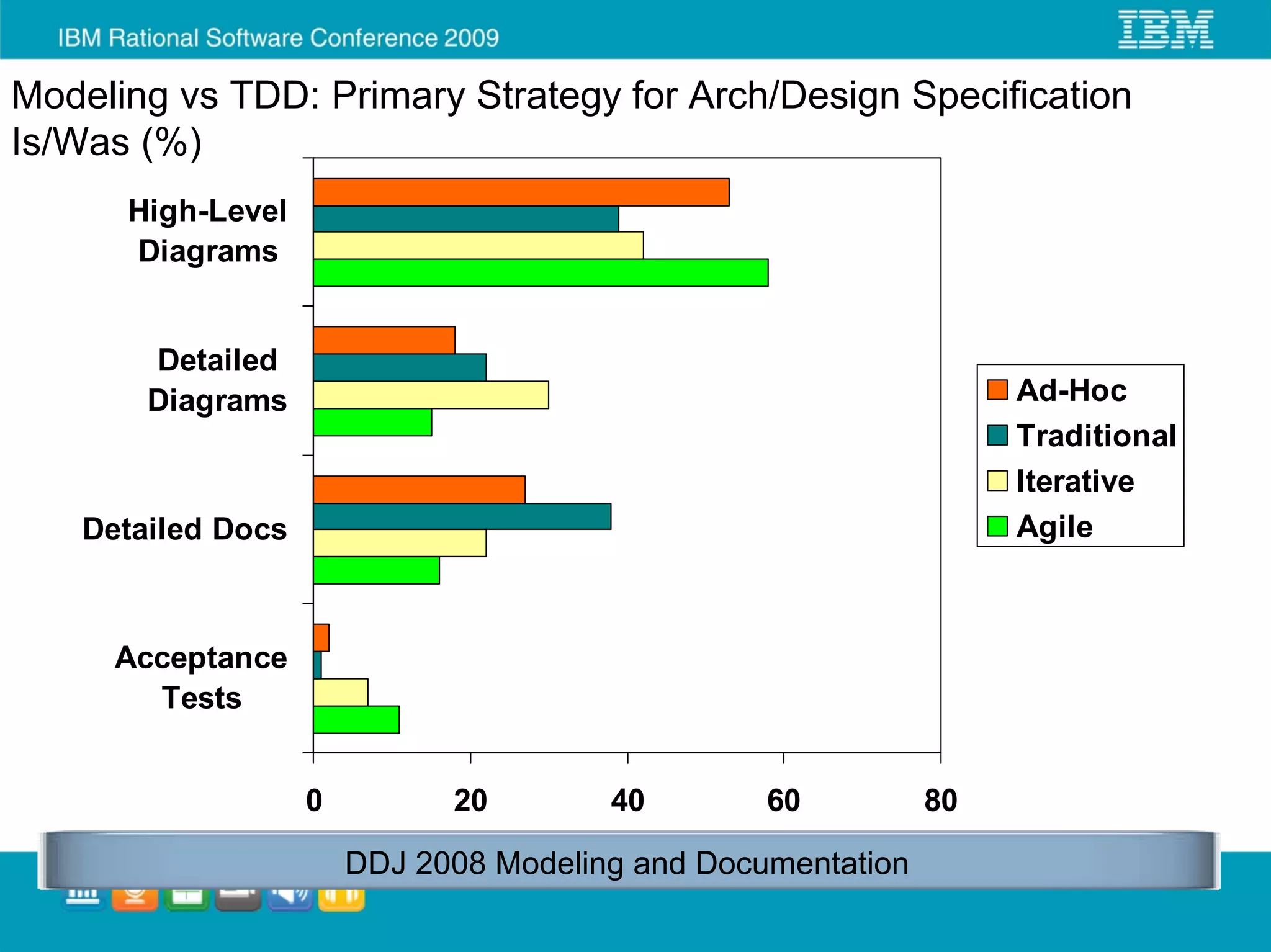
Modeling vs TDD: Primary Strategy for Arch/Design Specification
Is/Was (%)
      High-Level
      Diagrams


       Detailed
       Diagrams                                                   Ad-Hoc
                                                                  Traditional
                                                                  Iterative
   Detailed Docs                                                  Agile


     Acceptance
       Tests


                   0         20        40        60          80

                       DDJ 2008 Modeling and Documentation
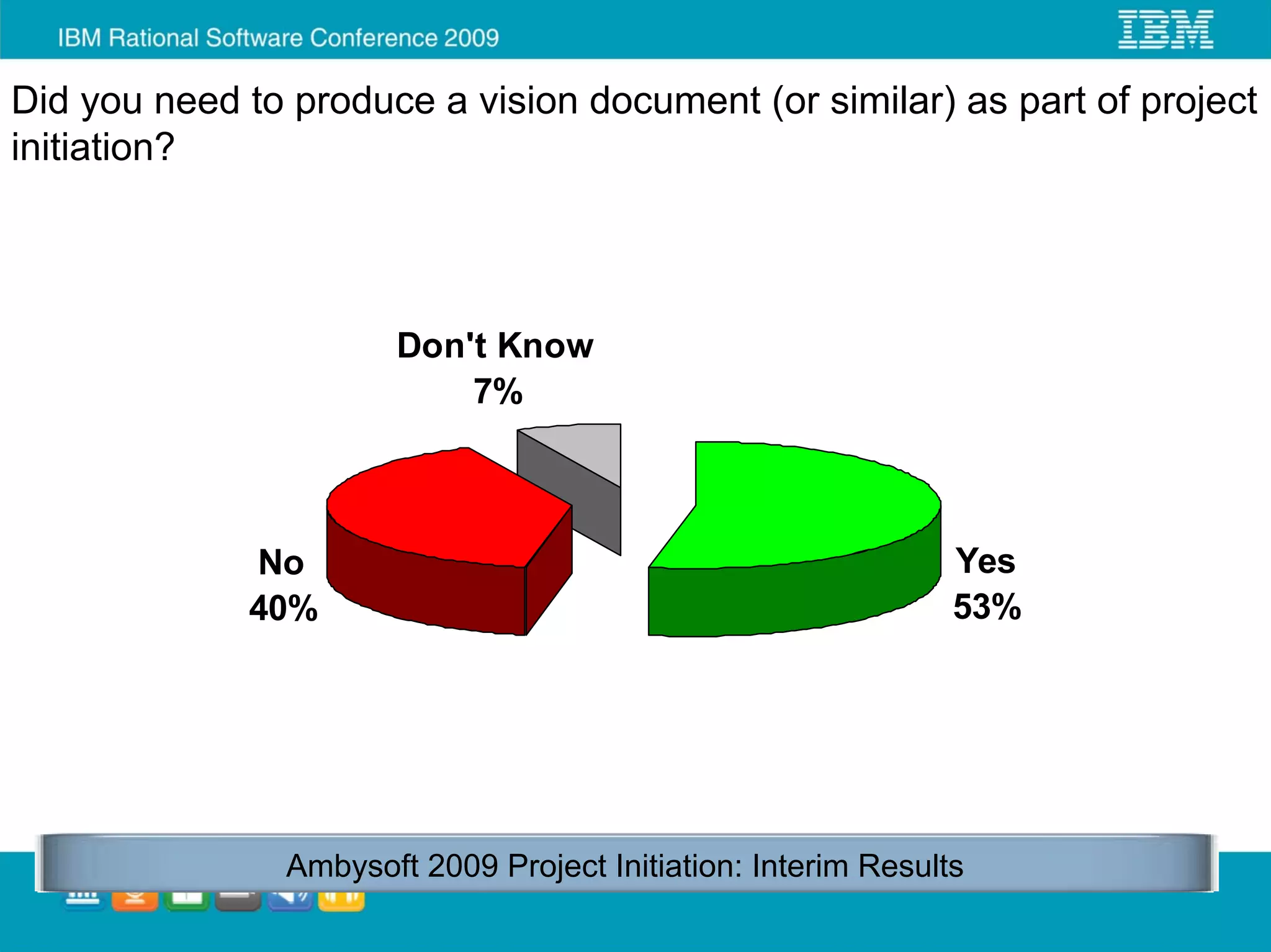
Did you need to produce a vision document (or similar) as part of project
initiation?


                       Don't Know
                           7%


             No                                                 Yes
             40%                                                53%


                Ambysoft 2009 Project Initiation: Interim Results
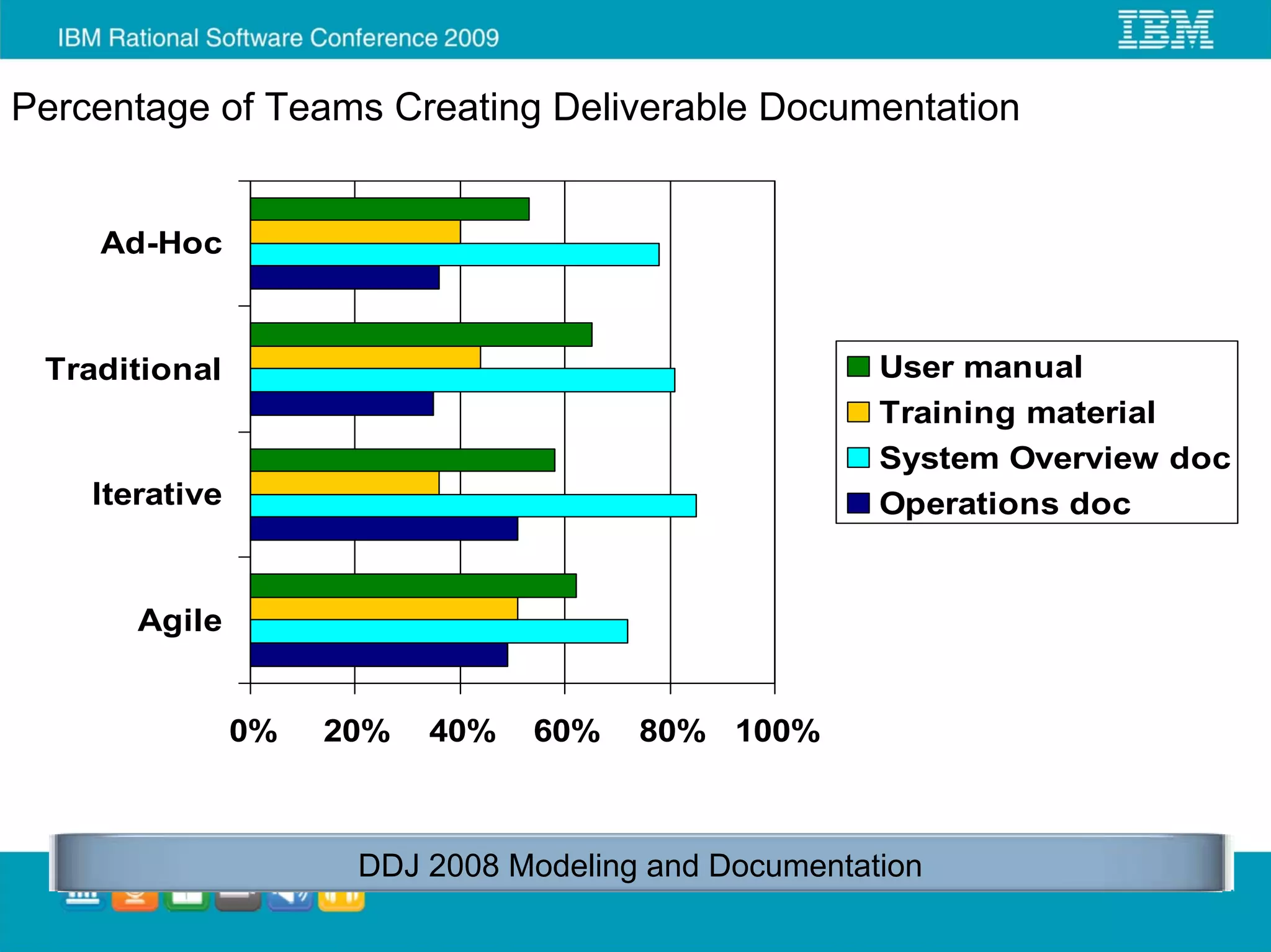
Percentage of Teams Creating Deliverable Documentation


    Ad-Hoc


 Traditional                                          User manual
                                                      Training material
                                                      System Overview doc
    Iterative                                         Operations doc


       Agile


                0%   20%   40%   60%   80% 100%


                      DDJ 2008 Modeling and Documentation
Agenda
•    The Surveys
•    Agile Practices
•    Agility@Scale
•    Adoption and Success
     Rates
•    Management
•    Governance
•    Development and Quality
•    Modeling and
     Documentation
•    Communication
•    Parting Thoughts
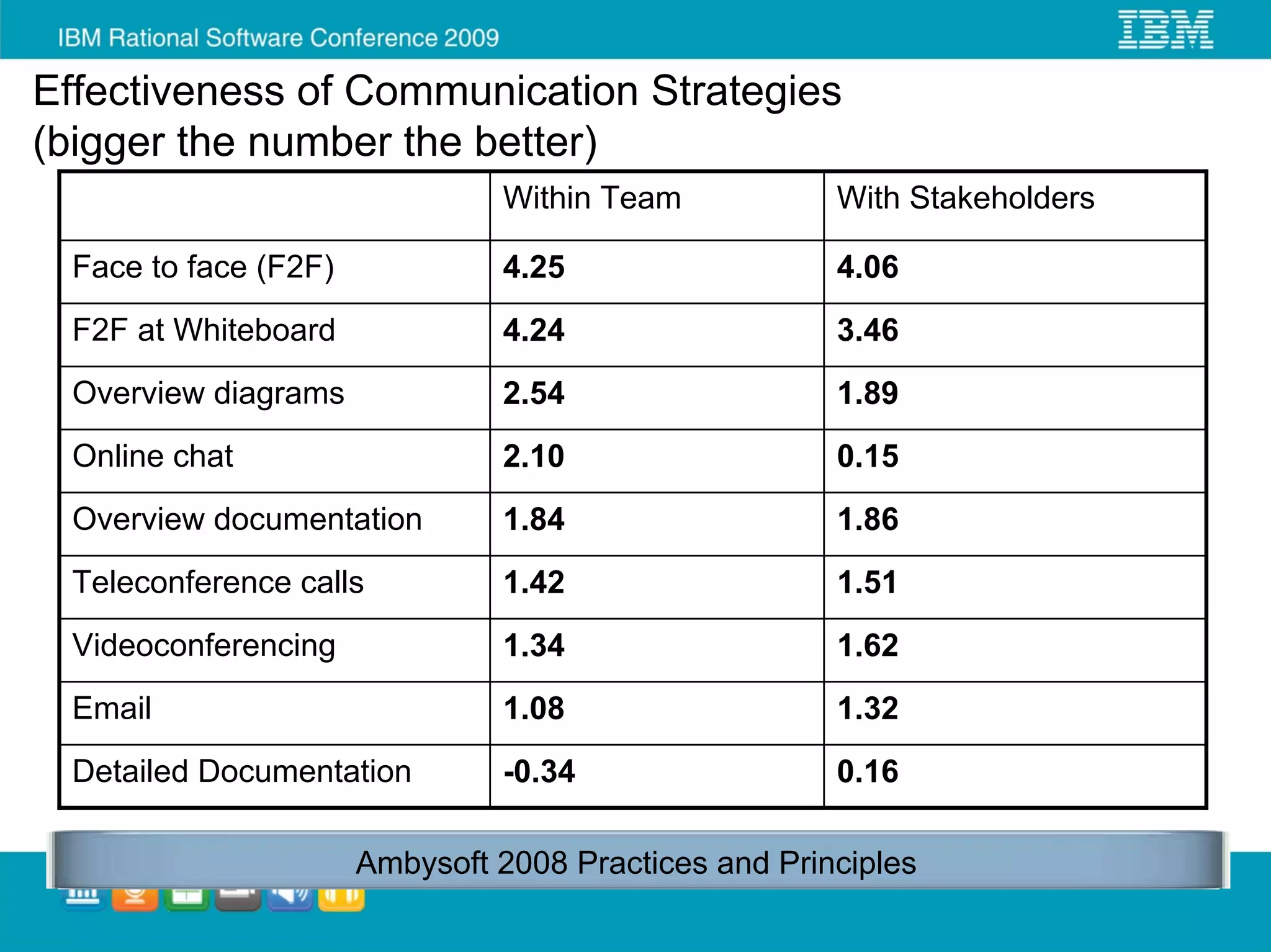
Effectiveness of Communication Strategies
(bigger the number the better)
                                Within Team            With Stakeholders

  Face to face (F2F)            4.25                   4.06
  F2F at Whiteboard             4.24                   3.46
  Overview diagrams             2.54                   1.89
  Online chat                   2.10                   0.15
  Overview documentation        1.84                   1.86
  Teleconference calls          1.42                   1.51
  Videoconferencing             1.34                   1.62
  Email                         1.08                   1.32
  Detailed Documentation        -0.34                  0.16

                       Ambysoft 2008 Practices and Principles
Agenda
•    The Surveys
•    Agile Practices
•    Agility@Scale
•    Adoption and Success
     Rates
•    Management
•    Governance
•    Development and Quality
•    Modeling and
     Documentation
•    Communication
•    Parting Thoughts
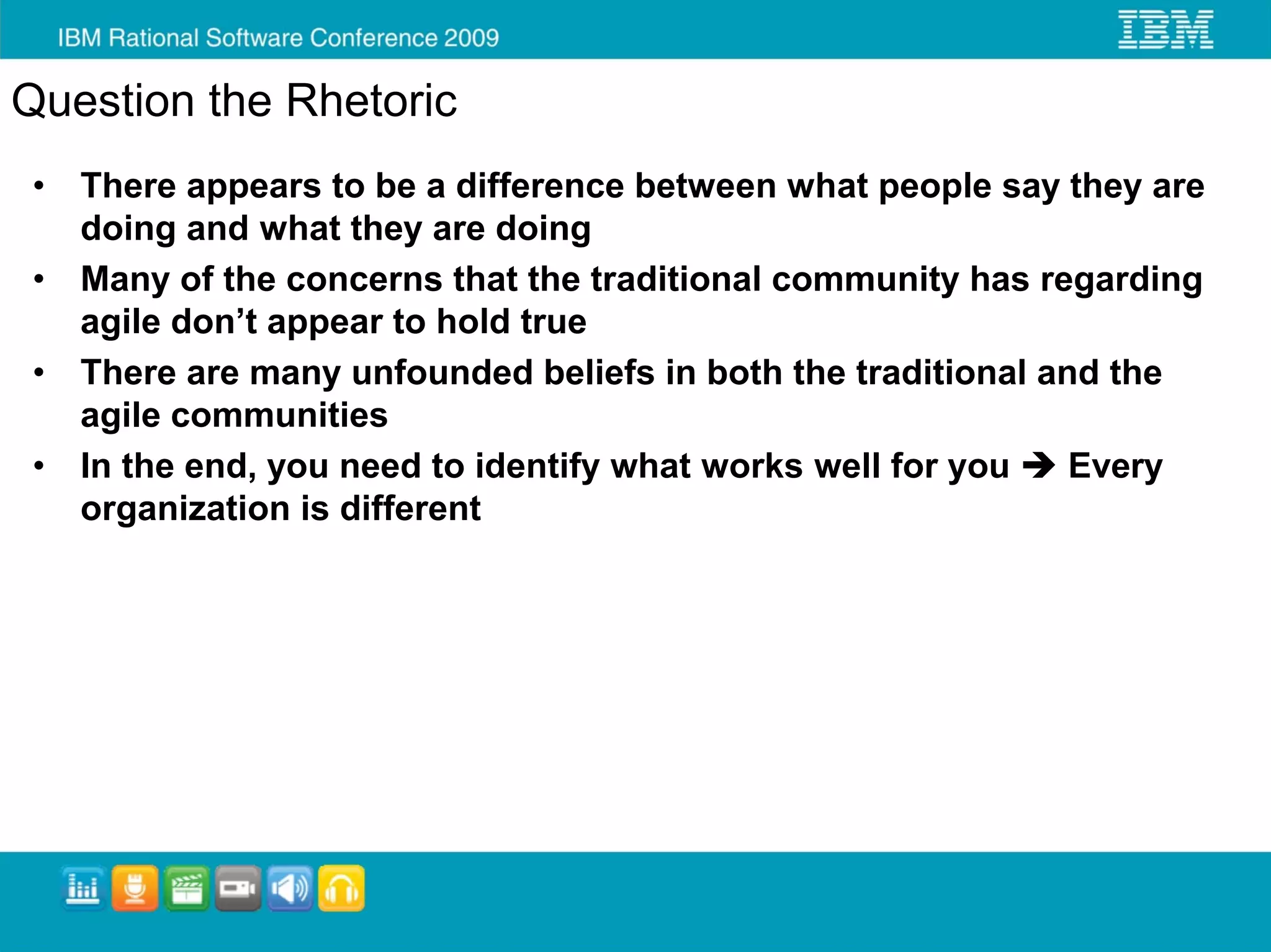
Question the Rhetoric
 •   There appears to be a difference between what people say they are
     doing and what they are doing
 •   Many of the concerns that the traditional community has regarding
     agile don’t appear to hold true
 •   There are many unfounded beliefs in both the traditional and the
     agile communities
 •   In the end, you need to identify what works well for you   Every
     organization is different
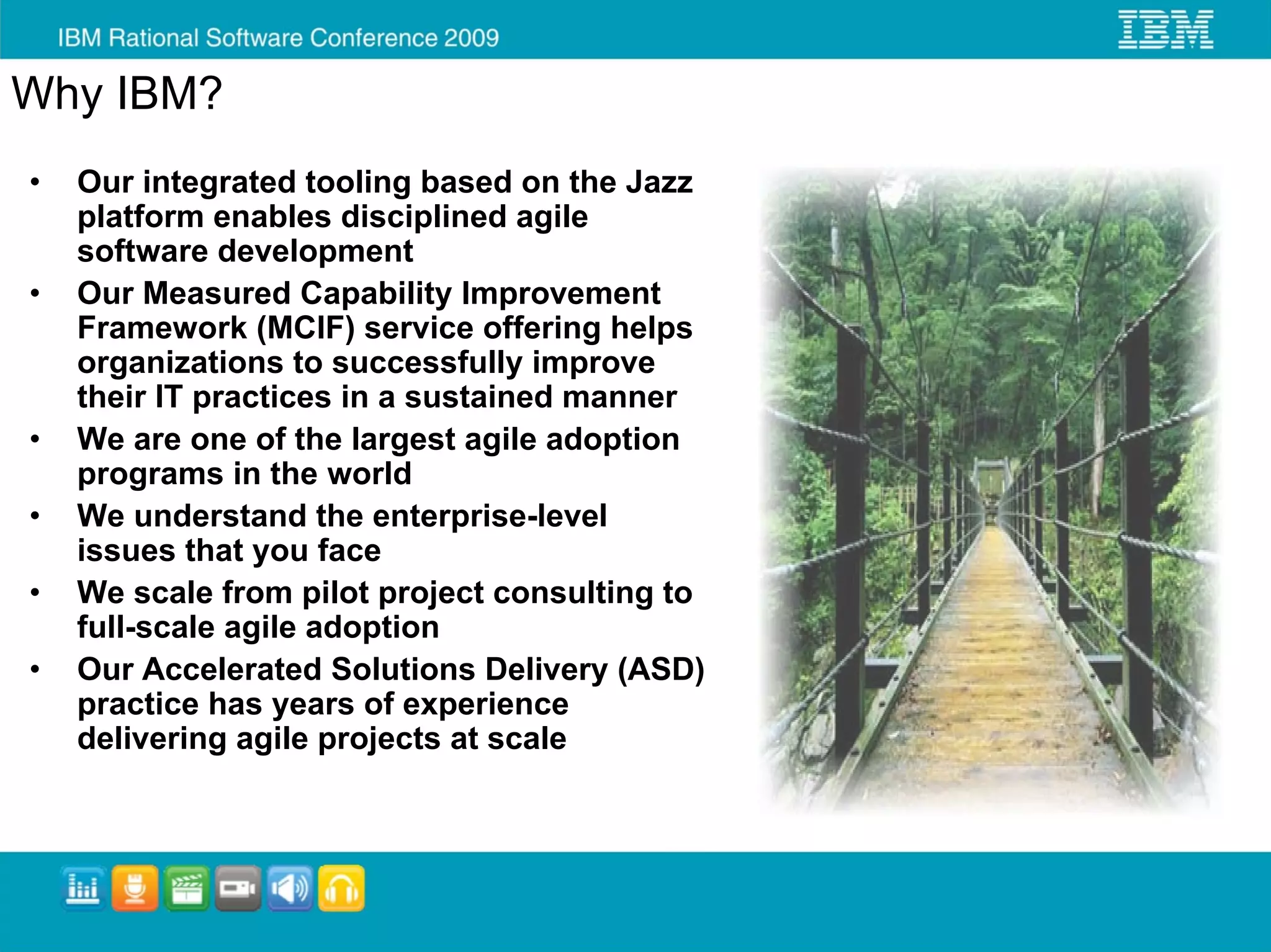
Why IBM?
•   Our integrated tooling based on the Jazz
    platform enables disciplined agile
    software development
•   Our Measured Capability Improvement
    Framework (MCIF) service offering helps
    organizations to successfully improve
    their IT practices in a sustained manner
•   We are one of the largest agile adoption
    programs in the world
•   We understand the enterprise-level
    issues that you face
•   We scale from pilot project consulting to
    full-scale agile adoption
•   Our Accelerated Solutions Delivery (ASD)
    practice has years of experience
    delivering agile projects at scale
DDJ 2006 Agile Adoption


•   Used Dr. Dobb’s Journal and Software Development mailing
    lists
•   4232 Respondents
•   March 2006
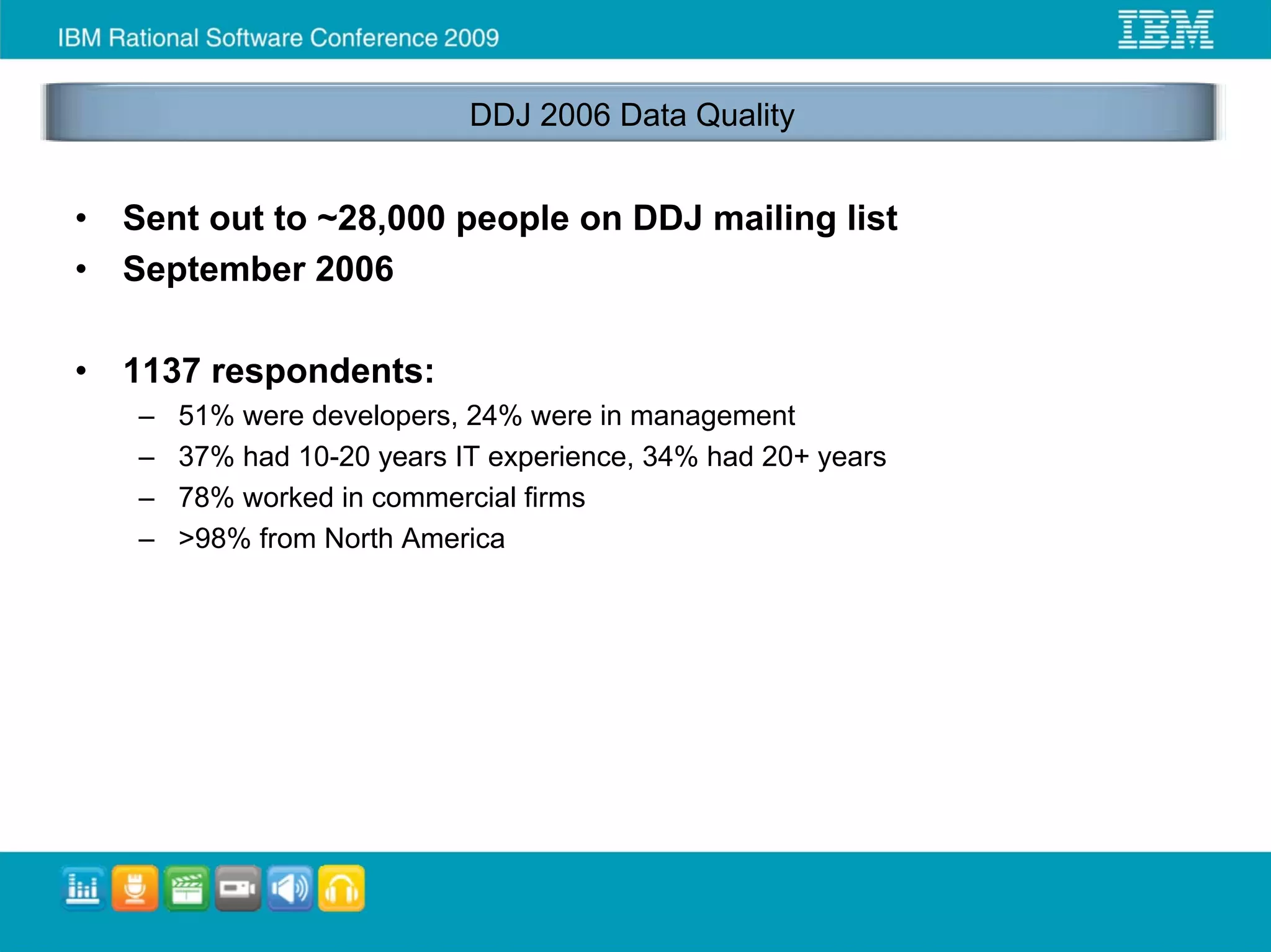
DDJ 2006 Data Quality


•   Sent out to ~28,000 people on DDJ mailing list
•   September 2006

•   1137 respondents:
    –   51% were developers, 24% were in management
    –   37% had 10-20 years IT experience, 34% had 20+ years
    –   78% worked in commercial firms
    –   >98% from North America
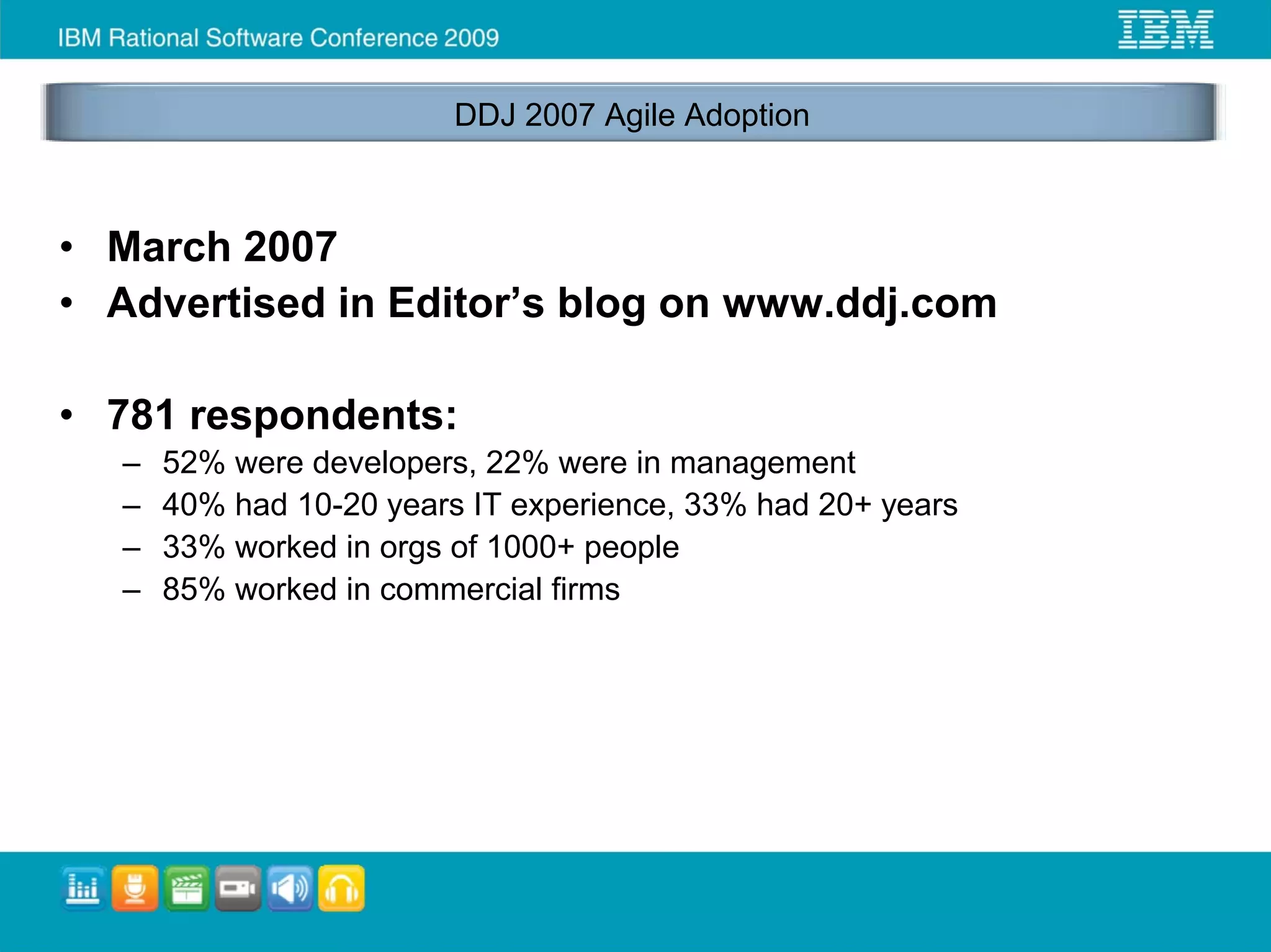
DDJ 2007 Agile Adoption


• March 2007
• Advertised in Editor’s blog on www.ddj.com

• 781 respondents:
  –   52% were developers, 22% were in management
  –   40% had 10-20 years IT experience, 33% had 20+ years
  –   33% worked in orgs of 1000+ people
  –   85% worked in commercial firms
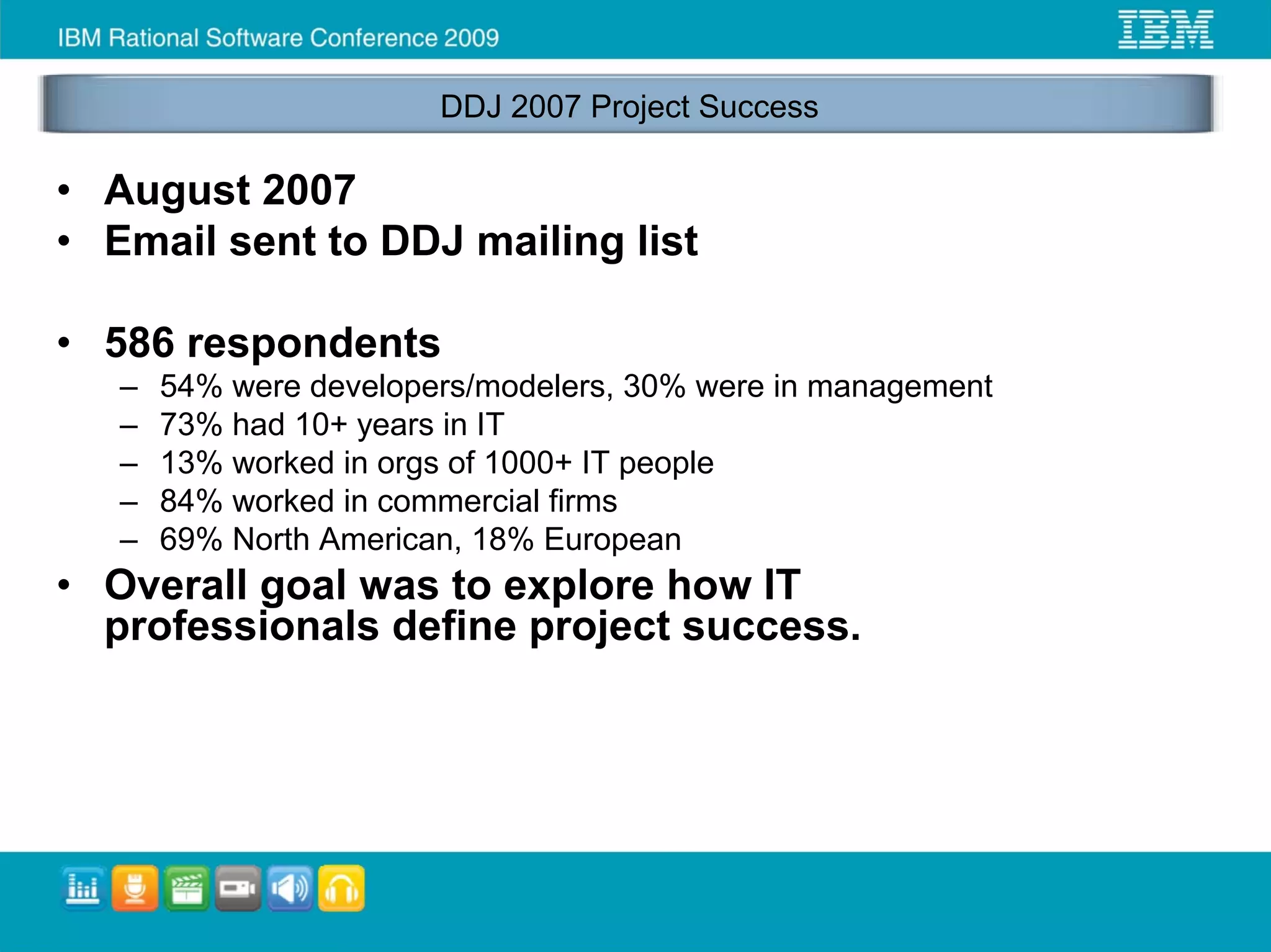
DDJ 2007 Project Success

• August 2007
• Email sent to DDJ mailing list

• 586 respondents
   –   54% were developers/modelers, 30% were in management
   –   73% had 10+ years in IT
   –   13% worked in orgs of 1000+ IT people
   –   84% worked in commercial firms
   –   69% North American, 18% European
• Overall goal was to explore how IT
  professionals define project success.
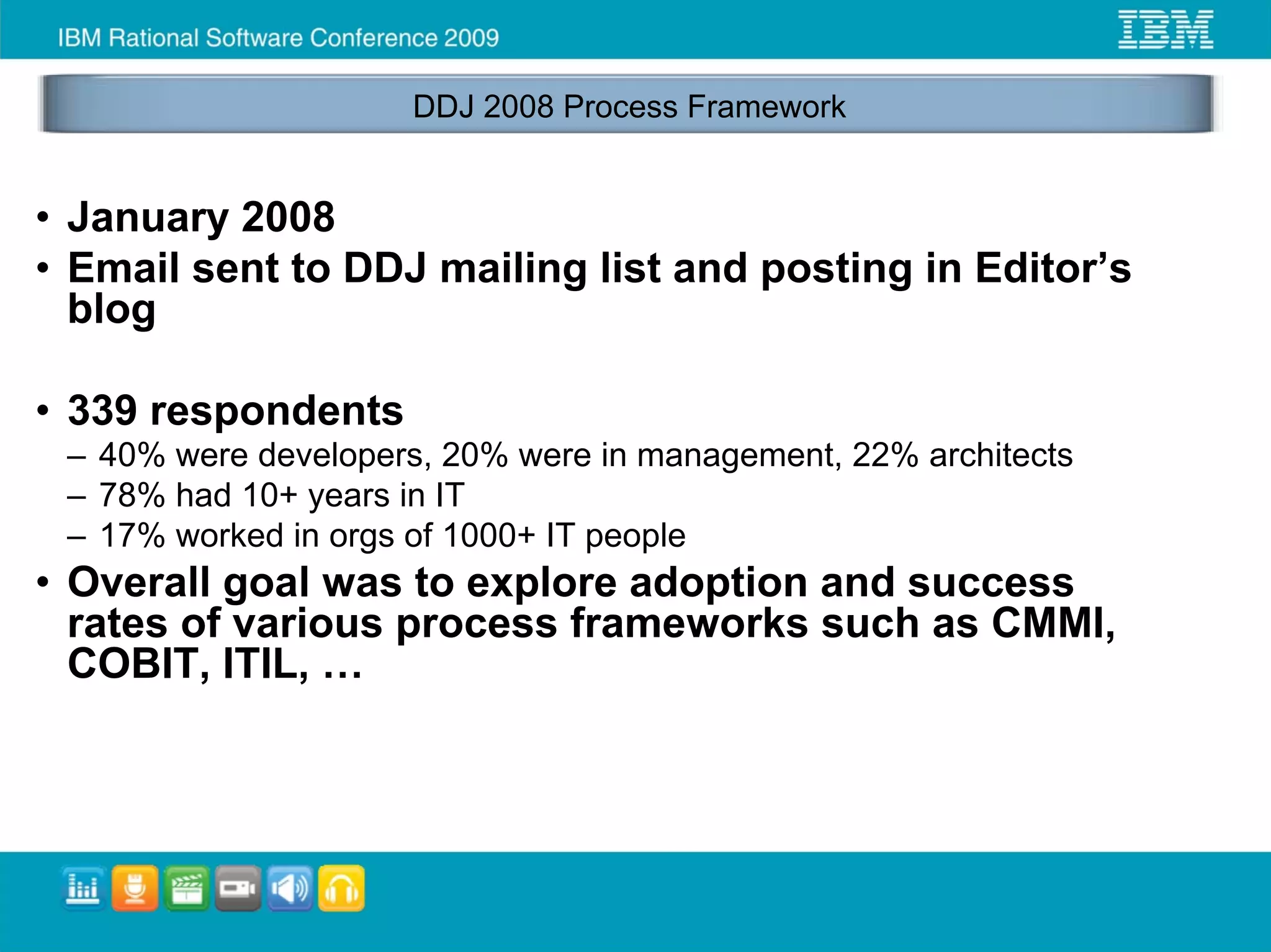
DDJ 2008 Process Framework


• January 2008
• Email sent to DDJ mailing list and posting in Editor’s
  blog

• 339 respondents
 – 40% were developers, 20% were in management, 22% architects
 – 78% had 10+ years in IT
 – 17% worked in orgs of 1000+ IT people
• Overall goal was to explore adoption and success
  rates of various process frameworks such as CMMI,
  COBIT, ITIL, …
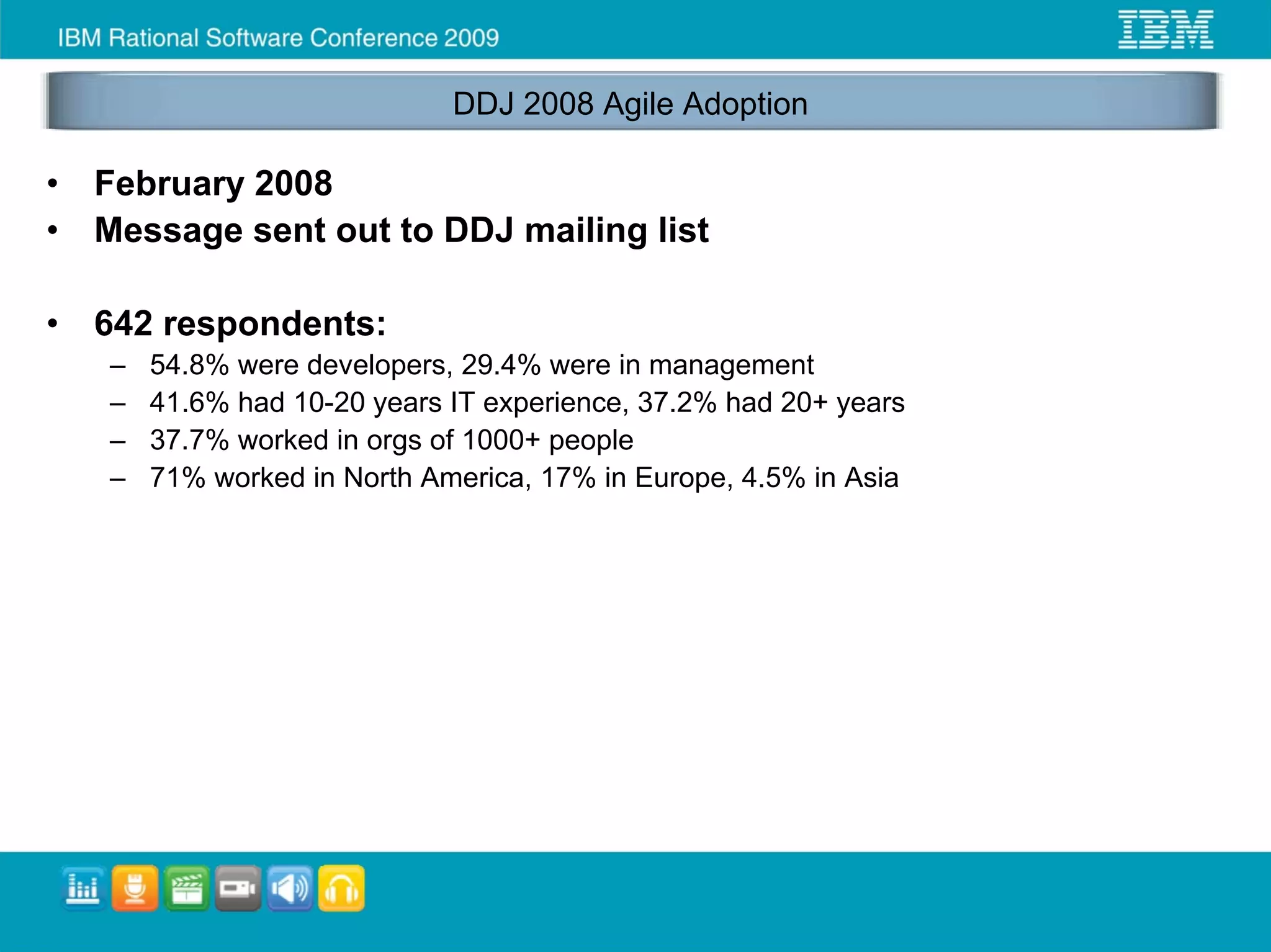
DDJ 2008 Agile Adoption

•   February 2008
•   Message sent out to DDJ mailing list

•   642 respondents:
    –   54.8% were developers, 29.4% were in management
    –   41.6% had 10-20 years IT experience, 37.2% had 20+ years
    –   37.7% worked in orgs of 1000+ people
    –   71% worked in North America, 17% in Europe, 4.5% in Asia
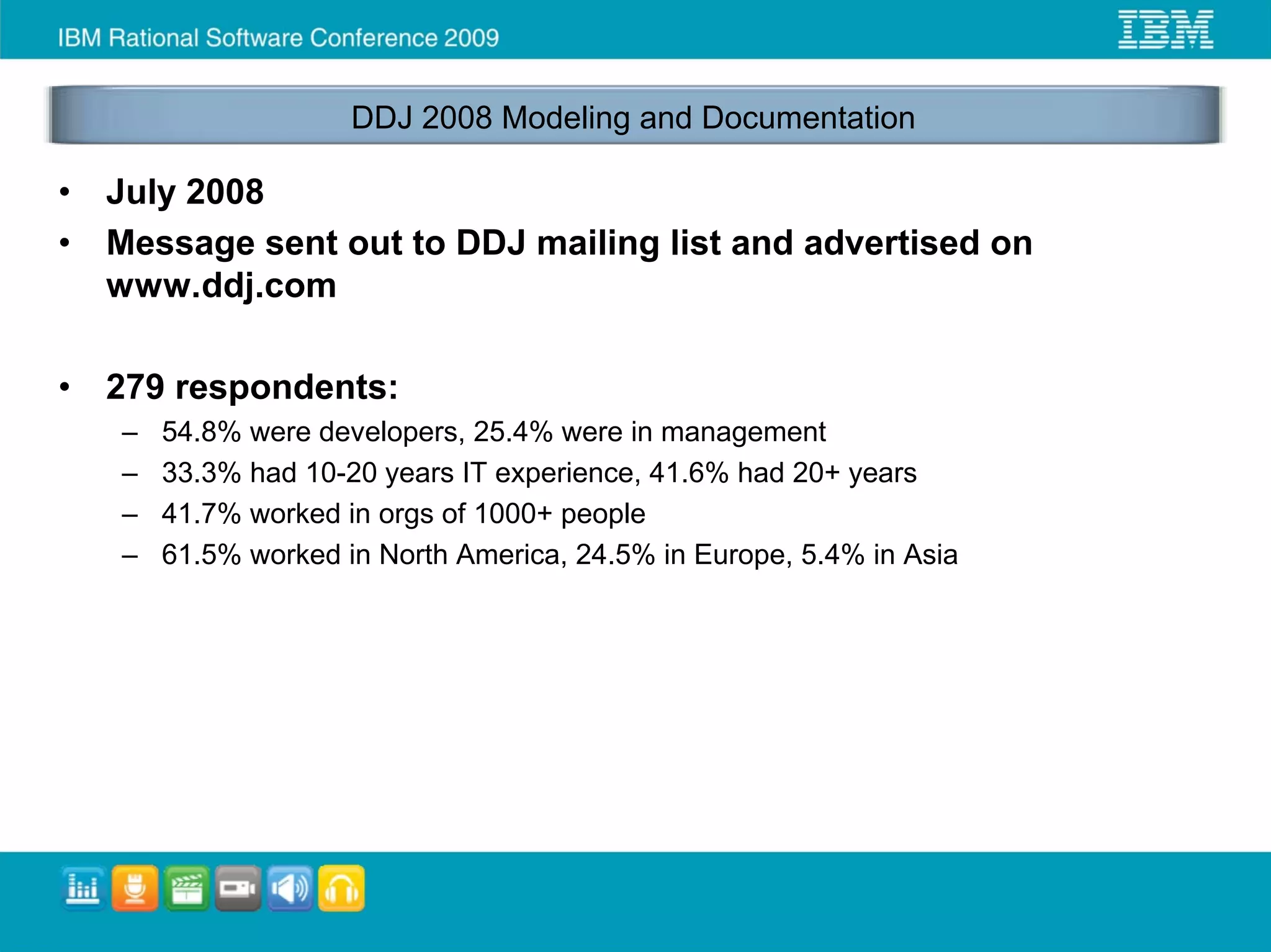
DDJ 2008 Modeling and Documentation

•   July 2008
•   Message sent out to DDJ mailing list and advertised on
    www.ddj.com

•   279 respondents:
    –   54.8% were developers, 25.4% were in management
    –   33.3% had 10-20 years IT experience, 41.6% had 20+ years
    –   41.7% worked in orgs of 1000+ people
    –   61.5% worked in North America, 24.5% in Europe, 5.4% in Asia
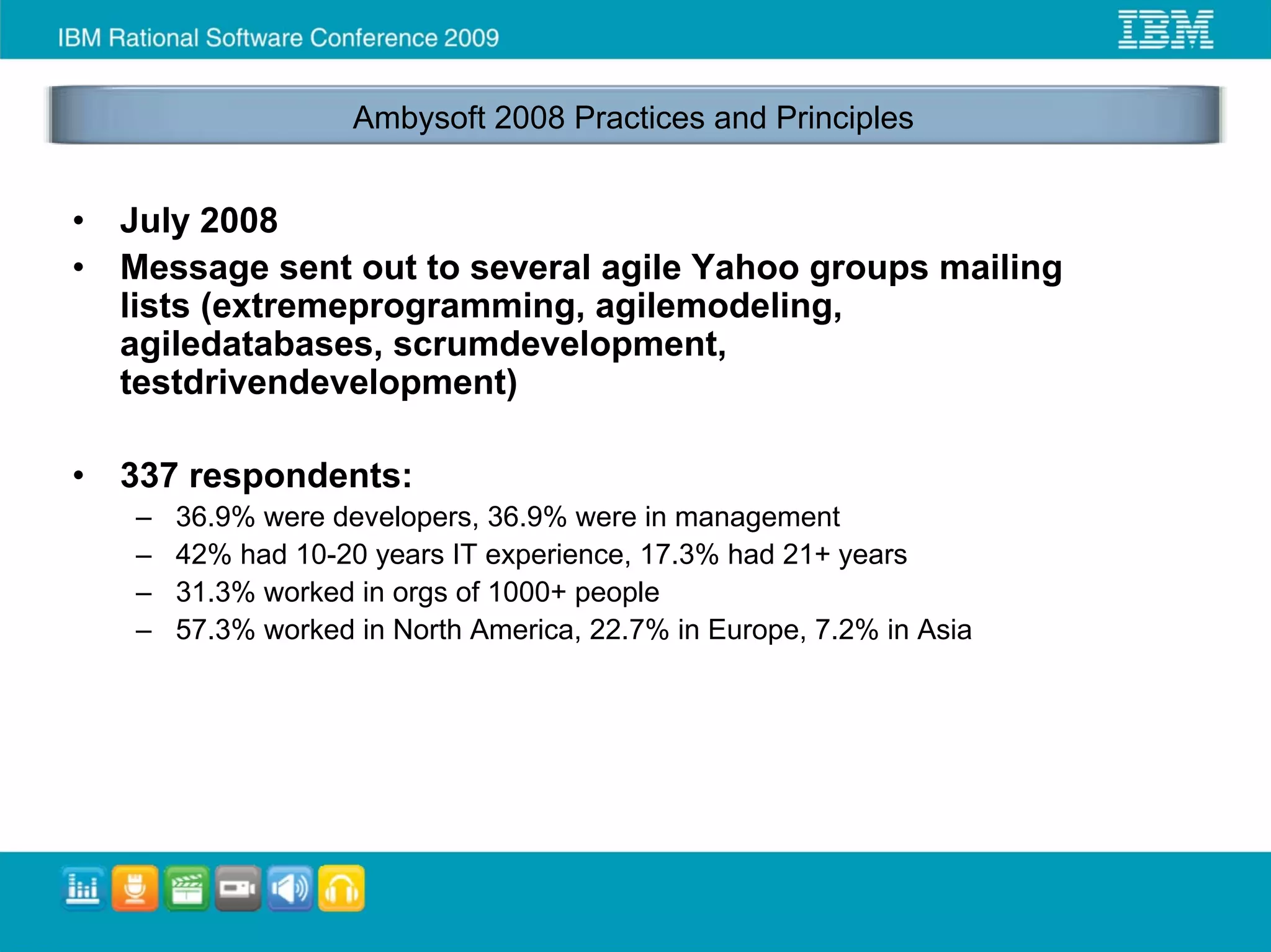
Ambysoft 2008 Practices and Principles


•   July 2008
•   Message sent out to several agile Yahoo groups mailing
    lists (extremeprogramming, agilemodeling,
    agiledatabases, scrumdevelopment,
    testdrivendevelopment)

•   337 respondents:
    –   36.9% were developers, 36.9% were in management
    –   42% had 10-20 years IT experience, 17.3% had 21+ years
    –   31.3% worked in orgs of 1000+ people
    –   57.3% worked in North America, 22.7% in Europe, 7.2% in Asia
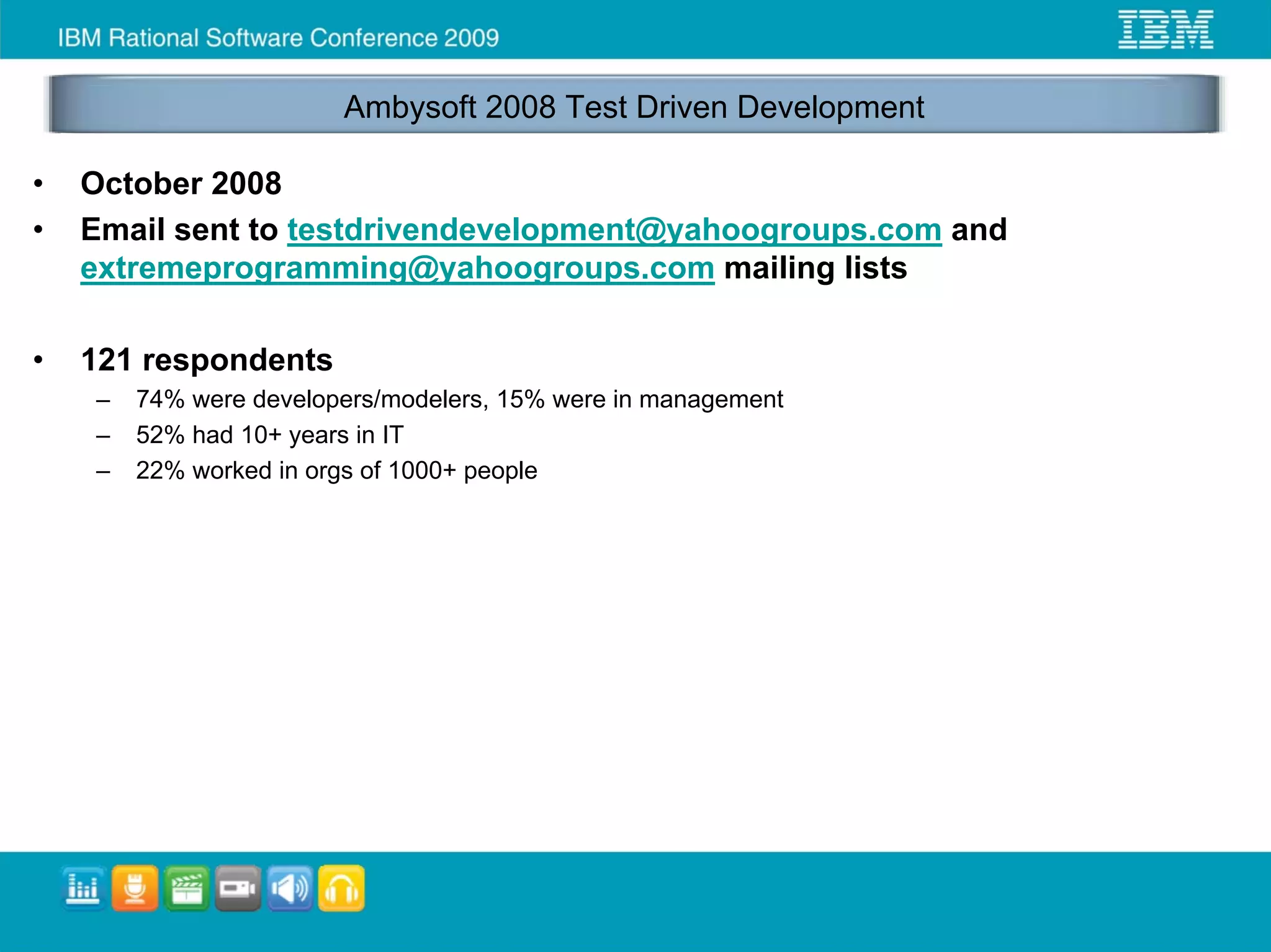
Ambysoft 2008 Test Driven Development

•   October 2008
•   Email sent to testdrivendevelopment@yahoogroups.com and
    extremeprogramming@yahoogroups.com mailing lists

•   121 respondents
    –   74% were developers/modelers, 15% were in management
    –   52% had 10+ years in IT
    –   22% worked in orgs of 1000+ people
DDJ 2008 Project Success

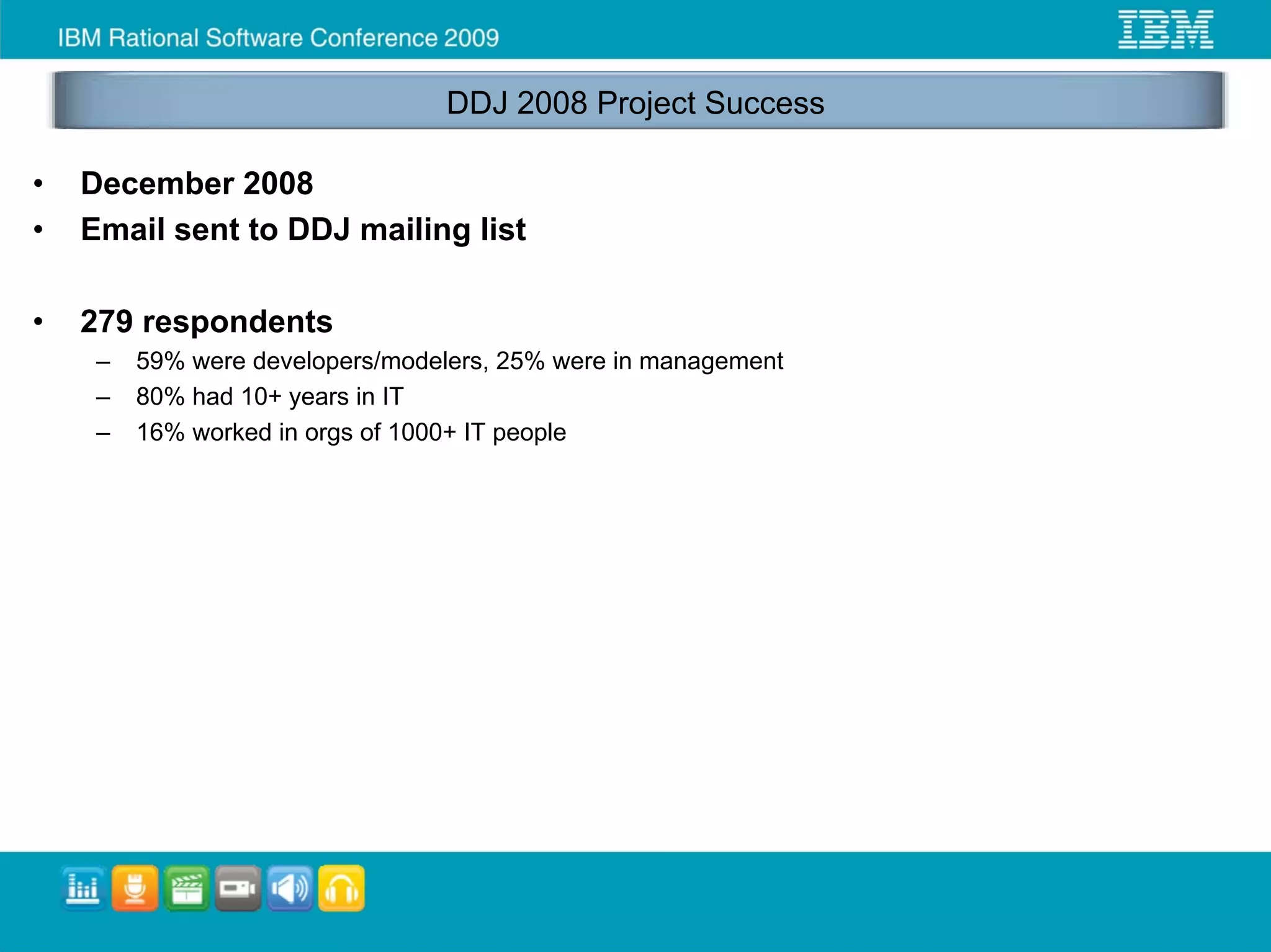
•   December 2008
•   Email sent to DDJ mailing list

•   279 respondents
     –   59% were developers/modelers, 25% were in management
     –   80% had 10+ years in IT
     –   16% worked in orgs of 1000+ IT people
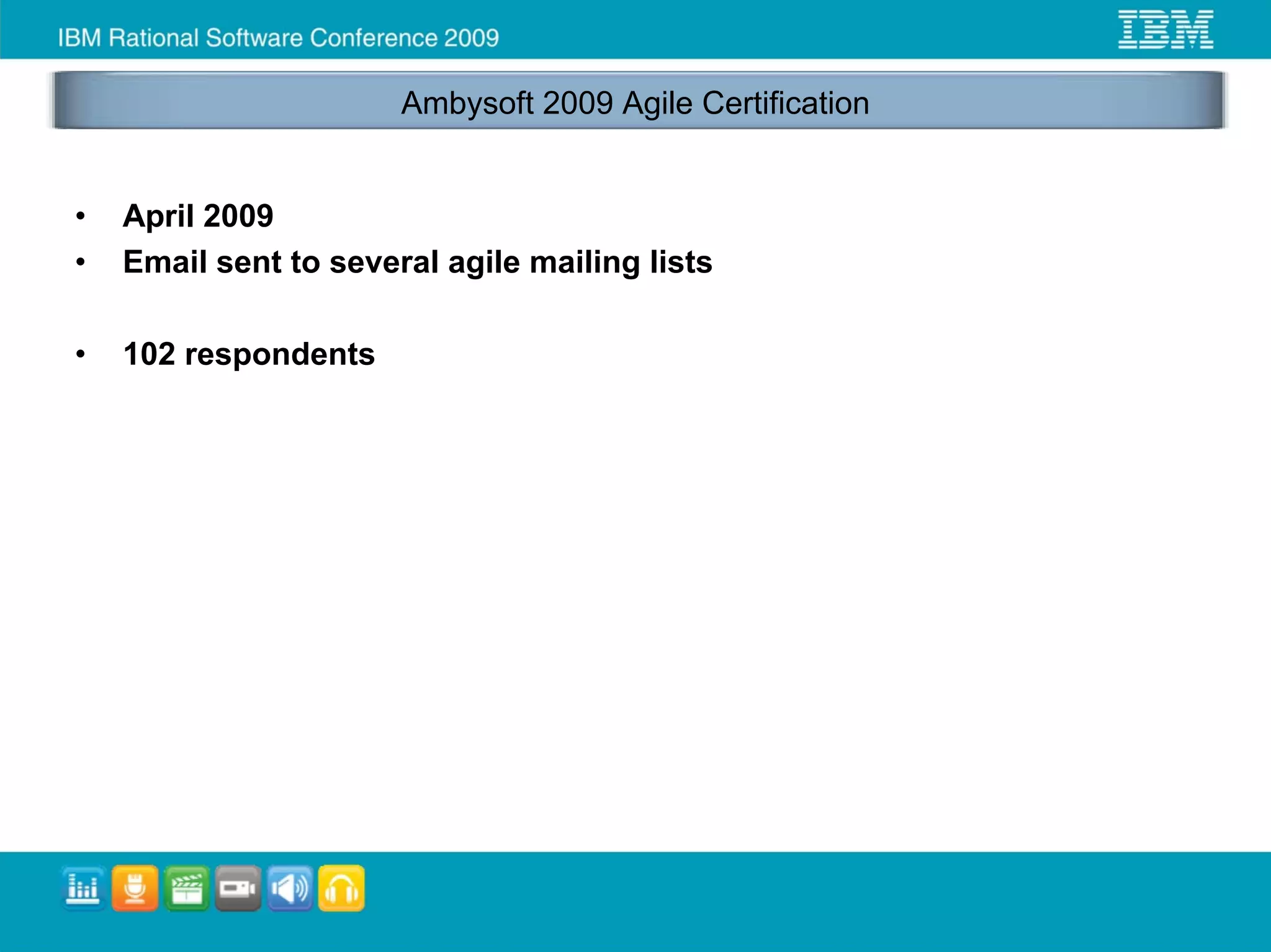
Ambysoft 2009 Agile Certification


•   April 2009
•   Email sent to several agile mailing lists

•   102 respondents
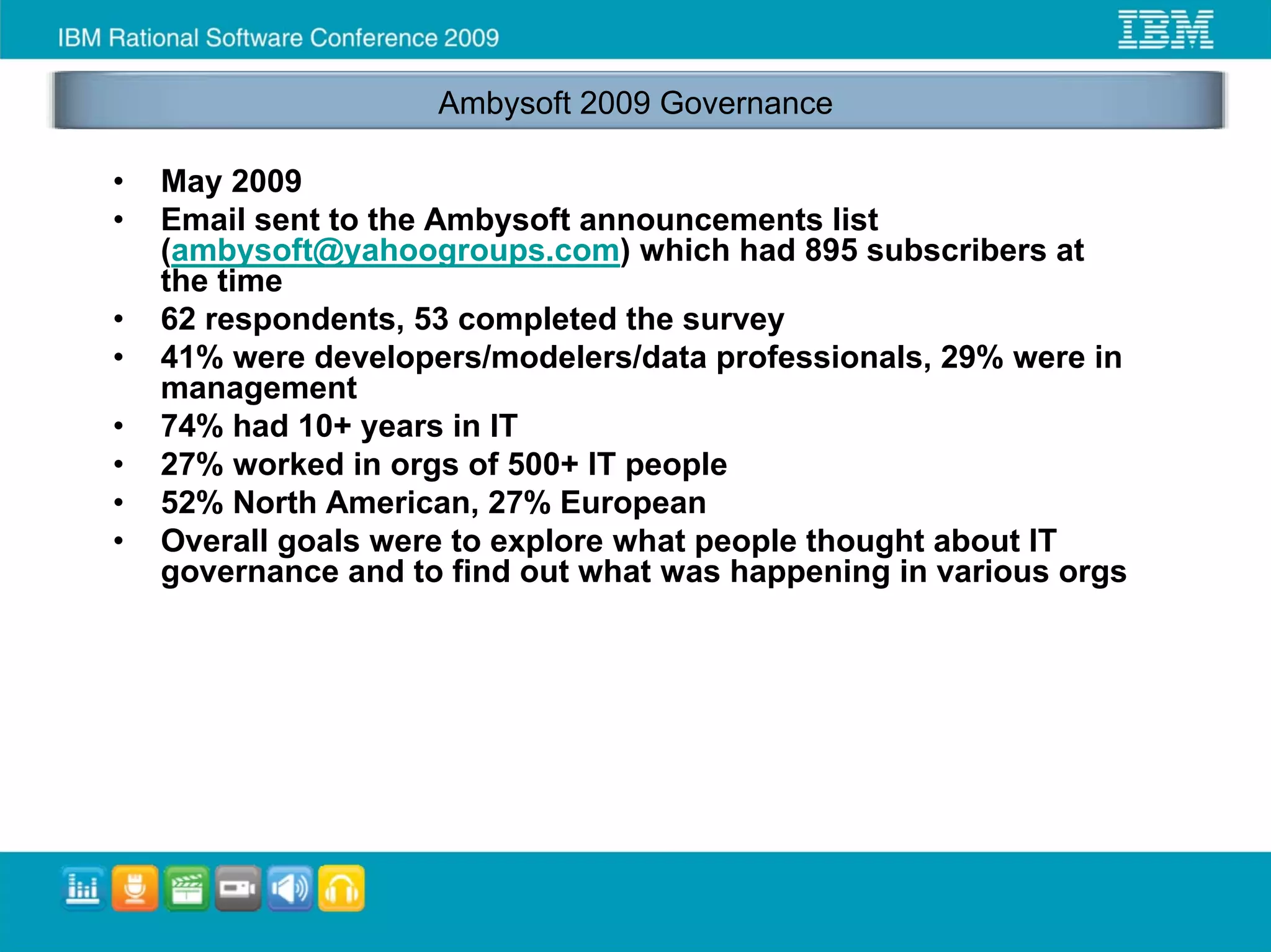
Ambysoft 2009 Governance

•   May 2009
•   Email sent to the Ambysoft announcements list
    (ambysoft@yahoogroups.com) which had 895 subscribers at
    the time
•   62 respondents, 53 completed the survey
•   41% were developers/modelers/data professionals, 29% were in
    management
•   74% had 10+ years in IT
•   27% worked in orgs of 500+ IT people
•   52% North American, 27% European
•   Overall goals were to explore what people thought about IT
    governance and to find out what was happening in various orgs
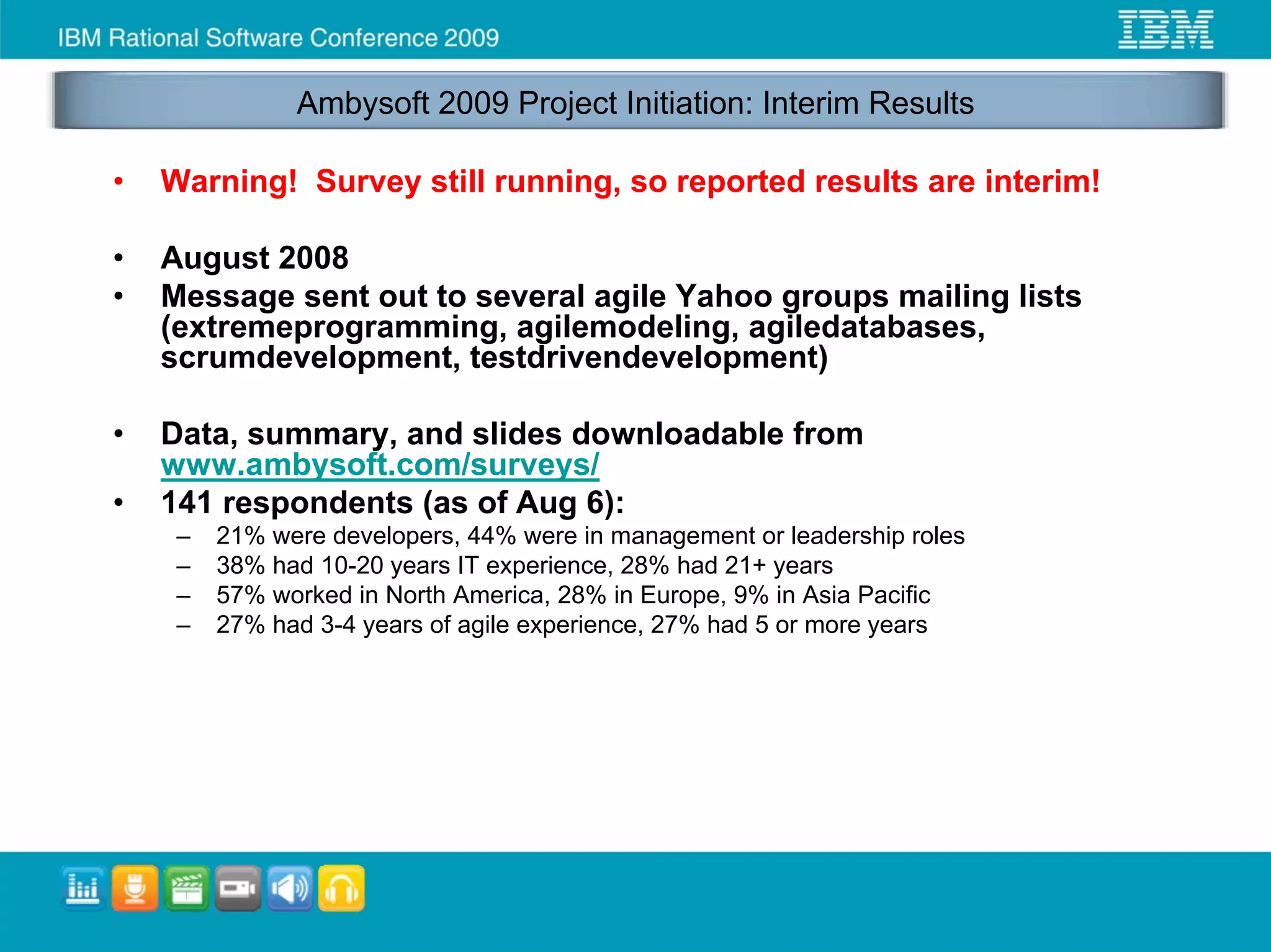
Ambysoft 2009 Project Initiation: Interim Results

•   Warning! Survey still running, so reported results are interim!

•   August 2008
•   Message sent out to several agile Yahoo groups mailing lists
    (extremeprogramming, agilemodeling, agiledatabases,
    scrumdevelopment, testdrivendevelopment)

•   Data, summary, and slides downloadable from
    www.ambysoft.com/surveys/
•   141 respondents (as of Aug 6):
     –   21% were developers, 44% were in management or leadership roles
     –   38% had 10-20 years IT experience, 28% had 21+ years
     –   57% worked in North America, 28% in Europe, 9% in Asia Pacific
     –   27% had 3-4 years of agile experience, 27% had 5 or more years
Ambysoft 2009 Agile Practices

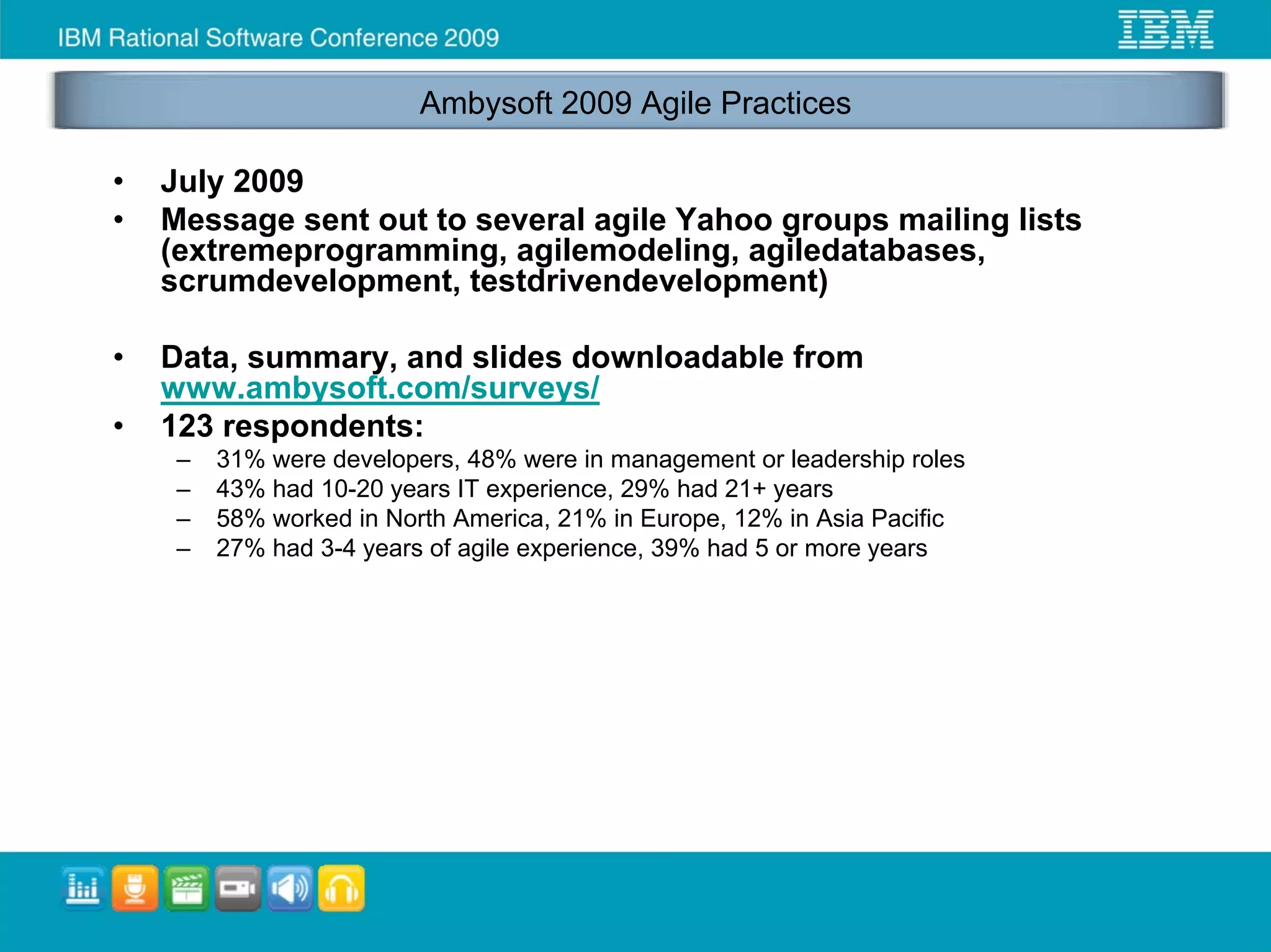
•   July 2009
•   Message sent out to several agile Yahoo groups mailing lists
    (extremeprogramming, agilemodeling, agiledatabases,
    scrumdevelopment, testdrivendevelopment)

•   Data, summary, and slides downloadable from
    www.ambysoft.com/surveys/
•   123 respondents:
     –   31% were developers, 48% were in management or leadership roles
     –   43% had 10-20 years IT experience, 29% had 21+ years
     –   58% worked in North America, 21% in Europe, 12% in Asia Pacific
     –   27% had 3-4 years of agile experience, 39% had 5 or more years
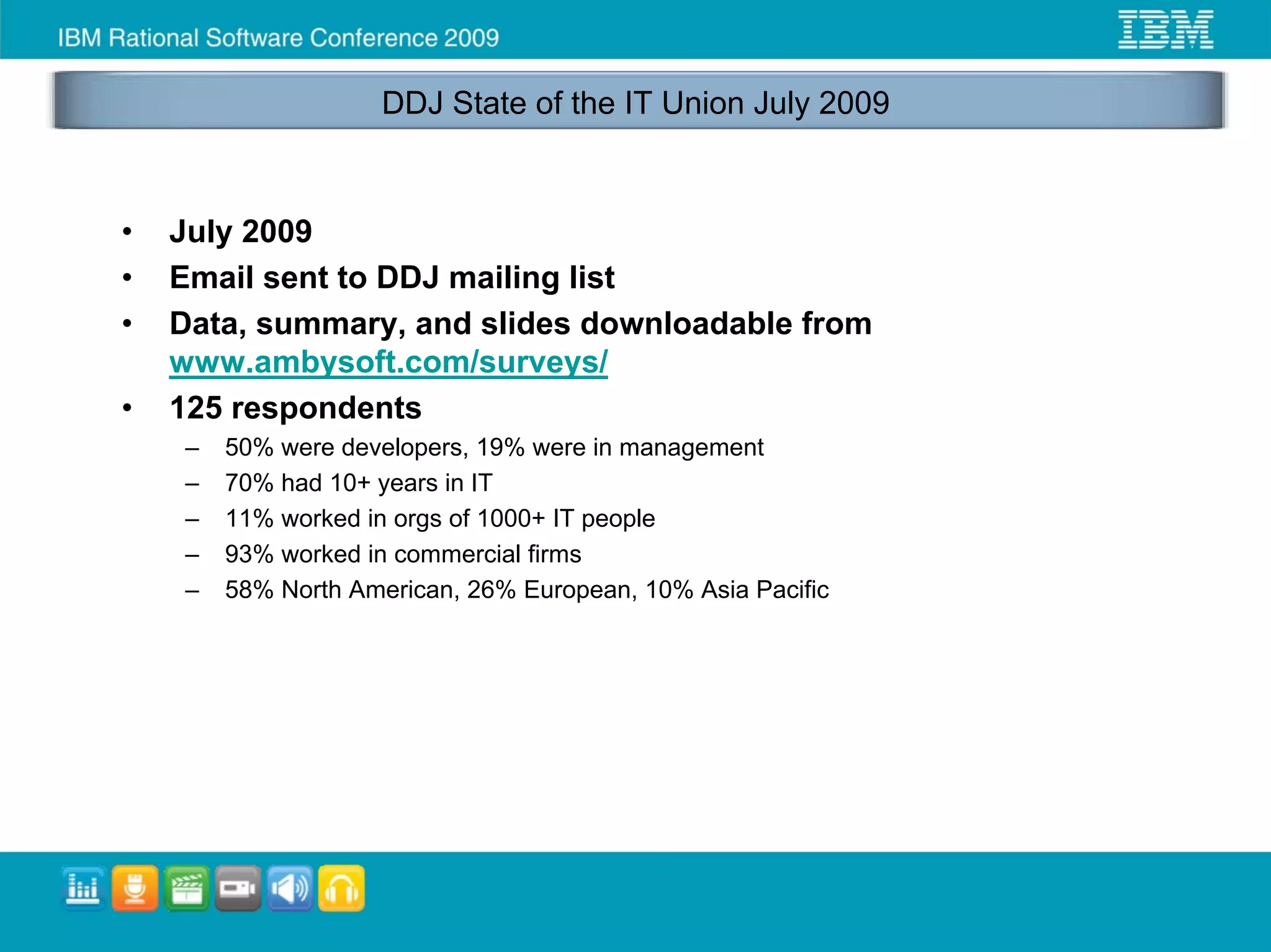
DDJ State of the IT Union July 2009


•   July 2009
•   Email sent to DDJ mailing list
•   Data, summary, and slides downloadable from
    www.ambysoft.com/surveys/
•   125 respondents
    –   50% were developers, 19% were in management
    –   70% had 10+ years in IT
    –   11% worked in orgs of 1000+ IT people
    –   93% worked in commercial firms
    –   58% North American, 26% European, 10% Asia Pacific

Agile By The Numbers - Scott Ambler

  • 1.
    Agile Software Developmentby the Numbers: What’s Really Going On Out There Scott W. Ambler Chief Methodologist/Agile scott_ambler@ca.ibm.com
  • 2.
    Warning! • You’ll be presented with a lot of information very quickly
  • 3.
    Agenda • The Surveys • Agile Practices • Agility@Scale • Adoption and Success Rates • Management • Governance • Development and Quality • Modeling and Documentation • Communication • Parting Thoughts
  • 4.
    Agenda • The Surveys • Agile Practices • Agility@Scale • Adoption and Success Rates • Management • Governance • Development and Quality • Modeling and Documentation • Communication • Parting Thoughts
  • 5.
    The Surveys • All survey data, original questions, and summary slide decks can be downloaded from www.ambysoft.com/surveys/ – If you can’t look at the original questions and analyze the data yourself, how can you trust the survey results? • Some surveys were done via Dr. Dobb’s Journal (DDJ), a community with a wide range of readers, not just Agilists • Some surveys, the Ambysoft ones, focused on just the agile community • The source survey for each chart is indicated using graphics such as: DDJ 2009 State of the IT Union Ambysoft 2009 Agile Practices Warning: You’ll be presented with a lot of information really quickly!
  • 6.
    Agenda • The Surveys • Agile Practices • Agility@Scale • Adoption and Success Rates • Management • Governance • Development and Quality • Modeling and Documentation • Communication • Parting Thoughts
  • 7.
    Most Effective Practices:Top 10 (out of 30) Continuous Integration 65% Daily Stand Up Meeting 47% Developer TDD 47% Iteration Planning 44% Code Refactoring 43% Retrospectives 39% Pair Programming 36% Active Stakeholder Participation 35% Potentially Shippable Software 28% Burndown Tracking 26% Ambysoft 2009 Agile Practices
  • 8.
    Practices Easiest toLearn: Top 10 (out of 30) Daily Stand Up Meeting 70% Continuous Integration 38% Retrospectives 35% Iteration Demo 32% Iteration Planning 31% Burndown Tracking 27% Pair Programming 25% Release Planning 21% Product Backlog 21% Code Refactoring 21% Ambysoft 2009 Agile Practices
  • 9.
    Practices Most Difficultto Learn : Top 10 (out of 30) Developer TDD 37% Aceptance TDD 30% Pair Programming 28% Initial Estimate and Schedule 26% Active Stakeholder Participation 24% Database Refactoring 22% Potentially Shippable Software 20% Executable Specifications 19% Release Planning 18% Continuous Integration 18% Ambysoft 2009 Agile Practices
  • 10.
    Practices Tried andAbandoned : Top 8 (out of 30) Pair Programming 24% Burndown Tracking 21% Potentially Shippable Software 17% Daily Stand Up Meetings 14% Executable Specifications 14% Initial Estimate and Schedule 14% Active Stakeholder Participation 11% Retrospectives 10% Ambysoft 2009 Agile Practices
  • 11.
    Agenda • The Surveys • Agile Practices • Agility@Scale • Adoption and Success Rates • Management • Governance • Development and Quality • Modeling and Documentation • Communication • Parting Thoughts
  • 12.
    What is Agility@Scale? Team size Compliance requirement Under 10 1000’s of Critical, developers developers Low risk Audited Geographical distribution Organization distribution (outsourcing, partnerships) Co-located Global Collaborative Contractual Disciplined Enterprise discipline Agile Technical complexity Project Enterprise Delivery Heterogeneous, focus focus Homogenous Legacy Organizational complexity Flexible Rigid
  • 13.
    Largest Team SizeAttempted vs. Successful 200+ 101 to 200 51-100 21 to 50 11 to 20 6 to 10 1 to 5 0 20 40 60 80 100 120 140 160 Attempt Success DDJ 2008 Agile Adoption
  • 14.
    Does your teamhave to comply to industry regulations? Don't Know 7% Yes 33% No 60% Ambysoft 2009 Agile Practices
  • 15.
    Does your teamfollow a CMMI compliant agile process? Don't Know Yes 13% 9% No 78% Ambysoft 2009 Agile Practices
  • 16.
    How distributed werethe IT people on your team? Don't Know, 1% Some Very Distant, 29% Co-Located, 42% Within Driving Distance, 13% Same Building, 17% Ambysoft 2009 Agile Practices
  • 17.
    Agenda • The Surveys • Agile Practices • Agility@Scale • Adoption and Success Rates • Management • Governance • Development and Quality • Modeling and Documentation • Communication • Parting Thoughts
  • 18.
    What percentage ofyour development teams have adopted agile techniques? 91-100% 4% • 76% of organizations have adopted agile techniques 81-90% 2% • On average, 44% of project 71-80% 11% teams in those are now doing agile 61-70% 1% – In small orgs of 50 or less IT, it’s 53% 51-60% 4% – In larger orgs, it’s 38% 41-50% 8% 31-40% 7% 21-30% 9% 11-20% 18% 1-10% 14% None 24% DDJ State of the IT Union July 2009
  • 19.
    Number of AgileProjects Run 51+ 6% 21 to 50 5% 11 to 20 8% 6 to 10 19% 1 to 5 45% Pilot 18% DDJ 2008 Agile Adoption
  • 20.
    Criteria to determineif a team is agile Disciplined agile teams: Yes, commonly Produce working software on a regular applied 19% basis. No, Don't See Do continuous regression testing, and Value 11% better yet take a Test-Driven No, Wish We Had Development (TDD) approach. It 26% Work closely with their stakeholders, Planning to ideally on a daily basis. Define 17% Are self-organizing, and disciplined teams work within an appropriate No Agile Projects 23% governance framework. Regularly reflect, and measure, on Don't Know 4% how they work together and then act to improve on their findings in a timely manner. Ambysoft 2009 Governance
  • 21.
    Why Agile? Becauseit Works! DDJ 2008 Agile Adoption
  • 22.
    Project success rates 4.9 Iterative Quality 5.0 2.3 0.4 6.0 Functionality 5.6 Agile 1.8 2.7 3.9 Money 3.0 Traditional 0.2 0.8 Agile Iterative 4.4 4.0 Traditional Time 0.8 Ad-Hoc Ad-Hoc 0.8 Bottom Line: Agile teams produce higher quality work, are quicker to deliver, are more likely to deliver the right functionality, and more likely to provide greater ROI than traditional teams DDJ 2008 Project Success
  • 23.
    Agile project successrates: the effect of distribution 70% 79% Average Co-Located Near Located 73% Far Located 55% DDJ 2008 Project Success
  • 24.
    Agenda • The Surveys • Agile Practices • Agility@Scale • Adoption and Success Rates • Management • Governance • Development and Quality • Modeling and Documentation • Communication • Parting Thoughts
  • 25.
    An organization’s typicalapproach to initial estimates on software development projects Must be "exact" 12% • On average, estimates need to be within a +/- Within 5% range 2% 11% range Within 10% 13% Within 15% 7% Within 20% 16% Within 25% 14% Within 50% 16% No initial estimates 21% DDJ State of the IT Union July 2009
  • 26.
    On average, theactual costs of software development projects compared to estimates Within 5% 2% • On average, actuals came in within a +/- 19% Within 10% 7% range Within 15% 5% Within 20% 10% Within 25% 17% Within 50% 14% Within 75% 4% More than 75% 4% No tracking against estimates 39% DDJ State of the IT Union July 2009
  • 27.
    Approach to InitialEstimation 9% No initial estimate at all 7% High-level estimate based on traditional estimation technique 27% High-level estimate based on agile estimation technique 38% High-level estimate based on reasonable guess of experienced person(s) 4% Detailed estimate based on traditional estimation technique 6% Detailed estimate based on agile estimation technique 7% Detailed estimate based on reasonable guess 3% Don’t know Ambysoft 2009 Agile Project Initiation: Interim Results
  • 28.
    Strategies which projectteams use to stay out of trouble or when in trouble to help get them out of it • “Questionable” strategies: – 18% pad the budget – 63% de-scope towards the end of the project to meet deadline – 34% ask for extra funds to complete the projects – 72% extend the schedule to deliver promised scope – 39% avoid scope creep wherever possible via a “change control/management” process – 10% change the original estimate to reflect the actuals – 18% change the original schedule to reflect the actuals • Ethical strategies: – 12% take a “stage gate” approach to funding – 13% have a flexible budget from the beginning of the project – 26% have a flexible schedule from the beginning of the project – 32% have flexible scope from the beginning of the project DDJ State of the IT Union July 2009
  • 29.
    How long didit take your project team to get started? (Average: 3.8 weeks) <1 Week 8% 1 Week 10% 2 Weeks 15% 3 Weeks 13% 4 Weeks 18% 5-6 Weeks 10% 7-8 Weeks 3% > 8 Weeks 10% Don't Know 12% Ambysoft 2009 Agile Project Initiation: Interim Results
  • 30.
    Justifying Agile Projects Show Technical Feasibility 60% Show Stakeholder Concurrence 59% Estimate ROI 34% Show Operational Feasibility 29% Considered Commercial Packages 17% Considered Offshoring 11% Estimate NPV 7% Ambysoft 2009 Agile Project Initiation: Interim Results
  • 31.
    Length of Iterations(% respondents) 82% have iterations between 1 and 4 weeks in length No Iterations 5.6 > 8 Weeks 1.4 7-8 Weeks 1.7 5-6 Weeks 7.2 4 Weeks 22.8 3 Weeks 16.7 2 Weeks 32.8 1 Week 9.2 < 1 Week 3.1 DDJ 2008 Agile Adoption
  • 32.
    Agenda • The Surveys • Agile Practices • Agility@Scale • Adoption and Success Rates • Management • Governance • Development and Quality • Modeling and Documentation • Communication • Parting Thoughts
  • 33.
    How would yourate your IT governance program? Too early to tell 6% 8% Generally helps 36% Neither helpful nor 19% harmful Generally harmful Don't Know 11% 20% No IT governance Program DDJ State of the IT Union July 2009
  • 34.
    Are rights andresponsibilities (R&R) defined for various groups within your organization? Defined for Development Teams 56% Defined for Operations and 37% Support Defined for Stakeholders 35% Undefined, but Part of Culture 15% Undefined, and we Need Them 21% Undefined, Don't Need Them 2% Ambysoft 2009 Governance
  • 35.
    Do your projectteams collect metrics to enable project monitoring by senior management? No 26% Yes, majority 51% manual Yes, majority 19% automated Don't Know 4% Ambysoft 2009 Governance
  • 36.
    Agenda • The Surveys • Agile Practices • Agility@Scale • Adoption and Success Rates • Management • Governance • Development and Quality • Modeling and Documentation • Communication • Parting Thoughts
  • 37.
    Development Practices • Coding Standards (2.30) • Collective Code Ownership (1.97) • Continuous integration (1.94) • Database standards (1.86) • UI standards (1.65) • Pair programming (-1.34) Ambysoft 2008 Practices and Principles
  • 38.
    Ambysoft 2008 TestDriven Development
  • 39.
    Quality Practices • Code Refactoring (1.79) • UI Testing (1.54) • Automated Developer Testing (1.08) • TDD (-0.08) • UI Refactoring (-0.22) • Database refactoring (-0.31) • Automated Acceptance Testing (-0.87) • Database regression testing (-1.03) • Executable Specs (-1.43) Ambysoft 2008 Practices and Principles
  • 40.
    Which organizational conventions/guidelinesdo development teams conform to? Coding 71% Security 53% Data 48% User Interface 41% Ambysoft 2009 Governance
  • 41.
    Agenda • The Surveys • Agile Practices • Agility@Scale • Adoption and Success Rates • Management • Governance • Development and Quality • Modeling and Documentation • Communication • Parting Thoughts
  • 42.
    Initial Modeling • 93% of respondents indicated that their team did some sort of up-front initial requirements modeling. • 90% of respondents indicated that their team did some sort of up-front initial architecture modeling. Ambysoft 2009 Project Initiation: Interim Results
  • 43.
    Primary Approach toModeling No Modeling Ad-Hoc Sketch to Think and Communicate Traditional Sketch and Capture Key Diagrams SBMT for Docs Iterative SBMT to Generate Code Agile SBMT for Full Trip Engineering 0% 20% 40% 60% 80% 100%
  • 44.
    Ambysoft 2008 TestDriven Development
  • 45.
    Modeling vs TDD:Primary Strategy for Requirements Specification Is/Was (%) High-Level Diagrams Detailed Diagrams Ad-Hoc Traditional Iterative Detailed Docs Agile Acceptance Tests 0 10 20 30 40 50 60 DDJ 2008 Modeling and Documentation
  • 46.
    Ambysoft 2008 TestDriven Development
  • 47.
    Modeling vs TDD:Primary Strategy for Arch/Design Specification Is/Was (%) High-Level Diagrams Detailed Diagrams Ad-Hoc Traditional Iterative Detailed Docs Agile Acceptance Tests 0 20 40 60 80 DDJ 2008 Modeling and Documentation
  • 48.
    Did you needto produce a vision document (or similar) as part of project initiation? Don't Know 7% No Yes 40% 53% Ambysoft 2009 Project Initiation: Interim Results
  • 49.
    Percentage of TeamsCreating Deliverable Documentation Ad-Hoc Traditional User manual Training material System Overview doc Iterative Operations doc Agile 0% 20% 40% 60% 80% 100% DDJ 2008 Modeling and Documentation
  • 50.
    Agenda • The Surveys • Agile Practices • Agility@Scale • Adoption and Success Rates • Management • Governance • Development and Quality • Modeling and Documentation • Communication • Parting Thoughts
  • 51.
  • 52.
    Effectiveness of CommunicationStrategies (bigger the number the better) Within Team With Stakeholders Face to face (F2F) 4.25 4.06 F2F at Whiteboard 4.24 3.46 Overview diagrams 2.54 1.89 Online chat 2.10 0.15 Overview documentation 1.84 1.86 Teleconference calls 1.42 1.51 Videoconferencing 1.34 1.62 Email 1.08 1.32 Detailed Documentation -0.34 0.16 Ambysoft 2008 Practices and Principles
  • 53.
    Agenda • The Surveys • Agile Practices • Agility@Scale • Adoption and Success Rates • Management • Governance • Development and Quality • Modeling and Documentation • Communication • Parting Thoughts
  • 54.
    Question the Rhetoric • There appears to be a difference between what people say they are doing and what they are doing • Many of the concerns that the traditional community has regarding agile don’t appear to hold true • There are many unfounded beliefs in both the traditional and the agile communities • In the end, you need to identify what works well for you Every organization is different
  • 55.
    Why IBM? • Our integrated tooling based on the Jazz platform enables disciplined agile software development • Our Measured Capability Improvement Framework (MCIF) service offering helps organizations to successfully improve their IT practices in a sustained manner • We are one of the largest agile adoption programs in the world • We understand the enterprise-level issues that you face • We scale from pilot project consulting to full-scale agile adoption • Our Accelerated Solutions Delivery (ASD) practice has years of experience delivering agile projects at scale
  • 57.
    DDJ 2006 AgileAdoption • Used Dr. Dobb’s Journal and Software Development mailing lists • 4232 Respondents • March 2006
  • 58.
    DDJ 2006 DataQuality • Sent out to ~28,000 people on DDJ mailing list • September 2006 • 1137 respondents: – 51% were developers, 24% were in management – 37% had 10-20 years IT experience, 34% had 20+ years – 78% worked in commercial firms – >98% from North America
  • 59.
    DDJ 2007 AgileAdoption • March 2007 • Advertised in Editor’s blog on www.ddj.com • 781 respondents: – 52% were developers, 22% were in management – 40% had 10-20 years IT experience, 33% had 20+ years – 33% worked in orgs of 1000+ people – 85% worked in commercial firms
  • 60.
    DDJ 2007 ProjectSuccess • August 2007 • Email sent to DDJ mailing list • 586 respondents – 54% were developers/modelers, 30% were in management – 73% had 10+ years in IT – 13% worked in orgs of 1000+ IT people – 84% worked in commercial firms – 69% North American, 18% European • Overall goal was to explore how IT professionals define project success.
  • 61.
    DDJ 2008 ProcessFramework • January 2008 • Email sent to DDJ mailing list and posting in Editor’s blog • 339 respondents – 40% were developers, 20% were in management, 22% architects – 78% had 10+ years in IT – 17% worked in orgs of 1000+ IT people • Overall goal was to explore adoption and success rates of various process frameworks such as CMMI, COBIT, ITIL, …
  • 62.
    DDJ 2008 AgileAdoption • February 2008 • Message sent out to DDJ mailing list • 642 respondents: – 54.8% were developers, 29.4% were in management – 41.6% had 10-20 years IT experience, 37.2% had 20+ years – 37.7% worked in orgs of 1000+ people – 71% worked in North America, 17% in Europe, 4.5% in Asia
  • 63.
    DDJ 2008 Modelingand Documentation • July 2008 • Message sent out to DDJ mailing list and advertised on www.ddj.com • 279 respondents: – 54.8% were developers, 25.4% were in management – 33.3% had 10-20 years IT experience, 41.6% had 20+ years – 41.7% worked in orgs of 1000+ people – 61.5% worked in North America, 24.5% in Europe, 5.4% in Asia
  • 64.
    Ambysoft 2008 Practicesand Principles • July 2008 • Message sent out to several agile Yahoo groups mailing lists (extremeprogramming, agilemodeling, agiledatabases, scrumdevelopment, testdrivendevelopment) • 337 respondents: – 36.9% were developers, 36.9% were in management – 42% had 10-20 years IT experience, 17.3% had 21+ years – 31.3% worked in orgs of 1000+ people – 57.3% worked in North America, 22.7% in Europe, 7.2% in Asia
  • 65.
    Ambysoft 2008 TestDriven Development • October 2008 • Email sent to testdrivendevelopment@yahoogroups.com and extremeprogramming@yahoogroups.com mailing lists • 121 respondents – 74% were developers/modelers, 15% were in management – 52% had 10+ years in IT – 22% worked in orgs of 1000+ people
  • 66.
    DDJ 2008 ProjectSuccess • December 2008 • Email sent to DDJ mailing list • 279 respondents – 59% were developers/modelers, 25% were in management – 80% had 10+ years in IT – 16% worked in orgs of 1000+ IT people
  • 67.
    Ambysoft 2009 AgileCertification • April 2009 • Email sent to several agile mailing lists • 102 respondents
  • 68.
    Ambysoft 2009 Governance • May 2009 • Email sent to the Ambysoft announcements list (ambysoft@yahoogroups.com) which had 895 subscribers at the time • 62 respondents, 53 completed the survey • 41% were developers/modelers/data professionals, 29% were in management • 74% had 10+ years in IT • 27% worked in orgs of 500+ IT people • 52% North American, 27% European • Overall goals were to explore what people thought about IT governance and to find out what was happening in various orgs
  • 69.
    Ambysoft 2009 ProjectInitiation: Interim Results • Warning! Survey still running, so reported results are interim! • August 2008 • Message sent out to several agile Yahoo groups mailing lists (extremeprogramming, agilemodeling, agiledatabases, scrumdevelopment, testdrivendevelopment) • Data, summary, and slides downloadable from www.ambysoft.com/surveys/ • 141 respondents (as of Aug 6): – 21% were developers, 44% were in management or leadership roles – 38% had 10-20 years IT experience, 28% had 21+ years – 57% worked in North America, 28% in Europe, 9% in Asia Pacific – 27% had 3-4 years of agile experience, 27% had 5 or more years
  • 70.
    Ambysoft 2009 AgilePractices • July 2009 • Message sent out to several agile Yahoo groups mailing lists (extremeprogramming, agilemodeling, agiledatabases, scrumdevelopment, testdrivendevelopment) • Data, summary, and slides downloadable from www.ambysoft.com/surveys/ • 123 respondents: – 31% were developers, 48% were in management or leadership roles – 43% had 10-20 years IT experience, 29% had 21+ years – 58% worked in North America, 21% in Europe, 12% in Asia Pacific – 27% had 3-4 years of agile experience, 39% had 5 or more years
  • 71.
    DDJ State ofthe IT Union July 2009 • July 2009 • Email sent to DDJ mailing list • Data, summary, and slides downloadable from www.ambysoft.com/surveys/ • 125 respondents – 50% were developers, 19% were in management – 70% had 10+ years in IT – 11% worked in orgs of 1000+ IT people – 93% worked in commercial firms – 58% North American, 26% European, 10% Asia Pacific