Lecture #3:
Aggregate Moisture and
Physical Characteristics
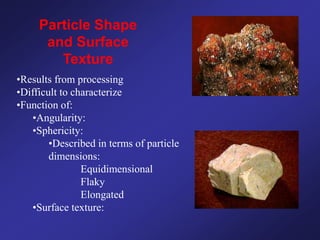
Particle Shape
and Surface
Texture
•Results from processing
•Difficult to characterize
•Function of:
•Angularity:
•Sphericity:
•Described in terms of particle
dimensions:
Equidimensional
Flaky
Elongated
•Surface texture:
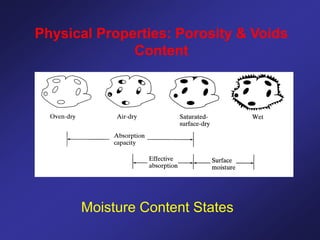
Moisture Content States
Physical Properties: Porosity & Voids
Content
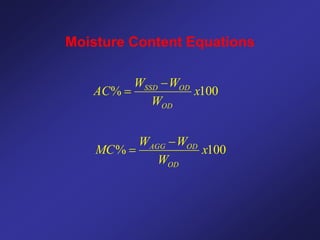
Moisture Content Equations
100
% x
W
W
W
AC
OD
OD
SSD 

100
% x
W
W
W
MC
OD
OD
AGG 

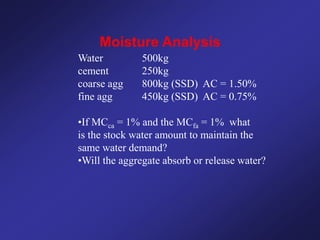
Moisture Analysis
Water 500kg
cement 250kg
coarse agg 800kg (SSD) AC = 1.50%
fine agg 450kg (SSD) AC = 0.75%
•If MCca = 1% and the MCfa = 1% what
is the stock water amount to maintain the
same water demand?
•Will the aggregate absorb or release water?
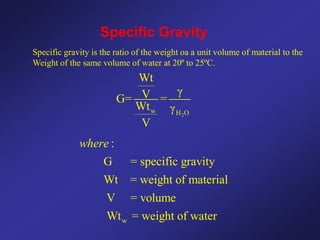
Specific Gravity
Specific gravity is the ratio of the weight oa a unit volume of material to the
Weight of the same volume of water at 20º to 25ºC.
2
w H O
Wt
γ
V
G= =
Wt γ
V
w
:
G = specific gravity
Wt = weight of material
V = volume
Wt = weight of water
where
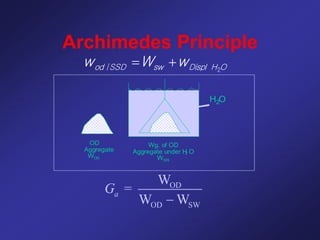
Archimedes Principle
H O
2
OD
Aggregate
WOD
Wg. of OD
Aggregate under H O
WSW
2
OD
OD SW
W
=
W W
a
G

2
/
od SSD sw Displ H O
w W w
 
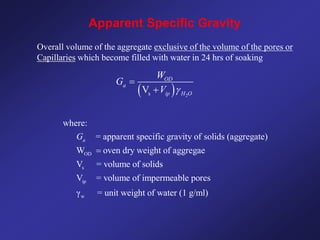
Apparent Specific Gravity
  2
s
V
OD
a
ip H O
W
G
V 


Overall volume of the aggregate exclusive of the volume of the pores or
Capillaries which become filled with water in 24 hrs of soaking
OD
s
ip
w
where:
= apparent specific gravity of solids (aggregate)
W oven dry weight of aggregae
V = volume of solids
V = volume of impermeable pores
γ = unit we
a
G

ight of water (1 g/ml)
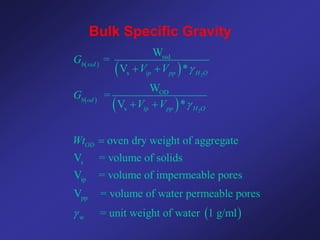
Bulk Specific Gravity
 
 
 
 
2
2
ssd
s
OD
s
s
ip
pp
w
W
=
V *
W
=
V *
oven dry weight of aggregate
V = volume of solids
V = volume of impermeable pores
V = volume of water permeable pores
= unit
b ssd
ip pp H O
b od
ip pp H O
OD
G
V V
G
V V
Wt



 
 

 
weight of water 1 g/ml
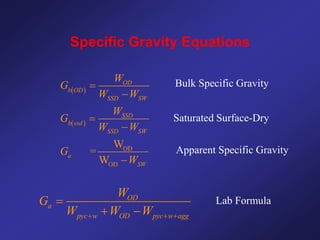
Specific Gravity Equations
Bulk Specific Gravity
Saturated Surface-Dry
Apparent Specific Gravity
Lab Formula
OD
a
pyc w OD pyc w agg
W
G
W W W
  

 
 
 
OD
OD
W
=
W
OD
b OD
SSD SW
SSD
b ssd
SSD SW
a
SW
W
G
W W
W
G
W W
G
W





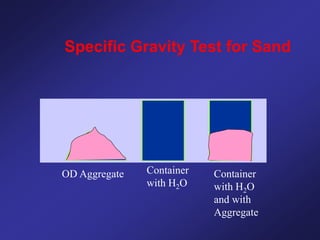
OD Aggregate Container
with H2O
Container
with H2O
and with
Aggregate
Specific Gravity Test for Sand
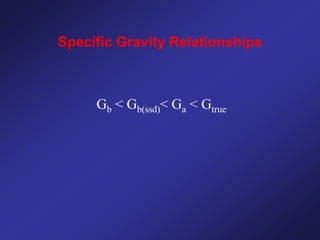
Specific Gravity Relationships
Gb < Gb(ssd)< Ga < Gtrue
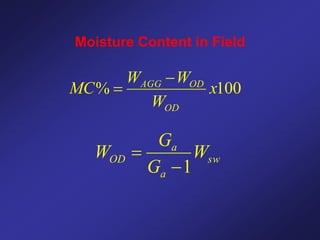
Moisture Content in Field
100
% x
W
W
W
MC
OD
OD
AGG 

sw
a
a
OD W
G
G
W
1


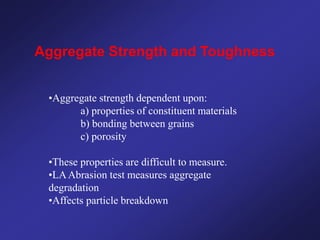
Aggregate Strength and Toughness
•Aggregate strength dependent upon:
a) properties of constituent materials
b) bonding between grains
c) porosity
•These properties are difficult to measure.
•LAAbrasion test measures aggregate
degradation
•Affects particle breakdown
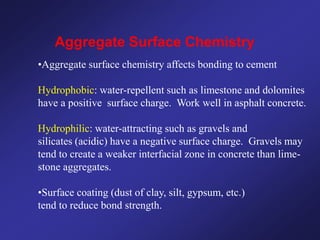
Aggregate Surface Chemistry
•Aggregate surface chemistry affects bonding to cement
Hydrophobic: water-repellent such as limestone and dolomites
have a positive surface charge. Work well in asphalt concrete.
Hydrophilic: water-attracting such as gravels and
silicates (acidic) have a negative surface charge. Gravels may
tend to create a weaker interfacial zone in concrete than lime-
stone aggregates.
•Surface coating (dust of clay, silt, gypsum, etc.)
tend to reduce bond strength.
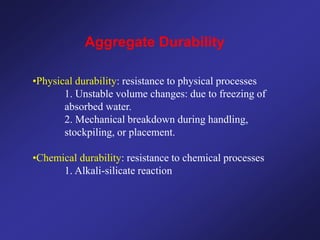
Aggregate Durability
•Physical durability: resistance to physical processes
1. Unstable volume changes: due to freezing of
absorbed water.
2. Mechanical breakdown during handling,
stockpiling, or placement.
•Chemical durability: resistance to chemical processes
1. Alkali-silicate reaction
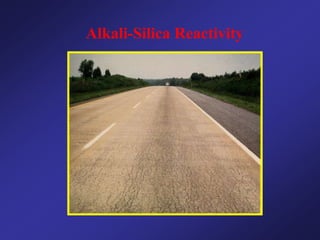
Alkali-Silica Reactivity
What is ASR?
 ASR only a concern if deleterious, e.g. causes
cracking.
 Needs three factors to be deleterious :
- Source of alkali - Internal and external
- Reactive silica (aggregate)
- Water ( humidity) > 80 %
What is ASR?
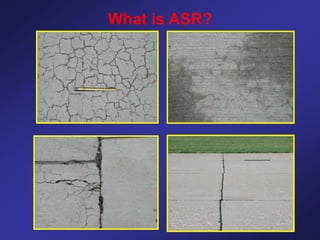
Onset of ASR results in formation of expansive gels
which produce internal stresses which may
cause cracking of concrete. Problem is often
misdiagnosed.
Environmental factors such as freeze-thaw cycles,
wetting/drying cycles, and traffic loading
propagate cracking.
Deicing salts, marine environments, can accelerate
ASR expansion and deterioration processes.
ASR can accelerate corrosion deterioration.
What is ASR?
Deleterious Substances
•Absorbent particles: shale, leached chert, or porous flint
•Clay lumps
•Coal or wood particles
•Organic impurities
•Flat or elongated particles

aggregatemoistureandphyicalchar.ppt

  • 1.
    Lecture #3: Aggregate Moistureand Physical Characteristics
  • 2.
    Particle Shape and Surface Texture •Resultsfrom processing •Difficult to characterize •Function of: •Angularity: •Sphericity: •Described in terms of particle dimensions: Equidimensional Flaky Elongated •Surface texture:
  • 3.
    Moisture Content States PhysicalProperties: Porosity & Voids Content
  • 4.
    Moisture Content Equations 100 %x W W W AC OD OD SSD   100 % x W W W MC OD OD AGG  
  • 5.
    Moisture Analysis Water 500kg cement250kg coarse agg 800kg (SSD) AC = 1.50% fine agg 450kg (SSD) AC = 0.75% •If MCca = 1% and the MCfa = 1% what is the stock water amount to maintain the same water demand? •Will the aggregate absorb or release water?
  • 6.
    Specific Gravity Specific gravityis the ratio of the weight oa a unit volume of material to the Weight of the same volume of water at 20º to 25ºC. 2 w H O Wt γ V G= = Wt γ V w : G = specific gravity Wt = weight of material V = volume Wt = weight of water where
  • 7.
    Archimedes Principle H O 2 OD Aggregate WOD Wg.of OD Aggregate under H O WSW 2 OD OD SW W = W W a G  2 / od SSD sw Displ H O w W w  
  • 8.
    Apparent Specific Gravity  2 s V OD a ip H O W G V    Overall volume of the aggregate exclusive of the volume of the pores or Capillaries which become filled with water in 24 hrs of soaking OD s ip w where: = apparent specific gravity of solids (aggregate) W oven dry weight of aggregae V = volume of solids V = volume of impermeable pores γ = unit we a G  ight of water (1 g/ml)
  • 9.
    Bulk Specific Gravity        2 2 ssd s OD s s ip pp w W = V * W = V * oven dry weight of aggregate V = volume of solids V = volume of impermeable pores V = volume of water permeable pores = unit b ssd ip pp H O b od ip pp H O OD G V V G V V Wt           weight of water 1 g/ml
  • 10.
    Specific Gravity Equations BulkSpecific Gravity Saturated Surface-Dry Apparent Specific Gravity Lab Formula OD a pyc w OD pyc w agg W G W W W           OD OD W = W OD b OD SSD SW SSD b ssd SSD SW a SW W G W W W G W W G W     
  • 11.
    OD Aggregate Container withH2O Container with H2O and with Aggregate Specific Gravity Test for Sand
  • 12.
    Specific Gravity Relationships Gb< Gb(ssd)< Ga < Gtrue
  • 13.
    Moisture Content inField 100 % x W W W MC OD OD AGG   sw a a OD W G G W 1  
  • 14.
    Aggregate Strength andToughness •Aggregate strength dependent upon: a) properties of constituent materials b) bonding between grains c) porosity •These properties are difficult to measure. •LAAbrasion test measures aggregate degradation •Affects particle breakdown
  • 15.
    Aggregate Surface Chemistry •Aggregatesurface chemistry affects bonding to cement Hydrophobic: water-repellent such as limestone and dolomites have a positive surface charge. Work well in asphalt concrete. Hydrophilic: water-attracting such as gravels and silicates (acidic) have a negative surface charge. Gravels may tend to create a weaker interfacial zone in concrete than lime- stone aggregates. •Surface coating (dust of clay, silt, gypsum, etc.) tend to reduce bond strength.
  • 16.
    Aggregate Durability •Physical durability:resistance to physical processes 1. Unstable volume changes: due to freezing of absorbed water. 2. Mechanical breakdown during handling, stockpiling, or placement. •Chemical durability: resistance to chemical processes 1. Alkali-silicate reaction
  • 17.
  • 18.
    What is ASR? ASR only a concern if deleterious, e.g. causes cracking.  Needs three factors to be deleterious : - Source of alkali - Internal and external - Reactive silica (aggregate) - Water ( humidity) > 80 %
  • 19.
    What is ASR? Onsetof ASR results in formation of expansive gels which produce internal stresses which may cause cracking of concrete. Problem is often misdiagnosed. Environmental factors such as freeze-thaw cycles, wetting/drying cycles, and traffic loading propagate cracking. Deicing salts, marine environments, can accelerate ASR expansion and deterioration processes. ASR can accelerate corrosion deterioration.
  • 20.
  • 21.
    Deleterious Substances •Absorbent particles:shale, leached chert, or porous flint •Clay lumps •Coal or wood particles •Organic impurities •Flat or elongated particles