Agent driven Simulation Framework
With mult-paradigm and AI Support
AdSiF – A Language for Simulation
& Agent Programming
AdSiF: Simulation Language
 What is AdSiF (Agent driven Simulation Framework)
AdSiF is a family of commercial off-the-shelf (COTS)
software products that provide the framework and all
basic functionality needed for constructive simulations
as well as the ability to interface with live, virtual, and
other constructive simulations.
Using AdSiF, it is possible to develop a simulation
customized for your exact requirements that is more
flexible and easier to use than simulations that are not
based on AdSiF. Using AdSiF can also substantially
lower the cost of developing, upgrading, maintaining,
and using your simulation. If you don’t have your own
simulation development team, Agena’s experts can
develop a custom, AdSiF-based simulation for you.
Language Properties
 AdSiF is a declerative general purpose simulation language.
 The language is developed for generic pupose – there is no
domain dependency.
 It is successful in simulation and intelligent agent programming.
 Multi-paradigm design environment
 Object oriented
 Aspect oriented
 Agent based modeling
 Logic programming
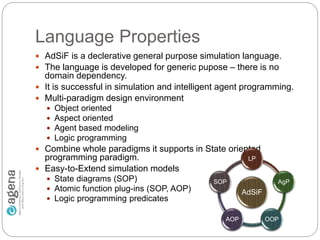
 Combine whole paradigms it supports in State oriented
programming paradigm.
 Easy-to-Extend simulation models
 State diagrams (SOP)
 Atomic function plug-ins (SOP, AOP)
 Logic programming predicates
AdSiF
LP
AgP
OOPAOP
SOP
Language Properties
 Extending simulation models by adding new methods,
even in run time
 Support for Aspect oriented programming by changing
behavior containers in run time.
 Supports discrete and continuous event simulation
 Dynamic execution frequency
 Stiffing
 Controlling double precision and fourier error
 Behavior management by deductive reasoning
 Ability to Draw whole Conceptual Model
 Starting from requirements up to simulation execution
 Generic logic based solution for time delayed systems
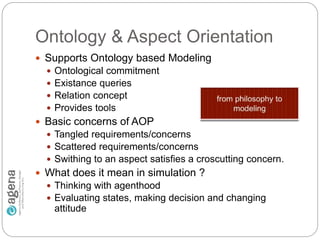
Ontology & Aspect Orientation
 Supports Ontology based Modeling
 Ontological commitment
 Existance queries
 Relation concept
 Provides tools
 Basic concerns of AOP
 Tangled requirements/concerns
 Scattered requirements/concerns
 Swithing to an aspect satisfies a croscutting concern.
 What does it mean in simulation ?
 Thinking with agenthood
 Evaluating states, making decision and changing
attitude
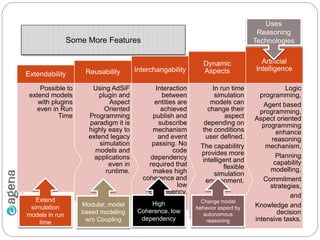
Some More Features
Logic
programming,
Agent based
programming,
Aspect oriented
programming
enhance
reasoning
mechanism,
Planning
capability
modelling,
Commitment
strategies,
and
Knowledge and
decision
intensive tasks.
Artificial
Intelligence
In run time
simulation
models can
change their
aspect
depending on
the conditions
user defined.
The capabilitry
provides more
intelligent and
flexible
simulation
environment.
Dynamic
Aspects
Interaction
between
entities are
achieved
publish and
subscribe
mechanism
and event
passing. No
code
dependency
required that
makes high
coherence and
low
dependency.
Interchangability
Using AdSiF
plugin and
Aspect
Oriented
Programming
paradigm it is
highly easy to
extend legacy
simulation
models and
applications
even in
runtime.
Reusability
Possible to
extend models
with plugins
even in Run
Time
Extendability
Extend
simulation
models in run
time
Modular, model
based modeling
w/o Coupling
High
Coherence, low
dependency
Change model
behavior aspect by
autonomous
reasoning
Uses
Reasoning
Technologies
Distributed Simulation
 Supports HLA and DIS
 Dynamic paralalization algorithm selection in run
time
 Optimistic algorithms
 Pessimistic Algorithms
 ..
 Altering simulation resources in run time
 Extending capabilities of simulation models in run
time
 Extending by new functions
 Adding new attributes
 Adding new behaviors
 Switching behavior categories in run time
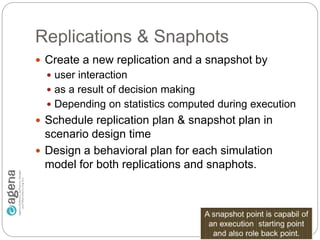
Replications & Snaphots
 Create a new replication and a snapshot by
 user interaction
 as a result of decision making
 Depending on statistics computed during execution
 Schedule replication plan & snapshot plan in
scenario design time
 Design a behavioral plan for each simulation
model for both replications and snaphots.
Run Time Analysis & Decision
Making
 The purpose of run time analysis is to
 Pick execution data during execution
 Analyze them
 Make a decision
 Handle execution dependig on the decision given
 Handling an execution consists of
 Altering resources
 Adding new functions, attributes, and behaviors
 Swithcing parallel simulation synchronization
algorithms
Intelligent Traces Mechanism
 The data generated by a simulation entity can be
traced depending on designer choice. These are
 Atomic actions
 Attributes
 Logical premises
 Behaviors executed
 State transitions
 State durations
 Event flows
 There is no software dependency between trace
declaration and simulation software
 Behavior traces give a grammar to learn and query
what the simulation model did during execution.
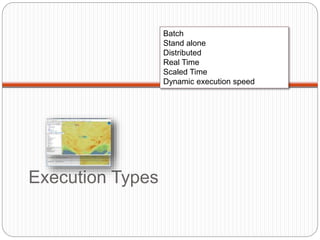
Execution Types
Batch
Stand alone
Distributed
Real Time
Scaled Time
Dynamic execution speed
Operating Systems AdSiF
supports
 Matlab
More features inside
write us
hocaoglu@agenasavunma.com
info@agenasavunma.com
LinkedIn Group: AdSiF-Simulationists

Agena adsif – a language for simulation & agent

  • 1.
    Agent driven SimulationFramework With mult-paradigm and AI Support AdSiF – A Language for Simulation & Agent Programming
  • 2.
    AdSiF: Simulation Language What is AdSiF (Agent driven Simulation Framework) AdSiF is a family of commercial off-the-shelf (COTS) software products that provide the framework and all basic functionality needed for constructive simulations as well as the ability to interface with live, virtual, and other constructive simulations. Using AdSiF, it is possible to develop a simulation customized for your exact requirements that is more flexible and easier to use than simulations that are not based on AdSiF. Using AdSiF can also substantially lower the cost of developing, upgrading, maintaining, and using your simulation. If you don’t have your own simulation development team, Agena’s experts can develop a custom, AdSiF-based simulation for you.
  • 3.
    Language Properties  AdSiFis a declerative general purpose simulation language.  The language is developed for generic pupose – there is no domain dependency.  It is successful in simulation and intelligent agent programming.  Multi-paradigm design environment  Object oriented  Aspect oriented  Agent based modeling  Logic programming  Combine whole paradigms it supports in State oriented programming paradigm.  Easy-to-Extend simulation models  State diagrams (SOP)  Atomic function plug-ins (SOP, AOP)  Logic programming predicates AdSiF LP AgP OOPAOP SOP
  • 4.
    Language Properties  Extendingsimulation models by adding new methods, even in run time  Support for Aspect oriented programming by changing behavior containers in run time.  Supports discrete and continuous event simulation  Dynamic execution frequency  Stiffing  Controlling double precision and fourier error  Behavior management by deductive reasoning  Ability to Draw whole Conceptual Model  Starting from requirements up to simulation execution  Generic logic based solution for time delayed systems
  • 5.
    Ontology & AspectOrientation  Supports Ontology based Modeling  Ontological commitment  Existance queries  Relation concept  Provides tools  Basic concerns of AOP  Tangled requirements/concerns  Scattered requirements/concerns  Swithing to an aspect satisfies a croscutting concern.  What does it mean in simulation ?  Thinking with agenthood  Evaluating states, making decision and changing attitude
  • 6.
    Some More Features Logic programming, Agentbased programming, Aspect oriented programming enhance reasoning mechanism, Planning capability modelling, Commitment strategies, and Knowledge and decision intensive tasks. Artificial Intelligence In run time simulation models can change their aspect depending on the conditions user defined. The capabilitry provides more intelligent and flexible simulation environment. Dynamic Aspects Interaction between entities are achieved publish and subscribe mechanism and event passing. No code dependency required that makes high coherence and low dependency. Interchangability Using AdSiF plugin and Aspect Oriented Programming paradigm it is highly easy to extend legacy simulation models and applications even in runtime. Reusability Possible to extend models with plugins even in Run Time Extendability Extend simulation models in run time Modular, model based modeling w/o Coupling High Coherence, low dependency Change model behavior aspect by autonomous reasoning Uses Reasoning Technologies
  • 7.
    Distributed Simulation  SupportsHLA and DIS  Dynamic paralalization algorithm selection in run time  Optimistic algorithms  Pessimistic Algorithms  ..  Altering simulation resources in run time  Extending capabilities of simulation models in run time  Extending by new functions  Adding new attributes  Adding new behaviors  Switching behavior categories in run time
  • 8.
    Replications & Snaphots Create a new replication and a snapshot by  user interaction  as a result of decision making  Depending on statistics computed during execution  Schedule replication plan & snapshot plan in scenario design time  Design a behavioral plan for each simulation model for both replications and snaphots.
  • 9.
    Run Time Analysis& Decision Making  The purpose of run time analysis is to  Pick execution data during execution  Analyze them  Make a decision  Handle execution dependig on the decision given  Handling an execution consists of  Altering resources  Adding new functions, attributes, and behaviors  Swithcing parallel simulation synchronization algorithms
  • 10.
    Intelligent Traces Mechanism The data generated by a simulation entity can be traced depending on designer choice. These are  Atomic actions  Attributes  Logical premises  Behaviors executed  State transitions  State durations  Event flows  There is no software dependency between trace declaration and simulation software  Behavior traces give a grammar to learn and query what the simulation model did during execution.
  • 11.
    Execution Types Batch Stand alone Distributed RealTime Scaled Time Dynamic execution speed
  • 12.
  • 13.
    More features inside writeus hocaoglu@agenasavunma.com info@agenasavunma.com LinkedIn Group: AdSiF-Simulationists