AFRICAN LITERATURE
An overview: Classroom Lecture by Ms. Kristine Dichoso-Vitug
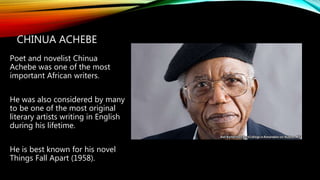
CHINUA ACHEBE
Poet and novelist Chinua
Achebe was one of the most
important African writers.
He was also considered by many
to be one of the most original
literary artists writing in English
during his lifetime.
He is best known for his novel
Things Fall Apart (1958).
• Identify and explain the basic elements and distinctive features of
folk tales.
• Visualize setting, characters, and action.
• Infer problem and goal of the character.
• Relate to the conflict presented and apply learning to present life
situations.
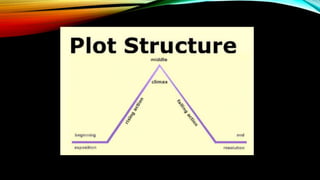
• Illustrate the plot story in a plot structure map.
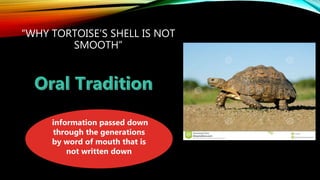
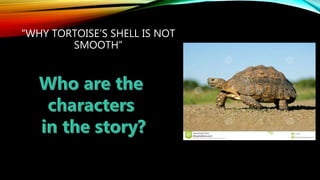
“WHY TORTOISE’S SHELL IS NOT
SMOOTH”
information passed down
through the generations
by word of mouth that is
not written down
“WHY TORTOISE’S SHELL IS NOT
SMOOTH”
a spoken or written
accounts of connected
events
has three basic elements:
characters, setting, and
plot
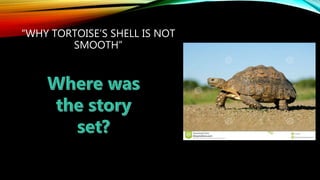
“WHY TORTOISE’S SHELL IS NOT
SMOOTH”
“WHY TORTOISE’S SHELL IS NOT
SMOOTH”
“WHY TORTOISE’S SHELL IS NOT
SMOOTH”
African literature
African literature
African literature
African literature

African literature

  • 1.
    AFRICAN LITERATURE An overview:Classroom Lecture by Ms. Kristine Dichoso-Vitug
  • 8.
    CHINUA ACHEBE Poet andnovelist Chinua Achebe was one of the most important African writers. He was also considered by many to be one of the most original literary artists writing in English during his lifetime. He is best known for his novel Things Fall Apart (1958).
  • 9.
    • Identify andexplain the basic elements and distinctive features of folk tales. • Visualize setting, characters, and action. • Infer problem and goal of the character. • Relate to the conflict presented and apply learning to present life situations. • Illustrate the plot story in a plot structure map.
  • 10.
    “WHY TORTOISE’S SHELLIS NOT SMOOTH” information passed down through the generations by word of mouth that is not written down
  • 11.
    “WHY TORTOISE’S SHELLIS NOT SMOOTH” a spoken or written accounts of connected events has three basic elements: characters, setting, and plot
  • 12.
    “WHY TORTOISE’S SHELLIS NOT SMOOTH”
  • 13.
    “WHY TORTOISE’S SHELLIS NOT SMOOTH”
  • 14.
    “WHY TORTOISE’S SHELLIS NOT SMOOTH”