Africa: pharma’s final frontier
understanding the pharmaceutical supply chain
in the world’s fastest-growing consumer market
2
Table of Contents
Foreword 3
1. Introduction 4
2. Challenges in Africa’s pharmaceutical logistics market 5
People 5
Legislation and regulations 5
Infrastructure 6
Counterfeit medicines 6
3. The current situation 7
4. A new pharmaceutical supply chain model 8
Strategic 8
Tactical 8
Operational 8
5. Conclusion 10
6. Bibliography 11
Agility’s role in the pharmaceutical sector 12
Foreword
robust supply chain in order to create sustainable solutions. One of the critical factors to overcome is
visibility – visibility of the physical, financial and information flows. This document provides a brief
overview of the current conditions and of some of the pressing issues. It also presents a way of
addressing these issues in a way that ensures secured medicines are delivered safely to the right
patients at the right time.
Please contact me or a member of our team if you have any questions about Agility and our ability to
meet your supply chain challenges in Africa or elsewhere.
Sincerely,
Leif Krönkvist
Vice President, Global Life Science
Agility Global Integrated Logistics
Africa is on everyone's radar. It is the world's fastest-growing
continent, a place of unparalleled opportunity. Yet about half of child
deaths globally occur in the Sub-Saharan region, and malaria and
other disease remain stubborn threats.
There are a lot of contradictions when it comes to Africa. First of all,
Africa is one continent but not one market, zone or country. The
variety in culture, climate and language across a landmass five times
larger than China demands a regional approach coupled with local
adaptation.
Regardless of the financial or political climate, Africa needs a more
3
Introduction
chapter one:
The world’s population, 2.5 billion in 1950,
stands at 7 billion today, and is expected to
grow to 9.6 billion by 2050 (United Nations,
2013). Population growth is already straining
food supply at a time when global climate
change poses a threat to output from
traditional areas and means of production.
Africa holds 60% of the world’s undeveloped
arable land, so it is poised to play an essential
role in future global food production, a
development that will drive broader economic
growth across the continent (AGRA, 2013).
Sizeable discoveries of oil and gas will help
Africa become energy sufficient and transform
itself into a global exporter and energy power.
Of Africa’s 54 countries, 16 already export oil.
Together, they hold an estimated 20% of the
world’s total reserves. East Africa’s gas reserves
are among the largest in the world (KPMG,
2013).
Consumer spending in Africa has been rising
sharply and is expected to reach $1.4 trillion
(USD) by 2020 (McKinsey Global Institute,
2010). Twenty-two Sub-Saharan African
countries have already attained “middle
income” status (The World Bank, 2015). Since
2000, Africa’s average annual growth rate has
been higher than the average growth rate of
the world economy (United Nations, 2014).
Despite this strong economic outlook, many
African countries continue to struggle with
development challenges. Sub-Saharan Africa
accounts for 11% of the world’s population,
but it bears 24% percent of the global disease
burden and is home to a mere 1% of global
health spending (World Health Organization,
2006). More than one in four Africans remain
chronically undernourished (Stop Hunger
Now, 2015), and 115 people die every hour
from diseases linked to poor sanitation and
contaminated water (United Nations, 2015).
Governments and international institutions
have made large commitments to reducing
the incidence of communicable diseases.
Those commitments are showing results. For
example, the number of new HIV infections
has decreased by one third since 2000; and
between 2003 and 2012 the number of
patients receiving anti-retroviral therapy
climbed from 100,000 to 7.5 million.
Non-communicable diseases such as cancer,
diabetes and cardiovascular disease have
become more prevalent as the middle class has
expanded. That has fed demand for additional
medicines.
So when it comes to medicines, where are the
hurdles in Africa between production and
patient? This document will highlight some
major opportunities and challenges and show
how the pharmaceutical logistics industry can
respond.
1
(Geoffrey White, 2015)
“For the first time, the world needs Africa more than Africa needs the world.” 1
Geoffrey White, CEO Agility Africa
4
People
Africa’s changing demographics – longer life
spans, rapid urbanization, a more western
lifestyle and a growing middle class – will all
drive increased demand for pharmaceutical
products.
While the working age population in Sub-
Saharan Africa is estimated to grow 74% by
2030, the practical skills base is low (JICA
Research institute, 2013). Africa has relatively
few health workers, and medical training
opportunities are scarce. A shortage of trained
workers in the healthcare and pharmaceutical
supply chain fields makes it difficult to
maintain supply chain security and integrity
in Africa. The scarcity of qualified employees
is exacerbated by a gender imbalance. Males in
Africa are 1.55 times more likely to receive
secondary education, even though the health
and related industries typically rely more
heavily on female workers (International
Monetary Fund, 2013).
Legislation and regulations
Much of the legislation and regulation
governing pharmaceuticals in Africa still dates
to colonial times and was adapted from rules
that were once in effect in European countries.
Efforts are underway across Africa to update
the regulatory framework to account for
modern medicines, national realities and
today’s patient needs.
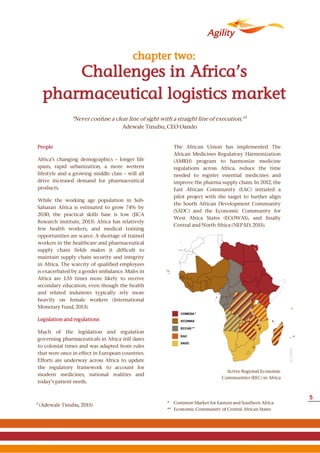
The African Union has implemented The
African Medicines Regulatory Harmonization
(AMRH) program to harmonize medicine
regulations across Africa, reduce the time
needed to register essential medicines and
improve the pharma supply chain. In 2012, the
East African Community (EAC) initiated a
pilot project with the target to further align
the South African Development Community
(SADC) and the Economic Community for
West Africa States (ECOWAS), and finally
Central and North Africa (NEPAD, 2015).
Active Regional Economic
Communities (REC) in Africa
Challenges in Africa’s
pharmaceutical logistics market
chapter two:
2
(Adewale Tinubu, 2015) * Common Market for Eastern and Southern Africa
** Economic Community of Central African States
"Never confuse a clear line of sight with a straight line of execution." 2
Adewale Tinubu, CEO Oando
©Agility
5
©MarcRoche–Fotolia.com
These fake drugs might not contain any active
ingredients at all; they might contain the
correct ingredients but at the wrong dose; or
they could contain highly toxic ingredients.
While ingesting a fake aspirin without any
active ingredient most likely won’t have any
major negative health effects, counterfeit
medicines used to treat patients with life-
threatening conditions like HIV/AIDS and
malaria have devastating consequences. The
demand for counterfeit drugs is highest in
impoverished, underdeveloped countries
where a majority of the populace cannot
afford or obtain medicines from legal sources.
Weak, inconsistent laws and regulations,
combined with a lack of visibility in the
supply chain, allow illicit distributors to
introduce counterfeit medicines, which often
end up being sold in pharmacies or
administered in hospitals (World Health
Organization, 2010).
Infrastructure
African infrastructure is in woeful shape as the
result of decades of underinvestment and
mismanagement. Half a billion Africans lack
access to electricity. Nigeria, with a population
of 180 million, has the same electricity
capacity as Hungary, which has a population
of 10 million.
Africa’s infrastructure deficit and unreliable
power supplies add significantly to the cost of
doing business. In addition, widespread use of
wood and kerosene adds to CO2 emissions and
the disease burden. Lack of consistent power
supplies undermines the pharmaceutical
supply chain by making proper storage of
vaccines and medicines difficult or impossible
in much of Africa (World Bank, 2011).
Sub-Saharan Africa needs $1.6 billion to $2.8
billion in distribution and retail infrastructure
– new warehouses, trucks, supply chain
management IT systems, etc.
Counterfeit medicines
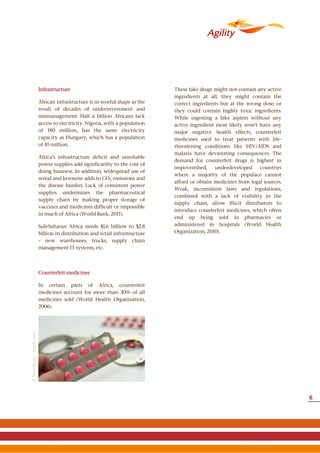
In certain parts of Africa, counterfeit
medicines account for more than 30% of all
medicines sold (World Health Organization,
2006).
6
©MaksymYemelyanov–Fotolia.com
The current situation
chapter three:
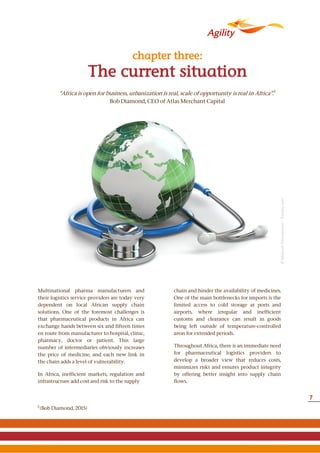
Multinational pharma manufacturers and
their logistics service providers are today very
dependent on local African supply chain
solutions. One of the foremost challenges is
that pharmaceutical products in Africa can
exchange hands between six and fifteen times
en route from manufacturer to hospital, clinic,
pharmacy, doctor or patient. This large
number of intermediaries obviously increases
the price of medicine, and each new link in
the chain adds a level of vulnerability.
In Africa, inefficient markets, regulation and
infrastructure add cost and risk to the supply
chain and hinder the availability of medicines.
One of the main bottlenecks for imports is the
limited access to cold storage at ports and
airports, where irregular and inefficient
customs and clearance can result in goods
being left outside of temperature-controlled
areas for extended periods.
Throughout Africa, there is an immediate need
for pharmaceutical logistics providers to
develop a broader view that reduces costs,
minimizes risks and ensures product integrity
by offering better insight into supply chain
flows.
"Africa is open for business, urbanization is real, scale of opportunity is real in Africa”.3
Bob Diamond, CEO of Atlas Merchant Capital
3
(Bob Diamond, 2015)
7
©filipefrazao–Fotolia.com
A new pharmaceutical
supply chain model
chapter four:
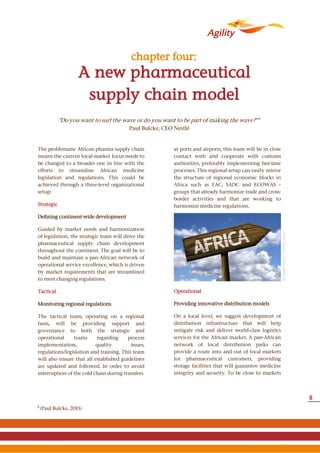
The problematic African pharma supply chain
means the current local-market focus needs to
be changed to a broader one in line with the
efforts to streamline African medicine
legislation and regulations. This could be
achieved through a three-level organizational
setup:
Strategic
Defining continent-wide development
Guided by market needs and harmonization
of legislation, the strategic team will drive the
pharmaceutical supply chain development
throughout the continent. The goal will be to
build and maintain a pan-African network of
operational service excellence, which is driven
by market requirements that are streamlined
to meet changing regulations.
Tactical
Monitoring regional regulations
The tactical team, operating on a regional
basis, will be providing support and
governance to both the strategic and
operational teams regarding process
implementation, quality issues,
regulations/legislation and training. This team
will also ensure that all established guidelines
are updated and followed. In order to avoid
interruption of the cold chain during transfers
at ports and airports, this team will be in close
contact with and cooperate with customs
authorities, preferably implementing fast-lane
processes. This regional setup can easily mirror
the structure of regional economic blocks in
Africa such as EAC, SADC and ECOWAS –
groups that already harmonize trade and cross-
border activities and that are working to
harmonize medicine regulations.
Operational
Providing innovative distribution models
On a local level, we suggest development of
distribution infrastructure that will help
mitigate risk and deliver world-class logistics
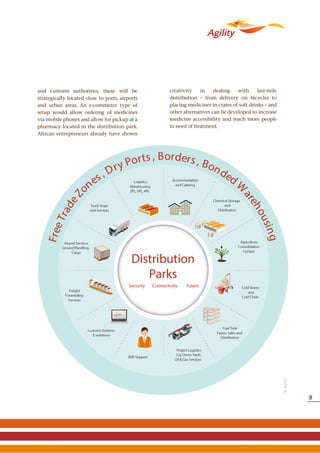
services for the African market. A pan-African
network of local distribution parks can
provide a route into and out of local markets
for pharmaceutical customers, providing
storage facilities that will guarantee medicine
integrity and security. To be close to markets
4
(Paul Bulcke, 2015)
"Do you want to surf the wave or do you want to be part of making the wave?" 4
Paul Bulcke, CEO Nestlé
8
and customs authorities, these will be
strategically located close to ports, airports
and urban areas. An e-commerce type of
setup would allow ordering of medicines
via mobile phones and allow for pickup at a
pharmacy located in the distribution park.
African entrepreneurs already have shown
creativity in dealing with last-mile
distribution – from delivery on bicycles to
placing medicines in crates of soft drinks – and
other alternatives can be developed to increase
medicine accessibility and reach more people
in need of treatment.
©Agility
9
Conclusion
chapter five:
While Africa has a bright future, there is still
much work to do to improve the health of its
rapidly growing population.
Fragmented markets with incomplete or
inefficient regulation, along with weak
infrastructure and a lack of qualified staff,
leave the pharmaceutical supply chain
vulnerable and add significant cost. The high
cost and limited availability of legitimate
medicines mean that a large part of Africa’s
population relies, often unknowingly, on
counterfeits, which can have serious health
consequences.
To break this vicious cycle, pharmaceutical
logistics service providers need to establish a
continental view and support with the efforts
of national government and regional
economic communities to standardize African
pharmaceutical legislation and regulation. One
solution would be to create a strategic network
of local distribution parks, which bring a
world-class environment and create a
geographical footprint across regions and the
continent.
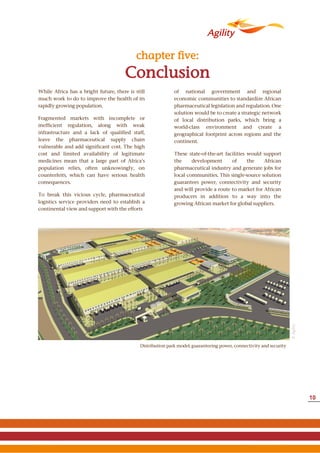
These state-of-the-art facilities would support
the development of the African
pharmaceutical industry and generate jobs for
local communities. This single-source solution
guarantees power, connectivity and security
and will provide a route to market for African
producers in addition to a way into the
growing African market for global suppliers.
©Agility
Distribution park model; guaranteeing power, connectivity and security
10
Bibliography
Adewale Tinubu, C. O. (2015, January 21). The
African Renaissance Breakfast Debate, WEF
Davos 2015. (C. o. Michael Elliot, Interviewer)
Davos , Switzerland .
AGRA. (2013). Africa agriculture status report.
Geoffrey White, C. A. (2015, January 21).
Africa's time is now. Agility Tradelanes
Magazine, Issue 24, 10.
International Monetary Fund. (2013). Women,
Work, and the Economy: Macroeconomic
Gains from Gender Equity.
JICA Research institute. (2013). Development
Challenges in Africa.
KPMG. (2013). Oil and gas in Africa - Africa's
reserves, potential and prospects.
McKinsey Global Institute. (2010). Lions on the
move: The progress and potential of African
economies.
NEPAD. (2015). African Medicines Regulatory
Harmonization Programme (AMRH).
Retrieved 01 29, 2015
Bob Diamond, C. O. (2015, January 21). The
African Renaissance Breakfast Debate, WEF
Davos 2015. (C. o. Michael Elliot, Interviewer)
Davos , Switzerland .
Paul Bulcke, C. N. (2015, January 21). The
African Renaissance Breakfast Debate, WEF
Davos 2015. (C. o. Michael Elliot, Interviewer)
Stop Hunger Now. (2015). Hunger facts.
Retrieved 01 21, 2015, from
http://www.stophungernow.org/hunger-facts
World Bank. (2011). Africa's Power
Infrastructure.
World Bank. (2015). World Bank Open Data.
Retrieved 01 21, 2015, from
http://data.worldbank.org/
United Nations. (2013). World Population
Prospects - The 2012 Revision.
United Nations. (2014). Economic
development in Africa.
United Nations. (2015, 01 22). Water for life.
Retrieved from
http://www.un.org/waterforlifedecade/africa.s
html
World Health Organization. (2006, 11 14).
Counterfeit medicines. Retrieved 02 02, 2015,
from
http://www.who.int/medicines/services/count
erfeit/impact/ImpactF_S/en/
World Health Organization. (2006). Working
together for health.
World Health Organization. (2010). Report of
the situation of counterfeit medicines based
on data collection tool.
11
Contact us for more information
Email: Lifescience@agility.com
Website: www.agility.com
Twitter: twitter.com/agility
LinkedIn: linkedin.com/company/agility
YouTube: youtube.com/user/agilitycorp
For a full listing of offices and services offered across Agility’s global network,
please visit our worldwide directory: www.agility.com/directory.
Agility’s role in the
pharmaceutical sector
From its roots in emerging markets, Agility
brings efficiency to supply chains in some of
the globe’s most challenging environments,
offering unmatched personal service, a global
footprint and customized capabilities in
developed countries and emerging economies
alike.
Agility’s solutions meet the unique
requirements of the pharmaceutical industry
by providing a range of services, including;
storage in multiple temperature zones, cold-
chain solutions, reverse logistics, and advanced
tracking and tracing technologies which
ensure total supply chain visibility and
reporting on merchandise flows across all
modes of transport.
Agility leverages these capabilities around the
world to help build access to new markets and
new opportunities for its customers.
In Africa, Agility is building 70 distribution
parks over the next 5 years. This pan-African
network of international-standard logistics
parks will provide a logistics platform into the
fast-growing African market for international
companies and, equally important, a route for
intra-African trade and for export of African-
produced goods.
12

Africa - Pharma's Final Frontier

  • 1.
    Africa: pharma’s finalfrontier understanding the pharmaceutical supply chain in the world’s fastest-growing consumer market
  • 2.
    2 Table of Contents Foreword3 1. Introduction 4 2. Challenges in Africa’s pharmaceutical logistics market 5 People 5 Legislation and regulations 5 Infrastructure 6 Counterfeit medicines 6 3. The current situation 7 4. A new pharmaceutical supply chain model 8 Strategic 8 Tactical 8 Operational 8 5. Conclusion 10 6. Bibliography 11 Agility’s role in the pharmaceutical sector 12
  • 3.
    Foreword robust supply chainin order to create sustainable solutions. One of the critical factors to overcome is visibility – visibility of the physical, financial and information flows. This document provides a brief overview of the current conditions and of some of the pressing issues. It also presents a way of addressing these issues in a way that ensures secured medicines are delivered safely to the right patients at the right time. Please contact me or a member of our team if you have any questions about Agility and our ability to meet your supply chain challenges in Africa or elsewhere. Sincerely, Leif Krönkvist Vice President, Global Life Science Agility Global Integrated Logistics Africa is on everyone's radar. It is the world's fastest-growing continent, a place of unparalleled opportunity. Yet about half of child deaths globally occur in the Sub-Saharan region, and malaria and other disease remain stubborn threats. There are a lot of contradictions when it comes to Africa. First of all, Africa is one continent but not one market, zone or country. The variety in culture, climate and language across a landmass five times larger than China demands a regional approach coupled with local adaptation. Regardless of the financial or political climate, Africa needs a more 3
  • 4.
    Introduction chapter one: The world’spopulation, 2.5 billion in 1950, stands at 7 billion today, and is expected to grow to 9.6 billion by 2050 (United Nations, 2013). Population growth is already straining food supply at a time when global climate change poses a threat to output from traditional areas and means of production. Africa holds 60% of the world’s undeveloped arable land, so it is poised to play an essential role in future global food production, a development that will drive broader economic growth across the continent (AGRA, 2013). Sizeable discoveries of oil and gas will help Africa become energy sufficient and transform itself into a global exporter and energy power. Of Africa’s 54 countries, 16 already export oil. Together, they hold an estimated 20% of the world’s total reserves. East Africa’s gas reserves are among the largest in the world (KPMG, 2013). Consumer spending in Africa has been rising sharply and is expected to reach $1.4 trillion (USD) by 2020 (McKinsey Global Institute, 2010). Twenty-two Sub-Saharan African countries have already attained “middle income” status (The World Bank, 2015). Since 2000, Africa’s average annual growth rate has been higher than the average growth rate of the world economy (United Nations, 2014). Despite this strong economic outlook, many African countries continue to struggle with development challenges. Sub-Saharan Africa accounts for 11% of the world’s population, but it bears 24% percent of the global disease burden and is home to a mere 1% of global health spending (World Health Organization, 2006). More than one in four Africans remain chronically undernourished (Stop Hunger Now, 2015), and 115 people die every hour from diseases linked to poor sanitation and contaminated water (United Nations, 2015). Governments and international institutions have made large commitments to reducing the incidence of communicable diseases. Those commitments are showing results. For example, the number of new HIV infections has decreased by one third since 2000; and between 2003 and 2012 the number of patients receiving anti-retroviral therapy climbed from 100,000 to 7.5 million. Non-communicable diseases such as cancer, diabetes and cardiovascular disease have become more prevalent as the middle class has expanded. That has fed demand for additional medicines. So when it comes to medicines, where are the hurdles in Africa between production and patient? This document will highlight some major opportunities and challenges and show how the pharmaceutical logistics industry can respond. 1 (Geoffrey White, 2015) “For the first time, the world needs Africa more than Africa needs the world.” 1 Geoffrey White, CEO Agility Africa 4
  • 5.
    People Africa’s changing demographics– longer life spans, rapid urbanization, a more western lifestyle and a growing middle class – will all drive increased demand for pharmaceutical products. While the working age population in Sub- Saharan Africa is estimated to grow 74% by 2030, the practical skills base is low (JICA Research institute, 2013). Africa has relatively few health workers, and medical training opportunities are scarce. A shortage of trained workers in the healthcare and pharmaceutical supply chain fields makes it difficult to maintain supply chain security and integrity in Africa. The scarcity of qualified employees is exacerbated by a gender imbalance. Males in Africa are 1.55 times more likely to receive secondary education, even though the health and related industries typically rely more heavily on female workers (International Monetary Fund, 2013). Legislation and regulations Much of the legislation and regulation governing pharmaceuticals in Africa still dates to colonial times and was adapted from rules that were once in effect in European countries. Efforts are underway across Africa to update the regulatory framework to account for modern medicines, national realities and today’s patient needs. The African Union has implemented The African Medicines Regulatory Harmonization (AMRH) program to harmonize medicine regulations across Africa, reduce the time needed to register essential medicines and improve the pharma supply chain. In 2012, the East African Community (EAC) initiated a pilot project with the target to further align the South African Development Community (SADC) and the Economic Community for West Africa States (ECOWAS), and finally Central and North Africa (NEPAD, 2015). Active Regional Economic Communities (REC) in Africa Challenges in Africa’s pharmaceutical logistics market chapter two: 2 (Adewale Tinubu, 2015) * Common Market for Eastern and Southern Africa ** Economic Community of Central African States "Never confuse a clear line of sight with a straight line of execution." 2 Adewale Tinubu, CEO Oando ©Agility 5
  • 6.
    ©MarcRoche–Fotolia.com These fake drugsmight not contain any active ingredients at all; they might contain the correct ingredients but at the wrong dose; or they could contain highly toxic ingredients. While ingesting a fake aspirin without any active ingredient most likely won’t have any major negative health effects, counterfeit medicines used to treat patients with life- threatening conditions like HIV/AIDS and malaria have devastating consequences. The demand for counterfeit drugs is highest in impoverished, underdeveloped countries where a majority of the populace cannot afford or obtain medicines from legal sources. Weak, inconsistent laws and regulations, combined with a lack of visibility in the supply chain, allow illicit distributors to introduce counterfeit medicines, which often end up being sold in pharmacies or administered in hospitals (World Health Organization, 2010). Infrastructure African infrastructure is in woeful shape as the result of decades of underinvestment and mismanagement. Half a billion Africans lack access to electricity. Nigeria, with a population of 180 million, has the same electricity capacity as Hungary, which has a population of 10 million. Africa’s infrastructure deficit and unreliable power supplies add significantly to the cost of doing business. In addition, widespread use of wood and kerosene adds to CO2 emissions and the disease burden. Lack of consistent power supplies undermines the pharmaceutical supply chain by making proper storage of vaccines and medicines difficult or impossible in much of Africa (World Bank, 2011). Sub-Saharan Africa needs $1.6 billion to $2.8 billion in distribution and retail infrastructure – new warehouses, trucks, supply chain management IT systems, etc. Counterfeit medicines In certain parts of Africa, counterfeit medicines account for more than 30% of all medicines sold (World Health Organization, 2006). 6
  • 7.
    ©MaksymYemelyanov–Fotolia.com The current situation chapterthree: Multinational pharma manufacturers and their logistics service providers are today very dependent on local African supply chain solutions. One of the foremost challenges is that pharmaceutical products in Africa can exchange hands between six and fifteen times en route from manufacturer to hospital, clinic, pharmacy, doctor or patient. This large number of intermediaries obviously increases the price of medicine, and each new link in the chain adds a level of vulnerability. In Africa, inefficient markets, regulation and infrastructure add cost and risk to the supply chain and hinder the availability of medicines. One of the main bottlenecks for imports is the limited access to cold storage at ports and airports, where irregular and inefficient customs and clearance can result in goods being left outside of temperature-controlled areas for extended periods. Throughout Africa, there is an immediate need for pharmaceutical logistics providers to develop a broader view that reduces costs, minimizes risks and ensures product integrity by offering better insight into supply chain flows. "Africa is open for business, urbanization is real, scale of opportunity is real in Africa”.3 Bob Diamond, CEO of Atlas Merchant Capital 3 (Bob Diamond, 2015) 7
  • 8.
    ©filipefrazao–Fotolia.com A new pharmaceutical supplychain model chapter four: The problematic African pharma supply chain means the current local-market focus needs to be changed to a broader one in line with the efforts to streamline African medicine legislation and regulations. This could be achieved through a three-level organizational setup: Strategic Defining continent-wide development Guided by market needs and harmonization of legislation, the strategic team will drive the pharmaceutical supply chain development throughout the continent. The goal will be to build and maintain a pan-African network of operational service excellence, which is driven by market requirements that are streamlined to meet changing regulations. Tactical Monitoring regional regulations The tactical team, operating on a regional basis, will be providing support and governance to both the strategic and operational teams regarding process implementation, quality issues, regulations/legislation and training. This team will also ensure that all established guidelines are updated and followed. In order to avoid interruption of the cold chain during transfers at ports and airports, this team will be in close contact with and cooperate with customs authorities, preferably implementing fast-lane processes. This regional setup can easily mirror the structure of regional economic blocks in Africa such as EAC, SADC and ECOWAS – groups that already harmonize trade and cross- border activities and that are working to harmonize medicine regulations. Operational Providing innovative distribution models On a local level, we suggest development of distribution infrastructure that will help mitigate risk and deliver world-class logistics services for the African market. A pan-African network of local distribution parks can provide a route into and out of local markets for pharmaceutical customers, providing storage facilities that will guarantee medicine integrity and security. To be close to markets 4 (Paul Bulcke, 2015) "Do you want to surf the wave or do you want to be part of making the wave?" 4 Paul Bulcke, CEO Nestlé 8
  • 9.
    and customs authorities,these will be strategically located close to ports, airports and urban areas. An e-commerce type of setup would allow ordering of medicines via mobile phones and allow for pickup at a pharmacy located in the distribution park. African entrepreneurs already have shown creativity in dealing with last-mile distribution – from delivery on bicycles to placing medicines in crates of soft drinks – and other alternatives can be developed to increase medicine accessibility and reach more people in need of treatment. ©Agility 9
  • 10.
    Conclusion chapter five: While Africahas a bright future, there is still much work to do to improve the health of its rapidly growing population. Fragmented markets with incomplete or inefficient regulation, along with weak infrastructure and a lack of qualified staff, leave the pharmaceutical supply chain vulnerable and add significant cost. The high cost and limited availability of legitimate medicines mean that a large part of Africa’s population relies, often unknowingly, on counterfeits, which can have serious health consequences. To break this vicious cycle, pharmaceutical logistics service providers need to establish a continental view and support with the efforts of national government and regional economic communities to standardize African pharmaceutical legislation and regulation. One solution would be to create a strategic network of local distribution parks, which bring a world-class environment and create a geographical footprint across regions and the continent. These state-of-the-art facilities would support the development of the African pharmaceutical industry and generate jobs for local communities. This single-source solution guarantees power, connectivity and security and will provide a route to market for African producers in addition to a way into the growing African market for global suppliers. ©Agility Distribution park model; guaranteeing power, connectivity and security 10
  • 11.
    Bibliography Adewale Tinubu, C.O. (2015, January 21). The African Renaissance Breakfast Debate, WEF Davos 2015. (C. o. Michael Elliot, Interviewer) Davos , Switzerland . AGRA. (2013). Africa agriculture status report. Geoffrey White, C. A. (2015, January 21). Africa's time is now. Agility Tradelanes Magazine, Issue 24, 10. International Monetary Fund. (2013). Women, Work, and the Economy: Macroeconomic Gains from Gender Equity. JICA Research institute. (2013). Development Challenges in Africa. KPMG. (2013). Oil and gas in Africa - Africa's reserves, potential and prospects. McKinsey Global Institute. (2010). Lions on the move: The progress and potential of African economies. NEPAD. (2015). African Medicines Regulatory Harmonization Programme (AMRH). Retrieved 01 29, 2015 Bob Diamond, C. O. (2015, January 21). The African Renaissance Breakfast Debate, WEF Davos 2015. (C. o. Michael Elliot, Interviewer) Davos , Switzerland . Paul Bulcke, C. N. (2015, January 21). The African Renaissance Breakfast Debate, WEF Davos 2015. (C. o. Michael Elliot, Interviewer) Stop Hunger Now. (2015). Hunger facts. Retrieved 01 21, 2015, from http://www.stophungernow.org/hunger-facts World Bank. (2011). Africa's Power Infrastructure. World Bank. (2015). World Bank Open Data. Retrieved 01 21, 2015, from http://data.worldbank.org/ United Nations. (2013). World Population Prospects - The 2012 Revision. United Nations. (2014). Economic development in Africa. United Nations. (2015, 01 22). Water for life. Retrieved from http://www.un.org/waterforlifedecade/africa.s html World Health Organization. (2006, 11 14). Counterfeit medicines. Retrieved 02 02, 2015, from http://www.who.int/medicines/services/count erfeit/impact/ImpactF_S/en/ World Health Organization. (2006). Working together for health. World Health Organization. (2010). Report of the situation of counterfeit medicines based on data collection tool. 11
  • 12.
    Contact us formore information Email: Lifescience@agility.com Website: www.agility.com Twitter: twitter.com/agility LinkedIn: linkedin.com/company/agility YouTube: youtube.com/user/agilitycorp For a full listing of offices and services offered across Agility’s global network, please visit our worldwide directory: www.agility.com/directory. Agility’s role in the pharmaceutical sector From its roots in emerging markets, Agility brings efficiency to supply chains in some of the globe’s most challenging environments, offering unmatched personal service, a global footprint and customized capabilities in developed countries and emerging economies alike. Agility’s solutions meet the unique requirements of the pharmaceutical industry by providing a range of services, including; storage in multiple temperature zones, cold- chain solutions, reverse logistics, and advanced tracking and tracing technologies which ensure total supply chain visibility and reporting on merchandise flows across all modes of transport. Agility leverages these capabilities around the world to help build access to new markets and new opportunities for its customers. In Africa, Agility is building 70 distribution parks over the next 5 years. This pan-African network of international-standard logistics parks will provide a logistics platform into the fast-growing African market for international companies and, equally important, a route for intra-African trade and for export of African- produced goods. 12