

Uploaded byDemand Metric
Shopper Marketing Maturity Model
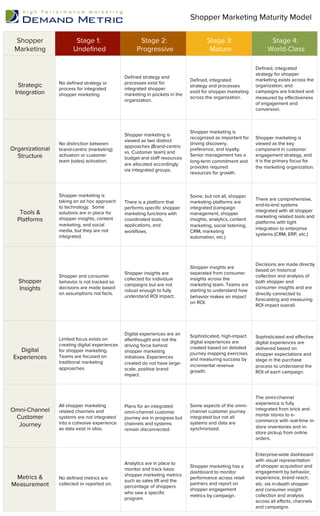
The document outlines a maturity model for shopper marketing, detailing four stages from undefined to world-class strategic integration. It emphasizes the evolution of strategies, organizational structures, technology, shopper insights, digital experiences, omni-channel customer journeys, and metrics/measurement as organizations progress through these stages. Key advancements include integrated systems, data-driven decision making, and comprehensive digital experiences that align with shopper expectations.
More Related Content


Similar to Shopper Marketing Maturity Model


Shopper Marketing Maturity Model
- 1. Shopper Marketing Stage 1: Undefined Stage 2: Progressive Stage3: Mature Stage 4: World-Class Strategic Integration No defined strategy or process for integrated shopper marketing. Defined strategy and processes exist for integrated shopper marketing in pockets in the organization. Defined, integrated strategy and processes exist for shopper marketing across the organization. Defined, integrated strategy for shopper marketing exists across the organization, and campaigns are tracked and measured by effectiveness of engagement and conversion. Organizational Structure No distinction between brand-centric (marketing) activation or customer team (sales) activation. Shopper marketing is viewed as two distinct approaches (Brand-centric vs. Customer team) and budget and staff resources are allocated accordingly via integrated groups. Shopper marketing is recognized as important for driving discovery, preference, and loyalty. Senior management has a long-term commitment and provides required resources for growth. Shopper marketing is viewed as the key component in customer engagement strategy, and it is the primary focus for the marketing organization. Tools & Platforms Shopper marketing is taking an ad hoc approach to technology. Some solutions are in place for shopper insights, content marketing, and social media, but they are not integrated. There is a platform that performs specific shopper marketing functions with coordinated tools, applications, and workflows. Some, but not all, shopper marketing platforms are integrated (campaign management, shopper insights, analytics, content marketing, social listening, CRM, marketing automation, etc.) There are comprehensive, end-to-end systems integrated with all shopper marketing related tools and platforms with tight integration to enterprise systems (CRM, ERP, etc.) Shopper Insights Shopper and consumer behavior is not tracked so decisions are made based on assumptions not facts. Shopper insights are collected for individual campaigns but are not robust enough to fully understand ROI impact. Shopper insights are separated from consumer insights across the marketing team. Teams are starting to understand how behavior makes an impact on ROI. Decisions are made directly based on historical collection and analysis of both shopper and consumer insights and are directly connected to forecasting and measuring ROI impact overall. Digital Experiences Limited focus exists on creating digital experiences for shopper marketing. Teams are focused on traditional marketing approaches. Digital experiences are an afterthought and not the driving force behind shopper marketing initiatives. Experiences created do not have large- scale, positive brand impact. Sophisticated, high-impact digital experiences are created based on detailed journey mapping exercises and measuring success by incremental revenue growth. Sophisticated and effective digital experiences are delivered based on shopper expectations and stage in the purchase process to understand the ROI of each campaign. Omni-Channel Customer Journey All shopper marketing related channels and systems are not integrated into a cohesive experience as data exist in silos. Plans for an integrated omni-channel customer journey are in progress but channels and systems remain disconnected. Some aspects of the omni- channel customer journey integrated but not all systems and data are synchronized. The omni-channel experience is fully integrated from brick and mortar stores to e- commerce with real-time in- store inventories and in- store pickup from online orders. Metrics & Measurement No defined metrics are collected or reported on. Analytics are in place to monitor and track basic shopper marketing metrics such as sales lift and the percentage of shoppers who saw a specific program. Shopper marketing has a dashboard to monitor performance across retail partners and report on shopper engagement metrics by campaign. Enterprise-wide dashboard with visual representation of shopper acquisition and engagement by behavior, experience, brand reach, etc. via in-depth shopper and consumer insight collection and analysis across all efforts, channels and campaigns. Shopper Marketing Maturity Model