Diversity and Health Behaviors Ms. Ana Linares University of North Florida PEACE Center Dr. Otilia Salmon, University of North Florida COEHS Dr. Judith C. Rodriguez, University of North Florida COH   March 25, 2005 This is part 2 of an 8 part series of seminars on Hispanic Health Issues brought to you by the University of North Florida’s Dept. of Public Health, College of Health, a grant from AETNA, and the cooperation of Duval County Health Department. For more information or register for the seminars, please call 620-1289.
Caribbean Hispanics World views Illness etiologies and categories  Behaviors  Illnesses Application of Health Behavior Models
Comparison of world views Community vs. individual Emotional vs. rational Dependence/interdependence vs. self reliance/autonomy  Focus on relationships vs. focus on time and money
Symptoms experience Assumption of sick role Care contact  Patient role Recovery or rehabilitation Illness Behavior
Traditional Etiologies The result of “good luck” A reward for good behavior A gift from God An imbalance (body) Punishment for wrongdoing
Major Categories Body imbalance – hot or cold Dislocation of parts of the body Magic or supernatural causes Strong emotional state Envy (envidia)
Spiritualism, Santeria and Fatalism Problems spiritual in nature are treated with prayer and ritual Practiced in:  Caribbean Mexico Central/South America
Identity and Implications for Health The Hispanic Paradox U.S. Census Categories and Hispanic  Demographic Complexity Black and White categories Nativity status US Born vs. Foreign Born
Based on humoral medicine Based on concept of balance Foods, climate, situations can make the body fall out of balance, hence, ill (effect on body) Illness and disease are treated by manipulations that get the body back in balance Hot – cold theory of disease
Hot – cold theory of disease Treatment is based on “oppositions” Thermal quality is not the factor Perceived intrinsic quality or affect on the body may be basis of descriptor Some medicines may be considered hot
Health Behaviors Examples of curative or therapeutic behaviors Cold conditions  = menstrual cramps,  coryza , pneumonia,  empacho , and colic are treated with hot medications and remedies to bring the individual back into balance.   Some groups believe arthritis to be a “cold” disease
Health Behaviors Examples of curative or therapeutic behaviors Hot conditions -  pregnancy, diabetes, hypertension, acid indigestion,  susto , and  bilis
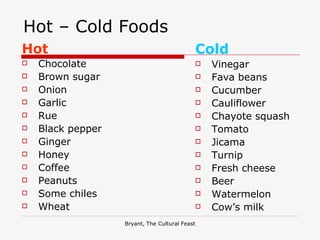
Hot – Cold Foods Hot Chocolate Brown sugar Onion Garlic Rue Black pepper Ginger Honey Coffee Peanuts Some chiles Wheat Cold Vinegar Fava beans Cucumber Cauliflower Chayote squash Tomato Jicama Turnip Fresh cheese Beer Watermelon Cow’s milk
Discussion What questions could you ask to determine if there are hot – cold practices? How might you evaluate/respond to the practice?
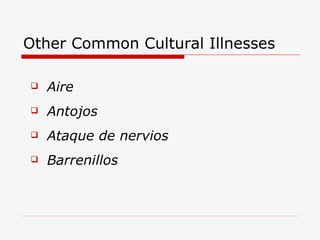
Other Common Cultural Illnesses Aire Antojos Ataque de nervios Barrenillos
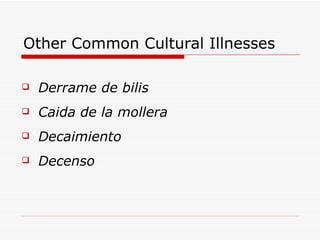
Other Common Cultural Illnesses Derrame de bilis Caida de la mollera Decaimiento Decenso
Other Common Cultural Illnesses Empacho Espasmo Mal de ojo Nerviosismo Susto
Discussion Examples of health prevention or treatment behaviors: “hot” medications. What questions could you ask to determine extent of traditional health beliefs or practices? How might you evaluate and respond to the practice?
Application of Theoretical Frameworks Health Belief Systems Family Systems Social Marketing
Health Beliefs Value? Possible behavior? Recommendation? Elements Perceived susceptibility Impact Advantages of change Barriers Self-efficacy
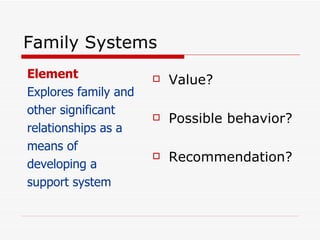
Family Systems Value? Possible behavior? Recommendation? Element Explores family and other significant relationships as a means of developing a support system
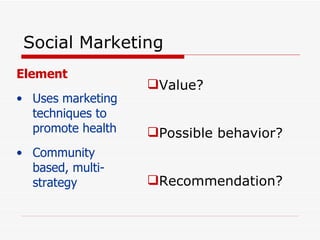
Social Marketing Element Uses marketing techniques to promote health  Community based, multi-strategy Value? Possible behavior? Recommendation?
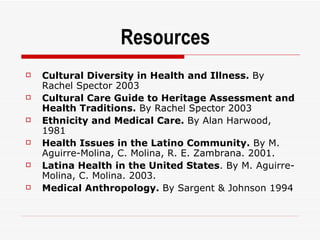
Cultural Diversity in Health and Illness.  By Rachel Spector 2003 Cultural Care Guide to Heritage Assessment and Health Traditions.  By Rachel Spector 2003 Ethnicity and Medical Care.  By Alan Harwood, 1981 Health Issues in the Latino Community.  By M. Aguirre-Molina, C. Molina, R. E. Zambrana. 2001. Latina Health in the United States . By M. Aguirre-Molina, C. Molina. 2003. Medical Anthropology.  By Sargent & Johnson 1994 Resources
Questions? Thank you! University of North Florida, College of Health Ms. Ana Linares UNF PEACE Center Dr. Judith C. Rodriguez, UNF COH March, 2005

Aetna Presentation Diversity Behaviors - part2

  • 1.
    Diversity and HealthBehaviors Ms. Ana Linares University of North Florida PEACE Center Dr. Otilia Salmon, University of North Florida COEHS Dr. Judith C. Rodriguez, University of North Florida COH March 25, 2005 This is part 2 of an 8 part series of seminars on Hispanic Health Issues brought to you by the University of North Florida’s Dept. of Public Health, College of Health, a grant from AETNA, and the cooperation of Duval County Health Department. For more information or register for the seminars, please call 620-1289.
  • 2.
    Caribbean Hispanics Worldviews Illness etiologies and categories Behaviors Illnesses Application of Health Behavior Models
  • 3.
    Comparison of worldviews Community vs. individual Emotional vs. rational Dependence/interdependence vs. self reliance/autonomy Focus on relationships vs. focus on time and money
  • 4.
    Symptoms experience Assumptionof sick role Care contact Patient role Recovery or rehabilitation Illness Behavior
  • 5.
    Traditional Etiologies Theresult of “good luck” A reward for good behavior A gift from God An imbalance (body) Punishment for wrongdoing
  • 6.
    Major Categories Bodyimbalance – hot or cold Dislocation of parts of the body Magic or supernatural causes Strong emotional state Envy (envidia)
  • 7.
    Spiritualism, Santeria andFatalism Problems spiritual in nature are treated with prayer and ritual Practiced in: Caribbean Mexico Central/South America
  • 8.
    Identity and Implicationsfor Health The Hispanic Paradox U.S. Census Categories and Hispanic Demographic Complexity Black and White categories Nativity status US Born vs. Foreign Born
  • 9.
    Based on humoralmedicine Based on concept of balance Foods, climate, situations can make the body fall out of balance, hence, ill (effect on body) Illness and disease are treated by manipulations that get the body back in balance Hot – cold theory of disease
  • 10.
    Hot – coldtheory of disease Treatment is based on “oppositions” Thermal quality is not the factor Perceived intrinsic quality or affect on the body may be basis of descriptor Some medicines may be considered hot
  • 11.
    Health Behaviors Examplesof curative or therapeutic behaviors Cold conditions = menstrual cramps, coryza , pneumonia, empacho , and colic are treated with hot medications and remedies to bring the individual back into balance. Some groups believe arthritis to be a “cold” disease
  • 12.
    Health Behaviors Examplesof curative or therapeutic behaviors Hot conditions - pregnancy, diabetes, hypertension, acid indigestion, susto , and bilis
  • 13.
    Hot – ColdFoods Hot Chocolate Brown sugar Onion Garlic Rue Black pepper Ginger Honey Coffee Peanuts Some chiles Wheat Cold Vinegar Fava beans Cucumber Cauliflower Chayote squash Tomato Jicama Turnip Fresh cheese Beer Watermelon Cow’s milk
  • 14.
    Discussion What questionscould you ask to determine if there are hot – cold practices? How might you evaluate/respond to the practice?
  • 15.
    Other Common CulturalIllnesses Aire Antojos Ataque de nervios Barrenillos
  • 16.
    Other Common CulturalIllnesses Derrame de bilis Caida de la mollera Decaimiento Decenso
  • 17.
    Other Common CulturalIllnesses Empacho Espasmo Mal de ojo Nerviosismo Susto
  • 18.
    Discussion Examples ofhealth prevention or treatment behaviors: “hot” medications. What questions could you ask to determine extent of traditional health beliefs or practices? How might you evaluate and respond to the practice?
  • 19.
    Application of TheoreticalFrameworks Health Belief Systems Family Systems Social Marketing
  • 20.
    Health Beliefs Value?Possible behavior? Recommendation? Elements Perceived susceptibility Impact Advantages of change Barriers Self-efficacy
  • 21.
    Family Systems Value?Possible behavior? Recommendation? Element Explores family and other significant relationships as a means of developing a support system
  • 22.
    Social Marketing ElementUses marketing techniques to promote health Community based, multi-strategy Value? Possible behavior? Recommendation?
  • 23.
    Cultural Diversity inHealth and Illness. By Rachel Spector 2003 Cultural Care Guide to Heritage Assessment and Health Traditions. By Rachel Spector 2003 Ethnicity and Medical Care. By Alan Harwood, 1981 Health Issues in the Latino Community. By M. Aguirre-Molina, C. Molina, R. E. Zambrana. 2001. Latina Health in the United States . By M. Aguirre-Molina, C. Molina. 2003. Medical Anthropology. By Sargent & Johnson 1994 Resources
  • 24.
    Questions? Thank you!University of North Florida, College of Health Ms. Ana Linares UNF PEACE Center Dr. Judith C. Rodriguez, UNF COH March, 2005