New	
  Paradigm	
  Schools:	
  	
  
  A	
  Na4onal	
  Survey	
  	
  
         October,	
  2012	
  
             AECT	
  
Introduc4on	
  
•  Background:	
  	
  
    –  Need	
  for	
  an	
  educa4onal	
  system	
  for	
  the	
  Informa4on	
  
       age	
  
    –  Focus	
  on	
  learning	
  rather	
  than	
  sor4ng	
  
•  Purpose:	
  	
  
    –  Iden4fy	
  learner-­‐centered	
  schools	
  
    –  Describe	
  their	
  instruc4onal	
  prac4ces,	
  system	
  
       structures,	
  and	
  uses	
  of	
  technology	
  	
  
•  Progress:	
  	
  
    –  Data	
  collec4on	
  (un4l	
  November,	
  2012)	
  
Conceptual	
  Framework	
  
•    Personalized	
  learning	
  plan	
  
•    Competency-­‐based	
  student	
  progress	
  
•    Criterion-­‐referenced	
  assessment	
  
•    Problem/Project-­‐based	
  learning	
  
•    Mul4-­‐year	
  mentoring/	
  Mul4-­‐grade	
  classroom	
  
Methods	
  
Target	
  popula,on	
                   Sources:	
  	
  
•  K-­‐12	
  learner-­‐centered	
       •  DoE	
  websites	
  
     schools	
  in	
  the	
  USA	
      •  The	
  Edutopia	
  website	


                                      •  Na4onal	
  school	
  models	
  
                                        •  The	
  list	
  collected	
  from	
  
                                           experts	
  and	
  literature	
  
Purposive	
  Sample	
  
•  Sampling	
  procedure	
  
       1.  Collect	
  informa4on	
  	
  
       2.  Check	
  if	
  met	
  criteria,	
  rate	
  by	
  the	
  number	
  of	
  criteria	
  
       3.  Selected	
  schools	
  that	
  met	
  3+	
  criteria	


•  Total	
  number	
  of	
  schools	
  in	
  the	
  sample:	
  310	
  	
  
•  Response	
  rate:	
  40	
  schools	
  (13%)	
  
       –  184	
  responses	
  from	
  administrators	
  &	
  teachers	


Instruments	
  Development	
  
•  Literature	
  review	
  
         •  5	
  features	
  (criteria)	
  
•  Expert	
  reviews	
  
         •  2	
  experts	
  	
  
•  Pilot	
  tests	
  
         •  4	
  former	
  k-­‐12	
  teachers	
  
Survey	
  Instrument	
  
1.	
  For	
  principals:	
  
    •  About	
  the	
  school	
  (5)	
  
2.	
  For	
  teachers:	
  
    •    Base	
  responses	
  on	
  year	
  of	
  2011-­‐2012	
  
    •    Demographic	
  info	
  (3)	
  	
  
    •    Personalized	
  learning	
  (2)	
  
    •    Student	
  progress	
  (1)	
  
    •    Assessment	
  (2)	
  	
  
    •    PBL	
  (7)	
  
    •    Mul4-­‐year	
  mentoring;	
  mul4-­‐grade	
  classroom	
  (4)	
  
    •    Technology	
  (5)	
  
QUESTIONS	
  OR	
  COMMENTS?	
  
Results	
  1:	
  Learner-­‐Centered	
  Schools	
  
From	
  	
  ini,al	
  sample	
                                 From	
  survey	
  responses	
  
Met	
  3+	
  criteria	
                                        Among	
  40	
  schools,	
  
       •  11	
  Na4onal	
  School	
  Model	
                      •  3	
  Na4onal	
  School	
  Model	
  
       •  17	
  School	
  District	
                              •  4	
  School	
  District	
  
       •  22	
  Individual	
  Schools	
                           •  1	
  Individual	
  School	
  
Breakdown	
  of	
  schools	
  with	
  3+	
  criteria	
         #	
  of	
  schools	
  that	
  met	
  all	
  5	
  criteria	
  
    •  5	
  Criteria:	
  43	
  schools	
  (13%)	
                          •  14	
  schools	
  out	
  of	
  40	
  (35%)	
  
    •  4	
  Criteria:	
  100	
  schools	
  (31%)	
  
    •  3	
  Criteria:	
  183	
  schools	
  (56%)	
  

Criteria:	
  	
  
                    1.    Personalized	
  learning	
  plan	
  
                    2.    Competency-­‐based	
  student	
  progress	
  
                    3.    Criterion-­‐referenced	
  assessment	
  
                    4.    Problem/Project-­‐based	
  learning	
  
                    5.    Mul4-­‐year	
  mentoring/grouping	
  
Results	
  1:	
  Learner-­‐Centered	
  Schools	
  
Type	
              Title	
                                    School	
  
Na4onal	
           Edvision	
                                 1.      Avalon	
  School,	
  MN	
  (Gr	
  6-­‐12,	
  N=143)	
  
School	
  Model	
                                              2.      Edvision	
  Off	
  Campus,	
  MN	
  (Gr	
  9-­‐12,	
  N=28)	
  	
  
                                                               3.      Minnesota	
  New	
  Country	
  School,	
  MN	
  (Gr	
  9-­‐12,	
  N=112)	
  
                                                               4.      Explore	
  Knowledge	
  Academy,	
  NV	
  (K-­‐12,	
  N=	
  521)	
  
                                                               5.      Phoenix	
  Rising,	
  WA	
  (Pre	
  K	
  –	
  6,	
  N=50)	
  
                    Carpe	
  Diem	
                            6.	


  Carpe	
  Diem	
  Collegiate	
  High	
  School,	
  AZ	
  (Gr	
  6-­‐12,	
  N=234)	
  

                    Big	
  Picture	
  Learning	
  School	
     7.      Durango	
  Big	
  Picture	
  High	
  School,	
  CO	
  (Gr	
  9-­‐12,	
  N=72)	
  	
  
                                                               8.      Tulsa	
  Met	
  High	
  School,	
  OK	
  (Gr	
  9-­‐12,	
  N=475)	
  
School	
            Chugach	
  school	
  district	
            9.	


  Chenega	
  Bay	
  Community	
  School,	
  AK	
  (Pre	
  K-­‐12,	
  N=24)	
  
District	
  
                    Grand	
  Rapids	
  Public	
  Schools	
     10.	
  	
  	
  City	
  High	
  Middle	
  School,	
  MI	
  (Gr	
  7-­‐12,	
  N=700)	
  
                    Kuspuk	
  School	
  District	
             11.	
  	
  	
  Gusty	
  Michael	
  School,	
  AK	
  (Pre	
  K-­‐12,	
  N=12)	
  
                                                               12.	
  	
  	
  Jack	
  Egnaty	
  Sr.High	
  School,	
  AK	
  (Pre	
  K-­‐12,	
  N=12)	
  
                    RSU	
  57	
  Massebesic	
                  13.	
  	
  	
  Massabesic	
  High	
  School,	
  ME	
  (Gr	
  9-­‐12,	
  N=1,194)	
  

Individual	
        -­‐	
                                      14.	
  	
  	
  Forest	
  Lake	
  Elementary	
  School,	
  FL	
  (Pre	
  K-­‐5,	
  N=681)	
  
School	
  	
  
Results	
  2:	
  Personalized	
  Learning	
  
•  How	
  olen	
  did	
  you	
  consider	
  the	
  following	
  when	
  preparing	
  a	
  personalized	
  
   learning	
  plan	
  for	
  most	
  students?	
  
•  5	
  point	
  Likert	
  scale,	
  1:	
  Never,	
  5:	
  Always	


     4.5	
  

          4	
  
                        3.89	
            3.79	
         3.78	
         3.78	
  
       3.5	
  
                                                                                           3.04	
  
          3	
  

       2.5	
  

          2	
  

       1.5	
  

          1	
  

       0.5	
  

          0	
  
                  Characteris4cs	
     Interests	
     Mastery	
     Academic	
       Career	
  goals	
  
                                                                     standards	
  
Results	
  2:	
  Student	
  Progress	
  
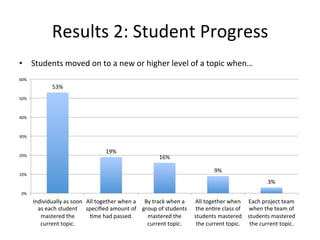
•  Students	
  moved	
  on	
  to	
  a	
  new	
  or	
  higher	
  level	
  of	
  a	
  topic	
  when…	


60%	
  
                      53%	
  
50%	


40%	


30%	


                                                    19%	
  
20%	
                                                                              16%	
  

                                                                                                                  9%	
  
10%	
  
                                                                                                                                                 3%	
  
  0%	
  
           Individually	
  as	
  soon	
   All	
  together	
  when	
  a	
   By	
  track	
  when	
  a	
   All	
  together	
  when	
   Each	
  project	
  team	
  
             as	
  each	
  student	
   specified	
  amount	
  of	
   group	
  of	
  students	
   the	
  en4re	
  class	
  of	
   when	
  the	
  team	
  of	
  
              mastered	
  the	
            4me	
  had	
  passed.	
          mastered	
  the	
           students	
  mastered	
   students	
  mastered	
  
              current	
  topic.	
                                           current	
  topic.	
          the	
  current	
  topic.	
   the	
  current	
  topic.	
  
Results	
  2:	
  Assessment	
  
Major	
  prac,ce	
  of	
  assessment	
     Student	
  academic	
  records	


     Norm-­‐                                                    Mastery	
  of	
  
   referenced	
           Criterion-­‐                          individual	
  
   assessment	
          referenced	
      Tradi4onal	
  	
  
                                             grades	
             skills	
  
      47%	
              assessment	
                              43%	
  
                                              57%	
  
                             53%	
  
Results	
  2:	
  PBL	
  
                    PBL	
                                                           Project	
  type	


                                    Rarely	
  
                        Never	
                                             En4re	
  class	
  
                                     4%	
  
                         6%	
                                                together	
  
                                                                               16%	
  
Always	
                                                Large-­‐
 31%	
                                                  group	


                                                         6%	
  

                                         Some4mes	
                                                       Individual	
  
                                           29%	
                                                           projects	
  
                                                                                                             54%	
  
                                                                 Small-­‐
                                                                 group	
  
                                                                  24%	
  
             Olen	
  
             30%	
  
Results	
  2:	
  Mul4-­‐year	
  mentoring/
                                  classrooms	
  
                 Mul,-­‐year	
  mentoring	
                           Mul,-­‐grade	
  classroom	


                           More	
  than	
  
                            4	
  years	
  
                                 7%	
  
          4	
  years	
                                           No	
  
            12%	
                                               37%	


3	
  years	
                                    1	
  year	
  
  13%	
                                          49%	
  
                                                                                                 Yes	
  
                                                                                                 63%	


                 2	
  years	
  
                   19%	
  
Results	
  2:	
  Tech	
  (Record	
  Keeping)	
  
•             You used computer technology for keeping record of students’…
100%	
                  2	
  
                                                                                                       17	
  
 90%	
                                                    21	
  
                       24	
                                                                                                                       29	
  
 80%	
  

 70%	
  

 60%	
  
                                                          51	
                                         57	
  
 50%	
  
                                                                                                                                                  52	
  

 40%	
  
                       83	
  

 30%	
  

 20%	
  
                                                          34	
                                         32	
  
 10%	
                                                                                                                                            25	


     0%	
  
                   Mastery	
                       Interests	
                               Characteris4cs	
                              Career	
  goals	
  

                                 Yes.	
     No,	
  but	
  I	
  wish	
  I	
  had	
  it.	
     No,	
  and	
  I	
  don't	
  want	
  it.	
  
Results	
  2:	
  Tech	
  (Planning)	
  
•             You used computer technology for planning each student learning by
              deciding on...
100%	
  
                     5	
                  9	
                    8	
  
                                                                                               13	
                   12	
                       15	
  
 90%	
  
                    18	
                                                                                                                                     28	
  
 80%	
                                   26	
                   29	
  
                                                                                               26	
                   29	
  
 70%	
  
                                                                                                                                                 43	
  
 60%	
  
                                                                                                                                                             37	
  
 50%	
  

 40%	
              84	
  
                                         72	
                   69	
                           67	
  
 30%	
                                                                                                                65	
  
                                                                                                                                                 50	
  
 20%	
                                                                                                                                                       40	
  

 10%	
  

     0%	
  
               Resources	
   Learning	
  goals	
   Uses	
  of	
  CBI	
                    Project	
            Timelines	
             Personalized	
   Teammates	
  
                                                                                                                                           plan	
  

                                         Yes.	
       No,	
  but	
  I	
  wish	
  I	
  had	
  it.	
      No,	
  and	
  I	
  don't	
  want	
  it.	
  
Results	
  2:	
  Tech	
  (Instruc4on)	
  
•             Your students used computer technology during learning in the
              following ways…
100%	
                   2	
                     1	
                            3	
  
                         7	
                                                                                     8	
                             8	
            10	
  
 90%	
                                          16	
  
                                                                               22	
  
                                                                                                                19	
                            19	
  
 80%	
  

 70%	
                                                                                                                                                          48	
  
 60%	
  

 50%	
  
                        99	
  
 40%	
                                          92	
  
                                                                               84	
                             81	
                            81	
  
 30%	
  
                                                                                                                                                                50	
  
 20%	
  

 10%	
  

     0%	
  
                Exploring	
  or	
       Crea4ng	
                    Sharing	
                            Using	
  CBI	
              Receiving	
           Receiving	
  
              finding	
  resources	
   products	
  for	
           resources	
  with	
                                                informa4on	
           feedback	
  
                                      their	
  projects	
         other	
  students	
                                               about	
  projects	
  

                                           Yes.	
        No,	
  but	
  I	
  wish	
  I	
  had	
  it.	
         No,	
  and	
  I	
  don't	
  want	
  it.	
  
Results	
  2:	
  Tech	
  (Assessment)	
  
•             You used computer technology for student assessment in the
              following ways...
100%	
  
                       8	
               11	
                 14	
                           14	
                   17	
                                17	
  
 90%	
                                                                                                                                         23	
  

 80%	
  
                      40	
  
 70%	
                                   42	
  
                                                              43	
  
                                                                                             48	
  
 60%	
                                                                                                              48	
  
                                                                                                                                                        57	
  
                                                                                                                                               53	
  
 50%	
  

 40%	
  

 30%	
  
                      59	
               55	
                 50	
  
 20%	
                                                                                       44	
                   41	
  
                                                                                                                                               31	
     31	
  
 10%	
  

     0%	
  
                Providing	
           Tes4ng	
       Cer4fying	
                    Receiving	
         Integra4ng	
        Tes4ng	
  on	
     Adjus4ng	
  
              students	
  with	
     different	
     arainments	
                     sta4s4cs	
            tests	
  as	
     demand	
          levels	
  of	
  
                feedback	
           content	
       (mastery)	
                    about	
  test	
   prac4ce	
  within	
                      difficulty	
  
                                                                                      results	
       the	
  instruc4on	
                    automa4cally	
  

                                         Yes.	
     No,	
  but	
  I	
  wish	
  I	
  had	
  it.	
      No,	
  and	
  I	
  don't	
  want	
  it.	
  
QUESTIONS	
  OR	
  COMMENTS?	
  
Results	
  3:	
  One	
  School	
  
The	
  Minnesota	
  New	
  Country	
  School	
  
   •    A	
  public	
  charter	
  school	
  in	
  Henderson,	
  MN	
  
   •    Founded	
  in	
  1994	
  
   •    110	
  students	
  in	
  grades	
  6-­‐12	
  
   •    10	
  teachers	
  (“advisors”)	
  *	
  
   •    No	
  principal	
  –	
  run	
  by	
  a	
  coopera4ve	
  of	
  teachers	
  *	
  
   •    17,000	
  sq	
  l	
  room	
  called	
  the	
  Atrium	
  *	
  
Results	
  3:	
  One	
  School	
  
AVainment-­‐Based	
  System	
  
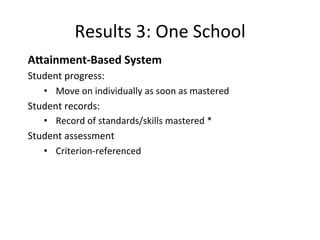
Student	
  progress:	
  
   •  Move	
  on	
  individually	
  as	
  soon	
  as	
  mastered	
  
Student	
  records:	
  
   •  Record	
  of	
  standards/skills	
  mastered	
  *	
  
Student	
  assessment	
  
   •  Criterion-­‐referenced	
  
Results	
  3:	
  One	
  School	
  
Technology	
  Systems	
  Used	
  
Project	
  Foundry	
  
   •  Project	
  design	
  and	
  management	
  
   •  Student	
  goals,	
  interests,	
  projects,	
  arainments	
  
   •  Internet,	
  resources,	
  instruc4on	
  *	
  
ALEKS	
  Math	
  
   •  No	
  PBL	
  
   •  Tutorials	
  
   •  Tes4ng	
  &	
  record	
  keeping	
  *	
  
Results	
  3:	
  One	
  School	
  
Project-­‐Based	
  Learning	
  
PBL	
  used	
  … 	
  Always	
  (except	
  for	
  math	
  &	
  reading)	
  
All	
  projects	
  were	
  individual	
  (no	
  teams)	
  *	
  
Projects	
  typically	
  last	
  2-­‐3	
  weeks	
  
Projects	
  are	
  …	
  
       •  Open-­‐ended	
  
       •  Mul4disciplinary	
  
       •  Real-­‐world	
  	
  (Example:	
  company)	
  
Results	
  3:	
  One	
  School	
  
Self-­‐Direc,on:	
  	
  How	
  oYen	
  did	
  students	
  …	
  
Choose	
  their	
  own	
  project	
  …           	
  Olen	
  
Set	
  their	
  own	
  goals	
  …                	
  Olen	
  
Decide	
  their	
  own	
  roles	
  …             	
  Olen	
  
Decide	
  on	
  their	
  process	
  …            	
  Olen	
  
Present	
  final	
  product	
  in	
  class	
  …   	
  Olen	
  
Share	
  product	
  with	
  community	
  …       	
  Olen	
  
Self-­‐monitor	
  their	
  progress	
  …         	
  Olen	
  
Reflect	
  on	
  their	
  learning	
  …           	
  Always	
  
Results	
  3:	
  One	
  School	
  
Instruc,onal	
  Support	
  During	
  Projects	
  
Frequency	
  of	
  instruc4onal	
  support	
  
•  From	
  advisor	
  lecture	
  …    	
  Seldom	
  
•  From	
  advisor	
  coaching	
  …   	
  Always	
  
•  From	
  computer	
  …              	
  Olen	
  
•  From	
  peers	
  …                 	
  Some4mes	
  *	
  
•  From	
  outsiders	
  …             	
  Olen	
  
Results	
  3:	
  One	
  School	
  
Assessment	
  
Students	
  were	
  assessed	
  on	
  …	
  
•  Final	
  product	
  
•  Individual	
  academic	
  performance	
  
•  Individual	
  non-­‐academic	
  performance	
  
•  Outside	
  experts	
  

•  No	
  peer	
  evalua4ons	
  
•  Most	
  projects	
  are	
  assessed	
  by	
  a	
  panel	
  
Results	
  3:	
  One	
  School	
  
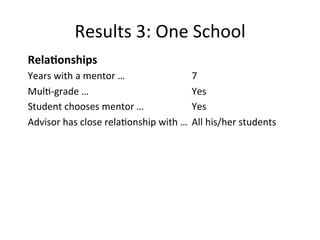
Rela,onships	
  
Years	
  with	
  a	
  mentor	
  …                   	
  7	
  
Mul4-­‐grade	
  …                                   	
  Yes	
  
Student	
  chooses	
  mentor	
  …                   	
  Yes	
  
Advisor	
  has	
  close	
  rela4onship	
  with	
  … 	
  All	
  his/her	
  students	
  
QUESTIONS	
  OR	
  COMMENTS?	
  

AECT: New Paradigm Schools

  • 1.
    New  Paradigm  Schools:     A  Na4onal  Survey     October,  2012   AECT  
  • 2.
    Introduc4on   •  Background:     –  Need  for  an  educa4onal  system  for  the  Informa4on   age   –  Focus  on  learning  rather  than  sor4ng   •  Purpose:     –  Iden4fy  learner-­‐centered  schools   –  Describe  their  instruc4onal  prac4ces,  system   structures,  and  uses  of  technology     •  Progress:     –  Data  collec4on  (un4l  November,  2012)  
  • 3.
    Conceptual  Framework   •  Personalized  learning  plan   •  Competency-­‐based  student  progress   •  Criterion-­‐referenced  assessment   •  Problem/Project-­‐based  learning   •  Mul4-­‐year  mentoring/  Mul4-­‐grade  classroom  
  • 4.
    Methods   Target  popula,on   Sources:     •  K-­‐12  learner-­‐centered   •  DoE  websites   schools  in  the  USA   •  The  Edutopia  website       •  Na4onal  school  models   •  The  list  collected  from   experts  and  literature  
  • 5.
    Purposive  Sample   • Sampling  procedure   1.  Collect  informa4on     2.  Check  if  met  criteria,  rate  by  the  number  of  criteria   3.  Selected  schools  that  met  3+  criteria     •  Total  number  of  schools  in  the  sample:  310     •  Response  rate:  40  schools  (13%)   –  184  responses  from  administrators  &  teachers    
  • 6.
    Instruments  Development   • Literature  review   •  5  features  (criteria)   •  Expert  reviews   •  2  experts     •  Pilot  tests   •  4  former  k-­‐12  teachers  
  • 7.
    Survey  Instrument   1.  For  principals:   •  About  the  school  (5)   2.  For  teachers:   •  Base  responses  on  year  of  2011-­‐2012   •  Demographic  info  (3)     •  Personalized  learning  (2)   •  Student  progress  (1)   •  Assessment  (2)     •  PBL  (7)   •  Mul4-­‐year  mentoring;  mul4-­‐grade  classroom  (4)   •  Technology  (5)  
  • 8.
  • 9.
    Results  1:  Learner-­‐Centered  Schools   From    ini,al  sample   From  survey  responses   Met  3+  criteria   Among  40  schools,   •  11  Na4onal  School  Model   •  3  Na4onal  School  Model   •  17  School  District   •  4  School  District   •  22  Individual  Schools   •  1  Individual  School   Breakdown  of  schools  with  3+  criteria   #  of  schools  that  met  all  5  criteria   •  5  Criteria:  43  schools  (13%)   •  14  schools  out  of  40  (35%)   •  4  Criteria:  100  schools  (31%)   •  3  Criteria:  183  schools  (56%)   Criteria:     1.  Personalized  learning  plan   2.  Competency-­‐based  student  progress   3.  Criterion-­‐referenced  assessment   4.  Problem/Project-­‐based  learning   5.  Mul4-­‐year  mentoring/grouping  
  • 10.
    Results  1:  Learner-­‐Centered  Schools   Type   Title   School   Na4onal   Edvision   1.  Avalon  School,  MN  (Gr  6-­‐12,  N=143)   School  Model   2.  Edvision  Off  Campus,  MN  (Gr  9-­‐12,  N=28)     3.  Minnesota  New  Country  School,  MN  (Gr  9-­‐12,  N=112)   4.  Explore  Knowledge  Academy,  NV  (K-­‐12,  N=  521)   5.  Phoenix  Rising,  WA  (Pre  K  –  6,  N=50)   Carpe  Diem   6.          Carpe  Diem  Collegiate  High  School,  AZ  (Gr  6-­‐12,  N=234)   Big  Picture  Learning  School   7.  Durango  Big  Picture  High  School,  CO  (Gr  9-­‐12,  N=72)     8.  Tulsa  Met  High  School,  OK  (Gr  9-­‐12,  N=475)   School   Chugach  school  district   9.          Chenega  Bay  Community  School,  AK  (Pre  K-­‐12,  N=24)   District   Grand  Rapids  Public  Schools   10.      City  High  Middle  School,  MI  (Gr  7-­‐12,  N=700)   Kuspuk  School  District   11.      Gusty  Michael  School,  AK  (Pre  K-­‐12,  N=12)   12.      Jack  Egnaty  Sr.High  School,  AK  (Pre  K-­‐12,  N=12)   RSU  57  Massebesic   13.      Massabesic  High  School,  ME  (Gr  9-­‐12,  N=1,194)   Individual   -­‐   14.      Forest  Lake  Elementary  School,  FL  (Pre  K-­‐5,  N=681)   School    
  • 11.
    Results  2:  Personalized  Learning   •  How  olen  did  you  consider  the  following  when  preparing  a  personalized   learning  plan  for  most  students?   •  5  point  Likert  scale,  1:  Never,  5:  Always     4.5   4   3.89   3.79   3.78   3.78   3.5   3.04   3   2.5   2   1.5   1   0.5   0   Characteris4cs   Interests   Mastery   Academic   Career  goals   standards  
  • 12.
    Results  2:  Student  Progress   •  Students  moved  on  to  a  new  or  higher  level  of  a  topic  when…     60%   53%   50%   40%   30%   19%   20%   16%   9%   10%   3%   0%   Individually  as  soon   All  together  when  a   By  track  when  a   All  together  when   Each  project  team   as  each  student   specified  amount  of   group  of  students   the  en4re  class  of   when  the  team  of   mastered  the   4me  had  passed.   mastered  the   students  mastered   students  mastered   current  topic.   current  topic.   the  current  topic.   the  current  topic.  
  • 13.
    Results  2:  Assessment   Major  prac,ce  of  assessment   Student  academic  records   Norm-­‐ Mastery  of   referenced   Criterion-­‐ individual   assessment   referenced   Tradi4onal     grades   skills   47%   assessment   43%   57%   53%  
  • 14.
    Results  2:  PBL   PBL   Project  type   Rarely   Never   En4re  class   4%   6%   together   16%   Always   Large-­‐ 31%   group       6%   Some4mes   Individual   29%   projects   54%   Small-­‐ group   24%   Olen   30%  
  • 15.
    Results  2:  Mul4-­‐year  mentoring/ classrooms   Mul,-­‐year  mentoring   Mul,-­‐grade  classroom   More  than   4  years   7%   4  years   No   12%   37%   3  years   1  year   13%   49%   Yes   63%   2  years   19%  
  • 16.
    Results  2:  Tech  (Record  Keeping)   •  You used computer technology for keeping record of students’… 100%   2   17   90%   21   24   29   80%   70%   60%   51   57   50%   52   40%   83   30%   20%   34   32   10%   25   0%   Mastery   Interests   Characteris4cs   Career  goals   Yes.   No,  but  I  wish  I  had  it.   No,  and  I  don't  want  it.  
  • 17.
    Results  2:  Tech  (Planning)   •  You used computer technology for planning each student learning by deciding on... 100%   5   9   8   13   12   15   90%   18   28   80%   26   29   26   29   70%   43   60%   37   50%   40%   84   72   69   67   30%   65   50   20%   40   10%   0%   Resources   Learning  goals   Uses  of  CBI   Project   Timelines   Personalized   Teammates   plan   Yes.   No,  but  I  wish  I  had  it.   No,  and  I  don't  want  it.  
  • 18.
    Results  2:  Tech  (Instruc4on)   •  Your students used computer technology during learning in the following ways… 100%   2   1   3   7   8   8   10   90%   16   22   19   19   80%   70%   48   60%   50%   99   40%   92   84   81   81   30%   50   20%   10%   0%   Exploring  or   Crea4ng   Sharing   Using  CBI   Receiving   Receiving   finding  resources   products  for   resources  with   informa4on   feedback   their  projects   other  students   about  projects   Yes.   No,  but  I  wish  I  had  it.   No,  and  I  don't  want  it.  
  • 19.
    Results  2:  Tech  (Assessment)   •  You used computer technology for student assessment in the following ways... 100%   8   11   14   14   17   17   90%   23   80%   40   70%   42   43   48   60%   48   57   53   50%   40%   30%   59   55   50   20%   44   41   31   31   10%   0%   Providing   Tes4ng   Cer4fying   Receiving   Integra4ng   Tes4ng  on   Adjus4ng   students  with   different   arainments   sta4s4cs   tests  as   demand   levels  of   feedback   content   (mastery)   about  test   prac4ce  within   difficulty   results   the  instruc4on   automa4cally   Yes.   No,  but  I  wish  I  had  it.   No,  and  I  don't  want  it.  
  • 20.
  • 21.
    Results  3:  One  School   The  Minnesota  New  Country  School   •  A  public  charter  school  in  Henderson,  MN   •  Founded  in  1994   •  110  students  in  grades  6-­‐12   •  10  teachers  (“advisors”)  *   •  No  principal  –  run  by  a  coopera4ve  of  teachers  *   •  17,000  sq  l  room  called  the  Atrium  *  
  • 22.
    Results  3:  One  School   AVainment-­‐Based  System   Student  progress:   •  Move  on  individually  as  soon  as  mastered   Student  records:   •  Record  of  standards/skills  mastered  *   Student  assessment   •  Criterion-­‐referenced  
  • 23.
    Results  3:  One  School   Technology  Systems  Used   Project  Foundry   •  Project  design  and  management   •  Student  goals,  interests,  projects,  arainments   •  Internet,  resources,  instruc4on  *   ALEKS  Math   •  No  PBL   •  Tutorials   •  Tes4ng  &  record  keeping  *  
  • 24.
    Results  3:  One  School   Project-­‐Based  Learning   PBL  used  …  Always  (except  for  math  &  reading)   All  projects  were  individual  (no  teams)  *   Projects  typically  last  2-­‐3  weeks   Projects  are  …   •  Open-­‐ended   •  Mul4disciplinary   •  Real-­‐world    (Example:  company)  
  • 25.
    Results  3:  One  School   Self-­‐Direc,on:    How  oYen  did  students  …   Choose  their  own  project  …  Olen   Set  their  own  goals  …  Olen   Decide  their  own  roles  …  Olen   Decide  on  their  process  …  Olen   Present  final  product  in  class  …  Olen   Share  product  with  community  …  Olen   Self-­‐monitor  their  progress  …  Olen   Reflect  on  their  learning  …  Always  
  • 26.
    Results  3:  One  School   Instruc,onal  Support  During  Projects   Frequency  of  instruc4onal  support   •  From  advisor  lecture  …  Seldom   •  From  advisor  coaching  …  Always   •  From  computer  …  Olen   •  From  peers  …  Some4mes  *   •  From  outsiders  …  Olen  
  • 27.
    Results  3:  One  School   Assessment   Students  were  assessed  on  …   •  Final  product   •  Individual  academic  performance   •  Individual  non-­‐academic  performance   •  Outside  experts   •  No  peer  evalua4ons   •  Most  projects  are  assessed  by  a  panel  
  • 28.
    Results  3:  One  School   Rela,onships   Years  with  a  mentor  …  7   Mul4-­‐grade  …  Yes   Student  chooses  mentor  …  Yes   Advisor  has  close  rela4onship  with  …  All  his/her  students  
  • 29.