Download free for 30 days
Sign in
Upload
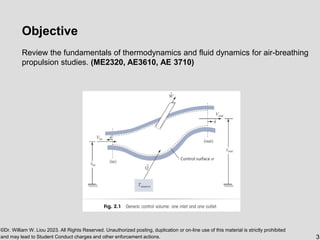
Language (EN)
Support
Business
Mobile
Social Media
Marketing
Technology
Art & Photos
Career
Design
Education
Presentations & Public Speaking
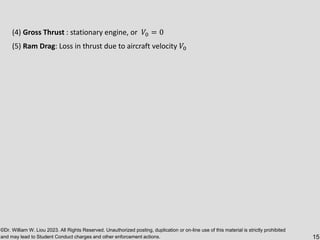
Government & Nonprofit
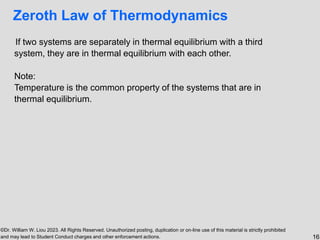
Healthcare
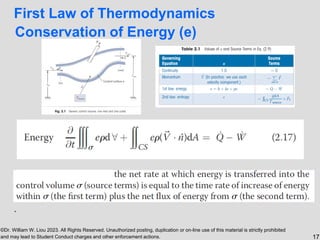
Internet
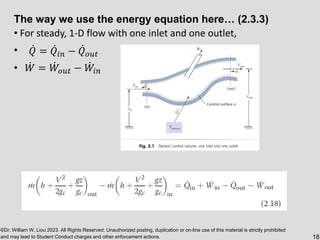
Law
Leadership & Management
Automotive
Engineering
Software
Recruiting & HR
Retail
Sales
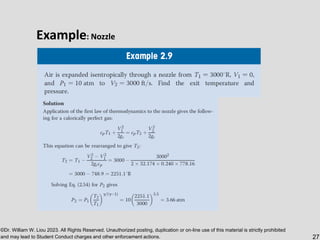
Services
Science
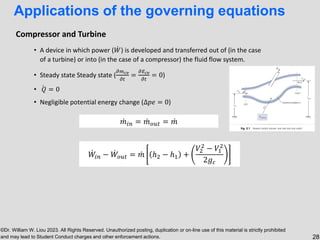
Small Business & Entrepreneurship
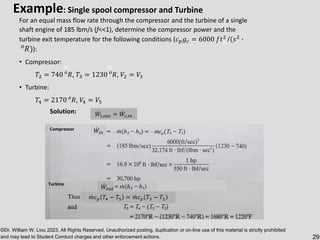
Food
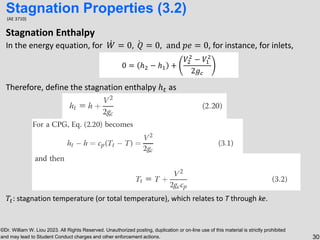
Environment
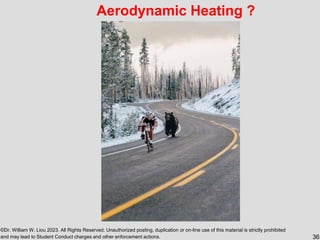
Economy & Finance
Data & Analytics
Investor Relations
Sports
Spiritual
News & Politics
Travel
Self Improvement
Real Estate
Entertainment & Humor
Health & Medicine
Devices & Hardware
Lifestyle
Change Language
Language
English
Español
Português
Français
Deutsche
Cancel
Save
EN
Uploaded by
OliverMartinez68
28 views
AE4660_Module_2_Review_of_Fundamentals-Lecture-2023.pdf
Propulsion, aerospace engineer
Engineering
◦
Read more
0
Save
Share
Embed
Embed presentation
1
/ 36
2
/ 36
3
/ 36
4
/ 36
5
/ 36
6
/ 36
7
/ 36
8
/ 36
9
/ 36
10
/ 36
11
/ 36
12
/ 36
13
/ 36
14
/ 36
15
/ 36
16
/ 36
17
/ 36
18
/ 36
19
/ 36
20
/ 36
21
/ 36
22
/ 36
23
/ 36
24
/ 36
25
/ 36
26
/ 36
27
/ 36
28
/ 36
29
/ 36
30
/ 36
31
/ 36
32
/ 36
33
/ 36
34
/ 36
35
/ 36
36
/ 36
More Related Content
PDF
Solutions for Exercises in Fox and McDonald's Introduction to Fluid Mechanics...
by
hmanavimm77
PDF
AE4660_Module_5_Component_Performance-2023-Lecture.pdf
by
OliverMartinez68
PPTX
Fluid mechanics
by
Razin Sazzad Molla
PDF
Chapter 5 fluid mechanics
by
abrish shewa
PDF
Aircraft Propulsion - Review of Fundamentals
by
Anurak Atthasit
PDF
2_Basic_Concepts_2026.pdf2_Basic_Concepts_2026.pdf
by
willgaming0117
PDF
GDJP - Unit 3, 4, 5 qb
by
gokulfea
PPTX
Thermofluids lecture 12 of thermal power 2
by
ArjunBedi12
Solutions for Exercises in Fox and McDonald's Introduction to Fluid Mechanics...
by
hmanavimm77
AE4660_Module_5_Component_Performance-2023-Lecture.pdf
by
OliverMartinez68
Fluid mechanics
by
Razin Sazzad Molla
Chapter 5 fluid mechanics
by
abrish shewa
Aircraft Propulsion - Review of Fundamentals
by
Anurak Atthasit
2_Basic_Concepts_2026.pdf2_Basic_Concepts_2026.pdf
by
willgaming0117
GDJP - Unit 3, 4, 5 qb
by
gokulfea
Thermofluids lecture 12 of thermal power 2
by
ArjunBedi12
Similar to AE4660_Module_2_Review_of_Fundamentals-Lecture-2023.pdf
PPT
Chapter 5 Mass and energy analysis of control volumes
by
margiegfernandez
PPTX
Applied Thermodynamic (1).pptx
by
Areej745332
PPTX
Lecture 4 chapter2-Compressible.p..nnptx
by
HAMZABHATTI700005
DOC
Chapter 3 thermodynamics final
by
Aaba Tambe
PDF
Aircraft propulsion non ideal cycle analysis
by
Anurak Atthasit
PPT
Principle of turbomachinery
by
Walid Mohammed
PDF
Chapter 7 (Additional notes) Thermodynamics Review (Power Plant Technology by...
by
muhammadzeeshan67105
PDF
Chapter 5 First Law Analysis for a Control Volume.pdf
by
ayushbaral4k
PPT
first law of thermodynamics and second law
by
naphis ahamad
PDF
Engineering Thermodynamics Notes for Quick Reference
by
AbdulNazar52
PDF
Anderson7e sm
by
Danggirl1
DOCX
(ME- 495 Laboratory Exercise – Number 1 – Brayton Cycle -.docx
by
aryan532920
PDF
Intro comp flow.pdf
by
shaileshpatel65540
PPTX
Themordynamics Unit 2 Mechanical First year
by
TonderaiMayisiri
PPTX
Steady flow energy eq....by Bilal Ashraf
by
Bilal Ashraf
PPTX
B.tech i eme u 1 intoduction
by
Rai University
PDF
Aircraft Propulsion - Ideal Turbojet Performance
by
Anurak Atthasit
PDF
Engine Cycles Analysis
by
INDIAN INSTITUTE OF TECHNOLOGY Delhi
PDF
Aircraft propulsion non ideal turbofan cycle analysis
by
Anurak Atthasit
PDF
Lect1
by
gauravaero
Chapter 5 Mass and energy analysis of control volumes
by
margiegfernandez
Applied Thermodynamic (1).pptx
by
Areej745332
Lecture 4 chapter2-Compressible.p..nnptx
by
HAMZABHATTI700005
Chapter 3 thermodynamics final
by
Aaba Tambe
Aircraft propulsion non ideal cycle analysis
by
Anurak Atthasit
Principle of turbomachinery
by
Walid Mohammed
Chapter 7 (Additional notes) Thermodynamics Review (Power Plant Technology by...
by
muhammadzeeshan67105
Chapter 5 First Law Analysis for a Control Volume.pdf
by
ayushbaral4k
first law of thermodynamics and second law
by
naphis ahamad
Engineering Thermodynamics Notes for Quick Reference
by
AbdulNazar52
Anderson7e sm
by
Danggirl1
(ME- 495 Laboratory Exercise – Number 1 – Brayton Cycle -.docx
by
aryan532920
Intro comp flow.pdf
by
shaileshpatel65540
Themordynamics Unit 2 Mechanical First year
by
TonderaiMayisiri
Steady flow energy eq....by Bilal Ashraf
by
Bilal Ashraf
B.tech i eme u 1 intoduction
by
Rai University
Aircraft Propulsion - Ideal Turbojet Performance
by
Anurak Atthasit
Engine Cycles Analysis
by
INDIAN INSTITUTE OF TECHNOLOGY Delhi
Aircraft propulsion non ideal turbofan cycle analysis
by
Anurak Atthasit
Lect1
by
gauravaero
Recently uploaded
PDF
Applications of AI in Civil Engineering - Dr. Rohan Dasgupta
by
Rohan Dasgupta
PDF
Soil Compressibility (Elastic Settlement).pdf
by
MahmoodKhalid11
PPTX
Presentation-WPS Office.pptx afgouvhyhgfccf
by
EndaleTimerga
PDF
NS unit wise unit wise 1 -5 so prepare,.
by
kumaransudhan1512
PPTX
traffic safety section seven (Traffic Control and Management) of Act
by
azeRakeshSunariMagar
PPTX
Day 3 Module 5_Optical fiber Network (operation and management).pptx
by
SachayaG
PDF
engineering management chapter 5 ppt presentation
by
ericaangelatoledo06
PPTX
How Does LNG Regasification Work | INOXCVA
by
INOXCVA
PDF
Basics of Electronics Task by Vivaan Jo Varghese.pdf
by
Vivaan Jo Varghese
PPTX
ISO 13485.2016 Awareness's Training material
by
PrakashSivan
PDF
Chad Ayach - An Accomplished Mechanical Engineer
by
Chad Ayach
PPTX
uADPF Topology_SFP requirements_locked slides.pptx
by
Md Bellal Hossain
PDF
Industrial Tools Manufacturers In India : Torso Tools
by
torsotools8
PPTX
Designing Work for Humans, Not Machines: Human-Centered Maintenance Excellence
by
MaintWiz Technologies Private Limited
PPTX
A professional presentation on Cosmos Bank Heist
by
ssuser7f0075
PDF
Model QP 2025 scheme Q &A- Module 1 and 2.pdf
by
SURESHA V
PPTX
1.Module 4-Clamping of jigs and fixtures for manufacturing.pptx
by
condieki
PPTX
What Green Hydrogen Is Definition: Hydrogen produced via electrolysis of wate...
by
Thit57
PDF
Chemical Hazards at Workplace – Types, Properties & Exposure Routes, CORE-EHS
by
CORE EHS
PPT
Momentum and collisions in physics or engineering
by
azizrahmanhakimi
Applications of AI in Civil Engineering - Dr. Rohan Dasgupta
by
Rohan Dasgupta
Soil Compressibility (Elastic Settlement).pdf
by
MahmoodKhalid11
Presentation-WPS Office.pptx afgouvhyhgfccf
by
EndaleTimerga
NS unit wise unit wise 1 -5 so prepare,.
by
kumaransudhan1512
traffic safety section seven (Traffic Control and Management) of Act
by
azeRakeshSunariMagar
Day 3 Module 5_Optical fiber Network (operation and management).pptx
by
SachayaG
engineering management chapter 5 ppt presentation
by
ericaangelatoledo06
How Does LNG Regasification Work | INOXCVA
by
INOXCVA
Basics of Electronics Task by Vivaan Jo Varghese.pdf
by
Vivaan Jo Varghese
ISO 13485.2016 Awareness's Training material
by
PrakashSivan
Chad Ayach - An Accomplished Mechanical Engineer
by
Chad Ayach
uADPF Topology_SFP requirements_locked slides.pptx
by
Md Bellal Hossain
Industrial Tools Manufacturers In India : Torso Tools
by
torsotools8
Designing Work for Humans, Not Machines: Human-Centered Maintenance Excellence
by
MaintWiz Technologies Private Limited
A professional presentation on Cosmos Bank Heist
by
ssuser7f0075
Model QP 2025 scheme Q &A- Module 1 and 2.pdf
by
SURESHA V
1.Module 4-Clamping of jigs and fixtures for manufacturing.pptx
by
condieki
What Green Hydrogen Is Definition: Hydrogen produced via electrolysis of wate...
by
Thit57
Chemical Hazards at Workplace – Types, Properties & Exposure Routes, CORE-EHS
by
CORE EHS
Momentum and collisions in physics or engineering
by
azizrahmanhakimi
AE4660_Module_2_Review_of_Fundamentals-Lecture-2023.pdf
1.
©Dr. William W.
Liou 2023. All Rights Reserved. Unauthorized posting, duplication or on-line use of this material is strictly prohibited and may lead to Student Conduct charges and other enforcement actions. AE 4660 Aerospace Propulsion I Fall 2023 Instructor: Dr. William W. Liou 1
2.
©Dr. William W.
Liou 2023. All Rights Reserved. Unauthorized posting, duplication or on-line use of this material is strictly prohibited and may lead to Student Conduct charges and other enforcement actions. Module 2 Review of Fundamentals Chapters 1, 2 and 3 2
3.
©Dr. William W.
Liou 2023. All Rights Reserved. Unauthorized posting, duplication or on-line use of this material is strictly prohibited and may lead to Student Conduct charges and other enforcement actions. 3 Objective Review the fundamentals of thermodynamics and fluid dynamics for air-breathing propulsion studies. (ME2320, AE3610, AE 3710)
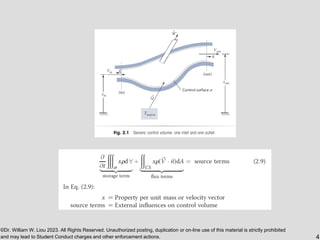
4.
©Dr. William W.
Liou 2023. All Rights Reserved. Unauthorized posting, duplication or on-line use of this material is strictly prohibited and may lead to Student Conduct charges and other enforcement actions. 4
5.
©Dr. William W.
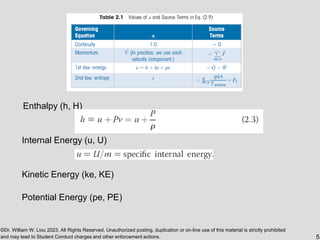
Liou 2023. All Rights Reserved. Unauthorized posting, duplication or on-line use of this material is strictly prohibited and may lead to Student Conduct charges and other enforcement actions. 5 Enthalpy (h, H) Internal Energy (u, U) Kinetic Energy (ke, KE) Potential Energy (pe, PE)
6.
©Dr. William W.
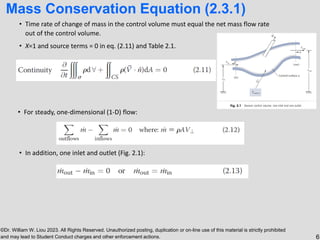
Liou 2023. All Rights Reserved. Unauthorized posting, duplication or on-line use of this material is strictly prohibited and may lead to Student Conduct charges and other enforcement actions. 6 Mass Conservation Equation (2.3.1) • Time rate of change of mass in the control volume must equal the net mass flow rate out of the control volume. • X=1 and source terms = 0 in eq. (2.11) and Table 2.1. • For steady, one-dimensional (1-D) flow: • In addition, one inlet and outlet (Fig. 2.1):
7.
©Dr. William W.
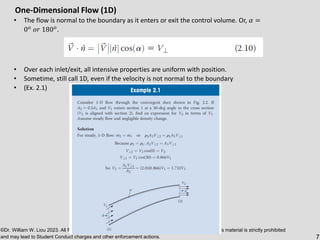
Liou 2023. All Rights Reserved. Unauthorized posting, duplication or on-line use of this material is strictly prohibited and may lead to Student Conduct charges and other enforcement actions. 7 One-Dimensional Flow (1D) • The flow is normal to the boundary as it enters or exit the control volume. Or, 𝛼 = 0𝑜 𝑜𝑟 180𝑜 . • Over each inlet/exit, all intensive properties are uniform with position. • Sometime, still call 1D, even if the velocity is not normal to the boundary • (Ex. 2.1)
8.
©Dr. William W.
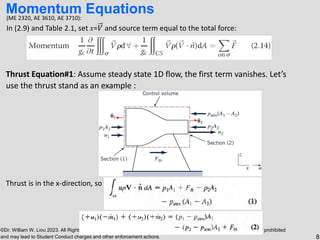
Liou 2023. All Rights Reserved. Unauthorized posting, duplication or on-line use of this material is strictly prohibited and may lead to Student Conduct charges and other enforcement actions. 8 Momentum Equations (ME 2320, AE 3610, AE 3710): In (2.9) and Table 2.1, set x=𝑉 and source term equal to the total force: ෝ 𝐧1 ෝ 𝐧2 Thrust Equation#1: Assume steady state 1D flow, the first term vanishes. Let’s use the thrust stand as an example : Thrust is in the x-direction, so
9.
©Dr. William W.
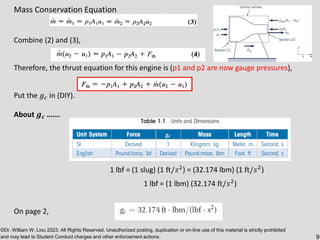
Liou 2023. All Rights Reserved. Unauthorized posting, duplication or on-line use of this material is strictly prohibited and may lead to Student Conduct charges and other enforcement actions. 9 Mass Conservation Equation Combine (2) and (3), Therefore, the thrust equation for this engine is (p1 and p2 are now gauge pressures), Put the 𝑔𝑐 in (DIY). About 𝒈𝒄 ……. 1 lbf = (1 slug) (1 ft/𝑠2) = (32.174 lbm) (1 ft/𝑠2) 1 lbf = (1 lbm) (32.174 ft/𝑠2) On page 2,
10.
©Dr. William W.
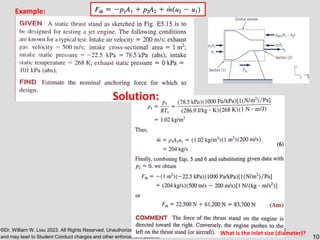
Liou 2023. All Rights Reserved. Unauthorized posting, duplication or on-line use of this material is strictly prohibited and may lead to Student Conduct charges and other enforcement actions. 10 Example: Solution: What is the inlet size (diameter)?
11.
©Dr. William W.
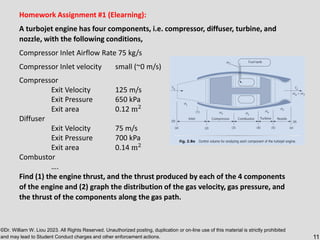
Liou 2023. All Rights Reserved. Unauthorized posting, duplication or on-line use of this material is strictly prohibited and may lead to Student Conduct charges and other enforcement actions. 11 Homework Assignment #1 (Elearning): A turbojet engine has four components, i.e. compressor, diffuser, turbine, and nozzle, with the following conditions, Compressor Inlet Airflow Rate 75 kg/s Compressor Inlet velocity small (~0 m/s) Compressor Exit Velocity 125 m/s Exit Pressure 650 kPa Exit area 0.12 m2 Diffuser Exit Velocity 75 m/s Exit Pressure 700 kPa Exit area 0.14 m2 Combustor …. Find (1) the engine thrust, and the thrust produced by each of the 4 components of the engine and (2) graph the distribution of the gas velocity, gas pressure, and the thrust of the components along the gas path.
12.
©Dr. William W.
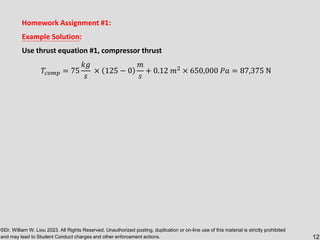
Liou 2023. All Rights Reserved. Unauthorized posting, duplication or on-line use of this material is strictly prohibited and may lead to Student Conduct charges and other enforcement actions. 12 Homework Assignment #1: Example Solution: Use thrust equation #1, compressor thrust 𝑇𝑐𝑜𝑚𝑝 = 75 𝑘𝑔 𝑠 × 125 − 0 𝑚 𝑠 + 0.12 𝑚2 × 650,000 𝑃𝑎 = 87,375 N
13.
©Dr. William W.
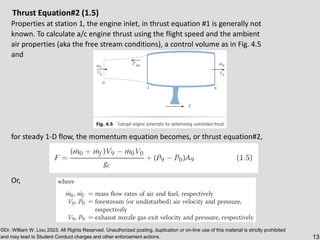
Liou 2023. All Rights Reserved. Unauthorized posting, duplication or on-line use of this material is strictly prohibited and may lead to Student Conduct charges and other enforcement actions. 13 Thrust Equation#2 (1.5) Properties at station 1, the engine inlet, in thrust equation #1 is generally not known. To calculate a/c engine thrust using the flight speed and the ambient air properties (aka the free stream conditions), a control volume as in Fig. 4.5 and for steady 1-D flow, the momentum equation becomes, or thrust equation#2, Or,
14.
©Dr. William W.
Liou 2023. All Rights Reserved. Unauthorized posting, duplication or on-line use of this material is strictly prohibited and may lead to Student Conduct charges and other enforcement actions. 14 Notes: (1) The pressure force is not zero only when the exhaust gas is not fully expanded, or the exhaust jet flow speed is supersonic. (2) The air was assumed inviscid here. The actual, or installed thrust T, can be much less. (3) Using fuel/air ratio f, It becomes ሶ 𝑚0[ 1 + 𝑓 𝑉9 − 𝑉0]
15.
©Dr. William W.
Liou 2023. All Rights Reserved. Unauthorized posting, duplication or on-line use of this material is strictly prohibited and may lead to Student Conduct charges and other enforcement actions. 15 (4) Gross Thrust : stationary engine, or 𝑉0 = 0 (5) Ram Drag: Loss in thrust due to aircraft velocity 𝑉0
16.
©Dr. William W.
Liou 2023. All Rights Reserved. Unauthorized posting, duplication or on-line use of this material is strictly prohibited and may lead to Student Conduct charges and other enforcement actions. 16 Zeroth Law of Thermodynamics If two systems are separately in thermal equilibrium with a third system, they are in thermal equilibrium with each other. Note: Temperature is the common property of the systems that are in thermal equilibrium.
17.
©Dr. William W.
Liou 2023. All Rights Reserved. Unauthorized posting, duplication or on-line use of this material is strictly prohibited and may lead to Student Conduct charges and other enforcement actions. 17 First Law of Thermodynamics Conservation of Energy (e) .
18.
©Dr. William W.
Liou 2023. All Rights Reserved. Unauthorized posting, duplication or on-line use of this material is strictly prohibited and may lead to Student Conduct charges and other enforcement actions. 18 The way we use the energy equation here… (2.3.3) • For steady, 1-D flow with one inlet and one outlet, • • ሶ 𝑊 = ሶ 𝑊𝑜𝑢𝑡 − ሶ 𝑊𝑖𝑛 ሶ 𝑄 = ሶ 𝑄𝑖𝑛 − ሶ 𝑄𝑜𝑢𝑡
19.
©Dr. William W.
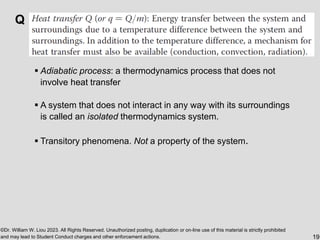
Liou 2023. All Rights Reserved. Unauthorized posting, duplication or on-line use of this material is strictly prohibited and may lead to Student Conduct charges and other enforcement actions. 19 Q ▪ Adiabatic process: a thermodynamics process that does not involve heat transfer ▪ A system that does not interact in any way with its surroundings is called an isolated thermodynamics system. ▪ Transitory phenomena. Not a property of the system.
20.
©Dr. William W.
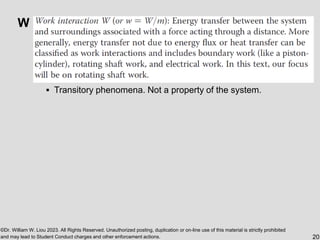
Liou 2023. All Rights Reserved. Unauthorized posting, duplication or on-line use of this material is strictly prohibited and may lead to Student Conduct charges and other enforcement actions. 20 ▪ Transitory phenomena. Not a property of the system. W
21.
©Dr. William W.
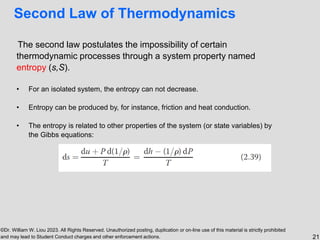
Liou 2023. All Rights Reserved. Unauthorized posting, duplication or on-line use of this material is strictly prohibited and may lead to Student Conduct charges and other enforcement actions. 21 Second Law of Thermodynamics The second law postulates the impossibility of certain thermodynamic processes through a system property named entropy (s,S). • For an isolated system, the entropy can not decrease. • Entropy can be produced by, for instance, friction and heat conduction. • The entropy is related to other properties of the system (or state variables) by the Gibbs equations:
22.
©Dr. William W.
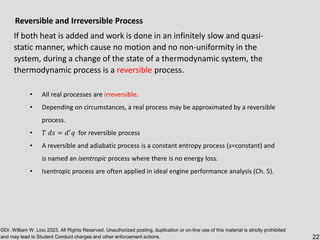
Liou 2023. All Rights Reserved. Unauthorized posting, duplication or on-line use of this material is strictly prohibited and may lead to Student Conduct charges and other enforcement actions. 22 Reversible and Irreversible Process If both heat is added and work is done in an infinitely slow and quasi- static manner, which cause no motion and no non-uniformity in the system, during a change of the state of a thermodynamic system, the thermodynamic process is a reversible process. • All real processes are irreversible. • Depending on circumstances, a real process may be approximated by a reversible process. • 𝑇 𝑑𝑠 = 𝑑′ 𝑞 for reversible process • A reversible and adiabatic process is a constant entropy process (s=constant) and is named an isentropic process where there is no energy loss. • Isentropic process are often applied in ideal engine performance analysis (Ch. 5).
23.
©Dr. William W.
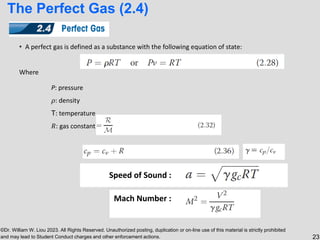
Liou 2023. All Rights Reserved. Unauthorized posting, duplication or on-line use of this material is strictly prohibited and may lead to Student Conduct charges and other enforcement actions. 23 The Perfect Gas (2.4) • A perfect gas is defined as a substance with the following equation of state: Where P: pressure 𝜌: density T: temperature 𝑅: gas constant Speed of Sound : Mach Number :
24.
©Dr. William W.
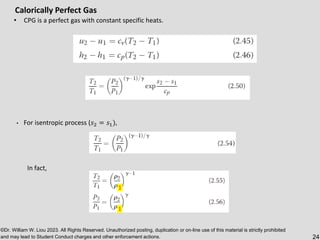
Liou 2023. All Rights Reserved. Unauthorized posting, duplication or on-line use of this material is strictly prohibited and may lead to Student Conduct charges and other enforcement actions. 24 Calorically Perfect Gas • CPG is a perfect gas with constant specific heats. • For isentropic process (𝑠2 = 𝑠1), In fact, 1 1
25.
©Dr. William W.
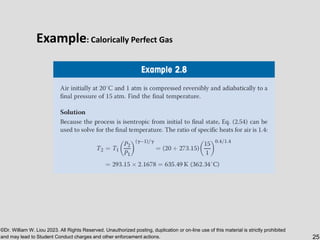
Liou 2023. All Rights Reserved. Unauthorized posting, duplication or on-line use of this material is strictly prohibited and may lead to Student Conduct charges and other enforcement actions. 25 Example: Calorically Perfect Gas
26.
©Dr. William W.
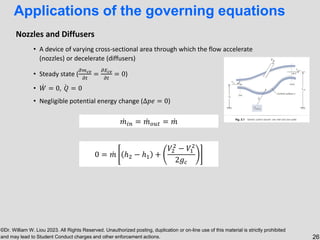
Liou 2023. All Rights Reserved. Unauthorized posting, duplication or on-line use of this material is strictly prohibited and may lead to Student Conduct charges and other enforcement actions. 26 Nozzles and Diffusers • A device of varying cross-sectional area through which the flow accelerate (nozzles) or decelerate (diffusers) • Steady state ( 𝜕𝑚𝑐𝑣 𝜕𝑡 = 𝜕𝐸𝑐𝑣 𝜕𝑡 = 0) • ሶ 𝑊 = 0, ሶ 𝑄 = 0 • Negligible potential energy change (∆𝑝𝑒 = 0) 0 = ሶ 𝑚 ℎ2 − ℎ1 + 𝑉2 2 − 𝑉1 2 2𝑔𝑐 ሶ 𝑚𝑖𝑛 = ሶ 𝑚𝑜𝑢𝑡 = ሶ 𝑚 Applications of the governing equations
27.
©Dr. William W.
Liou 2023. All Rights Reserved. Unauthorized posting, duplication or on-line use of this material is strictly prohibited and may lead to Student Conduct charges and other enforcement actions. 27 Example: Nozzle
28.
©Dr. William W.
Liou 2023. All Rights Reserved. Unauthorized posting, duplication or on-line use of this material is strictly prohibited and may lead to Student Conduct charges and other enforcement actions. 28 • A device in which power ( ሶ 𝑊) is developed and transferred out of (in the case of a turbine) or into (in the case of a compressor) the fluid flow system. • Steady state Steady state ( 𝜕𝑚𝑐𝑣 𝜕𝑡 = 𝜕𝐸𝑐𝑣 𝜕𝑡 = 0) • ሶ 𝑄 = 0 • Negligible potential energy change (∆𝑝𝑒 = 0) ሶ 𝑊𝑖𝑛 − ሶ 𝑊𝑜𝑢𝑡 = ሶ 𝑚 ℎ2 − ℎ1 + 𝑉2 2 − 𝑉1 2 2𝑔𝑐 ሶ 𝑚𝑖𝑛 = ሶ 𝑚𝑜𝑢𝑡 = ሶ 𝑚 Compressor and Turbine Applications of the governing equations
29.
©Dr. William W.
Liou 2023. All Rights Reserved. Unauthorized posting, duplication or on-line use of this material is strictly prohibited and may lead to Student Conduct charges and other enforcement actions. 29 Example: Single spool compressor and Turbine For an equal mass flow rate through the compressor and the turbine of a single shaft engine of 185 lbm/s (f<<1), determine the compressor power and the turbine exit temperature for the following conditions (𝑐𝑝𝑔𝑐 = 6000 𝑓𝑡2 /(𝑠2 ∙ 𝑜 𝑅)): • Compressor: 𝑇2 = 740 𝑜 𝑅, 𝑇3 = 1230 𝑜 𝑅, 𝑉2 = 𝑉3 • Turbine: 𝑇4 = 2170 𝑜 𝑅, 𝑉4 = 𝑉5 ሶ 𝑊𝑡,𝑜𝑢𝑡 = ሶ 𝑊𝑐,𝑖𝑛 ሶ 𝑊𝑖𝑛 Turbine ሶ 𝑊𝑜𝑢𝑡 ሶ 𝑚𝑐𝑝 𝑇4 − 𝑇5 = ሶ 𝑚𝑐𝑝 𝑇3 − 𝑇2 Solution: Compressor
30.
©Dr. William W.
Liou 2023. All Rights Reserved. Unauthorized posting, duplication or on-line use of this material is strictly prohibited and may lead to Student Conduct charges and other enforcement actions. 30 (AE 3710) Stagnation Enthalpy In the energy equation, for ሶ 𝑊 = 0, ሶ 𝑄 = 0, and 𝑝𝑒 = 0, for instance, for inlets, Therefore, define the stagnation enthalpy ℎ𝑡 as 𝑇𝑡: stagnation temperature (or total temperature), which relates to T through ke. Stagnation Properties (3.2) 0 = ℎ2 − ℎ1 + 𝑉2 2 − 𝑉1 2 2𝑔𝑐
31.
©Dr. William W.
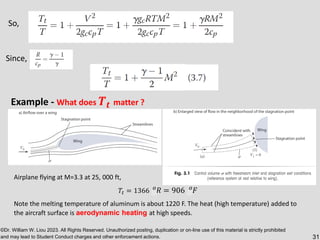
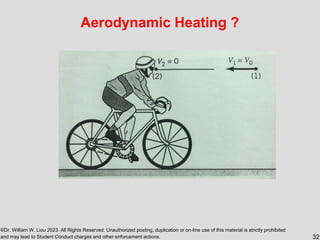
Liou 2023. All Rights Reserved. Unauthorized posting, duplication or on-line use of this material is strictly prohibited and may lead to Student Conduct charges and other enforcement actions. 31 So, Since, Example - What does 𝑻𝒕 matter ? Airplane flying at M=3.3 at 25, 000 ft, 𝑇𝑡 = 1366 𝑜 𝑅 = 906 𝑜 𝐹 Note the melting temperature of aluminum is about 1220 F. The heat (high temperature) added to the aircraft surface is aerodynamic heating at high speeds.
32.
©Dr. William W.
Liou 2023. All Rights Reserved. Unauthorized posting, duplication or on-line use of this material is strictly prohibited and may lead to Student Conduct charges and other enforcement actions. 32 Aerodynamic Heating ?
33.
©Dr. William W.
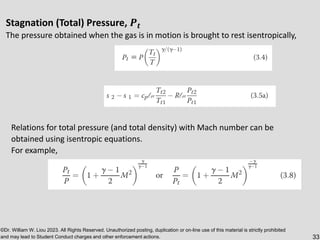
Liou 2023. All Rights Reserved. Unauthorized posting, duplication or on-line use of this material is strictly prohibited and may lead to Student Conduct charges and other enforcement actions. 33 Stagnation (Total) Pressure, 𝑷𝒕 The pressure obtained when the gas is in motion is brought to rest isentropically, Relations for total pressure (and total density) with Mach number can be obtained using isentropic equations. For example,
34.
©Dr. William W.
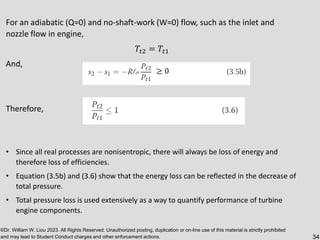
Liou 2023. All Rights Reserved. Unauthorized posting, duplication or on-line use of this material is strictly prohibited and may lead to Student Conduct charges and other enforcement actions. 34 For an adiabatic (Q=0) and no-shaft-work (W=0) flow, such as the inlet and nozzle flow in engine, 𝑇𝑡2 = 𝑇𝑡1 And, Therefore, • Since all real processes are nonisentropic, there will always be loss of energy and therefore loss of efficiencies. • Equation (3.5b) and (3.6) show that the energy loss can be reflected in the decrease of total pressure. • Total pressure loss is used extensively as a way to quantify performance of turbine engine components. ≥ 0
35.
©Dr. William W.
Liou 2023. All Rights Reserved. Unauthorized posting, duplication or on-line use of this material is strictly prohibited and may lead to Student Conduct charges and other enforcement actions. 35 END
36.
©Dr. William W.
Liou 2023. All Rights Reserved. Unauthorized posting, duplication or on-line use of this material is strictly prohibited and may lead to Student Conduct charges and other enforcement actions. 36 Aerodynamic Heating ?

![©Dr. William W. Liou 2023. All Rights Reserved. Unauthorized posting, duplication or on-line use of this material is strictly prohibited
and may lead to Student Conduct charges and other enforcement actions. 14
Notes:
(1) The pressure force is not zero only when the exhaust gas is not fully
expanded, or the exhaust jet flow speed is supersonic.
(2) The air was assumed inviscid here. The actual, or installed thrust T, can be
much less.
(3) Using fuel/air ratio f,
It becomes
ሶ
𝑚0[ 1 + 𝑓 𝑉9 − 𝑉0]](https://image.slidesharecdn.com/ae4660module2reviewoffundamentals-lecture-2023-250316003130-ba1a858a/85/AE4660_Module_2_Review_of_Fundamentals-Lecture-2023-pdf-14-320.jpg)