Coaching Kids, Teenagers & Young Adults
• It’s for the kids! Kids are the most important
• Kids/Children’s overall health and safety are top priorities
• Promotes maintenance of physical activity for lifelong leisure & fitness skills
Philosophy
1.	 Teach skills and skill development
2.	 Develop self esteem, feel worthy
3.	 Have fun
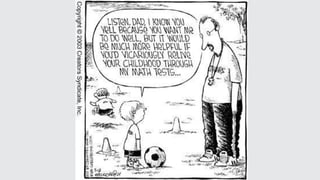
4.	 Foster healthy parent-child and adult-child relationships
5.	Socialization
6.	 Put forth an “effort to win”
7.	 Learn life long fitness and sports leisure skills
Outcomes
1.	Learn skills – get better, “more-skilled”
2.	Feel good (develop positive self-concept)
3.	Have fun
This is a joint/symbiotic effort of
coach + child + parent
Practice and competition
environment is safe
All surroundings are “accident proofed”; progressions use the right
equipment (example - size and weight of ball, etc.); the sequencing of
skill acquisition does not include unsafe practices (example - heading
a soccer ball at very young age); there are established routines for
examining the environment for injury prevention.
Kids feel good about themselves – self esteem, self efficacy; good
opinions and/or complimentary comments are expressed when
describing/seeing overall program; program is accepted by others
(peers, families, coaches, etc.); skill progressions and practices are
conducted in an environment prepared/arranged for success.
Physically
Emotionally
Proper placement of child in
a program or league
1.	Recreation vs. Elite Club
2.	Playing up in age
3.	Girls playing with boys;
		 boys playing with girls
4.	Playing time
Specialization
1.	At what age
2.	At what level
Possible solution – playing
multiple or all positions
until age 13 or 14
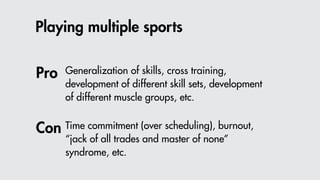
Playing multiple sports
Generalization of skills, cross training,
development of different skill sets, development
of different muscle groups, etc.
Time commitment (over scheduling), burnout,
“jack of all trades and master of none”
syndrome, etc.
Pro
Con
Promotion of Fitness and
Life Long Leisure Skills
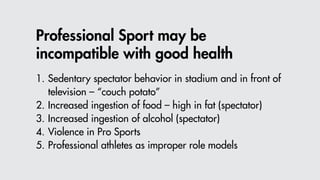
Professional Sport may be
incompatible with good health
1.	Sedentary spectator behavior in stadium and in front of 					
		 television – “couch potato”
2.	Increased ingestion of food – high in fat (spectator)
3.	Increased ingestion of alcohol (spectator)
4.	Violence in Pro Sports
5.	Professional athletes as improper role models
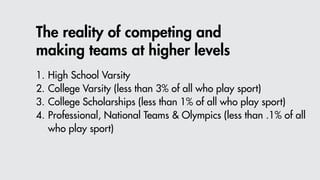
The reality of competing and
making teams at higher levels
1.	High School Varsity
2.	College Varsity (less than 3% of all who play sport)
3.	College Scholarships (less than 1% of all who play sport)
4.	Professional, National Teams & Olympics (less than .1% of all 	
		 who play sport)
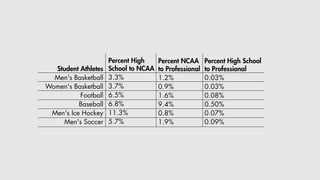
Percent High
School to NCAA
3.3%
3.7%
6.5%
6.8%
11.3%
5.7%
Percent NCAA
to Professional
1.2%
0.9%
1.6%
9.4%
0.8%
1.9%
Percent High School
to Professional
0.03%
0.03%
0.08%
0.50%
0.07%
0.09%
Student Athletes
Men's Basketball
Women's Basketball
Football
Baseball
Men's Ice Hockey
Men's Soccer
Women’s College Volleyball in the US
NCAA Divisions: I (311), II (260), III (406) Total NCAA: 977
NAIA (fifty states & BC): 257 schools
NCCAA: 60+
Community College: 380+
Grand Total: 1674+
Obtain a copy of the NCAA
publication – “Guide for the College-
Bound Student-Athlete”
– download a PDF file on www.ncaa.org
Out of the millions of kids that play
age group/high school sports only
3% will participate on a college
varsity sports team, only 1% will
receive any type of college athletic
scholarship
Head count versus equivalency
scholarship
Sport at the highest levels is a
“meritocracy”
The coach’s “recruiting game”
A school may be in contact with as many as 250-350 players
40-50 seriously (notes & letters, one call per week, etc.)
6 to 12 all out
top 3-4 they will ask for early commitments
36 to 48 scholarships for all of the PAC-12 for each year
You must be proactive
Do your research
Visit college campuses
Write preliminary letters
Prepare and send skills video
Follow-up letters, telephone calls, and e-mails
Find out where you are in the coach’s pecking order (which tier,
which # scholarship)
For Division I and II schools get an exact offer verbally – how much
$ and what will it cover – tuition, room & board, fees, books, etc.
Write or call schools
The better you do academically the more
choices you will have!
During your freshman and sophomore years – request a
school bulletin and information about the sport that you
are interested in.
Determine the academic requirements of the schools you are
interested in and the academic requirements for the NCAA (GPA
& SAT or ACT Qualifier Index and 13 core course requirements).
If you intend to participate in NCAA Division I
or II athletics as a freshman, you must register
and be certified by the NCAA Initial-Eligibility
Clearinghouse. Your school counselors can obtain
registration materials, at no cost.
Register
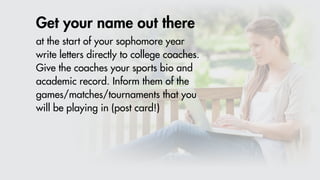
at the start of your sophomore year
write letters directly to college coaches.
Give the coaches your sports bio and
academic record. Inform them of the
games/matches/tournaments that you
will be playing in (post card!)
Get your name out there
Meeting with coach/coaching staff –
let your child lead the discussion…
What do you know about the head coach?
The coaching staff?
Ask the schools if you may
contact former and current
players and/or parents.
Would you attend this school even if
you had a career ending injury and
could not play?
Your top five choices – you can add and
drop as you go along
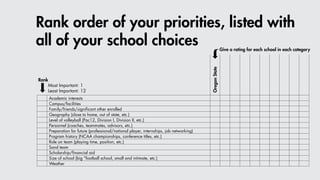
Rule of 5
Academic interests
Campus/facilities
Family/friends/significant other enrolled
Geography (close to home, out of state, etc.)
Level of volleyball (Pac12, Division I, Division II, etc.)
Personnel (coaches, teammates, advisors, etc.)
Preparation for future (professional/national player, internships, job networking)
Program history (NCAA championships, conference titles, etc.)
Role on team (playing time, position, etc.)
Sand team
Scholarship/financial aid
Size of school (big "football school, small and intimate, etc.)
Weather
Rank
Most Important: 1
Least Important: 12
Give a rating for each school in each category
OregonState


Rank order of your priorities, listed with
all of your school choices
Division III Institutions
“Life Long Leisure Skills”
Intramurals and Club sports.
Questions?
Please visit the website bellow to review this presentation as well as other coaching
and athletic resources I have prepared for you.
Continuing Education
Drills, tactics, techniques, philosophies, fitness tips, nutritional advice, mental training – it’s all
here at TheArtofCoachingVolleyball.com - all taken from the valuable input of numerous
coaches across the country who have mentored players at every level and every age.
www.theartofcoachingvolleyball.com/terry-calgary-jan2017

Calgary parents/players

  • 1.
    Coaching Kids, Teenagers& Young Adults • It’s for the kids! Kids are the most important • Kids/Children’s overall health and safety are top priorities • Promotes maintenance of physical activity for lifelong leisure & fitness skills
  • 2.
    Philosophy 1. Teach skillsand skill development 2. Develop self esteem, feel worthy 3. Have fun 4. Foster healthy parent-child and adult-child relationships 5. Socialization 6. Put forth an “effort to win” 7. Learn life long fitness and sports leisure skills
  • 3.
    Outcomes 1. Learn skills –get better, “more-skilled” 2. Feel good (develop positive self-concept) 3. Have fun
  • 4.
    This is ajoint/symbiotic effort of coach + child + parent
  • 6.
    Practice and competition environmentis safe All surroundings are “accident proofed”; progressions use the right equipment (example - size and weight of ball, etc.); the sequencing of skill acquisition does not include unsafe practices (example - heading a soccer ball at very young age); there are established routines for examining the environment for injury prevention. Kids feel good about themselves – self esteem, self efficacy; good opinions and/or complimentary comments are expressed when describing/seeing overall program; program is accepted by others (peers, families, coaches, etc.); skill progressions and practices are conducted in an environment prepared/arranged for success. Physically Emotionally
  • 7.
    Proper placement ofchild in a program or league 1. Recreation vs. Elite Club 2. Playing up in age 3. Girls playing with boys; boys playing with girls 4. Playing time
  • 8.
    Specialization 1. At what age 2. Atwhat level Possible solution – playing multiple or all positions until age 13 or 14
  • 9.
    Playing multiple sports Generalizationof skills, cross training, development of different skill sets, development of different muscle groups, etc. Time commitment (over scheduling), burnout, “jack of all trades and master of none” syndrome, etc. Pro Con
  • 10.
    Promotion of Fitnessand Life Long Leisure Skills
  • 11.
    Professional Sport maybe incompatible with good health 1. Sedentary spectator behavior in stadium and in front of television – “couch potato” 2. Increased ingestion of food – high in fat (spectator) 3. Increased ingestion of alcohol (spectator) 4. Violence in Pro Sports 5. Professional athletes as improper role models
  • 12.
    The reality ofcompeting and making teams at higher levels 1. High School Varsity 2. College Varsity (less than 3% of all who play sport) 3. College Scholarships (less than 1% of all who play sport) 4. Professional, National Teams & Olympics (less than .1% of all who play sport)
  • 13.
    Percent High School toNCAA 3.3% 3.7% 6.5% 6.8% 11.3% 5.7% Percent NCAA to Professional 1.2% 0.9% 1.6% 9.4% 0.8% 1.9% Percent High School to Professional 0.03% 0.03% 0.08% 0.50% 0.07% 0.09% Student Athletes Men's Basketball Women's Basketball Football Baseball Men's Ice Hockey Men's Soccer
  • 14.
    Women’s College Volleyballin the US NCAA Divisions: I (311), II (260), III (406) Total NCAA: 977 NAIA (fifty states & BC): 257 schools NCCAA: 60+ Community College: 380+ Grand Total: 1674+
  • 15.
    Obtain a copyof the NCAA publication – “Guide for the College- Bound Student-Athlete” – download a PDF file on www.ncaa.org
  • 16.
    Out of themillions of kids that play age group/high school sports only 3% will participate on a college varsity sports team, only 1% will receive any type of college athletic scholarship
  • 18.
    Head count versusequivalency scholarship Sport at the highest levels is a “meritocracy”
  • 19.
    The coach’s “recruitinggame” A school may be in contact with as many as 250-350 players 40-50 seriously (notes & letters, one call per week, etc.) 6 to 12 all out top 3-4 they will ask for early commitments 36 to 48 scholarships for all of the PAC-12 for each year
  • 20.
    You must beproactive Do your research Visit college campuses Write preliminary letters Prepare and send skills video Follow-up letters, telephone calls, and e-mails Find out where you are in the coach’s pecking order (which tier, which # scholarship) For Division I and II schools get an exact offer verbally – how much $ and what will it cover – tuition, room & board, fees, books, etc.
  • 21.
    Write or callschools The better you do academically the more choices you will have! During your freshman and sophomore years – request a school bulletin and information about the sport that you are interested in. Determine the academic requirements of the schools you are interested in and the academic requirements for the NCAA (GPA & SAT or ACT Qualifier Index and 13 core course requirements).
  • 22.
    If you intendto participate in NCAA Division I or II athletics as a freshman, you must register and be certified by the NCAA Initial-Eligibility Clearinghouse. Your school counselors can obtain registration materials, at no cost. Register
  • 23.
    at the startof your sophomore year write letters directly to college coaches. Give the coaches your sports bio and academic record. Inform them of the games/matches/tournaments that you will be playing in (post card!) Get your name out there
  • 24.
    Meeting with coach/coachingstaff – let your child lead the discussion… What do you know about the head coach? The coaching staff?
  • 25.
    Ask the schoolsif you may contact former and current players and/or parents.
  • 26.
    Would you attendthis school even if you had a career ending injury and could not play?
  • 27.
    Your top fivechoices – you can add and drop as you go along Rule of 5
  • 28.
    Academic interests Campus/facilities Family/friends/significant otherenrolled Geography (close to home, out of state, etc.) Level of volleyball (Pac12, Division I, Division II, etc.) Personnel (coaches, teammates, advisors, etc.) Preparation for future (professional/national player, internships, job networking) Program history (NCAA championships, conference titles, etc.) Role on team (playing time, position, etc.) Sand team Scholarship/financial aid Size of school (big "football school, small and intimate, etc.) Weather Rank Most Important: 1 Least Important: 12 Give a rating for each school in each category OregonState   Rank order of your priorities, listed with all of your school choices
  • 29.
    Division III Institutions “LifeLong Leisure Skills” Intramurals and Club sports.
  • 30.
  • 31.
    Please visit thewebsite bellow to review this presentation as well as other coaching and athletic resources I have prepared for you. Continuing Education Drills, tactics, techniques, philosophies, fitness tips, nutritional advice, mental training – it’s all here at TheArtofCoachingVolleyball.com - all taken from the valuable input of numerous coaches across the country who have mentored players at every level and every age. www.theartofcoachingvolleyball.com/terry-calgary-jan2017