Advice for
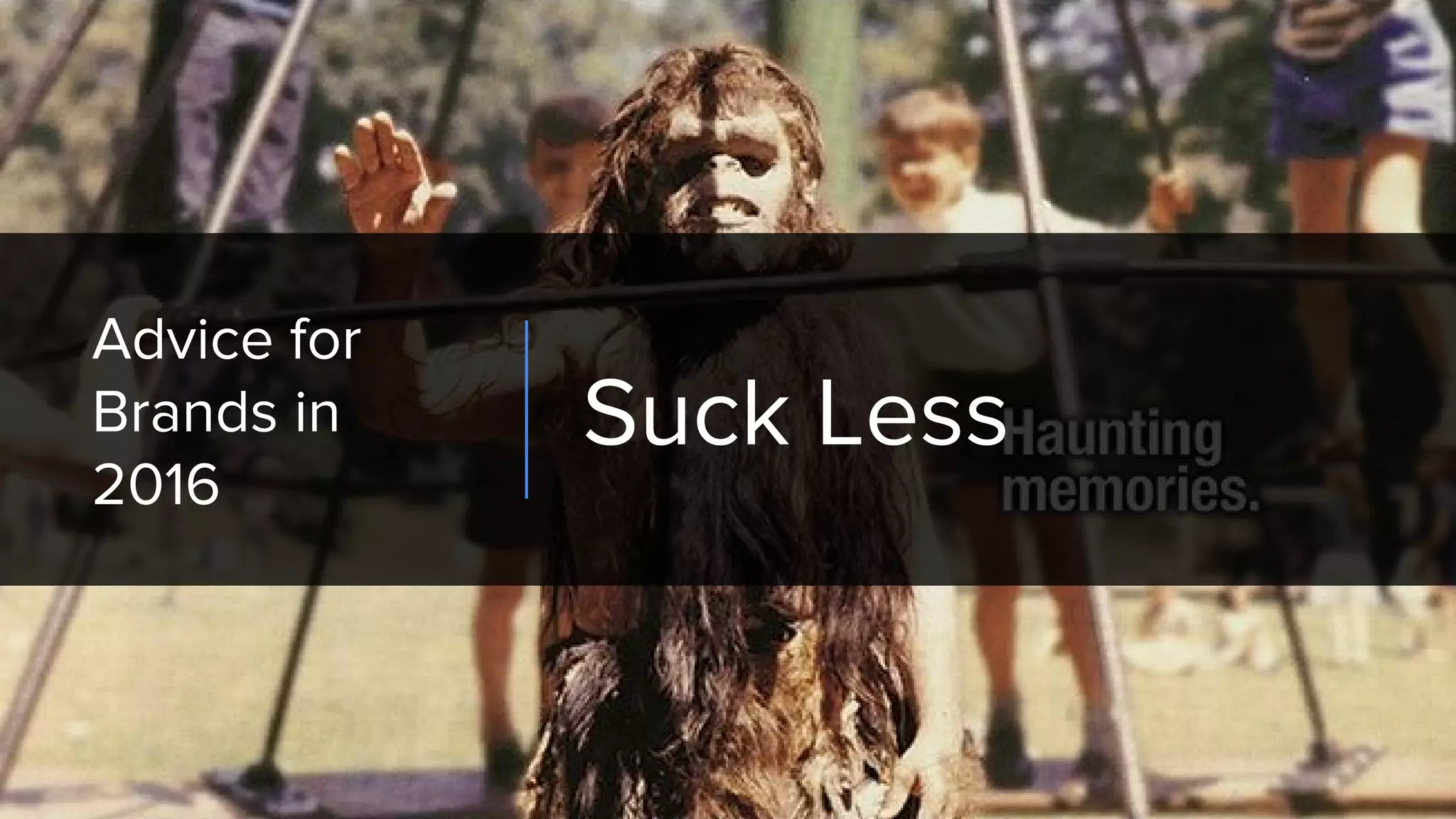
Brands in
2016
Suck Less
They Can’t Shoot us
from here...
Invidious behavior of a phalanx of the world’s admired brands threatens
a trust bubble. If the trust bubble bursts it would wreak havoc on the
intangible value of the world’s brands; nearly $4 trillion of the S&P alone.
In deference to former U.S. Treasury Dept. watchdog Neil Barofsky’s
book “Bailout,” in which he argued, “The public should lose faith in their
Government” – the real threat is the public losing faith
in brands.
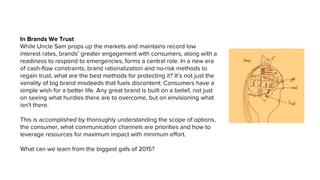
In Brands We Trust
While Uncle Sam props up the markets and maintains record low
interest rates, brands’ greater engagement with consumers, along with a
readiness to respond to emergencies, forms a central role. In a new era
of cash-flow constraints, brand rationalization and no-risk methods to
regain trust, what are the best methods for protecting it? It’s not just the
venality of big brand misdeeds that fuels discontent: Consumers have a
simple wish for a better life. Any great brand is built on a belief, not just
on seeing what hurdles there are to overcome, but on envisioning what
isn’t there.
This is accomplished by thoroughly understanding the scope of options,
the consumer, what communication channels are priorities and how to
leverage resources for maximum impact with minimum effort.
What can we learn from the biggest gafs of 2015?
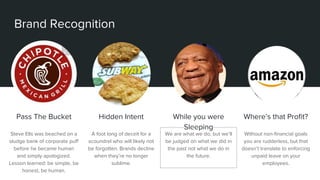
Brand Recognition
Pass The Bucket
Steve Ells was beached on a
sludge bank of corporate puff
before he became human
and simply apologized.
Lesson learned: be simple, be
honest, be human.
Hidden Intent
A foot long of deceit for a
scoundrel who will likely not
be forgotten. Brands decline
when they’re no longer
sublime.
While you were
Sleeping
We are what we do, but we’ll
be judged on what we did in
the past not what we do in
the future.
Where’s that Profit?
Without non-financial goals
you are rudderless, but that
doesn’t translate to enforcing
unpaid leave on your
employees.
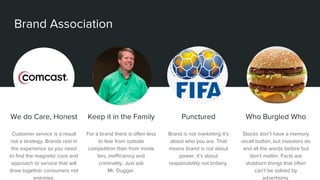
Brand Association
We do Care, Honest
Customer service is a result
not a strategy. Brands rest in
the experience so you need
to find the magnetic core and
approach to service that will
draw together consumers not
enemies.
Keep it in the Family
For a brand there is often less
to fear from outside
competition than from inside
lies, inefficiency and
criminality. Just ask
Mr. Duggar.
Punctured
Brand is not marketing it’s
about who you are. That
means brand is not about
power, it’s about
responsibility not bribery.
Who Burgled Who
Stocks don’t have a memory
recall button, but investors do
and all the words before but
don’t matter. Facts are
stubborn things that often
can’t be solved by
advertising.
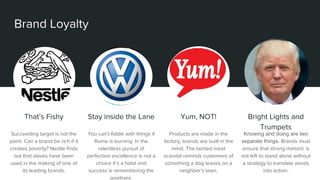
Brand Loyalty
That’s Fishy
Succeeding target is not the
point. Can a brand be rich if it
creates poverty? Nestle finds
out that slaves have been
used in the making of one of
its leading brands.
Stay inside the Lane
You can’t fiddle with things if
Rome is burning. In the
relentless pursuit of
perfection excellence is not a
choice it’s a habit and
success is remembering the
positives.
Yum, NOT!
Products are made in the
factory, brands are built in the
mind. The tainted meat
scandal reminds customers of
something a dog leaves on a
neighbor’s lawn.
Bright Lights and
Trumpets
Knowing and doing are two
separate things. Brands must
ensure that strong rhetoric is
not left to stand alone without
a strategy to translate words
into action.
1. Trust in Information
Adhesion to brand strategy can often cripple the need
for the brand to interact in a leaner, smarter manner as we have
witnessed with the tsunami of bad news and behavior
of big brands over recent months. Retaining trust requires
knowing what the “brand” means to the category, knowing who
are the game changers and developing communication
approaches that break the frame (not the law). Providing
accurate, timely advice and actionable insights via
recommendations by experts, consumer advisors, ratings
and reviews, using conventional marketing, social media and
brand building that is quickly deployable with high intensity,
works.
Trust is eroded and money is wasted by many brands when
they fail to understand when their consumers are most open
to influence on a topic and how you can interact with them
at those gateways. As the author Benjamin Graham, remarked:
“You’re neither right nor wrong because the crowd disagrees
with you. You are right because your data and reasoning are
right.”
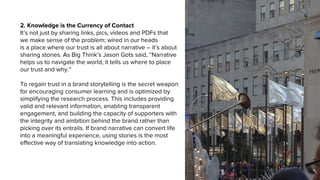
2. Knowledge is the Currency of Contact
It’s not just by sharing links, pics, videos and PDFs that
we make sense of the problem; wired in our heads
is a place where our trust is all about narrative – it’s about
sharing stories. As Big Think’s Jason Gots said, “Narrative
helps us to navigate the world, it tells us where to place
our trust and why.”
To regain trust in a brand storytelling is the secret weapon
for encouraging consumer learning and is optimized by
simplifying the research process. This includes providing
valid and relevant information, enabling transparent
engagement, and building the capacity of supporters with
the integrity and ambition behind the brand rather than
picking over its entrails. If brand narrative can convert life
into a meaningful experience, using stories is the most
effective way of translating knowledge into action.
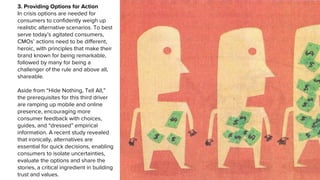
3. Providing Options for Action
In crisis options are needed for
consumers to confidently weigh up
realistic alternative scenarios. To best
serve today’s agitated consumers,
CMOs’ actions need to be different,
heroic, with principles that make their
brand known for being remarkable,
followed by many for being a
challenger of the rule and above all,
shareable.
Aside from “Hide Nothing, Tell All,”
the prerequisites for this third driver
are ramping up mobile and online
presence, encouraging more
consumer feedback with choices,
guides, and “dressed” empirical
information. A recent study revealed
that ironically, alternatives are
essential for quick decisions, enabling
consumers to isolate uncertainties,
evaluate the options and share the
stories, a critical ingredient in building
trust and values.
On The Front Foot
People are scared about the future.
If you simplify their decision-making
process with authenticity, simplified
learning and options to weigh in on,
consumers think less about the
decision.
While no panacea to illegitimate
behavior, such practical and forthright
actions to provide and present timely,
relevant and valid knowledge with
options to bail-out weary consumers
could irrevocably demonstrate a way
to win back much vaunted consumer
confidence and share of trust.
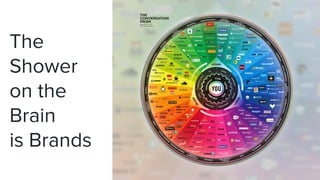
The
Shower
on the
Brain
is Brands
About Dean Crutchfield
Informed, outspoken, perceptive and engaging, Dean is an accomplished rainmaker and one of the leading
brand strategists in marketing and media today. Dean has been fortunate to have represented several of the
world's most iconic brands and has spoken for prestigious institutions like the J.L. Kellogg Graduate School
of Management, The Wharton School of Finance and the Google Speaker Series as well as speaking
internationally about how to accomplish service innovation.
Dean's reputation as an insightful advisor and storyteller has led to appearances on Al Jazeera, PBS,
Bloomberg TV, BBC World and CCTV America along with frequent commentary in a variety of publications,
including The New York Times, The Wall Street Journal and the Financial Times. Dean has provided insights
and speculation on a wide range of brands and categories as well as a Contributor to Forbes and editorials
in Advertising Age, Adweek and other marketing press, ranging from the do's and don'ts for CMOs in crisis
to how brand transformations can impact the economy.
Dean believes brands are stories shared and the language of the new consumer has changed: today’s
consumers admire brands that enable them to participate. Consequently, brands need to embrace more
freedom by adopting narrative based brand and marketing strategies that can impact multiple platforms
to engage consumers: creating brands that are more magnanimous, malleable and functional.
Global experience with brands has led Dean to develop a strong belief that brand is not marketing it is what
you stand for. With this belief, he urges the use of creativity and innovation to push boundaries and bust
categories with brave thinking that can solve problems, create value and advance humanity into a brighter
future.
Email
Twitter
LinkedIn

Advice For Brands 2016

  • 1.
  • 2.
    They Can’t Shootus from here... Invidious behavior of a phalanx of the world’s admired brands threatens a trust bubble. If the trust bubble bursts it would wreak havoc on the intangible value of the world’s brands; nearly $4 trillion of the S&P alone. In deference to former U.S. Treasury Dept. watchdog Neil Barofsky’s book “Bailout,” in which he argued, “The public should lose faith in their Government” – the real threat is the public losing faith in brands.
  • 3.
    In Brands WeTrust While Uncle Sam props up the markets and maintains record low interest rates, brands’ greater engagement with consumers, along with a readiness to respond to emergencies, forms a central role. In a new era of cash-flow constraints, brand rationalization and no-risk methods to regain trust, what are the best methods for protecting it? It’s not just the venality of big brand misdeeds that fuels discontent: Consumers have a simple wish for a better life. Any great brand is built on a belief, not just on seeing what hurdles there are to overcome, but on envisioning what isn’t there. This is accomplished by thoroughly understanding the scope of options, the consumer, what communication channels are priorities and how to leverage resources for maximum impact with minimum effort. What can we learn from the biggest gafs of 2015?
  • 4.
    Brand Recognition Pass TheBucket Steve Ells was beached on a sludge bank of corporate puff before he became human and simply apologized. Lesson learned: be simple, be honest, be human. Hidden Intent A foot long of deceit for a scoundrel who will likely not be forgotten. Brands decline when they’re no longer sublime. While you were Sleeping We are what we do, but we’ll be judged on what we did in the past not what we do in the future. Where’s that Profit? Without non-financial goals you are rudderless, but that doesn’t translate to enforcing unpaid leave on your employees.
  • 5.
    Brand Association We doCare, Honest Customer service is a result not a strategy. Brands rest in the experience so you need to find the magnetic core and approach to service that will draw together consumers not enemies. Keep it in the Family For a brand there is often less to fear from outside competition than from inside lies, inefficiency and criminality. Just ask Mr. Duggar. Punctured Brand is not marketing it’s about who you are. That means brand is not about power, it’s about responsibility not bribery. Who Burgled Who Stocks don’t have a memory recall button, but investors do and all the words before but don’t matter. Facts are stubborn things that often can’t be solved by advertising.
  • 6.
    Brand Loyalty That’s Fishy Succeedingtarget is not the point. Can a brand be rich if it creates poverty? Nestle finds out that slaves have been used in the making of one of its leading brands. Stay inside the Lane You can’t fiddle with things if Rome is burning. In the relentless pursuit of perfection excellence is not a choice it’s a habit and success is remembering the positives. Yum, NOT! Products are made in the factory, brands are built in the mind. The tainted meat scandal reminds customers of something a dog leaves on a neighbor’s lawn. Bright Lights and Trumpets Knowing and doing are two separate things. Brands must ensure that strong rhetoric is not left to stand alone without a strategy to translate words into action.
  • 7.
    1. Trust inInformation Adhesion to brand strategy can often cripple the need for the brand to interact in a leaner, smarter manner as we have witnessed with the tsunami of bad news and behavior of big brands over recent months. Retaining trust requires knowing what the “brand” means to the category, knowing who are the game changers and developing communication approaches that break the frame (not the law). Providing accurate, timely advice and actionable insights via recommendations by experts, consumer advisors, ratings and reviews, using conventional marketing, social media and brand building that is quickly deployable with high intensity, works. Trust is eroded and money is wasted by many brands when they fail to understand when their consumers are most open to influence on a topic and how you can interact with them at those gateways. As the author Benjamin Graham, remarked: “You’re neither right nor wrong because the crowd disagrees with you. You are right because your data and reasoning are right.”
  • 8.
    2. Knowledge isthe Currency of Contact It’s not just by sharing links, pics, videos and PDFs that we make sense of the problem; wired in our heads is a place where our trust is all about narrative – it’s about sharing stories. As Big Think’s Jason Gots said, “Narrative helps us to navigate the world, it tells us where to place our trust and why.” To regain trust in a brand storytelling is the secret weapon for encouraging consumer learning and is optimized by simplifying the research process. This includes providing valid and relevant information, enabling transparent engagement, and building the capacity of supporters with the integrity and ambition behind the brand rather than picking over its entrails. If brand narrative can convert life into a meaningful experience, using stories is the most effective way of translating knowledge into action.
  • 9.
    3. Providing Optionsfor Action In crisis options are needed for consumers to confidently weigh up realistic alternative scenarios. To best serve today’s agitated consumers, CMOs’ actions need to be different, heroic, with principles that make their brand known for being remarkable, followed by many for being a challenger of the rule and above all, shareable. Aside from “Hide Nothing, Tell All,” the prerequisites for this third driver are ramping up mobile and online presence, encouraging more consumer feedback with choices, guides, and “dressed” empirical information. A recent study revealed that ironically, alternatives are essential for quick decisions, enabling consumers to isolate uncertainties, evaluate the options and share the stories, a critical ingredient in building trust and values.
  • 10.
    On The FrontFoot People are scared about the future. If you simplify their decision-making process with authenticity, simplified learning and options to weigh in on, consumers think less about the decision. While no panacea to illegitimate behavior, such practical and forthright actions to provide and present timely, relevant and valid knowledge with options to bail-out weary consumers could irrevocably demonstrate a way to win back much vaunted consumer confidence and share of trust.
  • 11.
  • 12.
    About Dean Crutchfield Informed,outspoken, perceptive and engaging, Dean is an accomplished rainmaker and one of the leading brand strategists in marketing and media today. Dean has been fortunate to have represented several of the world's most iconic brands and has spoken for prestigious institutions like the J.L. Kellogg Graduate School of Management, The Wharton School of Finance and the Google Speaker Series as well as speaking internationally about how to accomplish service innovation. Dean's reputation as an insightful advisor and storyteller has led to appearances on Al Jazeera, PBS, Bloomberg TV, BBC World and CCTV America along with frequent commentary in a variety of publications, including The New York Times, The Wall Street Journal and the Financial Times. Dean has provided insights and speculation on a wide range of brands and categories as well as a Contributor to Forbes and editorials in Advertising Age, Adweek and other marketing press, ranging from the do's and don'ts for CMOs in crisis to how brand transformations can impact the economy. Dean believes brands are stories shared and the language of the new consumer has changed: today’s consumers admire brands that enable them to participate. Consequently, brands need to embrace more freedom by adopting narrative based brand and marketing strategies that can impact multiple platforms to engage consumers: creating brands that are more magnanimous, malleable and functional. Global experience with brands has led Dean to develop a strong belief that brand is not marketing it is what you stand for. With this belief, he urges the use of creativity and innovation to push boundaries and bust categories with brave thinking that can solve problems, create value and advance humanity into a brighter future. Email Twitter LinkedIn