WHO SAID SHE’S BEAUTIFUL? Becca Guerin, Caitlin Guffy,  Sadie Olen, Katie Dapper
IDEAS ABOUT BEAUTY  Advertisers definition What look is right? Insecure needs Obsession Judge others Naturally Fake Not good enough Youth Who are you impressing?  Target: Kids and Teens Why do you think the things you do?
Historical Context: Women and Advertising 1920’s- “Advertisers learned to wrap products in the tissue of dreams…instead of selling phonographs, they sold enjoyment, the painted glamour”  The “war on fat” The consumer was a ‘she’, the ‘New Woman’ Embodied the promise of modernity- youth, sexual freedom, style and conspicuous consumptions The 1930’s- Time of the Great Depression, Curvaceous celebs offered women “borrowed glamour” Attempts to energize the depressed market with emotional appeals  Hollywood star endorsements- Sophia Loren, Elizabeth Taylor (Twitchell)
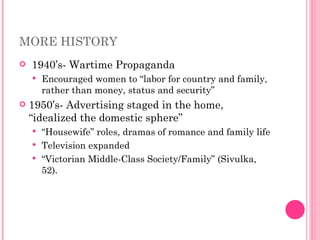
MORE HISTORY 1940’s- Wartime Propaganda  Encouraged women to “labor for country and family, rather than money, status and security” 1950’s- Advertising staged in the home, “idealized the domestic sphere” “ Housewife” roles, dramas of romance and family life Television expanded  “ Victorian Middle-Class Society/Family” (Sivulka, 52).
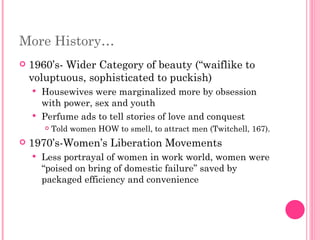
More History… 1960’s- Wider Category of beauty (“waiflike to voluptuous, sophisticated to puckish) Housewives were marginalized more by obsession with power, sex and youth Perfume ads to tell stories of love and conquest Told women HOW to smell, to attract men (Twitchell, 167). 1970’s-Women’s Liberation Movements Less portrayal of women in work world, women were “poised on bring of domestic failure” saved by packaged efficiency and convenience
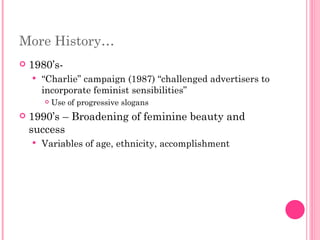
More History… 1980’s- “ Charlie” campaign (1987) “challenged advertisers to incorporate feminist sensibilities” Use of progressive slogans  1990’s – Broadening of feminine beauty and success Variables of age, ethnicity, accomplishment
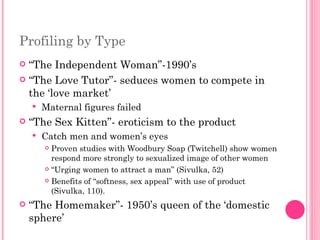
Profiling by Type  “ The Independent Woman”-1990’s  “ The Love Tutor”- seduces women to compete in the ‘love market’ Maternal figures failed “ The Sex Kitten”- eroticism to the product Catch men and women’s eyes Proven studies with Woodbury Soap (Twitchell) show women respond more strongly to sexualized image of other women “ Urging women to attract a man” (Sivulka, 52) Benefits of “softness, sex appeal” with use of product (Sivulka, 110). “ The Homemaker”- 1950’s queen of the ‘domestic sphere’


CREATE YOUR OWN DEFINITION OF BEAUTY
Works Cited Kurtz, Jan. “Dream Girls: Women in Advertising- Advertising History”.  USA Today (Society for the Advancement of Education).  FindArticles.com  26 March, 2011.  http://findarticles.com/p/articles/mi_m1272/is_n2620_v125/ai_19029242/ Sivulka, Juliann “Soap, Sex and Cigarettes: A Cultural History of American Advertising”. California, Wadsworth, 1998. Twitchell, James B. “Twenty Ads That Shook the World”. New York: Crown Publishing Group, 2000.

Advertising presentation 2

  • 1.
    WHO SAID SHE’SBEAUTIFUL? Becca Guerin, Caitlin Guffy, Sadie Olen, Katie Dapper
  • 2.
    IDEAS ABOUT BEAUTY Advertisers definition What look is right? Insecure needs Obsession Judge others Naturally Fake Not good enough Youth Who are you impressing? Target: Kids and Teens Why do you think the things you do?
  • 3.
    Historical Context: Womenand Advertising 1920’s- “Advertisers learned to wrap products in the tissue of dreams…instead of selling phonographs, they sold enjoyment, the painted glamour” The “war on fat” The consumer was a ‘she’, the ‘New Woman’ Embodied the promise of modernity- youth, sexual freedom, style and conspicuous consumptions The 1930’s- Time of the Great Depression, Curvaceous celebs offered women “borrowed glamour” Attempts to energize the depressed market with emotional appeals Hollywood star endorsements- Sophia Loren, Elizabeth Taylor (Twitchell)
  • 4.
    MORE HISTORY 1940’s-Wartime Propaganda Encouraged women to “labor for country and family, rather than money, status and security” 1950’s- Advertising staged in the home, “idealized the domestic sphere” “ Housewife” roles, dramas of romance and family life Television expanded “ Victorian Middle-Class Society/Family” (Sivulka, 52).
  • 5.
    More History… 1960’s-Wider Category of beauty (“waiflike to voluptuous, sophisticated to puckish) Housewives were marginalized more by obsession with power, sex and youth Perfume ads to tell stories of love and conquest Told women HOW to smell, to attract men (Twitchell, 167). 1970’s-Women’s Liberation Movements Less portrayal of women in work world, women were “poised on bring of domestic failure” saved by packaged efficiency and convenience
  • 6.
    More History… 1980’s-“ Charlie” campaign (1987) “challenged advertisers to incorporate feminist sensibilities” Use of progressive slogans 1990’s – Broadening of feminine beauty and success Variables of age, ethnicity, accomplishment
  • 7.
    Profiling by Type “ The Independent Woman”-1990’s “ The Love Tutor”- seduces women to compete in the ‘love market’ Maternal figures failed “ The Sex Kitten”- eroticism to the product Catch men and women’s eyes Proven studies with Woodbury Soap (Twitchell) show women respond more strongly to sexualized image of other women “ Urging women to attract a man” (Sivulka, 52) Benefits of “softness, sex appeal” with use of product (Sivulka, 110). “ The Homemaker”- 1950’s queen of the ‘domestic sphere’
  • 8.
  • 9.
  • 10.
  • 11.
    CREATE YOUR OWNDEFINITION OF BEAUTY
  • 12.
    Works Cited Kurtz,Jan. “Dream Girls: Women in Advertising- Advertising History”. USA Today (Society for the Advancement of Education). FindArticles.com 26 March, 2011. http://findarticles.com/p/articles/mi_m1272/is_n2620_v125/ai_19029242/ Sivulka, Juliann “Soap, Sex and Cigarettes: A Cultural History of American Advertising”. California, Wadsworth, 1998. Twitchell, James B. “Twenty Ads That Shook the World”. New York: Crown Publishing Group, 2000.