Part 1
Principle: Back to Basics
Copyright © Pearson Education Limited 2015
3-1
1. What is the social impact of brand
communication?
2. What ethical and social responsibilities do
communicators bear?
3. Why and how is advertising regulated?
Copyright © Pearson Education Limited 2015
3-2
Copyright © Pearson Education Limited 2015
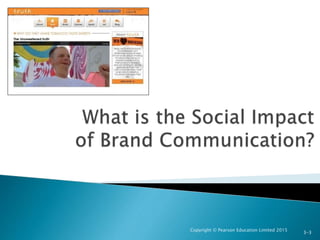
3-3
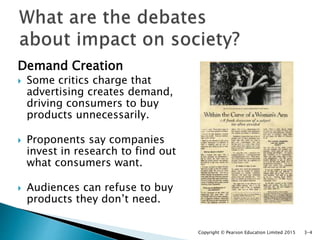
Demand Creation
 Some critics charge that
advertising creates demand,
driving consumers to buy
products unnecessarily.
 Proponents say companies
invest in research to find out
what consumers want.
 Audiences can refuse to buy
products they don’t need.
Copyright © Pearson Education Limited 2015 3-4
Shaping versus mirroring
 Does advertising create or reflect social
values?
 Critics say advertising abuses its influence
on children and teenagers.
 Critics say advertising creates social trends,
dictating how people think and act.
Copyright © Pearson Education Limited 2015
3-5
 Advertisers say they spot trends and develop
messages that connect with them.
 The answer to the debate may simply be that
advertising both mirrors and shapes values.
Copyright © Pearson Education Limited 2015
3-6
 Does advertising lead people to be too materialistic?
 Critics say advertising heightens expectations.
 Marketing to youth is controversial because children
are seen as vulnerable.
As a class:
What is your response to these criticisms?
Copyright © Pearson Education Limited 2015
3-7
Diversity and stereotypes
As a class:
What is a stereotype? How would you define it?
Answer:
A stereotype is a representation of a cultural group
that emphasizes a trait or traits that may or may not
communicate an accurate representation.
Copyright © Pearson Education Limited 2015
3-8
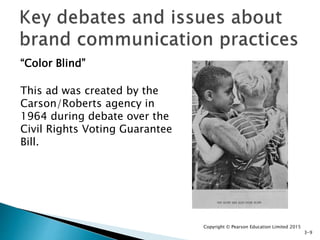
“Color Blind”
This ad was created by the
Carson/Roberts agency in
1964 during debate over the
Civil Rights Voting Guarantee
Bill.
Copyright © Pearson Education Limited 2015
3-9
Sex appeals and body image
 Advertising that portrays people as sex objects is
considered demeaning.
 Playing on consumers’ insecurities about their
appearance can lead to dangerous practices.
 Responsible advertisers now use models of
normal size and weight to reduce pressure on
young people.
Copyright © Pearson Education Limited 2015
3-10
Poor taste and offensive advertising
 Viewer reaction may be affected by sensitivity
to:
◦ the product category
◦ the timing
◦ whether the viewer is alone or with others
◦ the context
Copyright © Pearson Education Limited 2015
3-11
Poor taste and offensive advertising
 Creating guidelines is difficult because
“good taste” varies.
 What is considered “offensive” changes over
time.
Copyright © Pearson Education Limited 2015
3-12
 False advertising
 Misleading claims
and puffery
 Comparative advertising
 Endorsements and
demonstrations
Copyright © Pearson Education Limited 2015
3-13
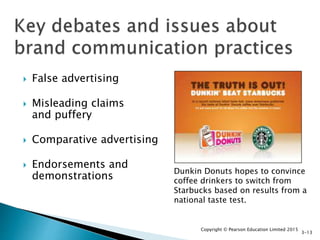
Dunkin Donuts hopes to convince
coffee drinkers to switch from
Starbucks based on results from a
national taste test.
Advertising claims are unethical if they are
false, misleading, or deceptive.
Copyright © Pearson Education Limited 2015
3-14
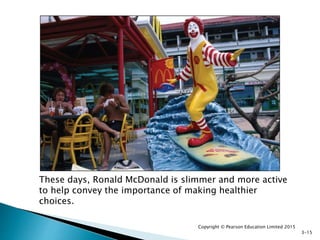
These days, Ronald McDonald is slimmer and more active
to help convey the importance of making healthier
choices.
Copyright © Pearson Education Limited 2015
3-15
Copyright © Pearson Education Limited 2015
3-16
Ethical decisions involve complex, conflicting
forces:
 strategy versus ethics
 costs versus ethics
 effectiveness versus ethics
Copyright © Pearson Education Limited 2015
3-17
 In a Gallup poll, advertising practitioners ranked just
above HMO managers and car salesmen.
 The American Association of Advertising Agencies
publishes a code of standards.
Copyright © Pearson Education Limited 2015
3-18
 Singapore, Malaysia, the Netherlands, and
Sweden have all established standards of
professional behavior.
As a class:
For added perspectives on the issue of ethics, read
and discuss “A Matter of Practice: Advertising Gets
No Respect!”
Copyright © Pearson Education Limited 2015
3-19
Professional codes of ethics
 Codes of ethics can help guide your actions.
 However, they are only broad statements, and do
not explain how to handle every situation.
 You must develop a strong personal and
professional sense of right and wrong.
Copyright © Pearson Education Limited 2015
3-20
Copyright © Pearson Education Limited 2015 3-21
Key advertising legislation:
1. Pure Food and Drug Act (1906)
2. Federal Trade Commission Act (1914)
3. Wheeler-Lea Amendment (1938)
4. Lanham Act (1947)
5. Magnuson-Moss Warranty/FTC Improvement Act (1975)
6. FTC Improvement Act (1980)
7. The Telemarketing and Consumer Fraud Act
and Abuse Protection Act (1994)
How have each of these acts impacted the advertising industry?
Copyright © Pearson Education Limited 2015
3-22
Trademark protection
 A trademark is a brand, corporate or store name, or
a distinctive symbol identifying a seller’s brand and
differentiating it from other brands.
◦ Registering through the Trademark Office
provides exclusive use, as long as it’s for a
specific product.
◦ The Lanham Trademark Act of 1947 protects
unique trademarks from infringement.
Copyright © Pearson Education Limited 2015
3-23
Copyright protection
 A copyright gives organizations exclusive rights to
use or reproduce an ad or package design, for a
period of time.
 Copyright infringement occurs when a product is
used in an ad without proper permission, including
copycat ads.
Copyright © Pearson Education Limited 2015
3-24
Brand communication and the
First Amendment
 First Amendment protection extends to commercial
speech, but not on an absolute basis.
 The Supreme Court permits some restrictions on
commercial speech.
 Only truthful speech is protected – not misleading
or deceptive statements.
Copyright © Pearson Education Limited 2015
3-25
International laws and regulations
 Legal and regulatory restrictions vary by country.
 Some countries ban ads for certain products.
 Thailand, Hungary, Hong Kong, and Malaysia have
bans on certain types of tobacco advertising.
 Contests, promotions, and direct mail are illegal in
some countries.
Copyright © Pearson Education Limited 2015
3-26
Federal Trade Commission (FTC)
 Regulates deceptive and misleading advertising,
focusing on:
◦ Unfairness
◦ Deception
◦ Violations
 The FTC also oversees advertising involving weight
loss products, children and elderly people,
telemarketing, and the entertainment industry.
Copyright © Pearson Education Limited 2015
3-27
Food and Drug Administration (FDA)
 Regulatory division of the U.S. Department of Health
and Human Services.
 Oversees package labeling, ingredient listings,
and advertising for food and drugs.
 Determines the safety and purity of foods, cosmetics.
 The FDA also acts as a watchdog for drug advertising.
Copyright © Pearson Education Limited 2015
3-28
Federal Communications Commission (FCC)
 Regulates radio and television broadcast
communications (media, not advertisers).
 Can issue and revoke licenses, ban deceptive
messages or those in poor taste.
 It responds to complaints but doesn’t initiate actions.
 Works closely with FTC to eliminate false and
deceptive advertising.
Copyright © Pearson Education Limited 2015
3-29
Other regulatory bodies
 Bureau of Alcohol, Tobacco, and Firearms (BATF)
Regulates deception in advertising and establishes
labeling requirements for the liquor industry.
 U.S. Postal Service regulates direct mail and magazine
advertising including the areas of obscenity, lotteries,
and fraud.
 The States’ Attorneys General regulate advertising at
the state level.
Copyright © Pearson Education Limited 2015
3-30
The FTC and children’s advertising
 Children’s Advertising Review Unit (CARU)
evaluates ads to children under 12.
 The Children’s Television Advertising Practice Act
(1990) placed ceilings on ads during TV programs.
 As of 1996, all stations must air three hours per
week of educational programming.
Copyright © Pearson Education Limited 2015
3-31
Regulating deception
 Deceptive advertising misleads consumers by making
false claims, failing to fully disclose important facts,
or both.
 Current FTC policy contains three elements:
1. Misleading: representation, omission, practice
2. Reasonableness: “reasonable consumer”
3. Injurious: must cause material injury
Copyright © Pearson Education Limited 2015
3-32
Regulating substantiation
 Does the advertiser have a reasonable basis to make a
claim about product performance?
 Factors considered:
◦ Type and specificity of claim made
◦ Type of product
◦ Possible consequences
◦ Degree of reliance
◦ Type and accessibility of evidence
◦ What substantiation is reasonable
Copyright © Pearson Education Limited 2015
3-33
Remedies for deception and unfair advertising
 Cease and desist orders
A process similar to court trial precedes the order.
 Corrective advertising
Advertiser runs messages correcting the false
impressions.
 Consumer redress
Cancel or reform contracts, refund money, return
property, pay for damages, or public notification.
Copyright © Pearson Education Limited 2015
3-34
Remedies for deception and unfair advertising
A question for you……
Can the ad agency be held liable along with
advertiser?
Answer:
Yes, when the agency is an active participant in
preparing the ad and knows it is false or
deceptive.
Copyright © Pearson Education Limited 2015
3-35
 The media screens and rejects advertising
that violate standards of truth, good taste.
 The First Amendment allows publishers to
refuse to run ads.
Copyright © Pearson Education Limited 2015
3-36
Self-Discipline
 Organizations develop and use their own norms
 Major advertisers and agencies utilize in-house
procedures.
 Several U.S. companies have their own codes of
behavior and criteria for acceptable advertising.
Copyright © Pearson Education Limited 2015
3-37
Industry Self-Regulation
 National Advertising Review Council (NARC)
 National Advertising Division (NAD)
 National Advertising Review Board (NARB)
Copyright © Pearson Education Limited 2015
3-38
Self-Regulation by Public and Community Groups
 Better Business Bureau
Advises local businesses on legal aspects of
advertising.
 Consumer activist groups
◦ Action for Children’s Advertising
◦ Public Citizen
◦ Cultural Environment Movement
Copyright © Pearson Education Limited 2015
3-39
In Part II, we will:
 Explore the basics of brand communication
planning with chapters on:
◦ The consumer audience
◦ Strategic research
◦ Strategy and planning
Copyright © Pearson Education Limited 2015
3-40
“The truth wins out in the end”
 The truth® campaign has won more than 300 creative
awards.
 But winning creative awards doesn’t necessarily mean
that the campaign was effective.
 A campaign may fail to address the critical question of
effectiveness: Did the campaign work for the client?
Copyright © Pearson Education Limited 2015
3-41
“The truth wins out in the end”
Evidence of campaign effectiveness:
 A tracking study showed an 8 percent increase among the
truth® audience in negative attitudes toward big tobacco
from the previous year.
 All truth® (Internet) properties increased engagement nearly
20 percent from the previous year.
 The effort increased engagement with social media.
Copyright © Pearson Education Limited 2015
3-42

Advertising Management - ch03

  • 1.
    Part 1 Principle: Backto Basics Copyright © Pearson Education Limited 2015 3-1
  • 2.
    1. What isthe social impact of brand communication? 2. What ethical and social responsibilities do communicators bear? 3. Why and how is advertising regulated? Copyright © Pearson Education Limited 2015 3-2
  • 3.
    Copyright © PearsonEducation Limited 2015 3-3
  • 4.
    Demand Creation  Somecritics charge that advertising creates demand, driving consumers to buy products unnecessarily.  Proponents say companies invest in research to find out what consumers want.  Audiences can refuse to buy products they don’t need. Copyright © Pearson Education Limited 2015 3-4
  • 5.
    Shaping versus mirroring Does advertising create or reflect social values?  Critics say advertising abuses its influence on children and teenagers.  Critics say advertising creates social trends, dictating how people think and act. Copyright © Pearson Education Limited 2015 3-5
  • 6.
     Advertisers saythey spot trends and develop messages that connect with them.  The answer to the debate may simply be that advertising both mirrors and shapes values. Copyright © Pearson Education Limited 2015 3-6
  • 7.
     Does advertisinglead people to be too materialistic?  Critics say advertising heightens expectations.  Marketing to youth is controversial because children are seen as vulnerable. As a class: What is your response to these criticisms? Copyright © Pearson Education Limited 2015 3-7
  • 8.
    Diversity and stereotypes Asa class: What is a stereotype? How would you define it? Answer: A stereotype is a representation of a cultural group that emphasizes a trait or traits that may or may not communicate an accurate representation. Copyright © Pearson Education Limited 2015 3-8
  • 9.
    “Color Blind” This adwas created by the Carson/Roberts agency in 1964 during debate over the Civil Rights Voting Guarantee Bill. Copyright © Pearson Education Limited 2015 3-9
  • 10.
    Sex appeals andbody image  Advertising that portrays people as sex objects is considered demeaning.  Playing on consumers’ insecurities about their appearance can lead to dangerous practices.  Responsible advertisers now use models of normal size and weight to reduce pressure on young people. Copyright © Pearson Education Limited 2015 3-10
  • 11.
    Poor taste andoffensive advertising  Viewer reaction may be affected by sensitivity to: ◦ the product category ◦ the timing ◦ whether the viewer is alone or with others ◦ the context Copyright © Pearson Education Limited 2015 3-11
  • 12.
    Poor taste andoffensive advertising  Creating guidelines is difficult because “good taste” varies.  What is considered “offensive” changes over time. Copyright © Pearson Education Limited 2015 3-12
  • 13.
     False advertising Misleading claims and puffery  Comparative advertising  Endorsements and demonstrations Copyright © Pearson Education Limited 2015 3-13 Dunkin Donuts hopes to convince coffee drinkers to switch from Starbucks based on results from a national taste test.
  • 14.
    Advertising claims areunethical if they are false, misleading, or deceptive. Copyright © Pearson Education Limited 2015 3-14
  • 15.
    These days, RonaldMcDonald is slimmer and more active to help convey the importance of making healthier choices. Copyright © Pearson Education Limited 2015 3-15
  • 16.
    Copyright © PearsonEducation Limited 2015 3-16
  • 17.
    Ethical decisions involvecomplex, conflicting forces:  strategy versus ethics  costs versus ethics  effectiveness versus ethics Copyright © Pearson Education Limited 2015 3-17
  • 18.
     In aGallup poll, advertising practitioners ranked just above HMO managers and car salesmen.  The American Association of Advertising Agencies publishes a code of standards. Copyright © Pearson Education Limited 2015 3-18
  • 19.
     Singapore, Malaysia,the Netherlands, and Sweden have all established standards of professional behavior. As a class: For added perspectives on the issue of ethics, read and discuss “A Matter of Practice: Advertising Gets No Respect!” Copyright © Pearson Education Limited 2015 3-19
  • 20.
    Professional codes ofethics  Codes of ethics can help guide your actions.  However, they are only broad statements, and do not explain how to handle every situation.  You must develop a strong personal and professional sense of right and wrong. Copyright © Pearson Education Limited 2015 3-20
  • 21.
    Copyright © PearsonEducation Limited 2015 3-21
  • 22.
    Key advertising legislation: 1.Pure Food and Drug Act (1906) 2. Federal Trade Commission Act (1914) 3. Wheeler-Lea Amendment (1938) 4. Lanham Act (1947) 5. Magnuson-Moss Warranty/FTC Improvement Act (1975) 6. FTC Improvement Act (1980) 7. The Telemarketing and Consumer Fraud Act and Abuse Protection Act (1994) How have each of these acts impacted the advertising industry? Copyright © Pearson Education Limited 2015 3-22
  • 23.
    Trademark protection  Atrademark is a brand, corporate or store name, or a distinctive symbol identifying a seller’s brand and differentiating it from other brands. ◦ Registering through the Trademark Office provides exclusive use, as long as it’s for a specific product. ◦ The Lanham Trademark Act of 1947 protects unique trademarks from infringement. Copyright © Pearson Education Limited 2015 3-23
  • 24.
    Copyright protection  Acopyright gives organizations exclusive rights to use or reproduce an ad or package design, for a period of time.  Copyright infringement occurs when a product is used in an ad without proper permission, including copycat ads. Copyright © Pearson Education Limited 2015 3-24
  • 25.
    Brand communication andthe First Amendment  First Amendment protection extends to commercial speech, but not on an absolute basis.  The Supreme Court permits some restrictions on commercial speech.  Only truthful speech is protected – not misleading or deceptive statements. Copyright © Pearson Education Limited 2015 3-25
  • 26.
    International laws andregulations  Legal and regulatory restrictions vary by country.  Some countries ban ads for certain products.  Thailand, Hungary, Hong Kong, and Malaysia have bans on certain types of tobacco advertising.  Contests, promotions, and direct mail are illegal in some countries. Copyright © Pearson Education Limited 2015 3-26
  • 27.
    Federal Trade Commission(FTC)  Regulates deceptive and misleading advertising, focusing on: ◦ Unfairness ◦ Deception ◦ Violations  The FTC also oversees advertising involving weight loss products, children and elderly people, telemarketing, and the entertainment industry. Copyright © Pearson Education Limited 2015 3-27
  • 28.
    Food and DrugAdministration (FDA)  Regulatory division of the U.S. Department of Health and Human Services.  Oversees package labeling, ingredient listings, and advertising for food and drugs.  Determines the safety and purity of foods, cosmetics.  The FDA also acts as a watchdog for drug advertising. Copyright © Pearson Education Limited 2015 3-28
  • 29.
    Federal Communications Commission(FCC)  Regulates radio and television broadcast communications (media, not advertisers).  Can issue and revoke licenses, ban deceptive messages or those in poor taste.  It responds to complaints but doesn’t initiate actions.  Works closely with FTC to eliminate false and deceptive advertising. Copyright © Pearson Education Limited 2015 3-29
  • 30.
    Other regulatory bodies Bureau of Alcohol, Tobacco, and Firearms (BATF) Regulates deception in advertising and establishes labeling requirements for the liquor industry.  U.S. Postal Service regulates direct mail and magazine advertising including the areas of obscenity, lotteries, and fraud.  The States’ Attorneys General regulate advertising at the state level. Copyright © Pearson Education Limited 2015 3-30
  • 31.
    The FTC andchildren’s advertising  Children’s Advertising Review Unit (CARU) evaluates ads to children under 12.  The Children’s Television Advertising Practice Act (1990) placed ceilings on ads during TV programs.  As of 1996, all stations must air three hours per week of educational programming. Copyright © Pearson Education Limited 2015 3-31
  • 32.
    Regulating deception  Deceptiveadvertising misleads consumers by making false claims, failing to fully disclose important facts, or both.  Current FTC policy contains three elements: 1. Misleading: representation, omission, practice 2. Reasonableness: “reasonable consumer” 3. Injurious: must cause material injury Copyright © Pearson Education Limited 2015 3-32
  • 33.
    Regulating substantiation  Doesthe advertiser have a reasonable basis to make a claim about product performance?  Factors considered: ◦ Type and specificity of claim made ◦ Type of product ◦ Possible consequences ◦ Degree of reliance ◦ Type and accessibility of evidence ◦ What substantiation is reasonable Copyright © Pearson Education Limited 2015 3-33
  • 34.
    Remedies for deceptionand unfair advertising  Cease and desist orders A process similar to court trial precedes the order.  Corrective advertising Advertiser runs messages correcting the false impressions.  Consumer redress Cancel or reform contracts, refund money, return property, pay for damages, or public notification. Copyright © Pearson Education Limited 2015 3-34
  • 35.
    Remedies for deceptionand unfair advertising A question for you…… Can the ad agency be held liable along with advertiser? Answer: Yes, when the agency is an active participant in preparing the ad and knows it is false or deceptive. Copyright © Pearson Education Limited 2015 3-35
  • 36.
     The mediascreens and rejects advertising that violate standards of truth, good taste.  The First Amendment allows publishers to refuse to run ads. Copyright © Pearson Education Limited 2015 3-36
  • 37.
    Self-Discipline  Organizations developand use their own norms  Major advertisers and agencies utilize in-house procedures.  Several U.S. companies have their own codes of behavior and criteria for acceptable advertising. Copyright © Pearson Education Limited 2015 3-37
  • 38.
    Industry Self-Regulation  NationalAdvertising Review Council (NARC)  National Advertising Division (NAD)  National Advertising Review Board (NARB) Copyright © Pearson Education Limited 2015 3-38
  • 39.
    Self-Regulation by Publicand Community Groups  Better Business Bureau Advises local businesses on legal aspects of advertising.  Consumer activist groups ◦ Action for Children’s Advertising ◦ Public Citizen ◦ Cultural Environment Movement Copyright © Pearson Education Limited 2015 3-39
  • 40.
    In Part II,we will:  Explore the basics of brand communication planning with chapters on: ◦ The consumer audience ◦ Strategic research ◦ Strategy and planning Copyright © Pearson Education Limited 2015 3-40
  • 41.
    “The truth winsout in the end”  The truth® campaign has won more than 300 creative awards.  But winning creative awards doesn’t necessarily mean that the campaign was effective.  A campaign may fail to address the critical question of effectiveness: Did the campaign work for the client? Copyright © Pearson Education Limited 2015 3-41
  • 42.
    “The truth winsout in the end” Evidence of campaign effectiveness:  A tracking study showed an 8 percent increase among the truth® audience in negative attitudes toward big tobacco from the previous year.  All truth® (Internet) properties increased engagement nearly 20 percent from the previous year.  The effort increased engagement with social media. Copyright © Pearson Education Limited 2015 3-42

Editor's Notes

  • #5 Demand Creation Critics say advertising creates demand, driving consumers to buy products unnecessarily. Proponents say companies invest in research to find out what consumers want. Audiences can refuse to buy products they don’t need.
  • #6 Does advertising create or reflect social values? Critics say advertising abuses its influence on children and teenagers. Critics say advertising creates social trends, dictating how people think, act.
  • #8 Does advertising lead people to be too materialistic? Critics say advertising heightens expectations. The lines between advertising, news, and entertainment have become blurred. As a class: What is your response to this criticism?
  • #9 As a class: What is a stereotype? How would you define it? Answer: A stereotype is a representation of a cultural group that emphasizes a trait or traits that may or may not communicate an accurate representation.
  • #11 Advertising that portrays people as sex objects is considered demeaning. Playing on consumers’ insecurities about their appearance can lead to dangerous practices. Responsible advertisers now use models of normal size and weight to reduce pressure on young people.
  • #12 Viewer reaction may be affected by sensitivity to: the product category the timing whether the viewer is alone or with others the context
  • #13 Creating guidelines is difficult because “good taste” varies. What is considered “offensive” changes over time.
  • #16 These days, Ronald McDonald is slimmer and more active to help convey the importance of making healthier choices. As a class, what is your opinion of this move, and how McDonalds represents itself as a brand?
  • #18 Ethical decisions involve complex, conflicting forces: strategy vs. ethics costs vs. ethics effectiveness vs. ethics
  • #19 In a Gallup poll, advertising practitioners ranked just above HMO managers and car salesmen. The American Association of Advertising Agencies publishes a code of standards.
  • #20 Singapore, Malaysia, the Netherlands, and Sweden have all established standards of professional behavior. As a class: For added perspectives on the issue of ethics, let’s read and discuss “A Matter of Practice: Advertising Gets No Respect!”
  • #21 Codes of ethics can help guide your actions. However, they are only broad statements, and do not explain how to handle every situation. You must develop a strong personal and professional sense of right and wrong.
  • #23 How have each of these acts impacted the advertising industry?
  • #24 A trademark is a brand, corporate or store name, or a distinctive symbol identifying a seller’s brand and differentiating it from other brands. Registering through the Trademark Office provides exclusive use, as long as it’s for a specific product. The Lanham Trademark Act of 1947 protects unique trademarks from infringement.
  • #25 A copyright gives organizations exclusive rights to use or reproduce an ad or package design, for a period of time. Copyright infringement occurs when a product is used in an ad without proper permission, including copycat ads.
  • #26 First Amendment protection extends to commercial speech, but not on an absolute basis. The Supreme Court permits some restrictions on commercial speech. Only truthful speech is protected – not misleading or deceptive statements.
  • #27 Legal and regulatory restrictions vary by country. Some countries ban ads for certain products. Thailand, Hungary, Hong Kong, and Malaysia have bans on certain types of tobacco advertising. Contests, promotions, and direct mail are illegal in some countries.
  • #28 The FTC regulates deceptive and misleading advertising, focusing on: Unfairness Deception Violations It also oversees advertising involving weight loss products, children and elderly people, telemarketing, and the entertainment industry.
  • #29 The FDA is the regulatory division of the U.S. Department of Health and Human Services. It oversees package labeling, ingredient listings, and advertising for food and drugs. It also determines the safety and purity of foods, cosmetics. The FDA is also a watchdog for drug advertising.
  • #30 The FCC regulates radio and television broadcast communications (media, not advertisers). Can issue and revoke licenses, ban deceptive messages or those in poor taste. It responds to complaints but doesn’t initiate actions. Works closely with FTC to eliminate false and deceptive advertising.
  • #31 The Bureau of Alcohol, Tobacco, and Firearms (BATF) Regulates deception in advertising and establishes labeling requirements for the liquor industry. U.S. Postal Service regulates direct mail and magazine advertising including the areas of obscenity, lotteries, and fraud. The States’ Attorneys General regulate advertising at the state level.
  • #32 The Children’s Advertising Review Unit (CARU) evaluates ads to children under 12. The Children’s Television Advertising Practice Act (1990) placed ceilings on ads during TV programs. As of 1996, all stations must air three hours per week of educational programming.
  • #33 Deceptive advertising misleads consumers by making false claims, failing to fully disclose important facts, or both. Current FTC policy contains three elements: Misleading: representation, omission, practice Reasonableness: “reasonable consumer” Injurious: must cause material injury
  • #34 Does the advertiser have a reasonable basis to make a claim about product performance? Factors considered: Type and specificity of claim made Type of product Possible consequences Degree of reliance Type and accessibility of evidence What substantiation is reasonable
  • #35 Cease and desist orders are a process similar to court trial precedes the order. With corrective advertising, the advertiser runs messages correcting the false impressions. With consumer redress, one must cancel or reform contracts, refund money, return property, pay for damages, or public notification.
  • #37 The media screens and rejects advertising that violate standards of truth, good taste. The First Amendment allows publishers to refuse to run ads.
  • #38 Organizations develop and use their own norms. Major advertisers and agencies utilize in-house procedures. Several U.S. companies have their own codes of behavior and criteria for acceptable advertising.
  • #40 The Better Business Bureau advises local businesses on legal aspects of advertising. Consumer activist groups include Action for Children’s Advertising, Public Citizen, and Cultural Environment Movement.
  • #42 In the truth® campaign, how do we know whether the campaign has worked for the client? What would be some measures of ultimate effectiveness?