Ethics In Advertising
 Ethics In Advertising:
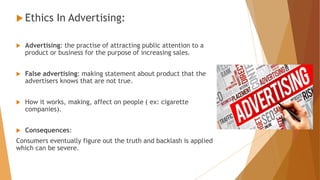
 Advertising: the practise of attracting public attention to a
product or business for the purpose of increasing sales.
 False advertising: making statement about product that the
advertisers knows that are not true.
 How it works, making, affect on people ( ex: cigarette
companies).
 Consequences:
Consumers eventually figure out the truth and backlash is applied
which can be severe.
 Ethical Problems In Advertising:
1) Puffery statements that are not outright
lies(exaggerations)
Ex: gum company exaggerating about best taste of their
gum.
Note: FTC(Federal Trade Commission) regulates
advertisings.
2) Bait and switch: advertising a product at low price while
stocks are less ( luring costumers to buy more expensive
items).
3) Advertising to children: law is passed to protect children
from deception and manipulation.
4) Telemarketing: selling directly to people through
unsolicited phone calls, emails, faxes.
(Laws allows people to sign up to do not call list).
 Ethical standards:
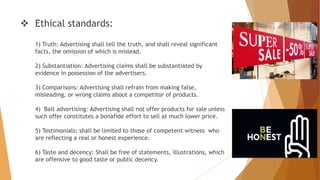
1) Truth: Advertising shall tell the truth, and shall reveal significant
facts, the omission of which is mislead.
2) Substantiation: Advertising claims shall be substantiated by
evidence in possession of the advertisers.
3) Comparisons: Advertising shall refrain from making false,
misleading, or wrong claims about a competitor of products.
4) Bait advertising: Advertising shall not offer products for sale unless
such offer constitutes a bonafide effort to sell at much lower price.
5) Testimonials: shall be limited to those of competent witness who
are reflecting a real or honest experience.
6) Taste and decency: Shall be free of statements, illustrations, which
are offensive to good taste or public decency.
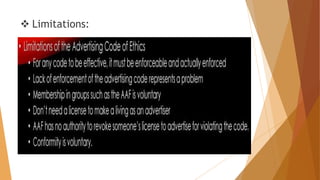
 Limitations:
Ethics In Advertising.pptx

Ethics In Advertising.pptx

  • 1.
  • 2.
     Ethics InAdvertising:  Advertising: the practise of attracting public attention to a product or business for the purpose of increasing sales.  False advertising: making statement about product that the advertisers knows that are not true.  How it works, making, affect on people ( ex: cigarette companies).  Consequences: Consumers eventually figure out the truth and backlash is applied which can be severe.
  • 3.
     Ethical ProblemsIn Advertising: 1) Puffery statements that are not outright lies(exaggerations) Ex: gum company exaggerating about best taste of their gum. Note: FTC(Federal Trade Commission) regulates advertisings. 2) Bait and switch: advertising a product at low price while stocks are less ( luring costumers to buy more expensive items). 3) Advertising to children: law is passed to protect children from deception and manipulation. 4) Telemarketing: selling directly to people through unsolicited phone calls, emails, faxes. (Laws allows people to sign up to do not call list).
  • 4.
     Ethical standards: 1)Truth: Advertising shall tell the truth, and shall reveal significant facts, the omission of which is mislead. 2) Substantiation: Advertising claims shall be substantiated by evidence in possession of the advertisers. 3) Comparisons: Advertising shall refrain from making false, misleading, or wrong claims about a competitor of products. 4) Bait advertising: Advertising shall not offer products for sale unless such offer constitutes a bonafide effort to sell at much lower price. 5) Testimonials: shall be limited to those of competent witness who are reflecting a real or honest experience. 6) Taste and decency: Shall be free of statements, illustrations, which are offensive to good taste or public decency.
  • 5.