Copyright © 2007 by The McGraw-Hill Companies, Inc. All rights reserved.
Reporting and
Interpreting
Liabilities
Chapter 9
9-2
Understanding the Business
The acquisition of assets is financed from two
sources:
Debt - funds
from creditors
Equity - funds
from owners
9-3
Understanding the Business
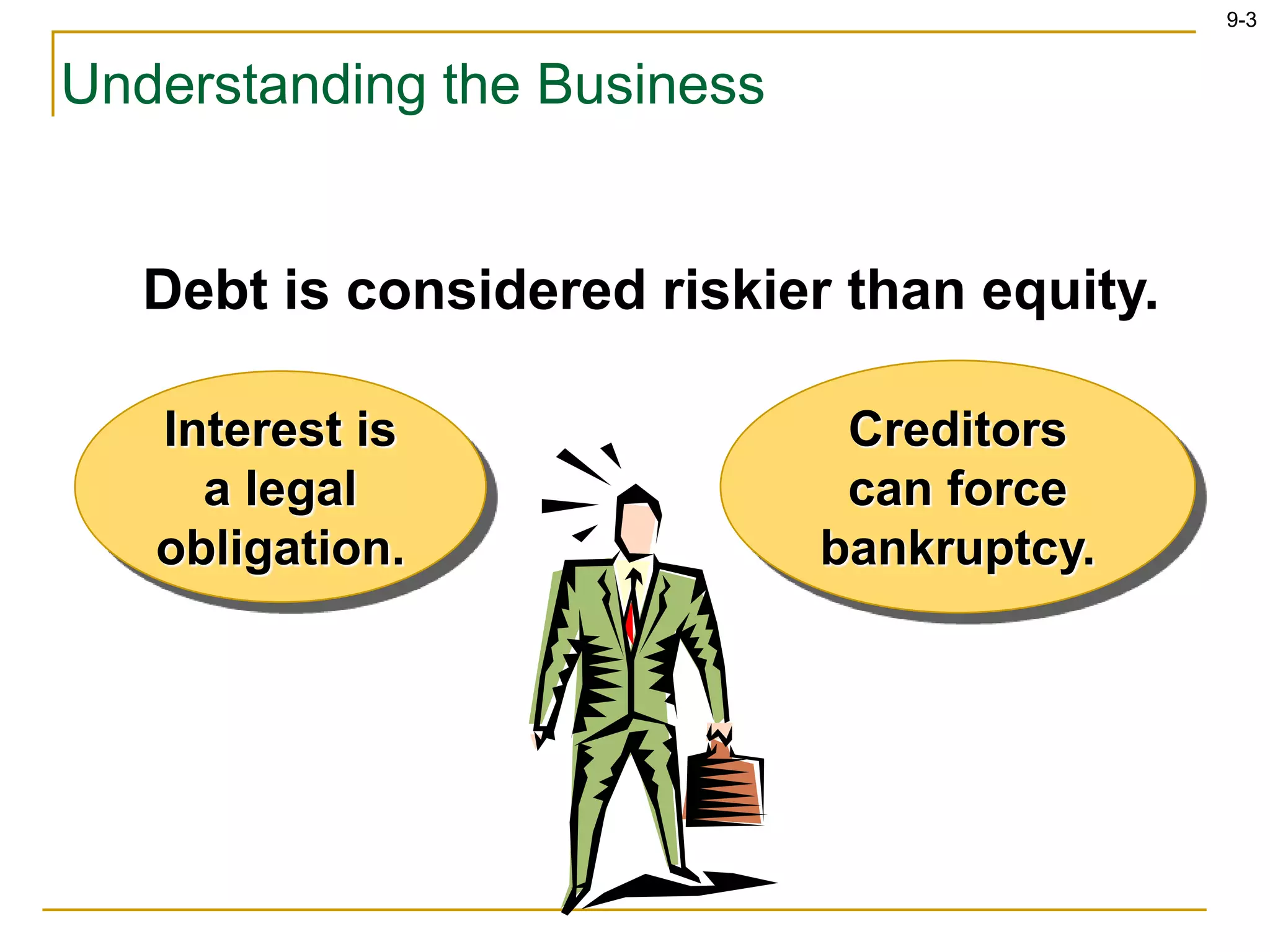
Debt is considered riskier than equity.
Interest is
a legal
obligation.
Creditors
can force
bankruptcy.
9-4
Learning Objectives
Define, measure, and report current liabilities.
9-5
Liabilities Defined and Classified
Defined as probable debts or obligations of the
entity that result from past transactions, which will
be paid with assets or services.
Maturity = 1 year or less Maturity > 1 year
Current
Liabilities
Noncurrent
Liabilities
9-6
Liabilities Defined and Classified
Liabilities are measured
at their current cash
equivalent (the amount
a creditor would accept
to cancel the debt) at
the time incurred.
9-7
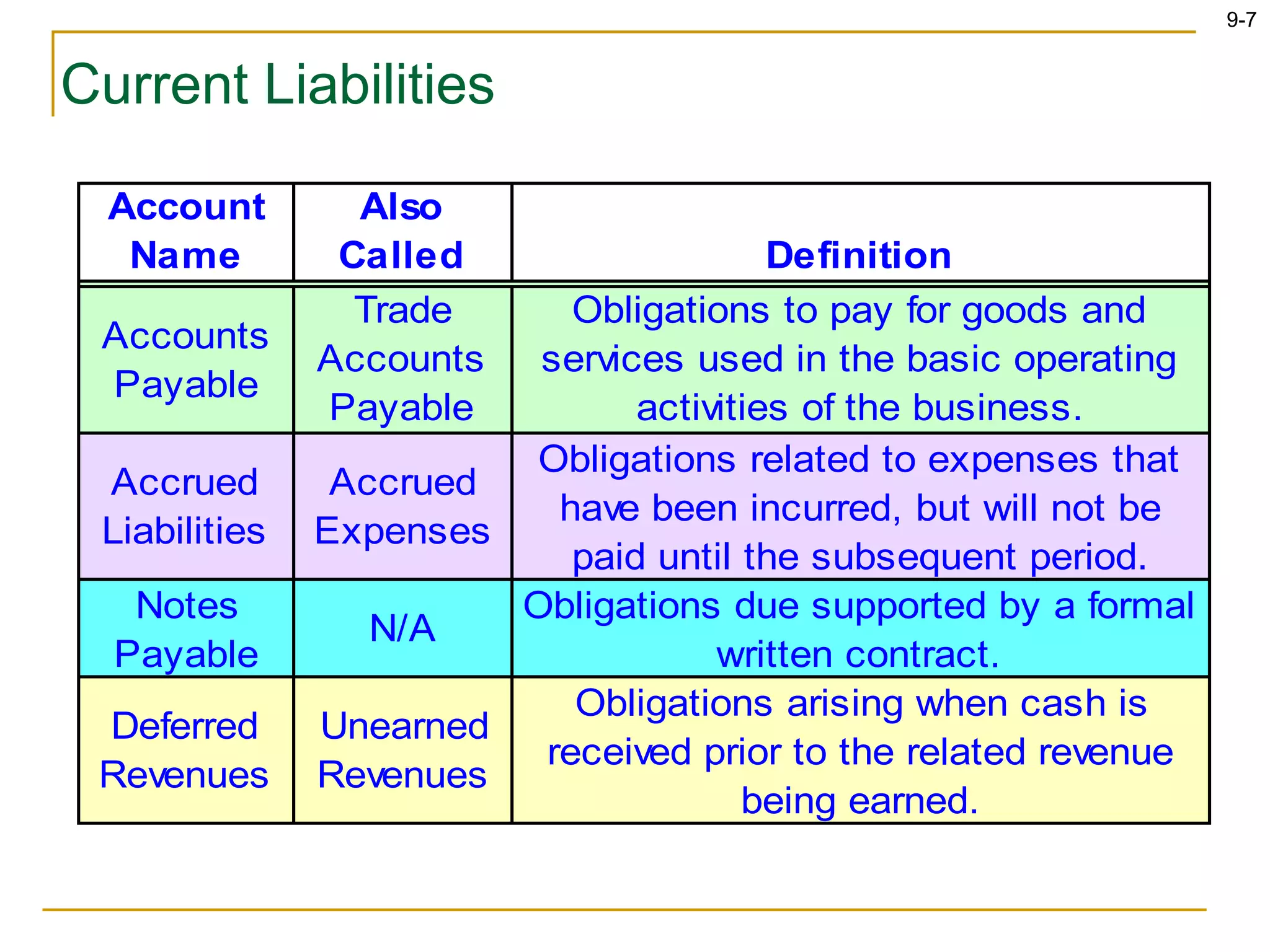
Current Liabilities
Account
Name
Also
Called Definition
Accounts
Payable
Trade
Accounts
Payable
Obligations to pay for goods and
services used in the basic operating
activities of the business.
Accrued
Liabilities
Accrued
Expenses
Obligations related to expenses that
have been incurred, but will not be
paid until the subsequent period.
Notes
Payable
N/A
Obligations due supported by a formal
written contract.
Deferred
Revenues
Unearned
Revenues
Obligations arising when cash is
received prior to the related revenue
being earned.
9-8
Net Pay
Medicare
Tax
State and
Local Income
Taxes
Social
Security
Tax
Federal
Income Tax
Voluntary
Deductions
Gross Pay
Payroll Taxes
Less Deductions:
9-9
Learning Objectives
Use the current ratio.
9-10
Current Ratio
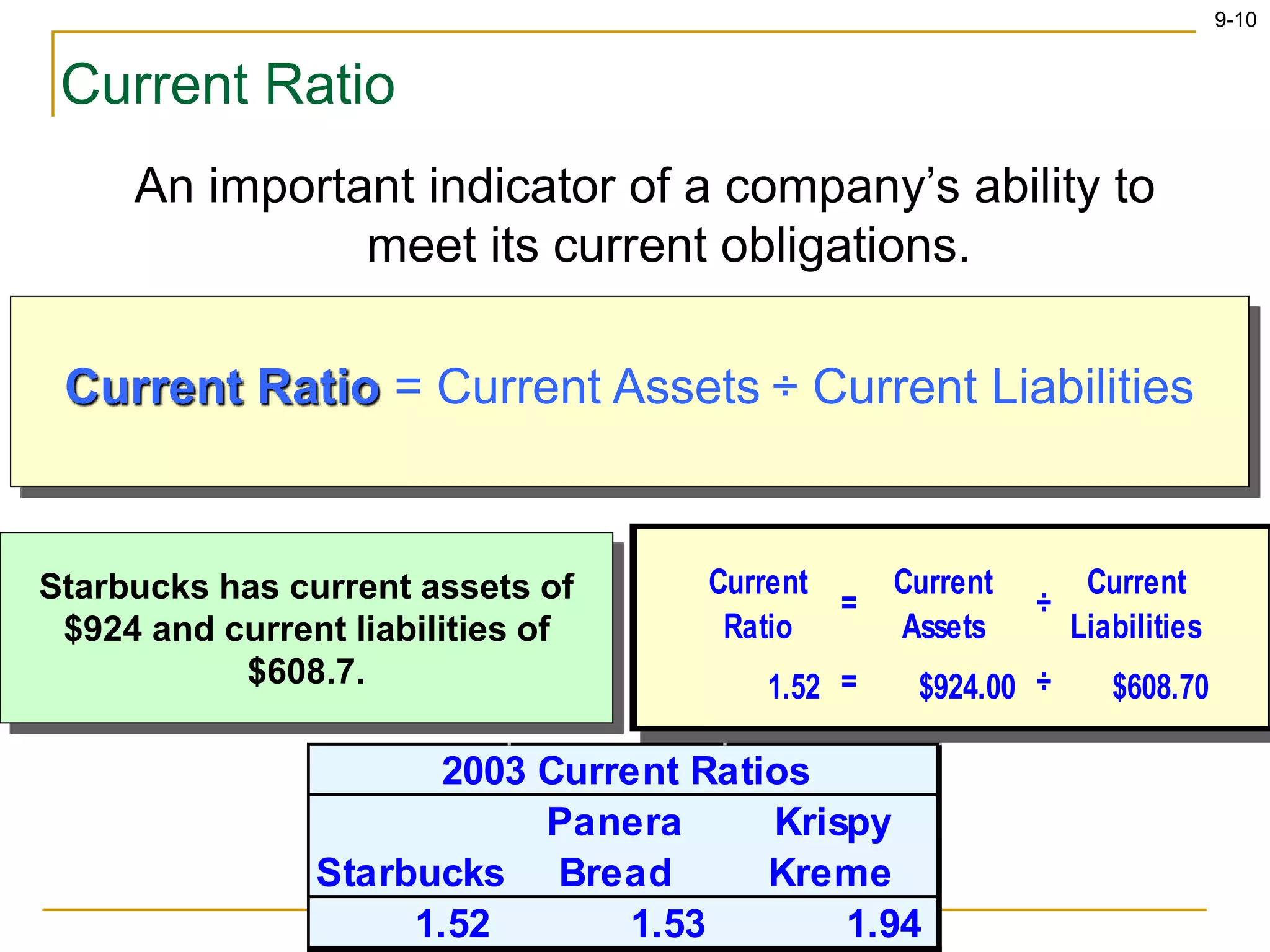
Current Ratio = Current Assets ÷ Current Liabilities
An important indicator of a company’s ability to
meet its current obligations.
Current
Ratio
=
Current
Assets
÷
Current
Liabilities
1.52 = $924.00 ÷ $608.70
Starbucks has current assets of
$924 and current liabilities of
$608.7.
Starbucks
Panera
Bread
Krispy
Kreme
1.52 1.53 1.94
2003 Current Ratios
9-11
Learning Objectives
Analyze the accounts payable turnover ratio.
9-12
Accounts Payable Turnover Ratio
Accounts
Payable
Turnover
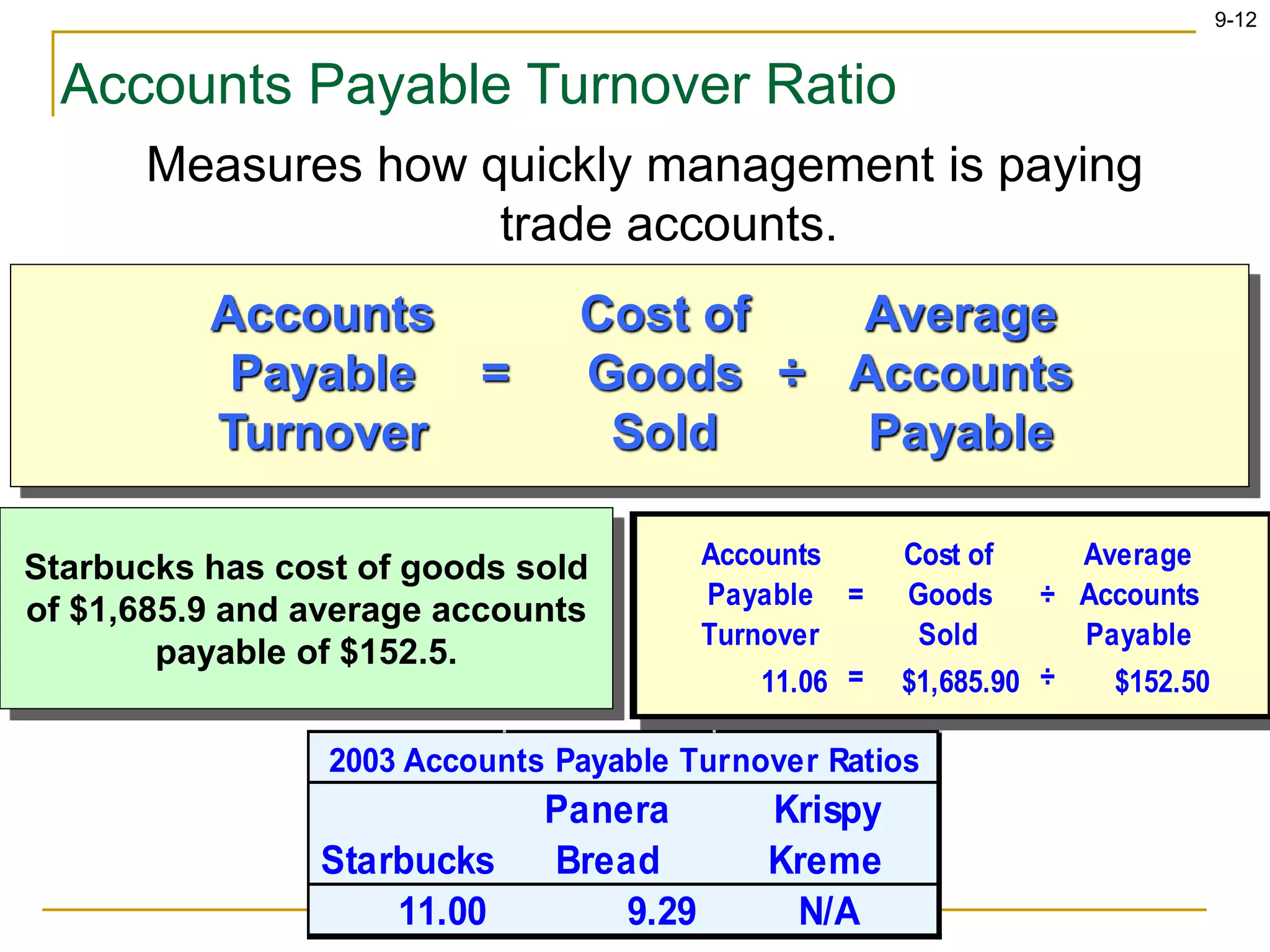
Measures how quickly management is paying
trade accounts.
Accounts
Payable
Turnover
=
Cost of
Goods
Sold
÷
Average
Accounts
Payable
11.06 = $1,685.90 ÷ $152.50
Starbucks has cost of goods sold
of $1,685.9 and average accounts
payable of $152.5.
Cost of
Goods
Sold
Average
Accounts
Payable
= ÷
Starbucks
Panera
Bread
Krispy
Kreme
11.00 9.29 N/A
2003 Accounts Payable Turnover Ratios
9-13
Learning Objectives
Report notes payable and explain the time
value of money.
9-14
Notes Payable
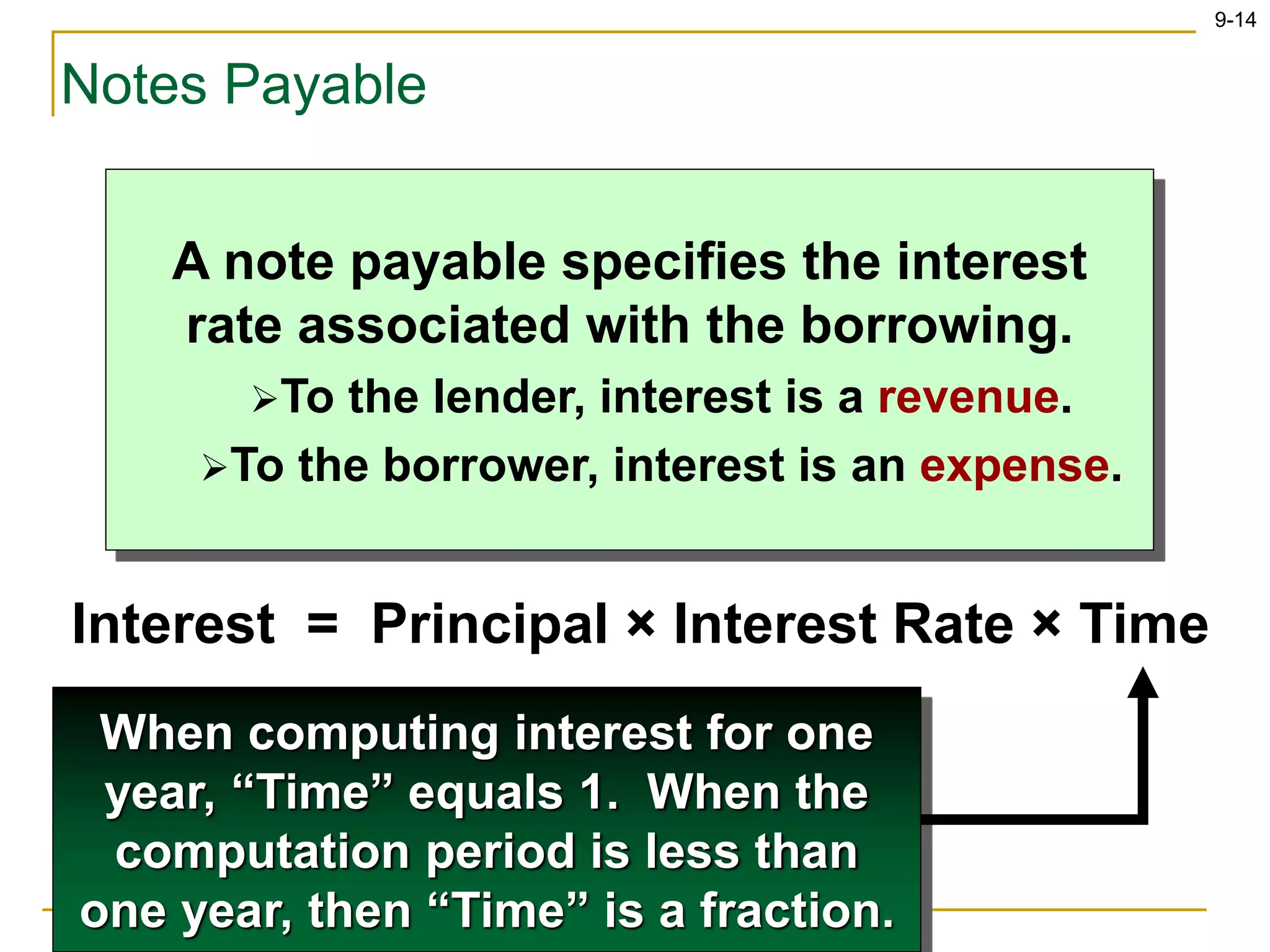
A note payable specifies the interest
rate associated with the borrowing.
To the lender, interest is a revenue.
To the borrower, interest is an expense.
Interest = Principal × Interest Rate × Time
When computing interest for one
year, “Time” equals 1. When the
computation period is less than
one year, then “Time” is a fraction.
9-15
Notes Payable
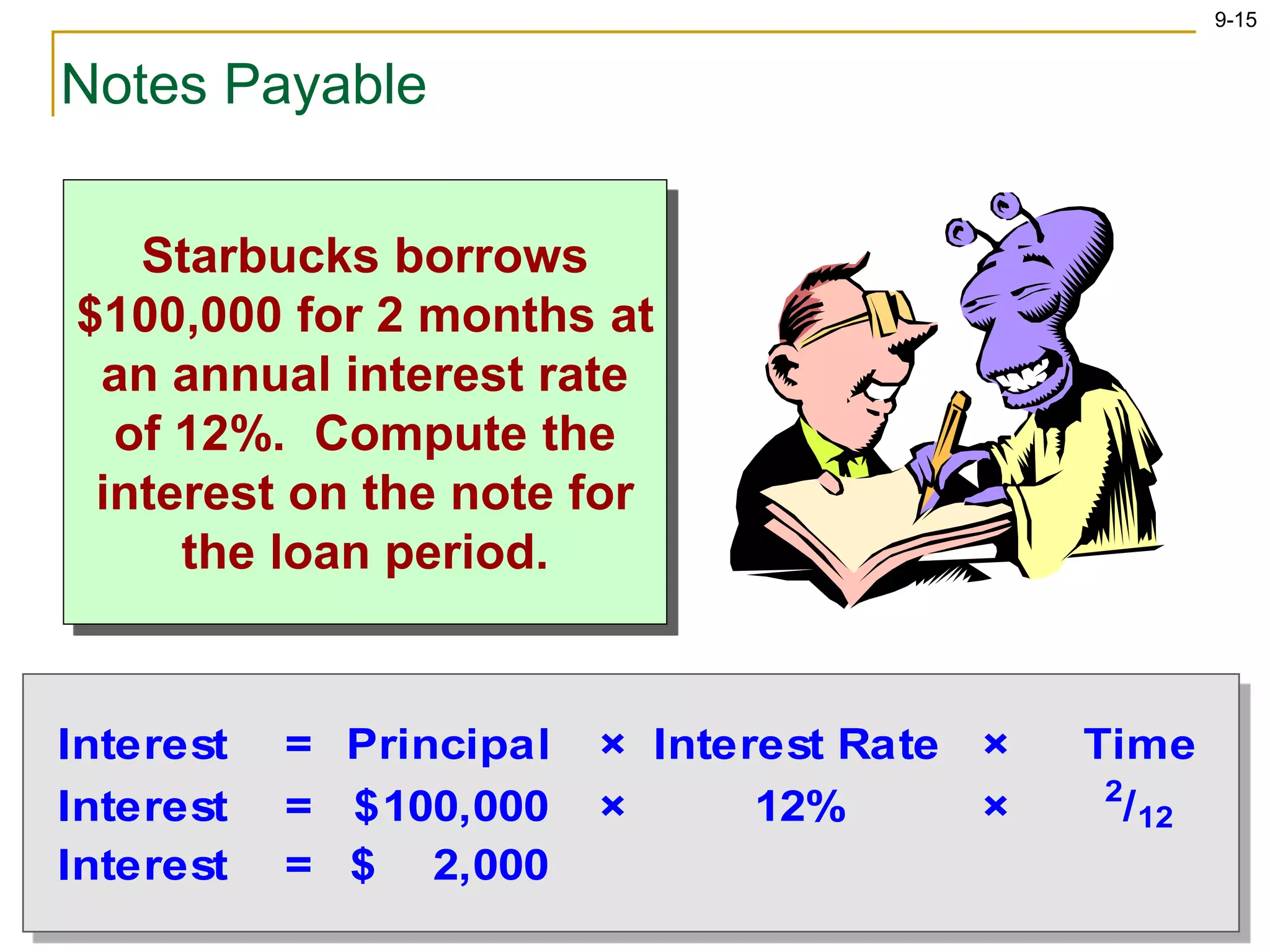
Starbucks borrows
$100,000 for 2 months at
an annual interest rate
of 12%. Compute the
interest on the note for
the loan period.
Interest = Principal × Interest Rate × Time
Interest = 100,000
$ × 12% × 2
/12
Interest = 2,000
$
9-16
Learning Objectives
Report contingent liabilities.
9-17
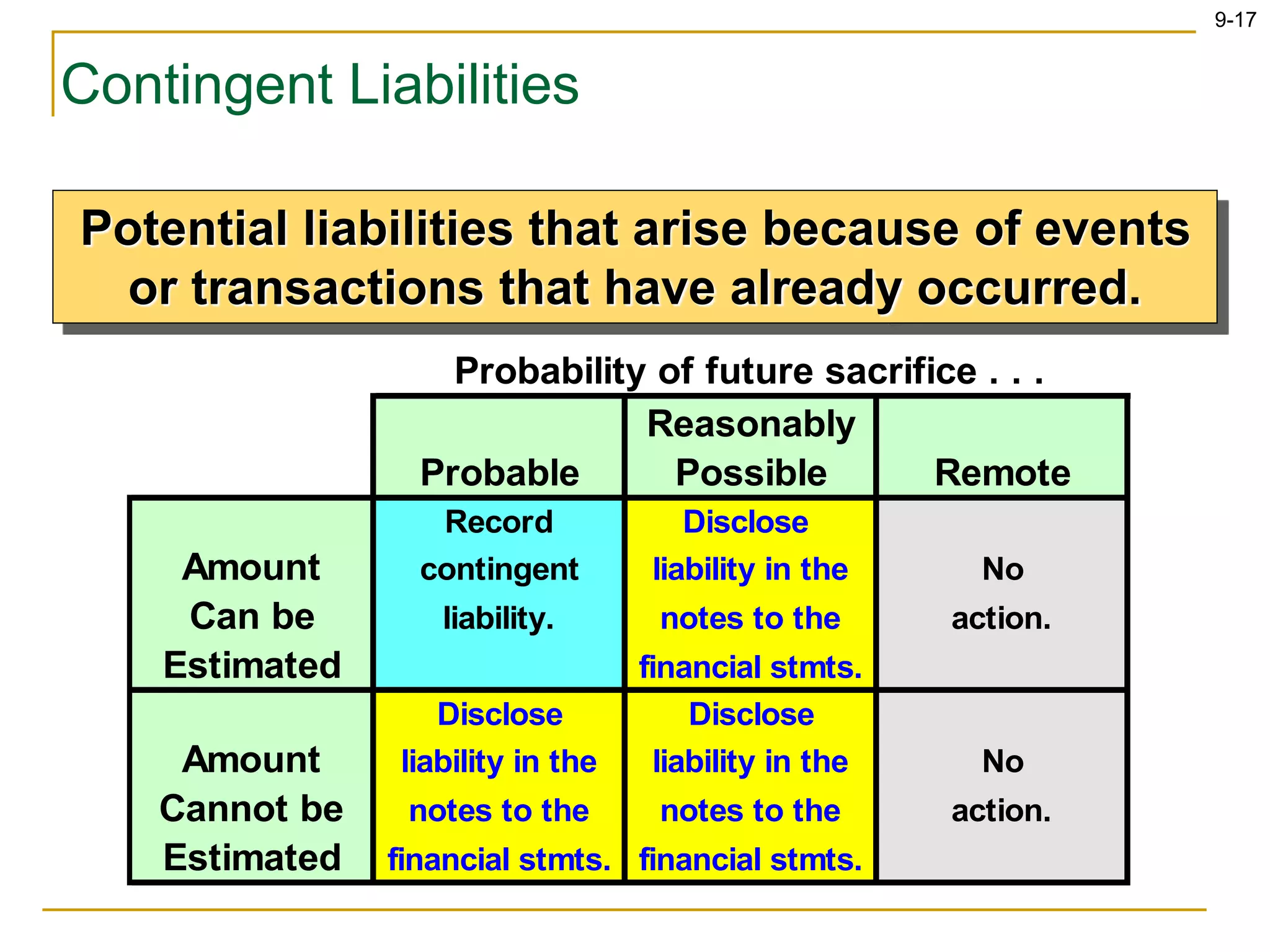
Contingent Liabilities
Probability of future sacrifice . . .
Reasonably
Probable Possible Remote
Record Disclose
Amount contingent liability in the No
Can be liability. notes to the action.
Estimated financial stmts.
Disclose Disclose
Amount liability in the liability in the No
Cannot be notes to the notes to the action.
Estimated financial stmts. financial stmts.
Potential liabilities that arise because of events
or transactions that have already occurred.
9-18
Learning Objectives
Explain the importance of working capital and
its impact on cash flows.
9-19
Working Capital Management
Changes in working capital accounts affect
cash flows as indicated in the following
table.
Change in Account Balance During Year
Increase Decrease
Current Reduce cash Increase cash
Assets flows. flows.
Current Increase cash Reduce cash
Liabilities flows. flows.
Working Capital = Current Assets - Current Liabilities
9-20
Learning Objectives
Report long-term liabilities.
9-21
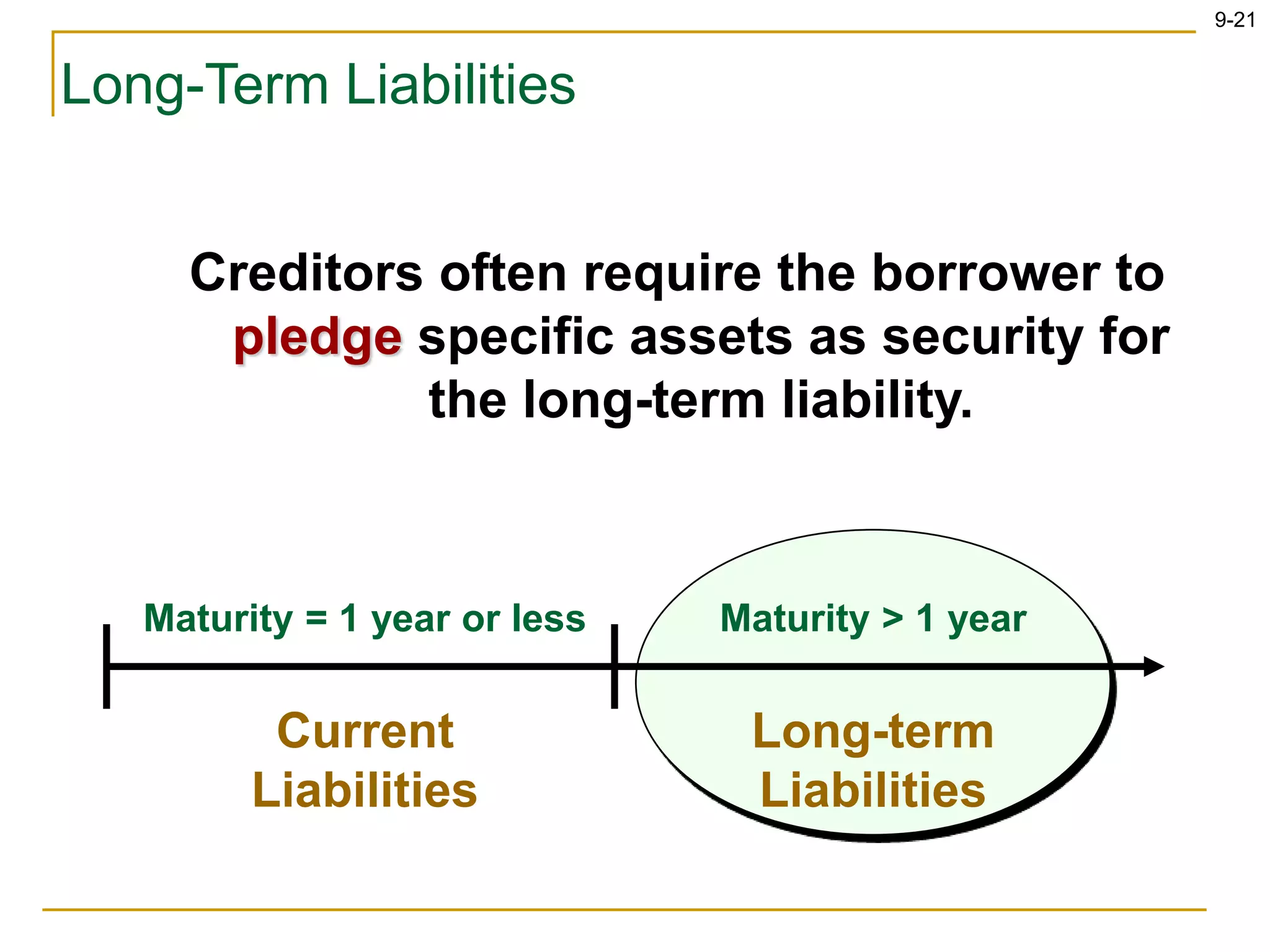
Long-Term Liabilities
Creditors often require the borrower to
pledge specific assets as security for
the long-term liability.
Maturity = 1 year or less Maturity > 1 year
Current
Liabilities
Long-term
Liabilities
9-22
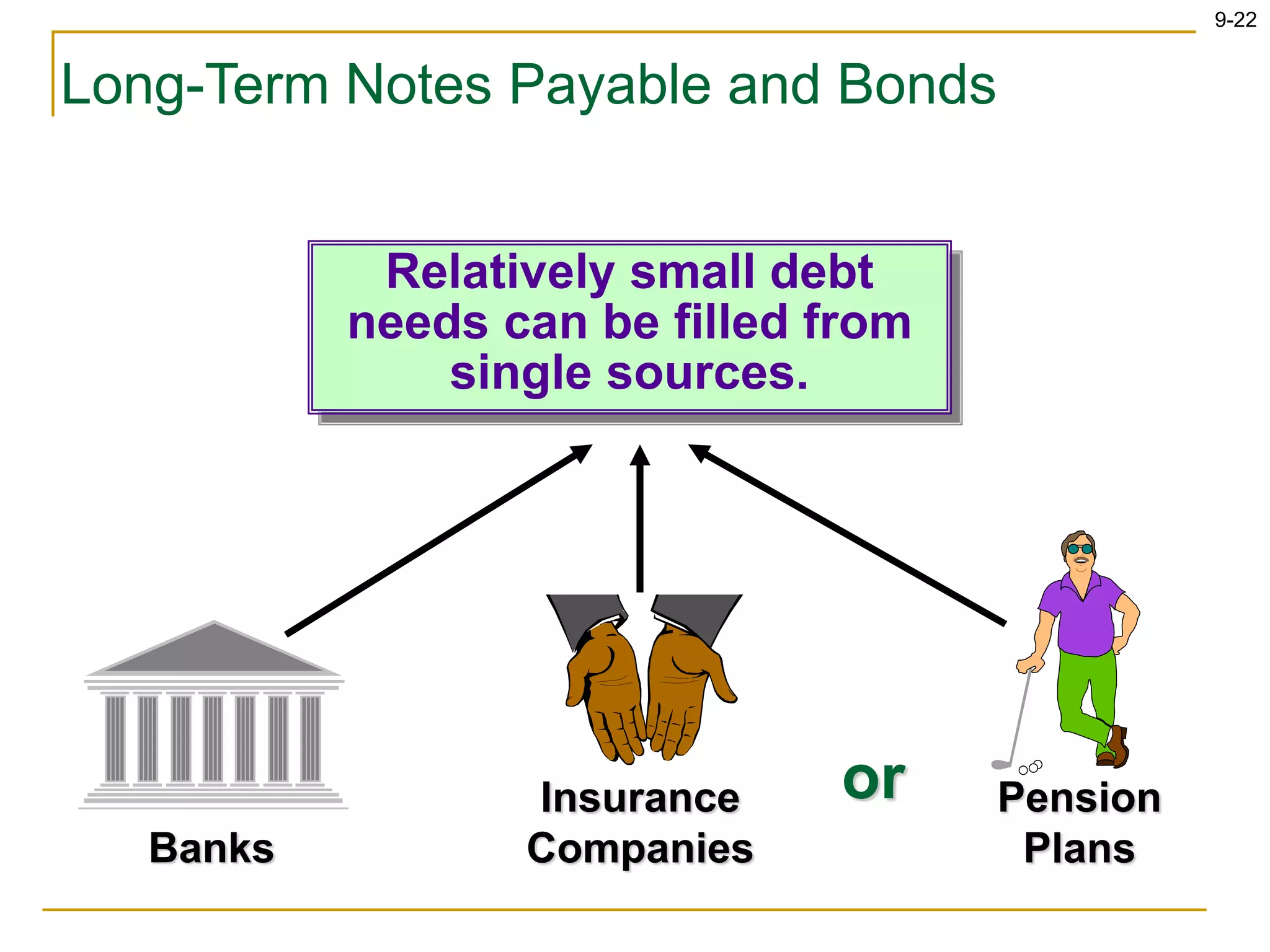
Long-Term Notes Payable and Bonds
Relatively small debt
needs can be filled from
single sources.
Banks
Insurance
Companies
Pension
Plans
or
9-23
Long-Term Notes Payable and Bonds
Significant debt needs are
often filled by issuing
bonds to the public.
Cash
Bonds
9-24
Borrowing in Foreign Currencies
 When a company has operations in a foreign
country, it often borrows in the local currency.
This reduces exchange rate risk.
 Because interest rates vary from country to
country, companies may borrow in the foreign
market with the lowest interest rate.
9-25
Operating and Capital Leases
Operating
Lease
Short-term lease; No
liability or asset
recorded
Capital
Lease
Long-term lease;
Meets one of 4
criteria; Results in
recording an asset
and a liability
Capital Lease Criteria
1. Lease term is 75% or more of the asset’s expected economic life.
2. Ownership of asset is transferred to lessee at end of lease.
3. Lease permits lessee to purchase the asset at a price that is lower than its
fair market value.
4. The present value of the lease payments is 90% or more of the fair market
value of the asset when the lease is signed.
9-26
Learning Objectives
Compute present values.
Apply present value concepts to liabilities.
9-27
Present Value Concepts
Money can grow over time,
because it can earn interest.
$1,000
invested
today at 10%.
In 5 years it
will be worth
$1,610.51.
In 25 years it
will be worth
$10,834.71!
9-28
Present Value Concepts
The growth is a mathematical
function of four variables:
1. The value today (present value).
2. The value in the future (future
value).
3. The interest rate.
4. The time period.
9-29
Present Value Concepts
Most analysts use present value
tables, calculators, or Excel to solve
time value of money problems.
We will use the present value tables in
our illustrations (an explanation of
how to use Excel is included in the
supplement to this chapter).
9-30
Present Value of a Single Amount
The present value of a single amount is
the worth to you today of receiving that
amount some time in the future.
Today
Present
Value
Future
Future
Value
Interest compounding periods
9-31
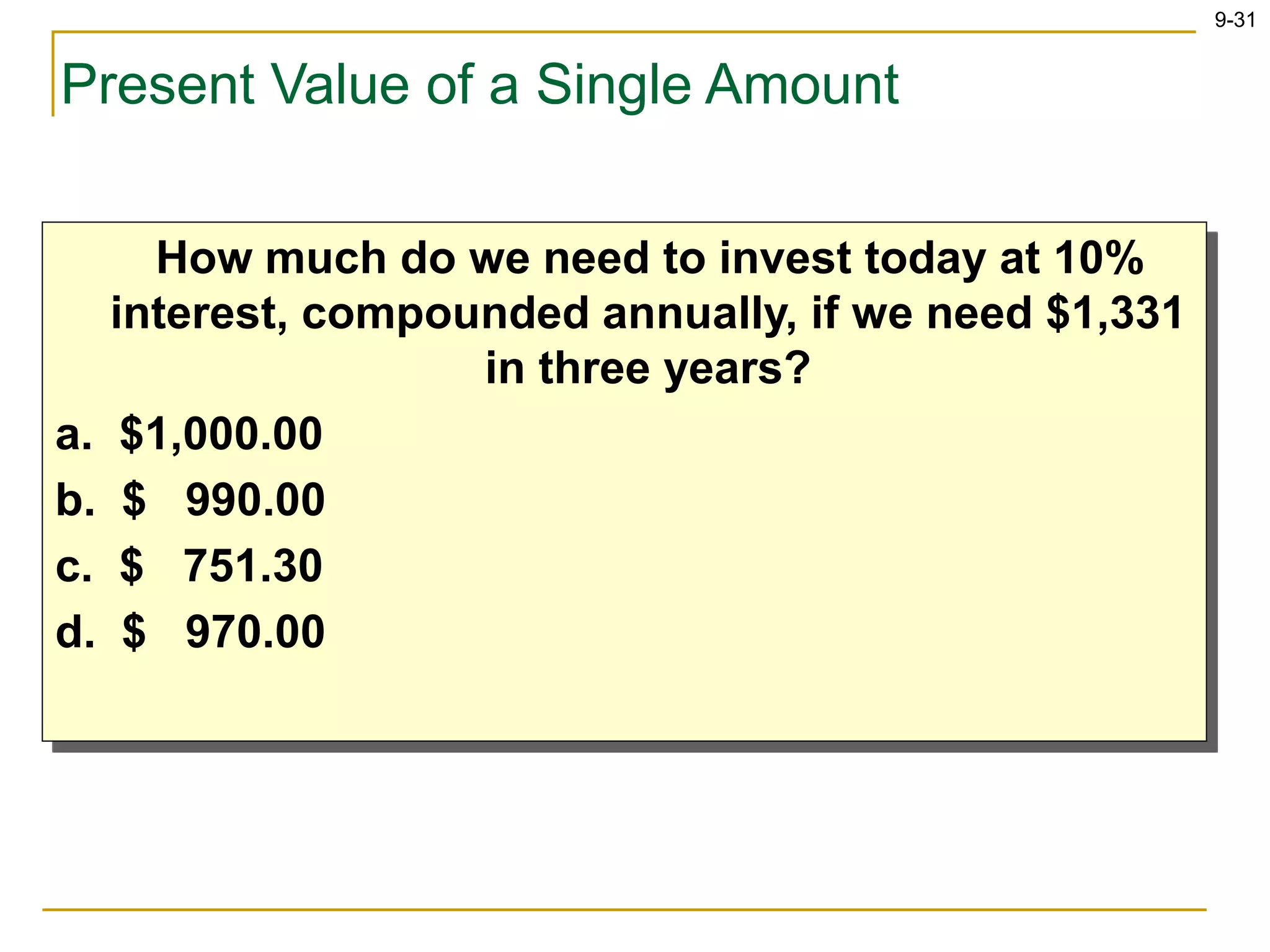
Present Value of a Single Amount
How much do we need to invest today at 10%
interest, compounded annually, if we need $1,331
in three years?
a. $1,000.00
b. $ 990.00
c. $ 751.30
d. $ 970.00
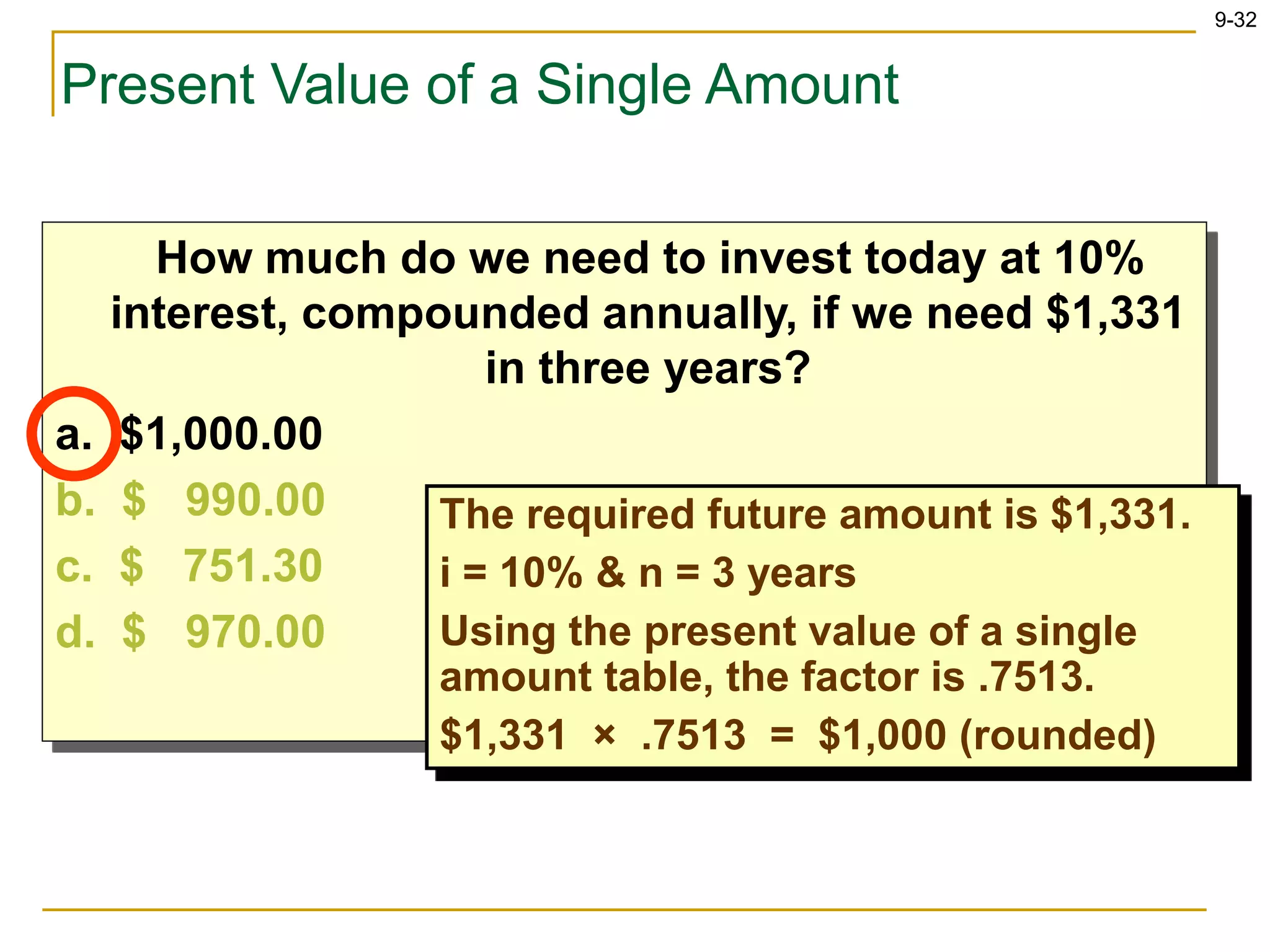
9-32
How much do we need to invest today at 10%
interest, compounded annually, if we need $1,331
in three years?
a. $1,000.00
b. $ 990.00
c. $ 751.30
d. $ 970.00
Present Value of a Single Amount
The required future amount is $1,331.
i = 10% & n = 3 years
Using the present value of a single
amount table, the factor is .7513.
$1,331 × .7513 = $1,000 (rounded)
9-33
Present Values of an Annuity
An annuity is a series of consecutive
equal periodic payments.
Today
9-34
Present Values of an Annuity
What is the value today of a series of
payments to be received or paid out in
the future?
Today
Present
Value
Interest compounding periods
Payment 1 Payment 2 Payment 3
9-35
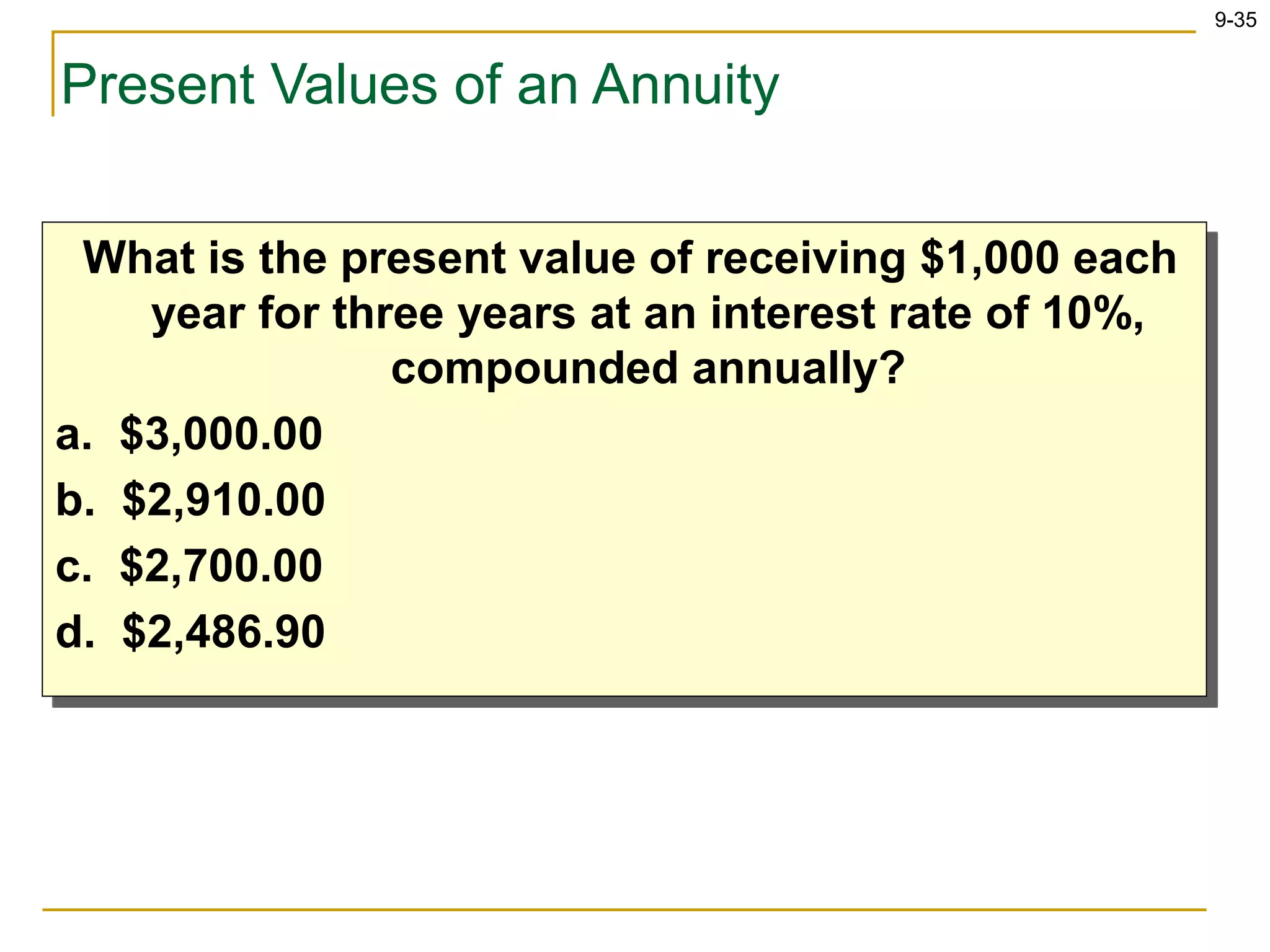
Present Values of an Annuity
What is the present value of receiving $1,000 each
year for three years at an interest rate of 10%,
compounded annually?
a. $3,000.00
b. $2,910.00
c. $2,700.00
d. $2,486.90
9-36
What is the present value of receiving $1,000 each
year for three years at an interest rate of 10%,
compounded annually?
a. $3,000.00
b. $2,910.00
c. $2,700.00
d. $2,486.90
Present Values of an Annuity
The consecutive equal payment
amount is $1,000.
i = 10% & n = 3 years
Using the present value of an
annuity table, the factor is 2.4869.
$1,000 × 2.4869 = $2,486.90
9-37
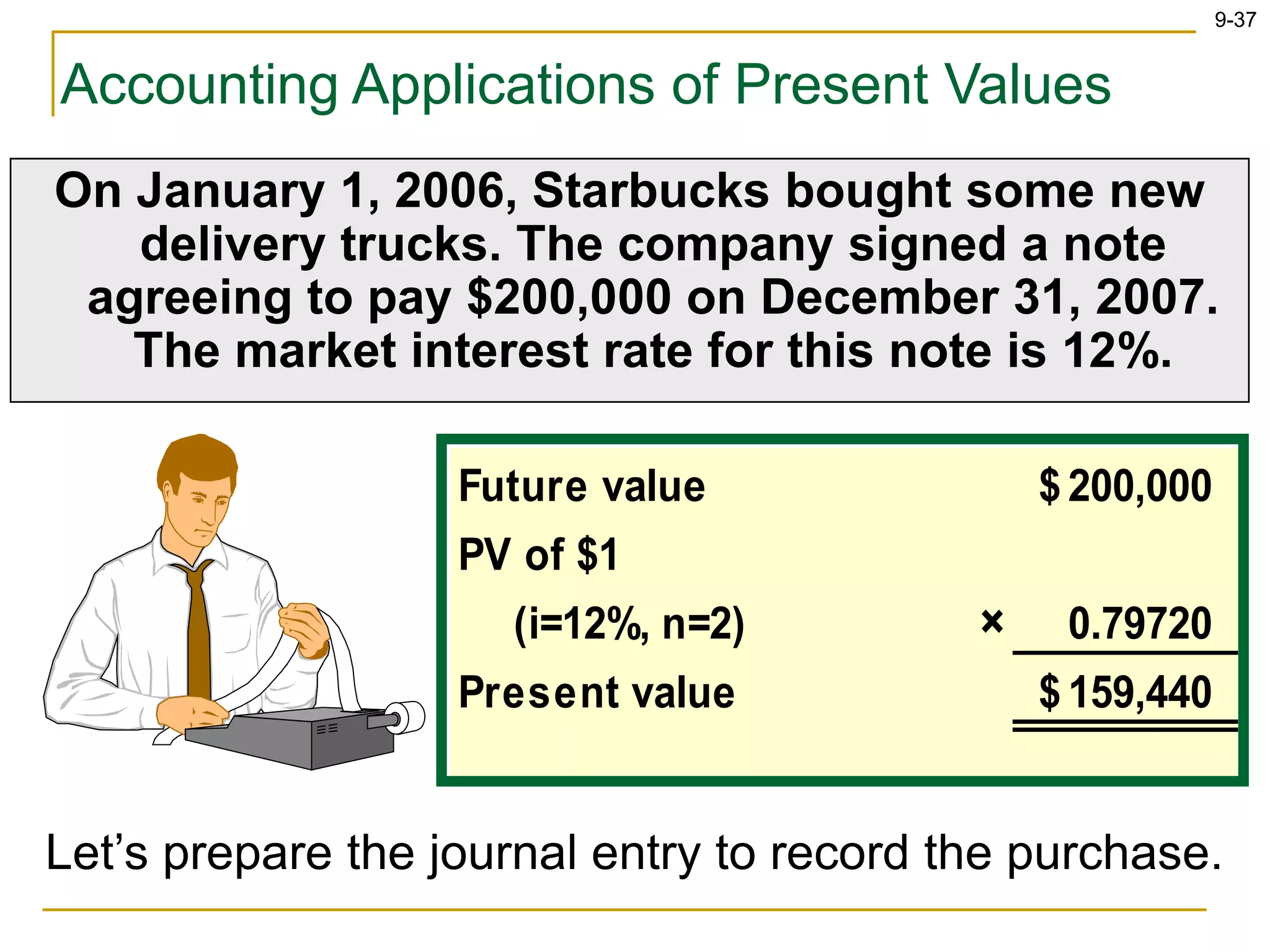
Accounting Applications of Present Values
On January 1, 2006, Starbucks bought some new
delivery trucks. The company signed a note
agreeing to pay $200,000 on December 31, 2007.
The market interest rate for this note is 12%.
Future value 200,000
$
PV of $1
(i=12%, n=2) × 0.79720
Present value 159,440
$
Let’s prepare the journal entry to record the purchase.
9-38
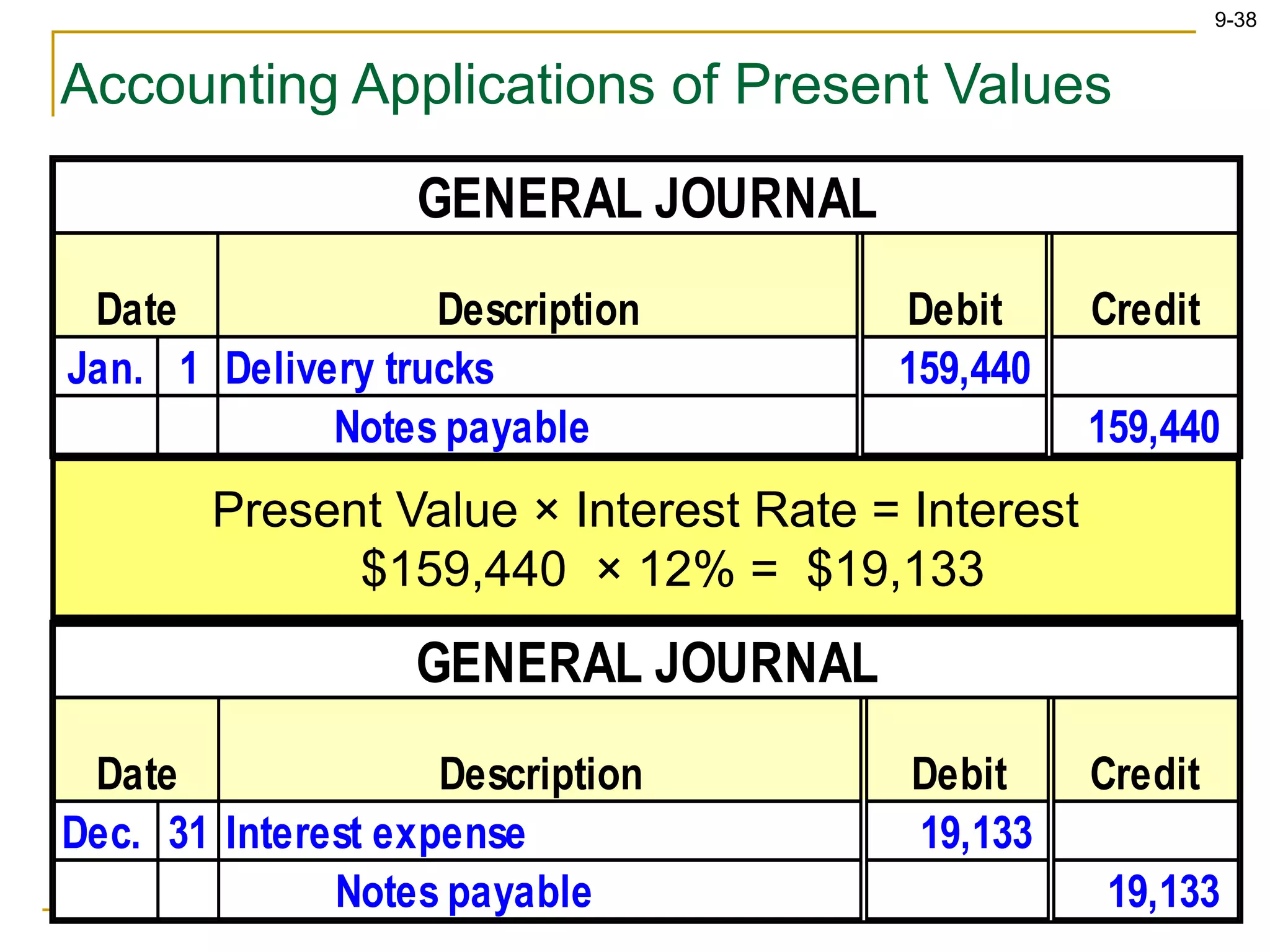
Accounting Applications of Present Values
Debit Credit
Jan. 1 Delivery trucks 159,440
Notes payable 159,440
Date Description
GENERAL JOURNAL
Now, let’s look at the journal entry at December 31,
2006.
Debit Credit
Dec. 31 Interest expense 19,133
Notes payable 19,133
Date Description
GENERAL JOURNAL
Present Value × Interest Rate = Interest
$159,440 × 12% = $19,133
9-39
Accounting Applications of Present Values
Now, let’s look at the journal entries at December 31,
2007.
Debit Credit
Dec. 31 Interest expense 21,429
Notes payable 21,429
31 Notes payable 200,000
Cash 200,000
Date Description
GENERAL JOURNAL
Present Value × Interest Rate = Interest
($159,440 + $19,133) × 12% = $21,429
9-40
Income Taxes and Retirement
Benefits
Chapter Supplement A
9-41
Income Taxes and Retirement Benefits
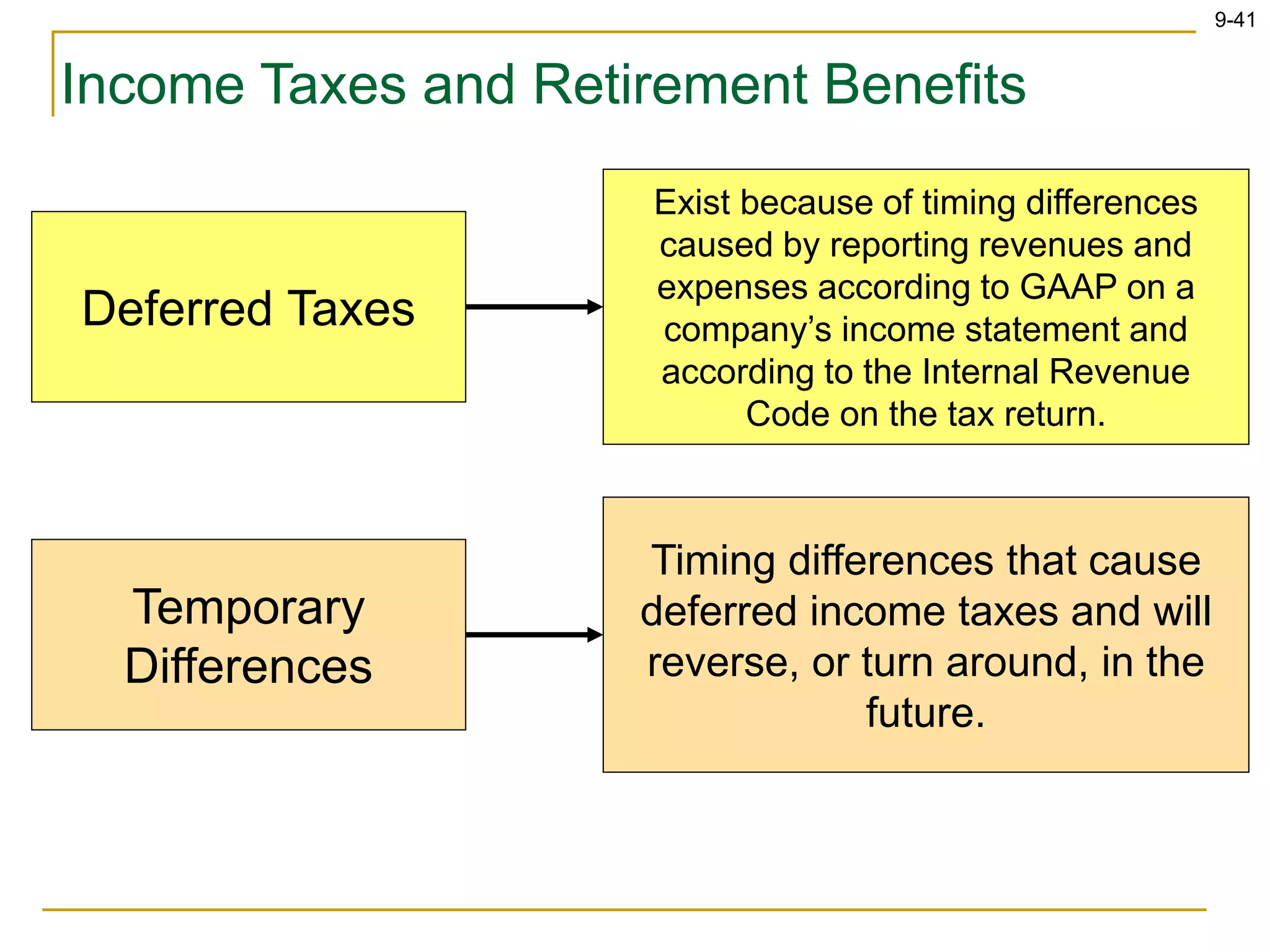
Deferred Taxes
Exist because of timing differences
caused by reporting revenues and
expenses according to GAAP on a
company’s income statement and
according to the Internal Revenue
Code on the tax return.
Temporary
Differences
Timing differences that cause
deferred income taxes and will
reverse, or turn around, in the
future.
9-42
Income Taxes and Retirement Benefits
Some pension plans
create obligations during
employees’ service periods
that must be paid during
their retirement periods.
The amounts contributed
during the employment
period are determined
using present value
computations of the
estimate of the future
amount to be paid during
retirement.
9-43
Federal Income Tax Concepts
Chapter Supplement B
9-44
Federal Income Tax Concepts
Corporations
Are separate legal entities and
are required to pay income
taxes.
Tax Obligation
Determined by multiplying
taxable income by the corporate
tax rate.
9-45
Revenue and Expense Recognition for
Income Tax Purposes
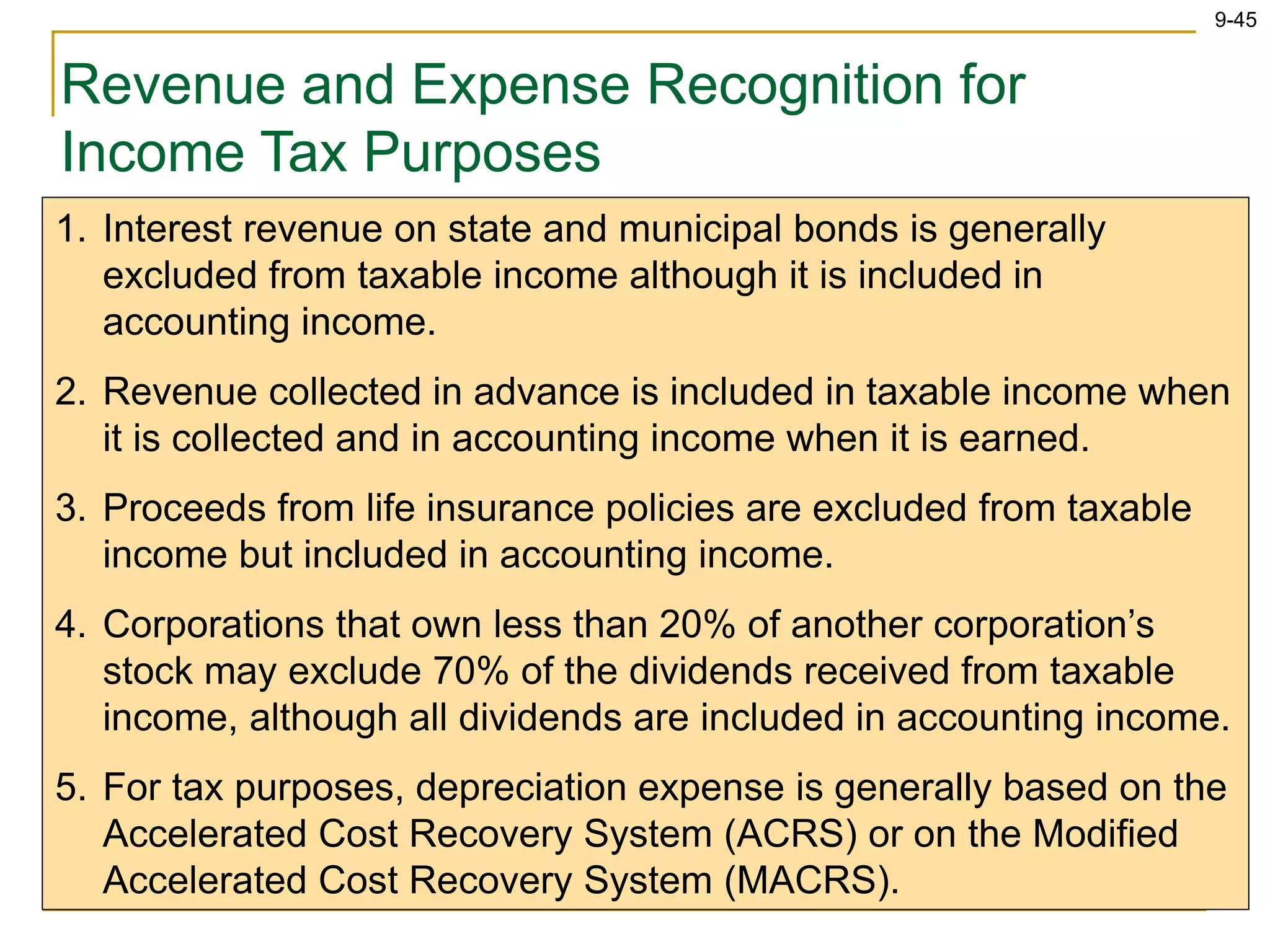
1. Interest revenue on state and municipal bonds is generally
excluded from taxable income although it is included in
accounting income.
2. Revenue collected in advance is included in taxable income when
it is collected and in accounting income when it is earned.
3. Proceeds from life insurance policies are excluded from taxable
income but included in accounting income.
4. Corporations that own less than 20% of another corporation’s
stock may exclude 70% of the dividends received from taxable
income, although all dividends are included in accounting income.
5. For tax purposes, depreciation expense is generally based on the
Accelerated Cost Recovery System (ACRS) or on the Modified
Accelerated Cost Recovery System (MACRS).
9-46
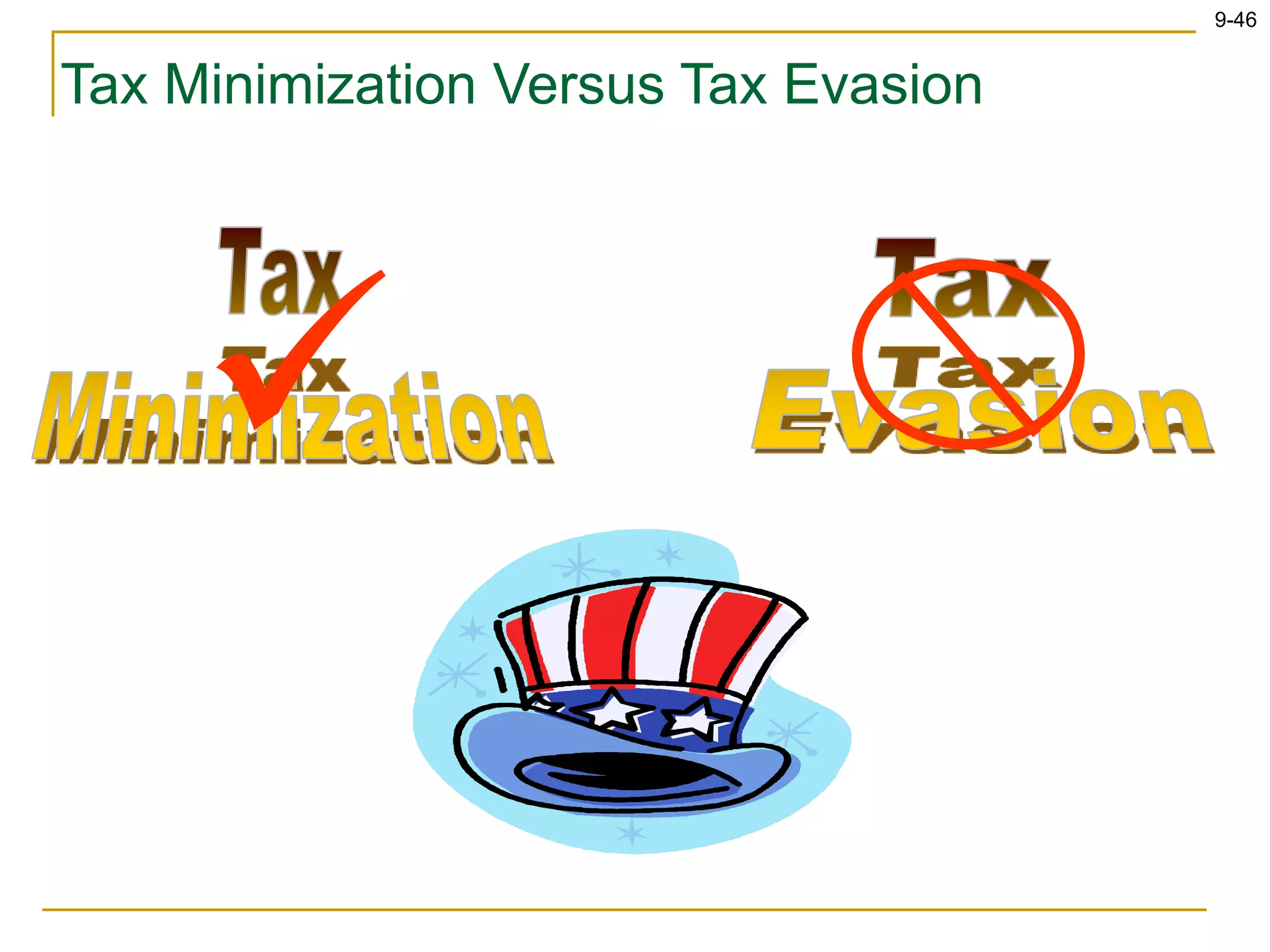
Tax Minimization Versus Tax Evasion

9-47
Present Value Computations
Using Excel
Chapter Supplement C
9-48
Present Value Computations Using Excel
Use the present value of an annuity formula
programmed in Excel by selecting the
function button (fx). In the drop down
menu, under the Select Category heading,
pick "Financial" and scroll down under
Select Function and click on "PV." In the
new drop down box, enter the specific
information for your problem and click
"OK."
= Payment/(1 + i)^n
Present Value of A Single Amount Formula
Present Value of An Annuity Formula
9-49
Future Value Concepts
Chapter Supplement D
9-50
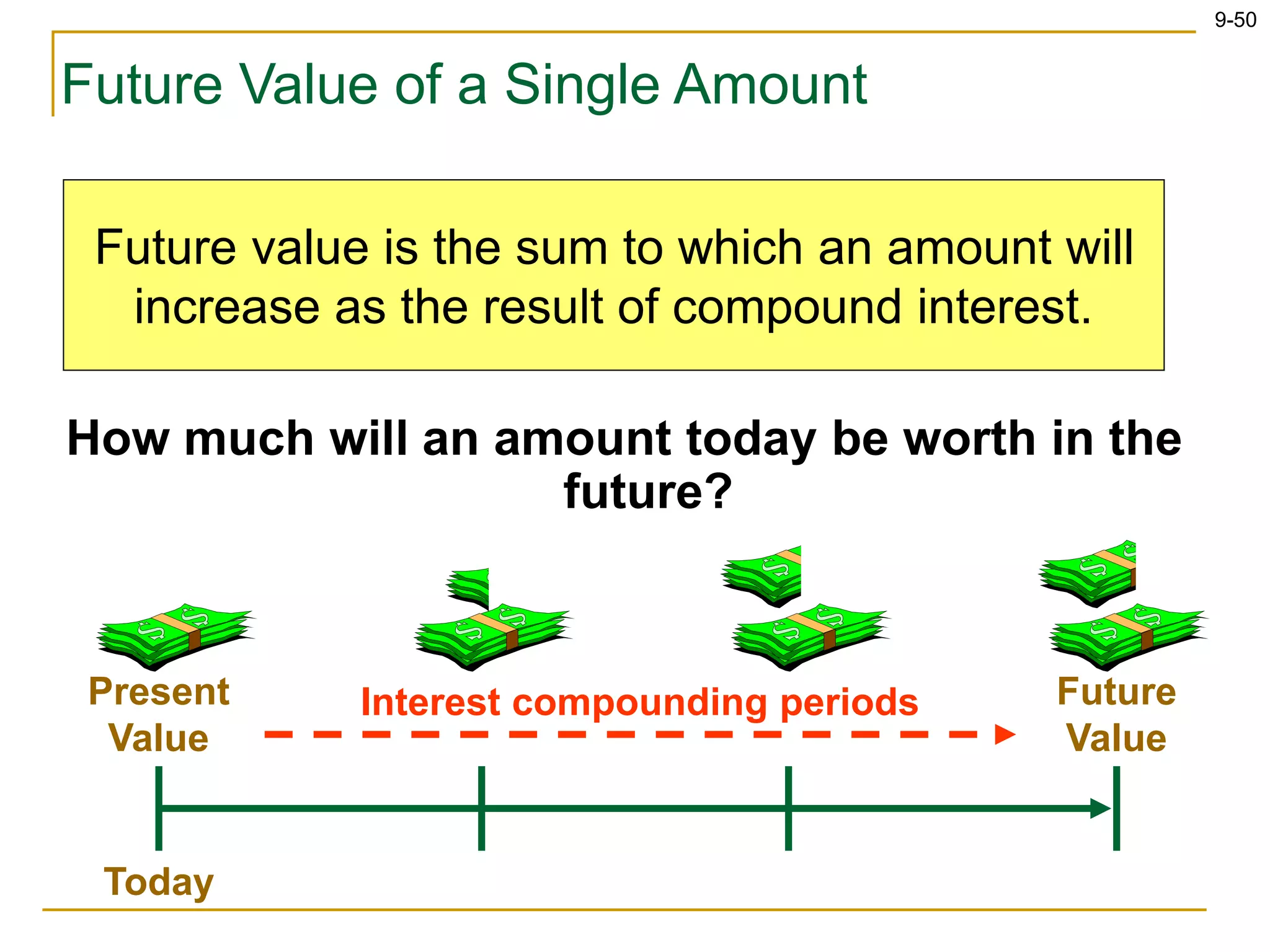
Future Value of a Single Amount
How much will an amount today be worth in the
future?
Today
Present
Value
Future
Value
Interest compounding periods
Future value is the sum to which an amount will
increase as the result of compound interest.
9-51
Future Value of a Single Amount
If we invest $1,000 today earning 10% interest,
compounded annually, how much will it be worth
in three years?
a. $1,000
b. $1,010
c. $1,100
d. $1,331
9-52
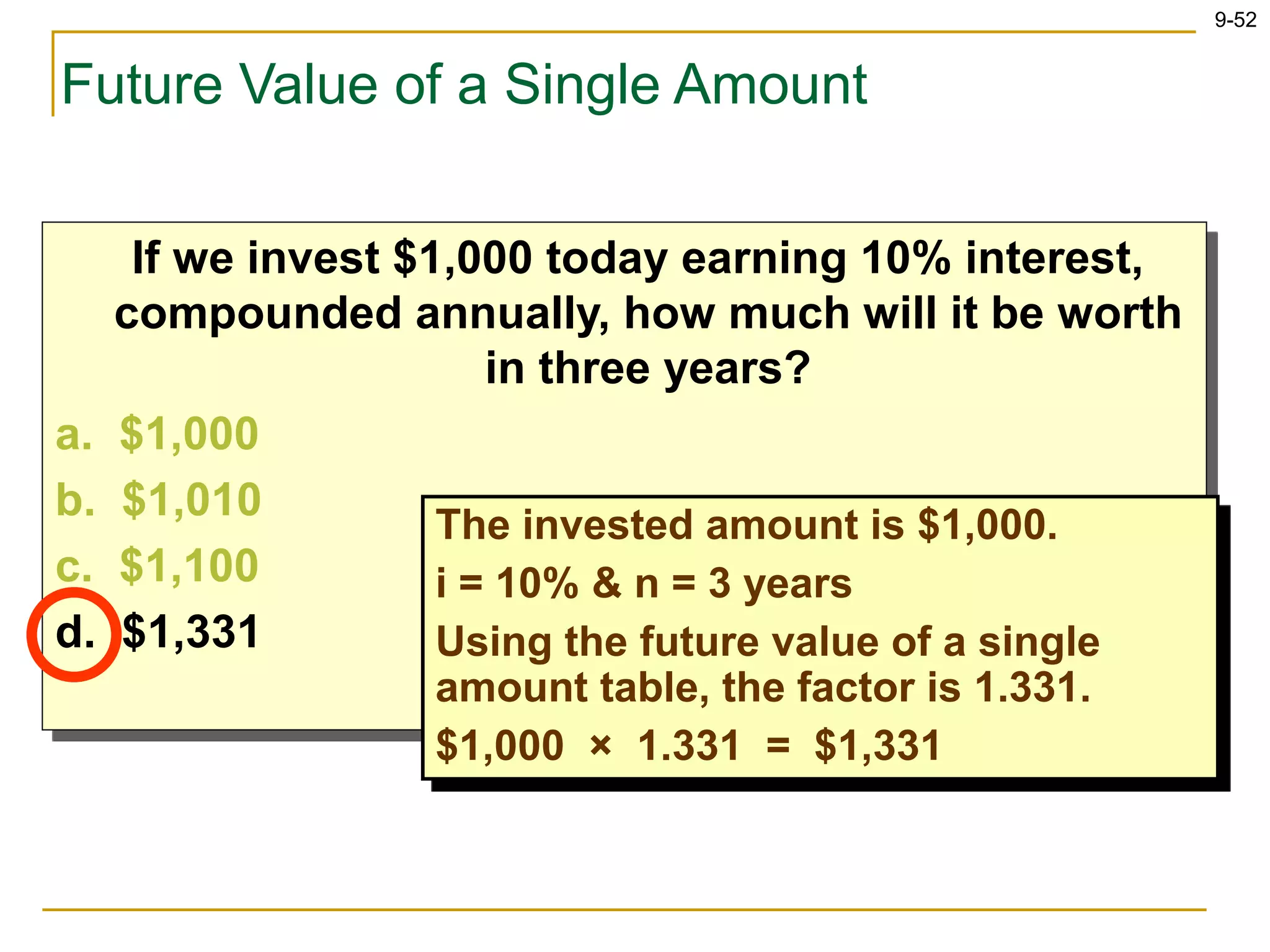
If we invest $1,000 today earning 10% interest,
compounded annually, how much will it be worth
in three years?
a. $1,000
b. $1,010
c. $1,100
d. $1,331
Future Value of a Single Amount
The invested amount is $1,000.
i = 10% & n = 3 years
Using the future value of a single
amount table, the factor is 1.331.
$1,000 × 1.331 = $1,331
9-53
Future Value of an Annuity
 Equal payments are made each period.
 The payments and interest accumulate over time.
Today
Interest compounding periods
Payment 1 Payment 2 Payment 3
9-54
Future Value of an Annuity
If we invest $1,000 each year at an interest rate
of 10%, compounded annually, how much will we
have at the end of three years?
a. $3,000
b. $3,090
c. $3,300
d. $3,310
9-55
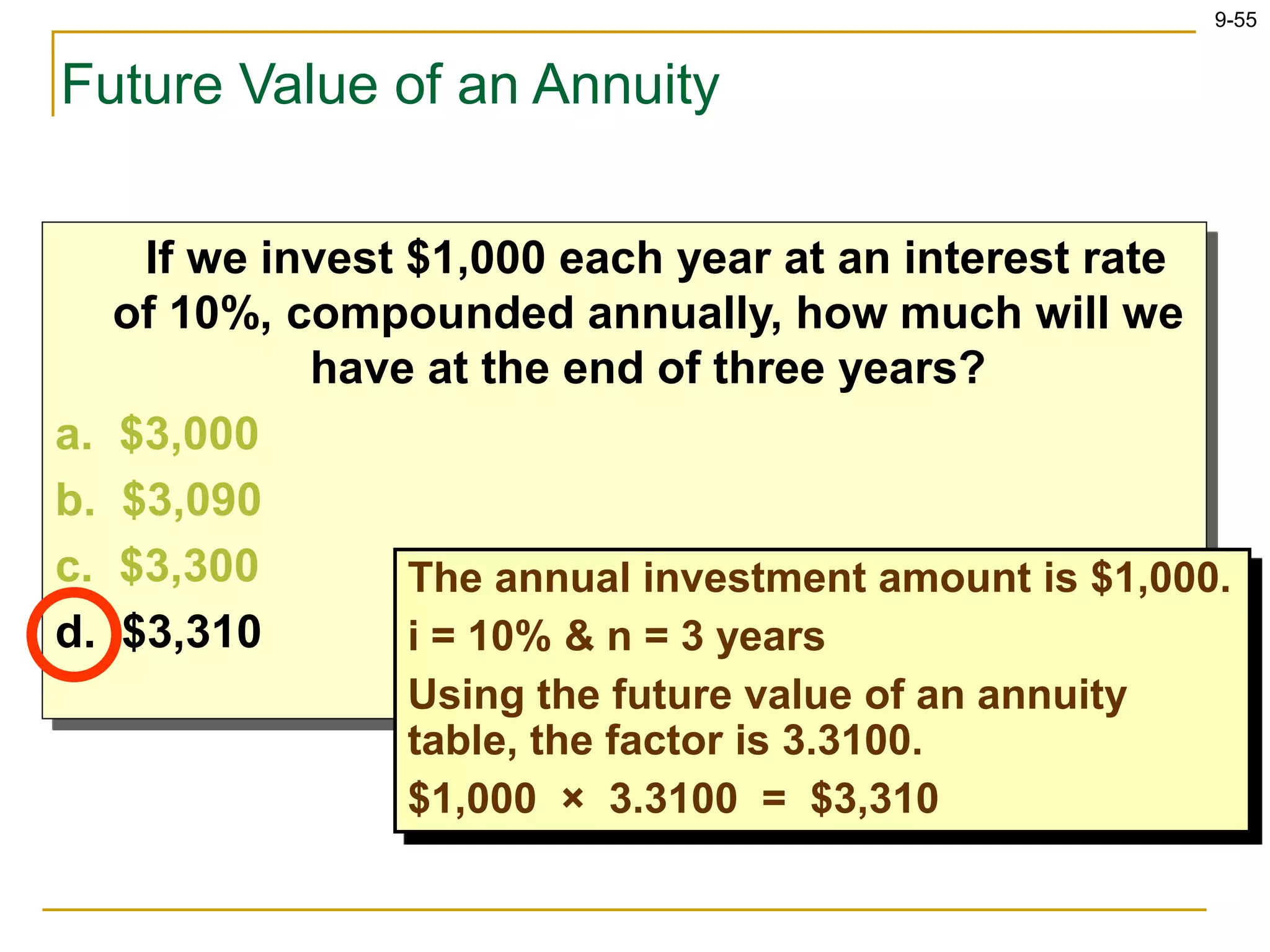
If we invest $1,000 each year at an interest rate
of 10%, compounded annually, how much will we
have at the end of three years?
a. $3,000
b. $3,090
c. $3,300
d. $3,310
Future Value of an Annuity
The annual investment amount is $1,000.
i = 10% & n = 3 years
Using the future value of an annuity
table, the factor is 3.3100.
$1,000 × 3.3100 = $3,310
9-56
End of Chapter 9

chapter_09.ppt

  • 1.
    Copyright © 2007by The McGraw-Hill Companies, Inc. All rights reserved. Reporting and Interpreting Liabilities Chapter 9
  • 2.
    9-2 Understanding the Business Theacquisition of assets is financed from two sources: Debt - funds from creditors Equity - funds from owners
  • 3.
    9-3 Understanding the Business Debtis considered riskier than equity. Interest is a legal obligation. Creditors can force bankruptcy.
  • 4.
    9-4 Learning Objectives Define, measure,and report current liabilities.
  • 5.
    9-5 Liabilities Defined andClassified Defined as probable debts or obligations of the entity that result from past transactions, which will be paid with assets or services. Maturity = 1 year or less Maturity > 1 year Current Liabilities Noncurrent Liabilities
  • 6.
    9-6 Liabilities Defined andClassified Liabilities are measured at their current cash equivalent (the amount a creditor would accept to cancel the debt) at the time incurred.
  • 7.
    9-7 Current Liabilities Account Name Also Called Definition Accounts Payable Trade Accounts Payable Obligationsto pay for goods and services used in the basic operating activities of the business. Accrued Liabilities Accrued Expenses Obligations related to expenses that have been incurred, but will not be paid until the subsequent period. Notes Payable N/A Obligations due supported by a formal written contract. Deferred Revenues Unearned Revenues Obligations arising when cash is received prior to the related revenue being earned.
  • 8.
    9-8 Net Pay Medicare Tax State and LocalIncome Taxes Social Security Tax Federal Income Tax Voluntary Deductions Gross Pay Payroll Taxes Less Deductions:
  • 9.
  • 10.
    9-10 Current Ratio Current Ratio= Current Assets ÷ Current Liabilities An important indicator of a company’s ability to meet its current obligations. Current Ratio = Current Assets ÷ Current Liabilities 1.52 = $924.00 ÷ $608.70 Starbucks has current assets of $924 and current liabilities of $608.7. Starbucks Panera Bread Krispy Kreme 1.52 1.53 1.94 2003 Current Ratios
  • 11.
    9-11 Learning Objectives Analyze theaccounts payable turnover ratio.
  • 12.
    9-12 Accounts Payable TurnoverRatio Accounts Payable Turnover Measures how quickly management is paying trade accounts. Accounts Payable Turnover = Cost of Goods Sold ÷ Average Accounts Payable 11.06 = $1,685.90 ÷ $152.50 Starbucks has cost of goods sold of $1,685.9 and average accounts payable of $152.5. Cost of Goods Sold Average Accounts Payable = ÷ Starbucks Panera Bread Krispy Kreme 11.00 9.29 N/A 2003 Accounts Payable Turnover Ratios
  • 13.
    9-13 Learning Objectives Report notespayable and explain the time value of money.
  • 14.
    9-14 Notes Payable A notepayable specifies the interest rate associated with the borrowing. To the lender, interest is a revenue. To the borrower, interest is an expense. Interest = Principal × Interest Rate × Time When computing interest for one year, “Time” equals 1. When the computation period is less than one year, then “Time” is a fraction.
  • 15.
    9-15 Notes Payable Starbucks borrows $100,000for 2 months at an annual interest rate of 12%. Compute the interest on the note for the loan period. Interest = Principal × Interest Rate × Time Interest = 100,000 $ × 12% × 2 /12 Interest = 2,000 $
  • 16.
  • 17.
    9-17 Contingent Liabilities Probability offuture sacrifice . . . Reasonably Probable Possible Remote Record Disclose Amount contingent liability in the No Can be liability. notes to the action. Estimated financial stmts. Disclose Disclose Amount liability in the liability in the No Cannot be notes to the notes to the action. Estimated financial stmts. financial stmts. Potential liabilities that arise because of events or transactions that have already occurred.
  • 18.
    9-18 Learning Objectives Explain theimportance of working capital and its impact on cash flows.
  • 19.
    9-19 Working Capital Management Changesin working capital accounts affect cash flows as indicated in the following table. Change in Account Balance During Year Increase Decrease Current Reduce cash Increase cash Assets flows. flows. Current Increase cash Reduce cash Liabilities flows. flows. Working Capital = Current Assets - Current Liabilities
  • 20.
  • 21.
    9-21 Long-Term Liabilities Creditors oftenrequire the borrower to pledge specific assets as security for the long-term liability. Maturity = 1 year or less Maturity > 1 year Current Liabilities Long-term Liabilities
  • 22.
    9-22 Long-Term Notes Payableand Bonds Relatively small debt needs can be filled from single sources. Banks Insurance Companies Pension Plans or
  • 23.
    9-23 Long-Term Notes Payableand Bonds Significant debt needs are often filled by issuing bonds to the public. Cash Bonds
  • 24.
    9-24 Borrowing in ForeignCurrencies  When a company has operations in a foreign country, it often borrows in the local currency. This reduces exchange rate risk.  Because interest rates vary from country to country, companies may borrow in the foreign market with the lowest interest rate.
  • 25.
    9-25 Operating and CapitalLeases Operating Lease Short-term lease; No liability or asset recorded Capital Lease Long-term lease; Meets one of 4 criteria; Results in recording an asset and a liability Capital Lease Criteria 1. Lease term is 75% or more of the asset’s expected economic life. 2. Ownership of asset is transferred to lessee at end of lease. 3. Lease permits lessee to purchase the asset at a price that is lower than its fair market value. 4. The present value of the lease payments is 90% or more of the fair market value of the asset when the lease is signed.
  • 26.
    9-26 Learning Objectives Compute presentvalues. Apply present value concepts to liabilities.
  • 27.
    9-27 Present Value Concepts Moneycan grow over time, because it can earn interest. $1,000 invested today at 10%. In 5 years it will be worth $1,610.51. In 25 years it will be worth $10,834.71!
  • 28.
    9-28 Present Value Concepts Thegrowth is a mathematical function of four variables: 1. The value today (present value). 2. The value in the future (future value). 3. The interest rate. 4. The time period.
  • 29.
    9-29 Present Value Concepts Mostanalysts use present value tables, calculators, or Excel to solve time value of money problems. We will use the present value tables in our illustrations (an explanation of how to use Excel is included in the supplement to this chapter).
  • 30.
    9-30 Present Value ofa Single Amount The present value of a single amount is the worth to you today of receiving that amount some time in the future. Today Present Value Future Future Value Interest compounding periods
  • 31.
    9-31 Present Value ofa Single Amount How much do we need to invest today at 10% interest, compounded annually, if we need $1,331 in three years? a. $1,000.00 b. $ 990.00 c. $ 751.30 d. $ 970.00
  • 32.
    9-32 How much dowe need to invest today at 10% interest, compounded annually, if we need $1,331 in three years? a. $1,000.00 b. $ 990.00 c. $ 751.30 d. $ 970.00 Present Value of a Single Amount The required future amount is $1,331. i = 10% & n = 3 years Using the present value of a single amount table, the factor is .7513. $1,331 × .7513 = $1,000 (rounded)
  • 33.
    9-33 Present Values ofan Annuity An annuity is a series of consecutive equal periodic payments. Today
  • 34.
    9-34 Present Values ofan Annuity What is the value today of a series of payments to be received or paid out in the future? Today Present Value Interest compounding periods Payment 1 Payment 2 Payment 3
  • 35.
    9-35 Present Values ofan Annuity What is the present value of receiving $1,000 each year for three years at an interest rate of 10%, compounded annually? a. $3,000.00 b. $2,910.00 c. $2,700.00 d. $2,486.90
  • 36.
    9-36 What is thepresent value of receiving $1,000 each year for three years at an interest rate of 10%, compounded annually? a. $3,000.00 b. $2,910.00 c. $2,700.00 d. $2,486.90 Present Values of an Annuity The consecutive equal payment amount is $1,000. i = 10% & n = 3 years Using the present value of an annuity table, the factor is 2.4869. $1,000 × 2.4869 = $2,486.90
  • 37.
    9-37 Accounting Applications ofPresent Values On January 1, 2006, Starbucks bought some new delivery trucks. The company signed a note agreeing to pay $200,000 on December 31, 2007. The market interest rate for this note is 12%. Future value 200,000 $ PV of $1 (i=12%, n=2) × 0.79720 Present value 159,440 $ Let’s prepare the journal entry to record the purchase.
  • 38.
    9-38 Accounting Applications ofPresent Values Debit Credit Jan. 1 Delivery trucks 159,440 Notes payable 159,440 Date Description GENERAL JOURNAL Now, let’s look at the journal entry at December 31, 2006. Debit Credit Dec. 31 Interest expense 19,133 Notes payable 19,133 Date Description GENERAL JOURNAL Present Value × Interest Rate = Interest $159,440 × 12% = $19,133
  • 39.
    9-39 Accounting Applications ofPresent Values Now, let’s look at the journal entries at December 31, 2007. Debit Credit Dec. 31 Interest expense 21,429 Notes payable 21,429 31 Notes payable 200,000 Cash 200,000 Date Description GENERAL JOURNAL Present Value × Interest Rate = Interest ($159,440 + $19,133) × 12% = $21,429
  • 40.
    9-40 Income Taxes andRetirement Benefits Chapter Supplement A
  • 41.
    9-41 Income Taxes andRetirement Benefits Deferred Taxes Exist because of timing differences caused by reporting revenues and expenses according to GAAP on a company’s income statement and according to the Internal Revenue Code on the tax return. Temporary Differences Timing differences that cause deferred income taxes and will reverse, or turn around, in the future.
  • 42.
    9-42 Income Taxes andRetirement Benefits Some pension plans create obligations during employees’ service periods that must be paid during their retirement periods. The amounts contributed during the employment period are determined using present value computations of the estimate of the future amount to be paid during retirement.
  • 43.
    9-43 Federal Income TaxConcepts Chapter Supplement B
  • 44.
    9-44 Federal Income TaxConcepts Corporations Are separate legal entities and are required to pay income taxes. Tax Obligation Determined by multiplying taxable income by the corporate tax rate.
  • 45.
    9-45 Revenue and ExpenseRecognition for Income Tax Purposes 1. Interest revenue on state and municipal bonds is generally excluded from taxable income although it is included in accounting income. 2. Revenue collected in advance is included in taxable income when it is collected and in accounting income when it is earned. 3. Proceeds from life insurance policies are excluded from taxable income but included in accounting income. 4. Corporations that own less than 20% of another corporation’s stock may exclude 70% of the dividends received from taxable income, although all dividends are included in accounting income. 5. For tax purposes, depreciation expense is generally based on the Accelerated Cost Recovery System (ACRS) or on the Modified Accelerated Cost Recovery System (MACRS).
  • 46.
  • 47.
    9-47 Present Value Computations UsingExcel Chapter Supplement C
  • 48.
    9-48 Present Value ComputationsUsing Excel Use the present value of an annuity formula programmed in Excel by selecting the function button (fx). In the drop down menu, under the Select Category heading, pick "Financial" and scroll down under Select Function and click on "PV." In the new drop down box, enter the specific information for your problem and click "OK." = Payment/(1 + i)^n Present Value of A Single Amount Formula Present Value of An Annuity Formula
  • 49.
  • 50.
    9-50 Future Value ofa Single Amount How much will an amount today be worth in the future? Today Present Value Future Value Interest compounding periods Future value is the sum to which an amount will increase as the result of compound interest.
  • 51.
    9-51 Future Value ofa Single Amount If we invest $1,000 today earning 10% interest, compounded annually, how much will it be worth in three years? a. $1,000 b. $1,010 c. $1,100 d. $1,331
  • 52.
    9-52 If we invest$1,000 today earning 10% interest, compounded annually, how much will it be worth in three years? a. $1,000 b. $1,010 c. $1,100 d. $1,331 Future Value of a Single Amount The invested amount is $1,000. i = 10% & n = 3 years Using the future value of a single amount table, the factor is 1.331. $1,000 × 1.331 = $1,331
  • 53.
    9-53 Future Value ofan Annuity  Equal payments are made each period.  The payments and interest accumulate over time. Today Interest compounding periods Payment 1 Payment 2 Payment 3
  • 54.
    9-54 Future Value ofan Annuity If we invest $1,000 each year at an interest rate of 10%, compounded annually, how much will we have at the end of three years? a. $3,000 b. $3,090 c. $3,300 d. $3,310
  • 55.
    9-55 If we invest$1,000 each year at an interest rate of 10%, compounded annually, how much will we have at the end of three years? a. $3,000 b. $3,090 c. $3,300 d. $3,310 Future Value of an Annuity The annual investment amount is $1,000. i = 10% & n = 3 years Using the future value of an annuity table, the factor is 3.3100. $1,000 × 3.3100 = $3,310
  • 56.