Gaussian Model or CFD?
Rosie Davies and Anusan Sugumaar, Arup
2
• Many methods and tool exist to assess pollutant dispersion
• More recently faced with complex building/stack scenarios in e.g.
planning applications, traditional tools (ADMS/AERMOD) run up
against their limitations
• CFD can account for complex geometry and models complex flow
fields, but what about dispersion?
Motivation for research?
3
Key Concepts - Scale
[1]
Neighbourhood
(1-2km)
Street Canyon
(up to 200m)
City
(10-20km)
Regional
(100-200km)
4
Key Concepts – Urban Topology and ABL
[2]
• Near Field vs Far Field ?
5
Key Concepts – Turbulence
• Turbulence is typically greater in urban areas than in rural locations due to higher
surface roughness, traffic movement and urban heat island effect (20-50% greater [3])
• Higher turbulence in urban areas will increase plume dilution and decrease maximum
ground level concentration, compared to that measured in an open country exposure
(dilution increased 2x [4])
Image from [2].
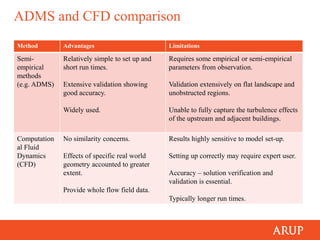
Method Advantages Limitations
Semi-
empirical
methods
(e.g. ADMS)
Relatively simple to set up and
short run times.
Extensive validation showing
good accuracy.
Widely used.
Requires some empirical or semi-empirical
parameters from observation.
Validation extensively on flat landscape and
unobstructed regions.
Unable to fully capture the turbulence effects
of the upstream and adjacent buildings.
Computation
al Fluid
Dynamics
(CFD)
No similarity concerns.
Effects of specific real world
geometry accounted to greater
extent.
Provide whole flow field data.
Results highly sensitive to model set-up.
Setting up correctly may require expert user.
Accuracy – solution verification and
validation is essential.
Typically longer run times.
ADMS and CFD comparison
7
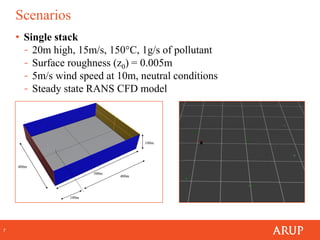
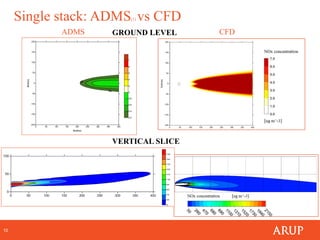
• Single stack
- 20m high, 15m/s, 150°C, 1g/s of pollutant
- Surface roughness (z0) = 0.005m
- 5m/s wind speed at 10m, neutral conditions
- Steady state RANS CFD model
Scenarios
8
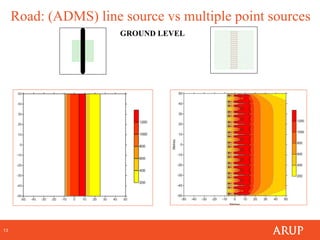
• Road
- Based on CEDVAL experiment [5] without the pitched roof
- Road width = 20m with 1g/km/s of pollutant
- Canyon height = 20m
- Building = 100m x 100m x 20m
Scenarios
9
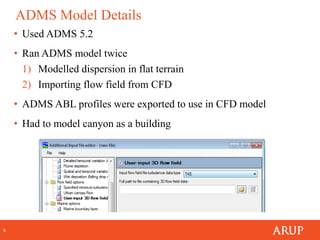
• Used ADMS 5.2
• Ran ADMS model twice
1) Modelled dispersion in flat terrain
2) Importing flow field from CFD
• ADMS ABL profiles were exported to use in CFD model
• Had to model canyon as a building
ADMS Model Details
10
Single stack: ADMS(1) vs CFD
GROUND LEVEL
VERTICAL SLICE
ADMS CFD
11
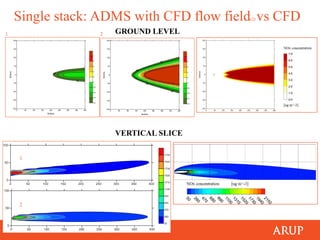
Single stack: ADMS with CFD flow field(2) vs CFD
GROUND LEVEL
VERTICAL SLICE
1 2
1
2
Road – no canyon
13
Road: (ADMS) line source vs multiple point sources
GROUND LEVEL
Road – street canyon
15
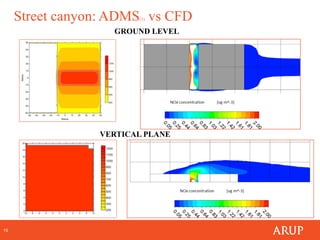
Street canyon: ADMS(1) vs CFD
GROUND LEVEL
VERTICAL PLANE
16
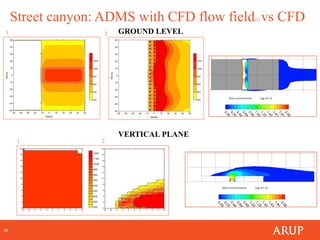
Street canyon: ADMS with CFD flow field(2) vs CFD
GROUND LEVEL
VERTICAL PLANE
21
21
17
Street canyon: CFD Streamlines & Concentration
18
• Flow field format restrictions: number of levels, greater extent
+/- 500m in each direction. Number of levels below 50m and
number of levels below 100m
• No flow field output (for visualisation)with this option! (use CFD
visualisation)
• Would be good to be able to import more detailed, less strict
format, flow field into ADMS and ADMS-Roads
• Flow field input needs to be a regular grid
Thoughts on ADMS flow fields
19
• Simple stack
- CFD model tends to under predict cross-wind diffusion of
pollutant
- Higher ground concentration levels
• Canyon
- Flow is three dimensional and unsteady  CFD better at
capturing these complexities
• Further assessment and development of the methodology for
importing CFD-generated flow field into ADMS required
Conclusions
20
• [1] “A review on the CFD analysis of urban microclimate” – Toparrlar et al.,
2017
• [2] “On the use of numerical modelling for near field pollutant dispersion in
urban environment” – Lateb et al., 2015
• [3] “Recent progress in CFD modelling of wind field and pollutant transport
in street canyons” – XL Li et al., 2016
• [4] “Ten questions concerning modelling of near-field pollutant dispersion in
the built environment” – Y.Tominaga and T.Stathopoulos, 2016
• [5] “Flow and Pollutant Dispersion in Street Canyons using FLUENT and
ADMS-Urban” – Di Sabatino et al., 2008
References

Advanced Gaussian Model or CFD?

  • 1.
    Gaussian Model orCFD? Rosie Davies and Anusan Sugumaar, Arup
  • 2.
    2 • Many methodsand tool exist to assess pollutant dispersion • More recently faced with complex building/stack scenarios in e.g. planning applications, traditional tools (ADMS/AERMOD) run up against their limitations • CFD can account for complex geometry and models complex flow fields, but what about dispersion? Motivation for research?
  • 3.
    3 Key Concepts -Scale [1] Neighbourhood (1-2km) Street Canyon (up to 200m) City (10-20km) Regional (100-200km)
  • 4.
    4 Key Concepts –Urban Topology and ABL [2] • Near Field vs Far Field ?
  • 5.
    5 Key Concepts –Turbulence • Turbulence is typically greater in urban areas than in rural locations due to higher surface roughness, traffic movement and urban heat island effect (20-50% greater [3]) • Higher turbulence in urban areas will increase plume dilution and decrease maximum ground level concentration, compared to that measured in an open country exposure (dilution increased 2x [4]) Image from [2].
  • 6.
    Method Advantages Limitations Semi- empirical methods (e.g.ADMS) Relatively simple to set up and short run times. Extensive validation showing good accuracy. Widely used. Requires some empirical or semi-empirical parameters from observation. Validation extensively on flat landscape and unobstructed regions. Unable to fully capture the turbulence effects of the upstream and adjacent buildings. Computation al Fluid Dynamics (CFD) No similarity concerns. Effects of specific real world geometry accounted to greater extent. Provide whole flow field data. Results highly sensitive to model set-up. Setting up correctly may require expert user. Accuracy – solution verification and validation is essential. Typically longer run times. ADMS and CFD comparison
  • 7.
    7 • Single stack -20m high, 15m/s, 150°C, 1g/s of pollutant - Surface roughness (z0) = 0.005m - 5m/s wind speed at 10m, neutral conditions - Steady state RANS CFD model Scenarios
  • 8.
    8 • Road - Basedon CEDVAL experiment [5] without the pitched roof - Road width = 20m with 1g/km/s of pollutant - Canyon height = 20m - Building = 100m x 100m x 20m Scenarios
  • 9.
    9 • Used ADMS5.2 • Ran ADMS model twice 1) Modelled dispersion in flat terrain 2) Importing flow field from CFD • ADMS ABL profiles were exported to use in CFD model • Had to model canyon as a building ADMS Model Details
  • 10.
    10 Single stack: ADMS(1)vs CFD GROUND LEVEL VERTICAL SLICE ADMS CFD
  • 11.
    11 Single stack: ADMSwith CFD flow field(2) vs CFD GROUND LEVEL VERTICAL SLICE 1 2 1 2
  • 12.
  • 13.
    13 Road: (ADMS) linesource vs multiple point sources GROUND LEVEL
  • 14.
  • 15.
    15 Street canyon: ADMS(1)vs CFD GROUND LEVEL VERTICAL PLANE
  • 16.
    16 Street canyon: ADMSwith CFD flow field(2) vs CFD GROUND LEVEL VERTICAL PLANE 21 21
  • 17.
    17 Street canyon: CFDStreamlines & Concentration
  • 18.
    18 • Flow fieldformat restrictions: number of levels, greater extent +/- 500m in each direction. Number of levels below 50m and number of levels below 100m • No flow field output (for visualisation)with this option! (use CFD visualisation) • Would be good to be able to import more detailed, less strict format, flow field into ADMS and ADMS-Roads • Flow field input needs to be a regular grid Thoughts on ADMS flow fields
  • 19.
    19 • Simple stack -CFD model tends to under predict cross-wind diffusion of pollutant - Higher ground concentration levels • Canyon - Flow is three dimensional and unsteady  CFD better at capturing these complexities • Further assessment and development of the methodology for importing CFD-generated flow field into ADMS required Conclusions
  • 20.
    20 • [1] “Areview on the CFD analysis of urban microclimate” – Toparrlar et al., 2017 • [2] “On the use of numerical modelling for near field pollutant dispersion in urban environment” – Lateb et al., 2015 • [3] “Recent progress in CFD modelling of wind field and pollutant transport in street canyons” – XL Li et al., 2016 • [4] “Ten questions concerning modelling of near-field pollutant dispersion in the built environment” – Y.Tominaga and T.Stathopoulos, 2016 • [5] “Flow and Pollutant Dispersion in Street Canyons using FLUENT and ADMS-Urban” – Di Sabatino et al., 2008 References