Paññāsāstra University of Cambodia
                  Commitment to Excellence


Alternative Dispute Resolution (ADR)

Course        :      Introduction to Law
Lecturer      :
Presented by:
Content
   What is ADR?

   Types of ADR
       Negotiation
       Mediation
       Arbitration

   Maison De La Justice

   Conclusion
ADR                             2
Alternative Dispute
      Resolution
      • ADR refers to the various ways parties can settle
        disputes outside of traditional court centered
        adjudication system.

      • The most common forms of ADR are negotiation,
        mediation, and arbitration.


ADR                                                         3
Alternative Dispute Resolution
  Importance of dispute resolutions:

  • Cost
  • Speed
  • Control
  • Confidentiality
  • Experienced neutral panelists
  • Cooperative approach

ADR                                    4
1. Negotiation


   Negotiation is the process of back and forth
      communication, whereby parties submit and consider
      offers until an offer is made and accepted.

   Cambodian law supports negotiation.

ADR                                                        5
Two Basic Approaches to
              Negotiation

  1. Distributive Negotiation (win-lose)


  2. Interest-based Negotiation (win-win)


ADR                                         6
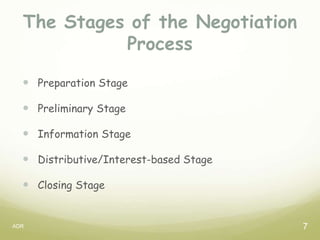
The Stages of the Negotiation
            Process

   Preparation Stage

   Preliminary Stage

   Information Stage

   Distributive/Interest-based Stage

   Closing Stage


ADR                                     7
2.Mediation


 Mediation defined as a facilitated or assisted negotiation.


ADR                                                       8
Characteristics of MEDIATION

       Negotiation with assistance of third party.

       No authority to impose settlement towards the
        parties for mediator.

       Mediator can only suggest solutions to the parties.


ADR                                                           9
THE MEDIATION PROCESS

 Initiating mediation
 Selecting the mediator
 Briefing the mediator
 Opening session
 General problem solving sessions
 Private caucuses
 closure
ADR                                  10
3. Arbitration


• Arbitration is the third major ADR method, which
  parties submit their dispute to a neutral third party.
  This third party considers the evidence the disputing
  parties have submitted and renders a decision called an
  “award.”
• Award can be binding or nonbinding.
ADR                                                        11
The Arbitration Process
 There are six stages to the typical arbitration process.

 1. Initiation of Arbitration

 2. Selection of Arbitral Tribunal

 3. Pre-hearing Procedure

 4. Arbitration Hearing

 5. Decision Making

 6. Appeal and Enforcement

ADR                                                         12
The National Arbitration
                 Center
   National Arbitration Center “NAC” is established
      inside the Ministry of Commerce.

   The NAC has potentially difficult responsibilities as
      both an arbitration forum and as a licensing and
      supervisory authority for all arbitrators in
      Cambodia, even those who might serve in other
      forums.

ADR                                                         13
The Cambodian Arbitration
               Council
   The Cambodian Arbitration Council (the “AC”) was
      established in 2003 and is part of the ADR
      framework for labor disputes.


ADR                                                    14
ADR   15
ADR   16
MAISONS DE LA JUSTICE

       The Maisons de la Justice were created through an
        inter-ministerial Prakas No. 85Rbk/MOJ/MOI/06
        and No. 13Rbk/MOJ/MOI/08 by the Government
        of Cambodia signed in December 2006 and Feb
        2008 for the establishment of the Maisons.


ADR                                                         17
MAISONS DE LA JUSTICE
 Mission of the maison de la justice:

 Provide training and/or technical advice to commune councils
      on conciliation and certain legal matters.

 Assess the demand for legal information at the district and
      commune levels.

 Disseminate necessary legal information to local officials and
      the public in the district.

 Conciliate and mediate disputes at the request of the parties.

 Provide referral services to disputants whose cases can not
      be resolved at the local level.
ADR                                                             18
MAISONS DE LA JUSTICE
                  at District level
      Structure

   Each Maison de Justice shall be led by a director
       with a number of assistants upon necessity.

   One civil servant who is assigned by The Ministry of
       Justice.

   One civil servant who is appointed by provincial
       governor.

ADR                                                        19
MAISONS DE LA JUSTICE
                   at District level
       The Ministry of Interior is in charge of
        administration, finance, and means for operation of
        the Maison de Justice.

       The Ministry of Justice is in charge of training the
        Maison de Justice staff on laws and ADR
        techniques.


ADR                                                            20
Conclusion


ADR                21
ADR   22

Adr

  • 1.
    Paññāsāstra University ofCambodia Commitment to Excellence Alternative Dispute Resolution (ADR) Course : Introduction to Law Lecturer : Presented by:
  • 2.
    Content What is ADR?  Types of ADR  Negotiation  Mediation  Arbitration  Maison De La Justice  Conclusion ADR 2
  • 3.
    Alternative Dispute Resolution • ADR refers to the various ways parties can settle disputes outside of traditional court centered adjudication system. • The most common forms of ADR are negotiation, mediation, and arbitration. ADR 3
  • 4.
    Alternative Dispute Resolution Importance of dispute resolutions: • Cost • Speed • Control • Confidentiality • Experienced neutral panelists • Cooperative approach ADR 4
  • 5.
    1. Negotiation  Negotiation is the process of back and forth communication, whereby parties submit and consider offers until an offer is made and accepted.  Cambodian law supports negotiation. ADR 5
  • 6.
    Two Basic Approachesto Negotiation 1. Distributive Negotiation (win-lose) 2. Interest-based Negotiation (win-win) ADR 6
  • 7.
    The Stages ofthe Negotiation Process  Preparation Stage  Preliminary Stage  Information Stage  Distributive/Interest-based Stage  Closing Stage ADR 7
  • 8.
    2.Mediation Mediation definedas a facilitated or assisted negotiation. ADR 8
  • 9.
    Characteristics of MEDIATION  Negotiation with assistance of third party.  No authority to impose settlement towards the parties for mediator.  Mediator can only suggest solutions to the parties. ADR 9
  • 10.
    THE MEDIATION PROCESS Initiating mediation  Selecting the mediator  Briefing the mediator  Opening session  General problem solving sessions  Private caucuses  closure ADR 10
  • 11.
    3. Arbitration • Arbitrationis the third major ADR method, which parties submit their dispute to a neutral third party. This third party considers the evidence the disputing parties have submitted and renders a decision called an “award.” • Award can be binding or nonbinding. ADR 11
  • 12.
    The Arbitration Process There are six stages to the typical arbitration process. 1. Initiation of Arbitration 2. Selection of Arbitral Tribunal 3. Pre-hearing Procedure 4. Arbitration Hearing 5. Decision Making 6. Appeal and Enforcement ADR 12
  • 13.
    The National Arbitration Center  National Arbitration Center “NAC” is established inside the Ministry of Commerce.  The NAC has potentially difficult responsibilities as both an arbitration forum and as a licensing and supervisory authority for all arbitrators in Cambodia, even those who might serve in other forums. ADR 13
  • 14.
    The Cambodian Arbitration Council  The Cambodian Arbitration Council (the “AC”) was established in 2003 and is part of the ADR framework for labor disputes. ADR 14
  • 15.
    ADR 15
  • 16.
    ADR 16
  • 17.
    MAISONS DE LAJUSTICE  The Maisons de la Justice were created through an inter-ministerial Prakas No. 85Rbk/MOJ/MOI/06 and No. 13Rbk/MOJ/MOI/08 by the Government of Cambodia signed in December 2006 and Feb 2008 for the establishment of the Maisons. ADR 17
  • 18.
    MAISONS DE LAJUSTICE Mission of the maison de la justice:  Provide training and/or technical advice to commune councils on conciliation and certain legal matters.  Assess the demand for legal information at the district and commune levels.  Disseminate necessary legal information to local officials and the public in the district.  Conciliate and mediate disputes at the request of the parties.  Provide referral services to disputants whose cases can not be resolved at the local level. ADR 18
  • 19.
    MAISONS DE LAJUSTICE at District level Structure  Each Maison de Justice shall be led by a director with a number of assistants upon necessity.  One civil servant who is assigned by The Ministry of Justice.  One civil servant who is appointed by provincial governor. ADR 19
  • 20.
    MAISONS DE LAJUSTICE at District level  The Ministry of Interior is in charge of administration, finance, and means for operation of the Maison de Justice.  The Ministry of Justice is in charge of training the Maison de Justice staff on laws and ADR techniques. ADR 20
  • 21.
  • 22.
    ADR 22