General Overview of Arbitration
What is Arbitration?Means to resolve disputes outside of courtLabor and Management present evidenceArbitrator makes final and binding rulingArbitration is different from mediation
 Arbitration UsesCommercial Arbitration: long used as substitute for court actions International Arbitration: used as settlement of differences between nationsLabor Arbitration: began during late 19th centuryLabor Arbitration advance rapidly after U.S. became involved in World War II
 Simple Mechanics of ArbitrationArbitration authorized by Collective Bargaining Agreement (CBA)Parties select arbitratorArbitrator and parties set hearing dateHearing HeldDecisionFinal and Binding AwardEnforcement
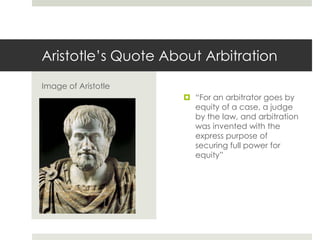
Aristotle’s Quote About Arbitration“For an arbitrator goes by equity of a case, a judge by the law, and arbitration was invented with the express purpose of securing full power for equity”Image of Aristotle
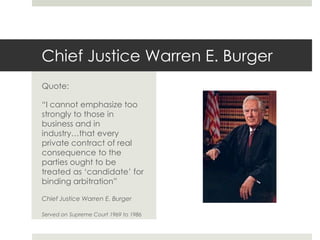
Chief Justice Warren E. BurgerQuote:“I cannot emphasize too strongly to those in business and in industry…that every private contract of real consequence to the parties ought to be treated as ‘candidate’ for binding arbitration”Chief Justice Warren E. BurgerServed on Supreme Court 1969 to 1986
Voluntary Arbitration UseVoluntary form of arbitration termsPrivateCommercial Contractual Example Industries using voluntary arbitrationMaritime SecuritiesLabor MedicalConstruction
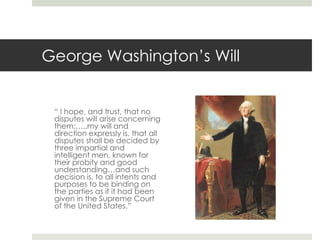
George Washington’s Will	“ I hope, and trust, that no disputes will arise concerning them;…..my will and direction expressly is, that all disputes shall be decided by three impartial and intelligent men, known for their probity and good understanding…and such decision is, to all intents and purposes to be binding on the parties as if it had been given in the Supreme Court of the United States.”
Courts and ArbitrationCourts originally did not favor arbitrationMost state and federal courts now support arbitrationRoutinely enforce arbitration awardsFederal Arbitration Act and State Acts enhanced supportCourts accept arbitration as alternative to litigation
ProceduresArbitration not required to follow court proceduresCourt may compel a refusing party to arbitrate Arbitration usually coordinated by an agencyAgency coordinates various procedural activities
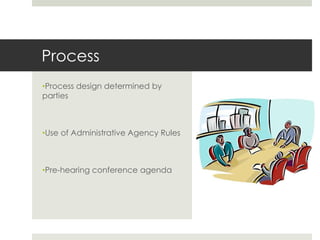
ProcessProcess design determined by parties
Use of Administrative Agency Rules
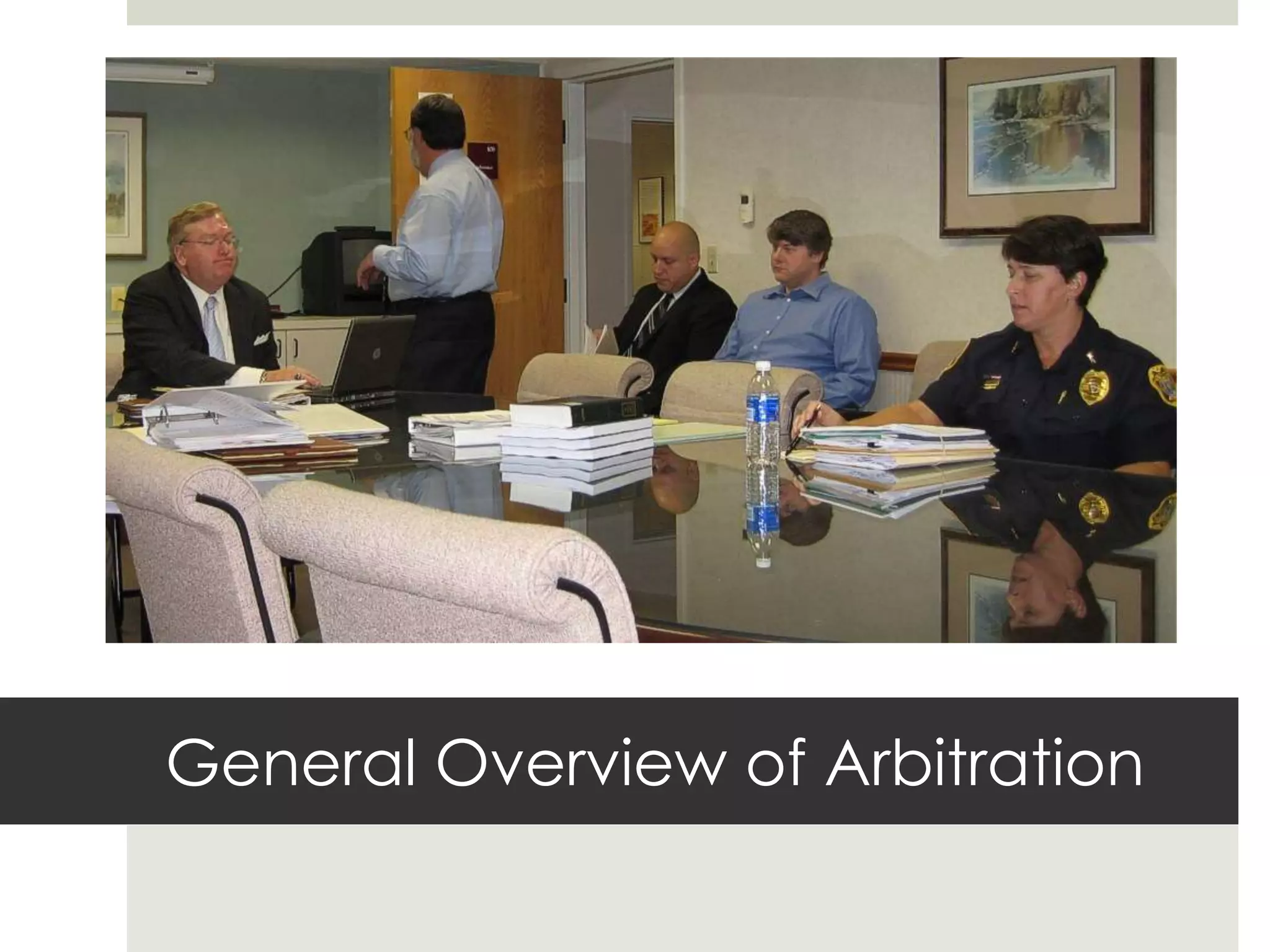
Pre-hearing conference agendaArbitration SettingSame look and feel of court trialOpening statementsIntroduction of evidenceWitness testimony Arbitrator more active roleHearings are usually private
TimelinessParties may make arbitration relatively quick and inexpensive compared to litigationHowever, bulk of arbitration cases requires several weeks or monthsArbitration issues are becoming increasingly complexTime requirements increase with complexityParties and/or selected arbitrator may not be readily availableNonetheless Arbitration is speedier than litigation
Arbitration CostsArbitrator fees can add up
Multiple Days of hearing are expensive
Arbitrator’s expenses for travel, meals and lodgingGrievance MediationHybrid variation between mediation and arbitrationAdvanced in recent years because perception that arbitration is excessively delayed, expensive, or formalisticOccurs after final step – prior to arbitrationMediator may not act as arbitratorMediation discussion  may not be used in arbitrationCommon practice in the public sector
Advantages Arbitration Over LitigationCourt costly, prolonged and technical procedures of courts not well adapted to labor-mgt. relationsCourts are not often versed in labor relation problemsSupreme Court stated in the Steelworkers case:	“The labor arbitrator performs functions which are not normal to the courts; the considerations which help him fashion judgments may indeed be foreign to the competence of the courts”.
Other Arbitration ConsiderationsPrompt compliance with the award obtained in most casesCourt actions seeking compliance or vacation of award is infrequent Discovery rights, attorney fees, punitive damages and supervised equity relief are typically unavailable Lack precedential value in development of the law of collective bargainingFaulty final and binding decisions may not be subject to review as are trial judge decisions
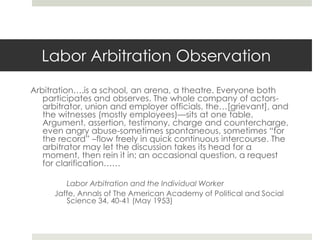
Labor Arbitration ObservationArbitration….is a school, an arena, a theatre. Everyone both participates and observes. The whole company of actors-arbitrator, union and employer officials, the…[grievant], and the witnesses (mostly employees)—sits at one table. Argument, assertion, testimony, charge and countercharge, even angry abuse-sometimes spontaneous, sometimes “for the record” –flow freely in quick continuous intercourse. The arbitrator may let the discussion takes its head for a moment, then rein it in; an occasional question, a request for clarification……	Labor Arbitration and the Individual WorkerJaffe, Annals of The American Academy of Political and Social Science 34, 40-41 (May 1953)

Arbitration Overview

  • 1.
  • 2.
    What is Arbitration?Meansto resolve disputes outside of courtLabor and Management present evidenceArbitrator makes final and binding rulingArbitration is different from mediation
  • 3.
    Arbitration UsesCommercialArbitration: long used as substitute for court actions International Arbitration: used as settlement of differences between nationsLabor Arbitration: began during late 19th centuryLabor Arbitration advance rapidly after U.S. became involved in World War II
  • 4.
    Simple Mechanicsof ArbitrationArbitration authorized by Collective Bargaining Agreement (CBA)Parties select arbitratorArbitrator and parties set hearing dateHearing HeldDecisionFinal and Binding AwardEnforcement
  • 5.
    Aristotle’s Quote AboutArbitration“For an arbitrator goes by equity of a case, a judge by the law, and arbitration was invented with the express purpose of securing full power for equity”Image of Aristotle
  • 6.
    Chief Justice WarrenE. BurgerQuote:“I cannot emphasize too strongly to those in business and in industry…that every private contract of real consequence to the parties ought to be treated as ‘candidate’ for binding arbitration”Chief Justice Warren E. BurgerServed on Supreme Court 1969 to 1986
  • 7.
    Voluntary Arbitration UseVoluntaryform of arbitration termsPrivateCommercial Contractual Example Industries using voluntary arbitrationMaritime SecuritiesLabor MedicalConstruction
  • 8.
    George Washington’s Will “I hope, and trust, that no disputes will arise concerning them;…..my will and direction expressly is, that all disputes shall be decided by three impartial and intelligent men, known for their probity and good understanding…and such decision is, to all intents and purposes to be binding on the parties as if it had been given in the Supreme Court of the United States.”
  • 9.
    Courts and ArbitrationCourtsoriginally did not favor arbitrationMost state and federal courts now support arbitrationRoutinely enforce arbitration awardsFederal Arbitration Act and State Acts enhanced supportCourts accept arbitration as alternative to litigation
  • 10.
    ProceduresArbitration not requiredto follow court proceduresCourt may compel a refusing party to arbitrate Arbitration usually coordinated by an agencyAgency coordinates various procedural activities
  • 11.
  • 12.
  • 13.
    Pre-hearing conference agendaArbitrationSettingSame look and feel of court trialOpening statementsIntroduction of evidenceWitness testimony Arbitrator more active roleHearings are usually private
  • 14.
    TimelinessParties may makearbitration relatively quick and inexpensive compared to litigationHowever, bulk of arbitration cases requires several weeks or monthsArbitration issues are becoming increasingly complexTime requirements increase with complexityParties and/or selected arbitrator may not be readily availableNonetheless Arbitration is speedier than litigation
  • 15.
  • 16.
    Multiple Days ofhearing are expensive
  • 17.
    Arbitrator’s expenses fortravel, meals and lodgingGrievance MediationHybrid variation between mediation and arbitrationAdvanced in recent years because perception that arbitration is excessively delayed, expensive, or formalisticOccurs after final step – prior to arbitrationMediator may not act as arbitratorMediation discussion may not be used in arbitrationCommon practice in the public sector
  • 18.
    Advantages Arbitration OverLitigationCourt costly, prolonged and technical procedures of courts not well adapted to labor-mgt. relationsCourts are not often versed in labor relation problemsSupreme Court stated in the Steelworkers case: “The labor arbitrator performs functions which are not normal to the courts; the considerations which help him fashion judgments may indeed be foreign to the competence of the courts”.
  • 19.
    Other Arbitration ConsiderationsPromptcompliance with the award obtained in most casesCourt actions seeking compliance or vacation of award is infrequent Discovery rights, attorney fees, punitive damages and supervised equity relief are typically unavailable Lack precedential value in development of the law of collective bargainingFaulty final and binding decisions may not be subject to review as are trial judge decisions
  • 20.
    Labor Arbitration ObservationArbitration….isa school, an arena, a theatre. Everyone both participates and observes. The whole company of actors-arbitrator, union and employer officials, the…[grievant], and the witnesses (mostly employees)—sits at one table. Argument, assertion, testimony, charge and countercharge, even angry abuse-sometimes spontaneous, sometimes “for the record” –flow freely in quick continuous intercourse. The arbitrator may let the discussion takes its head for a moment, then rein it in; an occasional question, a request for clarification…… Labor Arbitration and the Individual WorkerJaffe, Annals of The American Academy of Political and Social Science 34, 40-41 (May 1953)