

PAGE1
DEVOPS INDONESIA
DEVOPS INDONESIA AT SHOPEE
DevOps Community in Indonesia
AdoptingDevOpsascultureusingAzureDevOps
By : Mr. Eriawan
Jakarta, 13 Desember 2018
PAGE2
DEVOPS INDONESIA
Let’s get know each other
PAGE3
DEVOPS INDONESIA
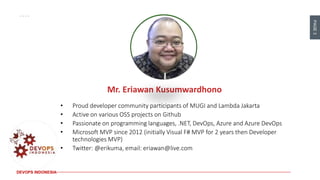
Mr. Eriawan Kusumwardhono
• Proud developer community participants of MUGI and Lambda Jakarta
• Active on various OSS projects on Github
• Passionate on programming languages, .NET, DevOps, Azure and Azure DevOps
• Microsoft MVP since 2012 (initially Visual F# MVP for 2 years then Developer
technologies MVP)
• Twitter: @erikuma, email: eriawan@live.com
PAGE4
DEVOPS INDONESIA
The pace of change is accelerating….
Agenda today
• DevOps today
• Cultural expectations
• Maturity roadmap
PAGE5
DEVOPS INDONESIA
Image: Alamy Stock Photo
DevOps today
PAGE6
DEVOPS INDONESIA
General definition of DevOps
A collaborations of (software) development and its operations in the scope of
departmental responsibility, communication, people and process
PAGE7
DEVOPS INDONESIA
Modern definition
(from https://aka.ms/DevOps)
DevOps is the union of people, process, and products to enable continuous
delivery of value to our end users. The contraction of “Dev” and “Ops”
refers to replacing siloed Development and Operations to create
multidisciplinary teams that now work together with shared and efficient
practices and tools. Essential DevOps practices include agile planning,
continuous integration, continuous delivery, and monitoring of
applications.
PAGE8
DEVOPS INDONESIA
8
The changes to method XYZ are incompatible with mine, how do we merge now…
When did we decide to upgrade to version…
I thought you fixed that two month ago…
Cultural expectations
PAGE9
DEVOPS INDONESIA
9
Common problems
• Developers often perceive things works well on their environment
• No strong team integration in the code (how far you are sure developer as
team player won’t break the code on every code commits?)
• No clear line or borderline for communications between dev and ops
• Tedious manual deployments, often not idempotent (is there a complete
rollback on any failed steps?)
• Operations puts constraints near end of development phase
• No easy way to reproduce with desired configuration requirements
PAGE10
DEVOPS INDONESIA
…which brings us these general facts
Dev
• TDD are often not enforced
• Often dev imagining things with higher
ideals environment with no budget
constraints
• Dev can’t go beyond pure dev
• Dev is isolated to any basic infrastructure
knowledge
Ops
• Ops don’t want to look further on
monitoring, only care the app won’t
break others
• Ops don’t want to be bothered by the
consequences of platform changes
• Ops often constrained with business
realizations dilemma such as budgets
• Ops don’t want to know development
needs alignments
PAGE11
DEVOPS INDONESIA
Unseen problems
• Licensing in terms of SAM, Software Asset Managements (number
of seats, core, devices, users)
• Legal compliance of OSS License model (sample cases: Facebook
ReactJS, GPL vs LGPL, MS SharedSource of .NET Framework)
PAGE12
DEVOPS INDONESIA
Demo
PAGE13
DEVOPS INDONESIA
DevOps maturity
PAGE14
DEVOPS INDONESIA
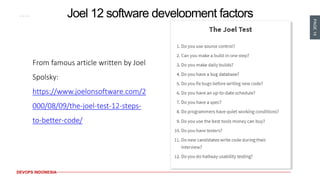
Joel 12 software development factors
From famous article written by Joel
Spolsky:
https://www.joelonsoftware.com/2
000/08/09/the-joel-test-12-steps-
to-better-code/
PAGE15
DEVOPS INDONESIA
DevOps maturity efforts
• Communications between Dev and Ops (it doesn’t have to be special DevOps
guy/staff)
• Automation: CI in Dev, CD in both Dev and Ops
• Requirement managements: projected number of users defined first, with basic
knowledge of actual hardware/software requirements to drive initial SAM
requirements
• TDD mentality enforced to Dev and Ops (even deployment needs to be tested
before)
• Governance: any third party software/libraries used especially OSS software must be
listed with the license models at initial/starting development phase
• Governance: change management regular meeting
PAGE16
DEVOPS INDONESIA
Q & A
PAGE17
DEVOPS INDONESIA
Stay Connected
https://www.linkedin.com/in/eriawan-kusumawardhono/
@erikuma
MVP Profile : https://mvp.microsoft.com/en-us/PublicProfile/4040024
PAGE18
DEVOPS INDONESIA
AloneWearesmart,togetherWearebrilliant
THANKYOU!
Quote by Steve Anderson

DevOps Indonesia #12 - Adopting DevOps as culture using Azure DevOps

  • 1.
    PAGE1 DEVOPS INDONESIA DEVOPS INDONESIAAT SHOPEE DevOps Community in Indonesia AdoptingDevOpsascultureusingAzureDevOps By : Mr. Eriawan Jakarta, 13 Desember 2018
  • 2.
  • 3.
    PAGE3 DEVOPS INDONESIA Mr. EriawanKusumwardhono • Proud developer community participants of MUGI and Lambda Jakarta • Active on various OSS projects on Github • Passionate on programming languages, .NET, DevOps, Azure and Azure DevOps • Microsoft MVP since 2012 (initially Visual F# MVP for 2 years then Developer technologies MVP) • Twitter: @erikuma, email: eriawan@live.com
  • 4.
    PAGE4 DEVOPS INDONESIA The paceof change is accelerating…. Agenda today • DevOps today • Cultural expectations • Maturity roadmap
  • 5.
    PAGE5 DEVOPS INDONESIA Image: AlamyStock Photo DevOps today
  • 6.
    PAGE6 DEVOPS INDONESIA General definitionof DevOps A collaborations of (software) development and its operations in the scope of departmental responsibility, communication, people and process
  • 7.
    PAGE7 DEVOPS INDONESIA Modern definition (fromhttps://aka.ms/DevOps) DevOps is the union of people, process, and products to enable continuous delivery of value to our end users. The contraction of “Dev” and “Ops” refers to replacing siloed Development and Operations to create multidisciplinary teams that now work together with shared and efficient practices and tools. Essential DevOps practices include agile planning, continuous integration, continuous delivery, and monitoring of applications.
  • 8.
    PAGE8 DEVOPS INDONESIA 8 The changesto method XYZ are incompatible with mine, how do we merge now… When did we decide to upgrade to version… I thought you fixed that two month ago… Cultural expectations
  • 9.
    PAGE9 DEVOPS INDONESIA 9 Common problems •Developers often perceive things works well on their environment • No strong team integration in the code (how far you are sure developer as team player won’t break the code on every code commits?) • No clear line or borderline for communications between dev and ops • Tedious manual deployments, often not idempotent (is there a complete rollback on any failed steps?) • Operations puts constraints near end of development phase • No easy way to reproduce with desired configuration requirements
  • 10.
    PAGE10 DEVOPS INDONESIA …which bringsus these general facts Dev • TDD are often not enforced • Often dev imagining things with higher ideals environment with no budget constraints • Dev can’t go beyond pure dev • Dev is isolated to any basic infrastructure knowledge Ops • Ops don’t want to look further on monitoring, only care the app won’t break others • Ops don’t want to be bothered by the consequences of platform changes • Ops often constrained with business realizations dilemma such as budgets • Ops don’t want to know development needs alignments
  • 11.
    PAGE11 DEVOPS INDONESIA Unseen problems •Licensing in terms of SAM, Software Asset Managements (number of seats, core, devices, users) • Legal compliance of OSS License model (sample cases: Facebook ReactJS, GPL vs LGPL, MS SharedSource of .NET Framework)
  • 12.
  • 13.
  • 14.
    PAGE14 DEVOPS INDONESIA Joel 12software development factors From famous article written by Joel Spolsky: https://www.joelonsoftware.com/2 000/08/09/the-joel-test-12-steps- to-better-code/
  • 15.
    PAGE15 DEVOPS INDONESIA DevOps maturityefforts • Communications between Dev and Ops (it doesn’t have to be special DevOps guy/staff) • Automation: CI in Dev, CD in both Dev and Ops • Requirement managements: projected number of users defined first, with basic knowledge of actual hardware/software requirements to drive initial SAM requirements • TDD mentality enforced to Dev and Ops (even deployment needs to be tested before) • Governance: any third party software/libraries used especially OSS software must be listed with the license models at initial/starting development phase • Governance: change management regular meeting
  • 16.
  • 17.
  • 18.