ADMINISTRATIVE
OFFICE
MANAGEMENT
HRM30013
PROF. VICTORIA CABALLERO
ADMINISTRATIVE OFFICE MANAGEMENT
System of arranging, sorting out,
organizing and controlling office
exercises with a view to accomplish
business targets and is worried about
proficient and viable execution of the
office work.
Businesses relies on the effectiveness of
its office and the accomplishment of its
goals.
ADMINISTRATIVE OFFICE MANAGEMENT
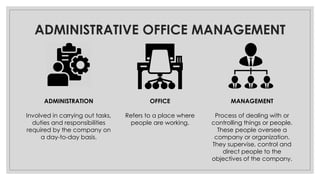
ADMINISTRATION
Involved in carrying out tasks,
duties and responsibilities
required by the company on
a day-to-day basis.
OFFICE
Refers to a place where
people are working.
MANAGEMENT
Process of dealing with or
controlling things or people.
These people oversee a
company or organization.
They supervise, control and
direct people to the
objectives of the company.
IMPORTANCE/SIGNIFICANCE OF AOM
PROVIDES INNOVATION
◦ Finding new, unique and better strategy for doing existing work.
RETENTION OF TALENT
◦ Effective administration helps in holding capable and persevering representatives by
giving them agreeable workplace.
LEADERSHIP
◦ Administration gives authority by affecting and directing office staff.
◦ Administrators impact his subordinates to work enthusiastically to achieve
hierarchical objectives.
IMPORTANCE/SIGNIFICANCE OF AOM
MANAGING CHANGE
◦ Helps in arranging the change and presenting it at the appropriate time and in the
correct way.
MAINTAINING PUBLIC RELATIONS
◦ Helps in mainlining a favorable and positive public image of the company.
SOCIAL BENEFITS
◦ Ensures the maintenance and keeps record up to date in terms of employee's social
benefits.
FACILITATES COORDINATION AND CONTROL OF VARIOUS OFFICE FUNCTIONS
◦ Connects different departments or divisions and ensures different office functions are
followed efficiently.
IMPORTANCE/SIGNIFICANCE OF AOM
HELPS IN ACHIEVEMENT OF TARGETS
◦ Targets or objectives are to be accomplished in any given time.
◦ Administration helps by assisting an individual with anything they need towards the
accomplishment of their goals.
OPTIMUM USE OF RESOURCES
◦ Administration controls the utilization of different assets to maximize the use of office
resources.
MINIMIZE COSTS
◦ Office expenses must be decreased under the direction and control of productive
administration.
◦ Through better organization, good relationship and practical control, administration
sets up a system to ensure careless expenses from both the employees and
employers.
IMPORTANCE/SIGNIFICANCE OF AOM
SMOOTH FLOW OF WORK
◦ Ensures to the continuous movement of work from one operation to another. A
steady flow of work results in high degree of efficiency making sure that work is not
hampered which may result in time wastage and inefficiency.
HELPS MAINTIN OFFICE EFFICIENCY
◦ Office administration can be characterized as an unmistakable procedure of
arranging, sorting out, staffing, coordinating, organizing and controlling office with a
specific end goal to encourage accomplishment of business goals.
WHY DOES ADMINISTRATIVE OFFICE
MANAGEMENT MATTERS?
A smoothly operating workplace contributes to
productivity and morale. Office administrators
tackle issues large and small to keep
everything flowing. Their job touches virtually
every aspect of a business, which makes them
an important go-to source of general
knowledge. And because they interact with so
many people—from vendors and customers to
new workers and seasoned managers—their
actions and attitude play a vital role in the
overall tone and culture of the organization.
WHAT ARE SOME COMMON TASKS
ASKED OF OFFICE ADMINISTRATORS?
▪ Responsibilities differ considerably by workplace and role, with office administrators
at small businesses especially taking on a range of duties due to fewer support
staff. Typical domains of concern include:
▪ Human resources (i.e., employee paperwork, payroll, taxes, compliance,
onboarding new hires)
▪ Financial (reimbursements, payments to vendors, billing, departmental record-
keeping, budgets)
▪ Logistical (making appointments, coordinating schedules, ordering supplies,
booking travel arrangements, organizing company events)
▪ Clerical (sending and distributing mail, typing, data entry, filing, answering phones
and emails)
▪ Managerial (overseeing special projects, delegating work to assistants)
CRITICAL AND ANALYTICAL THINKING
SKILLS
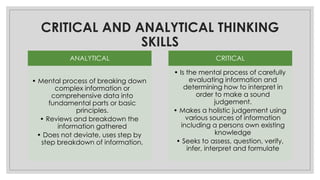
ANALYTICAL
• Mental process of breaking down
complex information or
comprehensive data into
fundamental parts or basic
principles.
• Reviews and breakdown the
information gathered
• Does not deviate, uses step by
step breakdown of information.
CRITICAL
• Is the mental process of carefully
evaluating information and
determining how to interpret in
order to make a sound
judgement.
• Makes a holistic judgement using
various sources of information
including a persons own existing
knowledge
• Seeks to assess, question, verify,
infer, interpret and formulate
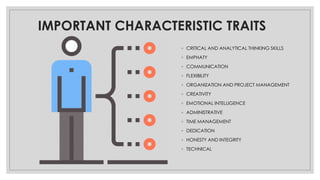
IMPORTANT CHARACTERISTIC TRAITS
◦ CRITICAL AND ANALYTICAL THINKING SKILLS
◦ EMPHATY
◦ COMMUNICATION
◦ FLEXIBILITY
◦ ORGANIZATION AND PROJECT MANAGEMENT
◦ CREATIVITY
◦ EMOTIONAL INTELLIGENCE
◦ ADMINISTRATIVE
◦ TIME MANAGEMENT
◦ DEDICATION
◦ HONESTY AND INTEGRITY
◦ TECHNICAL
IMPORTANT CHARACTERISTIC TRAITS
◦ EMPATHY
◦ The ability to perceive and interpret what another person is feeling or maybe thinking.
◦ the ability to understand and share the feelings of another.
◦ “Put Yourself in Someone Else’s Shoe”
◦ COMMUNICATION
◦ The ability to communicate effectively ensures everyone receives clear information in a timely
manner and understands office policies and procedures. Often privy to confidential and
sensitive info, including salaries and employee information – discretion is a must.
◦ DETAILED ORIENTED
◦ Being detail-oriented is a working trait that reflects the individual who has the skill. It refers to
someone who can demonstrate critical thinking, remain consistently efficient, and who can
observe much more than just words on a page. A detail-oriented person will only provide the
most accurate and efficient results. Often, this means spotting errors or inconsistencies, such as
grammatical mistakes, numerical issues, or the removal of unnecessary information.
IMPORTANT CHARACTERISTIC TRAITS
◦ FLEXIBILITY
◦ The day-to-day operations and typical workday can frequently change and having a flexible
office administrator can be useful. Not only does this help the rest of the office transition to new
requirements, but it can also help the office stay on track, despite these changes.
◦ Additionally, the office administrator may need to accommodate numerous work styles, both
with team members and management, and being flexible can help them adjust to these
differences.
◦ MULTI-TASKING
◦ An office administrative may be tasked to handle different tasks at one time. The ability to multi-
task and maintain organization among busy schedules is beneficial. A good office
administrative with an effective time management and work style can work under pressure
making sure that tasks are completed, and deadlines are met.
IMPORTANT CHARACTERISTIC TRAITS
◦ CREATIVITY
◦ Creativity is often overlooked but can provide many benefits to an office. This skill often helps in
producing unique solutions to problems. By bringing a creative mindset to office discrepancies
or issues, they can improve the morale of the office and implement a fresh approach. This can
also help to keep other staff members motivated. Additionally, they set the tone for a creative
work environment.
◦ EMOTIONAL INTELLIGENCE
◦ Office Administrative can be stressful a times. It is important for someone to have the ability to
control their emotions and adjust to stressful situations.
◦ Having this trait means you are more likely to respond to a difficult environment positively which
can set the tone for the rest of the organization.
◦ High emotional intelligence can also help recognize problems and come up with solutions.
IMPORTANT CHARACTERISTIC TRAITS
◦ ADMINISTRATIVE
◦ As an office administrator one may be tasked with answering phones, taking messages, filing
paperwork, drafting documents and keeping an organized office. The office administrator may
need to facilitate communication between customers or other team members using phone,
email or fax. Regardless of the environment, developed administrative skills helps with the
smooth flow of day-to-day operation.
◦ TIME MANAGEMENT
◦ Managing time is another important quality of an office administrative. The ability to set, and
maintain, schedules will help them complete projects within the specified timeline. This is a skill
that enables anyone to accomplish their daily responsibilities quickly and effectively.
◦ DEDICATION
◦ An Office Administrator does more than the minimum required. They are dedicated to their job,
and they often go above and beyond expectations. This dedication can improve many
aspects of their position, including interacting with customers, hiring and training staff.
IMPORTANT CHARACTERISTIC TRAITS
◦ HONESTY AND INTEGRITY
◦ Integrity and honesty in the workplace start with taking responsibility for our actions instead of
projecting blame. We should believe in ourselves, but we also need to be able to see reality
for what it is, through the eyes of other people or through the lenses of integrity.
◦ “Honesty and integrity are absolutely essential for success in life”. Integrity is the quality of
being honest and having strong moral principles. Integrity in the workplace is important
because that means that employees are doing what is right even when no one else is
watching them.
◦ TECHNICAL
◦ In today's office settings, many processes are technical. An office administrator that is
comfortable using computers, phones and other systems is necessary. Not only will they be
involved in training new staff on these programs, but they may also need to troubleshoot
them or work with vendors to repair them. The office administrator can also be a valuable
resource for determining the effectiveness of a new office program.
◦ Decision-makers in the business rely on this type of feedback when choosing new software
programs. This feedback can help to improve the efficiency of the office's software and
technical programs.
IMPORTANT CHARACTERISTIC TRAITS
◦ SOLID INTERPERSONAL SKILLS
◦ The role involves regular interaction with a range of different people. Being able to
listen to their concerns and respond accordingly benefits the organization. Office
administrators often serve as intermediaries between departments or staff members
involved in workplace conflict. Soothing relationships contribute to a better
atmosphere and more work getting accomplished. The nature of the position
sometimes even leads to acting as an impromptu “therapist” for employees looking for
a compassionate, knowledgeable sounding board.
◦ INITIATIVE
◦ Initiative is the ability to assess a situation and independently take action to address it.
You can show initiative at work in a variety of ways, including volunteering for
leadership roles, helping coworkers and brainstorming ideas to help the company
improve.
What job titles are common among employees
involved in office administration?
Office administration is a broad job classification. Roles within a company might include:
• Office Manager
• Administrative Assistant
• Secretary
• Office Assistant
• Human Resources Assistant
• Data Entry Operator
• Facilities Manager
• Front Desk Coordinator
***Some positions include the word “executive” in the title, such as an executive secretary. People in these roles
tend to focus less on clerical matters and more on offering direct support to high-ranking managers.

Administrative Office Management

  • 1.
  • 2.
    ADMINISTRATIVE OFFICE MANAGEMENT Systemof arranging, sorting out, organizing and controlling office exercises with a view to accomplish business targets and is worried about proficient and viable execution of the office work. Businesses relies on the effectiveness of its office and the accomplishment of its goals.
  • 3.
    ADMINISTRATIVE OFFICE MANAGEMENT ADMINISTRATION Involvedin carrying out tasks, duties and responsibilities required by the company on a day-to-day basis. OFFICE Refers to a place where people are working. MANAGEMENT Process of dealing with or controlling things or people. These people oversee a company or organization. They supervise, control and direct people to the objectives of the company.
  • 4.
    IMPORTANCE/SIGNIFICANCE OF AOM PROVIDESINNOVATION ◦ Finding new, unique and better strategy for doing existing work. RETENTION OF TALENT ◦ Effective administration helps in holding capable and persevering representatives by giving them agreeable workplace. LEADERSHIP ◦ Administration gives authority by affecting and directing office staff. ◦ Administrators impact his subordinates to work enthusiastically to achieve hierarchical objectives.
  • 5.
    IMPORTANCE/SIGNIFICANCE OF AOM MANAGINGCHANGE ◦ Helps in arranging the change and presenting it at the appropriate time and in the correct way. MAINTAINING PUBLIC RELATIONS ◦ Helps in mainlining a favorable and positive public image of the company. SOCIAL BENEFITS ◦ Ensures the maintenance and keeps record up to date in terms of employee's social benefits. FACILITATES COORDINATION AND CONTROL OF VARIOUS OFFICE FUNCTIONS ◦ Connects different departments or divisions and ensures different office functions are followed efficiently.
  • 6.
    IMPORTANCE/SIGNIFICANCE OF AOM HELPSIN ACHIEVEMENT OF TARGETS ◦ Targets or objectives are to be accomplished in any given time. ◦ Administration helps by assisting an individual with anything they need towards the accomplishment of their goals. OPTIMUM USE OF RESOURCES ◦ Administration controls the utilization of different assets to maximize the use of office resources. MINIMIZE COSTS ◦ Office expenses must be decreased under the direction and control of productive administration. ◦ Through better organization, good relationship and practical control, administration sets up a system to ensure careless expenses from both the employees and employers.
  • 7.
    IMPORTANCE/SIGNIFICANCE OF AOM SMOOTHFLOW OF WORK ◦ Ensures to the continuous movement of work from one operation to another. A steady flow of work results in high degree of efficiency making sure that work is not hampered which may result in time wastage and inefficiency. HELPS MAINTIN OFFICE EFFICIENCY ◦ Office administration can be characterized as an unmistakable procedure of arranging, sorting out, staffing, coordinating, organizing and controlling office with a specific end goal to encourage accomplishment of business goals.
  • 8.
    WHY DOES ADMINISTRATIVEOFFICE MANAGEMENT MATTERS? A smoothly operating workplace contributes to productivity and morale. Office administrators tackle issues large and small to keep everything flowing. Their job touches virtually every aspect of a business, which makes them an important go-to source of general knowledge. And because they interact with so many people—from vendors and customers to new workers and seasoned managers—their actions and attitude play a vital role in the overall tone and culture of the organization.
  • 9.
    WHAT ARE SOMECOMMON TASKS ASKED OF OFFICE ADMINISTRATORS? ▪ Responsibilities differ considerably by workplace and role, with office administrators at small businesses especially taking on a range of duties due to fewer support staff. Typical domains of concern include: ▪ Human resources (i.e., employee paperwork, payroll, taxes, compliance, onboarding new hires) ▪ Financial (reimbursements, payments to vendors, billing, departmental record- keeping, budgets) ▪ Logistical (making appointments, coordinating schedules, ordering supplies, booking travel arrangements, organizing company events) ▪ Clerical (sending and distributing mail, typing, data entry, filing, answering phones and emails) ▪ Managerial (overseeing special projects, delegating work to assistants)
  • 10.
    CRITICAL AND ANALYTICALTHINKING SKILLS ANALYTICAL • Mental process of breaking down complex information or comprehensive data into fundamental parts or basic principles. • Reviews and breakdown the information gathered • Does not deviate, uses step by step breakdown of information. CRITICAL • Is the mental process of carefully evaluating information and determining how to interpret in order to make a sound judgement. • Makes a holistic judgement using various sources of information including a persons own existing knowledge • Seeks to assess, question, verify, infer, interpret and formulate
  • 11.
    IMPORTANT CHARACTERISTIC TRAITS ◦CRITICAL AND ANALYTICAL THINKING SKILLS ◦ EMPHATY ◦ COMMUNICATION ◦ FLEXIBILITY ◦ ORGANIZATION AND PROJECT MANAGEMENT ◦ CREATIVITY ◦ EMOTIONAL INTELLIGENCE ◦ ADMINISTRATIVE ◦ TIME MANAGEMENT ◦ DEDICATION ◦ HONESTY AND INTEGRITY ◦ TECHNICAL
  • 12.
    IMPORTANT CHARACTERISTIC TRAITS ◦EMPATHY ◦ The ability to perceive and interpret what another person is feeling or maybe thinking. ◦ the ability to understand and share the feelings of another. ◦ “Put Yourself in Someone Else’s Shoe” ◦ COMMUNICATION ◦ The ability to communicate effectively ensures everyone receives clear information in a timely manner and understands office policies and procedures. Often privy to confidential and sensitive info, including salaries and employee information – discretion is a must. ◦ DETAILED ORIENTED ◦ Being detail-oriented is a working trait that reflects the individual who has the skill. It refers to someone who can demonstrate critical thinking, remain consistently efficient, and who can observe much more than just words on a page. A detail-oriented person will only provide the most accurate and efficient results. Often, this means spotting errors or inconsistencies, such as grammatical mistakes, numerical issues, or the removal of unnecessary information.
  • 13.
    IMPORTANT CHARACTERISTIC TRAITS ◦FLEXIBILITY ◦ The day-to-day operations and typical workday can frequently change and having a flexible office administrator can be useful. Not only does this help the rest of the office transition to new requirements, but it can also help the office stay on track, despite these changes. ◦ Additionally, the office administrator may need to accommodate numerous work styles, both with team members and management, and being flexible can help them adjust to these differences. ◦ MULTI-TASKING ◦ An office administrative may be tasked to handle different tasks at one time. The ability to multi- task and maintain organization among busy schedules is beneficial. A good office administrative with an effective time management and work style can work under pressure making sure that tasks are completed, and deadlines are met.
  • 14.
    IMPORTANT CHARACTERISTIC TRAITS ◦CREATIVITY ◦ Creativity is often overlooked but can provide many benefits to an office. This skill often helps in producing unique solutions to problems. By bringing a creative mindset to office discrepancies or issues, they can improve the morale of the office and implement a fresh approach. This can also help to keep other staff members motivated. Additionally, they set the tone for a creative work environment. ◦ EMOTIONAL INTELLIGENCE ◦ Office Administrative can be stressful a times. It is important for someone to have the ability to control their emotions and adjust to stressful situations. ◦ Having this trait means you are more likely to respond to a difficult environment positively which can set the tone for the rest of the organization. ◦ High emotional intelligence can also help recognize problems and come up with solutions.
  • 15.
    IMPORTANT CHARACTERISTIC TRAITS ◦ADMINISTRATIVE ◦ As an office administrator one may be tasked with answering phones, taking messages, filing paperwork, drafting documents and keeping an organized office. The office administrator may need to facilitate communication between customers or other team members using phone, email or fax. Regardless of the environment, developed administrative skills helps with the smooth flow of day-to-day operation. ◦ TIME MANAGEMENT ◦ Managing time is another important quality of an office administrative. The ability to set, and maintain, schedules will help them complete projects within the specified timeline. This is a skill that enables anyone to accomplish their daily responsibilities quickly and effectively. ◦ DEDICATION ◦ An Office Administrator does more than the minimum required. They are dedicated to their job, and they often go above and beyond expectations. This dedication can improve many aspects of their position, including interacting with customers, hiring and training staff.
  • 16.
    IMPORTANT CHARACTERISTIC TRAITS ◦HONESTY AND INTEGRITY ◦ Integrity and honesty in the workplace start with taking responsibility for our actions instead of projecting blame. We should believe in ourselves, but we also need to be able to see reality for what it is, through the eyes of other people or through the lenses of integrity. ◦ “Honesty and integrity are absolutely essential for success in life”. Integrity is the quality of being honest and having strong moral principles. Integrity in the workplace is important because that means that employees are doing what is right even when no one else is watching them. ◦ TECHNICAL ◦ In today's office settings, many processes are technical. An office administrator that is comfortable using computers, phones and other systems is necessary. Not only will they be involved in training new staff on these programs, but they may also need to troubleshoot them or work with vendors to repair them. The office administrator can also be a valuable resource for determining the effectiveness of a new office program. ◦ Decision-makers in the business rely on this type of feedback when choosing new software programs. This feedback can help to improve the efficiency of the office's software and technical programs.
  • 17.
    IMPORTANT CHARACTERISTIC TRAITS ◦SOLID INTERPERSONAL SKILLS ◦ The role involves regular interaction with a range of different people. Being able to listen to their concerns and respond accordingly benefits the organization. Office administrators often serve as intermediaries between departments or staff members involved in workplace conflict. Soothing relationships contribute to a better atmosphere and more work getting accomplished. The nature of the position sometimes even leads to acting as an impromptu “therapist” for employees looking for a compassionate, knowledgeable sounding board. ◦ INITIATIVE ◦ Initiative is the ability to assess a situation and independently take action to address it. You can show initiative at work in a variety of ways, including volunteering for leadership roles, helping coworkers and brainstorming ideas to help the company improve.
  • 18.
    What job titlesare common among employees involved in office administration? Office administration is a broad job classification. Roles within a company might include: • Office Manager • Administrative Assistant • Secretary • Office Assistant • Human Resources Assistant • Data Entry Operator • Facilities Manager • Front Desk Coordinator ***Some positions include the word “executive” in the title, such as an executive secretary. People in these roles tend to focus less on clerical matters and more on offering direct support to high-ranking managers.